

Introduction
Spain has been the second country of origin for foreign direct investment (FDI) in Latin America since the mid-1990s; only the United States has invested more in the region.Footnote 1 Between 1996 and 2000, 34 per cent of inward FDI in Latin America came from the United States and 23 per cent from Spain. Between 2001 and 2005, 39 per cent came from the United States and 12 per cent from Spain.Footnote 2 While Spanish investment in Latin America was one of the more unexpected but remarkable aspects of the growth of FDI in the 1990s, Spain's investments in banking and telecommunications were also part of a global trend towards FDI in services that has attracted a significant amount of academic research as its importance has become more marked.Footnote 3
Some of the more comprehensive studies of Spanish FDI in Latin America are based on John Dunning's theories, especially his ‘eclectic’ or OLI paradigm, which states that MNEs make foreign investments when they possess a combination of three types of advantages: ownership, location and internalisation.Footnote 4 Within this body of literature Bernardo Batiz-Lazo, Juan José Durán, José Antonio Alonso, Yolanda Fernández, José Galán and Javier González, and William Chislett have emphasised location advantages (the processes of privatisation and liberalisation in Latin America, culture and language), and ownership advantages (the ability of Spanish firms to adopt technological developments and to raise financial resources for their expansion).Footnote 5 Cristina López, however, focused on internalisation advantages, arguing that Spanish FDI resulted from the companies' inability to transfer a series of advantages through the market at arm's length.Footnote 6
A second group of scholars followed the ‘investment development path’ model developed by John Dunning and Rajneesh Narula in 1996, which analyses the relationship between the economic development of a country and its foreign direct investments.Footnote 7 This approach concludes that as countries develop, their firms generate more competitive goods and services that they decide to produce in new markets. José Manuel Campa, Mauro Guillén, Cristina López-Duarte and Esteban García argue that this was the case in Spain in the 1990s. Guillén illustrated this approach in later papers with short histories of some Spanish multinational firms, but did not focus exclusively on their investments in Latin America.Footnote 8
A third group of scholars follows the gradualist theory of the Scandinavian School, which posits that firms in small countries begin to make foreign investments once they have developed their national markets, even though the firms themselves may still be small. FDI is thus an independent decision of incremental expansion. Firms expand their international operations gradually as a logical process of their growth.Footnote 9 Other authors followed a fourth approach based on the theory of international trade. They explored the relationship between exports and FDI, and concluded that Spanish FDI in some industries was the result of the substitution of trade by investment.Footnote 10 Another group of scholars in the field of strategic management see Spanish FDI simply as a strategic move by the managers of the firms to add value to their firms because they perceive business opportunities abroad, or because their domestic market slows down.Footnote 11 Finally, a number of authors reject theoretical approaches and use empirical historical analysis to highlight the growth of the Spanish economy and the processes of privatisation and liberalisation in Latin America.Footnote 12
The goal of this article is to develop an alternative theoretical framework to explain foreign direct investment, taking the investments of seven Spanish MNEs in Latin America as case studies. It shares with Dunning's OLI model an emphasis on the concept of advantage. However, Dunning takes the advantages of firms as given. He does not provide a model to explain how the advantages come into being and, once the investments are made, how they change as the MNEs adjust to conditions in the host countries.Footnote 13 This article contributes to debates on FDI on three grounds. First, it tries to bridge the gap between structuralist and volitional approaches by showing how firms and context, agency and structure, co-constitute one another. It moves away from structuralist approaches that regard firms mainly as a function of their environment (the OLI and investment development path approaches and the theory of international trade) and from volitional approaches that privilege the firm as the unit of analysis over the context (the Scandinavian school and the strategic management approach). Both these approaches conceive of an atomistic universe of self-regarding units (firms, governments, etc.) whose identity is assumed, given and fixed. Instead, this article argues that firms and markets co-constitute one another. Second, it also seeks to make a contribution to the political economy literature by moving away from studies of state-firm bargaining.Footnote 14 Instead, it shows how the relationship between states and firms may not necessarily be a zero-sum game. Finally, it also seeks to fill a gap that the literature on structural reforms in Latin America has ignored. Because of their focus on the economic and political rationale behind privatisation and regulatory reforms in Latin America, scholars of the region tended not to analyse MNEs and thus paid little attention to the ways in which Spanish firms became prominent in infrastructure.Footnote 15
The approach used in this paper is to apply rule-oriented social theory to the study of MNEs, by using the concept of ‘advantage’. It explains FDI by looking at the strategic decision-making of individual firms in the light of their corporate competences. Social theory regards social facts as constituted by the combination of individual facts via social interactions that influence social behaviour.Footnote 16 In proposing a mode of analysis for the social sciences, Nicholas Onuf tackled the agency-structure debate by explaining how agents and institutions (or structures) co-constitute each other. Agents (firms, regulators) construct the social institutions (markets) in which they operate and these institutions, in turn, constrain agency. Institutions are sets of rules that tell agents how to behave in a given setting. The firm can be regarded as an institution or set of rules (normative framework) created by its own employees (the agents). Outside the firm, the market is the institution and the firm(s) become(s) the agent(s). These rules and practices constitute ‘corporate competences’, defined as an ensemble of human practices seen by those engaging in or observing them to have coherence, setting them apart from other practices. They guide (but do not determine) the conduct of its members, thereby giving it social meaning.Footnote 17
Explaining Spanish Investment in Latin America
The main thesis in this article is that Telefónica (telecommunications), Banco Bilbao Vizcaya Argentaria (BBVA) and Santander Central Hispano (SCH) in banking, Endesa, Iberdrola and Unión Fenosa (public utilities), and Repsol-YPF (energy) made significant investments in Latin America in the 1990s because their managers believed that they had an advantage, their ‘knowledge of the needs of the Latin American markets’, which was embodied in their corporate competences.Footnote 18 This advantage stemmed, first, from their experience of how to undertake a process of modernisation of infrastructure and development of new services in a short period of time. They believed that the needs of the Latin American markets in the 1990s resembled those in Spain in the 1980s, and that the knowledge, products and services they had developed in Spain could be easily applied in Latin America. Their advantages, in terms of investing there, resulted both from a shared culture, and from the technical know-how specific to each industry that they had acquired. The managers argued that the common language and Hispanisation of Latin America during the colonial period created similar mindsets. They concluded, therefore, that it would be easy for them to operate in this cultural environment, because it would facilitate personal relationships, transfers of know-how, and mobility of personnel.
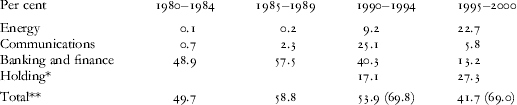
Sectoral Allocation of Spanish FDI flows going to Latin America between 1980–2000
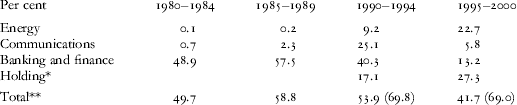
Source: Ministerio de Economía, Dirección General de Comercio e Inversiones.
Note: * ‘Holding’, ‘Holding societies’ or ‘ETVEs’ are terms used by the Spanish Ministry of Trade in its statistics for firms through which Spanish multinational enterprises channel their FDIs for fiscal reasons (to pay fewer taxes). In other words, if Telefónica in Spain takes over a Brazilian telephone company, it might make the acquisition through one of its holding societies in order to pay fewer taxes. This means the money for the acquisition is transferred to the holding society, which then makes the acquisition in Brazil. ** Refers to the addition of these industries, not to the total amount of FDI flows going from Spain to Latin America in these periods.
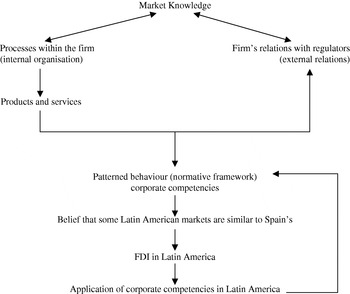
The technical knowledge necessary in each industry and the managerial skills of each firm were built up in Spain in the 1980s and early 1990s. The chief executives and other senior managers of these firms believed that the institutional context in Latin America following the implementation of structural reforms was very similar to that which they had experienced in Spain for several reasons (see Figure 1). With the exception of the banks, the Spanish firms included in this study had been state-owned and undergone processes of privatisation themselves. Many of them entered Latin America by taking over former state-owned enterprises. This was a quick way to gain access and market share. They also believed they had developed know-how in Spain on how to participate in privatisation processes.Footnote 19 Moreover, the Spanish government was gradually lifting restrictions on entry into its own market in the 1990s.
Development of the advantage as perceived by Spanish executives.

Liberalisation in Latin America sometimes even preceded liberalisation in Spain, and the managers took this as an opportunity to learn how to operate in a new competitive environment.Footnote 20 The Spanish firms had to modernise their services, technologies and products very quickly in the 1980s, and intended to do so in Latin America in the 1990s.Footnote 21 These factors forced the firms to adopt new organisational arrangements and managerial processes.Footnote 22 Furthermore, the process of liberalisation of markets that occurred in the European Union in the 1990s made the Spanish managers concerned that globalisation would result in a process of takeovers and that only the large international firms would survive. They decided, therefore, to develop an aggressive strategy of growth overseas in order to pre-empt competition in their domestic markets.Footnote 23 Finally, the sectors included in this study were also characterised by heavy regulation, which required managers to engage in continuous lobbying with the regulators and government officials.Footnote 24
The conditions that existed in Spain in the 1980s and 1990s thus forced the managers to adopt patterns of behaviour, both within the firm and externally, in order to adjust. They devised rules of behaviour that their employees had to follow within the firm (internal organisation) and in their relations with other actors, including regulators (external behaviour). These rules constitute the core corporate competences that embody the knowledge developed by the firms and institutionalised their advantage. This understanding of the corporate competences bridges the gap between agency and structure, between firms and context, and provides a dynamic approach to the construction of advantages (see Figure 2).
Application of the advantage.

The Telecommunications Sector
In early 1990 Telefónica did not have a single customer in Latin America. In 2005 it had 98 million (70.5 million in mobile telephony, 21.8 million in fixed telephony, 5.2 million in internet and data, and 0.5 million in pay-TV). It also had 131,968 employees in Latin America and 41.5 per cent of its consolidated revenue came from its Latin American subsidiaries. With 180.9 million customers worldwide, Telefónica had become the third largest telecommunications company in the world by number of customers.Footnote 25
Telefónica's investments in Latin America were motivated by a number of factors: the liberalisation of the telecommunications sector in Spain in December 1997, the culmination of Telefónica's process of privatisation, which had started in the 1970s; the privatisation of state-owned telephone operators in Latin America; and the evolution of the telecommunications sector globally, which favoured the creation of large multinational groups. In this context, its managers believed that the technology and know-how they had developed in Spain in the 1980s in order to upgrade telecommunications infrastructure in a short time could be applied in Latin America, where they thought that conditions were similar.Footnote 26
Demand for new telephone lines in Spain grew by 27.9 per cent in 1986 and 17.9 per cent in 1987, resulting in a dramatic increase in waiting time for the installation of new connections and considerable deterioration in the quality of service. In 1988 the Spanish government appointed new managers to Telefónica and asked them to prepare the firm for full privatisation in 1997. The new managers raised funds in the stock markets of Madrid, London, Paris, Frankfurt, Tokyo and New York, and began a programme to modernise infrastructure. They replaced Telefónica's obsolete technologies, digitised the network, and introduced satellite telecommunications, fibre optics, and, later, Internet access. Telefónica digitised 41.4 per cent of its urban network and increased the number of land lines from 11 million (28.1 per 100 inhabitants) in 1989 to 14.3 million (36.6) in 1993, and to 20.8 million (45.9) in 2002. The waiting list for installation fell from 539,000 lines in 1988 to 25,000 in 1993. After 1992 cellular access technology allowed Telefónica to extend basic telephone services to rural areas. Worker productivity grew from 149.30 lines per employee in 1982, to 181.36 in 1988, and to 213.61 in 1993. Telefónica's investments in this period were equivalent to 4.5 per cent of gross capital formation in Spain.Footnote 27
The managers believed that this experience in Spain had allowed Telefónica to develop the institutional know-how to undertake similar processes successfully in other countries. Ignacio Santillana, chief executive of Telefónica Internacional between 1990 and 1996, explained in 1997:
The internationalisation of Telefónica was established on the basis of the competitive advantages that Telefónica had vis-à-vis the American and European operators. It was based on the ability to undertake important investment programmes in short periods of time. Particularly in the late 1980s, Telefónica faced a crisis of demand for telephones and telephone services in Spain. In this period, Telefónica had close to one million requests to install a telephone. This crisis forced Telefónica to develop efficient large investment programmes quickly. This know-how, which some characterised as ‘trench technology’, was very useful and extraordinarily attractive as a means of satisfying the demands of the countries that required an urgent expansion of their telephone systems, given the high demand of the people for telephones waiting to be installed. It was a coincidence that the countries with these problems were involved in a process of privatisation of the state-owned firms that had provided telecommunication services under conditions of monopoly.Footnote 28
The process of privatisation of state-owned telephone operators that swept through Latin America after 1987 reversed the expropriation of telephone operators from private firms that had begun in the 1940s. The government of Argentina nationalised the country's telephone company in 1945 citing ‘national security concerns’. Brazil had followed in 1962, Peru in 1970, Chile in 1971, and Venezuela in 1976. Telefónica itself had been nationalised by the Spanish government in 1944 for similar reasons.Footnote 29 However, poor performance, growing technological demands, and lack of resources to undertake new projects led governments to privatise telephone operators after 1987. They expected that the newcomers would modernise the infrastructure, improve service, and provide fresh funds for the state. By privatising telephone operators governments also expected to send a signal to private investors that they embraced the ‘Washington Consensus’.Footnote 30
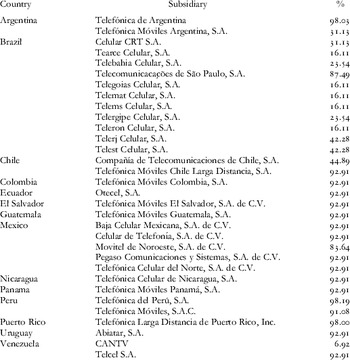
Telefónica's strategy of expansion in Latin America began in 1987, when it submitted a bid for Chile's operator, and continued in 1990, in Mexico, with the privatisation of Telmex. In both cases Telefónica's bids were lower than those of its competitors. As a result its executives decided to offer more money in the future. It submitted the highest bid in Argentina in 1990 (Telefónica was awarded the southern half of the country), in Venezuela in 1991, in Peru in 1992, and in Brazil in 1996 and 1998 (for the Companhía Riograndense de Telecomunicações and Telecomunicações de São Paulo SA, respectively). In 1990 Telefónica also bought the Chilean telephone operator from the firm that had outbid it three years before. In addition to these large acquisitions, Telefónica also took over other operators and obtained new concessions (see Table 2).Footnote 31
Telefónica's Main Subsidiaries in Each Country, 2005

Source: Telefónica, Annual Report (2005), pp. 131–61.
To undertake this expansion, Telefónica again raised funds in the stock markets of Madrid, New York, London, Paris, Frankfurt and Tokyo, before 1993 mainly through capital increases, and thereafter through a combination of bonds and equity. As a result, by 1993, 24 per cent of its stock was held by non-Spaniards. The Spanish government also gave Telefónica $1 billion in 1997, when it agreed to open up the Spanish telecommunications industry before the deadline set by the European Union.Footnote 32
Telefónica's goal in Latin America was to become the leading provider of comprehensive telecommunications services, integrating telephone with Internet and multimedia across Latin America, and eventually entering the Spanish-speaking market of the United States.Footnote 33 Telefónica's managers began to replicate in their subsidiaries the organisational culture that they had developed in Spain in the late 1980s. They transferred their know-how and technology, devising a set of four policies. The first was the expansion of telecommunications services to individuals and firms. Between 1989 and 2005, the number of land lines per 100 inhabitants grew by 349.7 per cent in Chile, 304.4 per cent in Brazil; between 1995 and 2005 it grew by 130.3 per cent in Argentina, and 70.9 per cent in Peru. The number of cell phones reached 67.8 per 100 people in Chile in 2005 (the highest in the Americas), 57.3 in Argentina, 47.8 in Colombia, 46.3 in Brazil, 35.1 in El Salvador, 25.0 in Guatemala and 20.0 in Peru. The second policy was to improve the quality of service. In 2002 Telefónica completed its Pan-American optical fibre network, allowing it to provide comprehensive telecommunications service to the corporate sector, as well as to other telecommunications operators. By 2005 all of Telefónica's lines had been fully digitised, except in Peru, where the rate was 97 per cent. Third, in order to cut costs, Telefónica concentrated procurement in a few centres in Spain and South America. It also centralised customer relations after 1999 and human resources after 2001 (saving $112 million per year). In Chile labour productivity (the number of lines per employee) grew from 108 in 1990 to 1,058 in 2002, and in Brazil it reached 1,314 in 2002, one of the highest levels in the world. Finally, Telefónica invested in media, services to business, advertising and e-commerce, especially after 1999, thus leading the process of convergence of telecommunications, Internet and audiovisual services in much of Latin America.Footnote 34
The Banking Sector
In 2005 Banco Bilbao Vizcaya Argentaria (BBVA) and Santander Central Hispano (SCH) had $270.6 billion managed customer funds ($125.2 billion and $145.4 billion, respectively) in Latin America, a figure 28 per cent greater than Argentina's GDP in 2005. They had 36.9 million customers in retail banking (16.6 million and 20.3 million, respectively), and 124,350 employees (61,604 and 62,746, respectively). 43 per cent of BBVA's net profit and 32 per cent of SCH's came from their Latin American subsidiaries.Footnote 35
The managers of the Spanish banks had developed their advantages in the context of a radical transformation of the Spanish banking and financial markets in the 1980s. The international crisis that began in 1973 affected Spanish banks very severely because tourism, property investment, construction and metallurgy, where they had made heavy investments, were so seriously affected. Fifty two of the 110 banks that were in operation in 1977 had found themselves in difficulty by 1985. The Spanish government devised a salvage operation that saved all of them from bankruptcy, but imposed new regulations that included stronger oversight of the financial sector by the state authorities, market-based exchange rates and interest rates, reform of their deposit requirements in the Bank of Spain, liberalisation of fees and commissions, elimination of the legal restrictions that barred banks, savings and loans, cooperatives and other financial institutions from entering each other's business activities, and authorisation for foreign banks to enter the Spanish market (although some restrictions remained until 1993).
The banks responded by increasing efficiency: they closed 700 offices between 1992 and 1994 and reduced their labour force by 35,000 employees between 1981 and 1995. A process of mergers and takeovers followed. In the second half of the 1980s, the Spanish government feared that Spanish banks would not be large enough to compete in the single European market and recommended growth through a policy of mergers. The Banco de Bilbao merged with the Banco de Vizcaya in 1987, creating the Banco Bilbao Vizcaya (BBV), which in turn took over state-owned Argentaria Caja Postal and Banco Hipotecario SA in 1999, to form Banco Bilbao Vizcaya Argentaria (BBVA). The Banco de Santander took over Banesto in 1994 (Spain's third largest at the time) and Banco Central Hispanoamericano (BCH) in 1999, to create SCH. The Spanish government in fact contributed to the creation of the two large Spanish banks by selling the state-owned Argentaria to BBV, and Banesto, a large private bank that had been bailed out by the government in the mid-1990s, to SCH.Footnote 36
In response to serious banking crises in the 1980s and 1990s, the governments of Latin America also embarked on ambitious processes of reform. Until the 1980s, governments had set interest rates, directed credit, and insisted that banks hold a large share of deposits as reserves. Nonetheless, financial institutions were often subject to lax rules and engaged in risky investments. Lack of an adequate supervisory framework precipitated the so-called ‘Debt Crisis’ of 1982. Many firms defaulted on their loans or their interest payments to the local banks. In some cases, the proportion of non-performing loans exceeded 20 per cent. As a result the financial reforms implemented from the 1980s restricted the role of governments to the enforcement of legislation and the creation of independent supervisory agencies. The reforms also included the deregulation of interest rates, the elimination of direct credit allocation rules, the reduction and harmonisation of reserve requirements for commercial banks, the relaxation of barriers to entry, the development of securities markets and institutional investors, the implementation of modern and efficient supervisory legislation, stricter accounting standards, and new safety nets to protect deposits.Footnote 37
At this point the managers of Spanish banks saw that Latin America was an attractive region in which to invest and that BBVA and SCH had the know-how needed to help develop the market. Matías Rodríguez Inciarte, the vice-chairman of SCH in the 1990s, argued that the elimination of trade barriers, fiscal discipline, macroeconomic stability, and privatisation made the region more stable and that the relative underdevelopment of the banking sector created great prospects for growth. The proportion of loans and deposits to GDP in Latin America was very low (23.5 per cent for deposits and 22.9 per cent for loans, compared with 68.2 per cent and 71.2 per cent in Spain in 1996). The number of accounts per capita in Chile, the Latin American country with the highest number, was 0.9 in 1998, compared with 2.6 in the United States. Mediation margins were higher than in the more developed countries (5.0 per cent on average for the period 1993–96), as well as in Eastern Europe (3.5 per cent) and Asia (3.2 per cent). The operating ratio (the relationship between expenses and revenue) was 78 per cent in Latin America, 47 per cent in Southeast Asia, and 51 per cent in Eastern Europe, creating great opportunities for efficiency gains. The process of privatisation of state-owned firms, reforms of pension systems, and the emission of public bonds to finance state deficits provided additional incentives.Footnote 38 In 2002 Francisco Luzón, the chief executive of SCH, argued that ‘the process of privatisation, concentration and liberalisation that we went through in Spain in the last twenty or twenty-five years was a great learning experience for Banco Santander and facilitated our internationalisation in Latin America’Footnote 39 BBVA's CEO also believed in 1999 that
‘in Latin America, the strategy of our group is based on a long-term commitment to consolidate a regional franchise, which already has great value, in which the entrepreneurial model, automation, and the systems platforms that our business units have in Spain, are in an advanced stage of implementation’.Footnote 40
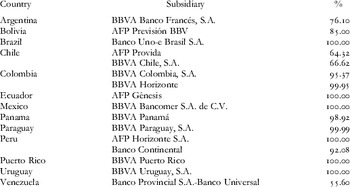
BBVA's Main Subsidiaries in Latin America, 2005
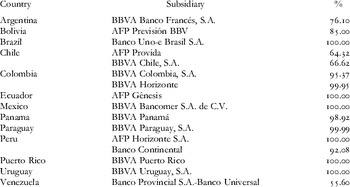
Source: BBVA, Annual Report (2005), pp. 242–9.
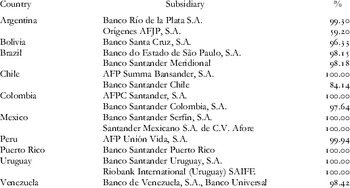
SCH's Main Subsidiaries in Latin America, 2005

Source: SCH, Annual Report (2005), pp. 278–81.
The banks taken over by BBVA and SCH in Latin America were very different. Some had been wholly or partly state-owned, some were distressed private local banks in which the government had intervened, some were still solvent private banks formed by local capital, and others were subsidiaries of foreign banks. BBVA's normal strategy was to seek a strong local partner, from which it purchased between 30 and 40 per cent of its stock and then gradually increased its share of ownership. In contrast, SCH sought majority ownership from the beginning. After taking over local institutions, both Spanish banks began to transfer their know-how.
The first step involved the reorganisation of management structures within the banks, selecting local managers for the top positions in order to ease relations with key domestic actors, including the government and business.Footnote 41 Then they cleaned up the banks' balance sheets. For example, to raise funds for its new Mexican subsidiary, BBVA undertook capital increases of $172 million in 1997 and $53 million in 1998. In order to finance its development in Latin America, SCH closed down or reduced some of its activities in other regions, including fixed income and equity activities in New York and London, and investment banking in Asia in 1998.Footnote 42 The managers of BBVA and SCH believed that the low use of banking services in Latin America was in part due to the poor reputation of the local banks as a result of periodic banking crises, and in part to the underdevelopment of banking and financial products and services. The third step of their strategy, therefore, was to build trust. To achieve this, they used a uniform image across Latin America under the BBVA or Santander brand, launched advertising campaigns that showed themselves as innovating and modern, transferred technology and know-how from Spain, and followed a policy of transparency and information disclosure, by issuing reports on their activities, strategies and financial results, by publicising reports conducted by independent auditors, and by inviting the press to many activities.Footnote 43 They aimed to provide as many financial and banking services as customers might need, so they would not go anywhere else.Footnote 44
How did they achieve efficiency gains and improve the operating ratio? Growth in revenue relied heavily on their provision of pension fund and mutual fund management services, taking advantage of the privatisation of pension programmes in Latin America. In 2005, between them, the two Spanish banks controlled 20 per cent of bank loans and bank deposits and 33 per cent of pension funds deposits in Latin America. Other strategies to increase revenue included altering fees and commission payments, and cross-selling products. Reduction of costs relied on four main programmes: adoption of a single technological platform across subsidiaries; reduction of the workforce; promotion of labour-saving means of banking, such as cash machines (ATMs), telephone banking and the internet; and the centralisation of core functions. As a result, BBVA improved the efficiency ratio (the proportion of revenue that gets lost as transaction costs) of its Latin American subsidiaries from 55.5 per cent in 1998 to 42.9 per cent in 2005, while in SCH it improved from 65.2 per cent in 1995 to 47.4 per cent in 2005.Footnote 45
Both banks developed mechanisms to minimise risk. Some of these were based on calculations of country risk (their subsidiaries adjusted their policies periodically to perceived changes in risk levels) and others were based on a system of ratings for businesses and scoring for individuals. As a result BBVA reduced the default ratio (the proportion of non-performing loans) in their Latin American subsidiaries dramatically – from 12.6 per cent in 1995 to 2.7 per cent in 2005 – while SCH moved from 3.3 per cent to 1.9 per cent over the same period.Footnote 46
Finally, both banks provided financial support for the expansion of Spanish firms in Latin America. Cooperation was sealed in the 1990s when BBVA and SCH participated in the privatisation of formerly state-owned firms in Spain by buying controlling stock. BBVA was part of the núcleo duro of Repsol, Telefónica, Gas Natural, Iberdrola and Endesa, and BS and BCH controlled Unión Fenosa's stock (although after their merger they sold it).Footnote 47
The Energy Sector
In 1995 the World Bank estimated that additional generating capacity of 70,000 megawatts (MW) would be needed in Latin America and the Caribbean between 1994 and 2000. Demand for electricity was expected to grow by 5.5 per cent annually, compared with 1.9 per cent in the United States, with returns on investment of 20–25 per cent (8–10 per cent in the United States). Meeting this demand would require additional investments of $20–25 billion.Footnote 48 In the midst of adjustment and debt-reduction schemes, Latin American governments realised that state-owned energy companies would be unable to meet these requirements and decided to open these industries to the private sector. Endesa, Iberdrola, and Unión Fenosa determined to take advantage of this opportunity. By 2005 they had 23,172 MW of installed capacity in Latin America (14,905 MW, 5,544 MW and 2,723 MW, respectively), equivalent to the whole of Argentina's consumption in 2001. Repsol-YPF, thanks mainly to the investments in oil and natural gas in Latin America and the Caribbean that it undertook at the same time, had become the eighth largest oil and gas firm in the world and the third main producer of liquefied petroleum gas by 2003.Footnote 49 Public utilities and oil and natural gas are analysed together in this section, because Spanish firms in these industries worked together to promote the use of natural gas for the generation of electricity.Footnote 50
Spanish public utilities began to operate in Latin America in the early 1990s as consultants. In the middle of the decade, they began investing in earnest. Again they believed that the technology and know-how they had developed in Spain since the 1980s, while modernising their infrastructure, taking over smaller firms and increasing energy production to meet the growing needs of the market, would be applicable in Latin America. Moreover, they were concerned about the liberalisation schedule that the European Union had set for the energy sector, which required member states to open their borders to public utilities from other member countries by 2007.
The managers of the Spanish public utilities believed that they had developed competitive advantages in the second half of the 1980s and early 1990s. At that point they worked closely with the Spanish government to solve the crisis that had affected the energy sector since the late 1960s, when the government forced public utilities to build nuclear power plants to meet growing demand.Footnote 51 In the 1980s, the government allowed firms to raise electricity charges well above production costs, encouraged them to exchange facilities to boost their generation capacity, created an electricity pool (to which firms contributed their excess production), and eliminated the requirement to build expensive nuclear power plants. To compensate for the costs of the nuclear programme and to help firms modernise their infrastructure, the government gave them soft loans and cash handouts (including one of $13.5 billion in 1997 alone) that allowed them to reduce their debts. The government also took over the least profitable activities in the energy sector, namely the distribution network and the central coordinating entity. The elimination of regional monopolies in 1989 allowed firms to expand throughout the country. A process of concentration followed. Whereas in 1980 only Endesa had a market share of energy generation of over 15 per cent, by 1996 only four firms were left in the market. By then, Endesa and Iberdrola controlled 80 per cent of generation and distribution, and Unión Fenosa, 14 per cent. The Spanish public utilities used a diversified base of energy sources (hydroelectric, coal, nuclear, natural gas and renewable), they had modern infrastructure and sufficient installed capacity in Spain to meet market demand, they were efficient, and they had the liquidity to undertake new expansion projects outside Spain.Footnote 52
The Spanish government played a more direct role in the creation of a Spanish oil giant, Repsol-YPF. After the nationalisation of Spain's oil industry in 1927, in order to guarantee a steady supply for the domestic market, private firms were only allowed in a small number of activities, principally in exploration during the 1960s and 1970s. To prepare for privatisation the government brought all of the state-owned oil firms under a single umbrella, Repsol, in 1987. With more than 5,000 service stations in 1990 (other Spanish firms had only 180, and foreign firms just 7), Repsol had a firm grip over the Spanish oil market, and it monopolised the market for butane. In 1991 Repsol refined more than 60 per cent of all crude oil in Spain and produced half its output of petrochemicals. The partial liberalisation of the market and full privatisation of Repsol came under pressure from the European Union in the early and mid-1990s. The Spanish government also gave Repsol control over the Spanish gas market by transferring state-owned gas ventures to its subsidiary, Gas Natural, and preventing foreign competition until the late 1990s. Ironically, between 2003 and 2005, Spain became one of the first countries in the European Union to eliminate all restrictions to foreign entry into its hydrocarbons industry. By then, however, Repsol had secured a leadership position.Footnote 53
Repsol's involvement in all of the stages of the oil and gas cycles, from exploration and production, to distribution and marketing, and all other intermediate activities, gave its managers and employees know-how.Footnote 54 However, due to Spain's lack of oil and gas deposits, Repsol's revenue in 1996 came mainly from refining and marketing (30 per cent), gas (30 per cent) and chemicals (30 per cent), with only 10 per cent from exploration and production, making it dependent on other companies for its supply of crude oil.Footnote 55 Growth in upstream activities would lessen its dependence on other firms for raw materials. Repsol's managers, therefore, decided to gain exploration and production rights in part through acquisitions of other firms. Alberto Cortina, Repsol's chief executive, stated in 1996 that ‘South America is an emerging area on the world economic scenario, with a rapidly expanding energy market, where we believe we have clear competitive advantages … The idea behind this strategic expansion is to place Repsol as an integrated energy company in Latin America’.Footnote 56 In addition, Repsol-YPF's Finance and Project Manager in Buenos Aires, Enrique Waterhouse, explained that Repsol's takeover of Argentina's YPF was also about obtaining know-how and technology in upstream activities, as well as gaining connections with the Argentine government and business community.Footnote 57
Reforms in the public utility sectors of Latin America began in Chile in the 1970s and 1980s, but then continued in the rest of the region following the debt crisis and its aftermath. The reformers sought three main goals: the introduction of competition in generation and distribution, the involvement of the private sector (including foreign firms), and the introduction of new management methods to increase energy production, to lower energy prices, and to improve the quality of service. Reforms in the oil and gas sectors began when the fall in oil prices in the mid-1980s reduced income from exports. Experts believed that Latin American oil and natural gas firms needed $30 billion in investments to expand energy production in the 1990s and the governments found themselves without the resources to undertake these investments. Reforms in the oil and gas industries in Argentina, where the government privatised its state-owned oil and gas firms, went the furthest. Brazil, Mexico and Venezuela only permitted foreign firms in certain ventures, mainly in old oilfields where production was low or in new areas where production was difficult for domestic firms. However, these countries did not privatise their state-owned oil giants. With the growth in demand for natural gas worldwide after the 1970s, natural gas also became one of the gems of the Latin American hydrocarbon market in the late 1990s.Footnote 58
Three Spanish public utility firms participated in the Latin American reforms, Endesa, Iberdrola and Unión Fenosa, together with one oil firm, Repsol. They raised resources on the stock market through capital increases, conversion of debt to equity, and the emission of bonds. Repsol's takeover of YPF in 1999, for example, the largest in Latin American history at that time, totalling $14.9 billion, was financed through Eurobonds worth $7.7 billion and a capital increase of $5.7 billion. The Spanish firms also received syndicated banking loans involving BBVA, SCH, and other large international institutions. The strong relationship among the Spanish firms became clearest in the energy sector. The use of natural gas to generate electricity facilitated cooperation between Repsol and the public utilities, especially with Endesa and, above all, Iberdrola. Cooperation was also possible in part thanks to the participation of BBVA in the núcleo duro of both these firms; BBVA's representatives called for cooperation between them. Iberdrola offered bonds that were redeemable for the stock of Repsol-YPF in 2001, and in 2002, Repsol-YPF's subsidiary, Gas Natural, paid Iberdrola $165 million for its Brazilian natural gas operations.Footnote 59
The expansion strategy of the three public utilities followed three phases. During the first half of the 1990s, Iberdrola and Unión Fenosa provided consulting services to Latin American public utilities. As governments began to privatise such operations, the Spanish firms made some small acquisitions. In a second phase, after 1996, both firms accelerated their investments. Iberdrola focused on Northeast Brazil and Mexico, Unión Fenosa on Central America and the Caribbean, and Endesa, the latecomer, began making investments at this point in Argentina, Brazil, Colombia and Peru. The third phase began in the late 1990s, after the three Spanish companies had completed most of their acquisitions. They then focused on improving efficiency and infrastructure and increasing energy supply.Footnote 60
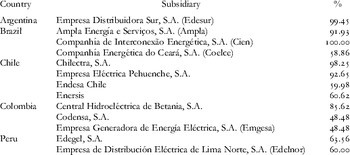
Endesa's Main Subsidiaries in Latin America, 2005

Source: Endesa, Annual Report (2005), p. 79.
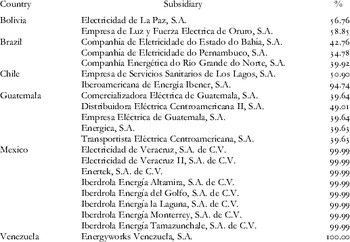
Iberdrola's Main Subsidiaries in Latin America, 2005

Source: Iberdrola Annual Report (2005), pp. 100–4.
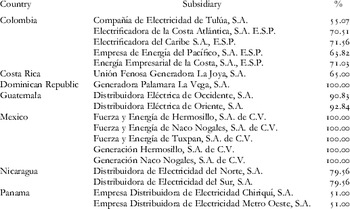
Unión Fenosa's Main Subsidiaries in Latin America and the Caribbean, 2005

Source: Union Fenosa, Annual Report (2005), pp. 69–72.
To achieve these goals, they adopted six measures. First, they built new facilities and/or upgraded older ones to increase generating capacity. Fifty eight per cent of the increase came from combined cycle power plants powered by natural gas and water (Repsol-YPF was the main supplier of gas); the other main technologies used were wind farms (25 per cent), hydroelectric power plants (11 per cent) and co-generation plants (less than 1 per cent). The three firms had almost 23 million customers in 2005, almost half of them in Brazil.Footnote 61 Second, they transferred know-how and management models in the generation and distribution of electricity, as well as in non-traditional activities such as water management, natural gas distribution, and telecommunications. Third, they increased efficiency in terms of power losses, production per employee, number of customers per employee, and operating costs.Footnote 62 Fourth, they made investments in new areas such as telecommunications. Endesa and Iberdrola also operated water treatment facilities and Unión Fenosa moved into pollution abatement and engineering.Footnote 63 Fifth, they built alliances that normally involved a financial partner (sometimes BBVA or SCH), and a local firm. Repsol-YPF provided natural gas for their combined cycle power plants. Telefónica and Electricidade de Portugal (EDP) were their partners in telecommunications.Footnote 64 Sixth, to reduce risk, the three firms incorporated local partners. They used credit from multilateral financial institutions (mainly the Inter-American Development Bank, the European Bank of Reconstruction and Development, and the IMF's International Financial Corporation), they concentrated their investments in the markets with the highest growth potential (principally Brazil and Mexico), they dollarised many of their transactions, and they converted debt into hard currency, mainly euros.Footnote 65
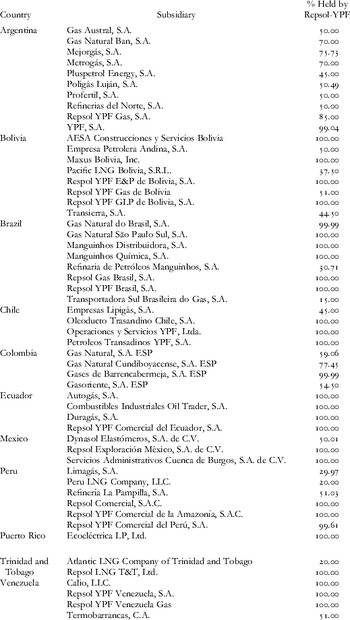
Repsol-YPF's Main Subsidiaries in Latin America and the Caribbean, 2005

Source: Repsol-YPF (2005), Annual Report, pp. 166–77.
Repsol's strategy comprised four points. The first was growth in exploration and production of oil and gas in Latin America and the Caribbean to supply its downstream markets in Latin America and Spain. Seventy five per cent of Repsol's production in 2005 came from Argentina, Bolivia and Brazil.Footnote 66 Repsol invested heavily in natural gas, mainly in Argentina, Bolivia, Brazil, and Trinidad and Tobago (where it shipped part of the gas to the United States); gas is cleaner than other sources of energy and had great growth potential. To stimulate demand, Repsol-YPF teamed up with Iberdrola to build and operate combined cycle power plants in Argentina and Brazil, and supplied Endesa with natural gas for its plants in both countries.Footnote 67 The second point was to operate refineries in Argentina, Brazil and Peru in order not to depend on other firms to process the output from its upstream activities.Footnote 68 The third was to strengthen its brand reputation in Latin America by building a network of 2,732 petrol stations to sell its own products: 1,838 of these were in Argentina (where YPF had been dominant in the market for fuel and oil products), 412 in Brazil, 211 in Chile, 121 in Ecuador, and 155 in Peru. Repsol-YPF also distributed bottled liquefied petroleum gas (LPG) in Argentina, Bolivia, Ecuador and Peru, and natural gas through its network of pipelines in Argentina, Brazil, Colombia and Mexico, as well as rubber and fertilisers.Footnote 69 The fourth point was to manage risk wisely. In spite of the Argentine crisis of 2001, and the decision of the Bolivian government to nationalise hydrocarbons in 2006, Repsol-YPF's managers remained committed to Latin America. They stressed Repsol-YPF's ability to respond quickly to economic and political shocks and to negotiate with the governments on a regular basis.Footnote 70
The Role of the Spanish Government
The role of the Spanish government in the creation of these large Spanish MNEs was critical. Given the small size of Spanish firms compared with large foreign MNEs, the government attempted from the 1980s to create a few large companies that could compete successfully in Spain and in international markets. The firms included in this study are the result of this strategy. Except for BBVA and SCH, they were formerly state-owned enterprises, and this provided the government with control over their management and facilitated the implementation of its plans. Endesa and Repsol were both created by the government in the 1980s. In 1983 Endesa brought together all of the state-owned public utilities, while also receiving some of the less profitable activities of the Spanish private firms, such as their nuclear power plants. Repsol brought together the state-owned firms in the oil and gas industry in 1987. Telefónica was Spain's single telecommunications firm following its nationalisation in the 1940s. Iberdrola and Unión Fenosa were partly owned by regional governments.
In addition to creating large companies, the government also assisted their growth in Spain by promoting a process of concentration of the market and protecting them from foreign competition. In the public utilities industries, the government eliminated the regulations that gave firms a monopolistic concession over a specific region of the country in the late 1980s. As a result, they began to compete with one another; by 1996, as already noted, Endesa, Iberdrola and Unión Fenosa together controlled almost 95 per cent of the Spanish market in generation and distribution. Repsol was sheltered from significant foreign competition in its downstream oil operations until the mid-1990s, and in natural gas distribution until the late 1990s. Telefónica did not face significant competition in its domestic market until 1998.Footnote 71
Even in the banking industry, where there were only a few small state-owned banks, the role of the government was critical. The government used a carrot-and-stick policy, helping the banks to deal with the crisis of the 1980s through cash injections and concessions. In exchange, it pushed them to accept a gradual process of liberalisation that resulted in mergers and takeovers, as a result of which BBVA and SCH emerged as some of the largest banks in Europe. In the 1990s the government even transferred the assets of two of the largest banks to BBVA and SCH: Argentaria to BBV, and Banesto to SCH.
The government also played an important role during the process of privatisation of the state-owned firms. Commencing in the early 1980s, the government reorganised them for privatisation by encouraging them to become more efficient and reducing their debt through soft loans and cash handouts. It ensured that they would not fall under foreign control in the 1990s by reserving the right to veto core decisions some years after privatisation, even after selling its last remaining shares (‘golden shares’). After that, it relied on the Spanish banks, especially BBVA, to protect the ‘Spanishness’ of these firms by making sure that the banks became their largest stockholders. By becoming part of what the government called the ‘núcleo duro’ (hard core), BBVA and SCH had control over the management decisions of other major companies.Footnote 72
The government also resisted demands by the European Union to open up the telephone and energy industries. The government did not commence the liberalisation of the Spanish telecommunications industry until 1998, when Telefónica was large, competitive, and had sizeable investments abroad, mainly in Latin America. It sheltered Repsol from competition in the domestic market, as noted already. In the case of the public utilities, it resisted until well into the 2000s. When Germany's E.ON leading company (with core activities in power and gas) tried to take over Endesa in 2006, the government engineered an alternative bid by a consortium integrated by a Spanish construction firm, Acciona, and an Italian utility, Enel. This led to a compromise among the three, thus keeping a large Spanish firm in the ‘núcleo duro’ of stockholders.Footnote 73
The Spanish government also played a direct role by encouraging these ‘giants’ to make investments outside Spain. The managers of state-owned firms were appointed by the government and they agreed that expansion in Latin America was a wise growth strategy. The government also provided cash to the firms to facilitate their takeovers in Latin America. Telefónica received $1 billion in 1997, in time for its big acquisition of Telesp in Brazil, and the public utilities received soft loans and cash handouts so that they could finance their expansion, especially in Brazil and Mexico. In the case of Telefónica the government justified these cash handouts to the European Union by arguing that they were compensation for agreeing to open up the Spanish telecommunications market before the deadline set by Brussels (the EU had generously granted Spain a longer deadline because the Spanish government argued that Telefónica was not ready to face competition). In the case of the public utilities, Madrid argued that the payments were compensation for the costs of modernising their infrastructure for the single European market. These cash handouts were the culmination of a long process, that the government had begun in the 1980s, to bail Spanish utilities out of financial trouble. This strategy comprised negotiated electricity prices, cash handouts, and transfer of the most inefficient facilities to the state (to Endesa).Footnote 74 Another financial incentive provided by the Spanish government was a special law that allows companies to offset 30 per cent of the goodwill costs of any foreign corporate purchase against tax (‘goodwill’ is defined as the difference between the book value of assets and the actual price paid). This hidden subsidy helped Spanish firms to outbid their competitors.
Finally, between 1990 and 1995, but especially in 1994 and 1995, the Spanish government signed bilateral agreements for reciprocal promotion and protection of investments with Latin American governments to pave the way for the investments of Spanish MNEs. These bilateral agreements developed alongside the growth of Spanish diplomatic interest in the region. Since the mid-1980s, Spanish diplomats have presented Spain as a ‘bridge between Europe and Latin America’ exploiting this depiction to increase its bargaining power. One of the best manifestations of this diplomatic interest in Latin America is the celebration, since 1991, of an annual ‘Cumbre Iberoamericana’ that brings together Spain (with Portugal and Andorra) and their former colonies in the Americas.Footnote 75
Conclusions
This article contributes to the theoretical scholarship on MNEs by applying rule-oriented social theory to the concept of advantage. It shifts the focus away from a specific actor, focusing instead on the interactions among actors. By focusing on the firm alone, students of multinational enterprises often fail to realise how the context (culture, politics, the stage of economic development, for example) provides different incentives and constraints. By looking at the context alone, all firms become black boxes that respond to external stimuli. Companies are staffed by different employees who develop different corporate competences to operate in a given context. These corporate competences embody the firm's advantages, and evolve as the firms and the context in which they operate change. By contrast, the approach taken here opens the ‘black box’ and presents firms as dynamic actors in an evolving relationship with the institutions around. This article concludes that the managers of the Spanish multinational companies believed that the firms had an advantage embodied in the set of corporate competences that they possessed. The construction of the advantage resulted from several factors in the home and host countries, the industry, and the firm. This paper also fills a gap in the literature on structural reforms in Latin America. Although Spain surpassed the United States as the main source of annual flows of foreign direct investment in Latin America in 1998 and 1999, scholars of Latin America have not fully considered the reasons behind this momentous rise in Spanish FDI, or its consequences. The sectors included in this article are very important, since telecommunications, banking and energy constitute part of the backbone of a country's economy and they accounted for three-quarters of Spanish FDI in the region. For this reason, an analysis of Latin America's structural reforms needs to go beyond consideration of the astronomical amounts that MNEs invested.
The process of modernisation undertaken by the seven Spanish firms in these sectors was fundamental to the resumption of economic growth in Latin America in the 1990s. Their activities touched the daily lives of the average citizen, while at the same time they became critical for the competitiveness of Latin American firms, whose activities came to rely on the availability of sources of finance, reliable energy supplies and good telecommunications which the Spanish firms provided. Their expansion in Latin America in part reflected the nature of competition and cooperation that existed among them in Spain. Competition was especially strong in the energy sector (Endesa vs. Iberdrola vs. Unión Fenosa) and banking (BBV vs. BS vs. BCH first, and BBVA vs. SCH after the mergers). Interestingly however, Telefónica was given monopolistic control over each market in Latin America at first, thereby operating under the same conditions as in Spain.
By looking at the firms, it is possible to show how the managers of each developed a strategy that allowed them to adjust to and shape the conditions of operation at the level of the state and the business sector in which they operated. The process of adjustment to the changing regulatory and technological conditions in Spain resulted in the development of best practices, services, and goods, embodied in a set of specific managerial, technological and organisational assets (advantages) in banking and finance, telecommunications and energy. During the 1980s, Spanish firms upgraded the quality of infrastructure very quickly, developed know-how, technology and organisational assets which they subsequently applied in Latin America in the 1990s under very similar conditions.
Co-operation among the Spanish firms manifested itself in the form of cross-sector alliances. Two main alliances of Spanish firms emerged around the major Spanish banks which owned controlling stock in them. BBVA, with its large investments in Telefónica, Repsol, Iberdrola, and Gas Natural, facilitated the development of joint ventures among these companies. The case of the development of combined cycle power plants by Repsol-YPF and Iberdrola is a good example. The other group emerged around BCH (SCH after the takeover), thanks to its investments in Endesa and Unión Fenosa, but after the BS-BCH merger, SCH's managers sold most of their stock.
An industry-level analysis sheds some light on the specific conditions that each firm faced and shows the different goals and processes of the reforms in each sector. Because the firms included in this study operated in conditions of monopoly or oligopoly, the analysis at the industry level involves analysis at the level of the firm. At the country level, the changes in regulatory frameworks in Spain and Latin America were critical, because they precipitated these investments. The imminent liberalisation of the Spanish market in telecommunications, public utilities and hydrocarbons under the auspices of the European Union made the managers decide to ‘take the plunge’ overseas before European competitors could enter Spain. The right time for these investments occurred when the governments of Latin America began to privatise formerly state-owned firms, especially after 1989. Timing was an important factor in telecommunications and energy (less so in banking), because privatisation in Latin America preceded full liberalisation in Spain, and the Spanish firms could use the resources generated in the protected Spanish market for their Latin American investments. A country-level approach also allows us to see the strong relationship that existed between the Spanish government and the firms. The government worked very hard from the 1980s to shape a number of Spanish firms (many of them state-owned) so that they could become world players. This involved the use of different policies: a process of concentration of the domestic market to create a few large firms in key industries; protection from foreign firms (by excluding foreign companies from the Spanish market and the boards of Spanish firms); financial incentives such as soft loans, cash handouts and subsidies for foreign investments; and agreements with Latin American governments for the protection of their investments.