The term “gender gap” has been applied to differences between men and women in three main areas of political life: how they vote, their views on public policy issues, and their degree of involvement in politics. This article focuses on the presence of a gender gap in a fourth area: attitudes and beliefs about the role of women in American political life. Existing scholarship on this topic has documented steady increases in people's support for the concept (if not the practice) of gender equality in the public sphere (e.g., Bennett and Bennett 1999; Huddy, Neely, and Lafay 2000; Sanbonmatsu 2002, chap. 3; Wolbrecht 2000, chap. 7). For the most part, these studies have suggested that men and women hold similar views on women's equality in the political arena. They have shown little evidence of the presence of a gender gap within this general drift toward more liberal attitudes about women in politics.
Valuable as these studies are, they obscure gender gaps that appear when we look at opinions over time and across generations. They lack breadth and depth with respect to one or more of the following characteristics: 1) replicated and multiple indicators of relevant attitudes within the same surveys; 2) developments across the life span; 3) multiple generations coming of age in discrete historical eras; 4) observations of preadults. In what follows, I utilize a research design that contains such components.
This analysis is based on a data set that includes three lineage generations and charts opinion movement over a 24-year period, stretching from 1965 to 1997. I employ three main indicators of attitudes about the political role of women: 1) opinions about women's place in the home versus in the public sphere; 2) support for the women's movement; and 3) beliefs about the current influence of women and men in public life. Additional indicators are also used at various points. Both the sample composition and the measures will be described in more detail.
One objective of this article is to portray and compare the changes in attitudes and beliefs among men and women over a long time frame and across generations, something that is not feasible with typical cohort analyses. Differences between the sexes in this regard can be thought of as developmental, longitudinal gender gaps, with the basic idea being that the pace and direction of change may vary according to sex. There are two variants of this gap; one focuses on change over time within generations, and a second focuses on changes over time and across the generations.
A second objective of this analysis is to assay the direction and magnitude of differences between men and women at a given point in time, what will be termed the contemporaneous gender gap. Increases in this gap, by age or generation, would suggest growing tension between the sexes as to what is appropriate and just for women, regardless of the absolute support for gender equality being expressed. Conversely, decreases in this gap would suggest that men and women are less likely to see political equality as a battleground. Longitudinal and contemporaneous gaps are related to each other, but each tells a different part of the story.
I consider three possible perspectives on the direction and magnitude of gender gaps across time and over generations. One longitudinal process at work could be that of generational effects, which have two main sources. Generational effects can result from compositional differences across generations. The rise among women in support for gender equality, for example, stems partly from their increased participation in the workforce (e.g., Bolzendahl and Myers 2004). A more challenging generational theory draws on the divergent political histories that might be experienced by birth cohorts. As enunciated most famously by Karl Mannheim ([1928] 1972), political generations emerge as a product of upcoming cohorts reacting to contemporary political events such that they differentiate themselves from preceding cohorts and, in especially distinct circumstances, from succeeding ones as well. Complications arise when compositional shifts are more or less coterminous with “zeitgeist effects.” In any event, my concern is whether the generational thesis can shed light on the appearance of longitudinal and contemporaneous gender gaps.
A second perspective on the dynamics of opinions regarding the political role of women is that of historical or period effects, which reflect the impact of events and movements in the external world. In their purest form, period effects fall more or less equally on all politically aware segments of the polity. The general rise over the past several decades in the belief that women should have an equal role in public life versus staying in the home is a pertinent example. In a more modified version, period effects affect some segments of the population more than others. Period effects will fall more heavily on young people because they are presumably more impressionable than the more resistant old, essentially producing a hybrid model of generation and period effects. In terms of the present analysis, period effects would be implicated if we find that individuals from separate generations are moving in the same direction with respect to a belief in gender equality. The critical question at hand is to determine if period effects fall unequally on men and women.
A third perspective is that of life cycle effects, which refer to the linkage between political orientations and the various stages traversed by individuals as they age. The most prominent, though largely discredited, thesis about life cycle effects is that individuals become more politically conservative as they pass through adulthood stages. Not surprisingly, that thesis receives little support in what follows. A more realistic and useful version of life cycle effects is that people become more resistant to change once the young adulthood years have been left behind (e.g., Sears 1990). Strong assessment of the resistance model relies on panel data. Although the data set to be used in this article does contain repeated observations of the same individuals, most of the analysis will be conducted at the aggregate level, as will be explained. References to resistance phenomena will be limited to net, aggregate movements.
METHODOLOGY
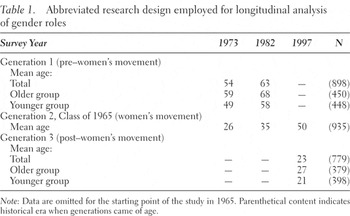
These topics will be addressed primarily by utilizing the multigeneration, cross-time data set known as the University of Michigan Political Socialization Project. Table 1 provides a sketch of the elements from that project that will be used here. Although not displayed in the table, the project began in 1965, the key components being a national probability sample of 1669 high school seniors and one or both of their parents (Jennings and Niemi 1965). As Table 1 shows, the Class of 1965 was resurveyed three more times and the parent sample twice more. The overall unadjusted retention rate for the class of '65 was 56% across four waves; the rate for the parent sample was 57% across three waves.1
Aside from a modest number of individuals who were sent mail questionnaires in the 1973 and 1982 surveys, all data were collected by personal interview. In 1997, half of the interviews were conducted by telephone and half were face-to-face.
Abbreviated research design employed for longitudinal analysis of gender roles

These three generations fit rather neatly into three historical eras with respect to the second-wave movement for women's equality in the twentieth century. Nine-tenths of the first generation were born between 1910 and 1930, and two-fifths came of age during the Great Depression years of 1929–38. They grew up under a regime of traditional gender roles though, notably, not during the “feminine mystique” decade or so following World War II. Although many of the women in this generation entered the workforce during that war, the immediate postwar period witnessed a resumption of life with traditional gender roles intact, even as the seeds of the second women's movement were being planted (e.g., Klein 1984).
Members of the second generation, the offspring of the first, were born in 1947 or 1948. Its early years were marked by the seeming domestic tranquility and prosperity of the 1950s and the onset of the Cold War. A series of critical events that began in the early 1960s and ended in the late 1970s helped shape the identity of this generation as it came of age. The women's movement, with its assault on traditional gender roles, caught the Class of 1965 at an impressionable age.
Nearly three-fourths of the third generation, the offspring of the second, were born between 1969 and 1977 and have been variously labeled as the “me,” “X,” and “Y” generations, depending upon the particular cutting points. Unlike their parents, the members of the third generation entered young adulthood with few identifying or defining historical moments. At the same time, however, issues involving gender roles were emerging in what would come to be known as the Culture Wars (e.g., Leege, Wald, Krueger, and Mueller 2002).
In keeping with the historical contexts marking their formative years, these three generations can be seen as those having come of age in the years preceding the women's movement, during the movement, and following the movement, from older to younger, respectively. I refer to the premovement generation as Generation 1 (Gen 1); to the movement generation as Generation 2 (Gen 2); and the postmovement generation as Generation 3 (Gen 3). Generation 2 is virtually homogeneous with respect to age, but Generations 1 and 3 are necessarily heterogeneous. In the analysis, I take advantage of that heterogeneity by dividing each one of those two large generations into approximately equal older and younger segments (see Table 1). Doing so allows, in essence, the analysis of five cohorts or sublineage generations, instead of three, and thus the ability to look more closely at the nuances of longitudinal and contemporaneous differences between the sexes.2
The standard deviations for the younger (under 54 as of 1973) and older (54 and older) portions of G1 are 2.9 and 4.5, respectively. Comparable figures for the younger (under 24) and older (24 and older) members of G3 are each 2.5.
Using all available cases at each point in time would yield more reliable estimates for that particular wave because the Ns would be larger than those for the complete panel respondents. Comparisons between panel only and all available cases, however, yielded few meaningful differences for the task at hand. Working only with the panel respondents also means that exactly the same cases are being analyzed throughout, thus mitigating any effects due to whatever differences might exist between panel stayers and dropouts.
Most of the analysis is at the aggregate rather than the individual level, partly because there are no panel data at all for Gen 3 and only two relevant waves for Gen 1. More importantly, the goal of establishing and evaluating contemporaneous and longitudinal gender gaps is satisfied by the aggregate approach.
I do not claim that these lineage respondents are statistically representative of the birth cohorts in which they are embedded. The initial and continuing socioeconomic status (SES) bias and cohortcentric nature inherent in a set of respondents oriented around a 1965 sample of graduating high school seniors obviously work against such claims.4
The upward SES bias stems from the fact that the high school dropout rate, around 25% in 1965, is associated with family SES. Similarly, the older members of Gen 3 have higher educational levels than do the surrounding birth cohorts as a whole (U.S. Bureau of the Census 2001, 163).
SUPPORT FOR EQUAL ROLE OF WOMEN IN SOCIETY
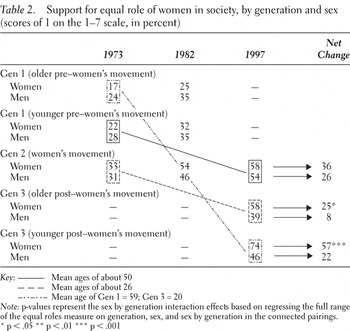
One of the longest-running questions dealing with preferences about women's place in American society takes the following form: “Recently there has been a lot of talk about women's rights. Some people feel that women should have an equal role with men in running business, industry, and government. Others feel that women's place is in the home. And other people have opinions somewhere in between.” Respondents are then asked to place themselves on a scale running from 1, “women should have an equal role,” to 7, “women's place is in the home.” As noted, other reports have demonstrated a pronounced thrust toward the “equal role” end of the continuum among both men and women over the past few decades, so much so that the extreme pole now dominates the distributions. That tendency appears in Table 2, which shows the proportion of interviewees opting for the most liberal position on the scale. Note, however, the changing nature of the relationship between gender and opinions on this issue.
Support for equal role of women in society, by generation and sex (scores of 1 on the 1–7 scale, in percent)

Looking first at the topic of longitudinal gender gaps, we see that the cross-generational movements differ for women and men. Two of the highlighted comparisons match approximately same-age members of two generations at different survey dates in order to establish whether men or women have changed more in the aggregate. One comparison involves the younger half of Gen 1 in 1973 and Gen 2 in 1997, when both were about 50 years old. The second matching pairs up Gen 2 in 1973 with the older half of Gen 3 in 1997, when both were in their midtwenties. A third highlighted comparison ignores matching and provides the longest time/age perspective available by linking the older half of Gen 1 in 1973 at an average age of 59 with the younger half of Gen 3 in 1997 at an average age of 20.
In each instance, the increase in support for equal roles is substantially higher among women than men, as indicated in the net change column of Table 2. In the two same-age comparisons, the match between 1973 Gen 2 and the 1997 younger Gen 3 is especially marked. In the long-term comparison, support went from 17% among the older women in Gen 1 to 74% among the younger women (their granddaughters) in Gen 3—a spectacular increase.5
The terms “grandchildren,” “parents,” and “children” are used throughout in a loose aggregate sense inasmuch as not all the members of each generation have a lineage connection with the other two generations due to differential response rates.
A more precise statistical way to capture what is transpiring to produce these net change figures consists of regressing beliefs about equal roles on sex, generation, and the interaction between sex and generation. Of prime interest here are the interaction effects because they facilitate a test of the hypothesis that period/generation effects have fallen differentially on women and men. The statistical significance of the interaction effects is indicated in the net change column of Table 2 (and in Tables 4 and 5 also). Thus, the interaction impact involving the pairings of Gen 2 and the older half of Gen 3 and that of the older part of Gen 1 and the younger part of Gen 3 meets the conventional test of p < .05, and the combination involving the younger half of Gen 1 and Gen 2 barely fails to meet the standard, at p < .07.
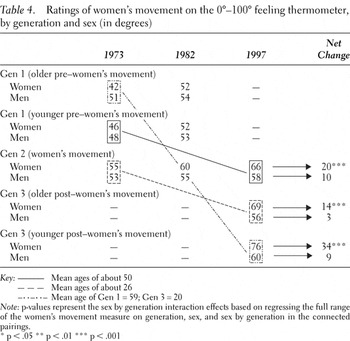
Ratings of women's movement on the 0°–100° feeling thermometer, by generation and sex (in degrees)

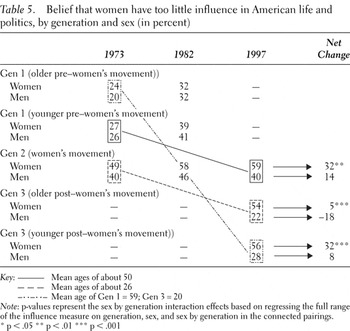
Belief that women have too little influence in American life and politics, by generation and sex (in percent)

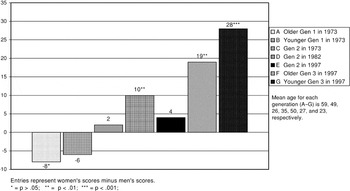
As described earlier, a second type of gender gap to be analyzed consists of the absolute differences between men and women at a given point in time. These contemporaneous comparisons can be derived from Table 2, but they are more readily depicted in Figure 1, which combines time, generation, and aging into a hybrid time/age line employing seven observations—the 1973 scores for both subunits of Gen 1, all three scores for Gen 2, and the 1997 scores for both subunits of Gen 3.

Gender gap on support for equal role of women in society (in percent).
One telling trend consists of the change in the direction of the relationship. Gen 1 men offer higher support for women's equality than do women, especially in the oldest subgroup. By contrast, men never exceed women in Generations 2 and 3, which themselves differ substantially. It is only in 1982, after the cresting of the women's movement, that the gender gap in Gen 2 reaches statistical significance. Women had responded more strongly to the movement than had men (see Table 2). Over the ensuing 17 years, however, men overcame this lag such that by 1997, the gap, while still evident, is statistically insignificant.
Members of Gen 3 depart dramatically from their parents. We have already observed the tailing off of support among the males of Gen 3 as compared with those of Gen 2. Coupling that decline with the increase of support among Gen 3 women produces by far the largest gender gap observed in any of the three generations, climaxing in the difference among the youngest members of the postmovement generation. Across these five cohorts, then, the difference with respect to supporting equal roles for women progressed from 8% in favor of men among the older members of Gen 1 to nearly 28% in favor of women among the younger members of Gen 3 for a net shift of 36%—a vivid reflection of the social, economic, and political changes that have transpired since the end of World War II and strong evidence pointing toward the differential impact of generational and period effects on men and women.
Importantly, these results do not hinge on men being more resistant to change over time as such. Individual-level analysis (not shown) revealed that women in both Generations 1 and 2 held more stable opinions than did men, which rules out greater resistance by men as a factor in any net increases in contemporaneous gaps within Generations 1 and 2.
Just as controlling for a variety of other factors does not remove the importance of the absolute differences in participation between men and women (Burns, Schlozman, and Verba 2001, 46–48), so too would the same undertaking not alter the real existence of the contemporaneous gender gaps and their likely political ramifications. Nevertheless, it is worthwhile here to rule out some likely demographic suspects that might be lurking behind these differences. To that end, a multivariate analysis (ordinary least squares) was carried out employing sex and three other known predictors of support for equal roles—education, marital status, and employment status.6
The education, marital, and employment status measures refer to the time of the observations, with the exception of Gen 2's education in 1997 and Gen 1's education in 1982. These three predictors vary considerably in importance across the three generations and time.
An important demographic about the younger half of Gen 3 is that it is still in a period of enormous transition compared with the older half. In particular, only 13% have finished college compared with 48% of the older group. Additional education will probably move the young men in a more liberal direction and with more dramatic effect than for their female peers because men would be starting from a much lower base. That said, men in the older half of Gen 3 have educational levels fully as high as those of men in Gen 2, yet render less liberal opinions on this and succeeding measures of gender role equality. This educational parity helps rule out compositional effects as an explanation for the enlarged contemporaneous gaps between Generations 2 and 3 and strengthens an argument for generational effects.
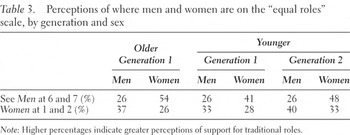
The modest differences between the sexes as of the initial 1973 sounding warrant additional comment. Recall that all of these findings are based on where the respondents placed themselves on a continuum. Does this mean that they perceived that men and women in general held the same kinds of views? Hardly. In one of those not uncommon instances of pluralistic ignorance that crop up in survey research, the perceptual differences in 1973 stand at odds against the revealed differences. The incriminating piece of evidence comes from answers to the question about where the respondents thought that most men and most women would be positioned on the seven-point scale.
Not surprisingly, both sexes more often located women toward the equal roles pole on the scale. Substantial cross-sex differences surface, however, within that general tendency. One way of illustrating these contrasts is to compare the proportions placing women at the two most liberal positions (1–2) and men at the two most conservative positions (6–7) on the scale (Table 3).7
Collapsing is used here due to different distributions for the placements of men and women. However, comparisons using uncollapsed scores yield the same conclusion about the contrast between revealed and projected gaps.
Perceptions of where men and women are on the “equal roles” scale, by generation and sex

As the projected location of men shows, females far outdistanced males in seeing men in general as preferring the traditional mode for women (p < .001 for all comparisons). Men differ not at all across these cohorts, whereas fluctuations do occur among women, with the most arresting figure being the 54% for older members of Gen 1, those having had the most experience in the pre–women's movement era. If women see men as far more conservative than do men, a reduced parallel finding in reverse appears with respect to how women are perceived. Men see women as more liberal on this issue than do women themselves, but this gap is rather modest and reaches statistical significance only among the oldest cohort in Gen 1. In sum, a strong gender gap based on projections existed as early as 1973, while the revealed, self-reported gap did not take strong root until the 1980s.
EVALUATIONS OF THE WOMEN'S MOVEMENT
Whereas the equal roles for women variable taps into a generic “big picture” outlook regarding women's place in American society, evaluations of the women's movement capture attitudes about efforts to alter public images and preferences concerning the role of women and to bring about the implementation of new policies promoting equality. Just as the terms “civil rights movement” and “gay rights movement” came to serve as handy shorthands for multiple activities and objectives, so too the term “women's movement” came to symbolize a core meaning, disparate elements within the movement notwithstanding (e.g., Carroll 1989; Rinehart 1992). Feelings about the women's movement were ascertained by the use of the so-called feeling thermometer, which runs from 0° to 100°. The higher the mark selected on the thermometer, the more favorably the individual feels about the stimulus object.8
The 1973 and 1982 instruments used the term “Women's Liberation Movement.” As time passed, the term “liberation” began to decline in popular usage. Consequently, and in order to retain functional equivalence, the 1997 instruments used the term “Women's Movement.” As shall be demonstrated, using this less-freighted term nevertheless failed to stem the tide of enlarged gender gaps over time.
In some respects, the findings here parallel those for the measure about equal roles for women. Evaluations rose over time among both women and men in Generations 1 and 2, most likely reflecting the broader secular trend as the claims of women acquired more legitimacy in the general public, and once more reflecting the capacity of people well into middle age to alter their views on an important topic (Table 4). In terms of longitudinal gaps within generations, the women in Generations 1 and 2 elevated their evaluations somewhat more than did men, thereby suggesting that the period effects fell more heavily on women. Note especially the very substantial increase in positive ratings among the older women of Gen 1. It is as though the message of the women's movement, blocked by traditional conceptions of gender roles, had finally broken through to these women, who aged on average from 59 to 68 between 1973 and 1982.
As shown by the cross-generational highlighted comparisons, same-age women in adjacent generations upped their favorability of the women's movement more than did comparable male pairs, providing more evidence of a longitudinal gap. And the long-term shift is far greater for women than for men, as indicated in the combination involving the older members of Gen 1 and the younger members of Gen 3. By contrast, the movement among men goes from 48° among the youngest males of Gen 1 to a high of 60° among the youngest males in Gen 3. Bolstering these interpretations are the results from the multivariate analysis involving sex, generation, and the interaction between the two as predictors of attitudes about the women's movement. These effects are highly significant for all three of the highlighted cross-generational combinations (see notations in net change column). Women simply changed a lot more than did men.
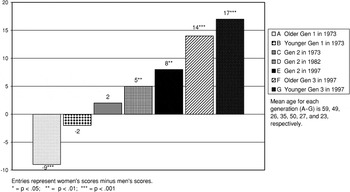
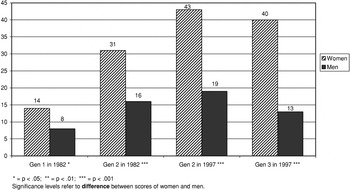
Shifting to the contemporaneous gender gaps, we see results that are even more striking than those for the equal roles measure. Figure 2 presents an elegant stair-step pattern that captures the dynamics of the gender gap remarkably well, beginning with the older members of Gen 1 in 1973 and topping out with the younger members of Gen 3 in 1997. All of the statistically significant associations in Figure 2 remain so with education, marital status, and employment status controlled. Again, the sign of the relationships switches between Gen 1 and Gen 2. Older Gen 1 males rendered significantly higher appraisals of the movement in 1973 than did older females. Beginning with Gen 2 in 1973, the gap always lies in the direction of higher scores for women than for men. Sizable gains among women, along with only modest increases by men in the succeeding periods, produced growing differences. The net result of these two patterns stands in contrast to the insignificant difference as of 1997 on the equal roles measure. A ready interpretation is that Gen 2 men were ultimately as willing as Gen 2 women to support, in principle, the idea of equal roles, but less inclined to favor a collective movement designed to bring about equality, an indirect sign of male ambivalence observed elsewhere (e.g., Sigel 1996, chap. 7).

Gender gap on ratings of women's movement on the feeling thermometer (in degrees).
The gender gap stands largest in Gen 3, which has the shortest political history. In general, the men in Generations 2 and 3 are standing still, while the women have become even more approving of the women's movement. Gen 3 men, regardless of birth cohort, registered about the same approval ratings as did the men of Gen 2, but the scores for Gen 3 women continued the upward rise noted across time for Gen 2 women, thereby producing the massive gaps shown in Figure 2.9
Some appreciation for just how great this distance is comes from the multiple regression analysis, where education, marital status, and employment status were also used as predictors. Being female would push up the average thermometer score 17 degrees in the younger group and 16 degrees in the older cohort.
BELIEFS ABOUT THE INFLUENCE OF MEN AND WOMEN
Attitudes about an equal role for women and the women's movement indirectly signify dispositions regarding the influence people believe women should have in the public sphere. In this section, I use a direct indicator of perceptions about the reality of such influence. The introduction to a multi-item battery containing the stimulus “women” ran as follows: “Some people think that certain groups have too much influence in American life and politics, while other people feel that certain groups don't have as much influence as they deserve.” Respondents were offered the alternatives of “too much influence,” “right amount of influence,” and “too little influence.” Unlike the previous two measures, this one combines affect and cognition. That is, the estimates reflect some (unknown) normative baseline about how much female influence is desirable, along with some perceptions about how much influence women actually have.
The results are presented in terms of the percentage opting for the “too little influence” choice, but the same conclusions would be reached if mean scores were used. Several fascinating findings emerge on the basis of the intergenerational and cross-time comparisons (Table 5). Men and women in Generations 1 and 2 display exactly the kind of parallel increases between 1973 and 1982 we would expect if strong period effects were at work. Indeed, men and women in Gen 1 scored very similar gains. By 1997 the trend is no longer linear. On the whole, women from Gen 2 essentially did not change in the aggregate between 1982 and 1997, whereas men in fact experienced a small decline in the perception that women had too little say. The nascent trend surfacing in Gen 2 emerges full blown in both halves of Gen 3, where a very small drop appears among women and a massive one among men.
As the highlighted entries in Table 5 show, women in the two age-matched cohorts experienced substantially more positive gains than did men. The most dramatic contrast in this longitudinal gap comes about because far fewer of the older men in Gen 3 said “too little influence,” as compared with their age-mate fathers in 1973. Indeed, this is the only instance in all the analysis in which the cross-generational pairings produce a decrease of liberal sentiment. Then, too, the younger men of Gen 3 differ more with their fathers as of 1997 than with their grandfathers as of 1973. By contrast, the younger women register a much higher figure than do their grandmothers. This unusual configuration may be taken to underline a recurring pattern pointing toward either the exceptionalism of the “movement” men in Gen 2 or the retreat of Gen 3 males from long-term trends. Finally, and not surprisingly, the multivariate analysis again confirms the impression that generation/period effects had more impact on women than men.
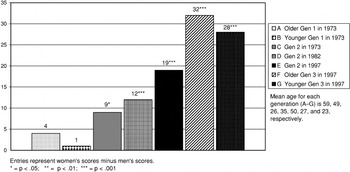
The consequent contemporaneous gender gaps in estimates of women's clout reflect the divergent trends among men and women, as graphically portrayed in Figure 3. In contrast to the findings regarding support for equal roles and appraisals of the women's movement, no statistically significant gaps exist in Gen 1 with respect to the influence measure. However, a discernible difference had already appeared in Gen 2 by 1973 and continued to widen over time. That sizable gulf expands even further in Gen 3, a development accounted for almost entirely by the large drop among men in their belief that women have too little influence. Young men and women have drastically contrasting views about how far women have come in the political world, a difference of opinion that would almost certainly condition the political claims of both sexes in the political arena. All of the differences for Gens 2 and 3 continue to be significant, with education, marital status, and employment status held constant.

Gender gap on belief that women have too little influence in American life and politics (in percent).
To understand what seems to be another illustration of resentment or ambivalence among Gen 3 men, it is helpful to recall the historical setting surrounding the coming of age for men in Generations 2 and 3. The former entered political adulthood in the midst of a social revolution with respect to women's rights and behaviors. Inequities were being identified, mobilization was occurring, public policies were changing, and the political climate in general favored expansion of opportunities for women—some fervent opponents notwithstanding. Moreover, these Gen 2 men often had sisters, female cousins, girlfriends, wives, and mothers who were caught up in the women's movement either as activists or passive supporters.
For the men of Gen 3, the historical situation accompanying their coming of age has been markedly different. By the 1980s and 1990s, conventional wisdom held that gender equality, or at least the opportunity for equality, was on the verge of having been more or less achieved. At the same time, competition between men and women in the marketplace mushroomed and women experienced stronger relative gains compared with men in educational, income, and occupational spheres (e.g., Fox-Genovese 1996). Thus, an undercurrent of opinion may have developed among some segments of the younger male population, in particular, that women were being overindulged and given preferential treatment.
Men coming of age in such an environment may develop a resentment similar to the racial resentment felt by many whites with respect to policies regarding blacks (e.g., Kinder and Sanders 1996). Abetting these sentiments were the strategies of the two political parties in the 1980s and 1990s, the Republicans attempting to build on—if not indeed, help create—various discontents and preferences among younger men, and the Democrats seeking to exploit the growing numbers of well-educated, professional, and (often) single young women (e.g., Leege et al. 2002, chap. 10; Sanbonmatsu 2002; Wolbrecht 2000).
Indirect support for the resentment hypothesis comes in the form of responses to two statements bearing on the topic of egalitarianism, although no specific groups are mentioned. Whereas 61% of Gen 3 women either agreed or strongly agreed that “one of the big problems in this country is that we don't give everyone an equal chance,” the same was true of but 42% of the men (p < .001). Similarly, 54% of the women disagreed or strongly disagreed with the proposition that “we have gone too far in pushing equal rights in this country,” as compared with 31% of the men (p < .001). Although differences between men and women also appear in Gen 2, they are much smaller than in Gen 3. Opinions about these two statements are, in turn, significantly related, among both men and women, to the three key measures of gender equality being used in this article.
I would not want to push the resentment hypothesis too far. It does seem plausible that the more pronounced gap in the postmovement generation stems in part from many younger men feeling not only that the playing field has been leveled and equality of opportunity achieved but also that the rules have been changed to favor unfairly one team over the other. However, young men could also be expressing such beliefs as part of a more conservative, traditional outlook without feeling threatened or resentful, their beliefs about affirmative action and the objective reality of unequal influence notwithstanding.
In the 1982 and 1997 surveys, the respondents also indicated whether they felt men had too much, too little, or about the right amount of influence. The most extreme expression of perceived gender influence inequality lies at the intersection of perceived excessive male influence and insufficient female influence. Examining the frequencies of this cell over time and across generations shows the degree to which this strongest view of gender inequity has gained in currency (Figure 4).

Belief that men have too much influence and that women have too little influence (in percent).
A majority of Gen 1 respondents selected “right amount” for both sexes, thus imposing statistical constraints on the “men too much, women too little” targeted combination.10
Because of this lopsidedness, the Gen 1 analysis combines both the younger and older elements. For consistency, the same rule is applied to Gen 3.
HOW GENERALIZABLE ARE THE RESULTS ABOUT THE GENDER GAPS?
Given the special nature of the samples being used, reservations can be raised as to generalizability. Two of the most telling results revealed by the foregoing analyses consist of 1) the increasing gender gap (aside from the equal roles measure) in the “movement” generation over time, and 2) the enlarged contemporaneous gender gaps running from the earliest “premovement” generation at the most distant time point to the “postmovement” generation at the most recent time point. This trend and the youthfulness of Gen 3 members have obvious implications for the unfolding relationships between gender and politics as time moves on.
While not ideal, supplementary evidence from recent national, cross-section surveys carried out by the National Elections Studies (NES) and the General Social Surveys (GSS) between 1996 and 2000 can be brought to bear on this issue of generalizability with respect to Gen 2 and Gen 3. The procedure involves looking at findings for birth cohorts that encompass the age ranges of each full generation under study at particular points in time.11
Thus, for data from the 1996 NES, 18–27-year-old respondents stand in for Gen 3, seven-tenths of whom were in that age range as of 1997. Similarly, 45–54-year-old respondents stand in for Gen 2, whose mean age was 50 in 1997. For surveys carried out in 2000, the same age span was used for Gen 3 in order to accommodate the aging of the 15–17-year-olds in Gen 3. The age range for Gen 2 became 48–57.
I turn first to the results from the 1996 NES based on responses to the seven-point scale question about whether women's place is mainly in the home or sharing equality with men in the public sphere. In keeping with the practice employed in the three-generation analysis, the gender gap figures are based on the percentages selecting the most liberal position on the scale. Doing so produces a gender gap of 7% in the predicted direction within the cohort that contains Gen 2, but which lags behind the 15% gap (p < .04) in the cohort containing Gen 3,12
The gap is much wider in the 18–23-year bracket, at 22%.
Similar findings emerge with respect to evaluations of the women's movement. Whereas the 1996 NES data reveal a difference of five degrees in the older cohort representing Gen 2 (p < .05), that figure rose modestly to eight degrees in the younger cohort standing in for Gen 3 (p < .01).13
Huddy, Neely, and Lafay (2000, 319) report similar results for 1996.
Unfortunately, questions regarding the perceived influence of women and men were not asked in the 1996 NES, but they are available from the 2000 survey. Gender gap differences between the representatives of Gens 2 and 3 were slight in that year, but the gender gap within each generation was highly significant (p < .001). The combination of feeling that men have too much influence and women too little yields a gap of 14% in the cohort embracing Gen 2, while the gap for the Gen 3 representatives was slightly higher at 17%, well below that for Gen 3 as such (see Figure 4), but also clearly of a piece with it in terms of the contrast in how men and women view the world of influence.
Additional evidence supporting the proposition about wide gaps found in the postmovement generation comes from GSS data. One question appearing in many GSS surveys asks respondents whether they agree or disagree with the statement that “women are not as well suited emotionally for politics as are men.” Surveys leading up to the 2000 study revealed very small differences between men and women. Indeed, in the 2000 survey, men and women as a whole differed scarcely at all, with agreement being at 26% for men and 23% for women. Among the 18–27-year-olds, however, the figures were 35% for men and 14% for women, for a gender gap of 21% (p < .001). Other analysts, using a gender role index based on three items from the GSS in the 1991–96 period, found a similar gap among young adults (Bennett and Bennett 1999), and a 1997 national survey of entering college students reported that one-third of the men compared with one-fifth of the women felt that married women activities were best confined to the home (Gose 1998). On balance, then, contemporary findings from national cross-section surveys resemble those based on the multigeneration data as of the mid to late 1990s.
CONCLUSION
Previous research has chronicled a drift toward approval of gender equality in the United States from the 1970s to the 1990s. Disguised beneath this general movement, however, are several dynamic elements that have been exposed by the foregoing analysis, which looked at multiple generations over a long span of time. One dynamic is the reversal of roles in terms of which sex took the more liberal, supportive position on this topic. Second, and related to the first point, women have moved further and faster in that direction across the generations and time than have men, thereby helping generate significant longitudinal gender gaps. Third, there is some evidence of support having reached a plateau among women and, crucially, of support having stabilized or even declined among men. Fourth, the contemporaneous gender gaps have increased over time and across generations to the point of stunning contrasts in the youngest generation. For the most part, controlling for education, employment status, and marital status left the contemporaneous gender gaps in place. By the same token, taking into account sex, generation, and the interaction between the two indicated the importance of the interaction in prompting the longitudinal cross-generational gender gaps—the net change differences between men and women.14
Women also proved to have more constrained opinions with respect to the three main indicators of gender equality used in this article. For similar findings of higher female constraint across a wide range of gender equality issues, see Sigel (1996, 133).
At the outset, I introduced three models—life cycle, generational, and period effects—that could be invoked to account for the gender gap patterns and trends to be revealed in the analysis. As suggested earlier, the life cycle model was of little utility in its “aging leads to conservatism” version because both men and women in the premovement and movement generations tended to become more liberal over time.
Although my objectives did not include producing precise estimates of the generation and period effects that generated the dynamics of the longitudinal and contemporaneous gender gaps, both processes were clearly present, often working in conjunction as they affected men and women in differential fashion. To call them generational effects, however, is to say that there was an interaction between generational location and gender, that coming of age in different eras can have a rather similar impact on the sexes, as in the case of the premovement generation, or a dramatically different one, as in the case of the postmovement generation.
Much the same can be said of period or historical effects, and here we see how generation effects are often difficult to untangle from period effects. While all generations reflected the secular tide, most pointedly so in the parallel increases between 1973 and 1982 in the premovement and movement generations, women and men often manifested different effects from the tide. One example consists of the generally expanding gap between men and women in the movement generation as they both marched through the same historical time. A more striking illustration rests in the large discrepancies between the sexes in the postmovement generation, where men appeared to be reacting to the external environment in a quite different fashion than were women.
Yet to say that men and women responded differentially to generation and period forces does not explain the processes by which that happened. Broadly speaking, three kinds of theoretical explanations could be invoked to help explain the observed patterns.15
I borrow here from Bolzendahl and Myers (2004).
Yet that explanation cannot be the whole story. As we saw, women in the premovement generation were, if anything, less supportive than were comparable males. More importantly, contemporaneous gender gaps usually existed in the movement and postmovement generations even after controlling for key structural determinants of equality beliefs. Ironically, it seems possible that structure-based interests may be affecting the beliefs of younger males if, as was suggested, they resent the gains and perceived preferences being accorded women or see women as threats to their own well-being.
Another major explanation for changes is based on the exposure hypothesis, which is loosely associated with what I have called period or historical effects. According to this perspective, changes would occur as individuals were exposed increasingly to the ideas of gender equality, driven in part by media content, social movements, and interpersonal relations. Although structural changes among women might heighten the receptivity to such exposure, the “spirit of the times” messages can obviously affect men as well as women who might themselves continue to practice traditional roles. Thus, the large increases in support for equality among men in the premovement and movement generations would seem to be very much a function of exposure. However, the greater gains of women than men over time and the sharp increases in contemporaneous gaps point toward women as having been much more influenced by exposure phenomena, even in the movement generation itself.
Of course, it is empirically and conceptually difficult to sort out the relative influence of interests and exposure and reciprocal processes are undoubtedly at work. One way in which the two perhaps become entwined with respect to women is through gender consciousness, a third accounting of changes in the gender gap. A central element in the dynamics observed here must surely have been a heightened sense of gender consciousnesses on the part of women as time passed by and as new cohorts came of age. Although definitions of (female) gender consciousness vary, four commonly cited components are identification as a woman, positive feelings about women as a group, a perception that the fates of women are interdependent, and—in its most politicized form—a belief that collective action is needed to solve problems associated with being a woman.16
Such indicators of gender consciousness are not available in the present data set, but other work supports this explanation. Sue Tolleson Rinehart (1992), for example, shows that the post-1972 percentage of women feeling close to women was always higher than the 1972 figures, which is to say that identification with other women in the wake of the women's movement never descended back to premovement marks. Using a gender consciousness typology that combines closeness to women and views about equal roles for women, she also demonstrates that the most extreme gender consciousness category of identification and egalitarianism expanded from slightly over one-fifth to two-fifths between 1972 and 1980 and hovered there through 1988. Although the components of gender consciousness were strongly affected by structural differences among women, upward shifts in gender consciousness tended to occur among all strata. Higher levels of gender consciousness were, in turn, positively related to higher evaluations of the women's movement and to a belief that women have too little influence.
What, if anything, do these three explanations tell us about the future direction of differences between men and women, with respect to women's place in the political domain? Speculation is hazardous, and the unique nature of the data set prompts caution. Nevertheless, a few observations may be proffered. One is that it seems likely that the impetus supplied to women by gender consciousness has passed its zenith. Similarly, there has by now been sustained and widespread exposure to the idea of gender equality in the public sphere. By contrast, interests, especially as expressed via the workplace and child-related issues, would seem to be the arena that could spur greater claims by women for more equality and thereby help maintain or increase the gender gap. The orientations of men, already somewhat more ambivalent, could conceivably become infused with more feelings of resentment or a turn toward more traditional values among younger cohorts. That development, too, would act to maintain or increase the gender gap in upcoming cohorts.