Introduction
Scholars of international relations have long argued that noncompliance could be effectively punished by reputational sanctions without the threat of direct retaliation or the authority of a third party (Keohane Reference Keohane1984; Abbott and Snidal Reference Abbott and Snidal2000; Simmons Reference Simmons2000; Tomz Reference Tomz2007; Guzman Reference Guzman2008). The argument is that the ‘costs of acquiring a bad reputation as a result of rule-violations are imposed specifically on the transgressor’ (Keohane Reference Keohane1984, 105), and a bad reputation makes it difficult for the state to make credible commitments in international negotiations. Thus, the state has a natural incentive to maintain a good reputation and comply with previous commitments.
The traditional theory of reputational sanctions as a compliance-promoting device is firmly based on the assumption that the state is a unitary holder of reputation like humans or private organizations. It is, however, less clear whether the argument would still hold if individual governments or leaders are the bearers of reputations rather than the state as a whole. As Brewster (Reference Brewster2009a) puts it, ‘[w]hether the reputation belongs to the state or to the government makes a significant difference in the causal analysis of whether a government will comply with [international agreements] … [because] the government will not internalize fully the reputational costs and benefits to the state in its compliance calculus’ (p. 325). In fact, scholars have increasingly noticed the problems of this theory on similar grounds (Downs and Michael Reference Downs and Michael2002; Goldsmith and Posner Reference Goldsmith and Posner2005, Reference Goldsmith and Posner2006; Phelan Reference Phelan2009; Brewster Reference Brewster2009a, Reference Brewsterb).
In this paper we present a simple theoretical model of international bargaining and enforcement in which we relax the assumption of the state as a unitary holder of national reputation. Specifically, we make two assumptions; (1) the state's preference for compliance depends on the preference of the party in government and (2) domestic parties – the Dove and the Hawk – carry their own reputations in international negotiations. We assume that the Dove has more domestic supporters with ‘internationalist’ preferences, and thus it is more constrained to abide by an international promise than the Hawk, holding their positions in the negotiation constant. In addition to these domestically induced preferences, parties also have different preferences for compliance depending on their positions in the international negotiation. The party that sat at the negotiating table feels more obliged to comply with the agreement than the party that did not participate in the negotiation because noncompliance with its own party's promise, which we call Type I noncompliance, conveys more important information regarding the creditworthiness of the party than noncompliance with the other party's promise, which we call Type II noncompliance.Footnote 1 Thus, international audiences in our model take an important cue from the partisanship of government regarding the credibility of the state's commitments in international negotiations.Footnote 2
In this paper, we narrow down our discussion to a type of bargaining in which one state promises to provide rewards to change a policy of another state.
For example, the US's nuclear disarmament negotiations with Iran, Libya, North Korea, and Syria involved promises of rewards such as normalization of relationships and lifting economic sanctions in return for denuclearization. In this type of asymmetric bargaining, a time inconsistency between the target state's policy change and the provision of rewards for the policy change makes it difficult to achieve cooperation (Powell Reference Powell2006). In the US's nuclear disarmament negotiations, the promise of economic aid is traded for the verifiable dismantling of the nuclear weapons program, but the US may have a weak incentive to fulfill its commitment once the target state's denuclearization is completed. This is particularly true when an election in the promise-making state creates a discontinuity in the partisanship between the government that was in charge of negotiation and the one that is in charge of compliance.Footnote 3
Under the assumptions of party-specific international reputations and the possibility of a government change in the promise-making state, our model identifies the conditions under which reputational sanctions hold the state accountable for its words. In the case of the Dove negotiator, the Dove always abides by an international agreement whereas the Hawk may renege on it; the outcome is consistent with the two parties’ domestic preferences for enforcement outcomes. In the case of the Hawk negotiator, there are two possibilities. In the first case where partisan preferences are relatively similar, the Hawk enforcer always chooses compliance whereas the Dove may choose noncompliance despite its domestic preference for compliance. In the second case where partisan preferences for compliance are quite different, the Dove enforcer always chooses compliance whereas the Hawk enforcer may choose noncompliance. In this case of the Hawk negotiator–Dove enforcer under significant partisan differences, an international negotiation succeeds even when one of the participating governments is expected to renege on the agreement reached in the negotiation, which has not been considered in the literature.
In the next section, we discuss our model and equilibrium analysis results. Then, we illustrate the empirical implications of the model using the US negotiations with North Korea over its nuclear weapons program.
International cooperation under party-specific reputational sanctions
Suppose that there are three actors: two political parties in state 1 (S 1) and one political party in state 2 (S 2). The two states are in conflict over the policy of S 2, the value of which is normalized to unity. International cooperation in our model involves two stages: bargaining and enforcement.
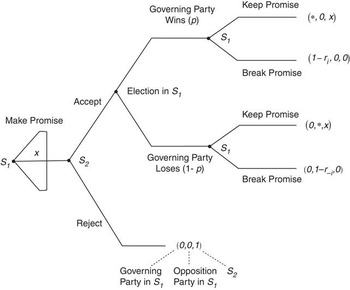
Initially, the governing party that holds power in S 1 makes a take-it-or-leave-it proposal to provide x ≥ 0 units of side payments in order to change S 2's disputed policy. After the proposal, S 2 decides whether to change or maintain the policy. If it maintains the policy, the game will immediately end with no change in the status quo. In this case, the two parties in S 1 and S 2 will receive payoffs 0, 0, and 1, respectively. On the other hand, if S 2 changes its policy, then S 1 will hold an election, and the winning party will decide whether or not to implement the promise previously made at the bargaining stage. If it abides by the promise, x units of side payments will be transferred to S 2 and if it does not, no side payments will be transferred. The winning party receives the benefit of policy change in S 2 as a political rent, whereas the losing party gains nothing regardless of international outcomes. Figure 1 displays the sequence of moves.
Game Structure. The payoffs are shown in the parentheses: the first argument represents the payoff for the governing party in S 1, the second argument the payoff for the opposition party in S 2, and the third argument the payoff for S 2. The payoffs with an asterisk (*) vary depending on which party (the Hawk or the Dove) was in power at the bargaining stage (see Table 1).

International cooperation in this model is for S 2 but not for S 1: S 1 may exploit S 2, but not vice versa, as S 1 is able to decide whether to keep its promise after observing S 2's decision to change the disputed policy. It is important to emphasize that our goal is not to present a general model of international cooperation in which the risk of noncompliance is equally shared by the negotiating parties. Instead, our goal is to analyze a specific type of bargaining in which one state promises to provide benefits in return for a change in policy of another state as in the cases of the US's nuclear disarmament negotiations with Iran, Libya, North Korea, and Syria.
Due to the asymmetry, S 2's decision to reach an agreement depends on the credibility of S 1's promise to provide benefits as well as the size of the promised benefits. What, then, affects the enforcement decision by S 1? To examine this question, we introduce party-specific preferences. Political parties have different preferences for enforcement outcomes, and these party-specific preferences are induced in two different ways – that is, domestically and internationally.
First, one party in S 1 has more domestic supporters with ‘internationalist’ preferences, and thus it is more constrained to abide by an international promise than the other party in S 1. Following previous studies (e.g. Kydd Reference Kydd2000; Schultz Reference Schultz2005), we refer to the former as the Dove and the latter as the Hawk. Other things being equal, the Dove has a greater incentive to abide by an agreement than the Hawk. Specifically, we consider that the party in charge of enforcement (party j) loses x/θj units of utility when it implements an international promise to give x units of side payments. The parameter θj > 0 measures the degree of party j's domestic constraint to comply with an international agreement or the size of its domestic supporters with internationalist preferences: the larger the value of θj, the more domestically constrained it is to fulfill an international commitment, and thus the smaller disutility of doing so. The assumption that the Dove is more constrained than the Hawk can be expressed as θ H < θ D. The subscripts D and H denote the Dove and the Hawk, respectively, throughout this paper.Footnote 4
Second, in addition to these domestically induced preferences, parties also have different preferences for compliance depending on their positions in the international negotiation. Specifically, we assume that the party that sat at the negotiating table feels more obliged to comply with the agreement than the party that did not participate in the negotiation. According to the reputational sanctions literature, reputation is information about past behaviors that is useful to predict the future (Keohane Reference Keohane1984; Milgrom et al. Reference Milgrom, North and Weingast1990). An actor with a good record of compliance is expected to have a good reputation for compliance, which helps in future negotiations by alleviating the mistrust of others. In this regard, it is reasonable to treat noncompliance with the agreement previously negotiated by other parties differently from noncompliance with the agreement previously negotiated by the same party; the latter conveys more information about the credibility of the party's future commitments.
We use  $$)(-->$<>{{r}_{{\rm{ - }}i}}\: \gt \:{\rm{0}}<$>
<!--$$
to denote the amount of reputation loss incurred when state i reneges on a promise previously made by the other party at the bargaining stage. Similarly, we denote
 $$)(-->$<>{{r}_i}\: \gt \:{\rm{0}}<$>
<!--$$
as the amount of reputation loss incurred when state i violates a promise previously made by the same party at the bargaining stage. Corresponding to our discussion of Type 1 noncompliance and Type II noncompliance, we refer to the former as Type I reputation loss and the latter as Type II reputation loss.Footnote 5 For example, if the Dove reneges on an agreement previously made by the Hawk, the Dove will lose r−i units of reputation. In contrast, if the Dove reneges on an agreement previously made by the Dove itself, the amount of reputation loss is ri. It is natural to expect that noncompliance by a negotiator would be punished more severely than noncompliance by a non-negotiator because the former is expected to send a stronger signal about the defector's future credibility than the latter. Thus, we assume
 $$)(-->$<>{{r}_{{\rm{ - }}i}}\: \lt \:{{r}_i}<$>
<!--$$
.
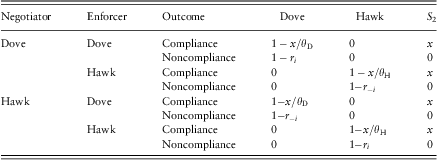
In our model, S 1 will hold an election after reaching an agreement and the winning party will be in charge of the state's compliance decision. Since the election follows after the international negotiation, it may be natural to expect that voters would, more or less, take into account the bargaining outcome when casting their votes. Let 0 < p < 1 denote the probability that the negotiating party will win the election. To take into account the possibility of an endogenous election outcome, we consider that p depends on the size of concessions made by the negotiating party. Specifically, we assume that p = p(x) is weakly decreasing in x, implying that voters may or may not place priority on foreign affairs when casting their votes. Table 1 summarizes the payoff to each actor.
Payoffs
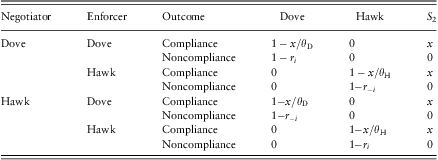
Each column represents the party responsible for bargaining in S 1, the party that is in charge of enforcement after the election, the enforcement outcome, and the payoffs of the Dove, the Hawk, and S 2. Each actor obtains payoffs 0, 0, and 1, respectively, in the case of bargaining failure.
Equilibrium analysis
We use backward induction to derive the equilibrium outcomes. The Appendix shows a full description of the subgame perfect equilibrium. The equilibrium outcomes vary depending on the type of the bargaining party. Our discussion starts from a simpler case (the Dove negotiator) and moves to a more complicated case (the Hawk negotiator).
Dove negotiator
We begin with the case of the Dove negotiator and the Dove enforcer. If the Dove implements the agreement, it will receive a payoff of  $$)(-->$<>{\rm{1}}\:{\rm{ - }}\:x\:/\:{{\theta }_{\rm{D}}}<$>
<!--$$
and if it does not, it will get
 $$)(-->$<>{\rm{1}}\:{\rm{ - }}\:{{r}_i}<$>
<!--$$
. Hence, the Dove enforcer fulfills its own agreement when:
 $${\rm{1}}\:{\rm{ - }}\:{{r}_i}\:\leq \:{\rm{1}}\:{\rm{ - }}\:\frac{x}{{{{\theta }_{\rm{D}}}}}\; \; \Leftrightarrow \; \; x\:\leq \:{{r}_i}{{\theta }_{\rm{D}}}$$
The inequality (1) implies that the Dove negotiator is more likely to keep its promise as the size of side payments (x) decreases, its domestic preference for compliance (θ D) increases, and/or its concern for Type II reputation loss (ri) – reputation loss for breaking its own promises – increases. All of these outcomes are quite consistent with our understanding of international cooperation.
Now suppose that the Hawk – the party not responsible for bargaining – comes to power after the election. If the Hawk implements the agreement previously made by the Dove negotiator, it will obtain  $$)(-->$<>{\rm{1}}\:{\rm{ - }}\:x\:/\:{{\theta }_{\rm{H}}}<$>
<!--$$
. On the other hand, it will get
 $$)(-->$<>{\rm{1}}\:{\rm{ - }}\:{{r}_{{\rm{ - }}i}}<$>
<!--$$
if the Hawk violates the Dove's agreement. Hence, the Hawk complies with the Dove's agreement when:
 $${\rm{1}}\:{\rm{ - }}\:{{r}_{{\rm{ - }}i}}\:\leq \:{\rm{1}}\:{\rm{ - }}\:\frac{x}{{{{\theta }_{\rm{H}}}}}\; \; \Leftrightarrow \; \; x\:\leq \:{{r}_{{\rm{ - }}i}}{{\theta }_{\rm{H}}}$$
The inequality (2) implies that the Hawk is more likely to keep the promise previously made by the Dove negotiator as the size of side payments (x) decreases, its domestic preference for compliance (θ H) increases, and/or its concern for Type I reputation loss ( $$)(-->$<>{{r}_{{\rm{ - }}i}}<$>
<!--$$
) – the reputation loss for breaking others’ promises – increases.
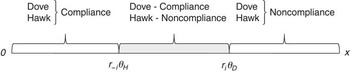
The two inequalities (1) and (2) described above imply that overall the Dove will be more cooperative than the Hawk at the enforcement stage. To see this clearly, Figure 2 displays the enforcement outcomes. When  $$)(-->$<>x\:\leq \:{{r}_{{\rm{ - }}i}}{{\theta }_{\rm{H}}}<$>
<!--$$
, both the Dove and the Hawk choose compliance; when
 $$)(-->$<>{{r}_i}{{\theta }_{\rm{D}}}\: \lt \:x<$>
<!--$$
, both parties choose noncompliance; and when
 $$)(-->$<>{{r}_{{\rm{ - }}i}}{{\theta }_{\rm{H}}}\: \lt \:x\:\leq \:{{r}_i}{{\theta }_{\rm{D}}}<$>
<!--$$
only the Dove chooses compliance.
Enforcement outcomes – Dove negotiator.

The Dove is more cooperative than the Hawk at the enforcement stage for two reasons. First, the Dove is more constrained by its domestic supporters to abide by an international agreement ( $$)(-->$<>{{\theta }_{\rm{H}}}\: \lt \:{{\theta }_{\rm{D}}}<$>
<!--$$
). Second, international audiences are expected to punish Type II noncompliance – noncompliance with its own party's promise – more severely than Type I noncompliance – noncompliance with the other party's promise;
 $$)(-->$<>{{r}_{{\rm{ - }}i}}\: \lt \:{{r}_i}<$>
<!--$$
.
There are two types of agreements that can be reached on the equilibrium path: an agreement enforceable for both the Dove and the Hawk and an agreement enforceable only for the Dove. In either case, the international negotiation fails whenever the Dove negotiator proposes an agreement that is unenforceable for itself. S 2 is well aware that any agreement unenforceable for the Dove is also unenforceable for the Hawk and hence rejects such a ‘hopeless’ offer by S 1 at the bargaining stage. On the other hand, the international negotiation may succeed even when the Dove negotiator proposes an agreement that is unenforceable for the Hawk but enforceable for the Dove. S 2 may accept such a ‘partially hopeful’ agreement as long as the electoral chance of the Dove is relatively high. However, in order to compensate for the risk taken by S 2, the Dove negotiator needs to promise relatively large side payments, which could endanger its chance of reelection. As long as voters care little about international bargaining outcomes when they vote, that is p is relatively flat with respect to x, the Dove negotiator is able to make such a generous promise without greatly risking its chance for reelection.Footnote 6
Hawk negotiator
Now we consider the case of the Hawk negotiator. First, suppose that the Hawk is reelected at the enforcement stage. If the Hawk enforcer abides by its previous agreement, it will obtain a payoff  $$)(-->$<>{\rm{1}}\:{\rm{ - }}\:x/{{\theta }_{\rm{H}}}<$>
<!--$$
, and if it does not, it will get
 $$)(-->$<>{\rm{1}}\:{\rm{ - }}\:{{r}_i}<$>
<!--$$
. Hence, the Hawk enforcer complies with the agreement when:
 $${\rm{1}}\:{\rm{ - }}\:{{r}_i}\:\leq \:{\rm{1}}\:{\rm{ - }}\:\frac{x}{{{{\theta }_{\rm{H}}}}}\; \; \Leftrightarrow \; \; x\:\leq \:{{r}_i}{{\theta }_{\rm{H}}}$$
Second, suppose the Dove is in charge of the state's compliance decision. If it implements the agreement previously reached by the Hawk negotiator, it will obtain  $$)(-->$<>{\rm{1}}\:{\rm{ - }}\:x/{{\theta }_{\rm{D}}}<$>
<!--$$
, and if it does not, it will get
 $$)(-->$<>{\rm{1}}\:{\rm{ - }}\:{{r}_{{\rm{ - }}i}}<$>
<!--$$
. Hence, the Dove enforcer keeps the promise when:
 $${\rm{1}}\:{\rm{ - }}\:{{r}_{{\rm{ - }}i}}\:\leq \:{\rm{1}}\:{\rm{ - }}\:\frac{x}{{{{\theta }_{\rm{D}}}}}\; \; \Leftrightarrow \; \; x\:\leq \:{{r}_{{\rm{ - }}i}}{{\theta }_{\rm{D}}}$$
Because  $$)(-->$<>{{\theta }_{\rm{H}}}\: \lt \:{{\theta }_{\rm{D}}}<$>
<!--$$
and
 $$)(-->$<>{{r}_{{\rm{ - }}i}}\: \lt \:{{r}_i}<$>
<!--$$
, there are two possibilities: (1)
 $$)(-->$<>{{r}_{{\rm{ - }}i}}{{\theta }_{\rm{D}}}\: \lt \:{{r}_i}{{\theta }_{\rm{H}}}<$>
<!--$$
and (2)
 $$)(-->$<>{{r}_i}{{\theta }_{\rm{H}}}\: \lt \:{{r}_{{\rm{ - }}i}}{{\theta }_{\rm{D}}}<$>
<!--$$
. We examine each case in turn.
Case 1.  $$)(-->$<> {{r}_{{\rm{ - }}i}}{{\theta }_{\rm{D}}}\: \lt \:{{r}_i}{{\theta }_{\rm{H}}} <$>
<!--$$
Suppose  $$)(-->$<>{{r}_{{\rm{ - }}i}}{{\theta }_{\rm{D}}}\: \lt \:{{r}_i}{{\theta }_{\rm{H}}}<$>
<!--$$
or equivalently
 $$\frac{{{{\theta }_{\rm{D}}}}}{{{{\theta }_{\rm{H}}}}}\:\leq \:\frac{{{{r}_i}}}{{{{r}_{{\rm{ - }}i}}}}$$
The left-hand side of the inequality (3) represents the difference between the two parties’ domestic preferences for enforcement outcomes, and the right-hand side represents the difference between Type I and Type II reputation losses. As can be seen clearly, the inequality (3) is likely to hold when the Hawk is very similar to the Dove in its compliance preference  $$)(-->$<>({{\theta }_{\rm{H}}}\: \approx \:{{\theta }_{\rm{D}}})<$>
<!--$$
.
Figure 3 displays the enforcement outcomes. When  $$)(-->$<>x\:\leq \:{{r}_{{\rm{ - }}i}}{{\theta }_{\rm{D}}}<$>
<!--$$
, both the Dove and the Hawk choose compliance; when
 $$)(-->$<>{{r}_{{\rm{ - }}i}}{{\theta }_{\rm{D}}}\: \lt \:x<$>
<!--$$
, both parties choose noncompliance; and when
 $$)(-->$<>{{r}_{{\rm{ - }}i}}{{\theta }_{\rm{D}}}\: \lt \:x\:\leq \:{{r}_i}{{\theta }_{\rm{H}}}<$>
<!--$$
, only the Hawk chooses compliance.
Enforcement outcomes – Hawk negotiator (I).

Thus, when the Hawk sits down at the negotiating table and the two parties have relatively similar preferences  $$)(-->$<>({{\theta }_{\rm{H}}}\: \approx \:{{\theta }_{\rm{D}}})<$>
<!--$$
, the Hawk will be more cooperative than the Dove at the enforcement stage because of its attention to Type II reputation loss.
As in the case of the Dove negotiator, two types of agreements can be reached on the equilibrium path. The first type is an agreement enforceable for both the Dove and the Hawk and the second type is an agreement enforceable only for the Hawk. In either case, the international negotiation fails whenever the Hawk negotiator proposes an agreement that is unenforceable for itself. The Hawk will be more cooperative than the Dove at the enforcement stage, and thus an agreement that is unenforceable for the Hawk is also unenforceable for the Dove; S 2 rejects such a ‘hopeless’ agreement at the bargaining stage.
On the other hand, the international negotiation may succeed with an agreement that is unenforceable for the Dove but enforceable for the Hawk; if the Hawk wins the election, it will be in charge of enforcement with its clear preference for compliance induced by its attention to Type II reputation loss, and hence S 2 may accept such a ‘partially hopeful’ agreement as long as the chance of the Hawk's victory in the election is high. In order to make S 2 accept it, the Hawk negotiator needs to compensate for the risk of noncompliance with large side payments. The possibility of agreement depends on whether such a generous promise threatens the Hawk's chance in the election, which further depends on how important international negotiation outcomes are to voters’ choices.
Case 2.  $$)(-->$<>{{r}_i}{{\theta }_{\rm{H}}}\: \lt \:{{r}_{{\rm{ - }}i}}{{\theta }_{\rm{D}}}<$>
<!--$$
Next we consider the case  $$)(-->$<>{{r}_i}{{\theta }_{\rm{H}}}\: \lt \:{{r}_{{\rm{ - }}i}}{{\theta }_{\rm{D}}}<$>
<!--$$
or equivalently:
 $$\frac{{{{r}_i}}}{{{{r}_{{\rm{ - }}i}}}}\: \lt \:\frac{{{{\theta }_{\rm{D}}}}}{{{{\theta }_{\rm{H}}}}}$$
The inequality (4) is likely to hold when the Hawk is very different from the Dove in its partisan preference  $$)(-->$<>({{\theta }_{\rm{H}}}\: \ll \:{{\theta }_{\rm{D}}})<$>
<!--$$
.
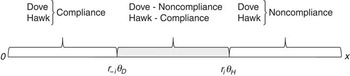
As displayed in Figure 4, when the Hawk is in charge of bargaining and the two parties have relatively different preferences  $$)(-->$<>({{\theta }_{\rm{H}}}\: \ll \:{{\theta }_{\rm{D}}})<$>
<!--$$
, the Hawk will be less cooperative than the Dove at the enforcement stage. When
 $$)(-->$<>x\:\leq \:{{r}_i}{{\theta }_{\rm{H}}}<$>
<!--$$
, both the Dove and the Hawk choose compliance; when
 $$)(-->$<>{{r}_{{\rm{ - }}i}}{{\theta }_{\rm{D}}}\: \lt \:x<$>
<!--$$
, both parties choose noncompliance; and when
 $$)(-->$<>{{r}_i}{{\theta }_{\rm{H}}}\: \lt \:x\:\leq \:{{r}_{{\rm{ - }}i}}{{\theta }_{\rm{D}}}<$>
<!--$$
, the Dove chooses compliance but the Hawk does not comply with the agreement. The Hawk negotiator is less cooperative than the Dove at the enforcement stage because its large domestic constraint for noncompliance outweighs its concern for Type II reputation loss.
Enforcement outcomes – Hawk negotiator (I).

Two types of agreements can be reached on the equilibrium path: (1) an agreement enforceable for both the Dove and the Hawk and, more importantly, (2) an agreement enforceable only for the Dove. The latter case deserves further discussion because S 2 reaches an agreement with an ‘untrustworthy’ negotiator.
The Hawk negotiator is untrustworthy to S 2 because it is expected to renege on its promise when it sits in the government at the enforcement stage. Even in such a situation, however, the two states could reach an agreement. The Hawk negotiator is an unreliable partner, but S 2 may be willing to accept such a ‘partially hopeful’ agreement because it knows that there is a chance that the Dove wins the election and, once it happens, the Dove has a strong partisan constraint to fulfill the previous commitment. This is a case in which an international negotiation may succeed even when one of the participating governments is expected to violate the agreement reached in the negotiation.
In this counterintuitive scenario, the Hawk negotiator needs to compensate S 2 for the risk of noncompliance. If voters are relatively insensitive to bargaining outcomes, the Hawk negotiator could make such a generous promise without hurting its chance for reelection significantly. Moreover, the generous side payments promised by the Hawk will constrain only the Dove at the enforcement stage; if reelected, the Hawk will not keep its promise at the enforcement stage. On the other hand, if the electorate is sensitive to bargaining outcomes, the promise of large side payments will make the Hawk negotiator less likely to win the election, making it difficult for the Hawk to compensate S 2 for the risk of noncompliance.
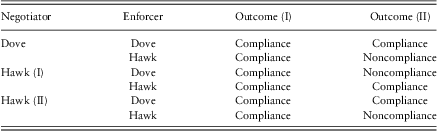
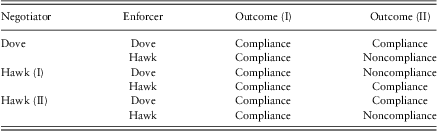
Table 2 summarizes the main outcomes of the equilibrium analysis. In the case of the Dove negotiator, it always abides by an international agreement whereas the Hawk may renege on it; the outcome is consistent with the two parties’ domestic preferences for enforcement outcomes. In the case of the Hawk negotiator, there are two possibilities. In the first case where partisan preferences are relatively similar, the Hawk enforcer always chooses compliance whereas the Dove may choose noncompliance despite its domestic preference for compliance. In the second case where partisan preferences are relatively different, the Dove enforcer always chooses compliance whereas the Hawk enforcer may choose noncompliance, implying that an international negotiation may succeed even when one of the participating governments is expected to renege on the agreement reached in the negotiation.
Equilibrium outcomes
Discussion: US–North Korea negotiations over North Korea's nuclear programs
In this section, we discuss the US–North Korea negotiations over North Korea's nuclear programs from the perspective of our model. To briefly recap the history of the negotiations, four US presidents – George H.W. Bush, Clinton, George W. Bush, and Obama – have engaged in either bilateral or multilateral negotiations over North Korea's nuclear programs since the discovery of a nuclear research reactor in Youngbyon, North Korea in 1982.
Among them, the Clinton administration and North Korea made an important agreement regarding the denuclearization of North Korea in the Agreed Framework of 1994. In this agreement North Korea promised to freeze and eventually dismantle its graphite-moderated reactors, accept IAEA monitoring, cooperate to store the spent fuel safely, and remain a party to the NPT. In return, the United States agreed to provide formal assurances against the threat or use of nuclear weapons, alternative energy in the form of heavy oil, and light-water reactors.Footnote 7
The 1994 Agreed Framework clearly shows what both sides wanted to trade with each other: a policy change (denuclearization) in North Korea in return for side payments (security assurance and economic aid) from the United States. The security assurance is important because North Korea is trading denuclearization today for a promise of peaceful actions by the present and future US governments.
Less than a month before the US presidential election in 2000, another important agreement came; North Korea agreed to resolve the uranium enrichment issue and the inspection of Kumchang-ri with the Clinton administration. The Joint communique contains ‘a pledge from the two countries to abandon the hostility of the past’ and the implementation of the Agreed Framework. In addition, the Clinton administration allegedly promised a visit by then-US President Bill Clinton to North Korea, which did not come true.Footnote 8
The 1994 Agreed Framework and the 2000 Joint communique can be well explained by the equilibrium outcomes under the Dove negotiator in our model. Our discussion of the ‘partially hopeful’ agreement under the Dove negotiator – the gray area in Figure 2 – clearly shows that it was rather unclear to North Korea whether the agreement with the Clinton administration would have been respected if the Democratic Party had lost the election. However, since there was a chance of a Democratic victory, North Korea still had an incentive to come to an agreement with the Clinton administration and to bet on a Democratic victory. In order to compensate North Korea for the risk of noncompliance by the Republican Party, the Clinton administration had to give large concessions such as the first visit to North Korea by the US Secretary of State in the 2000 negotiation. From the perspective of our model, it is highly likely that the US President's planned visit to North Korea at the end of 2000 was aborted because the Democratic government perceived that the visit could jeopardize the electoral chance of the Democratic presidential candidate by raising voters’ concerns over the size of US concessions to North Korea.
Within a year of the Joint communique, there was a partisan shift in the US government and the 11 September 2001 terrorist attack. In the 2002 State of the Union address, President Bush categorized North Korea along with Iraq and Iran as ‘terrorist allies’ and ‘an axis of evil, arming to threaten the peace of the world’. The George W. Bush administration made it clear that the United States would not engage in any bilateral talks with North Korea. Further, in response to North Korea's inadvertent signal about the possible existence of a uranium-based nuclear weapons program, the George W. Bush administration suspended the delivery of heavy oil to North Korea and discontinued the funding to the Korean Energy Development Organization (KEDO). That is, the Republican administration declined to enforce what had been agreed between the former Democratic administration and North Korea. The US invasion of Iraq confirmed North Korean top leaders’ belief that nuclear weapons were the only way to secure their regime's survival.
The US–North Korea relationship in the first four years of the Bush administration can be analyzed using the Dove negotiator–Hawk enforcer framework in our model. The Republican administration completely reviewed the Clinton administration's North Korean policy and concluded that Clinton's policy rewarded North Korea for its bad behavior.Footnote 9 In an interview with Asian newspaper editors, President Bush said:
I want our government to help starving people. On the other hand, I don't want to send aid to a government that doesn't help its people. It's one thing to help the people, it's another to send the aid and then the government doesn't help the people.Footnote 10
In response, North Korea reminded the United States of what the latter previously promised:
A thaw was brought to the frozen DPRK-U.S. relations with much efforts. But they got refrozen and the bilateral dialogue came to a rupture entirely due to Bush and his administration with deep-rooted conception of hostility towards the DPRK. In the last period of the Clinton administration, the two countries became brisk in dialogue and published even a joint communique that promised an end to the hostile relations between them. However, the new U.S. administration broke all those agreements as soon as it took office.Footnote 11
Based on our model, we argue that it is the position of the Bush administration as an enforcer of the Dove-led agreement that made it difficult for the dialogue between two states to resume. In other words, in the absence of the two agreements during the Clinton administration, our model predicts that the relationship between the George W. Bush administration and North Korea would have been much different from what really happened in the first four years. Although this counterfactual reasoning cannot be tested rigorously because of the lack of enough data, we provide the US–Libya negotiations over Libya's nuclear weapons program during the same period as an anecdotal evidence in favor of this counterfactual reasoning.
In both cases, the US was dealing with ‘rogue states’ that have supported terrorist acts and declined to abandon nuclear weapons program. Neoconservative hawks within the Bush administration such as Secretary of Defense Donald Rumsfeld and Undersecretary of Defense John Bolton fiercely opposed the idea of direct negotiations with both states.
Despite the similarities between the two cases, however, the US pursued secret talks with Libya and finally reached an agreement on 19 December 2003. The agreement aimed to denuclearize Libya in return for lifting economic sanctions and normalizing the bilateral relationship. We do not disagree with the fact that many factors came into play in the US–Libya negotiations.Footnote 12 However, in light of our model, what clearly distinguishes the US–Libya case from the US–North Korea case during the first term of the Bush administration is the position of the Bush administration in the negotiation process. Unlike the US–North Korea relationship in which the Bush administration actively sought ‘ABC (Anything But Clinton) policy’ (Pritchard, Reference Pritchard2007, 15), the Clinton administration left no concrete partisan legacy to the following administration in the US–Libya relationship.
Last, despite hostility between the Bush administration and North Korea and the dominance of neoconservative Hawks within the Bush administration, both sides reached three agreements during the second term of the Bush administration.Footnote 13 None of these agreements was fully implemented by either side. Thus, one could disregard the importance of these agreements simply as ‘cheap talk’. However, if it were cheap talk, it is difficult to explain why North Korea showed different patterns of behaviors during the first and second Bush administration.
Our model provides a more nuanced explanation to this puzzle than the claim of cheap talk. From the point of the target state (North Korea), it is rational to consider the acceptance of a ‘partially hopeful’ proposal from an ‘untrustworthy’ negotiator (the Bush administration) if the target state believes that the agreement is respected when there is a change in government. From the point of the Hawk negotiator (the George W. Bush administration), it is rational to make a promise of ‘generous’ – from the perspective of the Hawk negotiator – side payments in the belief that this commitment will bind only the hands of the opposition party government in the future.Footnote 14
Concluding remarks
The argument that reputational concerns promote compliance is at the center of the literature of international cooperation. These studies are firmly based on the unitary actor assumption and hence tend to ignore the complex interplay between partisan competition in domestic politics and reputational sanctions by international audiences. By shifting the theoretical focus on to domestic parties that carry their own international reputations, we showed that the prospect of international cooperation varies depending on who sits at the negotiation table, how partisan preferences for compliance are different, and how much international audiences discriminate between different types of noncompliance.
We found that a dovish government is more cooperative than a hawkish government at the enforcement stage if the agreement was signed by a dovish government at the negotiation stage, which is quite intuitive. Next, we showed that a hawkish government may be more cooperative than a dovish one at the enforcement stage despite their weaker partisan preferences for compliance when the agreement was negotiated by the hawkish party at the negotiation stage and partisan differences on compliance preference are minor. Also, our model suggested a possibility that an international negotiation may succeed even when one of the participating governments is expected to renege on the agreement reached in the negotiation. In our model, this case arises when a hawkish party sits in the negotiation and partisan differences are significant.
Certainly, our work is not the first study to find that Hawks can bring cooperative outcomes in international bargaining. For example, Schultz (Reference Schultz2005) also finds a Hawk advantage in achieving cooperation from a different perspective. In his model, a government can send a signal to the voters. To win an election, the government needs to make the median voter believe that they have similar preferences. In order to accomplish this goal, a Dove government attempts to look more like a hard-liner (defector), whereas a Hawk government attempts to look more like a soft-liner (cooperator). Therefore, ‘a moderate hawk is the most likely type to initiate cooperation’ (Schultz Reference Schultz2005, 5). We reached a similar conclusion by considering the possibility for the discrepancy between bargaining and enforcement governments.
Our model is designed to understand the commitment problem caused by leadership changes between the negotiation and the enforcement of international agreements. Thus, it is rather simple, abstracting away from many parts of the reality in domestic politics and international relations. For example, we assume the existence of an election in one country but not in the other. We justify this simplification on the grounds that the type of negotiations we focus on does not involve alternating offers between both sides. Thus, we can ignore the partisan dynamics within the target state, S 2 in our model, without losing important insights.
Also, we stress that our argument is not restricted to a pair of democratic and nondemocratic countries. Electoral institutions may guarantee chances of power rotation among domestic groups, but power rotation can also occur in nondemocracies. What is important is not the existence of an electoral institution but that of domestic parties seeking power. The logic of our model can be applied to any pair of political regimes involved in asymmetric bargaining as long as there is a possibility for discontinuity between the one in charge of enforcement and the one responsible for bargaining. For some countries the discontinuity arises through elections, whereas for others it can occur through nondemocratic means such as a military coup.
Appendix
We previously described the equilibrium behaviors at the enforcement stage. This section focuses on the bargaining stage and specifies the subgame perfect equlibrium by using backward induction.
Dove negotiator
We first examine S 2's behavior at the bargaining stage. If the Dove negotiator proposes  $$)(-->$<>x \in [0,{{r}_{{\rm{ - }}i}}{{\theta }_{\rm{H}}}]<$>
<!--$$
, both the Dove and the Hawk will abide by the agreement (see Figure 2). Because the Dove negotiator will win the election with probability
 $$)(-->$<>p\: = \:p(x)<$>
<!--$$
, S 2 will accept such a proposal if and only if
 $$)(-->$<>{\rm{1}}\:\leq \:px\: + \:({\rm{1}}\:{\rm{ - }}\:p)x<$>
<!--$$
– that is, if and only if
 $$)(-->$<>{\rm{1}}\:\leq \:x<$>
<!--$$
. Next, if the Dove negotiator proposes
 $$)(-->$<>x \in ({{r}_i}{{\theta }_{\rm{D}}},\infty )<$>
<!--$$
, both the Dove and the Hawk will renege on the agreement, and thus S 2 will never accept such a proposal. Lastly, if the Dove negotiator proposes
 $$)(-->$<>x \in ({{r}_{{\rm{ - }}i}}{{\theta }_{\rm{H}}},\,{{r}_{ii}}{{\theta }_{\rm{D}}}]<$>
<!--$$
, only the Dove will choose compliance. Hence, S 2 will accept such a proposal if and only if
 $$)(-->$<>{\rm{1}}\:\leq \:px\: + \:({\rm{1}}\:{\rm{ - }}\:p)(0)<$>
<!--$$
– that is, if and only if
 $$)(-->$<>{\rm{1}}\:\leq \:p(x)x<$>
<!--$$
. Let x* denote the minimum value of x supporting the equality:
 $${\rm{1}}\: = \:p(x)x$$
Because p(x) is weakly decreasing in x, the equation may or may not have a solution depending on the functional form of p(x). However, there always exists x* as long as p(x) is relatively flat with respect to x. Notice that  $$)(-->$<>{{x}\ast} \: \gt \:{\rm{1}}<$>
<!--$$
since
 $$)(-->$<>p(x)\: \lt \:{\rm{1}}<$>
<!--$$
.
Let us next shift our focus to the Dove negotiator's behavior at the bargaining stage. Suppose that x* exists. When  $$)(-->$<>{\rm{1}}\,\leq \,{{r}_{ - i}}{{\theta }_{\rm H}<$>
<!--$$
, the Dove negotiator can maximize its payoff by proposing x = 1 if it wants to reach an agreement. If it proposes
 $$)(-->$<>x \in [0,\,{\rm{1}})<$>
<!--$$
, the negotiation will fail and it will obtain a payoff of 0. Hence, the Dove negotiator will propose x = 1 if
 $$)(-->$<>0\,\leq \,p({\rm{1 - 1}}/{{\theta }_{\rm D})\, + \,({\rm{1 - }}p)(0)<$>
<!--$$
– that is, if
 $$)(-->$<>{\rm{1}}\,\leq \,{{\theta }_{\rm D}<$>
<!--$$
– and
 $$)(-->$<>x \in [0,\,{\rm{1}})<$>
<!--$$
if
 $$)(-->$<>{\rm{1}}\, \gt \,{{\theta }_{\rm D}<$>
<!--$$
. Next, when
 $$)(-->$<>{{r}_{{\rm{ - }}i}}{{\theta }_{\rm H}\, \lt \,{\rm{1}}<$>
<!--$$
, the Dove negotiator can maximize its payoff by proposing x = x* if it wants to reach an agreement. Hence, it will propose x = x* if
 $$)(-->$<>0\,\leq \,p({\rm{1 - }}{{x}\ast} /{{\theta }_{\rm D})\, + \,({\rm{1 - }}p)(0)<$>
<!--$$
– that is, if
 $$)(-->$<>{{x}\ast} \,\leq \,{{\theta }_{\rm D}<$>
<!--$$
– and any
 $$)(-->$<>x<$>
<!--$$
supporting the inequality
 $$)(-->$<>{\rm{1}}\, \gt \,p(x)x<$>
<!--$$
if
 $$)(-->$<>{{x}\ast} \, \gt \,{{\theta }_{\rm D}<$>
<!--$$
. Lastly, when
 $$)(-->$<>{{r}_{{\rm{ - }}i}}{{\theta }_{\rm H}\, \lt \,{\rm{1}}<$>
<!--$$
and
 $$)(-->$<>{{r}_i}{{\theta }_{\rm D}\, \lt \,{{x}\ast} <$>
<!--$$
, the Dove negotiator will propose any x because S 2 will reject any proposal. On the other hand, suppose that x* does not exist. It is obvious that when
 $$)(-->$<>{\rm{1}}\,\leq \,{{r}_{{\rm{ - }}i}}{{\theta }_{\rm H}<$>
<!--$$
, the Dove negotiator will propose x = 1 if
 $$)(-->$<>{\rm{1}}\,\leq \,{{\theta }_{\rm D}<$>
<!--$$
and
 $$)(-->$<>x \in [0,\,{\rm{1}})<$>
<!--$$
if
 $$)(-->$<>{\rm{1}}\, \gt \,{{\theta }_{\rm D}<$>
<!--$$
, and when
 $$)(-->$<>{\rm{1}}\, \gt \,{{r}_{{\rm{ - }}i}}{{\theta }_{\rm H}<$>
<!--$$
it will propose any x as S 2 will reject any proposal.
Hawk negotiator
Case 1.  $$)(-->$<>{{r}_{{\rm{ - }}i}}{{\theta }_{\rm{D}}}\:\leq \:{{r}_i}{{\theta }_{\rm{H}}}<$>
<!--$$
If the Hawk negotiator proposes  $$)(-->$<>x \in [0,\,{{r}_{{\rm{ - }}i}}{{\theta }_{\rm{D}}}]<$>
<!--$$
, both the Dove and the Hawk will abide by the agreement (see Figure 3). Because the Hawk negotiator will win the election with probability
 $$)(-->$<>p\: = \:p(x)<$>
<!--$$
, S 2 will accept such a proposal if and only if
 $$)(-->$<>{\rm{1}}\:\leq \:px\: + \:({\rm{1}}\:{\rm{ - }}\:p)x<$>
<!--$$
– that is, if and only if
 $$)(-->$<>{\rm{1}}\:\leq \:x<$>
<!--$$
. Next, if the Hawk negotiator proposes
 $$)(-->$<>x \in ({{r}_i}{{\theta }_{\rm{H}}},\infty )<$>
<!--$$
, both the Dove and the Hawk will renege on the agreement, and thus S 2 will never accept such a proposal. Lastly, if the Hawk negotiator proposes
 $$)(-->$<>x \in ({{r}_{{\rm{ - }}i}}{{\theta }_{\rm{D}}},{{r}_i}{{\theta }_{\rm{H}}}]<$>
<!--$$
, only the Hawk will choose compliance. Hence, S 2 will accept such a proposal if and only if
 $$)(-->$<>{\rm{1}}\:\leq \:px\: + \:({\rm{1}}\:{\rm{ - }}\:p)(0)<$>
<!--$$
– that is, if and only if
 $$)(-->$<>{\rm{1}}\:\leq \:p(x)x<$>
<!--$$
.
Suppose that x* exists. When  $$)(-->$<>{\rm{1}}\:\leq \:{{r}_{{\rm{ - }}i}}{{\theta }_{\rm{D}}}<$>
<!--$$
, the Hawk negotiator can maximize its payoff by proposing x = 1 if it wants to reach an agreement. Hence, it will propose x = 1 if
 $$)(-->$<>0\:\leq \:p({\rm{1}}\:{\rm{ - }}\:{\rm{1}}/{{\theta }_{\rm{H}}})\: + \:({\rm{1}}\:{\rm{ - }}\:p)(0)<$>
<!--$$
– that is, if
 $$)(-->$<>{\rm{1}}\:\leq \:{{\theta }_{\rm{H}}}<$>
<!--$$
– and
 $$)(-->$<>x \in [0,\,{\rm{1}})<$>
<!--$$
if
 $$)(-->$<>{\rm{1}}\: \gt \:{{\theta }_{\rm{H}}}<$>
<!--$$
. Next, when
 $$)(-->$<>{{r}_{{\rm{ - }}i}}{{\theta }_{\rm{D}}}\: \lt \:{\rm{1}}<$>
<!--$$
and
 $$)(-->$<>{{x}\ast} \:\leq \:{{r}_i}{{\theta }_{\rm{H}}}<$>
<!--$$
, the Hawk negotiator can maximize its payoff by proposing
 $$)(-->$<>x\: = \:{{x}\ast} <$>
<!--$$
if it wants to reach an agreement. Hence, it will propose
 $$)(-->$<>x\: = \:{{x}\ast} <$>
<!--$$
if
 $$)(-->$<>0\:\leq \:p({\rm{1}}\:{\rm{ - }}\:{{x}\ast} \:/\:{{\theta }_{\rm{H}}})\: + \:({\rm{1}}\:{\rm{ - }}\:p)(0)<$>
<!--$$
– that is, if
 $$)(-->$<>{{x}\ast} \:\leq \:{{\theta }_{\rm{H}}}<$>
<!--$$
– and any x supporting the inequality
 $$)(-->$<>{\rm{1}}\: \gt \:p(x)x<$>
<!--$$
if
 $$)(-->$<>{{x}\ast} \: \gt \:{{\theta }_{\rm{H}}}<$>
<!--$$
. Lastly, when
 $$)(-->$<>{{r}_{{\rm{ - }}i}}{{\theta }_{\rm{D}}}\: \lt \:{\rm{1}}<$>
<!--$$
and
 $$)(-->$<>{{r}_i}{{\theta }_{\rm{H}}} \lt {{x}\ast} <$>
<!--$$
, the Hawk negotiator will propose any x as S 2 will reject any proposal. On the other hand, suppose that x* does not exist. When
 $$)(-->$<>{\rm{1}}\:\leq \:{{r}_{{\rm{ - }}i}}{{\theta }_{\rm{D}}}<$>
<!--$$
, the Hawk negotiator will propose
 $$)(-->$<>x\: = \:{\rm{1}}<$>
<!--$$
if
 $$)(-->$<>{\rm{1}}\:\leq \:{{\theta }_{\rm{H}}}<$>
<!--$$
and
 $$)(-->$<>x \in [0,\,{\rm{1}})<$>
<!--$$
if
 $$)(-->$<>{\rm{1}}\: \gt \:{{\theta }_{\rm{H}}}<$>
<!--$$
, and when
 $$)(-->$<>{\rm{1}}\: \gt \:{{r}_{{\rm{ - }}i}}{{\theta }_{\rm{D}}}<$>
<!--$$
it will propose any x as S 2 will reject any proposal.
Case 2.  $$)(-->$<>{{r}_i}{{\theta }_{\rm{H}}}\: \lt \:{{r}_{{\rm{ - }}i}}{{\theta }_{\rm{D}}}<$>
<!--$$
If the Hawk negotiator proposes  $$)(-->$<>x \in [0,\,{{r}_i}{{\theta }_{\rm{H}}}]<$>
<!--$$
, both the Dove and the Hawk will abide by the agreement (see Figure 4). Hence, S 2 will accept such a proposal if and only if
 $$)(-->$<>{\rm{1}}\:\leq \:x<$>
<!--$$
. Next, if the Hawk negotiator proposes
 $$)(-->$<>x \in ({{r}_{{\rm{ - }}i}}{{\theta }_{{\rm{D}},\infty }})<$>
<!--$$
, both the Dove and the Hawk will renege on the agreement, and thus S 2 will never accept such a proposal. Lastly, if the Hawk negotiator proposes
 $$)(-->$<>x \in ({{r}_i}{{\theta }_{\rm{H}}},\,{{r}_{{\rm{ - }}i}}{{\theta }_{\rm{D}}}]<$>
<!--$$
, only the Dove will choose compliance. Hence, S 2 will accept such a proposal if and only if
 $$)(-->$<>{\rm{1}}\:\leq \:p(0)\: + \:({\rm{1}}\:{\rm{ - }}\:p)x<$>
<!--$$
– that is, if and only if
 $$)(-->$<>{\rm{1}}\:\leq \:({\rm{1}}\:{\rm{ - }}\:p(x))x<$>
<!--$$
. Let x** denote the minimum value of x supporting the equality:
 $${\rm{1}}\: = \:({\rm{1}}\:{\rm{ - }}\:p(x))x$$
which may or may not have a solution depending on the functional form of p(x). However, there always exists x** as long as p(x) is relatively flat with respect to x. Notice that x** > 1 because  $$)(-->$<>{\rm{1}}\:{\rm{ - }}\:p(x)\: \lt \:{\rm{1}}<$>
<!--$$
.
Suppose that x** exists. When  $$)(-->$<>{\rm{1}}\:\leq \:{{r}_i}{{\theta }_{\rm{H}}}<$>
<!--$$
, the Hawk negotiator can maximize its payoff by proposing
 $$)(-->$<>x\: = \:{\rm{1}}<$>
<!--$$
if it wants to reach an agreement. Hence, it will propose
 $$)(-->$<>x\: = \:{\rm{1}}<$>
<!--$$
if
 $$)(-->$<>{\rm{1}}\:\leq \:{{\theta }_{\rm{H}}}<$>
<!--$$
and
 $$)(-->$<>x \in [0,\,{\rm{1}})<$>
<!--$$
if
 $$)(-->$<>{\rm{1}}\: \gt \:{{\theta }_{\rm{H}}}<$>
<!--$$
. Next, when
 $$)(-->$<>{{r}_i}{{\theta }_{\rm{H}}}\: \lt \:{\rm{1}}<$>
<!--$$
and
 $$)(-->$<>{{x}{\ast\ast}} \:\leq \:{{r}_{{\rm{ - }}i}}{{\theta }_{\rm{D}}}<$>
<!--$$
, the Hawk negotiator can maximize its payoff by proposing
 $$)(-->$<>x\: = \:{{x}{\ast\ast}} <$>
<!--$$
if it wants to reach an agreement. Hence, it will propose
 $$)(-->$<>x\: = \:{{x}{\ast\ast}} <$>
<!--$$
if
 $$)(-->$<>{\rm{0}}\:\leq \:p({\rm{1}}\:{\rm{ - }}\:{{x}{\ast\ast}} \:/\:{{\theta }_{\rm{H}}})\: + \:({\rm{1}}\:{\rm{ - }}\:p)({\rm{0}})<$>
<!--$$
– that is, if
 $$)(-->$<>{{x}{\ast\ast}} \:\leq \:{{\theta }_{\rm{H}}}<$>
<!--$$
– and any x supporting the inequality
 $$)(-->$<>{\rm{1}}\: \gt \:p(x)x<$>
<!--$$
if
 $$)(-->$<>{{x}{\ast\ast}} \: \gt \:{{\theta }_{\rm{H}}}<$>
<!--$$
. Lastly, when
 $$)(-->$<>{{r}_i}{{\theta }_{\rm{H}}}\: \lt \:{\rm{1}}<$>
<!--$$
and
 $$)(-->$<>{{r}_{{\rm{ - }}i}}{{\theta }_{\rm{D}}}\: \lt \:{{x}{\ast\ast}} <$>
<!--$$
, the Hawk negotiator will propose any x as S 2 will reject any proposal. On the other hand, suppose that x** does not exist. When
 $$)(-->$<>{\rm{1}}\:\leq \:{{r}_i}{{\theta }_{\rm{H}}}<$>
<!--$$
, the Hawk negotiator will propose
 $$)(-->$<>x\: = \:{\rm{1}}<$>
<!--$$
if
 $$)(-->$<>{\rm{1}}\:\leq \:{{\theta }_{\rm{H}}}<$>
<!--$$
and
 $$)(-->$<>x \in [0,\,{\rm{1}})<$>
<!--$$
if
 $$)(-->$<>{\rm{1}}\: \gt \:{{\theta }_{\rm{H}}}<$>
<!--$$
, and when
 $$)(-->$<>{\rm{1}}\: \gt \:{{r}_i}{{\theta }_{\rm{H}}}<$>
<!--$$
it will propose any x as S 2 will reject any proposal.