Introduction
The detailed knowledge of the distribution and habitat requirements of threatened species is essential in improving conservation actions and policies (Hunter & Webb Reference Hunter and Webb2002; Berglund & Jonsson Reference Berglund and Jonsson2003). Most threatened species are rare or very locally distributed, which makes it difficult to obtain appropriately quantified information about their autecology, consisting of limiting factors and optimal ecological conditions for species survival (Scheidegger & Goward Reference Scheidegger, Goward, Nimis, Scheidegger and Wolseley2002; Glavich et al. Reference Glavich, Geiser and Mikulin2005). In Europe, the epiphytic alliance Lobarion, which is confined to woodland habitats of long ecological continuity and to sub-neutral barked deciduous trees, consists of lichen species of great conservation concern (Rose Reference Rose1988). The characteristic species of this alliance, Lobaria pulmonaria (L.) Hoffm., is a conspicuous foliose lichen which is used as a model organism to study the population biology of lichens at the stand and landscape levels (Scheidegger & Werth Reference Scheidegger and Werth2009).
Intensified forest management practices have influenced the distribution of L. pulmonaria, as a significant part of the modern European forest landscape is covered with mono-cultured and even-aged stands with short rotation cycles and a lack of suitable host trees (Rose Reference Rose1988). In the boreal region, the species has mainly been preserved in small and fragmented old forest patches within managed forests (Gustafsson et al. Reference Gustafsson, Fiskesjö, Ingelög, Pettersson and Thor1992; Auzinš & Ek Reference Auzinš, Ek, Andersson, Marciau, Paltto, Tardy and Read2001; Gu et al. Reference Gu, Kuusinen, Konttinen and Hanski2001; Andersson et al. Reference Andersson, Martverk, Külvik, Palo and Varblane2003; Pykälä Reference Pykälä2004; Jüriado & Liira Reference Jüriado and Liira2009, Reference Jüriado and Liira2010). Low connectivity among fragmented forest remnants is proposed as an essential limiting factor for cryptogamic epiphytes, including also L. pulmonaria, indicating a restricted dispersal range (Snäll et al. Reference Snäll, Hagström, Rudolphi and Rydin2004, Reference Snäll, Pennanen, Kivistö and Hanski2005).
Lobaria pulmonaria also grows in various semi-natural habitats with sparse cover of old trees, such as old parklands, pasture-woodlands and wooded meadows (e.g. Hallingbäck & Martinsson Reference Hallingbäck and Martinsson1987; Rose Reference Rose, Bates and Farmer1992; Wolseley & James Reference Wolseley and James2000; Kalwij et al. Reference Kalwij, Wagner and Scheidegger2005; Carlsson & Nilsson Reference Carlsson and Nilsson2009). Wooded meadows are a critical habitat in Estonia, because 19% of forest remnants with L. pulmonaria have become endangered by forest management and 6% have been cut during the last decade (Jüriado & Liira Reference Jüriado and Liira2010).
At the tree scale the presence of L. pulmonaria is affected by various abiotic and biotic factors. In boreal forests the species prefers large diameter host trees (Gu et al. Reference Gu, Kuusinen, Konttinen and Hanski2001; Riiali et al. Reference Riiali, A. Penttinen and Kuusinen2001; Mikhailova et al. Reference Mikhailova, Trubina, Vorobeichik and Scheidegger2005; Öckinger et al. Reference Öckinger, Niklasson and Nilsson2005). Tree bark pH is another factor limiting its distribution because even small changes in bark pH prevent the establishment of new individuals (Wolseley & James Reference Wolseley and James2000). Large diameter deciduous trees with a well-buffered bark and a pH between 5·0 and 6·0 are the preferred hosts for L. pulmonaria (James et al. Reference James, Hawksworth, Rose and Seaward1977; Gauslaa Reference Gauslaa1985).
On the tree bole, presence of lichen-feeding molluscs (Scheidegger et al. Reference Scheidegger, Frey and Zoller1995; Asplund & Gauslaa Reference Asplund and Gauslaa2008) and the extent of the bryophyte cover (Wolseley & James Reference Wolseley and James2000; Öckinger et al. Reference Öckinger, Niklasson and Nilsson2005) are important ecological drivers that influence the establishment and growth of L. pulmonaria. Air pollution also affects the vitality and fertility of L. pulmonaria; because of acid rain there are fewer fertile specimens now than is believed to have been the case in the past (Hawksworth et al. Reference Hawksworth, Rose, Coppins, Ferry, Baddeley and Hawksworth1973; Hallingbäck & Martinsson Reference Hallingbäck and Martinsson1987; Wirth Reference Wirth1995; Bruun Reference Bruun2000).
The aim of this study was to explore the role of tree- and stand-scale factors affecting the probability of occurrence, cover and fertility of the epiphytic lichen L. pulmonaria in the abandoned wooded meadows of Estonia. The role of these stand and tree trunk properties need to be evaluated for conservational application and restoration management of overgrown wooded meadows. Overgrowing of semi-open habitat, due to cessation of traditional land-use, causes significant changes in microhabitats of lichen communities on trees; the number of lichen species decreases and the species composition changes (Leppik & Jüriado Reference Leppik and Jüriado2008; Jönsson et al. Reference Jönsson, Thor and Johansson2011; Leppik et al. Reference Leppik, Jüriado and Liira2011). Highly intensive management activities may also threaten sensitive lichen species (Rose Reference Rose, Bates and Farmer1992, Reference Rose and Fletcher2001). Observations from wooded meadows in Finland (Carlsson & Nilsson Reference Carlsson and Nilsson2009) suggest that L. pulmonaria prefers intermediate conditions of partially overgrown wooded meadows to well lit and dry, continuously managed, wooded meadows.
Materials and Methods
Study area
Estonia is located in north-eastern Europe in the hemi-boreal sub-zone of the boreal forest zone (Laasimer & Masing Reference Laasimer, Masing and Raukas1995). It is characterized by significant seasonal variations in air temperature and in the amount of solar radiation (Arold Reference Arold2005). The study area is located in north-eastern Estonia in the Pandivere Uplands, where the till plain is mostly 100–130 m high. The bedrock core of this upland is Ordovician limestone underlying a thin Quaternary glacial sediment cover with a thickness of 2–5 m. Although the upland is characterized by a cultural landscape with extensive fields and numerous rural settlements, the woodland area is still 40·5% (Arold Reference Arold2005). In this region, a significant part of the forestland consists of abandoned overgrown fields or wooded meadows. Wooded meadows are semi-natural communities where traditional management has led to the formation of complexes of mosaic vegetation, consisting of scattered deciduous trees and shrubs alternating with mowed open areas (Kukk & Kull Reference Kukk and Kull1997). In the study area, wooded meadows accounted for approximately 20% of the upland's land cover in the mid-20th century (Arold Reference Arold2005). After the rapid increase of intensive agriculture and collectivization of farming in Estonia in the second half of the 20th century, the mosaic wooded meadows were replaced by cultivated fields or woods (Kukk & Kull Reference Kukk and Kull1997; Kukk & Sammul Reference Kukk, Sammul and Sammul2006).
Study sites and data collection
Based on the data from previous inventories (Andersson et al. Reference Andersson, Martverk, Külvik, Palo and Varblane2003; Jüriado & Liira Reference Jüriado and Liira2009), weselected three study sites with L. pulmonaria growing in partially overgrown wooded meadows (Fig. 1), located in Lääne-Viru County at the Lasila, Haavakannu and Suurekivi Nature Reserves. Each study site is characterized by a high abundance of L. pulmonaria.
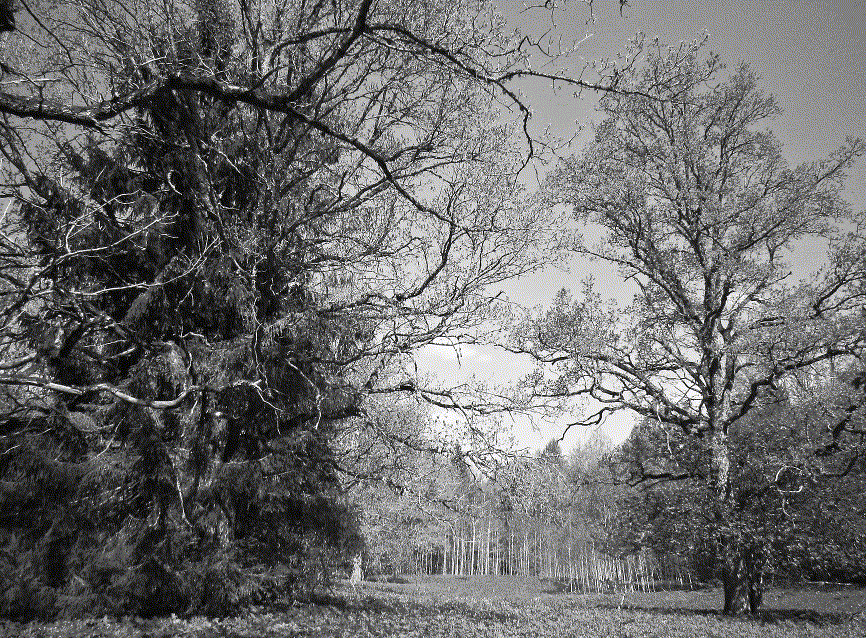
Photograph of the Lasila wooded meadow illustrating the overgrowth of an oak tree by spruce (on the left side of the photograph) and the Corylus-shrub partially shading the trunk of the other oak tree (on the right side of the photograph). In the background, saplings of aspen colonize the open part of the meadow in front of the overgrown forest-like part.

Within each of the three study sites, three study plots were selected, each with an area of 0·5 ha, and each with different canopy closure (Appendix 1). The distance between the study plots was at least 200 m. The dominant tree species in the selected plots were Quercus robur L., Populus tremula L., Acer platanoides L., Salix caprea L., Tilia cordata Mill. and Fraxinus excelsior L. Some coniferous trees, such as Pinus sylvestris L. and Picea abies (L.) H. Karst., occurred also in the subcanopy. The shrub layer was dominated by Corylus avellana L. In addition, there grew Sorbus aucuparia, Ribes alpinum L., Lonicerea xylosteum L. and Frangula alnus Mill. The cover percentage of the shrub layer in each study plot was estimated according to the Braun-Blanquet scale (Jongman et al. Reference Jongman, Ter Braak and van Tongeren1995).
A spherical densiometer was used to estimate the forest canopy cover. The canopy cover in each study plot was estimated at the centre of the plot and at 20 m from the centre in every cardinal direction. The average of these five estimates was used in data analyses.
We applied a stratified factorial sampling methodology to maximize the efficiency of the analytical apparatus, in order to ensure factorial completeness and to obtain unbiased quantitative estimates for critical environmental factors at the tree and stand scales. First, we stratified samples by tree species occurring in the plot. Second, within each tree species, we sampled an equal number of trees with and without L. pulmonaria as local pairs. In the study plot, we recognized all trees with Lobaria as ‘Lobaria-trees’. Thereafter, for each individual Lobaria-tree we described a potentially suitable but uncolonized host tree for L. pulmonaria as a ‘control tree’. The control tree was defined by two criteria: 1) the nearest neighbouring tree from the same tree species as the Lobaria-tree to avoid subjective selection of control trees and to increase the efficiency of revealing spatial neighbourhood effects; and 2) a trunk diameter of at least 8 cm to exclude tree saplings not suitable for establishment of L. pulmonaria. In our sample plots, L. pulmonaria was sometimes growing so abundantly that nearly all suitable deciduous trees without Lobaria were selected as control trees. Total sample size was 301 trees, consisting of 151 Lobaria-trees and 150 control trees (for one Salix there was no suitable match with acceptable size). We sampled the four most frequent tree species in the study stands: Quercus robur (n = 210), Acer platanoides (n = 34), Populus tremula (n = 32) and Salix caprea (n = 25). The number of sampled trees in the study plot varied from 23 to 50. The geographical co ordinates of all trees were recorded by means of GPS (GPSmap 60Csx, Garmin) to assess the distance between the trees.
The circumference of each sampled tree was measured at breast height (c. 1·3 m above ground level), the vitality of each sampled tree (healthy or senescent, the latter including unhealthy, partly dead, dried or damaged trees) was determined and the presence of trees and shrubs around the sampled trees (within 1 m) was recorded (Appendix 1). The maximum height of shrubs, within 1 m of each sampled tree, was also measured, as was the inclination of the trunk of the sampled tree, in degrees, using a compass.
Lobaria pulmonaria usually grows unevenly around the tree trunk, frequently preferring only one side of the tree bole. To determine the reason for such one-sided preference, we sampled two sides of each Lobaria-tree: the side with Lobaria (or with the highest coverage) and the side opposite to it (without Lobaria or with lower coverage). In the case of the control trees, the two contrasting sides were subjectively defined based on the cover of other epiphytic lichens and bryophytes (maximum vs. least cover), light conditions (most vs. least well lit) and inclination of the trunk (upper side vs. lower side). The methodology designating contrasting sides gives information on the range of environmental variation on the trunk, as well as general conditions from averaging two extreme values. The rationale for this methodology, in contrast to traditional fixed cardinal directions, lies in the environmental complexity of mixed woodland. For instance, direction to the nearest gap or evergreen conifer tree affects environmental conditions on the trunk more than cardinal direction. Hence our methodology helps avoid biased estimation of average conditions on the trunk and provides an option to use maximum values in addition to average estimates per tree as factors in models. We determined the cardinal position of both sides. The cover percentage of L. pulmonaria and the cover of bryophytes were estimated at a height of 2 m above the ground on both sides of the trunk (in 10% intervals). The roughness of the bark was also measured on both sides, using a vernier caliper; measurements were made in triplicate, at c. 1·3 m above ground level, and the average value was used in data analysis. Light conditions on both sides of the tree were measured, using a spherical densitometer at 0·5 m from the trunk. The minimum values of the ‘Light conditions’ variable were used in data analysis (Appendix 1).
For measurement of bark pH, two samples of the bark free of lichens and bryophytes were removed with a knife from both sides of the trunk on each sampled tree. The bark samples were air-dried and stored in paper bags until laboratory analysis. Bark pH was measured with a flat head electrode (Consort C532), applying a technique suggested by Schmidt et al. (Reference Schmidt, Kricke and Feige2001) and Kricke (Reference Kricke, Nimis, Scheidegger and Wolseley2002), with slight modifications by Jüriado et al. (Reference Jüriado and Liira2009).
We also recorded the presence of apothecia on L. pulmonaria for each sampled tree and evaluated their presence relative to the cover value of L. pulmonaria and other environmental variables.
Statistical analyses
We used the main effects of ANOVA (n = 301) to test for the difference in the average estimates of the tree properties and the environmental factors between the study sites, the tree species and the sampled trees (Lobaria-trees vs. control trees), to make sure that sampling was adequately balanced.
We applied a generalized linear model (GLZ) with the two-way stepwise selection procedure to study the probability of presence/absence of L. pulmonaria (n = 301) as dependent on the environmental variables, implemented in the program package Statistica ver. 7 (StatSoft, Inc. 2005). The model was assembled from variables describing the site and tree properties listed in Appendix 1. In the model, we used the Binomial error distribution, logit link-function and Pearson correction coefficient to correct for overdispersion.
The GLZ analysis was also applied to evaluate the influence of ‘Cover of Lobaria’ and environmental variables on the probability of occurrence of the apothecia of L. pulmonaria, using the same model settings as in the model described above. Only the sides of the Lobaria-trees with the lichen were considered in this model (n = 151).
We tested the response of the cover of L. pulmonaria to the influence of the environmental variables (n = 151) using a general linear mixed model (GLMM; Littell et al. Reference Littell, Milliken, Stroup and Wolfinger1996) with the stepwise selection procedure, implemented in the program package SAS ver. 8.2 (proc MIXED, SAS Institute Inc. 1989). The categorical factor ‘Sample tree’ was considered the random factor and ‘Tree side’ was treated as repeated observations of L. pulmonaria per sample tree. In the model building, we also tested interactions with the categorical factors ‘Tree species’ and ‘Tree side’; we also tested non-linear relationships between the factors. For multiple comparisons between the factors ‘Tree species’ and ‘Tree side’, we used the Tukey-Kramer adjustment. Akaike's information criterion (AIC; Akaike Reference Akaike, Petrov and Csáki1973) was used as an auxiliary tool to find an optimal model according to predictive power and to avoid overparameterization (Shao Reference Shao1997). Only the final model is presented.
In ANOVA and GLMM, the cover values of L. pulmonaria and the variables ‘Bark roughness’, ‘Circumference’ and ‘Distance’ were log-transformed to obtain the Normal distribution of residuals.
Results
Study plots and sample tree characteristics
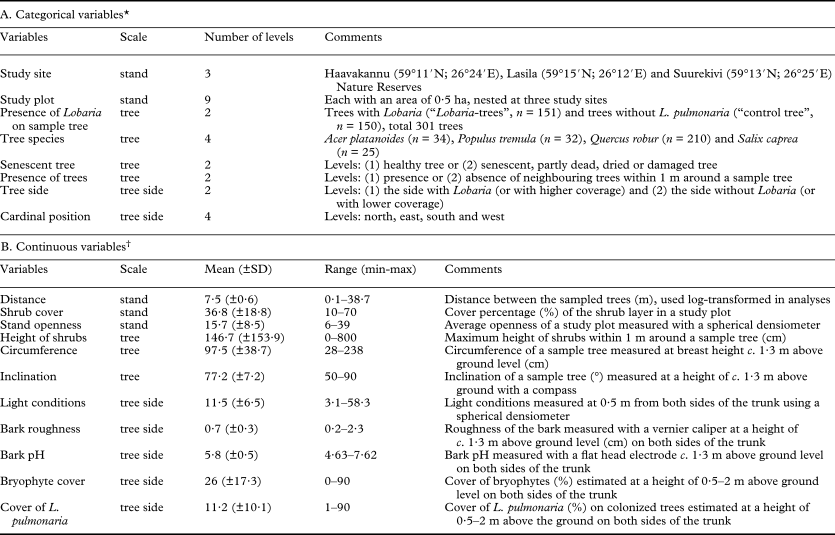
Among the nine investigated study plots, light availability (i.e. stand openness) varied between 6 and 39% and the cover of shrubs varied between 10 and 70%. The circumference of sampled trees varied between 28 and 238 cm, the inclination of the trunks was 50°–90°, and most of the tree boles were partially covered with mats of bryophytes (mean 26%). The pH of the tree bark varied from rather acid (4·63) to moderately basic (7·62) and the cracks in the bark were 0·2–2·3 cm deep. The mean cover of L. pulmonaria on colonized trees was 11% (Appendix 1). In the study area, L. pulmonaria was more common on Quercus robur (69·5%, n = 105), compared to Acer platanoides (11·3%, n = 17), Populus tremula (10·6%, n = 16) and Salix caprea (8·6%, n = 13). The geometric mean distance between the trees with L. pulmonaria was 6·5 m (quartile range, i.e. 50% of observations are between 3·9–11·6 m) and between the control tree and the nearest Lobaria-tree was 9·3 m (quartile range 6·1–14·7 m). According to the result of ANOVA, these means are significantly different (P <0·0001, F = 16·47).
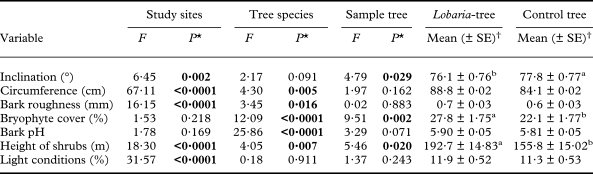
According to the main effects of ANOVA, the selected sites differed in their light conditions and height of shrubs (as prescribed in the sampling scheme) but also in some tree characteristics (average inclination, circumference and bark roughness) (Table 1). The characteristics of sampled trees and the height of shrubs near the trees differed also for the four deciduous tree species studied (Table 1), whereas light conditions were similar for all tree species (P = 0·911). Lobaria-trees and control trees revealed statistically significant differences in the mean values of trunk inclination, bryophyte cover, and height of shrubs near the tree. However, these differences were minimal in the ecological sense and proved significant only because of the large sample size (n = 301) (Table 1). For example, on average, the cover of bryophytes was 5·7% larger on Lobaria-trees than on control trees, the trunks of colonized trees were 1·7° more inclined than the trunks of uncolonized trees, and shrubs were 34 cm taller near Lobaria-trees than near control trees.
The results of main effects of ANOVA for the difference in the average values of the environmental variables between colonized (Lobaria-tree) and uncolonized trees (control tree), study sites and tree species (n = 301).

* Significant P values (P <0·05) in bold.
† Superscript letters denote homogeity groups.
Factors predicting the probability of occurrence, cover and fertility of Lobaria pulmonaria
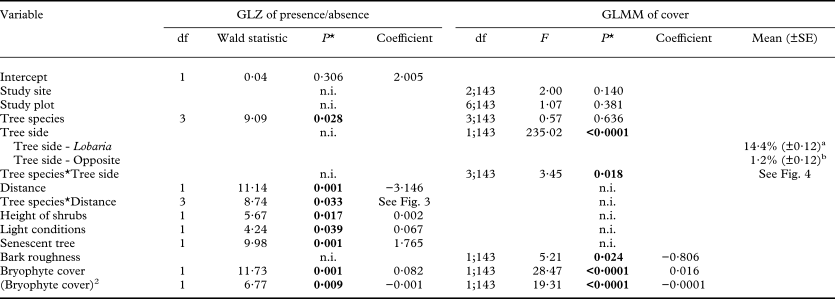
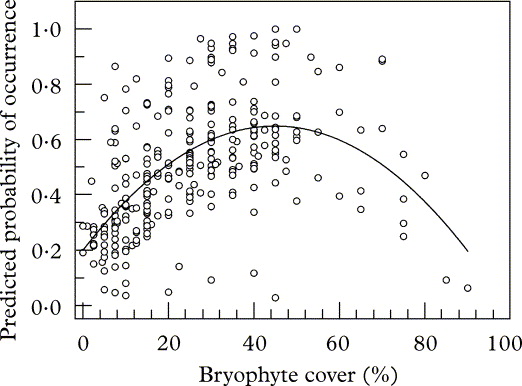
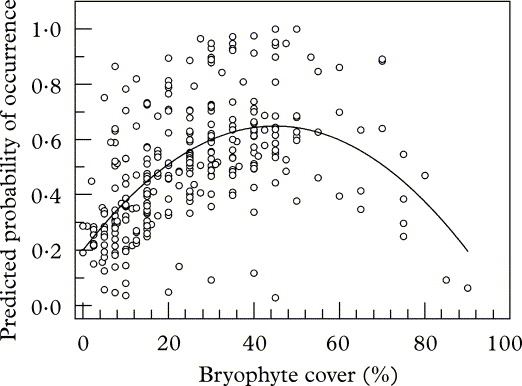
The modelling results show that the presence of L. pulmonaria was positively correlated with light availability and, at the same time, with increasing height of shrubs around the trunk (Table 2, left half). The probability of occurrence of L. pulmonaria also increased with increasing cover of bryophytes on the trunk, up to 50%, but decreased thereafter according to a unimodal relationship (Fig. 2).
The results of the Generalized Linear Model (GLZ†) analysis in terms of the dependence of presence/absence of L. pulmonaria on the environmental variables (n = 301) and the results of the General Linear Mixed Model (GLMM) analysis about the effect of the environmental variables on the cover of L. pulmonaria (log-transformed) (n = 151).
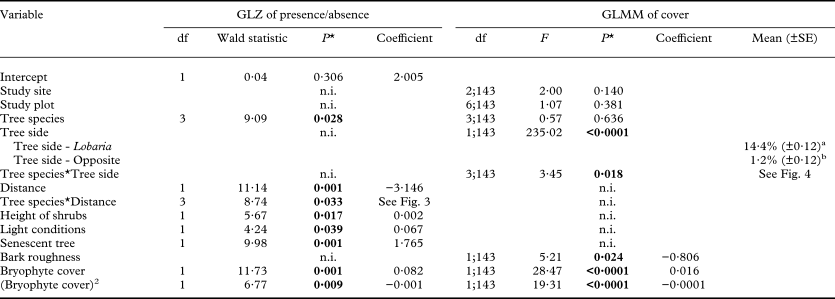
df, degree of freedom; Wald statistic, the value of Wald test statistic; F, value of F-criterion; P*, significant values (P <0·05) in bold; Coefficient, parameter estimate for a continuous variable in the model; n.i., not included.
† The specifications of the GLZ model are: Binomial error distribution, log-link function and Pearson correction-coefficient for overdispersion. In the GLMM model, the factor ‘Sample tree’ is treated as the random factor and ‘Tree side’ is treated as repeated observations per sample tree. The variables ‘Bark roughness’ and ‘Distance’ are log-transformed; ‘Tree side: ‘Lobaria’ – tree side with Lobaria, ‘Opposite’ – tree side without Lobaria or lower cover of Lobaria. Model coefficient estimates are presented for continuous variables; within-group mean values are presented for categorical variables, letter labels in superscript denote homogeneity groups according to the results of the Tukey-Kramer multiple comparison test. Factors not included in either model can be found in Appendix 1.
Predicted probability of occurrence of Lobaria pulmonaria on the mean cover of bryophytes according to the generalized linear model (GLZ) (see Table 2).
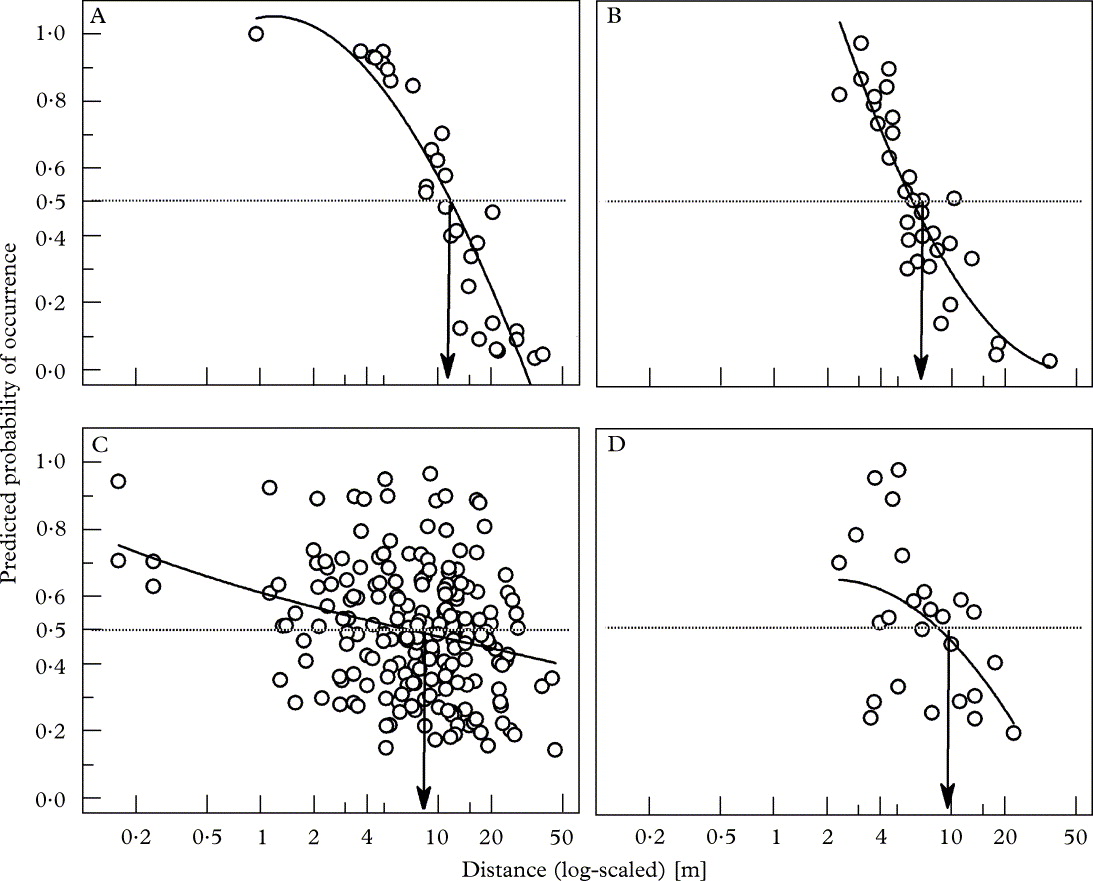
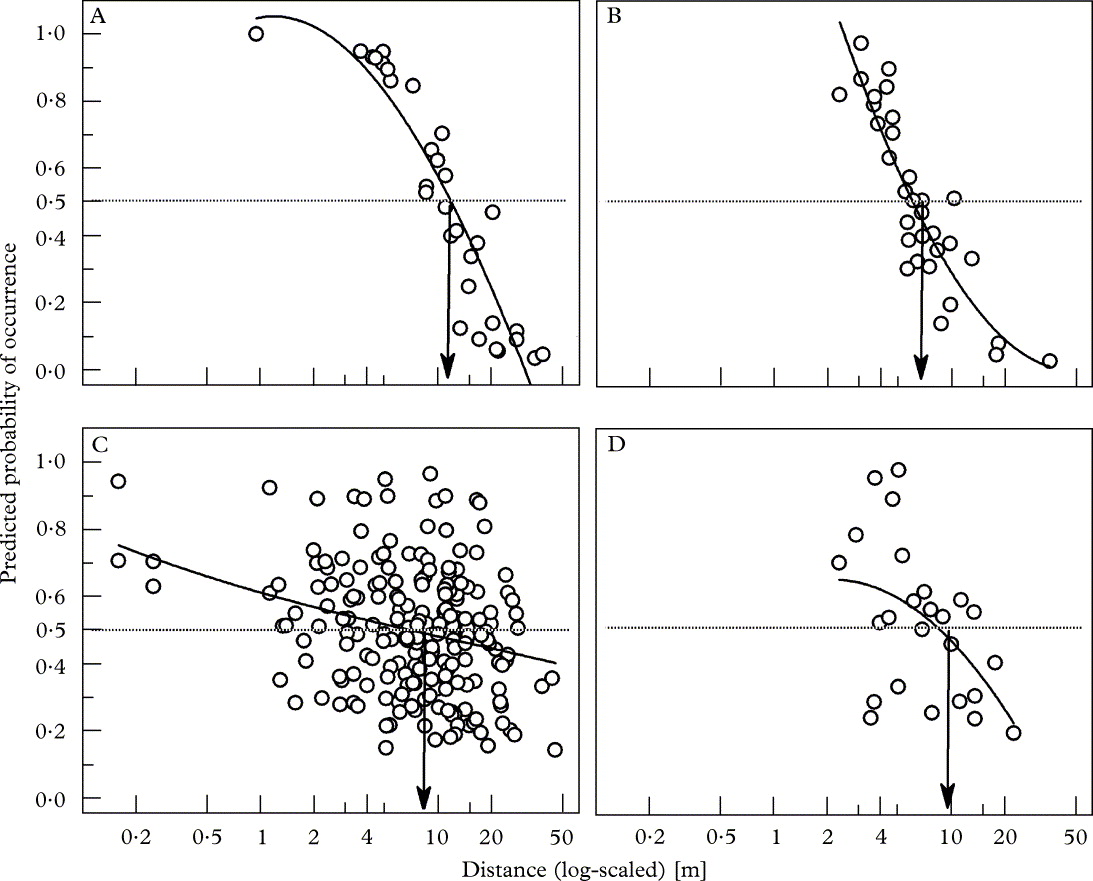
The probability of occurrence of L. pulmonaria was dependent on the host tree species and on the vitality of the tree. The probability of occurrence was also higher on the trunks of senescent trees (Table 2). The probability of occurrence of L. pulmonaria decreased with increasing distance from the nearest colonized tree. The probability of its occurrence was less than 50% when the neighbouring Lobaria-tree was at a distance of more than 10 m and less than 25% when the neighbouring Lobaria-tree was at distance of c. 20 m (Fig. 3). The significant term of interaction between host tree species and distance to the nearest neighbour tree indicated tree species-specific patterns (Table 2, Fig. 3), revealing the weakest effect of distance in the case of Quercus robur and strongest effect of distance in the case of less common trees such as Acer platanoides and Populus tremula.
Predicted probability of occurrence of Lobaria pulmonaria depending on the distance to the nearest source tree, according to the generalized linear model (GLZ) (see Table 2). A, Acer platanoides; B, Populus tremula; C, Quercus robur; D, Salix caprea. The arrow denotes the derivation of the distance between the target tree and the nearest neighbouring tree with L. pulmonaria at which value the occurrence probability of L. pulmonaria on the target tree is 50%.
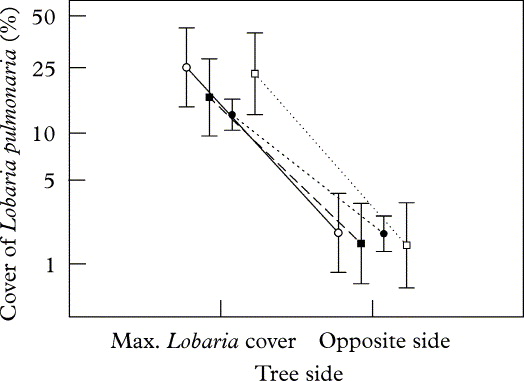
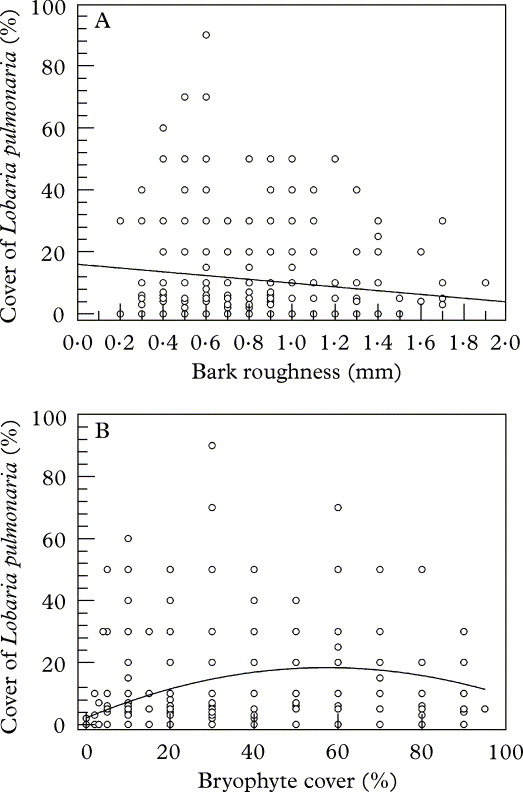
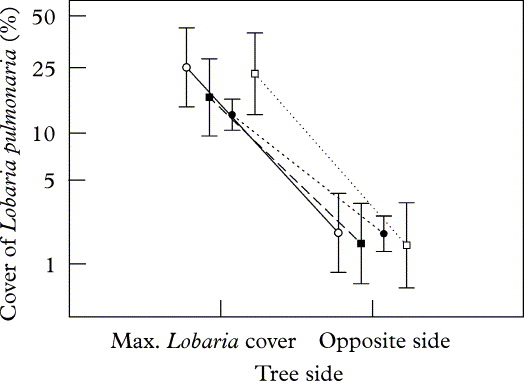
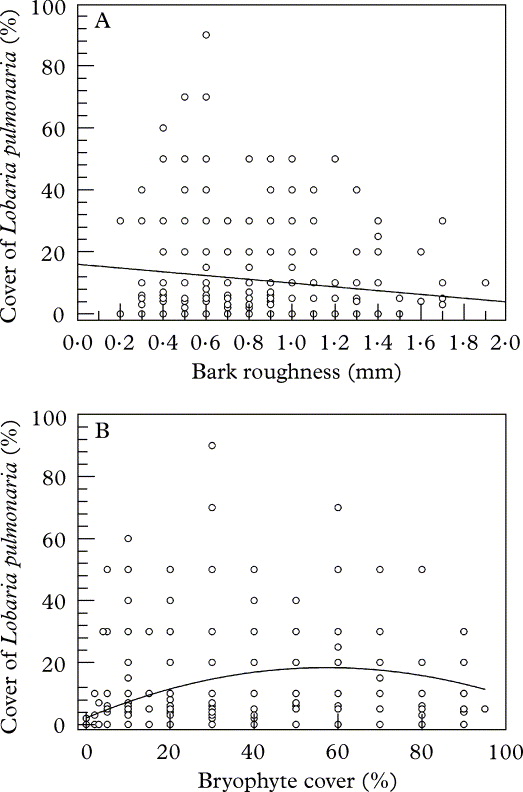
Targeting in the GLMM analysis on factors predicting the cover of L. pulmonaria on trunks and taking into consideration the effect of site and intentionally sampled contrast between the tree sides, ‘Tree side’ identity and the effect of tree species in interaction with ‘Tree side’ were significant (Table 2). Comparison between the tree side with the highest abundance of L. pulmonaria and the opposite side revealed the most contrasting cover values in the case of Acer platanoides and Salix caprea, and the most uniform distribution of cover values in the case of Quercus robur (Fig. 4). Additionally, the cover of L. pulmonaria on the tree trunk was negatively correlated with bark roughness (Table 2, Fig. 5A) and had a unimodal relationship with the cover of bryophytes (Table 2, Fig. 5B). The cover of L. pulmonaria increased with increasing cover of bryophytes up to 50–70%, thereafter the cover of L. pulmonaria decreased. This suggests that colonization by L. pulmonaria might be supported by bryophytes on tree trunks up to a certain limit, but in the case of a profusion of bryophytes, spatial competition between L. pulmonaria and bryophytes will determine the relationship (Table 2, Fig. 5B).
Cover (log-scale) of Lobaria pulmonaria on two sides of the trunk for different tree species according to the general linear mixed model (GLMM) (see Table 2). Trunk sides are defined as the side with maximum L. pulmonaria cover and the side opposite to it. ○ Acer platanoides; ■ Populus tremula; • Quercus robur; □ Salix caprea.
Relationships between cover of Lobaria pulmonaria and A, bark roughness and B, bryophyte cover (GLMM, see Table 2).
According to the results of the model building procedure, the probability of occurrence and cover of L. pulmonaria were not influenced by mean canopy cover of the stand, mean cover of shrubs in the study plot, presence of trees near the sample tree, tree-level parameters such as inclination and circumference of the tree trunk, pH of the tree bark or cardinal position of the trunk side, as these factors were insignificant in the models.
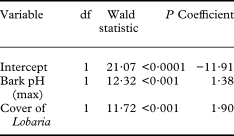
We observed apothecia at all three study sites and in almost every study plot. The percentage of trees with fertile thalli in the population was the highest at Haavakannu (36%) and less at Lasila (22%) and Suurekivi (14%). The probability of occurrence of apothecia was the highest at the maximum values of bark pH and increased with increasing cover of L. pulmonaria on the trunk (Table 3).
The results of the Generalized Linear Model (GLZ) analysis about the dependence of presence/absence of apothecia of L. pulmonaria on the maximum values of bark pH and cover of L. pulmonaria (log-transformed) on a sample tree (n = 151).

df, degrees of freedom; Wald statistic, the value of Wald test statistic; Coefficient, parameter estimate for a continuous variable in the model.
Discussion
Partly overgrown wooded meadows in the Pandivere Uplands support one of the largest populations of L. pulmonaria in Estonia (Andersson et al. Reference Andersson, Martverk, Külvik, Palo and Varblane2003; Jüriado & Liira Reference Jüriado and Liira2010). In this area, the presence of L. pulmonaria depends on light conditions near the trunk of host trees rather than on general light conditions in the habitat (e.g. average canopy cover). The presence of deciduous shrubs around the tree trunk is also a predictor of its higher probability of occurrence. Sheltering by shrubs could be especially important during the establishment of diaspores of L. pulmonaria. Hilmo et al. (Reference Hilmo, Rocha, Holien and Gaulaa2011) have reported that establishment success decreases with increasing canopy openness.
It has been reported that the occurrence and growth of L. pulmonaria is controlled by a delicate balance between light availability and desiccation risk, showing physiological trade-offs between the growth potential and fatal desiccation damage, both of which increase with increasing light (Gauslaa et al. Reference Gauslaa, Lie, Solhaug and Ohlson2006, Reference Gauslaa, Palmqvist, Solhaug, Holien and Hilmo2007). For L. pulmonaria in open habitats, there is a long-term risk of being killed by high light intensity during long periods with no rain (Gauslaa et al. Reference Gauslaa, Lie, Solhaug and Ohlson2006). In Estonia, this is the period of mid-summer. Such a risk probably occurs in managed wooded meadows with open canopies and few shrubs. Deciduous shrubs, mainly Corylus avellana, around the tree trunk could help maintain a favourable moisture regime on the tree bole as they protect the tree trunk from desiccating winds and direct sunlight during the summer period. In moist periods (spring and autumn), however, leafless deciduous shrubs provide improved light conditions for growth.
In a forested landscape, the occurrence of L. pulmonaria within a stand is most frequently found to depend on the diameter of host trees (Gu et al. Reference Gu, Kuusinen, Konttinen and Hanski2001; Riiali et al. Reference Riiali, A. Penttinen and Kuusinen2001; Mikhailova et al. Reference Mikhailova, Trubina, Vorobeichik and Scheidegger2005; Öckinger et al. Reference Öckinger, Niklasson and Nilsson2005; Edman et al. Reference Edman, Eriksson and Villard2008; Belinchón et al. Reference Belinchón, Martínez, Otálora, Aragón, Dimas and Escudero2009). However, in the Estonian wooded meadows we studied, the species grew on a large variety of tree species with a large variation in trunk diameters. For example, we found it growing on large oak trees (Quercus robur), representing substratum continuity during several hundred years, as well as on small-diameter trees, such as Salix caprea and Sorbus aucuparia. It has been reported that, under optimal climate and habitat conditions where L. pulmonaria is abundant, the species can grow on various trees, even those with small diameters, and even on moss-covered large stones (Hakulinen Reference Hakulinen1964; James et al. Reference James, Hawksworth, Rose and Seaward1977; Wolseley Reference Wolseley and Galloway1991; Istomina Reference Istomina1996; Carlsson & Nilsson Reference Carlsson and Nilsson2009).
In the current investigation, bark pH like the trunk diameter, was not correlated with the probability of occurrence and cover of L. pulmonaria. However, it has already been shown that bark pH is an important factor limiting the establishment of L. pulmonaria from propagules (Scheidegger et al. Reference Scheidegger, Frey, Walser, Kondratyuk and Coppins1998; Wolseley & James Reference Wolseley and James2000). In habitats where L. pulmonaria is abundant, it seems that the pH of the substratum is less important, as in the studied stands L. pulmonaria was also growing on lower shaded twigs of spruce (Picea abies) (bark pH of 3·70–4·50) and on the coniferous shrub Juniperus communis (bark pH 3·60–3·99). The specimens growing on spruce and juniper had obviously fallen from deciduous trees and attached to coniferous branches.
Regarding the colonization success of lichens on trunks, bark roughness is reported to facilitate the attachment of lichen diaspores to the substratum (Ranius et al. Reference Ranius, Johansson, Berg and Niklasson2008). In the case of L. pulmonaria, neither transplantation studies (Scheidegger et al. Reference Scheidegger, Frey, Walser, Kondratyuk and Coppins1998) nor field surveys (Öckinger et al. Reference Öckinger, Niklasson and Nilsson2005) have found any correlation with bark structure. In the current investigation, bark structure did not differ between Lobaria-trees and control trees, nor did it predict the probability of occurrence of L. pulmonaria on trees. It is possible that, at our study sites, L. pulmonaria was too common to reveal the bark structure-establishment relationship. We did find, however, that L. pulmonaria was more abundant on trunks with lower bark roughness, which indicates that the lichen has some preference for the bark of middle-aged trees with low or medium bark roughness. Regrettably, we did not record the abundance of juveniles on tree trunks, which would more directly indicate establishment success.
We also found that the probability of occurrence of L. pulmonaria and its cover on the host tree was positively correlated with cover of bryophytes, that is bryophytes facilitated the growth of L. pulmonaria. Yet this relationship was only valid up to a certain abundance of bryophytes, as we observed a unimodal relationship between cover of bryophytes and occurrence and cover of L. pulmonaria. It has been shown that some bryophytes may out-compete L. pulmonaria (Wolseley & James Reference Wolseley and James2000) and a dense bryophyte mat can also hinder the establishment of diaspores (Scheidegger et al. Reference Scheidegger, Frey and Zoller1995). At the same time, a moss mat on tree trunks helps maintain suitable humidity conditions on the bole (Veneklaas et al. Reference Veneklaas, Zagt, Van Leerdam, Van Ek, Broekhoven and Van Genderen1990) and supports more suitable growing conditions for cyanolichens in comparison to the bare bark (Sillett & McCune Reference Sillett and McCune1998). Nonetheless, the presence of mosses on the tree bole is not always obligatory for L. pulmonaria colonization, as it grows well also on the bare bark (Öckinger & Nilsson Reference Öckinger and Nilsson2010).
An interesting additional finding of our case survey is the higher probability of occurrence of L. pulmonaria on damaged or senescent trees, which might be interpreted as its preference for mineral-rich microsites (Gauslaa Reference Gauslaa1995). It has been shown that many lichens and mosses survive well around wounds or on nutrient streaks that have higher pH than the rest of the trunk (Gilbert Reference Gilbert1970). We suggest that L. pulmonaria might profit from improved light conditions and flow of rainwater on the tree trunk, as the crown of these damaged or senescent trees is incomplete and the canopy above the trunk is open.
Population genetics studies of L. pulmonaria in wooded meadows of Estonia showed a high rate of clonal spread within distances of 15 to 30 m (Jüriado et al. Reference Jüriado, Liira, Csencsics, Widmer, Adolf, Kohv and Scheidegger2011). Evidence for source-sink dynamics (Gaggiotti Reference Gaggiotti1996) was found; it was concluded that old trees harbour a higher number of different multilocus genotypes and act as a source of vegetative diaspores, while younger trees between the old ones can be considered sink substrata (Jüriado et al. Reference Jüriado, Liira, Csencsics, Widmer, Adolf, Kohv and Scheidegger2011). Their low estimate for the dispersal range was confirmed by the present study: probability of occurrence of L. pulmonaria decreased with increasing distance from the nearest colonized tree and dropped below 50% even at a distance less than 10 m (Fig. 3). This estimate of the limiting distance might be slightly underestimated because the spatial relationship was studied under conditions of multiple source trees in the sample plot. At the same time, actual sources might have been located at greater distances. Our observed effective dispersal distance is several times shorter than that suggested by previous studies (Kalwij et al. Reference Kalwij, Wagner and Scheidegger2005; Öckinger et al. Reference Öckinger, Niklasson and Nilsson2005).
The results of the current study and our previous study (Jüriado et al. Reference Jüriado, Liira, Csencsics, Widmer, Adolf, Kohv and Scheidegger2011) suggest that sub-optimal host trees can be colonized only if they are situated very close to other colonized trees. Hence, dispersal success profits from the ‘mass-effect’ (Shmida & Wilson Reference Shmida and Wilson1985). Consequently, in order to preserve and support the viability of L. pulmonaria populations in woodlands, suitable host trees must grow in the vicinity of 10–20 m from the source tree and from each other, so that further dispersal is enhanced.
In many of the previously investigated populations of L. pulmonaria elsewhere, fertile specimens were either absent (Gu et al. Reference Gu, Kuusinen, Konttinen and Hanski2001) or the number of apothecia found was low (Gauslaa Reference Gauslaa2006; Öckinger & Nilsson Reference Öckinger and Nilsson2010). In the populations studied in north-eastern Estonia, trees with fertile individuals accounted for 14–36% of all Lobaria-trees. This is consistent with the results of fertility studies carried out in North America, where the described within-population frequency of fertile thalli was up to 25% (Denison Reference Denison2003) or even 30% (Edman et al. Reference Edman, Eriksson and Villard2008). Similarly, in Northern Europe, in Åland Islands (SW Finland), about 25–30% of trees harboured fertile individuals in some luxuriant populations of L. pulmonaria (Carlsson & Nilsson Reference Carlsson and Nilsson2009).
On the tree scale, like Edman et al. (Reference Edman, Eriksson and Villard2008), we found that the presence of apothecia correlated significantly with abundance of the lichen. Environmental conditions also play an important role in determining the presence of apothecia. Edman et al. (Reference Edman, Eriksson and Villard2008) have noted that fertile individuals are more frequent in uncut stands while Öckinger & Nilsson (Reference Öckinger and Nilsson2010) failed to find any correlation between fertility of L. pulmonaria and habitat characteristics. We found that the presence of apothecia increased with increasing bark pH. In combination with the results of an earlier study (Jüriado et al. Reference Jüriado, Liira, Csencsics, Widmer, Adolf, Kohv and Scheidegger2011) we suggest, therefore, that bark pH plays a role in the production of apothecia, but this effect is evidently related to population size, continuity of the stand and suitability of growing conditions.
Conclusions
The results of our study show that partially overgrown wooded meadows provide favourable environmental conditions for L. pulmonaria in the region of hemi-boreal forests, serving as important habitats with high conservation concern. However, during the secondary succession of these wooded meadows into deciduous woods, increasing canopy cover with low light conditions beneath will undoubtedly restrict the growth of L. pulmonaria. To maintain optimal light conditions for this species, moderate management of the habitat by means of tree and shrub thinning is needed, particularly of conifers. Lobaria-trees and potential host trees for L. pulmonaria should be spaced, on average, 10–20 m from each other. The potential host trees in such areas include, primarily, Quercus robur, as well as other deciduous trees with sub-neutral bark pH and a moderate cover of bryophytes on the tree trunk. Also, in long-term conservation planning, regrowth of potential host trees should be promoted to ensure the continuity and vitality of the L. pulmonaria population. When thinning the shrub layer, some deciduous shrubs near the trunk of colonized tees and near potential host trees should also be preserved.
We are very grateful to Urmas Karu who participated in the fieldwork. Ester Jaigma is acknowledged for revising the English text of the manuscript. Financial support was received from the Estonian Science Foundation (grants Nos. 7816 and 7878), the Ministry of Education and Research of Estonia (target financing Nos. SF0180153s08 and SF0180012s09), and the European Union through the European Regional Development Fund (FIBIR Center of Excellence).
Explanatory variables used in data analyses.

* A, categorical variables: number of levels.
† B, continuous variables: mean values with standard deviation (SD) and the minimum–maximum range.