


1. INTRODUCTION
In shipping, the IMO is working on various fronts to reduce the emissions of polluting gases (sulphur oxides, nitrogen oxides and particulate matter) and of greenhouse gases (mainly CO2) into the atmosphere. The first line of action is aimed at establishing a mandatory maximum index of CO2 emissions for new builds. The second line of action focuses on already-built vessels and attempts to achieve a reduction in emissions. This plan needs to be approved and involves finding technically and economically feasible solutions. In the third line of action, an Emissions Trading Scheme (ETS) aims to reduce or offset emissions.
To a great extent, these emission control measures will affect how vessels' auxiliary systems are currently powered, the way maritime fuels are improved and, above all, how Short Sea Shipping (SSS) is used, given that there are at present alternative means of transport, such as roads and railways.
In terms of legislation, Annex VI of the MARPOL Convention enters into force, imposing limits on the vessels' emissions of nitrogen oxides (NOx) and sulphur oxides (SOx). It bans the use of certain substances that deplete the ozone layer. Its revision is due to enter into force on 1 January 2012 to establish a maximum content of sulphur for onboard fuels of 3·5%, instead of the current 4·5%. From 1 January 2020, this will be reduced to 0·5%.
The European Union (EU), in the strategy described in the COM (2002) 595 final [1], marks a turning point in the protection policy against atmospheric pollution from vessels. 42% of the EU's domestic shipping and 90% of its trade with non-European countries is transported by sea. The energy consumption and CO2 emissions per tonne and mile travelled by ship is approximately 25% of fuel consumption by road. Therefore, the EU has established as a fundamental strategic objective the reduction of polluting and greenhouse gas emissions by transferring the transport of goods by road to SSS and motorways of the sea. Despite these measures, it is estimated that, by 2020, vessel emissions of sulphur oxides (SOx), nitrogen oxides (NOx) and particulate matter (PM2·5) in EU waters will increase by 40%, 50% and 55%, respectively, compared with 2000 levels.
Oil prices are fluctuating. Sulphur will gradually be eliminated from fuels, forcing shipbuilders to use high-quality diesel fuel (over 50% more expensive than heavy fuel oil). Moreover, there has been firm backing for penalties against vessels that emit CO2 above set values. The maritime sector faces the obligation and challenge to seek alternatives to oil based fuels and help prevent environmental pollution. At the same time companies have to generate reasonable profits when operating vessels.
2. ALTERNATIVES TO OIL BY-PRODUCTS
Several alternatives are proposed to reduce or to replace fossil fuels onboard a ship: sails; kites; electricity in ports, biodiesel; wind turbines; photovoltaic panels and hydrogen fuel cells. They can be used on their own or in conjunction with what are called hybrid systems for power generation onboard a ship. These are green energy generation systems that use renewable or clean energies. For the purposes of this study, these alternatives are arranged into three groups, based on the functions they perform on the ship.
2.1. Sails and Kites
The sole function of sails and kites will be to assist the propulsion of the vessel. Both systems, through the use of wind power, will provide savings in the fuel consumed by the ship's main engine.
2.1.1. Sails
In 1995, the Danish Department of Environment and Energy subsidized a study by the consultancy firm, Knud E. Hansen A/S, to look into sail propulsion for merchant vessels. As a result, the company between 1995 and 1999 developed a model tanker of 200 m length and 50,000 dwt designed to transport oil products, with sail-assisted propulsion in the form of wingsails (Figure 1). The feasibility studies for this project reached these conclusions:
• The vessel had an estimated cost increase of 10%.
• Fuel savings varied between 20% and 27% for certain routes, depending on the average speed of the vessel.
• The ideal market segment for using sails on commercial vessels is long-distance bulk transportation. Fuel consumption is greatly reduced by lowering the vessel's speed. If, at the same time, the revenues per freight are maintained when the transported load volume is increased, money is saved. Another factor is if these types of loads run north-south, parallel to the major wind systems of the planet.
Sails are not technically feasible in containerships due to the particular arrangement of the cargo, which takes up the whole open deck. This unfavourable load arrangement is also present in multi-purpose and general cargo vessels. Sails made of photovoltaic solar panels may make this alternative more attractive in the future. Electric energy could be produced aboard while the vessel has an auxiliary form of propulsion.
Modern windship.

2.1.2. Kites
Kites are a revolutionary system in the area of commercial vessel propulsion and have become more widespread recently. Their efficiency is based on the high altitude at which they operate, where wind speeds are much greater than on the sea surface. This produces greater thrust forces using the same sail area associated with traditional sails. The area of the kites used to tow cargo vessels varies between approximately 150 and 600 m2. They are attached to the vessel by means of a cable to the so-called towing point (normally situated forward of the forecastle), and hence to the winch, which will release or pull the cable depending on the thrust required. A computer on the bridge processes all the information received by the system's sensors and controls the skysail accordingly. (See Figure 2.)
Kites.

The advantages of kites over conventional sails are:
• The system can readily generate propulsion power per square metre of sail five times greater than that generated by conventional sails.
• They can be installed easily and at low cost, in any type of vessel in service.
• The cost of acquisition, assembly and maintenance is notably lower than that of conventional sails.
• The effect on the heel of the ship caused by the force applied to the sail surface is minimized with kites, as this force is transmitted to the vessel towing point.
• They do not interfere with loading and unloading of the ship in port or when going under bridges. Kites are always collected and stowed three miles from shore.
• When kites and their supporting systems are stowed, they take up little room and the additional weight to the ship is not significant.
• Their handling does not require additional specialized crew.
2.2. Electricity in port
This is to power the vessel's auxiliary services (lighting, heating, air conditioning and hot water) while the ship is docked. In its programme Clean Air for Europe (CAFE) towards a strategy in favour of air quality, the European Commission confirmed that ship engine emissions while at port were insufficiently regulated. This ties in with the IMO. The Commission therefore published a recommendation ‘to promote the use of electricity by ships docked in Community ports’ [2] in May 2006.
In the U.S.A. this method for reducing emissions into the air while ships are docked is known as Alternative Maritime Power (AMP) or cold ironing. It will be implemented in six Californian ports from 2010. In June 2004, the Port of Los Angeles, together with the shipping company China Shipping Container Line, announced the opening of the first container terminal in the world using this type of operation. Neighbouring Los Angeles and Long Beach ports decided to set up a joint strategy to reduce emissions, resulting in the San Pedro Bay Ports Clean Air Action Plan (CAAP). This plan establishes that, within five to ten years, all cruise and container ship terminals will be equipped with this system.
The typical configuration of a shore-side electricity connection includes:
• A connection to the national grid carrying electricity from 20 to 100 kV from a local substation, where it is converted to between 6 and 20 kV.
• Cables to allow electricity distribution between 6 and 20 kV from the substation to the port terminal.
• Where necessary, electrical frequency conversion from 50 to 60 Hz.
• A cable reel, a winch and a system to load and unload cables from the ship.
• A connection onboard the ship to connect the cable.
• An onboard voltage transformer to transform high-tension electricity to 400 V.
• Electricity that is distributed to the ship, with auxiliary engines turned off.
Advantages:
• Carbon dioxide (CO2) and Nitrous Oxide (N2O) are reduced by more than 50% and Carbon monoxide (CO) by more than 99%.
• Their widespread use could be very significant, with potential emission reductions for vessels of up to 70%.
• The vibration and noise generated by auxiliary engines is eliminated.
Disadvantages:
• It cannot be used in vessels at sea.
• In ships that use onboard energy for loading and unloading operations, such as oil tankers, installing this system can be difficult, requiring major and costly conversion work.
• The implementation of this system in ports has to be the first step to persuade shipbuilders to adapt their ships. Private investment is subject to prior public investment.
2.3. Biodiesel, wind turbines, photovoltaic solar panels and hydrogen fuel cells
The main function of this group of alternative sources will be to generate electrical power for auxiliary systems, although they will also be able to provide propulsion.
2.3.1. Biodiesel
Biodiesel is a fuel derived from biomass (biofuels) for diesel engines. Taking into account that almost all propulsion and power generation systems for merchant ships now consist of diesel engines, it is clear that biofuels can play a major role in this sector. Vegetable oils, in particular rapeseed oil, work best, although these fuels can also be obtained from:
• Discarded cooking oil: this is one of the alternatives with better prospects since it is the cheapest raw material and, when used, the cost of treating it as waste is avoided.
• Animal fats.
• Other sources, notably single-cell algae. These accumulate in water reservoirs and residual waters and need little more than carbon dioxide and light to grow. While one hectare of soya yields around 560 litres of biodiesel, one hectare of algae could yield, in theory, more than 45,000 litres of biodiesel per year. Furthermore, soya is harvested once a year whilst algae can be gathered daily, making its cultivation in very diverse places possible.
As for its commercialization, biodiesel can be pure or mixed with diesel oil. The letter B (from biodiesel) followed by a number that indicates the proportion of the mixture is used to identify it i.e. B100=Biodiesel in a pure state.
Advantages:
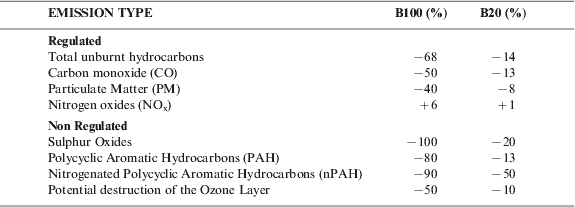
• There is a significant reduction in the pollutants emitted into the air (See Table 1).
• It biodegrades in watery solutions, degrading between 85% and 88% in a 28-day period.
• It can be used in any conventional diesel engine and can be stored in the same tanks as diesel without any additional modifications or investment.
• The energy balance is positive, with a ratio of 1 (input)/2·5(output).
Disadvantages:
• It entails high production costs, about twice that for diesel oil.
• The market price is higher than that of conventional diesel for ships. Also, as a result of its energy contents, 1,163 litres of biodiesel are needed to substitute 1,000 litres of diesel oil, and therefore, the use of MGO and DGO in vessels is more than 30% cheaper than biodiesel.
• It has harmful effects on the environment: destruction of forest and jungles for this type of crop and increased emissions of nitrogen oxides (NOx).
• The refuelling infrastructure for ships at port is still in the early stages of development.
• The current production of biodiesel is around 10% of the global market of diesel.
• Problem of space: producing one tonne of biodiesel requires three hectares of cropland.
Abatement of polluting atmospheric emissions.
2.3.2. Wind turbines
In wind turbines energy from the wind acts on the blades, making a generator spin. This in turn converts rotational mechanical energy into electrical energy [Reference David3]. Their characteristics are:
• They use the wind's clean and renewable energy.
• They have to be installed on the vessel's open deck.
• Its energy production is not continuous owing to the random existence of adequate wind conditions.
• Their most significant application in vessels is as part of a hybrid energy system, working in combination with hydrogen fuel cells. In these systems, the electricity produced by wind turbines will be used to generate hydrogen through the electrolysis of water and this is used to charge the cells.
The most developed wind turbines are those of the Horizontal Axis Wind Turbines (HAWT) type, an excellent method of generating electrical energy on land. Their application on merchant ships is very attractive considering that the wind force is greater at sea than on land and, hence, a better performance is yielded. The technical feasibility of onboard installation will be analysed based on their main dimensions: blade diameter, the axis rotation height, base diameter and weight.
In merchant vessels, the most frequent power range for auxiliary engines varies between 300 and 900 kW: To provide this type of power, a horizontal-axis wind turbine (HAWT) would need to have blades with diameters varying between 30 and 50 metres respectively and a weight of up to 80 tonnes. These dimensions would have a detrimental impact on the ship's stability. For this reason, it is advisable to install various HAWTs with less power, whereby their combined power would equal that of wind turbines of bigger dimensions. Thus, their blade dimensions are reduced, the added weight is evenly distributed and the negative impact on vessel stability is compensated. (See Figure 3.)
Vessel with horizontal-axis wind turbines.

Vertical Axis Wind Turbines (VAWT) perform better than HAWTs with air turbulence, changes in wind direction and high-speed winds. Owing to their low altitude they also have less impact on the ship's stability, and this in turn makes their maintenance easier. However, they produce 50% less energy than HAWTs. This means that, to produce similar power, VAWTs are significantly larger than HAWTs and this fact makes them inferior to the latter. The best known example of VAWT use in a merchant vessel is that of the Hydrogen Challenger, a 66 m long coastal tanker that produces oxygen and hydrogen. (See Figure 4.) Despite the fact that HAWTs are best suited to merchant vessels, their installation is not always possible. They cannot be installed on vessels, such as containerships or multipurpose ships, in which loads are stowed on open decks. Nor would their installation be possible on passenger ships, chemical tankers and gas carriers. They could, however, be installed on bulk carriers, Ro-Ro's and oil-tankers. In the third case, they could be symmetrically installed on port and starboard, over the transversal bulkheads that separate the tanks.
Vessel Hydrogen Challenger.

2.3.3. Photovoltaic Solar Panels
Connected in series and in parallel, photovoltaic solar panels are made up of solar cells with identical characteristics. These absorb light (solar energy) and convert it into electrical energy. Modern solar cells are made of semiconductor materials that have specific electrical properties, silicon being that most commonly used [Reference Martín Jiménez4]. Photovoltaic solar panels have general characteristics similar to those outlined above for wind turbines:
• They feed on clean renewable energy, in this case from the Sun.
• They must be installed on the open deck of the ship.
• Their energy output is not continuous due to the lack of sun during the night and the uncertainty of its presence during the day.
• Their most frequent application on ships is in combination with hydrogen fuel cells as part of power generation hybrid systems.
If 9 m2 panels are needed to produce 1 kW of electrical power and the most common power range for auxiliary engines for merchant vessels varies between 300 and 900 kW, then 2,700 to 8,100 m2 of photovoltaic solar panels will be needed. Arranging these big free areas on open deck is not possible for all vessel types or sizes. Therefore they are not suitable for container, multipurpose and passenger ships. They are well suited however for oil tankers, bulk-carriers (with panels on cargo hold hatch covers when these are the side-opening- sliding type) and Ro-Ro's. They can also be installed on gas carriers, with the panels arranged as spherical tank covers. The only drawback with this type of arrangement is that its performance will never be optimum owing to the different orientations it has with the Sun. (See Figure 5.)
Solar Sailor, catamaran ferry with eight photovoltaic solar panel sails.

Recently, the British company, Coros Colors, launched an amazing initiative expected to be marketable in 2012. It could mean a revolution in terms of using solar energy for ships: spraying a nanocrystalline coating onto solar cells. These cells would be used to cover the steel roofs of shops, supermarkets and factories, thus producing authentic solar panels. On ships, the more immediate application would be on cargo hold hatch covers or open, superstructure decks. In the future it could be applied to rigid construction sails.
These cells, known as Dye Sensitised Semiconductor Cells (DSSC), consist of titanium oxide nanostructures, capable of an 11% electrical yield. Furthermore, their manufacturing cost is low, in contrast with that of silicon cells.
2.3.4. Hydrogen fuel cells
Hydrogen fuel cells are electrochemical devices that can convert the chemical energy contained in hydrogen into electrical energy, yielding water as the only by-product. They are similar to batteries, except that they are designed to produce electricity continuously, provided that hydrogen and oxygen are supplied from an external source. Batteries, on the other hand, have a limited capacity [5]. Hydrogen is the most abundant element on Earth. It makes up more than 80% of all matter in the universe and can be found mainly as part of water, biomass and hydrocarbons. It is therefore necessary to produce it through another source of energy; an ‘energy vector’, i.e. an energy carrier.
Almost 95% of hydrogen is produced from hydrocarbons (primarily natural gas) through a two-step process called steam reforming:
CH4+H2O→CO+3H2
CO+H2O→CO2+H2
As a result, CO2 is released into the atmosphere and the process turns out to be polluting.
Since the infrastructure needed in ports for ships to refuel hydrogen is not even in the design phase, ships carrying hydrogen fuel cells will need a short and medium term means of producing and storing hydrogen onboard. An interesting application on ships is by means of water electrolysis, a process in which electric current passing through water produces a disassociation of its molecules into hydrogen and oxygen. This is a clean hydrogen generation system. The electricity required can be provided using renewable energy, such as wind or solar power (power generation hybrid systems).
Advantages:
• High yields result from the process of obtaining electricity (two to three times that of an internal combustion engine).
• Hydrogen stocks are limitless. This is not the case with oil; energy systems based on this type of product are precarious.
• When operating the hydrogen fuel cell, water is the only waste. This is a zero emission, clean energy.
• Low levels of noise are produced, less than a quarter of those produced by diesel generators.
• It is easy to use and maintain, working at low temperatures and having very few moving parts.
• It is versatile in that it can be part of hybrid systems in combination with other renewable energies, such as wind, solar or photovoltaic.
Disadvantages:
• At present, the estimated investment cost to produce a hydrogen fuel cell system is about 6,000 Euros per kW.
• The technology has not undergone sufficient testing; there will be certain risks for innovators.
In recent years, polymer membrane hydrogen fuel cells (PEMFC) have been used to power submarines, with satisfactory results. Specifically, this type of cell was assembled in the submarines 212-A (nine BZM 34 modules) built for the navies of Germany and Italy and the 214 (two BZM 120 modules) for Greece and South Korea (See Figure 6). Additional benefits of this type of fuel cell, making it very attractive for installation on commercial vessels, are that it has unlimited power; quick starts and stops; a completely modular design of the propulsion system; high performance, especially with partial loads; easy automation; and an excellent dynamic response, with the ability to withstand overloads during short periods of time. They are also small, so that a large number of modules can be installed in the spacious engine rooms of merchant ships (see Table 2).
BZM 34 (left) and BZM 120 (right) hydrogen fuel cells.

Power and main dimensions of BZM 34 and BZM 120 hydrogen fuel cells.

3. ECONOMIC ANALYSIS
An economic analysis of these alternatives will be carried out in a similar way to the presentation of its technical feasibility. This will again be divided into three groups based on the functions they perform onboard the ship.
3.1. Economic analysis of sails and kites
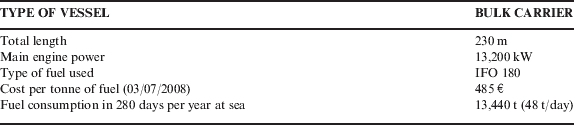
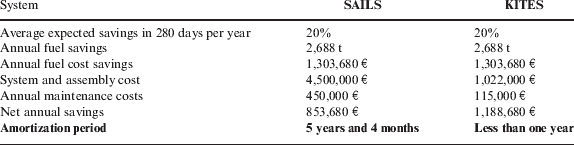
These propulsion support systems can provide significant fuel savings to the main engine of the ship, resulting in reduced operating costs and air polluting emissions. Table 3 shows the depreciation period of these systems calculated for a 230 metres, 70,000 dwt bulk carrier, whose new market price is 45 million Euros. The difference between the expected savings in fuel (assumed to be 20% for both systems) and the annual maintenance costs (about 10% of the purchase cost of the equipment), represents the total annual net savings that each system provides. Hence, the amortization period for sail systems is slightly higher than five years, while that of the kites less than one year. Although the former offers a reasonable figure from an investor's point of view, kites have a surprising amortization period, with an additional competitive advantage in comparison with sail systems.
Amortization period for a 230 m bulk carrier.
3.2. Economic analysis of electricity in port
Recommendation 2006/339/EC assesses the economic impact of reducing air polluting emissions resulting from 500 berths for vessels with medium size engines. In that study, it seems that there are many cases in which the benefits of electricity in port outweigh the costs, and in some cases these benefits reach several levels of magnitude.
3.3. Economic analysis of biodiesel, wind turbines, photovoltaic solar panels and hydrogen fuel cells
The study of electric power generation costs for auxiliary systems on a ship is divided into five sections:
• Investment costs: The costs for the generating equipment (diesel engines, wind turbines, solar panels, …) are extracted from various publications and data provided by manufacturers. The cost of installation is included.
• Operating costs: These relate primarily to fuel costs for the generating equipment.
• Maintenance costs: These vary between 1%–5% of the initial investment, depending on the type of generating equipment.
• Financial costs: This calculation assumes an investment amortization period of 20 years at 6% interest.
• Emission costs of CO 2: Currently it is about 15 €/tonne, especially in the case of fossil fuels. This figure results from the fact that burning 1 tonne of conventional fuel produces 3 tonnes of CO2.
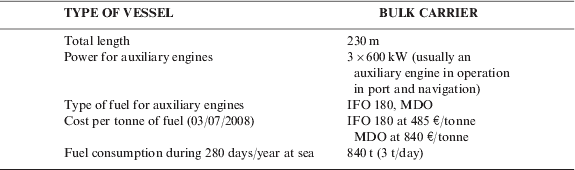
The study used the same type of vessel as for section 3.1 and the specifications for the vessel are shown in Table 4. It is very important to note that, although the study has been done on a bulk carrier of particular characteristics, the results and the conclusions obtained can be applied to any type and size of vessel that allow the installation of the proposed systems to generate energy onboard. This is because the only costs that may vary when selecting another type of vessel with different auxiliary power would be that of fuel consumption, and this is small change that would not affect the analysis of these results.
Specification data.
At present, the infrastructure needed to refuel hydrogen in ports does not exist. Consequently, hydrogen cell fuels have been considered as part of power generation hybrid systems, working in combination with wind turbines or photovoltaic solar panels. With this arrangement, the fuel cost for hydrogen fuel cells will be the cost of the electrolysis process for obtaining the hydrogen that will be used. Because the electrolysis process will be aided by wind turbines or solar panels onboard, the cost of fuel for the hydrogen fuel cell, the investment cost for these systems, can be estimated per kW.
From the results, shown in Table 5, it can be seen that renewable energies are marked by high initial investment costs and consequently high financial costs. Conventional energies, by contrast, have very high operational costs (fuel consumption) and significant costs with CO2 emissions, exceeding by more than double the investment. Broadly speaking, all of this results in lower total costs for renewable energies. An exception to this would be biodiesel, which is the most expensive alternative.
Cost calculation results.

These results would be even more favourable for renewable energies if this study included the environmental impact associated with conventional energies which, even today, have not been fully assessed.
CONCLUSIONS
The idea of gradually substituting conventional fuels, used in propulsion and power generation for merchant vessels, with alternative fuels that use clean or renewable energies, is becoming a reality driven by two fundamental factors. First, there has been an increase in international policy aimed at eliminating the use of polluting fuels in ships. Secondly, the price of these fuels has also risen, because of dwindling oil reserves.
In search of a ‘green’ ship to navigate the seas, the conclusions obtained for each alternative presented are:
• Alternatives to assist propulsion:
∘ Kites are the most suitable system in the short term because of their ease of installation, simplicity of use, high performance and low costs.
∘ Sails have a more concrete range of application; they could be very efficient in tankers and bulkcarriers. Their potential success in the long term lies in sails made of photovoltaic solar material.
• Alternative of generation of electricity in port: The use of electricity in port could be inspired by examples in the USA, although it is not expected to be widespread in the short to medium term.
• Alternatives to generate energy onboard:
∘ Biodiesel is not expected to be competitive in the short term because of its high price and the fact that it is difficult to accelerate production. The use of biodiesel in combination with sails or kites to provide propulsion would greatly reduce polluting emissions and the resulting cost increase could be compensated by the savings offered by sails and kites.
∘ HAWT offer the most profitable alternative. Their dependency on optimum wind conditions means that they cannot be relied on to generate all the power needed onboard. Therefore, their short term installation on vessels will be in combination with diesel generators and, in the long term, combined with hydrogen fuel cells, making them part of hybrid systems.
∘ Photovoltaic solar panels present conclusions similar to those for wind turbines, except that they are not so profitable and that their current technical development is not very advanced; therefore they yield lower performance.
∘ Hydrogen fuel cells represent the system with best future prospects within renewable energies, as hydrogen is the most abundant element in nature and because they can store the energy produced by other renewable sources. Their most significant application on ships, while there is no adequate infrastructure to distribute hydrogen in ports, will be as part of hybrid systems, in combination with wind turbines or photovoltaic panels.
In general, the use of renewable energies to generate power onboard is more profitable in the long term than the use of diesel generators using conventional fuels. Therefore, in those ships where it is technically feasible, they are an excellent economic and environmental bet in the long term.



