Non-suicidal self-injury (NSSI) is a deliberate, not socially acceptable act which involves damage to one´s body tissues and which is carried out without suicidal intent (Favazza, Reference Favazza1996). Precise prevalence of NSSI is unknown, but prevalence rates among college students are estimated to be between 12% (Favazza, DeRosear, & Conterio, Reference Favazza, Rosear and Conterio1989) and 35% (Gratz, Reference Gratz2001). NSSI has been significantly associated with various psychopathological conditions: substance abuse disorders (Langbehn & Pfohl, Reference Langbehn and Pfohl1993; Zlotnick, Mattia, & Zimmerman, Reference Zlotnick, Mattia and Zimmerman1999), eating disorders (Herpertz, Reference Herpertz1995), depressive disorders (Briere & Gil, Reference Briere and Gil1998; Stanley, Gameroff, Michalsen, & Mann, Reference Stanley, Gameroff, Michalsen and Mann2001), anxiety disorders and personality disorders (Haw, Hawton, Houston, & Townsend, Reference Haw, Hawton, Houston and Townsend2001), and especially borderline personality disorder (Herpertz, Sass, & Favazza, Reference Herpertz, Sass and Favazza1997; Zweig-Frank, Paris, & Guzder, Reference Zweig, Paris and Guzder1994), for which NSSI is a diagnostic criterion. However, because many studies associating NSSI to different psychopathologies are performed with clinical samples (Haw et al., Reference Haw, Hawton, Houston and Townsend2001; Stanley et al., Reference Stanley, Gameroff, Michalsen and Mann2001; Zweig-Frank et al., Reference Zweig, Paris and Guzder1994), it is possible that the co-occurrence of NSSI with various psychopathological disorders may be overrepresented. However, in a community study by Ross and Heath’s (Reference Ross and Heath2002) the authors found that high school students who self-mutilated also reported more depressive symptoms and greater anxiety, and 64% used the terms “lonely”, “sad” and “alone” to describe their feelings prior and during NSSI. Thus, this study will aim at a better understanding of this association on a community sample.
Messer and Fremouw (Reference Messer and Fremouw2008) conducted a review of the existing literature and distinguished seven different approaches to NSSI – the sexual model/sadomasochism, the depersonalization model, the interpersonal/systemic model, the suicide model, the physiological/biological model, affect regulation model, and the behavioral/environmental model. The strongest empirical support was shown for the behavioral/environmental model, which included the emotion regulation model, the interpersonal/systemic model and the depersonalization model. The behavioral model (Nock & Prinstein, Reference Nock and Prinstein2004) emphasizes the functions of NSSI: automatic negative reinforcement (e.g. the decreasing of tension after NSSI); automatic positive reinforcement (e.g. induction of a positive emotional state through NSSI); positive social reinforcement (e.g. getting the attention of others with this behavior) and negative social reinforcement (e.g. to avoid doing something unpleasant due to the behavior). The emotional regulation model is based on research that verified that (a) acute negative emotions precede NSSI (negative affective antecedents) and (b) less negative emotions and more relief are present after NSSI (positive affective consequences, Klonsky, Reference Klonsky2007). The inability to regulate and cope with negative emotions results in a heightened state of physiological and emotional arousal that seems to lead to NSSI. Several studies have also shown that automatic negative reinforcement functions are, on average, those most often cited by individuals for engaging in NSSI, and that lower percentages of individuals engaging in the behavior report reasons involving automatic and social positive reinforcement (Jacobson & Gould, Reference Jacobson and Gould2007).
Non suicidal-injury and attachment theory
It is through the conceptualization of NSSI as a form of maladaptive emotional regulation that Attachment Theory (Ainsworth & Bowlby, Reference Ainsworth and Bowlby1991; Bowlby, Reference Bowlby1969) may represent an interesting conceptual model to explore the theme of NSSI. Bowlby’s major conclusion was that to grow up mentally healthy “the infant and young child should experience a warm, intimate, and continuous relationship with this mother (or substitute) in which both find satisfaction and enjoyment” (Bowlby, Reference Bowlby1951, p.13). The mental representations (internal working models) of the self and others shaped in the context of the this child-caregiver relationship are assumed to guide attention, interpretation, and memory in a way that allows individuals to generate expectations and to develop plans for dealing with future situations, thus influencing adult attachment relationships (see Pietromonaco & Barrett, Reference Pietromonaco and Barret2000 for a revision).
Attachment theory explains how the insecurity of attachment develops and interferes with emotional regulation, social adjustment and mental health (Mikulincer & Shaver, Reference Mikulincer, Shaver, Cassidy and Shaver2008). According to adult attachment theory, attachment orientations arise from mental representations of relationships that are activated in response to loss, separation, stress or illness (Hazan & Shaver, Reference Hazan and Shaver1987). Healthy attachment orientations are considered secure and unhealthy attachment orientations are considered insecure. Adult attachment insecurity has two distinct dimensions, attachment anxiety and attachment avoidance (Brennan & Shaver, Reference Brennan and Shaver1995) Elevated attachment anxiety seems to be related to self-destructive behavior including self-injury (Gormley & McNiel, Reference Gormley and McNiel2010). Thus, Secure, Insecure-Anxious and Insecure-Avoidant patterns of attachment relate to different strategies of emotion regulation. The secure pattern integrates the primary strategy of emotion regulation: proximity seeking - a strategy made possible by the repeated experiences of restoration and enhancement of security that add to a sense of “felt security” (Mikulincer & Shaver, Reference Mikulincer, Shaver, Cassidy and Shaver2008). By contrast, insecure attachment is related to secondary strategies of emotion regulation that may involve hyperactivation or deactivation of the attachment behavioral system (Cassidy & Kobak, Reference Cassidy, Kobak, Belsky and Nezworsky1988).
As already mentioned, one of the most supported explanatory models for NSSI is the model that conceptualizes it as a form of avoidance / reduction of negative emotions. It has also been exposed that it is in the context of attachment relationships that individuals learn to modulate their emotional experience and that this regulation will influence, for example, higher or lower levels of emotional disturbance during periods of stress (Mikulincer & Shaver, Reference Mikulincer, Shaver, Cassidy and Shaver2008). Thus, if a) NSSI arises as a result of various emotional states experienced as negative and b) insecure attachment styles are related to greater emotional distress in times of stress, then one would expect that individuals involved in NSSI would present, compared with those who do not perform NSSI, a higher prevalence of insecure attachment styles, which would then be conceptualized as a risk factor for involvement in NSSI.
Some recent studies (e.g., Gratz, Conrad, & Roemer, Reference Gratz, Conrad and Roemer2002; Levesque, Lafontaine, Bureau, Cloutier, & Dandurand, Reference Levesque, Lafontaine, Bureau, Cloutier and Dandurand2010) have demonstrated an association between NSSI and insecure attachment styles. For example, Gratz et al. (Reference Gratz, Conrad and Roemer2002) found that insecure attachment to fathers was positively associated with NSSI for females but not for males. Another study by Kimball and Diddams (Reference Kimball and Diddams2007) with university students found also that anxious and avoidant attachment styles were related to NSSI. However, as mentioned by Gratz and colleagues (2002), these investigations are still internationally quite scarce and exploratory and, in Portugal, the rare studies on the topic of NSSI have been conducted with specific populations (Duque & Neves, Reference Duque and Neves2004) or have focused primarily on the prevalence and phenomenological characteristics of NSSI (Aventura Social, 2011; Gonçalves, Rosendo, Martins, Machado, & Silva, Reference Gonçalves, Martins, Rosendo, Machado and Silva2012) not yet exploring risk factors that may be associated with the initiation and maintenance of the behavior. On the other hand, there is a growing awareness that attachment can be flexible and can change over time (Hallab & Covic, Reference Hallab and Covic2010) which may be important to the etiology of self-destructive behavior, and to understand the etiologic role of attachment on current and past NSSI. As far as we know, this is the first study that compares current self-injurers with past self-injurers on psychopathology and romantic attachment dimensions.
Therefore, the present study has five central aims: (1) to evaluate the prevalence, the affective antecedents and consequences and the functions of NSSI in a college population; (2) to compare self-injurers to non-self-injurers on psychopathology; (3) to compare current self-injurers and past self-injurers on psychopathology; (4) to compare self-injurers to non-self-injurers on romantic attachment dimensions; and (5) to compare current self-injurers and past self-injurers on romantic attachment dimensions.
Method
Participants
The study sample consists of 518 university students (171 males and 347 females) aged between 17 and 62 years old (M = 20.9; SD = 6.1) who attended 32 different courses of two different university campuses. No significant association was found between gender and NSSI (χ2(1) = .50, p = .34). Self-injurers were younger than non-self-injurers (M = 19.52 vs. 21.17, p = .02), however no significant differences were found between current self-injurers and past self-injurers on age (M = 19.86 vs. 19.24, p = .28).
Measures
Demographic Information
Participants completed a demographic questionnaire to collect personal information (e.g., gender, age).
Self-Injury Questionnaire – Treatment Related (SIQ-TR)
(Claes & Vandereycken, Reference Claes, Vandereycken and Goldfarb2007; Portuguese version by Gonçalves, Reference Gonçalves2008.This questionnaire is subdivided into 6 different groups, referring to distinct types of NSSI: scratching, hurting, cutting, burning, biting one’s self and other. For each group, NSSI characteristics are evaluated on a Likert scale, including: how long it had been since the last NSSI episode (1 = a week; 2 = one month; 3 = several months; 4 = more than one year; 5 = never), NSSI frequency during the last month (1 = 1 to 5 days; 2 = 6 to 10 days; 3 = 11 to 15 days; 4 = more than 15 days), pain’s intensity and frequency; related emotions; and reasons for engaging in NSSI. The affective antecedents and consequences of NSSI were also assessed on the SIQ-TR: participants were asked to rate on a 5 point Likert scale (from 1 = not at all; to 5 = very much) the degree to which they felt different emotions (e.g., relieved, anxious, angry) just before and right after the NSSI episode.
Regarding the functions of NSSI, participants were asked to rate on a 5 point Likert scale (from 1 = not at all; to 5 = very much) 12 different reasons for engaging in the behavior (e.g., to feel something; to stop bad feelings) based on the Nock and Prinstein’s Model (Reference Nock and Prinstein2004). In the original version, this questionnaire revealed very favorable psychometric characteristics (Claes & Vandereycken, Reference Claes, Vandereycken and Goldfarb2007). In the Portuguese version, Cronbach’s alpha range from .65 to .70.
Adult Attachment Scale (AAS)
(Collins & Read, Reference Collins and Read1990; Portuguese version EVA by Canavarro, Dias, & Lima, Reference Canavarro, Dias and Lima2006). This self-report questionnaire measures adult attachment styles in romantic relationships and consists of 18 items answered on a 5-point Likert scale (from not at all characteristic to very characteristic) that represent three dimensions: Anxiety, Comfort with Closeness and Trust in Others. The Anxiety factor refers to the degree of anxiety felt by the individual related to interpersonal issues of abandonment or fear of not being loved. The Comfort with Proximity factor refers to the degree to which the individual is comfortable with closeness and intimacy and the Trust in Others factor concerns the degree of confidence that individuals have on others, as well as on their availability when felt as necessary (Canavarro et al., Reference Canavarro, Dias and Lima2006).The items include: I know that others will be there when I need them (Secure Attachment); I find it difficult to allow myself to depend on others (Avoidant Attachment); I am not sure that I can always depend on others to be there when I need them (Anxious Attachment). Collins and Read (Reference Collins and Read1990) reported Cronbach’s alpha coefficients of between .69 and .75 and in the Portuguese version these values ranged from .84 to .54 (Canavarro et al., Reference Canavarro, Dias and Lima2006).
Brief Symptom Inventory (BSI)
(Derogatis, Reference Derogatis1982; Portuguese Version by Canavarro, Reference Canavarro, Almeida, Simões, Machado and Gonçalves1999). This is a self-report inventory designed to identify psychopathological symptoms (Somatization, Obsessive-Compulsive, Depression, Anxiety, Hostility, Interpersonal Sensitivity, Phobic Anxiety, Paranoid Ideation, Psychoticism, as well as three indexes: Positive Symptom Total -PST-, General Severity Index -GST- and Positive Symptom Index -PSI-) in adolescents and adults. There is also a cut-off point on the PSI subscale which allows for the assessment of emotional distress (PSI ≥ 1.7: indicator of emotional distress). Participants are asked to answer 53 Likert questions that assess how much they were disturbed by different types of symptoms during the week before questionnaire completion. Alpha coefficients ranged from .71 to .85 on the original version (Derogatis, Reference Derogatis1982) and from .72 and .80 on the Portuguese version (Canavarro, Reference Canavarro, Almeida, Simões, Machado and Gonçalves1999), except for Psychoticism (.62) and Phobic Anxiety (.62) subscales.
Procedure
Data collection was held at two university campuses in north Portugal and in two different ways: 90% (n = 466) of the participants filled in the self-report instruments personally, in the classroom, and the remaining 10.0% (n = 52) via email. This second procedure involved sending an email to all students requesting their participation. Digital versions of the questionnaires were attached to this email and students should fill in the questionnaires and send them back to the sender. All participants were informed of the general objectives of the research and data confidentiality terms on a separate document and ticked a box which implied they read these and agreed to participate. Current self-injurers were those participants who reported having self-injured “last week” and past self-injurers were those who reported having self-injured “more than one year ago”.
Results
Prevalence and behavioral characteristics of NSSI
Eighty four (16.2%) participants reported having injured themselves at some point of their lives and 12 (2.3%) reported NSSI in the last week. In the last month, 38 (22%) scratched themselves, 37 (21.5%) bruised, 34 (18.9%) bit themselves, 34 (18.9%) cut, 18 (10.5%) burned and 11 (6.4%) reported other type of NSSI. Non suicidal self-injury occurs on average “1 to 5 times a month” and “less than once a day”. Most of the students admit that they feel “now and then” some “mild” to “moderate” pain during NSSI.
Affective antecedents and consequences of NSSI
Regarding the affective antecedents and consequences of NSSI, differences between positive and negative emotions reported before and after NSSI were tested for. The SIQ-TR is designed in such a way that only the participants who reported some kind of self-injury on the month or the week prior to the questionnaire completion can answer the questions which further describe the behavior. Thus, only data from participants who reported some kind of self-injury on the last month or last week integrated this analysis. Wilcoxon tests revealed significant differences between positive (Z = –3.29, p < .001) and negative emotions (Z = –3.43, p < .001) before and after NSSI. In particular, participants reported significantly more positive emotions and fewer negative emotions after NSSI.
Functions of NSSI
We sought to understand if the reported NSSI functions were endorsed at different rates. The Friedman test revealed significant differences between these rates (χ 2(2) = 11.04, p < .01). Wilcoxon tests with Bonferroni correction revealed significant differences between Automatic Negative Reinforcement (ANR) and Automatic Positive Reinforcement (APR) (Z = –2.76, p < .01) and between ANR and Social Positive Reinforcement (SPR) (Z = –2.72, p < .01). Particularly, the ANR function was reported at a higher rate than the APR and the SPR. No differences were found between SPR and APR (Z = –.98, p = .33).
Psychopathology and NSSI
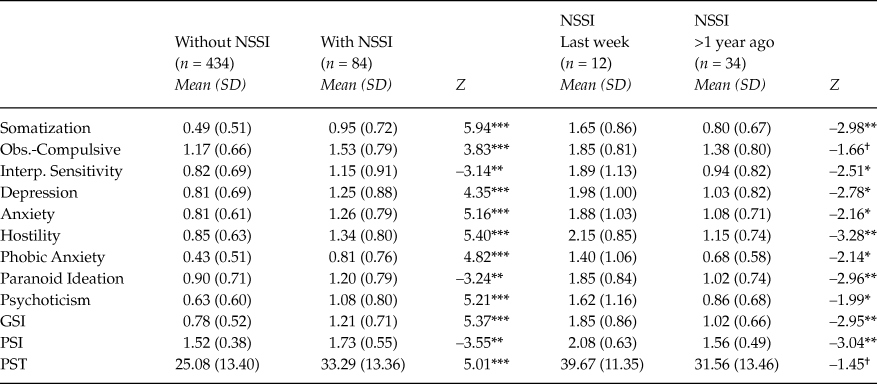
Mann Whitney tests were calculated in order to assess the differences between individuals with and without NSSI in the various subscales of the BSI. Significant differences between groups were found on Somatization (Z = 5.94), Obsessive-Compulsive (Z = 3.83), Depression (Z = 4.35), Anxiety (Z = 5.16), Hostility (Z = 5.40), Phobic Anxiety (Z = 4.82), Paranoid Ideation (Z = –3.24), Psychoticism (Z = 5.21), General Severity Index (GSI) (Z = 5.37) and Positive Symptom Total (PST) (Z = 5.01) (all p’s <. 001), and Interpersonal Sensitivity (Z = –3.14, p < .01), and Positive Symptom Index (PSI) (Z = –3.55, p < .01). Particularly, individuals with NSSI scored significantly higher on all BSI subscales (Table 1).
Comparison between individuals with and without NSSI and between individuals whose last injury was performed last week or more than one year ago on BSI´s Psychopathology Dimensions

† p < .10, *p < .05, **p < .01, ***p < .001.
Mann-Whitney tests were calculated in order to assess differences on BSI scales between current self-injurers and past self-injurers. Results are shown on Table 1. Significant differences were found between groups on Somatization (Z = –2.98, p = .004), Hostility (Z = –3.28, p = .002), Paranoid Ideation (Z = –2.96, p = .008), GSI (Z = –2.95, p = .017) and PSI (Z = –3.04, p = .036), Interpersonal Sensitivity (Z = –2.51, p = .012), Anxiety (Z = –2.16, p = .044), Depression (Z = –2.78, p = .010), Phobic Anxiety (Z = –2.14, p = .044) and Psychoticism (Z= –1.99, p = .043), and marginally significant differences were obtained on Obsessive-Compulsive (Z = –1.66, p = .091) and PST (Z = –1.45, p = .087) subscales.
Particularly, current self-injurers show higher levels of psychopathology than past self-injurers on all BSI subscales and tend to present higher levels of psychopathology on Obsessive-Compulsive and PST dimensions (Table 1).
As previously mentioned, BSI´s Positive Symptoms Index (PSI) is used as a general measure of emotional distress which may be considered present this subscale score equals or exceeds 1.7. In order to understand whether emotional distress is associated with the presence of NSSI, a chi-square test was calculated. The test revealed a significant association between the presence of NSSI and emotional distress, as measured by the BSI´s PSI (χ2(1) = 9.12, p = .003): 26.5% of the individuals without NSSI are emotionally disturbed against 42.9% of individuals with NSSI.
NSSI and Attachment: Anxiety, Comfort with Proximity and Trust in Others
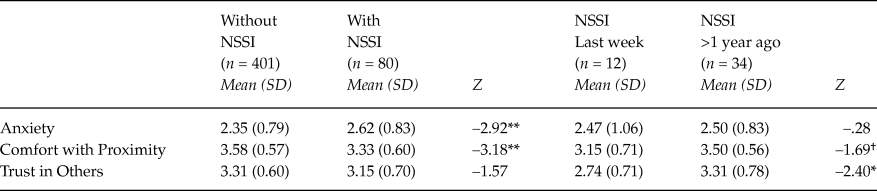
Mann-Whitney tests were calculated in order to assess differences between individuals with and without NSSI on each AAS subscale. The tests revealed the existence of significant differences between participants with and without NSSI on Anxiety (Z = –2.92, p < .01) and Comfort with Proximity (Z = –3.18, p < .01) subscales. Specifically, participants with NSSI reported greater anxiety and less comfort with proximity than those who reported no NSSI. With regard to the Trust in Others dimension, no differences were found between groups (see Table 2).
Comparison between individuals with and without NSSI and between individuals whose last injury was performed last week or more than one year before questionnaire completion on Anxiety, Comfort with Proximity and Trust in Others (AAS: Portuguese version: EVA)

† p < .10, *p < .05, **p < .01.
Mann-Whitney tests revealed significant differences between past self-injurers and current self-injurers on Trust in Others (Z = –2.40, p < .05), marginally significant differences on Comfort with Proximity (Z = –1.69, p = .072) and no differences on Anxiety (Z = –.28, p = .78). Specifically, individuals who performed the last self-injury more than one year ago revealed greater trust in others and a tendency for greater comfort with proximity then those whose last episode of NSSI occurred only one week prior to questionnaire completion (Table 2).
Discussion
In accordance with previous studies, this study revealed that NSSI is relatively common among college students. A significant relationship between NSSI and emotional disturbance and high psychopathology scores reported by individuals engaging in NSSI even when this is assessed in a nonclinical sample were also demonstrated. Furthermore, self-injurers scored significantly higher than past self-injurers on various psychopathological scales. These results indicate that the decrease in emotional disturbance relates to the reduction of NSSI, supporting the Emotional Regulation Model of NSSI and providing a direction to the intervention with this population: focusing on the psychopathological symptoms may be useful in the reduction or eradication of NSSI. However, it was also found that 57.1% of participants engaging in NSSI were not classified as emotionally disturbed according to the cutoff point of BSI´s PSI thus more studies are necessary in order to clarify the relationship between psychopathology and NSSI.
Participants experienced significantly more positive and less negative emotions after NSSI episodes and reported engaging in NSSI mainly for reasons relating to automatic negative reinforcement processes (i.e. reasons involving the avoidance or elimination of negative emotional states) which is consistent with previous studies and also provides support for the emotion regulation model of NSSI.
The higher fears of abandonment or of not being loved (Anxiety) and the lower comfort with closeness and intimacy (Comfort with Proximity) reported by participants engaging in NSSI (vs. participants who never did) support the NSSI relationship with secondary strategies of emotion regulation that may involve hyperactivation or deactivation of the attachment behavioral system (Cassidy & Kobak, Reference Cassidy, Kobak, Belsky and Nezworsky1988), fostering the conceptualization of insecure attachment styles as a risk factor for engagement in NSSI.
Another interesting result was that past self-injurers revealed higher levels of trust in others than current self-injurers. While the presence of high levels of insecure dimensions of attachment, be it anxious (high Anxiety) or avoidant (low Comfort with Proximity), seems to be an important risk factor for the presence of NSSI, the degree of Trust in Others seems to be an important factor in the continuation of the behavior, once it is initiated: if the cessation of the behavior is accompanied by a greater trust in others when felt as necessary, it could be hypothesized that the cessation of the behavior is achieved when a different form of emotional regulation strategy associated with secure attachment (proximity seeking) is initiated, or when the others can be felt as a secure base to which individuals can turn to in times of difficulty. This may represent an important guideline to the conceptualization and intervention with individuals engaging in NSSI.
Limitations to this study include: a) the problems raised by the use of two different ways of recollecting data, which could have influenced the prevalence of NSSI obtained because some of the participants who chose to complete the questionnaires could have done so because they were self-injurers); b) the use of non-parametric tests for all interval variables which could have influenced the significance of the obtained significance of the results; and c) the low internal consistency (< .70) for some of the subscales of the instruments used. Future studies with more robust methods, including a) the use of a single way of data collection; b) the use of parametric tests and c) self-report measures with higher internal consistency are necessary in order to support or refute these findings.
Nonetheless, we believe our study has made an important contribution to the existing knowledge on the subject of NSSI, especially because it is the first study to assess and reveal a differentiation between current and past self-injurers on specific attachment and psychopathology dimensions, suggesting that these dimensions play a role not only in the initiation but also in the continuation of the behavior and that a therapeutic focus on these dimensions could have a significant impact on the cessation of NSSI.