Introduction
“Über Nacht ist aus dem verachteten und verlästerten kleinen Häuflein eine Massenpartei allergrössten Stils geworden, und der Sieg, den sie am 14. September an ihre Fahnen heften konnte, steht ohne Beispiel da in der gesamten Parteiengeschichte,” Joseph Goebbels (Reference Goebbels1930) acclaimed in the Nazi bulletin Der Angriff after the 1930 Reichstag election. The German National Socialist Worker’s Party (NSDAP) had won 18.3% of the vote but only 2.6% in the previous 1928 election. The 1930 election was the Nazi’s political breakthrough. The popular vote provided longed-for confidence and the party acted on the offensive. In July 1932, the NSDAP attracted 37.4% of the vote, and in March 1933 its proportion was 43.9%. Even though the Nazis were firmly antidemocratic, their electoral success made the rise to power possible.
Ever since the sociologist Theodor Geiger’s (Reference Geiger1930) contemporary analysis of the Nazi electorate, it has been common to divide it into social groups or classes by referring to their socioeconomic interests. In the course of its research history, the classification of groups has been made more distinct by taking into account sociocultural (e.g., protestant/catholic and rural/urban) and geographical factors (Mühlberger Reference Mühlberger2003). However, the lack of proper data has made it difficult to reach unequivocal conclusions as to which groups voted for the Nazis. Surely aggregate data exist, but as there were no survey studies at the time, it is difficult to infer knowledge from the aggregate to the individual level (ecological fallacy). Unsurprisingly therefore, psephological research has drawn different conclusions as to whether the NSDAP was predominantly appealing to specific socioeconomic groups, or whether it was a catch-all party. A reference work within this field is provided by Jürgen Falter (Reference Falter1991), who maintained that, although in keeping with the traditional view that the middle classes constituted the core of the Nazi vote, the NSDAP was basically a “Volkspartei des Protests” appealing to many groups. Yet, Falter (ibid.: 169–93) also identified a strong religious effect as Protestants were far more inclined to vote for the Nazis than were the Catholics. This confessional pattern persisted when tested in interaction with the urban-rural dimension, yet slightly stronger in rural areas and slightly weaker in urban areas.
More recently, two excellent contributions have taken the thesis of the different voting pattern between Protestants and Catholics as their point of departure for further causal scrutiny. Gary King et al. (Reference King, Rosen, Tanner and Wagner2008) accepted the different voting pattern but assumed that this followed from divergent economic interests, and looked for economic incentives. The relatively low appeal of the Nazi party in Catholic areas, they concluded, was because it did not appeal to farmers: “[T]he agricultural policies of the Nazis did not suit well the preferences of the people living in southern and western Germany, that is the Catholic regions” (ibid.: 959). Hence, the notion of a religious effect was spurious, and research had not revealed that it worked as a proxy for socioeconomic interests. In 2014, Jörg Spenkuch and Philipp Tillmann offered an alternative thesis to King et al. by showing a correlation between the geographic distribution of the confessional divide historically and in the Weimar Republic. The confessional divide caused the voting pattern, they argued: “[R]eligion is the single most important predictor of Nazi votes.” As to why confession mattered, they argued that “the effect of religion operated through the Catholic Church leaning on believers to vote for the Zentrum Party, while the Protestant Church remained politically neutral” (Spenkuch and Tillmann Reference Spenkuch and Tillmann2014: 2, 31). Whereas King et al. saw Catholics pursuing economic self-interest, Spenkuch and Tillmann saw identification and loyalty toward the elites.
In this article, we analyze the Weimar 1930 election by systematically combining elements of the two approaches. We take issue with Spenkuch and Tillmann and assume there were two confessional Germanys in operation, one Catholic and one Protestant. We test this hypothesis by modeling the conditional effect of social class and religion on the Nazi vote. However, we do not build our model from scratch. Instead, we take as our point of departure the data set “Wahl- und Sozialdaten der Gemeinden und Kreise des Deutschen Reiches 1920–1933” (Hänisch Reference Hänisch1989), which has been aggregated for comparison with several elections by King et al. (Reference King, Rosen, Tanner and Wagner2008). This data set includes information on five social classes. Though our main focus is on the 1930 election, we also present results from the 1928, the two 1932 elections, and the 1933 election, in the Appendix.
By running models without taking into account the interrelation between religious divide and social classes, we find little support for the NSDAP being anything other than a chiefly Protestant and white-collar party. However, we argue that whether or not the five social groups voted NSDAP depended on in which of the two Germanys their particular Kreis was situated. Falter presented multivariate models looking at the interaction of confessional context and the affinity of social groups (Reference Falter1991: 214, 217, 220). An earlier study by Waldman (Reference Waldman1973) introduced an interaction term in his regression models to explain the NSDAP vote. Here, he specified interaction between the proportion of Protestants and the proportion of the workforce in the agricultural sector, finding that the combination of these two categories increased the vote for the NSDAP. Falter and Hänisch (Reference Falter and Hänisch1986) performed a multivariate analysis of workers and confession, arguing that the working classes were reluctant to vote NSDAP only when they were integrated in either a proletarian or a Catholic-political environment.
We present models in which this conditional effect is taken into account for five different social groups. The results show a clear correlation between the percentage of each social group and the Nazi proportion of the votes in each Kreis. However, the effect of each group is more often than not the opposite in the Protestant and Catholic precincts. Of the five social classes included in the model, only the results for blue-collar workers show the same trend in both Protestant and Catholic areas. For the four other classes—unemployed, white-collar, self-employed, and domestic workers—results depend on which religious denomination was prominent. Hence, we have found strong support for the two Germanys hypothesis.
The results not only contribute to the understanding of the Nazi electorate but they also conform to German historians’ Confessionalism Theory (Konfessionalisierungsthese), which argues that the religious divide operated as a long-term historical structure in German territories commencing in the sixteenth century and retained its potency during Germany’s Weimar era.
First, we present the historical Confessionalism Theory and the conceptual framework in psephological research that most evidently takes account of the confessional divide. Subsequently we present the hypothesis, data, and the method employed, before analyzing the results and linking them to existing relevant literature.
Two Germanys: The Confessional Divide in Historiography and Psephology
According to the Confessionalism Theory developed by German historians of early modern Europe, the sixteenth-century Protestant reformation and Catholic revival (counterreformation) caused a denominational divide in the Holy German Reich. The theory maintains that by the seventeenth century, a denominational confessional uniformity had taken root within the different political territories, whether Protestant or Catholic. One early advocate of the theory went so far as to indicate that the Zwang zur Konfessionalisierung even tended to divide households and families (Reinhard Reference Reinhard1977). Few others would go so far but they would still claim that by the seventeenth century a fairly uniform confessional conscience had settled in the different political units of German-speaking Europe while rather sharp antagonism prevailed between the confessions (Ehrenpreis and Lotz-Heumann Reference Ehrenpreis and Lotz-Heumann2002; Reinhard Reference Reinhard1983; Schilling Reference Schilling1988; Ziegler Reference Ziegler2008).
The theory is based on the historic fact that political units within the German Reich, such as principalities and towns, were allowed to choose their confession within their territory. The principle that the religion of the ruler should be the religion of the ruled (caius region, eius religio) was written into the Peace of Augsburg in 1555. Further, it takes into account that the chosen confessions were not only religious doctrines. Because they were also movements of a highly political character, chosen by elites and causing political coalitions and religious wars, they were followed by social disciplining. Common people who were displeased with the dominant confession and its related repression were allowed to emigrate, thereby also contributing to mono-confessional cultures. The result was religious unity within the principalities but a fragmentation within the German Reich as a whole.
The Confessionalism Theory claimed to represent an epochal paradigm and contribute to modernization theory. It has since been heavily criticized for both. Today, most historians would argue that the denomination process was not as fundamental and uniform as originally claimed. However, and although the 1648 Peace of Westphalia allowed for religious freedom, no serious historian would deny that it caused a dominant confessional socioculture within each of the different political units of the German Reich. Hence, our notion of two Germanys takes its historical origins in the Reformation.
For long, it was the predominant view among scholars that the West European Enlightenment had weakened confessionalism by introducing religious tolerance. In 1806, representing Enlightenment, Napoleon gave the Holy German Reich an annihilating blow by introducing the Code Civil on the west bank of the Rhine and in some other territories, in addition to establishing new territorial borders. The ecclesiastical territories, so central to Confessionalism Theory, disappeared and those political and juridical structures that had sustained mono-confessional sociocultures were weakened. Accordingly, secularization was to characterize nineteenth-century developments. Even historians guided by Max Weber’s notions of Western modernity who concluded that German history in the nineteenth century represented a Sonderweg in political terms, paid relatively little attention to the causality of religion (Wehler Reference Wehler1975).
Yet other historians observed that modernity did not remove the confessional divide in Germany (Nipperdey Reference Nipperdey1988). The sociologist, Mario Lepsius (Reference Lepsius, Lütge, Abel, Borchardt, Kellenbenz and Zorn1966), even made the confessional divide a bearing element in his analysis of political behavior during the Kaiserreich and the Weimar period. In an influential study he showed that the party system remained quite stable. He argued that this reflected rather stable sociocultural communities (Gesinnungsgemeinschaften/sozialmoralische Milieus), and that their preferences were largely formed before the German party system was established. He distinguished between four large “camps”: the conservative-protestant, the liberal-protestant, the catholic, and the social-democratic. From this structural pattern, in which the confessional divide was an effectual constituent, he formulated an overall interpretation saying that confessional antagonism contributed to persistent polarization among the communities, thereby hindering political compromise and societal reforms which again led to the weak Weimar state and subsequently Hitler’s assumption of power (ibid.). Lepsius’s perspective was further elaborated by Karl Rohe (Reference Rohe1992), who reduced the number of “camps” to three (Dreilagerthese): “Nationals” consisting of the protestant bourgeoisie and secularized Catholics, Catholics, and Socialists. Rohe, even more strongly than Lepsius, emphasized that the continuous religious divide was a decisive factor in German society and politics.
Lepsius’s broad interpretation made up a core element of the so-called Sonderweg-thesis of German history, which sought to explain the Nazi seizure of power in the light of structural continuities from the Kaiserreich. Although this strand of thought increasingly accepted that the confessional divide was a profound continuity in German history, Helmut Smith’s (Reference Smith1995) assertion that historians’ focus on class relations had left the impact of religious cleavages unexplored, was generally correct. Together with Wolfgang Altgeld he has made a significant contribution to understanding the separate cultures of the confessional divide, their mutual antagonism, and political implications (Altgeld Reference Altgeld1992; Smith Reference Smith2008). Yet none went as far as Olaf Blaschke (Reference Blaschke2001), who, referring to the Confessionalism Theory of early modern Europe, even talked of “a second confessionalist era” (zweites konfessionelles Zeitalter), enduring well into the twentieth century. Admittedly, Blaschke’s assertion has been impetuously contested by fellow historians. For instance, Smith (Reference Smith2003) accepted that mechanisms toward stronger confessional identities were often in operation but argued that Blaschke generally exaggerated their monolithic character, concluding that the term “a second confessionalist era” was unjustified.
For all the disagreements about Blaschke’s thesis, most historians would accept the notion that the confessional divide endured. The main argument goes somewhat like this: after unification, the German Kaiserreich had a population that was about 62% Protestant and 35% Catholic. Majority Protestantism, whether combined with conservative or liberal preferences, developed a more secular attitude (Kulturprotestantismus), which identified strongly with the new German nation-state, while minority Catholicism, in opposition, adopted a more conservative and autarkic attitude in defense of the Church. Catholics as well as Protestants tended to choose their own schools, associations, newspapers, publishers, and political parties. The entrenchment was reinforced by Bismarck’s Kulturkampf, which pursued the values of enlightened Prussian Protestantism.
Rohe (Reference Rohe1992) found no reason to weaken the Dreilagerthese with regard to the Weimar period, and historians have shown that the confessional divide endured. Whereas Catholicism had felt threatened by the dominant national-protestant movement during the Kaiserreich, Manfred Kittel (Reference Kittel and Blaschke2001: 250) has argued that the defeat of the Kaiserreich and the Weimar revolution made Protestant communities feel threatened: “Der politische Katholizismus stand mit Masse im Lager der Republic, der Protestantismus im Lager ihrer Gegner.” He concluded that both camps pursued a strategy of dissociating from each other during the Weimar years, creating much social tension in mixed areas. On a national level, the cleavage found its way into political disputes, in particular between the Catholic Zentrum and the Protestant German National People’s Party (DNVP) (ibid.).
Adolf Hitler referred to the confessional cleavage in Mein Kampf, maintaining that Catholics and Protestants sought to wipe each other out. Officially, the NSDAP was neutral and advocated a supraconfessional Volksgemeinschaft. However, at lower levels of the party there was a clear bias toward Protestantism (May Reference May1991). Even though the Protestant clergy was officially neutral regarding the NSDAP, many of its bishops saw in Nazism the fulfillment of Protestant politics (Steigmann-Gall Reference Steigmann-Gall2000). The Catholic clergy, by contrast, officially opposed the Nazis (Waldmann Reference Waldman1976). This divided trend has been confirmed by various regional historical studies on “der Weg ins Dritte Reich.” Worth mentioning is Rietzler’s accounts (Reference Rietzler1982a, Reference Rietzler1982b) of Schleswig-Holstein, which convincingly reveal the very close relation between the Protestant clergy and the Nazi party.
Having outlined the historiography of the confessional cleavage to justify our hypothesis, how has it been treated by psephological research on the Nazi’s move to power? The dominating explanatory framework was class based for a long time, assuming that social classes in Weimar Germany had homogeneous interests and were able to convert these into forms of political expression. Although this framework excludes no individual class, its most conspicuous thesis pointed to the Protestant middle classes, arguing that these had previously voted for the middle-class parties of the Weimar coalition but voted for Hitler in frustration as they felt betrayed by their traditional parties. Geiger (Reference Geiger1930) saw the middle class in a state of panic shifting their sympathies toward the Nazis. This view was accepted by American sociologists and most succinctly expressed by Seymour Lipset, who claimed the ideal typical Nazi voter was a middle-class self-employed Protestant living in a small community who strongly opposed big business and big labor (Lipset Reference Lipset1960). Also Lepsius (Reference Lepsius, Lütge, Abel, Borchardt, Kellenbenz and Zorn1966) and leading German historians (Bracher Reference Bracher1955; Erdmann Reference Erdmann1980) concurred with this interpretation.
For long, this interpretative framework was only challenged by mass theory, which basically argued that people not coping with the modern condition in which old institutions were constantly replaced by new, were alienated and tended to vote for extremist alternatives. The theory was most strongly advocated by Reinhard Bendix, who argued that Hitler managed to mobilize the alienated masses and that former abstainers dominated the Nazi electorate (Bendix Reference Bendix, Lipset and Bendix1953). Rightly, King et al. (Reference King, Rosen, Tanner and Wagner2008) maintain that mass-society theory has been mainly supported by political philosophers and hardly subjected to empirical analysis. Further, Bendix’s argument that previous nonvoters dominated the Nazi electorate has later been emphatically disproven. Only in 1933 was the party able to attract the votes of this group (Falter Reference Falter1991). The differences between the two group-based views became apparent through the Lipset-Bendix controversy, ending with Bendix being almost converted to Lipset’s view (Bendix and Lipset Reference Bendix and Lipset1959).
The class-based framework prevailed unchallenged well into the 1980s. However, a variety of studies, often restricted to local or regional areas, nuanced or contradicted the initial argument that the middle classes were responsible for voting Hitler into power. Richard Hamilton (Reference Hamilton1982), who focused his study on the larger cities, argued that the higher strata of the middle classes were much more important than the lower strata. Thomas Childers (Reference Childers1983) and several others maintained that working-class support was considerably higher than accounted for earlier. Although using different methods and disagreeing profoundly, Hamilton and Childers were early proponents of the view that the NSDAP appealed to a broad spectrum of social groups (Childers Reference Childers1984). They also agreed that larger communities tended to have a smaller proportion of Nazi votes than smaller communities (Hamilton Reference Hamilton1982). Childers (Reference Childers1983) concluded that “the NSDAP by 1932 had become a unique phenomenon in German electoral politics, a catch-all party of protest.” This catch-all theory had taken strong hold by the early 1990s, not least due to the works of Jürgen W. Falter and his research group whose methodology and data were unforeseen. Implementing a research design that would transcend the class-based paradigm, Falter also tested gender voting. He repudiated the popular belief that the NSDAP increasingly appealed to female voters by showing that in Catholic areas males voted for the Nazis consistently more than females. However, in Protestant areas women were increasingly mobilized by the NSDAP in 1932 and 1933 (Falter Reference Falter1991: 136–46).
Catholics’ reluctance to vote for Hitler compared to Protestants was long acknowledged. Falter and Hänisch (Reference Falter and Hänisch1986), while primarily advocating the catch-all theory by showing that also the working class voted for Hitler, revealed that blue-collar workers integrated in Catholic-political environments were less inclined to do so. This pointed to one of Falters’ most cogent results: the dominant resistance among Catholics, in particular those belonging to rural communities (Falters Reference Falter1991). O’Loughlin et al. (Reference O’Loughlin, Flint and Anselin1994), and subsequently Christian Stögberger (Reference Stögbauer2001), also found strong support for Catholic resistance, leading the latter to conclude that the confessional cleavage was the most conspicuous political cleavage among the Weimar electorate.
The American political scientist, Walter Dean Burnham’s (Reference Burnham1973) conceptual framework for understanding the different voting pattern between Protestants and Catholics dominated for a long period. Agreeing that the Nazi vote came predominantly from the Protestant middle class, Burnham fell under the class-based framework. Yet his theory of political confessionalism was applicable also to the catch-all framework. By political confessionalism, Burnham meant a specific form of party identification among individuals that resembles individual faith because the identification involves a total worldview. This worldview would find expression in networks and social organizations. Hence, he spoke of political parties characterized by political confessionalism as “political churches” in which individuals find existential meaning just as much as they were instruments for redeeming situational material interests. Political confessionalism would tend to cause enduring “political immunization” due to party identification. The confessional electorate would tend to react at least as much toward external attacks as to economic depression. Burnham saw three Weimar parties more or less fitting with the criteria: the Zentrum’s relation to the Catholics, and further, the Social Democratic Party (SPD) and Communist Party’s (KPD) relation to the organized working class electorate. If not immune, these groups would show less acquiescence toward the Nazis. In contrast, the middle-class parties would tend to enjoy less “ideological intensity” and give in more easily: “It was the politically unchurched middle-classes and smallholder peasantry which ‘went overboard’ in 1929–33, and not the German electorate as a whole” (ibid.: 15). Burnham’s explanation of Catholic resistance was seriously challenged by King et al. (Reference King, Rosen, Tanner and Wagner2008), who rejected that party identification was in operation, whereas Spenkuch and Tillmann (Reference Spenkuch and Tillmann2014) argued that elite mobilization by the clergy was needed to convert party identification into votes.
Hypothesis Concerning the Interaction between Social Class and Religious Affiliation
From the literature review in the preceding text we assume a consistent cleavage between Catholics and Protestants both religiously and regionally, and which affected the way the electorate voted. In this section we test a set of hypothesis based on this assumption to see how religious affiliation affected social class. This assumption has previously been explored by Falter (Reference Falter1991), Falter and Hänisch (Reference Falter and Hänisch1986), and Waldman (Reference Waldman1973). The former consisted of multivariate models including religion as a moderating factor, while the latter employed regression models including an interaction term consisting of religion and social groups. Our main contribution is to include this approach to all five social groups, each with different proposed causal effects on the Nazi vote depending on religious affiliation.
We apply the data set of King et al. (Reference King, Rosen, Tanner and Wagner2008), where classification is based on five different social groups: (1) unemployed, (2) blue-collar workers, (3) white-collar workers, (4) self-employed, and (5) domestic workers. The last category includes domestic employees in domestic services. We formulate individual hypotheses for each of these groups.
The first group is (1) unemployed, grew increasingly up to the election in 1930. Hitler had a clear goal of trying to mobilize the unemployed in his favor, and historians long assumed he was successful. However, the efforts largely failed. As pointed to by Falters (Reference Falter1991: 299–300), the NSDAP generally performed poorer the higher the level of unemployment whereas the opposite applied to the KPD. Yet we would expect most of the unemployed to be in urban areas where the more often than in rural areas Catholics voted for the NSDAP. Hence our hypotheses appears:
H1a: Protestant precincts with many unemployed would see relatively fewer votes for the NSDAP compared to Protestant precincts with few unemployed.
H1b: Catholic precincts with many unemployed would see a larger percentage of votes for the NSDAP compared to Catholic precincts with few unemployed. (We would expect this effect to be moderate; see explanation after H2b.)
The second group is (2) blue-collar workers. Falter (ibid.: 202) concluded that the higher proportion of employed blue-collar workers in a given area, the higher proportion of votes for the NSDAP. Yet in general the working class would rather turn to counterparts on the political left. We assume that blue-collar workers would have somewhat similar interests as the unemployed, and because the unemployed lived mostly in urban areas. Because the Nazis faced trouble finding support in urban Protestant areas and among the working class, we would expect a negative relationship between blue-collar workers and Protestant votes for the NSDAP. In Catholic areas the effect should be opposite because the NSDAP found more support in Catholic urban areas. Thus, the following hypotheses are deduced:
H2a: In Protestant precincts with a large working class, the NSDAP would receive fewer votes than in Protestant precincts with less blue-collar workers.
H2b: Catholic precincts with a large working class tended to vote for the NSDAP compared to those Catholic precincts with fewer blue-collar workers.
Because we expect the unemployed and blue-collar workers to have largely similar interests, and that the political parties on the left best defended those interests, we would expect the positive effect proposed in H1b and H2b to be moderate. The main reason for believing that there was a positive effect in Catholic precincts is that the NSDAP tended to get fewer votes in Catholic rural areas than in Protestant rural areas (ibid.: 182, 184).
The third group is (3) white-collar workers, also a mainly urban category. The divide between Protestants and Catholics with regard to this social class is well established in the literature. Brown (Reference Brown1982) already presented evidence that the NSDAP received a larger proportion of the votes in Catholic areas with many white-collar workers, yet lost votes in comparable Protestant areas. Falter and Zintl (1998: 73) concluded that “Catholic white-collar workers and civil servants voted NSDAP somewhat more frequently than non-Catholic members of the salaried middle-classes.” From this, we expect the following hypotheses to be confirmed:
H3a: In Protestant precincts with a large population of white-collar workers, the NSDAP received fewer votes than in Protestant precincts with a smaller proportion of white-collar workers.
H3b: In Catholic precincts with a large population of white-collar workers the NSDAP received more votes than in Catholic precincts with fewer white-collar workers.
The two last social groups under investigation, (4) self-employed and (5) domestic workers, are more rural based. Yet the former also includes some urban population. Sometimes called the old middle class, the self-employed group is a mixture of landowners, small shop owners, and others from the Mittelstand. This group is often mentioned as being the core of the Nazi electorate. With this in mind we propose the following hypotheses connected to the group of self-employed:
H4a: In Protestant precincts with a large population of self-employed, the NSDAP would receive more votes than in Protestant precincts with fewer self-employed.
H4b: In Catholic precincts with a large population of self-employed, the NSDAP would receive fewer votes than in Catholic precincts with fewer self-employed.
The final group is (5) domestic workers. Constituting the most rural-based group of the five we have chosen, it consisted mostly of agricultural laborers and peasant workers. This group had on many levels concurrent interests with the self-employed, and we would expect the effect to be similar. We therefore propose the following hypotheses:
H5a: In Protestant precincts with a large population of domestic workers, the NSDAP would receive more votes than in Protestant precincts with fewer domestic workers.
H5b: In Catholic precincts with a large population of domestic workers, the NSDAP would receive fewer votes than in Catholic precincts with fewer domestic workers.
Data
The data are taken from King et al. (Reference King, Rosen, Tanner and Wagner2008), which again is based on the Election and Social Data of the Districts and Municipalities of the German Empire from 1920 to 1933 (Falters and Hänisch Reference Falter and Hänisch1986).Footnote 1 From this data set we have focused on the vote for NSDAP.
King et al. (Reference King, Rosen, Tanner and Wagner2008) based their information on occupational status from the 1933 census and their information on religious affiliation from the 1925 census. Hence our information concerning social classes derives from the 1933 census. Our information about whether a precinct was predominantly Catholic or Protestant derives from the 1925 census, where information is given on the proportion of the Protestant population. Ideally, of course, we would use censuses from the election year 1930. However, as we expect social mobility to be low in the Weimar Republic, this should not be a major caveat with regard to our results. In addition, King et al. (Reference King, Rosen, Tanner and Wagner2008) limited the number of precincts to 681 from the original 1248. This was done because some of the boundaries changed over time. In the interest of contiguous units, they were limited to the boundaries that were most stable.
Using this type of aggregated data to investigate voter behavior is problematic. The data are on the precinct level, and as the Weimar Republic had a secret ballot no voter surveys were conducted in this period. This can be illustrated through an example. We can assume that in districts with a high number of blue-collar workers there were also high numbers of white-collar workers. As such, we cannot systematically differentiate between these groups in our results. King et al. (Reference King, Rosen, Tanner and Wagner2008: 970–74) employs a new method to break this data down to the individual level. However, this will always be based on educated guesses to some extent. Thus, we make use of data on an aggregated level, which is not an ideal solution but they are the best data available. Regarding the complication associated with ecological fallacy, the definition of classes from this period has been heavily debated. Without details about family background, education, and income level, it is difficult to draw strict social class boundaries.Footnote 2
Method, Analysis, and Results
As already specified, we have taken into account the religious division when modeling the effect of having the different social groups in a precinct. We make use of Ordinary Least Squares regression models when predicting values for the NSDAP proportion of votes as given in the following equation.
 $$\eqalign{{ Percentage NSDAP}& = {{\beta _0} + {\beta _1}\ln population + {\beta _2}protestants + {\beta _3}social group} \cr& \quad {+ {\beta _4}protestants \times social group + e}} $$
([1])
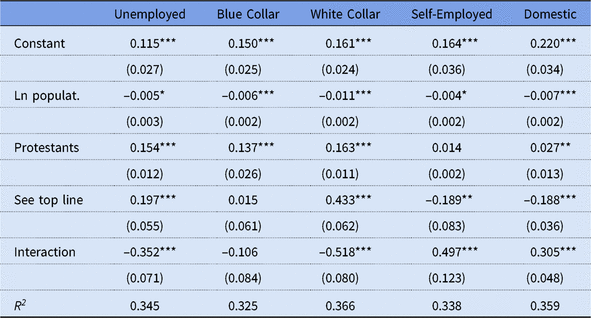
The dependent variable is votes for the NSDAP in the 1930 Reichstag election as a proportion of eligible voters. We also include the logged precinct population as a control variable. Proportion of Protestants in a precinct is an independent variable in all five models presented. In each model a different social category and its corresponding interaction with Protestant proportion is included. We present five linear regression models (Table 1), one for each of the social groups. The independent variables here are: (1) the given social group, (2) proportion of Protestants, and (3) an interaction variable (the given social group * proportion of Protestant). The interaction variable is important for our main hypotheses as it looks directly at how the effect of social class is conditioned by the religious majority of a given precinct.
Different social classes with religion (Catholic/Protestant), regression of 681 precincts (Kreise) in Weimar Germany. Dependent variable is votes for NSDAP in the 1930 Reichstag election as proportion of total eligible voters

Note: Standard errors are in parentheses. Units are weighted according to their population.
*p < .10. **p < .05. ***p < .01.
Because we examine the whole population of German precincts, and not just a sample, we are generalizing within stochastic model theory rather than within sample theory. Following sample theory, when investigating the entire population, one should acquire perfect predictions and thus there would be no need for significance tests. However, when following the logic of stochastic model theory we are generalizing from our observations to the process or mechanism that brings about the present data (Gold Reference Gold1969; Henkel Reference Henkel1976; Mehmetoglu and Jakobsen Reference Mehmetoglu and Tor2016).Footnote 3
The results of the five regression models are summarized in Table 1.Footnote 4 We see that the interaction term is significant for all social groups except blue collar.Footnote 5 This indicates that the effects differ depending on whether the precinct is predominantly Protestant or Catholic when investigating how having a large proportion of unemployed, white collar, self-employed, or domestic workers in a precinct influences the NSDAP vote. To a large extent, this supports our main argument, confirming that social class support for NSDAP is moderated by religious denomination.
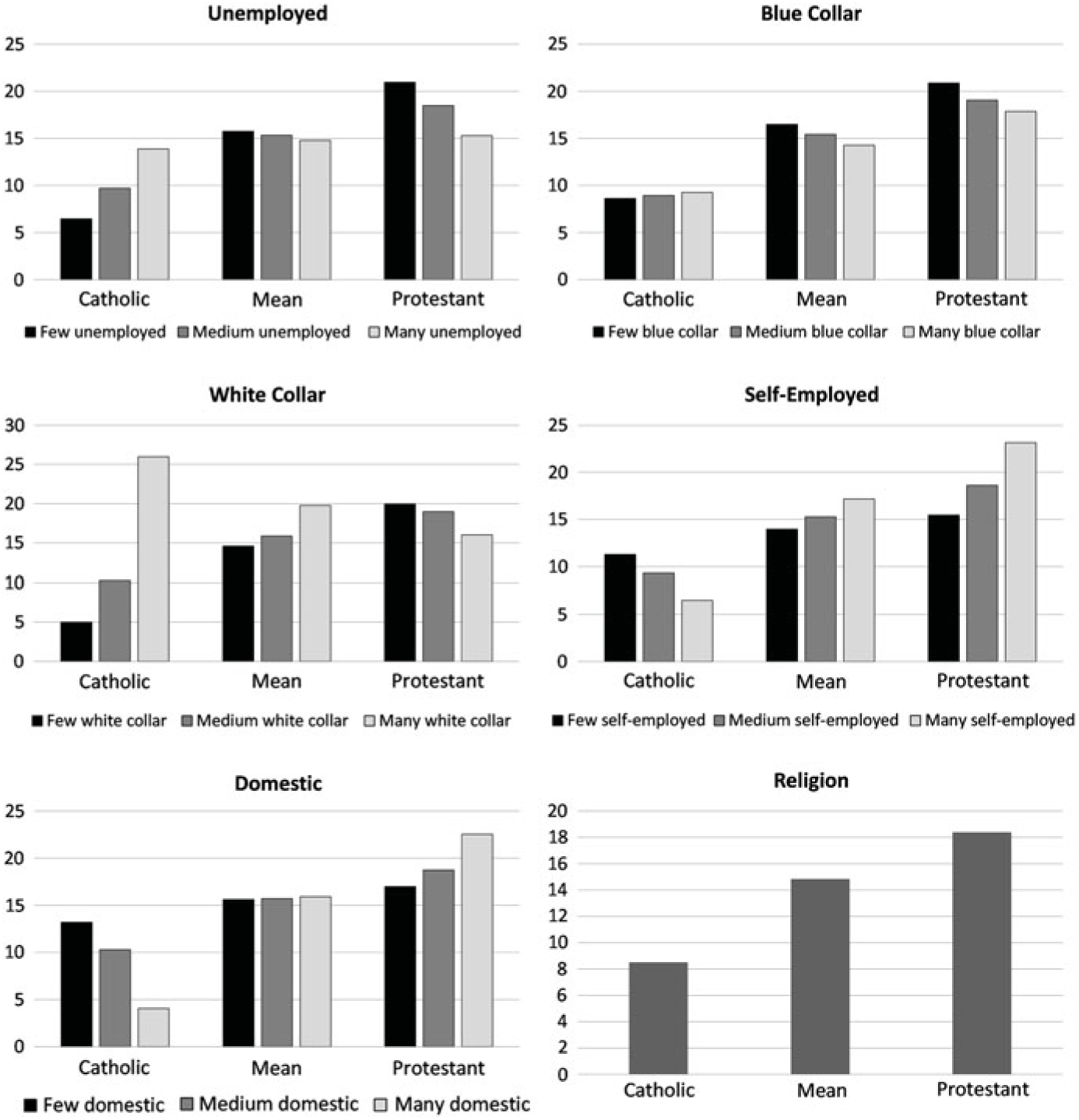
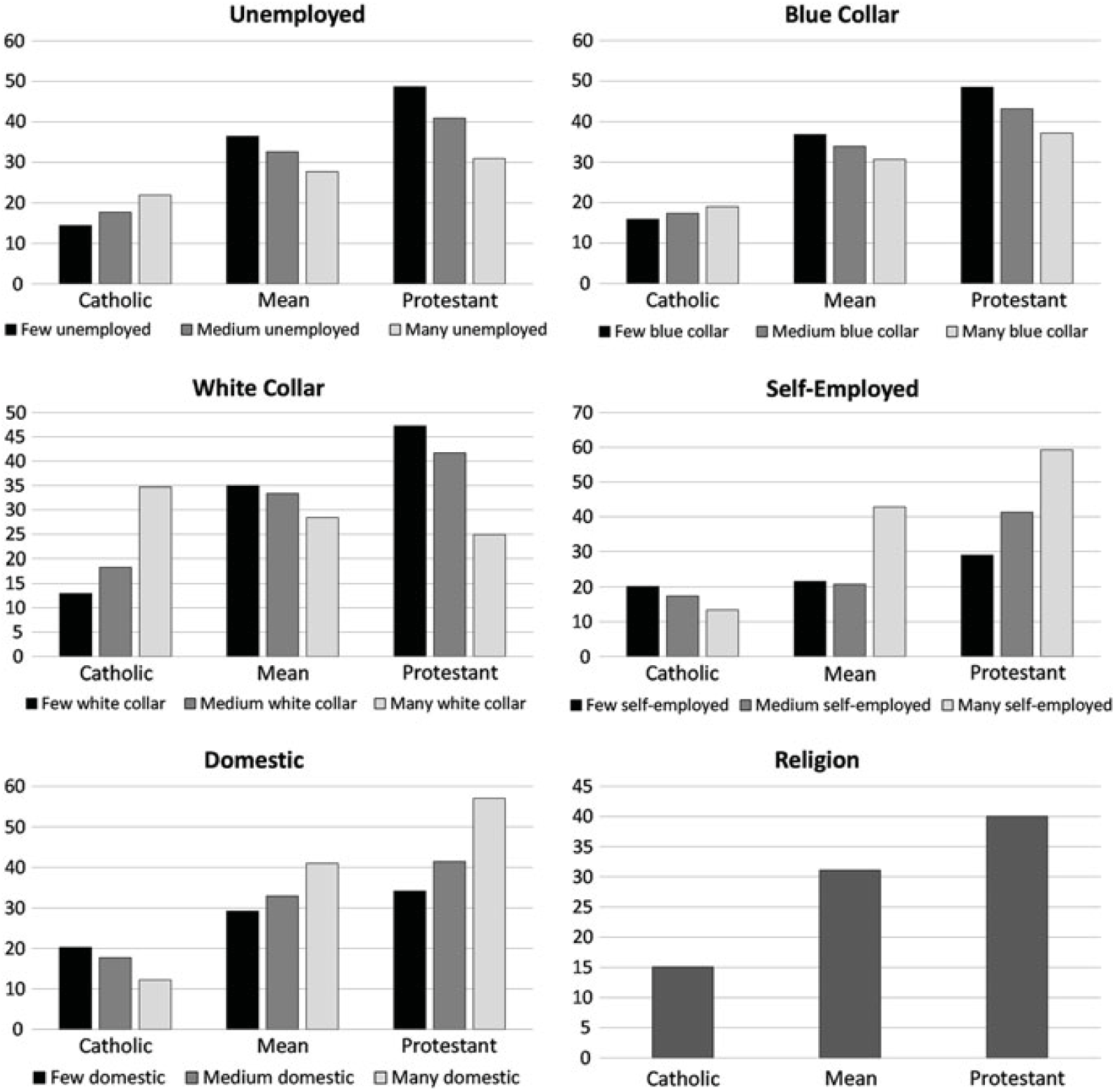
Taking into account that it is difficult to intuitively interpret a table with an interaction composed of two continuous variables, we have chosen to present the findings in five graphs (see Figure 1). The values have been calculated using the following equation:Footnote 6
 $$\eqalign{{\hat y} & = {\beta _0} + {\beta _1}(mean)\ln population + {\beta _2}(min/mean/max)protestants \cr &\quad + {\beta _3}(min/mean/max)social{\mkern 1mu} group + {\beta _4}(min/mean/max)protestants \cr &\quad \times (min/mean/max)social{\mkern 1mu} {\mkern 1mu} group}$$
([2])
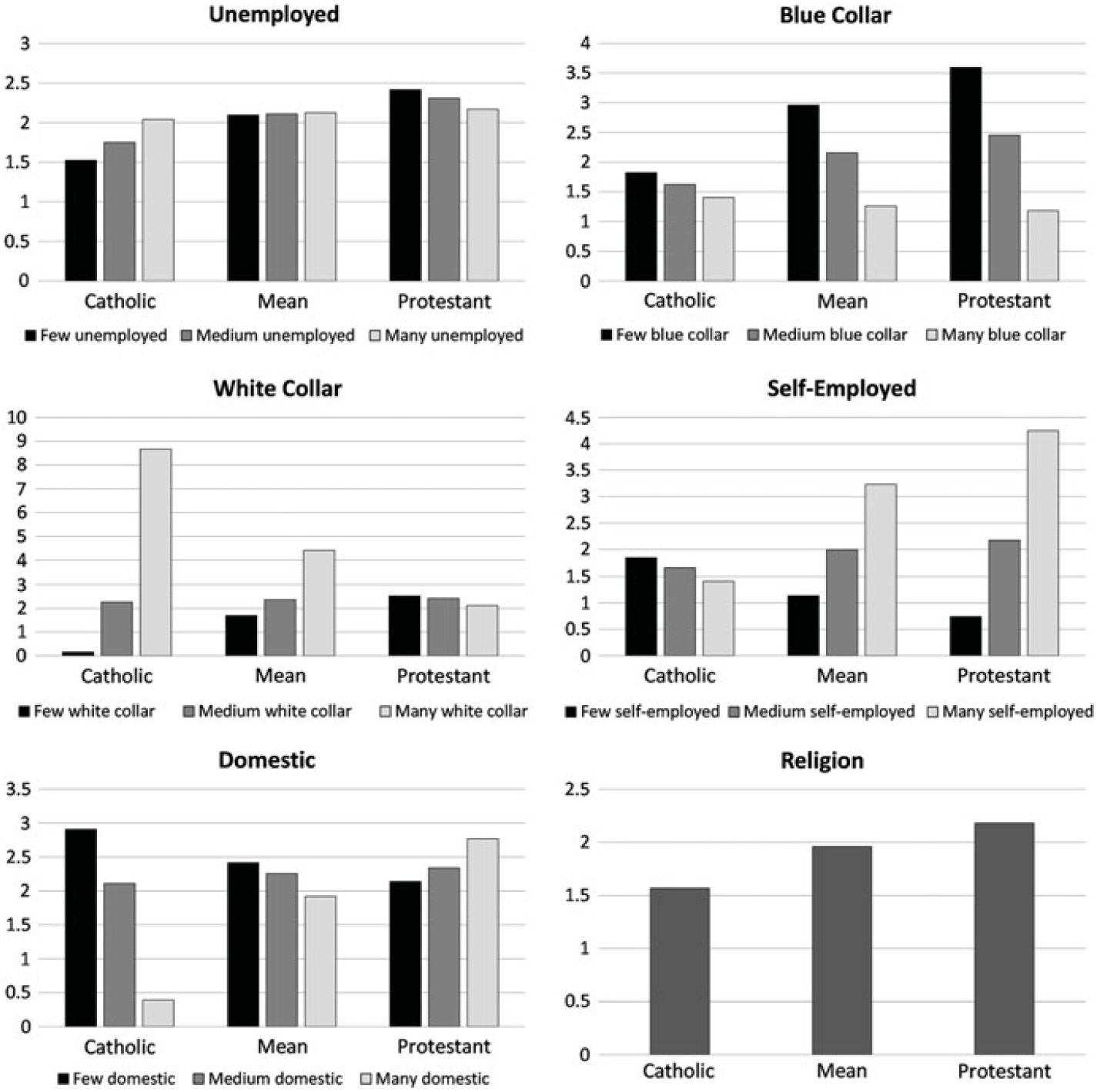
Reichstag Election, September 14, 1930.

Nine calculations have thus been made for each social group, replacing the minimum, mean, and maximum values for religion and the given social group. The minimum values on Protestant are assumed to indicate a large proportion of Catholics in the graphs. We have chosen this approach as it is an easily interpretable way to test the hypotheses presented. In addition we have added a graph that describes the general difference between Protestants and Catholics concerning votes for the NSDAP in the 1930 elections, also based on minimum, mean, and maximum values of the variable Proportion of Protestants.
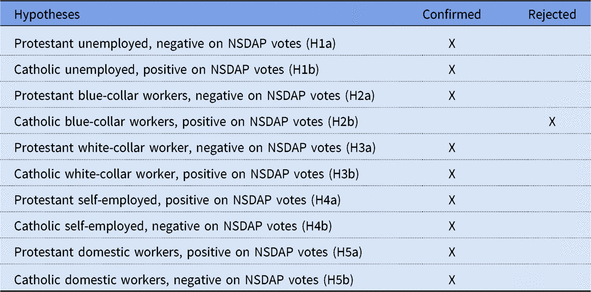
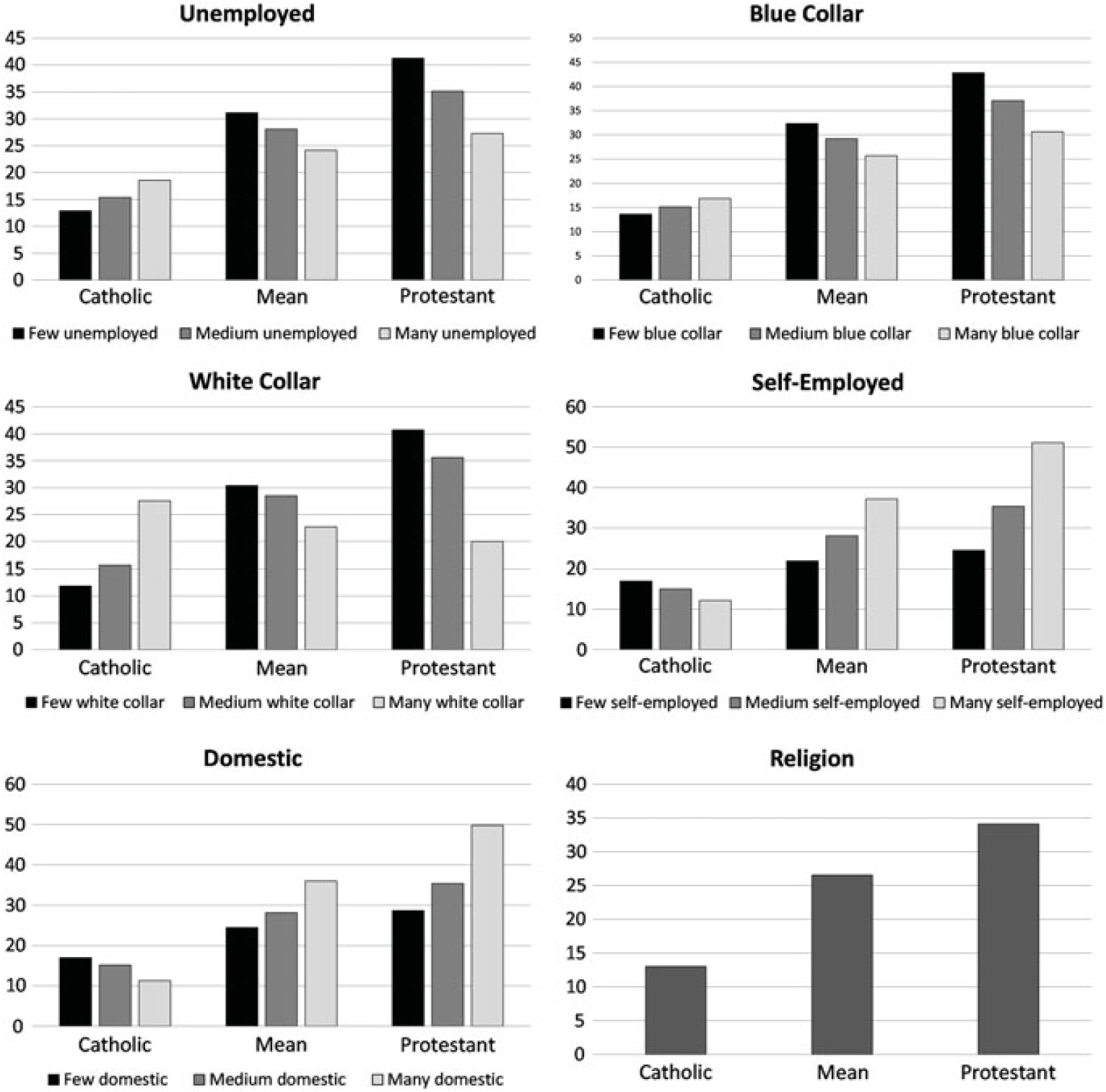
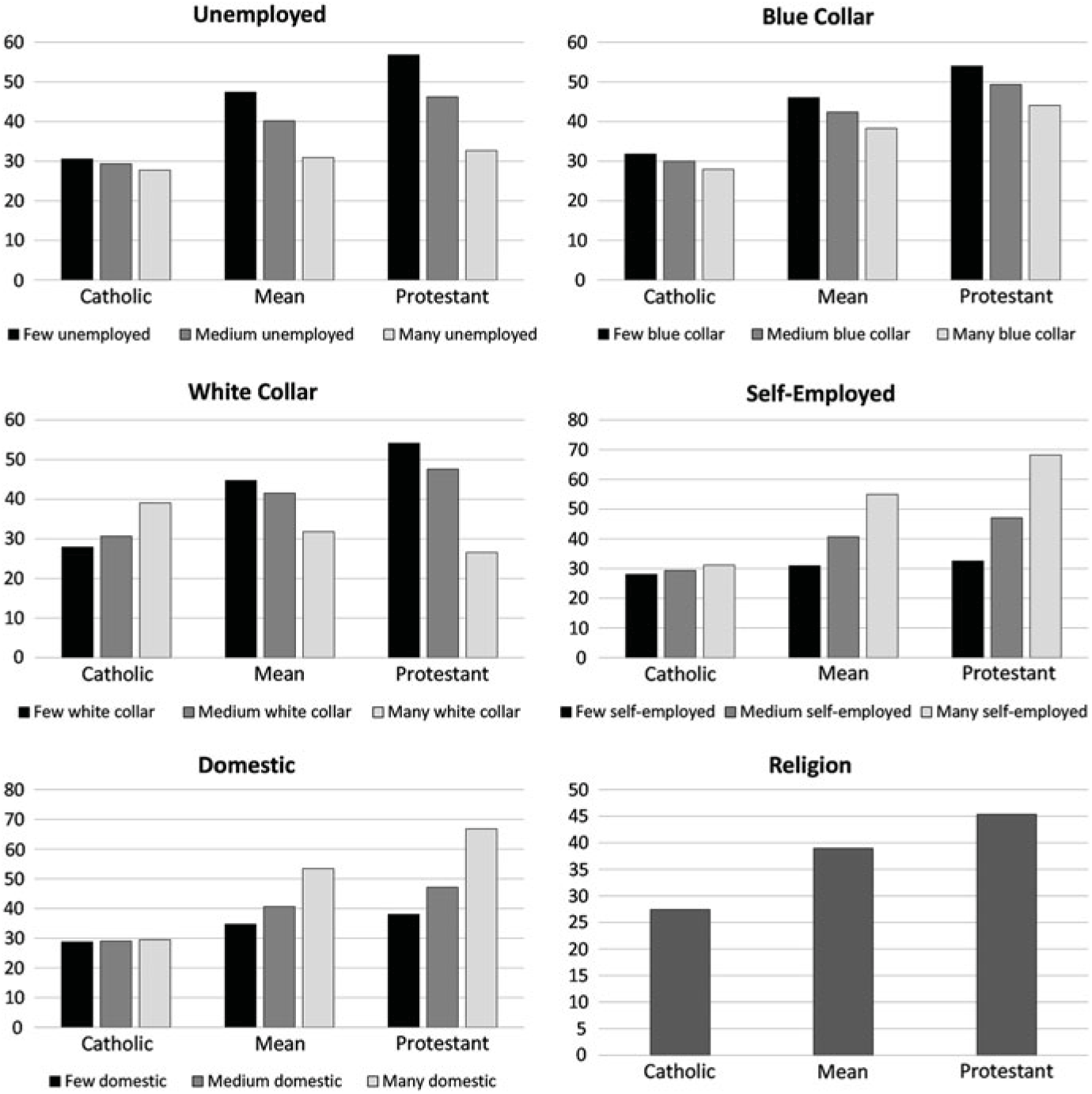
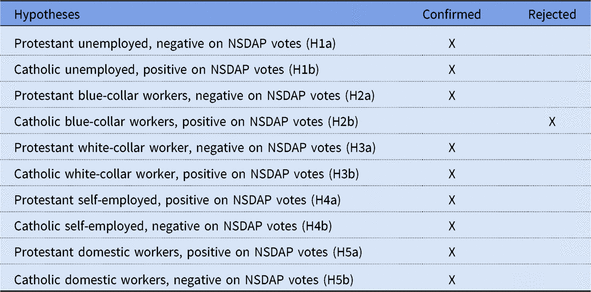
Figure 1 shows that the trends are opposite for all groups except for blue-collar workers. In the other four groups, Catholic and Protestant precincts seem to behave in a completely opposite manner, and predicated precincts with an equal size of the two denominations are placed between. Unsurprisingly, the stronghold for Protestants voting for the NSDAP is found in the two more rural classes—the self-employed and domestic workers. Further, it seems to have been a problem for the NSDAP to find support in predominantly Protestant areas with many unemployed, whereas the opposite effect was the case for precincts with a Catholic majority. Of the interaction hypotheses, all are confirmed except H2b. This shows a close to zero trend with regard to NSDAP votes and blue-collar Catholic workers. The trends found in the 1930 election are largely consistent with the findings from the 1928 and the two 1932 elections (see Appendix). An overview of the hypotheses and their test results is presented in Table 2.
Overview of hypotheses
We find the biggest differences among the white collars, the self-employed, and domestic workers. The strongest NSDAP support among Catholics occurred in precincts with many white-collar workers.Footnote 7 Conflicting theories have been presented over the years with regard to white-collar workers. Hamilton (Reference Hamilton1982) argued that this group was a key part of the NSDAP electorate, whereas Childers (Reference Childers1983) argued that they were far behind most other social groups in voting for the NSDAP. This confusion might be due to the conflicting results from Protestants and Catholic precincts, as revealed by Falter (Reference Falter1991: 235, 248) with regard to Angestellten, yet less so with regard to Beamten. Our findings seem to further confirm that notion. Protestant voting loyalties toward other parties in this social group might help to explain some of the difference as the middle-class Protestant was more likely to vote for Conservative or Center parties than their Catholic counterparts. This finding is especially important because the success of the NSDAP in Catholic precincts with many white-collar workers is second only to that of rural Protestant precincts. That the former group is mostly urban based also suggests that this is a stronghold for Catholics but not for Protestants. We have seen that more religiosity in Protestants areas leads to more votes for the NSDAP, and that the opposite is true for Catholics. Because it is plausible to assume that they are more religious in rural areas, this can be part of the explanation. Still, it is clear that among urban Catholics there is a division between the working class and the middle class. The working class seems to have opposed the NSDAP whereas the urban middle class appears to have been more inclined to vote for the NSDAP.
We assumed the same expected effect for blue-collar workers as for the unemployed. Countering our hypothesis H2b, the trend for blue-collar workers was negative in Protestant precincts and no effect in Catholic precincts. One explanation could be that we have underestimated the appeal of KDP and SDP even in Catholic precincts. It seems at first glance counterintuitive that the effect for unemployed and blue-collar workers in Catholic precincts would differ. However, the explanation might be that there was a higher level of unemployed white-collar Catholics who had more in common with the middle classes than the working class. It could also be that the urban unemployed Catholics had a weaker connection to the Catholic Church, and therefore fell outside the institutions that insulated Catholics from voting for the NSDAP. With regard to the Protestant unemployed, these were generally associated with the working class, and lived in areas where the KPD had a tendency of receiving a larger proportion of the protest votes. Blue-collar workers is the only social group that does not show a clearly opposite trend for both confessions: it therefore seems safe to say that the NSDAP did not have strong support among the working class. Still, for the two first groups it is difficult to draw strict conclusions based on this study. This is as expected, with the reservation made in regard to H1b and H2b.
Conclusion
Having taken as its point of departure, and sought to further and improve on the works of Falter and King et al., we have tested the interaction effect of religion and social groups on the Nazi vote. We find support for our main argument that voting by the various social groups in 1930 depends on whether they lived in a predominantly Catholic or Protestant precinct. This holds true for all groups except for blue-collar workers where there was no trend for Catholics. This renders support to earlier conclusions that the NSDAP was a worker’s party only in name. In Catholic precincts, many white-collar workers meant sundry votes for the NSDAP. For Protestant precincts it was the more rural social classes, the self-employed and domestic workers, that were most receptive to the Nazi appeal. The rural-based Catholics had in general strong voting loyalties toward the Zentrum and the BVP, and therefore more difficult for Hitler to win over to his side. When it comes to white-collar Protestants it seemed that they supported more reformist parties, among them the SPD. Although this argument has been advanced by others, we have tested this empirically on data for the whole of Germany, thereby contributing to the debate on the origin of the Nazi vote.
Appendix
Reichstag Election, May 20, 1928.

Reichstag Election, July 31, 1932.

Reichstag Election, November 6, 1932.

Reichstag Election, March 5, 1933.