Introduction
Adequate temporal abilities are essential to perform most of our everyday activities. Temporal judgments are based on three processing stages: clock, memory, and decision (Gibbon, Reference Gibbon1977; Treisman, Reference Treisman1963). The clock stage is composed of a pacemaker that emits pulses that are stored in an accumulator (for a review, see Grondin, Reference Grondin2010). The memory stage is conceptualized as the storing system that accumulates pulses in working memory for comparison with content in reference memory (i.e., the long-term memory representation of pulses accumulated across prior temporal experience). The final stage is the decision stage, in which the current duration is compared with those stored in reference memory. Many studies on time estimation have focused on properties of the pacemaker. Variations in arousal level are known to affect the rate of the pulses’ emission: an increased level of arousal increases the speed of the pacemaker. For a given duration period, if the pacemaker runs faster, more pulses reach the accumulator, and this duration is judged to be longer (Droit-Volet, Brunot, & Niedenthal, Reference Droit-Volet, Brunot and Niedenthal2004; Effron, Niedenthal, Gil, & Droit-Volet, Reference Effron, Niedenthal, Gil and Droit-Volet2006).
Variations in an individual’s arousal level, and consequently on the rate of the internal clock and perceived duration, can be influenced by the presentation of emotional stimuli. Several studies, conducted on healthy participants, showed that emotional pictures generating high arousal lead to greater overestimation of time, compared to emotional pictures generating less arousal (Angrilli, Cherubini, Pavese, & Manfredini, Reference Angrilli, Cherubini, Pavese and Manfredini1997; Droit-Volet et al., Reference Droit-Volet, Brunot and Niedenthal2004; Droit-Volet & Gil, Reference Droit-Volet and Gil2009; Gil & Droit-Volet, Reference Gil and Droit-Volet2011; Lee, Seelam, & O’Brien, Reference Lee, Seelam and O’Brien2011; Noulhiane, Mella, Samson, Ragot, & Pouthas, Reference Noulhiane, Mella, Samson, Ragot and Pouthas2007; Tipples, Reference Tipples2008). In particular, facial expressions of anger, fear, happiness, and sadness lead to an overestimation of time (Droit-Volet et al., Reference Droit-Volet, Brunot and Niedenthal2004; Effron et al., Reference Effron, Niedenthal, Gil and Droit-Volet2006; Gil & Droit-Volet, Reference Gil and Droit-Volet2011; Lee et al., Reference Lee, Seelam and O’Brien2011; Tipples, Reference Tipples2008), but facial expressions of shame lead to an underestimation of time (Droit-Volet & Meck, Reference Droit-Volet and Meck2007; Droit-Volet & Gil, Reference Droit-Volet and Gil2009). The effect of disgust on time perception is more mixed. In some cases, viewing facial expressions of disgust do not provoke time distortions (Gil & Droit-Volet, Reference Gil and Droit-Volet2011); however, viewing a disgusting image (e.g., body mutilations) results in longer perceived duration (Angrilli et al., Reference Angrilli, Cherubini, Pavese and Manfredini1997; Grondin, Laflamme, & Gontier, Reference Grondin, Laflamme and Gontier2014) and viewing disgusting food pictures results in shorter perceived duration (Gil, Rousset, & Droit-Volet, Reference Gil, Rousset and Droit-Volet2009).
Parkinson’s disease (PD) is a movement disorder characterized by bradykinesia, tremor, rigidity and postural instability. Disease symptoms occur as a result of selective, progressive, and chronic degeneration of the nigrostriatal and mesocortico-limbic dopamine systems (Jankovic & Tolosa, Reference Jankovic and Tolosa2007). It offers an opportunity to study the possible influence of these dopaminergic pathways on emotional processing (Gray & Tickle-Degnen, Reference Gray and Tickle-Degnen2010; Péron, Dondaine, LeJeune, Grandjean, & Vérin, Reference Péron, Dondaine, LeJeune, Grandjean and Vérin2012). In fact, it is generally assumed that abnormalities in the recognition of facial emotions in PD patients are caused by dysfunction of fronto-subcortical systems (including dopaminergic neurons) involved in facial emotion recognition (Blonder & Slevin, Reference Blonder and Slevin2011; Dujardin et al., Reference Dujardin, Blairy, Defebvre, Duhem, Noël, Hess and Desté2004; Gray & Tickle-Degnen, Reference Gray and Tickle-Degnen2010; Lawrence, Goerendt, & Brooks, Reference Lawrence, Goerendt and Brooks2007; Péron et al., Reference Péron, Dondaine, LeJeune, Grandjean and Vérin2012; Sotgiu & Rusconi, Reference Sotgiu and Rusconi2013; Sprengelmeyer et al., Reference Sprengelmeyer, Young, Mahn, Schroeder, Woitalla, Buttner and Przuntek2003).
While studies conducted with PD patients generally show dysfunction in emotional facial expression recognition (Assogna, Pontieri, Caltagirone, & Spalletta, Reference Assogna, Pontieri, Caltagirone and Spalletta2008; Clark, Neargarder, & Cronin-Golomb, Reference Clark, Neargarder and Cronin-Golomb2008; Dujardin et al., Reference Dujardin, Blairy, Defebvre, Duhem, Noël, Hess and Desté2004; Lawrence et al., Reference Lawrence, Goerendt and Brooks2007; Péron et al., Reference Péron, Biseul, Leray, Vicente, La Jeune, Drapier and Vérin2010; Sprengelmeyer et al., Reference Sprengelmeyer, Young, Mahn, Schroeder, Woitalla, Buttner and Przuntek2003), there is partial discordance about the type of emotions affected by this dysfunction. Sprengelmeyer et al. (Reference Sprengelmeyer, Young, Mahn, Schroeder, Woitalla, Buttner and Przuntek2003) tested medicated and un-medicated PD patients. Relative to controls, both PD patient groups showed impairment in facial expression recognition, but un-medicated PD patients were consistently worse in recognition of disgust than medicated PD patients and controls. Similarly, previous findings revealed significant impairment in recognition of facial expression of fear (Kan, Kawamura, Hasegawa, Mochizuki, & Nakamura, Reference Kan, Kawamura, Hasegawa, Mochizuki and Nakamura2002), disgust (Dujardin et al., Reference Dujardin, Blairy, Defebvre, Duhem, Noël, Hess and Desté2004; Kan et al., Reference Kan, Kawamura, Hasegawa, Mochizuki and Nakamura2002), anger (Dujardin et al., Reference Dujardin, Blairy, Defebvre, Duhem, Noël, Hess and Desté2004), and sadness (Dujardin et al., Reference Dujardin, Blairy, Defebvre, Duhem, Noël, Hess and Desté2004) in PD patients. In addition, results from work by Lawrence et al. (Reference Lawrence, Goerendt and Brooks2007) indicated that recognition of anger was impaired in PD patients who had been temporarily removed from dopamine replacement therapy.
Dysfunctions in dopamine transmission have also been identified as the main cause of temporal impairment in PD patients (Harrington, Zimbelman, Hinton, & Rao, Reference Harrington, Zimbelman, Hinton and Rao2010; Harrington et al., Reference Harrington, Castillo, Greenberg, Song, Lessig, Lee and Rao2011; Meck, Reference Meck2005; Meck & Benson, Reference Meck and Benson2002). Evidence suggests that PD patients show dysfunctions in time perception when using finger tapping tasks (Artieda, Pastor, Lacruz, & Obeso, Reference Artieda, Pastor, Lacruz and Obeso1992; O’Boyle, Freeman, & Cody, Reference O’Boyle, Freeman and Cody1996; Pastor, Jahanshahi, Artieda, & Obeso, Reference Pastor, Jahanshahi, Artieda and Obeso1992), as well as tasks involving time reproduction, time production, and time estimation (Lange, Tucha, Steup, Gsell, & Naumann, Reference Lange, Tucha, Steup, Gsell and Naumann1995; Pastor, Artieda, Jahanshahi, & Obeso, Reference Pastor, Artieda, Jahanshahi and Obeso1992; Perbal et al., Reference Perbal, Deweer, Pillon, Vidailhet, Dubois and Pouthas2005). For duration discrimination, one study (Harrington, Haaland, & Knight, Reference Harrington, Haaland and Knight1998) revealed lower discrimination level in PD patients, while another study (Ivry & Keele, Reference Ivry and Keele1989) failed to find differences between PD patients and controls when using the same task. Smith, Harper, Gittings, and Abernethy (Reference Smith, Harper, Gittings and Abernethy2007) found that PD patients were less sensitive to duration differences than controls with a time bisection task in conditions involving either auditory or visual signals for marking time. It is possible that some of the contradictory findings reported in the literature on timing and time perception with PD patients might be explained by the motor responses required in some timing tasks (Jones, Malone, Dirnberger, Edwards, & Jahanshahi, Reference Jones, Malone, Dirnberger, Edwards and Jahanshahi2008; see also Mioni, Stablum, McClintock, & Grondin, Reference Mioni, Stablum, McClintock and Grondin2014).
The current project plans to investigate if the same temporal distortion produced by emotional stimuli observed in healthy controls, is present in PD patients. This can have important implications from an experimental and clinical prospective. In fact, we can better understand temporal and emotional processing in PD patients and further investigate the effect of emotional stimuli on time perception. Moreover, we can better plan rehabilitation programs on those emotions that are scarcely recognized by PD patients. If PD patients present a dysfunction in recognizing emotional stimuli, we should not expect any distortion in time perception. On the other hand, if emotional stimuli are correctly identified by PD patients, we should observe a variation in temporal judgment similar to that observed in healthy controls.
Current Investigation
Taken together, previous studies showed that temporal processes can be modulated by the presentation of stimuli with emotional content (Gil & Droit-Volet, Reference Gil and Droit-Volet2011). Moreover, previous studies showed emotional recognition dysfunction (Gray & Tickle-Degnen, Reference Gray and Tickle-Degnen2010; Péron et al., Reference Péron, Dondaine, LeJeune, Grandjean and Vérin2012) as well as temporal dysfunctions in PD patients (O’Boyle et al., Reference O’Boyle, Freeman and Cody1996; Harrington et al., Reference Harrington, Haaland and Knight1998; Perbal et al., Reference Perbal, Deweer, Pillon, Vidailhet, Dubois and Pouthas2005). In the present study, we investigate the effect of emotional stimuli on time perception. This is the first study addressing this issue in PD patients.
We have three main aims in the present study. The first aim is to investigate time perception in PD patients. In particular, we investigate if differences in temporal judgments in PD patients relative to healthy controls are related to level of cognitive function in PD patients. Previous studies conducted with children (Zélanti & Droit-Volet, Reference Zélanti and Droit-Volet2011), healthy adults (Perbal, Droit-Volet, Isingrini, & Pouthas, Reference Perbal, Droit-Volet, Isingrini and Pouthas2002), and severe traumatic brain injury patients (Mioni, Mattalia, & Stablum, Reference Mioni, Mattalia and Stablum2013) have already pointed out the importance of adequate high cognitive functions in time perception. Cognitive impairments or dementia symptoms are often associated with PD (Litvan et al., Reference Litvan, Goldman, Tröster, Schmand, Weintraub, Petersen and Emre2012). Consequently, it is of great interest to assess cognitive functions as a possible mediator of lower temporal abilities in PD patients. To this end, we divided PD patients in two sub-groups according to criteria specified by Litvan et al. (Reference Litvan, Goldman, Tröster, Schmand, Weintraub, Petersen and Emre2012; see the Method section). We predict that PD patients with a diagnosis of mild cognitive impairment (MCI) would be less accurate and more variable in their temporal judgments than PD without MCI and controls due to their reduced cognitive abilities.
The second aim of the present study is to investigate the effect of emotional facial expression on time perception. According to previous studies, facial emotional stimuli influence time perception and the direction of temporal distortion depends on the type of emotional stimulus presented (Gil & Droit-Volet, Reference Gil and Droit-Volet2011, Reference Gil and Droit-Volet2012; Lee et al., Reference Lee, Seelam and O’Brien2011; Mella, Conty, & Pouthas, Reference Mella, Conty and Pouthas2011; Tipples, Reference Tipples2008). We included anger and shame as emotional stimuli, given that they have generated different effects on time perception (Gil & Droit-Volet, Reference Gil and Droit-Volet2011). In particular, we predicted an overestimation of temporal intervals when the stimulus marking time represents anger and an underestimation of temporal intervals when the stimulus represents shame.
Finally, the third aim of the present investigation is to combine the previous two aims and further investigate if the magnitude of temporal distortions caused by the presentation of the facial expression of emotions would be the same for PD patients (with or without MCI) and controls.
Method
Participants
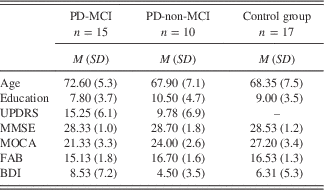
Twenty-five older adults with PD (11 males, 14 females) and 17 healthy older adults (9 males, 8 females) took part in the present study. PD participants were recruited from a major hospital in Ospedale S. Bortolo, Vicenza, Italy. All PD participants had been diagnosed with idiopathic PD by a movement disorders neurologist, and evaluated with the “Unified Parkinson’s disease Rating Scale” (UPDRS; Fahn et al., Reference Fahn and Elton1987), which indicates the progression of PD. Controls or non-PD participants were volunteers from the local community (Vicenza and Bari of Italy; Table 1). Controls were matched to PD participants on the basis of age and education (±2 years respect to PD sample).
Demographic and clinical characteristics of PD patients and controls.

Note: UPDRS=Unified Parkinson’s disease Rating Scale; MMSE=Mini Mental State Examination; MOCA=Montreal Cognitive Assessment; FAB=Frontal Assessment Battery; BDI=Beck Depression Inventory.
Exclusionary criteria included possible dementia or severe cognitive impairment, treatment with anticholinergic medications, treatment with certain dopaminergic or benzodiazepine medications known to interfere with cognitive functioning, history of neurosurgery or other neurological conditions (aside from PD for PD participants), significant history or current psychiatric disorders, or any condition (e.g., depression) which would interfere with testing.
Possible cognitive impairment was detected with the following tasks. The Mini-Mental State Examination (MMSE; Folstein, Folstein, & McHugh, Reference Folstein, Folstein and McHugh1975) was used to evaluate global cognitive functioning. The total possible score is 30 points; a score of 24 or above is considered within the normal range. The Montreal Cognitive Assessment (MoCA, Nasreddine et al., Reference Nasreddine, Phillips, Bedirian, Charbonneau, Whitehead, Collin and Chertkow2005) was used to screen for mild cognitive and executive dysfunctions. The total possible score is 30 points; a score of 26 or above is considered within the normal range. The Frontal Assessment Battery (FAB, Appollonio et al., Reference Appollonio, Leone, Isella, Piamarta, Consoli, Villa and Nichelli2005) was administrated to evaluate frontal lobe functions; higher scores indicate better performance, maximum score is 18. The Beck Depression Inventory is a self-report questionnaire (BDI; Beck, Ward, Mendelson, Mock, & Erbaugh, Reference Beck, Ward, Mendelson, Mock and Erbaugh1961) used to evaluate the level of depression in PD patients and controls.
Importantly, we divided the PD groups in two sub-groups based on the scores at neuropsychological tasks (see the Neuropsychological assessment section for the details of the tasks included). Litvan et al. (Reference Litvan, Goldman, Tröster, Schmand, Weintraub, Petersen and Emre2012) defined five cognitive domains (Attention and working memory; Executive functions; Language; Memory, and Visuo-spatial function) and proposed a list of tasks for each domain. According to Litvan’s criteria, patients with a diagnosis of PD that failed at least two tasks (below two standard deviations) in the same domain or in different domains were defined as PD-MCI in the current study. PD-non-MCI patients were PD patients that did not meet criteria to be considered as a PD-MCI patient.
The three groups (PD-MCI, PD-non-MCI, and controls) did not differ with respect to age, education, MMSE, and BDI (all p’s>.05). PD-MCI patients had lower scores on the FAB [F(2,42)=4.20; p=.022; η2 p=.177] and MOCA [F(2,42)=7.92; p=.001; η2 p=.289], compared to PD-non-MCI patients and controls. No differences were observed between PD-non-MCI and controls on these tests (Table 1).
Procedure
PD patients were tested at the hospital S. Bortolo, Vicenza, Italy, whereas controls were tested in their own home. During the tasks, participants were seated at a distance of approximately 60 cm in front of a 15-inch PC monitor screen. E-Prime®2.0 was used to program and run the experiment. PD patients were tested during one experimental session that lasted approximately 50 min. Neuropsychological information of PD patients were collected from clinical records, whereas controls were tested in one experimental session lasting approximately 90 min for completion of the time bisection task and neuropsychological assessment. Informed consent was collected from all participants and the study was conducted in accordance with Helsinki Declaration (59th WMA General Assembly, Seoul, 2008).
Time Bisection Task
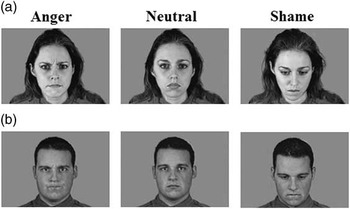
The experimental session started with the learning phase in which participants were required to memorize two standard durations: 400 ms (short standard) and 1600 ms (long standard). Both standard durations were presented 10 times. During the learning phase, the stimulus used for marking time was a gray oval with a size similar to that of the target stimuli. After the training phase, participants were required to perform four blocks with pictures of female facial expressions (Figure 1a) and four blocks with pictures of male facial expressions (Figure 1b). Within each block, 12 pictures of females or males were randomly presented for each of the comparison durations (400, 600, 800, 1000, 1200, 1400, 1600 ms), for a total of 84 stimuli. Stimuli represented the facial expression of anger or shame, or a neutral expression. After the presentation of the comparison durations, participants were required to press the key labeled “B” (“B” refers to the Italian word “Breve”=short) if the duration presented was closer to the short standard, or to press the key labelled with “L” (“L” refers to the Italian word “Lungo”=long) if the duration presented was closer to the long standard. The participants were asked to respond with their left and right index fingers and response keys were counterbalanced between participants. After the response, there was a 1000-ms inter-trial interval.
Example of the emotional facial expressions used for female (a) and male (b).

Neuropsychological Assessment
Neuropsychological tasks were included to investigate cognitive abilities in PD patients and controls. Moreover, performances on the following tasks were used to divide the PD sample into two sub-groups (PD-MCI and PD-non-MCI), according to criteria outlined by Litvan et al. (Reference Litvan, Goldman, Tröster, Schmand, Weintraub, Petersen and Emre2012).
Attention and working memory
The Trial Making Test (TMT; Reitan, Reference Reitan1958; Italian normative data in Giovagnoli, Del Pesce, Simoncelli, Laiacona & Capitani, Reference Giovagnoli, Del Pesce, Simoncelli, Laiacona and Capitani1996) is composed of two parts (TMT Parts A and B). In Part A, participants are required to connect a series of 25 numbers in numerical order. In Part B, the subject connects 25 encircled numbers and letters in numerical and alphabetical order, alternating between numbers and letters. Part A is generally presumed to be a test of visual search and motor speed skills; whereas Part B is considered also to be a test of higher level cognitive skills such as mental flexibility. Performance is evaluated in time (seconds) to execute the task. In the present study, we use the time to execute Part A and Part B, as well as the difference (in seconds) between Parts B and A.
Executive functions
The Semantic Fluency task (Novelli et al., Reference Novelli, Papagno, Capitani, Laiacona, Cappa and Vallar1986) requires generating words belonging from a category: fruit, cities, color, and animals. Each of the four trials lasts 60 s. The semantic fluency test is a good indicator of cognitive flexibility; lower performance might indicate cognitive impairment. The score is the number of correct words produced. The Modified Card Sorting Test (MCST, Nelson, Reference Nelson1976; Italian normative data in Caffarra, Vezzadini, Dieci, Zonato, & Venneri, Reference Caffarra, Vezzadini, Dieci, Zonato and Venneri2004) was used to evaluate abstract reasoning, mental flexibility (ability to shift set), and problem solving skills. Participants are required to sort 48 cards based on an unknown rule that changes during the test through use of feedback from the examiner. Performance on the MCST was scored by computing the number of categories achieved by the participant, and the number of perseverative errors.
Language
The Naming on Confrontation sub-test from Aachen Aphasia Test (AAT; Luzzatti, Willmes, & De Bleser, Reference Luzzatti, Willmes and De Bleser1991). The task requires naming objects from different categories. Performance is based on number of objects correctly named.
Memory
The Rey-Osterrieth Complex Figure Test (ROCF; Osterrieth, Reference Osterrieth1944; Italian normative data in Caffarra, Vezzadini, Dieci, Zonato, & Venneri, Reference Caffarra, Vezzadini, Dieci, Zonato and Venneri2002) was used to investigate visuo-spatial constructional functions, visuo-graphic memory, and some aspects of planning and executive function. Participants were presented the ROCF stimulus card, showing a complex black-and-white figure, and asked to copy the same figure. Subsequently, they were instructed to draw what they remembered about the same figure (immediate recall), without the stimulus card present. After a delay of 30 min, participants were required to draw the same figure again (delayed recall). The Word-list recall task (Rey, Reference Rey1958; Italian normative data in Carlesimo et al., Reference Carlesimo, Caltagirone, Gainotti, Fadda, Gallassi, Lorusso and Parnetti1996) consists of five consecutive immediate free-recall trials of a list of 15 words read aloud by the examiner (immediate recall). After 15 min, a delayed recall trial is given (delayed recall).
Visuo-spatial functions
The Clock Drawing Test (CDT; Goodglass & Kaplan, Reference Goodglass and Kaplan1972; Italian normative data in Mondini, Mapelli, Vestri & Bisiacchi, Reference Mondini, Mapelli, Vestri and Bisiacchi2003) requires participants to draw a clock with numbers (from 1 to 12) and both minute and hour hands. The CDT has been proposed as a useful neuropsychological screening instrument for dementia and has demonstrated good sensitivity to constructional, visuo-perceptual, and conceptual deficits.
Results
Time Bisection Task
In the time bisection task,Footnote 1 we calculated the proportion of “long” responses for each stimulus duration and these were included in a mixed-design ANOVA with group (PD-MCI, PD-non-MCI and controls) as a between-subject factor and emotion (anger, shame, and neutral) and temporal interval (400, 600, 800, 1000, 1200, 1400, and 1600 ms) as within-subjects factors. All significant effects were followed by post hoc analyses performed with a Bonferroni correction to reduce the Type I error rate, and the effect size was estimated with partial eta squared (η2 p).
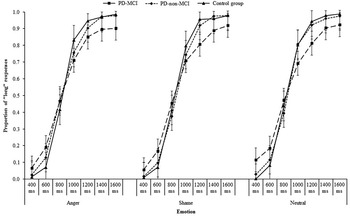
Significant main effects for emotion [F(2,78)=4.10; p=.020; η2 p=.095] and temporal intervals [F(6,234)=593.26; p=.001; η2 p=.938] were found. No main effect of group was found (p=.716; η2 p=.017), but group significantly interacted with temporal interval [F(12,234)=3.52; p=.001; η2 p=.153]. Moreover, the interaction group×emotion×temporal interval [F(24,468)=1.80; p=.012; η2 p=.085] was found (Figure 2). Post hoc analyses showed that PD-MCI judged the long temporal intervals (1200, 1400, and 1600 ms) as shorter, and the short temporal intervals (400 and 600 ms) as longer, compared to PD-non-MCI and controls. PD-non-MCI and controls equally judged the temporal intervals in all emotions. Only in the case of PD-MCI, at 400 ms, were significant differences observed between emotional stimuli (anger and shame facial expressions) and neutral stimuli. This finding indicates that PD-MCI patients pressed more often “long” at 400 ms when the stimulus has a neutral emotional valence than when anger or shame is shown.
Psychometric function (pooled data) for each emotional condition and each group. The error bars indicate ±1 SE.

The temporal bisection point was also calculated for investigating perceived duration; the index is defined as the x value corresponding to the .50 probability of “long” responses on the y-axis, serving as a measure of perceived duration. The observed shift of the bisection point for the different facial expression of emotions presented on groups can be interpreted as an indicator of differences in these conditions, with smaller bisection point values meaning longer perceived durations (Grondin, Reference Grondin2008). Group (PD-MCI, PD-non-MCI and controls) was the between-subject factor and emotion (anger, shame, and neutral) was the within-subject factor. A significant effect of group was found [F(2,78)=2.55; p=.045; η2 p=.134]. Results indicated that PD-MCI patients (M=948) perceived temporal intervals as shorter than PD-non-MCI patients (M=844) and controls (M=844). No effect of emotion or interactions was found (all ps>.05).
We also calculated an index (d scores) for each stimulus duration (see Gil & Droit-Volet, Reference Gil and Droit-Volet2011). The d corresponds to the difference between the proportion of “long” responses for the emotional and neutral faces, and was used as an index of emotional distortion on time perception. A d value greater than 0 reflects an overestimation of time for emotional faces, compared to neutral faces, and a d value lower than 0 reflects an underestimation of time. Data were included in a mixed-design ANOVA with group (PD-MCI, PD-non-MCI and controls) as a between-subjects factor and emotion (anger, shame) and temporal interval (400, 600, 800, 1000, 1200, 1400, and 1600 ms) as within-subjects factors. A main effect of emotion was found [F(1,39)=6.06; p=.018; η2 p=.135], indicating that being exposed to facial expressions of anger produces an overestimation of temporal intervals (d=.013). The facial expression of shame produced an underestimation of temporal intervals (d=−.010). No other main effects or interactions were found (all ps>.05).
To further explore the effect of emotional valence on time perception in the three groups we have also conducted correlations between indices (d scores) for anger and shame and the BDI score. A significant correlation was observed only between the index of anger and the BDI score in PD-MCI (r=−.576; p<.001).
Neuropsychological Tasks
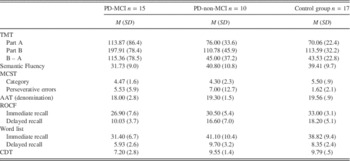
Separate one-way ANOVAs were conducted on performances at neuropsychological tasks in PD-MCI, PD-non-MCI patients, and controls (Table 2). Significant differences were observed between groups on CDT [F(2,42)=8.87; p=.001; η2 p=.313], ROCF immediate recall [F(2,42)=4.74; p=.014; η2 p=.196], ROCF delayed recall [F(2,42)=10.67; p=.001; η2 p=.354], semantic fluency [F(2,42)=3.52; p=.039; η2 p=.153], word list immediate recall [F(2,42)=4.45; p=.018; η2 p=.186], word list delayed recall [F(2,42)=6.54; p=.004; η2 p=.251], TMT part B [F(2,42)=10.08; p=.001; η2 p=.372], and TMT B-A [F(2,42)=8.06; p=.001; η2 p=.328]. Specifically, except for CDT, PD-MCI were less accurate than PD-non-MCI and controls, and PD-non-MCI performed as accurately as controls. In the case of CDT, PD-MCI patients were less accurate than PD-non-MCI and controls, and PD-non-MCI performed more poorly than controls. No differences between groups were observed on AAT, TMT part A and MCST on both category and perseverative errors (all ps>.05).
Descriptive statistics for the neuropsychological tasks included in the study

Note: CDT=Clock Drawing Test; ROCF=Rey-Osterrieth Complex Figure Test in immediate recall and delayed recall conditions; Word list=World-list recall task in immediate recall and delayed recall conditions; AAT=Aachen Aphasia Test; TMT=Trial Making Test in part A and B and difference in reaction time between parts B and A (B–A); MCST=Modified Card Sorting Test.
Discussion
A large number of studies conducted with PD patients have almost uniformly reported difficulties for judging the duration of intervals in the millisecond and second range (Lange et al., Reference Lange, Tucha, Steup, Gsell and Naumann1995; Malapani, Deweer, & Gibbon, Reference Malapani, Deweer and Gibbon2002; Malapani et al., Reference Malapani, Rakitin, Levy, Meck, Deweer, Dubois and Gibbon1998; Pastor, Artieda, et al., Reference Pastor, Artieda, Jahanshahi and Obeso1992; Perbal et al., Reference Perbal, Deweer, Pillon, Vidailhet, Dubois and Pouthas2005). Temporal dysfunction in PD patients has been attributed to disruption of central dopaminergic activity (Meck, Reference Meck1996; Rammsayer, Reference Rammsayer1999). Disruption of dopaminergic neurons, resulting in dysfunction of fronto-subcortical systems, may also be responsible for abnormalities in emotional facial expression recognition in PD patients (Adolphs, Reference Adolphs2002a,Reference Adolphsb; Dujardin et al., Reference Dujardin, Blairy, Defebvre, Duhem, Noël, Hess and Desté2004; Lawrence et al., Reference Lawrence, Goerendt and Brooks2007; Sprengelmeyer et al., Reference Sprengelmeyer, Young, Mahn, Schroeder, Woitalla, Buttner and Przuntek2003). The aims of the present study were to investigate the effect of emotional facial expression on time perception in PD patients with and without MCI.
Results showed that PD-MCI patients were less accurate than PD-non-MCI patients and controls, such that PD-MCI patients perceived temporal intervals as shorter than the presented interval. Moreover, PD-MCI patients judged longer temporal intervals (1400 ms and 1600 ms) as shorter and short intervals (400 ms and 600 ms) as longer than the presented durations (migration effect, Buhusi & Meck, Reference Buhusi and Meck2005; Koch et al., Reference Koch, Costa, Brusa, Peppe, Gatto and Caltagirone2008; Malapani et al., Reference Malapani, Rakitin, Levy, Meck, Deweer, Dubois and Gibbon1998, Reference Malapani, Deweer and Gibbon2002; Smith et al., Reference Smith, Harper, Gittings and Abernethy2007). This effect may be due to memory dysfunction rather than a change in clock speed (Koch, Brusa, Olivieri, Stanzione, & Caltagirone, Reference Koch, Brusa, Olivieri, Stanzione and Caltagirone2005; Malapani et al., Reference Malapani, Rakitin, Levy, Meck, Deweer, Dubois and Gibbon1998, Reference Malapani, Deweer and Gibbon2002). Malapani et al. (Reference Malapani, Rakitin, Levy, Meck, Deweer, Dubois and Gibbon1998) tested PD patients “on” and “off” medication with a time reproduction task (8 s and 21 s). PD patients “off” medication overestimated the 8-s temporal intervals and underestimated the 21-s temporal intervals (Experiment 1). According to the authors, changes in clock speed would not cause any bias in temporal accuracy under conditions in which participants were trained and tested in the same neurological state (“on” or “off” medication). Conversely, memory dysfunction for a previous learned interval (during the training phase, when two temporal intervals are learned) would affect the estimation of the later learned interval, leading to a migration of the two target durations toward each other (Malapani et al., Reference Malapani, Rakitin, Levy, Meck, Deweer, Dubois and Gibbon1998). The migration effect was consistently observed when PD patients received feedback, leading to the conclusion that the migration effect is indeed caused by a memory storage/retrieval problem rather than a clock problem (Koch et al., Reference Koch, Brusa, Olivieri, Stanzione and Caltagirone2005; Malapani et al., Reference Malapani, Rakitin, Levy, Meck, Deweer, Dubois and Gibbon1998, Reference Malapani, Deweer and Gibbon2002; Perbal et al., Reference Perbal, Deweer, Pillon, Vidailhet, Dubois and Pouthas2005). Our results confirm this interpretation. Consistent with previous studies (Malapani et al., Reference Malapani, Rakitin, Levy, Meck, Deweer, Dubois and Gibbon1998, Reference Malapani, Deweer and Gibbon2002), participants learned the two standard intervals during the training phase. It is possible that the PD-MCI patients created an inaccurate representation of the two standard intervals leading to a subsequent overestimation of short temporal intervals and underestimation of long temporal intervals. Additionally, in support with the memory interpretation of the migration effect, only PD-MCI patients with severe cognitive memory dysfunctions presented the migration effect.
The second aim of the present study was to investigate the effect of emotional facial expression on time perception. The results showed an effect of emotional stimuli on time perception. When stimuli showed facial expressions of anger, temporal intervals were overestimated whereas when stimuli showed facial expressions of shame, temporal intervals were underestimated. These results are consistent with previous findings revealing facial expression of anger were associated with overestimations of time, among children and adults (Gil & Droit-Volet, Reference Gil and Droit-Volet2011; Gil, Niedenthal, & Droit-Volet, Reference Gil, Niedenthal and Droit-Volet2007). According to the internal clock model (Gibbon, Church, & Meck, Reference Gibbon, Church and Meck1984), temporal intervals are overestimated when the pacemaker runs faster; indeed, when the pacemaker runs faster, more pulses are stored into the accumulator and the duration is considered to be longer. Anger is a particularly arousing emotion (Calder, Keane, Lawrence, & Manes, Reference Calder, Keane, Lawrence and Manes2004; Phelps & Ledoux, Reference Phelps and Ledoux2005), and increasing arousal level has been demonstrated to increase the speed of the internal clock (Angrilli et al., Reference Angrilli, Cherubini, Pavese and Manfredini1997; Gil & Droit-Volet, Reference Gil and Droit-Volet2012; Mella et al., Reference Mella, Conty and Pouthas2011; Rammsayer, Reference Rammsayer1997; Wearden & Penton-Voak, Reference Wearden and Penton-Voak1995). Consequently, time is overestimated when facial expressions of anger are presented.
Time distortions caused by the perception of angry facial expressions may be adaptive, as they prepare the organism to act for survival. This idea is consistent with studies showing that threatening stimuli or stressful situations induce an overestimation of time (Angrilli et al., Reference Angrilli, Cherubini, Pavese and Manfredini1997; Grondin, Laflamme, & Gontier, Reference Grondin, Laflamme and Gontier2014). On the other hand, facial expression of shame leads to an underestimation of time. Shame is a secondary emotion, which develops later with social interactions and the internalization of social rules; shame does not have the same adaptive meaning as anger (Lagattuta & Thompson, Reference Lagattuta and Thompson2007; Tangney & Dearing, Reference Tangney and Dearing2002). Considering that shame has been interpreted as self-conscious emotion involving a reflexive attitude toward oneself (Haidt, Reference Haidt2003), some authors have concluded that facial expressions of shame attract attentional resources (Gil & Droit-Volet, Reference Gil and Droit-Volet2011), resulting in an underestimation of time. According to the attentional gate model (Zakay & Block, Reference Zakay and Block1996), when attention is not fully allocated on time, less temporal information is stored in the accumulator and the temporal interval is judged to be shorter than the objective duration.
The third aim was to investigate if stimuli of facial emotional expressions influence temporal judgments in PD patients and controls differently. Results showed significant differences between emotional stimuli (anger and shame) and neutral stimuli only at 400 ms in PD-MCI patients. Greater temporal dysfunction with short temporal intervals is a consistent finding in the literature with PD patients (Artieda et al., Reference Artieda, Pastor, Lacruz and Obeso1992; Harrington et al., Reference Harrington, Zimbelman, Hinton and Rao2010; Malapani et al., Reference Malapani, Rakitin, Levy, Meck, Deweer, Dubois and Gibbon1998; Pastor, Artieda, et al., Reference Pastor, Jahanshahi, Artieda and Obeso1992; Riesen & Schnider, 2001; Smith et al., Reference Smith, Harper, Gittings and Abernethy2007), reflecting a memory or storage/retrieval problem rather than a clock problem (Koch et al., Reference Koch, Brusa, Olivieri, Stanzione and Caltagirone2005; Malapani et al., Reference Malapani, Rakitin, Levy, Meck, Deweer, Dubois and Gibbon1998, Reference Malapani, Deweer and Gibbon2002; Perbal et al., Reference Perbal, Deweer, Pillon, Vidailhet, Dubois and Pouthas2005). We interestingly found an effect of emotional stimuli at 400 ms in PD-MCI patients. It is possible that a less stable temporal representation in PD-MCI patients is more prone to be distorted by emotional stimuli.
The three groups included did not differ for the level of depression, although PD-MCI patients showed a slightly higher level of depression. The correlation analyses conducted between the index (d score) of emotional distortion on time perception and depression index indicated that PD-MCI patients with higher levels of depression had a reduced distortion on time perception when the facial expression of anger was presented. One hypothesis for explaining that result is that PD-MCI patients with higher levels of depression were less prone to identify anger than less depressed participants.
To conclude, our study showed temporal dysfunctions in PD patients specifically related to level of cognitive impairment. Specifically, PD-MCI patients were less accurate than PD-non-MCI patients and controls, such that PD-MCI patients perceived temporal intervals as shorter than the presented interval. Moreover, PD-MCI patients judged longer temporal intervals (1400 ms and 1600 ms) as shorter and short intervals (400 ms and 600 ms) as longer than the presented durations. The migration effect observed is attributed to a distortion in the memory representation of time (Malapani et al., Reference Malapani, Deweer and Gibbon2002). The current study also revealed interesting results regarding the effect of emotional stimuli on time perception in PD patients. When stimuli showed angry facial expressions, temporal intervals were overestimated; when stimuli showed shame facial expressions, temporal intervals were underestimated. This effect was particularly evident in PD-MCI patients when 400 ms was used.
The effect of emotional stimuli on time perception demonstrates that PD patients adequately recognized and processed the emotional stimuli of anger and shame. These results seem not to be in line with the literature on emotional facial recognition in PD patients. Importantly, PD-non-MCI and controls showed similar temporal abilities, and they present similar cognitive abilities as indicated by the neuropsychological evaluation. It is possible that they still have intact the networks involved in emotional facial recognition. Alternatively, it is possible that in our study, PD patients implicitly processed the emotional stimuli; in fact, participants were not explicitly questioned about emotional facial expressions during the time bisection task. It is possible that emotional facial recognition is preserved at an implicit level and that this has produced the effect observed. Future studies should consider the effect of other facial emotional stimuli on temporal processing in PD patients. Studies have shown that happiness and sadness are differently recognized in PD patients relative to controls (Clark et al., Reference Clark, Neargarder and Cronin-Golomb2008; Yip, Lee, Ho, Tsang, & Li, Reference Yip, Lee, Ho, Tsang and Li2003), and that recognition of disgust is dysfunctional in PD patients (Assogna et al., Reference Assogna, Pontieri, Caltagirone and Spalletta2008; Sprengelmeyer et al., Reference Sprengelmeyer, Young, Mahn, Schroeder, Woitalla, Buttner and Przuntek2003; Suzuki, Hoshino, Shigemasu, & Kawamura, Reference Suzuki, Hoshino, Shigemasu and Kawamura2006).
Acknowledgments
The information in this manuscript and the manuscript itself has never been published either electronically or in print. There are no financial or other relationships that could be interpreted as a conflict of interest affecting this manuscript. This research received no specific grant from any funding agency, commercial or not-for-profit sectors. The authors gratefully acknowledge Laura Malesani and Vincent Laflamme for their help in collecting and analyzing the data, Pamela May and the “INS Research Editing and Consulting Program" for assisting with editing, and Emi Hasuo and one anonymous reviewer for their comments on an earlier version of this article. The authors also gratefully acknowledge the staff of the Ospedale S. Bortolo, Vicenza, Italy and the participants, their families, and friends who participated in this study.