Three components relevant for understanding verb semantics are: (1) overtly expressed arguments, comprising syntactic frames and argument structure; (2) core verb meaning (or ‘verb root’; Pinker, Reference Pinker, Gleitman and Landau1994) – that part of the verb's meaning stable across use in different argument structures; and (3) relational roles in scenes to which verbs refer (‘conceptual arguments’). We examined children's developing knowledge of individual verbs (component 2) and relational roles in scenes associated with those verbs (component 3), as well as how the connection between components 2 and 3 matters for children learning languages that differ in their overt expression of arguments (component 1).
Many have noted that the meanings of even common and early-learned English verbs are non-obvious, in that they are relational and not directly discernible from scenes to which they refer: a scene described as ‘giving’ might also be described (with quite different meaning) by ‘getting’, ‘receiving’, ‘holding’, ‘moving’, ‘having’, etc. (Gentner, Reference Gentner1978; Gleitman, Reference Gleitman and Bloom1994; Gleitman, Cassidy, Nappa, Papafragou & Trueswell, Reference Gleitman, Cassidy, Nappa, Papafragou and Trueswell2005; Pinker, Reference Pinker, Gleitman and Landau1994). Studies that have examined whether English speakers are able to figure out the verb from watching a scene with minimal contextual information (see Gleitman et al., Reference Gleitman, Cassidy, Nappa, Papafragou and Trueswell2005) suggest that linguistic context, particularly the argument structure of the verb, plays a strong role in isolating the relevant meaning. For example, give, always used in English with three obligatory arguments (subject, object, recipient), refers to a particular conceptual parsing of the scene into particular relational roles – one person (‘giver’) transferring something (‘given object’) to another (‘givee’).
Experimental studies of children learning English have documented their use of expressed argument structure to determine the scene to which a novel verb refers. Indeed, a variety of experimental methods have shown that young English learners find the range of argument structures occurring with a verb highly informative regarding important aspects of that verb's meaning (e.g. Gleitman, Reference Gleitman and Bloom1994; Gleitman et al., Reference Gleitman, Cassidy, Nappa, Papafragou and Trueswell2005; Landau & Gleitman, Reference Landau and Gleitman1985; Naigles, Gleitman & Gleitman, Reference Naigles, Gleitman, Gleitman and Dromi1993). Systematic regularities between verbs and argument structures in English have been documented both in adult language (Fisher, Gleitman & Gleitman, Reference Fisher, Gleitman and Gleitman1991; Levin, Reference Levin1993) and child-directed speech (Naigles & Hoff-Ginsberg, Reference Naigles and Hoff-Ginsberg1998). All this evidence suggests a strong relationship between expressed arguments, verb meaning and the relational structure of referred-to scenes. However, not all languages present such strong links in everyday language between these three components, in that many languages do not explicitly mention the verb's arguments.
Three experiments were conducted to examine child and adult speakers' understanding of the arguments of the verb in English and Tamil, languages which differ in their explicit mention of arguments. English is an SVO word order language, with very little nominal or verbal morphology, and tends to overtly express argument structure with verbs. Tamil, a Dravidian language spoken primarily in south India, is an SOV word order language, with richer nominal and verbal morphology systems than English (Schiffman, Reference Schiffman1999). Verbs in Tamil are generally associated less systematically with any given overtly expressed argument structure than verbs in English: although the subject is marked on the verb, other arguments of the verb are frequently left unexpressed. For example, in English, all three roles implied by give (giver, receiver, given thing) must be explicitly expressed; however, in Tamil, it is acceptable to use the dictionary translation of give (kuDu) in additional ways: ‘he gave her the book’, as well as ‘he gives’, ‘he gives her’ and ‘he gives the book’. That is, whereas English nearly always pairs transitive verbs with overtly expressed objects, regular ‘argument omission’ is common in Tamil and many other languages, especially in everyday speech and speech to children (e.g. Arrernte: Wilkins, Reference Wilkins, Bowerman and Brown2008; Hindi: Narasimhan, Budwig & Murty, Reference Narasimhan, Budwig and Murty2005; Inuktikut: Allen, Reference Allen, Bowerman and Brown2007; Skarabela, Reference Skarabela2007; Skarabela & Allen, Reference Skarabela, Allen, Skarabela, Fish and Do2002; Japanese: Rispoli, Reference Rispoli, Tomasello and Merriman1995; Korean: Clancy, Reference Clancy and Clark2004; Mandarin Chinese: Lee & Naigles, Reference Lee and Naigles2005; Reference Lee and Naigles2008; Tamil: Sethuraman & Smith, Reference Sethuraman and Smith2010; Turkish: Göksun, Küntay & Naigles, Reference Göksun, Küntay and Naigles2008; Küntay & Slobin, Reference Küntay and Slobin2002; Tzeltal: Brown, Reference Brown, Bowerman and Brown2007).
Prior research has suggested that children learning languages with highly variable pairings of verbs and overtly expressed arguments may still find the range of argument structures that occurs with a verb highly informative (e.g. Lee & Naigles, Reference Lee and Naigles2005; Reference Lee and Naigles2008; Lidz, Gleitman & Gleitman, Reference Lidz, Gleitman and Gleitman2003; Göksun et al., Reference Göksun, Küntay and Naigles2008; Küntay & Slobin, Reference Küntay and Slobin2002; Naigles, Küntay, Göksun & Lee, Reference Naigles, Küntay, Göksun, Lee, Bamman, Magnitskaia and Zaller2006). In addition, studies have indicated that the use of argument structure as cues to verb meaning becomes stronger with age as children's familiarity with those argument structures and verbs increases, both in languages that typically overtly mention argument structure (‘argument expressing’ languages, specifically English: e.g. Naigles et al., Reference Naigles, Gleitman, Gleitman and Dromi1993; Sethuraman, Goldberg & Goodman, Reference Sethuraman, Goldberg, Goodman and Clark1997) and languages that commonly may not (‘argument dropping’ languages: e.g. Göksun et al., Reference Göksun, Küntay and Naigles2008; Lee & Naigles, Reference Lee and Naigles2005; Reference Lee and Naigles2008; Lidz et al., Reference Lidz, Gleitman and Gleitman2003; Naigles et al., Reference Naigles, Küntay, Göksun, Lee, Bamman, Magnitskaia and Zaller2006).
Nevertheless, there are relatively few direct comparisons of verb learning across these two types of languages. This is an important gap, since English is atypical in its near mandatory expression of all relevant arguments for a verb. It might be expected that children learning English would show somewhat different patterns of acquisition. In this context, it is important to recognize that the difference between ‘argument expressing’ and ‘argument dropping’ languages is a matter of degree. ‘Argument dropping’ languages often overtly express arguments, and it is possible to not mention arguments in English (e.g. I ate, he read, they looked).
The question we asked is whether the degree to which different languages present different regularities among verbs, the relational roles in the scenes with which they are associated, and the linguistic expression of those roles yield cross-linguistic differences in early verb learning. We examined this issue in three experiments, selecting English and Tamil verbs common in child language that are dictionary translations. Additionally, the verbs were chosen such that the same relational roles are overtly expressed in typical usage of these verbs in both English and Tamil, although they may also be omitted (see Sethuraman & Smith, Reference Sethuraman and Smith2010, for a study that examined productions of these verbs by native English and Tamil speakers). That is, verbs, the expression of relational roles (either through obligatory or optional arguments or optional adjuncts), and scenes depicting relevant relational roles co-occur in both English and Tamil.
We used a new task that combined two methods for assessing children's comprehension of verbs. First, the task asked children to pick out the most likely scene referred to by a bare verb, presented with no arguments. Past research (Naigles, Reference Naigles1990) has shown that when presented with two scenes (e.g. two puppets jumping versus one puppet pushing another puppet), young learners of English can pick out the relevant scene using explicitly expressed argument structure in the context of a novel and thus uninformative verb (e.g. Big Bird is gorping Cookie Monster). The question asked here is whether young learners, using their knowledge of verbs brought to the task, could use a known bare verb to pick out a scene that includes the relational structure for that verb – a question which, to the best of our knowledge, has not been examined before. For example, given sleeping (typically used with one argument in English), could the child pick out a scene depicting one role (actor)? Given pouring (typically used with two or three arguments in English), could the child pick out a scene with the corresponding two or three roles (actor, object, goal)? The critical question is whether learners of English and Tamil, languages differing in the regularity with which the arguments of a verb are explicitly expressed, differed in their choices of scenes. We chose to use bare verbs in a comprehension task because we wanted to measure the links between a known verb and its implied relational structure without additional information from overtly expressed argument structure. The three experiments described here did not examine the children and adults on production measures and therefore did not look at the specific linguistic form in which scene elements were used in the two languages (e.g. direct object, clausal complement, etc.) The measure used in these experiments – which scene elements depicted in a picture were chosen as best representing a verb – was used to address the question of the link between with a verb and the relational structure of scenes.
Second, we asked children to map verbs to static pictures of scenes. This method, while not ideal in that it removes dynamic information, enables one to construct and manipulate highly controlled representations of the structural elements in relational scenes for relatively many verbs. The pictures in our studies were created by starting with a picture depicting a prototypical scene to represent the target verb and omitting different relational roles in subsequent pictures (e.g. the actor of the action, the object of the action, etc.) Participants were asked to choose between the picture that presents the full relation and pictures derived from this subtraction approach, providing a measure of how much a relational component matters for the understanding of a verb. While static pictures are rarely used in experimental studies of verb comprehension, they are commonly used in standardized measures of lexical development (Peabody Picture Vocabulary Test (PPVT-4): Dunn & Dunn, Reference Dunn and Dunn2007; Test for Auditory Comprehension of Language-Revised (TACL-R): Carrow-Woolfolk, Reference Carrow-Woolfolk1985). As in these standardized assessments of verb comprehension, we presented children with several static pictures of events as choices and asked them to indicate the best picture depicting a target verb (e.g. Show me eating).
Our use of pictures with more and fewer relational roles depicted was specifically motivated by our earlier study (Sethuraman & Smith, Reference Sethuraman and Smith2010), in which English and Tamil speakers, asked to describe video clips of everyday events, mention more or fewer objects in their descriptions depending on whether there are more or fewer objects present in the scene, respectively. In this previous study, the number of objects in a scene appeared to be a relevant cue to the number of arguments with which a verb is used, and English speakers were more likely to mention more objects than Tamil speakers, perhaps because of their greater reliance upon overly expressed verb argument structure.
This is the first study in this area, and three outcomes – all informative – are possible. First, several lines of thinking and evidence argue for similar patterns of performance and development in both languages. Verbs in both ‘argument expressing’ and ‘argument dropping’ languages refer to scenes in the world with the same kinds of conceptual argument structure (Pinker, Reference Pinker1989): the event of ‘giving’ includes a giver, a receiver and a thing given, regardless of whether those arguments are explicitly expressed. Further, even languages that regularly ‘drop arguments’ do explicitly express those arguments in some pragmatic contexts (e.g. Clancy, Reference Clancy and Clark2004; DuBois, Reference DuBois1987; Küntay & Slobin, Reference Küntay and Slobin2002). It may well be that explicit expression of arguments, even if only some of the time, could be sufficient for learning the argument structure characteristic of specific verbs (Lee & Naigles, Reference Lee and Naigles2005; Reference Lee and Naigles2008; Göksun et al., Reference Göksun, Küntay and Naigles2008; Naigles et al., Reference Naigles, Küntay, Göksun, Lee, Bamman, Magnitskaia and Zaller2006). Finally, languages that allow pervasive ‘argument dropping’ may use alternative cues to refer to unmentioned relational roles, such as other linguistic cues (Lee & Naigles, Reference Lee and Naigles2005; Reference Lee and Naigles2008; Narasimhan et al., Reference Narasimhan, Budwig and Murty2005), shared knowledge and other factors of discourse-pragmatics (Clancy, Reference Clancy and Clark2004; DuBois, Reference DuBois1987), and gaze and joint attention (Allen, Reference Allen, Bowerman and Brown2007; Skarabela, Reference Skarabela2007; Skarabela & Allen, Reference Skarabela, Allen, Skarabela, Fish and Do2002). Although these cues are most likely found in ‘argument expressing’ languages, perhaps even to the same extent as in ‘argument dropping’ languages, it may be that these varied sources of information, along with hearing some overtly expressed argument structure, provide enough reliable and valid cues to the relevant relational roles in a scene.
A second possible outcome is that children learning ‘argument dropping’ languages are more sensitive – given a bare verb – to the relevant scene structure. Because these children are exposed to greater variability in explicitly expressed argument structure (e.g. Küntay & Slobin, Reference Küntay and Slobin2002), it may be that the bare verb alone is the best predictor of scene structure. Indeed, it has been suggested that children learning Turkish and Mandarin, languages which permit omission of arguments, learn to focus on the bare verb rather than the argument structure because the verb rather than the frame is the more stable indicator of the meaning of the utterance (Göksun et al., Reference Göksun, Küntay and Naigles2008; Naigles et al., Reference Naigles, Küntay, Göksun, Lee, Bamman, Magnitskaia and Zaller2006): verbs in these languages may direct attention to relational roles more reliably than overtly expressed argument structure, because the verb by itself must carry this weight more often. By contrast, children learning English may rely less upon the bare verb: because they hear argument structure paired with verbs so pervasively, they may come to find that the frame and its associated meaning convey the meaning of the utterance more reliably than the verb (Goldberg, Casenhiser & Sethuraman, Reference Goldberg, Casenhiser and Sethuraman2005).
A third possible outcome is that children learning ‘argument expressing’ languages are particularly aided in learning links between the verb and the relevant relational roles in the world. Just as expressed arguments enable young learners of English to link a made-up verb to a scene with the relevant structure in an experimental task, so may the explicit expression of these arguments help link real verbs to the relevant roles. This link may be more strongly present evenwhen the knowledge is tested under conditions in which the arguments are not explicitly expressed, that is, with bare verbs (see Yoshida & Smith, Reference Yoshida and Smith2003, for an idea concerning other differences between languages). This suggests that the explicit use of arguments makes the relational meaning of verbs more obvious to learners, a position consistent with the more general view that languages differ in the transparency of surface cues to relevant syntactic distinctions, and that some distinctions are more readily acquired (and/or acquired earlier) in some languages than in others (Slobin, Reference Slobin and Slobin1985). By this line of reasoning, children learning languages with more variable expression of the verb's arguments may progress more slowly in acquiring the relational meaning and may have initially broader use and acceptance of the verb across more variable scene structures. The expectation from this line of reasoning, then, is that English-speaking children will be more sensitive to the scene elements and more narrowly map the verb to the scene displaying the full argument structure.
Experiment 1
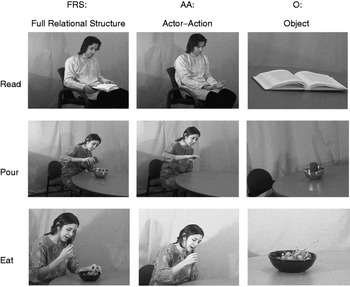
Experiment 1 asked children to indicate which picture out of three choices best depicted a particular target verb. The three picture choices were created by taking a prototypical scene – displaying all the key roles – and omitting either the actor of the action or the object of the action. This resulted in the following types of pictures (examples in Figure 1): (1) the Full Relational Structure (FRS): an actor performing an appropriate action directly on an object; (2) Actor–Action (AA): an actor performing an action, but no object is shown; (3) Object (O): only the object is depicted. All three pictures were displayed together and the child was asked to choose the one best illustrating the verb. Our question is whether the children would attend to the scene elements corresponding to the verb argument structure and thus choose the Full Relational Structure picture as the best depiction of the activity labeled by the bare verb.
Because our task had not been used before, it was particularly important to consider cross-cultural factors (see Peña, Reference Peña2007). In order to address possible cultural differences in the children's outgoingness and level of anxiety around strangers, all children were tested in environments comfortable to them, with a family member or well-known teacher present. In order to address differences in the interpretation of stimuli independent of the factors studied, differences in the interpretation of the task, and differential preferences for certain kinds of pictures, three control studies were conducted, with three different sets of participants. We first discuss each control task and then continue with the methods and results of Experiment 1.
Stimulus Control
To determine whether the pictures would be seen as equally relevant to the target verbs in each language, we asked English-speaking and Tamil-speaking adults to describe the stimuli. The key question, particularly for the derived pictures in which a scene element was subtracted, is not whether adult speakers offer the target verb, but whether there are differences in the likelihood across the two languages. For example, the task as constructed would be an unfair measure of the two groups of children's mapping of verbs to scenes if all the speakers of one language said ‘read’ when they saw a book by itself but none of the speakers of the other language did. The key stimulus type is the scene depicting the Full Relational Structure, which shows an actor performing an appropriate action on an object. However, this control tested all pictures, including those which may be considered more ambiguous.
Ten English-speaking adults (psychology undergraduates at Indiana University) and ten Tamil-speaking adults (college-educated, college-age, and older individuals in Chennai, India; all spoke English to varying degrees) were asked to describe each picture one at a time. Half the participants saw the stimuli in the 3-Picture Condition with three pictures on a page, as in Experiment 1 (examples in Figure 1), where context would presumably help with interpretation of the more ambiguous pictures; the remaining participants were in the 1-Picture Condition, where the pictures were shown one at a time in random order.
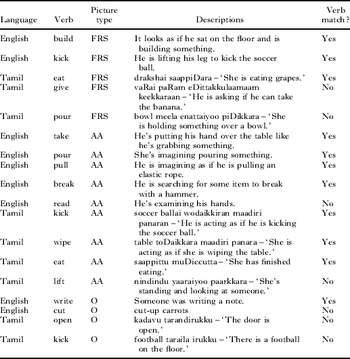
Speakers' descriptions (examples in Table 1) were counted as matching the target verb if the participants either used the actual target verb in their description or used a synonym (e.g. ‘grab’ for target verb take). Because speakers could describe the pictures however they wished (see, e.g., Gleitman, Reference Gleitman and Bloom1994; Snedecker & Gleitman, Reference Snedeker, Gleitman, Hall and Waxman2004, for discussion of the abstract relations encoded by verbs), many of the speakers' responses involved no action verbs (e.g. ‘cut-up carrots’ for a picture reflecting target verb cut) or invoked other possible descriptions (e.g. ‘hold’, ‘show’ or ‘have’ for a picture reflecting target verb lift). We scored responses conservatively in both languages and did not count utterances with alternative verbs or no verb as being equivalent to the target verb. Note that alternative construals in this open task need not mean that speakers would not select the picture as an appropriate depiction when given a target verb.
Descriptions provided by subjects in 1-Picture/3-Picture Conditions

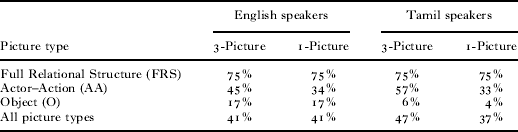
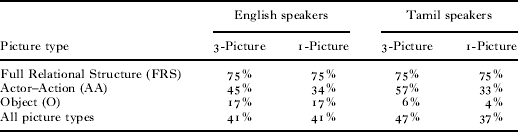
Table 2 gives the percentage of agreement of English and Tamil speakers' descriptions with the target verb for each picture type. The picture type of primary interest is the Full Relational Structure picture, which shows the actor performing a relevant action on an object. In their descriptions of the FRS picture, English and Tamil speakers used the target verb (or one of closely related meaning) more than 75% of the time in both conditions. However, as seen in Table 2, the Actor–Action and Object pictures were not as evocative of the target verb. The critical fact here is that adults in both languages produced the target verb in response to the FRS picture, the derived AA and O pictures, and overall to all three picture types to equivalent extents. Overall, the pictures depicting these activities appear reasonably comparable for speakers of both languages.
Percentage of agreement with the target verb in English and Tamil speakers' descriptions for the Full Relational Structure (FRS), Actor–Action (AA), and Object (O) picture types for the 3-Picture and 1-Picture conditions in the Stimulus Control for Experiment 1
Task Control
In order to ensure that both groups of children understood the task and instructions in similar ways, we presented the children with the same task used in Experiment 1 (matching the target word with one of three pictures) on a different type of stimulus set: objects rather than actions. Language differences are expected when this task involves verbs but not expected when this task involves nouns – across languages, nouns convey more stable meanings than verbs, which carry meanings open to different temporal and aspectual construals (Gentner, Reference Gentner1978).
Ten children sampled from similar populations to those tested in Experiment 1 participated from each language group (English: 2 ; 2 to 3 ; 11, mean age 3 ; 4; Tamil: 2 ; 2 to 3 ; 10, mean age 3 ; 5). Participants were asked to select the best picture from three choices for each of eight early-learned and common nouns (English/Tamil): dog/naay; tree/maram; baby/paappaa; bird/paravai; book/pusttakkam; hand/kay; horse/kudarai; and moon/candaran.Footnote 1 For each target noun (e.g. baby), children were shown a ‘best example’ (e.g. an infant), a ‘good example’ (e.g. a toddler), and a ‘non-example’ (e.g. an old lady). Results indicated that both groups of children understood the basic task structure when it was not about verbs: English- and Tamil-speaking children showed a high level of agreement (88%) in which picture was chosen as depicting a target noun.
Random Choice Control
In order to examine random selections and personal preferences, children were asked to pick the picture they most liked from each set of pictures used in Experiment 1 (examples in Figure 1). Ten English-speaking children (ages 2 ; 1 to 3 ; 7, mean age 2 ; 10) and twenty Tamil-speaking children (ten younger: 2 ; 4 to 2 ; 10, mean age 2 ; 6; ten older: 3 ; 1 to 4 ; 5, mean age 3 ; 10) were sampled from similar populations to those tested in Experiment 1. The same strong preference for Object pictures was found in both English speakers (60%) and Tamil speakers (70% for both age groups).
Method
Participants
Twenty English-speaking children (Younger: 2 ; 3 to 2 ; 11, mean age 2 ; 8; Older: 3 ; 1 to 4 ; 10, mean age 3 ; 10) and twenty Tamil-speaking children (Younger: 2 ; 3 to 2 ; 11, mean age 2 ; 7; Older; Tamil: 3 ; 1 to 4 ; 11, mean age 3 ; 10) participated. The English-speaking children were drawn from the population in Bloomington, Indiana, a small mid-western college town, and included children of parents from a range of professions, including academics as well as farmers and other workers in rural areas with no college education, and encompassed a wide range of ethnicities. The Tamil-speaking children were selected to be as directly comparable as possible and included children whose parents were doctors and high-school teachers, as well as children whose parents had no college education.
The English learners were tested individually in a developmental psychology laboratory, with one or both parents present. The Tamil learners, recruited in Chennai, Tamil Nadu, India at Shree Vignesh Creche & Pre School, were tested individually in a separate room with a teacher present or in their own home with one or both parents present. The preschool selected in India was one that had previously hosted researchers in child development.
Comparing language levels between the two groups of children
The English-speaking children were all monolingual. Because India is a multilingual country, children are exposed to many languages and many speakers of Tamil also speak one or more additional languages. English, in particular, is pervasively used in everyday speech, although many children enter school without producing full English sentences. In order to have a population of children whose main language is Tamil, children of parents whose mother tongue was Tamil, who spoke Tamil at home, and who were educated primarily in Tamil-medium schools were selected.
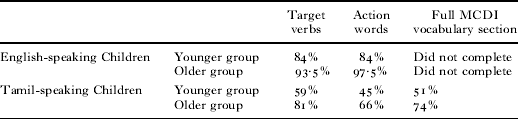
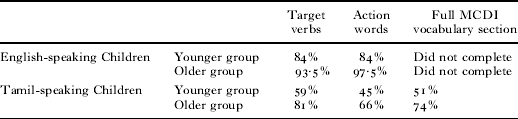
Parents of English learners were asked to complete the action word section on the MacArthur-Bates Communicative Development Inventory: Words and Sentences (Fenson et al., Reference Fenson, Dale, Reznick, Thal, Bates, Hartung, Pethick and Reilly1993). In spite of the inherent problems, we used a translation of the English CDI vocabulary section for the Tamil-speaking children (Sethuraman, Reference Sethuraman, Goldberg, Goodman and ClarkIn Preparation), which twelve parents returned. Table 3 shows the percentage of words the children were reported to know.
Percentage of words known (as given by parent report) by English- and Tamil-speaking children from (1) the Target Verbs, (2) the Action Words section on the English MCDI: Words and Sentences form, and (3) the full vocabulary section on the English MCDI: Words and Sentences form (dictionary translational equivalents used with Tamil speakers) (MCDI: Fenson et al., Reference Fenson, Dale, Reznick, Thal, Bates, Hartung, Pethick and Reilly1993)
Stimuli
Twenty verbs were selected from the English MCDI (Fenson et al., Reference Fenson, Dale, Reznick, Thal, Bates, Hartung, Pethick and Reilly1993) and dictionary translational equivalents were used for Tamil (English/Tamil): bite/kaDi, break/woDai, build/kaTTu, buy/vaangu, close/muuDu, cut/narakku, eat/saappiDu, give/kuDu, kick/wodai, lift/tuukku, open/tara, pour/koTTu, pull/yiRu, put/vai, read/paDi, show/kaami, take/yeDu, wash/kaRavu, wipe/toDai and write/yeRidu. The verbs were selected to be common, span a wide range of meanings and occur with a wide range of argument structures. Eighteen of the verbs were present in one or both corpora of Tamil adult and child speech examined (kaTTu ‘build’ and narakku ‘cut’ did not appear): (1) the Vanitha Corpus (CHILDES: MacWhinney, Reference MacWhinney2000; Narasimhan, Reference Narasimhan1981), consisting of speech from a young Tamil-learning child (Vanitha: 0 ; 9–2 ; 9) and her parents; (2) adult and child Tamil speakers' descriptions of everyday actions (Sethuraman & Smith, Reference Sethuraman and Smith2010).
Three types of pictures, shown in Figure 1, were created for each verb and presented together: (1) Full Relational Structure: an actor performing an appropriate action on an object; (2) Actor–Action: an actor performing an action, but no object is shown; (3) Object: only an object is shown. The pictures were presented in one of two random orders, such that both the order of the verbs and the presentation of the three choices for each verb were randomized.
The three types of stimulus pictures used in Experiment 1, the Stimulus Control for Experiment 1, and the Random Choice Control for Experiment 1, for the verbs read, pour and eat: FRS – Full Relational Structure, AA – Actor–Action and O – Object.

Procedure
On each trial, children were shown a page with three pictures and were asked to select one picture (usually by placing a sticker) corresponding to a target verb. Children had no difficulty understanding the instructions and required little additional prompting. Children were given the prompt (English/Tamil): Put the sticker on reading/PaDikkuradu meela (sticker) woTTu ‘stick (the sticker) on reading’. We chose to use the gerund form, indicating ongoing action, in the prompt for each language for three reasons. First, this is the phrasing that is used in standardized tests in English (PPVT: Dunn & Dunn, Reference Dunn and Dunn2007) and in other studies of English verb learning. Second, this form is the grammatically correct name of the action in both languages; constructions such as ‘put it on read’ or ‘show me read’ are ungrammatical in Tamil. Third, we wanted to use a prompt that did not provide any information about the subject, which is normally marked on most verb forms in Tamil; the gerund form in Tamil indicates ongoing action without referring to a subject. A morphological gloss of the gerund verb form for read in Tamil is: verb imperative (paDi) + infinitive marker (paDi + kka) + verbal noun marker (paDikka + radu).
Results and discussion
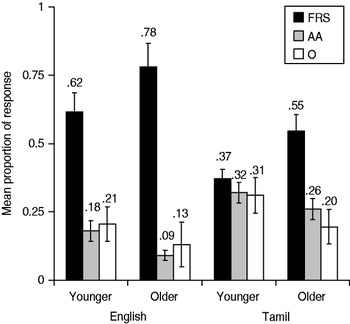
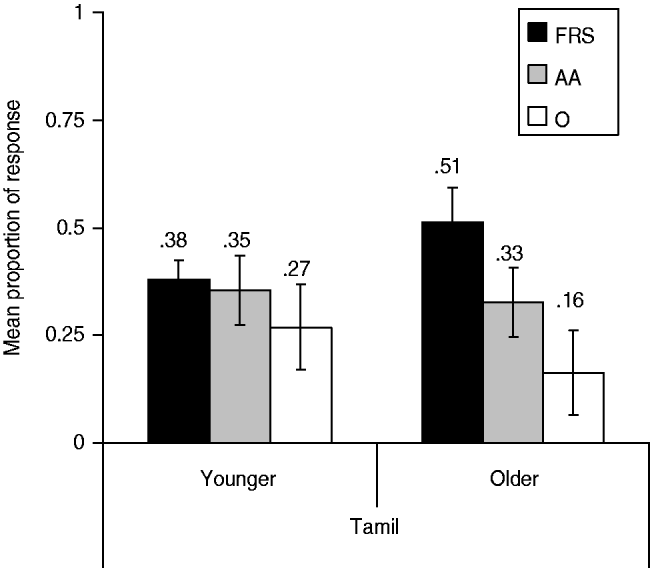
The central question is whether speakers of the two languages differ in the kinds of pictures accepted as describing the target verbs. Figure 2 shows the percentage of trials on which the children selected the Full Relational Structure (FRS), Actor–Action (AA) and Object (O) pictures. As is evident, both younger and older English-speaking children overwhelmingly selected the FRS picture, but Tamil-speaking children were less likely to do so. The number of choices of the FRS picture was submitted to an ANOVA with language (2) and age (2) as factors. The analysis yielded a main effect of language (F(1,36) = 13·08, p = 0·01, ηp2 = 0·267), and a main effect of age (F(1,36) = 6·57, p = 0·02, ηp2 = 0·154). The interaction of language and age did not approach significance. English-speaking children's greater preference for the FRS picture is consistent with the hypothesis that verbs in English, because of their history of association with explicitly expressed arguments, more strongly point to the relational structure (even when used without their arguments) than verbs in Tamil, which are not so consistently associated with explicitly expressed arguments. Older Tamil children show a clear preference for the FRS picture (though not as marked as that of their English-speaking peers).
Mean proportion of choices of each picture type by younger and older English- and Tamil-speaking children in Experiment 1: FRS – Full Relational Structure, AA – Actor–Action, O – Object. Error bars show standard error.

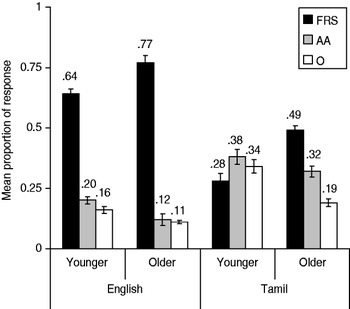
Overall, English-speaking children performed better in mapping verbs to pictures with all the relational roles depicted than did Tamil-speaking children. Indeed, the younger Tamil-speaking children's selections of the three pictures are evenly distributed and their selections do not differ reliably from chance (t(9) < 1·00). Older Tamil-speaking children did select the FRS picture at levels greater than chance (t(9) = 3·49, p < 0·05), but less often than the English-speaking children. The youngest Tamil-speaking children chose all the possible pictures with equal frequency, suggesting that they perhaps did not understand the verbs or did not understand the argument structures of those verbs. This pattern of performance characterized the youngest Tamil speakers with all verb types except for one subclass, namely verbs that involve an instrument (‘break’, ‘cut’, ‘wipe’, ‘write’). As shown in Figure 3, for these four verbs only, the younger Tamil-speaking children do show a tendency to choose the FRS picture (though again not as robustly as the English-speaking children). Apparently, these verbs imply the instrument, and this may be true for young learners of both languages.
Mean proportion of choices of each picture type by younger and older English- and Tamil-speaking children in Experiment 1 for the subclass of verbs that involve an instrument (break, cut, wipe, write): FRS – Full Relational Structure, AA – Actor–Action, O – Object. Error bars show standard error.

One way to interpret these results is that the younger Tamil-speaking children performed at chance and the older Tamil-speaking children performed like the younger English speakers. The simplest interpretation of such results is that the task is more difficult for Tamil-speaking children than English-speaking children. But there are many reasons why this might be so, including cultural differences or the choice of verbs. In addition, one might argue that the Tamil-speaking children had the harder task in identifying base verbs due to the greater morphological complexity of the form of the verb used in the prompt (e.g. paDikkiratu – three morphemes vs. reading – two morphemes). However, Tamil-learning children are exposed to much more verbal morphology than English-learning children, and so are more accustomed to hearing different forms of the verb, but this is an issue to explore in future work.
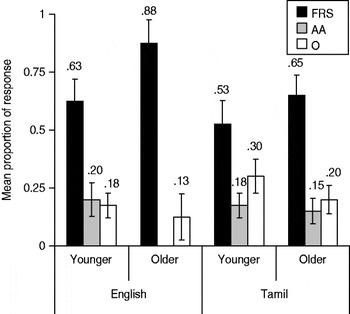
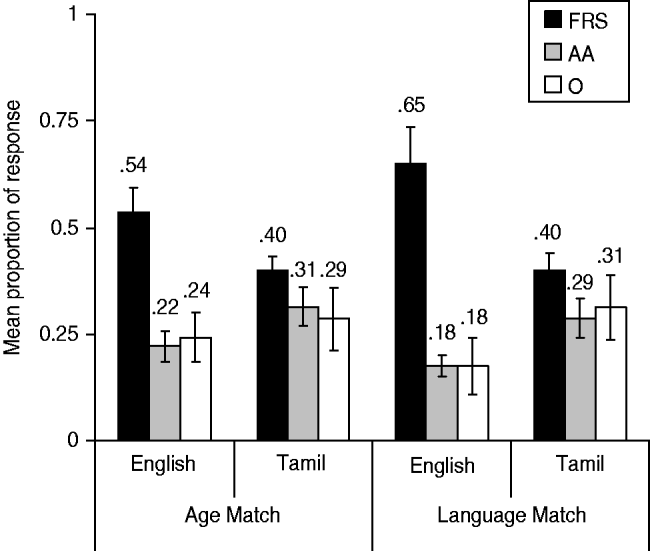
One may also argue that the Tamil learners' performance was due to a ‘developmental lag’ in verb learning. As discussed earlier, the English-speaking children were reported by their parents to know more verbs than the twelve Tamil learners for whom parents returned a vocabulary checklist. The possibility of a lag was considered by re-examining the results obtained in Experiment 1 in three ways: (1) using only the verbs that 75% or more of the parents reported the younger Tamil learners as having in their productive vocabulary, most likely a highly conservative predictor of receptive knowledge, shown in Figure 4 (analysis includes seven verbs: bite, close, eat, give, open, pour, show); (2) age-matching (±1 month of age) seven younger Tamil and English learners and language-matching (±1 verbs known, by parent report) four younger Tamil and English learners, shown in Figure 5; and (3) re-examining the data from the twelve Tamil-speaking children whose parents returned vocabulary checklists, by limiting the data set to just the verbs that parents specifically said each child produced (7 younger children: 6–20 verbs reported known, average = 12 verbs reported known; 5 older children: 12–18 verbs reported known, average = 16 verbs reported known), shown in Figure 6.
Mean proportion of choices of each picture type by younger and older English- and Tamil-speaking children in Experiment 1 when data is limited to the verbs that 75% of younger Tamil-speaking children are reported to know (by parent report); FRS – Full Relational Structure, AA – Actor–Action, O – Object. Error bars show standard error.

Mean proportion of choices of each picture type by younger English- and Tamil-speaking children in Experiment 1, when seven children are Age Matched (±1 month of age) and when four children are Language Matched (±1 verb known, as given by parent report): FRS – Full Relational Structure, AA – Actor–Action, O – Object. Error bars show standard error.

Mean proportion of choices of each picture type by younger and older Tamil-speaking children in Experiment 1 when data is limited to only the verbs reported by parents as known by each child. Error bars show standard error.

If in fact the Tamil-speaking children's performance was simply due to knowing fewer of the test verbs than the English-speaking children, these reduced datasets should, at the very least, reduce the differences in performance between the two groups of children. As seen in Figures 4, 5 and 6, this did not happen in these analyses: rather, the same patterns are observed as when the full dataset is used, lending additional support to the idea that these differences may reflect meaningful differences in the development of verb meanings by learners of the two languages.
Overall, these results are consistent with the possibility that young verb learners develop in their ability to understand relational roles, and that the explicit expression of the arguments of verb benefits this development. That is, one might argue that the Tamil-speaking children's responses may be due to differences in the strength of the link between a verb and its relevant relational roles. Still, it could be that these results are capturing other kinds of knowledge besides knowledge of argument structure – an alternative explanation for why the Tamil-speaking children are making any choice other than the Full Relational Structure picture. We address more specifically what Tamil-speaking children know about argument structure in Experiment 2 and what Tamil-speaking adults do when confronted with a similar sort of task as the children in Experiment 3.
Experiment 2
Experiment 2 has two purposes: (1) to show that Tamil-speaking children are not simply delayed in their understanding of these test verbs or their relevant relational structures; (2) to show that Tamil-speaking children are sensitive to and correctly understand explicitly expressed arguments. This is relevant because children learning languages in which arguments are often omitted could learn to ignore argument structure as an unreliable cue (e.g. Bates & MacWhinney, Reference Bates, MacWhinney and MacWhinney1987). Using the stimuli from Experiment 1 with a distractor picture added, Tamil-speaking children were asked which picture best matched the target verb used with overtly expressed argument structure (e.g. ‘Show me the picture in which the woman is pouring water into a cup.’).
Method
Participants, stimuli and procedure
Ten younger Tamil-speaking children (ages 2 ; 2 to 2 ; 10; mean age 2 ; 6) participated. The children were selected from populations similar to those tested in Experiment 1. The procedure and stimuli were identical to that in Experiment 1, with the addition of a distractor picture depicting an unrelated scene for each verb, so that even if children had a broad understanding of the verbs, there was clearly one wrong answer. The stimuli were presented in one of two random orders, such that both the order of the twenty verbs and the presentation of the four choices for each verb (Full Relational Structure; Actor–Action; Object; Distractor) were randomized. The following instructions were provided: Enda paDattil oru aaL pustagam paDikkarar? Anda paDam meela (sticker) woTTu! ‘In which picture is the man reading the book? Stick (the sticker) on that picture.’
Results
The Tamil learners overwhelmingly chose the Full Relational Structure picture (90%) in response to verbs used with explicit arguments.
Discussion
The results emphasize that with full argument structure information, even very young Tamil-speaking children can select the appropriate picture for the verb. By contrast, in Experiment 1 and unlike English-speaking age-mates, they could not do so given the bare verb, a result that implies that the bare verb does not activate knowledge of argument structure as well for Tamil learners as English learners. Although Tamil does have case marking that indicates the relational roles of overtly expressed arguments, case marking, particularly that which indicates the direct object of the verb, may be commonly dropped in spoken Tamil. These results, along with the variability in the presence of arguments and case marking, could mean that Tamil learners take a longer time to learn verbs than English learners, which may reflect one of the acquisition consequences of learning an argument dropping language (see also Bowerman & Brown, Reference Bowerman and Brown2008, for discussion of verb learning in typologically different languages). As Slobin (Reference Slobin and Slobin1985) pointed out, languages differ in the quality of information they present young learners for different aspects of the language. The natural elicitations of many of the target verbs in the current study showed that English and Tamil speakers use these verbs differently, with English speakers (adult and child) naming more verbal elements and being affected differently by the pragmatic factors manipulated in the experiment, such as the presence of more or unusual objects in the scene (Sethuraman & Smith, Reference Sethuraman and Smith2010). When considered with the results of Experiment 1, the results here suggest that young Tamil learners, even though they may understand arguments when used with a verb, do not strongly associate bare verbs to relational roles in the same way that similarly aged English learners do, but rather may be influenced by different linguistic and pragmatic cues available to them in the Tamil input. We return to this idea in the ‘General discussion’.
Experiment 3
The results of Experiment 1 suggest that Tamil learners, who do not always hear verbs consistently paired with arguments, take longer to associate relational roles to the verb than do English learners. By hypothesis, hearing verbs used more often with explicitly mentioned arguments may help English learners learn to associate relational roles with verbs more quickly. Thus, the developmental paths children take in learning these languages may be different, with one perhaps occurring over a longer period of time, even though the final outcome might be the same. It is also possible, however, that the final outcome is not exactly the same, and that differences observed in the two groups of children persist into adulthood. This is what is examined in Experiment 3.
Adult speakers of English and Tamil were shown eight depictions at the same time for each target verb and were asked to select: (1) the one picture that was the best match; and (2) additional pictures that also are acceptable depictions. We used this more difficult and open-ended task in order to discern what might be expected to be subtle differences in adult speakers of the two languages. The eight pictures consisted of six picture types (see Figure 7) structured in ways analogous to those used in Experiment 1, with the Full Relational Structure pictures designed to depict the elements most likely to be relevant to the typical argument structure of the target verbs, and the remaining picture types omitting elements. The critical issue here is adult sensitivity, as a function of language group, to the presence of scene elements in selecting depictions of the verbs. To control for possible cultural differences unrelated to verb meanings in participants' willingness to accept pictures, we used a Task Control using nouns, similar to that in Experiment 1. We expected to find no language differences due to differences in understanding nouns (e.g. Gentner, Reference Gentner1978). We discuss the Task Control first and then continue with the methods and results for Experiment 3.
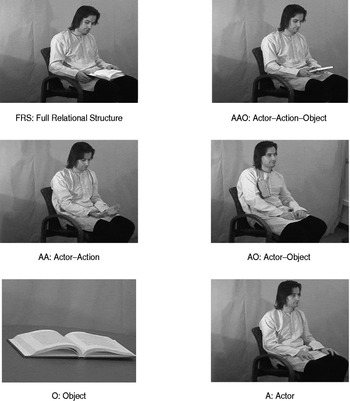
The six kinds of stimulus pictures used in Experiment 3 for the verb read: FRS – Full Relational Structure, AAO – Actor–Action–Object, AA – Actor–Action, AO – Actor–Object, O – Object, A – Actor.

Task Control
Ten English-speaking and ten Tamil-speaking adults participated, sampled from the same population used in Experiment 3. The same eight early-learned and common nouns used in the corresponding control study in Experiment 1 were used here, depicted by eight pictures, structured (e.g. for target noun hand) to show ‘good examples’ (e.g. the back of a hand, many hands), ‘possible examples’ (e.g. just fingers, the bones in a hand), ‘bad examples’ (e.g. a dog's paw), and ‘non-examples’ (e.g. feet). Participants were asked to choose one picture best depicting the particular target noun and additional pictures depicting good examples of that noun.
There was 80% or more agreement between English and Tamil speakers for which picture was most often selected as the best example for each of seven nouns, and 50% agreement for the eighth noun (moon). Additionally, overall, speakers of both language groups circled the same number of instances as good examples of each target noun (English: 2·6 pictures per noun, SD = 0·23; Tamil: 2·3 pictures per noun, SD = 0·49), and, in fact, chose the same pictures as good examples, with 91% agreement for which pictures were selected. These results suggest that both groups understood the task and instructions similarly.
Method
Participants
Twenty-four adults from each language group participated. The English-speaking adults were psychology undergraduates at Indiana University who participated in the study for course credit. The Tamil-speaking adults, tested in Chennai, India, participated in the study for candy and included some college-educated individuals, who were college-age as well as older individuals; all spoke English to varying degrees.
Stimuli
The same twenty verbs used in Experiment 1 were used in Experiment 3. For each verb, six types of pictures were created, shown in Figure 7 for read, which varied in their inclusion of the elements that might be relevant to the argument structure of the verbs. Three of these picture types were used in Experiment 1, namely the Full Relational Structure, Actor–Action and Object, and three additional picture types were used here: Actor–Action–Object (AAO), showing all constituents but the action does not happen directly on the object (e.g. the actor is holding the book closed so it is not actually being read); Actor–Object (AO), in which the actor and object (book) are present but the action is not explicitly shown; and Actor (A), which depicts an actor in a neutral position.
Stimuli for each verb included the six picture types described above, plus variants of two types, randomly selected, for a total of eight choices per verb. For example, stimuli for read duplicated the Object type (the two O pictures: an open book; a closed book) and the Actor–Object type (the two AO pictures: an actor holding the book in one hand; an actor holding the book under his arm). Picture types were duplicated in order to minimize the likelihood that participants would intuit the Subject, Verb, Object structure underlying the creation of the choices. Pictures for each verb were given on separate pages. Two random orders were created by varying the order of the target verbs and the placement order of pictures on each page.
Procedure
Participants were shown eight depictions for each target verb and given the following written instructions (English/Tamil): Circle all pictures that are a good example of VERB. Put a star next to the picture that is the best example of VERB/VERB enru vaarttaikku sariyaana fooTTookkaLai suRi suRittu kaaNpikkavum. VERB enru vaarttaikku mika sariyaana fooTTookkaLai pakkattil oru nakshattira kuri pooDngaL ‘For the word VERB-imperative, circle all the photos that correspond. For the word VERB-imperative, put a star next to the photo that is the most corresponding.’
The instructions used here with adults differed from those used with children in Experiment 1 for two reasons. First, because the main interest in this experiment was to determine adult understanding of these verbs as they related to scenes (and not to compare their performance to that of children), we used the open-ended task of choosing possibly several pictures as instances. Second, the instructions were written rather than spoken, which allowed us to use the bare verb without ‘-ing’. In these ways, the experiment, while not directly comparable to that with the children, enabled us to provide converging evidence from a sensitive measure of adult performance.
Results and discussion
Best example of target verb
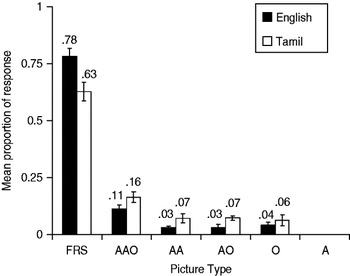
This first analysis asked how many times, overall, pictures of each type were considered the best example of each verb. Responses for the picture type chosen as the best example of the target verb were submitted to an ANOVA with language (2) and picture type (6) as factors. The analysis yielded a main effect of picture type (F(5,230) = 288·74, p = 0·001, ηp2 = 0·863), and a reliable interaction between language and picture type (F(5,230) = 6·18, p = 0·001, ηp2 = 0·118). Post-hoc analyses (Tukey's HSD, α < 0·05; see Winer, Reference Winer1971) were used to examine the sources of these effects; all pairwise differences mentioned below are reliable.
As shown in Figure 8, speakers rank-ordered the picture types nearly identically. Both Tamil and English speakers chose the Full Relational Structure (FRS) picture most often as the best example depicting the target verb. However, the English speakers chose the FRS picture reliably and significantly more often than the Tamil speakers.
Mean proportion of choices of each picture type by English- and Tamil-speaking adults in Experiment 3 as the Best Example of the verb: FRS – Full Relational Structure, AAO – Actor–Action–Object, AA – Actor–Action, AO – Actor–Object, O – Object, A – Actor. Error bars show standard error.

In addition, both Tamil and English speakers choose Actor–Action–Object (AAO) as the second-best type representing the target verb. Actor–Action (AA), Actor–Object (AO) and Object (O) were selected equally often (within each language group) as the third-best choice. Tamil speakers were generally more likely to choose these four alternatives than the English speakers. Neither language group selected the Actor (A) picture type as the best example of the target verb. The patterns of choices are qualitatively similar and thus suggest qualitatively similar understandings of the relational meaning of these verbs between the two language groups.
Good examples of the target verb
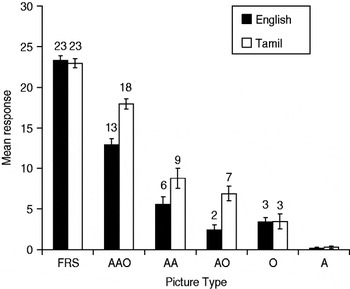
This second analysis asked how many times, overall, pictures of each type were considered acceptable examples of the verbs. The number of times participants in each language group accepted each type of picture across the twenty trials was submitted to an ANOVA for a mixed design with language (2) and picture type (6) as the factors. The analysis yielded main effects of language (F(1,46) = 15·26, p = 0·001, ηp2 = 0·249), picture type (F(5,230) = 322·03, p = 0·001, ηp2 = 0·875), and a reliable interaction between language and picture type (F(5,230) = 5·86, p = 0·001, ηp2 = 0·113). In general, Tamil speakers accepted more pictures than English speakers but this varied with picture type. Post-hoc analyses (Tukey's HSD, α < 0·05; see Winer, Reference Winer1971) were used to understand the sources of these effects. All results discussed below were reliable by this method.
As shown in Figure 9, the relative frequency with which Tamil and English speakers accepted different picture types as ‘Good Examples’ was consistently similar, although overall, Tamil speakers accepted a broader range of pictures. That is, both groups virtually always included the Full Relational Structure (FRS) picture as an instance of the target verb, and did so equally often; however, Tamil speakers were much more likely to include depictions missing some elements, including Actor–Action–Object (AAO), Actor–Action (AA), Actor–Object (AO) and Object (O), in that order. English speakers also included, as good depictions of the target verb, those missing elements, including Actor–Action–Object, Actor–Action, Object and Actor–Object, in that order. However, English speakers were much less likely to include depictions with missing elements than Tamil speakers. Neither language group included Actor (A), and English and Tamil speakers did not differ in their inclusion of Object or Actor. That is, adult speakers of Tamil were much more likely to include thematically related scenes that did not fully depict the complete relational structure.
Mean number of choices of each picture type by English- and Tamil-speaking adults in Experiment 3 as a possible instance (Good Example) of the verb: FRS – Full Relational Structure, AAO – Actor–Action–Object, AA – Actor–Action, AO – Actor–Object, O – Object, A – Actor. Error bars show standard error.

It may be that Tamil speakers are simply liberal in their selections in this type of task. However, they showed no such trend in their choices in the Task Control, in which Tamil and English speakers performed comparably. Although the comparable Task Control performance does not guarantee that the differences in Experiment 3 are due to differences in sensitivity to the scene elements relevant to the relational meaning of the verb, they do suggest that the cross-linguistic differences observed in children may be subtly present in adult judgements of verb–scene correspondences, just as they are present in adult uses of verbs (Sethuraman & Smith, Reference Sethuraman and Smith2010). The nearly identical performance of adult and child Tamil and English speakers on nouns but not verbs suggests that it is only in the range of scenes taken as acceptable depictions of a verb that there are language differences, a result consistent with considerable cross-linguistic differences in verb meanings relative to nouns (e.g. Gentner, Reference Gentner1978), and suggestive of a perhaps weaker link between the bare verb and its implied relational roles in adult speakers of Tamil, just as in child learners of Tamil.
In sum, these differences in the performances of adult speakers are subtle and could be due to other cultural differences and not linguistic differences, despite several culturally sensitive controls. However, the larger set of results – the earlier study of English and Tamil differences in verb productions to describe scenes (Sethuraman & Smith, Reference Sethuraman and Smith2010), the differences between English- and Tamil-speaking children in Experiment 1, and the subtle differences observed in adult verb–scene choices in this experiment – are suggestive of the possibility that different patterns of language use (in this case, the explicit expression of arguments with verbs) create somewhat different developmental pathways and perhaps also different outcomes in how verbs are used and understood with respect to their argument structure.
General discussion
Learning verb meanings
Three hypotheses were initially considered as to whether English or Tamil learners would map verbs to relational roles earlier and more strongly: (1) they could perform identically; (2) speakers of Tamil (due to greater reliance on verbs, the more stable cue) could map verbs to relational roles earlier; and (3) speakers of English (due to greater reliance on overt argument structure, the more reliable cue regarding relational roles) could map verbs to relational roles earlier. The results support Hypothesis 3: English-speaking children more systematically linked the verb to pictures depicting the full relational structure than did Tamil learners. Tamil-speaking children mapped verbs used with explicitly expressed arguments to scenes with complete relational roles (Experiment 2); but given a verb alone, Tamil learners did not map the verb to the implied relational structure as strongly as their English-speaking counterparts (Experiment 1). English-speaking children's strong mapping of the verb to scenes depicting the full relational roles may have benefited from the consistent expression of verbs with arguments in their daily experience.
Consistent with this interpretation of the role of regular argument expression in English is the finding of smaller developmental differences among the English-speaking children. That is, the younger English-speaking children behaved similarly to the older English group whereas the younger and older Tamil-speaking children behaved quite differently from each other. The large developmental shift observed between the younger and older Tamil-speaking children may follow from the highly variable use of overtly expressed arguments with verbs in their input, so that, without clear argument structures to associate with verbs, the association of relational roles in the scene with argument structure occurs more slowly, increasing with language experience. Results of studies examining child learners of English, French, Mandarin and Turkish suggested that English learners, who arguably hear the most consistently overt expression of arguments, relied the most conservatively upon the cues provided by the syntactic frames in considering verb meaning (Naigles et al., Reference Naigles, Gleitman, Gleitman and Dromi1993; Naigles et al., Reference Naigles, Küntay, Göksun, Lee, Bamman, Magnitskaia and Zaller2006).
Cross-linguistic differences in meaning?
The differences observed in the children's performance may not go away completely when they become adults. However, one must be cautious in not overinterpreting the finding that Tamil adults selected a broader range of scenes with varying relational structures as acceptably depicting a verb. Certainly relevant to understanding these results is the fact that neither group of adult speakers exclusively chose the Full Relational Structure picture, but instead selected a range of pictures for every target verb. One explanation might be that because both languages allow omission of arguments, adult speakers interpreted a range of scenes containing different numbers of relational roles as relevant to the target verb. From this perspective, Tamil speakers took a broader interpretation of those scenes. This could be the key cross-linguistic difference, one directly related to differences in overt-argument expression, suggesting, at the very least, pragmatic differences in how verbs are used (see also Sethuraman & Smith, Reference Sethuraman and Smith2010).
If this is so, Tamil verbs may be linked to more variable arguments and thus understood as referring to somewhat more variable scene structures; in this sense, verbs in Tamil may evoke different construals and expectations (even if not different meanings). English- and Tamil-learning children may not develop different core meanings for verbs but may nonetheless derive, in context, different understandings. That is, because verbs in English and Tamil differ in the kinds of argument structures with which they are used, the structure of the language allows Tamil-speaking children and adults greater flexibility in what scenes they consider to be acceptable representations of a verb. Pederson (Reference Pederson, Bowerman and Brown2008) suggested a similar idea, that German- and Tamil-speaking children developed the same understanding of the basic meaning of verbs, but differed in their understanding of the realization (completeness) of the event described by that verb, because of differing input from adults.
One interesting way to examine whether English and Tamil speakers are developing similar or different kinds of understandings of verbs would be to examine different verbs within the same language. For example, in English, it may be that give, which is always expressed with three arguments, may be tied more strongly to particular relational roles, whereas verbs like go and get, which vary quite widely in the range of argument structures with which they are used, may be associated more weakly to particular relational roles. If this is so, it would seem possible that a language that consistently presents individual verbs in many different linguistic frames might also have verb meanings that are broader in the range of relational structures to which they refer and with which they are used. One way to think about this is in terms of Goldberg's (Reference Goldberg1995) analysis of the meaning of kick. In each of the sentences listed in Table 4, kick has the same core meaning but is understood differently because of the independent contribution of meaning from the argument structure of the sentence. Following this line of reasoning, it may be that verbs in different languages that express argument structure more or less frequently have stronger or weaker associations with particular relational roles as a part of their meaning, in addition to the core meaning (see also Sethuraman & Smith, Reference Sethuraman and Smith2010). These discussions hint at possibly subtle but different systems of verb meanings across languages, a potentially controversial idea in that it raises larger questions of whether there are universal mappings between arguments, relational roles and verb meanings (e.g. Gleitman, Reference Gleitman and Bloom1994; Gleitman et al., Reference Gleitman, Cassidy, Nappa, Papafragou and Trueswell2005; Lidz et al., Reference Lidz, Gleitman and Gleitman2003), or whether the way in which arguments are realized in a language impacts verb meaning and its connection to relational roles in the scene (e.g. Goldberg, Reference Goldberg1995; Tomasello, Reference Tomasello2003).
The verb kick used with different argument structures (Goldberg, Reference Goldberg1995: 11)

On the former account, there is an inextricable tie between a verb's meaning, arguments and relational roles: verb meanings and arguments, whether or not they are overtly expressed, relate directly back to the same relational roles. Argument structures directly correlate with components of the meanings of the verbs they are used with and are, to a large extent, derivable from the meanings of those verbs (e.g. Landau & Gleitman, Reference Landau and Gleitman1985; Levin, Reference Levin1993; Pinker, Reference Pinker1989). By this view, the structure of the language being learned does not influence the relationship between these three components: verbs in languages that allow arguments to be dropped are argued to still be regularly associated with those missing elements. Although available regularities may be more variable and not as transparent in English, nevertheless speakers of these languages may still use probabilistic surface cues in learning grammatical generalizations (Gleitman, Reference Gleitman and Bloom1994; Gleitman et al., Reference Gleitman, Cassidy, Nappa, Papafragou and Trueswell2005; Lidz et al., Reference Lidz, Gleitman and Gleitman2003).
On the latter, alternative account, children do not come to the learning task supported by language-specific biases or prior expectations regarding language structure, but rather attend to statistical regularities in the input regarding regular syntax–semantics correspondences (e.g. Tomasello, Reference Tomasello2003; Goldberg, Reference Goldberg1995). Following Goldberg (Reference Goldberg1995), argument structure and verbs do not directly reflect each other. Rather, argument structures act as units and have semantics in their own right, and verbs and arguments that co-occur do so because of commonalities between verb semantics and the semantics of the argument structures.
Both accounts – whether verbs and argument structures are inextricably tied together (Gleitman, Reference Gleitman and Bloom1994; Gleitman et al., Reference Gleitman, Cassidy, Nappa, Papafragou and Trueswell2005; Lidz et al., Reference Lidz, Gleitman and Gleitman2003) or whether verbs and argument structures are related but independent units (Goldberg, Reference Goldberg1995) – are argued to describe the structure of English and the importance of argument structure in verb learning for young children by their respective proponents. However, taking the second position a little farther, Tamil and English learners may be viewed as solving different problems because they are hearing adults use verbs in very different linguistic contexts, which may focus attention on different aspects of the scene. In other words, if verbs and their argument structures are independent units, and if there is greater variability in the links among verbs, expressed arguments and the relational structure of the scene in Tamil, then it may be unlikely that Tamil- and English-speaking children will use highly variable argument structure as a bootstrap to verb meaning in the same way. It may be that Tamil learners use their developing knowledge of verbs, the more stable cue in their input, to learn argument structure, an idea to examine in future work. The consequence of these different developmental paths may also be somewhat differently structured verb meanings.
Limitations and future directions
These conjectures about the interplay between regularities in the input, developmental trajectories and the nature of verb meanings in different languages underscore the importance of systematic studies of verb acquisition in children learning different languages. However, such cross-linguistic studies bring with them many problems. Accordingly, we conclude by noting several limitations – and compelling open questions – that will need to be considered in future work. First, although we attempted to select children in the two cultures with comparable socioeconomic status and to use materials and testing procedures that were suitable in the two cultures, comparability of participants and stimuli across such different cultures can never be assumed. Potentially relevant differences to be considered are possibly different overall levels of linguistic development (rather than just different levels of verb knowledge), potentially different parenting practices relevant to language learning, and, of course, the larger multilanguage context in which any language is learned in urban India. Second, potentially more difficult to resolve, and also more theoretically important, is the possibility that the verbs used in this study are not equivalent in frequency, use or meaning. Work on adults' and children's spontaneous productions in the two languages indicates that verbs are more frequent (relative to nouns) in Tamil than in English, consistent with the differences in allowable dropping of arguments (Sethuraman, In Preparation). The present data and data on adults' descriptions of scenes (Sethuraman & Smith, Reference Sethuraman and Smith2010) also clearly indicated that these verbs may be used by Tamil speakers in broader ranges of contexts, and the overt mention of arguments in Tamil is part of the pragmatic system. All this might imply somewhat different meanings for what might seem to be translational equivalents. In brief, although there may be no perfect ‘equivalence’ for any set of words across two languages, there are also many differences that may be relevant to the present findings that need to be specified more completely.
A second limitation concerns the task of mapping bare verbs to still pictures, which is purposely ambiguous in two ways: (1) participants do not hear the verb in its normal sentential role; and (2) the pictures do not present the full extralinguistic dynamic context of the labeled event. We chose this task, using known verbs, so as to discern what the speakers of the two languages brought to the task in terms of their knowledge about verbs and the relational structure of the events to which they refer. The results of Experiment 2 suggest the observed cross-linguistic differences might be minimized given more extensive linguistic contexts: it would be interesting to examine how these differences interact with variations in verb forms and portrayals of the stimulus events themselves. Indeed, extralinguistic context may be particularly important for Tamil speakers. Several recent studies suggest that speakers of elliptical languages are more dependent on non-linguistic contextual information, including joint attention, gesture and shared information (e.g. Allen, Reference Allen, Bowerman and Brown2007; Clancy, Reference Clancy and Clark2004; Naigles et al., Reference Naigles, Küntay, Göksun, Lee, Bamman, Magnitskaia and Zaller2006; Skarabela, Reference Skarabela2007). Future studies manipulating the verb form would also be informative. For example, if the Tamil-speaking children or adults were given a verb in the third person singular present form, we might find even fewer mappings to the Full Relational Structure pictures, if omission has pragmatic implications for what is communicatively relevant. Equally interesting is whether argument omission in a language in which the overt expression of arguments is so pervasive has different consequences for understanding: e.g. do English speakers interpret he eats and he eats it differently? Finally, it would also be useful to conduct a study in which English and Tamil learners are taught novel verbs in different syntactic patterns, controlling for previous exposure to the verbs and their argument structure.
Conclusion
The connection among verbs, arguments and relational roles is surely central to developing verb meanings. The present results suggest that the link between the verb and its relational roles may vary for speakers of languages which differ in the linguistic expression of those roles. The results provide new insights into cross-linguistic differences in verb learning and raise new questions about possible cross-linguistic differences in verb meanings themselves.