Most organisms are subject to strong selective pressures from predators, and prey employ a combination of morphological and behavioural adaptations to avoid predation (Blanchette & Saporito Reference BLANCHETTE and SAPORITO2016, David et al. Reference DAVID, SALIGNON and PERROT-MINNOT2014, Toledo et al. Reference TOLEDO, SAZIMA and HADDAD2011). Many predators are sensitive to movement, and therefore it can be advantageous for prey to remain immobile (Bulbert et al. Reference BULBERT, PAGE and BERNAL2015, Cooper et al. Reference COOPER, CALDWELL and VITT2009a, Miyatake et al. Reference MIYATAKE, TABUCHI, SASAKI, OKADA, KATAYAMA and MORIYA2007, Ozel & Stynoski Reference OZEL and STYNOSKI2011, Paluh et al. Reference PALUH, HANTAK and SAPORITO2014). Crypsis is one strategy in which prey use camouflage and immobility to avoid detection; however, aposematic organisms often exhibit slow movements (Cooper et al. Reference COOPER, CALDWELL and VITT2009a, Reference COOPER, CALDWELL and VITTb: Ozel & Stynoski Reference OZEL and STYNOSKI2011), which may act to enhance the visibility of their warning signal to predators (Ruxton et al. Reference RUXTON, SHERRATT and SPEED2004).
Poison frogs in the family Dendrobatidae are aposematically coloured and chemically defended (Saporito et al. Reference SAPORITO, ZUERCHER, ROBERTS, GERROW and DONNELLY2007, Reference SAPORITO, DONNELLY, SPANDE and GARRAFFO2012). Dendrobatids exhibit complex social behaviours and forage diurnally in the leaf litter, which likely increases their conspicuousness and risk to potential predators, such as birds. Although many social behaviours are well described (Meuche et al. Reference MEUCHE, LINSENMAIR and PRÖHL2011, Savage Reference SAVAGE2002), little is known about the behavioural responses of dendrobatids to predators. Escape behaviour of anurans in response to predators has been largely quantified in the literature by measures such as latency to move, angle of escape and distance fled (Bulbert et al. Reference BULBERT, PAGE and BERNAL2015, Cooper et al. Reference COOPER, CALDWELL and VITT2009a, Reference COOPER, CALDWELL and VITTb); however, flight initiation distance (the distance between predator and prey when the prey flees; FID) is the most commonly measured parameter. FID has been used to compare antipredator behaviour between cryptic and aposematic anurans, wherein humans are commonly used as a simulated predator (Cooper et al. Reference COOPER, CALDWELL and VITT2008, Dugas et al. Reference DUGAS, HALBROOK, KILLIUS, SOL and RICHARDS-ZAWACKI2015, Ozel & Stynoski Reference OZEL and STYNOSKI2011; however, see Willink et al. Reference WILLINK, BRENES-MORA, BOLANOS and PRÖHL2013). The dendrobatid frogs Dendrobates auratus and Oophaga pumilio hop short distances in response to an approaching human (Cooper et al. Reference COOPER, CALDWELL and VITT2008, Reference COOPER, CALDWELL and VITT2009a, Reference COOPER, CALDWELL and VITTb; Cooper & Blumstein Reference COOPER and BLUMSTEIN2016, Dugas et al. Reference DUGAS, HALBROOK, KILLIUS, SOL and RICHARDS-ZAWACKI2015, Ozel & Stynoski Reference OZEL and STYNOSKI2011, Pröhl & Ostrowski Reference PRÖHL and OSTROWSKI2011), whereas the dendrobatid O. granulifera varies in the degree of movement in response to a simulated bird predator, which is correlated with its dorsal colouration (Willink et al. Reference WILLINK, BRENES-MORA, BOLANOS and PRÖHL2013). A comparative study focused on measuring the escape responses of dendrobatid frogs to a simulated human and bird predator would provide valuable information on how frogs perceive various approaching threats.
The goal of the present study was to compare the behaviours of the dendrobatid frog O. pumilio to an approaching human and bird predator, by examining escape response variables (flight initiation distance, latency to move, angle of escape and distance fled) between these two simulated predator threats. Furthermore, as a comparison of the antipredator strategies between cryptic and aposematic organisms, these same escape variables were also measured in cryptic frogs in the genus Craugastor sp.
The present study was conducted in lowland tropical forest at the La Selva Biological Station (10°26′N, 83°59′W) in north-eastern Costa Rica from 26 February–7 March 2016. Forty-seven adult O. pumilio (SVL ≥ 19 mm) and 31 Craugastor sp. (SVL 15–25 mm) were captured during daylight hours (08h00–11h00) (Savage Reference SAVAGE2002). Upon capture, the sex of O. pumilio was determined based on the presence of a darkened throat patch in males (Savage Reference SAVAGE2002). Craugastor sp. exhibits no obvious secondary sexual characteristics (Savage Reference SAVAGE2002). All frogs were measured for SVL to the nearest 0.01 mm using Traceable® Digital Calipers and to the nearest 0.01 g for mass using a Pesola PPS200 digital pocket balance prior to behavioural assays. Individuals were housed in Ziploc bags (26.7 × 22.9 × 13.2 cm) with small amounts of leaf litter for up to 48 h post capture before being released at their original capture site. To avoid resampling of the same individuals, frogs were not collected from the same location following their release.
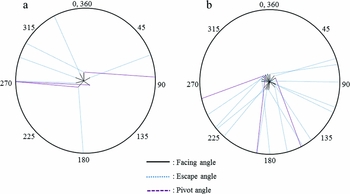
All behavioural assays were conducted at the Huertos Plots (STR 1200) during daylight hours (08h00–17h00) and under similar weather conditions (clear to partly cloudy). Each frog was placed onto the centre of a black plastic base (30.5 × 30.5 cm), and acclimatized under a dark cover object (8 × 7.8 × 5.2 cm) for 5 min. A researcher standing 1.5 m away lifted the cover object, and the frog was given 10 s to adjust before the simulated predator began approach from 5 m away. The simulated predator approached from a 0/360o angle relative to the position of the frog, and the angle of frog escape was based on this approach (Figure 1). The distance fled was measured as the distance the frog moved to until it either remained motionless for 5 s or passed 1.5 m. Latency to movement (time until frog moved in response to the predator) was recorded from when the simulated predator began its approach. If the frog did not move, FID, latency and distance fled were recorded as zero and the final angle at which the frog was facing was recorded.
The facing, escape, and pivot angles of Oophaga pumilio that exhibited movement in response to the approaching bird (a) and the approaching human (b) at La Selva Biological Station, Costa Rica. The facing angle refers to the orientation of the individual when the cover object was lifted. The escape angle refers to the direction of individuals that fled and the pivot angle refers to individuals that changed orientation but did not flee. Both predators approached from 0/360o.

For the bird predation treatment, 25 O. pumilio (14 female, 11 male) and 21 Craugastor sp. were used. The rufous motmot (Baryphthengus martii) is documented as a predator of dendrobatids (Alvarado et al. Reference ALVARADO, ALVAREZ and SAPORITO2013), and therefore a life-sized model of this bird was constructed using Floracraft Floral Foam sealed with Mod Podge Sealer and painted with FolkArt® multisurface acrylic paint. A clear nylon monofilament line (3.6 kg test strength) was tied at one end to a PVC pipe at 2 m in height and on the other end to a stake in the ground 7.5 m away. The model bird was attached to this line, and once released it glided silently over each frog (average height: 0.5 m; approximate velocity: 0.9 m s−1). For the human approach treatment, 22 O. pumilio (11 female, 11 male) and 21 Craugastor sp. (11 of which were also used in the bird treatment, due to low capture rates) were used. One researcher approached each frog from the same starting position as the bird model and walked at an approximate velocity of 0.9 m s−1.
Independent-samples t-tests were used to compare the FID, latency and distance fled between O. pumilio and Craugastor sp. and between O. pumilio males and females among and within treatments. All statistical analyses were conducted in SPSS v. 14 for Windows.
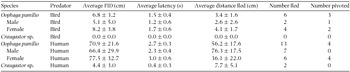
In response to the simulated bird predator, nine out of 25 O. pumilio exhibited movement (three pivoted, six fled; Figure 1a), whereas zero out of 21 Craugastor sp. moved. There was a significant difference between O. pumilio and Craugastor sp. in response to the bird model for FID (t24 = 2.13, P = 0.044), latency (t24 = 3.34, P = 0.003), and distance fled (t24 = 2.13, P = 0.043). In response to the approaching human, 17 out of 22 O. pumilio exhibited movement (four pivoted, 13 fled; Figure 1b), whereas two out of 21 Craugastor sp. moved. There was a significant difference between O. pumilio and Craugastor sp. in response to the human for FID (t21.9 = 3.04, P = 0.006), latency (t38.1 = 4.91, P < 0.05) and distance fled (t26.6 = 3.16, P = 0.004; Table 1).
The average flight initiation distance (FID), latency, and distance fled (± SE) for Oophaga pumilio, Oophaga pumilio males and females, and Craugastor sp. that exhibited movement in response to approaching bird and human simulated predators at La Selva Biological Station, Costa Rica. The number fled refers to the number of individuals that attempted escape and the number pivoted refers to the individuals that remained in place but changed orientation.

On average, female O. pumilio responded quicker to the approaching bird than male O. pumilio; however, there were no significant differences in response to the bird for FID (t23 = 0.47, P = 0.640), latency (t23 = 0.48, P = 0.638), and distance fled (t23 = 0.48, P = 0.638; Table 1) between sexes. On average, female O. pumilio responded quicker to the approaching human than male O. pumilio; however, there were no significant differences in response to the human for FID (t20 = 0.84, P = 0.839), latency (t20 = 0.96, P = 0.350), and distance fled (t20 = −1.43, P = 0.168; Table 1) between sexes.
Cryptic organisms generally rely on camouflage and immobility to reduce predation risk, while aposematic organisms rely on conspicuous colouration and some degree of movement to deter predators (Ruxton et al. Reference RUXTON, SHERRATT and SPEED2004). Cryptic frogs commonly remain motionless in the presence of a simulated human predator (Cooper et al. Reference COOPER, CALDWELL and VITT2008), whereas aposematic frogs have been found to flee, but their movement is characterized by slow hops (Cooper et al. Reference COOPER, CALDWELL and VITT2009a, Reference COOPER, CALDWELL and VITTb). Our study supports previous findings that cryptic Craugastor sp. will not flee from an approaching threat (Cooper et al. Reference COOPER, CALDWELL and VITT2008, Reference COOPER, CALDWELL and VITT2009a). Conversely, O. pumilio was more responsive to the approaching human when compared with the bird predator. Most O. pumilio individuals fled directly away from or perpendicular to the approaching human (Figure 1b), and for longer distances, whereas fewer frogs exhibited movement in response to the model bird. Of those O. pumilio individuals that moved in response to the bird, their movement was not as far and appeared to be more erratic (Figure 1a). Other studies have reported that escape trajectories of anurans are typically directed away from simulated terrestrial predators (Lippolis et al. Reference LIPPOLIS, BISAZZA, ROGERS and VALLORTIGARA2002, Royan et al. Reference ROYAN, MUIR and DOWNIE2010), but are more variable in response to simulated aerial threats (Cooper et al. Reference COOPER, CALDWELL and VITT2008).
Dendrobatids are at risk of predation by certain bird predators and there is some evidence that movement may be important to O. pumilio, in part due to the potential risk of birds mistaking them as fruit or seeds (Paluh et al. Reference PALUH, KENISON and SAPORITO2015). Further, movement may increase the conspicuousness of aposematic individuals to avian predators by enhancing their warning signal (Pröhl & Ostrowski Reference PRÖHL and OSTROWSKI2011, Ruxton et al. Reference RUXTON, SHERRATT and SPEED2004). While studies of predation upon clay model replicas have shown that birds attack some aposematic frogs, movement of model replicas significantly decreases avian predation (Paluh et al. Reference PALUH, HANTAK and SAPORITO2014, Reference PALUH, KENISON and SAPORITO2015, Willink et al. Reference WILLINK, BRENES-MORA, BOLANOS and PRÖHL2013). Counter to the prediction that frogs would flee, many O. pumilio individuals remained immobile or moved slightly when approached by the bird model, suggesting that conspicuous warning colouration, associated with some movement, is an effective defence.
The majority of escape-behaviour studies conducted with anurans have used humans as an approaching threat. In the current study, most O. pumilio individuals exposed to the approaching human had greater fleeing distances than those exposed to the bird model (Table 1). The increased fleeing distance in response to a human is similar to previous studies (Cooper et al. Reference COOPER, CALDWELL and VITT2009a, Reference COOPER, CALDWELL and VITTb; Ozel & Stynoski Reference OZEL and STYNOSKI2011), and may suggest that frogs view humans as a risk of trampling and not predation. Humans are large objects and produce vibrations when walking, which may cause the frogs to move sooner than would be expected if an actual predator were approaching (Cooper et al. Reference COOPER, CALDWELL and VITT2009b). The comparison between Craugastor sp. and O. pumilio highlights the difference in antipredator strategies between cryptic and aposematic organisms. The likelihood of Craugastor sp. being detected is low if it remains immobile in response to a human or bird; however, some movement of O. pumilio, particularly in response to a bird, may increase the visibility of its aposematic signal to a perceived threat.
The current study suggests that male and female O. pumilio do not exhibit any significant differences in escape behaviour in response to an approaching bird or human; however, females were more likely to initiate escape sooner, with respect to FID, in response to both simulated predators (Table 1). Males may experience greater pressure to remain stationary in response to a predator because of the energy that would be required to return to their territories and the potential for missed mating opportunities (Dugas et al. Reference DUGAS, HALBROOK, KILLIUS, SOL and RICHARDS-ZAWACKI2015).
ACKNOWLEDGEMENTS
We thank A.W. Jones for his advice and assistance with the field component of this research and bird design, the Department of Biology at John Carroll University for providing financial support, and P. Drockton, S. Kocheff and J. Trudeau for providing comments on earlier versions of this manuscript. We also thank the OTS La Selva Biological Station and Costa Rican government for permitting this project to be conducted (Permit # SINAC-SE-GASP-PI-R-0161). The Institutional Animal Care and Use Committee at John Carroll University approved the methods used in the present study (protocol #1400).