Introduction
Charles Thurstan Shaw’s archaeological discovery at Igbo Ukwu reveals that horses were introduced in Hausa land around 1000 ad and trading relations between northern Nigeria and Igbo Ukwu were established on the basis of horse trading and title taking.Footnote 1 P. A. Oguaha recalls that horses were portrayed by one of the bronze objects found in Igbo Richard, one of the archaeological sites at Nri. According to him,
Horses are used for funeral rites and for title taking ceremonies called Ogbu Anyinya (horse killer) among some northern Igbo groups. These horses were brought down by Hausa merchants across the river Benue into Igala country where they were sold at the important horse fair at Ejule.Footnote 2
The presence of a horse’s head in the motif of Igbo Ukwu, according to Robin Horton, was familiar to the people of the eastern Guinea forests as early as tenth century ad.Footnote 3 This reveals the history of animal-related title taking practices, as we shall see later in this article. Writing animals into history is always problematic, especially through how the past is presented.Footnote 4 For historians interested in writing animals into history, their craft is less important if it has no correlation with man. Second, they should also engage in studying animal welfare ethics concerning animal rights, in particular.Footnote 5 Most significantly, the phenomenon behind man preventing predators such as cats from killing birds,Footnote 6 but at the same time man also engaged in the killing of animals for title taking, funerals, rituals, and others. This needs to be studied from the perspective of how social constructions affected the attitude of humans towards animals.
Animals, especially with emphasis on the horse trade, served both as a political and economic issue, since they played a central role in political economy. For example, during the era of the cavalry state, horses became an essential tool not only for transportation but also instrumental in the slave trade.Footnote 7 Horses were also an expensive commodity that many dynasties could not afford.Footnote 8 The affluence of old empires such as Oyo was built on the number of horses acquired,Footnote 9 and it soon became a binding factor in intergroup relations between the Muslim north and southwestern regions of Oyo, where horses were traded in exchange for other commodities such as leather, iron, salts and kolanuts.Footnote 10
In precolonial settings, cruelty to animals in Nigeria was not monitored or controlled, despite the introduction of colonial rule. Animal rights history and campaigns originated in England in 1809 when a group of people in Liverpool set up the Society for the Suppression of Wanton Cruelty to Animals.Footnote 11 Although the organisation, as available records indicate, folded long after it was established, it paved a way for another association established in London in 1824 by Richard Martin, William Wilberforce, and Reverend Arthur Broome, known as the Society for the Prevention of Cruelty to Animals (SPCA).Footnote 12 This time, the group gained support of both clergies and members of the parliament. At around 1840, Queen Victoria gave her support to the group, and subsequently the name was changed to the Royal Society for the Prevention of Cruelty to Animals (RSCPA).Footnote 13 The queen’s endorsement marked the beginning of the group’s imperial tone and influence, especially in dealing with colonised people vis-à-vis the selling of humane killers produced in England for the purpose of monitoring animal cruelty in British colonies.
An additional feather was added to the cap when members of the British parliament, namely Richard Martin, William Wilberforce and Thomas Fowell Buxton, initiated a bill to prevent the cruel and improper treatment of cattle. Following this development, a law known as Cruel Treatment of Cattle Act 1822 was made (long title ‘An Act to prevent the cruel and improper Treatment of Cattle’); also known as Martin’s Act, named after the MP and animal rights campaigner Richard Martin. This Act was legislated for the prevention of cruel and improper treatment of cattle, but also extended to other animals such as mares, geldings, mules, asses, cows, heifers, steer, oxen and sheep.Footnote 14
The Nigerian branch of the RSPCA, established in 1947, is one of the oldest animal welfare organisations in Africa. The policy of the society is to prevent cruelty and to promote kindness to animals.Footnote 15 As established in this article, the Society’s promoting of the intention to abolish the improper treatment of animals was widely known. However, as an imperial organisation, the RSCPA held economic interest in selling the ‘humane killer’ machines to local butchers, under the guise of encouraging pro-animal policies. This is an important aspect of the public policy dynamics of the colonial regime, especially the manner upon which it was conducted in eastern Nigeria.
Njoku revealed that among the Igbo of southeastern Nigeria, hunters who killed predators such as leopards, lions, hyenas, and elephants were given honorific titles such as Ogbuagu (‘leopard killer’) and Ogbu enyi (‘elephant killer’).Footnote 16 Continuing the exploration of animals and honorific names, Okwuosa also made mention of Ogbuokiri and Ogbuehi, which were names given to wealthy men in parts of Igboland to mark the killing of castrated goats and cattle.Footnote 17
The Igbo words of Otigbu Anyinya or Ogbu Anyinya for horse-related titles can be associated with animal cruelty, for they implied clubbing or beating the horse to death, or ‘killer of horse’. The various methods used in killing horses in Igbo land, as we shall see in this article, are objects of historical transformation. Horse sacrifices were not associated with every Igbo-speaking group. The Ajalli, Awgulu (Agulu) and Isuofia districts, according to a report, were not engaged in the practice of horse sacrifice. The people of Abagana occasionally engaged in horse rituals, while in Achalla, Nando and Igbariam, horses were killed with blows from sticks.Footnote 18 In Ohaozara towns and their neighbouring Amakor, Ogugu, Enwen and Obak, horses ranging in numbers from fifty to sixty were killed annually for those hoping for the title of Mazi. The method of killing the horse was to hobble it, bring it to the ground, and then cut its throat while a crowd of men sat on the animal to pin it down.Footnote 19
There was general indifference among colonial authorities regarding placing a ban on horse sacrifice. While the principal reason for banning or limiting horse sacrifice was animal cruelty, the economic gains meant that few colonial authorities deemed that the animals were treated cruelly. Market taxes generated from various horse markets must have also influenced a general turning of blind eyes. As time passed, the importation of humane killers and pistols for killing horses yielded more revenue and this was insisted upon through colonial administration when monitoring the ways and manners upon which horses were killed. This article will examine horse trading among various Nigerian groups, the contribution of horses to the local economy, and horse-related title taking.
Horse trading and intergroup relations among various Nigerian groups
The origins of using horses in Igbo rituals have been partly explained by leading Igbo historian Adiele Afigbo. He maintained that title taking in Igbo rituals had something to do with the killing of buffalo (atu) or the aspirant to a title obtaining the tail of atu as part of the symbol of his new status. When atu (buffalo) became scarce, horses then became more widely used in most Igbo rituals.Footnote 20 Isichei traced the introduction of horses in Igbo rituals to Thurstan Shaw’s archaeological discovery of Igbo-Ukwu as earlier mentioned, especially the trade relationship with northern Nigeria. Isichie went further to argue that while horses disappeared in the kingdom of Benin in the nineteenth century, horse rituals in Igboland were used to preserve and value memories. According to her, ‘the horse man may reflect contact with areas further north – an Igbo who had travelled to Idda or beyond, a craftsman from Idda or an encounter with mounted Igala invaders.’Footnote 21
Onwuka Njoku took an extensive account of the significant impact of horses in intergroup relations among the Igbo, Igala, and the Ejule South of Benue as follows:
Igala professional dyers also traveled down to Nsukka area and settled at Ibagwa Aka to produce their craft. Horses were in high demand in Nsukka, Udi and Abakaliki areas of Igbo land for title taking and burial rite purposes. South of the Benue, Ejule was the most famous horse market while in Igbo land, Ibagwa Aka was the largest market for horses, brought down on the hoof from Ejule. Horses are still sold in Ibagwa Aka and Obolo Afor markets, and many Igala horse dealers still reside in these towns. Most of them are descendants of Igala horse traders who had settled in the towns long before colonial rule. In the same way, a settlement of Ibagwa Aka horse traders had emerged in Ejule by the 19th century.Footnote 22
The origin of horse trade in the Nsukka area has been traced to the Nupe tribe, known locally as Akechi, who first brought horses into the town. The first operated in Ejure (Ejule) but later moved to a town known as Agba-abutaji, Idah and finally at Nsukka through Adoru and Akpanya. In time, Ibagwa became the foremost horse market and Igala became more prominent than the people of Nupe in horse trade, to the extent that horses were referred to as ‘anyinya nwa Ata Igara’ (‘sons of the Ata of Igala’).Footnote 23 The increasing demand for horses in the Nsukka area prompted traders to start embarking on journeys to Ejure (Ejule) and Idah in order to purchase horses for customers in Abakaliki, Udi and beyond.Footnote 24
Horse trade played a significant role in strengthening intergroup relations. The chief horse market at one time in the Udi division was situated at Ogbaho in order to accommodate Hausa dealers travelling through Obukpa and Eha Alumona. Later the trade was extended to Abaja and Nkanu towns, where elderly, emaciated horses were brought to the town. Some of the methods of killing horses involved cutting the throats and tails of the horses, or, in most cases, they were starved to death.Footnote 25 A 1934 report, ‘Worn-out Horses’ in Onitsha Province maintained that horses were brought into the division from Benue across Umuahia from the northern provinces and then to Ejule in the Igala division where they were sold to Hausa horse traders who operated further south. The report maintained that Ibegwa Ani was an important horse market, especially for horses needed for second burial, while unsold ones were taken to Opi and from there to Ogbaho in the Udi division, and later to Eha Amufu at prices between 23/- to 26/-.Footnote 26 Ibagwa Nkwor, about four miles from Nsukka, was an important horse market of the 1930s, where approximately two to three hundred horses were sold each market day during the dry season.Footnote 27 The general practice of people in this area was to parade the purchased horses around the market in order to demonstrate the buyers’ wealth.Footnote 28
In 1930 at Ojukwu’s market in Uburu, horse trading with Aro middle men was a prominent feature. An estimate of around fifteen horses were sold every market day in Afo and Nkwo. The horses sold at Uburu usually came from the Nsukka area. The horses purchased at Uburu were usually for the bestowal of titles such as Otigbua Anyinya (‘horse beater’) and Ofia Anyinya (‘killer of many horses’).Footnote 29 The biographies of those engaged in horse trading markets would interest future historians but only a cursory mention will be attempted here. Prominent of those horse traders was Oni Ementa of Enugu Awka, who purchased six horses for the second burial of Omahu in August 1938. Adubuisi (probably Ndubuisi) an Aro in Uburu, Ani Nwaja and Ede Nwaja were all prominent horse traders in Uburu in the 1930s.Footnote 30
Similarly, among the Umuezeoka clan of Ezza, the origin of horse trading has been traced back to the arrival of the Aro to the Onueke area of the town. Prominent horse traders like Chief Obodo Igboke learnt the trade from the Aro merchants. At the time, the value of a horse was placed at thirty-two cows and two slaves (male and female).Footnote 31 The contribution of horses to the local economy in Ezza was so enormous that Chief Igboke was able to build a health centre, a school, and he even sponsored some indigent students to acquire Western education from horse trading proceeds.Footnote 32 The increasing expectation to control and monitor horse sacrifices was beset with major concerns. First, the economic loss that would be felt by traders, and second, there was the fear of interfering with local customs, such as burial rites and rituals.Footnote 33 Horse-related title taking was a prominent feature among the people of Umunya, Achalla, Nando, Igbariam, Ogbunike, Umuleri, Aguleri and Anam. The main source of horse supply was the Nsukka division from where half-starved animals undertook a long and weary trek before the end result of a doubtless painful and ignominious death.Footnote 34
The contribution of horses to the local economy
Horses were of great economic importance and were also the commodity for exchanging goods and services. During the slave trade, there was the rate of ten slaves for a horse in the Nsukka area, while in 1880 in Uburu, a horse was exchanged for four to six adult slaves.Footnote 35 Horses were so vital to the Igbo economy that horseshoe-shaped manila of copper and brass was at one time used for exchange and currency.Footnote 36
The crude way of killing horses in the Nsukka area was reported around May 1938. Horses were used for second burials/funeral celebrations of important persons, and in such occasions wives displayed the horses bought by their husbands through the assistance of younger people as a show of wealth. The Ibagwa horse market was estimated of selling about two to three hundred horses on each market day at the price of £1 to of £2 10s per horse.Footnote 37 Statistics of 13th March 1939 revealed that about 352 horses were brought to market in Ibagwa Aka market, 195 in Ogbaho, six in Nkerefi, and seven in Ukana during the month of January 1939.Footnote 38 From this estimate of 352 horses passing through Ibagwa Aka market, about seventy were sold and the remaining taken to either Uburu in the Afikpo division via Eha Amufu or to Opi, where a special horse fair was held.Footnote 39
At the time, the colonial government felt that mass education could help to reduce the practice of slaughtering horses for ceremonial purposes.Footnote 40 By 1940, the colonial government came up with the idea that each butcher in slaughterhouses in eastern Nigeria should be given captive bolt pistols, which could be ordered from the RSPCA headquarters in London.Footnote 41 In their resolve to reduce and monitor the cruelty of animals, especially horses, there was encouragement from the colonial authorities in district officers in Onitsha Province to employ positive propaganda among their respective councils regarding the methods of killing horses.Footnote 42
In 1950, H. J. M. Harding, the colonial district officer in charge of Awka, noted that the killing of horses for the purpose of honorific titles was becoming unpopular with the people of the Onitsha and Awka divisions. This was because the use of Hausa and native cows was gradually replacing the use of horses for second burials of fully-titled men.Footnote 43 Licensed butchers were introduced in order to help the traffic in horses and reduce cruelty in animals that were being slaughtered.Footnote 44 Hence, the colonial government requested their various agencies to make available within the space of every three months reports of the use of humane killers.Footnote 45 Indeed, 1950 was a wake-up time for the colonial government to reduce cruelty to animals, including dogs, which suffered many injuries before consumption.Footnote 46 By October 1951, cruelty inflicted on horses was gradually reducing but ignorance and fear posed a challenge to the idea and the introduction of humane killers for animals.Footnote 47
Horse-related title taking
Horse-related title taking among the northern Igbo groups has received tremendous academic attention, but with more in-depth research of burial rites, honour and prestige than the accompanying cruelty to animals. In an intensive study, an Ikwo local historian, Oliver N. U. Eze, made an elaborate attempt to explain the ritual aspects of horse-related title taking among the Ikwo of northeastern Igbo land. He presented Ikwo culture as associated with practices that were cruel to animals. The Ogbuwesi (‘cow killer’) and Ogbu Inyinya (‘horse killer’) titles present a culture wherein the suffering and deaths of animals were not considered a reason to end certain practices or rituals. Those looking to be bestowed with the title of Ogbuinyinya were normally expected to perform the Ogbuwesi rituals of killing a cow.Footnote 48 This was followed by the ceremony of obtaining a horse and the washing of the horse’s legs, known as Okwo Okpa Inya.Footnote 49 This ceremony was marked with visits from friends and well wishers of a prospective Ogbuinyinya title holder.
The second stage in horse-related title taking among the Ikwo of northeastern Igbo land was the Ongu Inya (‘outing of horse to the market’), which was normally accompanied by an Opinya music group, which also played an entertaining role at its stage of the ceremony. There was also the horse-related title taking ritual known as Ogwa Inya, which required visiting the first title holder in the family group, and on the title taking day (Mboku Ogwa Inya), delicacies such as yam, pounded yam and different pots of soup with assorted drinks were provided by the would-be Ogbuinyinya title holder. The Opuinya music group was not excluded.Footnote 50 The killing of the horse (Ogbuinya) was carried out on a different day with members of the Ogbuinya group also being entertained. After a day of the Ogbuinya ceremony, the next stage was the Owola Eke Inya, which meant sending the horse’s leg to the title taker’s maternal relations. It did not matter whether the maternal relations came and collected the leg, or even if they attended the Ogbuinya ceremony.Footnote 51 The final stage in the ceremonial process was the Okpo mme Inya, which was cleaning of the blood from horse-related title practices. During the ceremony, the new Ogbuinya offered a goat, which was prepared with other food, to thank members of his close family.Footnote 52 The cleaning carried out on the Ogwa Inya and Ogbu Inya days of the ceremonies signified the end of the Ogbuinya series of ceremonies.Footnote 53
The Intelligence Report on the Ikwo clan in 1930 by G. B. G. Chapman made mention of one Ezaka Utobo of Umuota Ikwo, who held forty-two horse-related titles.Footnote 54 How else would one explain the nexus between horse-related title taking and cruelty on animals? Apart from Ikwo, other communities of northeastern Igboland had their own fair share of title taking. Sir Walter Egerton in 1905 in his tour of Ezza towns recorded that they were excellent farmers, but noted that while he was passing through Onitchia and Isiri (Oshiri) country, he saw several horses brought from the northern parts of Nigeria.Footnote 55
Horse cruelty and the colonial regime
In 1938, the Emirs’ and chiefs of northern Nigeria’s attention on horse cruelty yielded no meaningful result. They had set out to abolish unnecessary suffering to animals but held no political will to block the source of supply of horses to eastern Nigeria from their region.Footnote 56 The bodily conditions of most of the horses suggested that they were exhausted and in poor health. A report from the Resident Office Onitsha Province to the Honourable Secretary Southern Provinces Enugu reflects the state of horses being traded in eastern Nigeria in October 1938 as follows:
On the 17th August I found five horses tottered up at the back of the market. They were in the usual emaciated condition, but I would not go far to say that they were entirely uncared for; they had cut grass to eat and their fetlocks were painted with the brown substance which is reputed to keep off tsetse. It must be remembered that is in the interest of the Northerners who run this iniquitous traffic to keep the horse alive until they have disposed of them.Footnote 57
As of 25th February 1952, the colonial government sent veterinary assistant-trained butchers for the purpose of using humane killers for animals. This was vehemently resisted by Muslim butchers, who insisted that humane killers for animals were anti-Islamic, as they did not allow for bloodletting.Footnote 58 In response to this development, the colonial government quickly supplied the butchers with copies of statements from Grand Moulvie of England and the Sheiks of Islam in Cairo in support of the use of humane killers.Footnote 59 The colonial government was assured by the Acting Resident of Onitsha Province in September 1952 that it would be unreasonable to believe that the introduction of humane killers will move at a faster pace in the manner the colonial government wanted it.Footnote 60
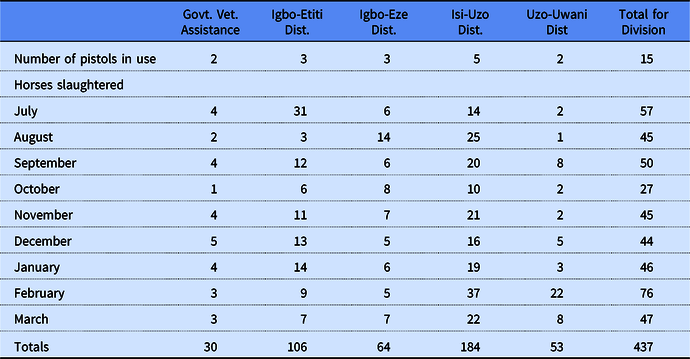
Table 1 suggests that the use of humane killers received less take-up than was expected. For a period of close to ten months, the number of horses killed suggests that there might have been local resistance in terms of greater numbers of horses slaughtered without humane killers. As of April 1953, seven humane killer pistols, four booklets containing instructions for their use, seven licences to bear arms and five pockets of cartridges were already in use in Nsukka town.Footnote 61 At the same time, fifteen Cox pistols were ordered for use in Onitsha.Footnote 62 Around June 1953, approximately 102 horses were killed with humane killers in Nsukka and Enugu, as available records indicate. This figure amounts to about 90 per cent of the total horses in the town. As a way of ensuring the use of humane killers, local chiefs who refused to comply and abide by the law were prosecuted in the magistrate courts for committing offenses in contravention to Section 495 of the Criminal Code.Footnote 63 In the Igbo Etiti area of Nsukka the story was similar, as the Native Authority made remarkable progress in the use of humane killers.Footnote 64 Regarding the progress made in this area, Acting Resident Onitsha Province reported as follows:
The assistance of local councils has been sought in advocating kindness to animals, and elimination of unnecessary suffering by the use of humane killers for slaughtering horses. Whenever information has been received of the slaughtering of any horse without use of pistols police investigations has been ordered. During the year under review, seven cases were taken in the magistrate’s court against persons charged for this offence with cruelty to animals.Footnote 65
Numbers of horses slaughtered with humane killers in the Nsukka division, July 1953 to March 1954

Source: National Archives Enugu (NAE) Horse Sacrifice and Cruelty to Animals file 3518 ONDIST 20/1/1690.
The actual number of cases relating to the non-use of humane killers taken to court during this period was infinitesimal when compared with various rituals and functions associated with horses in eastern Nigeria that took place underground.
Islamic butchers and introduction of humane killers
From 1890 up to 1900, Muslim elephant hunters from northern Nigeria moved from their zone to other areas of Nigeria. The colonial records from 1922 noted that the Calabar, Benin and Owerri Provinces were widely dominated by elephants, which were destroying farms. As a result, they created the Wild Animals Preservation Ordinance, which was established to monitor and control such menace.Footnote 66 Notwithstanding the destruction of farms by elephants, the colonial government still felt that it did not compare to the activities of the herdsmen, whose principal occupation was hunting elephants.Footnote 67 Over time, especially with the arrival of rail and road construction, herdsmen of Islamic backgrounds from northern Nigeria began to dominate cattle trade in eastern Nigeria. They established slaughterhouses and refused the introduction of humane killers, as such practices negated the teachings of Islam.
The various innovations introduced by the colonial government were accepted, apart from the idea of introducing the use of humane killers for animals. The Muslims were in opposition to some of the humane methods of killing animals and maintained that a sharp knife for the purpose of killing animals is prescribed in Maliki law.Footnote 68 The use of humane killers for animals in Nigeria had its origins in Lagos. It was introduced in the early 1950s but was denied by Muslims in Lagos. In spite of the legal backing of a by-law introduced in 1956 to enforce the use of humane killers in Calabar, it was not popular because the people were not duly consulted.Footnote 69 Humane killing refers to a method of using electric stunners to shock the animals to death.Footnote 70 Guns, as we shall discuss later, were meant to stun and render the animal unconscious before the knife was used to cut the animal’s throat.Footnote 71 This development was challenged by Muslims, who felt that the use of a knife was more easy and direct as it did not involve a breach of animal cruelty. The colonial government was determined to proceed with the introduction of humane killers in order to raise revenue from the necessary licences.
During February 1955, only one slaughterhouse in Degema was available and the method there was tying the legs of the cows and cutting their throats.Footnote 72 In Elele, Omoku, Agwa, Abua and Isoba, the Muslim ways of killing animals were similar to Degema during this period.Footnote 73 Around April 1955, the Medical Officer in charge of Portharcourt made attempts to introduce and supervise humane killers for animals, which was not possible due to shortage of manpower for supervision purposes.Footnote 74
In the United Kingdom (UK) and other countries of the world, the introduction of humane killers was an issue of public concern. Jewish kosher meat was not in accordance with the meat processed by abattoirs in Glasgow. This is because Jewish beliefs refused to accept the use of humane killers, and as a result meat from humanely killed animals was marked with dye by the Chief Rabbi. It was suggested that the Sarkin Pawa (the Muslim controller of the slaughterhouse) could adopt the same measures, especially if clarifications came from the Sultan of Sokoto as the leader of Islamic religion in Nigeria.Footnote 75 As a way of monitoring the issues of animal cruelty, humane killing methods were strongly advocated for, especially due to the construction of many slaughterhouses across the various regions of Nigeria. As a result, government at the level of the Native Authorities came up with rules to oversee and manage the slaughtering of animals, and in addition, Sanitary Inspectors were posted to abattoirs to ensure compliance.Footnote 76
In order to further the primary objective of introducing the use of humane killers for animals, by March 1955 the Veterinary Headquarters situated in Abakaliki organised a course for Sanitary Inspectors. After receiving the training in Abakaliki, the Sanitary Inspector sent from Calabar Town Council began the use of humane killers for pigs in Calabar. Within a short timeframe, around seventy-five pigs were being killed on a daily basis.Footnote 77 The success recorded in the use of humane killers for pigs in Calabar slaughterhouses could not be perfected for cows. In the Owerri Province, Muslims rejected the use of humane killer as did not align with Islamic beliefs. The Senior Resident Owerri believed that the method of killing animals by Islamic butchers in Owerri did not involve animal cruelty, as the vertebrae of the animal was severed with one stroke without prolonging the death of the animal.Footnote 78 This helps us to focus our argument on the use of humane killers for boosting the colonial revenue generation.
Still, in 1955, the Colonial Resident Owerri reported an entirely different development in Aba. It was observed that the Jewish method of killing animals (securing the animal’s legs then cutting the throat as quickly as possible with a sharp knife and allowing the animal to bleed) was still in operation, and as such, he advocated for the introduction of the humane killers.Footnote 79 The rejection of humane killers in Calabar was not by Muslims alone – Christians also felt that animals killed with humane killers could easily decompose.Footnote 80 After several persuasions the colonial government was beginning to feel that they had convinced people with regards the use of humane killers. This was manifested in the rush of few individuals to acquire licences for the various forms of humane killers. A reference point is the case of Mr E. B. Effion, who in March 1956 applied and obtained a licence for the use of Cox Universal Arm No. T/3903 for the purpose of killing of animals.Footnote 81
The colonial government in Calabar was disappointed in April 1957 when its effort to introduce the service of a humane killer operative in Calabar Township market was rejected by Muslims as contrary to their beliefs.Footnote 82 Based on the insistence of the Muslim butchers that the use of humane killers would not stand, a meeting between the Muslim butchers and the colonial government was convened. At that meeting, the Muslim butchers argued that: ‘since the use of the humane killer by the Sanitary Inspector would precede the cutting of the animals throat, and since the use of the humane killer would cause death even if cutting of the throat did not follow, it therefore followed that Muslims could not reconcile the proposed dual method of the humane killer followed by throat cutting.’Footnote 83
Following this argument, it was agreed that the humane killer method be postponed, but also that could be used in private slaughterhouses owned by non-Muslims.Footnote 84 This arrangement was not adhered to. The district officer and the permanent secretary were not on the same page. District Officer Calabar strongly believed that the use of humane killers was better. He expressed the view that the Calabar Urban District Council should consider, with the help of the Government Health Superintendent, whether the slaughterhouse could be divided between Muslims and non-Muslims. The idea was that in the Muslim section of the slaughterhouse, the method of killing by cutting the throat of the animals could continue. It was possible for the Sanitary Inspectors in those situations to be onsite in the slaughterhouse in order to ensure that sharp knives were used and the killing was carried out swiftly and efficiently. In the non-Muslim section it was expected that the use of humane killers were adopted, but must be clearly separated and highlighted for the purchasing public.Footnote 85 Already, there was public misconception that animals slaughtered with humane killers were not fit for consumption. The Muslim community in Calabar later clarified that they had no objection to humane killers, but the greatest problem was how to supply meat meant for consumption.Footnote 86 Considering the huge economic loss the colonial government was to encounter if they persisted in the introduction of humane killers, the idea was suspended.Footnote 97 This is because cows on arrival to Calabar were paid for, and other slaughter and sanitary fees were also charged. The slaughterhouse and animals were a huge source of revenue for the colonial political economy.
In May 1952, the campaign to use humane killers for animals was intensified in the eastern region of Nigeria. In the Nsukka area, the use of humane killers was increased, as one government veterinary assistant, one native administration veterinary assistant and three licensed slaughterers were used to ensure the humane killing of animals. In 1951 alone, forty-six horses, six cattle, and one goat were killed with humane killers, and in 1952 it was sixty-eight horses, seven cattle, three sheep and twenty-one pigs.Footnote 88 In Igbo Etiti around 1955, it was confirmed that approximately fifteen humane killers were in use.Footnote 89 This was not a huge success considering the demography of people in the eastern region as a whole. Meanwhile, pockets of resistance were witnessed in Abakaliki and Enugu, respectively, and oppositions from Hausa butchers was heightened.Footnote 90 Around May 1952, there were about five volunteers willing to travel on bicycles if humane killings were requested in the Nsukka neighbourhood.Footnote 91 By 1955, about 405 horses were slaughtered, as opposed to 513 in 1954. A report states that it was not because of the introduction of humane killers but as a result of the increase in education, which made horse-related title taking a less desirable option.Footnote 92
In June 1955, the RSPCA disapproved of the proposed horse race that was planned to run between sunset and sunrise from Zaria to Kaduna at a distance of fifty miles.Footnote 93 In response, the colonial government stated that the RSPCA had been misinformed. The government argued that the endurance test was customarily in Europe and that the horses would not travel more than twenty-five miles. Furthermore, it was revealed that the veterinary department of the government was fully involved and that any unfit horses would not partake in the race.Footnote 94
The RSPCA again were critical of the various horse rituals taking place among the Igbo of southeastern Nigeria and demanded for photographs of those engaged in the practice, to aid possible prosecution.Footnote 95 By 1962, the RSPCA led by T. H. Scott made plans to secure office space in the Calabar division to further pursue the objectives of monitoring any instances of animal cruelty.Footnote 96 Meanwhile, beginning with their formal entrance, the RSPCA’s principal aim was to make sure that the captive bolt pistol was obtained from their headquarters in London.Footnote 97 This raises the fundamental question of whether the objective of this group was not to contribute to the colonial exploitative economy. In spite of the efforts of the colonial regime to insist on the use of humane killers for animals, it was not ordinary practice for quite a long time.
Conclusion
The various efforts introduced to regulate and lessen animal cruelty during the colonial period in Nigeria were slowed and inhibited by the economic ambition of the colonial state. In addition, there were traditional and cultural factors that made it difficult for animal cruelty to be ameliorated. The various chieftaincy and title taking cultures of the people that centred around animals played a significant role in prolonging the need to monitor the cruelty of animals. In addition, Islamic butchers in charge of slaughterhouses, due to certain Islamic instructions on how to handle animals, made it difficult for the introduction of humane killers for animals.
Horse trading was an important milestone in the economic history of precolonial and colonial Nigeria. It soon became a useful instrument to ascertain intergroup relations in northern and eastern Nigeria. At various times, measures were put in place by the colonial government to minimise the various ways cruelty to animals was being practiced and ritualised by local people. Rather than pursue that objective for its own sake, they encouraged the idea of introducing humane killers for animals as a way of raising revenue for the colonial regime. Eventually, the people preferred the traditional method of killing animals, and the colonial regime that relied on market tolls for its revenue still wanted to raise more funds by the sale of humane killers to butchers.