INTRODUCTION
Jellyfish are generally unfavourably known by their negative impact on human activities related to the sea such as fishing, aquaculture and tourism (Purcell et al., Reference Purcell, Uye and Lo2007). Among the cnidarian jellyfish groups (known as medusozoans), the class Scyphozoa Goette, Reference Goette1887 comprises about 200 described species occurring in all oceans (Mianzan & Cornelius, Reference Mianzan, Cornelius and Boltovskoy1999; Daly et al., Reference Daly, Brugler, Cartwright, Collins, Dawson, Fautin, France, McFadden, Opresko, Rodriguez, Romano and Stake2007). Scyphozoan jellyfish are important macrozooplankton predators, unique due to their large size and beautiful colour patterns (Cornelius, Reference Cornelius and Richmond1997). They play a significant role in marine food webs, not only predating on several groups (Purcell, Reference Purcell1997) but also serving as food for many marine animals (Arai, Reference Arai2005). In different countries, some scyphomedusae species are also consumed by humans as a delicacy food (Hsieh et al., Reference Hsieh, Leong and Rudloe2001; Omori & Nakano, Reference Omori and Nakano2001). The group presents venomous species that sometimes even cause severe medical problems to humans (Burnett, Reference Burnett2001). The occurrence of large populations or blooms (Graham et al., Reference Graham, Pagès and Hamner2001; Miranda et al., Reference Miranda, Morandini and Marques2012) in coastal waters can cause disturbance in fishing activities (Purcell et al., Reference Purcell, Uye and Lo2007; Nagata et al., Reference Nagata, Haddad and Nogueira2009).
For the coast of Pakistan (North Arabian Sea) there are only two reports mentioning scyphozoan jellyfish species, both rhizostomes (Tahera & Kazmi, Reference Tahera and Kazmi2006; Muhammed & Sultana, Reference Muhammed and Sultana2008): Rhizostoma pulmo (Macri, Reference Macri1778) and Catostylus mosaicus (Quoy & Gaimard, Reference Quoy and Gaimard1824).
Here we report the occurrence of another scyphomedusae for Pakistan, and a discussion concerning previous identification of Catostylus mosaicus.
MATERIALS AND METHODS
Jellyfish specimens were found stranded at the rocky intertidal of Manora (November 2003 and 2012) (24°47′49″N 66°58′03″E) and Clifton (December 2012) (24°47′12″N 67°01′21″E) at the Karachi coast of Pakistan. They were all collected by hand and preserved in 4% formaldehyde solution. Living specimens were observed in a small rock pool, and were photographed alive.
Measurements were taken using a plastic ruler; a red dye was injected into the gastrovascular cavity to study the canal system using a hypodermic syringe.
The collected specimens are housed in the Museum of Zoology Department (MZD), Jamia Millia Government Degree College, Malir, Karachi, Pakistan.
RESULTS
SYSTEMATICS
Class SCYPHOZOA Goette, Reference Goette1887
Subclass DISCOMEDUSAE Haeckel, Reference Haeckel1880
Order RHIZOSTOMEAE Cuvier, Reference Cuvier1800
Family CATOSTYLIDAE Claus, Reference Claus1883
Genus Catostylus L. Agassiz, Reference Agassiz1862
Catostylus perezi Ranson, Reference Ranson1945
(Figures 1–3)
MATERIAL EXAMINED
MZD/CN-08, one specimen preserved in 4% formaldehyde solution; intertidal rocky shore, Manora, 8 November 2003, coll. biology students.
DESCRIPTION
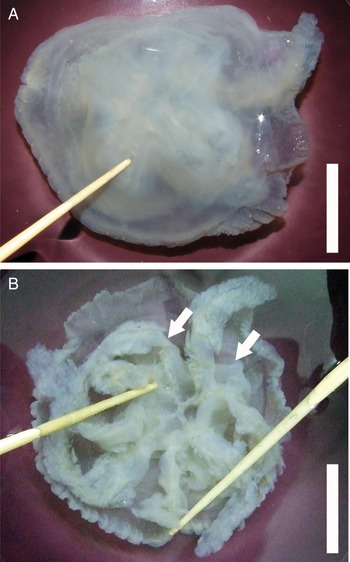
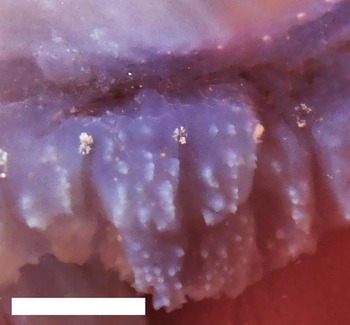
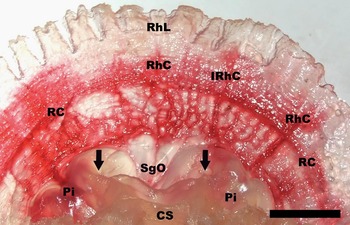
The preserved specimen has a hemispherical umbrella, 147 mm in diameter, with the central part of the exumbrella smooth, without granules (Figure 1A). Although the animal is a bit damaged, there seem to be eight rhopalia. Each octant with 10–12 pointed velar lappets, sometimes large lappets seem to divide into two smaller ones; lappets connected to each other by a thin membrane. All lappets bear numerous minute warts or papillae in short, irregular, vertical rows on the exumbrellar side (Figure 2). The rhopalar lappet pairs are also pointed but smaller (1–2 times), not presenting papillae but with uneven exumbrellar surface. The rhopalia are located inside a pit between the rhopalar lappet pairs on the exumbrellar side, the pit showing many furrows. Subumbrellar musculature not discernible. Subgenital ostia wide (almost 1/5 bell diameter), without any structure; pillars 1/2 the size of the ostia. Eight oral arms, 85 mm long, three-winged in cross-section like in other rhizostomes, without any appendages (Figure 1B). Central stomach Maltese cross-shaped (from aboral view) (Figure 1A). Gastric canal system consists of eight rhopalar and eight inter-rhopalar radial canals; circular canal 1/3 bell radius away from margin and with an external anastomosing network of canals also into marginal lappets; intracircular anastomosing network of canals communicating with the rhopalar, inter-rhopalar canals, the central stomach and the ring canal (Figure 3). Gonads not discernible. The whole preserved animal is light creamish coloured.
Specimen of Catostylus perezi Ranson, Reference Ranson1945 from Pakistani waters (MZD/CN-08): (A) aboral view of specimen showing a smooth central part; (B) oral view of specimen showing eight oral arms without appendages; arrows showing subgenital ostium width below oral arm, to the right it is visible as a pillar. Scale bars: 5 cm.

Detail of exumbrellar margin of a specimen of Catostylus perezi Ranson, Reference Ranson1945 from Pakistani waters (MZD/CN-08). Note the warts/papillae on the margin. Scale bar: 1 cm.

Specimen of Catostylus perezi in oral view. Note the connection of the intracircular network of canals to the rhopalar and interrhopalar canals. Arrows indicate the extension of the subgenital ostium. CS, central stomach; Pi, pillar; IRhC, interrhopalar canal; RhL, rhopalar lappets; RhC, rhopalar canal; RC, ring or circular canal; SgO, subgenital ostium. Scale bar: 3 cm.

DISTRIBUTION
The species was only reported on the south coast of the Arabian Peninsula and Persian Gulf.
Order SEMAEOSTOMEAE L. Agassiz, Reference Agassiz1862
Family PELAGIIDAE Gegenbaur, Reference Gegenbaur1856
Genus Pelagia Péron & Lesueur, Reference Péron and Lesueur1810
Pelagia cf. noctiluca (Forsskål, Reference Forsskål1775)
(Figures 4–6)
MATERIAL EXAMINED
MZD/CN-09A, 11 specimens preserved in 4% formaldehyde solution, intertidal rocky shore, Manora, 28 November 2012 (bell diameter 55–70 mm), coll. S. Gul; MZD/CN-09B, 3 specimens preserved in 4% formaldehyde solution, intertidal sandy shore, Clifton, 2 December 2012 (bell diameter 45–65 mm), coll. S. Gul.
DESCRIPTION
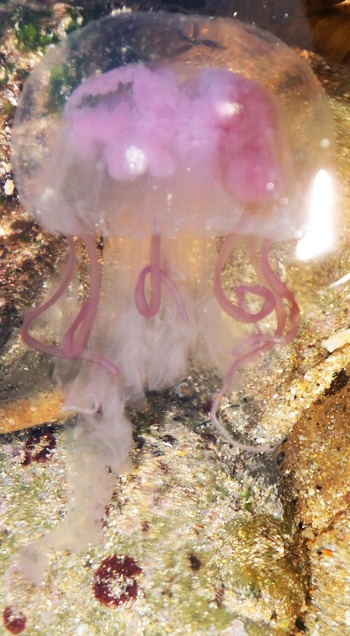
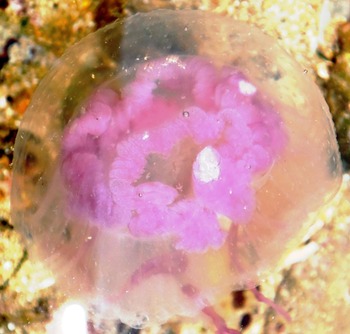
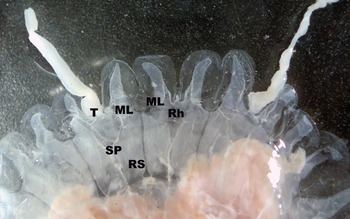
The umbrella is hemispherical and transparent (Figures 4–5). Exumbrellar surface covered with small colourless warts of variable size and shape (Figures 4–5); numerous in larger specimens. The bell margin bears eight rhopalia, and 16 marginal lappets (2 per octant); the lappets are large, rounded and without any warts; a broad, canal-like lobe of the gastrovascular cavity projects into each lappet (Figure 6). From the umbrella margin eight thick tentacles arise between successive lappets (Figures 4 & 6); the tentacles are rounded, somewhat shorter or equal in length to the oral arms. Subumbrella bears a central mouth which forms an oral tube provided with four long, frilled oral arms. Sixteen stomach pouches, each being the origin of the two unbranched, prominent gastrovascular canals which reach into the above mentioned marginal lappets; pouches separated by straight septa with a triangular basal part (Figure 6). Freshly collected live animals showed a mauve coloration in the gonads, tentacles and oral arms (Figures 4–5).
Live specimen of Pelagia cf. noctiluca (Forsskål, Reference Forsskål1775) in rock pool (MZD/CN-09A). Bell size ~55 mm.

Live specimen of Pelagia cf. noctiluca (Forsskål, Reference Forsskål1775) in exumbrellar view (MZD/CN-09A). Note gonad colour and small warts on exumbrella. Bell size ~60 mm.

Detail of the bell margin (exumbrellar view) of Pelagia cf. noctiluca (Forsskål, Reference Forsskål1775) specimen (MZD/CN-09A) showing the tentacles (T), marginal lappets (ML), rhopalium (Rh), radial septum (RS), stomach pouches (SP) and their projections into the lappets. Bell size ~60 mm.

DISTRIBUTION
There are mentions of other species of the genus in the literature (e.g. Cornelius, Reference Cornelius and Richmond1997; Gershwin & Collins, Reference Gershwin and Collins2002). Here we followed Kramp (Reference Kramp1961) and Russell (Reference Russell1970) in considering only one valid species of the genus with a circumglobal distribution in warm and temperate waters.
STING ABILITY
While handling these specimens, the first author got accidently in contact with the animals and noted a burning sensation, which started immediately after the skin contact. Light brown coloured patches appeared on the palms, which persisted for about ten days.
DISCUSSION
Catostylus perezi
The family Catostylidae was wrongly assigned to Gegenbaur (Reference Gegenbaur1856) and sometimes to Stiasny (Reference Stiasny1920, Reference Stiasny1921) in the literature (e.g. Stiasny, Reference Stiasny1929; Dawson, Reference Dawson2005). Gegenbaur (Reference Gegenbaur1856: 209) referred only to Acraspeda medusae (Scyphozoa and Cubozoa) and Stiasny (Reference Stiasny1920, Reference Stiasny1921) presented a diagnosis for the family, but was not the first. The correct author of the family is Claus (Reference Claus1883: 61) who defined the group for the first time. The family contains six genera and 24 species (Daly et al., Reference Daly, Brugler, Cartwright, Collins, Dawson, Fautin, France, McFadden, Opresko, Rodriguez, Romano and Stake2007). Stiasny (Reference Stiasny1925) presented data on developmental stages of members of the group and how their canal systems resemble the pattern of other genera and proposed a ‘connection' between those genera. Later these ideas were used by Thiel (Reference Thiel1970) to propose a biphyletic system for the Rhizostomeae.
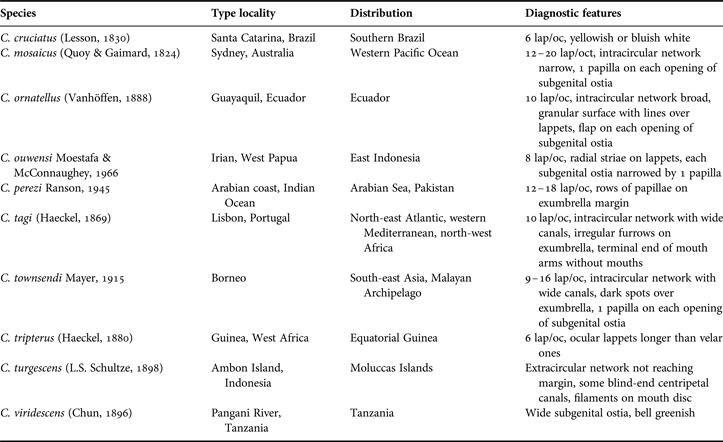
Kramp (Reference Kramp1961: 370–372) mentioned eight species of the genus Catostylus, but the web repository The Scyphozoan Wiki lists ten valid species (Dawson et al., Reference Dawson, Jarms and Morandini2013) (see also Table 1). Catostylus perezi is one of the species of the genus with few reports, i.e. only two: Ranson (Reference Ranson1945: 242; six specimens collected in 1904 on the south coast of the Arabian Peninsula or Persian Gulf) and Kramp (Reference Kramp1956: 241; two specimens collected in 1937 at the Persian Gulf, coast of Iran near Kharg). This species can clearly be distinguished from its other congeners by the smooth central part of exumbrella and by having tiny papillae/warts on the margin and lappets.
Species of the genus Catostylus L. Agassiz, Reference Agassiz1862, with data on distribution and diagnostic characters, based mostly on the original descriptions by Mayer (Reference Mayer1910) and Kramp (Reference Kramp1961). lap/oc, lappets per octant.

The genus Catostylus has an interesting distribution, as highlighted by Kramp (Reference Kramp1970: 9–10, 15, figure 6). Most (six) of the valid species (according to Dawson et al., Reference Dawson, Jarms and Morandini2013) occur in Indo-Pacific waters (from East Africa to New Zealand; C. mosaicus, C. ouwensi, C. perezi, C. townsendi, C. turgescens and C. viridescens), with only three species recorded in Atlantic waters (C. cruciatus, C. tagi and C. tripterus) and one limited to the Pacific coast of South America (C. ornatellus).
There is a record of Catostylus mosaicus (Quoy & Gaimard, Reference Quoy and Gaimard1824) from Pakistan reported by Tahera & Kazmi (Reference Tahera and Kazmi2006). Although we had no access to the specimen observed by Tahera & Kazmi (Reference Tahera and Kazmi2006), we do not agree with their identification of that material as Catostylus mosaicus. Based on the diagnostic character (papillae/warts on exumbrella margin) and looking at the image provided by the authors (their figure 2A, B), it is possible to see papillae/warts at the marginal lappets. Available descriptions of C. mosaicus (e.g. Kramp, Reference Kramp1961; Cornelius, Reference Cornelius and Richmond1997; Dawson, Reference Dawson2005) did not point out such character. In this way, we believe that the specimens examined and reported by Tahera & Kazmi (Reference Tahera and Kazmi2006) belong in fact to the species Catostylus perezi.
Pelagia cf. noctiluca
The specimens were identified as Pelagia cf. noctiluca (Forsskål, Reference Forsskål1775). The most recent systematic synopsis about scyphomedusae (Kramp, Reference Kramp1961) did not make any distinction between species of the genus Pelagia Péron & Lesueur, Reference Péron and Lesueur1810, although previous and recent authors distinguished other species based on morphology (e.g. Mayer, Reference Mayer1910; Stiasny, Reference Stiasny1935, Sanders & Sanders, Reference Sanders and Sanders1963; Cornelius, Reference Cornelius and Richmond1997). The family Pelagiidae Gegenbaur, Reference Gegenbaur1856 contains three genera: Chrysaora Péron & Lesueur, Reference Péron and Lesueur1810, Pelagia Péron & Lesueur, Reference Péron and Lesueur1810 and Sanderia Goette, Reference Goette1886 (Kramp, Reference Kramp1961) and 21 species (Morandini & Marques, Reference Morandini and Marques2010) worldwide.
The jellyfish species Pelagia noctiluca was described by Forsskål (Reference Forsskål1775) as Medusa noctiluca for the Mediterranean Sea, and named after its phosphorescent nature. This medusa is commonly known as mauve stinger due to its colour. Unlike most of the pelagiid species it presents a holoplanktonic life cycle (Rottini Sandrini & Avian, Reference Rottini Sandrini and Avian1983). Historical records (Kramp, Reference Kramp1961) of Pelagia noctiluca show that the species is morphologically variable. Many researchers have previously discussed the variability in the characters of the species. Stiasny (Reference Stiasny1934: 387) pointed out that: ‘proportionate dimensions of the bell, length of manubrium and mouth arms, outline of the marginal lappets, shape and arrangement of exumbrella nettle warts, etc., proved not to be reliable for discrimination of the species, altering with age or being subject to great variation'.
Pelagia noctiluca was documented from the Arabian Sea and Gulf of Oman by Stiasny (Reference Stiasny1937) and later from the Iranian Gulf by Kramp (Reference Kramp1956). The specimens from the Iranian Gulf (Kramp, Reference Kramp1956: 240) presented a smooth exumbrellar surface whereas, our specimens have small colourless warts on the exumbrella; but this character might be subjected to abrasion. It is also noted that the notch at the margin of lappets is somewhat deeper in the given material.
A study of specimens from Europe showed no variation in molecular markers (COI, ITS-1 and ITS-2) (Stopar et al., Reference Stopar, Ramšak, Trontelj and Malej2010). A more recent study (Miller et al., Reference Miller, von der Heyden and Gibbons2012) also using the same molecular markers, showed significant differentiation between the southern and northern Atlantic population groups of Pelagia noctiluca. This is intriguing and points to the necessity of a thorough revision of the group, aiming to define possible different species paying special attention to the distributional areas and the names that have been applied in the past.
This semaeostome species is widely distributed in warm and temperate waters (Russell, Reference Russell1970). The species is typical of warm waters while, through currents, it can reach temperate and colder areas (Mariottini et al., Reference Mariottini, Elisabetta and Luigi2008). It is well known due to its outbreaks in the Mediterranean and such outbreaks have also been observed in the north-east Atlantic (Doyle et al., Reference Doyle, De Haas, Cotton, Dorshell, Cummins, Houghton, Davenport and Hays2008).
Stings of Pelagia noctiluca can cause local pain, burning, swelling and hyperpigmentation with skin eruptions in case of repeated contacts (Mariottini et al., Reference Mariottini, Elisabetta and Luigi2008). However, recently, it is proposed that the crude venom of this species can be effective in the treatment of pain and neurodegenerative disorders like Alzheimer's disease (Ayed et al., Reference Ayed, Dellai, Mansour, Bacha and Abid2012). The stung person who manipulated the animals during collection only presented burning sensation and no further systemic reactions.
This contribution aims to provide further data on the jellyfish species along the Pakistan coast, also contributing to a better understanding of their distribution. We provided detailed descriptions of the specimens found, highlighting the occurrence of Catostylus perezi and disagreeing with the report of Catostylus mosaicus for the area based on the image provided. We were unable to differentiate the Pelagia specimens from other populations around the world based on the characters frequently used for that; the genus needs detailed studies to clarify if there are cryptic species.
ACKNOWLEDGEMENTS
Thanks to all BSc Biology students of Jamia Millia Government Degree College who collected the specimen of Catostylus perezi during an Annual Field Trip (2003) to Manora. This work was partially supported by FAPESP Biota to A.C.M. (project 2010/50174-7). We thank Drs Kylie Pitt and Michael N. Dawson for information about Catostylus mosaicus. Drs Ilka Straehler-Pohl and Sergio N. Stampar are acknowledged for corrections and comments on the manuscript.