Introduction
Reproductive technologies may be of help in preventing the loss of threatened wild species. Genetic resources can be built up by the cryopreservation of their gametes and the establishment of genetic resource banks (Watson & Holt, Reference Watson and Holt2001). Certainly, the use of stored gametes in artificial insemination (AI) programmes should help in the dispersal of genes across isolated gene pools. Unfortunately, the collection of gametes can present many difficulties. Indeed, even sperm collection can be complex in some wild species, although viable epididymal spermatozoa can sometimes be retrieved post mortem (Soler et al., Reference Soler, Pérez-Guzmán and Garde2003; Cocchia et al., Reference Cocchia, Ciani, El-Rass, Russo, Borzacchiello, Esposito, Montagnaro, Avallone, Tortora and Lorizio2010; Anel et al., Reference Anel, Alvarez, Anel, Martinez-Pastor, Martinez, Chamorro and de Paz2011; Keeley et al., Reference Keeley, McGreevy and O'Brien2012). Furthermore, assisted reproduction typically produces few offspring (Andrabi & Maxwell, Reference Andrabi and Maxwell2007). One reason for this situation is the variation in the fertilization capacity of cryopreserved sperm. This aspect should always be checked before using stored sperm for conservation purposes.
The Iberian ibex (Capra pyrenaica) is a wild caprine endemic to the Iberian Peninsula. Phylogenetically it is related to the domestic goat (Capra hircus). Studies on the cryopreservation of its sperm and assisted reproduction in the species (Santiago-Moreno et al., Reference Santiago-Moreno, Toledano-Díaz, Dorado, Pulido-Pastor, Coloma and López-Sebastian2007, Reference Santiago-Moreno, Coloma, Dorado, Pulido-Pastor, Gómez-Guillamon, Salas-Vegas, Gómez-Brunet and López-Sebastián2009a; Coloma et al., Reference Coloma, Toledano-Díaz, Castaño, Velázquez, Gómez-Brunet, López-Sebastián and Santiago-Moreno2011) have led to its recognition as a good model for other wild mountain ungulates (Santiago-Moreno et al., Reference Santiago-Moreno, Coloma, Toledano-Díaz, Castaño, Gómez-Brunet and López-Sebastián2010). Heterologous in vivo insemination of domestic goats has been used to determine the fertilization capacity of Iberian ibex frozen–thawed epididymal spermatozoa, permitting the selection of sperm doses most likely to produce live offspring via AI (Santiago-Moreno et al., Reference Santiago-Moreno, Toledano-Díaz, Pulido-Pastor, Gómez-Brunet and López-Sebastián2006). However, the fertility rates obtained in both normal and interspecies AI are profoundly influenced by the fertility of the females involved, the quality of the corpus luteum, early embryonic mortality, and the response to hormonal synchronisation treatments (Salamon & Maxwell, Reference Salamon and Maxwell2000; Maurel et al., Reference Maurel, Roy, Hervé, Bertin, Vaiman, Cribiu, Manfredi, Bouvier, Lantier, Boue and Guillou2003). The ability to assess fertilization capacity in vitro would, therefore, be very useful. Indeed, it is an important goal for understanding epididymal sperm biology and may be critical for developing optimised assisted reproduction protocols.
In vitro fertilization (IVF) can be used to predict the in vivo fertilization capacity of sperm. Ideally, IVF procedures should use homologous oocytes. However, in wild animals, obtaining oocytes in sufficient quantities for IVF can be very challenging. Consequently, heterologous sperm–oocyte interaction assays, such as the generic oocyte zona-pellucida-free hamster assay (Soler & Garde, Reference Soler and Garde2003), or IVF that involves oocytes from related species (Comizzoli et al., Reference Comizzoli, Mauget and Mermillod2001; Soler et al., Reference Soler, Poulin, Fernández-Santos, Cognie, Esteso, Gardé and Mermillod2008; García-Álvarez et al., Reference García-Álvarez, Maroto-Morales, Martínez-Pastor, Fernandez-Santos, Esteso, Pérez-Guzmán and Soler2009), must be used.
The aim of the present study was to assess the use of prepubertal domestic goat oocytes to determine the fertilization capacity of frozen–thawed epididymal Iberian ibex spermatozoa. As the optimal concentration of oestrous sheep serum (ESS) in the fertilization medium has not been determined for domestic sheep and goat IVF protocols that involve cryopreserved epididymal sperm, the effect of different concentrations on fertilization and embryo development was also examined.
Materials and methods
Dulbecco's phosphate-buffered saline (PBS) was purchased from Gibco (Paisley, UK), and OviPure® from Nidacon International AB (Mönldal, Sweden). The antibiotics for sperm extenders were purchased from Calbiochem® (La Jolla, California, USA). All other reagents were purchased from Sigma-Aldrich Chemical Co. (Madrid, Spain).
Sperm collection
Testes were obtained from five mature Iberian ibexes that had been legally hunted during the rutting season (November/December) in the Tejeda and Almijara Game Reserve in southern Spain (36ºN latitude). The testes, with their scrotal sac, were transported to the laboratory immediately after removal. All materials were kept at ambient temperature (about 11ºC) during transport and laboratory processing. To reduce the death-to-sperm collection time, a small laboratory was set up in the mountains of the hunting reserve. All epididymal spermatozoa were collected between 2 and 8 h after death; no sperm variables are affected within 8–9 h of death (Santiago-Moreno et al., Reference Santiago-Moreno, Toledano-Díaz, Pulido-Pastor, Gómez-Brunet and López-Sebastián2006). The testes and epididymes were removed from the scrotal sac and the caudae epididymides isolated from the testes and surrounding connective tissue. Epididymal spermatozoa were collected by the retrograde flushing method (Santiago-Moreno et al., Reference Santiago-Moreno, Astorga, Luque, Coloma, Toledano-Díaz, Pulido-Pastor, Gómez-Guillamon, Salas-Vega and López-Sebastián2009b) using 1 ml of Tris–citric acid–glucose medium (TCG) at ambient temperature. This TCG was composed of 3.8% Tris (w/v), 2.2% citric acid (w/v), 0.6% glucose (w/v), 5% glycerol (v/v), and 6% egg yolk (v/v). Two antibiotics – penicillin G potassium salt (1000 IU/ml) and streptomycin sulphate (1 mg/ml) – were added to this medium. Sperm counts were recorded using a Neubauer chamber (Marienfeld, Lauda-Königshofen, Germany). The final samples were diluted with TCG medium to a concentration of 800 × 106 sperm/ml, placed in 15 ml centrifuge tubes (Falcon™) set in a beaker with 100 ml of water at 12ºC, and then transferred to a refrigerator at 5ºC. Cooling to 5ºC took about 1 h; the suspension was then maintained at this temperature for an additional 2 h. At this point, aliquots of samples were loaded into 0.25 ml French straws (IMV®; L'Aigle Cedex, France), sealed by ultrasound using an Ultra Seal 31 apparatus (Minitub, Germany), and frozen by placing them in the vapour 5 cm above the surface of a liquid nitrogen container for 10 min before plunging them into the liquid nitrogen itself.
Sperm analysis and processing
Sperm motility, morphological abnormalities, acrosome integrity and plasma membrane integrity were assessed for each sample – both fresh and frozen–thawed – to determine in vitro sperm quality. The percentage of motile spermatozoa and the quality of sperm motility were evaluated subjectively using a phase-contrast microscope (Zeiss, Germany) at ×400, examining samples incubated for 20 min at 37°C. The vigour with which the sperm cells moved was scored on a scale from 0 (lowest) to 5 (highest). Sperm viability was assessed by staining an aliquot of sperm suspension with nigrosin–eosin (Campbell et al., Reference Campbell, Dott and Glover1956). Simultaneously, plasma membrane integrity was assessed using the hypo-osmotic swelling test (Jeyendran et al., Reference Jeyendran, Van Der Ven, Perez-Pelaez, Crabo and Zaneveld1984). Morphological abnormalities were assessed by phase-contrast microscopic examination of glutaraldehyde-fixed samples. Spermatozoa with cytoplasmic droplets were considered morphologically normal as these are commonly seen in epididymal sperm cells. The percentage of spermatozoa with intact acrosomes was assessed by observing spermatozoa in samples fixed in buffered 2% glutaraldehyde solution at 37ºC, using phase-contrast microscopy (magnification ×1000) (Pursel & Johnson, Reference Pursel and Johnson1974). Each analysis required the observation of 200 cells. In addition, the motility variables of the frozen–thawed sperm samples were assayed using a computer-aided sperm analysis system (CASA) running Sperm Class Analyzer® v.4.0. software (Microptic S.L., Barcelona, Spain), and their membrane and acrosome integrity examined by fluorescence staining (Santiago-Moreno et al., Reference Santiago-Moreno, Castaño, Toledano-Díaz, Esteso, López-Sebastián, Guerra, Ruiz, Mendoza, Luna, Cebrián-Pérez and Hildebrandt2013; Soler et al., Reference Soler, Esteso, Fernández-Santos and Garde2005) (the necessary equipment was not available in the field laboratory to test the fresh sperm).
For IVF, the straws were thawed for 1 min at 37°C and highly motile spermatozoa selected by density gradient (OviPure®) centrifugation. This procedure is the first time that ibex sperm has been purified by density gradient; a protocol for domestic rams was therefore followed. Briefly, 1 ml of Bottom Layer Medium was placed in a 15 ml Falcon® tube, and then carefully overlaid with 1 ml of Top Layer Medium. Aliquots (50 μl) of frozen–thawed sperm were placed at the top of the gradient and centrifuged at 300 g for 10 min. After centrifugation, the supernatant was carefully removed using a pipette. The sperm pellet was resuspended in 4 ml of synthetic oviductal fluid (SOF), centrifuged at 300 g for 5 min, and the supernatant again carefully removed. The remaining pellet was resuspended in SOF for use in IVF procedures.
Oocyte collection and in vitro maturation
Ovaries from prepubertal domestic goats were obtained from a local abattoir and transported to the laboratory in sterile Dulbecco's PBS at 37–39ºC. Once in the laboratory, the ovaries were washed three times with PBS. Cumulus–oocyte complexes (COCs) were recovered by slicing the ovary in HEPES-buffered TCM-199 medium supplemented with 1.1 mg/ml sodium bicarbonate and 50 μg/ml gentamicin. Only COCs with two or more complete and compact layers of cumulus cells and homogenous cytoplasm were chosen for use.
The selected COCs were washed in TCM-199. Groups of 25–30 COCs were matured in 100 μl TCM-199 supplemented with 275 μg/ml sodium pyruvate, 146 μg/ml l-glutamine, 10% (v/v) donor bovine serum (DBS), 10 μg/ml oLH, 10 μg/ml oFSH, 1 μl/ml 17β-estradiol, 100 μM cysteamine and 50 μg/ml gentamicin. Their maturation was completed by incubating these samples under mineral oil for 24–27 h at 38.5°C in a humidified atmosphere containing 5% CO2 in air (Jiménez-Macedo et al., Reference Jiménez-Macedo, Izquierdo, Anguita and Paramio2005).
IVF, assessment of nuclear stage, and embryo development
After maturation, the COCs were partially denuded by gentle pipetting and transferred into SOF. Fertilization was performed in 50 μl microdrops of medium supplemented with ESS at different concentrations: SOF-C (0% ESS), SOF-2 (2% ESS) or SOF-20 (20% ESS) (five replicates). Groups with a maximum of 15 COCs per microdrop were co-incubated with 1 × 10⁶ spermatozoa/ml for 20–24 h at 38.5°C, 5% CO2, 5% O2 and 90% N2 in a humidified atmosphere (Comizzoli et al., Reference Comizzoli, Mauget and Mermillod2001).
At 17 h post-insemination (hpi), a sample of half of the presumptive zygotes was separated from the cumulus cells by gently pipetting, and fixed in acetic acid:ethanol (1:3, v/v) for 24 h at 4°C. The presumptive zygotes were stained with 1% lacmoid and observed under a phase-contrast microscope. Zygotes were classified as normally fertilized if one female and one male pronucleus (2PN) was observed. The male pronucleus was detected when one sperm tail was close to the pronucleus. Zygotes with 3PN were considered polyspermic; oocytes with 1PN were classified as asynchronous (Mogas et al., Reference Mogas, Palomo, Izquierdo and Paramio1997).
The remaining presumptive zygotes were completely denuded, washed by gentle pipetting and cultured in groups of 10–15 in 20 μl culture drops of SOF medium at 38.5°C in a humidified 5% CO2, 5% O2 and 90% N2 atmosphere for 7 days. On day 5, the embryos were transferred to microdrops with fresh medium. Cleavage and blastocyst formation rates were evaluated at 48 and 168 hpi respectively (Jiménez-Macedo et al., Reference Jiménez-Macedo, Izquierdo, Anguita and Paramio2005).
Statistical analysis
The data for the sperm variables were not normally distributed (as determined by the Shapiro-Wilk's test); they were therefore arcsine-transformed before analysis. The t-test for matched pairs was used to compare the values of sperm variables before and after thawing. The nuclear status after fertilization and embryonic development data were assessed using general linear model (GLM) ANOVA. When this analysis revealed the ESS concentration to have a significant effect, differences between ESS treatment groups were examined using Tukey's post hoc test. All calculations were performed using SAS v.9.1 software. Data are presented as means ± standard error (SE). Significance was set at P < 0.05.
Results
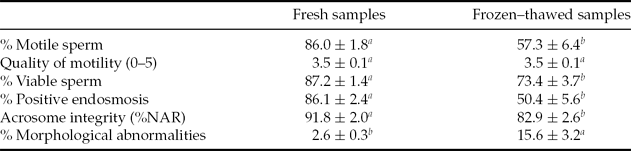
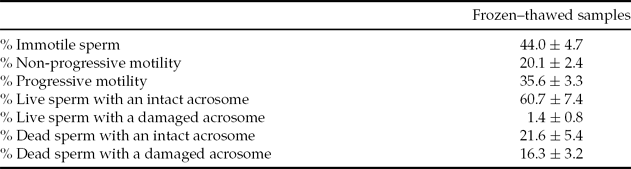
The freezing–thawing process significantly reduced the percentage of motile spermatozoa (P < 0.001), the percentage of viable sperm according to nigrosin–eosin staining (P < 0.05), the membrane integrity according to the hypo-osmotic swelling test (P < 0.001), the percentage of sperm showing acrosome integrity (P < 0.05), and the percentage of morphological sperm abnormalities (P < 0.001) (Table 1). Table 2 shows the results for the motility variables for frozen–thawed sperm as analysed objectively by CASA, plus the percentage of sperm showing plasma membrane and acrosome integrity as assessed by fluorescence staining. The results are similar to those obtained by the previous methods.
Sperm variable (mean ± S.E.) values for fresh and frozen–thawed epididymal spermatozoa collected within 8 h of death

a ,b Different superscript letters between columns indicate significant differences (P < 0.05).
Sperm motility variables (mean ± S.E.) analysed by CASA, and membrane and acrosome integrity fluorescence staining (fluorochrome combination of propidium iodide and fluorescein isothiocyanate-conjugated peanut [Arachis hypogea] agglutinin) in frozen–thawed epididymal spermatozoa collected within 8 h of death
Table 3 shows the recorded nuclear stage data for oocytes at 17 h after IVF. The SOF-C treatment provided 14.5% 2PN zygotes (Fig. 1 shows a representative 2PN zygote). In the SOF-2 treatment, the percentage of 2PN zygotes increased (but not significantly) to 27.7%. In the SOF-20 group, the percentage decreased to 2.9% (P < 0.05 with respect to the SOF-2 result). Polyspermic fertilization (3PN) was only observed with the SOF-2 treatment (10.5%). The percentage of asynchronous oocytes (1PN) was 1.9% with the SOF-C treatment, and 8.8% with the SOF-2 treatment (no significant difference).
Nuclear status of zygotes at 17 h following insemination of prepubertal domestic goat oocytes with frozen–thawed ibex epididymal sperm
SOF: synthetic oviductal fluid medium. ESS: oestrous sheep serum. SOF-C: 0% ESS; SOF-2: 2% ESS; SOF-20: 20% ESS. 1PN: asynchrony, i.e. oocytes with one female pronucleus and one condensed sperm head; 2PN: zygotes with two pronuclei (normal fertilization); 3PN: polyspermic zygotes.
a ,b Values with different subscripts within the same column indicate significant differences (P < 0.05).Values in parentheses are the mean (%) of five replicates.
Normal zygote obtained via heterologous IVF involving prepubertal domestic goat oocytes and frozen–thawed ibex epididymal sperm (recovered after death). Arrows indicate the female and male pronucleus (2PN).
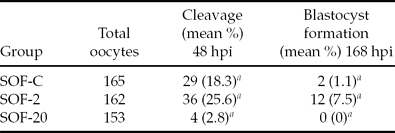
Table 4 shows the recorded embryo development data after 7 days of culture. The percentage of cleaved embryos at 48 hpi was higher with the SOF-2 than with the SOF-C and SOF-20 treatments (25.6% versus 18.3 and 2.8% respectively); however, none of these differences was significant. At 168 hpi, the blastocyst formation rate was higher with the SOF-2 than with the SOF-C or SOF-20 treatments (7.5 versus 1.1 and 0% respectively); but again, the differences were not significant. Figure 2 shows a blastocyst stage embryo.
Embryonic development at 48 and 168 h post-fertilization with frozen–thawed ibex epididymal sperm
aValues with different subscripts within the same column indicate significant differences (P < 0.05). SOF: synthetic oviductal fluid medium. ESS: oestrous sheep serum. SOF-C: 0% ESS; SOF-2: 2% ESS; SOF-20: 20% ESS. Values in parentheses are the mean (%) of five replicates.
Blastocyst stage embryo obtained by heterologous IVF of a prepubertal domestic goat oocyte by a frozen–thawed ibex epididymal sperm.
Discussion
Overall, the values for the fresh and frozen–thawed sperm variables were similar to those previously reported for this species in samples collected within 8 h of death (Santiago-Moreno et al., Reference Santiago-Moreno, Toledano-Díaz, Pulido-Pastor, Gómez-Brunet and López-Sebastián2006; Fernández-Santos et al., Reference Fernández-Santos, Soler, Ramon, Ros-Santaella, Maroto-Morales, Garcia-Alvarez, Bisbal, Garde, Coloma and Santiago-Moreno2011). The percentage of live spermatozoa with damaged acrosomes was very low; such damage was usually seen in dead sperm. Both the motility and viability variables measured and the CASA and fluorescence results showed the quality of the present frozen–thawed epididymal sperm to be greater than that of electro-ejaculated sperm from the same species (Coloma et al., Reference Coloma, Gómez-Brunet, Velázquez, Toledano-Díaz, López-Sebastián and Santiago-Moreno2010). This finding suggests that epididymal sperm cells better resist freezing and thawing.
This report describes the first use of heterologous IVF in a threatened ibex species. The number of penetrated oocytes and the embryo development achieved indicated that heterologous IVF may be an effective method for predicting the fertilization capacity of ibex spermatozoa.
While the fertilization capacity of ibex sperm doses can be determined via interspecific AI in vivo, the results can be influenced by factors that are difficult to control, such as sub-clinical ovarian and uterine pathologies (Smith & Sherman, Reference Smith and Sherman2009), the quality and early regression of the corpus luteum, early embryonic mortality, and the response of females to hormonal treatments for synchronisation and the induction of ovulation (Salamon & Maxwell, Reference Salamon and Maxwell2000; Maurel et al. Reference Maurel, Roy, Hervé, Bertin, Vaiman, Cribiu, Manfredi, Bouvier, Lantier, Boue and Guillou2003). Fertility also depends on the presence of a heterogeneous population of sperm (i.e. with sperm subpopulations) (Holt, Reference Holt2009), the quality of the oocyte vestments, and the quality of the oocyte itself. Therefore, neither a simple spermiogram nor routine post-thaw evaluation can adequately determine the fertilization capacity of cryopreserved sperm (Rodríguez-Martínez, Reference Rodríguez-Martínez2003). Furthermore, correlations between sperm motility and fertility may vary greatly in domestic ruminant species (Kjaestad et al., Reference Kjaestad, Ropstad and Andersen Berg1993; Bailey et al., Reference Bailey, Robertson and Buhr1994; Januskauskas et al., Reference Januskauskas, Johannisson and Rodríguez-Martínez2003) and the relationship between the degree of damage to the sperm plasma membrane and fertility is not always clear (Garner et al., Reference Garner, Thomas, Allen, Senger and Sasser1997; Rodríguez-Martínez & Larsson, Reference Rodríguez-Martínez and Larsson1998). Functional in vitro assays that involve IVF, however, seem able to determine the ability of sperm cells to accomplish specific steps in fertilization and the triggering of early embryo development. This aspect is important when valuable sperm doses from non-domestic and endangered species are used, as in these species definitive correlations between normally recorded sperm variables and fertility are even more difficult to establish (Durrant, Reference Durrant2009).
The success of the present heterologous fertilization assay is underpinned by the fact that both domestic goats and Iberian ibex have 60 chromosomes. Other authors report heterologous IVF assays involving mouflon (Ovis gmelini musimon) sperm and sheep (Ovis aries) zona-pellucida-intact oocytes – both species with 54 chromosomes – to be successful (Berlinguer et al., Reference Berlinguer, Ledda, Rosati, Bogliolo, Leoni and Naitana2003).
We previously reported the usefulness and adequacy of prepubertal domestic goat oocytes in IVF also involving goat sperm (Romaguera et al., Reference Romaguera, Casanovas, Morató, Izquierdo, Catalá, Jiménez-Macedo, Mogas and Paramio2010). The present results also support the idea that they may be used in heterologous IVF assays of ibex sperm fertilization capacity. The mean percentage of oocytes appropriately fertilized (2PN) in the SOF-2 treatment group was 27.7%; this finding is similar to the 20% reported in earlier in vivo work (Santiago-Moreno et al., Reference Santiago-Moreno, Toledano-Díaz, Pulido-Pastor, Gómez-Brunet and López-Sebastián2006).
The concentration of ESS in the culture medium may be a key factor in the success of IVF. The present results showed a significantly higher percentage of 2PN zygotes with the SOF-2 treatment than with SOF-20. How higher concentrations of ESS might prevent oocyte penetration is unknown, but the possibilities include the induction of sperm agglutination and alterations of the factors controlling oocyte–sperm interactions, such as sperm–ZP3 binding affinity (Cummins, Reference Cummins, Grudzinskas and Yovich1995; Oehninger & Franken, Reference Oehninger, Franken, De Jonge and Barratt2006). The percentage of cleaved embryos at 48 hpi was higher with the SOF-2 than the SOF-C and SOF-20 treatments (25.6 versus 18.3 and 2.8% respectively), although the differences were not significant. A larger number of oocytes and/or replicates might be needed to detect significant differences in embryo development. While the SOF-2 treatment seemed to have some beneficial effect on fertilization, this effect was not so visible at the blastocyst stage. Using both fresh and frozen–thawed goat semen, Velilla et al. (Reference Velilla, Izquierdo, Rodríguez-González, López-Béjar, Vidal and Paramio2004) found 22% of oocytes to be appropriately fertilized (2PN), similar to the figure obtained with the present SOF-2 treatment (27.7%). In another study that used freshly ejaculated sperm and oocytes from follicles of more than 3 mm diameter, an 18.1% blastocyst formation rate was achieved (Romaguera et al., Reference Romaguera, Moll, Morató, Roura, Palomo, Catalá, Jiménez-Macedo, Hammami, Izquierdo, Mogas and Paramio2011), greater than that achieved with the present SOF-2 treatment (7.5%) for frozen–thawed sperm. It has been reported that the ESS concentration does not affect the fertilization rates of electro-ejaculated deer sperm (Comizzoli et al., Reference Comizzoli, Mauget and Mermillod2001), but these authors did not follow embryo development to the blastocyst stage. In addition, some authors (Huneau et al.,1994) have reported a beneficial effect of adding 20% ESS to the fertilization medium for sheep, but while high rates of fertilization were obtained, these authors did not use cryopreserved epididymal sperm. The present results may differ from those of previous studies for this reason. In addition, little information is known about the effects of ESS on ibex sperm. Further studies are needed to clarify the effects of ESS. The effect of fetal bovine serum should also be examined (Ghasemzadeh-Nava & Tajik, Reference Ghasemzadeh-Nava and Tajik2000; Tibary et al., Reference Tibary, Anouassi and Khatir2005).
IVF usually involves the selection of sperm via a density or swim-up gradient (Mortimer, Reference Mortimer and Mortimer1994). The literature contains no report regarding the selection of functional ibex sperm, so a density gradient designed for rams (OviPure®) was used in this study. As 27.7% of oocytes were appropriately fertilized (2PN) even in the SOF-2 treatment group, this method of sperm selection can be recommended. However, density gradients more specific for caprines (e.g., CapriPure® [Batista et al., Reference Batista, Silva, Soares, Monteiro, Wischral and Guerra2011]) should be tested.
In conclusion, heterologous IVF assays using prepubertal domestic goat oocytes can be used to assess the fertilization capacity of cryopreserved ibex epididymal sperm, and therefore perhaps that of other wild mountain ungulates. The use of 2% ESS in the fertilization medium may be a better option than using none at all or the standard 20% concentration as, in the present work, it increased the percentage of appropriately fertilized oocytes (2PN).
Acknowledgements
This study was funded by grants from MINECO (AGL2011–23784 and AGL2011–25495), and CONACYT Mexico (0105961/10110/194/09). J. Lopez was the recipient of a CONACYT scholarship number 240847. The authors thank Dr Cecilia Esquivelzeta and Dr Manuel Castillo for statistical assistance.