Introduction
Equity in ease of access to, and utilization of, health services remains the bedrock of most health systems throughout the world. Strong health systems can deliver preventive and curative health services and make a difference to people's health (Xu et al., Reference Xu, Evans, Kawabata, Zeramdini, Klavus and Murray2003). While in principle this is true in the developed regions of the world, the situation is completely different in most low- and-middle-income countries. In these countries, accessing health care services can be a difficult task and could lead individuals to having a heavy economic burden (Xu et al., Reference Xu, Evans, Kawabata, Zeramdini, Klavus and Murray2003). Due to inadequate financing, health care systems in these countries are weak and poorer households continue to make out-of-pocket payments (Pannarunothai & Mills, Reference Pannarunothai and Mills1997; Skarbinski et al., Reference Skarbinski, Walker, Baker, Kobaladze, Kirtava and Raffin2002; Limwattananon et al., Reference Limwattananon, Tangcharoensathien and Prakongsai2007), and this sometimes restricts their demand for, and utilization of, such facilities (Annear et al., Reference Annear, Bigdeli, Ros, Jacobs, Meessen, Pei, Criel and Bloom2008; Onwujekwe et al., Reference Onwujekwe, Hanson, Uzochukwu, Ichoku, Ike and Onwughalu2010a). Consequently, many resort to patronizing less skilled and unqualified health practitioners, including traditional healers (Uzochukwu & Onwujekwe, Reference Uzochukwu and Onwujekwe2004; Onwujekwe et al., Reference Onwujekwe, Uzochukwu, Obikeze, Okoronkwo, Ochonma and Onoka2010b).
In Cambodia, as in several other countries in South-East Asia, most households pay out-of-pocket for their health care expenses (Pannarunothai & Mills, Reference Pannarunothai and Mills1997; Barber et al., Reference Barber, Bonnet and Beckedam2004; Limwattananon et al., Reference Limwattananon, Tangcharoensathien and Prakongsai2007; O'Donnell et al., Reference O'Donnell, van Doorslaer, Rannan-Eliya, Somanathan, Adhikari and Akkazieva2008; Tangcharoensathien et al., Reference Tangcharoensathien, Patcharanarumol, Ir, Aljunid, Mukti and Akkhavong2011). Cambodia, a South-East Asian country with a population of over 14.8 million, is currently in a state of economic liberalization and at the initial phase of rebuilding and strengthening its health system. The Cambodian health system collapsed during the devastating regime of the Khmer Rouge ‘Democratic Kampuchea’ period (1975–79) and the Vietnamese occupation (1979–89) (Kiernan, Reference Kiernan1996). Almost 90% of its health care work force, such as doctors, nurses and midwives, were lost due to starvation, overwork and execution. The Khmer Rouge administration emphasized the patronage of ‘Khmer Rouge doctors’, who were semi-literate and practised mainly traditional medicine and home-based treatments (Grundy et al., Reference Grundy, Khut, Oum, Annear and Ky2009). There has been a recent awareness of the repositioning of health systems in most low- and middle-income countries and Cambodia is no exception (Tin et al., Reference Tin, Lwin, Kyaing, Htay, Grundy and Skold2010). The strengthening of health systems in Cambodia is geared towards prevention and control of communicable and non-communicable diseases and injuries, and managing public health crises (Soeung et al., Reference Soeung, Grundy, Kamara, McArthur and Samnang2007; Touch et al., Reference Touch, Grundy, Hills, Rani, Samnang and Khalakdina2009).
For any health system to be effective there should be fairness in access to health services, for both preventive and curative care, across the economic strata. In Cambodia there seems to be a delay in social transition (Grundy & Moodie, Reference Grundy and Moodie2009), a situation typical of most countries at the initial phase of developing a new health system. According to a recent study in Cambodia (Grundy & Moodie, Reference Grundy and Moodie2009), socioeconomic factors such as education have been shown to play a major role in determining access to facility-based health services. Thus, there is a need to assess the fairness of utilizing health care among the Cambodian population based on their socioeconomic status.
Therefore, this study was conducted to explore ease of access and fairness in use of health care facilities and out-of-pocket payment for treatments among a nationally representative sample of Cambodian adults aged 15–49 years across 557 communities. The aims of this study are two-fold: first, to examine the level of equality in the distribution of cost burden based on individual socioeconomic status; and second, to examine the reasons why some people face ‘catastrophic’ payments for treatment. This will aid the planning and future implementation of health benefit packages aimed at alleviating catastrophic payments for health care use in Cambodia.
Methods
Data source
The data analysed in the study were from the 2007 Cambodian Demographic and Health Surveys (CDHS), conducted from September 2005 to March 2006. The CDHS-2005 was funded by USAID, DFID, UNICEF and the World Bank with technical assistant from the global Demographic and Health Surveys project (MEASURE DHS) of Macro International Inc. (Macro ORC, 2005). This nationally representative survey uses a multi-stage stratified cluster sampling procedure for sample collection. Face-to-face interviews using a semi-structured questionnaire were conducted to obtain information on various demographic and health characteristics from the respondents in the selected households. The full details of the methods and procedure used in data collection in the CDHS have been published elsewhere (Macro ORC, 2005). The study population for this study comprised 2589 women aged 15–49 years nested within 557 communities across the country.
Measures
Outcome variables
The main outcome variables for this analysis were: (i) whether the respondent or a household member was sick or injured in the last 30 days prior to the survey period and the severity of the sickness/injury; (ii) where care was sought, and the cost and mode of payment. ‘Instances on treatment' mean successive health care visits for a single case of sickness/injury.
Dependent variable
The dependent variable is economic status measured in quintiles as poorest, poorer, middle, richer and richest based on principal component analysis (Vyas & Kumaranayake, Reference Vyas and Kumaranayake2006). The poorest quintile (last 20%) has been recognized as being ‘below the poverty line’.
Statistical analysis
To examine the association between economic status and severity of illness or injuries and place of first and subsequent visits for treatment, cross-tabulation and chi-square tests were performed. Lorenz curves were used to assess the degree of distribution of inequality in out-of-pocket expenditures by an individual in relation to the economic status of the total population. Briefly, the Lorenz curve is a measure of the distribution of wealth in a population and has found useful applications in many areas (Subramanian et al., Reference Subramanian, Delgado, Jadue, Vega and Kawachi2003; Subramanian & Kawachi, Reference Subramanian and Kawachi2003, Reference Subramanian and Kawachi2004). The x-axis on the curve represents the percentile of the population distributed according to the characteristic under observation, in this case economic status. The L(y) value of the curve, on the other hand, denotes the exact proportion of the overall value of the treatment cost accrued to people that are no wealthier than a specified estimated percentile of the population.
Mathematically, the Lorenz curve can be expressed as:
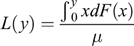 $$L(y)={\vint ^y_0 xdF (x) \over \mu }$$
, where F(x) denotes the cumulative distribution function of ordered individuals and μ represents the average size. The Lorenz curve is usually interpreted as follows. If there is no difference among all individuals under observation, the Lorenz curve would be a straight diagonal line, called the line of equality. However, if inequality exists among the population, then the Lorenz curve would show a fall below the line of equality (Subramanian & Kawachi, Reference Subramanian and Kawachi2004).
All treatments costs were calculated in Cambodia Riel using the current exchange rate of US$1 to 4100 Riel.
Ethical considerations
The survey instrument received ethical permission from the Ethics Committee of the institutional review board of ORC Macro Inc. Permission to use these data was obtained from ORC Macro.
Results
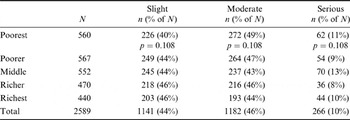
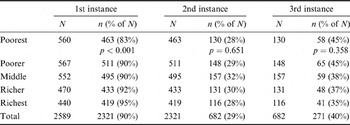
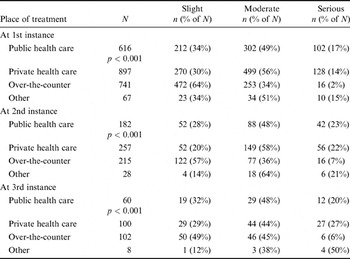
An economic gradient in occurrence of slight and moderate health problems was observed in the 2589 respondents (see Table 1). The poorest people are proportionally less affected by slight illness or injuries (40%) than richest people (46%). The reverse is the case for moderate health problems. Table 2 depicts health service use: almost 95% of rich people have sought treatment in 1st instances compared with 83% of the people below the poverty line. There is, however, a general trend (28–30%) in the utilization of health care facilities in 2nd instances. Almost 45% of people in both the 20% below the poverty line and 20% above the poverty line (i.e. poorest and poorer quintiles) used health care in 3rd instances compared with 35% of their rich counterparts. Table 3 shows the use of different types of health service by severity of illness/injury. For slight health problems, over-the-counter facilities are the preferred choice for all instances of utilization. The trend in use is as follows; 1st instance, 64%, 2nd instance, 57% and 3rd instance, 49%.
Severity of respondents' health problems by economic status

Health care utilization of respondents by economic status

Type of health care service use of respondents by severity of illness/injury

There is, however, a small difference in the choice of place of treatment for moderate health problems at both the 1st and 2nd instances and in favour of private health care facilities. Specifically, more than half of the respondents visited private health care facilities in the 1st and 2nd instances (56% and 58% respectively). Interestingly, for the same problem if they need to visit a 3rd time then the majority of them (48%) visit public hospitals. Utilization of over-the-counter facilities for serious health problems is lowered for utilization at the 1st instance (2%), but increased for both the 2nd and 3rd instances (7% and 6%).
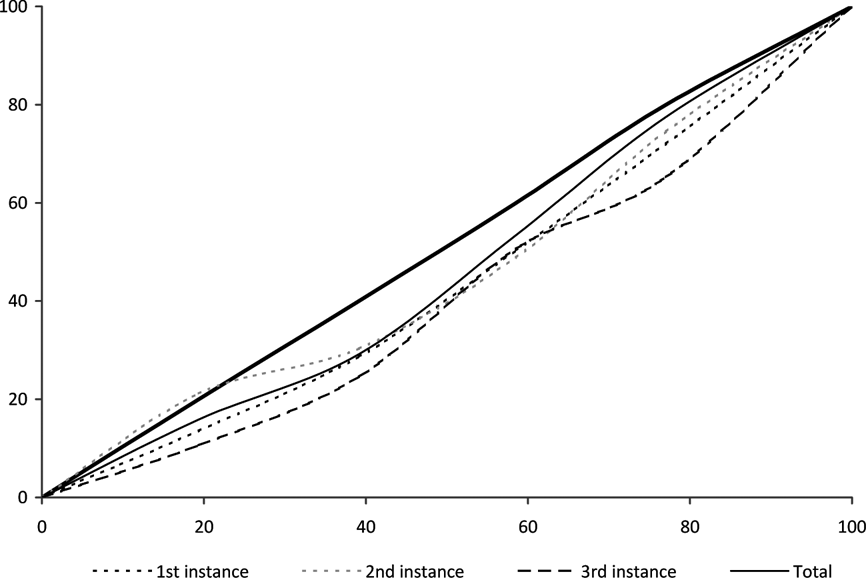
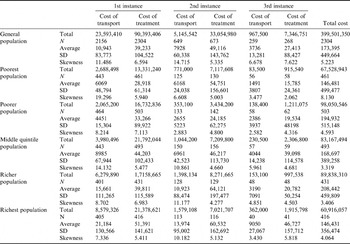
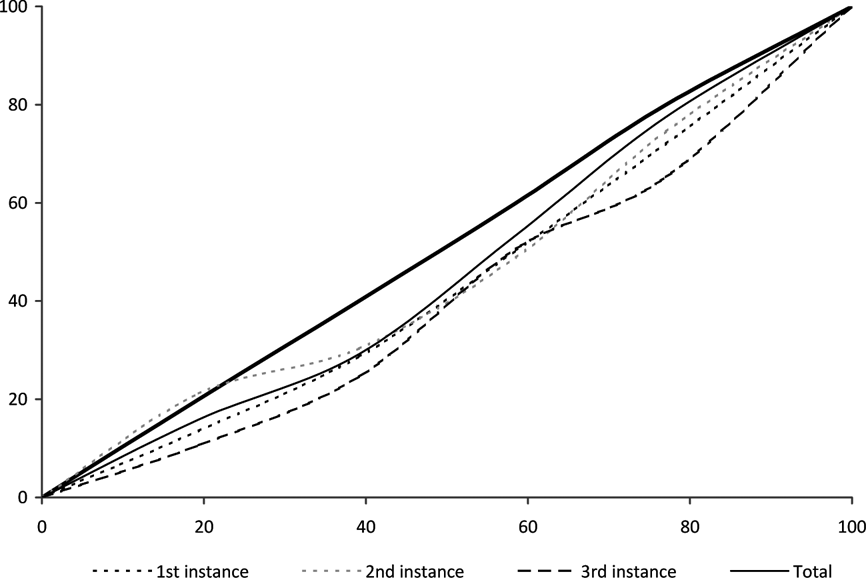
The cost burden associated with the 1st, 2nd and 3rd instances of use of health facilities by the payees based on their economic status is shown in Table 4. Based on the 2005 gross domestic product, the per capita income for Cambodia was 1,400,000 KHR (approximately $US329). In this study, the average costs of treatment including transport cost for the general population was 1,73,395 KHR. For people below the poverty line the medical cost was 146,484 KHR, while for the richest people it was 146,433 KHR. With regards to equity, and based on the Lorenz curves as shown in Fig. 1, for all instances of treatment, the cost of treatment for the 3rd instance is most unequal. People at the middle quintiles of the economic strata are in a relatively better situation to bear the cost of treatment.
Lorenz curve of the cost of medical treatments in various instances of treatment.
Cost burden (in KHR) of 1st, 2nd and 3rd instances of health care by economic status

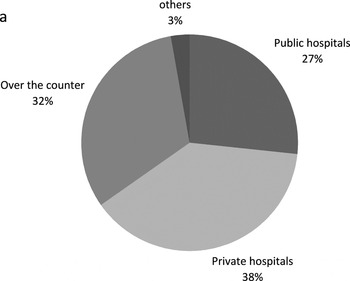
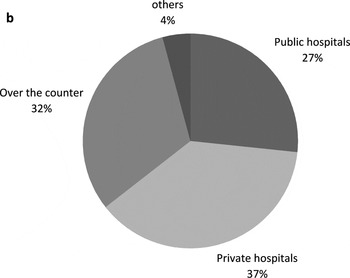
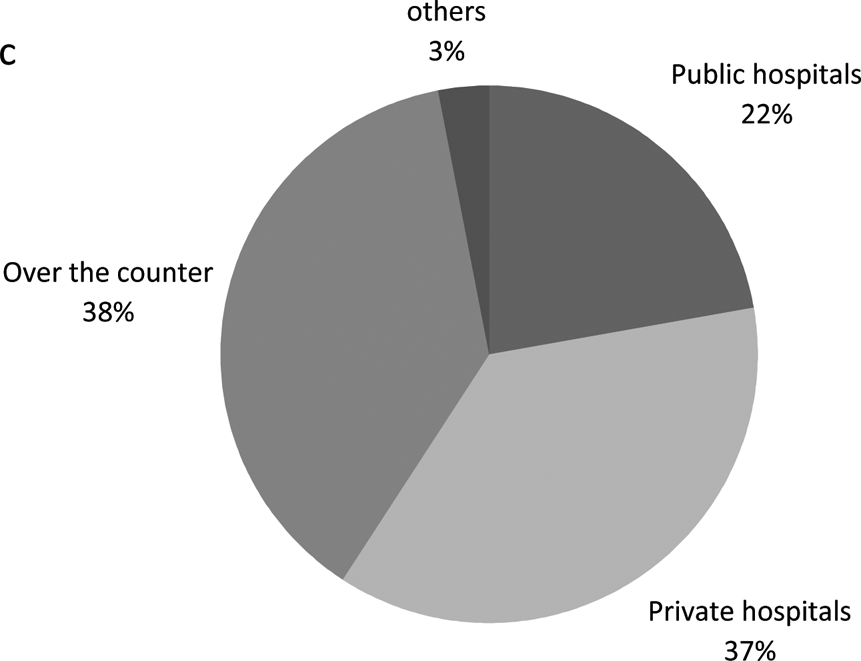
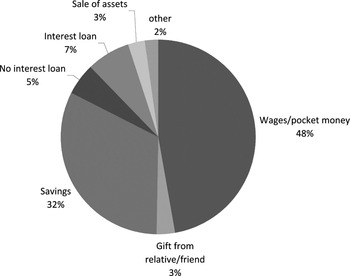
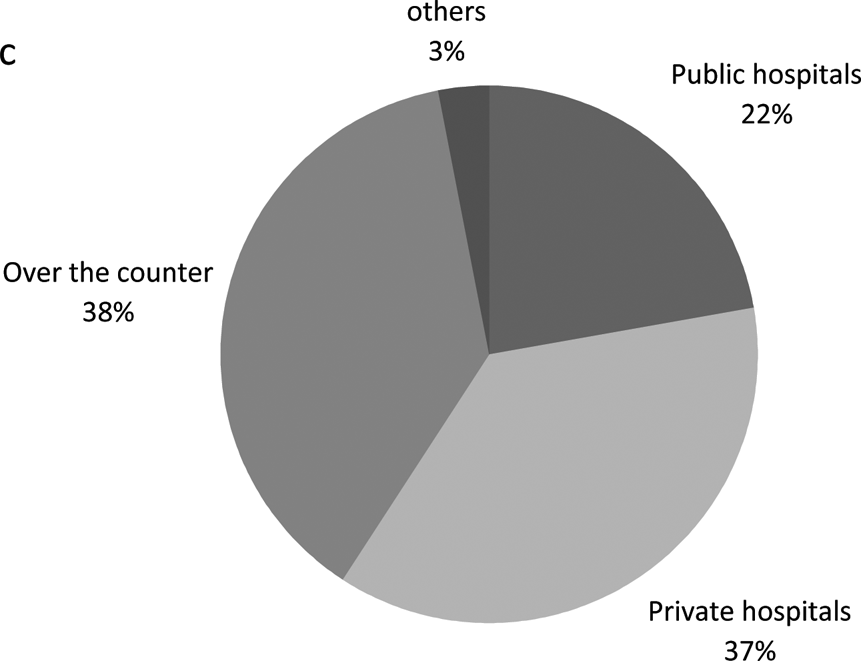
The general population in Cambodia prefer to patronize over-the-counter drug stores for treatment. As can be seen from Fig. 2a–c, for the 1st instance 39% visited private health facilities, with a slight decrease in successive visits (38% and 37%). The utilization of the public facilities was less for the third instance (22% only). For the 3rd and last instance of treatment, the majority of people (38%) visit over-the-counter drug stores. Figure 3 shows the sources of expenditure on health care. Almost half of the respondents (47%) funded the treatment cost from their regular wage. One-third paid from their savings, while the remaining 13% paid by means of loans, with or without interest.

Places of treatment for 1st treatment instance (a), 2nd treatment instance (b) and 3rd treatment instance (c).

Continued
Sources of financing for medical treatments.

Discussion
The current study has attempted to assess the fairness of utilization of health care facilities and out-of-pocket payment burden in Cambodia. According to the CDHS-2007, a large proportion of people living below the poverty line had suffered from one form of moderate health problem or the other. In general, Cambodian people tend to visit over-the-counter drug stores for their health problem. This is in accordance with the prepondence of studies that have demonstrated patronage of drug stores and the private sector in preference to the public health system in Cambodia (Meessen et al., Reference Meessen, Bigdeli, Chheng, Decoster, Ir and Men2011). This trend is not new, especially in low-income setting where the health system is pluralistic. The importance of private care facilities in providing health care services has been well reported in such settings. For instance, private providers have been documented to contribute immensely to family planning services and treatment of infectious diseases (Berman & Rose, Reference Berman and Rose1996). On the other hand, the pluralistic nature of health care systems, coupled with the regressive cost burden on households imposed by the need to pay user fees, may be responsible for the sick seeking care from hawkers since they charge only nominal fees (Berman & Dave, Reference Berman and Dave1996; Fabricant et al., Reference Fabricant, Kamara and Mills1999; Haines et al., Reference Haines, Heath and Smith2000; Thuan et al., Reference Thuan, Lofgren, Chuc, Janlert and Lindholm2006). Another reason for the utilization of private providers by sick or injured persons of lower socioeconomic status could be the non-functional referral system in some areas, as reported for an injury case in a study by Nakahara and colleagues (Nakahara et al., Reference Nakahara, Saint, Sann, Ichikawa, Kimura and Eng2010). The trend in patronage of hawkers or using over-the-counter medication for treatment by people from poorer households has also been documented in the treatment of communicable and non-communicable diseases (Aremu et al., Reference Aremu, Lawoko, Moradi and Dalal2011).
However, the fact that households reported spending an average of 173,395 KHR, which is almost 1.5 times the average monthly per capita income, points to the existence of ‘catastrophic’ spending. It is worrying to see that those living below the poverty line and earning less than one dollar a day (in 2005, 127,660 KHR per month), spend an average of 19,4932 KHR on a health problem, which is almost 1.6 times their per capita monthly income. The economic hardship being faced by these poorer households due to the need to care for a sick or injured family member is untold. Studies in other parts of the developing world have shown that when people from poor households cannot afford to pay for proper treatment from a qualified health care provider they tend to use several mechanisms to adapt to their precarious economic situations (Onwujekwe et al., Reference Onwujekwe, Uzochukwu, Obikeze, Okoronkwo, Ochonma and Onoka2010b).
In this study, the findings show that people from poorer households utilized tertiary health care services more than those from richer households. This might mean relatively easy access to quality health care services for a certain percentage of the poor. The fact that many of the respondents visited private health care facilities for the first treatment of moderate health problems rather than using over-the-counter treatment, demonstrates their recognition of the need to seek proper care regardless of the cost. This might be related to their perception about quality and the attitude of health workers or the services provided by them. Studies have shown that factors such as long waiting times, lack of drugs and poor service and incompetence of health workers have sometimes led to people to turn their backs on public health care facilities (Opwora et al., Reference Opwora, Laving, Nyabola and Olenja2011). The fact that the study shows that for the same state of ill health or injury subsequent visits are to public health facilities means that they fear that they may die if urgent medical steps are not taken.
This study further shows that there is little difference in the cost burden between the poor and the rich in Cambodia when it comes to payment for treatment. Specifically, it was found that 51 KHR is the cost difference borne by the poor and the rich. This, to a large extent, represents a level of fairness, though for the poor and poverty-stricken population the cost difference remains a huge amount of money. As for the sources of finance for treatment, out-of-pocket payment from wages still represents the main source of finance. However, the fact that some sections of the population pay for their health care through the sale of their personal belongings points towards ‘catastrophic’ spending, which is not new and has been reported in several other low- or middle-income countries (Bigdeli & Annear, Reference Bigdeli and Annear2009; Kruk et al., Reference Kruk, Goldmann and Galea2009). Sale of personal effects to pay for health care and treatments is a coping strategy that has been well documented in several studies (Biacabe, Reference Biacabe2009). For instance, a study in fifteen African countries reported that sales of personal effects to pay for health care range from 23% in Zambia to 68% Burkina Faso, and that people from richer households are less likely to borrow or sell assets to pay for treatment (Leive & Xu, Reference Leive and Xu2008). This study has noticed a high level of out-of-pocket payments for treatment of injuries and sickness in Cambodia, which points towards the need for a proactive effort to mitigate the economic burden.
This study used national representative CDHS data from 2005–2006. More recent data are available, and a few studies have attempted to identify health care equity in Cambodia using these, but they have the disadvantage of being mainly provincial or regional in nature (Annear et al., Reference Annear, Bigdeli, Ros, Jacobs, Meessen, Pei, Criel and Bloom2008; Biacabe, Reference Biacabe2009; Bigdeli & Annear, Reference Bigdeli and Annear2009). This curent study has the advantage of using national representative data.
Conclusion
There is a moderate level of fairness in health care utilization and out-of-pocket payment burden among the general populace in Cambodia. This study is in line with findings of a recent study by Meessen et al. (Reference Meessen, Bigdeli, Chheng, Decoster, Ir and Men2011), which shows that though utilization of health care services is fair across socioeconomic strata, catastrophic payment by people from poorer households still exists. The findings of this analysis stress the need to ensure that the poor and most vulnerable are protected against catastrophic spending when seeking care for communicable and non-communicable diseases.
Acknowledgments
The contribution of Professor Per Carlsson, Linkoping University, Sweden, is acknowledged for his generous comments. The authors are grateful to the ORC for granting access to the use of the data after ethical approval.