Introduction
The administration of medicines to older people can be problematic for a variety of reasons. Advancing age is associated with multiple physical health problems requiring treatment in the form of considerable numbers of medicines. Older people commonly report swallowing difficulties with tablets and capsules, especially when these are large and/or multiple, and this can lead to poor compliance and treatment outcomes. Among people aged 75 years and over and living in the community, 11% reported difficulty in swallowing tablets and capsules (Morris, 2005). In a U.K. survey of nurses working in nursing homes, 15% of patients were reported to have swallowing difficulties, 5% regularly spat out their medication and 1% hid it (Wright, Reference Wright2002a). Equivalent liquid preparations are not always available, so solid dosage forms may need to be crushed or capsules opened, a common practice for older mentally ill patients (Stubbs et al., Reference Stubbs, Haw and Dickens2008) but one that is illegal without the authorization of the prescriber (Wright, Reference Wright2002b). In one study of Australian residential care homes, the practice of crushing or altering medications was contra-indicated in 17% of instances (Paradiso et al., Reference Paradiso2002). Where a dosage form has been modified the resultant powdered medication may be unpalatable, hence the practice of mixing medication with jam or other strongly flavored food substances. Administration of crushed medications, mixed together and then put into food or drink is technically unlicensed administration since it lies outside of the Marketing Authorization (a U.K. term, formerly known as the Product License). It is not known in detail if or how the bio-absorption and bioavailability of drugs is affected by this practice, although problems do arise occasionally from dosage form modification. For example, the effect of crushing extended release preparations is that the entire dose becomes immediately available for absorption and this results in a high levels in the blood. Where slow-release opiate analgesics are involved there is potential for a serious adverse drug event. Mixing drugs with food can sometimes increase or decrease the effect of the drug. The most common type of food–drug interaction occurs when food changes the bioavailability of the drug, for example dairy products contain chelating agents that reduce the bioavailability of certain antibiotics (Schmidt and Dalhoff, Reference Schmidt and Dalhoff2002). A number of lists of food–drug interactions have been identified and published but these particular interactions are unlikely to be well known to those administering medication (Schmidt and Dalhoff, Reference Schmidt and Dalhoff2002; Leibovitch et al., Reference Leibovitch, Deamer and Sanderson2004).
Older mentally incapacitated patients may sometimes refuse to swallow medication that is essential to their health and well-being or, more controversially, is essential to control disturbed behavior. In these circumstances it may be decided by those involved in the patient's care that the medicines should be administered in food or drink without the patient's knowledge, a practice known as covert or surreptitious prescribing or administration. Giving medication to a patient covertly has been described as an insidious and deceitful practice that violates every tenet of the doctor–patient relationship (Ahern and van Tosh, Reference Ahern and van Tosh2005). But even these authors acknowledge that this practice may be appropriate for selected patients with cognitive impairment. Clearly, covert medication should be avoided where at all possible but, equally clearly, it can provide clinicians with a practical solution to an elderly, mentally incapable patient's refusal to take medication. For some patients and certain medicines, the alternative to covert medication would be to administer the medication forcefully by injection, thereby causing the patient distress, worsening their relationship with staff, and potentially causing physical injury to patient and staff. In this situation, covert administration could be justified as being less restrictive to patient autonomy and dignity, provided it was a proportionate response to the patient's needs and the benefits outweighed the harm of not administering the medication and of deceiving the patient. Many medicines are only available for oral administration and so unless the patient is given the medication covertly they may suffer harm as a result of not receiving medication necessary for their well-being. Clearly, covert medication poses difficult ethical problems for clinical staff, revolving around the issue of patient autonomy vs beneficence and non-maleficence (Wong et al., Reference Wong, Poon and Hui2005).
Covert administration of medicines is common, especially in patients with dementia where mental capacity has been lost. In a survey of residential, nursing and inpatient units in England, it was reported that in 71% of these institutions medicines were sometimes given covertly (Treloar et al., Reference Treloar, Beats and Philpot2000). Few respondents had consulted a pharmacist about possible interactions between crushed drugs and foodstuffs, and a number reported that the practice was hidden for fear that disciplinary action might be taken against staff. In a survey of staff in Norwegian nursing homes, 17% of patients in special care units for dementia were receiving medication in food or drink at least once a week (Kirkevold and Engedal, Reference Kirkevold and Engedal2005). When this study was repeated a few years later this figure had fallen to 14% (Kirkevold and Engedal, Reference Kirkevold and Engedal2009).
In England and Wales, the Mental Capacity Act 2005 (hereafter MCA) now provides a mechanism for safeguarding the interests of the mentally incapacitated patient with regard to covert administration (Ministry of Justice, 2008). The MCA includes safeguards, such as a “best interests checklist” that should be completed before medication is given in this way, taking into account the likely views of the patient before they lost capacity as well as the views of relatives. For inpatients detained under the England and Wales Mental Health Act, 1983, amended in 2007 (hereafter MHA), after the first three months of compulsory treatment, psychotropic medication can be given without their consent provided an independent psychiatrist (second opinion approved doctor; SOAD) has authorized the medication. A patient can only be detained under the MHA if appropriate treatment is available for their mental disorder, though the definition of appropriate treatment is very broad and includes nursing care as well as medication. However, the MHA does not apply to the majority of patients receiving medication covertly, namely those who reside in nursing and residential homes and who are not detained under the MHA. In any event, the MHA does not apply to medications for physical disorders.
Although there is some literature on dose form modification and covert administration, there are few actual studies in this area or studies examining the mixing of medication with food or drink. We therefore set out to conduct a study of this practice at our own hospital. Townsend Division is part of a large independent tertiary referral centre (St Andrew's Hospital, Northampton) that provides assessment and treatment for approximately one hundred mainly elderly patients with challenging behavior, including mentally disordered offenders. There is also an 11-bed unit for younger patients with Huntington's disease and challenging behavior. In a previous observational study of medicines administration on two wards within Townsend Division, 13% of doses administered were added to food or beverages (Stubbs et al., Reference Stubbs, Haw and Dickens2008).
The aims of the present study were to determine: (1) the frequency and reasons for mixing medication with food or drinks; (2) whether dosage modification and mixing with food or drink is safe and appropriate; (3) whether or not the prescriber is aware of the practice; (4) the frequency with which medication is being given covertly in food or drink; and (5) the most common types of medication being administered in this way.
We included the following audit standards in the study. These were derived from the Royal College of Psychiatrists’ “Statement on covert administration” (Royal College of Psychiatrists, 2004) and “Covert administration of medicines” (Nursing and Midwifery Council, 2007).
1. Dosage form modification should only take place if there are no more suitable preparations available.
2. Mixing medicines together in food and drink should only take place if there are no practical alternatives to medicines administration.
3. The practice of mixing drugs with food or drink should be discussed with the multidisciplinary team, including a pharmacist and the consultant psychiatrist.
4. The prescriber should indicate on the medication chart that the medication can be mixed with food or drink.
5. The mixing of medication with food and drink should be documented in the care plan.
6. Where medicine is being disguised in food and drink, this should only take place when the patient lacks capacity, where the multidisciplinary team has met and considered that it is in the patient's best interests and any relatives have been consulted. The medicine that is to be administered covertly should be indicated by the prescriber on the medication chart and documented in the care plan. If the patient is informal (i.e. admitted to hospital on a voluntary basis), then a MCA best interests checklist should be completed.
7. There should be a policy and procedure in place for covert administration.
Methods
JS visited all seven wards within Townsend Division between April and June 2009 and examined each patient's medication chart. For each patient JS asked a member of the nursing staff (Staff Nurse grade or above) who was involved in medication administration the method by which each drug was administered to that patient, in particular if the dose-form was altered and if the medication was mixed with food or drink. The reasons for these practices were sought, as were whether or not the patient had the mental capacity to consent to treatment with medication and whether or not the patient would still take medication that had been mixed with food (or drink) if they were told that the food (or drink) contained medication. Where medication was being concealed in food or drink because otherwise the patient would refuse to take it, for the purposes of the study this was regarded as covert medicines administration.
Patients’ ICD-10 clinical psychiatric diagnoses were obtained from their consultant psychiatrists. Consultant psychiatrists were also asked which patients were receiving medication covertly and, if so, whether a MCA checklist had been completed. We examined patients’ care plans for evidence that the multidisciplinary team had agreed that medication should be given in food or drink. JS checked whether there was any other more appropriate licensed preparation available and that there were no contra-indications to mixing the relevant medicines together using the British National Formulary (British Medical Association and Royal Pharmaceutical Society of Great Britain, 2008) and the electronic Medicines Compendium (eMC; http://www.medicines.org.uk). Demographic, legal and consent to treatment details were obtained from patients’ records.
Data were collected using a simple proforma and were then entered into SPSS version 14 (SPSS Inc., 2006) and a simple descriptive analysis was undertaken.
Results
Patient population receiving medication in food or drink
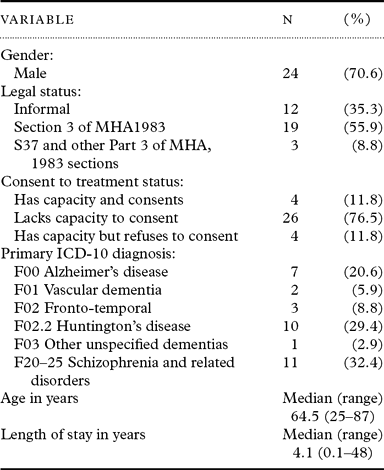
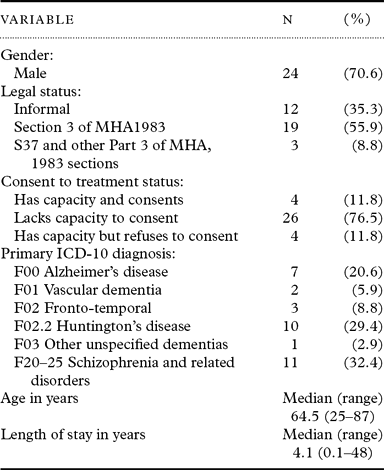
Thirty-four out of a total of 110 (30.9%) patients were receiving medication mixed with food or drink (not water). The demographic, legal and clinical details of these patients are summarized in Table 1. Over two-thirds of those receiving medication in food or drink were male; two-thirds had a primary ICD-10 diagnosis of dementia and a third had a diagnosis of schizophrenia or other functional psychoses, reflecting the finding for the total population of Townsend Division. Nine of the ten patients with Huntington's disease were aged under 65 years. Although slightly over a third of the 34 patients were informal, almost all were judged by clinical staff to either lack capacity to consent or would refuse treatment given the choice.
Demographic, legal and clinical details of patients receiving medication in food or drink (N = 34)
Why and how are medicines administered in food and drink
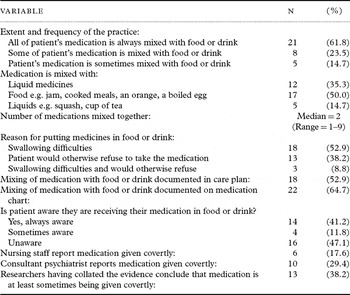
The most common reason was swallowing difficulties (21 cases; 61.8%); the other reason was that the patient would otherwise refuse to take their medication (16 cases; 47.1%). In three cases, both reasons applied (see Table 2). Nursing staff thought that slightly under 60% of patients were aware they were receiving medication in their food or drink.
Details of 34 cases where administration of medicines took place in food or drink

It was usual for all of a patient's tablets to be crushed and then mixed together with food or drink, but in a minority of cases only some of their medication was administered in this way and for several others the mixing with food or drink was an intermittent practice dependent upon the patient's mental state at the time of the drug round. The most frequent vehicle for mixing medicines were liquid medicines, but jam, squash, Fortipuddings and Forticremes (high protein nutritional supplements) and cooked meals were also popular. Almost all patients had multiple medicines administered in this way. Thirty patients had psychotropics administered in food or drink – the most common were antipsychotics (N = 18) and anxiolytics (N = 15) – and 26 were administered medicines for physical health problems.
Problems with dosage form modification or mixing medicines with food or drink
We could not identify any major problems with the crushing of particular medicines and mixing with the identified food and drinks. This is likely to be because in almost all instances a pharmacist had already been consulted on how best to administer the patient's medicines. However, in a number of instances, more appropriate licensed dosage forms were available, for example granules or liquids rather than tablets or capsules.
Documentation about medicines administration in food and drink
The addition of medication to food or drink had been discussed with the psychiatrist, pharmacist and multidisciplinary team in 33/34 (97.1%) cases and with relatives in 18 (52.9%) cases (not all patients had relatives). However, patients’ documentation did not always reflect this. In just under two-thirds of cases the psychiatrist had authorized the practice on the medication chart and in just over half it was documented in the patient's care plan.
Covert administration
Nursing staff reported that in their opinion six patients were receiving medication covertly, that is, if the patient was told that they were receiving medication they would then refuse to take it, while consultant psychiatrists reported a total of ten of patients were receiving covert medication. However, on reviewing all the responses of nursing staff and psychiatrists as well as the case notes it was clear that a total of 13 patients received their medication covertly at least some of the time, for example when they were particularly paranoid or aggressive (see Table 2). Thus, 13/110 (11.8%) of patients in Townsend Division regularly or sometimes received medication covertly. All 13 were detained under the MHA and according to their consultant psychiatrist all lacked capacity to consent to treatment with medication. Eight (61.5%) had dementia and five (38.5%) schizophrenia. Medication administered covertly was more commonly psychotropic (11 patients) than non-psychotropic (eight patients). Antipsychotics (N = 8) and anxiolytics and hypnotics (N = 7) were the most commonly administered classes of drugs.
Documentation and policies about covert administration
Although in two-thirds of cases (9/13; 69.2%) covert administration was authorized by the prescriber on the medication chart, it was documented in the care plan in less than half of patients (6/13; 46.2%). One (detained) patient receiving medication covertly had a MCA checklist completed. Although the hospital has a policy about dose form modification, no hospital-wide or local policy was found for covert administration.
Discussion
Main findings
In this study of mainly older inpatients with dementia or schizophrenia, 31% were receiving some or all of their medication mixed with food or drink. Swallowing difficulties were more common (62%) than refusal to take medication (47%) as the reason for administering medicines in this way and our findings may have been biased by the inclusion of a ward of patients with Huntington's disease, the majority of whom had dysphagia and had their medicines crushed and made into a puree with food. Although the multidisciplinary team, which included a pharmacist, had in almost all cases met to discuss administering medication in this way, documentation that tablets were to be crushed and mixed with food or liquids was frequently absent from the care plan and medication chart. We found evidence that covert or surreptitious medication was occurring more frequently than either the consultant psychiatrist or nursing staff reported. This may be because for some patients covert administration occurred intermittently when their mental state deteriorated and their behavior became disturbed, or that the staff concerned were not fully aware that medication was being administered covertly. Psychotropics, principally antipsychotics and benzodiazepines, were the drugs most frequently administered in this way. Again, covert administration was documented in the care plan in less than half of cases. In two-thirds of cases the prescriber had authorized it on the medication chart. For one of the 13 patients receiving medication covertly a MCA checklist had been completed but since all 13 patients were detained under the MHA, completion of the checklist was not required as the provisions of the MHA take precedence over those of the MCA. All of the patients receiving medication covertly were detained under the MHA, unlike the situation in nursing and residential homes. Although the Hospital medicines policy covers dose form modification, there is no specific policy on covert medication. The Nursing and Midwifery Council guidance recommends that hospitals and homes should have a policy in place.
Strengths and limitations
There have been few previous studies of the administration of medicines in food and drink that have reported individual patient data. Most studies have relied upon interviews or questionnaires to staff. We have carried out a simple, transparent audit on the wards for older persons at our hospital using audit standards derived from the U.K. Nursing and Midwifery Council and Royal College of Psychiatrists documents on covert administration. The audit could easily be repeated by others in a wide range of elderly care settings. It raises important issues about covert administration, how and when this should occur, who should be consulted and what documentation is needed.
We acknowledge that our study has a number of important limitations. First, the study was conducted at a specialist inpatient unit, a tertiary referral center in the independent sector, and hence the patients are not typical of those found in U.K. National Health Service older persons’ wards, care or nursing homes and are likely to have more severe psychopathology. Secondly, the study population included a ward for younger patients with Huntington's disease, an uncommon illness, again tending to skew our findings. Thirdly, our study had a relatively small sample size, which limits the conclusions that can be drawn from it. More standards could have been audited. For example, it would have been of interest to ask clinicians what harm to patients would have occurred if the covert medication had been withheld, although the making of such ratings would inevitably have been rather subjective. We found it difficult at times to distinguish if a medicine was being mixed with food because of swallowing difficulties or because of patient refusal to swallow tablets. For a number of patients both reasons applied. Sometimes staff did not agree that a medicine was being given covertly. Where there was a clear statement by either nursing staff or the consultant psychiatrist that the patient would refuse to take tablets then we considered this to be covert administration.
Covert administration
Our finding that 12% of patients were receiving their medication covertly is very similar to the findings of another published report in this area. Kirkevold and Engedal (Reference Kirkevold and Engedal2005), in their large survey of Norwegian nursing homes, reported 11% of patients in regular nursing homes and 17% in special units for people with dementia had medicines mixed with food or drink at least once a week and, as in our study, in only 40% of cases was the practice documented. But in a study of non-specialist nursing homes in south-east England, staff reported that only 5% of residents had ever had to be given their medication covertly (Macdonald et al., Reference Macdonald, Roberts and Carpenter2004). The substantially lower rate in this study compared with ours and that of Kirkevold and Engedal (Reference Kirkevold and Engedal2005; Reference Kirkevold and Engedal2009) is likely to be due to differences in the patient populations, environment and/or staffing levels.
In the U.K., a number of national organizations have issued specific and supportive guidance on covert administration in an effort to raise standards of practice and documentation (for example, Royal College of Psychiatrists, 2004; Nursing and Midwifery Council, 2007; Mental Welfare Commission for Scotland, 2006). Guidance is also given in the widely read Maudsley Prescribing Guidelines (Taylor et al., Reference Taylor, Paton and Kapur2009). Care homes and hospitals need to embrace the standards in these documents by developing policies on covert administration, training staff and regularly auditing compliance with the required standards. Rather than feeling that they must administer medication to a patient at all costs, perhaps covertly, nursing staff should discuss the difficulties with the prescriber and other members of the multidisciplinary team. Wards and units for older people need regular input from a psychiatric pharmacist who can advise about dosage form modification and the desirability of mixing medicines together. Consultation with the whole multidisciplinary team should be considered, including a speech and language therapist if there are swallowing difficulties and relatives where appropriate. It is also necessary to consider the legal framework within which covert administration is being proposed. Under England and Wales law this takes place within the framework of the MHA for incapacitated, detained patients and under the MCA for informal patients. There is an MCA best interests checklist that should be completed in order to determine the best interests of the patient. A further consideration for clinicians is whether or not the covert administration amounts to restraint. The MCA defines restraint as the use of force to make someone do something that they are resisting, or the restriction of a person's freedom of movement. In the case of antipsychotics or anxiolytics it could be argued that administering these drugs covertly could in some circumstances amount to chemical restraint. Under the MCA, restraint is appropriate when it is used to prevent harm to the person who lacks capacity and it is a proportionate response to the likelihood and seriousness of harm. According to the Mental Capacity Act 2005: Deprivation of Liberty Safeguards Code of Practice Supplement (Ministry of Justice, 2008), appropriate use of restraint falls short of deprivation of liberty. It is, therefore, doubtful that covert medication could be construed as constituting deprivation of liberty unless sedation was marked and resulted in loss of freedom. What constitutes deprivation of liberty is still being determined by case law. If chemical restraint is in a particular case considered to amount to deprivation of liberty then the MCA still permits such restraint to take place providing it has been authorized by an independent body.
It is not considered ethical to administer covert medication to a patient who has capacity but who is refusing to take medication. It is interesting that in our study there were three patients with a primary diagnosis of schizophrenia who, according to the MHA, were classified as refusing treatment (as opposed to lacking mental capacity) and hence at first sight it might appear unethical to administer medication covertly. However, on questioning, both the consultant psychiatrist and the administering nurse both said these patients were all chronically ill and incapable of giving valid consent.
Further research and audit
The literature about the circumstances and types of medication that patients receive covertly is very limited and is restricted to older adults, mainly in nursing and care homes in the U.K. and Norway. The extent of the practice in other countries, in general hospitals, or in other patient populations, such as those with learning disabilities or brain injury, is not known. While we did not detect any major safety, ethical or legal issues surrounding the practice in the severely ill older inpatient group studied, the situation for community patients is likely to be less discussed and less monitored. With the introduction of the MCA in England and Wales, covert administration to informal patients requires completion of a best interests checklist and a need for chemical restraint to be proportionate and necessary for the prevention of harm. Compliance with these new legal requirements could usefully be audited. To date there has only been one study of relatives’ views about covert administration, conducted in south-east England (Treloar et al., Reference Treloar, Beats and Philpot2000). It is possible that relatives’ views may have now changed following the recent publicity that antipsychotics increase the risk of stroke to patients suffering from dementia. Further exploration of relatives’ thoughts and feelings about covert administration would also be of interest, examining not only the nature and circumstances of medicines administered but the ethical dilemmas involved.
Conflict of interest
None.
Description of authors' roles
JS conceived the idea for the study, collected the data and contributed to the writing of the paper. CH designed the study, analyzed the data and wrote the paper.