Introduction
Determination of the genetic basis of prenatal survival or the genetic or environmental causes of prenatal losses is a complex problem. Most losses are characterized by asynchronization between embryo and uterus that leads to problems in the process of implantation and/or placentation. The successful establishment and maintenance of pregnancy requires orchestrated communication between embryo and uterus that includes secretions from the embryo to signal pregnancy recognition and secretion and remodelling from the uterine epithelium to support attachment, development, and growth of the embryo.
Attachment of the embryo to the maternal endometrium is considered to be an active process facilitated by the attainment of a period of uterine receptivity. This interval, known as the implantation window, was first suggested by McLaren & Michie (Reference McLaren and Michie1954). Subsequent comparative studies refined this concept and, in some instances, the differences between species have been very informative (Psychoyos, Reference Psychoyos1986; Enders, Reference Enders, Glasser, Mulholland and Psychoyos1994; Weitlauf, Reference Weitlauf, Knobil and Neill1994). Several key maternal factors that may contribute to maximal uterine receptivity have been identified: ultrastructural components such as pinopodes (Psychoyos & Nikas, Reference Psychoyos and Nikas1994); steroids or cytokines and growth factors (Pollard et al., Reference Pollard, Hunt, Wiktor-Jedrzejczak and Stanley1991; Stewart et al., Reference Stewart, Kaspar, Brunet, Bhatt, Gadi, Köntgen and Abbondanzo1992; Fukuda et al., Reference Fukuda, Sato, Nakayama, Klier, Mikami, Aoki and Nozawa1995, Zhu et al., Reference Zhu, Bagchi and Bagchi1998; Hoffman et al., Reference Hoffman, Olson, Carson and Chilton1998).
Rabbits are good experimental models in embryology and developmental biology because of their reproductive characteristics. The precise timing of ovulation (8–10 h after induction) is advantageous for documenting the moment of embryo development, apposition and attachment (Yang & Foote, Reference Yang and Foote1987; Hoffman et al., Reference Hoffman, Olson, Carson and Chilton1998); several biochemical markers have been described that define the period of receptivity in this species (Denker Reference Denker1977; Winterhager et al., Reference Winterhager, Mulholland and Glasser1994). In addition, the points of blastocyst attachment to the uterine epithelium are unique structures, known as trophoblastic knobs, and are readily identifiable during early pregnancy (Enders & Schlafke, Reference Enders and Schlafke1971). This animal model has been studied to examine the expression of several endometrial biomarkers during implantation, such as uteroglobin (Krishnan & Daniel, Reference Krishnan and Daniel1967; Beier Reference Beier1968), MUC-1 (Hoffman et al., Reference Hoffman, Olson, Carson and Chilton1998), VEGF (Das et al., Reference Das, Chakraborty, Wang, Dey and Hoffman1997), integrin (Illera et al., Reference Illera, Lorenzo, Gui, Beyler, Apparao and Lessey2003) or cytokines (Muscettola et al., Reference Muscettola, Massai, Lodi, Briganti, Fontani and Lupo2003).
In rabbit, uteroglobin (SCGB1A1) comprises 40–60% of the total protein from the histotroph uterine secretion on day 5 of pregnancy. These high levels observed close to early events of implantation (Krishnan & Daniel, Reference Krishnan and Daniel1967; Beier Reference Beier1968) are induced by the progressive increase of progesterone levels together with the decreasing levels of oestrogens in this period (Kopu et al., Reference Kopu, Hemminki, Torkkeli and Janne1979; Chandra et al., Reference Chandra, Woo and Bullock1980; Muller & Beato, Reference Muller and Beato1980; Snead et al., Reference Snead, Day, Chandra, Mace, Bullock and Woo1981, Shen et al., Reference Shen, Tsai, Bullock and Woo1983).
Vascular endothelial growth factor (VEGF) is considered to be a potent promoter of vascular endothelial cell proliferation, microvascular endothelial cell proliferation and migration associated with neovascularization in implantation, embryogenesis, corpus luteus development, ovarian follicle development and tumorigenesis (Chakraborty et al., Reference Chakraborty, Das and Dey1995; Ferrara & Davis-Smyth, Reference Ferrara and Davis-Smyth1997; Artini et al., Reference Artini, Valentino, Montleone, Simi, Parisen-Toldin, Critello, Cela and Genazzani2008). The expression of VEGF in uterine tissue has been detected in many species, including in rabbit at the sixth day of gestation (Llobat et al., Reference Llobat, Marco-Jiménez, Peñaranda, Thieme, Navarrete-Santos and Vicente2012a).
Integrins are a major class of cell adhesion molecules. Both constitutive and cyclical expression of integrins has been observed in the uterus, and they are now considered to be the most decisive criteria for determining uterine receptivity (Lessey et al., Reference Lessey, Ilesanmi, Sun, Lessey, Harris and Chwalisz1996). Apical localization of αVβ3 and αVβ5 integrins in the mouse, human, baboon, rabbit, pig and sheep luminal epithelium makes these specific integrin pairs appropriate candidates for mediating trophoblast/epithelial interactions (Bowen et al., Reference Bowen, Bazer and Burghardt1996; Lessey et al., Reference Lessey, Ilesanmi, Sun, Lessey, Harris and Chwalisz1996; Fazleabas et al., Reference Fazleabas, Donnelly, Hild-Petito, Hausermann and Verhage1997; Burghardt et al., Reference Burghardt, Johnson, Jaeger, Ka, Garlow, Spencer and Bazer2002; Illera et al., Reference Illera, Lorenzo, Gui, Beyler, Apparao and Lessey2003). Moreover, the αVβ3 integrin has also been shown on the surface of the blastocyst (Sutherland et al., Reference Sutherland, Calarco and Damsky1993), so a reciprocal and cooperative role in attachment is suggested.
Maternal-embryonic recognition is mainly related to the expression of different cytokines in various species (Sharkey, Reference Sharkey1998). Embryos synthesize factors that stimulate the production of cytokines and prevent local activation of cytotoxic cells. Some of these cytokines are interferons (IFN) that have been linked to pregnancy recognition (IFN-α in pigs, IFN-α and IFN-β in humans, ω48 and IFN-γ in rabbits or IFN-τ in ruminants) (Cross & Roberts, Reference Cross and Roberts1989; Aboagye-Mathiesen et al., Reference Aboagye-Mathiesen, Tóth, Zdravkovic and Ebbesen1995; Muscettola et al., Reference Muscettola, Massai, Lodi, Briganti, Fontani and Lupo2003; Spencer et al., Reference Spencer, Burghardt, Johnson and Bazer2004). Moreover, IFNs are involved in the angiogenesis process and the activation of natural killer cells (IFN-α in mouse or IFN-γ in rabbits) (Krusche et al., Reference Krusche, Vloet, Herrler, Black and Beier2002; Murata et al., Reference Murata, Hori, Lee, Nakamura, Kohama, Karaki and Ozaki2005; Godornes et al., Reference Godornes, Leader, Molini, Centurion-Lara and Lukehart2007).
The aim of the present study was to evaluate the mRNA expression of a set of transcripts related to maternal recognition and the establishment of early rabbit pregnancy (uteroglobin, SCGB1A1; integrin α1, ITGA1; interferon-γ, IFNG; vascular endothelial growth factor, VEGF) in oviduct and uterine tissue at 16, 72 or 144 h post-ovulation.
Materials and methods
Animals
Twenty four nulliparous does belonging to the New Zealand White line from the ICTA at the Polytechnic University of Valencia (UPV, Spain) were used to obtain preimplantation oviduct and uterus tissues. All experimental procedures involving animals were approved by the Research Ethics Committee of the UPV and licensed by the European Community Directive 86/609/EC.
Donor females were inseminated with 0.5 ml of fresh heterospermic pool semen at a rate of 40 × 106 spermatozoa/ml in Tris–citric–glucose extender (Viudes-De-Castro & Vicente, Reference Viudes-De-Castro and Vicente1997). Motility was examined at room temperature under a microscope with phase-contrast optics at ×40 magnitude. Only those ejaculates with >70% motile sperm (minimum requirements commonly used in artificial insemination) were pooled (Marco-Jiménez et al., Reference Marco-Jiménez, Vicente, Lavara, Balasch and Viudes-de-Castro2010). Immediately after insemination, ovulation was induced by an intramuscular injection of 1 μg buserelin acetate
Oviduct and uterus tissue recovery
Eight samples from both tissues (oviduct and uterus) were recovered for each experimental group. Donor does were slaughtered at 16, 72 or 144 h after insemination and induction of ovulation. Oviduct and uterine samples were obtained by gently scraping from the ampulla section and endometrium and plunged into Trizol reagent (Invitrogen S.A, Barcelona, Spain).
RNA extraction and reverse transcription
Total RNA was extracted using the traditional phenol/chloroform extraction method by sonication of samples in Trizol reagent (Invitrogen S.A, Barcelona, Spain). To prevent DNA contamination, one deoxyribonuclease treatment step (gDNA Wipeout Buffer, Qiagen Iberia S.L., Madrid, Spain) was performed from total RNA (1000 ng). Afterwards, reverse transcription was carried out using a Reverse Transcriptase (RT) Quantitect kit (Qiagen Iberia S.L.) according to the manufacturer's instructions.
SYBR® Green assay (quantitative real-time polymerase chain reactions)
Real-time PCR were conducted in an Applied Biosystems 7500 PCR system (Applied Biosystems, Foster City, CA, USA). Every PCR was performed from 5 μl diluted 1:40 cDNA template, 250 nM of forward and reverse specific primers (Table 1) and 10 μl of PowerSYBR Green PCR Master Mix (Fermentas GMBH, Madrid, Spain) in a final volume of 20 μl. The PCR protocol included an initial step of 50 °C (2 min), followed by 95 °C (10 min) and 42 cycles of 95 °C (15 s) and 60 °C (60 s). After real-time PCR, a melting curve analysis was performed by slowly increasing the temperature from 65–95 °C, with continuous recording of changes in fluorescent emission intensity. The amplification products were confirmed by SYBR Green-stained 2% agarose gel electrophoresis in 1× bionic buffer. Serial dilutions of cDNA pool made from several samples were done to assess PCR efficiency. A ΔΔCt method adjusted for PCR efficiency was used (Weltzien et al. Reference Weltzien, Pasqualini, Vernier and Dufour2005), employing the geometric average of H2AFZ (H2A histone family member Z) and GAPDH (glyceraldehyde-3-phosphate dehydrogenase) as housekeeping normalization factor. Target and reference genes in unknown samples were run in duplicate. The expression of a cDNA pool from various samples was used as a calibrator to normalize all samples within one PCR run or between several runs.
Information on primers used for qRT-PCR

GAPDH: glyceraldehyde-3-phosphate dehydrogenase (Navarrete-Santos et al., Reference Navarrete-Santos, Ramin, Tonack and Fischer2008); H2AFZ: H2A histone family member Z (Mamo et al., Reference Mamo, Gal, Polgar and Dinnyes2008); IFNG: interferon-γ (Llobat et al., Reference Llobat, Marco-Jiménez, Peñaranda, Thieme, Navarrete-Santos and Vicente2012a); ITGA1: integrin α1 (Saenz-de-Juano et al., Reference Saenz-de-Juano, Marco-Jiménez, Peñaranda, Joly and Vicente2012); SCGB1A1: uteroglobin (Saenz-de-Juano et al., Reference Saenz-de-Juano, Marco-Jiménez, Peñaranda, Joly and Vicente2012); VEGF: vascular endothelial growth factor (Saenz-de-Juano et al., Reference Saenz-de-Juano, Peñaranda, Marco-Jiménez, Llobat and Vicente2011).
Statistical analysis
After data normalization by logarithm transformation, the differences in mRNA expression among different post-ovulation induction times in both tissues (oviduct or uterus) were analysed by one-way analysis of variance (ANOVA), using the General Linear Models (GLM) procedure of Statgraphics Plus 5.1. Significance was taken as a P-value <0.05.
Results
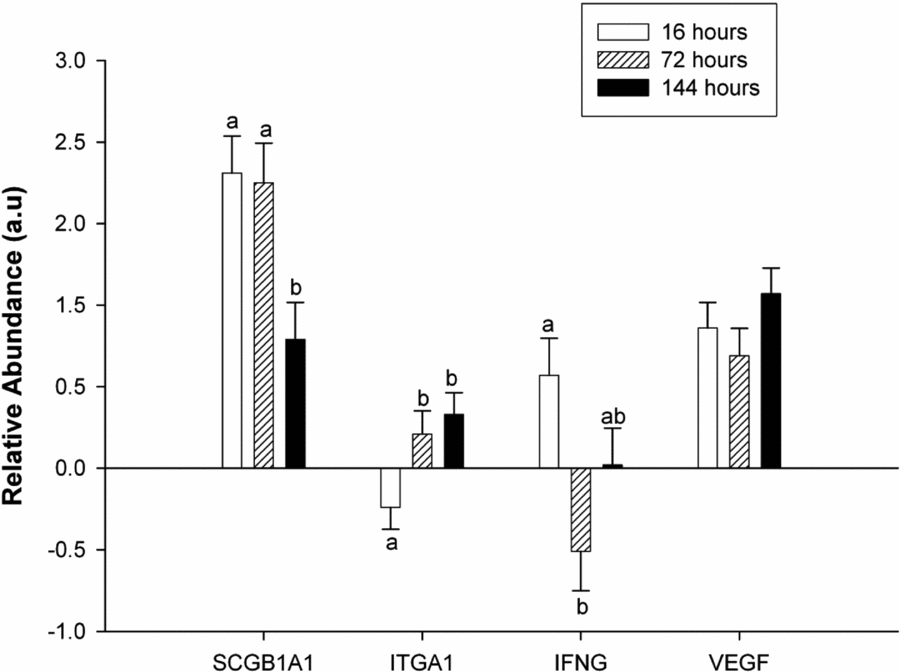
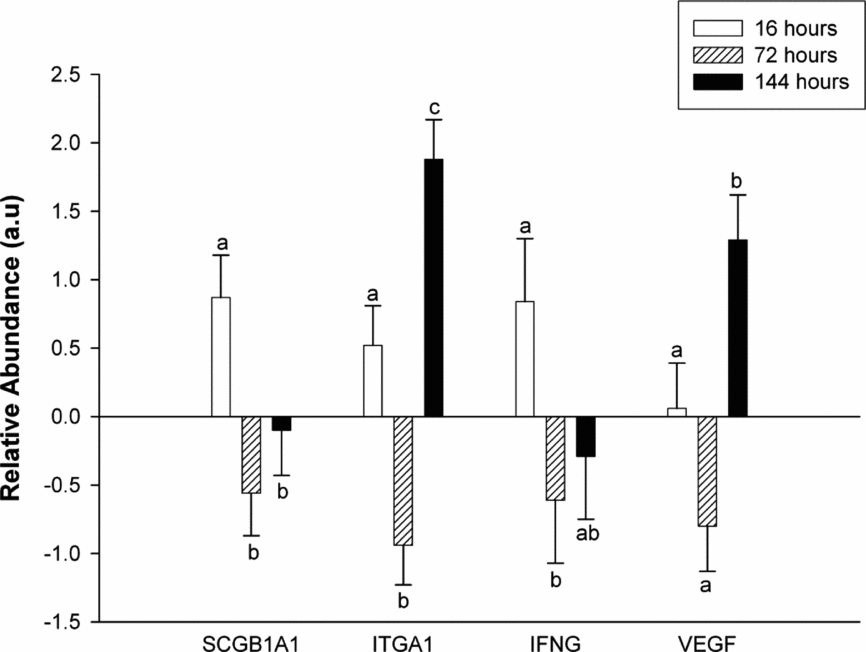
The relative transcript abundance of SCGB1A1, VEGF, ITGA1, and IFNG for oviduct and uterine tissues among different post-ovulation induction times are shown in Figs 1 and 2, respectively.
Relative abundance of SCGB1A1 (uteroglobin), ITGA1 (integrin α1), IFNG (interferon-γ) and VEGF (vascular endothelial growth factor) mRNA expression for oviduct tissue in 16 h, 72 h and 144 h post-ovulation induction. Relative abundance values are expressed in arbitrary units (a.u.), showing the mean value ± standard error of the mean (SEM). a,bDifferent letters represent significant differences.
Relative abundance of SCGB1A1 (uteroglobin), ITGA1 (integrin α1), IFNG (interferon-γ) and VEGF (vascular endothelial growth factor) mRNA expression for endometrium tissue in 16 h, 72 h or 144 h post-ovulation induction. Relative abundance values are expressed in arbitrary units (a.u.), showing the mean value ± standard error of the mean (SEM). a,b,cDifferent letters represent significant differences.
In the oviduct tissue, a significant decrease in the level of SCGB1A1 mRNA expression was observed from 72 to 144 h post-ovulation. In the case of ITGA1, the transcript abundance was lowest at 16 h post-ovulation, but the mRNA expression increased significantly at 72 and 144 h. For IFNG, a huge decrease was observed from 16 to 72 h post-ovulation, but this mRNA expression did not remain low and increased at 144 h. Finally, no significant differences were observed in VEGF transcript abundance between experimental days (Fig. 1).
For uterine tissue, the current results showed a significant decline in the level of SCGB1A1 mRNA expression from 16 to 72 h post-ovulation induction. The highest levels of ITGA1 transcript were detected at 144 h, followed by 72 h. In the case of IFNG, the mRNA expression pattern was similar to oviduct tissue, and a decrease was observed from 16 to 72 h post-ovulation followed by an increase at 144 h. Finally, it was possible to observe that VEGF mRNA abundance was present at low levels at 16 h post-ovulation and remained low at 72 h, but the level increased at 144 h (Fig. 2).
Discussion
In rabbits, losses from ovulation to days 6 to 7 post-insemination have been estimated at 8–14% (Adams, Reference Adams1960; Mocé et al., Reference Mocé, Santacreu and Climent2002; Llobat et al., Reference Llobat, Marco-Jiménez, Peñaranda, Saenz-de-Juano and Vicente2012b). From fertilization to implantation, embryonic development is influenced during its migration by the maternal environment (Fleming et al., Reference Fleming, Kwong, Porter, Ursell, Fesenko, Wilkins, Miller, Watkins and Eckert2004). As the current results show, the oviduct exhibits a spatial-temporal pattern of transcripts involved in peri-implantation events. In rabbits, the embryo remains in the oviduct from fertilization until days 3 to 4 of development. During these days, the zygote should be converted into a competent embryo for implantation, requiring several changes such as cell cleavage divisions, activation of the embryonic genome, segmentation and compaction of the morula and blastocyst formation (Lonergan et al., Reference Lonergan, Rizos, Kanka, Nemcova, Mbaye, Kingston, Wade, Duffy and Boland2003). Carney et al. (Reference Carney, Tobback and Foote1990) found that co-culture of rabbit zygotes with rabbit oviduct epithelial cells increased blastocyst formation. Ovarian steroids, growth factors, glucose, lactate, pyruvate, proteins, cholesterol, phospholipids and ions as sodium, potassium, chloride and calcium have been found in oviduct fluid (Leese, Reference Leese1988; Henault & Killian, Reference Henault and Killian1993; Grippo et al., Reference Grippo, Anderson, Chapman, Henault and Killian1994; Killian, Reference Killian2004; Aviles et al., Reference Aviles, Gutierrez-Adan and Coy2010; Vecchio et al., Reference Vecchio, Neglia, Di Palo, Campanile, Balestrieri, Giovane, Killian, Zicarelli and Gasparrini2010) and several reports have confirmed that this support of oviduct secretions to embryo development are not species specific (Minami et al., Reference Minami, Kato, Inoue, Yamada, Utsumi and Iritani1994; Lai et al., Reference Lai, Wang, Lee, Lee, Huang, Chang, Lee and Soong1996; Yadav et al., Reference Yadav, Saini, Kumar and Jain1998; Lloyd et al., Reference Lloyd, Romar, Matas, Gutierrez-Adan, Holt and Coy2009). In the current experiment, the mRNA expression of a set of genes (SCGB1A1, ITGA1, IFNG and VEGF) associated with maternal recognition and establishment of rabbit pregnancy was examined. The specific hours (16, 72 and 144 h post-induction of ovulation) were selected because at 16 h the zygotes are in the oviduct, at 72 h the morulae or early blastocysts are exiting the oviduct and entering the uterus, and finally at 144 h the late blastocyst are in the uterus before the onset of gastrulation and adhesion to endometrium. As expected, the gene expression pattern of the oviduct changed from 16 to 144 h post-ovulation induction. It seemed that after ovulation the oviduct started to prepare the best case scenario to carry out the first steps of preimplantation development, by maintaining or increasing the quantity of crucial molecules such as uteroglobin, integrins or growth factors. Although the uteroglobin gene (SCGB1A1) was first identified in rabbit as a specific uterus protein, previous studies have detected mRNA expression in the oviduct (Kay & Feigelson, Reference Kay and Feigelson1972). As stated previously, studies that focussed on regulation of uteroglobin in the uterus have identified that progesterone had the ability to induce it and oestrogen to repress it. However, in the case of the oviduct, it has been detected that SCGB1A1 expression was induced by oestrogen, not progesterone (Mukherjee et al., Reference Mukherjee, Zhang and Chilton2007), a finding that could explain why its expression is higher at 16 h than at 144 h post-ovulation induction. Integrins comprise a large family of heterodimeric transmembrane receptors linked with a great variety of extracellular matrix ligands. Regulation of the transport and stability of gametes and early embryos in the oviduct requires the support of cell adhesion molecules and, for this reason, it was possible to observe an increase in mRNA expression of ITGA1 from 72 h. It is well known that interferons have a multipotential role in the immune response throughout pregnancy. In particular, successful pregnancy requires a protective immunomodulatory mechanism, including a reduction in inflammatory and cytotoxic reactions mainly carried out via IFNG, IL-2 and TNF (Druckmann & Druckmann, Reference Druckmann and Druckmann2005). As the expression of IFNG is considered an immunoreaction related to pregnancy failure, it could be posited that transcript abundance was reduced significantly at 72 h in order to avoid embryo abortion. Moreover, it has been suggested that IFN-γ is also enhanced by oestrogens (Platt & Hunt, Reference Platt and Hunt1998), a suggestion that would correlate with the high transcript abundance observed after ovulation. Regarding VEGF mRNA expression, no differences were found in the oviduct tissue between post-ovulation and preimplantation stage. The current results complemented the observations by Wijayagunawardane et al. (Reference Wijayagunawardane, Kodithuwakku, Yamamoto and Miyamoto2005), which showed that, after ovulation, the elevated VEGF mRNA expression is immediately downregulated by negative feedback regulation; the current results suggest that this expression remains constant in the days before implantation.
To establish embryo–uterine cross-talk and begin the implantation process, the uterus must differentiate into a receptive state (Paria et al., Reference Paria, Song and Dey2001). This change means that the endometrial epithelium is functionally and structurally ready to accept the embryo for implantation (Salilew-Wondim et al., Reference Salilew-Wondim, Schellander, Hoelker and Tesfaye2012). The importance of progesterone in pregnancy recognition and uterine receptivity has been studied widely in many species; inadequate progesterone levels could reduce the ability of the uterus to support embryo development (Rizos et al., Reference Rizos, Carter, Besenfelder, Havlicek and Lonergan2010; Salilew-Wondim et al., Reference Salilew-Wondim, Schellander, Hoelker and Tesfaye2012). Apart from ovarian hormones, there are other components such as growth factors, cytokines, chemokines and adhesion molecules, among others, that participate in this dialogue between endometrium and embryo (van Mourik et al., Reference van Mourik, Macklon and Heijnen2009); any modification or absence of these molecules may hinder the implantation process. The results of the present research agree with previous studies that reported the presence of uteroglobin in the uterus during early pregnancy (Peri et al., Reference Peri, Dubin, Dhanireddy and Mukherjee1995). In particular, this uteroglobin has been associated with cell proliferation and stimulation of blastocyst growth (Beier, Reference Beier2000; Riffo et al., Reference Riffo, Diaz-Gonzalez and Nieto2007; Mukherjee et al., Reference Mukherjee, Zhang and Chilton2007). Previous studies have detected mRNA expression in rabbit blastocysts embryos (Saenz-de-Juano et al., Reference Saenz-de-Juano, Marco-Jiménez, Peñaranda, Joly and Vicente2012; Naturil-Alfonso et al., Reference Naturil-Alfonso, Vicente, Peñaranda and Marco-Jiménez2013), so the synthesis of this protein by the embryo itself could explain the decrease in mRNA expression observed from 72 to 144 h in the uterine tissue. Integrins are considered to be immunohistochemical markers of uterine receptivity (Lessey, Reference Lessey1998), and it has been observed that they could be expressed in the endometrium either constitutively or in a cycle-dependent manner. Recently, Tesfaye et al. (Reference Tesfaye, Salilew-Wondim and Schellander2011) analysed the endometrial gene expression of heifers that eventually resulted in calf delivery and those that resulted in no pregnancy, and observed that expression of integrins was up-regulated in successfully pregnant heifers. Interferons have a crucial role in the uterine immune system and make both implantation and maintenance of pregnancy possible (Szekeres-Bartho, Reference Szekeres-Bartho2002). In the current experiment, as occurs in the oviduct tissue, a significant decrease was observed in IFNG gene expression from 16 to 72 h or 144 h post-ovulation induction; this decrease was also correlated with high progesterone levels at these stages. Finally, in the case of VEGF, up-regulation in expression of this transcript was found in uterus tissue at 144 h. VEGF has been associated with the process of de novo angiogenesis (Lee & DeMayo, Reference Lee and DeMayo2004); its expression and function has been regarded as ensuring a suitable vasculogenesis during implantation and early placentation (Torry et al., Reference Torry, Leavenworth, Chang, Maheshwari, Groesch, Ball and Torry2007). So, as occurs for the ITGA1 gene, its importance grows as the implantation window approaches.
To understand why prenatal mortality continues to occur, it is important to characterize the causes from a biological point of view. The examination of biochemical changes and gene expression patterns of the oviduct and uterus in the presence of gametes or embryos could help us understand the molecular mechanisms of oviduct–oocyte, oviduct–embryo and uterus–embryo interactions.
Acknowledgements
The authors would like to thank Neil Macowan Language Services for revising the English version of the manuscript.
Financial support
This work was supported by the Spanish Research Projects (CICYT AGL2011–29831-C03–01). M.D. Saenz-de-Juano was supported by a research grant from Generalitat Valenciana (Programa VALI+d, ACIF/2011/254).
Conflict of interest
There are no conflicts of interest.