


Statement of Research Significance
Research Question(s) or Topic(s): This prospective, longitudinal cohort study investigated cognitive functioning acutely and up to 6 months after pediatric mild traumatic brain injury (mTBI) as compared with mild orthopedic injury (OI). Main Findings: Cognitive domain standard scores were reduced after pediatric mTBI relative to OI, especially for Reaction Time ≤48 hours post-injury and among adolescents. Cognitive changes diminished over time during recovery. Odds of clinically impaired Reaction Time were 50-times and 8-times higher acutely and post-acutely after mild traumatic brain injury for adolescents, but did not differ for Visual Memory or Executive Function after mTBI. Clinical risk scores did not predict cognitive scores after mild traumatic brain injury. Study Contributions: Pediatric mTBI is associated with an early reduction and high risk of clinical impairment in reaction time that can persist up to 6 months post-injury for some children.
Introduction
Pediatric mild traumatic brain injury (mTBI) is a global public health concern, affecting millions of children annually (Cassidy et al., Reference Cassidy, Carroll, Peloso, Borg, von Holst, Holm, Kraus and Coronado2004; Nguyen et al., Reference Nguyen, Fiest, McChesney, Kwon, Jette, Frolkis, Atta, Mah, Dhaliwal, Reid, Pringsheim, Dykeman and Gallagher2016; Thurman, Reference Thurman2016). In children, mTBI leads to cognitive symptoms that typically are most severe acutely and resolve to pre-injury levels within the first month of recovery (Zemek et al., Reference Zemek, Barrowman, Freedman, Gravel, Gagnon, McGahern, Aglipay, Sangha, Boutis, Beer, Craig, Burns, Farion, Mikrogianakis, Barlow, Dubrovsky, Meeuwisse, Gioia, Meehan, Beauchamp, Kamil, Grool, Hoshizaki, Anderson, Brooks, Yeates, Vassilyadi, Klassen, Keightley, Richer, DeMatteo and Osmond2016). However, a substantial minority (15–25%) of children experience persisting symptoms up to 6 months post-injury or longer (Chadwick et al., Reference Chadwick, Roth, Minich, Taylor, Bigler, Cohen, Bacevice, Mihalov, Bangert, Zumberge and Yeates2021; Ledoux et al., Reference Ledoux, Tang, Yeates, Pusic, Boutis, Craig, Gravel, Freedman, Gagnon, Gioia, Osmond and Zemek2019; Mayer et al., Reference Mayer, Stephenson, Dodd, Robertson-Benta, Pabbathi Reddy, Shaff, Yeates, van der Horn, Wertz, Park, Oglesbee, Bedrick, Campbell, Phillips and Quinn2020). Older children (i.e., adolescents) and females demonstrate particular risk for prolonged symptom recovery following mTBI (Ledoux et al., Reference Ledoux, Tang, Yeates, Pusic, Boutis, Craig, Gravel, Freedman, Gagnon, Gioia, Osmond and Zemek2019; Mayer et al., Reference Mayer, Stephenson, Dodd, Robertson-Benta, Pabbathi Reddy, Shaff, Yeates, van der Horn, Wertz, Park, Oglesbee, Bedrick, Campbell, Phillips and Quinn2020; Sicard et al., Reference Sicard, Stephenson, Hergert, Dodd, Robertson-Benta, Pabbathi Reddy, Yeates, Cromer, Meier, Campbell, Phillips, Sapien and Mayer2022, Reference Sicard, Zemek, Bijelic, Barrowman, Yeates, Beauchamp, Brooks, Anderson, Keightley, Desire and Ledoux2025; Zemek et al., Reference Zemek, Barrowman, Freedman, Gravel, Gagnon, McGahern, Aglipay, Sangha, Boutis, Beer, Craig, Burns, Farion, Mikrogianakis, Barlow, Dubrovsky, Meeuwisse, Gioia, Meehan, Beauchamp, Kamil, Grool, Hoshizaki, Anderson, Brooks, Yeates, Vassilyadi, Klassen, Keightley, Richer, DeMatteo and Osmond2016). In contrast to our understanding of subjective cognitive symptoms (based on child and parent-proxy report) after mTBI, the recovery trajectories, clinical significance, and moderators of objective cognitive functioning after pediatric mTBI are less well understood. This prospective longitudinal cohort study examined objective measures of cognitive function up to 6 months following pediatric mTBI to address important knowledge gaps.
Pediatric mTBI can negatively affect cognitive functioning, but results vary considerably across studies (Hou et al., Reference Hou, Zhang, Fei, Zhou and Li2023; Iverson et al., Reference Iverson, Gardner, Terry, Ponsford, Sills, Broshek and Solomon2017). It appears to cause mild to moderate reductions acutely (i.e., ≤72 hours) and up to 1-month post-injury for most children (Babikian & Asarnow, Reference Babikian and Asarnow2009). However, cognitive scores are not always reduced after pediatric mTBI (Babikian et al., Reference Babikian, Satz, Zaucha, Light, Lewis and Asarnow2011; Maillard-Wermelinger et al., Reference Maillard-Wermelinger, Yeates, Taylor, Rusin, Bangert, Dietrich, Nuss and Wright2009; Studer et al., Reference Studer, Simonetti, Joeris, Margelisch, Steinlin, Roebers and Heinks2014). The effects of mTBI are not associated with alterations in general intellectual functioning and differ by cognitive domain (Ware et al., Reference Ware, McLarnon, Lapointe, Brooks, Bacevice, Bangert, Beauchamp, Bigler, Bjornson, Cohen, Craig, Doan, Freedman, Goodyear, Gravel, Mihalov, Minich, Taylor and Zemek2023). Fluid cognitive processes appear particularly impacted by mTBI, whereas crystalized processes are generally preserved (Chadwick et al., Reference Chadwick, Roth, Minich, Taylor, Bigler, Cohen, Bacevice, Mihalov, Bangert, Zumberge and Yeates2021; Ware et al., Reference Ware, McLarnon, Lapointe, Brooks, Bacevice, Bangert, Beauchamp, Bigler, Bjornson, Cohen, Craig, Doan, Freedman, Goodyear, Gravel, Mihalov, Minich, Taylor and Zemek2023). Reaction time, visual learning and memory, and executive functioning are among the most frequently affected fluid cognitive processes (Hou et al., Reference Hou, Zhang, Fei, Zhou and Li2023).
Cognitive dysfunction typically lessens over time after pediatric mTBI (Brooks, Daya, et al., Reference Brooks, Daya, Khan, Carlson, Mikrogianakis and Barlow2016; Chadwick et al., Reference Chadwick, Roth, Minich, Taylor, Bigler, Cohen, Bacevice, Mihalov, Bangert, Zumberge and Yeates2021; Crowe et al., Reference Crowe, Collie, Hearps, Dooley, Clausen, Maddocks, McCrory, Davis and Anderson2016; Rieger et al., Reference Rieger, Lewandowski, Callahan, Spenceley, Truckenmiller, Gathje and Miller2013; Sicard et al., Reference Sicard, Hergert, Reddy, Robertson-Benta, Dodd, Shaff, Stephenson, Yeates, Cromer, Campbell, Phillips, Sapien and Mayer2021). However, no consensus exists regarding the typical time course of cognitive recovery. Conflicting research suggests that cognitive recovery may occur within 1 month, after 3 months, or as late as 2 years post-injury (Beauchamp et al., Reference Beauchamp, Aglipay, Yeates, Désiré, Keightley, Anderson, Brooks, Barrowman, Gravel, Boutis, Gagnon, Dubrovsky and Zemek2018; Chadwick et al., Reference Chadwick, Roth, Minich, Taylor, Bigler, Cohen, Bacevice, Mihalov, Bangert, Zumberge and Yeates2021; Cossette et al., Reference Cossette, Gagné, Ouellet, Fait, Gagnon, Sirois, Blanchet, Le Sage and McFadyen2016; Crowe et al., Reference Crowe, Collie, Hearps, Dooley, Clausen, Maddocks, McCrory, Davis and Anderson2016; Lambregts et al., Reference Lambregts, Smetsers, Verhoeven, de Kloet, van de Port, Ribbers and Catsman-Berrevoets2018; Rieger et al., Reference Rieger, Lewandowski, Callahan, Spenceley, Truckenmiller, Gathje and Miller2013; Scherwath et al., Reference Scherwath, Sommerfeldt, Bindt, Nolte, Boiger, Koch and Petersen-Ewert2011; Sicard et al., Reference Sicard, Hergert, Reddy, Robertson-Benta, Dodd, Shaff, Stephenson, Yeates, Cromer, Campbell, Phillips, Sapien and Mayer2021). Substantial heterogeneity in brain development and the neural effects of mTBI could contribute to inconsistent findings. Inconsistent results also are likely to reflect methodological variation across studies (Hou et al., Reference Hou, Zhang, Fei, Zhou and Li2023; Iverson et al., Reference Iverson, Gardner, Terry, Ponsford, Sills, Broshek and Solomon2017; Sicard et al., Reference Sicard, Stephenson, Hergert, Dodd, Robertson-Benta, Pabbathi Reddy, Yeates, Cromer, Meier, Campbell, Phillips, Sapien and Mayer2022). This includes varying sample characteristics (e.g., age ranges and sex ratios), comparison groups (e.g., uninjured typically developing children versus children with injuries not involving the head), cognitive assessment measures and tools (e.g., computerized versus paper–pencil; specific tests selected), assessment timing post-injury (e.g., within 72 hours versus 1 month post-injury), and study duration (6 months versus 2 years). Computerized testing appears to offer greater sensitivity to generally subtle and transient cognitive problems after mTBI, especially in reaction time and fluid cognitive processes (e.g., NIH Toolbox; Betz et al., Reference Betz, Cetin-Karayumak, Bonke, Seitz-Holland, Zhang, Pieper, O’Donnell, Tripodis, Rathi, Shenton and Koerte2024; Chadwick et al., Reference Chadwick, Roth, Minich, Taylor, Bigler, Cohen, Bacevice, Mihalov, Bangert, Zumberge and Yeates2021; Dufour et al., Reference Dufour, Adams, Brody, Puente and Gray2020) as compared with paper–pencil tests (Beauchamp et al., Reference Beauchamp, Brooks, Barrowman, Aglipay, Keightley, Anderson, Yeates, Osmond and Zemek2015). Finally, small sample sizes (e.g., Scherwath et al., Reference Scherwath, Sommerfeldt, Bindt, Nolte, Boiger, Koch and Petersen-Ewert2011) could reduce power to detect subtle group differences or track change across time. Prospective, longitudinal research with adequate power for detecting subtle change over time is needed to better characterize the typical recovery trajectories of cognitive changes following pediatric mTBI.
Key demographic factors moderate subjective and objective cognitive symptom recovery following pediatric mTBI. For instance, both biological sex and age at injury moderate cognitive symptom recovery in children, whereby female sex and older age at injury are associated with prolonged recovery (Ledoux et al., Reference Ledoux, Tang, Yeates, Pusic, Boutis, Craig, Gravel, Freedman, Gagnon, Gioia, Osmond and Zemek2019; Mayer et al., Reference Mayer, Stephenson, Dodd, Robertson-Benta, Pabbathi Reddy, Shaff, Yeates, van der Horn, Wertz, Park, Oglesbee, Bedrick, Campbell, Phillips and Quinn2020). Both factors also predict objective cognitive functioning in children after traumatic injury and in uninjured typically developing children more generally (Babikian et al., Reference Babikian, McArthur and Asarnow2013; Beauchamp et al., Reference Beauchamp, Aglipay, Yeates, Désiré, Keightley, Anderson, Brooks, Barrowman, Gravel, Boutis, Gagnon, Dubrovsky and Zemek2018; Chadwick et al., Reference Chadwick, Roth, Minich, Taylor, Bigler, Cohen, Bacevice, Mihalov, Bangert, Zumberge and Yeates2021; Rieger et al., Reference Rieger, Lewandowski, Callahan, Spenceley, Truckenmiller, Gathje and Miller2013; Yeates et al., Reference Yeates, Taylor, Bigler, Minich, Tang, Cohen, Bacevice, Mihalov, Bangert, Zumberge and Yeates2022). Limited evidence indicates that sex can moderate recovery of fluid cognitive processes (e.g., processing speed; Rieger et al., Reference Rieger, Lewandowski, Callahan, Spenceley, Truckenmiller, Gathje and Miller2013) after pediatric mTBI, but this relationship has not replicated across studies (Yeates et al., Reference Yeates, Taylor, Bigler, Minich, Tang, Cohen, Bacevice, Mihalov, Bangert, Zumberge and Yeates2022). Compared with sex, age at injury has been examined as a moderator of cognitive functioning in far fewer studies and does not appear to moderate cognitive functioning after mTBI (Babikian et al., Reference Babikian, McArthur and Asarnow2013). Additional longitudinal research in larger samples with representative age ranges and balanced sex ratios is needed to understand whether key demographic factors moderate cognitive functioning after pediatric mTBI.
The clinical significance of cognitive changes is poorly characterized in pediatric mTBI. Many published studies do not report rates of clinical impairment based on standard thresholds, and studies that have reported on the clinical significance of cognitive reductions have used varying classification criteria (e.g., standard score ≤ 85 versus standard score ≤ 70; Beauchamp et al., Reference Beauchamp, Aglipay, Yeates, Désiré, Keightley, Anderson, Brooks, Barrowman, Gravel, Boutis, Gagnon, Dubrovsky and Zemek2018; Lambregts et al., Reference Lambregts, Smetsers, Verhoeven, de Kloet, van de Port, Ribbers and Catsman-Berrevoets2018; Rieger et al., Reference Rieger, Lewandowski, Callahan, Spenceley, Truckenmiller, Gathje and Miller2013; Scherwath et al., Reference Scherwath, Sommerfeldt, Bindt, Nolte, Boiger, Koch and Petersen-Ewert2011). The American Academy of Clinical Neuropsychology (AACN) has established uniform labels for describing standardized cognitive scores (Guilmette et al., Reference Guilmette, Sweet, Hebben, Koltai, Mahone, Spiegler, Stucky and Westerveld2020). However, no pediatric mTBI study has examined rates of clinical impairment based on those standard classification thresholds. Addressing this knowledge gap has important implications for neuropsychological decision-making and could enhance clinical care of children with mTBI.
This prospective longitudinal study sought to address existing knowledge gaps by examining cognitive functioning up to 6 months following pediatric mTBI relative to mild orthopedic injury (OI). Specifically, this study investigated objective cognitive outcomes up to 6 months post-injury to clarify the recovery course, severity (rate of clinical impairment; i.e., standard scores < 80), and demographic moderators of cognitive functioning after pediatric mTBI. Children with mild OI were included as a comparison group to account for both pre- and post-injury factors that are known to increase children’s risk of injury and influence cognitive performance (Babikian & Asarnow, Reference Babikian and Asarnow2009; Yeates et al., Reference Yeates, Beauchamp, Craig, Doan, Zemek, Bjornson, Gravel, Mikrogianakis, Goodyear, Abdeen, Beaulieu, Dehaes, Deschenes, Harris, Lebel, Lamont, Williamson, Barlow, Bernier, Brooks, Emery, Freedman, Kowalski, Mrklas, Tomfohr-Madsen and Schneider2017). Based on prior research, reduced standard scores and higher rates of clinical impairment (i.e., standard score < 80) in reaction time, executive functioning, and visual memory were expected acutely and post-acutely after mTBI as compared with OI, with gradual recovery occurring by 3 months post-injury (Crowe et al., Reference Crowe, Collie, Hearps, Dooley, Clausen, Maddocks, McCrory, Davis and Anderson2016; Ledoux et al., Reference Ledoux, Tang, Yeates, Pusic, Boutis, Craig, Gravel, Freedman, Gagnon, Gioia, Osmond and Zemek2019). Biological sex and age at injury were expected to moderate cognitive outcomes, with worse outcomes for females and older children with mTBI relative to OI (Chadwick et al., Reference Chadwick, Roth, Minich, Taylor, Bigler, Cohen, Bacevice, Mihalov, Bangert, Zumberge and Yeates2021; Hou et al., Reference Hou, Zhang, Fei, Zhou and Li2023; Iverson et al., Reference Iverson, Gardner, Terry, Ponsford, Sills, Broshek and Solomon2017).
Methods
General procedures
Data were drawn from the Advancing Concussion Assessment in Pediatrics (A-CAP) study, a prospective, longitudinal, multisite, concurrent cohort observational study of pediatric mTBI and OI (Yeates et al., Reference Yeates, Beauchamp, Craig, Doan, Zemek, Bjornson, Gravel, Mikrogianakis, Goodyear, Abdeen, Beaulieu, Dehaes, Deschenes, Harris, Lebel, Lamont, Williamson, Barlow, Bernier, Brooks, Emery, Freedman, Kowalski, Mrklas, Tomfohr-Madsen and Schneider2017). The A-CAP study protocol is published (Yeates et al., Reference Yeates, Beauchamp, Craig, Doan, Zemek, Bjornson, Gravel, Mikrogianakis, Goodyear, Abdeen, Beaulieu, Dehaes, Deschenes, Harris, Lebel, Lamont, Williamson, Barlow, Bernier, Brooks, Emery, Freedman, Kowalski, Mrklas, Tomfohr-Madsen and Schneider2017). Briefly, the study consecutively recruited children (age 8 to 17 years) ≤48 hours of sustaining a mTBI or OI from the Emergency Department of five Canadian children’s hospitals in the Pediatric Emergency Research Canada (PERC) network (Bialy et al., Reference Bialy, Plint, Zemek, Johnson, Klassen, Osmond and Freedman2018). Enrolled children completed computerized cognitive testing during the acute Emergency Department visit and at three follow-up visits: post-acute (i.e., targeted for 7 days post-injury; range 1–32, Median = 8, IQR = 4 days) and 3 and 6 months post-injury. All study procedures were conducted in accordance with the Helsinki Declaration, and the ethical standards and Institutional Review Board approval at each study site. Parents and children respectively provided written informed consent and assent.
Participants
Detailed participant inclusion and exclusion criteria is published (Yeates et al., Reference Yeates, Beauchamp, Craig, Doan, Zemek, Bjornson, Gravel, Mikrogianakis, Goodyear, Abdeen, Beaulieu, Dehaes, Deschenes, Harris, Lebel, Lamont, Williamson, Barlow, Bernier, Brooks, Emery, Freedman, Kowalski, Mrklas, Tomfohr-Madsen and Schneider2017). Briefly, children were included in the mTBI group if they presented with at least one of the following criteria, consistent with World Health Organization (WHO) definition of mTBI (Carroll et al., Reference Carroll, Cassidy, Holm, Kraus and Coronado2004): observed loss of consciousness, Glasgow Coma Scale score of 13 or 14, or at least one other acute sign or symptom. Children were included in the OI group if they presented with an upper or lower extremity injury associated with an Abbreviated Injury Scale score ≤ 4 (Committee on Injury Scaling, 1998). Children with OI who had a head or face injury, overt or suspected brain injury, or required surgery or sedation were excluded. Children with non-accidental injuries were excluded from both groups.
Measures
Demographic history
Parents completed a standard demographics questionnaire. Socioeconomic status was measured using the Material Deprivation Index (Pampalon et al., Reference Pampalon, Hamel, Gamache and Raymond2009, Reference Pampalon, Hamel, Gamache, Simpson and Philibert2014). The Health and Behavior Inventory (Ayr et al., Reference Ayr, Yeates, Taylor and Browne2009) was used to assess post-concussive symptoms. Premorbid (pre-injury) symptom ratings were provided by parents at the post-acute visit, and post-injury symptom ratings were provided by both parents and children at each follow-up visit.
5P Clinical risk score
The Predicting and Preventing Postconcussive Problems in Pediatrics (5P) clinical risk score (Zemek et al., Reference Zemek, Barrowman, Freedman, Gravel, Gagnon, McGahern, Aglipay, Sangha, Boutis, Beer, Craig, Burns, Farion, Mikrogianakis, Barlow, Dubrovsky, Meeuwisse, Gioia, Meehan, Beauchamp, Kamil, Grool, Hoshizaki, Anderson, Brooks, Yeates, Vassilyadi, Klassen, Keightley, Richer, DeMatteo and Osmond2016) was calculated for each participant based on patient demographics and reported medical history, behavioral observation by Emergency Department medical and nursing staff, performance on an acute balance test, and acute self-reported symptoms. The 5P is validated to predict self-reported symptom recovery up to 4 weeks post-injury across multiple samples (Howell et al., Reference Howell, Zemek, Brilliant, Mannix, Master and MeehanIII2018; Miller et al., Reference Miller, Valovich McLeod, Zaslow, Wilson, Master, Snedden, Halstead, Grady, Fazekas, Santana, Coel and Howell2023).
Cognitive function
At each study visit, children completed selected tests from the computerized CNS Vital Signs (Gualtieri & Johnson, Reference Gualtieri and Johnson2006). Tests were selected that (i) best discriminate mTBI from comparison groups, including mild OI, (ii) are sensitive to changes across time during recovery, and (iii) can be administered acutely without worsening symptoms after mTBI in children (Brooks, Low, et al., Reference Brooks, Low, Daya, Khan, Mikrogianakis and Barlow2016). Thus, the Stroop Test, Visual Memory Test, and Shifting Attention Test were selected and used to calculate age-normalized Reaction Time, Visual Memory and Executive Function domain standard scores. The selected tests and domain standard scores align with the factor structure of the full CNS Vital Signs battery (Brooks et al., Reference Brooks, Plourde, Fay-McClymont, MacAllister and Sherman2019). Specifically, Reaction Time represents decision-making speed during an inhibitory control test and is the average of two Stroop Test reaction times (complex and stroop); Visual Memory is derived from the Visual Memory Test correct hits immediate, correct pass immediate, correct hits delayed, and correct passes delayed scores; and Executive Function represents cognitive efficiency and flexibility, and is derived from the Shifting Attention Test correct and errors scores (Brooks et al., Reference Brooks, Plourde, Fay-McClymont, MacAllister and Sherman2019; Gualtieri & Johnson, Reference Gualtieri and Johnson2006). Cognitive domain standard scores were confirmed during data cleaning and quality assurance; domain standard scores derived from subtests with reaction time scores of 0 were considered incomplete and were removed from the final dataset.
Clinical impairment
The selected cutoff threshold for clinical impairment in this study was a cognitive domain standard score < 80 (i.e., <9th percentile rank; Below Average and Exceptionally Low scores based on Guilmette et al., Reference Guilmette, Sweet, Hebben, Koltai, Mahone, Spiegler, Stucky and Westerveld2020). This threshold was selected to optimize the base rate of low scores given the normal intra-individual variability and frequency of low scores in healthy, uninjured children (Binder et al., Reference Binder, Iverson and Brooks2009; Brooks et al., Reference Brooks, Iverson, Sherman and Holdnack2009, Reference Brooks, Sherman and Iverson2010; Brooks, Reference Brooks2010), and is consistent with the test score labels based on standard scores for tests with normal distributions recommended by the AACN (Guilmette et al., Reference Guilmette, Sweet, Hebben, Koltai, Mahone, Spiegler, Stucky and Westerveld2020).
Performance validity
Children completed the Medical Symptom Validity Test (Green, Reference Green2004), a standalone performance validity test, at each follow-up visit to measure performance validity. The standard cutoff thresholds for valid performance from the manual were used. Performance validity can account for variance in cognitive testing for children with TBI (Chadwick et al., Reference Chadwick, Roth, Minich, Taylor, Bigler, Cohen, Bacevice, Mihalov, Bangert, Zumberge and Yeates2021; Kirkwood & Kirk, Reference Kirkwood and Kirk2010). The CNS-VS embedded validity performance indicators were considered (Gualtieri & Johnson, Reference Gualtieri and Johnson2006), but ultimately were not used as indicators of performance validity due to prior research suggesting they have low sensitivity (Brooks, Sherman, et al., Reference Brooks, Sherman and Iverson2014).
Statistical analyses
Statistical analyses were conducted using R version 4.2.2 (R Core Team, 2021). Groups were compared on demographic and acute injury characteristics using χ 2 for categorical variables and independent samples t-test for continuous variables (Yoshida & Bartel, Reference Yoshida and Bartel2022).
Generalized least squares (GLS) models with restricted maximum likelihood estimation were conducted using the rms package (Harrell Jr., Reference Harrell2023b) to compare groups and investigate age at injury and biological sex as moderators for cognitive domain standard scores across time (days) post-injury. Thus, participants with at least 1 cognitive domain standard scores and all covariates were included in final analyses. Separate models were conducted for the Reaction Time, Visual Memory, and Executive Function standard scores. Models included predictors group, time (linear and nonlinear), age at injury (centered), and biological sex, and all two- and three-way interactions between group, time (linear and nonlinear), and age or sex, and covariate socioeconomic status as fixed effects, with participant nested within site as random effects. Four-way interactions between group, time, age, and sex were not significant in preliminary analyses and were trimmed from final models to prevent overfitting and ensure interpretability. To test for the linear and nonlinear effects of time, restricted cubic splines with 4 knots were conducted using the Hmisc package (Harrell Jr., Reference Harrell2023a). Linear and non-linear effects of time were included in models because recovery is not expected to occur linearly acutely up to 6 months post-injury. Instead, recovery is expected to involve rapid recovery acutely and post-acutely, with gradual improvements 3 and 6 months post-injury. For random effects, a continuous first-order autoregressive correlation structure was used because participants and correlated residuals of participant-level change over time are nested within study site. Binomial generalized linear mixed-effect models were fitted to compare groups on rate of clinical impairment (i.e., defined as a cognitive domain standard score < 80) and to examine the moderating effects of time (linear and nonlinear), age, and sex using the same fixed and random effects as prior models.
Post hoc follow-up for significant interactions that involved group in the models for standard scores were conducted using the emmeans package (Lenth, Reference Lenth2023). Specifically, groups were compared at 0, 10, 90, and 180 days post-injury for interactions involving time (linear and nonlinear). For interactions involving age, groups were compared at younger (i.e., 5th percentile; 9.36 years) and older (i.e., 95th percentile; 15.90 years) ages at injury. Standardized effect size with 95% confidence interval (CI) was assessed for group comparisons. Specifically, for GLS models, Cohen’s d was computed, with |0.20| ≤ d <|0.50|, |0.50| ≤ d <|0.80|, and d ≤|0.80| signifying small, medium, and large effects, respectively (Cohen, Reference Cohen1988). For the binomial models, odds ratio (OR) was computed, with 1.5 ≤ OR, 1.50 < OR ≤ 2.5, and 2.5 < OR ≤ 4 signifying small, medium, and large effects, respectively (Cohen, Reference Cohen1988).
Finally, GLS models with restricted maximum likelihood estimation were used within the mTBI sample to investigate whether the 5P clinical risk score predicted cognitive functioning across time. Only the mild TBI group was examined because risk score calculation was confounded with group. Age and sex were removed from models because they contribute to 5P clinical risk score calculation, but the model structure was otherwise the same as prior models. For the 5P clinical risk score analyses, follow-up tests for significant interactions were compared at the cutoff thresholds for low (5P = 3) and high risk (5P = 9) established in the original validation study (Zemek et al., Reference Zemek, Barrowman, Freedman, Gravel, Gagnon, McGahern, Aglipay, Sangha, Boutis, Beer, Craig, Burns, Farion, Mikrogianakis, Barlow, Dubrovsky, Meeuwisse, Gioia, Meehan, Beauchamp, Kamil, Grool, Hoshizaki, Anderson, Brooks, Yeates, Vassilyadi, Klassen, Keightley, Richer, DeMatteo and Osmond2016).
Results
Sample
The A-CAP study enrolled 967 children (633 mTBI/334 OI) out of 3,051 eligible children. Of those, 121 children (12.20%; 71 mTBI/50 OI) only completed study enrollment in the Emergency Department and did not complete any subsequent visits, and were therefore missing data on premorbid symptoms and excluded from analysis. A total of 827 (85.52%; 549 mTBI/278 OI), 722 (74.66%; 477 mTBI/245 OI), and 691 (71.46%; 453 mTBI/238 OI) children returned for the post-acute, 3 months, and 6 months visits. The study attrition rates of 14.48%, 25.34%, and 28.54% for post-acute, 3 months, and 6 months visits did not differ by study site or group, p ≥ .246 (Ware, Yeates, Tang, et al., Reference Ware, Yeates, Tang, Shukla, Onicas, Guo, Goodrich-Hunsaker, Abdeen, Beauchamp, Beaulieu, Bjornson, Craig, Dehaes, Doan, Deschenes, Freedman, Goodyear, Gravel, Ledoux, Zemek and Lebel2022; Yeates et al., Reference Yeates, Beauchamp, Craig, Doan, Zemek, Bjornson, Gravel, Mikrogianakis, Goodyear, Abdeen, Beaulieu, Dehaes, Deschenes, Harris, Lebel, Lamont, Williamson, Barlow, Bernier, Brooks, Emery, Freedman, Kowalski, Mrklas, Tomfohr-Madsen and Schneider2017), and are similar to those of other published pediatric mTBI studies (e.g., Chadwick et al., Reference Chadwick, Roth, Minich, Taylor, Bigler, Cohen, Bacevice, Mihalov, Bangert, Zumberge and Yeates2021; Taylor et al., Reference Taylor, Orchinik, Minich, Dietrich, Nuss, Wright, Bangert, Rusin and Yeates2015). The children who completed ≥1 study visit after enrollment (n = 846; 87.49%; 559 mTBI/287 OI) did not differ from those who only completed study enrollment in the Emergency Department in terms of age at injury, sex, or socioeconomic status, p ≥ .177.
Children who returned to complete the post-acute visit completed a 3T MRI scan without sedation. Radiological review was conducted by qualified examiners who were blind to group membership. Trauma-related findings (i.e., hyperintensity) were noted in only 2 children (0.2%; 1 mTBI/1 OI). The child (14-year-old female) with trauma-related findings in the mild OI group was excluded from further analysis. An additional 4 children (0.41%; 3 mTBI/1 OI) were excluded for missing cognitive assessment data.
The final sample included 841 children (86.97%; 556 mTBI/285 OI) who had ≥1 valid cognitive domain standard score at one or more study visit and scored above standard cutoffs on standalone performance validity testing; none of the children in the final sample performed below standard thresholds on performance validity testing at any timepoint. Children included in the final sample did not differ from those who only completed study enrollment in the Emergency Department or had missing cognitive data in terms of group, study site, age, sex, or socioeconomic status, p ≥ .188.
Groups in the final sample (Table 1) did not differ in age at injury, sex, parental education, race, socioeconomic status, whether the injury occurred during sport/recreation, or incidental brain findings (i.e., not considered to be trauma-related; e.g., cyst, posterior fossa malformation, and vascular malformation). However, groups differed in mechanism of injury, and pre- and post-injury symptom ratings were higher in the mTBI group relative to the OI group.
Group sociodemographic and injury characteristics

Table 1 Long description
The table compares sociodemographic and injury characteristics between two groups: mTBI and OI. It has 25 rows and 6 columns. The columns are labeled as Variable, mTBI (n = 556), OI (n = 285), and p. The rows include variables such as study site, valid cognitive scores, age at injury, sex, parental education, race, socioeconomic status, mechanism of injury, injury setting, post-concussive symptoms, 5P clinical risk score, and incidental MRI finding. Each row provides specific data points for each variable across the two groups. Notable trends include differences in the mechanism of injury and pre- and post-injury symptom ratings, which are higher in the mTBI group relative to the OI group.
Note. Bolded signifies p < .05.
a Pampalon Material Deprivation Index percentile (Pampalon et al., Reference Pampalon, Hamel, Gamache and Raymond2009, Reference Pampalon, Hamel, Gamache, Simpson and Philibert2014).
b Health and Behavior Inventory total score (Ayr et al., Reference Ayr, Yeates, Taylor and Browne2009).
c Reported at post-acute visit.
d Blind radiological review of post-acute MRI scans.
Cognitive domain standard scores
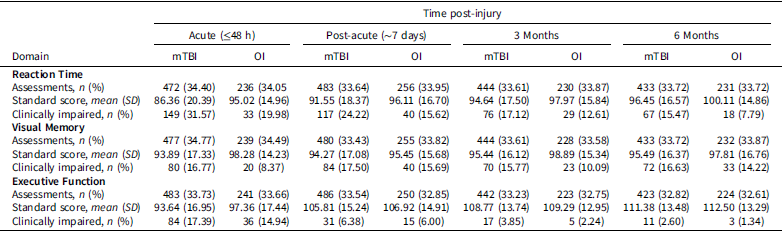
After excluding incomplete cognitive domain standard scores using pairwise deletion (i.e., 34 Reaction Time/32 Visual Memory/3 Executive Function), the final dataset included 2,818 assessments (2,785 Reaction Time/2,788 Visual Memory/2,772 Executive Function) across cognitive domains and study visits. Number of assessments included in final analyses and descriptive statistics for standard scores and rate of scores below the clinical impairment cutoff (i.e., standard score < 80) are reported for the cognitive domains for each group and study visit in Table 2.
Cognitive domain standard scores and rate of clinical impairment (i.e., standard score ≤ 80) by group and time post-injury

Table 2 Long description
A table comparing cognitive domain standard scores and clinical impairment rates across different time periods post-injury. The table has 4 columns and 12 rows. The columns are labeled as follows: Domain, Acute (<=48 h), Post-acute (~7 days), 3 Months, and 6 Months. The rows are labeled with different cognitive domains: Reaction Time and Visual Memory. Each domain has assessments, standard scores, and clinically impaired percentages for mild traumatic brain injury (mTBI) and orthopedic injury (OI) groups. The table includes data for each time period: Acute, Post-acute, 3 Months, and 6 Months. Each row provides the number of assessments, mean standard scores with standard deviations, and the percentage of clinically impaired individuals. For example, in the Reaction Time domain during the Acute period, mTBI has 472 assessments with a mean standard score of 86.36 and 14.9 percent clinically impaired, while OI has 236 assessments with a mean standard score of 95.02 and 3.39 percent clinically impaired.
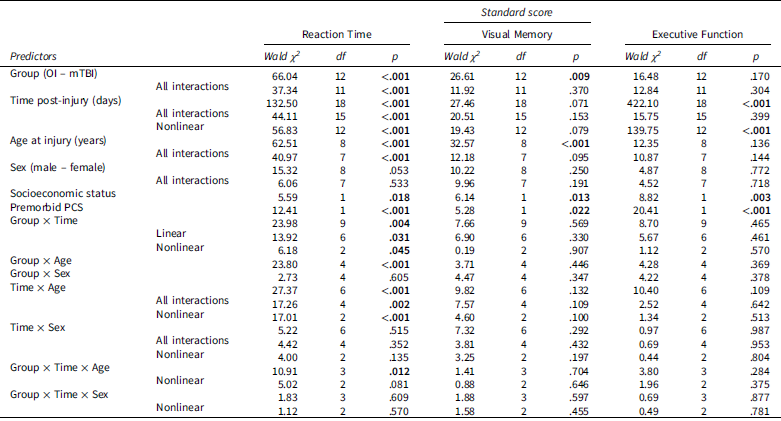
Final models included premorbid PCS ratings (based on parent report) as a covariate to account for group differences in this variable. Mechanism of injury differs inherently between groups and was therefore not included as a covariate in final models. Final model statistical results for the cognitive domain scores are reported in Table 3 and shown in Figure 1.
Graphs illustrating group differences in cognitive domain standard scores up to 6 months post-injury. Group differences in Reaction Time standard scores were moderated by time and age, adjusting for sex, socioeconomic status, and premorbid PCS, whereby scores were lower after mild TBI relative to OI for older children (i.e., 95th percentile age), with differences that were large acutely, d = −1.11, medium post-acutely, d = −0.70, and small at 3 months, d = −0.29, and 6 months, d = −0.21, but did not differ at any timepoint in younger children (i.e., 5th percentile age). Visual Memory standard scores were mildly lower after mTBI relative to OI, d = −0.20, across time, age, sex, socioeconomic status, and premorbid PCS. Groups did not differ in Executive Function standard scores, which increased over time. Estimated marginal means with 95% CI (shading) are shown for each group and domain score.

Statistical results for the cognitive domain standard scores

Table 3 Long description
The table presents statistical results for cognitive domain standard scores, focusing on reaction time, visual memory, and executive function. It includes predictors such as group, time post-injury, age at injury, sex, socioeconomic status, premorbid PCS, and various interactions. The table has 13 rows and 18 columns, with column headers including Wald chi-square, degrees of freedom, and p-values for each cognitive domain. Each row provides specific predictor details and their statistical significance across different domains. Notable trends include significant p-values for group, time post-injury, age at injury, and premorbid PCS across all cognitive domains.
Note. Bolded = p < .05. Final models included covariates socioeconomic status and premorbid PCS scores.
Reaction Time
Time and age moderated group effects for Reaction Time standard scores, after adjusting for sex, socioeconomic status, and premorbid PCS. Scores were lower after mild TBI relative to OI for older children, with differences that were large acutely, Cohen’s d (95% CI) = −1.11 (−1.42, −0.80), medium post-acutely, −0.70 (−0.98, −0.43), and small at 3 months, −0.29 (−0.61, −0.02), and 6 months, −0.21 (−0.56, 0.14); in contrast, the mild TBI and OI groups did not differ for younger children.
Visual Memory
Visual Memory standard scores were significantly lower after mTBI relative to OI, but with a small effect size, d = −0.20 (−0.37, −0.04), and differences did not vary by time, age, or sex, after adjusting for sex, socioeconomic status, and premorbid PCS.
Executive Function
Group and its associated interactions were not significantly associated with Executive Function standard scores, which increased over time. Age and sex were not significant moderators, after adjusting for socioeconomic status and premorbid PCS.
Clinical impairment
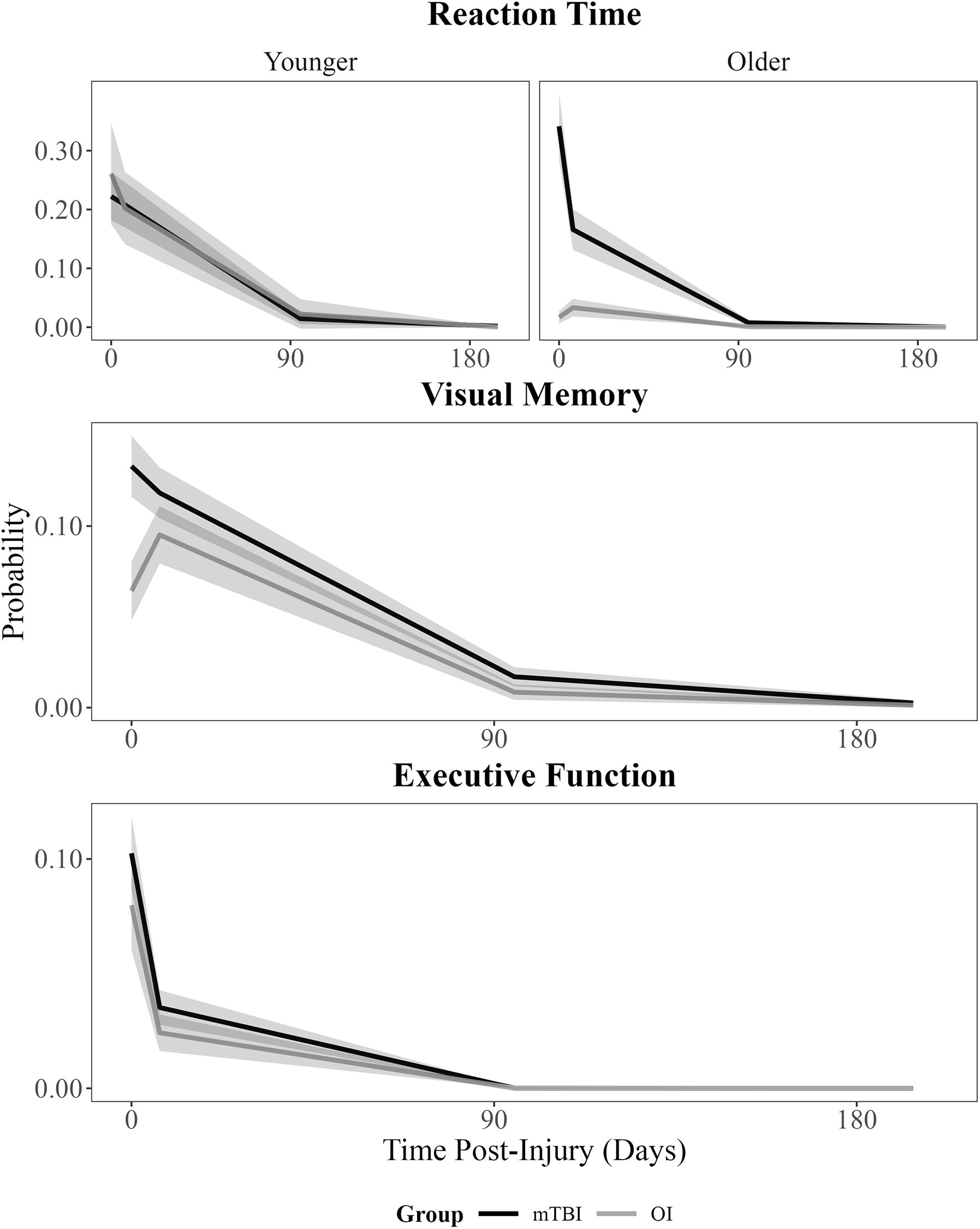
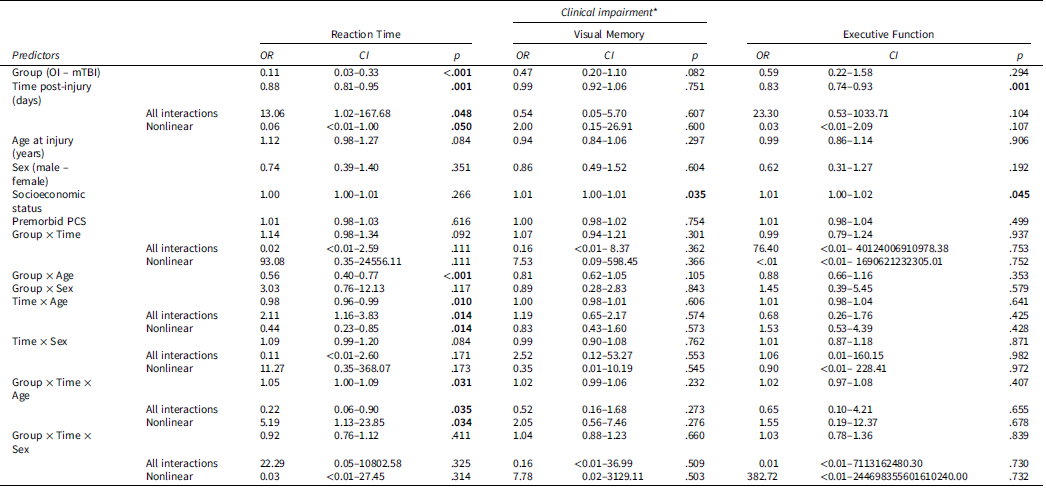
The model statistical results for rates of clinical impairment (i.e., standard score < 80) for the cognitive domains are reported in Table 4 and shown in Figure 2.
Rate of clinical impairment (i.e., standard score < 80) within the cognitive domains. Time and age moderated group differences in the odds of clinical impairment (i.e., standard score < 80) for Reaction Time, after adjusting for sex, socioeconomic status, and premorbid PCS. Odds of acute and post-acute clinical impairment for Reaction Time after mTBI relative to OI were 51.33 to 8.01 times higher for older children, respectively, but did not differ for younger children at any timepoint or at 3 and 6 months for older children. Rates of clinical impairment for Visual Memory and Executive Function did not differ by group. Estimated marginal means with 95% CI (shading) are shown for each group and domain score.

Statistical results for the cognitive domain clinical impairment rate

Table 4 Long description
The table presents statistical results for the cognitive domain clinical impairment rates. It includes predictors such as Group (OI vs. mTBI), Time post-injury (days), Age at injury (years), Sex, Socioeconomic status, Premorbid PCS, and various interactions. The table is divided into three main sections: Reaction Time, Visual Memory, and Executive Function. Each section contains columns for Odds Ratio (OR), Confidence Interval (CI), and p-value (p). The table has 12 rows and 15 columns, with each row representing a different predictor or interaction. Notable trends include significant p-values for certain interactions, indicating their impact on clinical impairment rates.
Note * = Domain standard score < 80; Bolded = p < .05; OR = odds ratio. Final models included covariates socioeconomic status and premorbid PCS scores.
Reaction Time
Time (linear and nonlinear) and age moderated group differences in the rate of clinical impairment for Reaction Time scores, after adjusting for sex, socioeconomic status, and premorbid PCS. The odds of acute and post-acute clinical impairment were substantially higher after mTBI relative to OI for older children, OR = 51.33 (10.07, 261.73) and 8.01 (2.18, 29.39), respectively, but did not differ for younger children (Supplemental Table 1 ). Odds of clinical impairment 3 and 6 months after mTBI relative to OI did not differ by group for younger or older children.
Visual Memory
Group and its associated interactions were not significantly associated with rate of clinical impairment in Visual Memory scores. Age and sex were not significant moderators, after adjusting for socioeconomic status and premorbid PCS.
Executive Function
Group and its associated interactions were not associated with clinical impairment rates in Executive Function, which declined over time. Age and sex were not significant moderators, after adjusting for socioeconomic status and premorbid PCS.
Clinical risk score
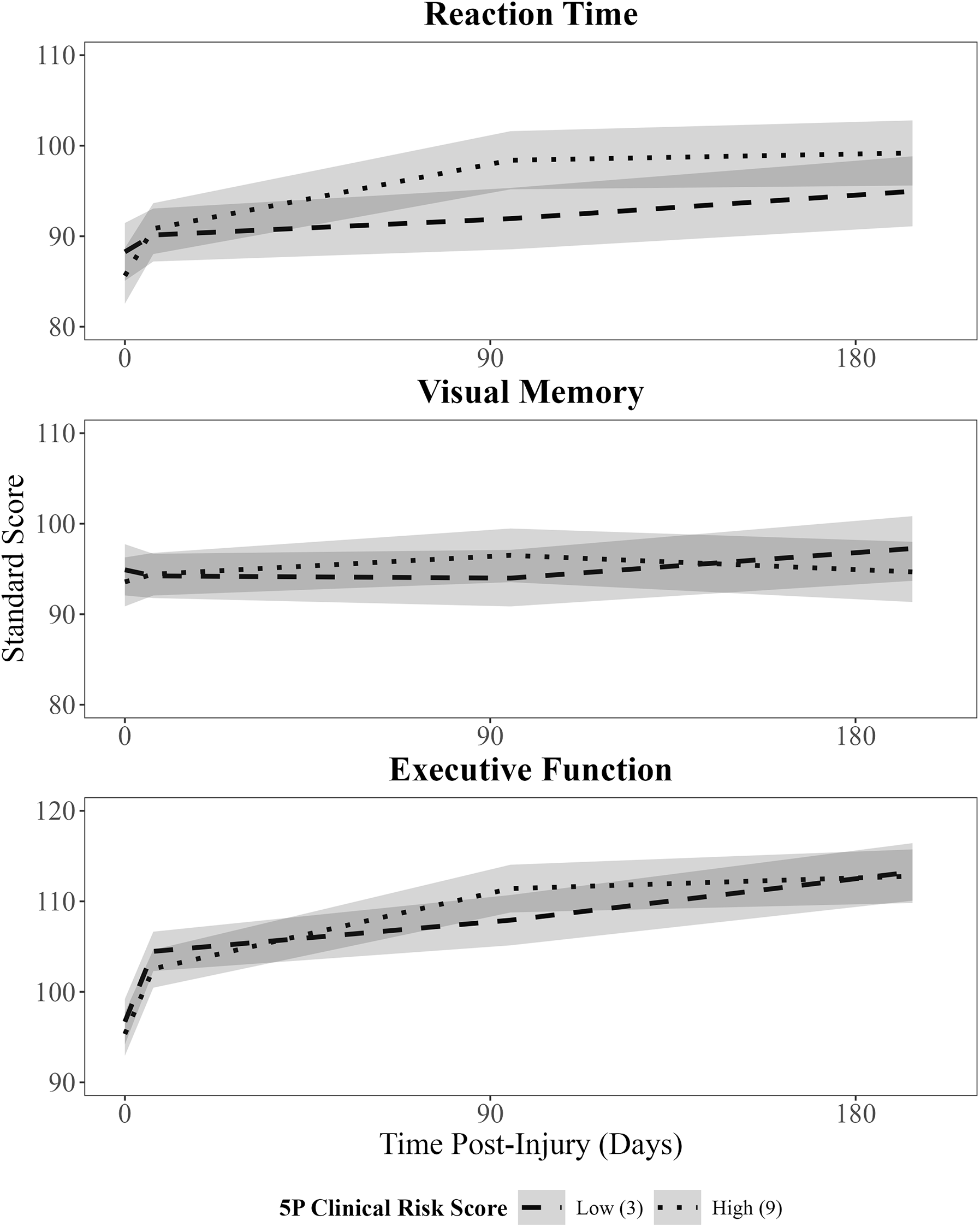
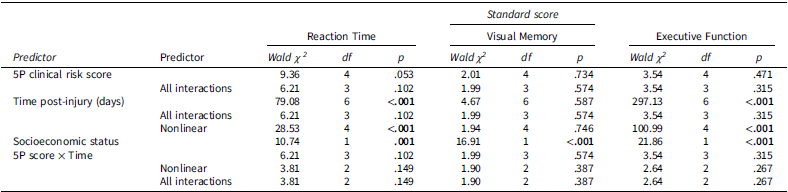
The 5P clinical risk score for the mild TBI group is reported in Table 1. Model statistical results for each cognitive domain are reported in Table 5 and shown in Figure 3. The 5P score was not significantly associated with cognitive scores in any of the domains.
The 5P clinical risk score was not associated with cognitive domain standard scores in the mTBI group, across time and covarying for socioeconomic status. Estimated marginal means with 95% CI (shading) are shown for low (5P score = 3) and high (5P score = 9) clinical risk and domain score.

Statistical results for the 5P clinical risk scores on cognitive domain standard scores in the mTBI group

Table 5 Long description
A table comparing statistical results for cognitive domain standard scores in the mTBI group. The table has 6 rows and 12 columns. Column headers are Predictor, Predictor, Wald chi-squared, df, p, Wald chi-squared, df, p, Wald chi-squared, df, p. Row labels are 5P clinical risk score, All interactions, Time post-injury (days), All interactions, Nonlinear, Socioeconomic status, 5P score x Time, Nonlinear, All interactions. Row 1: 5P clinical risk score, Predictor, 9.36, 4, .053, 2.01, 4, .734, 3.54, 4, .471. Row 2: All interactions, Predictor, 6.21, 3, .102, 1.99, 3, .574, 3.54, 3, .315. Row 3: Time post-injury (days), Predictor, 79.08, 6, <.001, 4.67, 6, .587, 297.13, 6, <.001. Row 4: All interactions, Predictor, 6.21, 3, .102, 1.99, 3, .574, 3.54, 3, .315. Row 5: Nonlinear, Predictor, 285.3, 4, <.001, 1.94, 4, .746, 100.99, 4, <.001. Row 6: Socioeconomic status, Predictor, 10.74, 1, .001, 16.91, 1, <.001, 21.86, 1, <.001. Row 7: 5P score x Time, Predictor, 6.21, 3, .102, 1.99, 3, .574, 3.54, 3, .315. Row 8: Nonlinear, Predictor, 3.81, 2, .149, 1.90, 2, .387, 2.64, 2, .267. Row 9: All interactions, Predictor, 3.81, 2, .149, 1.90, 2, .387, 2.64, 2, .267.
Note. Bolded = p < .05. Final models included the covariate socioeconomic status.
Discussion
This prospective, longitudinal study followed children who presented to a pediatric hospital Emergency Department ≤48 hours of sustaining an mTBI or OI for 6 months to understand the severity and recovery trajectories of cognitive changes, and whether age at injury or biological sex moderate cognitive recovery. Study strengths include a larger sample size, broad age range, balanced sex ratio, inclusion of socioeconomic status as a covariate, and assessment of performance validity. Overall, findings suggests that pediatric mTBI can negatively impact cognition up to 6 months post-injury relative to mild OI. Of the domains examined, reaction time and, to a lesser extent, visual memory were the most negatively impacted by mTBI. Reaction time scores were substantially reduced ≤48 hours (acutely) and remained decreased for up to 6 months after mTBI in older children (i.e., adolescents), but not in younger children. Children with mTBI also had mildly reduced visual memory scores up to 6 months post-injury, regardless of age or sex. The odds of clinically impaired reaction time scores were significantly higher in adolescents with mTBI relative to OI at acute and post-acute timepoints. Executive function scores did not differ in mTBI relative to OI, but improved with time post-injury across groups. In contrast to the moderating effects of time post-injury and age at injury, sex did not moderate cognitive outcomes after mTBI. Finally, the 5P clinical risk score did not predict cognitive domain scores in the mTBI group.
Prior evidence has suggested mild to moderate reductions in reaction time, visual memory, and executive function after pediatric mTBI relative to OI (Beauchamp et al., Reference Beauchamp, Aglipay, Yeates, Désiré, Keightley, Anderson, Brooks, Barrowman, Gravel, Boutis, Gagnon, Dubrovsky and Zemek2018; Chadwick et al., Reference Chadwick, Roth, Minich, Taylor, Bigler, Cohen, Bacevice, Mihalov, Bangert, Zumberge and Yeates2021) and healthy comparison groups (Sicard et al., Reference Sicard, Hergert, Reddy, Robertson-Benta, Dodd, Shaff, Stephenson, Yeates, Cromer, Campbell, Phillips, Sapien and Mayer2021). The overall pattern of the current results is consistent with a growing body of research based on computerized testing that suggests pediatric mTBI can affect reaction time, especially during complex tasks, but does not negatively impact executive functioning per se (Brooks, Khan, et al., Reference Brooks, Khan, Daya, Mikrogianakis and Barlow2014; Chadwick et al., Reference Chadwick, Roth, Minich, Taylor, Bigler, Cohen, Bacevice, Mihalov, Bangert, Zumberge and Yeates2021; Hou et al., Reference Hou, Zhang, Fei, Zhou and Li2023). Executive functions are complex higher-order cognitive processes that support goal-directed behavior. The current executive function domain scores provide a measure of cognitive flexibility (Plourde et al., Reference Plourde, Hrabok, Sherman and Brooks2018). However, other studies have identified changes in some aspects of executive functioning, including cognitive flexibility, after pediatric mTBI that may differ from the current results due to test selection (e.g., Chadwick et al., Reference Chadwick, Roth, Minich, Taylor, Bigler, Cohen, Bacevice, Mihalov, Bangert, Zumberge and Yeates2021; Cossette et al., Reference Cossette, Gagné, Ouellet, Fait, Gagnon, Sirois, Blanchet, Le Sage and McFadyen2016). Timing of recovery for reaction time and visual memory varies in prior studies, with some suggesting that recovery occurs by 3 months after mTBI relative to OI (Brooks, Khan, et al., Reference Brooks, Khan, Daya, Mikrogianakis and Barlow2014; Chadwick et al., Reference Chadwick, Roth, Minich, Taylor, Bigler, Cohen, Bacevice, Mihalov, Bangert, Zumberge and Yeates2021), whereas a recent meta-analysis suggests that reaction time reductions persist up to 6 months after mTBI (Hou et al., Reference Hou, Zhang, Fei, Zhou and Li2023).
The odds of clinically impaired reaction time was more than 50 times higher acutely and 8 times higher post-acutely after mTBI than OI in older children. However, the 95% CIs were very large, suggesting a lack of precision in the estimates. The large OR and wide 95% CI observed for rates of clinically impaired scores could be sample dependent (i.e., due to small cell sizes for clinical impairment) or result from model overfitting. Regardless, even the lower bound of the 95% CI suggests that, for older but not younger children, concussion has a very strong and statistically significant positive association with clinical impairment, with the odds being at least 10 times higher acutely and at least 2.2 times higher post-acutely after mTBI relative to OI.
The current study selected a clinical impairment threshold (i.e., standard score < 80) based on current recommendations for uniform labeling of standard scores for normally distributed measures (Guilmette et al., Reference Guilmette, Sweet, Hebben, Koltai, Mahone, Spiegler, Stucky and Westerveld2020). This threshold was selected to optimize the base rate of low scores given the normal intra-individual variability and frequency of low scores in the normative population (Binder et al., Reference Binder, Iverson and Brooks2009; Brooks, Reference Brooks2010; Brooks et al., Reference Brooks, Iverson, Sherman and Holdnack2009, Reference Brooks, Sherman and Iverson2010). Comparisons of the current rates of clinical impairment to published rates are difficult because studies have used varying thresholds for classifying clinical impairment, e.g., standard score ≤ 85 versus standard score ≤ 70 (Beauchamp et al., Reference Beauchamp, Aglipay, Yeates, Désiré, Keightley, Anderson, Brooks, Barrowman, Gravel, Boutis, Gagnon, Dubrovsky and Zemek2018; Lambregts et al., Reference Lambregts, Smetsers, Verhoeven, de Kloet, van de Port, Ribbers and Catsman-Berrevoets2018). Less conservative thresholds (e.g., standard score < 85), which can be used to identify subtle effects but could overestimate impairment rates, have yielded rates of acute clinical impairment for several cognitive domains after pediatric mTBI (e.g., 35%) similar to those of the present study (Beauchamp et al., Reference Beauchamp, Aglipay, Yeates, Désiré, Keightley, Anderson, Brooks, Barrowman, Gravel, Boutis, Gagnon, Dubrovsky and Zemek2018; Rieger et al., Reference Rieger, Lewandowski, Callahan, Spenceley, Truckenmiller, Gathje and Miller2013). More conservative thresholds (e.g., standard score ≤ 70), which could underestimate true impairments that are subtle or transient, or classification of clinical impairment based on performance across tests in a comprehensive battery (e.g., based on two or more measures with standard scores ≤ 70; Beauchamp et al., Reference Beauchamp, Brooks, Barrowman, Aglipay, Keightley, Anderson, Yeates, Osmond and Zemek2015) have yielded lower rates of clinical impairment post-acutely (10%) and 3 months (5%) post-injury relative to the present study (Beauchamp et al., Reference Beauchamp, Aglipay, Yeates, Désiré, Keightley, Anderson, Brooks, Barrowman, Gravel, Boutis, Gagnon, Dubrovsky and Zemek2018). Methodological differences could contribute to inconsistencies across studies (e.g., computerized versus paper–pencil tests, timing of assessment post-injury, included cognitive domains, selected measures, etc.).
Children in the OI group demonstrated higher rates of scores below the clinical impairment threshold (i.e., standard score < 80) than would be expected in healthy (normative) populations for age-normalized standard scores. This is not surprising. Clinical impairment has been reported acutely in up to 50% of children with OI (Rieger et al., Reference Rieger, Lewandowski, Callahan, Spenceley, Truckenmiller, Gathje and Miller2013). Children with OI and mTBI are similar in premorbid factors that predispose children to traumatic injury generally, as well as post-injury factors (e.g., pain, disruption of routine, etc.), and differ from uninjured typically developing children (Babikian et al., Reference Babikian, McArthur and Asarnow2013). An OI comparison group also offers high relevance for research on clinical diagnosis and prognostication in pediatric mTBI. Thus, our inclusion of children with OI is viewed as a study strength.
Age moderated reaction time after pediatric mTBI. Adolescents demonstrated larger reductions in reaction time acutely after mTBI than school-aged children. This is consistent with prior findings (e.g., Baillargeon et al., Reference Baillargeon, Lassonde, Leclerc and Ellemberg2012). Age at injury is a known moderator of self-reported cognitive symptoms of mTBI (Mayer et al., Reference Mayer, McQuaid, Wick, Dodd, Robertson-Benta, Stephenson, van der Horn, Quinn, Davis, Hittson, Sapien, Phillips and Campbell2024; Moser et al., Reference Moser, Davis and Schatz2018; Zemek et al., Reference Zemek, Barrowman, Freedman, Gravel, Gagnon, McGahern, Aglipay, Sangha, Boutis, Beer, Craig, Burns, Farion, Mikrogianakis, Barlow, Dubrovsky, Meeuwisse, Gioia, Meehan, Beauchamp, Kamil, Grool, Hoshizaki, Anderson, Brooks, Yeates, Vassilyadi, Klassen, Keightley, Richer, DeMatteo and Osmond2016). Younger age at injury is associated with more optimal recovery after pediatric mTBI as compared with older age (Beauchamp et al., Reference Beauchamp, Tang, Yeates, Anderson, Brooks, Keightley, Désiré, Boutis, Gagnon, Gravel, Dubrovsky and Zemek2019). Brain maturation is strongly influenced by age in childhood and adolescence, and could account for age-related differences in reaction time after pediatric mTBI (Blakemore, Reference Blakemore2012; Corrigan et al., Reference Corrigan, Yarnykh, Hippe, Owen, Huber, Zhao and Kuhl2021). We previously found that age-related brain structure and function changes after mTBI in this sample (Onicas et al., Reference Onicas, Deighton, Yeates, Bray, Graff, Abdeen, Beauchamp, Beaulieu, Bjornson, Craig, Dehaes, Deschenes, Doan, Freedman, Goodyear, Gravel, Lebel, Ledoux, Zemek and Ware2024; Ware et al., Reference Ware, Goodrich-Hunsaker, Lebel, Shukla, Wilde, Abildskov, Bigler, Cohen, Mihalov, Bacevice, Bangert, Taylor and Yeates2020; Ware, Yeates, Geeraert, et al., Reference Ware, Yeates, Geeraert, Long, Beauchamp, Craig, Doan, Freedman, Goodyear, Zemek and Lebel2022), suggesting that the maturational status of the brain at the time of injury influences neurological effects of pediatric mTBI. However, more research is needed to directly link the present findings to brain structure and function.
In contrast to time and age, sex was not a significant moderator of cognitive functioning in pediatric mild TBI. This is consistent with some prior research (Yeates et al., Reference Yeates, Taylor, Bigler, Minich, Tang, Cohen, Bacevice, Mihalov, Bangert, Zumberge and Yeates2022). However, results regarding sex differences in pediatric mTBI sequelae generally are mixed (Merritt et al., Reference Merritt, Padgett and Jak2019). Sex can influence recovery in pediatric mTBI (Beauchamp et al., Reference Beauchamp, Tang, Ledoux, Harris, Kowalski, Craig, Gravel, Doan, Freedman, Zemek and Yeates2025), and is a key moderator of cognitive symptoms (Ledoux et al., Reference Ledoux, Tang, Yeates, Pusic, Boutis, Craig, Gravel, Freedman, Gagnon, Gioia, Osmond and Zemek2019; Mayer et al., Reference Mayer, Stephenson, Dodd, Robertson-Benta, Pabbathi Reddy, Shaff, Yeates, van der Horn, Wertz, Park, Oglesbee, Bedrick, Campbell, Phillips and Quinn2020). It can influence recovery of fluid cognitive processes, such as processing speed (Rieger et al., Reference Rieger, Lewandowski, Callahan, Spenceley, Truckenmiller, Gathje and Miller2013), with higher risk of more severe acute cognitive dysfunction in females relative to males (Sandel et al., Reference Sandel, Schatz, Goldberg and Lazar2017). Overall, though, support for sex differences in cognitive functioning in pediatric mTBI is mixed. Some studies found sex differences in visual memory (Covassin et al., Reference Covassin, Elbin, Harris, Parker and Kontos2012) and processing speed (Colvin et al., Reference Colvin, Mullen, Lovell, West, Collins and Groh2009; Majerske et al., Reference Majerske, Mihalik, Ren, Collins, Reddy, Lovell and Wagner2008), whereas other studies found no moderating effects of sex on cognitive functioning (Sufrinko et al., Reference Sufrinko, Mucha, Covassin, Marchetti, Elbin, Collins and Kontos2017; Yeates et al., Reference Yeates, Taylor, Bigler, Minich, Tang, Cohen, Bacevice, Mihalov, Bangert, Zumberge and Yeates2022; Zuckerman et al., Reference Zuckerman, Solomon, Forbes, Haase, Sills and Lovell2012). In typical development, sex differences in cognition occur, but are generally minimal and dependent on maturational stage (Gur et al., Reference Gur, Richard, Calkins, Chiavacci, Hansen, Bilker, Loughead, Connolly, Qiu, Mentch, Abou-Sleiman, Hakonarson and Gur2012; Toivainen et al., Reference Toivainen, Papageorgiou, Tosto and Kovas2017).
The 5P clinical risk score was not predictive of cognitive domain scores in the children with mTBI. This is somewhat surprising given the robust clinical utility of using 5P score to predict subjective symptom recovery 4 weeks after pediatric mTBI (Zemek et al., Reference Zemek, Barrowman, Freedman, Gravel, Gagnon, McGahern, Aglipay, Sangha, Boutis, Beer, Craig, Burns, Farion, Mikrogianakis, Barlow, Dubrovsky, Meeuwisse, Gioia, Meehan, Beauchamp, Kamil, Grool, Hoshizaki, Anderson, Brooks, Yeates, Vassilyadi, Klassen, Keightley, Richer, DeMatteo and Osmond2016). Subjective symptoms and objective cognitive functioning are correlated, but not uniformly across cognitive domains, developmental stage, or recovery progression in pediatric mTBI (Jones et al., Reference Jones, Nyman-Mallis, Ploetz, Staples and Benjaminov2023; Robertson-Benta et al., Reference Robertson-Benta, Pabbathi Reddy, Stephenson, Sicard, Hergert, Dodd, Campbell, Phillips, Meier, Quinn and Mayer2024). These findings suggest that the factors that increase risk of prolonged symptom recovery differ from those that increase risk of persisting cognitive dysfunction after pediatric mTBI.
The current results have clinical implications. Greater acute cognitive impairment predicts longer symptom recovery and poorer quality of life in children with mTBI (Brooks, Daya, et al., Reference Brooks, Daya, Khan, Carlson, Mikrogianakis and Barlow2016). Cognitive dysfunction also has implications for problems in other functional domains, including emotion dysregulation (Betz et al., Reference Betz, Cetin-Karayumak, Bonke, Seitz-Holland, Zhang, Pieper, O’Donnell, Tripodis, Rathi, Shenton and Koerte2024) and adaptive behavior (Shultz et al., Reference Shultz, Hoskinson, Keim, Dennis, Taylor, Bigler, Rubin, Vannatta, Gerhardt, Stancin and Yeates2016). Children and young adults with more severe or persistent self-reported cognitive symptoms after mTBI can have poor long-term (i.e., up to 2 years) sport participation and academic functioning (Lambregts et al., Reference Lambregts, Smetsers, Verhoeven, de Kloet, van de Port, Ribbers and Catsman-Berrevoets2018), but further research is needed to determine whether decreased objective cognitive function is associated with similar long-term effects. Children with clinically impaired cognitive functioning could potentially benefit from early cognitive rehabilitation, which can improve aspects of fluid cognition (Treble-Barna et al., Reference Treble-Barna, Sohlberg, Harn and Wade2016). Finally, computerized testing may offer greater sensitivity to the subtle and generally transient cognitive problems that can occur after mTBI in children, especially in reaction time. However, reductions in fluid cognitive processes have been demonstrated in pediatric mTBI using both computerized (e.g., NIH Toolbox; Betz et al., Reference Betz, Cetin-Karayumak, Bonke, Seitz-Holland, Zhang, Pieper, O’Donnell, Tripodis, Rathi, Shenton and Koerte2024; Chadwick et al., Reference Chadwick, Roth, Minich, Taylor, Bigler, Cohen, Bacevice, Mihalov, Bangert, Zumberge and Yeates2021; Dufour et al., Reference Dufour, Adams, Brody, Puente and Gray2020) and paper–pencil tests (Beauchamp et al., Reference Beauchamp, Brooks, Barrowman, Aglipay, Keightley, Anderson, Yeates, Osmond and Zemek2015).
Limitations
The A-CAP study recruited from the Emergency Department of children’s hospitals. Results may not generalize to children who do not seek treatment or who seek treatment at other settings. The sample was predominantly White and came from regions with higher socioeconomic status. Results may not generalize to groups with reduced access to material resources, including health care. Study attrition could limit generalizability of results. However, study attrition rates are similar to those of other published pediatric mTBI studies (e.g., Chadwick et al., Reference Chadwick, Roth, Minich, Taylor, Bigler, Cohen, Bacevice, Mihalov, Bangert, Zumberge and Yeates2021; Taylor et al., Reference Taylor, Orchinik, Minich, Dietrich, Nuss, Wright, Bangert, Rusin and Yeates2015), and demographic characteristics of the children in the final sample did not differ from the those who were excluded. We measured cognitive functioning in three domains using selected tests from the CNS Vital Signs computerized battery. Results may not generalize to other cognitive domains or other computerized measures or paper–pencil tests. The study included children between the ages of 8 and 17 years of age. Results may not generalize to young children (Beauchamp et al., Reference Beauchamp, Anderson, Ewing-Cobbs, Haarbauer-Krupa, McKinlay, Wade and Suskauer2024) or adults (Davis et al., Reference Davis, Anderson, Babl, Gioia, Giza, Meehan, Moser, Purcell, Schatz, Schneider, Takagi, Yeates and Zemek2017). Finally, other factors that can influence cognition after mTBI, such as pain or depression (Grandhi et al., Reference Grandhi, Tavakoli, Ortega and Simmonds2017; Terry et al., Reference Terry, Brassil, Iverson, Panenka and Silverberg2019), were not investigated here but could be examined in future analyses. The family environment, parental distress, and other aspects of psychosocial functioning also are associated with cognition after severe TBI (Gerrard-Morris et al., Reference Gerrard-Morris, Taylor, Yeates, Walz, Stancin, Minich and Wade2010) and persistent symptoms after mTBI (Babikian et al., Reference Babikian, McArthur and Asarnow2013; Olsson et al., Reference Olsson, Lloyd, LeBrocque, McKinlay, Anderson and Kenardy2013; Rausa et al., Reference Rausa, Anderson, Babl and Takagi2018) in children, but research examining their association with cognitive performance following mTBI is needed.
Conclusions and future directions
Pediatric mTBI was associated with reductions in reaction time and visual memory within 48 hours post-injury that decreased in magnitude but persisted up to 6 months post-injury. Up to 32% of children with mTBI demonstrated clinical impairment in reaction time acutely. Time post-injury and age moderated outcomes, but sex did not. Overall results suggest that changes in cognitive functioning following mTBI are typically most apparent acutely, in reaction time, and among adolescents, but persist in a small percentage of children. Future research is needed to understand the implication of these results for determining appropriate accommodations for return-to-school and return-to-sport. Additional research also is needed to understand the functional implications of these results. Finally, future research focused on identifying interventions to promote cognitive recovery is needed to enhance clinical management of affected children.
Supplementary material
The supplementary material for this article can be found at https://doi.org/10.1017/S1355617726102124.
Acknowledgments
The researchers would like to thank the children and families who participated in the study.
Funding statement
This work was supported by the Canadian Institutes of Health Research (CIHR FDN143304, KOY); Ronald and Irene Ward Chair in Pediatric Brain Injury (KOY); CREST Dynamic – Multiscale and Multimodal Brain Mapping Across the Lifespan graduate research assistantship (National Science Foundation Grant #2112455, MAL and ALW).
Competing interests
Keith Owen Yeates receives an editorial stipend from the American Psychological Association. He is a principal investigator (PI) on grants from the Canadian Institutes of Health Research (CIHR) and Canada Foundation for Innovation, and a co-investigator on grants from CIHR, the US National Institutes of Health (NIH), Brain Canada Foundation, and National Football League Scientific Advisory Board. He has paid research consultancies with University of California San Francisco, Pennsylvania State University, and Research Institute at Nationwide Children’s Hospital. He receives book royalties from Guilford Press and Cambridge University Press. He has received travel support and honoraria for presentations to multiple organizations. He receives an honoraria for serving on the Independent Data Monitoring Committee (IDMC), Care for Post-Concussive Symptoms Effectiveness (CARE4PCS-2) Trial, University of Washington. Miriam Beauchamp is a principal investigator (PI) on grants from the Canadian Institutes of Health Research (CIHR), and a co-investigator on grants from CIHR, the CQDM-Brain Canada Foundation, and Quebec Research Funds. She receives book royalties from Guilford Press. She has received travel support and honorarium for presentations at conferences. Brian L. Brooks declares the following potential conflicts of interest: royalties for the sales of the Pediatric Forensic Neuropsychology textbook (2012, Oxford University Press); royalties for the sales of three pediatric neuropsychological tests [Child and Adolescent Memory Profile (ChAMP, Sherman and Brooks, 2015, PAR Inc.), Memory Validity Profile (MVP, Sherman and Brooks, 2015, PAR Inc.), and Multidimensional Everyday Memory Ratings for Youth (MEMRY, Sherman and Brooks, 2017, PAR Inc.)]; grants for concussion/mTBI research; reimbursement for talks on concussion/mTBI; consulting neuropsychologist to the Calgary Flames for the NHL Concussion Program; and private practice work with people with concussion/mTBI. Roger Zemek holds competitively funded research grants from Canadian Institutes of Health Research (CIHR), Ontario Neurotrauma Foundation (ONF), Physician Services Incorporated (PSI) Foundation, CHEO Foundation, Ontario Brain Institute (OBI), and Ontario SPOR Support Unit (OSSU), and the National Football League (NFL) Scientific Advisory Board. He is supported by a Clinical Research Chair in Pediatric Concussion from the University of Ottawa. He is the co-founder, Scientific Director, and a minority shareholder in 360 Concussion Care, an interdisciplinary concussion clinic. The other authors have no additional conflicts of interest to disclose. Ashley Ware is sole proprietor of a neuropsychology clinic that provides medicolegal services involving TBI.




 Open access

