The rubric ‘Snipings’, introduced into the World Trade Review in 2004, is intended for contributions which, while rigorous, are shorter and therefore less extensively developed and documented than our standard length articles. It offers, among other things, an opportunity for early analyses targeting topical policy issues concerning the multilateral trading system.
1. Introduction
China has recently been under the spotlight regarding its export restriction policies. In December 2009, the Dispute Settlement Body (DSB) of the World Trade Organization (WTO) established a panel to examine complaints by the United States (US), the European Union (EU), and Mexico concerning China's export restrictions on selected minerals (China–Raw Materials case).Footnote 1 The commodities in question were bauxite, coke, fluorspar, magnesium, manganese, phosphate (yellow phosphorus), silicon (metal and carbide), and zinc. More recently, in November 2010, China was alleged to be restricting its exports, this time, of rare earth metals, in which it is almost a monopoly supplier, to Japan and to other industrialized countries which attracted substantial international media attention.Footnote 2 China's export restriction policies raise serious questions about its role in the multilateral trading system in general and the implications of its so-called ‘WTO-plus’ commitments for its domestic and trade policies in particular.Footnote 3
What are the policy objectives of China in instituting export restrictions? Is the policy simply a reaction to certain non-trade political disputes with Japan and the US creating trade-related tensions? Alternatively, is it a reflection of China's assertiveness in the growing global competition over natural resources? Similarly, could its concerns over domestic environmental protection and sustainable use of exhaustible resources play an important role as a policy objective? Given that China is major producer, consumer and trader of many commodities that are strategically important for global supply chains, its export restrictions may have substantial consequences for global welfare.
This paper is organized as follows. Section 2 describes a range of policy objectives that might lead countries to institute these measures and it illustrates their potential implications for global welfare. Section 3 summarizes the WTO regulation dealing with the issue and briefly reviews the previous GATT and WTO disputes involving export restrictions. Section 4 offers a detailed analysis of the China–Raw Materials case which illustrates how China imposes quantitative restrictions and export taxes. This section attempts to clarify the extent to which these measures might be related to environmental protection, or be used as a disguised restriction on trade. Section 5 examines the potential implications of China's ‘WTO-plus’ commitments in this field. Section 6 offers a brief conclusion.
2. Export restrictions and their welfare implications
Both developing and developed countries resort to export restrictions which can take the form of export taxes, quantitative restrictions (through quotas and licences), and outright export bans. As a form of market distortion, these restrictions change the terms of trade and shift economic rents. As compared to other policy alternatives, such as direct support/subsidies or income taxes, it is often argued that export restrictions are not the most effective policy tools to achieve distributional objectives (WTO, 2010b). On the other hand, some countries impose them to address market failures, especially in the field of environmental protection (Korinek and Kim, Reference Korinek and Kim2009).
In the agricultural sector, export restrictions are applied to maintain domestic food supplies and achieve food security, especially in the face of the risks of tight supply conditions in relatively ‘thin’ international markets.Footnote 4 In the industrial sectors, export restrictions often serve the objective of promoting downstream processors and manufacturers. By restricting the exports of certain raw materials, a country can lower input prices for downstream sectors, which in turn gives it a price advantage in export markets for processed and manufactured goods.
However, export restrictions result in net welfare losses for both the country imposing the export restriction and for the rest of the world by driving a wedge between the domestic and border prices. The potential impacts vary depending on the demand and supply elasticities of the commodity, the specific measure in question and on who appropriates the rent (difference between the domestic and border prices). In the country imposing export restrictions, the consumers of the restricted product would benefit from lower than pre-export restriction prices. However, the aggregate loss of producer welfare would exceed consumers' gains from the measure (i.e. deadweight cost of market distortion). It may also lead to various inefficiencies in allocation of resources as it may promote sectors which do not have comparative advantage.
Export restrictions also undermine traders' confidence in the world trading system – as they distort trade and create or aggravate short-term price volatilities (von Braun, Reference Von Braun2008; WTO, 2010b). The restriction measures that seek to insulate domestic prices from changes in world market prices (e.g. in the agricultural sector), or to gain strategic advantages by limiting the supply of critical raw materials have a destabilizing effect on world prices, which in turn offsets the benefits that countries seek to gain from these measures.
Countries may also impose export restrictions for environmental reasons. Since markets for environmental goods and services are not fully developed, if they exist at all, market prices do not reflect the social value of environmental goods, such as fisheries, forestry, minerals, and fresh water.Footnote 5 Mining is a case in point – as by-products of extracts and various inputs used in mining operations could be highly contaminating.Footnote 6 Hence in a highly export-oriented sector, export restrictions, in conjunction with other domestic measures limiting production and consumption, could help correct market failures that lead to environmental degradation and unsustainable resource depletion. Nevertheless, depending on the objective and the nature of the environmental externality to be targeted, various policy tools could be employed to restrict production rather than trade, which could be equally or more effective than export restrictions and potentially less.Footnote 7 However, low-income countries often have better capacity to control trade than to control domestic production and consumption, and the introduction or increase of production taxes instead of export taxes may encourage firms to evade production taxes by relocating to the informal sector (Emran and Stiglitz, Reference Emran and Stiglitz2005). Hence in those countries, administering export restrictions is a second best, yet more feasible, policy option to target environmental externalities.
3. WTO regulation on export restrictions
The WTO regulation dealing with export restrictions is relatively limited, offering ample ‘policy space’ for domestic policy considerations. The most relevant legal texts in this context are GATT XI and Article 12 of the Agreement on Agriculture (AoA). GATT XI requires Members to eliminate all prohibitions and quantitative restrictions on exports. As for export restrictions aimed at environmental protection, violating GATT XI can be excused if restrictions qualify for an exception under Article XX. Article 12 of the AoA mirrors GATT XI, yet also requires Members to give written notice to the Committee on Agriculture, and to consult with Members who are likely to be affected by their export restrictions. GATT XI does not restrict Members to imposing export taxes (Crosby, Reference Crosby2008), but if they are applied at levels which are de facto prohibitive, they might be considered as measures amounting to export bans, which would violate Article XI.
On the other hand, some new WTO Members, such as China, Mongolia, Saudi Arabia, and Ukraine, were required, during their accession negotiations, to commit themselves to stricter rules, so called ‘WTO-plus’, which restrict their ‘policy space’ in this field. Although the scope and the scale of their commitment varied, they were obliged to phase out export taxes or to limit them to a designated number of tariff lines with a bound rate (Crosby, Reference Crosby2008). Hence it may be argued that the WTO law in relation to export restrictions is biased against the late accession Members, including China.
The DSB's interpretation of export restrictions
Few cases relating to export restrictions have been brought before the WTO/GATT Dispute Settlement Body. In all cases, the disputes involved accusations that the export restrictions had been designed to offer some form of advantage to the downstream producers and processors of the country instituting the measure, at the expense of the downstream sectors in complainant countries.Footnote 8 Only in one resolved case, Canada–Salmon, did the defendant resort to the environmental exceptions under GATT XX (see below).
The case of Canada–Salmon is highly relevant in the context of the China–Raw Materials examined below. In this case, the disputed regulation was part of Canada's fishery legislation stating that ‘No person shall export from Canada any sockeye or pink salmon unless it is canned, salted, smoked, dried, pickled or frozen.’ The complainant, the US, claimed that this was a clear violation of Article XI. It alleged that the disguised objective of the measure in question was to promote the downstream processor sectors in Canada, at the expense of the processors in neighbouring areas in the US territory.Footnote 9 However, Canada claimed that the measures under dispute were part of its fisheries conservation and management regime and hence justified under Article XX(g), which allows for restrictive measures if they are ‘relating to’ the conservation of exhaustible natural resources.
In this case, the Panel examined whether these measures could be justified by Article XX(g). It first assessed the meaning of the terms ‘relating to’ and ‘in conjunction with’ as stated in Article XX(g). Its interpretation was that for a trade measure to be considered as ‘relating to’, it had to be primarily aimed at conservation of exhaustible resources. It also stated that a trade measure could only be considered to be ‘in conjunction with’ production or consumption restrictions if ‘it was primarily aimed at rendering effective these restrictions’.Footnote 10
Then the Panel examined whether the Canadian regulation could satisfy these criteria. It found that, affirming the US argument, the Canadian fishery regulation which restricted domestic production (i.e. harvesting) covered other fish varieties which were not subject to export prohibitions. In addition, the export prohibitions only applied to supplies in unprocessed form and did not cover exports of the same varieties in general. The Panel also found that these measures restricted purchases of these commodities only by foreign processors and consumers and not those made by domestic processors and consumers. Hence it concluded that ‘these prohibitions could not be deemed to be primarily aimed at the conservation of salmon and herring stocks and at rendering effective the restrictions on the harvesting of these fish’. So it determined that the export prohibitions imposed by Canada violated Article XI and could not be justified under Article XX(g).Footnote 11
The two other major disputes concerning export restrictions were the Japan–Semiconductors Footnote 12 and the Argentina–Hides and Leather cases.Footnote 13 The Japan–Semiconductors case involved a component dealing with ‘export restrictions’ allegedly imposed by Japan. The Panel in this case concluded that Japan exerted various forms of pressure on the private sector to eliminate the sale of selected semi-conductors below company-specific prices, which substantially restricted their exports, hence violating Article XI.Footnote 14 The Argentina–Hides and Leather dispute investigated the EC's complaint about measures taken by Argentina on the export of bovine hides.Footnote 15 The EC alleged that Argentina had imposed a de facto export prohibition on raw and semi-tanned bovine hides which allegedly violated GATT Article XI:1.Footnote 16 However, the Panel concluded that the EC had not offered satisfactory evidence to illustrate how the Argentinean regulation in question would violate Article XI.Footnote 17
4. China–Raw Materials case
In December 2009, the Dispute Settlement Body established a panel to examine complaints by the US, the EU, and Mexico concerning China's export restrictions on selected minerals. The commodities in question were bauxite, coke, fluorspar, magnesium, manganese, phosphate (yellow phosphorus), silicon (metal and carbide), and zinc. The complainants alleged that China's policies regarding the exportation of these commodities are inconsistent with its obligations under Article VIII, Article X, and Article XI of the GATT 1994 and the Protocol on the Accession of the People's Republic of China (‘Accession Protocol’) (WTO Secretariat, 2001b) and the Working Party Report on the Accession of China (WTO, 2001c).
The complainants' case rests upon three pillars (WTO, 2009a): (a) China imposes quantitative restrictions on the commodities in question; (b) it imposes export duties on them; (c) it resorts to other constraints on the exportation of these commodities, through fees and excessive formalities which are applied ‘in a manner that is not uniform, impartial, and reasonable’. The following section looks at the first two components of the case. The third component, which is related to China's administrative measures, albeit relevant, goes beyond the scope of this paper.Footnote 18
Domestic production and trade
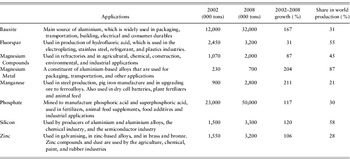
China is a major producer and exporter of the majority of these commodities which are often strategically important for a range of manufacturing sectors (see Table 1 for a range of applications). As shown in Table 1, between 2002, when China joined the WTO, and 2008, the volume of production of all of these minerals has grown substantially (USGS, 2010). In 2008, China's share in world production of the minerals listed above was reported to range between 28% for zinc and 87% for magnesium metal. As such, China is a major, and in some cases the biggest, producer of these commodities.Footnote 19
Industrial applications, production trends and share in world production of selected minerals in China

Source: Compiled by the author based on USGS Mineral Commodity Summaries (2010).
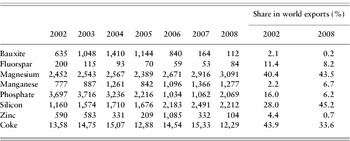
The picture for trade flows and volumes, however, is different. For some minerals, China is a major exporter, and for others, it has become a major importer, despite also being a major producer. The volume of its exports has fluctuated over the past few years. Between 2002 and 2008, the export volumes of silicon and magnesium increased considerably. The biggest rise was in silicon exports which grew by 90%. As of 2008, among the listed minerals, the highest market shares held by China were for silicon and magnesium, each amounting to about 45% of total world exports. It is clear that China controls a substantial share of world markets in these commodities (see Table 2) (UnComtrade, 2010). By contrast, the exports of some other minerals have declined considerably. The biggest drops were seen in exports of bauxite and zinc (82% each). China has become a major importer of these minerals. For example, between 2002 and 2008, the volume of its bauxite imports grew by approximately 2,400%, from 1.1 million metric tons to more than 28 million metric tons (UnComtrade, 2010).
Volume of exports (thousand metric tons) in selected minerals in China, 2002–2008

Source: UnComtrade (2010), compiled by the author based on the following HS codes:
Bauxite: 260600, 262040, 760110, 760200
Fluorspar: 252921, 252922
Magnesium: 810411, 810419, 810420, 251910, 251990, 253020, 281610, 282731, 283321
Manganese: 260200, 811100, 282010, 720211, 720230
Phosphate: 251010, 251020, 280470
Silicon: 280461, 280469, 284920, 720221, 720229
Zinc: 260800, 262011, 262019, 281700, 790111, 790112, 790120, 790200
Coke: 270400
Export restrictions
The imposition of export restrictions on a range of commodities has long been part of China's trade policy. The list of items subjected to various forms of export restrictions goes beyond the minerals listed in the China–Raw Materials case. A number of agricultural products (timber, cattle, chemical fertilizers), and other minerals, such as molybdenum, chromium, and rare earth metals are commodity groups which have been subject to export restrictions. For clarity of the analysis, however, the section below focuses on the minerals mentioned in the case.
Quantitative restrictions on exports
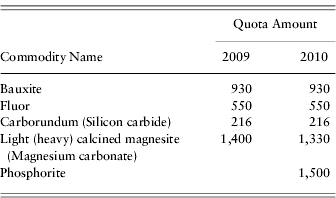
The first component of the case against China challenges the WTO compatibility of these quantitative restrictions. Based on the official announcements of China's Ministry of Commerce, five of the commodity groups listed under industrial products are mentioned in the case – namely bauxite, fluor, silicon carbide, magnesium, and phosphorite (see Table 3) – are subject to export quotas in 2009 and 2010 (Ministry of Commerce, 2008). However, it is important to note that some of these export quotas, for instance for bauxite, are not fully utilized by exporters.
Total export quota (thousand metric tons) for selected industrial products in China, 2009–2010
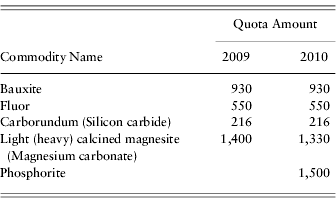
Source: Ministry of Commerce (2008).
It is clear that, unless justified by exceptions, the mere existence of these measures is inconsistent with GATT XI:1. Moreover, Paragraph 162 of the Working Party Report refers to export restrictions and provides that ‘China would abide by WTO rules in respect of non-automatic export licensing and export restrictions … Moreover, export restrictions and licensing would only be applied, after the date of accession, in those cases where this was justified by GATT provisions.’ As such, before going into an analysis of the possibility of exceptional conditions which may allow these measures, it is clear that China's quantitative export restrictions violate its commitments under GATT XI and the Accession Protocol.
Export taxes
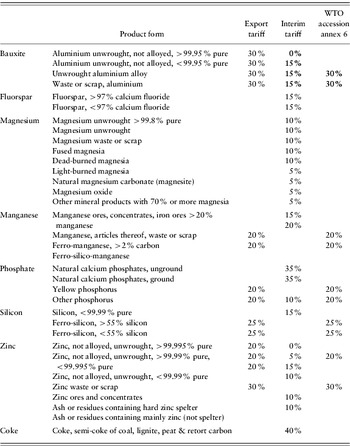
The second component of the case is about export taxes. China resorts to export taxes quite extensively. According to the ‘Circular of the Customs Tariff Commission of the State Council on the Tariff Execution Plan 2010’, a total of 329 tariff lines (8-digit Harmonized System (HS)) are subject to export taxes, which are applied in the form of ‘export tariffs’, and/or ‘interim tariffs’ and/or ‘special export tariffs’. All of the minerals mentioned in this case are listed in the Tariff Execution Plan 2010 (ETCN, 2010). Ranging from 5% for magnesium oxide to 40% for coke, various degrees of export taxes are imposed (see Table 4).
Export taxes imposed on selected minerals by China, 2010

Notes: Export tariffs are the generally applicable rates; ‘interim’ tariffs are applied for a defined period of time (e.g. high season), and generally valid for one year. The Government reviews interim tariffs and adjusts them as it deems necessary. It can also set ‘special’ tariffs in response to special circumstances. According to the Regulations of the People's Republic of China on Import and Export Duties (Article 11) ‘In cases where export goods, to which export tariff rates are applicable are subject to temporary tariff rate, the temporary tariff rate shall apply.’
Source: Compiled by the author based on ETCN (2010), and China Accession Protocol.
In relation to the WTO compatibility of its export taxes, which is under dispute, China faces significant constraints arising from its accession commitments rather than its obligations under GATT, which allows Members to impose export taxes. Its Accession Protocol explicitly limits the number of items and the level of export taxes that China is allowed to impose. According to Article 11.3 of the Accession Protocol, ‘China shall eliminate all taxes and charges applied to exports unless specifically provided for in Annex 6 of this Protocol or applied in conformity with the provisions of Article VIII of the GATT 1994’ (WTO, 2001b). Accordingly, Annex 6 lists a total of 84 tariff lines (8-digit HS), with maximum levels of export duties. China also confirmed that it would maintain the applied rates imposed at the time of the agreement and would consult with its trade partners who would potentially be affected if, under ‘exceptional circumstances’, it had to increase its applied rates (still not to exceed the maximum level indicated in Annex 6).Footnote 20
In order to establish whether China complies with its commitments under the Accession Protocol, the question is whether China imposes export duties on commodities which are not listed in Annex 6, and whether it exceeds the maximum levels designated in Annex 6. As indicated in Table 4, China imposes export taxes on a number of minerals that are not listed in Annex 6 (for example, nine forms of magnesium, two forms of fluorspar, and coke).Footnote 21 Also, the export taxes on some of the minerals that are listed in Annex 6 exceed the maximum rates indicated (for example, ‘unwrought aluminum alloy’). It should also be noted that China revises its export taxes quite often, apparently following trends in prices and the demand and supply situation related to the commodity in question (China Chemical Reporter, 2009).
The fact that China's ‘Tariff Commission of the State Council on the Tariff Execution Plan 2010’, includes 329 items while Annex 6 of its Accession Protocol includes only 84 items (both 8-digit HS), illustrates that the coverage of China's export taxes goes beyond the list of commodities designated in Annex 6, and they often exceed the levels to which China committed itself with its Accession Protocol.Footnote 22
Favouring downstream sectors?
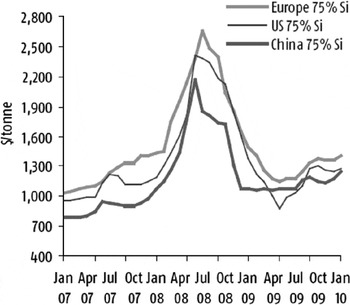
The impact of these measures on domestic prices is particularly apparent when considering those minerals of which China is a major exporter. For instance, the domestic prices of minerals such as ferro-silicon, silicon metal, and ferro-manganese, of which China is one the world's biggest producers and exporters, have been consistently lower than the international prices. As is shown in Figure 1, between February 2007 and February 2010, domestic prices of ferro silicon (75% pure) were significantly lower than those in the Western markets, namely Europe and the US (Metal Bulleting Research, 2010). Similar price differentials between domestic and international prices exist in other minerals, such as silicon metal and ferro manganese. Such price differentials, which might be partly a result of export restrictions, clearly offer significant price advantages to the domestic downstream manufacturing sectors over foreign producers, which is one of the main concerns of the countries which brought the case before the DSB.
Ferro-silicon prices, China, Europe, US, 2007–2010

Conservation of natural resources?
Given that its export restriction measures appear inconsistent with its commitments under GATT 1994 and the Accession Protocol, China will have to demonstrate that its measures satisfy certain exception(s) under Article XX of GATT 1994. As the Appellate Body explicitly clarified during the recent China–Publications and Audiovisual Products case, there is no doubt that China may invoke GATT Article XX to excuse itself from its commitments under its Accession Protocol.Footnote 23 In fact, responding to the panel request by the complaining parties, some Chinese officials have already indicated that the objective of these policies was related to environmental protection.Footnote 24 In that case, China will have to demonstrate that its export restriction measures satisfy the requirement of ‘relating to’ the conservation of natural resources in the meaning of GATT Article XX, paragraph (g), and that its measures operate ‘in conjunction with restrictions on domestic production or consumption’, i.e. that they are in line with the so-called ‘even-handedness requirement’. In addition, China will have to demonstrate that these measures do not constitute ‘a disguised restriction on international trade’ as mentioned in the ‘chapeau’ of Article XX.Footnote 25
Environmental regulation of mineral production in China
The Environmental Protection Law of China defines the ‘environment’ as ‘the total body of all natural elements and artificially transformed natural elements affecting human existence and development, which includes the atmosphere, water, seas, land, minerals, forests, grasslands, wildlife, natural and human remains, nature reserves, historic sites and scenic spots, and urban and rural areas’.Footnote 26 As such, protection of minerals, as part and parcel of the environment, could be classified as environmental protection under domestic law. This is particularly relevant in the context of China's Foreign Trade Law – as it allows for restrictions and bans on the imports and exports of goods in order to protect, among other things, the environment (Article 16(2)).Footnote 27
However China's domestic environmental regulation specifically addressing production of minerals is highly fragmented. There are a number of laws dealing directly or partly with environmental issues related to mining operations. The Mineral Resources Law requires mining enterprises to have a report on the ‘mining area, its mining design or mining plan, production and technological conditions and safety and environmental protection measures’ with an examination and approval by relevant State authorities (Article 15).Footnote 28 The Law on Water and Soil Conservation requires mining enterprises to have a water and soil conservation programme which is approved by the Department of Water Administration (Article 19).Footnote 29 The Law of the Prevention and Control of Water Pollution, on the other hand, requires those responsible for underground mining operations to take protective measures against groundwater pollution (Article 35).Footnote 30
Although government authorities may decline to grant permission for production on sites or for operations that may lead to environmental damage, these measures cannot be considered as direct restrictions on production intended to protect or to prevent the depletion of minerals as environmental resources. Moreover, it has been argued that the implementation and enforcement of these regulations have been highly problematic. Complicated institutional and regulatory structures and inconsistencies of implementation have been reported as major causes of a range of environmental damage, high numbers of casualties among miners and economic inefficiencies in small-scale mining operations (Cao, Reference Cao2007; Andrews-Speed et al., Reference Andrews-Speed, Yang, Shen and Cao2003; Wright, Reference Wright2004).
Resource tax
There is one measure, however, which is directly aimed at production: the Resource Tax. It is a quantifiable measure which acts as a disincentive to production through a ‘market mechanism’. It is directly imposed on production of non-metal ores, crude oil, natural gas, coal, and solid salt, in the case of non-metal ores, depending on the type of mineral, its grade (purity), and the location of production, different tax rates apply. Among the listed minerals under dispute, the resource tax is Rmb 20.00/ton (US$ 2.9/ton) for bauxite (grade 3); Rmb 2/tonne (US$ 0.3/ton) for manganese ore; and Rmb 2–4 (US$ 0.3–0.6/ton) for zinc ore (grades 1–5) (State Administration of Taxation, 2010). However, these market measures are relatively insignificant when compared to the overall value of production. In March 2010, they amounted to less than 1% of the price of bauxite, less than 0.5% of the price of manganese ore, and less than 0.1% of the price of zink respectively (Asia Metal, 2010; Commodityonline, 2010; Firstbauxite, 2010). Hence the current design and implementation of the Resource Tax does not seem to offer an effective mechanism to curb production and conserve minerals, albeit allowing local provinces to raise tax revenues.Footnote 31
Mineral-specific environmental measures
The Government takes some other mineral-specific measures, directly or indirectly related to the environment, which affect the mining sector (China Mining Association, 2010). For example, it imposes limitations on electricity consumption for mineral production and processing which constrains production and hence affects prices (USGS, 2008). The government has also introduced a set of standards regarding the scale and the potential for pollution of production and processing facilities of some minerals, such as lead, magnesium, manganese, and zinc. In 2008, according to the China Magnesium Association, 18 magnesium plants with high energy consumption and pollution intensity (as a result of relying on direct coal combustion) were closed down (China Magnesium Industry, 2007). However, since the total volume of mineral production by such small-scale operators is relatively low, such closures were not expected to reduce total production significantly (TEX Report, 2007).
5. WTO-plus commitments
It is highly likely that China will have difficulty in demonstrating that its export restrictions in the context of its environmental regulation satisfy the requirements of Article XX(g). First, although the Appellate Body's interpretation of the ‘relating to’ facet of Article XX(g) is less strict than the GATT jurisprudence requiring the measures in question to be ‘primarily aimed at’ rendering effective the restrictions on domestic production and consumption,Footnote 32 China still has to establish that its export restrictions are ‘reasonably related’ to the policy goal of conservation of exhaustible natural resources. However, as indicated above, its measures do not appear to be part of its highly fragmented environmental regulation dealing with mineral production. It would be difficult to establish that the measures in question are ‘fairly narrowly focused’.
Secondly, whether or not the measures concerned are applied ‘in conjunction with restrictions on domestic production or consumption’ (the even-handedness requirement), there are difficulties too. They seem to impose restrictions, just in respect of the exports of the minerals in question, not with respect to domestic production and consumption. As such they restrict only purchases of these minerals by foreign processors and consumers and not those made by domestic processors and consumers. In addition, these restrictions apply only to supplies in unprocessed form and do not cover exports of processed products which are composed of the raw materials in question. On the other hand, the above-mentioned restrictions on domestic production (e.g. the resource tax), or the product specific environmental measures cover other natural resources which are not subject to export restrictions. Hence, it is unlikely that the measures concerned would satisfy the even-handedness requirement. For the next step of the examination as to whether or not they would satisfy the chapeau of Article XX (i.e. that they are not ‘a disguised restriction on international trade’), the measures have to pass the first tier of the analysis (i.e. ‘relating to’ and the ‘even-handedness requirement’).
In the Canada–Herring and Salmon case, environment-related exceptions under GATT Article XX were not found to be applicable. Such an outcome is highly likely for the China–Raw Materials case too. This is mainly because the DSB is likely to judge that the environmental component/objective of the measures in question was relatively weak compared to their economic component/objective with a restrictive impact on trade.
The China–Raw Materials case will be a show case to exemplify the extent to which China's WTO-plus commitments might constrain its economic and environmental policy considerations in the near future. It is clear that WTO law regarding export restrictions shows signs of disproportionality. Although it is arguably an area of ‘under-regulation’ or ‘regulatory deficiency’ in WTO law (see Section 3 above) – as it offers Members ample ‘policy space’ for domestic policy considerations – it is biased against the late accession Members, the majority being developing countries such as China, which have had to commit themselves to stricter rules. Hence unlike other Member countries, China is likely to face legal action if it resorts to using export restrictions for the objective of promoting downstream processing and manufacturing sectors. These stricter rules may also constrain its policy options in addressing various environmental concerns through export restrictions.Footnote 33 Although Article XX provides some leeway, this comes with significant limitations and compliance requirements.
6. Conclusions
Like most of the other GATT/WTO cases on export restrictions, the latest dispute between China and the US, EU, and Mexico could be seen as another example of competition over natural resources. It involves alleged ‘unfair’ advantages that the measures have created for the downstream producers and processors in China, at the expense of the downstream sectors in complainant countries. For the complainants, the primary motivation seems to be the objective of obtaining greater access to raw materials. As the world economy is recovering from the current slowdown and the international competition over raw materials is picking up again (reflected in rising prices), China is likely to face growing resistance if it resorts to using export restrictions. There might be other similar dispute cases filed against China being brought before the DSB. As such, export restriction is an area where China might feel the implications of its so called ‘WTO-plus’ commitments on its domestic and trade policies.
Problems of ‘unfair’ competition and related global welfare losses would be substantial if China, which is a major supplier of many commodities with limited substitution possibilities, continues to resort to export-protectionist measures (or ‘resource nationalism’). Similarly, in the case of thin market conditions (e.g. certain strategic minerals), its supply constraints combined with export restrictions could inflate prices rapidly, to the detriment of net importing countries. This would also undermine the confidence in the multilateral trading system. It is important to note that as a major trading country which has been relying heavily on export-oriented growth, maintaining the stability and the predictability of the multilateral trading system is in the interest of China's long-term prosperity. Hence, China has a strong interest in avoiding policies that would create additional volatility in global markets and damage global welfare.
As for its legitimate environmental and social concerns, Chinese policy makers will need carefully to weigh the effectiveness and the potential benefits of export restrictions against the welfare losses they cause and consider the alternative tools at their disposal. There seem to be significant discrepancies between the environmental policy objectives that might be intended to be achieved through export restrictions and the actual impact on the ground. Depending on the objective and the nature of environmental externalities, various other policy tools could be employed and be equally as effective or more so than export restrictions and would also be potentially less costly in terms of global welfare losses.