Introduction
Throughout Africa, contemporary boundaries are deemed ‘artificial’ because they were external impositions breaking apart supposedly homogeneous ethnic units. Recent literature, however, nuances this view of African borders. Imperialist competition driven by European economic and political interests, deeply rooted in racial ideologies about African inferiority that legitimized colonial violence, indeed led to an often arbitrary partitioning of the continent. Yet, African contexts on the ground were not completely ignored and sometimes affected the precise locations of borders (Nugent and Asiwaju Reference Nugent and Asiwaju1996). While these ‘myths’ on African borders have been nuanced, a more tenacious assumption is that ‘better’ borders could have been designed, not splitting ‘ethnic’ or ‘linguistic’ groups and presumably averting much contemporary conflict (see, for example, Alesina et al. Reference Alesina, Easterly and Matuszeski2011; Michalopoulos and Papaioannou Reference Michalopoulos and Papaioannou2016).
This article argues that, for the Lake Kivu region, reading back such relationships onto a precolonial past is anachronistic, for relations between territory and identity were fundamentally different then. The problem with the colonial borders was not just that they arbitrarily dissected African societies, but rather that they profoundly changed the way in which territoriality and authority functioned in this region, and therefore they affected identity. The presumption that territories could be constructed in which ‘culture’ and ‘political power’ neatly coincided was heavily influenced by European ideas about space and identity (see also Lefebvre Reference Lefebvre2015) and privileged the perceptions and territorial claims of those ruling the most powerful centres in the nineteenth century. Those conceptions shaped ideas about international borders as well as internal borders (of chieftaincies, for instance) within colonies (Justin and De Vries Reference Justin and De Vries2019).
Thus, this article questions assumptions about ‘ethnic’ identities, state authority and political control in the nineteenth century that continue to influence contemporary views of the region, by exploring examples from several societies around Lake Kivu in this period. It shows that local understandings of space and identity, and the relationship between them, differed fundamentally from state-centred perspectives, whether of precolonial centralized states or colonial states.
Several researchers have shown the importance of studying these ‘interstitial’ societies in their own right (for example, Newbury, Ntezimana and Semadwinga), and my work also relies on these accounts. Yet, in shifting the focus to local societies rather than prioritizing state-centred narratives, this article corrects the ‘state’- or ‘monarchy’-centred reading of precolonial borders in general (see, for example, Herbst Reference Herbst2014), and in Rwandan history, as in the works of Alexis Kagame (Reference Kagame1972; Reference Kagame1975) and scholars such as Jan Vansina (Reference Vansina2004).
As elsewhere in Africa, a historical vantage point on these processes can avoid the primordialist trap of assuming that identities are static and timeless, while also nuancing simplistic instrumentalist approaches (Lentz and Nugent Reference Lentz, Nugent, Lentz and Nugent2000: 5; Amselle and M'Bokolo Reference Amselle and M'Bokolo2017; Chrétien and Prunier Reference Chrétien and Prunier2003). It also pushes back against accounts influenced by ‘the territorial trap’, the assumption that communities are bounded and homogeneous sovereign units (Agnew Reference Agnew1994).
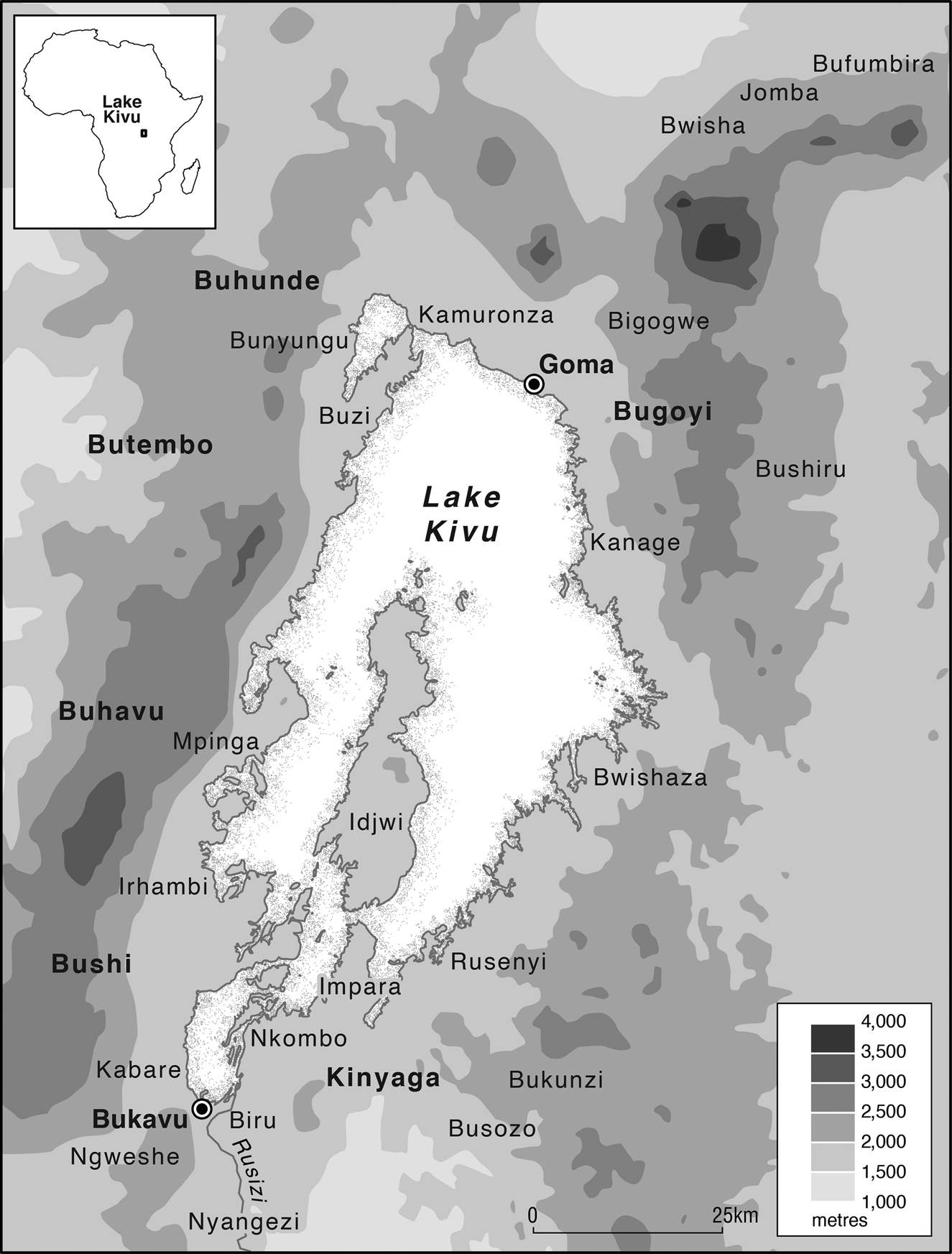
This article focuses on Kinyaga and Bugoyi, both located on the shores of Lake Kivu (respectively at the south and north extremities of the lake) and separated from the Rwandan heartland by the Congo–Nile watershed, a natural barrier between the core of the Rwandan kingdom and its western frontier. It also discusses Bushi, in the eastern Democratic Republic of Congo (DRC), nowadays the hinterland of Bukavu, and Bwisha, to the north-west of Bugoyi, just beyond the Virunga volcanoes bordering Rwanda, Uganda and the DRC. While present from the end of the nineteenth century, Belgian and German colonial authorities demarcated the border of this frontier – today's borderland between Rwanda and the DRC – on paper only in 1910 and on the ground in 1911. Before then, the Lake Kivu region was called a zone contestée, indicating that both Germany and Belgium had territorial claims on it (Louis Reference Louis1963; see also Figure 1).
Historical regions in the nineteenth-century Lake Kivu area. Goma and Bukavu have been added for orientation.

Many of these precolonial societies had some form of territorial limit, and broad cultural differences between ‘Rwanda’, ‘Shi’ and ‘Hunde’, among others, were significant. Court tradition in Rwanda thus portrayed all ‘Shi’ – those to the west of the Congo–Nile divide, irrespective of their ‘ethnic’ affiliations – as fundamentally different (Newbury Reference Newbury and Kopytoff1987). However, such differences did not necessarily coincide with boundaries. Territorial limits were often pretensions, or political imaginaries that political centres projected onto their ‘frontiers’, as Newbury (ibid.) shows for Rwanda.
Integration within certain political limits did not mean identification or compliance with the centre. Seen locally from the perspective of these interstitial zones, limits and differences were less clearly marked. Rather than political and cultural clarity, there were political and cultural variations; rather than overarching identities, identity was often locally defined and adaptable to changing contexts; and seen from a long-term perspective, territorial control was never stable. This is not merely a conceptual issue: primordial notions of territory and identity, and the links between them, continue to have an impact.
Contemporary discourses
In the Lake Kivu region, ‘primordial’ notions of identity – ‘national’ and ‘ethnic’ – are still actively deployed by regional actors, making it difficult to avoid these categories. Within eastern DRC, consecutive state interventions have made relationships between ethnicity and territory stronger and more rigid (Mathys Reference Mathys2014; Hoffmann Reference Hoffmann2021). There, the definition of the limits of ‘ethnic’ territories – presumed to have been delineated long ago, and based on static ideas about ‘identity’, ‘territory’ and ‘political control’ – is a highly contentious issue that is often at the heart of local conflict dynamics (Mathys Reference Mathys2017; Hoffmann Reference Hoffmann2021; Muchukiwa Reference Muchukiwa2006; Huggins Reference Huggins2010).
On the Congolese side of the borderland of DRC and Rwanda, there is a tendency to draw sharp boundaries between who is ‘Congolese’ and who is ‘Rwandan’, based on often dubious historical claims (Jackson Reference Jackson2006; Reference Jackson2007; Mathys Reference Mathys2017). In grey literature and public discourse, it is not uncommon to hear that ‘before the colonial period … Congo, Rwanda and Burundi [were] three distinct political entities that each develop[ed] [évoluent] within their own context (sphere)’ (Mahano ge Mahano 1998). Conflict actors such as the rebel leader Laurent Nkunda employed primordial notions of ‘national’ identity to contextualize their actions. In 2009, Nkunda stated: ‘If there had been no colonization, and thus no creation in Africa of totally new and artificial territorial entities … the “Banyabwisha” would not be Congolese, but Banyarwanda, exactly as before the “Anglo-German-Belgian Convention of 1910” relative to the eastern borders of the Belgian Congo.’Footnote 1 Yet such visions are belied by a focus on mobility and the ‘itinerant’ nature of territoriality (Mbembe Reference Mbembe2000) in this ‘frontier’ zone, as this article shows.
Likewise, in Rwanda, political violence along ethnic lines since 1959 and the genocide against the Tutsi in 1994 have meant that the historical dimensions of ‘Hutu’ and ‘Tutsi’ identity have received much more scholarly scrutiny than what it means to be ‘Rwandan’ historically.Footnote 2 There, too, static ideas about how identity and territory supposedly converged shape ideas about ‘being Rwandan’. Indeed, precolonial Rwandan historiography has a strong centrist and ideological bias: the ruling dynasty's history is taken as the kingdom's history, and the histories of those not belonging to the ruling monarchy are not considered (Newbury and Newbury Reference Newbury and Newbury2000; Chrétien Reference Chrétien2010). The common view on Rwanda, heavily influenced by historian Alexis Kagame and propagated by the current regime in power (and also present during the Habyarimana regime) is that of a precolonial kingdom turned independent country: Rwanda did not have to emerge as a nation state after independence in 1962 because it existed as a nation state before colonization.
The presence of Kinyarwanda speakers beyond the current borders of Rwanda came to be equated with historical political control over these areas by the Rwandan kingdom (Newbury Reference Newbury1997). These views were possibly influenced by Kagame, for whom language was one of the ‘constituting elements of the soul of a people’ (Kagame Reference Kagame1958: 5), echoing colonial missionary language ideology (Vinck Reference Vinck, Harries and Maxwell2012). Discourses stressing that colonial demarcation ‘amputated’ Rwanda from parts of its territory appear in the public domain even today.Footnote 3 However, a historical approach focusing on local communities shows that such visions are the result of state-centred and colonial ideas about the relationship between territory and identity.
‘Itinerant’ territorialities and the Kivu frontier
All territory must be scrutinized historically: territories are produced, mutable and in flux, neither fixed nor permanent, but ‘contingent on the relational processes that create, sustain and dissolve them’ (Agnew Reference Agnew1994: 782). The Lake Kivu region is an apt example of Kopytoff's ‘frontier’ concept, which emphasizes exchange and argues that African societies developed through intense interaction within a frontier zone, eventually crystallizing into new polities and societies (Kopytoff Reference Kopytoff and Kopytoff1987: 6).
On the Kivu frontier, production of a certain kind of space in relation to a state or a political authority was not linear. Neither control nor social activities were stable, but constantly changing and often contested. Therefore we need to focus on how relationships between territory and political control changed. These characteristics also resulted in territoriality being ‘itinerant’, to use Achille Mbembe's term (Reference Mbembe2000). ‘Itinerant’ territoriality refers to territoriality determined by movement and change. Precisely because of this ‘itinerant’ characteristic, the frontier provided opportunities to escape the control of political authorities (see also Vigneswaran and Quirk Reference Vigneswaran and Quirk2015: 6ff.).
The Lake Kivu region is part of the Great Lakes region, the lands stretching between and around the lakes surrounding the main flow of the Nile. Cohesion there – that is, the presence of centralized political units, similar religious systems and languages, and an overall high population density – contrasts with neighbouring areas. Focusing only on cohesion, however, blurs cultural, political and ecological diversity (Chrétien Reference Chrétien2003: 23–5). At the end of the nineteenth century, the region contained diverse but interconnected cultural, political and ecological zones, even within comparatively centralized polities.
As James Scott says of South-East Asia, ‘for much of history, living within or outside the state – or in an intermediate zone – was a choice, one that might be revised as the circumstances warranted’. Moreover, ‘it was very common for state subjects to run away’ (Scott Reference Scott2009: 7). In the Lake Kivu region, inhabitants often employed their mobility to escape the state's power or political centralization, especially during the reign of mwami (chief) Rwabugiri (who ruled 1867–95), although this movement had already begun before his time.Footnote 4 Yet, we cannot presume that movement was due solely to political struggles, for there were also social and commercial relationships connecting the region in all directions (Newbury Reference Newbury1980a; Reference Newbury and G. Nzongola-Ntalja1986; Reference Newbury1991). In any case, intense interaction and exchange did not always mean the peaceful establishment of frontier societies. These processes were often highly contingent and contested (Howard and Shain Reference Howard, Shain, Howard and Shain2005: 51–4); control over territory was therefore unstable and in constant flux.
Territory within the frontier or on the periphery was also more complex. Lefebvre points out that space is constituted by myriad different spaces, not abolishing each other but inherently intertwined; some spaces penetrate each other or superimpose themselves upon each other (Lefebvre Reference Lefebvre1991: 86–7). Therefore, as societies and communities met in a frontier zone, they produced numerous overlapping, sometimes competitive, forms of spatial or territorial structuring (Mbembe Reference Mbembe2000).
Portraying cultural and/or political regions as well defined and neatly demarcated can project a false picture, concealing the itinerant character of the region's limits and the plurality of links and allegiances between and within different ‘territories’. Indeed, contemporary cultural and/or political regions are products of history, often the result of colonial (re-)spatialization, disguising the contingent, fluid characteristics of territory. But as this article shows, the same goes for identities. The ‘intense passions’ of ethnicity (and autochthony) (Young Reference Young1986) made perceptions of identities more static, and concealed their historical shapes.
Centralization in the Rwandan kingdom
Colonial European images, and imagery propagated by today's Rwandan government, depict nineteenth-century Rwanda as an extraordinarily centralized political entity resembling a nation. Yet, this image fails to account for regional realities and varying links and forms of (in)dependence vis-à-vis the Rwandan court. Many colonial-era publications emphasize regional cultural tendencies and degrees of independence from the Rwandan court at the fringes of today's Rwanda (Newbury and Newbury Reference Newbury and Newbury2000; Vansina Reference Vansina2004). Thus, references to the precolonial Rwandan kingdom should not be confused with present-day Rwanda.
The heartland of the Rwandan kingdom can be situated to the east of the Congo–Nile divide, in the high-altitude mountains separating the Lake Kivu region from central Rwanda. The core of the central areas was Nduga. The regions in present-day western Rwanda (and those beyond today's Rwanda) long remained outside the kingdom's political control, while sometimes maintaining links to the centre. During the nineteenth century, governance and socio-political structure in regions to the west of the Rwandan kingdom were different from those in the centre. Clan or family heads (abakonde) governed some small domains independently, for instance in Bugoyi and some regions in Bwisha, north of Lake Kivu.
Elsewhere, small kingdoms united different families and clans. These Hutu kingdoms were ruled by bami (s. mwami, kingFootnote 5) who held ritual and magical powers. Kinship was not the main organizing factor in these polities, but rather ritual claims to the land's productivity and the population's well-being (Newbury Reference Newbury2001: 290). Examples can be found in Bukunzi, near the Shi kingdoms, and in Bushiru, bordering Bugoyi (Pauwels Reference Pauwels1967; Ntezimana Reference Ntezimana1980; Newbury Reference Newbury2001: 290–1). Yet, according to Rwandan court ideology, these bami were illegitimate, giving the Rwandan kingdom the right to conquer the small polities. Ideological framing of the small Hutu principalities translated into naming practices: in Rwandan court sources, leaders of the toparchies were called abahinza (s. umuhinza, rebel in Kinyarwanda), not bami (Newbury Reference Newbury2001: 290ff.).
Increasingly, the centre encroached on western regions and projected its power by establishing islands of control (Des Forges and Newbury Reference Des Forges and Newbury2011: 153) from where power could be further extended. One facilitating institution was the army. In particular, armies in border camps were a means to establish central rule in outlying regions. They also became integrative, incorporating newly subjected populations administratively and politically into the Rwandan kingdom (Newbury Reference Newbury and Kopytoff1987: 169). Residences of Rwandan bami from the central kingdom and chiefs acting as court representatives were often the centres of these islands of control, or springboards for further expansion (Vansina Reference Vansina2004), highlighting the ambulant nature of the exercise of power in the Rwandan kingdom, as both the Rwandan mwami and important Rwandan chiefs travelled between the residences and the court.
The heyday of Rwandan expansion was the second half of the nineteenth century, during mwami Kigeri Rwabugiri's reign (c.1867–95). Rwabugiri is still considered one of Rwanda's most infamous bami. Beyond Rwanda's contemporary confines, he is remembered for numerous campaigns associated with violence and often devastating consequences. Only during Rwabugiri's reign did some of the region west of Nduga become more firmly politically integrated within the Rwandan kingdom, with attempts made to incorporate areas that were previously only loosely connected.
It would be tempting to look at these western regions as ‘peripheries’ to the Rwandan court. However, even if the Rwandan kingdom was militarily dominant in the region throughout the nineteenth century, it is important to understand how these regions related to the kingdom's authority. Even during Rwabugiri's reign, the Rwandan court's authority varied regionally. In some ‘peripheral’ regions that are incorporated today into Rwandan national territory, Rwabugiri was able to govern only over the hills neighbouring his royal residences (Des Forges and Newbury Reference Des Forges and Newbury2011: 101). Moreover, limitations on the reach of power were spatial and temporal: the Rwandan court could exercise its power in an area only while its representatives or armies were located there; without them, such regions often reverted to political autonomy.
Rather than being ‘peripheral’ to the centre's power and its dominant military force, these regions had their own spatial logics relative to the Rwandan kingdom's power and authority. They were influenced but not entirely determined by Rwanda. Moreover, they had an influence upon the centre (Newbury Reference Newbury and Kopytoff1987). This can be seen by shifting focus from centre to ‘periphery’, using Kopytoff's frontier concept to facilitate understanding of how territories relate to authorities, how they change over time and space, and how they overlap and conflict.
This is what the remainder of this article does, by placing Rwanda's ‘periphery’ at the centre. First, it examines shifting identities, as well as the myth of political boundaries coinciding with ‘ethnic’ ones, within the local societies that are the focus of this article. Second, it analyses the contradictions and tensions between ‘autonomy’ and ‘incorporation’ in relationships between these local societies and the centre. And third, it sheds light on the role of local elites in mobilizing the tensions between ‘autonomy’ and ‘incorporation’ for their own interests. In doing so, it corrects narratives about these precolonial societies that fall into the ‘territorial trap’ (Agnew Reference Agnew1994).
Identity: mobility and fluidity
Czekanowski recounts his 1907 arrival at a village just ‘a hill away from Kivumba [Kibumba]’ in today's North Kivu, bordering Rwanda:
Smiths, just as the inhabitants of Kivumba, they considered themselves as subjects of the King of Rwanda, which was (according to the interpreter from Nyundo), incontestable … Whilst the guide from Nyundo affirmed that they were Bahunde, the local guide took this as an insult towards his compatriots. According to the latter, the Bahunde lived further up north and delivered the iron with which the people here forged hoes and other objects. Hoes being one of the principal forms of money in Rwanda, he concluded that we were in the money of the King of Rwanda … The two informants maintained that these lands did not belong to the domain of Rwakadigi, because they were inhabited by free peasants, who were not subordinate to herders. Nevertheless, these peasants were no bagabo – a kind of petty nobility – because they were not obliged to respond with weapons in the hand to the appeal of the King, and they did not wear the typical bracelet in wood as the bagabo wear. (Czekanowski Reference Czekanowski, Meschy and Balandier2001 [1907]: 49–51)Footnote 6
His account implies links to the mwami of Rwanda (in this case to Rwakadigi, an important Rwandan chief) but also a certain degree of independence from Rwanda's political centre. The population's characterization as ‘free’ likely meant that there were no patron–client relations with chiefs coming from Rwanda's political centre and/or access to land related to lineage heads. Moreover, the people were not integrated into Rwandan armies, indicating that this region was not fully incorporated into the Rwandan kingdom.
That certain categorizations of people (were they ethnic Hunde or not?) were unknown or not immediately clear to local people shows that overarching ‘ethnic’ identities were not necessarily the most important means of self-identification, and might have been irrelevant in some contexts. Furthermore, until at least the 1960s, people identified primarily with clans or lineages (Chrétien Reference Chrétien2003: 88; Mugaruka bin Mubibi Reference Mugaruka bin1986: 48). Given the complicated relationship between identity, authority and territory suggested by Czekanowski, we must ask how colonizers interpreted this situation and which parameters they used to design borders reflecting ‘ethnographic’ realities on the ground. The observations of Czekanowski and his guides illustrate wider patterns of the region's social processes and political action.
While we do not know which hill Czekanowski spoke about, people of Kibumba (and neighbouring Buhumba) are believed to consist of a mix of ‘Hutu’ and ‘Hunde’ clans today. And sources differ on the ‘ethnic’ identity of Burunga, chief of Buhumba when the first Europeans arrived. For some he was ‘Hutu’, for others ‘Hunde’.Footnote 7
Therefore, labels such as ‘Hunde’, ‘Havu’, ‘Shi’ and ‘Rwandan’ – even Hutu and Tutsi – are misleading for the time. Until the colonial period, people did not necessarily identify with overarching ‘ethnic’ identities. Switching between cultures and identities often was the norm – another cause and consequence of the itinerant nature of the frontier. Therefore, these labels are frequently anachronistic, as they suggest long-term continuities of these identities, while their salience resulted from colonial-era processes. Although these labels are used here for want of other categories, we must not confuse them with what they have come to designate over time, or see them as fixed ‘political’ or ‘cultural’ identities.
East of Lake Kivu
Despite contemporary claims to a Rwandan ‘national’ identity predating colonization, focusing on the local societies reveals a more complex situation. The language spoken in Buhunde and Bugoyi (Kihunde and Kigoyi) had many similarities (Pagès Reference Pagès1933: 602). While many clans claimed origins east of Bugoyi, such as the Bagwabiro, others traced their origins to the lake's western shore, including Gishari and Kamuronza (today parts of Masisi territory in DRC) (Czekanowski Reference Czekanowski1917: 294; Reisdorff Reference Reisdorff1952: 79), and those links were not ruptured when these immigrants settled in Bugoyi (Pagès Reference Pagès1933: 635ff.). The settlement of people from west of Bugoyi in the eighteenth and nineteenth centuries intensified mobility, even during the colonial period. Additionally, throughout the colonial period, clans such as the Bashobyo, claiming their origins in Gishari, often returned there to make ancestral offerings (ibid.).
In Kinyaga, south-east of Lake Kivu, similar dynamics were apparent, and there, too, immigration came from different directions. People arrived from Nduga in the eighteenth and nineteenth centuries through different motivations: famine, lack of fertile land, political disturbances, or war linked to internal political developments in the Rwandan kingdom's heartland, a reminder of Scott's emphasis on the desirability of living beyond the state's reach (Scott Reference Scott2009). Still others had a direct link to central Rwanda, such as ‘colonizers’ sent intentionally from the central court in the eighteenth century to attempt to integrate Kinyaga into Rwanda (Newbury Reference Newbury1988: 29–35). Yet, the presence of people from the Rwandan court cannot be equated with ‘occupation’ or ‘control’. Before Rwabugiri's reign (1867–95), the political and administrative reach of the Rwandan kingdom in Kinyaga was fragile (Newbury Reference Newbury1988: 30–3).Footnote 8
The proportion of people not associated with Rwanda was high in Kinyaga, for, in addition to those immigrating from the east, people also came from non-Rwandan areas. Those from Havu and Shi regions had similar motives to those coming from the east, but their movement was not necessarily associated with attempts at incorporation by a centralized state. The presence of non-Rwandans from regions north and west of Kinyaga indicates that Kinyaga was a frontier zone for the Rwandan kingdom (its western frontier) as well as for neighbouring polities such as Bushi and Buhavu.
Many people living in Kinyaga claimed their origins in Bushi, on the western shore of the Rusizi, to the south-west of Lake Kivu. Mobility is a factor, but political struggles within Bushi kingdoms and polities were particularly important with regard to the presence of people tied to Bushi and/or Bushi's royal families in Kinyaga. Illustrating Kopytoff's frontier thesis, fluidity and high levels of mobility also led to new polities in Kinyaga. Bukunzi was a small independent kingdom whose kings were renowned for their rainmaking skills and claimed origins in a royal family of Bushi, attracting a considerable number of people from that direction.Footnote 9 Bukunzi was also a place of refuge for elites during internal struggles in Bushi.Footnote 10 The Rwandan court treated Bukunzi with respect, especially because of the mwami's rainmaking skills, and although the ruler of Bukunzi paid tribute to the Rwandan mwami, he received many more gifts in return. It was well into the 1920s before Bukunzi was brought under the control of a court-appointed chief in Kinyaga, Rwagataraka, and then only at Belgian insistence (Des Forges and Newbury Reference Des Forges and Newbury2011: 203; Bourgeois Reference Bourgeois1957: 182; Ntezimana Reference Ntezimana1980).
The presence of chiefs identified and identifying as Shi but under (nominal) Rwandan political authority demonstrates that ‘cultural’ identities did not necessarily coincide with political alliances. In contrast to the autonomy of the kings of Bukunzi, chiefs of Shi descent such as Ntumwa, Ruberamiheto and Ngendo were abagaragu (s. umugaragu, client) of the Rwandan mwami Musinga, who had given them hills over which they governed.Footnote 11 The presence of Shi chiefs also implied a rather large presence of people labelled Shi during the colonial period, many of whom settled along the eastern side of the Rusizi River (the present-day border between Rwanda and the DRC). Even in the 1930s, the colonial administration portrayed the Shi around Chief Ntumwa as endogamous, and maintained that Ntumwa could not speak Kinyarwanda or Kiswahili.Footnote 12 The presence of Ntumwa and other Shi in the area engendered exchanges with areas across the Rusizi River, an impact still felt today.Footnote 13 Ntumwa's case shows that cultural or linguistic connections did not preclude political alliances with other power centres. Bukunzi's integration as late as the 1930s demonstrates the salience of other territorial regimes and the importance of the ‘colonial moment’ in attempting to halt overlapping territorialities.
Seen from the centre, the ‘peripheral’ locations of Kinyaga and Bugoyi also influenced their perception by outsiders. Even in 1939, when the politics of ethnicity had become more rigid and identities more sharply defined, people from Kinyaga were called Bashi (inhabitants of Bushi) or ‘strangers from across the borders’ (Dufays and de Moor Reference Dufays and de Moor1939). Those from the Bugoyi region were also designated generically as Bashi, derogatorily as ‘Banyabungo’, or as Bagoyi (people from Bugoyi), rather than ‘Rwandan’ (Classe Reference Classe1905: 414; Newbury Reference Newbury1991: 62). Likewise, for many in this region – and in Kinyaga – those east of the Congo–Nile divide (Hutu and Tutsi) were called ‘Banyanduga’ (people from Nduga). In 2011, many of the elderly people I talked to still referred to ‘Nduga’ when explaining commercial or political relationships with areas in central Rwanda.
To the north-west of Lake Kivu
North-west of Bugoyi, beyond the volcanoes forming the border between today's Rwanda, DRC and Uganda, lay the Bwisha area. Kagame situates Rwandan influence in this region far into the past, with Gihanga. While most authors consider the latter a mythical king, Kagame sees him as Rwanda's first ‘historical’ king, with a residence in Buhindangoma, close to Rutshuru. For Kagame, mwami Rugaanzu Ndori (c.1510–43) conquered the region (Kagame Reference Kagame1972: 42).Footnote 14 This view extends the Rwandan court's presence deep into the past, while evidence from local societies in Bwisha suggests increased court interest in the area only during mwami Yuhi Gandihiro's reign (the first half of the nineteenth century), probably due to pressure on central Rwandan pasture. Successive attempts were made by the court to establish rule in the region through intermediaries,Footnote 15 although this appears to have become somewhat permanent during mwami Rwabugiri's reign (Vansina Reference Vansina2004: 159).
This does not preclude the presence of people speaking Kinyarwanda before Rwabugiri's reign. The region was rich in pasture, with abundant arable land. Probably the first immigrants speaking Kinyarwanda in Bwisha began arriving at the end of the seventeenth century (Kajiga Reference Kajiga1956: 7–8; Fairhead Reference Fairhead1990: 78) and recognized the principalities led by abahinza, or rather bami, or societies based on the power of the abakonde (family heads) (Fairhead Reference Fairhead1990: 78).
In regions experiencing later presence of the central Rwandan court, people probably did not identify as ‘Hutu’ or ‘Tutsi’ before the arrival of court delegates. As in Kinyaga, people identified foremost with lineages and localities. Consequently, describing the region's ‘ethnic’ makeup before the second half of the nineteenth century in terms of ‘Hutu’ and ‘Tutsi’ is tricky, and probably inadequate.
People from the west (whom we would now identify as ‘Hunde’) were likewise present, especially in Bwito, but also in Bukoma, Rugari and Gisigari. However, in the latter two localities, they seem to have been driven out by arriving Kinyarwanda speakers returning to Bwito and Kamuronza or moving to Bukoma. Others allegedly accepted integration or subordination to these lineages – another expression of the fluidity of cultural boundaries (Kajiga Reference Kajiga1956: 9; Bwana-Kweli Reference Bwana-Kweli1985: 8). Schumacher points to the mixed-clan origins of people in Bwisha, coming from the west (Kamuronza and Gishari) and the east (Buyambiriri and Mulera in today's Rwanda) (Schumacher Reference Schumacher1943: 86).
West of Lake Kivu
Although less powerful than the Rwandan kingdom, Bushi, nowadays broadly Kabare and Walungu territories in DRC, was regionally powerful and rapidly centralizing in the nineteenth century. It was not a unified political entity at the time, but a cultural zone of Mashi speakers of kingdoms including Ninja, Kaziba, Luhwinja, Burhinyi, Kabare (or Buhaya) and Ngweshe (sometimes also Bishugi) (Bishikwabo Reference Bishikwabo1973: 11–12; Sigwalt Reference Sigwalt1975), with Kabare and Ngweshe the ‘core’ kingdoms of Bushi, and the regions close to the lake and the Rusizi River.
Due to high mobility, not all clans within Kabare and Ngweshe claimed ‘Shi’ origins. Some traced their origin to Burega (present-day Shabunda), others to present-day Rwanda (for example, the Barungu and Bega clans) or elsewhere,Footnote 16 illustrating the fluid nature of overarching ‘cultural’ identities in this region and mobility's constitutive role in these identities.
Irhambi, Lugendo and Ishungu provide excellent examples of dynamics already described for Rwanda's western frontier. The population appears to have consisted of ‘Hunde’ and ‘Havu’ clans, and, from mwami Mwendanga onwards (in the early nineteenth century), it was integrated into the domain of the ‘Havu’ Nsibula dynasty (Nsibula Reference Nsibula K.1977; Newbury Reference Newbury1991).
During the second half of the nineteenth century, the core kingdoms of Bushi began to expand. Irhambi (now Katana) became integrated into Kabare under Bigomokero, and ‘Shi’ mingled with the populations already in place. Similar to the ‘strangers from across the borders’ in Kinyaga, people from Irhambi are often called ‘Havu’ by those from Kabare proper, even today (Lunjwire Reference Lunjwire1980; personal observations). One elderly man stated: ‘We used to be Havu, but now we are Shi, because our mwami is Shi.’ This shows that older identifications still bear some relevance.Footnote 17
Thus, in contrast to certain contemporary visions assuming static relationships between (national) identity and territory in eastern Congo and Rwanda extending back to the precolonial period (Hoffmann Reference Hoffmann2021; Mathys Reference Mathys2014), in these frontier areas ‘fluidity’ was the norm, not the exception, and political affiliations rarely coincided with delineated identities.
Between autonomy and incorporation
As early as 1903, Dufays and de Moor, White Fathers in Rwanda, characterized relations between the Rwandan court and the Kinyagans thus:
Rwanda has a political organization that honours the great race of the Batutsi, the incontestable chiefs in most of the provinces that compose the kingdom. And, in general, this observation cannot be denied. But, when we observe more closely – something a [mere] traveller cannot do – one of the mixed populations that make up the border provinces, one quickly realizes that this organization is reduced to its most simple expression: ‘Expected to pay taxes on their harvests more or less regularly.’ In the meantime, they govern as they wish, or are exploited by chiefs, [who are] more or less authentic representatives of the king. They do not bend themselves to present themselves to their leader and master, who in turn does not want to engage too much with their affairs. The Kinyaga of the past fell into the category of those provinces whose leaders were listening to the orders of the kings from a distance, governing in their own ways, and fiercely defending their rebelliousness. And the young Musinga, since the death of his royal father Kigeri [Rwabugiri], did not insist to obtain a real sovereignty, especially because his great muvubyi [rainmaker] lived in this area and gave him disloyal competition to obtain the heart and property of his subjects. (Dufays and de Moor Reference Dufays and de Moor1939: 13–14)
The presence of representatives of the Rwandan heartland in Kinyaga predated Musinga's (who ruled 1896–1931) and Rwaburgiri's reign. Efforts at integration became more important during the reigns of bami Gahindiro (c.1801–45) and Rwogera (c.1845–67). Incorporation of Kinyaga was linked to Rwanda's military expansion, seen in the toponomy, with the Kinyagan provinces Impara and Biru named after the military companies that ‘protected’ them (Kagame Reference Kagame1952: 52; Newbury Reference Newbury1988). The arrival of the Biru and Impara armies in Kinyaga at the end of the eighteenth century was the first sign of interest by the Rwandan court, a trend continued under bami Gahindiro and Rwogera (early and mid-nineteenth century) (see, for example, Newbury Reference Newbury1988).
Consequently, within Kinyaga, different, sometimes overlapping or conflicting, regimes of territoriality coexisted. While, during the nineteenth century, the Rwandan court increasingly took territorial control over the area, this was not an even, linear process. Local perceptions of territoriality and accompanying rights still mattered, and various political authorities coexisted in regions nominally under the control of one centre. These competing dynamics resulted in pendulum swings between autonomy and incorporation.
In Bugoyi – which, today, roughly corresponds to Rubavu district in Rwanda – small polities ruled by bami had not yet fully emerged during the second half of the nineteenth century. In the eighteenth and nineteenth centuries, lineage heads regulated social life and access to land in Bugoyi. While access to land was established by ‘clearing’, land was held by the lineage, not individuals. Bugoyi's first inhabitants – or, more precisely, the first who established rights over land, ‘first comers’ or those who cleared the land – seem to have been the Bagwabiro clan (Basinga) from south-east of Bugoyi (Bunyambiriri), probably during the eighteenth century.Footnote 18 Their arrival is most plausibly explained by a desire for independence from the Rwandan central kingdom (Newbury Reference Newbury and Kopytoff1987: 172) or that kingdom's increasing military activities, which pushed them further west (Vansina Reference Vansina2004: 121). Although ejected from the Rwandan kingdom, they also cleared the path for Bugoyi's incorporation into the Rwandan kingdom's realm a century later under Rwabugiri. Macumu, a lineage head of the Bagwabiro, accepted the first forms of (nominal) Rwandan rule in the eighteenth century. Military raids during Rujugira's reign forced a political alliance and some form of Rwandan suzerainty, thereby opening up the region to later attempts at incorporation (Vansina Reference Vansina2004: 115ff.).
Links to the Rwandan kingdom are important in understanding the establishment of the Bagwabiro as chiefs of Bugoyi, but this does not mean that the Rwandan kingdom had full political control over the region early on. Links with the eighteenth-century Rwandan kingdom consisted of ‘gifts’ or ‘tribute’ to a court delegate, a suzerain in name only because he never went there. For a long time, this delegate's successors collected tribute from the local authority and imposed dues on local Tutsi, yet they did not establish themselves in Bugoyi (Vansina Reference Vansina2004: 159). The first ‘official’ Rwandan delegate to settle in Bugoyi was Chief Buki, probably at the end of mwami Rwogera's reign (1830–60). He and the local head of the Bagwabiro lineage were responsible for collecting tribute for the Rwandan mwami. From Buki's time onwards, conflicts erupted in this region, often linked to struggles at the Rwandan court, with the Bagwabiro taking sides to reinforce their own positions (Vansina Reference Vansina2004: 158–9).
Dynamics in Bwisha were similar. The first representatives of the Rwandan kingdom appointed to this region were probably representatives only in name. The influence of later representatives also seems to have been limited. King Rwogera's spouse Sekarubera (Rwogera ruled from 1847 to 1863), for example, had been ‘given’ Bwisha, but actual administration remained in the hands of Lutamo (Pagès Reference Pagès1933: 650), father of the local chief Ntamuhanga.
As for the regions included in Rwanda today, more effective administration was attempted only during Rwabugiri's reign. It seems he first tried to establish footholds in Mulera (present-day Rwanda) and Bufumubiro (present-day Uganda, Kisoro region), and later established residences in the Bwisha region.Footnote 19 These residences, often administrative structures, require greater scrutiny. Bwisha's history is clearly linked to Bufumbiro's (Mateke Reference Mateke1970: 37–8). The latter was governed by Buki, an emissary of Rwabugiri responsible for tax collection in Bugoyi. The Mabungo residence in Bufumbiro was apparently used to gather tribute from Bwisha, too (Tegera Reference Tegera2010: 55), although in these ‘frontier’ districts, collections might have been irregular. The importance of the Mabungo residence is demonstrated by its selection as the site of two first-fruit festivals (umuganura), crucial in the reproduction of sacred kingship, rallying the whole population around the mwami (Kagame Reference Kagame1975: 18–19) and a possible indicator of the region's integration – even if uprisings against delegates from the Rwandan court also occurred there (Mateke Reference Mateke1970).
The establishment of residences also had the aim of introducing more systematic forms of taxation. In Bwisha, tribute and other forms of tax were introduced. Some hills were also responsible for the upkeep of the armies (Schumacher Reference Schumacher1949: 87). Apparently, in Bwisha, the organization of land access also underwent changes, with indications that Rwabugiri's representatives began attempting to control pastureland.Footnote 20 Here, too, there were both centripetal and centrifugal tendencies, and local rulers still tried to assert their autonomy.
In many principalities nominally governed by Rwandan court representatives, local chiefs enjoyed considerable autonomy. In Bukoma, Rwabugiri collected tribute, leaning on the authority of the chiefs who were already in place (Pagès Reference Pagès1933).Footnote 21 Gisigari, headed by ‘Hutu’ chief Ntamuhanga, seems to have been integrated in a similar way. In Jomba, local chiefs governed on behalf of Rwandan emissaries. Nshizirungu, a ‘Tutsi’ from the Baha clan, which had been present in the region for centuries, was the representative for Chief Rwidegembya, who in turn was the representative for the Rwandan authorities (Kanyamachumbi Reference Kanyamachumbi1993: 95; Tegera Reference Tegera2010: 44–5).
Thus, the situation in Bwisha did not differ from those in other frontier regions of Rwanda, such as Bugoyi. Territorial and political control did not necessarily fully coincide. Centrifugal and centripetal tendencies competed. Sometimes, autonomous tendencies evolved into outright resistance. In Bwisha at the end of the nineteenth century, the Nyabingi cult, which was mainly active in Ndorwa (north-west of Rwanda), east of Bwisha, managed to rally people against the Rwandan court, erecting state-like structures and collecting tribute. The cult was also active in the Bwisha region, with renowned priestess Rutagirakijuna residing there. For some time, she controlled the region as far as Jomba, preventing taxes from being paid to Rwabugiri. To quash this movement, Rwabugiri sent three warriors to kill her (Schumacher Reference Schumacher1949; Reference Schumacher1958: 11). In Buhumba, Gunzi, in the lineage of the chiefs of Buhumba, is said to have been killed for attacking caravans bringing tribute to Rwabugiri.Footnote 22
Shifting alliances
Viewing alliances beyond the perspective of the centre shows that the expansion of more powerful states was often mobilized by local elites determined to reinforce their own interests, as becomes clear when looking at the role of Niganda women during Rwabugiri's attacks on the Bushi area. Kabare and Ngweshe, Bushi core kingdoms, emerged as separate political domains over a longer period of time. By the mid-nineteenth century, their split was permanent. Wars between the two kingdoms were rife, but their struggles were not merely internal matters, as both tried to strengthen their rule by seeking legitimacy and forging alliances with other neighbouring kingdoms (Masson Reference Masson1960). While Ngweshe frequently sought alliances with Rwanda, this does not mean that it was subordinated to Rwanda. Seeking multiple and external alliances with other power centres was a prime regional strategy (Mathys Reference Mathys2014). Therefore, labelling Ngweshe a district or tributary state of the Rwandan court, as Kagame does, says little about how such relationships were seen and mobilized locally (see the maps in Kagame Reference Kagame1975). One must instead recentre attention in frontier areas and local historical accounts, which are often more detailed and reliable than broad assertions by Rwandan central court historians for those regions.
From the 1880s, Rwabugiri launched several attacks on Shi states, profiting from secession struggles to conquer areas in Kabare and Ngweshe. In this, he was helped by Shi elites who straddled Rwandan and Shi cultural spheres, such as the Niganda family, who played upon the interests of Rwandan representatives to further their own positions. The Niganda family allegedly fled the Rwandan kingdom because of troubles with the mwami there, and settled in Bushi where they were said to already have commercial links (Mugaruka bin Mubibi Reference Mugaruka bin1986: 256–62). Like the Bega clan in the Rwandan kingdom, the Niganda – also of the Bega clan – held important functions at court in Bushi, and, as in Rwanda, they were wives and queen mothers of bami and powerful chiefs. During Rwabugiri's campaigns in Bushi, his contacts with the Ngweshe kingdom were often structured through ties with this Niganda family.
In Bushi, Niganda women assumed leading roles. For example, Nakesa, wife of Lirangwe, ruler of Ngweshe, did not want her husband to marry Mugeni, widow of the mwami of Kabare, a move that could possibly have made Lirangwe the ruler of both Kabare and Ngweshe. Nakesa's resistance was likely motivated by her desire to become queen mother in Ngweshe, and she was perhaps disgruntled because Lirangwe worked to oust her sister Namuloko's son from the throne in Kabare. Ultimately, the involvement of the women of the Niganda family and of the Rwandans led to Lirangwe's death. Although Shi and Rwandan sources differ on who initiated his murder, Nakesa's plan worked. After the murder of Lirangwe and his second wife, Mugeni, Nakesa's son acceded to the throne, but because he was too young to rule, Nakesa became the de facto ruler of Ngweshe (Mathys Reference Mathys2014: 105–7).
The role of ‘frontiersperson’, often straddling different political and cultural zones, is important. While the Niganda family either was ejected from or fled the metropole, they were later used by that same metropole as a tool for conquest and occupation. At the same time, the Niganda family used their liminal positions to further their own position locally. Relations between Ngweshe and Rwanda reveal multiple and shifting alliances. Relations between the royal families of Idjwi and the Rwandan kingdom during the nineteenth century likewise document this principle, showing that tension between centripetal and centrifugal tendencies persisted even in times of war (Newbury Reference Newbury and Newbury2009; for parallels with the situation in Bugoyi, see Newbury Reference Newbury1991: 281–2). However, while the Rwandan kingdom might have briefly ruled over some Bushi areas and Idjwi, incorporation was not long-lasting; after Rwabugiri's death, many areas occupied by Rwandan representatives or local proxies (in Ngweshe and Kabare, for example) regained their independence.
Aftermaths
The period after Rwabugiri's death in 1895 is crucial to understanding the impermanent character of territoriality in the region and the tensions between autonomy and incorporation. Bugoyi, for example, became more fully integrated under Rwabugiri, but this integration should not be overstated; nor should the continuing power of the lineages in Bugoyi be underestimated. After Rwabugiri's death, Bugoyi witnessed an uprising clearly directed against central power (Pagès Reference Pagès1933: 610; Schumacher Reference Schumacher1958: 182). Even after the population of Bugoyi was defeated, at the beginning of his successor mwami Musinga's reign, notables feared travelling between the small islands of central control (Des Forges and Newbury Reference Des Forges and Newbury2011: 101; Kandt Reference Kandt1904: 483). The kingdom struggled to control centrifugal tendencies aimed at keeping some form of local autonomy – a tension only truly resolved after the Belgians took over Rwanda.
In Bwisha, Rwabugiri's demise and the struggles following his death diminished the court's influence there (Pagès Reference Pagès1933: 651). Although Europeans in the Rutshuru region did not deny the influence of the Rwandan court there, they described political organization in Bwisha as a patchwork of small political entities headed by chiefs (Rukatsi Reference Rukatsi1988: 117). Even if tribute was sent to mwami Musinga until World War One, the first Belgians in the region suggested that the most important social and political organization, and means of access to land, was the clan, and many of the ‘small chiefs’ did not send any tribute.Footnote 23 Spiltoir wrote in 1908:
The country is in reality divided in clans (muliango [sic] in the indigenous language)[;] this division is the only important one. One clan can constitute a chieftaincy; it is also possible to find several clans in one chefferie. Footnote 24
Others still considered themselves ‘subjects’ of the mwami of Rwanda at the beginning of the twentieth century (Czekanowski Reference Czekanowski, Meschy and Balandier2001 [1907]), showing that alliances and connections to the Rwandan kingdom probably varied locally, and that older forms of territorialization did not suddenly disappear with colonial occupation. The fact that agents of the Congo Free State plundered and exploited the population of Bwisha might also have reinforced this link to the Rwandan king (ibid.).
For the other areas in today's eastern DRC, the situation was more straightforward. In the words of Birasenyeri, a lieutenant of Rwabugiri involved in his military campaigns: ‘Of all the fleeting conquests in Bunyabungo [Bushi] and Idjwi only the memory remains.’Footnote 25 Such ‘impermanent’ territoriality and the competition between different political regimes were also noticeable in the frontiers of other centralized polities. While consecutive colonial interventions more firmly fixed connections between territory and political control, competition between different political and territorial regimes continued to simmer below the surface (Mathys Reference Mathys2014; Hoffmann Reference Hoffmann2021). In Irhambi, for example, centrifugal, secessionist tendencies against Kabare's influence resurfaced shortly after independence, in 1964 (Bagalwa Mungazi Reference Bagalwa Mungazi1986).
Conclusion
By shifting the focus to the frontier, this article has demonstrated that similar processes of contact, incorporation and contestation could be found throughout the Lake Kivu region. Although the end of the nineteenth century was eventful, earlier accounts attest to the ‘itinerant’ nature of territory as an inherent characteristic of socio-political authority in the region well before the period of intensified turbulence. This does not mean that there were no regimes of territoriality, or that political limits did not exist in this frontier area. As Lefebvre shows for the Sahel, multiple forms of such limits existed, corresponding to multiple forms of territoriality and political authority (Lefebvre Reference Lefebvre2015: 14). Often, such ‘precolonial’ limits are characterized as the limits of the space over which authorities could broadcast control and exploit resources (Herbst Reference Herbst2000). Yet, that is a state-centric perspective. Within local communities, both centripetal and centrifugal dynamics existed, often fluctuating over time, hence the characterization of territoriality as ‘itinerant’.
The ‘artificiality’ of the colonial border lies in the fact that it ‘fixed’ ephemeral and previously contested socio-political and cultural realities, rather than in the partitioning of presumed homogeneous groups. This observation can extend to other regions in Africa (McGregor 2009; Lefebvre Reference Lefebvre2015; see also Castryck Reference Castryck2019), and it bears many similarities to the ‘pre-national’ period in settings further afield such as the Ottoman borderlands (Bartov and Weitz Reference Bartov and Weitz2013).
It would be wrong to completely juxtapose ‘precolonial’ impermanent limits with hard ‘colonial’ borders, or precolonial fluid identities with the more rigid identities developed during the colonial period. We have indications that the expansion of the central Rwandan kingdom during the nineteenth century went hand in hand with identities becoming less fluid and encompassing larger groups. Such was the case for clans as well as for ‘ethnic’ identities such as Hutu, Tutsi and Twa (Vansina Reference Vansina2004; Newbury Reference Newbury1980b: 396), although this does not absolve Belgian colonial authorities from their historical responsibility for making these identities more rigid and exclusive.
This does not mean that in the nineteenth century Rwanda could already be considered a nation state (see, for example, Kalimba Reference Kalimba and Byanafashe2004). While there were clearly cultural affinities between people in Bugoyi, Bwisha and Kinyaga and those in the central regions of present-day Rwanda, it is not clear if this also meant that they identified as ‘Rwandan’; nor did cultural affinities coincide with political integration in the Rwandan kingdom. Similarly, not all people included in the political domain of the Shi kingdom of Kabare, or claimed by Kabare to be included in that political domain, considered themselves Shi. There, too, centrifugal tendencies emphasizing local autonomy remained important, even throughout the colonial period.
Such dynamics become visible only when the perceptions of those communities at the margins are included and considered as social and political spaces in their own right. Yet, this poses particular problems. European written accounts are indeed a legitimate source for ‘putting history back into ethnicity’ (Nugent Reference Nugent2008) and into our understanding of social and political space. However, as the case of Rwanda shows, many accounts relied on those in power or connected to power (Vansina Reference Vansina2004), thus presenting a centrist, distorted picture of these processes. Only by including European accounts of the voices of such interstitial communities and oral histories stemming from the people in the margins can we obtain a clearer and more nuanced picture.
Lemarchand called the idea of a ‘greater Rwanda’ a myth (Reference Lemarchand2009: 64). Similarly, in DRC, static ideas about the relationship between identity and territory continue to have an impact on conflict dynamics. A historical perspective corrects such easily manipulated views. But that perspective should not limit itself to correcting ideological accounts of relationships between identity and territory, or to trying to determine where to draw the boundaries between certain groups at a certain time. Rather, it should try to understand how boundaries were created and dissolved; what meanings they had for local communities and for those in power; and how tensions and relations between overlapping claims of territoriality and between local and supralocal perceptions of territory shaped social and political realities, including identities.
Acknowledgements
In memory of Alphonse Njangu Canda-Ciri, who was a brilliant historian, and whose insights shaped my thinking in more ways than one. This article benefited tremendously from generous comments from David Newbury. Paul Nugent, Sarah Watkins and Rafael Verbuyst provided comments on earlier drafts of this work. Special thanks also to Marie-Eve Desrosiers and Aidan Russell for their comments on earlier versions. A previous version of this article was presented at Leipzig University during the workshop ‘Territoriality, Boundaries and Spatial Practices in “Berlin's Africa”’, organized by Geert Castryck on 8 May 2017.