Introduction
Increasing seed dormancy is a major goal for cereal breeders around the world. The lack of grain dormancy at late maturity in modern wheat varieties has the unfortunate side-effect that the grain is prone to germinate prematurely following rain (pre-harvest sprouting), a serious problem in many wheat-growing regions. Recently, we characterized two wheat genes, TaPM19-A1 and -A2, which were candidates for the major 4AL dormancy QTL (quantitative trait locus) in this species (Barrero et al., Reference Barrero, Cavanagh, Verbyla, Tibbits, Verbyla, Huang, Rosewarne, Stephen, Wang, Whan, Rigault, Hayden and Gubler2015). More recently a MAPKK encoding gene (TaMKK3-A), involved in abscisic acid (ABA) signalling, was confirmed to be the causal gene underlying this QTL (Torada et al., Reference Torada, Koike, Ogawa, Takenouchi, Tadamura, Wu, Matsumoto, Kawaura and Ogihara2016; Shorinola et al., Reference Shorinola, Balcárková, Hyles, Tibbits, Hayden, Holušova, Valárik, Distelfeld, Torada, Barrero and Uauy2017). Nevertheless, we showed using a transgenic approach that the PM19 genes are also involved in grain dormancy in wheat, finding that the expression of these genes positively correlates with grain dormancy. To gain insight into how the PM19 genes work, and to investigate if they could be used to manipulate seed dormancy, we have taken advantage of the model plant Arabidopsis thaliana to investigate the function of this family of genes in seeds.
The PM19 genes belong to the AWPM19 (ABA-induced wheat plasma membrane) gene family, and previous reports in wheat (Koike et al., Reference Koike, Takezawa, Arakawa and Yoshida1997; Barrero et al., Reference Barrero, Cavanagh, Verbyla, Tibbits, Verbyla, Huang, Rosewarne, Stephen, Wang, Whan, Rigault, Hayden and Gubler2015) and barley (Ranford et al., Reference Ranford, Bryce and Morris2002) demonstrated that the expression of these genes is associated with dormancy and the hormone ABA, which is a well-known dormancy-promoting factor. The wheat TaPM19-1 and the rice OsPM19L1 were reported to be involved in osmotic stress responses (Li et al., Reference Li, Zhang, Zhang, Meng, Ren, Niu, Wang and Yin2012; Chen et al., Reference Chen, Lan, Huang, Zhang, Yuan, Huang, Huang and Zhang2015) and very recently another gene of the family, OsPM1, was shown to be directly involved in ABA transport (Yao et al., Reference Yao, Cheng, Gu, Huang, Li, Wang, Wang, Xu, Ma and Ge2018). There are several lines of evidence that the PM19 gene family encode membrane proteins, but their cellular localization is still unclear. Work done in wheat, rice and Arabidopsis showed that PM19 encodes a protein localized in the plasma membrane (Koike et al., Reference Koike, Takezawa, Arakawa and Yoshida1997; Yao et al., Reference Yao, Cheng, Gu, Huang, Li, Wang, Wang, Xu, Ma and Ge2018; Alsaif, Reference Alsaif2013), although other studies in Arabidopsis and rice indicated that it could be localized in the seed oil bodies or to organelle membranes, respectively (Vermachova et al., Reference Vermachova, Purkrtova, Santrucek, Jolivet, Chardot and Kodicek2011; Chen et al., Reference Chen, Lan, Huang, Zhang, Yuan, Huang, Huang and Zhang2015).
In this study we identified the Arabidopsis orthologous gene PM19-Like 1 (PM19L1), and demonstrated that knock-out mutations alter seed dormancy. We used transgenic plants to over-express or silence the expression of PM19L1, which resulted in a decrease or an increase in seed dormancy, respectively. We also generated Arabidopsis transgenic plants over-expressing the wheat TaPM19-A1 and -A2 genes (Barrero et al., Reference Barrero, Cavanagh, Verbyla, Tibbits, Verbyla, Huang, Rosewarne, Stephen, Wang, Whan, Rigault, Hayden and Gubler2015), finding that their effects were identical to those of the Arabidopsis own gene over-expression. We also localized PM19L1 in Arabidopsis mature seeds primarily in the cotyledon and aleurone cells. These results, together with the analysis of the network of co-expressed genes, support a role for PM19L1 in the regulation of the ABA-induced seed desiccation and storage programme, which are fundamental for the acquisition of seed dormancy.
Materials and methods
Plant material
T-DNA insertion lines were identified using the Salk T-DNA insertion database (Alonso et al., Reference Alonso, Stepanova, Leisse, Kim, Chen, Shinn, Stevenson, Zimmerman, Barajas, Cheuk, Gadrinab, Heller, Jeske, Koesema, Meyers, Parker, Prednis, Ansari, Choy, Deen, Geralt, Hazari, Hom, Karnes, Mulholland, Ndubaku, Schmidt, Guzman, Aguilar-Henonin, Schmid, Weigel, Carter, Marchand, Risseeuw, Brogden, Zeko, Crosby, Berry and Ecker2003; http://signal.salk.edu/cgi-bin/tdnaexpress), and seeds for those mutants were obtained from the Arabidopsis Biological Resource Center. Presence of the T-DNA was checked with primers flanking the insertions (see Supplemental Table 1 in Supplementary Material) and a primer for left border of the T-DNA, and homozygous mutant plants were generated, and grown side-by-side with the wild-type Col-0, under our conditions (16 h photoperiod, with a light intensity of 180 mmol m–2 s–1 at a temperature of 20°C; Griffiths et al., Reference Griffiths, Barrero, Taylor, Helliwell and Gubler2011). Seeds were freshly harvested from a few siliques that had newly matured, as previously described in Penfield et al. (Reference Penfield, Josse, Kannangara, Gilday, Halliday and Graham2005), and dormancy was assayed in those seeds. Dormant and after-ripened seed from the C24 ecotype were generated as described previously (Millar et al., Reference Millar, Jacobsen, Ross, Helliwell, Poole, Scofield, Reid and Gubler2006). Mature seed was harvested when the plants were completely dry. Harvested seed was then allowed to dry at room temperature for 2 days. Half of the seed was stored at –80°C in order to maintain its dormancy. The other half of the seed was stored at room temperature and dormancy decay was measured until 90% of seed germinated after 7 days.
Generation of transgenic Arabidopsis
For constitutive expression the PM19 genes, the coding regions were subcloned behind the 35S promoter using the pART7/27 system (Gleave, Reference Gleave1992). amiRNA construct was done using pBlueGreen vector (Eamens et al., Reference Eamens, Smith, Curtin, Wang and Waterhouse2009), based on the natural miRNA precursor of the miRNA159b, in which a 21mer specific sequence (AACGGCCAAACGCACCACCCT) of the gene PM19L1 was cloned into the miRNA precursor with the primers shown in Supplemental Table 1 (see Supplementary Material) and following the protocol from Eamens et al. (Reference Eamens, McHale and Waterhouse2014).
The Green Fluorescent Protein (GFP) constructs were made by cloning the PM19L1 1.1 kb promoter region driving the expression of a GFP-tagged CDS PM19L1 fusion, with the own gene terminator (0.5 kb downstream sequence), into the pART27. A 5′PM19::GFP and a 3′PM19::GFP were made and tested. All constructs were introduced into Agrobacterium tumefaciens GV3101 and used to transform Arabidopsis by the dipping method (Clough and Bent, Reference Clough and Bent1998).
For each transformation several transgenic plants were recovered and two or three M3 homozygote lines were isolated for each construct and used in our studies. Plants were grown together with the wild-type in the same way as explained previously, and freshly matured seeds for dormancy tests were harvested as described in the previous section.
Germination assays
For dormancy experiments, approximately 100 seeds were placed in 85-mm diameter Petri dishes with 3 ml of water and three Whatman No. 1 70-mm diameter filter papers (Whatman International, Maidstone, UK) as previously described (Millar et al., Reference Millar, Jacobsen, Ross, Helliwell, Poole, Scofield, Reid and Gubler2006). Plates were then sealed with Parafilm and incubated at 20°C under continuous fluorescent light (100 μmol m–2 s–1) for 7 days. Germination was scored as emergence of the radicle from the seed coat. Experiments were performed in triplicate for each line examined.
For induction of secondary dormancy we used a method described by Chen et al. (Reference Chen, Nayak, Majee, Lowenson, Schafermeyer, Eliopoulos, Lloyd, Dinkins, Perry, Forsthoefel, Clarke, Vernon, Zhou, Rejtar and Downie2010). Wild-type and mutant seeds, which were after-ripened for more than a month, were imbibed in Petri dishes in water and placed in an oven at 40°C for 4 days. After that treatment the plates containing the seeds were moved to the normal germination conditions at 20°C, and germination was scored after 7 days. Seed viability was determined at the end of the germination time course by assessing firmness to touch (Martel et al., Reference Martel, Blair and Donohue2018).
The ABA treatment used for the gene expression experiment was done by imbibing the seeds in Petri dishes with filter paper containing 3 ml of 100 μM ABA, and seed samples were collected at different times for RNA extraction.
ABA quantification
The ABA content of mature seeds was measured using gas chromatography–mass spectrometry (GC–MS) with a deuterated internal standard (Millar et al., Reference Millar, Jacobsen, Ross, Helliwell, Poole, Scofield, Reid and Gubler2006). ABA was extracted from approximately 100 seeds in 80% methanol as described previously (Gubler et al., Reference Gubler, Hughes, Waterhouse and Jacobsen2008). Samples were methylated and then purified by high-performance liquid chromatography (HPLC) prior to GC–MS analysis. Three biological replicates were carried out.
Quantitative real-time polymerase chain reaction (RT-qPCR)
For the expression of PM19L1 in Fig. 2, developing seeds were obtained from plants growing in the same conditions at different stages after pollination. Rosettes (including all leaves, central apical meristem and hypocotyl), leaves (leaves 1 to 4) and roots (below hypocotyl) were isolated from 21-day-old plants, growing on MS plates. For the expression of ABI3, ABI5, DOG1 and PM19L1 in Fig. 8, developing siliques were harvested at the different time points indicated. In both cases floral buds were tagged at the first sight of visible white petals.
RNA was isolated from green tissues using the RNEasy Plant Mini kit (Qiagen). When extracting from developing seeds or siliques, Plant RNA Isolation AID (Ambion) was added to the extracting buffer. RNA was isolated from dry or imbibed seeds using the hexadecyltrimethylammonium procedure (Chang et al., Reference Chang, Puryear and Cairney1993). The RNA was treated with DNase on mini RNeasy columns (Qiagen), and its quality was assessed on a NanoDrop 1000 Spectrophotometer (Thermo Scientific).
A total of 2 μg of total RNA was then used to synthesize cDNA using SuperScript III (Invitrogen Life Sciences) following the supplier's recommendations in 20 μl reactions. cDNA was diluted 50-fold and 10 μl was used in 20 μl PCR reactions with Platinum Taq and SYBR Green (Invitrogen Life Sciences). Specific primers were designed and are listed in Supplemental Table 1 (see Supplementary Material). Reactions were run on a Rotor-gene 3000A real-time PCR machine (Corbett Research, Sydney, Australia) and data were analysed with Rotor-gene software using the comparative quantitation tool that is based on the 2–ΔΔCT or comparative CT method (Livak and Schmittgen Reference Livak and Schmittgen2001). The expression of Cyclophillin (At2g29960) was used as control gene (Barrero et al., Reference Barrero, Millar, Griffiths, Czechowski, Scheible, Udvardi, Reid, Ross, Jacobsen and Gubler2010). Three biological replicates were performed for each experiment.
Antibody localization and imaging of GFP-tagged PM19
Seeds were frozen immediately after harvesting and stored at –80°C before processing at room temperature. To ensure penetration of the fixative into the embryos, the seed coat of every seed was pricked with a micromanipulator needle. Seeds were then fixed in 4% paraformaldehyde, 0.2% glutaraldehyde in 25 mM phosphate buffer, pH 7.2, for 3 h at room temperature after vacuum-infiltration two to three times to aid penetration of fixative. Seeds were then transferred into fresh fixative and incubated overnight at 4°C. After washing in buffer three times (5 min each time), seeds were rinsed twice in distilled water then dehydrated in an increasing ethanol series with at least 1 h in each 10% step. Medium-grade LR White resin was infiltrated in 10% steps in 100% ethanol (approximately 2 h for each infiltration step). After transfer to fresh 100% resin, the seeds in resin were polymerized for 1–2 h at 60°C under nitrogen gas. Sections 1 μm thick were transferred to gelatine-coated slides for immunostaining.
Sections were blocked for 1 h at room temperature in phosphate-buffered saline containing 3% bovine serum albumin (PBS-BSA), then incubated in the primary antibody against GFP (Evrogen Anti-Tag(CGY)FP; Sapphire Bioscience, Australia) diluted 1/100 in PBS-BSA overnight at 4°C. After washing six times in PBS-BSA (5 min each time), sections were incubated in secondary antibody (Alexa488-tagged goat anti-rabbit IgG; ThermoFisher, Australia) diluted 1/100 in PBS-BSA for 3 h at 37°C. After washing six times in PBS-BSA (5 min each time), sections were stained with 0.01% Calcofluor White for 5 min, rinsed with distilled water and then mounted in 50% glycerol for observation. Images were collected using a Leica SP8 confocal microscope with sequential scanning, first using excitation at 488 nm with emission collected at 505–540 nm for Alexa488 fluorescence and 625–695 nm for background autofluorescence, then using excitation at 405 nm with emission collected at 435–465 nm for Calcofluor White.
Results
Homologues of TaPM19 in Arabidopsis
By using a TBLASTN (search translated nucleotide databases using a protein query) with the wheat TaPM19-A1 protein sequence (KP844889; Barrero et al., Reference Barrero, Cavanagh, Verbyla, Tibbits, Verbyla, Huang, Rosewarne, Stephen, Wang, Whan, Rigault, Hayden and Gubler2015), we identified four Arabidopsis genes (At1g04560, At5g46530, At1g29520 and At5g18970) with close similarity (Table 1). All are annotated as AWPM19-like family genes, and At1g04560 was the most similar to the wheat gene with 62% identity at the protein level. Expression analysis of these AWPM19-like genes by RT-qPCR (Fig. 1) showed that At1g04560 was very highly expressed in seeds, and not detected in rosettes, leaves, roots or flowers, whereas the other three genes of the family had very low expression levels in all tissues including seeds. These results made us focus on At1g04560, which we have named PM19-Like 1 (PM19L1). PM19 genes in wheat are intron-less; however, in Arabidopsis PM19L1 contains two introns and is 1.113 kb long. It encodes a protein with 186 amino acids and a molecular weight of 19.846 kDa. This protein, as in the case of wheat, is highly hydrophobic and contains four transmembrane domains (Koike et al., Reference Koike, Takezawa, Arakawa and Yoshida1997; Alsaif, Reference Alsaif2013).
Expression pattern of the Arabidopsis PM19-Like genes. The expression of PM19L1-L4 (A–D) was tested in different Arabidopsis tissues by RT-qPCR. Values represent relative expression compared with the control gene. Means of three biological replicates with their SEs are shown.

TBLASTN results against Arabidopsis transcripts using the wheat PM19-A1 protein

We analysed the expression pattern of PM19L1 by RT-qPCR during seed development (Fig. 2A) and germination in two ecotypes with different levels of seed dormancy (Fig. 2B). In the Col-0 ecotype, which produces seeds with weak dormancy (Barrero et al., Reference Barrero, Millar, Griffiths, Czechowski, Scheible, Udvardi, Reid, Ross, Jacobsen and Gubler2010), PM19L1 showed low expression during the early stages of seed development, with expression increasing from day 5 after pollination to day 12, reaching maximum expression at seed maturity. During germination PM19L1 expression remained high after 1 h of imbibition, decreased sharply after 3 h, then continued to decline with expression disappearing after 24 h. We also studied the expression of PM19L1 after seed imbibition in dormant and non-dormant (after-ripened) seeds of the ecotype C24, which produces seeds with strong dormancy. In dormant C24 seeds, the expression level of PM19L1 remained unchanged after imbibition (Fig. 2C). In contrast, in non-dormant C24 seeds, the gene expression decreased after imbibition in the same fashion as Col-0 seeds (Fig. 2D). In summary, PM19L1 expression disappeared soon after imbibition in Col-0 and in non-dormant C24 seeds (these seeds will complete germination), and remained very high in dormant C24 seeds (will not germinate).
PM19L1 gene expression in seeds. (A) RT-qPCR expression analysis of PM19L1 during seed development in Col-0 ecotype. (B) PM19L1 expression following water imbibition of Col-0 seeds. (C) PM19L1 expression during water imbibition of dormant C24 seeds. (D) Expression during water imbibition of after-ripened C24 seeds. Means of three biological replicates with their SEs are shown.

PM19L1 loss-of-function mutation increases dormancy in Arabidopsis
In order to study the function of PM19L1 we searched for publicly available mutants in the SALK Institute T-DNA collection (http://signal.salk.edu/cgi-bin/tdnaexpress). Only two T-DNA mutants were available for this gene (lines SALK_075435 and SALK_075577), but we could only confirm by PCR the T-DNA insertion for the line SALK_075435, so the other line was abandoned (data not shown). We have renamed the SALK_075435 line as pm19l1-1, which carries a T-DNA insertion in the second exon of the gene, producing a knock-out allele (Figs 3A and 8A). Freshly harvested (harvested just after reaching maturation) and after-ripened seeds from pm19l1-1 and wild-type were used in germination tests. In our experiment, freshly harvested Col-0 seeds reached about 60% germination, while only about 30% of the pm19l1-1 seeds germinated (Fig. 3B). This increased seed dormancy was still observable after 1 week of after-ripening, where wild-type seeds reached 80% germination and pm19l1-1 reached 60% (Fig. 3C). In seeds after-ripened for 2 weeks there was no longer a significant difference in dormancy level between wild-type and mutant, and germination was close to 100% in both genotypes (Fig. 3D). This experiment was repeated three times using different seed batches which always produced similar results, and indicated that PM19L1 plays a role in seed dormancy. Apart from the increase in seed dormancy, the pm19l1-1 mutant did not show any other noticeable phenotype in plant or seed anatomy (at least under standard growth conditions) and this suggests a unique and specific role of PM19L1 in seed dormancy. We also explored the possibility of PM19L1 being involved in secondary dormancy (dormancy that appears in non-dormant seeds after being exposed to non-optimal conditions during imbibition). We performed a test to analyse the effect of high temperature on the development of secondary dormancy (Chen et al., Reference Chen, Nayak, Majee, Lowenson, Schafermeyer, Eliopoulos, Lloyd, Dinkins, Perry, Forsthoefel, Clarke, Vernon, Zhou, Rejtar and Downie2010; Martel et al., Reference Martel, Blair and Donohue2018). After-ripened wild-type and pm19l1-1 seeds were imbibed and placed in an oven at 40°C for 4 days. The plates containing the seeds were then moved into normal germination conditions at 20°C, and germination was scored. In this test Col-0 reached 80% germination (only 20% of the seeds acquired secondary dormancy), but germination of pm19l1-1 seed was 30% (about 70% acquired secondary dormancy; Fig. 3E). We determined the viability of the seeds that did not germinate by assessing the firmness of them at the end of the treatment as in Martel et al. (Reference Martel, Blair and Donohue2018), and although they remained firm after the test we cannot absolutely exclude the possibility of some seed deterioration.
PM19L1 structure and mutant phenotype. (A) Schematic representation of the PM19L1 gene with the insertion point of the T-DNA found in the pm19l1-1 mutant allele. Black boxes represent the exons. (B–D) Germination of freshly harvested (B), and of 1 or 2 weeks after-ripened (C,D) wild-type and mutant seeds. (E) Germination of after-ripened wild-type and mutant seeds exposed to heat during imbibition. Germination was scored at 7 days. Means of three biological replicates with their SEs are shown. *Statistically significant differences using Student's t-test at P < 0.05 (n = 3).

Gene silencing and over-expression studies
Given that we only had one mutant allele for this gene, we generated transgenic lines silencing and over-expressing PM19L1 to confirm the role of this gene in dormancy. An artificial microRNA (amiRNA) construct was generated targeting a region of the gene with a hairpin molecule (see Materials and methods) and was transformed into Col-0 plants. Transgenic lines over-expressing PM19L1 under the cauliflower mosaic virus 35S promoter were also generated. To investigate the effects of the wheat PM19 genes located in the 4AL QTL we also made constructs to over-express the TaPM19-A1 and TaPM19-A2 genes in the same Arabidopsis background. Two allelic versions of the wheat gene (one from the high-dormancy cultivar ‘Yitpi’ and the other from the low-dormancy cultivar ‘Chara’; Barrero et al., Reference Barrero, Cavanagh, Verbyla, Tibbits, Verbyla, Huang, Rosewarne, Stephen, Wang, Whan, Rigault, Hayden and Gubler2015) were cloned behind the 35S promoter. All constructs were transformed into Col-0 and two or three independent homozygous lines per construct identified and the expression level tested with the amiRNA silencing lines having very low PM19L1 expression in seeds (Fig. 4A), and the over-expression lines showing high PM19 expression in leaves (Fig. 4B).
Expression and phenotype of silencing and over-expression lines. (A) Relative expression of PM19L1 in mature seeds from three amiRNA silencing transgenic lines and wild-type. (B) Relative expression in leaves of Arabidopsis PM19L1 and wheat TaPM19-A1 and -A2 in several Arabidopsis transgenic lines. Two or three independent lines per construct were studied. For the wheat genes, two alleles from two wheat cultivars were used: ‘Ch’ (‘Chara’, low-dormancy allele) and ‘Y’ (‘Yitpi’, high-dormancy allele). (C) Germination of freshly harvested seeds from silencing and over-expression lines, and also from the wild-type. Black bars represent the wild-type, white bars represent silencing or loss-of-function, and grey bars represent over-expression. Means of three biological replicates per line with their SEs are shown.

All the transgenic lines were grown side-by-side with the wild-type and seed was harvested at maturity for dormancy analysis from all individual lines. Dormancy was then tested (Fig. 4C).The dormancy level displayed by the amiRNA silencing lines was reduced as expected and similar to that found in the pm19l1-1 mutant (Fig. 3B). On the other hand, the lines over-expressing the Arabidopsis PM19L1 gene displayed reduced dormancy (Fig. 4C). Similarly, the lines over-expressing the wheat genes also produced seed with reduced dormancy (Fig. 4C). No differences between lines carrying different TaPM19 genes or alleles were found, which confirms a conserved and specific role of these genes in seed dormancy and indicates that the expression level is important for their roles.
Localization of the PM19L1 protein in seeds
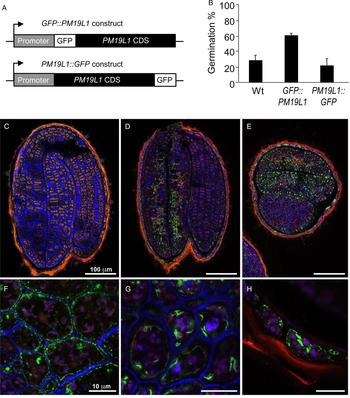
To gain insight into the function of PM19L1 we generated two reporter constructs using the native gene promoter with GFP fused to either the 5' (GFP::PM19L1) or the 3' (PM19L1::GFP) end of the gene-coding sequence (Fig. 5A). Both constructs were transformed into Col-0, several transgenic lines were recovered, and a homozygote line of each kind was studied. The GFP::PM19L1 displayed reduced dormancy (Fig. 5B), which was in agreement with the over-expression lines and suggested a functional reporter version of the protein. By contrast the PM19L1::GFP line showed wild-type levels of dormancy. We were able to localize the 5'GFP-tagged PM19 reporter protein in mature dry seeds (Fig. 5C–H), but we failed to visualize the 3'GFP-tagged PM19 version and it was abandoned. We localized the GFP-tagged PM19 using anti-GFP antibodies, because the GFP signal in dry seeds was too weak for reliable imaging. By this method, PM19L1 appeared to be expressed almost exclusively in the cotyledons and aleurone layer with some expression detected in the radicle (Fig. 5D,E). At the subcellular level, PM19L1 appeared to be located at the plasma membrane with some accumulation in subcellular compartments that could not be identified (Fig. 5F–H). The plasma membrane label appeared patchy, which is not uncommon for membrane proteins detected by immunofluorescence (e.g. Naramoto et al., Reference Naramoto, Kleine-Vehn, Robert, Fujimoto, Dainobu, Paciorek, Ueda, Nakano, Van Montagu, Fukuda and Friml2010; Brill et al., Reference Brill, van Thournout, White, Llewellyn, Campbell, Engelen, Ruan, Arioli and Furbank2011) or immuno-electron microscopy (e.g. Khan et al., Reference Khan, Wang, Sjölund, Schulz and Thompson2007), but it is also possible that PM19 was localized in discrete organelles in close proximity to the plasma membrane.
GFP localization of PM19L1. (A) Schematic representation of the two reporter constructs that were tested. (B) Germination of freshly harvested seed from the wild-type and the reporter lines. (C) Longitudinal section of Arabidopsis dry matured seed stained with secondary antibody only. No GFP fluorescence was detectable in the section. (D) Longitudinal section of Arabidopsis seed expressing 5'GFP-tagged PM19 showing anti-GFP label in the cotyledons and radicle epidermis. (E) Cross-section of Arabidopsis seed showing expression of 5'GFP-tagged PM19 throughout the cotyledons, aleurone layer and some in the radicle epidermis. (F) Higher magnification of cotyledon tissue showed 5'GFP-tagged PM19 located possibly in the plasma membrane, with some label within intracellular compartments. (G) Deeper tissues often showed more internal expression of 5'GFP-tagged PM19. (H) Aleurone layer cells also showed 5'GFP-tagged PM19 expression, both at the plasma membrane and in internal compartments. Scale bars: 100 μm for C–E, 10 μm for F–H.

PM19L1 co-expression analysis and ABA induction
Another approach to understand the role of PM19L1 and the pathways in which it is involved is to analyse the group of genes co-expressed with our target gene. We performed a co-expression analysis by comparing publicly available expression data using the SeedNet tool (Bassel et al., Reference Bassel, Lan, Glaab, Gibbs, Gerjets, Krasnogor, Bonner, Holdsworth and Provart2011) available at The Virtual Seed Web Resource (vseed.nottingham.ac.uk). The representation of the network of gene expression interactions has a topology (Fig. 6A) in which genes with similar expression patterns appear linked and nearby, and genes with different expression patterns are widely separated. The seed expression network showed two very distinctive regions: one associated with the genes expressed in dormant seeds and the other with the genes expressed in germinating seeds (Fig. 6B). Using this platform we compared the expression of PM19L1 with the genome-wide transcription profile in imbibed Arabidopsis seeds, allowing us to identify a small core network of 71 co-expressed genes that are abundant in dormant seeds (Fig. 6C). This core network (Table 2) shares over 0.75 correlation of expression with PM19L1 and contains genes with known roles and expression during late seed maturation (such as genes encoding late embryogenesis abundant (LEA) and other storage proteins) or in response to ABA (such as HVA22B or RAB18).
Co-expression analysis of PM19L1. (A) SeedNet topology. (B) Dormancy (red) and germination (blue) associated genes displayed in the network. (C) Detail of the small core of genes co-expressed with PM19L1. (D) GO-enrichment analysis results for the group of co-expressed genes.

SeedNet co-expression network for PM19L1 (data were obtained from The Virtual Seed Web Resource: http://www.vseed.nottingham.ac.uk/)

A gene ontology (GO; Ashburner et al., Reference Ashburner, Ball, Blake, Botstein, Butler, Cherry, Davis, Dolinski, Dwight, Eppig, Harris, Hill, Issel-Tarver, Kasarskis, Lewis, Matese, Richardson, Ringwald, Rubin and Sherlock2000) enrichment analysis (http://geneontology.org/page/go-enrichment-analysis; Mi et al., Reference Mi, Huang, Muruganujan, Tang, Mills, Kang and Thomas2017) showed that the PM19L1 co-expression network was significantly enriched in categories involving seed storage, maturation and dormancy, and responses to stress and ABA. The GO terms ‘seed oil body biogenesis’, ‘lipid storage’, ‘seed dormancy process’, ‘dormancy process’, ‘seed maturation’, ‘maintenance of location’ and ‘cold acclimation’ were enriched over 20-fold (Fig. 6D).
The co-expression analysis situated PM19L1 within a small group of genes that are ABA induced and dormancy related. Many of these genes, including PM19L1, have been reported to be directly (e.g. PER1, Em6 or Em1; Table 2) or indirectly regulated by the ABSCISIC ACID INSENSITIVE 3 (ABI3; Giraudat et al., Reference Giraudat, Hauge, Valon, Smalle, Parcy and Goodman1992) and ABI5 (Finkelstein and Lynch, Reference Finkelstein and Lynch2000) transcription factors (Lopez-Molina et al., Reference Lopez-Molina, Mongrand, McLachlin, Chait and Chua2002; Mönke et al., Reference Mönke, Seifert, Keilwagen, Mohr, Grosse, Hähnel, Junker, Weisshaar, Conrad, Bäumlein and Altschmied2012). To understand the role of PM19L1 in the context of ABA signalling, we first measured ABA in dry seeds of Col-0 wild-type and the pm19l1-1 mutant (Fig. 7A), and found no significant differences, indicating that PM19L1 did not affect the accumulation of ABA during seed development. Secondly, we found that PM19L1 was strongly induced in response to ABA during imbibition (Fig. 7B), which validated the results from the co-expression analysis.
ABA quantification and induction. (A) ABA content in dry seeds from Col-0 wild-type and pm19l1-1 mutant. (B) Relative expression of PM19L1 in seeds in response to imbibition in the presence of ABA. The expression levels shown are relative to those of dry seeds (0 h imbibition), to which a value of 1 was given. Means of three biological replicates with their SEs are shown.

ABI3 and ABI5 are key transcription factors governing the acquisition of desiccation tolerance and dormancy in seeds. PM19L1 is reported to be under the control of ABI3, which is upstream of ABI5 (Mönke et al., Reference Mönke, Seifert, Keilwagen, Mohr, Grosse, Hähnel, Junker, Weisshaar, Conrad, Bäumlein and Altschmied2012). In addition, the well-known DELAY OF GERMINATION 1 (DOG1; Bentsink et al., Reference Bentsink, Jowett, Hanhart and Koornneef2006) interacts with ABI3 and affects the expression of ABI5 (Dekkers et al., Reference Dekkers, He, Hanson, Willems, Jamar, Cueff, Rajjou, Hilhorst and Bentsink2016). For those reasons, and given the important role of these genes in dormancy, we analysed by qPCR the expression of ABI3, ABI5 and DOG1 in siliques from the wild-type and pm19l1-1 mutant collected at different times after pollination. As a check and as expected, the expression of PM19L1 was very high in Col-0 but almost absent in the mutant (Fig. 8A). We found a small but significant increase in the expression of both ABI3 and ABI5 at 15 and 25 days after pollination, respectively (Fig. 8B, C). The expression of DOG1 was also increased in pm19l1-1 at 15 days after pollination (Fig. 8D).
PM19L1, ABI3, ABI5 and DOG1 expression in Col-0 and pm19l1-1 mutant. RT-qPCR results of PM19L1 (A), ABI3 (B), ABI5 (C) and DOG1 (D) assayed in developing siliques. Means of three biological replicates with their SEs are shown. *Statistically significant differences using Student’s t-test at P < 0.05 (n = 3).

Discussion
We have examined for the first time the role of PM19L1 in Arabidopsis seed dormancy. We found that loss-of-function mutants of PM19L1, including T-DNA and silencing lines, displayed enhanced dormancy pointing to a role as a negative regulator of dormancy. Over-expressing the Arabidopsis and also the wheat TaPM19-A1 and A2 genes gave reduced seed dormancy, supporting this idea. These results seem to oppose our previous work in wheat which suggested that the TaPM19 genes were positive regulators of dormancy (Barrero et al., Reference Barrero, Cavanagh, Verbyla, Tibbits, Verbyla, Huang, Rosewarne, Stephen, Wang, Whan, Rigault, Hayden and Gubler2015); however, in rice the OsPM1 gene has also been found to be a negative regulator of germination (Yao et al., Reference Yao, Cheng, Gu, Huang, Li, Wang, Wang, Xu, Ma and Ge2018).
The finding that the same class of genes may play different roles in different species may be explained in the context of the different mechanisms of dormancy between those species. For example, while red/far red light ratios control germination in Arabidopsis with no effect of blue light, the reverse is true in wheat where blue light plays a major role in inhibiting germination (Barrero et al., Reference Barrero, Downie, Xu and Gubler2014). It is also possible that the results in Arabidopsis are ecotype dependent, and that in other ecotypes like C24, which produces seeds with higher dormancy, the effects of PM19L1 gene could be similar to wheat. Several other mutations affecting dormancy have opposite effects in Col-0 and C24 (Griffiths et al., Reference Griffiths, Barrero, Taylor, Helliwell and Gubler2011; Vaistij et al., Reference Vaistij, Gan, Penfield, Gilday, Dave, He, Josse, Choi, Halliday and Graham2013). In fact, the expression pattern of PM19L1 during seed imbibition, where gene expression disappears after imbibition and high expression is found in dormant seeds, points to role as a positive regulator of dormancy. Whilst it is not clear that a difference in function between Arabidopsis and cereals exist, we have demonstrated that the PM19L1 gene plays a role in the regulation of dormancy in Arabidopsis.
We have demonstrated that the PM19L1 gene is induced by ABA and it is co-expressed with a discrete network of dormancy-related genes that are ABA induced. PM19L1 belongs to a group of genes that are part of the ABI3 regulon (Mönke et al., Reference Mönke, Seifert, Keilwagen, Mohr, Grosse, Hähnel, Junker, Weisshaar, Conrad, Bäumlein and Altschmied2012) which are expressed during late seed maturation and are involved in dormancy acquisition, desiccation tolerance and accumulation of reserves. It is well known that ABI3 plays a principal role during seed maturation and that it interacts with other important dormancy regulators such as ABI5 and DOG1 (Dekkers et al., Reference Dekkers, He, Hanson, Willems, Jamar, Cueff, Rajjou, Hilhorst and Bentsink2016). In this context we found that the expression of ABI3, ABI5 and also DOG1 was transiently increased in pm19l1-1 mutant siliques during seed development, which agrees with the higher dormancy found in this mutant. A second report also found that PM19L1 and many of the genes that are co-regulated with it, were controlled by AREB1, AREB2 and ABF3 transcription factors in response to dehydration, salt or ABA (Yoshida et al., Reference Yoshida, Fujita, Sayama, Kidokoro, Maruyama, Mizoi, Shinozaki and Yamaguchi-Shinozaki2010). Similarly, members of the AWPM19 family of genes have been previously associated with dormancy and ABA. Koike et al. (Reference Koike, Takezawa, Arakawa and Yoshida1997) described for the first time the AWPM19 protein, and interestingly they showed that the increased freezing tolerance of ABA-treated wheat suspension cells was strongly associated with the accumulation of this protein. More recently the wheat gene named TaPM19-1 was shown to be highly expressed in grain during late maturation (Barrero et al., Reference Barrero, Cavanagh, Verbyla, Tibbits, Verbyla, Huang, Rosewarne, Stephen, Wang, Whan, Rigault, Hayden and Gubler2015) and also to be induced by ABA in roots (Li et al., Reference Li, Zhang, Zhang, Meng, Ren, Niu, Wang and Yin2012). In rice OsPM19L1 is expressed in leaves and its expression is strongly induced by abiotic stresses and ABA (Chen et al., Reference Chen, Lan, Huang, Zhang, Yuan, Huang, Huang and Zhang2015). A homologue gene in barley had also been shown to be embryo specific and to have reduced mRNA levels upon germination, but high levels in dormant embryos for up to 72 h of imbibition (Ranford et al., Reference Ranford, Bryce and Morris2002). In non-dormant embryos treated with NaCl, sorbitol or ABA, chemicals that prevent germination, the HvPM19 mRNA levels remained high or were induced. The expression pattern of these genes in several species shows that they are associated with late seed maturation and dormancy, and in some cases also with abiotic stress, although very little is known about their role in these processes. The fact that this class of genes is present and conserved in a wide range of higher plant species (Ranford et al., Reference Ranford, Bryce and Morris2002; Li et al., Reference Li, Zhang, Zhang, Meng, Ren, Niu, Wang and Yin2012; Alsaif, Reference Alsaif2013; Chen et al., Reference Chen, Lan, Huang, Zhang, Yuan, Huang, Huang and Zhang2015), always showing the same hydrophobic structure with four membrane-spanning domains, suggests that they may carry an important biological function (Koike et al., Reference Koike, Takezawa, Arakawa and Yoshida1997).
AWPM19 was initially described in wheat as a plasma membrane polypeptide (Koike et al., Reference Koike, Takezawa, Arakawa and Yoshida1997). Previous data from Arabidopsis expressing a 35S GFP reporter line suggested that PM19L1 is localized to the plasma membrane of root cells and induced by drought, although its presence in seeds was not studied (Alsaif, Reference Alsaif2013). The author suggested a role for PM19L1 as an ion exporter as the germination of pm19l1-1 mutant seeds in the presence of several salts was reduced compared with wild-type seeds. These results partially agree with studies in rice which found that OsPM19L1 was localized to organelle membranes in tobacco transient assays (Chen et al., Reference Chen, Lan, Huang, Zhang, Yuan, Huang, Huang and Zhang2015). Also in rice, a recent report by Yao et al. (Reference Yao, Cheng, Gu, Huang, Li, Wang, Wang, Xu, Ma and Ge2018) proposed an interesting new role for another member of this gene family, OsPM1, as an ABA influx carrier localized to the plasma membrane which can confer drought tolerance by over-expression. OsPM1 was expressed in vascular tissues, in stomata and in mature embryos, and was described as having a role as a negative regulator of seed germination in rice, although dormancy was not analysed in that study (Yao et al., Reference Yao, Cheng, Gu, Huang, Li, Wang, Wang, Xu, Ma and Ge2018). Other OsPM1 genes were found to have different expression patterns, suggesting that this class of genes could participate in ABA uptake in other tissues. In these reports, PM19 was localized to the plasma membrane or to organelle membranes using reporter constructs with constitutive promoters and ectopic transient expression assays (Alsaif, Reference Alsaif2013; Chen et al., Reference Chen, Lan, Huang, Zhang, Yuan, Huang, Huang and Zhang2015; Yao et al., Reference Yao, Cheng, Gu, Huang, Li, Wang, Wang, Xu, Ma and Ge2018). Our localization results also suggest a plasma membrane location for PM19L1, which would agree with some previous studies, but given the patchy pattern found using the PM19L1 own promoter it could also be associated with discrete organelles in close proximity to the plasma membrane. We also detected labelling in irregularly shaped internal compartments, which we could not categorize.
Biochemical fractionation studies in Arabidopsis found PM19L1 in the membranes of oil bodies in mature seeds, along with the proteins oleosins, calleosins and steroleosins (Vermachova et al., Reference Vermachova, Purkrtova, Santrucek, Jolivet, Chardot and Kodicek2011). We showed that the gene co-expression network that includes PM19L1 is particularly enriched in functional categories related to oil bodies (e.g. ‘seed oil body biogenesis’ or ‘lipid storage’), and that some of the co-expressed genes encode oleosin and steroleosin family proteins. Interestingly, Arabidopsis mutants affecting oil body membrane proteins (such as oleosin or caleosin mutants) produced seeds with altered dormancy (Chapman et al., Reference Chapman, Dyer and Mullen2012). Many of the other co-expressed genes encode storage and dehydration proteins such as the LEAs, which although traditionally seen as storage proteins, can play an active role in modifying ABA sensitivity and germination as for LEA3-3 (Zhao et al., Reference Zhao, Liu, Ma, Gong, Wang, Jia, Zheng and Liu2011). Another one of the co-expressed LEAs, SEED MATURATION PROTEIN 1, is involved in the acquisition of secondary dormancy in response to temperature (Chen et al., Reference Chen, Nayak, Majee, Lowenson, Schafermeyer, Eliopoulos, Lloyd, Dinkins, Perry, Forsthoefel, Clarke, Vernon, Zhou, Rejtar and Downie2010), which is another trait shared with PM19L1. As explained before, this suggests a role for PM19L1 as a part of a small core set of genes important for late seed maturation, reserve storage and dormancy acquisition, which could be a subset of a regulon governed by ABI3 (Mönke et al., Reference Mönke, Seifert, Keilwagen, Mohr, Grosse, Hähnel, Junker, Weisshaar, Conrad, Bäumlein and Altschmied2012). This role fits very well with our PM19L1 tissue localization in the cotyledons, which is the reserve storage organ in the Arabidopsis seed (Mansfield and Briarty, Reference Mansfield and Briarty1992). We also found PM19L1 in the cells of the aleurone layer, which is also a lipid-rich tissue (Penfield et al., Reference Penfield, Rylott, Gilday, Graham, Larson and Graham2004) very important for controlling germination. It is noteworthy that the gene with the most similar expression to PM19L1 is HVA22B, one of a class of genes that in barley inhibit aleurone vacuolization as part of its role in regulating seed germination and seedling growth (Guo and Ho, Reference Guo and Ho2008). Our GFP localization studies are consistent with the reported presence of PM19L1 in oil bodies, but more work is needed to establish with certainty the exact localization of PM19L1 in seeds and also if its localization can change depending on dormancy status and germination conditions (e.g. temperature).
In several species including Arabidopsis, high temperature during imbibition can generate secondary dormancy in non-dormant seeds (Chen et al., Reference Chen, Nayak, Majee, Lowenson, Schafermeyer, Eliopoulos, Lloyd, Dinkins, Perry, Forsthoefel, Clarke, Vernon, Zhou, Rejtar and Downie2010), due to an enhancement in ABA sensitivity in the treated seeds (Martel et al., Reference Martel, Blair and Donohue2018). The germination of pm19l1-1 mutant seeds showed increased sensitivity to the high temperatures that produce secondary dormancy, and this phenotype is in agreement with previous reports in other species. For example, the barley PM19 gene was induced in the grain by heat stress (Mangelsen et al., Reference Mangelsen, Kilian, Harter, Jansson, Wanke and Sundberg2011) and in wheat we described previously that the expression of TaPM19-A1 was supressed by high temperatures during grain maturation, thus leading to a decay in dormancy (Barrero et al., Reference Barrero, Cavanagh, Verbyla, Tibbits, Verbyla, Huang, Rosewarne, Stephen, Wang, Whan, Rigault, Hayden and Gubler2015). As PM19 proteins have been localized to membranes and seem to be relatively abundant, they could play a role in modifying the membrane properties, and thus modulate responses to temperature, which was proposed some time ago as an elemental mechanism regulating dormancy and germination (Black et al., Reference Black, Bewley and Halmer2006). The direct link between PM19L1 and ABA suggests that this gene may be part of a missing mechanistic pathway linking the hormone ABA, temperature and membrane properties, which are key factors influencing seed dormancy and germination.
Acknowledgements
We thank Ms Trijntje Hughes and Ms Jasmine Rajamony for their excellent and dedicated technical assistance. We also thank Mr Corentin Losson and Mr Ronan Griot for their efforts during their internships, and Dr Loïc Rajjou from AgroParisTech for facilitating their visits. Finally, many thanks to Dr Paweł Widera for his help retrieving data from SeedNet, and in particular to Dr Maria M. Alonso-Peral for the thoughtful critical review.
Financial support
This work was supported by the CSIRO.
Supplementary Material
To view Supplementary Material for this article, please visit: https://doi.org/10.1017/S0960258519000151