Introduction
Design studies have recently begun to pay closer attention to the economic impact the law has on design. Carma Gorman remarks in her 2014 article that intellectual property laws significantly differ among nations. Footnote 1 Consequently, she proposes the law as an area of intensified study, and argues that it has “significant economic consequences” on design as well as on creators, regulators, manufacturers, and consumers of design products. Footnote 2 With this article on the cantilever chair, I contribute to the debate. I explain the segmentation of today’s market for iconic cantilever designs through the early business history of the chairs in which intellectual property rights (IPRs) play a crucial role. More generally, I hope to exemplify the contribution that economic and business history can make to understand the economic impact of law on design.
Several scholars have investigated the relationship between the law and the value of design. Stina Teilmann-Lock shows, by way of contemporary examples from Denmark, that national jurisdictions impact the ways in which designs “are appreciated and valued” in an aesthetic sense. Footnote 3 She also calls attention to the negative impact on personal wealth, resulting from the difficulty of fashion designers in Denmark to be recognized as authors. Footnote 4 Aviva Meridian Kaiser and Zachary Kaiser, also in 2014, warn that the shift of IPR ownership from designers to digital design platforms changes the discursive field that defines the value of creativity. Footnote 5 Phil McCollam examines the value of design from the perspective of social inclusion, calling on the profession to favor “more ethnically minded and better-trained designers.” Footnote 6 Véronique Pouillard adds a historical perspective and shows how French fashion businesses in the 1950s protected the market value of their products in spite of failing to protect them as intellectual property. Footnote 7 Pouillard argues that they “managed to shift the authenticity of their work from the design to the brand.” Footnote 8 An investigation of the cantilever chair from a historical-commercial perspective complements these efforts. It provides more detailed insight into the circumstances under which the law impacts the material value of a design product.
One Design, Two Market Segments
The cantilever chair as a type-form is a modern classic. Developed in the late 1920s, its characteristic feature is a sledge-like steel frame construction that requires no rear legs. Typically, the steel frame has a shiny chrome finish. Early original examples, such as Marcel Breuer’s B 32, are part of the collections of the Victoria and Albert Museum in London and the Museum of Modern Art in New York City. The cantilever chair is the subject of exhibitions, monographs, coffee table books, and scholarly research.
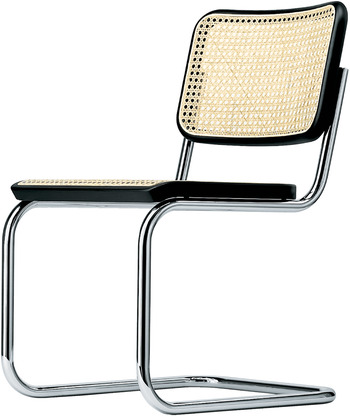
The cantilever chair, too, is a tradable commodity in the furniture market. Since the early 1930s, cantilever chairs have brought a cold touch and sterile look not only into offices and conference spaces but also into the privacy and comfort of the living room. Today, Ikea’s cantilever model TOBIAS costs £65 and is an affordable product for the mass market. It consists of a seat shell made from polycarbonate plastic that is montaged onto a chrome-plated cantilevered leg frame. Footnote 9 Breuer’s iconic design is available on the contemporary furniture market as well (Figure 1).
Thonet GmbH’s S 32 V, 2016. Thonet GmbH prices the chair at approximately £540. Other producers, e.g., Steelclassic, offer almost the same design for as little as £120.
Source: Thonet GmbH Germany, Mediendatenbank. Used with permission.

Donatella Cacciola shows that production and details of construction and design have evolved since the interwar period, but the look of the chair has remained very much the same. Footnote 10 Breuer’s design consists of the typical chrome-plated steel sledge. Wooden frames with a cane weaving make up the seat and backrest.
Unlike the Ikea model, Breuer’s chair simultaneously belongs to two segments of the market. Depending on the manufacturer, the price stretches from the lower to the upper range. British-Italian company Steelclassic demands as little as £120 for the “Marcel Breuer - Cesca Chair.” Footnote 11 The name Cesca dates back to the 1960s, when Breuer marketed his design in collaboration with the Italian company Gavina. Footnote 12 The German company Thonet GmbH sells the Breuer design, labeled as S 32 V, for approximately £540. Footnote 13 I can make the same observation for many other early modernist designs, such as the Barcelona Chair by Mies van der Rohe or the LC4 Chaise Longue by Le Corbusier; various companies offer the same design or very similar designs at significantly different prices.
A crucial difference between the S 32 V and the Cesca chair is whom their producers attribute as creators. Thonet GmbH refers to Breuer as designer of the S 32 V but takes care to mention as well that the artistic copyright lies with Mart Stam, the Dutch architect. Footnote 14 Steelclassic, in comparison, only refers to Breuer as designer of the Cesca chair. Footnote 15 It is worth taking notice of the fact that Thonet GmbH, the manufacturer of the much more expensive S 32 V, refers to Stam. The upmarket position of the S 32 V today is opposite to the intentions that Stam originally pursued with his work. In 1926 Stam argued: “[Representation] testifies to unscrupulousness, to an anti-social way of life at times when the claims to a minimal standard of living remain unsatisfied for thousands amongst the working population.” Footnote 16
Stam’s maxim was “general economic efficiency” in a time of scarcity and material grievance. Footnote 17 Stam shaped the final declaration of the first Congrès International d’Architecture Moderne in June 1928, in La Sarraz, Switzerland, into a demand for the economic efficiency of architecture. Footnote 18 Eric Mumford maintains that the declaration’s section on urbanism echoes the Communist Manifesto of Marx and Engels. Footnote 19 In the 1930s, Stam was part of the Brigade May, a group of architects that tried to build rational worker cities in Magnitogorsk, Makijiwka, and Orska in the Soviet Union. Footnote 20
Stam’s work was part of the modernist movement of the interwar years that affected all creative and productive domains. Among its tenets were an engagement with social and political problems and the unity of art and craft. Footnote 21 It revolved around building a utopian world that was “materially, spiritually, politically, socially and visually a better place.” Footnote 22 Chairs, in particular cantilevered chairs made from steel tubes, have gained a symbolically important position in the modernist project. They disproportionately attracted the creative efforts of architects. Christopher Wilk adduces several explanatory factors: first, architects had few opportunities to work on actual buildings; second, steel allowed the creation of structurally novel and statically daring forms such as the cantilever; third, existing furniture did not match the style of the emerging modernist buildings, causing architects to remake furniture that fit their buildings; and, fourth, steel as a material lent itself particularly well to implement the functionalist and hygienic aesthetic to which architects aspired. Footnote 23
Wilk, too, provides a starting point from which to investigate the journey of Stam’s creation. Modernism, argues Wilk, was stripped of its social beliefs over the course of the 1930s. It lost its political edge and became “one of a number of possible styles” when modernist creations entered the market place. Footnote 24 By 1935 Stam thought that steel furniture had degenerated into an “effete and decadent” mass of “steel macaroni monsters.” Footnote 25 How is it that Breuer’s design, as well as several others’ designs, rose above the macaroni monsters? Why are they trading in the lower and upper segment at the same time? I begin by examining the prose that Thonet GmbH and Steelclassic employ to market their products today.
Real Copies and Accurate Reproductions
Thonet GmbH, based in Frankenberg, Germany, argues that it has been producing the “original S 32” since 1929–1930, when Breuer designed the chair. Footnote 26 Thonet GmbH also refers to Mart Stam, holder of the “artistic copyright,” whose name in turn is a registered trademark of Thonet GmbH. Footnote 27 The company offers a service for customers to test whether they own a “real” Thonet chair. Footnote 28 In contrast, British-Italian company Steelclassic regards its chairs to be “accurate reproductions [without] relevant deviations from the original design.” Footnote 29 Originals, to Steelclassic, are pieces “manufactured personally by […] designers” that today are “extremely rare […] and largely in the possession of museums or private collectors.” Footnote 30 Steelclassic explains that German copyright law is less lenient than that of Italy or Britain, making it entirely “legal to buy furniture reproductions” in the latter countries and to ship them all over Europe. Footnote 31
Evidently, the two manufacturers are using the term “original” in incompatible ways. Thonet GmbH claims to be producing originals since 1929, while Steelclassic claims that originals are first exemplars or archetypes. The diverging uses of the term “original” are rooted in the early history of the IPR to Breuer’s design more specifically and to the cantilever chair more generally. From the design historical perspective of Werner Möller and Otakar Máčel, the cantilever chair was a “collective invention.” Footnote 32 Courts in different countries, however, have formulated diverging and differentiating answers to the question of authorship. As a consequence, several national strands make up an idiosyncratic overall picture.
The major contribution in unpicking the IPR situation surrounding the cantilever chair is made by Máčel. Footnote 33 Architect Mart Stam designed and built a frame for a chair without rear legs in 1926. This was the archetype of the cantilever chair. Stam built it from offcuts of gas pipes that were held together by pipefittings. Footnote 34 His idea was quickly adapted by numerous other architects and designers, among them Marcel Breuer and Ludwig Mies van der Rohe. Mies was the first to formally secure intellectual property rights related to the cantilever chair. Footnote 35 Technical patent DRP 467 242 was filed in Germany on August 28, 1927. Mies used a single piece of “cold-drawn steel tube, bent in a semi-circle to form a continuous line from the supporting part to the seat and the back,” resulting in a frame that had sufficient springiness for comfort. Footnote 36
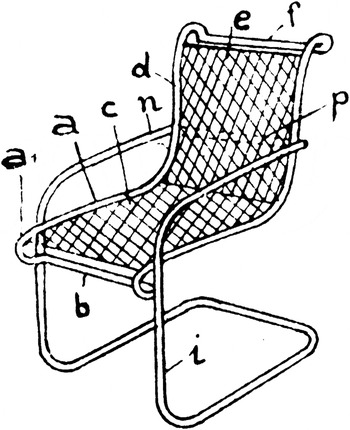
The market entry of Thonet AG, the forerunner of Thonet GmbH during the interwar years, intensified IPR-related activities. Footnote 37 Thonet AG contracted Breuer as designer in 1928 and bought Standard Möbel, the furniture business of Breuer and Kálmán Lengyel, in April 1929. Footnote 38 Anton Lorenz, the director of Standard Möbel, spotted a business opportunity and moved to control IPRs. He registered a utility model in his own name in 1928 (Figure 2). In 1929 he bought all of Stam’s rights, assuming that Stam was the artistic creator, and took Thonet AG to court to prevent the company from producing any cantilevered models. Footnote 39
Drawing by Anton Lorenz (1929) for his utility model application. Lorenz tried to establish himself as owner and broker of IPRs to cantilevered designs.
Source: Möller and Máčel, Ein Stuhl macht Geschichte, 53. Otakar Máčel Archive. Used with permission.

In 1932 the legal rights of Lorenz were established in Germany. Footnote 40 The courts recognized Stam’s original chair as an artistic creation, to which Lorenz owned the rights. Stam’s authorship would expire thirty years after his death. Footnote 41 Stam’s artistic copyright in Germany was confirmed several times afterward, including in 1944 as part of a lawsuit that Mies initiated to protect his technical patent and in 1961 and 1981 by the German Federal Court of Justice. Footnote 42 In 1986, when Stam actually died, authorship protection had been extended to seventy years. Thus, according to German law, Stam’s cantilever chair is an “individual creation” of “original value that rests in its entirety on a primary, individual vision.” Footnote 43 Every cantilever chair produced in Germany after Stam’s 1926 archetype is the replica of an original. In 1932, after Lorenz had won his lawsuit, he licensed his rights exclusively to Thonet AG, which is followed by Thonet GmbH today.
How did the IPR situation of the cantilever chair develop outside of Germany? From 1933 to 1935, Lorenz was director of the intellectual property department of Thonet AG, and the duo went to court in the Netherlands, Sweden, and Denmark. While the cantilever chair was recognized as a technical innovation, the courts did not think that it was an artistic creation. Footnote 44 Technical patents, like industrial designs, are usually protected for twenty to thirty years. It is not clear if there were similar legal disputes in Italy and Britain at the time or which outcomes they might have produced. The language that companies such as Steelclassic use today, however, gives an indication of the chair’s legal status. Steelclassic does not refer to Stam’s artistic copyright. The company does, however, refer to Breuer’s design and argues that its IPR protection expired after twenty-five years. Footnote 45 A German State Court in Düsseldorf in 2009 enjoined an Italian company from referencing Stam in advertising one of its cantilever chairs in Germany. Footnote 46 At the same time, in Italy and Britain, the production and advertisement of cantilever chairs with reference to Stam is common practice and evidently legally unproblematic.
As Gorman, Teilmann-Lock, and Pouillard each suggest, the legal status of a design product in the market depends on national jurisdictions. Footnote 47 In Germany, a cantilever chair that looks like Figure 1 has a threefold legal status: the form that Stam created in 1926 is an artistic creation; Mies’s use of a single piece of resilient steel tubing is a technical patent; and the design itself is attributed to Breuer. IPR protection through technical and design patents have long since expired, but Stam’s artistic creation will be protected by copyright until 2056. In Italy and Britain, in contrast, such a chair never was an artistic creation. It might be a technical innovation and an original design but legal protection for both would have expired by now. Consequently, both the Cesca chair and the S 32 V are reproductions of a Breuer design and use a technical patent by Mies. In Germany, however, the S 32 V is, in addition, the copy of an artwork by Stam to which Thonet GmbH holds exclusive rights.
The Law and the Value of Creativity
What is the difference between a work of art and a design object? According to German law, the former has to be an “original creation […] that rests in its entirety on a primary, individual vision.” Footnote 48 Artistic copyright law protects the particular material configuration of an object, indifferent to its material or use value. Moreover, it protects the creative and intellectual effort of the artist, which has “come to visible expression” in the work of art. Footnote 49 The form of an artwork is protected in itself and by being the material proxy of an immaterial creative effort. A design, or Geschmacksmuster, in comparison, is equally protected in its material configuration, but it does not count as an “individual, artistic vision.” Footnote 50
Alfred Osterrieth, in his History of Property Rights in England, recounts how Locke’s conception of property and labor was applied in the 1709 Statute of Anne, in order to protect publishers from illegal reproductions of their books. Footnote 51 Osterrieth credits William Warburton with delivering the “first application of Lockean principles to literary property,” in his 1747 Letter from an Author. Footnote 52 Warburton stressed the strain in creating an artistic form, to which he extended the concept of property. Thus, the notion of the author became intertwined with his or her singular work of creativity. Both are rooted in the need for a discursive justification of creative property in the legal realm.
Teilmann-Lock points to the impact that Kant’s aesthetic theory had on the legal discourse in Germany. Kant distinguished the fine arts from the applied arts, or Lohnkunst, arguing that only the creative effort in the fine arts is pleasant and can therefore be regarded as an individual expression. The creative effort in the applied arts, in contrast, fulfills the purpose of “attracting a wage.” Footnote 53 Hence, it is interspersed with labor, not genuinely pleasant, and cannot be regarded exclusively as the creative expression of an individual. Footnote 54 Teilmann-Lock tracks how Kant’s distinction found its way into German Idealism and eventually into Germany’s legal scholarship, promoted by Otto von Gierke in the late nineteenth century. Footnote 55
Gerhard Plumpe argues that actors in the art world itself created the distinction from manufacturing, and later from industrial techniques, with the emergence of the aesthetic discourse in the eighteenth century. Footnote 56 Then, antiquity’s notion of art as mimesis was superseded by the notion of art as the subjective impression of an individual. Footnote 57 The fine arts differentiated themselves from the applied arts by ascribing to them reducibility to scientific knowledge, which is general, nonexclusive, and nonindividual. For themselves, the fine arts claimed particularity, exclusivity, and individuality. They could do so only by tying the work of art categorically to the unique subjectivity of its creator. Footnote 58 The driving forces behind the shift to artistic subjectivity, argues Plumpe, were formal institutions that were created to protect the products of creative labor. He argues that it was the “judicialization” of artistic practice since the 1750s that has resulted in an “epoch-making turn” for the self-conception of art. Footnote 59
The law suggests that the value of art and design is neither exclusively captured by the total cost of material, labor, and capital nor by the utility of an item. Creativity, contained in the form of a creative product, has a residual value to the law. That value is greater for art than for design, because the former is the expression of a singular vision. How did this distinction play out in the market? Does it help to explain the price differential between an S 32 V and a Cesca chair?
The Cost of Intellectual Property Rights
Intellectual property rights are a cost factor. Historically, Thonet AG built its business by purchasing copyrights and protecting the company’s own designs. Breuer was contracted in 1929. Thonet AG forestalled Lorenz in 1931, purchasing Mies’s rights for a share of 5 percent in revenue. Footnote 60 In 1932 the company reached an agreement with designer Walter Knoll and purchased production rights from Lorenz. The arrangement of Thonet AG was comparably favorable. Lorenz received 4 percent of the retail price from Thonet AG, while CEBASCO, a much smaller manufacturer, had to pay 10 percent. Footnote 61 Lorenz, in turn, had to transfer a share of the licensing fees to the designers. Initially, there was a considerable spread, with Stam receiving 1 percent of the revenue and the Luckhardt brothers receiving 5 percent. Footnote 62 Later, these arrangements converged toward an equal split between Lorenz and the designers. Footnote 63
Today, Thonet GmbH pays for the exclusive right to reproduce Stam’s artwork, too. The historical record suggests that the fee is about 5 percent of the retail price. Consequently, the customers of Thonet GmbH, knowingly or unknowingly, pay a mark-up in order to own a replica of an artwork, not just a design reproduction. Thonet GmbH pays an estimated £27 in licensing fees per chair (calculated as 5 percent of £540). Furthermore, Thonet GmbH incurs costs in enforcing its exclusive rights in Germany. Steelclassic, in comparison, has no such costs. Considering that the price differential between the S 32 V and the Cesca chair is approximately £420, the major share remains to be explained.
Product quality is related to differences in legal status. Manufacturing a high-quality product is a way for Thonet GmbH to differentiate the S 32 V from the Cesca chair in a way that customers can experience. Footnote 64 Hence, quality underpins the differentiation of Thonet GmbH’s product. While the actual difference in quality between an S 32 V and a Cesca chair is unclear, Thonet GmbH is certainly perceived as the higher-quality manufacturer.
This market position dates back to 1929, and it is rooted in the actual production of Thonet AG. The company consistently used expensive cold-drawn, seamless steel tubing. It was available starting only in the late 1880s, after the Mannesmann brothers developed the so-called pilgrim-step method, or Pilgerschrittverfahren. Footnote 65 This method facilitated the production of resilient steel tubing of any length and with smaller diameters and thinner walls. The new material showed hardly any fatigue, and since no or very little welding was involved, its structure had no weak points. Footnote 66 Initially, cold-drawn steel tubing was used in industries revolving around transportation and mobility, such as aviation, automotive, and shipbuilding; later, it was also employed in apparatus engineering. Footnote 67 Complying with DIN standard 2385, the 1935 Mannesmann tubes had an intrinsic fatigue resistance of 35 kg–45 kg/mm. In other words, they were resistant to fissure against several millions of repetitive strains of up to 45 kg/mm. Footnote 68 That was equivalent to the resistance of Krupp’s steel that was used in railway axles at the time. Footnote 69 In the 1930s, many competitors of Thonet AG resorted to cheaper steel tubing, which had a tangible impact on the comfort of the chairs and their life cycle. Footnote 70
Moreover, it appears that the production of Thonet AG has always been a little more intricate than that of its competitors. There were at least two more layers under the chrome finish: copper followed by nickel. Footnote 71 To make the different platings stick and to effectively protect against corrosion, the depth of the pores on the steel surface has to be reduced. The tubing has to be sanded down and polished thoroughly with several abrasive belts of increasing granularity. Footnote 72 In addition, all wooden parts are ergonomically shaped and built up as composite work pieces from sheets of wood glued together. Every piece of wood is sanded, polished, and cleaned with acid at least three times. Footnote 73 Companies that tried to compete with Thonet AG in the past were more lax with the polishing or simply skipped the copper-plating. Consequently, the chrome-plating was less adherent and the chairs rusted quickly. Footnote 74 Finally, customers who bought Thonet chairs were always offered choices. Frames, seats, and backrests were and are available in many different finishes, colors, and materials. Footnote 75 The corollary is a slower and more complicated production process. In addition, offering choices heightens the intricacy of the entire workflow, from marketing, to distribution, to accounting, all of which generally lead to greater costs.
It is the perceived wisdom that IPRs and product quality, as corollaries, are cost factors for a producer. Footnote 76 Hence, the law raises the threshold at which production becomes profitable. Neither historical nor current data are available to quantify these costs exactly. Qualitative and anecdotal evidence strongly suggests that Thonet GmbH has higher production costs than does Steelclassic, not least due to geography. It is unlikely, though, that IPRs and product quality are sufficient to explain the entire price differential between an S 32 V and a Cesca chair. Hence, price could be thought of not from a cost perspective but from a demand perspective.
The Utility of Intellectual Property Rights
Why does it make sense to think about demand, and which role does that leave for IPRs? Probably only very few customers are familiar with the details of the intellectual property situation of the Breuer chair. However, customers who buy the S 32 V of Thonet GmbH probably have a sense of buying the “real” or “original” Breuer chair. This assumption is supported by the efforts of Steelclassic to dispel the notion that its Cesca chair is “merely a copy.” The standing that Thonet GmbH enjoys today dates back to the early 1930s.
The observations of several scholars indicate that Thonet AG pursued an upmarket strategy from the start. Wilk points out that a steel chair by Thonet AG “could cost up to three times as much as the least expensive bentwood chair” of the company. Footnote 77 While Wilk does not present any quantitative evidence, his assessment generally fits to the cantilever chair’s early legal history and other observations. Möller and Máčel notice the high price of steel tube chairs, too. Prices at the 1929 exhibition, “The Chair,” in Frankfurt, Germany, ranged from Rm25 to Rm65, while Thonet’s bentwood model A7 was available for Rm14; meanwhile, a weekly wage was approximately Rm45. Footnote 78
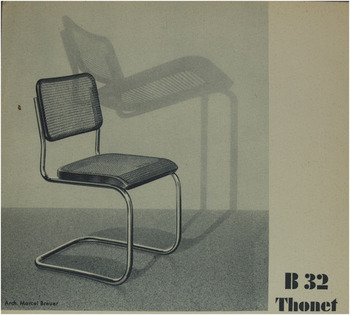
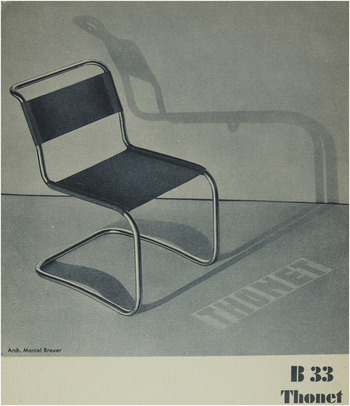
These remarks are complemented by the results of Ariana Lourie Harrison’s (née de la Belleissue) doctoral thesis of 2008. De la Belleissue investigates the marketing and branding activities of Thonet AG from 1929 onward. She shows how the company mobilized “the auratic potential of brand and signature in order to cultivate new markets for modernism.” Footnote 79 The management of Thonet AG, in collaboration with contemporary designers, according to de la Belleissue, established Thonet as a leading brand for modernist furniture. Footnote 80 On the 1931 price list, Thonet-Mundus advised that its models were protected by IPRs and that copyists would be prosecuted; the company referred to its designers as “authoritative architects.” Footnote 81 The same year, in response to the emergence of unlicensed copies, Thonet AG affixed little plaques to its chairs, stamped with the names of the company and designer. Footnote 82 By 1930–1931, Thonet AG had developed the “signature style,” too, in which photographs of the furniture were “autographed” by designers, sometimes together with the Thonet name (Figures 3 and 4). Footnote 83
B 32 in Thonet AG’s portfolio catalogue of 1930–1931. “Architect Marcel Breuer” is referenced as designer in the bottom left corner.
Source: Günther et al., Thonet Steckkartenkatalog. Vitra Design Museum. Used with permission.

B 33 card in Thonet AG’s portfolio catalogue of 1930–1931. Part of the “signature style” was that the company name appeared in the photographs, along with names of designers.
Source: Günther et al., Thonet Steckkartenkatalog. Vitra Design Museum. Used with permission.

Photographs of cantilevered models such as the B 32 or the B 33 employ reduced, yet strong, visual means (see Figures 3 and 4). A single chair is shown in front of a wall, where a spotlight casts an oversized hard shadow, dramatizing and monumentalizing the appearance. Character and rarity of the chairs are emphasized by the name of the designer (titled architect), which is inset on the bottom left corner of the image. Alluding to a painter’s signature on his work, the reference to the designer marks artistic ownership and links the item back to a creative individual. During its first few years in the market, Thonet AG taught customers to perceive Thonet and names such as Breuer as synonymous with the modernist style. Footnote 84
In discussing customer perception of the Thonet brand and Thonet furniture, de la Belleissue considers the role of IPRs as well. Footnote 85 She argues that the market of Thonet AG “eroded with the influx of illegitimate copies” and that the company turned to copyright and patent law to “secure the authenticity of its product.” Footnote 86 De la Belleissue puts forward a sequential chronology. She conceives IPR protection by Thonet AG as a response to an eroding market that chronologically follows conventional marketing and branding. I challenge that sequential narrative: the timing of Thonet AG’s legal activities indicate that they were deployed simultaneously with marketing and branding activities. IP protection of designs was an integral part of Thonet AG’s steel tubing furniture business from the start. Importantly, though, de la Belleissue shows that Thonet AG’s marketing and branding converted the legal status of the company’s products into a perceived authenticity in the market. That mechanism is still effective today. It explains why a company such as Steelclassic is so keen to assure potential customers that its Cesca chair is a legal and true original reproduction of Breuer’s design. Footnote 87
Regarding IPRs, two factors have been identified to explain the price spread between an S 32 V and a Cesca chair. First, there are costs that are directly and indirectly associated with the legal status of the chair that can raise its retail price; second, and vitally, there is reputational authenticity of the producer’s brand and product, based to a large extent on actually owning or licensing IPRs. The case of Thonet AG shows that owning IPRs can enable a company to shape the market of a design product. Control over IPRs has some effect in preventing competitors from producing licensed designs. Most importantly, though, combining IPRs with marketing and branding activities creates an opportunity to infuse the company name and its products with a sense of “realness” that extends beyond patents and artistic copyright.
Pouillard has made a similar argument for French fashion businesses in the 1950s. Footnote 88 After French firms failed to protect their designs through international copyrights, Pouillard argues, they “managed to shift the authenticity of their work from the design to the brand.” Footnote 89 An important difference to Pouillard’s case is, however, that Thonet AG legally protected its products through IPRs. Although Stam’s chair was legally an artwork only in Germany, it seems that design and technical patents were recognized more widely. The problem is the enforcement of IPRs in wide geographic markets and jurisdictions. Footnote 90 The case of Thonet AG teaches us that marketing and branding can complement and draw on IPRs. A company that owns or licenses IPRs can transfer the legality of its products to its brand. In that process, legal authenticity is converted into reputational authenticity.
Most likely, IPR-infused marketing and branding of Thonet AG in the 1930s explains most of the price difference between an S 32 V and a Cesca chair today. Customers perceive the product by Thonet GmbH as the real one and are willing to pay a markup that exceeds Thonet GmbH’s higher costs. How did Thonet AG find the customers that were willing to pay for “authentic” furniture in the first place? How did the company set absolute prices? Again, some of the answers come from the company’s early business history.
Chrome and the Premium for Authenticity
Surprisingly little is known about the concrete economic forces that acted on steel-tube furniture in its first years. Christopher Wilk and J. Stewart Johnson argue that production suffered from high costs of material and, before Thonet AG, lacked scale and proper management. Footnote 91 The particular aesthetic and tactile features of steel tubing played a role in terms of market acceptance, but opinions diverge on what that role was. Some scholars see aesthetics as the key obstacle to quicker dissemination. Wilk points to contemporaries who criticized “robot modernism”; steel furniture violated the private sphere with materials and looks that belonged to the realms of sanitation, commerce, and science. Footnote 92 Möller and Máčel point to the “optical chill” of steel furniture, too. Footnote 93 In contrast, Sonja Günther and colleagues see contemporary consumer taste adapting quickly, and they argue that the new look was “in fashion” by 1930. Footnote 94
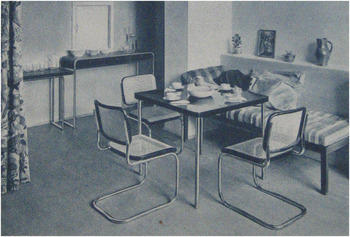
Von Vegesack argues that Thonet AG succeeded because of its international reach and financial strength that allowed the company to adopt the “new ideology,” which architects such as Stam and Mies brought to design, and to match it to market demands. Footnote 95 Von Vegesack qualifies his assessment with an analysis of the visual language that Thonet AG adopted (Figure 5). He argues that it was a successful blend of “forceful design” with rather ordinary “contemporary tastes.” Footnote 96 Máčel identifies strong commercial dynamics, too, but rather to the disadvantage of Thonet AG. He remarks that over the course of the 1930s, the “sheer volume of production” all over Europe made it impossible for Lorenz to effectively control the rights he legally owned. Footnote 97 Thonet AG should have faced the same problems.
Breuer’s chair, then designated as B32, as part of a living room in Thonet AG’s 1932 catalogue. The interior blends the progressive modernist design of steel-tube furniture with rather plain and conservative elements, such as a pitcher and flowerpot on the sideboard.
Source: Thonet GmbH Archive Germany, “F/3: Thonet 3209 (Catalogue),” 1932. Used with permission.

It can be inferred from other sources that the market was highly contested, indicating tight or even negative profit margins. Breuer and Lengyel chose to stop production at Standard Möbel and sell the company to Thonet AG in 1929. Lorenz closed down his company DESTA in 1932 to take up his position at Thonet AG, after racking up debt of Rm130,000. Footnote 98 CEBASCO exited the market in 1934; and Möller suggests, like Máčel, that a continuous stream of illegitimate copies threatened to erode prices and cause legal costs. Footnote 99
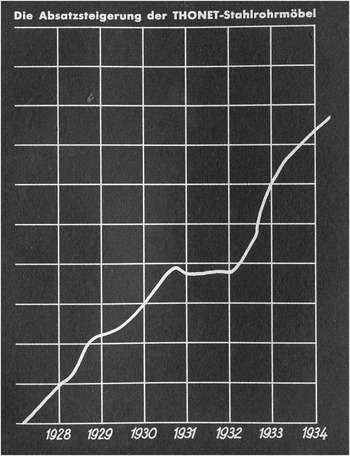
As von Vegesack argues, the size of Thonet AG, and its increasing scale, certainly played an important role in the company’s success. It had more resources than smaller manufacturers, and higher volumes resulted in lower unit costs. Standard Möbel was a one-man workshop in 1928; DESTA and CEBASCO were larger, but neither were the size of Thonet AG. Footnote 100 Unfortunately, it is unknown what the accounts of Thonet AG in the interwar years looked like. An aircraft bomb hit the company’s production site and offices in Frankenberg, Germany, on March 12, 1945, and most papers went up in flames. Footnote 101 A snippet survived though, which suggests that an important piece to the puzzle has been overlooked so far (Figure 6).
Thonet’s revenue from steel-tube furniture, 1928–1934.
Source: Thonet GmbH Germany, “Thonet Stahlrohrmöbel Katalog,” 1935, reprint, inside front cover. Used with permission.

The graph reproduced in Figure 6 is taken from the reprint of the 1935 catalogue and shows the increase in revenue from Thonet’s steel-tube furniture business from 1928 to 1934. Footnote 102 Units are missing, but relative revenue growth can be gathered from the chart’s grid. Revenues more than doubled from 1928 to 1929, tripled by 1930, and were close to fourfold by 1931. During 1931, revenue stagnated but grew faster than before from 1932 to 1934. If the 1934 value is taken to be 7.25 times the value of 1928, the compound annual growth rate of Thonet AG’s steel-tube furniture business in its first six years was above 39 percent.
How can this growth be reconciled, especially from 1932 onward, with the assessments by von Vegesack, Günther, and Máčel? They maintain that the cantilever designs spread quickly. Moreover, Máčel and Möller argue that a stream of illegitimate copies emerged that Thonet AG could barely stop. For Thonet AG, both factors should have resulted in flattening growth, a continuation of the curve similar to 1931. The answer, I argue, is that growth from 1932 and onward did not come from volume but from increasing retail prices and the company’s success in positioning itself as an upscale manufacturer. Thonet AG figured out that there was a certain feature of steel-tube furniture for which its customers were willing to pay a considerable premium: chrome.
I now look closer at how Thonet AG priced its steel-tube furniture in the early years. Historical prices are available for a few years. The archive of Thonet GmbH in Frankenberg holds price lists from 1934 to 1936. Footnote 103 Moreover, a price list from the Austrian branch, Thonet-Mundus, is available for 1931. Footnote 104 The Bauhaus Archive in Berlin holds two price lists: one from Thonet AG from 1930, and one from Standard Möbel from 1929. Footnote 105
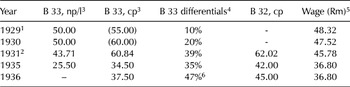
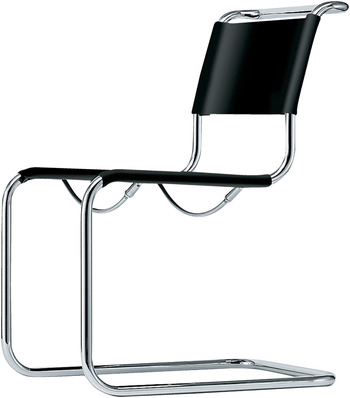
These sources allow the construction of a short time-series from 1929 to 1936 (Table 1). There are no data for 1932 and 1933, and the models in the table are not listed for 1934. The table has five categories: (1) model B 33, (2) model B 33 with the steel frame in nickel- and chrome-plated finishes, (3) the price differential of B 33 between a nickel- and chrome-plated chair, (4) model B 33 (chrome-plated), and (5) a week’s average wages of skilled labor. The B 33 is the model offered most continuously. Today, Thonet GmbH and other companies market the design as S 33 (Figure 7). Many other models appeared and disappeared from the product range in those years, probably due to ongoing litigation. From the prices of the B 33, I have calculated the price differential among a nickel-plated, lacquered, and chrome-plated exemplar. The B 32 is the design that Thonet GmbH markets as S 32 today (see Figure 1). The purpose of the wage data is to give a sense of relative prices. The source for the wage data is the Statistical Yearbook of the German Reich, 1938. Footnote 106 Wages are calculated as weighted averages, building on the hourly standard wage of seventeen trades in thirteen sectors. Footnote 107
Retail prices of Thonet AG’s cantilevered models, differentials, and weekly wages, 1929–1936

Sources: Bauhaus Archive, “6599/4: Standard Möbel: Preis-Liste Stahlrohrmöbel,” 1929; Bauhaus Archive, “2002/31: Thonet AG: Stahlrohrmöbel Preisliste,” 1930; Thonet GmbH Archive Germany, “F/32: Preisliste Nr. 31,” 1931; Thonet GmbH Archive Germany, “Preisliste Nr. 935,” 1935; Thonet GmbH Archive Germany, “F: Thonet AG: Preisliste Nr. 1036,” 1936; Statistisches Reichsamt, Jahrbuch, 1938, 338; Lebenshaltung 1927/28, 101.
1 Prices for B 33 calculated via Standard Möbel’s price list.
2 Prices originally given in Austrian shillings; converted into reichsmark using the average rate for 1931, as published in Statistisches Reichsamt, Jahrbuch 1933, 360.
3 np refers to nickel-plated, l to lacquered, and cp to chrome-plated finishes.
4 Difference in price between a nickel-plated or lacquered B 33 and a chrome-plated B 33. Calculated as markup to price of nickel-plated or lacquered chair.
5 Skilled labor, per week.
6 Calculated with the 1935 price for the lacquered B 33. The assumption is warranted by stable wages in 1935 and 1936.
Thonet GmbH’s S 33 (2016). The chair is the successor to Thonet AG’s B 33. The steel frame has been chrome-plated by default since 1936.
Source: Thonet GmbH Germany, Mediendatenbank. Used with permission.

Table 1 shows the most important point: an almost fivefold increase of the price differential between nickel-plating and chrome-plating from 1929 to 1936. Footnote 108 In 1929 a chrome-plated B 33 chair cost 10 percent more than a nickel-plated one. In 1936 it cost 47 percent more. During the intervening years, Thonet AG puzzled out an important detail of the market: the company realized that its customers were willing to pay a significant premium for its chairs if the steel frame was chrome-plated. As a consequence, the company raised the price of the chrome-plated option and eventually eliminated the lacquered one.
Today, chrome-plating is part of the classic look of steel-tube furniture, although initially nickel-plating was the standard. Footnote 109 In 1929 an extra 10 percent were charged for chrome. In 1930 the mark-up increased to 20 percent; in 1931, to 39 percent. Between 1931 and 1935, presumably, chrome and nickel finishes were offered side-by-side as explicitly priced options. In 1936 chrome became the standard and the markup increased to 47 percent.
This trajectory explains how Thonet AG established its chairs in the upper segment of the market. It makes sense, too, from an entrepreneurial perspective. When the cantilever chair was on the market in 1929, Standard Möbel did not know yet which look would become popular. Thus, the company minimized costs and risks by producing the cheaper, nickel-plated version by default. Simultaneously, it offered the customer choices, such as the more expensive chrome-plated option. In 1930 Thonet AG began to test price elasticity of demand by raising the markup for chrome: How would quantity change in response to a price change? What would be the aggregate effect of changes in price and quantity? It can be assumed that it had a positive impact, judging by the fact that Thonet-Mundus further raised the markup in 1931. Demand for the chrome finish was price-inelastic.
What happened between 1932 and 1935 is hard to say. The data are fragmentary, but it looks like the markup remained comparably stable. During those years, Thonet AG offered both options, catering to different tastes and serving different market segments. In 1936 Thonet AG committed its chairs to the upper segment: first, it was the year when the company discontinued the lacquered, cheaper option; second, it was when the company increased the price of the B 33 and the B 32 chairs by further raising the markup for chrome, even as average wages remained stable. Thonet AG focused on customers with greater purchasing power.
Thonet AG improved its profit margin as well between 1929 and 1936. It is known from the 1929 price list that the cost for chrome-plating was approximately 10 percent of the retail price. Footnote 110 The three major inputs into chrome-plating were labor, chrome, and energy. The cost of these inputs decreased significantly over the following years. Footnote 111 As Wilk, Johnson, and von Vegesack argue, increasing scale and the learning curve of Thonet AG improved the margin, too. Between 1929 and 1935, the retail price of the nickel-plated B 33 was cut in half (see Table 1). Wages also decreased in that period but only by a quarter.
What does this say about the relationship between IPRs and the market value of a design product? It further specifies the circumstances under which IPRs actually result in higher prices. The cantilever chairs of Thonet AG were protected by IPRs and marketed as “authentic” and rarefied objects from 1930 onward. However, Table 1 shows that that was not sufficient to establish them as upmarket products. The nickel-plated B 33 was protected by IPRs, as was the B 32, but it became continuously cheaper in absolute and in relative terms until it was discontinued. The authenticity of its chairs alone did not allow the company to charge a premium. The chairs also had to be chrome-plated. Hence, the higher market value of a design object that is protected by IPRs and is perceived and appreciated as authentic might ultimately depend on a feature that is entirely unrelated to the question of authenticity.
The Legacy of the Cantilever Chair
Thonet chairs had not aligned with Stam’s political vision since 1936. When the chairs were committed to the upscale segment, they were lost to Stam’s case of a “minimal standard of living.” Footnote 112 Möller has tracked the development the cantilever chair took after 1936 and before it became the classic and museum piece it is today. Footnote 113 Lorenz immigrated to the United States in 1939, and his income from licensing fees dried up almost entirely. Due to the war, overall production of steel-tube furniture dropped after 1941. Some of his rights had expired after 1945 or he had lost them because of unpaid patent fees. In addition, the number of knock-offs increased so much that he had to focus on defending his copyrights in Germany and Switzerland. Footnote 114
Thonet GmbH resumed the production of cantilever models in 1948, but demand declined until the middle of the 1960s, and after that it almost dried up. Footnote 115 During the six-year period (1949 to 1954), Lorenz received DM40,759 in licensing fees. Hence, the revenue of Thonet GmbH for the period was at least at DM815,000, or DM135,800 per year. Footnote 116 Between 1955 and 1963, Lorenz’s fees amounted to DM36,750; that is, Thonet GmbH’s revenue for the period dropped to DM735,000, or just DM81,700 per year. Footnote 117 Lorenz commented this development in a letter to Stam on February 29, 1962. Footnote 118 With resignation, he stated that “now that we have finally won […], the customer’s taste has changed and the chairs are not well received anymore”; at the time of Lorenz’s letter, Thonet GmbH produced only two cantilever models: the S 32 and S 64. Footnote 119
From the end of the 1960s to the middle of the 1970s, modernism experienced a comeback, a stylistic revival under the term “coolness,” which translated into a fourfold revenue increase for Thonet GmbH. Footnote 120 Von Vegesack points to a “broad acceptance from a design-conscious elite” around 1965, which marked the conversion of the cantilever chair into a classic. Footnote 121 Demand is ongoing, and today companies such as Steelclassic or Cool Designworks also serve it. Which role Thonet GmbH had in the forceful return of the chairs in the 1960s lies beyond the scope of this article. Obviously, tastes changed, and when they did, Thonet GmbH had the tradition, commitment, brand, knowledge, and IPRs to the cantilever chair. Thonet GmbH’s commercial activities have at least contributed to the iconic status that interwar designs enjoy today.
In real terms, the S 32 V of Thonet GmbH is even more of an upmarket product today than it was in the 1930s. Calculating with the 1936 price, an average annual rate of price increase of 2.94 percent, a conversion rate of one reichsmark to one deutschmark at the 1948 currency reform, and a conversion rate of euro to deutschmark of 1.96, the S 32 V should cost about €230 or £180. Footnote 122 In fact, it is priced at €720 or £540. Footnote 123 A visit to the facilities of Thonet GmbH reveals that manual labor still plays a surprisingly important role, considering the possibilities of standardization and automation. Customers have come to expect the Thonet GmbH chair to meet extremely high standards of comfort and longevity. While these qualities are certainly associated with craftsmanship, it is not evident that they cannot be achieved mechanically. The cantilever classics of Thonet GmbH might retain their upmarket market position due to a paradox: they were intended to be an industrial product, and they look like an industrial product, but actually they are artisanal. Steelclassic’s Cesca chair, however, is cheaper in real terms today than the B 32 was in 1936. Ikea and other companies who offer their own cantilever designs at an even lower price have fulfilled Stam’s political vision.
Conclusions
The case in this article broadly shows that IPRs can shape design markets and impact the value of goods in that market. Thonet AG was, and its successor remains, the single most important owner and licensee of IPRs to cantilever chair models. These IPRs enabled Thonet AG to claim a dominant position in the upper segment of the market. Thonet GmbH retains that position today. As Gorman suggests, there is a specifically national aspect, too. Footnote 124 Greater legal protection of the cantilever chair in Germany allows greater restriction of competitors. The way in which IPRs impact the market exactly, however, is idiosyncratic and can only be understood by considering other economic forces and activities of market participants. Herein lies the contribution that economic and business history can make.
This case has focused on historical management, branding, and pricing activities, and it has shown that IPRs can impact the price of a design product in several ways. IPRs are a cost factor by themselves, and they cause additional costs through IPR enforcement or higher manufacturing quality. Owners or licensees of IPRs, however, can raise the market value of their product much beyond the additional cost. The case suggests that this potential does not lie in establishing a monopoly. Controlling the market through legal means is technically possible, but it is hard to do in practice. It might work in a few geographic areas and national jurisdictions, but it is not very promising as a general strategy. Instead, the potential of IPRs lies in converting them into reputational authenticity. Pouillard shows that brand can work as a substitute for legal protection. Footnote 125 This case shows that IPRs can bolster brand and reputation without the latter substituting IPRs.
Moreover, while perceived authenticity is necessary to raise the market value, it is not sufficient. Ultimately, it might be an arbitrary feature, entirely unrelated to the question of authenticity, with which the producer achieves a higher price. Such a feature—in the case, chrome—allows a manufacturer to do two things: first, it allows identifying those customers with a higher willingness to pay for authenticity; second, it allows a markup for authenticity to the product.
The importance of branding as transmission between IPRs and market value suggests an addition to the research areas mapped out by Gorman. Footnote 126 In certain instances, cultural and language areas might be more promising analytical categories than national jurisdictions.