1. Introduction
The agnostoid arthropod Lotagnostus Whitehouse, Reference Whitehouse1936, has supplied one candidate for definition of the base of the youngest stage (Stage 10) of the latest Cambrian Furongian Series (Peng et al. Reference Peng, Babcock, Zhu, Zuo and Dai2013, Reference Peng, Babcock, Zhu, Terfelt and Dai2015). The genus was originally proposed with Agnostus trisectus Salter, Reference Salter1864, as the type species (see Rushton, Reference Rushton2009). However, Peng & Babcock (Reference Peng and Babcock2005) argued that L. trisectus was, in fact, a junior synonym of L. americanus (Billings, Reference Billings1860). Their definition of L. americanus allowed for substantial morphological variation, and they identified it from several Cambrian continents, including Laurentia, Avalonia, Baltica, Siberia, Tarim, South China and Gondwana. As such, they considered L. americanus to have considerable potential as an index to define the base of Stage 10.
Peng & Babcock's interpretation of L. americanus has sparked controversy. It has received support from some workers (e.g. Lazarenko et al. Reference Lazarenko, Gogin, Pegel and Abaimova2011; Ahlberg & Terfelt, Reference Ahlberg and Terfelt2012) but has drawn criticism from others. Rushton (Reference Rushton2009) compared topotype material of both L. trisectus and L. americanus, and concluded that they were distinct taxa (see also Rushton, Reference Rushton, Rushton, Brück, Molyneux, Williams and Woodcock2011, p. 4), although he chose to differentiate them at the subspecific level. This view was amplified by Westrop, Adrain & Landing (Reference Westrop, Adrain and Landing2011), who revised type material of L. americanus and effaced species of Lotagnostus from Australia, and illustrated new material of a well-furrowed species from Nova Scotia. They argued that L. americanus could not be identified beyond the type area in Quebec; a conclusion that was endorsed by Tortello (Reference Tortello2014). Peng et al. (Reference Peng, Babcock, Zhu, Zuo and Dai2013, Reference Peng, Babcock, Zhu, Terfelt and Dai2015) responded to critiques of their broad definition of L. americanus, arguing that differences in morphology record intraspecific variation. As defined by Peng and colleagues, L. americanus had an exceptionally broad habitat range, and occurred in well-oxygenated, shelf margin facies recorded by debris flow boulders in east Laurentia as well as dysoxic facies in east Asian and Baltic successions (e.g. Landing, Westrop & Adrain, Reference Landing, Westrop and Adrain2011).
As noted by Westrop, Adrain & Landing (Reference Westrop, Adrain and Landing2011), the relatively small number of figured specimens hinders critical evaluation of most nominal species of Lotagnostus. Lotagnostus trisectus rests on a firmer footing than most, with several exoskeletons and sclerites from Avalonian Britain illustrated by Rushton (Reference Rushton2009, fig. 1A–I, P, fig. 2A–D, G, K–L). However, even in this case, comparisons with other species are undermined by the quality of preservation. All of the British specimens are compacted to varying degrees, and may be overprinted by tectonic deformation (Rushton, Reference Rushton2009, fig. 2A, B). Broadly similar sclerites from other Cambrian continents have been identified as L. trisectus (Bao & Jago, Reference Bao and Jago2000, pl. 1, figs 12–15; Rushton, Reference Rushton2009, fig. 2E, F, H–J), but are problematic in our view because of these various preservational issues in the type area (see also Westrop, Adrain & Landing, Reference Westrop, Adrain and Landing2011).
In this paper, we describe new sclerites from Avalonian Canada that are preserved in skeletal limestone. Unlike coeval material from Avalonian Britain (Rushton, Reference Rushton2009), these agnostoid sclerites have suffered little compaction and are undeformed tectonically. As such, they allow a critical evaluation of the morphology of well-furrowed species of Lotagnostus, and we provide extensive photographic documentation of a range of specimens. They also make the case for the presence of four distinct species in the Avalonian succession, all of which differ from type and other specimens of L. americanus (Billings, Reference Billings1860) from Quebec (Westrop, Adrain & Landing, Reference Westrop, Adrain and Landing2011, figs 5, 6).
2. Localities
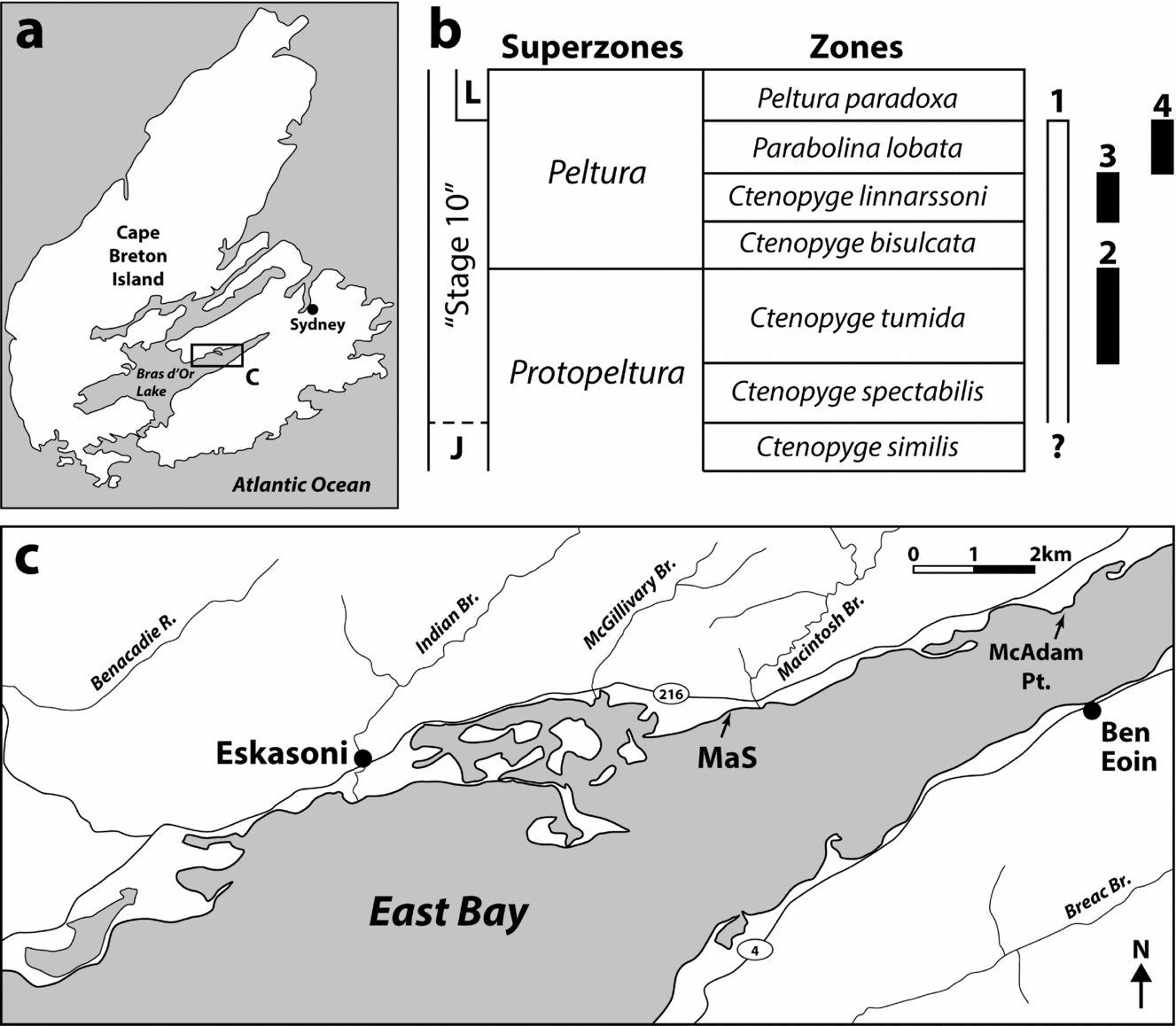
Sclerites of Lotagnostus and associated trilobites documented in this paper come from the north shore of East Bay of Bras d'Or Lake, Cape Breton Island (Fig. 1a, c). The Cambrian succession is largely concealed beneath overlying Carboniferous strata, but is exposed as small outcrops along the shore of the lake. Section MaS (Fig. 1c; see Landing & Westrop, Reference Landing and Westrop2015, fig. 3 for a stratigraphic column with ranges of trilobites and agnostoids) comprises dark-grey to black siliciclastic mudstone with carbonate interbeds of the Chelsey Drive Group (see Landing & Westrop, Reference Landing and Westrop2015, p. 976 for discussion of the stratigraphic nomenclature), and yields Lotagnostus salteri sp. nov. in a collection made near the top of the section, 6.15 m above the base.
Locality maps and stratigraphic distribution of Lotagnostus species. (a, c), maps of Cape Breton Island and detailed view of part of East Bay of Bras d'Or Lake showing the location of section MaS. MaS is likely the approximate location of the sites that Matthew (Reference Matthew1901, Reference Matthew1903) variously referred to as ‘MacAdam shore’ or ‘Eascasonie shore’. Spelling of Eskasoni follows usage on current Canadian topographic maps. (b) Biostratigraphy of the mid-Furongian succession of Avalonia (modified from Rushton, in Rushton & Molyneux, Reference Rushton, Molyneux, Rushton, Brück, Molyneux, Williams and Woodcock2011; superzones from Nielsen et al. Reference Nielsen, Weidner, Terfelt and Høyberget2014) showing the distribution of Lotagnostus species. 1 = L. trisectus (Salter), with open rectangle showing range in Avalonian Britain (Rushton, Reference Rushton2009); question mark expresses uncertainty regarding the age of the oldest occurrences. Black rectangles show ages of species from Avalonian Canada; 2, L. salteri sp. nov.; 3, L. ponepunctus (Matthew) and L. germanus (Matthew); 4, L. matthewi sp. nov. The base of ‘Stage 10’ is arbitrarily placed at the lowest definitive occurrence of Lotagnostus; J, Jiangshanian Stage. Also shown is an alternate proposal for the base of ‘Stage 10’ (Landing, Westrop & Adrain, Reference Landing, Westrop and Adrain2011), at the base of the Lawsonian Stage (L). Correlation of the base of the Lawsonian Stage into Avalonia uses the occurrence of the TOCE excursion at the base of the P. paradoxa Zone in Sweden (Terfelt, Eriksson & Schmitz, Reference Terfelt, Eriksson and Schmitz2014).

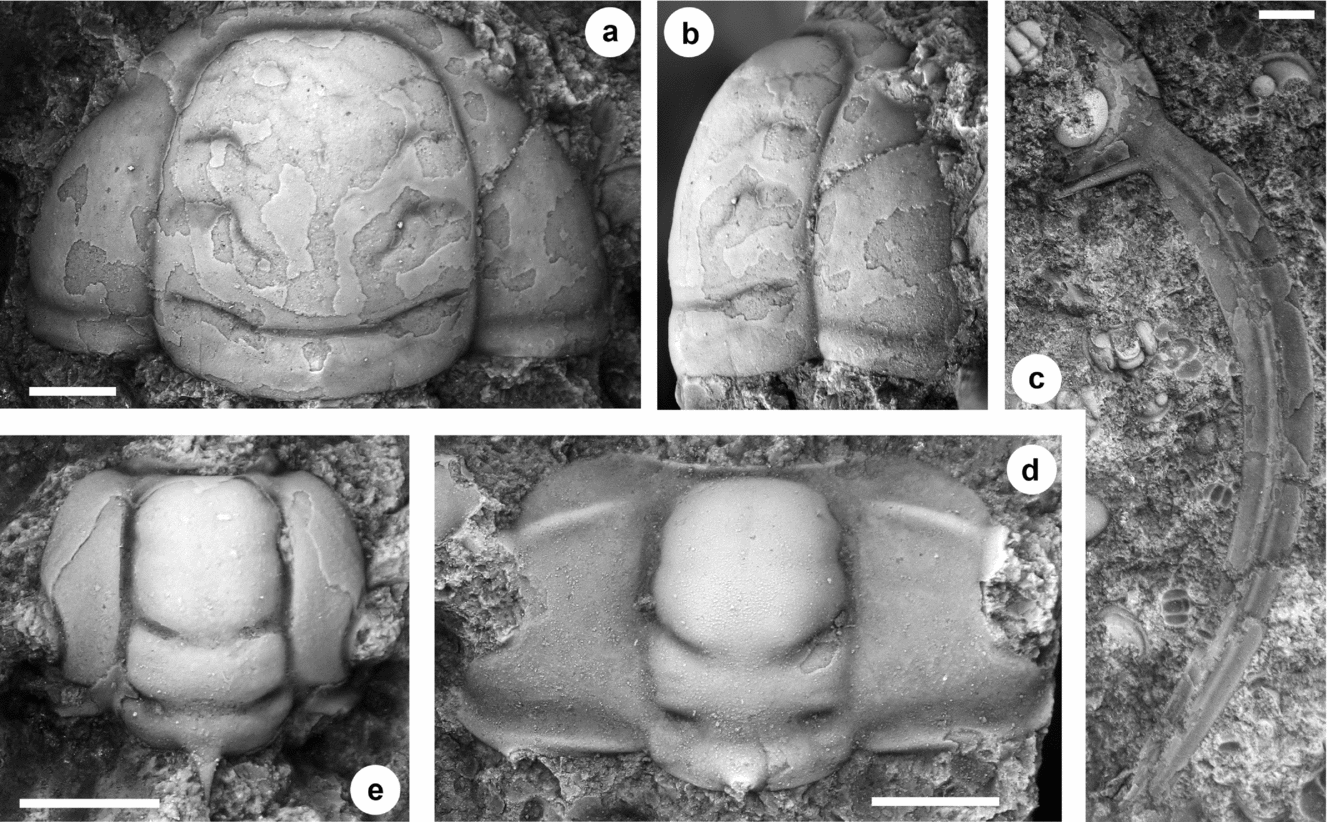
MaS is located 0.5 km west of the mouth of Macintosh Brook (not MacDonald Brook as stated by Landing & Westrop, Reference Landing and Westrop2015, caption to fig. 2) and must be the same locality that was mentioned by Hutchinson (Reference Hutchinson1952, p. 49) as being one-third of a mile (0.53 km) west of the mouth of the brook. Both Hutchinson and Landing & Westrop (Reference Landing and Westrop2015) thought that this exposure was the same as the MacAdam Shore locality of Matthew (Reference Matthew1901; also named Escasonie shore by Matthew, Reference Matthew1903, caption to plate 17 and pp. 221–4; Matthew seems to have used these locality names interchangeably in his 1903 monograph). However, Matthew (Reference Matthew1901, Reference Matthew1903) reported a different, younger fauna, including Ctenopyge fletcheri (Matthew, Reference Matthew1901) (Fig. 2c, d), from the one obtained from collection MaS 6.15. The exact provenance of Matthew's material is unclear, although Hutchinson (Reference Hutchinson1952, p. 49) listed Peltura scarabaeoides (Wahlenberg, Reference Wahlenberg1821) as occurring at his Macintosh Brook locality, and this may be part of Matthew's fauna (Fig. 2a, b). A small slab from the New Brunswick Museum is almost certainly the specimen from which Matthew (Reference Matthew1901, p. 282; Reference Matthew1903, p. 228) made his abundance counts, as there is no other candidate in the collection (R. Miller pers. comm.). It includes the type material of both C. fletcheri and L. ponepunctus (Matthew, Reference Matthew1901) (see following discussion of L. ponepunctus).
Olenid trilobites from the Chelsey Drive Group, north shore of East Bay near Eskasoni, Bras d'Or Lake, Cape Breton Island, Nova Scotia. Scale bars are 1 mm in length. All specimens are from a small slab of skeletal limestone in the New Brunswick Museum (NBMG 4386) that was collected by G. F. Matthew. (a, b) Peltura cf. P. scarabaeoides (Wahlenberg, Reference Wahlenberg1821), cranidium, NBMG 4386/1 dorsal and lateral views, ×11. (c, d) Ctenopyge fletcheri (Matthew, Reference Matthew1901). (c) Free cheek, NBMG 4386/2 (lectotype), dorsal view, ×7. (d) Cranidium, NBMG 4386/3, dorsal view, ×16. (e) Triangulopyge cf. T. humilis (Phillips, Reference Phillips1848), cranidium, NBMG 4386/4, dorsal view, ×18.

3. Biostratigraphy
The most widely used trilobite biostratigraphy for the Furongian series in Avalonia is a set of zones and subzones (Rushton, in Rushton & Molyneux, Reference Rushton, Molyneux, Rushton, Brück, Molyneux, Williams and Woodcock2011) that is similar to the traditional biostratigraphy of Baltica (Ahlberg, Reference Ahlberg2003, fig. 2). We follow Terfelt, Ahlberg & Eriksson (Reference Terfelt, Ahlberg and Eriksson2011) in treating the subzones as zones (Fig. 1b), with superzones defined by Nielsen et al. (Reference Nielsen, Weidner, Terfelt and Høyberget2014).
Collection MaS 6.15 yields a trilobite fauna that was assigned to the Ctenopyge tumida Zone (as emended by Høyberget & Bruton, Reference Høyberget and Bruton2012) by Landing & Westrop (Reference Landing and Westrop2015). This places the associated species of Lotagnostus, L. salteri (Figs 3–7), in the lower half of the range of the genus in Avalonian Britain (Fig. 1b), although at least one zone is above the base of that range (which begins in either the Ctenopyge similis or C. spectabilis zone, according to Rushton, Reference Rushton2009, p. 276).
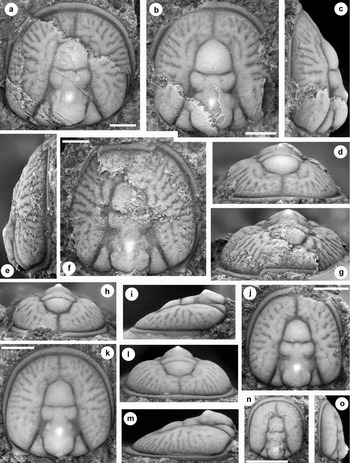
Lotagnostus salteri sp. nov. from the Chelsey Drive Group, north shore of East Bay, Bras d'Or Lake, Cape Breton Island, Nova Scotia, collection MaS 6.15; all cephala; all ×20, except (a–f, o, q), ×18; all scale bars = 1 mm. All specimens are paratypes. (a–c) NBMG 20061, dorsal, anterior and lateral views. (d–f) NBMG 20062, lateral, dorsal and anterior views. (g–i) NBMG 20063, anterior, dorsal and lateral views. (j) NBMG 20064, dorsal view. (k) NBMG 20065, dorsal view. (l–n) NBMG 20066, anterior, dorsal and lateral views. (o) NBMG 20067, dorsal view. (p) NBMG 20068, dorsal view. (q) NBMG 20069, dorsal view.

Lotagnostus salteri sp. nov. from the Chelsey Drive Group, north shore of East Bay, Bras d'Or Lake, Cape Breton Island, Nova Scotia, collection MaS 6.15; all cephala; all scale bars = 1 mm. (h–j) are the holotype and all other specimens are paratypes. (a) NBMG 20070, dorsal view, ×14. (b–d) NBMG 20071, dorsal, lateral and anterior views, ×16. (e–g) NBMG 20072, lateral, dorsal and anterior views, ×14. (h–j) NBMG 20073, anterior, lateral and dorsal views, ×18. (k–m) NBMG 20074, dorsal, anterior and lateral views, ×17. (n–o) NBMG 20075, dorsal and lateral views, ×20.

Lotagnostus salteri sp. nov. from the Chelsey Drive Group, north shore of East Bay, Bras d'Or Lake, Cape Breton Island, Nova Scotia, collection MaS 6.15; all pygidia; all scale bars = 1 mm. All specimens are paratypes. (a–c) NBMG 20076, dorsal, lateral and posterior views, ×15. (d–f) NBMG 20077, dorsal, posterior and lateral views, ×16. (g–i) NBMG 20078, posterior, lateral and dorsal views, ×16. (j–l) NBMG 20079, posterior, lateral and dorsal views, ×17. (m) NBMG 20080, dorsal view, ×16. (n–p) NBMG 20081, dorsal, lateral and posterior views, ×17.

Lotagnostus salteri sp. nov. from the Chelsey Drive Group, north shore of East Bay, Bras d'Or Lake, Cape Breton Island, Nova Scotia, collection MaS 6.15; all pygidia; all scale bars = 1 mm. All specimens are paratypes. (a–c) NBMG 20082, dorsal, posterior and lateral views, ×17. (d–f) NBMG 20083, lateral, posterior and dorsal views, ×17. (g) NBMG 20084, dorsal view, ×17. (h) Degree 1 meraspis, NBMG 20085, dorsal view, ×25. (i, j), NBMG 20086, dorsal and posterior views, ×20. (k, l) NBMG 20087, dorsal and posterior views, ×20. (m, n) NBMG 20088, dorsal and posterior views, ×20. (o) NBMG 20089, dorsal view, ×20. (p) NBMG 20090, dorsal view, ×20. (q) NBMG 20091, dorsal view, ×20. (r) NBMG 20092, dorsal view, ×20.

Lotagnostus salteri sp. nov. from the Chelsey Drive Group, north shore of East Bay, Bras d'Or Lake, Cape Breton Island, Nova Scotia, collection MaS 6.15; all pygidia except a–c, g, j (cephala); all scale bars = 1 mm. All specimens are paratypes. (a–c) NBMG 20093, dorsal, lateral and anterior views, ×18. (d–f) NBMG 20094, dorsal, posterior and lateral views, ×18. (g) NBMG 20095, dorsal view, ×15. (h) NBMG 20096, dorsal view, ×20. (i) NBMG 20097, dorsal view, ×18. (j) NBMG 20098, dorsal view, ×18. (k, l) NBMG 20099, dorsal and posterior views, ×18.

As noted above, Lotagnostus ponepunctus (Figs 9, 10) occurs on a slab with a different trilobite fauna, to be documented fully elsewhere, that includes C. fletcheri (Fig. 2c, d). Ctenopyge fletcheri has also been reported from Baltica (Henningsmoen, Reference Henningsmoen1957, pl. 22, figs 1–6), and the most recent compilation of range data (Terfelt, Ahlberg & Eriksson, Reference Terfelt, Ahlberg and Eriksson2011) places it in the Ctenopyge linnarssoni Zone. Other species in the assemblage are consistent with this zonal assignment, including a single cranidium of Peltura cf. P. scarabaeoides (Fig. 2a, b) as well as numerous sclerites of Triangulopyge cf. T. humilis (Phillips, Reference Phillips1848; Fig. 2e). Cranidia of the latter are similar to the lectotype cranidium of T. humilis from the White-leaved Oak Shale, Malvern, Avalonian England (Rushton, Reference Rushton1968, pl. 78, fig. 13; designated by Høyberget & Bruton, Reference Høyberget and Bruton2012), but appear to differ from cranidia from the Alum Shale Formation of the Oslo region, Norway (Høyberget & Bruton, Reference Høyberget and Bruton2012, fig. 13A–D, F, G), in having narrower fixigenae. In Avalonia (Rushton, Reference Rushton1968), sclerites identified as T. humilis occur in the C. linnarssoni and underlying C. bisulcata zones. In Baltica, this species is also reported from both of these zones as well as the younger Parabolina lobata zone (Terfelt, Ahlberg & Eriksson, Reference Terfelt, Ahlberg and Eriksson2011).
Matthew (Reference Matthew1901, p. 270; Reference Matthew1903, p. 182) indicated that L. germanus (Matthew, Reference Matthew1901) was also part of the fauna that includes C. fletcheri and L. ponepunctus, but we have not been able to confirm this. All specimens of L. germanus that we have examined are preserved on small rock fragments without other associated taxa. Assuming that Matthew's observations are accurate, L. germanus occurs in the Ctenopyge linnarssoni Zone.
Sclerites from Cape Breton Island that we (Westrop, Adrain & Landing, Reference Westrop, Adrain and Landing2011, p. 572, figs 2, 3) identified as L. cf. L. trisectus are named as a new species, L. matthewi, in this paper. They occur with rare sclerites of Peltura cf. scarabaeoides westergaardi Henningsmoen, Reference Henningsmoen1957, which suggests a position in the Parabolina lobata Zone (Terfelt, Ahlberg & Eriksson, Reference Terfelt, Ahlberg and Eriksson2011, fig. 1) and near the top of the range of L. trisectus in Avalonia (Fig. 1b).
4. Lotagnostus americanus revisited
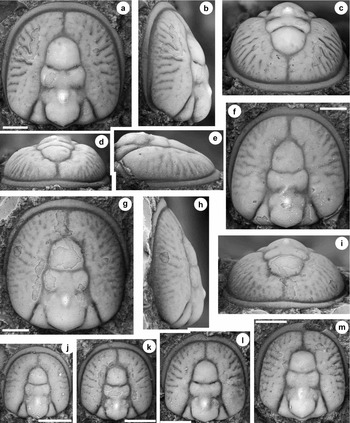
As revised by Westrop, Adrain & Landing (Reference Westrop, Adrain and Landing2011), Lotagnostus comprises a set of species whose morphologies range from strongly furrowed (Figs 3–7) to effaced (Westrop, Adrain & Landing, Reference Westrop, Adrain and Landing2011, figs 7–9; Tortello, Reference Tortello2014, figs 2, 3). Lotagnostus americanus is known from only a small number of sclerites in its type area in Quebec, where it exhibits an intermediate morphology. The glabella and pygidial axis are better defined than on L. obscurus Palmer, Reference Palmer1955 and other effaced species (Westrop, Adrain & Landing, Reference Westrop, Adrain and Landing2011, figs 7–9), but the trisection of the posteroaxis, which is conspicuous on strongly furrowed species (Figs 5, 6), is weakly developed (Rushton, Reference Rushton2009, fig. 1M–O; Westrop, Adrain & Landing, Reference Westrop, Adrain and Landing2011, fig. 5A–C) to absent (Westrop, Adrain & Landing, Reference Westrop, Adrain and Landing2011, fig. 6A). There is also a difference in cephalic convexity. The cephalon of L. americanus is most like effaced species (Westrop, Adrain & Landing, Reference Westrop, Adrain and Landing2011, figs 7C, I, 8C, E) in being inflated, with evenly curved flanks in anterior view. Consequently, the glabella is separated from the genae by a relatively weak inflexion of the slope (Westrop, Adrain & Landing, Reference Westrop, Adrain and Landing2011, figs 5E, 6D, G, I). In contrast, more furrowed species show a distinct flattening of the genae as they approach the glabella, and the glabella is defined in anterior view by a far more pronounced break in slope (Figs 4d, g, h, l, 9c, d, i, 12b, c).
There is clear size-related (ontogenetic) variability of Lotagnostus species (see also Peng et al. Reference Peng, Babcock, Zhu, Terfelt and Dai2015). For example, scrobiculation increases in both incision and density during growth of cephala (Figs 3, 4, 7a–c, g, j) and, where present, pygidia (Figs 5, 6). Comparisons between species must be based on similarly sized specimens and, in this context, it should be noted that all sclerites of L. americanus from the type area that we have been able to examine directly are large; only the smallest of these specimens, an enrolled exoskeleton (Westrop, Adrain & Landing, Reference Westrop, Adrain and Landing2011, fig. 6A–D) overlaps in size with the sclerites illustrated in this paper. However, this specimen has weak cephalic scrobiculation, and lacks pygidial scrobiculation entirely. Along with larger specimens, it suggests that modest increases in scrobiculation characterize the ontogeny of L. americanus in its type area (Westrop, Adrain & Landing, Reference Westrop, Adrain and Landing2011, figs 5, 6E–J), a conclusion that is also supported by the sclerites from Quebec illustrated by Rushton (Reference Rushton2009, fig. 1J–O). Similarly, the enrolled specimen of L. americanus lacks trisection of the posteroaxis (Westrop, Adrain & Landing, Reference Westrop, Adrain and Landing2011, fig. 6A, D), and, as noted above, this feature is at best weakly developed in larger sclerites. The ontogenetic trajectories are entirely different in the Avalonian species described in this paper, with well-developed notular furrows and intranotular axes in small pygidia (Figs 6, 10c) that are retained in larger ones (Figs 5a–f, 10a, b).
Our knowledge of L. americanus in Laurentia is clearly incomplete. There are limited numbers of specimens available, and we have only a partial understanding of holaspid ontogeny. Peng et al. (Reference Peng, Babcock, Zhu, Terfelt and Dai2015) sought to remedy the situation by redefining L. americanus with material from other Cambrian palaeocontinents that had been assigned by previous authors to different species (e.g. Troedsson, Reference Troedsson1937; Lu & Lin, Reference Lu and Lin1989). In our view, this is wholly inadequate. The fundamental problem is the paucity of information from eastern Laurentia, and this is not solved by asserting that species from other biogeographic regions are synonyms of L. americanus, and then using them as surrogates. No amount of research on faunas in other places can mitigate the shortcomings of the data available from the type area. New collections from Quebec are needed, although sampling at the type locality in the North Ridge Conglomerate at Lévis has not yet yielded additional material (Landing, unpub. data).
In the search for globally distributed ‘index species’, there is a real danger that biostratigraphic goals will drive taxonomic decisions. In their commentary on our (Westrop, Adrain & Landing, Reference Westrop, Adrain and Landing2011) revision of L. americanus, Peng et al. (Reference Peng, Babcock, Zhu, Terfelt and Dai2015, p. 282) noted that, ‘narrow definitions of agnostoid species essentially preclude the possibility of recognizing individual species as intercontinentally distributed.’ Indeed, but this statement can be inverted: the desire for intercontinentally distributed agnostoid species promotes broad definitions of individual species. In our view, the sprawling synonymy list proposed by Peng & Babcock (Reference Peng and Babcock2005; expanded by Peng et al. Reference Peng, Babcock, Zhu, Terfelt and Dai2015, p. 300) for L. americanus is symptomatic of a biostratigraphically driven approach to species identification.
Peng et al. (Reference Peng, Babcock, Zhu, Terfelt and Dai2015) included a wide range of cephalic morphologies in L. americanus, including semi-effaced specimens (e.g. their fig. 5A–E) that may be related to Laurentian material, as well as strongly furrowed and scrobiculate specimens that clearly are not (e.g. their fig. 9D–H). As defined by Peng and colleagues, L. americanus occurs on most Cambrian continents, and has been proposed as an index for the base of the uppermost Cambrian stage (Peng et al. Reference Peng, Babcock, Zhu, Zuo and Dai2013). This view of L. americanus is an extension of the conclusions of Troedsson (Reference Troedsson1937) when proposing Lotagnostus asiaticus for material from the Torsuqtag, Quruq taghm, western Xinjiang, China. As noted by Peng et al. (Reference Peng, Babcock, Zhu, Terfelt and Dai2015), Troedsson included a range of cephalic morphologies in L. asiaticus, and he (Reference Troedsson1937, p. 25) considered the variation to be at least partly related to weathering of the exoskeleton and internal mould: relatively smooth specimens are unweathered and preserved the test, whereas deep cephalic furrows and well-developed scrobiculation on other sclerites were thought by Troedsson to be accentuated by weathering. In an earlier discussion of L. asiaticus, we (Westrop, Adrain & Landing, Reference Westrop, Adrain and Landing2011, p. 577) accepted Troedsson's comments at face value. However, Peng et al. (Reference Peng, Babcock, Zhu, Terfelt and Dai2015, figs 4, 5A–F, 6) have reillustrated Troedsson's types with high-resolution digital images that allow a more thorough evaluation of these specimens.
The holotype of L. asiaticus (Peng et al. Reference Peng, Babcock, Zhu, Terfelt and Dai2015, fig. 5A–F) records a similar grade of cephalic effacement to L. americanus (e.g. Westrop, Adrain & Landing, Reference Westrop, Adrain and Landing2011, figs 5D–G, 6C–J), although, unlike the latter (Rushton, Reference Rushton2009, fig. 1M–O; Westrop, Adrain & Landing, Reference Westrop, Adrain and Landing2011, figs 5A–C, 6A), the pygidium has conspicuous trisection of the relatively long and narrow posteroaxis. Both the holotype cephalon of L. asiaticus and the associated larger cephalon (Peng et al. Reference Peng, Babcock, Zhu, Terfelt and Dai2015, fig. 5F) are partly exfoliated and show that the expression of the axial and glabellar furrows and scrobicules is little different between the testate surfaces and the internal moulds. However, other cephala included in L. asiaticus by Troedsson have firmly impressed axial furrows and glabellar furrows, and genal sculpture of anastomosing rugae and deep scrobiculae (Peng et al. Reference Peng, Babcock, Zhu, Terfelt and Dai2015, fig. 6E, F, I). We agree with Peng et al. (Reference Peng, Babcock, Zhu, Terfelt and Dai2015, p. 292) that the contrast between the holotype and these strongly furrowed and scrobiculate specimens cannot be the result of differential weathering, but we are not in the least tempted to follow their lead in interpreting these differences as intraspecific variation.
While a broadly defined species is biostratigraphically expedient, it is not the only possible interpretation of Troedsson's material. Stratigraphic co-occurrence does not automatically mean that specimens are conspecific, and in this case, in which variation is apparently discrete rather than gradational, an interpretation as two distinct species is in our view preferable. From this perspective, Lotagnostus asiaticus is a relatively effaced species that, in the type lot, comprises the holotype exoskeleton and associated large cephalon (Peng et al. Reference Peng, Babcock, Zhu, Terfelt and Dai2015, fig. 5A–F), and one other exoskeleton (Peng et al. Reference Peng, Babcock, Zhu, Terfelt and Dai2015, fig. 6B). However, the remaining specimens from the type lot (Peng et al. Reference Peng, Babcock, Zhu, Terfelt and Dai2015, fig. 6E–I) represent a different, more strongly furrowed species that may be allied with L. punctatus Lu, Reference Lu and Wang1964 (e.g. Peng et al. Reference Peng, Babcock, Zhu, Terfelt and Dai2015, fig. 9). Indeed, similar material from further west in Xinjiang, in the Borohoro Mountains region, was illustrated by Xiang & Zhang (Reference Xiang, Zhang, Wang, Cheng, Xiang and Zhang1985, pl. 9, figs 13–15, pl. 10, figs 3–11) as a subspecies of L. punctatus.
Segregation of Troedsson's types into two sympatric species permits an alternative interpretation of all of the material illustrated by Peng et al. (Reference Peng, Babcock, Zhu, Terfelt and Dai2015); one that follows earlier taxonomic conclusions regarding these specimens (e.g. Lu & Lin, Reference Lu and Lin1984, Reference Lu and Lin1989; Peng, Reference Peng1992). We argue that at least two species are present in the Chinese collections. Several specimens from Hunan (Peng et al. Reference Peng, Babcock, Zhu, Terfelt and Dai2015, figs 2J, 9A, F, G, and probably the somewhat compacted specimen, fig. 1E, F), Xinjiang (Peng et al. Reference Peng, Babcock, Zhu, Terfelt and Dai2015, fig. 6E–I) and Zhejiang (Peng et al. Reference Peng, Babcock, Zhu, Terfelt and Dai2015, fig. 9B, D, E, H, J–M) may represent L. punctatus Lu as identified in earlier studies (e.g. Lu & Lin, Reference Lu and Lin1984, Reference Lu and Lin1989; Peng, Reference Peng1992). This species is well furrowed with distinct scrobicules on small cephala (Peng et al. Reference Peng, Babcock, Zhu, Terfelt and Dai2015, fig. 9F) that become deeper and increase in density in larger specimens, and separate conspicuous, anastomosing rugae (Peng et al. Reference Peng, Babcock, Zhu, Terfelt and Dai2015, fig. 9D, E). Associated pygidia (e.g. Peng et al. Reference Peng, Babcock, Zhu, Terfelt and Dai2015, fig. 9K) have closely spaced, pit-like scrobicules, which may become weaker in some larger individuals (Peng et al. Reference Peng, Babcock, Zhu, Terfelt and Dai2015, fig. 9A, L, M), and notular furrows are well developed, as are notulae.
The other species, L. asiaticus, includes type specimens from Xinjiang (Peng et al. Reference Peng, Babcock, Zhu, Terfelt and Dai2015, figs 5A–F, 6B–D) as well as others from Hunan (Peng et al. Reference Peng, Babcock, Zhu, Terfelt and Dai2015, figs 1A–D, G–J, 2A–I, K–N, 3) and Zhejiang (Peng et al. Reference Peng, Babcock, Zhu, Terfelt and Dai2015, fig. 7 and, possibly, fig. 9I). The cephalic ontogeny of this species differs markedly from L. punctatus. Unlike similarly sized L. punctatus (Peng et al. Reference Peng, Babcock, Zhu, Terfelt and Dai2015, fig. 9F, G), small cephala of L. asiaticus (Peng et al. Reference Peng, Babcock, Zhu, Terfelt and Dai2015, figs 1B, 2H, 7A, C) are nearly smooth; scrobiculation develops later in cephalic ontogeny (Peng et al. Reference Peng, Babcock, Zhu, Terfelt and Dai2015, figs 1G–J, 2C, E, F) but it lacks the incision and density seen in similarly sized specimens of L. punctatus (Peng et al. Reference Peng, Babcock, Zhu, Terfelt and Dai2015, fig. 9D, E), and the rear third of the genae remains relatively smooth. The largest cephalon of L. asiaticus illustrated by Peng et al. (Reference Peng, Babcock, Zhu, Terfelt and Dai2015, fig. 7F, G) is also the most strongly scrobiculate, but this sculpture is subdued compared to similarly sized L. punctatus (Peng et al. Reference Peng, Babcock, Zhu, Terfelt and Dai2015, fig. 6E, F). Pygidia tend to be relatively smooth at all sizes (Peng et al. Reference Peng, Babcock, Zhu, Terfelt and Dai2015, figs 1A–D, G, H, 3, 7A–D), and even the most strongly scrobiculate specimen (Peng et al. Reference Peng, Babcock, Zhu, Terfelt and Dai2015, fig. 7G, H) does not reach the development of scrobicules seen in L. punctatus. Unlike L. americanus from Quebec (Rushton, Reference Rushton2009, fig. 1M–O; Westrop, Adrain & Landing, Reference Westrop, Adrain and Landing2011, figs 5A–C, 6A, B, D), notular furrows and intranotular axes are clearly expressed in small (Peng et al. Reference Peng, Babcock, Zhu, Terfelt and Dai2015, figs 1A–D, 3A, B) and large (Peng et al. Reference Peng, Babcock, Zhu, Terfelt and Dai2015, figs 3C–F, 5B, C, E, 7H–J) specimens of L. asiaticus.
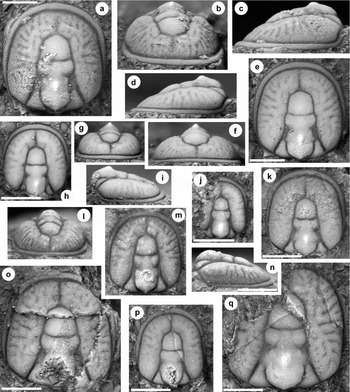
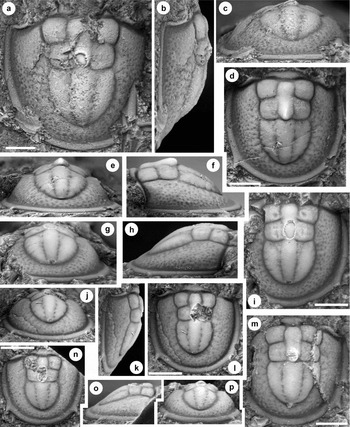
Peng et al. (Reference Peng, Babcock, Zhu, Terfelt and Dai2015) expressed concerns that the length (exsag.) of the basal glabellar lobe, which has a long history of use as a character to separate species of Lotagnostus (e.g. Ludvigsen & Westrop, in Ludvigsen, Westrop & Kindle, Reference Ludvigsen, Westrop and Kindle1989; Rushton, Reference Rushton2009), may be difficult to measure accurately, particularly on compacted specimens. They further argued that what some workers have identified as the anterior tip of the basal lobe is actually the outer part of the M2 glabellar lobe. Cephala of L. ponepunctus (Fig. 9) are particularly well preserved and show that there is indeed variability in the expression of the basal lobe. The anterior tip is clearly demarcated in some individuals, and ends at a depressed area that we interpret as an expanded axial furrow, rather than an outer lobe of M2 (Fig. 9k, l). In other, mostly large specimens (Fig. 9f, g, m), the anterior tip of the basal lobe is diffuse and grades into the expanded axial furrow. As a result, consistent measurement of the length of the lobe may be difficult, and there will be a large variance (cf. Fig. 9l, m), reducing the utility of this character. However, as should be evident from the discussion presented earlier in the text, there is no shortage of additional characters with which to unambiguously diagnose the various distinct species (L. americanus; L. asiaticus; L. punctatus) that Peng and colleagues prefer to treat as synonyms.
Finally, it should be apparent that we are using a profoundly different species concept from the one used by Peng and colleagues (Reference Peng, Babcock, Zhu, Zuo and Dai2013, Reference Peng, Babcock, Zhu, Terfelt and Dai2015; see also Peng & Babcock, Reference Peng and Babcock2005). This is not the trite distinction between ‘lumpers’ and ‘splitters’; rather, it is a more fundamental contrast between pattern-based and process-based approaches to species recognition.
We use a pattern-based phylogenetic species concept (Wheeler & Platnick, Reference Wheeler, Platnick, Wheeler and Meier2000), but it is clear from Peng et al.’s (Reference Peng, Babcock, Zhu, Terfelt and Dai2015, pp. 292, 294) discussion of cephala from the Ogon'or Formation, on the Khos–Nelege River section in Siberia, that their definition of L. americanus incorporates interpretations of evolutionary processes. They link together cephala with different effaced (Peng et al. Reference Peng, Babcock, Zhu, Terfelt and Dai2015, fig. 8A) and more strongly furrowed (Peng et al. Reference Peng, Babcock, Zhu, Terfelt and Dai2015, fig. 8C, D) morphologies into a ‘microevolutionary’ series. In so doing, Peng and colleagues offer nothing more than what was dismissed decades ago by Forey (Reference Forey, Joysey and Friday1982) as palaeontological story telling. The distinction between pattern and process is hardly a new one (Eldredge & Cracraft, Reference Eldredge and Cracraft1980), and we side with those who argue that processes-based definitions of species are problematic (e.g. Smith, Reference Smith1994; see also Westrop & Adrain, Reference Westrop and Adrain2016).
It is worth noting that Lazarenko et al. (Reference Lazarenko, Gogin, Pegel and Abaimova2011, fig. 9) illustrated co-occurring pygidia for three of the cephala from the Khos–Nelege River section that were re-figured by Peng and colleagues as parts of a ‘microevolutionary pattern’. The stratigraphically lowest cephalon illustrated by Peng et al. (Reference Peng, Babcock, Zhu, Terfelt and Dai2015, fig. 8A; Lazarenko et al. Reference Lazarenko, Gogin, Pegel and Abaimova2011, fig. 9D) is associated with a non-scrobiculate pygidium in which the trisection of the posteroaxis is barely perceptible (Lazarenko et al. Reference Lazarenko, Gogin, Pegel and Abaimova2011, fig. 9E). Lazarenko et al. (Reference Lazarenko, Gogin, Pegel and Abaimova2011) assigned these specimens to L. (Eolotagnostus) cf. agnostiformis Apollonov and Chugaeva, Reference Apollonov, Chugaeva, Apollonov, Bandaletov and Ivshin1983, although differences in glabellar and pygidial axis lengths suggest that they may not be conspecific with other, stratigraphically older specimens that were similarly identified (Lazarenko et al. Reference Lazarenko, Gogin, Pegel and Abaimova2011, fig. 9A–C). These older specimens are more like the type pygidium of the species (Apollonov & Chugaeva, Reference Apollonov, Chugaeva, Apollonov, Bandaletov and Ivshin1983, pl. 7, fig. 1). Younger, more strongly furrowed cephala and associated pygidia (Lazarenko et al. Reference Lazarenko, Gogin, Pegel and Abaimova2011, fig. 9F–K), misidentified as L. americanus, are clearly different from the older ones. Moreover, these strongly furrowed specimens also differ from each other in, for example, proportions of pygidial axes, sculpture, and expression of notular furrows and intranotular axes (cf. Lazarenko et al. Reference Lazarenko, Gogin, Pegel and Abaimova2011, fig. 9G, I), and it is likely that multiple Lotagnostus species are present in the Khos–Nelege section. Clearly, more data are needed to test this hypothesis, but the succession at Khos–Nelege underscores the fact that isolated data points of objectively different morphotypes cannot be assembled into a gradational anagenetic sequence (see also Westrop & Adrain, Reference Westrop and Adrain2016).
In conclusion, despite arguments to the contrary, the available data indicate that L. americanus is a species that is known with certainty only from Laurentian North America and does not offer a basis to define the base of a global Stage 10. Rather than a single globally distributed species, L. ‘americanus’ of Peng & Babcock (Reference Peng and Babcock2005; Peng et al. Reference Peng, Babcock, Zhu, Terfelt and Dai2015) is best treated as a biogeographically segregated plexus of distinct species. There is evidence to suggest that many of these species also occupied different environments (see also Landing, Westrop & Adrain, Reference Landing, Westrop and Adrain2011), with L. americanus s.s. from the Levis Formation and L. sp. indet. from the Frederick Formation occurring in oxic and weakly (?) dysoxic carbonate environments, respectively, at the edge of Laurentia, whereas Avalonian species described here are from strongly dysoxic organic-rich mudstone facies (Landing & Westrop, Reference Landing and Westrop2015).
At the current state of knowledge of the systematics of Lotagnostus, it seems unlikely that any species of the genus will provide the basis for the definition of the lower boundary of a globally recognized terminal Cambrian Stage 10. An alternative proposal would place the basal horizon of Stage 10 at the lowest occurrence of the widely distributed euconodont species, Eoconodontus notchpeakensis (Miller, Reference Miller1969), which has the advantage of lying immediately below the onset of the strong TOCE carbon isotope excursion (see Landing, Westrop & Adrain, Reference Landing, Westrop and Adrain2011 for an extended discussion of this candidate).
5. Systematic palaeontology
Illustrated material is housed in the New Brunswick Museum (NBMG), Saint John, and the National Museum of Natural History, Washington, DC (USNM). Proportions (percentages) are expressed in the descriptions as means with ranges; measurements of pygidial length and pygidial axis length exclude the articulating half-ring as it is commonly broken away. Peng et al. (Reference Peng, Babcock, Zhu, Terfelt and Dai2015) correctly noted that oblique lighting may accentuate sculpture on specimens. In this paper (and in all previous publications by Westrop extending back to 2004), we used a ring light to provide even illumination, as did Peng and colleagues. Consequently, the expression of scrobicules and various other cephalic and pygidial furrows should be directly comparable between our figures and those in Peng et al. (Reference Peng, Babcock, Zhu, Terfelt and Dai2015).
Class Uncertain
Order AGNOSTIDA Salter, Reference Salter1864
Family AGNOSTIDAE M'Coy, Reference M'Coy1849
Genus Lotagnostus Whitehouse, Reference Whitehouse1936
Type species. Agnostus trisectus Salter, Reference Salter1864 from the White-leaved Oak Shale of Malvern, England (by original designation).
Discussion. Taphonomic and, in some cases, tectonic distortion make the type species, L. trisectus from Avalonian Britain (Rushton, Reference Rushton2009), difficult to evaluate, and we (Westrop, Adrain & Landing, Reference Westrop, Adrain and Landing2011) noted that one could argue that the name is best restricted to the type and topotype specimens from the White-leaved Oak Shale. The shortcomings of the latter material are now magnified by the well-preserved sclerites from Avalonian Canada that allow the recognition of four stratigraphically separate (Fig. 1b) species. They show that such features as the convexity and profile of the genae, and expression of the trisection of the posteroaxis, offer important criteria for discriminating species, including L. americanus; however, these characters are modified or entirely lost in specimens that are flattened in shale. As a result, we recommend that L. trisectus be restricted to material from the type area in Malvern, and that open nomenclature (L. cf. L. trisectus, or L. sp. indet.) be used for variably flattened and deformed specimens from elsewhere in Avalonian Britain (e.g. Rushton, Reference Rushton2009, fig. 2A–D, G, K–L). As far as can be determined from specimens from the type locality (Rushton, Reference Rushton2009, fig. 1A–I, P), L. trisectus had distinct notular furrows and an intranotular axis on the pygidium, and is thus unlike L. germanus (Fig. 11a–e); the posteroaxis occupies a relatively larger proportion of the pygidial axis than in L. salteri (Figs 5, 6) and in this respect resembles a specimen from the Alum Shale of Sweden (Rushton, Reference Rushton2009, fig. 2H, I).
Lotagnostus salteri sp. nov.
Figures 3–7
2015 Lotagnostus aff. trisectus (Salter); Landing & Westrop, p. 979, fig. 5b–e.
Types. All types are from the Chelsey Drive Group, north shore of East Bay, Bras d'Or Lake. The holotype (NBMG 20073) is a cephalon (Fig. 4h–j); paratypes are 17 cephala (NBMG 20061–20072, 20074, 20075, 20093, 20095, 20098; Figs 3, 4, 7) and 21 pygidia (NBMG 20076–20092, 20094, 20097, 20099; Figs 5–7).
Diagnosis. Strongly furrowed with convex glabella separated from flatter proximal areas of genae by conspicuous break in slope. Well-defined F2 furrow; M3 lobe equal to slightly less than one-fifth (19%; 18–20) of glabellar length. Pygidial posteroaxis occupies about half (52%; 46–55) of axis length. Well-developed notular furrows and intranotular axis. Cephalic and pygidial scrobiculation increase during holaspid ontogeny; well developed in largest specimens.
Etymology. For J. W. Salter.
Material and occurrence. Thirty-two cephala and 33 pygidia from section MaS, Chelsey Drive Group, north shore of East Bay, Bras d'Or Lake, collection MaS-6.15, Ctenopyge tumida Zone (Landing & Westrop, Reference Landing and Westrop2015).
Description. Cephalon convex, with genae becoming flatter adaxially and separated from the glabella by conspicuous break in slope (Figs 3f, g, l, 4d, h, l); subelliptical in outline, width equal to a little more than 90% of length (93%; 88–98, with lower values in smaller specimens). Axial furrows, well-incised grooves. Glabella occupies almost 70% (69; 66–71) of cephalic length, and about one-third (34%; 32–37) of cephalic width at M3; beyond basal lobes, glabella gently tapered, bulging outward slightly at M3, bluntly pointed anteriorly. Lateral profile (Figs 3d, i, 4i, m) rises gradually between posterior margin and median tubercle, then descends abruptly to F2, sloping gently forward along M3 and posterior half of anteroglabella, before dropping more steeply to anterior margin. Basal lobe subtriangular in outline, length equal to about a quarter (25%; 20–30) of glabellar length. F1 furrow expressed only as short (tr.), faint groove near anterior tip of basal lobe. M2 may include rounded inflations anteriorly (Figs 3q, 4k); conspicuous median tubercle on posterior half. F2 short (tr.) but well incised on most specimens, curving forward adaxially on larger specimens to partly isolate M3 (Fig. 4b, c). M3 accounts for slightly less than 20% (18%; 16–20) of glabellar length. Transglabellar F3 clearly defined groove nearly transverse or, less commonly, bowed gently forward medially, but curved forward abaxially. Anteroglabella comprises about one-third of glabellar length (35%; 32–38). Preglabellar median furrow well-defined groove that narrows (tr.) slightly anteriorly; may terminate short of border furrow. Border furrows firmly impressed, deliquiate; border convex, longest in front of glabella, but narrowing posteriorly, particularly behind level of F2; border width opposite M3 about half (54%; 41–68) maximum extent (sag.). Genae with at least weak scrobiculation (Fig. 3h, j, p) on all but a few of the smallest specimens (Figs 4n, o, 7a–c).
Pygidium strongly arched, with pleural field curving downward from axial furrow in posterior view, steepening distally; semielliptical in outline, length 87% (75–94) of width at M2. Axial furrows similar in incision to cephalic axial furrows. Axis broad, width at M2 comprising nearly 40% (39%; 33–44; lower values in smaller specimens) pygidial width, and occupies slightly more than three-quarters (77%; 67–81; lower values in smaller specimens) pygidial length; gently arched in posterior view; lateral profile flexed downward along posteroaxis; constricted at M2, where width equal to 85% (79–90) of width at M1. Articulating furrow well defined, roughly transverse, shallowest medially, but deepens in front of lateral lobes of M1. Articulating half-ring transversely semielliptical in outline, accounts for about 10% (9%; 8–10) of axis length. F1 firmly impressed, nearly transverse abaxially, proceeding inward for about one-third of axis width before turning abruptly forward, terminating at articulating furrow, isolating lateral lobe of M1. Lateral lobe of M1 subquadrate in outline, with outwardly curved lateral margin at axial furrow; length equal to about one-quarter of axis length (23%; 20–27); central part of M1 continuous with adjacent part of M2. F2 similar in depth to F1, continuous across axis and nearly transverse, but curved gently forward in front of intranotular axis; finely etched furrow extends forward to partly isolate lateral lobe of M2, terminating short of F1; lateral lobe of M2 similar in length to M1, subquadrate with weakly curved lateral margin. Median part of M2 with elongate axial node. Posteroaxis accounts for about half (52%; 46–55) of axis length; expands slightly in front of F2 before narrowing gradually backward to rounded to bluntly pointed posterior tip. Notular furrows well defined, usually with conspicuous notulae. Intranotular axis with gentle independent convexity and raised above extranotular axis; terminal node at tip. Border furrow deliquiate. Border convex; minimum width at anterior corner of pygidium, expanding forward to level of mid-point of posteroaxis, then maintains nearly even width. Short but conspicuous posterolateral spines with bases opposite or slightly behind tip of axis. Scrobiculation consists of pits, augmented by short grooves near axis, develops during holaspid ontogeny; may be augmented by low tubercles near border in larger specimens.
Ontogenetic variation. Cephalic outline changes through holaspid ontogeny. Smaller individuals (Figs 3h, j, p, 4n) are relatively narrower (tr.), with width at M3 about 90% (88–94) of length (sag); larger specimens (Fig. 4a, b, f, j) are generally wider, with width about 95% (93–98) of length. F2 tends to be more strongly incised and wider (tr.) in larger specimens (Figs 3q, 4a–m; cf. Figs 3h–j, p, 4n, o, 7a, b). Cephalic scrobiculation increases in density and incision through holaspid ontogeny. In smallest specimens, scrobicules are faint to absent (Figs 3g–j, p, 4n, o, 7a–c); where present, they are concentrated on the distal, sloping portions of the genae, and are absent from the posterior regions behind the level of F2. At larger sizes (Figs 4a–m, 7g, j), scrobicules become more firmly impressed, and appear in regions close to the glabella and over the posterior third of the genae. As a whole, the network becomes more complex.
The relative length of the pygidial axis increases during ontogeny. In the degree one meraspis stage (Fig. 6h), the axis comprises less than two-thirds of pygidial length, and in smaller holaspids (less than 2 mm sag.; Fig. 6i, k, m, o–r), it averages about three-quarters (73%; 67–77) of pygidial length. In the largest specimens (greater than 3 mm sag.; Fig. 5a, d, i, m), the axis occupies 80% (78–81) of pygidial length. The axis also becomes proportionately wider during ontogeny, accounting for less than 30% of width at M1 in the meraspis stage; rising to slightly more than one-third of the width (36%; 33–38) in holaspids less than 2 mm in length; and exceeding 40% (43%; 43–44) in the largest specimens.
Discussion: As far as can be determined, L. salteri sp. nov. is similar to younger (i.e., Ctenopyge bisulcata–C. linnarssoni zones; Rushton, Reference Rushton2009, p. 275), flattened topotypes of L. trisectus (Salter) from the White-leaved Oak Shale of the Malvern area of England (Rushton, Reference Rushton2009, fig. 1A–I, P). Both species have well-developed cephalic scrobiculation. Isolation of M2 by F2 on the neotype and other specimens (Rushton, Reference Rushton2009, fig. 1A, E) may record enhancement by compaction of the shallow, forwardly directed branch of F2 evident on larger cephala of L. salteri (Fig. 4b, k). None of the topotype pygidia or others attributed to L. trisectus (Rushton, Reference Rushton2009, figs 1D–I, P, 2G, K, L) shows clear evidence of the mostly pit-like scrobicules developed on L. salteri (Fig. 5), but we cannot rule out secondary loss through compaction. Although notular furrows and the intranotular axes are well expressed in both species, the pygidial posteroaxis appears to be relatively longer in topotype L. trisectus, occupying 60% (56–63) of axis length, as measured from Rushton's photographs. In contrast, the posteroaxis of L. salteri (Figs 5, 6) is noticeably shorter, accounting for barely half of axis length (52%; 46–55). Pygidial axis proportions comparable to L. trisectus are present in a specimen from Sweden (Rushton, Reference Rushton2009, fig. 2H, I) that was assigned to that species by Westergård (Reference Westergård1922; but see Ahlberg & Terfelt, Reference Ahlberg and Terfelt2012 for an alternative identification), and it may also represent a distinct species from L. salteri.
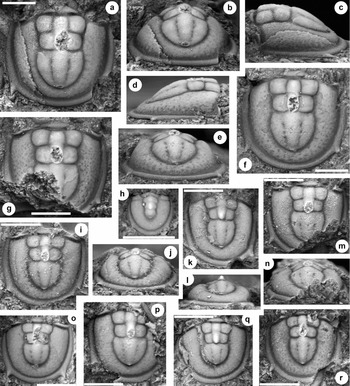
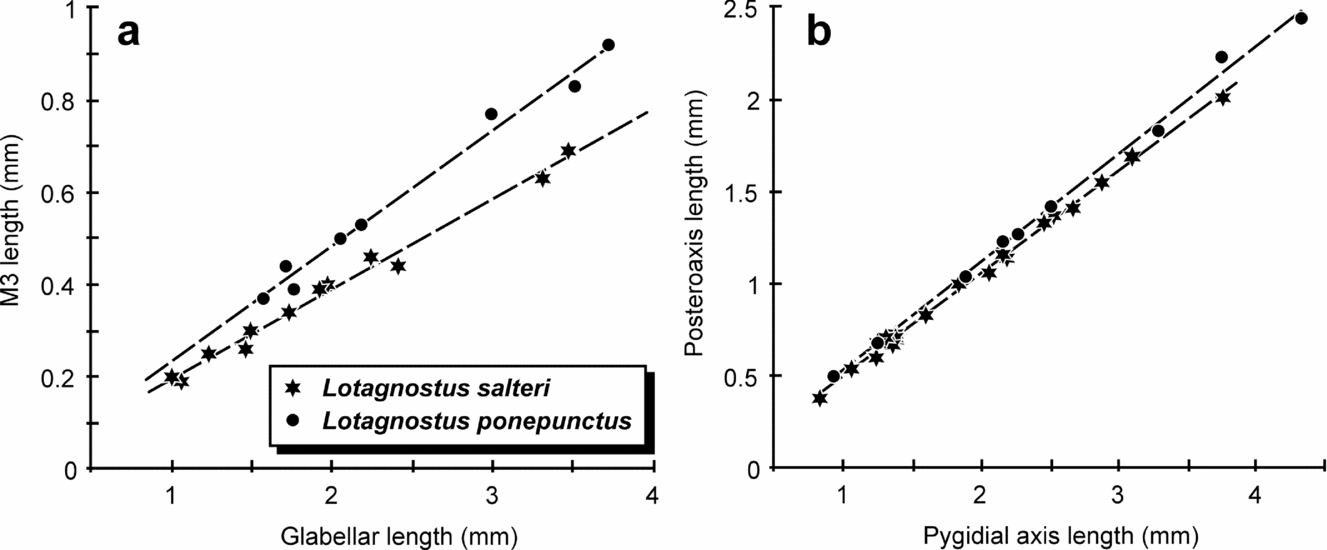
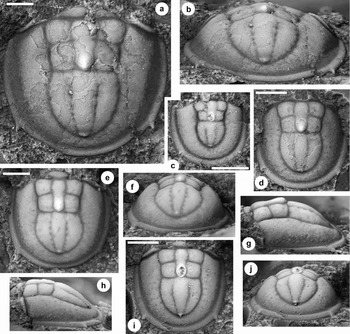
Among species from Avalonian Canada, L. salteri resembles L. ponepunctus, from the younger Ctenopyge linnarssoni Zone, in possessing cephalic genae that become flatter as they approach the glabella. Glabellar M3 lobes are relatively longer in L. ponepunctus, equal to about one-quarter of glabellar length, rather than about one-fifth in L. salteri; comparison of slopes of reduced major axis regression lines (Fig. 8a; Table 1) shows that this difference is significant (p<.0005). In addition, there are persistent differences in the distribution of cephalic scrobicules. Scrobicules become deeper and increase in density during the ontogeny of L. ponepunctus (Fig. 9) but, as also recognized by Matthew (Reference Matthew1901, p. 278), are concentrated on abaxial portions of the genae, with a relatively smooth zone bordering the glabella, which becomes wider (tr.) towards the posterior margin. Over a similar size range of cephala, scrobicules expand during the ontogeny of L. salteri to ‘fill in’ the region bordering the glabella (Figs 4e–g, 7g, j). Pygidia of L. salteri (Fig. 5) have abundant, pit-like scrobicules, whereas these are fainter in similarly sized specimens of L. ponepunctus (Fig. 10). Both species have well-developed notular furrows and intranotular axes, but the posteroaxis is somewhat longer in L. ponepunctus (56% of axis length; 53–60) than in L. salteri (52% of axis length; 46–55); however, comparison of slopes of regression lines (Fig. 8b; Table 1) shows that this modest difference is in fact significant (p=.05).
Regression coefficients (see Fig. 8 for plots).

Bivariate plots of cephalic and pygidial parameters of Lotagnostus salteri sp. nov. and L. ponepunctus (Matthew). Dashed lines show reduced major axis regression lines, with parameters listed in Table 1; comparisons between slopes follow the methodology described by Imbrie (Reference Imbrie1956) and Jones (Reference Jones1988). (a) Length (exsag.) of M3 glabellar lobe against glabellar length (sag.); slopes are significantly different (p<.0005; see Table 1 for details). (b) Posteroaxis length (sag.) against pygidial axis length (sag.; excluding articulating half-ring); slopes are significantly different (p=.05; see Table 1 for details).

Lotagnostus ponepunctus (Matthew, Reference Matthew1901) from the Chelsey Drive Group, north shore of East Bay near Eskasoni, Bras d'Or Lake, Cape Breton Island, Nova Scotia, Ctenopyge linnarssoni Zone; all cephala; all scale bars = 1 mm. (a–c) are the lectotype and all other specimens are paralectotypes. (a–c) NBMG 4386/5, dorsal, lateral and anterior views, ×13. (d–f) NBMG 4386/6, anterior, lateral and dorsal views, ×14. (g–i) NBMG 4386/7 (latex cast from external mould), dorsal, lateral and anterior views, ×14. (j) NBMG 4386/8, dorsal view, ×18. (k) NBMG 4386/9, dorsal view, ×16. (l) NBMG 4386/10, dorsal view, ×16. (m) NBMG 4386/11, dorsal view, ×16.

Lotagnostus ponepunctus (Matthew, Reference Matthew1901) from the Chelsey Drive Formation, north shore of East Bay near Eskasoni, Bras d'Or Lake, Cape Breton Island, Nova Scotia, Ctenopyge linnarssoni Zone; all pygidia; all scale bars = 1 mm. All specimens are paralectotypes. (a, b) NBMG 4386/12 (latex cast from external mould), dorsal and posterior views, ×14. (c) NBMG 4386/13, dorsal view, ×18. (d) NBMG 4386/14 (latex cast from external mould), dorsal view, ×18. (e–g) NBMG 4386/15, dorsal, posterior and lateral views, ×13. (h–j) NBMG 4386/16, lateral, dorsal and posterior views, ×15.

Lotagnostus germanus (Matthew) differs most clearly from L. salteri in having trisection of the posteroaxis that is faint to barely perceptible (Fig. 11; Westrop, Adrain & Landing, Reference Westrop, Adrain and Landing2011, fig. 4D–F, M–O), and in lacking scrobiculation on pygidium. Unlike L. salteri, the cephalon of L. germanus is weakly scrobiculate with poorly defined F2 furrows on unflattened specimens (Westrop, Adrain & Landing, Reference Westrop, Adrain and Landing2011, fig. 4J–L) although the furrows may be accentuated by compaction (Westrop, Adrain & Landing, Reference Westrop, Adrain and Landing2011, fig. 4I).
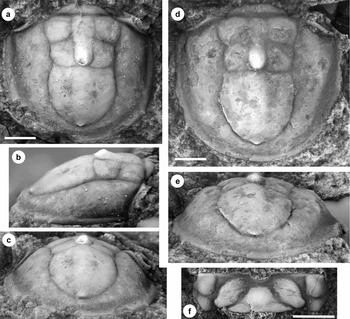
Lotagnostus from the Chelsey Drive Formation, north shore of East Bay near Eskasoni, Bras d'Or Lake, Cape Breton Island, Nova Scotia. Scale bars = 1 mm. (a–e) Lotagnostus germanus (Matthew, Reference Matthew1901). (a–c) pygidium, NBMG 15454, dorsal, lateral and posterior views, ×15. (d, e) pygidium, NBMG 4376/4, dorsal and posterior views. (f) Lotagnostus ponepunctus (Matthew, Reference Matthew1901), anterior thoracic segment, dorsal view, NBMG 4386/17, ×20.

Uncompressed cephala of L. matthewi sp. nov. (Westrop, Adrain & Landing, Reference Westrop, Adrain and Landing2011, fig. 3D–G) also have weak F2 furrows, and M3 is ill defined. Unlike L. salteri, scrobiculation is all but absent on both cephala and pygidia (Westrop, Adrain & Landing, Reference Westrop, Adrain and Landing2011, fig. 2). There is a minor but persistent difference in the outline of the intranotular axis of the pygidium, which tapers sharply towards the rear in L. matthewi (Westrop, Adrain & Landing, Reference Westrop, Adrain and Landing2011, fig. 2), but maintains a more even width in L. salteri (Figs 5, 6).
As noted earlier, the large sizes of the limited number of sclerites of L. americanus from the type area in Quebec hinder comparisons with the species documented in this paper. Cephala that are similar in size to the larger specimens of L. salteri (Rushton, Reference Rushton2009, fig. 1L; Westrop, Adrain & Landing, Reference Westrop, Adrain and Landing2011, fig. 6B–D) have much shallower scrobicules that are concentrated on abaxial parts of the genae. In all specimens of L. americanus (Westrop, Adrain & Landing, Reference Westrop, Adrain and Landing2011, figs 5E, F, 6G, I), genae are inflated and are flexed downward from the axial furrow, so that there is a relatively small change in slope with the flanks of the glabella; however, the genae of L. salteri (and the other species from Avalonian Canada) are less inflated and become relatively flat as they approach the axial furrows, producing a more pronounced change in slope with the flanks of the glabella (Fig. 4d, g, i; for other species, see for example Fig. 9c, i and Westrop Adrain & Landing, Reference Westrop, Adrain and Landing2011, figs 3G, 4J). All type and other pygidia of L. americanus from Quebec (Rushton, Reference Rushton2009, fig. 1M–O; Westrop, Adrain & Landing, Reference Westrop, Adrain and Landing2011, figs 5A–C, 6A, B) have notular furrows and intranotular axes that are at best poorly defined, and have little or no scrobiculation, whereas L. salteri has trisection of the posteroaxis and scrobicules that are both well developed (Figs 5, 6).
As noted above, the density and incision of cephalic scrobicules of L. salteri varies ontogenetically, so that small holaspids are nearly smooth to weakly scrobiculate, but larger specimens have well-developed networks that extend over the entire genae. In contrast, specimens that we would assign to L. asiaticus (see above) form a different ontogenetic trajectory in which scrobicules develop more slowly. Consequently, specimens that fall in the upper end of the size range of our cephala of L. salteri (Peng et al. Reference Peng, Babcock, Zhu, Terfelt and Dai2015, figs 1D, 2G, 7C) or beyond it (Peng et al. Reference Peng, Babcock, Zhu, Terfelt and Dai2015, figs 1G, 1H, 2K, 5C) resemble smaller, earlier holaspids of that species (Fig. 3a–f, k, m). Lotagnostus asiaticus also appears to have more evenly inflated genae (Peng et al. Reference Peng, Babcock, Zhu, Terfelt and Dai2015, fig. 2A–F, N) that do not flatten near the glabella as in L. salteri. Pygidia of L. asiaticus remain at best weakly scrobiculate through holaspid ontogeny (Peng et al. Reference Peng, Babcock, Zhu, Terfelt and Dai2015, figs 1A–E, G, H, 3, 5B, C, E) whereas scrobiculation is well developed in all but the smallest pygidia of L. salteri (Figs 5, 6, 7d–f, h, i, k, l). In addition, the pygidial posteroaxis is proportionally longer in L. asiaticus, averaging nearly 60% of axis length (59%; 55–64; measured from images in Peng et al. Reference Peng, Babcock, Zhu, Terfelt and Dai2015) versus about half of axis length in L. salteri (52%; 46–55).
As interpreted by us (see above), L. punctatus is a strongly furrowed, scrobiculate species (Peng et al. Reference Peng, Babcock, Zhu, Terfelt and Dai2015, figs 2J, 6E–I, 9). Scrobicules increase in density and incision on the cephala, producing anastomosing networks of rugae that are even better developed than in L. salteri. As in L. salteri, pygidia of L. punctatus have mostly pitted sculpture and are most easily separated from the former by the proportionately longer posteroaxes that range from 59 to 66% of axis length (measurements from images in Peng et al. Reference Peng, Babcock, Zhu, Terfelt and Dai2015).
Lotagnostus matthewi sp. nov.
2011 Lotagnostus cf. trisectus (Salter); Westrop, Adrain & Landing, p. 572, figs 2, 3.
Diagnosis. Cephalon faintly scrobiculate; glabella with faint F2 and poorly differentiated M3. Pygidium non-scrobiculate and well rounded in outline; notular furrows well defined; intranotular axis with conspicuous backward taper.
Types. All types are from Chelsey Drive Group, MacNeil Brook, Nova Scotia. The holotype (NBMG 15464) is a cephalon (Westrop, Adrain & Landing, Reference Westrop, Adrain and Landing2011, fig. 3D, E, G); paratypes (Westrop, Adrain & Landing, Reference Westrop, Adrain and Landing2011, figs 2, 3) are a cephalon (NBMG 15465) and seven pygidia (NBMG 15457–15463).
Etymology. For G. F. Matthew.
Material and occurrence. Two cephala and seven pygidia from the Chelsey Drive Group, MacNeil Brook, Nova Scotia, collection MaNe–E 1.0, and probably Parabolina lobata Zone (see Westrop, Adrain & Landing, Reference Westrop, Adrain and Landing2011, p. 574 for detailed description of the locality).
Discussion. Westrop, Adrain & Landing (Reference Westrop, Adrain and Landing2011) recognized that sclerites from MacNeil Brook, Cape Breton Island, shared some features with topotype L. trisectus from the type area in Avalonian Britain, but comparisons were hindered by poor preservation of the latter. Discovery of a larger sample of well-preserved sclerites that are even closer to L. trisectus in morphology demonstrates that the material from MaNe–E 1.0 is distinctive and is interpreted as a new species, L. matthewi; Westrop, Adrain & Landing (Reference Westrop, Adrain and Landing2011, p. 574) presented a full description under the name Lotagnostus cf. L. trisectus. It is most like L. germanus in that it is weakly scrobiculate and glabellar F2 and M3 are poorly defined. However, L. matthewi has well-defined trisection on uncompacted pygidia, whereas the notular furrows and intranotular axis of L. germanus are weak (Westrop, Adrain & Landing, Reference Westrop, Adrain and Landing2011, fig. 4M–O) to barely expressed (Fig. 11a–e; Westrop, Adrain & Landing, Reference Westrop, Adrain and Landing2011, fig. 4D–F). In addition, L. matthewi has a well-rounded pygidial outline that contrasts with the more convergent lateral margins and acrolobe of L. germanus. Comparisons with L. salteri are presented above, and comparisons with L. ponepunctus follow below.
Lotagnostus ponepunctus (Matthew, Reference Matthew1901)
Figures 9, 10, 11f
1901 Agnostus trisectus mut. ponepunctus Matthew, p. 278, pl. 5, fig. 8a–c
1903 Agnostus trisectus mut. ponepunctus Matthew, p. 220, pl. 17, fig. 8a-c.
Diagnosis. M3 glabellar lobe equal to about one-quarter (24%; 22–26) of glabellar length; scrobiculation of cephalon confined to abaxial areas, and weak to absent on posterior region, opposite basal lobes and M2 lobe. Pygidium with little sculpture; relatively long pygidial posteroaxis occupies more than half (56%; 53–60; lowest values in smallest specimens) of axis length; well-developed notular furrows and intranotular axis.
Type. All types are from Chelsey Drive Group, north shore of East Bay, Bras d'Or Lake, Nova Scotia. The lectotype (designated here) is a cephalon (NBMG 4386/5; Fig. 9a–c); paralectotypes (designated here) are six cephala (NBMG 4386/6–4386/11; Fig. 9) and five pygidia (NBMG 4386/12–4386/16; Fig. 10).
Material and occurrence. Ten cephala and ten pygidia from both surfaces of a small slab from the Chelsey Drive Group, ‘McAdam Shore’, north shore of East Bay, Bras d'Or Lake, Cape Breton Island (Matthew, Reference Matthew1901, Reference Matthew1903), Ctenopyge linnarssoni Zone.
Discussion. Matthew (Reference Matthew1901) did not designate types for the taxa that he named from ‘McAdam Shore’, but he did provide line drawings of representative specimens (Reference Matthew1901, pl. 5). The only clue to the specimens that were the basis for L. ponepunctus (and also Ctenopyge fletcheri) is a table of abundances (Matthew, Reference Matthew1901, p. 282) that includes an entry for ‘Agnostus trisectus chiefly the mut. ponepunctus’ along with ‘Sphaerophthalmus fletcheri, Ctenopyge pecten, Peltura scarabaeoides and Parabolina dawsoni’. The only specimen that matches this description in the collections of the New Brunswick Museum is a small slab catalogued as NBMG 4386 (R. Miller, pers. comm.). The faunal list matches the composition of the fauna of NBMG 4386 (although as noted by Henningsmoen, Reference Henningsmoen1957, p. 216 [synonymy], some sclerites attributed by Matthew to C. fletcheri are misassigned, and belong to Triangulopyge cf. T. humilis of this paper). The slab includes a large librigena of C. fletcheri (Fig. 2c) that is almost certainly the specimen illustrated by Matthew (Reference Matthew1901, pl. 5, fig. 7d) and, as in Matthew's counts, there is a single incomplete cranidium of P. dawsoni. The sclerites of Lotagnostus on NBMG 4386 match the original description and figures of L. ponepunctus (Matthew, Reference Matthew1901, p. 278, pl. 5, fig. 8), and include the single anterior thoracic segment (Fig. 11f) listed in the counts and illustrated by Matthew (Reference Matthew1901, pl. 5, fig. 8b). Finally, there are no other specimens of C. fletcheri and L. ponepunctus in the New Brunswick Museum collections (R. Miller, pers. comm.). We conclude that NBMG 4386 is the source of the figured material of both C. fletcheri and L. ponepunctus; a lectotype has already been designated for the former species by Henningsmoen (Reference Henningsmoen1957; Fig. 2c), and one is designated for the latter above.
Comparisons between L. ponepunctus and L. salteri are presented above. The glabella of L. matthewi, the youngest species recorded from Avalonian Canada (Fig. 1b), is characterized by a weak F2 furrow and ill-defined M3 lobes (Westrop, Adrain & Landing, Reference Westrop, Adrain and Landing2011, fig. 3D–F) that contrast with the large, conspicuous M3 and deeper F2 of L. ponepunctus (Fig. 9). The faint cephalic scrobiculation of L. matthewi is similar only to the smallest specimen of L. ponepunctus (Fig. 9j); scrobicules increase in density in abaxial regions of the genae during the ontogeny of the latter species, and when similarly sized specimens are compared (e.g. Fig. 9m and Westrop, Adrain & Landing, Reference Westrop, Adrain and Landing2011, fig. 3E), scrobiculation is better developed in L. ponepunctus.
The well-developed notular furrows and intranotular axis of L. ponepunctus (Fig. 10) contrast with the weak expression of the trisection of the pygidial posteroaxis in L. germanus (Westrop, Adrain & Landing, Reference Westrop, Adrain and Landing2011, fig. 4D–F, M–O; Fig. 11a–e) and also L. americanus (Rushton, Reference Rushton2009, fig. 1M–O; Westrop Adrain & Landing, Reference Westrop, Adrain and Landing2011, figs 5A–C, 6A, B). Uncompacted cephala of L. germanus have faint F2 glabellar furrows (Westrop, Adrain & Landing, Reference Westrop, Adrain and Landing2011, fig. 4J–L), whereas these furrows are well incised in L. ponepunctus (Fig. 9a, l). Lotagnostus asiaticus as defined in this paper (see above) is closer to L. ponepunctus in the expression of the intranotular axis, although the notular furrows appear to be weaker in similarly sized specimens of the former (compare Fig. 10a, b, with Peng et al. Reference Peng, Babcock, Zhu, Terfelt and Dai2015, figs 1G–J, and 2C–F) and the posteroaxis even longer (Peng et al. Reference Peng, Babcock, Zhu, Terfelt and Dai2015, figs 5B, 7C, H). Cephala of L. asiaticus have weaker glabellar furrows than similarly sized cephala of L. ponepunctus, even on internal moulds (Peng et al. Reference Peng, Babcock, Zhu, Terfelt and Dai2015, fig. 5A–C), and the glabella is proportionately longer and narrower; measurements of photographs in Peng et al. show that width at the M3 lobe is equal to a little more than 40% (43%; 41–46) of glabellar width versus nearly half in L. ponepunctus (49%; 48–52), although sample sizes are too small for a proper statistical treatment.
Lotagnostus germanus (Matthew, Reference Matthew1901)
Figure 11a–e
2011 Lotagnostus germanus (Matthew); Westrop, Adrain & Landing, p. 577, fig. 4 (see for synonymy).
Diagnosis. See Westrop, Adrain & Landing (Reference Westrop, Adrain and Landing2011, p. 577)
Lectotype. A pygidium (NBMG 3358; Westrop, Adrain & Landing, Reference Westrop, Adrain and Landing2011, fig. 4D–F) from the Chelsey Drive Group, East Bay, Bras d'Or Lake, Cape Breton Island.
Material and occurrence. Three cephala and four pygidia from the Chelsey Drive Group, ‘McAdam Shore’, north shore of East Bay, Bras d'Or Lake, Cape Breton Island (Matthew, Reference Matthew1901, Reference Matthew1903), Ctenopyge linnarssoni Zone.
Discussion. Lotagnostus germanus was revised recently by Westrop, Adrain & Landing (Reference Westrop, Adrain and Landing2011) using type and other material from Matthew's collections at the New Brunswick Museum. Two additional pygidia from these collections, one of which is slightly compacted, confirm that the notular furrows and intranotular axis of the posteroaxis are poorly defined at best (Fig. 11). The indistinct trisection of the posteroaxis is shared with L. americanus from Quebec and L. peladensis (Rusconi, Reference Rusconi1951; see Tortello, Reference Tortello2014 for revision) from Mendoza, Argentina, and is also a characteristic of more effaced species (e.g. Westrop, Adrain & Landing, Reference Westrop, Adrain and Landing2011, figs 7–9). Lotagnostus peladensis has a proportionately shorter pygidial axis than L. germanus (compare Tortello, Reference Tortello2014, figs 2.21–2.28, 3.5–3.7 with Westrop, Adrain & Landing, Reference Westrop, Adrain and Landing2011, fig. 4D–F, M–O and Fig. 11a–e). The cephalon of L. pedalensis is more strongly effaced, with the glabella poorly defined on larger testate individuals, and is non-scrobiculate; as noted by Tortello (Reference Tortello2014, p. 299), it is allied with other relatively effaced species, such as L. obscurus Palmer, Reference Palmer1955; Westrop, Adrain & Landing, Reference Westrop, Adrain and Landing2011, fig. 7).
Pygidia of L. germanus and L. americanus from the type area are quite similar, although the former seems to have a more pronounced constriction of the axis at M2 (compare Westrop, Adrain & Landing, Reference Westrop, Adrain and Landing2011, fig. 4D–F, M–O and Fig. 11a–e with Rushton, Reference Rushton2009, fig. 1M–O and Westrop, Adrain & Landing, Reference Westrop, Adrain and Landing2011, figs 5A–C, 6A, B). Cephala are clearly differentiated by the lower degree of inflation of the genae in L. germanus, which become flatter as they approach the glabella (Westrop, Adrain & Landing, Reference Westrop, Adrain and Landing2011, fig. 4J). In similarly sized specimens (Westrop, Adrain & Landing, Reference Westrop, Adrain and Landing2011, figs 4J–L, 6B–D), L. americanus has deeper F2 furrows, narrower (tr.) basal lobes and weaker scrobiculation.
Lotagnostus sp. indet.
Fig. 12
1959 Lotagnostus cf. L. trisectus (Salter); Rasetti, p. 381, pl. 51, figs 8, 9.
Material and occurrence. Two cephala from a loose block of limestone of the Frederick Formation (= ‘Grove Formation’ of Rasetti, Reference Rasetti1959; Reinhart, Reference Reinhardt1974) collected from a stone wall on the west side of North Market Street, opposite 15th Street, Frederick, Maryland, locality ccb/2 (Rasetti, Reference Rasetti1959, p. 379). The associated trilobites indicate a correlation with either the Onchonotus richardsoni or Keithia subclavata faunas of the Cow Head Group of western Newfoundland (Ludvigsen, Westrop & Kindle, Reference Ludvigsen, Westrop and Kindle1989, p. 9).
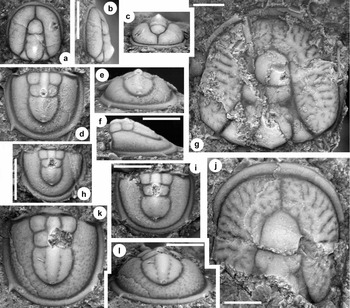
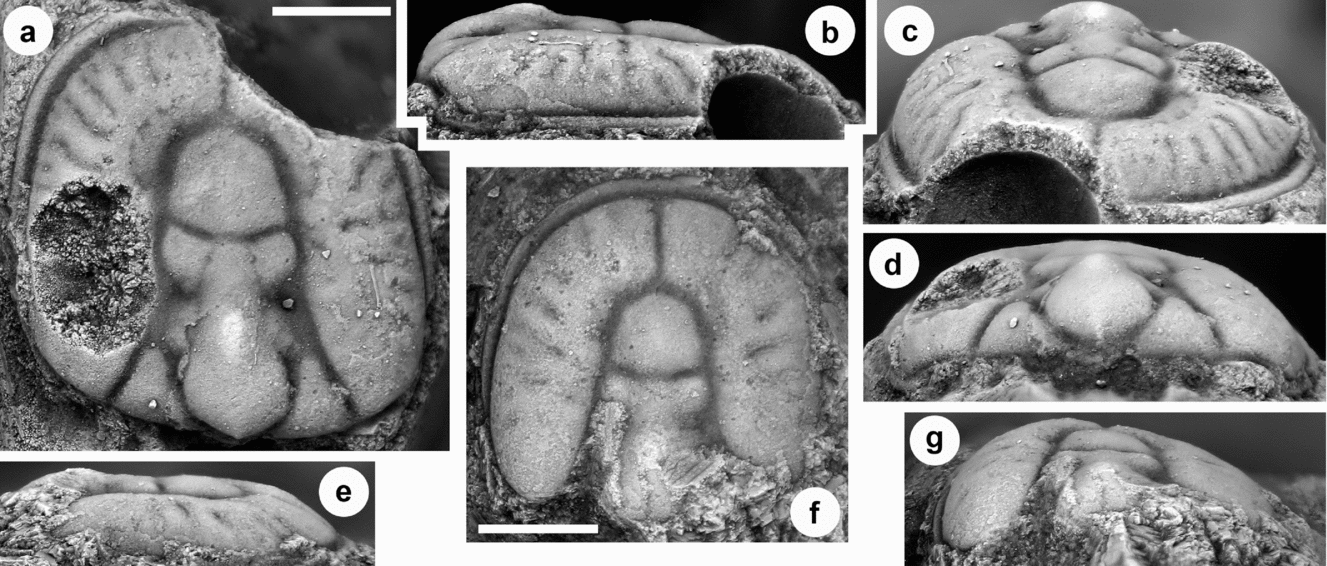
Discussion. Limited material records the presence of a trisectus-like species of Lotagnostus on the east Laurentian platform, although unlike L. americanus, the sclerites are almost certainly from dysoxic upper slope facies of the Lime Kiln Member of the Frederick Formation (Landing, unpub. data). As in L. salteri, cephala of L. sp. indet. have well-incised axial and glabellar furrows, have short M3 glabellar lobes that are equal to less than 20% of glabellar length, and the genae flatten markedly towards the glabella (Fig. 12c). They differ in the extent of scrobiculation, which is reduced in L. sp. indet. and resembles the condition in L. ponepunctus (Fig. 9); the latter is distinguished by its much longer M3 glabellar lobe. It would not be surprising if L. sp. indet. proves to represent a new species, but more material is needed.
Lotagnostus sp. indet. from the Frederick Formation (‘Grove Formation’ of Rasetti, Reference Rasetti1959), loose block from a stone wall, Frederick, Maryland; all cephala and ×15; all scale bars = 1 mm. (a–d) USNM 136930, dorsal, lateral, anterior and posterior views (illustrated previously by Rasetti, Reference Rasetti1959, pl. 51, fig. 8). (e–g) USNM 628841, lateral, dorsal and posterior views (illustrated previously by Rasetti, Reference Rasetti1959, pl. 51, fig. 9).

Acknowledgements
This research was supported in part by National Science Foundation grants EAR 9973065 and EAR 0308685 to Westrop. Randy Miller arranged the loan of material from the Matthew collection at the New Brunswick Museum and confirmed the identification of the type lots of Ctenopyge fletcheri and Lotagnostus ponepunctus. Conrad Labandiera and Dan Levin lent specimens from the National Museum of Natural History, Washington, DC. Comments from two anonymous reviewers helped improve the paper.