The CHDs are global health problems being the most common major congenital anomalies with increasing incidence globally.Reference Abdulla, Koenig, Hijazid and Zimmerman1 Worldwide incidence of CHDs range between 1.9 and 9.3 per 1000 live births.Reference Linde, Konings and Slager2 Reported incidence of CHDs in Nigeria is 3.5 per 1000 live births.Reference Gupta and Antia3 The hospital-based prevalence studies in Nigeria range between 0.5 and 14.4% of hospital admissions.Reference Chinawa, Obu, Eke and Eze4–Reference Otaigbe and Tabansi8
CHDs contribute to childhood morbidity and mortality, especially in the developing countries where facilities for intervention are often unavailable.Reference Sadoh, Nwaneri and Owobu9 The majority of children with CHDs often live with their condition for prolonged periods after diagnosesReference Abdulla, Koenig, Hijazid and Zimmerman1,Reference Sadoh, Uzodimma and Daniels6,Reference Ekure, Sadoh and Bode-Thomas10 with attendant complications, such as heart failure, recurrent pneumonia, and renal injury.Reference Dimopoulos, Diller and Koltsida11
CHDs are classified into acyanotic CHDs and cyanotic CHDs.Reference Ibadin, Sadoh and Osarogiagbon5,Reference Sadoh, Uzodimma and Daniels6,Reference Otaigbe and Tabansi8 Acyanotic CHDs, especially those with significant shunt lesions,Reference Sadoh, Nwaneri and Owobu9 cause recurrent and chronic heart failure with resultant chronic hypoperfusion of tissues, while the cyanotic CHDs cause chronic systemic desaturation.Reference Perloff12 Both pathophysiologic processes lead to chronic tissue hypoxia with subsequent injury to various organs such as the kidney.Reference Dimopoulos, Diller and Koltsida11,Reference Perloff12 Chronic hypoxia which is the sequela of CHDsReference Amoozgar, Basiratnia and Ghasemi13–Reference Akita, Matsuoka and Kuroda16 results in early renal tubular damageReference Agras, Derbent and Ozcay15 for years before subsequent glomerular damage becomes obvious.Reference Agras, Derbent and Ozcay15–Reference Perloff, Latta and Barsotti17 Renal injury which is defined as structural or functional abnormalities of the kidney manifested by either pathological abnormalities or elevated levels of biomarkers of kidney damage18 is a recognised complication of CHDs even as early as infancy.Reference Amoozgar, Basiratnia and Ghasemi13–Reference Agras, Derbent and Ozcay15,Reference Zheng, Yao, Han and Xiao19 Renal injury is known to cause threefold increase in morbidity and mortality in these patients.Reference Sadoh, Nwaneri and Owobu9,Reference Dimopoulos, Diller and Koltsida11 Hence, early identification of renal injury in children with CHDs and institution of interventions (such as medications, blood pressure control, and dietary modifications) may slow the progression of renal injury and improve their quality of life pending institution of corrective heart surgery.Reference Maleki, Ghaffari, Ghaffari, Samadi, Maleki and Behnam14,Reference Saweirs and Goddard20
The identification of renal injury using reliable and specific biomarker of early renal injury is imperative. Several studies had looked at renal injury in children and adults with CHD using markers such as creatinine, N-acetyl-beta-d-glucosaminidase, β 2-microglobulin, and α1-microglobulin with varied findings in terms of onset of renal injury.Reference Dimopoulos, Diller and Koltsida11,Reference Amoozgar, Basiratnia and Ghasemi13,Reference Agras, Derbent and Ozcay15,Reference Zheng, Yao, Han and Xiao19 The use of urinary neutrophil gelatinase-associated lipocalin, which has been demonstrated by several studies to be most sensitive and specific biomarker of renal tubular injury,Reference Devarajan21,Reference Mitsnefes, Kathman and Mishra22 has not been evidently studied in children with uncorrected CHDs except in assessment of renal function following cardiac surgery.Reference Mishra, Dent and Tarabishi23 Urinary neutrophil gelatinase-associated lipocalin has been shown to be very sensitive in detection of renal injury as well as monitor progression.Reference Devarajan21,Reference Mitsnefes, Kathman and Mishra22,Reference Bolignano, Lacquaniti and Coppolino24 There is also dearth of information on the renal status of Nigerian children with uncorrected CHDs.
This study was therefore carried out to evaluate the renal injury in children with uncorrected CHDs with significant shunt in the University of Benin Teaching Hospital, Benin City, using urinary neutrophil gelatinase-associated lipocalin as well as to determine the levels of urinary neutrophil gelatinase-associated lipocalin in these children with CHDs and their age- and sex-matched controls. The urinary neutrophil gelatinase-associated lipocalin levels in children with uncorrected acyanotic and cyanotic CHDs were also compared.
Methods
This cross-sectional descriptive study was carried out at the Paediatric Cardiology Outpatient Clinic of the University of Benin Teaching Hospital, Benin City, between March and July 2017.
The patients were children aged 2 to 204 months with confirmed uncorrected CHDs on echocardiography without evidence of structural renal defect on renal ultrasound scan. The patients were clinically stable patients on follow-up in the clinic. Most of those with acyanotic CHD had significant shunt lesions resulting in chronic congestive heart failure, for which they were on treatment. Patients with uncorrected CHD with known history of diabetes mellitus, asthma, structural renal defect, and ongoing acute infections such as urinary tract infection, pneumonia, and sepsis were excluded from the study.
The controls were apparently healthy infants and younger children from well-baby clinic and apparently healthy older children who followed their siblings and parents to the General Practice Clinic of the University of Benin Teaching Hospital who do not have CHDs from history and examination. Renal ultrasound scan was done for the control group to rule out structural renal defects at recruitments.
The sample size was determined using the formula described by Yamane.Reference Yamane25
 $$n = {N \over {1 + N{{\left( e \right)}^2}}}$$
where n was the minimum sample size of the study population, N was the estimated size of the population (70 patients attended the paediatric cardiology clinic in the preceding 6 months), and e is the level of precision (fixed at 5% or 0.05).
Thus, the sample size was
 $$n = {{70} \over {1 + 70{{\left( {0.05} \right)}^2}}} = 59.57$$
An estimated sample size of 60 was obtained. An attrition rate of 5% was incorporated to allow missing samples. Thus, a total of 65 patients were recruited for the study. A total of 65 healthy children were also recruited as controls.
Sampling technique was by consecutive recruitment until the desired number was met, following which the controls were recruited. Frequency matching technique (with allowance of 2 months difference in age between patient and controls below 12 months) was used to obtain the controls.
Data collection and clinical evaluation
The relevant socio-demographic and clinical information were obtained using a semi-structured researcher-administered proforma by the researcher. Trained assistants who were registrars and medical house officers in paediatric cardiology postings assisted in the anthropometric measurements. The socio-economic status was determined using the scoring system developed by Olusanya et al.Reference Olusanya, Okpere and Ezimokhai26
Echocardiography procedure
An echocardiographic machine PHILIPS HD7XE with a 5–8 MHz transducer was used for diagnoses of CHDs in all patients prior to the study by the paediatric cardiologist. The two-dimensional, the M-mode, and Doppler echocardiographic images were acquired from standard echocardiographic views (apical, parasternal, suprasternal, and subcostal) with all patients on supine position and some on the left lateral decubitus position when there was difficulty with apical view. Analysis of reports was in accordance with the recommendation of American Society of Echocardiography.27 All patients with the various forms of CHDs that met the inclusion criteria were recruited.
Renal ultrasound scans procedure
Renal ultrasound scan was done using a SONACE X6 (Madison Inc., Korea 2010) ultrasound machine. All respondents without features of structural renal abnormality were recruited for the study.
The anthropometric measurements
The children less than 1 year of age were weighed without any clothing or diaper, sitting in a bassinet weighing scale with a sensitivity of 0.01 kg. Children aged 1 year or above were weighed wearing their normal clothing without their foot wear or cardigans standing on a Seca® scale (Secagmbh & Co, Germany) with a sensitivity of 0.1 kg. The lengths of all the children were measured using a non-distensible measuring tape from the vertex to the heel placed in the neutral position, having a sensitivity of 0.01 cm. The patients’ lengths were measured as they presented in respiratory difficulty and were unable to stand up. The controls also had their lengths taken in order to allow for uniformity in both study arms. The body mass index of the participants was determined as the ratio of weight (kg)/height2 (m2). The values were then plotted against the percentile chart for the age and sex, and the body mass index percentile was obtained.
Measurement of oxygen saturation
This was determined using appropriately fitted pulse oximeter (Pulse Oximeter TS1301) fixed to the thumb or big toe. The appropriate reading was taken following correlation of the measured pulse rate with counted pulse or heart rate.
Determination of urinary neutrophil gelatinase-associated lipocalin levels
First, the urine sample that voided directly into a sterile container was obtained from the patients through a clean catch from the young patients below 2 years, while mid-stream from the patients above years old enough to understand instruction. Each day, the urine samples were stored in an ice-packed polythene container with cock-screwed lid at 4°C and transported to the research laboratory within 4 hours after collection. The samples were centrifuged at 3500 revolutions per minute for 10 minutes to remove debris within 4 hours of reception at the laboratory. Afterwards, a minimum of 100 μl of the supernatant of centrifuged urine samples was dispensed into cryotubes and stored at −80°C. All samples were analysed within 6 months of storage.Reference Grenier, Ali and Syed28–Reference Pedersen, Ravn, Hjortdal, Nørregaard and Povlsen30
The urinary neutrophil gelatinase-associated lipocalin samples were analysed using the commercially available neutrophil gelatinase-associated lipocalin enzyme-linked immunosorbent assay (ELISA) kit (ELISA Kit 036RUO, Lot No.NG-1503-04; BioPorto Diagnostics, Tuborg Havnevej 15st, Denmark). It is a solid-phase ELISA designed specifically to measure human neutrophil gelatinase-associated lipocalin. This was done according to manufacturer’s specification.Reference Grenier, Ali and Syed28
The study intra-assay and inter-assay coefficients of variability were 4.1 and 5%, respectively. Hence, this study possesses good precision.
Different cut-off values were generated for males and females because of the statistically significant difference in the median urinary neutrophil gelatinase-associated lipocalin levels in male and female controls in previous study.Reference Bennett, Nehus, Haffner, Ma and Devarajan31
Statistical analysis
The data obtained were analysed using International Business Machines Corporation Statistical Package for the Social Sciences (SPSS) version 21.0 (SPSS for Window Inc; Chicago, LL, USA) statistical software. The urinary neutrophil gelatinase-associated lipocalin and age were summarised using median and interquartile range as they were not normally distributed. The heights, weight, and body mass index were summarised as mean ± standard deviation as their frequency distributions were normal. The categorical data such as age groups and socio-economic class of both patients and controls were presented as frequencies and percentages, and chi-square test was used to test the categorical data. Student’s t-test was used to compare the means of the normally distributed continuous variables, while the Mann–Whitney U was used to compare medians of the non-normally distributed continuous variables such as urinary neutrophil gelatinase-associated lipocalin levels. The level of significance of each test was p < 0.05 at 95th confidence interval. Renal injury in children with uncorrected CHDs was determined using urinary neutrophil gelatinase-associated lipocalin levels greater than 95th percentile cut-off for each gender of the age- and sex-matched controls.Reference Bennett, Nehus, Haffner, Ma and Devarajan31
Results
A total of 65 children with uncorrected CHDs and without structural renal defects were recruited for this study. The patients consisted of 31 (47.7%) males and 34 (52.3%) females in both patients and controls groups with a male:female ratio of 1:1.1. The study participants were aged 2–204 months, and the median age and interquartile range of the patients was 14.0 (7.0–62.0) months, while that of the control group was 12.0 (6.0–60.5) months (U = 2009.5, p = 0.631).
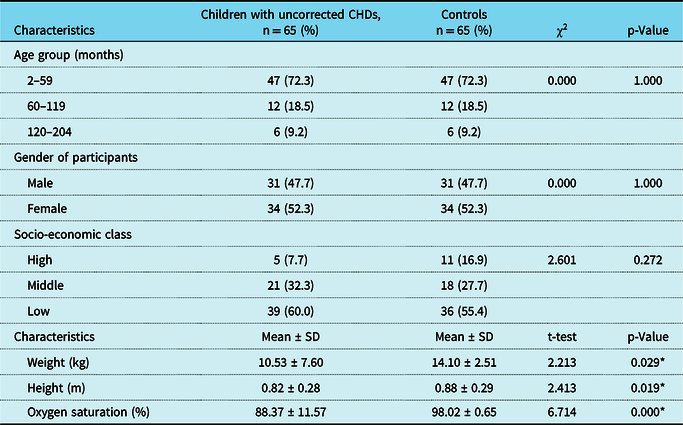
The ages of the participants were categorised into three groups: 2–59 months, 60–119 months, and 120–204 months. Of the 47 patients aged 2–59 months, 31(66.0%) were aged 1–12 months. While of the 47 controls aged 2–59 months, 34 (72.2%) were aged 1–12 months (χ2 = 0.449, p = 0.779). The median and interquartile range ages of the female patients and controls were 10.0 (5.8–61.3) months and 12.0 (6.0–60.0) months, respectively (U = 575.0, p = 0.971), while that between the male patients and controls were 22.0 (9.0–81.0) months and 12.0 (9.0–62.0) months, respectively (U = 417.0, p = 0.37). The details of the age group, socio-economic class, the mean anthropometric indices, and oxygen saturation values between patients and controls are shown in Table 1.
Socio-demographic and clinical characteristics of patients

* Significant at p < 0.05. Note: Patient below 2 months did not present in the paediatric cardiology clinic during recruitments for this study.
There was also statistically significant lower mean oxygen saturation in children with uncorrected CHD compared with the controls (t = 6.714, p = 0.000).
Patients with cyanotic and acyanotic CHDs
In this study, 36 (55.4%) patients had acyanotic CHDs, while 29 (44.6%) had cyanotic CHDs. Of the 36 patients with acyanotic CHDs 14 (38.9%) were males and 22 (61.1%) were females, while of the 29 patients who had cyanotic CHDs 17 (58.6%) were males and 12 (41.4%) were females. There were seven patients with reversal of shunt (right to left), cyanosis who were classified as cyanotic CHD.
Types of CHDs
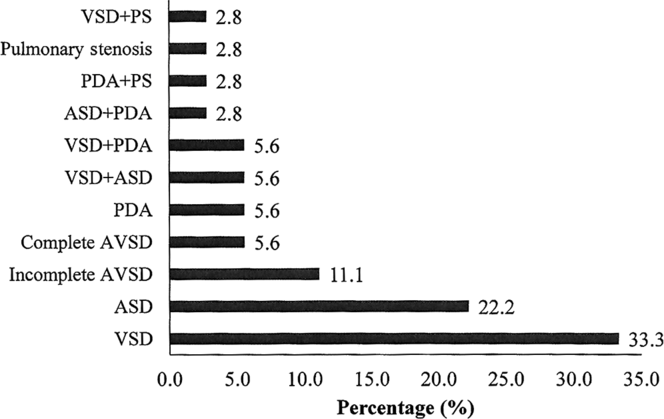
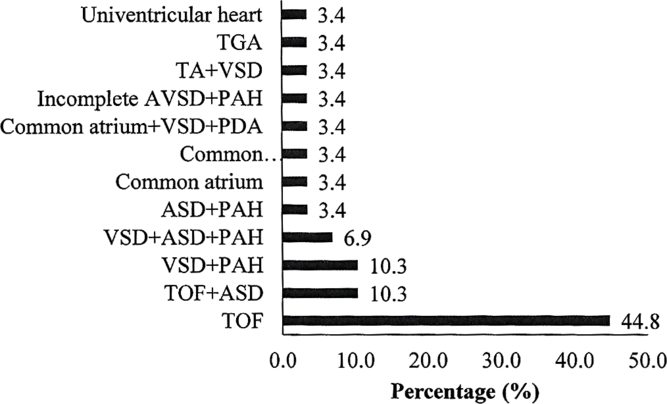
The most common type of acyanotic CHDs was isolated ventricular septal defect 12 (33.3%) followed by isolated atrial septal defect of 8 (22.2%) (see Figure 1), while the most common type of cyanotic CHDs was tetralogy of Fallot of 13 (44.8%) followed by tetralogy of Fallot + atrial septal defect of 3 (10.3%) and ventricular septal defect + pulmonary arterial hypertension of 3 (10.3%) (Figure 2)
Bar chart of frequencies of types of acyanotic CHDs. VSD = ventricular septal defect; PS = pulmonary stenosis; PDA = patent ductus arteriosus; ASD = atrial septal defect; AVSD = atrioventricular septal defect.

Bar chart of frequencies of types of cyanotic CHDs. TGA = transposition of the great artery; TA = tricuspid atresia; VSD = ventricular septal defect; AVSD = atrioventricular septal defect; PAH = pulmonary arterial hypertension; PDA = patent ductus arteriosus; ASD = atrial septal defect; TOF = tetralogy of fallot.

Tetralogy of Fallot was the most common type of CHDs from this study with a total of 13 (20%) followed by isolated ventricular septal defect with a total of 12 (18.5%) patients. Isolated defects accounted for 35 (53.8%), while combined defects accounted for 30 (46.2%) of CHDs patients.
Anthropometric indices and oxygen saturation of children with CHDs
The anthropometric indices and oxygen saturation of acyanotic and cyanotic CHDs are as shown in Table 2. The mean height and weight of children with cyanotic CHD were significantly higher than children with acyanotic CHDs (p = 0.007 and p = 0.008), respectively.
Anthropometric indices and oxygen saturation of children with CHDs

* Significant at p < 0.05.
The mean oxygen saturation of the children with cyanotic CHDs was significantly lower than those with acyanotic CHDs (p ≤ 0.0001).
Median urinary neutrophil gelatinase-associated lipocalin levels of patients and controls
The median urinary neutrophil gelatinase-associated lipocalin level of the patients was 26.10 (14.15–44.80) ng/ml and it was significantly higher than the value observed for the controls, 16.90 (12.20–30.00) ng/ml (U = 1624.50, p = 0.023).
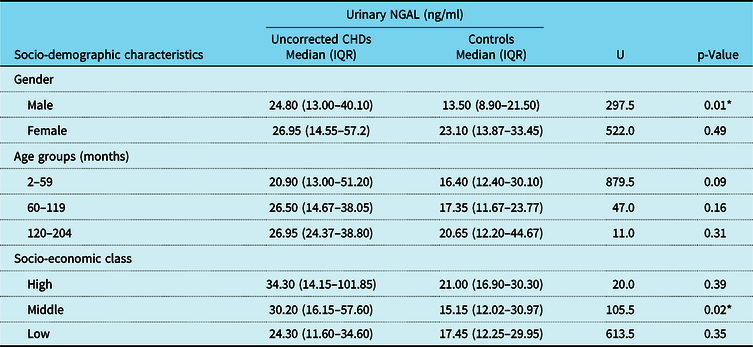
The median and interquartile range of urinary neutrophil gelatinase-associated lipocalin levels of the patients and controls according to age group, gender, and socio-economic class are shown in Table 3. The median urinary neutrophil gelatinase-associated lipocalin level of patients was higher than the controls across age group, gender, and socio-economic class. However, the differences were only significant in between the male patients and controls (U = 297.5, p = 0.01) and middle socio-economic class (U = 105.5.5, p = 0.02).
Median urinary NGAL levels of the patients and controls across the socio-demographic groups

NGAL = neutrophil gelatinase-associated lipocalin; IQR = interquartile range.
* Significant at p < 0.05.
Prevalence of renal injury in patients using urinary neutrophil gelatinase-associated lipocalin
The 95th percentile cut-off value of urinal neutrophil gelatinase-associated lipocalin for male patients was 46.34 ng/ml, while that for the female patient was 65.00 ng/ml.
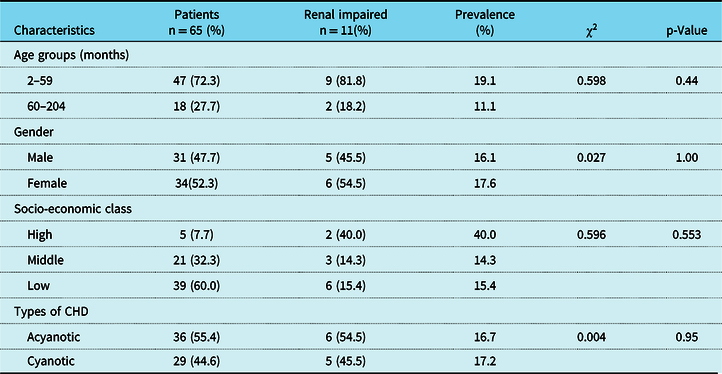
Using the gender-specific cut-off values, five males and six female patients exceeded the cut-off value of urinary neutrophil gelatinase-associated lipocalin. Thus, a total of 11 patients with a prevalence of 16.9% had renal injury. The median and interquartile range age was 16 (4–44) months. Only a 3-month-old male control participant with 59.00 ng/ml urinal neutrophil gelatinase-associated lipocalin level exceeded the 46.34 ng/ml 95th percentile cut-off value for males. None in female controls exceeded their 65 ng/ml 95th percentile cut-off value for females.
Prevalence of renal injury by socio-demographic and clinical variables
The prevalence of renal injury by gender, age groups, and socio-economic class are shown in Table 4. There was no statistically significant difference between age groups, gender, and socio-economic classes (p > 0.05).
Prevalence of renal impairment across socio-demographic and clinical categories

Urinary neutrophil gelatinase-associated lipocalin levels and renal injury in patients with acyanotic and cyanotic CHDs
The median and interquartile range of urinary neutrophil gelatinase-associated lipocalin level of the patients with acyanotic CHDs was 22.60 (11.95–34.73) ng/ml, while that of those with cyanotic CHDs was 30.2 (15.15–52.60 ng/ml). The difference in urinary neutrophil gelatinase-associated lipocalin levels was not statistically significant (U = 417.50, p = 0.168). The difference in renal injury prevalence between children with acyanotic and cyanotic CHDs was not significant (χ2 = 0.004, p = 0.951). See Table 4.
Discussion
This study showed that children with uncorrected CHDs have a significantly higher median urinary neutrophil gelatinase-associated lipocalin level compared to their age- and sex-matched controls. Previous studiesReference Agras, Derbent and Ozcay15,Reference Zheng, Yao, Han and Xiao19,Reference Noori, Sadeghi, Shahramian and Keshavarz32 have demonstrated similar findings of significantly elevated biomarkers of renal injury such as N-acetyl-beta-d-glucosaminidase and β 2-microglobulin in CHDs patients in relation to controls. In the study by Agras et al,Reference Agras, Derbent and Ozcay15 N-acetyl-beta-d-glucosaminidase was noted to be significantly elevated when compared to the control group. This finding has also been collaborated by Zheng et alReference Zheng, Yao, Han and Xiao19 who also noted that biomarkers of renal injury such as N-acetyl-beta-d-glucosaminidase and α1-microglobulin were significantly elevated when compared to the control group as early as infancy. This is the first known study to demonstrate elevated urinary neutrophil gelatinase-associated lipocalin in patients with uncorrected CHDs compared to their age- and sex-matched controls. Chronic hypoxia which is the sequela of CHDs,Reference Amoozgar, Basiratnia and Ghasemi13–Reference Akita, Matsuoka and Kuroda16 resulting in early renal tubular damage,Reference Agras, Derbent and Ozcay15,Reference Zheng, Yao, Han and Xiao19 may be responsible for the elevated urinary neutrophil gelatinase-associated lipocalin, a known sensitive and early marker of renal tubular injury.Reference Mishra, Ma and Kelly33
There were higher median urinary neutrophil gelatinase-associated lipocalin levels in patients across gender, age, and socio-economic class when compared with the controls. Although, median urinary neutrophil gelatinase-associated lipocalin was significantly higher in male patients when compared with controls, the levels were not significantly higher in female patients compared to controls. The reason for this finding is not clear. There is no previous study that compared urinary neutrophil gelatinase-associated lipocalin levels in patients with renal injury and controls across gender to compare with. This finding could be an incidental finding which may be invalidated by studies with higher sample size.
The median and interquartile range of urinary neutrophil gelatinase-associated lipocalin levels for the controls in this study is higher than the study by Bennett et alReference Bennett, Dent and Ma34 which reported 6.6 ng/ml and interquartile range of 2.8–17 mg/dl. Despite the use of similar method (BioPorto sandwich ELISA) which has been validated by Pedersen et al,Reference Pedersen, Ravn, Hjortdal, Nørregaard and Povlsen30 the higher value in this study may be due to the younger age group of controls (as low as 2 months) included in this study. The lower age group in this study is closer to the neonatal age which was noted to have higher neutrophil gelatinase-associated lipocalin values compared to older children by Cangemi et al.Reference Bennett, Nehus, Haffner, Ma and Devarajan31 Studies by Bennett et alReference Bennett, Nehus, Haffner, Ma and Devarajan31 and Cangemi et alReference Cangemi, Storti and Cantinotti35 on paediatric reference ranges for urinary neutrophil gelatinase-associated lipocalin, demonstrated a significantly higher levels in children below 1 month and children above 10 years. These findings may argue for possible age-related cut-offs and the possible influence on our results. However, in our study, only six (9.2%) patients and controls were older than 10 years and their distribution was not significantly different from the other age groups. The higher urinary neutrophil gelatinase-associated lipocalin levels in controls aged 10 years and above in relation to younger age groups in this study is similar to findings by Bennett et al.Reference Bennett, Dent and Ma34 However, the non-significant finding in this cohort may be due to smaller number of participants in this age cohort. The higher levels of urinary neutrophil gelatinase-associated lipocalin in adolescents have been attributed to growth spurt and pubertal development.Reference Bennett, Dent and Ma34
There was significantly higher median urinary neutrophil gelatinase-associated lipocalin level in female control than their male counterpart in all age groups. The finding is similar to previous studies.Reference Bennett, Dent and Ma34 The biological reasons why urinary neutrophil gelatinase-associated lipocalin is generally higher in healthy females are currently unknown. This calls for further study on urinary neutrophil gelatinase-associated lipocalin physiology in healthy male and female children.
The overall prevalence of renal injury in children with uncorrected CHDs using different urinary neutrophil gelatinase-associated lipocalin cut-off value for each gender was 16.9%. Previous studiesReference Agras, Derbent and Ozcay15,Reference Zheng, Yao, Han and Xiao19,Reference Noori, Sadeghi, Shahramian and Keshavarz32 on renal injury in children with CHDs had compared significant levels of biomarkers in patients with that of controls without generating cut-off values. However, the study by Dimopoulos et alReference Dimopoulos, Diller and Koltsida11 on adult survivals of CHDs documented 9% prevalence of renal injury by estimation of glomerulo filtration rate using serum creatinine, with cut-off of glomerolo filtration rate set at 60 ml/min/1.73 m2 for determination of renal injury.18 The higher prevalence of renal injury in this study compared to that of Dimopoulos et alReference Dimopoulos, Diller and Koltsida11 further confirms urinary neutrophil gelatinase-associated lipocalin as an early and more sensitive biomarker of renal injury in children with uncorrected CHDs. Dimopoulos et alReference Dimopoulos, Diller and Koltsida11 study being on adult survivals who had lived with CHDs for a long time is expected to have high prevalence of renal injury. However, this lower finding is most likely due to the use of serum creatinine which is a late marker of glomerular damage.Reference Cangemi, Storti and Cantinotti35 It could also be argued that both studies are not comparable being that they were done in two different populations with different biomarkers.
Renal injury as early as infancy in this study is comparable to the study by Zheng et alReference Zheng, Yao, Han and Xiao19 who demonstrated renal injury in infancy. They documented significantly high values of N-acetyl-beta-d-gluconsaminidase and α1-microglobulin in children younger than 3 years. The similar finding of renal injury as early as infancy is most likely due to the use of sensitive biomarkers of renal injury in both studies.Reference Devarajan21,Reference Mitsnefes, Kathman and Mishra22 However, previous studiesReference Dimopoulos, Diller and Koltsida11,Reference Amoozgar, Basiratnia and Ghasemi13 using late markers such as serum creatinine reported that the finding of renal injury is unlikely in children younger than10 years. The detection of impaired renal function in this study in children less than 10 years may have been due to the sensitivity of urinary neutrophil gelatinase-associated lipocalin used in this study. The implication is that renal injury occurs quite early in children with uncorrected CHDs and could be detected early if sensitive biomarker like urinary neutrophil gelatinase-associated lipocalin is used.
The low prevalence of renal injury in older age group in this study may be due to the fact that children with uncorrected CHDs complicated by renal injury die earlier than those not complicated with renal injury.Reference Maleki, Ghaffari, Ghaffari, Samadi, Maleki and Behnam14 This has been supported by previous study by Dimopoulos et al.Reference Dimopoulos, Diller and Koltsida11 It is also possible that the older children who have renal injury may have undergone corrective heart surgeries hence were not recruited in this study.
There was a non-significantly higher median urinary neutrophil gelatinase-associated lipocalin level in cyanotic CHDs compared to the acyanotic CHDs. This is similar to previous studies on biomarkers of renal injury by Agras,Reference Agras, Derbent and Ozcay15 Zheng,Reference Zheng, Yao, Han and Xiao19 and Noori et al.Reference Devarajan36 These studiesReference Agras, Derbent and Ozcay15,Reference Zheng, Yao, Han and Xiao19,Reference Devarajan36 noted that there were non-significantly higher levels of biomarkers of renal injury in cyanotic CHDs when compared with acyanotic CHDs. Agras et alReference Agras, Derbent and Ozcay15 noted non-significantly higher mean NAG levels in cyanotic CHDs in relation to the acyanotic CHDs.
The prevalence of renal injury in cyanotic CHDs was not significantly higher than that of acyanotic CHDs. This is different from the study by Dimopoulos et alReference Dimopoulos, Diller and Koltsida11 on adult survivals of CHDs using estimated glomerular filtration rate. Dimopoulos et alReference Dimopoulos, Diller and Koltsida11 reported significantly higher prevalence of renal injury in cyanotic CHDs compared to the acyanotic CHDs; however, other comparable studiesReference Agras, Derbent and Ozcay15,Reference Zheng, Yao, Han and Xiao19,Reference Devarajan36 simply stated levels of biomarkers without determining the prevalence of renal injury in acyanotic and cyanotic CHDs. This non-significant difference in the prevalence of renal injury in this study could be due to the ability of urinary neutrophil gelatinase-associated lipocalin to detect subtle renal injury which may have started in these children with acyanotic CHDs. It could also be attributed to the higher proportion of younger children in the study population since neutrophil gelatinase-associated lipocalin is very sensitive and could detect renal injury early in both groups. However, the use of urinary neutrophil gelatinase-associated lipocalin as biomarker of renal injury in female cohort of cyanotic and acyanotic CHDs will need to be validated by further studies as earlier highlighted.
This study showed that children with CHDs are more likely to be malnourished when compared to the age- and sex-matched control. These findings of malnutrition and failure to thrive are known findings in children with CHDs, especially when there is delay in institution of correction heart surgeries. These children are constantly undernourished irrespective of type of CHDs.Reference Swagata and D’Souza37 Decreased energy intakes, increased energy requirements, or both have been attributed to malnutrition seen in CHDs patients.Reference Varan, Tokel and Yilmaz38 Increased energy expenditure is a result of increased sympathetic activities and cardiac work from heart failure, recurrent respiratory infections, and chronic hypoxia seen in both acyanotic and cyanotic CHDs.Reference Swagata and D’Souza37
There was no significant difference in the weight for age, height for age, and body mass indices of children with acyanotic and cyanotic CHDs. This finding is similar to the recent study by Rahman et alReference Rahman, Utamayasa, Hidayat, Irawan and Elizabeth39
Conclusion
This study evaluated the renal function of children with uncorrected CHDs aged 2 to 204 months. The prevalence of renal injury was 16.9% and it was more prevalent in under 5 than older children. It is noteworthy that 5/39 (12.8%) of infants had renal injury which buttresses the usefulness of urinary neutrophil gelatinase-associated lipocalin in detecting early renal injury. Periodic evaluation of children with uncorrected CHD for possible injury using urinary neutrophil gelatinase-associated lipocalin is therefore recommended to initiate corrective care and slow down the pace of renal injury.
Acknowledgements
The authors thank Bioportes Diagnostics, Denmark, for a rebate of the cost of neutrophil gelatinase-associated lipocalin ELISA kit due to high foreign exchange rate at that time.
Financial support
This research received no specific grant from any funding agency, commercial or not-for-profit sectors.
Conflict of interest
The authors have no conflicts of interest to declare.
Ethical standards
Ethical approval (ADM/E22/A/VOL.VII/1334) was obtained from the Ethics Committee of the UBTH, while written informed consent was obtained from parents/guardians of the patients and controls. Verbal assent was obtained from children aged 8 years and above.