Introduction
Artedidraconidae (Antarctic plunderfishes) is a subclade of the Notothenioidei and includes important components of the benthic fish fauna in Southern Ocean continental shelf and slope habitats (Hubold Reference Hubold1992, Eastman & Eakin Reference Eastman and Eakin1999, La Mesa et al. Reference La Mesa, Cattaneo-Vietti and Vacchi2006). The 26 Artedidraconidae species are small to medium sized (100–300 mm) fish of the genera Artedidraco, Dolloidraco, Histiodraco, and Pogonophryne, and all are endemic to Antarctic waters (Eakin Reference Eakin1990). Pogonophryne is the most species-rich genus, comprising 18 species (Eakin et al. Reference Eakin, Eastman and Matallanas2008, Reference Eakin, Eastman and Near2009). Artedidraco includes five species (A. glareobarbatus, A. loennbergi (Roule), A. orianae, A. shackletoni and A. skottsbergi) distributed in the high Antarctic zone (Eakin et al. Reference Eakin, Eastman and Vacchi2006) and one species (A. mirus Lönnberg) endemic to South Georgia and Shag Rocks (Eakin Reference Eakin1990). The genera Dolloidraco (D. longedorsalis Roule) and Histiodraco (H. velifer) are each monotypic.
All artedidraconids are sedentary species that typically utilize benthic or suprabenthic trophic habitats (Hubold Reference Hubold1992, Olaso et al. Reference Olaso, Rauschert and De Broyer2000, Lombarte et al. Reference Lombarte, Olaso and Bozzano2003). Several species have good camouflage capability among various macrobenthic organisms (Ekau & Gutt Reference Ekau and Gutt1991), thus explaining the occurrence of colour morphs in some species (Eastman & Eakin Reference Eastman and Eakin1999, La Mesa & Vacchi Reference La Mesa and Vacchi2005). One of the most distinctive morphological feature of artedidraconids is the mental barbel that is used as lure or tactile organ (MacDonald & Montgomery Reference MacDonald and Montgomery1991, Janssen et al. Reference Janssen, Jones and Slattery1993, Eastman & Lannoo Reference Eastman and Lannoo2003). The morphology of the mental barbel is variable across the genera and species of Artedidraconidae, even at intra-specific level (Eakin et al. Reference Eakin, Eastman and Jones2001, Reference Eakin, Eastman and Vacchi2006, Eastman & Eakin Reference Eastman and Eakin2001, La Mesa & Vacchi Reference La Mesa and Vacchi2005). The various morphologies and size of the barbel in artedidraconids are hypothesized to have contributed to the ecological diversification of the clade (Lombarte et al. Reference Lombarte, Olaso and Bozzano2003).
The growing international cooperative effort for Antarctic research has increased the opportunity to sample a broad diversity of artedidraconids, which has improved our knowledge of various aspects of the ecology and biology of the group (e.g. Eastman & Eakin Reference Eastman and Eakin1999, Eastman & Lannoo Reference Eastman and Lannoo2003, Lombarte et al. Reference Lombarte, Olaso and Bozzano2003, Eakin et al. Reference Eakin, Eastman and Vacchi2006, La Mesa et al. Reference La Mesa, Cattaneo-Vietti and Vacchi2006, Vacchi et al. Reference Vacchi, Bottaro, Pisano, Eastman and Eakin2007). Nevertheless the cytogenetics of artedidraconids remained poorly known for a long time, despite a growing database on the cytogenetic diversity of other Antarctic notothenioids (reviewed in Pisano & Ozouf-Costaz Reference Pisano and Ozouf-Costaz2003, Pisano & Ghigliotti Reference Pisano and Ghigliotti2009). Information on karyotypes, based on conventional analysis, are available for four species of Pogonophryne (Ozouf-Costaz et al. Reference Ozouf-Costaz, Hureau and Beaunier1991, Morescalchi et al. Reference Morescalchi, Morescalchi, Odierna, Stingo and Capriglione1996), two species of Artedidraco (Ozouf-Costaz et al. Reference Ozouf-Costaz, Hureau and Beaunier1991), and H. velifer (Caputo et al. Reference Caputo, Splendiani, Nisi Cerioni and Olmo2003). According to these initial analyses, artedidraconids appear to be conservative in their genomic organization at the chromosomal level, having karyotypes consistently composed of 46 chromosomes, with very few recognizable differences between species.
The aim of our study was to contribute to the ichthyological survey performed during the Victoria Land Project with a cytogenetic analysis of six species drawn from three of the four artedidraconid genera, Artedidraco glareobarbatus, A. orianae, A. skottsbergi, A. shackletoni, Histiodraco velifer, and Pogonophryne sp. The study included both conventional karyotyping and the cytogenetic mapping of marker genes onto the chromosomes through Fluorescence In Situ Hybridization (FISH). For two of the species, A. glareobarbatus and A. skottsbergi, no cytogenetic information was previously available. We investigated the species-specific cytogenetic features of Antarctic plunderfish and highlighted patterns of evolutionary change of chromosomal morphology using a molecular phylogeny of Artedidraconidae inferred from DNA sequences of mitochondrial (ND2) and nuclear (S7 ribosomal protein intron 1) genes.
Materials and methods
Animal sampling and chromosome preparation
Specimens were collected using an Agassiz trawl during the oceanographic cruise conducted onboard of the RV Italica in the western Ross Sea (February 2004, XIX Italian Antarctic Expedition) as part of the multidisciplinary Victoria Land Transect (VLT) Project. The sampling area was located across a latitudinal gradient of about 4° off Victoria Land (approximately between 71°10′S and 74°50′S). Five sites were investigated during the cruise, from north to south: Cape Adare, east and west side of the Hallett Peninsula, Coulman Island, and Cape Russell (as described in La Mesa et al. Reference La Mesa, Cattaneo-Vietti and Vacchi2006). Of the seven artedidraconid species sampled during the cruise, A. loennbergi was not included in the present work, because none of the specimens were suitable for cytogenetic analysis. Specimen identification was made using taxonomic keys for Antarctic plunderfishes (Eakin Reference Eakin1990, Eastman & Eakin Reference Eastman and Eakin1999). Voucher specimens of the studied species were deposited in the collections of the National Antarctic Museum in Genoa (Italy). Specimen collection locality data are summarized in Table I.
Specimens used for cytogenetic analysis among artedidraconid fish collected during the VLT cruise 2004, RV Italica, across a latitudinal gradient in the western Ross Sea.

M = male, F = female, J = juvenile.
Specimens were maintained in tanks supplied with fresh, aerated seawater at local ambient temperature aboard the RV Italica. They were injected with colchicine, and mitotic cells were obtained from head kidney and spleen following standard protocols for fish cytogenetics. Suspensions of mitotic cells were fixed in 3/1 methanol/ acetic acid (v/v) and stored at -20°C for further analyses.
Karyotyping
Chromosome spreads on microscope slides were treated for karyotyping according to standard cytogenetic methods. Characterization of chromosomal morphology followed the nomenclature by Levan et al. (Reference Levan, Fredga and Sandberg1964) based on centromeric position and arm ratio as metacentric (m), submetacentric (sm), subtelocentric (st) and telocentric (t). Metacentric and submetacentric chromosomes are clearly bi-armed, whereas the subtelocentric and telocentric ones are conventionally considered one-armed. In the bi-armed elements the long arm is referred to as q (queue) and the short as p (petit), according to the International System for Human Cytogenetic Nomenclature (Mitelman Reference Mitelman1995). The total number of chromosome arms in a karyotype constitutes the Fundamental Number (FN). The specific karyotypes were established after analysis of multiple DAPI (4,4′,6-diamidino-2-phenylindole) stained metaphases from each specimen, and the chromosomes were arranged in the karyotypes according to size. The chromosome preparations were analysed with an Olympus BX61 microscope equipped with a Sensys (Photometrics) CCD camera for digital imaging. Micrographs were processed either by the use of Genus Software (Applied Imaging) or by application of Adobe Photoshop image analysis software.
Fluorescence In Situ hybridization (FISH)
To map the position of ribosomal genes onto the chromosomes, a clone containing a partial sequence (762 bp) of the major ribosomal RNA genes, was used as probe (28S_C1D3 clone; GenBank accession number AY926497). The clone was obtained from the notothenioid Dissostichus mawsoni Norman as described in Ghigliotti et al. (Reference Ghigliotti, Mazzei, Ozouf-Costaz, Bonillo, Williams, Cheng and Pisano2007). After nick translation labelling with biotin-16-dUTP (Roche Diagnostics) according to standard procedures, the probe was purified by ethanol precipitation and dissolved in the hybridization buffer (50% formamide/2 x SSC, 40 mM, KH2PO4, 10% dextran sulphate) to yield final concentration of 10 ng μl-1.
The protocol for FISH followed updated procedures used for detecting ribosomal genes in notothenioid fishes. Briefly, the chromosomes were denatured by heating at 70°C for 1 min in 70% (v/v) formamide/2 x SSC (pH 7), dehydrated in a cold ethanol series, and air-dried. The probes were applied to chromosomal spreads (20 μl per slide) and incubated overnight in a moist chamber at 37°C. High-stringency post-hybridization washing was performed in 2 x SSC at 72°C (5 min) followed by 2 min in PBD buffer (4 x SSC, 0.07% Tween20) at room temperature. Hybridized probe was detected by incubation of chromosomal spreads with streptavidin-Cy3 (Amersham Biosciences). The chromosomes were counterstained in 0.3 μg ml-1 DAPI/ 2 x SSC and mounted in a standard anti-fade solution (Vector). Chromosomal spreads were analysed using a Zeiss Axiophot fluorescence microscope, and fluorescence signals were captured by use of a cooled CCD camera and processed with the Genus software for animal chromosomes (Applied Imaging).
Phylogenetic analysis
The mitochondrial ND2 gene and the nuclear encoded S7 intron 1 were sequenced for Harpagifer antarcticus and 13 artedidraconid species using laboratory protocols outlined in Near & Cheng (Reference Near and Cheng2008). A molecular phylogeny was inferred from a partitioned data Bayesian analysis using the computer program MrBayes 3.1.2 (Ronquist & Huelsenbeck Reference Ronquist and Huelsenbeck2003). Four data partitions were identified, three corresponding to the codon positions in the protein coding ND2 gene and a single partition for the nuclear encoded S7 intron 1. Optimal molecular evolutionary models were selected using the Akaike Information Criterion as executed in the computer program MrModeltest. Two simultaneous MrBayes 3.1.2 analyses were run for 20 million generations and convergence was assessed by determining when the split frequencies of the standard deviation between the separate runs was less than 0.01.
Results
Karyotyping and ribosomal genes mapping
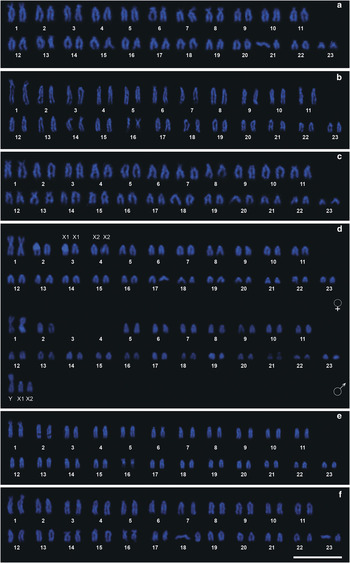
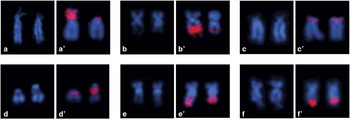
The karyotypes of all the species studied are shown in Fig. 1. Details on the morphology of the chromosome pairs bearing the ribosomal genes, and the location of these genes after FISH, are illustrated in Fig. 2.
The karyotypes of the six artedidraconid species analysed during the VLT project. For each specific chromosome set the DAPI-stained chromosomes were arranged according to size. a. Artedidraco glareobarbatus, b. Artedidraco orianae, c. Artedidraco shackletoni, d. Artedidraco skottsbergi female and male, e. Histiodraco velifer, f. Pogonophryne sp. Scale bar is 10 μm.

Comparative picture illustrating the pairs of homologous chromosomes bearing major ribosomal genes in the six artedidraconid species. In each species rDNA genes are located on a single chromosomal pair. The morphology of the homologous chromosomes is illustrated after DAPI staining (a, b, c, d, e, f) and FISH (a’, b’, c’, d’, e’, f’). a. Artedidraco glareobarbatus, b. Artedidraco orianae, c. Artedidraco shackletoni, d. Artedidraco skottsbergi, e. Histiodraco velifer, f. Pogonophryne sp.

In Artedidraco glareobarbatus (Fig. 1a) the karyotype is composed of 23 pairs of homologous chromosomes (2n = 46) and includes a majority of st/t chromosomes (19 pairs), and four pairs of bi-armed chromosomes classified as submetacentric (pairs n. 7, 8, 13, and 23 in the karyotype). The FN is 54 and the karyotypic formula is: 8 m/sm + 38 st/t. The morphology of the chromosomes of the pair n. 1 (the largest in the karyotype) was ambiguous, being in-between submetacentric and subtelocentric, but the consistency of the arm ratio value allowed us to classify them as subtelocentric elements. A certain degree of heteromorphism due to the difference in length of the DAPI-negative short (p) arm was detected in the submetacentric chromosomes of the pair n. 7 (Figs 1a & 2a). Hybridization signals were consistently revealed on the entire short arms of the chromosomes of pair n. 7, and were of different extent according to the different length of the DAPI-negative arms of the two homologues (Fig. 2a’).
The karyotype of A. orianae (Fig. 2b) is composed of 23 pairs of homologues (2n = 46). According to the arm ratio, two pairs of chromosomes (n. 14 and n. 16 in the karyotype) were classified as submetacentric whereas the largest chromosomes forming the pair n. 1 were subtelocentric (FN = 50; karyotypic formula: 4 m/sm + 42 st/t). The submetacentric chromosomes of the pair n. 16 were easily recognizable in all the spreads because of a large DAPI-negative region extending along the terminal part of their q arms (Figs 1b & 2b). FISH signals overlapped this DAPI-negative region identifying the location of extended repeats of rDNA clusters (Fig. 2b).
The karyotype of A. shackletoni (Fig. 1c) is similar to A. glareobarbatus, with the same diploid and arm numbers (2n = 46, FN = 54) and karyotypic formula (8 m/sm + 38 st/t). A single locus for rDNA was localized on the short arms of the bi-armed elements of the pair n. 7 (Figs 1c & 2c). Heteromorphism in the length of the p arms in the pair was detected in some specimens. In all cases the FISH signals extended along the whole length of the chromosome arms.
A sex-linked karyotypic heteromorphism was observed in A. skottsbergi (Fig. 1d). The karyotype in the females is composed of one pair of metacentric chromosomes (pair n. 1) and 44 one-armed elements of decreasing size (2n = 46; FN = 48; karyotypic formula: 2 m + 44 st/t). The metacentric chromosomes of pair n. 1 are the largest in the chromosome set, extending four times the length of the smallest elements. In the male karyotype an additional large metacentric, for which no homologue having similar size and morphology is recognizable (Y chromosome), occurs. Therefore the male karyotype is composed by a pair of metacentric chromosomes (n. 1), 42 one-armed elements and an unpaired metacentric Y chromosome (2n = 45; FN = 48; karyotypic formula: 3 m + 42 st/t). A second distinctive trait in A. skottsbergi is that the ribosomal genes are located at an interstitial position on one of the smallest telocentric elements (pair n. 21). Similar to what is observed in all other artedidraconid species, the chromosomal region hosting the clusters of rDNA is DAPI-negative, and size differences between the two homologues (Fig. 2d) have been detected.
H. velifer (Fig. 1e) has 46 chromosomes in both males and females (2n = 46). According to measurements and arm ratio, four chromosomes are submetacentric (pairs n. 14 and n. 16) whereas all the others were classified as subtelocentric, including the biggest pair of the karyotype (pair n.1), giving a FN = 50 and karyotypic formula 4 m/sm + 42 st/t. The submetacentric chromosomes of the pair n.16 are morphologically similar to the corresponding pair in the karyotype of A. orianae, and the two species also bear the ribosomal genes on a large DAPI-negative region extending along the terminal part of the q arms (Figs 1e, 2e & 2e’).
The chromosome set of Pogonophryne sp. (Fig. 1f) is composed of 46 chromosomes, and it is similar to the karyotype observed in other species in the genus (Ozouf-Costaz et al. Reference Ozouf-Costaz, Hureau and Beaunier1991, Morescalchi et al. Reference Morescalchi, Morescalchi, Odierna, Stingo and Capriglione1996). According to present analysis, the karyotype includes two pairs of submetacentrics (pairs n. 14 and n. 16) and 21 pairs of telo-subtelocentric chromosomes, giving FN = 50 and karyotypic formula 4 m/sm + 42 st/t. The large chromosomes of the pair n. 1, classified as subtelocentrics, are very similar to the corresponding chromosomes of pair n. 1 in all the other artedidraconid species, except for A. skottsbergi. The ribosomal genes, here mapped by FISH for the first time in a species of Pogonophryne, are located on a DAPI-negative region extending along the terminal part of the q arm of a pair of small submetacentric chromosomes (Fig. 2f). By comparing both the general morphology of the chromosomes, and the ribosomal genes location across the artedidraconid karyotypes, Pogonophryne, H. velifer, and A. orianae exhibit similar cytogenetic features.
Pylogenetic analysis
Isolation of DNA, PCR, and DNA sequencing was completed for 13 artedidraconid species. The alignment of the mtDNA encoded ND2 gene contained 1047 sites and the alignment of the nuclear encoded S7 intron 1 contained 686 sites. The Bayesian phylogeny inferred from the concatenated dataset was well resolved and provided a basis for the investigation of chromosome evolution in Artedidraconidae. In particular Artedidraco was paraphyletic, A. skottsbergi was the sister lineage to all other sampled artedidraconid species, and there were two sister species pairs involving species of Artedidraco, Histiodraco velifer and A. mirus and Dolloidraco longedorsalis and A. shackeltoni. Pogonophryne was monophyletic.
Discussion
The plunderfish karyotypes
A modal diploid number equal or close to 2n = 48 and FN = 48 has been found in most of the marine perciform species (Molina Reference Molina2007), including notothenioid species classified in the Bovichtidae (Mazzei et al. Reference Mazzei, Ghigliotti, Lecointre, Ozouf-Costaz, Coutanceau, Detrich and Pisano2006). Given the monophyly of the Notothenioidei (Near et al. Reference Near, Pesavento and Cheng2004), and the distribution of cytogenetic diversity in the clade (Pisano & Ozouf-Costaz Reference Pisano and Ozouf-Costaz2003), the karyotype of the putative notothenioid common ancestor is hypothesized to have been similar to the one found in Bovichtidae: a chromosome set made up of 48 one-armed chromosomes. The karyotypes of the extant notothenioids arose from the ancestral set through various types of chromosomal changes leading to the substantial range of diploid numbers (from 20 to 58) and morphologies observed in the clade (e.g. Prirodina Reference Prirodina1997, Pisano & Ozouf-Costaz Reference Pisano and Ozouf-Costaz2003). A karyotype made up of 48 elements, slightly rearranged with respect to ancestral condition, is present in the non-Antarctic species Pseudaphtritis urvillii Cuvier (Pisano et al. Reference Pisano, Angelini, Mazzei and Stanyon2000) and Eleginops maclovinus Cuvier (Mazzei et al. Reference Mazzei, Ghigliotti, Coutanceau, Detrich, Prirodina, Ozouf-Costaz and Pisano2008), and is also the most frequently observed state among species in the derived Antarctic clade (Prirodina Reference Prirodina1997, Pisano & Ozouf-Costaz Reference Pisano and Ozouf-Costaz2003). In Harpagiferidae, which is the sister lineage of the Artedidraconidae, the two species studied display 48 chromosomes (Prirodina & Ozouf-Costaz Reference Prirodina and Ozouf-Costaz1995).
Considering the above situation, artedidraconids are unique among notothenioids in that all of the studied species exhibit a karyotype made up of 46 chromosomes (present work, Ozouf-Costaz et al. Reference Ozouf-Costaz, Hureau and Beaunier1991, Morescalchi et al. Reference Morescalchi, Morescalchi, Odierna, Stingo and Capriglione1996, Caputo et al. Reference Caputo, Splendiani, Nisi Cerioni and Olmo2003). In notothenioids, a karyotype made up of 46 chromosomes, has been found in a minority of species, namely Trematomus hansoni Boulenger, T. newnesi Boulenger and Pagothenia borchgrevinki (Boulenger) (Pisano & Ozouf-Costaz Reference Pisano and Ozouf-Costaz2003).
By comparing the general karyotypic features of Harpagiferidae and Artedidraconidae, it is reasonable to hypothesize that the plunderfish chromosome set was derived from a common ancestor having 48 chromosomes through fusion of chromosomal elements. Such a fusion may explain the presence of the large chromosome pair observed in Artedidraconidae, and may provide a mechanism for the reduction in the diploid number from 48 to 46. Indeed, chromosomal rearrangements involving fusions of one-armed chromosomes to produce karyotypes with reduced numbers of larger elements are common events in the chromosome evolution of vertebrates, including notothenioid fishes (King Reference King1993, Pisano et al. Reference Pisano, Angelini, Mazzei and Stanyon2000, Caputo et al. Reference Caputo, Nisi Cerioni, Splendiani, Capriglione, Odierna and Olmo2002).
Karyotypic diversity of the Artedidraconidae
Despite a conserved diploid number, the following karyotypic traits account for major cytogenetic differences among artedidraconid species: 1) morphology of the largest chromosome pair, 2) chromosomal organization of ribosomal gene sequences, 3) presence of sex-related chromosomes in A. skottsbergi.
Morphology of the largest chromosome pair
In all artedidraconid species, the largest chromosomes arranged in pair n. 1 are easily recognizable in the karyotype and the large size supports their possible origin from fusion of one-armed elements of an ancestral chromosomal set of 48 elements. Although the size of these chromosomes is consistent across artedidraconid species, their morphology is different in A. skottsbergi, where these large chromosomes are unambiguously metacentric. In this species their morphology suggests a possible origin through centric fusion of two one-armed elements of similar size. In all the other artedidraconid species the chromosomes of pair n. 1 have a very different arm ratio and are consistently classified as subtelocentric. This morphology is probably derived through an end-tail (tandem) rearrangement, as previously suggested by Caputo et al. (Reference Caputo, Splendiani, Nisi Cerioni and Olmo2003) for the species H. velifer. Given the lack of information on the genomic content of the chromosomes of pair n. 1, the described morphological differences in the artedidraconid species raises the question of whether the chromosomes of this pair are homeologous (do have a common origin) in the various Antarctic plunderfish lineages or whether they originated independently. In addition, when considering the chromosomes of pair n. 1 as homeologous in Artedidraconidae, a single-step event of fusion of one-armed chromosomes, leading to new larger chromosomes, is not sufficient to explain the current differences between the metacentric morphology of the chromosomes of pair n. 1 in A. skottsbergi, and the subtelocentric morphology observed in all other artedidraconid species.
Chromosomal organization of the ribosomal genes sequences
When studying fish genomes at chromosomal level, the major ribosomal genes (major rDNAs), encoding for the ribosomal 18S, 5.8S, and 28S RNAs, are among the most widely studied loci. This is due the availability of a large amount of DNA sequence information. In addition, their repetitive organization makes it possible to unambiguously visualize the ribosomal gene clusters on the chromosomes, when appropriate cytogenetic approaches, such as FISH, are used (Phillips Reference Phillips2007). As adequate protocols for FISH have become available, major rDNAs were mapped onto the chromosomes of a wide diversity of notothenioid fishes. A review of the chromosomal organization of ribosomal genes in Notothenioidei, based on FISH evidences in six out of the eight families, summarized some major evolutionary and adaptive issues (Pisano & Ghigliotti Reference Pisano and Ghigliotti2009). In the above review, due to the lack of direct in situ information on the rDNA location in artedidraconids prior to present work, the chromosomal organization of rDNA for the family was deduced from the position of the Nucleolar Organizing Regions (NORs) as observed using conventional Ag-NOR banding in Pogonophryne scotti Regan (Morescalchi et al. Reference Morescalchi, Morescalchi, Odierna, Stingo and Capriglione1996) and H. velifer (Caputo et al. Reference Caputo, Splendiani, Nisi Cerioni and Olmo2003). Based on this approximation, sequences coding for the major rDNAs were thought to be located along the entire long arms of a pair of submetacentric chromosomes (Pisano & Ghigliotti Reference Pisano and Ghigliotti2009, Fig. 2).
Our analysis demonstrates that the major ribosomal genes are present in a single locus, on a single pair of chromosomes, in each of the six plunderfish species examined. Such a general pattern is consistent with previous observations that indicated a single locus for major rDNA as a common feature in notothenioids (Pisano & Ghigliotti Reference Pisano and Ghigliotti2009). The available data indicate that a duplication of rDNA loci occurred in a minority of notothenioid species, such as the nototheniid Dissostichus mawsoni Norman (Ghigliotti et al. Reference Ghigliotti, Mazzei, Ozouf-Costaz, Bonillo, Williams, Cheng and Pisano2007) and the channichthyid Pagetopsis macropterus (Boulenger) (Mazzei et al. Reference Mazzei, Ghigliotti, Bonillo, Coutanceau, Ozouf-Costaz and Pisano2004). In Artedidraconidae, the chromosomal region bearing the locus, regardless of its position, is consistently achromatic after conventional Giemsa staining (unpublished) and DAPI staining (Fig. 2, a, b, c, d, e, f), and it is positive for C-banding, Chromomycine A3 and Ag-NOR staining (unpublished), in accordance with the cytogenetic characteristics of the Nucleolar Organizing Regions of notothenioid species (Pisano & Ghigliotti Reference Pisano and Ghigliotti2009, Fig. 3). The size heteromorphism between the two homologous rDNA bearing chromosomes found in some artedidraconid specimens (e.g. Fig. 2a’, e’ & d’) is also a shared feature among notothenioids (Mazzei et al. Reference Mazzei, Ghigliotti, Bonillo, Coutanceau, Ozouf-Costaz and Pisano2004). It results from the unequal distribution of ribosomal cistrons per haploid chromosomal set that frequently occurs in teleost fish (e.g. Galetti Reference Galetti1998, Rabova et al. Reference Rabova, Rab and Ozouf-Costaz1999).
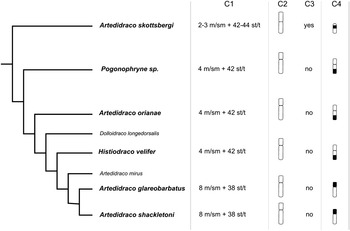
Main cytogenetic characters of plunderfish mapped on the phylogenetic tree. Karyotyped species are in bold types. C1 = karyotype formula, C2 = ideograms of the large chromosomes of pair n. 1 in the plunderfish karyotypes (haploid set), C3 = presence/absence of sex-linked chromosomes, C4 = ideograms of the chromosome-bearing rDNA sequences (haploid set), the black bands indicate the position of the rDNA loci.

In contrast to the conserved general features, the single rDNA locus in Artedidraconidae is involved in important chromosomal changes that reflect remarkable interspecific differences. In fact we found a variety of chromosome organization of the rDNA locus that is interstitially located on a pair of small telocentric chromosomes in A. skottsbergi, extending along the long arms of submetacentric chromosomes in A. orianae, H. velifer, and Pogonophryne sp., and building up the short arms of a pair of submetacentric chromosomes, in A. glareobarbatus and A. shackletoni.
Considering that ribosomal sequences are highly dynamic in eukaryotes (e.g. Dubcovsky & Dvorák Reference Dubcovsky and Dvorák1995, Zhuo et al. Reference Zhuo, Reed and Phillips1995, Stage & Eickbush Reference Stage and Eickbush2007) it is not surprising that structural changes of the rDNA locus have occurred in Artedidraconidae. A number of mechanisms, including chromosomal rearrangements, intra-chromosomal recombination mediated by circular DNA or transposons, and interlocus unequal crossing over, have been proposed to explain the changes of the rDNA chromosomal loci (Pedrosa-Harand et al. Reference Pedrosa-Harand, Souza de Almeida, Mosiolek, Blair, Schweizer and Guerra2006). The interstitial position of the ribosomal genes on a pair of telocentric chromosomes, a distinctive trait observed in A. skottsbergi, is noteworthy because similar locations for ribosomal genes are observed in the non-Antarctic notothenioid lineage Bovichtidae and is hypothesized as the ancestral state in notothenioids (Mazzei et al. Reference Mazzei, Ghigliotti, Lecointre, Ozouf-Costaz, Coutanceau, Detrich and Pisano2006, Pisano & Ghigliotti Reference Pisano and Ghigliotti2009). A similar chromosomal organization has also been found in a few species of the derived family Nototheniidae, Notothenia angustata Hutton (Pisano et al. Reference Pisano, Ghigliotti, Mazzei and Ozouf-Costaz2003) and Lepidotothoten squamifrons (Günther) (Tomaszkiewicz et al. personal communication 2009). However, due to the consistently supported monophyly of the notothenioid Antarctic clade (e.g. Balushkin Reference Balushkin2000, Near et al. Reference Near, Pesavento and Cheng2004, Near & Cheng Reference Near and Cheng2008) and the previous hypotheses of evolutionary change at the rDNA locus (Pisano & Ghigliotti Reference Pisano and Ghigliotti2009), in derived lineages such as Nototheniidae and Artedidraconidae an interstitial organization of ribosomal genes on a pair of telocentric chromosomes is unlikely the ancestral condition. Instead, this type of rDNA locus organization could have independently been generated in these lineages through pericentric inversions that moved the chromosomal region bearing rDNA sequences from a previous terminal to the interstitial position, and led to consequent morphological change from submetacentric into telocentric rDNA bearing chromosomes. Pericentric inversions are known as one of the most frequent mechanisms associated with karyotype diversification in perciform fishes (Galetti et al. Reference Galetti, Aguilar and Molina2000, Molina Reference Molina2007).
By providing additional evidence of the karyotypic difference between A. skottsbergi and the other studied artedidraconid species, our rDNA mapping stresses the need for future studies that will include a greater sampling of notothenioid species, in order to reconstruct the evolutionary history of cytogenetic changes at the rDNA locus. In particular, it would be a priority to investigate with FISH the chromosomal organization of rDNA in Harpagiferidae, the sister lineage of Artedidraconidae.
Presence of sex-related chromosomes in one species, A. skottsbergi
Our analysis of artedidraconid chromosome morphology revealed the existence of sex-related heteromorphic karyotypes in A. skottsbergi. The sex-chromosome heteromorphism involves four chromosomes in the female, and three chromosomes in the male, and is therefore referable to the multiple sex chromosomes system known as X1X1X2X2/X1X2Y (Bertollo et al. Reference Bertollo, Takahashi and Moreira Filho1983). The presence of the same FN in male and female karyotypes, together with the large size of the odd metacentric, suggests that the Y chromosome originated by centric fusion of two telocentric elements, possibly corresponding to the chromosomes of pairs n. 3 and n. 4 in the female karyotype (indicated as X1X1; X2X2).
In notothenioids, heteromorphic sex-chromosomes occur in high frequency, having been found in 25% of the cytogenetically studied species (Pisano & Ozouf-Costaz Reference Pisano and Ozouf-Costaz2003). A sex-chromosomes system very close to that of A. skottsbergi has been described in Nototheniidae and in Channichthyidae (reviewed in Pisano & Ozouf-Costaz Reference Pisano and Ozouf-Costaz2003). A slightly different sex-chromosome system, also involving male digamety, has been found in one bathydraconid species (Bathydraco marri Norman) (Ozouf-Costaz et al. Reference Ozouf-Costaz, Hureau and Beaunier1991). Sex chromosomes have not been observed in any of the non-Antarctic notothenioids, therefore the present observation on A. skottsbergi supports the hypothesis that the evolution of sex chromosomes is a derived feature in notothenioids and may have occurred independently in several lineages of the Antarctic clade.
Karyotypic evolution in plunderfish
We have shown that artedidraconid species are characterized by a conserved diploid number (46), but with some degree of interspecific cytogenetic diversification. The occurrence of sex-related heteromorphism, the morphology of the largest chromosomes and the interstitial location of the ribosomal genes, karyotypically distinguish A. skottsbergi from all the other species. The other examined artedidraconid species can be grouped based on cytogenetic features such as a) species having two pairs of bi-armed chromosomes in the karyotype (formula 4 m/sm + 42 t/st) and bearing the ribosomal genes on the q arm of a pair of small–medium sized sub-metacentric chromosomes (A. orianae, Histiodraco velifer, and Pogonophryne sp.), and b) species having a more rearranged karyotype (formula 8 m/sm + 38 t/st) and bearing the ribosomal genes on the p arm of a pair of large–medium sized sub-telocentric chromosomes (A. glareobarbatus and A. shackletoni).
In Figure 3 the cytogenetic characteristics of Artedidraconidae are examined in the context of the phylogenetic hypothesis inferred from DNA sequences sampled from a mitochondrial (ND2) and a nuclear gene (S7 ribosomal protein intron 1). In the molecular phylogeny, Artedidraco is not monophyletic and is placed in three different regions of the phylogeny. The unique chromosomal morphology observed in A. skottsbergi is consistent with the phylogenetic hypothesis that resolves this species as the sister lineage of all the other Artedidraconidae. In addition, the karyological similarity between A. glareobarbatus and A. shackletoni appears to be a derived condition within the clade, and it is consistent with their inferred sister species relationship in the phylogeny.
The phylogenetic distribution of chromosomal morphology allows the development of a hypothesis of chromosome diversification in Artedidraconidae. Regarding the morphology of the large chromosomes of pair n. 1 (Fig. 3, column C2), the phylogenetic tree suggests that a first chromosomal rearrangement event (centric fusion of two one-armed chromosomes) should have occurred early in the diversification of artedidraconids from a common ancestor that had 48 acrocentric chromosomes. Such a fusion event would have produced a large metacentric chromosome, similar to the one observed in A. skottsbergi, and was responsible for the reduction of diploid number from 48 to 46. A subsequent round of intra-chromosomal rearrangements, such as pericentric inversion, in the common ancestor of all the other artedidraconid species, could than have changed the previous large metacentric into a large submetacentric chromosome.
Sex chromosomes are present in only one lineage of the six studied artedidraconid species (Fig. 3, column C3). According to the hypothesis presented in Ota et al. (Reference Ota, Kobayashi, Ueno and Gojobori2000), heteromorphic sex chromosomes have undergone repeated events of origin and loss in the evolutionary diversification of teleost fishes. The rearrangement events leading to the evolution of sex-chromosomes may have occurred early in the diversification of artedidraconids. Such a karyotypic change might have played a role in post mating reproductive isolation, thus providing a potential mechanisms for the speciation of A. skottsbergi.
The evolution of the chromosomal position of the rDNA locus across all notothenioids seems to indicate that the terminal position along the longer arm of a subtmetacentric chromosome is a derived feature shared by the lineages of the Antarctic clade, including Harpagiferidae, the sister lineage of Artedidraconidae (Pisano & Ghigliotti Reference Pisano and Ghigliotti2009, Fig. 2). In the light of these data, and in the context of the present phylogenetic hypothesis, the ancestral condition for Artedidraconidae is probably submetacentric chromosomes bearing the rDNA along its longer arm, similar to the one observed in A. orianae, H. velifer, and Pogonophryne sp (Fig. 3, column C4). Therefore the terminal position of the rDNA locus on the short arm of a submetacentric chromosome, shared by the sister species A. glaoreobarbatus and A. shackletoni, is derived and could be attributed to various rounds of intra- or inter-chromosomal change. Also the organization of the rDNA locus observed in A. skottsbergi, despite its apparently primitive position, is derived, as the result of secondary rearrangements. Pericentric inversions, moving the rDNA chromosomal region from the terminal to the interstitial position, and leading to subsequent morphological change from a previous submetacentric to a telocentric chromosome, are the most probable rearrangements involved in these structural changes.
Conclusion
Despite their common benthic habit and largely sympatric distribution, artedidraconids show a high degree of diversification of some morphological traits, allowing them to occupy a wide range of ecological niches. The faunistic and ecological analysis of the artedidraconid communities off Victoria Land highlighted further ecological diversification of the species, by means of food and spatial niche partitioning. Present work, in addition to the consistent occurrence of 46 chromosomes in all the plunderfishes, revealed major cytogenetic differences among the species, including the chromosomal organization of ribosomal gene sequences and the occurrence of sex linked chromosomes in one species. These results indicate that artedidraconids are not conservative in their genomic organization at the chromosomal level, and provide additional evidence of the degree of the biological diversity occurring in this notothenioid subclade. The two plunderfishes studied cytogenetically for the first time (A. skottsbergi and A. glareobarbatus) highlighted a deep cytogenetic diversification within the genus Artedidraco, which is consistent with the inferred relationship in the molecular phylogeny.
Acknowledgements
Research was supported by the Italian National Program for Antarctic Research (PNRA), Victoria Land Transect Project (Scientific leader Riccardo Cattaneo-Vietti). We are grateful to the Captain and the crew of the RV Italica for assistance and collaboration during the 2004 VLT cruise. Nicole Ponta collaborated in the FISH analyses at the University of Genoa. The study contributes to the SCAR Research Program “Evolution and Biodiversity in Antarctica (EBA)”.