INTRODUCTION
Classical frontier and modern borderland studies view mid-to-late nineteenth century Trans-Mississippi settlement as a national expansion of civic and political life (Glenn Reference Glenn2015; Hogan Reference Hogan1985; Jensen Reference Jensen1980; Turner Reference Turner1961[1893]). However, the studies associated with each paradigm make different assumptions and produce different findings. In classical studies, settlement is a process that unfolds across regions or sectionsFootnote 1 that lack political boundaries (Aron Reference Aron2006; Steiner Reference Steiner1995; Turner Reference Turner1961[1893]). Institution-building, primarily by White men, seemingly proceeds on never-peopled or indigene-relinquished lands after treaties or wars (Hurtado Reference Hurtado2001; Steiner Reference Steiner1995; Turner Reference Turner1961[1893]). In contrast, borderland studies highlight conflict between indigenous peoples and the settlers who seek control of contested land (Aron Reference Aron2006; Glenn Reference Glenn2002). Institution-building proceeds as settler power grows and indigene power fades, ultimately, to the point of death and/or expulsion. Actors include indigenous and White men, women, and children (Cooper and Stoler, Reference Cooper and Laura Stoler1997; Glenn Reference Glenn2002, Reference Glenn2015; Kramer Reference Kramer2011; Perry Reference Perry2001). Less visible, however, in both paradigms, are the historical Black actors who settled in mid-to-late nineteenth century Trans-Mississippi frontiers. We address this gap by fusing a racial state (James Reference James1988; James and Redding, Reference James, Redding, Janoski, Alford, Hicks and Schwartz2005; Jung and Kwan, Reference Jung and Kwon2013) to a gendered life course framework (Elman et al., Reference Elman, Feltey, Wittman and Jauk2013; Hareven Reference Hareven1996; Moen and Chermack, Reference Moen and Chermack2005) to examine Black and White women’s settlement in post-Civil War Arkansas: as a borderland, a frontier, and yet, more.
By the early nineteenth century, shifting geo-political boundaries, alliances, and conflicts among indigenous and White settler groups had ended in Arkansas, as elsewhere in the United States with Indian epidemics, wars, removals West, and White political control (Aron Reference Aron2006; Blevins Reference Blevins2002; Glenn Reference Glenn2002; McNeilly Reference McNeilly2000). But Arkansas remained “a frontier society at the outbreak of the Civil War” (Gatewood Reference Gatewood, Whayne and Gatewood1993, p. 4; Jones Reference Jones2015) and its population precipitously fell, by as much as half, during the war.Footnote 2 According to one settler (Dixon, WPA 1936-38), it was “a wild and sickly country”Footnote 3 with an inhospitable natural terrain that did not well support commodified or even family-based subsistence agriculture (Bolton Reference Bolton1998; Hanson and Moneyhon, Reference Hanson and Moneyhon1989; Valencius Reference Valencius and Rupke2001). Mass Black and White settlement commenced as the postwar Arkansas Delta underwent deforestation and development and as planters offered generous tenancy terms and wages, under conditions that made land purchase possible (Lanza Reference Lanza, Cimbala and Miller1999; Matkin-Rawn Reference Matkin-Rawn and Kirk2014; Whayne Reference Whayne1992; Woodruff Reference Woodruff2003). Beyond this, Arkansas was—symbolically, for postwar Black settlers—a Frontier state that promised opportunity (Gordon Reference Gordon, Whayne and Gatewood1993). Of a half million southern-born Blacks who moved to a different southern state after the Civil War, about 100,000 chose Arkansas (Matkin-Rawn Reference Matkin-Rawn and Kirk2014). This half-century-long settlement pattern does not well fit borderland or frontier conceptualizations; neither Indian removal nor 1836 statehood (e.g., institutionalization of White settler power) was sufficient for mass settlement. Rather, initial settlement rested on the joint foundations of the removal of indigenous peoples to vacate and the coercion of Black bonded labor to transform “wild and sickly” land (Johnson Reference Johnson2013; McNeilly Reference McNeilly2000). Opportunistic waves of Black and White settlement only commenced after the end of the Civil War.
How did postwar settlers fare? We focus on women, exploring their settlement patterns and consequent life circumstances using qualitative sources, including first-person Black women’s narratives from the Arkansas volume of the Works Progress Administration (WPA 1936-38), Duke University’s collection of Arkansas Behind the Veil (BTV 1995) interviews (Chafe et al., Reference Chafe, Gavins and Korstad2001), and diaries and memoirs of White women. We highlight the 1880 to 1910 period when more than half of the women in Arkansas were settlers. They could have settled just before, during, or after the Civil War, in one of three state subregions; the sources above provide rich accounts of settlement and daily life across period and subregion. We use quantitative Census microdata (IPUMS 1880, 1910) and county-level U.S. Plantation Census data to examine state and subregional settlement patterns, women’s family and work roles, and economic mobility. We contextualize women’s accounts across periods by using a racial state framework that addresses shifting political-economic contexts of settlement: the transformation of an “old” prewar to a “new” postwar racial state regime (James Reference James1988). Our multiple-methods approach provides insight into how women’s lives strongly reflected the dominance hierarchies that operated at a great distance from their personal experience (cf. hooks 1994 in Smith Reference Smith1987; Maynes et al., Reference Maynes, Pierce and Laslett2008). Race and gender are relational, heterogeneous categories (Glenn Reference Glenn2002) and we examine historical social differentiation in women’s life course experiences across categories, as structured by racial state apportioning of material and social dis/advantage.
INSTITUTIONAL DOMAINS, STRUCTURED DIS/ADVANTAGE, AND THE GENDERED LIFE COURSE
Our gendered life course approach focuses less on the unique biographical accounting of individual women’s lives than on uncovering commonalities and differences in women’s lives as shaped by personal and social factors, life events, and historical social institutional forces (Elman et al., Reference Elman, Feltey, Wittman and Jauk2013; Hareven Reference Hareven1996). Both classical frontier and settler colonial paradigms are limited for this purpose. Classical studies explore sectional differences in U.S. institution-building more than the structuration of individual life experiences (Hogan Reference Hogan1985; Turner Reference Turner1961[1893]). Settler colonialism studies locate women’s family and work relations in the context of expanding White territorial and hegemonic power relative to indigenous populations (Glenn Reference Glenn2002; Kramer Reference Kramer2011). In addition, classical and settler frameworks center White males as colonizers under Manifest Destiny, with White women’s support contributing to expansionist domesticity (Shire Reference Shire2016). Our life course approach centers women, taking a “long view” of their lives. Settler women’s activities (e.g., work roles) and life circumstances shifted over life stages, from early adulthood to older age. Their lives reflected opportunities and resources that were available (or not) at a given life stage as well as those accumulated over a lifetime (Moen and Chermack, Reference Moen and Chermack2005).
Classical and settler colonial frameworks are also theoretically silent about Black co-migrants during and after colonialization, even though “the settler project constructed various racialized gender and gendered racial dualisms” that produced different outcomes for men and women in subjugated groups (Glenn Reference Glenn2015, p. 71). In classical studies, social and ethnic relations are assumed to transform through citizenship (Steiner Reference Steiner1995). Colonial settler scholarship maintains that “the otherness of colonized persons was neither inherent nor stable… [and] had to be defined and maintained” (Cooper and Stoler, Reference Cooper and Laura Stoler1997, p. 7) but focuses on indigenous peoples who, as in Arkansas, faced colonial domination and/or removal prior to or soon after statehood and settler control (Blevins Reference Blevins2002; Glenn Reference Glenn2015; McNeilly Reference McNeilly2000). Neither paradigm has accounted for shifting directions in social relations, as occurred between African Americans and European Americans, over time and place (Glymph Reference Glymph2008; Moneyhon Reference Moneyhon and Kirk2014; also Feagin and Elias, 2014; Omi and Winant, Reference Omi and Winant2015; Wacquant Reference Wacquant2002). For example, a shift away from legal master-slave relations after the Civil War coincided with Arkansas losing frontier status. While settlers of all ethnic backgrounds poured into the state, Black settlers entered at higher rates to escape the ravages of war and to (re)gain land, family, and community (Gordon Reference Gordon, Whayne and Gatewood1993; Matkin-Rawn Reference Matkin-Rawn2013, Reference Matkin-Rawn and Kirk2014; Nash Reference Nash1989). This wave was soon followed by a second, out of the South altogether, as relations shifted again, for the worse (Wilkerson Reference Wilkerson2010; Woodson Reference Woodson2002 [1918]). Each migratory wave was rooted in a re-alignment of state-sponsored social relations—slavery’s abolition and the institutional maturation of Jim Crow, respectively.
We fuse a gendered life course to a racial state frameworkFootnote 4 (James Reference James1988; James and Redding, Reference James, Redding, Janoski, Alford, Hicks and Schwartz2005; Jung and Kwan, Reference Jung and Kwon2013; Werum Reference Werum1999) in order to contextualize continuity and change in racial state policies across old (prewar) and new (postwar) state regimes. The framework relaxes an implicit assumption of “constant, unified, and cohesive” southern state and class structures over time and place (Tomaskovic-Devey and Roscigno, Reference Tomaskovic-Devey and Vincent1996, p. 566). It instead highlights fragmented and fluid sovereignty such that, at a given time and place, power might reside with federal and/or state-local actors (e.g., state or county executives), and/or class interest groups (e.g., planters, financiers, urban elites) (James Reference James1988; James and Redding, Reference James, Redding, Janoski, Alford, Hicks and Schwartz2005; Werum Reference Werum1999). The framework accommodates our exploration of how initial settlement and then mass settlement reflected policies at different time points and at the state-local and national levels. Most importantly, the framework highlights how post-Reconstruction policies ultimately shaped intersectional processes, (re)constructing frontier-borderland women’s race and gender relations and life roles in ways that could “account [for] the appropriation of labor and formation and circulation of wealth” (Choo and Ferree, Reference Choo and Marx Ferree2010, p. 135) in the rising Jim Crow South.
We use a second macro-level framework of “economic outsider” (e.g., extra-regional, often international, hereafter Outsider) influences on institution-building. The mechanism resembles internal colonialism and uneven economic development in that net outflows of state and local resources and commodities benefitted Outsiders to a greater extent than residents or the state (Hind Reference Hind1984). This dynamic of extraction differs from settler land appropriation (Hind Reference Hind1984; Hogan Reference Hogan1985). White Arkansas elites may have facilitated the outflows by designing or abetting key policies and may have therefore benefitted (Blair and Barth, Reference Blair and Barth2005; Feagin and Elias, 2014; Hogan Reference Hogan1985). However, this study’s concern is that resource-draining policies impacted localities, hence the lives of women therein, well into the twentieth century (Alston and Ferrie, Reference Alston and Ferrie1999; Blair and Barth, Reference Blair and Barth2005; Moneyhon Reference Moneyhon1994, Reference Moneyhon1997).
Analytic Model
Our analytic model is in Figure 1. Women’s life course circumstances partly reflected their embeddedness in historically-established institutional arrangements (Figure 1, Box 1). The American South, prior to the Civil War and just after, was primarily an agricultural region “short on towns, railroads, factories, schools, and universities” (Wright Reference Wright2006, p. 82). Yet the South was quite diverse, in that it contained different forms or modes of agricultural production. Modes were partly rooted in geography; topographic factors such as water, soil, and climate; and the commodities cultivated (Aiken Reference Aiken1998; Wright Reference Wright2006). Prior to the Civil War, large-scale agriculture (plantations) prevailed in geographic zones with rich (hence, more expensive) soils and crop-friendly climates. Postwar, old plantations were subdivided into tenant farms while new plantations were built as modern, multi-unit farms (Woodruff Reference Woodruff2003; see also Aiken Reference Aiken1998; Mandle Reference Mandle1992; Whayne Reference Whayne1992; Virts Reference Virts1991). U.S. Census enumerators in 1910 identified, in a geographic Belt extending from Virginia to Texas, 39,073 plantations holding 398,905 tenant farms in 325 counties of eleven states, including Arkansas (U.S. Department of Commerce 1916, p. 16). Other productive modes, both before and after the Civil War, involved basic subsistence or essentially living off the land, and mixed farming as subsistence with some commercialism. These modes prevailed on poorer quality, less valuable soils over different contiguous portions of the South, for example mountainous Appalachian and Ozark lands and the pine-forested Atlantic and Gulf Coasts, respectively. Productive modes cut across boundaries, bisecting or trisecting southern states (Harris Reference Harris2001; McKenzie Reference McKenzie1994; Woodruff Reference Woodruff2003).
A Model of Women’s Life Course Outcomes*
* Adapted from Moen and Chernack (Reference Moen and Chermack2005)

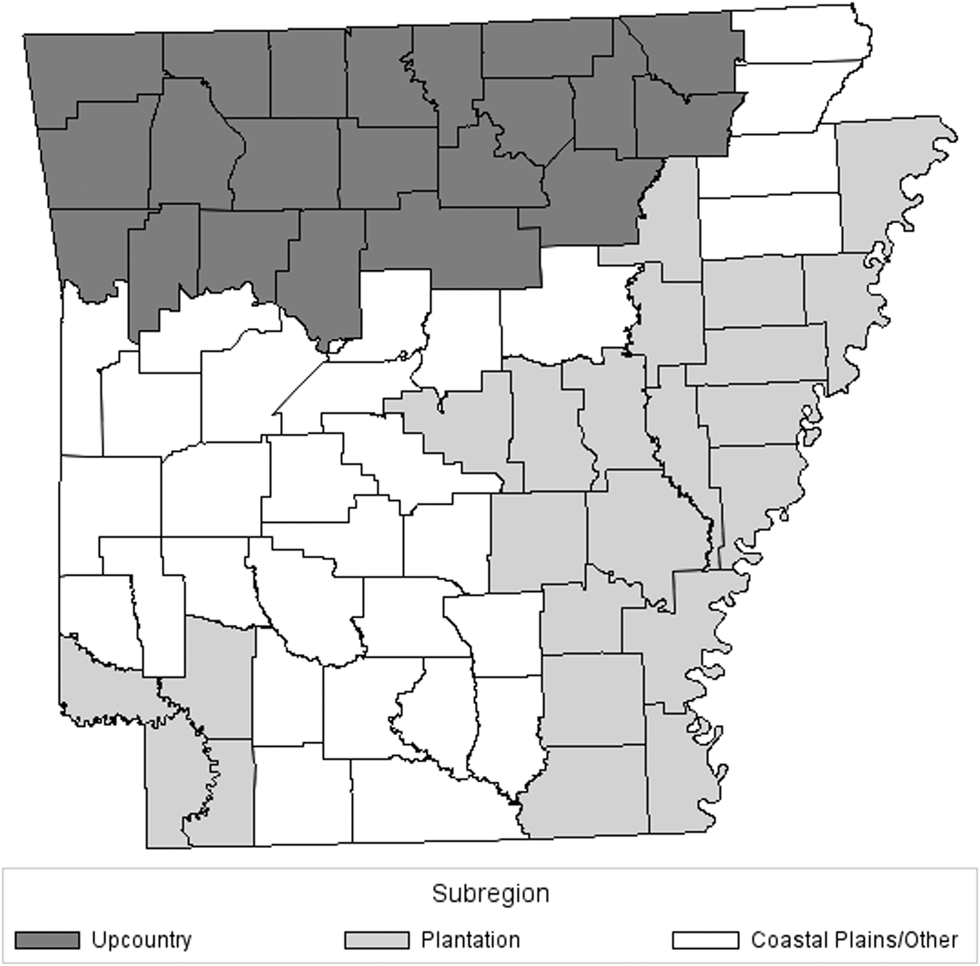
In Arkansas, as shown in Figure 2, “a diagonal line drawn from the northeast corner of the state to the southwest corner” separated mountainous upcountry from lowlands (McNeilly Reference McNeilly2000, pp. 1, 2). Lowlands are further divided into a Mississippi River alluvial plain (Delta) bordering Tennessee and Mississippi, and a sandy soil Coastal Plain bordering Louisiana and Texas. Different topographic environments supported different productive modes: subsistence (often no farming at all) in the mountainous Upcountry Ozarks; plantation farming in the rich Delta bottomlands; and mixed self-use/commercial small-holding on the pine-forested, sandy Coastal Plains. A first measure of women’s institutional embeddedness pertains to their residence with regard to subregional agricultural mode.
Arkansas Subregions
Note: Upcountry Counties in Blevins (2002:5), Plantation Counties in U.S. Census Bureau (1916)

However, productive modes were as much rooted in organizational factors, aligned with federal and state-local political-legal supports, as in topographical factors (Alston and Ferrie, Reference Alston and Ferrie1999; Jones Reference Jones2009; Woodman Reference Woodman1979; Wright Reference Wright2006). Variants of subsistence and plantation farming in Arkansas, as elsewhere in the South, historically differed in terms of farm organization, labor management, and the goals of production (Brannen Reference Brannen1924; U.S. Department of Commerce 1916; Virts Reference Virts1991). Prior to the Civil War, bondsmen on plantations primarily produced for external markets under planter direction. Their high levels of productivity for plantation-use, however, did not obviate their dependency on planter good-will for sustenance (Johnson Reference Johnson2013). In contrast, prewar White yeoman, tenants, and squatters in Upcountry and Coastal Plains subregions had more autonomy and could produce for home-use and/or markets (Blevins Reference Blevins2002; Bolton Reference Bolton1994; McNeilly Reference McNeilly2000).Footnote 5 After the Civil War, Black farm families aspired to land ownership and its associated high status and autonomy; freedom, for them, entailed exiting dependent labor relations imposed by planters under old racial state rules (Glenn Reference Glenn2002; Jaynes Reference Jaynes1986; Jones Reference Jones2009; Mandle Reference Mandle1992; Steedman Reference Steedman2008). But how could they get there? Under new postwar rules, economic mobility toward land ownership entailed movement on an “agricultural ladder” where the “first rung…is represented by the period during which the embryo farmer is learning the rudiments of his trade…The hired man stands on the second rung, the tenant on the third, while the farm owner has attained the fourth or final rung of the ladder” (Spillman Reference Spillman1919, p. 170; Woodman Reference Woodman1979; Wright Reference Wright1986). Thus, southern Black and White farmers after the Civil War—unless gifted a farm, or able to inherit, buy, or homestead a farm—moved toward ownership through assortments of contracted family labor arrangements (Alston and Higgs, Reference Alston and Higgs1982; Jaynes Reference Jaynes1986; Mann Reference Mann1989; Steedman Reference Steedman2008; Woodman Reference Woodman1979, Reference Woodman1995). Upward mobility on the agricultural ladder was also contingent on whether contracted work took place in plantation or in subsistence agriculture (Alston and Higgs, Reference Alston and Higgs1982; Woodman Reference Woodman1995). Moving to farm ownership was more difficult under the contracted terms of plantation production, especially for Black farmers (Alston and Kauffman, Reference Alston and Kauffman1998; Du Bois Reference Du Bois1912; Mandle Reference Mandle1992; Woodman Reference Woodman1995). A second measure of women’s embeddedness is their placement on the agricultural ladder, an institutional system of stratification, in subregional context.
Women’s lives reflected (re)emergence of new racial state rules of social control, a third domain of embeddedness. New rules leading to disenfranchisement, segregation, and labor control (Alston and Ferrie, Reference Alston and Ferrie1999; Jaynes Reference Jaynes1986; Woodman Reference Woodman1979) were also designed to re-introduce and reinforce social relations marked by dependency and subordination, countering Black aspirations for freedom and autonomy (Jones Reference Jones2010; Steedman Reference Steedman2008). For example, segregation policies created, then imposed, then reified, categories of racial distinctions that permeated daily life, from social interaction to the distribution of public resources (e.g. education). Yet, the new rules of social control that blanketed the South by 1910—reinforced by threat of violence—varied by context: they more explicitly limited interpersonal interracial contact and shared space in urban places and imposed behavioral etiquettes of social dependency in rural places (Jones Reference Jones1992; Schultz Reference Schultz2005; Steedman Reference Steedman2008). Rural patterns of daily life involved a series of long term, face-to-face encounters between small numbers of people, Black and White, who needed to sustain relations (e.g., tenants and landowners) (Schultz Reference Schultz2005). Rural norms sustained White social control in that etiquettes confirmed, at least outwardly, Black dependency and [feigned] acquiescence, not upward mobility (Steedman Reference Steedman2008). We examine, in still-rural Arkansas to 1910, women’s accounts of (non)dependence and mobility on the agricultural ladder, linked to forces of social control (Schultz Reference Schultz2005; Steedman Reference Steedman2008).
Continuing with our model in Figure 1, the construction/attribution of race, as legitimated by policy, lies at the core of the racial state (Box 2), thereby filtering the levels and types of natural and social resources available to residents (James Reference James1988). By 1910, Jim Crow laws in Arkansas, as elsewhere in the South, (re)constructed racial identities and regulated the allocation of land ownership, transportation, political action, markets, education, housing, and health care (Feagin and Elias, Reference Feagin and Elias2013; Omi and Winant, Reference Omi and Winant2015; Patterson Reference Patterson1982; Winant Reference Winant2000). We ask: On these late-settling Trans-Mississippi frontier-borderlands, to what degree did women’s early lives (Box 3a) and later life economic status (Box 3b) reflect attribution of race (Box 2), and institutional forces underlying productive mode and social control (Box 1)?
BACKGROUND: INITIAL SETTLEMENT
The federal or superordinate state (James Reference James1988) shaped Arkansas well before statehood in 1836. Large tracts of Trans-Mississippi land came under federal control by purchase or treaty following wars with native peoples (Hogan Reference Hogan1985; Johnson Reference Johnson2013). Beginning in 1812, the U.S. General Land Office surveyed, mapped, and apportioned all acquired federal lands into 160-acre parcels that were federally awarded as grants to veterans and other groups or distributed via mechanisms of sale or lottery (Blair and Barth, Reference Blair and Barth2005; Johnson Reference Johnson2013). Surveyors did not reach the western Arkansas border until 1841 but lowland sales began in 1821 (Hanson and Moneyhon, Reference Hanson and Moneyhon1989). Below, we can only briefly describe how a dense network of federal, state, and Outsider policies and practices enabled initial Arkansas settlement and its terms.
Superordinate Policies of Labor and Land
Federal policy, grandfathered in as part of the 1803 Louisiana Purchase, supported the territorial practice of holding slaves as property. Congressional debate on slavery in the newly established Arkansas Territory (1819) ended with refusal to limit slavery in the new territory; a motion to reject the practice was defeated, 68 to 80 (Cathey Reference Cathey1944). Defenders of slavery argued that Whites lacked the endurance to settle and farm south of 35° latitude and that ownership of slaves, already viewed as “property” in the territory, should not be restricted (Cathey Reference Cathey1944; see also Aron Reference Aron2006). National discussion at the time of statehood (1836) again proclaimed slavery necessary for settlement, land deforestation and development, and national wealth (Johnson Reference Johnson2013). Plantation owners, the most powerful eliteFootnote 6 in Arkansas and across the South, exerted power at the federal level in 1850 to promote passage of the federal Fugitive Slave Act, which further strengthened property rights in slavery (Glenn Reference Glenn2002; Johnson Reference Johnson2013). The translation of coercive labor policy from abstract federal law to everyday practice fueled an entrepreneurial and speculative regional market in slave labor (Baptist Reference Baptist2010; Beckert Reference Beckert, Follett, Beckert, Coclanis and Hahn2016; Johnson Reference Johnson2013), although most slave traders lived in earlier-settled plantation states of Louisiana, Missouri, and Virginia (Deyle Reference Deyle2005; McNeilly Reference McNeilly2000). In all, federal promulgation, legitimation, and enforcement of slavery alongside state policies (addressed in the next section), drove considerable deforestation and large-scale (plantation) cotton marketization across the Arkansas Delta and Coastal Plains riverbed sections by 1850 (McNeilly Reference McNeilly2000; Poe Reference Poe2011).
Public lands had originally been intended for small-holder farming but federal actors in state land offices and state elites—assuming future profitable plantation growth—fueled a land entrepreneurialism that resulted in vast tracts of acreage falling into speculative, often Outsider hands (Bolton Reference Bolton1994). Acquiring land and labor required financing. Until statehood in 1836, buyers made federal land payments directly to the Federal Bank via land offices. The first business of the newly-established Arkansas Congress was to establish two state banks, run by bank trustees and investors, to retain revenues from land sales in the state (Worley Reference Worley1950). The banks, from their inception, channeled loans to state and local elites and Outsider speculators who bought large parcels, sometimes the whole of future counties, of mostly federal lands. By 1840, speculative loans on the overvalued land had bankrupted both state banks. The state lacked enough capital to bail out its insolvent banks; to continue operations, bank trustees sold bonds and other instruments to state elites and Outsider northern and global capitalist agencies (Blair and Barth, Reference Blair and Barth2005; Worley Reference Worley1950). Arkansas commercial farmers, however, did not rely on banks to finance year-to year operations. Instead, they used Outsider regional or extra-regional/global merchants, known as factors, to advance “fictitious capital” or credit before planting season to support commodity production; farmers then settled accounts at harvest (Johnson Reference Johnson2013, p. 258; see also Jaynes Reference Jaynes1986). By 1850, inflated land prices had placed land ownership out of the reach of most poor Arkansas Whites (Bolton Reference Bolton1994; Brown Reference Brown2013; Johnson Reference Johnson2013; McNeilly Reference McNeilly2000). Indebtedness plagued the state throughout the century (Blair and Barth, Reference Blair and Barth2005).
State Policies and Initial Settlement
Different population streams, in terms of place of origin, settled the different Arkansas subregions prior to the Civil War, in the context of the land, labor, and finance policies above (Blair and Barth, Reference Blair and Barth2005; Hogan Reference Hogan1985; Moneyhon Reference Moneyhon1994). White families entered the Upcountry after 1820 (Blevins Reference Blevins2002; Bolton Reference Bolton1998).Footnote 7 Some had been landowners in neighboring states, but most were poor, landless, and descendants of land-poor parents, grandparents, and great-grandparents who had moved ever-southwestward across upcountry terrains of other states (Blevins Reference Blevins2002; Bolton Reference Bolton1994; Hanson and Moneyhon, Reference Hanson and Moneyhon1989; McNeilly Reference McNeilly2000). Much like the land-poor generations that had preceded them, they faced limited options: taking low-paid tenancies in settled states, traveling back-and-forth across states in nomadic family life, or re-locating to upcountry borderlands of Georgia, Tennessee, Alabama, and later Arkansas, Oklahoma, and Texas where they could cheaply purchase or squat on land (Bolton Reference Bolton1994; Brown Reference Brown2013; Johnson Reference Johnson2013). Settlement on Upcountry Arkansas Ozark and Ouachita mountain ranges limited land quality, overland and waterway travel, and potential marketization. However, most settlers as “hill folk” were accustomed to relatively isolated life where they could live off the land (Larson Reference Larson2010; McDonald and McWhiney, Reference McDonald and Grady1980; McNeilly Reference McNeilly2000; Moneyhon Reference Moneyhon1994). They rarely settled with bonded labor, other than in the eastern and western commercialized corners near river transportation (Blevins Reference Blevins2002).Footnote 8
Lowland Whites who settled the Delta subregion had moved, in westward direction, from the commercial-oriented lowlands of adjacent southern states, intending to produce cotton for international markets (Beckert Reference Beckert, Follett, Beckert, Coclanis and Hahn2016; Holley Reference Holley, Whayne and Gatewood1993). Settling the Delta, however, required deforestation and land development under conditions where rivers flooded with enough force to wash away soils, crops, homes, roads, natural and man-made landmarks, and even whole towns. Large planters, holding twenty or more bondsmen, and small planters with nineteen or fewer bondsmen, used slave labor to clear land, plant and tend crops, and support home life (Deyle Reference Deyle2005; Johnson Reference Johnson2013; McNeilly Reference McNeilly2000). By 1850, the Plantation subregion supported large-scale cotton production (McNeilly Reference McNeilly2000). The lowland Coastal Plain riverbeds were rich enough for plantations, but most land was pine-forested with sandy soils that barely supported farming (McNeilly Reference McNeilly2000; Poe Reference Poe2011). Most White small-holders or yeoman settled here, to farm and forage, because they could not afford to purchase or feared settlement on the rich but “sickly” malarial Delta lands (McMillan Reference McMillan and Walls1990; Poe Reference Poe2011). Most did not own slaves but accepted the institution and aspired to ownership while poorer Whites survived as tenants and squatters (McNeilly Reference McNeilly2000; Poe Reference Poe2011).
Black settlement also followed intergenerational, southwestward movement (Johnson Reference Johnson2013; Hanson and Moneyhon, Reference Hanson and Moneyhon1989). Between 1820 and 1860 up to one million bondsmen were forcibly relocated from older southern states to the lower South (Johnson Reference Johnson2013). Between 1850 and 1860 the Black population of Arkansas grew by over 200%, more than twice the White growth rate (Holley Reference Holley, Whayne and Gatewood1993; McNeilly Reference McNeilly2000). While federal policies legitimated keeping bondsmen as property in states where slavery existed, states determined the terms of settlement within their borders. The Arkansas legislature in 1838 viewed free, non-dependent Black status as threatening (Gordon Reference Gordon, Whayne and Gatewood1993; Patterson Reference Patterson1982; for Missouri see Aron Reference Aron2006).Footnote 9 Lawmakers outlawed in-migration of free Blacks and Mulattos after March 1, 1843 except as bonded servants, punishable by fine, incarceration, and deportation (Gordon Reference Gordon, Whayne and Gatewood1993). After January 1860, free Blacks and Mulattos were denied residency in the state; those remaining faced arrest and forced hiring-out for twelve months to self-fund deportation or sale into slavery (Cathey Reference Cathey1944). Thus, at the start of the Civil War, only 144 free Blacks remained in Arkansas (Gordon Reference Gordon, Whayne and Gatewood1993). Under old racial state rules, social identity and the right to exist within state borders was defined by slave versus free, underpinned by attribution of race.
DATA AND METHODS
We include qualitative materials in the form of interviews conducted with former slaves in the 1930s from the Work Progress Administration (later renamed Work Projects Administration), and cite this source as WPA in the text (see Appendix A for interviewee list). We also draw from oral histories of elderly Black women and men born in Arkansas using audio recordings of interviews conducted in the mid-1990s. They are contained in the Behind the Veil (BTV) archives (see Appendix B for interviewee list), part of the John Hope Franklin Collection of African and African-American Documentation, as a Special Collection at Duke University’s Rubenstein Library. The full holdings include 1,265 oral histories of African Americans, born under Jim Crow in states across the South (Chafe et al., Reference Chafe, Gavins and Korstad2001). Two of the authors listened to and transcribed each taped account, reconciling differences between their transcriptions and the Special Collection transcription, if available. We used BTV reports about mothers/parents because most interviewees were born after 1910. They were asked to identify parents and kin but were not asked personal questions about their own or parents’ marital or kin relations. In addition, we used published memoirs and diaries of White women to illustrate patterns related to settlement, family life, and work.
We analyzed the qualitative accounts using primarily a deductive approach. We sampled specific WPA accounts purposively based on which accounts were from women and included information about the 1880-1910 time frame. We analyzed WPA accounts using MaxQDA (versions 10, 11, and 12). We developed codes based on questions that emerged from reviewing the literature, trends found while analyzing the quantitative data analysis, as well as from themes which emerged inductively while reading the transcribed accounts. Behind the Veil and other accounts were coded by hand using a code book developed from the WPA analysis.
We use 1880 and 1910 Integrated Public Use Microdata Series (IPUMS) Census microdata (Ruggles et al. Reference Ruggles, Trent, Genadek, Goeken, Schroeder and Sobek2010) to form cross-sectional samples, respectively, of women ages 18-34 (n=14,416), and ages 45-64 (n=1,192). The women were born just prior to or around the time of the Civil War and were either Arkansas-born or migrants to the state.Footnote 10 We use IPUMS 1880 and 1910 person weights, respectively, in descriptive tables and figures. Although the 1910 sample does not necessarily capture the same women sampled in 1880, the two-period cross-sectional design allows us to explore women’s economic activities, resources, and mobility over the long arc of settlement, and to differentiate life stage circumstances of settlers and natives. We link 1910 IPUMS micro-data to Haines and ICPSR (1910) Decennial Census data and to Plantation Census data (Department of Commerce, 1916). The latter source identifies southern counties with extensive land improvement in plantations, as reconstructed by economic historians (Brannen Reference Brannen1924; Elman et al., Reference Elman, London and McGuire2015, Reference Elman, McGuire and London2019; Mandle Reference Mandle1992; Virts Reference Virts1991).
The 1880 dependent variable, economic activity, is constructed from the IPUMS (1880) Labforce variable. The 1910 dependent variable, farm ownership, is a household-level indicator of reaching the top of the agricultural ladder. It is constructed from IPUMS (1910) variables Farm household and Ownership of residence. We examine this outcome in a sample of women living in self-headed or kin-headed farm households in 1910 (this captures most women). Both outcomes are dichotomous and estimated by logistic regression.
Key micro-level independent variables in both 1880 and 1910 models include Arkansas-born/settler status (settler=1) constructed from the IPUMS (1880, 1910) Place of Birth variables; and Black (=1 if Black or Mulatto) constructed from IPUMS (1880, 1910) detailed Race variables. Micro-level control variables include women’s age and literacy (reading and writing=1) constructed, respectively, from IPUMS (1880, 1910) Age and Literacy variables. The 1880 economic activity model adjusts for self-reported chronic disease constructed from the IPUMS 1880 Sickness variable.Footnote 11 Dichotomous controls for household and family structure in 1880 and 1910 models are: lives with spouse only; single parent; lives with others including extended kin and non-kin; with living with spouse and child(ren) or nuclear family form as reference. The series is constructed using IPUMS (1880, 1910) Marst, Relate, and Nchild variables. Household farm (=1) versus non-farm is constructed from the IPUMS (1880) Farm Household variable.
At the county-level, 1880 productive modes are operationalized as Plantation subregion (=1) and Upcountry subregion (=1), with Coastal Plains subregion as the reference. The designation of Upcountry counties in 1880 and in 1910 is based on Blevins listing (2002, p.5). Plantation subregion (1880 analyses) is based on McNeilly’s (Reference McNeilly2000, p.126) designation of Arkansas counties with extensive and growing plantation production just prior to the Civil War. The Plantation productive mode in 1910 (Figure 2 map, 1910 analyses) is operationalized based on Census data (Department of Commerce, 1916); this Census was published in 1916 but data were collected at the time of the Thirteenth (1910) Decennial Census. The Plantation reference category (1910 analyses) includes both Upcountry/Coastal Plains subregions, combined due to small micro-level sample sizes by race. County-level controls in 1910 regressions include county proportion of improved farm land and urban center (county population center greater than 2,500 persons) from Haines and ICPSR (Reference Haines2010).
1880: POST-WAR OPPORTUNITY, SETTLEMENT, AND THE EARLY LIFE COURSE
After the Civil War, and the collapse of old racial state laws, settlers—Black, White, and a small number of Asians—streamed into Arkansas (Du Bois Reference Du Bois1998[1935]; Hanson and Moneyhon, Reference Hanson and Moneyhon1989; Matkin-Rawn Reference Matkin-Rawn and Kirk2014; Watkins Reference Watkins1979; Woodson 2002[1918]).Footnote 12 By 1880, however, young Black and White women generally lived in different subregions under different productive modes. Figure 3 uses 1880 IPUMS data to examine women’s residence by nativity (Arkansas-born or settler) and by subregion. As shown in Column A of Figure 3, just under half (44%) of IPUMS sample young women in 1880 were born in the state while slightly more than half (56%) were settlers, born outside of the state.Footnote 13 Slightly more than half of Black women (52.8%) and White women (57.1%) were settlers, born outside the state (Column B). As shown in Column C, over three-fourths of White women in 1880, whether Arkansas-born (81.9%) or settlers (76%), lived in the Upcountry and Coastal Plains subregions that were less oriented to commercial production and the market economy. In contrast, most Black women in 1880, whether Arkansas-born (63.7%) or settlers (78.2%), lived where perhaps the richest of national lands were becoming available for use, under expanding plantation development.
Arkansas Women Ages 18-34, by Migration Status, Race, and Subregion of Residence, 1880 IPUMS

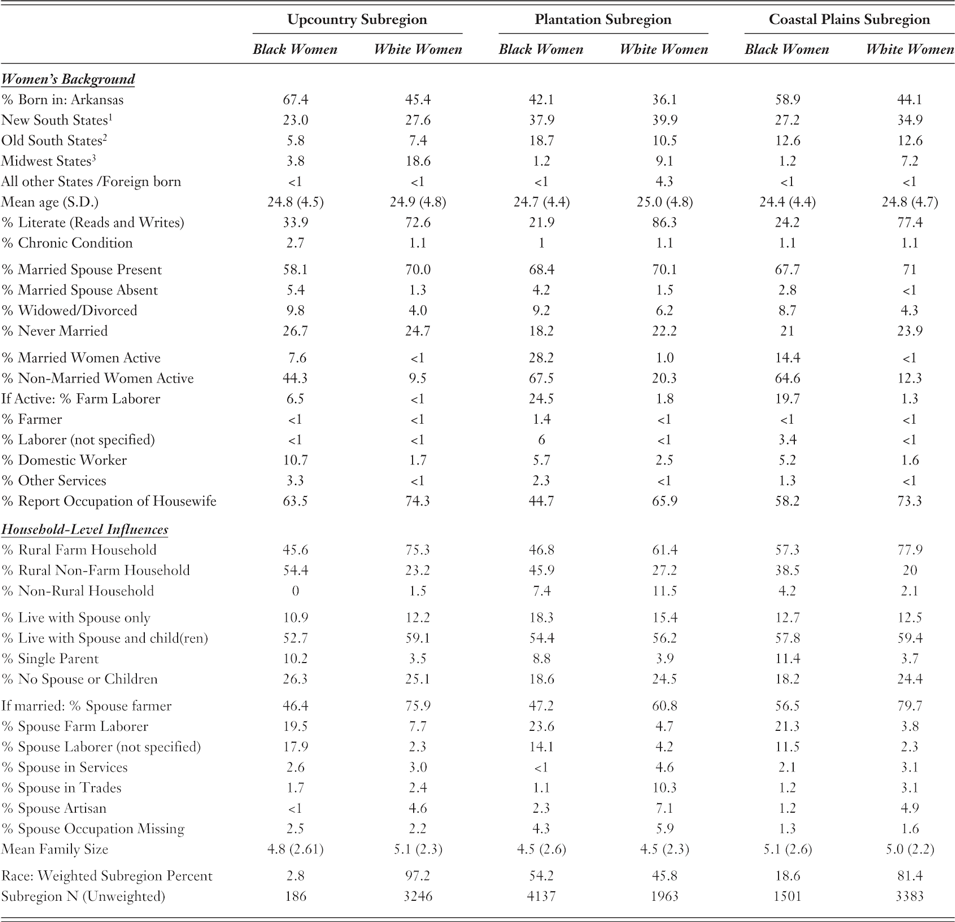
Investigating the settlement pattern further, Table 1 provides descriptive statistics of Arkansas-born and settling women by subregion. The first two columns on the left pertain to Upcountry women, the two middle columns pertain to women in counties with concentrated plantation development, and the two right columns pertain to Coastal Plains women. Black women comprised only 2.8% of the Upcountry and 18.6% of the Coastal Plains female populations (Columns 1 and 5, bottom row). More than Upcountry or Coastal Plains White women, they were born in Arkansas and were not settlers (67.4% vs. 45.4%, and 58.9% vs. 44.1%, respectively, top row). The pattern reflects the relatively small prewar Upcountry and Coastal Plain populations of coerced labor and the large postwar Black population flows by 1880 into the Plantation subregion. This section explores women’s settlement in, and early life course conditions associated with, different subregional productive modes, underpinned by forces of social control.
Arkansas Women Ages 18-34: Descriptive Statistics by Subregion and Race, 1880 IPUMS

1 Mississippi, Tennessee, Alabama, Kentucky, Louisiana, Oklahoma, Texas
2 Delaware, District of Columbia, Florida, Georgia, Maryland, N. Carolina, S. Carolina, Virginia, West Virginia
3 Illinois, Indiana, Michigan, Ohio, Wisconsin, Iowa, Kansas, Montana, Missouri, Nebraska, N. Dakota, S. Dakota
Settlement under Subsistence
Upcountry White women, prewar and postwar, had limited exposure to—or interest in—sociocultural and economic change, including commercialization of farming (Larson Reference Larson2010; Sellers Reference Sellers1991). Their households were largely self-sufficient, perhaps also providing local services or cultivating small amounts of tobacco or hemp to augment cash flow (Blevins Reference Blevins2002). For example, White Upcountry-born Mary Hamilton sold the animals and tools that her family needed for commercial cotton farming on their Mississippi Delta tenant farm to return to tenancy in Upcountry Randolph County. She wrote:
We could have [the farm] … as long as we wanted it if we would pay the taxes and keep up repairs… It…had a fine orchard, nice dwelling house, and barn…. We shipped the things we needed most, enough to keep house with, then sold the rest, cows, calves, horses, corn, and farm tools (Davis Reference Davis1992, p. 215).
Further facilitating self-sufficiency were forests that provided timber for housing and fuel, and community pasturage norms that allowed families to send marked cattle and hogs into the wild to forage and fatten prior to slaughter. Mary Hamilton noted advantages of open pasturage:
It didn’t cost half as much to live [Upcountry] as in the Delta. We could get all the cows we wanted to milk, just for feeding them; all we were asked to do was to mark the calves with the owner’s mark when we turned them out (Davis Reference Davis1992, p. 220).
By 1880, newly freed Upcountry Black women had begun “the practical work” of building new lives and new households (Glymph Reference Glymph2008, p. 168). Some had spent time in refugee camps where they were subject to sickness and starvation (Downs Reference Downs2012). Interviewed at age eighty-six, Mittie Freeman (WPA 1936-38), described relocation at the end of the Civil War:
They packed us in their … big covered army wagons, and tuck us to Little Rock. Did you ever know where the old penitentiary was? Well, right there is where the Yanks had a great big barracks. All chilluns and growd womens was put there.Footnote 14
Some had remained with former owners in isolated Upcountry realms of White household economies. Remaining in the household or on the land of former owners for paid labor might have been the only viable option for older former slaves. Mahalia Shores (WPA 1936-38) recalled her master’s announcement of freedom:
You can stay and I will pay you or you can go. I pay no more doctor bills. I don’t feed you no more nor give you no more clothes. Some moved and some hired to him. Some went to his father-in-law’s place and some to his brothers’ place and around.Footnote 15
The path to relative autonomy in very rural portions of the South—marked by cultures of personalism and localism—often required freedmen to maintain loyalty and White patronage “based on a personal equation” (Schultz Reference Schultz2005, p. 51). Millie Evans, age eighty-seven when interviewed in 1936, noted that her family “reached (Arkansas) safe but when we got here we foun’ freedom here too. Ol’ mistress begged us to stay wid her an we stayed till she died” (WPA 1936-38).Footnote 16 Other types of resource exchanges with Whites also reflected paternalistic rewards for service (Schultz Reference Schultz2005). Adeline Blakeley remembered:
My uncle George was coachman and drove my master’s family in great splendor in a fine barouche to church. After the war, when he went to his own place, Mr. Parks gave him the old carriage and bought a new one for the family (WPA 1936-38).Footnote 17
Millie Evans and Adeline Blakely express views about freedom and ultimately going to one’s “own place,” describing social relations of relative autonomy or interdependence, if not independence, in the context of Upcountry isolation. Some freedwomen, however, claimed and sustained Upcountry autonomy by forming or joining communities. The all-Black Driftwood community, founded in 1875 in Lawrence County, maintained a post office, two groceries, a cotton gin, sawmill, sorghum mill, and a combined school (Gordon Reference Gordon1995). Black newcomers to Arkansas from neighboring Tennessee and South Carolina founded another community, Menifee, in the Ozark foothills of Conway County in 1878. A Menifee settler recalled the challenge of building in the Ozarks:
Tenable land now was ravine and lakes. These old people came in here and ditched them and drained them out. The old men died after felling trees, building houses, and working in the swamps. Pappy died the second year we were out here. So many people couldn’t get acclimated out here and a lot of them died (Matkin-Rawn Reference Matkin-Rawn2013, p. 50).
Once settled, the community thrived and maintained a sense of pride, as described in an 1896 publication, Freeman. “Menifee is inhabited by colored people. They own most all the business houses here…there are a great many wealthy families here” (Gatewood Reference Gatewood1974, p. 320).
IPUMS data also suggest that Black women in the 1880 Upcountry (Table 1 Column 1) had status advantage, compared to Black women in Plantation (Column 3) and Coastal Plain (Column 5) subregions. They were more likely to be literate (33.9% vs. 21.9%, 24.2% respectively). Laura Jackson Edwards of Yell County, born in Mississippi and brought to Arkansas by her White mistress months after her mother’s death, recalls attending the free school at the Jackson home and studying the “Blue Back[ed] Speller” (University of Arkansas Library). In contrast, Upcountry White women were least likely among White women in Arkansas to be literate: only about 72.6% could read and write, compared to 86.3% of Plantation and 77.4% of other lowland White women. A century of intergenerational upcountry migration westward, in response to land commodification booms in the “Old South” states that boosted land prices out-of-reach (Bolton Reference Bolton1998; Johnson Reference Johnson2013),Footnote 18 had limited Upcountry White women’s accumulation of human capital resources such as literacy (Bolton Reference Bolton1994; Brown Reference Brown2013).
Upcountry Black women were less likely to be married (spouse present) than Black women in lowland subregions (58.1% vs. 68.4%, 67.7%). This may be due to very limited Black settlement (sparse marriage markets), economic alternatives to marriage, or isolation (limiting travel). However, if married, they were less likely to engage in paid labor than Black women in other subregions (7.6% vs. 28.2%, 14.4%). Their husbands less likely worked as farm laborers (19.5% vs. 23.6, 21.3%) and more likely worked in higher-status trades and services. Also signaling relative advantage is their reporting an occupation of “housewife” more often than Black women elsewhere (63.5% vs. 44.7%, 58.2%).
If working, Upcountry Black women were nearly twice as likely to report a domestic versus a farm occupation compared to Black women in other subregions (10.7% vs. 5.7%, 5.2%). This suggests economic ties to, if not dependency on, White communities for domestic work. For example, Laura Jackson Edwards cooked and kept house for local families, and in later life, cooked for the first hotels in the community. Mahalia Shores, married at age twenty, described her domestic work for White families: “I have cooked three Sunday dinners on Saturday and Sunday together. I would make three dollars when I done that…(and) I washed and ironed” (WPA 1936-38).Footnote 19 Domestic work often entailed hire for tasks and was a hallmark of changing Black women’s labor relations: freedwomen who tasked or set limits on White employers’ work demands strategically created time for their own domestic production (Glymph Reference Glymph2008). They gained relative control over the terms of their employment.
Upcountry White women were almost universally married, at young ages. They did not commonly participate in economic activity outside the home, perhaps due to lack of local enterprise, sociocultural disinterest in market activity, stigma of women’s paid work in this era, or relative economic advantage. Fewer than 1% of married and fewer than 10% of unmarried White women were economically active compared to 7.6% and 44.3%, respectively, of Upcountry Black women. Lack of economic activity, exacerbated by mountain isolation, left White women a narrow range of life course roles, most family-oriented. Thus, Upcountry White women, “in an era that lacked modern conveniences…carried out onerous chores” or else hired, if available, Black women to do the work as domestic servants (Whayne et al., Reference Whayne, Deblack, George and Arnold2002, p. 255). White women’s marriages also reflected utility more than companionship (Allured Reference Allured1988). When Mary Hamilton was a teen and about to be left on her own as her mother and brother lay dying from pneumonia in 1886, she reluctantly agreed to marry thirty-year-old Frank Hamilton:
Twice in one day I promised to marry Frank Hamilton, and he had never asked me. There was no word of love on either side. Everything and everybody was trying to crowd me into a marriage I didn’t want (Davis Reference Davis1992, p. 6).
Settlement Under Lowland Commercialism
Prior to the Civil War, White women and families settling the Plantation and mixed commercial Coastal Plains lowlands generally did so to prosper. However, they faced precarity, regardless of family wealth: the most privileged of women, settling on the best Delta lands, tended to do so at the expense of their health (McMillan Reference McMillan and Walls1990). Coastal Plains White women settling on poorer quality land, practicing subsistence and foraging, could experience poverty and hunger as well as sickness (Poe Reference Poe2011). Black bondswomen—as children, mothers, and grandmothers—traveled many paths to lowland Arkansas. Some, Arkansas-born near the time of the Civil War, had never left. Judy Parker from Coastal Plains Little River reported at age seventy-seven that she was six months old when her family’s owner, who sat out the war in Arkansas, decided to return to Florida.
He asked the rest of us if they wanted to go back too. But my folks made up their minds they didn’t…After my mother died I was with my grandmother. She washed and cooked for Herb Jean’s family. I stayed on with her, helped out until I got married. I was about fifteen when that time come (WPA 1936-38).Footnote 20
Women might have initially been transported to Texas and beyond—a strategy planters used to resist the emancipation of slaves—and then settled in Arkansas after the war. Clara Walker, interviewed at age 111 in Garland County, explained:
Finally ol’ miss refugeed a lot of us to California. What is it to refugee? Well, you see, suppose you was afraid dat somebody goin’ to take your property an’ you run ‘em away off somewhere (WPA 1936-38).Footnote 21
Postwar, Clara Walker found her mother with twelve children in Arkansas and stayed to help her farm since she “could plow as good as a man in dem days.” After her mother died, she moved to Hot Springs where she did laundry for hotels.
After the Civil War, rising cotton prices produced a decades-long panic among state elites in frontier Arkansas to replace bonded farm labor: emancipation of slaves not only threatened cotton productivity but the southern planter class (Steedman Reference Steedman2008) and the very “well-being of European industry” (Beckert Reference Beckert, Follett, Beckert, Coclanis and Hahn2016, p. 55). Slaves had worked cotton fields, organized as gangs but freedmen refused such working conditions (Du Bois Reference Du Bois1998[1935]; Jaynes Reference Jaynes1986). Most Arkansas plantations had remained in the hands of planters or kin after the war (Moneyhon Reference Moneyhon1994, Reference Moneyhon and Kirk2014), and the old planters, along with new planters including Outsider entrepreneurial Delta developers, sought to maintain prewar cotton productivity. But as Robert Preston Brooks (Reference Brooks1914) noted:
The problem confronting the planter in 1865 was to preserve the maximum degree of control over the laborers consonant with their changed condition…maintaining in most of its essentials the plantation organization (p. 18).
State elites wrote ads and distributed pamphlets to encourage general in-migration while planters sent out labor agents to comb the South and promise freedmen and poor Whites better tenancy terms and higher wages than offered in the low-wage Upper South states (Mandle Reference Mandle1992; Nash Reference Nash1989; Wright Reference Wright1986). The Republican politicians in power, aware of the great unmet labor demand, demurred in quickly implementing the racial codes that were being adopted in other southern states, with the exception of quick passage of an enticement law forbidding employers’ competitive hiring (Roback Reference Roback1984). Lawmakers also awarded citizens’ rights to Black males (Moneyhon Reference Moneyhon1994; Rosen Reference Rosen2009), banished Ku Klux Klan activities by 1869 (Du Bois Reference Du Bois1998[1935]; Moneyhon Reference Moneyhon and Kirk2014) and enrolled 19,280 Black children in new, albeit segregated, public schools by 1870 (Moneyhon Reference Moneyhon and Kirk2014). Arkansas Freedman’s Bureau agents, after national passage of the Southern Homestead Act of 1866, were among the most proactive in identifying and settling freedmen on higher quality federal lands (Lanza Reference Lanza, Cimbala and Miller1999). In addition, Freedman’s Bureau agents across much of the South were well-networked and referred freedmen to places, including in Arkansas, with high demand and remuneration for rural labor (Jaynes Reference Jaynes1986). Thus, citizens’ rights with the promise of political participation, comparatively limited racial code policies, better wage and tenancy terms, and the potential for owning fertile, if still “wild and sickly” land, encouraged Black migration to Arkansas, especially to the promising, rich soils of the Plantation lowlands (Jones Reference Jones2015; Matkin-Rawn Reference Matkin-Rawn2013, Reference Matkin-Rawn and Kirk2014; Nash Reference Nash1989). Cleo Jeffers (BTV 1995) born in 1912, said that:
[People] came to Arkansas like the gold rush, my parents came to Arkansas because they were told they could make a better living. [My father was a] railroad man before he married my mother… couldn’t afford children…Left Mississippi by night. Dad in a boxcar and mother on train.Footnote 22
The Arkansas frontier also provided refuge, even if only symbolically, to settlers determined to escape oppressive conditions in surrounding states. Dora Strong Dennis (BTV 1995), born in 1900, was sixteen when she and her mother relocated to Arkansas. She reported:
[Mother’s Mississippi boss] would wait right good until the crops get finished, the labor, you know, and then he would more or less run you off the place. But he didn’t run Mama off the place… well, after she picked out her crops, she thought she could move, you know…but he went and nailed up all of her things in the house.Footnote 23
Dora Strong Dennis’s mother was able to access legal help, gather her belongings and family together, and move. Not everyone could do this. Rather, escaping bad or dangerous circumstances often required circumspection, perhaps moving in stages. Faced with an oppressive Louisiana landlord, Delores Twillie Wood’s (BTV 1995) grandmother:
had a big old trunk and she put all her stuff in it and she came out here like she going to visit her son, but then when you go back the trunk is empty. So you go back and get some more stuff and she moved all of us on that…I mean a lot of them came over like that and a lot of them came over just like they visiting.Footnote 24
Similar to Upcountry Black settlers, many formed or joined all-Black residential communities as farm owners and as long-term tenants. Oliver Williams (BTV 1995), born in 1926 and descendent of a founder, described Dark Corner, a community in Woodruff County:
[The] people up here, they come in and they cleaned this land up, they bought it. We had people from Georgia, people from Alabama, people from Mississippi and Tennessee and Kentucky…They all just kind of immigrated in here you might say all just about the same time. Her people’s all from Georgia. Mine’s from Mississippi. And just on and on. It was just alright.Footnote 25
Women and Work
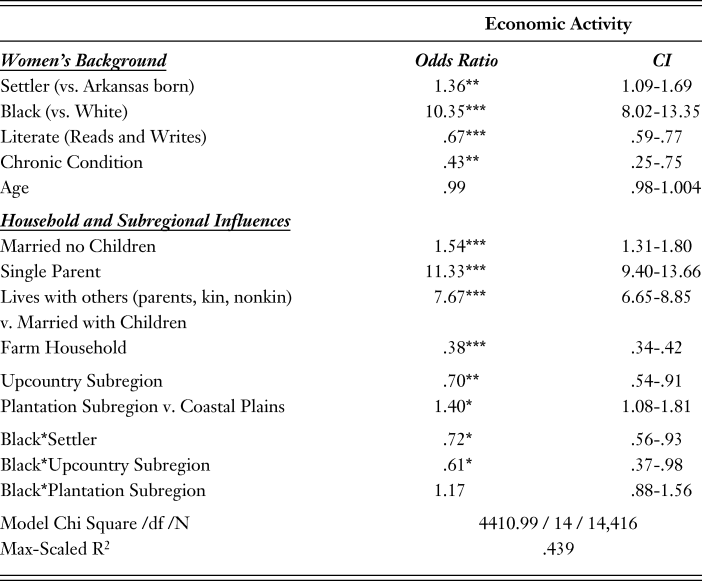
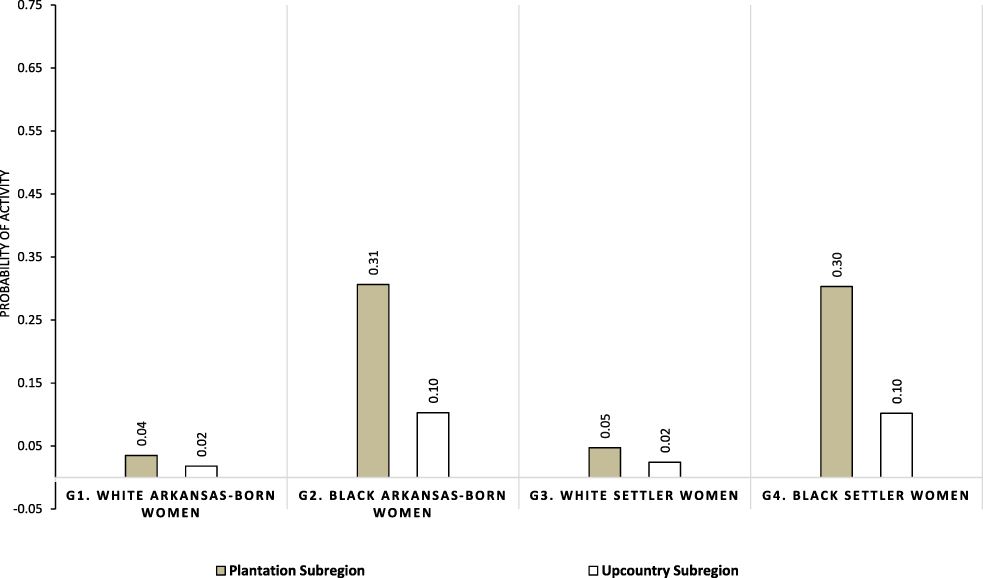
Young Black women in plantation districts were the most economically active women in the state (Table 1). Table 2 more closely examines women’s economic activity by using logistic regression. We model a woman’s Economic Activity as a function of her settler vs. Arkansas-born status; race; early life course socioeconomic dis/advantage represented by literacy; health or ability to work; age; current life stage family/household structure (e.g., marital status and presence of children); whether her household is a farm vs. nonfarm; and her household’s subregional location. The 1880 IPUMS does not report household ownership of farms. We present findings as odds ratios (exponentiated coefficients), but highlight Figure 4 which summarizes the equation findings as the probability of being economically active, by race, settler status, and subregion of residence, calculated at the sample means of other variables.
Logistic Regression: Economic Activity of Arkansas Women, 1880 IPUMS

*p <.05 **p <.01 ***p <.001
Note: Upcountry counties as in Blevins (2002, p. 5). Plantation counties as in McNeilly (2000, p. 126)
Probability of Women’s Economic Activity by Race, Subregion and Settler Status, 1880 IPUMS

Figure 4 shows that White Arkansas-born (G1) and White settler (G3) women had relatively low probabilities of economic activity, although White women in both groups more likely worked if residing in the Plantation subregion (Coastal Plains is the reference category). Black Arkansas–born (G2) and Black settler (G4) women had relatively high probabilities of economic activity, again especially in the Plantation subregion. In addition, chronic illness and literacy reduced all women’s odds of working by 57% and 33%, respectively (Table 2) while age was not associated with economic activity.Footnote 26 Married women without children, single women with children, and women in households of others had increased odds of working, relative to married women with children (nuclear family form as reference) (Table 2). In sum, women with greater economic need or fewer household kin worked if healthy enough to do so. Plantation subregion residence raised (for all women) and Upcountry residence lowered (especially for Black women) the odds of work, relative to Coastal Plains residence.
Consistent with our analytic model, women’s young adult work roles, partly determined by family roles (Figure 1, Box 3a), was correlated with race (Box 2) and institutional forces associated with productive mode (Box 1). We initially asked: How did postwar settlers fare? We do not yet know. For, young working or non-working women in a given subregion, Black or White, might or might not have attained relative autonomy by later life. Upward mobility to farm ownership on the agricultural ladder was age-graded: it took time to inherit, buy, or claim homesteaded land (Alston and Kauffman 1997, Reference Alston and Kauffman1998; Lanza Reference Lanza, Cimbala and Miller1999; Spillman Reference Spillman1919). We next explore older women’s placement on the agricultural ladder around 1910, in the context of new racial state and related institutional forces.
(RE)INSTITUTIONALIZING THE RACIAL STATE: STRUCTURED INEQUALITY AND LATER LIFE
Paradoxically, the transformation of “wild and sickly” Arkansas into rich farm acreage after 1880—the very “pull factor” that spurred mass settlement—reduced the availability of high-quality, low-cost acreage for small-holder purchase by 1910. Migration and high fertility rates boosted competition for farm land, leading to rising land cost; subdividing old plantations, for sales or tenancies, reduced farm size. Shrinking farm size in Arkansas, as elsewhere in the South, then limited household productivity, whether for home-use or markets (Blevins Reference Blevins2002; Fite Reference Fite1984; Jones Reference Jones2010; Moneyhon Reference Moneyhon1994). Farmers in the commercial eastern portion of the Upcountry and in the Coastal Plains subregion increasingly sought to get ahead by growing more cotton, a sure market winner, while reducing the crops grown for home-use.Footnote 27 The strategy might pay off by boosting immediate cash flows—allowing tenants to buy tools, animals, and eventually land—but several years of bad weather, insects, and/or low cotton prices could severely reduce household self-sufficiency and living standards and increase debt (Fite Reference Fite1984; Ransom and Sutch, Reference Ransom and Sutch2001). Yet this strategy, undertaken to move up the agricultural ladder toward land ownership and wealth, was popular: judged by a cotton to corn ratio of 25:1 or lower, the number of Arkansas counties that lost farm self-sufficiency rose from eight in 1860 to twenty-six in 1880, and continued to rise thereafter (Hansen and Moneyhon, Reference Hanson and Moneyhon1989; Moneyhon Reference Moneyhon1994).
As Upcountry and Coastal Plains subsistence-marketization lines blurred between 1880 and 1910, lowland Delta deforestation and plantation production accelerated (Brannon Reference Brannen1924; Brooks 1906; Mandle Reference Mandle1992; Virts Reference Virts1991; Whayne Reference Whayne1992; Woodruff Reference Woodruff2003). Plantations as defined in 1910 consisted of five or more tenant farms, contracted out by one owner, on one continuous tract of land (Elman et al., Reference Elman, London and McGuire2015; U.S. Census Bureau 1916). Landowners, perhaps with managers or overseers, used contracts to rigidly control tenant family labor and the crops grown (Brannen Reference Brannen1924; Mandle Reference Mandle1992; Mann Reference Mann1989; Woofter Reference Woofter1969[1936]). Black tenant farmers on rising, modern “business” plantations were mostly sharecroppers as early as 1880 (Hansen and Moneyhon, Reference Hanson and Moneyhon1989; Moneyhon Reference Moneyhon1997; Woodman Reference Woodman1995) although sharecropping was not formally recognized as an occupational status by the Census Bureau until 1920. Sharecropping resembled wage work more than true tenancy (Alston and Kauffman, Reference Alston and Kauffman1998; Jaynes Reference Jaynes1986; Woodman Reference Woodman1979); sharecroppers lacked the autonomy to make on-the-job decisions and were not remunerated for the skills, tools, or animals that they brought to tenancy contracts (Alston and Kauffman, 1997, Reference Alston and Kauffman1998; Brannen Reference Brannen1924; Brooks Reference Brooks1914; Woodman Reference Woodman1995). Sharecroppers hoped to move up the agricultural ladder, as did other Arkansas farmers. But, due to lack of remuneration, forced dependency on landowners and other aspects of the sharecropping system (illustrated below), most could not do so (Du Bois Reference Du Bois1912; Mandle Reference Mandle1992; Steedman Reference Steedman2008; Woodman Reference Woodman1995).
Institutional Mobility Constraints
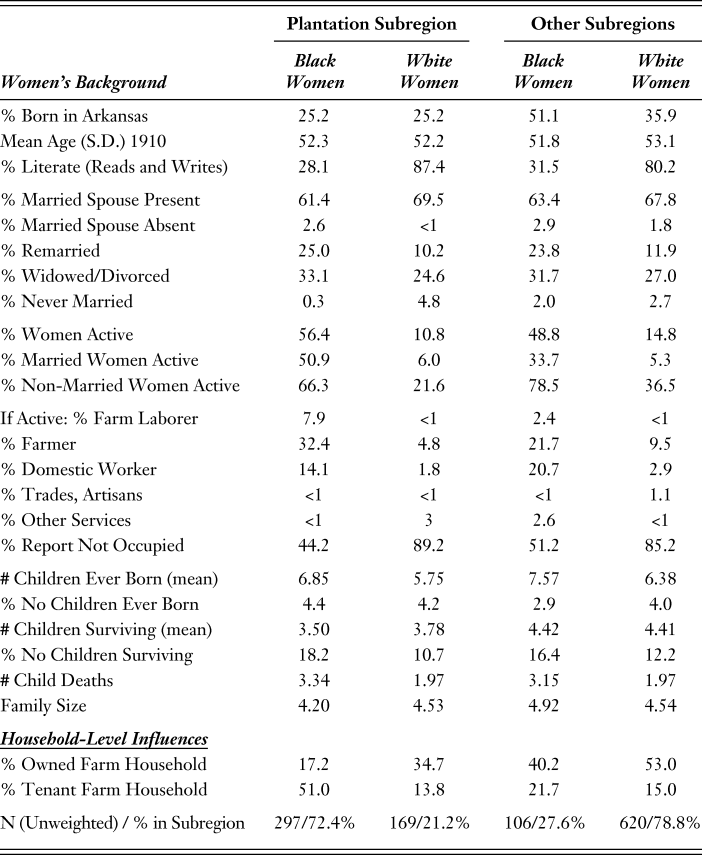
Yet, many Black Arkansas farmers did reach the top of the agricultural ladder. As early as the 1870s, one in twenty Black Arkansan head of households owned land, double or triple the rate of other Deep South States.Footnote 28 This section examines women’s placement on the agricultural ladder in a process of agrarian stratification, differentially constrained by productive mode. The 1910 IPUMS only reports women’s placement on two broad rungs of the ladder: living in a tenant farm household (collapsing all forms of tenancy including sharecropping) and living in an owned farm household, the top rung of the ladder (Table 3, bottom two rows). An examination of statuses by race and productive mode of Plantation (left two columns) versus combined subsistence-oriented Upcountry/Coastal Plains subregions (right two columns), finds that White women in Plantation (Column 2) versus other counties (Column 4) were less likely to reach the top of the ladder (34.7% vs. 53%). A similar pattern existed for Black women (Columns 1 and 3, 17.2% vs. 40.2%).
Descriptive Statistics by Subregion and Race, 1910 IPUMS

Ownership/non-ownership in 1910 partly reflected subregional productive mode. Upcountry cotton marketization faded by the 1890s as cotton prices fell, but less-commercial, less-indebted farm families retained farm ownership by returning to subsistence or selling timber, hemp, or free-roaming livestock (Allured Reference Allured1988; Moneyhon Reference Moneyhon1997). On the Coastal Plains, mixed subsistence/commercial cultivation continued, now by Black as well as White small-holders and tenants, who increasingly produced cotton for markets. The small-holder and more-resourced tenant families who retained a “safety-first” way of life had more financial control over what they produced, how they produced it, and gains, if any. They could pay off debt or invest in tools, animals, or land (Schweninger Reference Schweninger1997). In contrast, Plantation subregion farmers, primarily sharecroppers after 1880, signed contracts that often limited or precluded their choice of growing for market or home-use (Brannen Reference Brannen1924; Woofter (Reference Woofter1969[1936]). Landowners owned the season’s crop and paid a sharecropper’s wage of housing, perhaps a small food allowance, as a share of production, settled at harvest (Jaynes Reference Jaynes1986; Woodman Reference Woodman1979). Owners of rich soils rarely sold their land to Black farmers (Schultz Reference Schultz2005; Schweninger Reference Schweninger1997). Sharecroppers rarely had the cash to purchase tools, animals, or land after settlement and struggled to even sustain living standards to the next season (Dirks and Duran, Reference Dirks and Duran2001; Jones Reference Jones2010).
Ownership and non-ownership also reflected institutional realignment. Newly passed racial state laws were designed to promote social control, including for servicing the labor productivity of large-scale agriculture (Moneyhon Reference Moneyhon1994; Wacquant Reference Wacquant2002; Woodman Reference Woodman1979). For, by the 1890s, the same Arkansan “leaders of the Old South… [who] took the state into Reconstruction, the New South, and beyond” (Moneyhon Reference Moneyhon1994, p.189) reversed their relatively benign 1870s and 1880s course. Although these new laws, or “rules of the game” (Alston and Ferrie, Reference Alston and Ferrie1999, p. 3; James Reference James1988, p. 194) and their timing varied across the South (James Reference James1988; Roback 1980; Werum Reference Werum1999), they shared goals of imposing landlord supremacy, disenfranchisement, and segregation (Alston and Ferrie, Reference Alston and Ferrie1999; James Reference James1988; Mandle Reference Mandle1992; Moneyhon Reference Moneyhon and Kirk2014). New crop lien laws provided landlords with the first slice of sharecroppers’ shares to repay credit, raising sharecroppers’ risk of debt (James Reference James1988; Roback Reference Roback1984; Whayne Reference Whayne1992; Woodman Reference Woodman1995). Vagrancy laws passed around 1900 limited Black farmers’ off-plantation travels to search for jobs or better tenancy terms (Naidu Reference Naidu2010; Woodruff Reference Woodruff2003). In addition, the new racial states blocked federal power and shifted state power downward, closer to planter control, toward local government and county executives (James Reference James1988; Werum Reference Werum1999). Planters produced, with county magistrates and judges—in the context of vagrancy arrests and inability to pay fines—a new form of coerced Black labor: prisoners consigned to work in prisons, factories, on chain gangs, and on local elites’ plantations (Blackmon Reference Blackmon2008; Wacquant Reference Wacquant2002).
Table 3 illustrates that the Plantation subregion sharecropping system, compared to subsistence/commercializing modes in other subregions, had by 1910 multiplied (statistically moderated) unequal life chances for Black women's upward mobility. In the Plantation subregion, White women were twice as likely as Black women to live in owned farm households (Table 3, 34.7% vs. 17.2%) whereas the percent difference was about 13% in the other subregions (53% vs. 40%). Also, 51% of Black women versus 13.8% of White women lived in tenant farm households in the Plantation subregion, a nearly four-fold difference, while 21.7% of Black women versus 15% of White women, a much narrower difference, lived in tenant farm households in the other subregions. There was also an economic activity race gap across modes: in the Plantation subregion 56.4% of Black women versus 10.8% of White women were economically active, a more than five-fold difference, whereas in other counties, 48.8% of Black versus 14.8% of White women were economically active, a three-fold difference. Intra-racial disparities existed across subregions: for example, married Black women in Plantation versus the other subregions were more likely to work (50.9% vs. 33.7%).
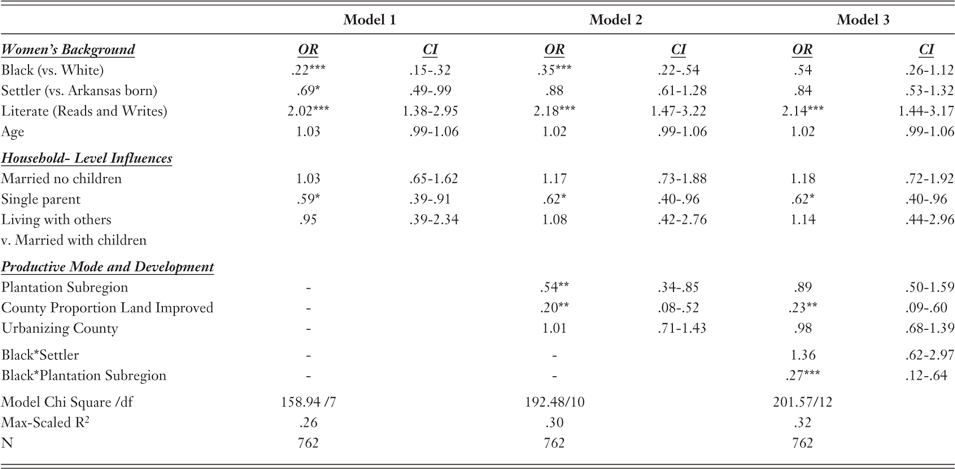
We take a closer look at the correlates of farm ownership, the top rung of the agricultural ladder, by using logistic regression to model older women’s odds of Residing in an owned farm household (Table 4). Our analytic sample is a subsample of 1910 IPUMS women who lived in kin-based farm households (they or kin were household heads). In Model 1, women’s odds of living in an owned farm household is a function of their settler vs. Arkansas-born status, race, literacy, age, and current life stage family/household structure. Black women had 78% reduced odds of ownership compared to White women. Settlers vs. Arkansas-born women, and women raising children without spouses (married couples with children being the reference) also had lower odds of farm ownership. Black and White women who had reached the top rung were more likely native to the state and literate. Settlers might have had fewer accumulated resources, different household/family economy strategies, lacked White paternal sponsorship for land purchase (Schultz Reference Schultz2005) and/or lost properties once owned (Jones Reference Jones2010). Women’s literacy in 1910 reflected early life course dis/advantage (access to school) under old racial state policies prohibiting Black literacy.
Logistic Regressions: Lives in Owned Farm Household, Arkansas Farm Household Women, 1910 IPUMS

*p <.05 **p <.01 ***p <.001
Model 2 adds Plantation subregion (Upcountry/Coastal Plains as reference), also adjusting for county urbanization and county proportion of improved land, where the latter indicates local land competition and value. Women with higher odds of reaching the top rung lived in the non-Plantation subregions and in counties with less improved (hence, less valuable, and less costly) land. Settler status in this model becomes non-significant; perhaps resources and paternalistic ties mattered less adjusting for productive mode. The final model adds interactions of race*settler status and race*Plantation subregion residence, finding a joint effect of race and subregion. This finding differs from our analytic model which expected race and institutional factors to independently contribute to economic mobility. Rather, Black women’s households in the Plantation subregion were least likely to reach/retain the top rung of the agricultural ladder.
Life on the Ladder
Unfortunately, the 1910 IPUMS only distinguishes owner vs. tenant (all types) farm household status. Census data are also limited for exploring how and why some women faced mobility barriers. Therefore, we turn to women’s oral descriptions of work, living standards, and social mobility on different rungs of the agricultural ladder. Black landowners could accumulate extensive landholdings and contract with tenant and sharecropping families as well as wage laborers to work their land. Ella Clemons (BTV 1995), born in 1907 in Delta Monroe County, had parents that came from Savannah to Arkansas:
At that time they had seven kids but they come to Arkansas and that’s where my daddy started progressing, he bought three farms…Back in that day he worked them but he had hired hands, they sharecropped for my daddy.Footnote 29
Women who became landowners, even if on a small scale, expressed a sense of achievement as well as residential autonomy. Lizzie Barnett (WPA 1936-38), a former slave who settled in Coastal Plains Faulkner County in 1867, stated:
I bought this piece of land to build my shanty from Mr. Jim Harkrider for $25.00. I worked hard for white folks and saved my money and had this little two-room house built...It is about to fall down on me, but it will last as long as I live.Footnote 30
Ann May (WPA 1936-38) of Upcountry Jackson County, sold as a child with her mother, implies that both White patronage and her family’s decision-making led to farm ownership:
We all lived with the white folks. My mother took care of all of them. They was always as good as they could be to us and after the war we stayed on…our white folks told my father to homestead a place near…and he did. We lived there until after father died. We paid taxes and lived just like the white folks.Footnote 31
Women who did not own farms also found paths toward residential autonomy. Former slave Molly Brown (WPA 1936-38), estimated age between ninety and 100 when interviewed, described buying her house in Delta Monroe County—the house she still lived in:
Way me and my husband paid for the house, he farmed for Jim Black and Mr. Gunn. I cooked for Jim Woodfin. Then I run a roomin’ house till four years ago.Footnote 32
Cash tenancy, a step down from ownership, was also desirable: tenants owned tools, livestock, and like farm owners, had considerable autonomy. Mattie Chandler (BTV 1995), born into a cash tenant family in Delta Monroe county, recalled:
My dad was a big cotton farmer, and he was a renter, he worked a lot of land….Footnote 33
Tenant (share) families owned the potential harvest and would pay a share of it to landlords at the season’s end. Having fewer assets and less economic security than cash tenants, share tenants often depended on landlords, who acted as local bankers, to extend credit to purchase farm and household necessities (Schultz Reference Schultz2005). Nanny Jackson (b. 1854), a White tenant who had moved to Delta Desha county from Tennessee, was distraught when Frank Nady, a planter, turned down her husband’s request to borrow money to buy seeds and equipment. She wrote, “Mr. Nady can’t help us this year and I don’t know who we will get” (Bolsterli Reference Bolsterli1982, p. 97).
Women’s work and family roles reflected both placement on the agricultural ladder and agrarian mode. Upcountry women in tenancy faced work burdens but had some discretion in arranging activities because they were less often bound by rigid contracts. Mary Hamilton, a White tenant, described her routine in summer:
I would go to bed, set the alarm for four o’clock, get up, get breakfast, milk, get my churn ready and be in the field almost as soon as the men were… After my morning work of milking, churning, cleaning house, getting dinner and supper at one time, and cutting a dress for someone, I would help the children in the field all afternoon (Davis Reference Davis1992, pp. 173, 207).
Sharecropping in the Plantation subregion was more akin to wage work than true tenancy (Alston and Kaufmann, Reference Alston and Kauffman1998) and a status near the bottom of the ladder. Women in sharecropping households were subject to unpredictability in daily work schedules. They were often pulled to work on other sharecroppers’ lands, often in teams. Dora Strong Dennis (BTV 1995) recalled:
It was Mama and my sisters. She would chop cotton for somebody, take them and go and chop cotton in somebody else’s field so they could come fly in her field. That’s the way the boss man had it arranged.
Plantation sharecropping also limited women’s discretion in the timing and sequencing of family and work activities, compared to true tenancy or negotiated task work with employers (Glymph Reference Glymph2008). Sharecropping contracts, between White landowners and male heads of sharecropping families, ensured the field labor of women and children (Mann Reference Mann1989). In sharecropping, like slavery, women worked alongside men in the field, and took care of the domestic work of home and family (Frankel Reference Frankel1999). Field work after Emancipation meant less autonomy in how women, now in individualized farm households, carried out the (unpaid) “production for use” work for their family (Mann Reference Mann1989, p. 797). For example, women sharecroppers had limited control over child care. Le Ester Jones (BTV 1995) from Delta Lee County recalled:
If all the children was old enough to be in the field, the baby was carried to the field, put under a shade tree in a box and, had to check on the babies, you know, every time they chop awhile, then they check on the baby.Footnote 34
Living standards also reflected both placement on the agricultural ladder and agrarian mode. Mattie Chandler, born into a Delta cash tenant family, had high living standards when a child:
[My dad had] a big family and raised a lot of stock, cows and hogs and everything….. And we just had plenty of food…chickens, ducks, geese, guineas, turkeys we had, and things that he killed.
Upcountry and Coastal Plains tenant families could also hunt and forage, perhaps without growing crops, and get meat, butter, and milk from free-roaming livestock (McDonald and McWhiney, Reference McDonald and Grady1980; Moneyhon Reference Moneyhon1997; Poe Reference Poe2011). In contrast, sharecropping contracts could forbid raising of food or livestock. Over 90% of 1910 plantation households across the South bought food on credit throughout the year, at high prices and interest rates, from plantation stores run by employers or merchants (Brannen Reference Brannen1924). Sharecroppers then needed to settle store credit accounts at harvest. Thelma Nash (BTV 1995) described:
Well, [plantation manager] called it settlement, but what really would happen when you go there…he would give you what he wanted you to have... So it always kept you down. You didn’t have anything to get up off of… if you had six or seven children and you cleared $30. Now what did you have? ...And you started right back taking up groceries, you know, for your family because you had to…and try to make it until next year.Footnote 35
Annie Floyd (BTV 1995) recalled:
The bossman owned the community and owned you…one great big store, if you had money you had to spend it there… If one owed money [to the commissary] one could not move unless repaid, unless slipping off.Footnote 36
Classical frontier and settler colonial studies assume stable settler (White) independence on borderlands once hegemonic White control is achieved. But White rural mobility in Arkansas fell by 1910, much as elsewhere in the South, due to falling cotton prices, rising production costs, and other related problems (Fite 1980; Jones Reference Jones2010; McDonald and McWhiney, Reference McDonald and Grady1980; Moneyhon Reference Moneyhon1994, Reference Moneyhon1997). Arkansas White farm ownership fell from over 80% to about 37% of farms between 1865 and 1930 (Moneyhon Reference Moneyhon1997). Moreover, by 1910, White indebted small-holders not only fell into tenancy, but increasingly into sharecropping (Moneyhon Reference Moneyhon1997). Plantation sharecropping exposed White women to a plantation-style labor system where they were subject to systemic poverty, contractual control of work/family roles, and status dependency (Mann Reference Mann1989; Steedman Reference Steedman2008). Cleaster Mitchell (BTV 1995), having grown up in a Black sharecropping community, noted:
Now, white could move to our community, but we could not move to their community. But I know we had several white families to move in our community, but they were in the same shape we was—extremely poor. At that time, if you was extremely poor, regardless to what color you was, if you was really, really poor, then you was treated like you was poor.Footnote 37
Black farm families sustained community and family networks to provide material and social supports whenever possible, sharing food and caregiving for children and the sick, despite differences in relative position on the rungs of the agricultural ladder (Chafe et al., Reference Chafe, Gavins and Korstad2001; Jones Reference Jones2010). White farmers’ support networks were conditional, often contingent on the acceptance of others in the White community (Schultz Reference Schultz2005). Upcountry tenant Mary Hamilton noted:
When you move to the hill country of Arkansas, if you make a good impression on the first family you meet and make friends with them, you are looked on as a friend and neighbor by the whole community (Davis Reference Davis1992, p. 220).
It is unclear if poor White plantation sharecroppers could marshal significant “safety net” support from more-advantaged Whites. Poor Whites sharing the same labor status as poor Blacks shared a status of dependence and inferiority, despite race (Steedman Reference Steedman2008). As Jaynes (Reference Jaynes1986) noted, “In the South, white laborers had few friends outside their class” (p. 253). Community support might occur across race-related lines, especially among the poor (Schultz Reference Schultz2005), but as segregation spread, “a racial caste system pervaded the southern countryside” (Jones Reference Jones1992, p. 337). Moreover, the sharing of food, one of the strongest safety nets in the Black community, was the most severe rule violation under rural segregationist etiquette (Schultz Reference Schultz2005). Lucinda Baltimore’s (BTV 1995) parents owned land and had more than adequate provisions. She discovered as a child that racial norms for Whites outweighed hunger:
The white family was proud and would not ask for food, would not beg. The woman and kids [visited my mother] and she was eating and offered to feed the children...telling the white mother that she felt bad eating in front of the kids. The mother allowed her to give food to the children but refused food for herself.Footnote 38
Yet Whites faced, in general, fewer headwinds to mobility in the new racial state. Poor as they were, White sharecroppers more likely exited the sharecropping system, moving into higher forms of tenancy or, if tenants, “aging” into land ownership via inheritance or purchase (Alston and Kauffman, Reference Alston and Kauffman1998). Black elder sharecropping women, recalling lifetimes of effort to exit their status, understood that their lack of mobility on the agricultural ladder was at least partly due to their embeddedness in a system designed to foster dependency. Molly Hardy Scott (WPA 1936-38), interviewed at age ninety in Prairie County, looked back on life as a sharecropper:
I never owned nothing…If we did have a good crop we never could get ahead. We couldn’t get ahead nuff not to have to be furnished the next year. We did work, but we never could get ahead.Footnote 39
For some, sharecropping life was not significantly different from slavery, as Cora Gillam (WPA 1936-38), interviewed at age eighty-six in Little Rock, described:
I know what they told us every time when crops would be put by. They said ‘Why didn’t you work harder? Look. When the seed is paid for, and all your food and everything, what food you had just squares the account.’ Then they take all the cotton we raise, all the hogs, corn, everything. We was just about where we was in slave days.Footnote 40
The sharecropping system may have entrapped White women for a while but they were not as bound by new racial state laws and norms of social control, constructing race, should they exit. Cleaster Mitchell’s mother took a young White sharecropping woman under her wing:
…teaching her how to cook and stuff just like she did my sisters, and maybe the little children wouldn’t have survived if my mother didn’t help her, because if they was sick, my mother would doctor on them. They was down there with us about two years. But the catch was, if they pull up a little bit, they have to get out from down there. They can’t stay because then they won’t be recognized, you see. They got to get to where they can sort of be recognized.
CONCLUSION
Our examination of Trans-Mississippi settlement finds patterns considerably different from those depicted in classical Turnerian and settler colonial frameworks (Glenn Reference Glenn2015; Perry Reference Perry2001). In Turnerian fashion, opportunistic waves of Black and White settlers “came to Arkansas like the gold rush” after the Civil War (see Jeffers, BTV 1995) but the opposite of a Turnerian melting pot emerged: White settlers codified social relations as racial division and social exclusion. As settler colonial studies suggest, an initial burst of settlement growth was fueled by the expulsion of indigenous peoples and the importation of coerced ethnic (non-White) labor. Yet, Arkansas would remain a frontier state at the Civil War’s end. Moreover, the assumption of both frameworks, that settler institution-building commences in unoccupied White-institutional space, is problematic in Arkansas: initial establishment of land, forced labor and financial systems, even formal statehood, fully preceded and collapsed prior to mass settlement. Old institutional legacies lingered under the renewed settlement, beyond the collapse of the old racial state, as harbingers, if not seeds, of later institutions and policies (Feagin and Elias, 2014; James Reference James1988; Ruef and Fletcher, Reference Ruef and Fletcher2003; Wacquant Reference Wacquant2002).
A somewhat clearer portrait of Arkansas settlement emerges under a theoretic lens of the racial state (James Reference James1988). Mass settlement was bracketed by two state institutional forms that awarded rights and resources according to race: slavery and Jim Crow statism. Each emerged as formal totalizing institutions with implications—varying depending on attribution of race—for women’s lives. Under each system, racial social control initiated by agricultural elites proceeded legally, over different and fluid levels of government, in stages. It was in the interregnum, in the post-Civil War period between the old and new racial states—while under strong Federal and Outsider investor countervailing controls, while in the throes of labor hunger—that opportunistic mass settlement occurred in Arkansas. These settlers were responding to strong pull factors of land and wage to fulfill goals of household self-sufficiency, freedom on the land, and/or capitalist mobility. A less rigid post-Civil War racial caste system up to the 1890s contributed to the ensemble of pull factors drawing Black migrants to Arkansas and especially to the rich land of the Delta (Lancaster Reference Lancaster and Kirk2014; Makin-Rawn Reference Matkin-Rawn2013). Arkansas merits close study, if only as an outlying Trans-Mississippi West Frontier state. But if fragmented racial state sovereignty historically produced significant policy and settlement differences across time, other southern states need analysis in this light (James Reference James1988; James and Redding, Reference James, Redding, Janoski, Alford, Hicks and Schwartz2005; Werum Reference Werum1999).
Our study highlights topographic as well as institutional features of the productive modes that trisected Arkansas, showing that subregions differentially shaped settlement patterns and life course conditions. Before and after the Civil War, White women who lacked resources, or had economic orientations favoring limited marketization risk or resistance to commercialism, mostly settled in Upcountry and Coastal Plains subregions where they lived more cheaply, practicing subsistence or mixed commercial farming. Even if tenancy limited their upward mobility, they retained relative household economic autonomy. The small proportion of Upcountry Black women also appear to have had relative advantage in 1880 although their proportions grew still smaller by 1910 as Upcountry towns adopted “sundown” codes, often accompanied by community violence, to restrict Black presence and/or residence (Lancaster Reference Lancaster and Kirk2014; Loewen Reference Loewen2005).
Prewar, Black women were forced laborers in the Plantation subregion and pockets of other subregions. In the immediate postwar period, Black women mostly settled in the Plantation subregion where rapid deforestation, development of high-quality soils, and steerage by Freedman’s Bureau agents to land and employment promised household autonomy and land ownership. The Black migration to the state, at least initially, provided rewards: the Black share of farm ownership rose from the Civil War’s end to 1910, even as the White share fell over the same period (McDonald and McWhiney, Reference McDonald and Grady1980; Moneyhon Reference Moneyhon1994; Schultz Reference Schultz2005; Schweninger Reference Schweninger1997). Over time, however, subregional development—as shaped by racial state rules—produced divergent paths of land mobility. By 1910, forces associated with plantation production under the sharecropping system multiplied Black women’s odds of not rising to the top of the agricultural ladder. As productive modes similarly bisected and trisected other post-Reconstruction southern states, they also need analysis in this light (Harris Reference Harris2001; McKenzie Reference McKenzie1994).
African American women and kin primarily settled in Plantation districts where, by 1910, they had lower odds of owning farms. Their movement up the ladder was increasingly limited by labor laws and debt peonage (Naidu Reference Naidu2010). Most often, Black women in sharecropping families worked in the fields, earning less than the men. Black women not working in the fields were designated as “dependents” and listed with children on contracts (Frankel Reference Frankel1999). Thus, the economic system of sharecropping, supported by the new racial state, reinforced patriarchal family structure with separation of external/paid work and internal/unpaid work into gendered realms (Mann Reference Mann1989). Women’s work in slavery, now in sharecropping, was masculinized whereas men’s work was not systematically feminized in either system. In this way, race and gender hierarchies structured the lives of freedwomen and all women as they forged their versions of freedom, interdependence, and independence in post-slavery Arkansas.
Among our study’s shortcomings is that predictors and outcomes in equations are simultaneously measured in cross-sectional IPUMS data although we take care to interpret findings as associational, not causal. We likely underestimate women’s economic activity because Census enumerators and households under-reported women’s work in this era. Also important is that the most disadvantaged women are missing from IPUMS data and from oral records due to selective mortality. Regardless, our study demonstrates social differentiation in women’s life course due to race—with regard to economic activity and mobility—as Arkansas transitioned from frontier to mass settlement status, under modern planter dominance. It also provides insight about conditions that triggered the wave of movement out of the state, by both Blacks and Whites, which commenced after 1910. Partly because planter control delayed industrial development until the 1940s (Moneyhon Reference Moneyhon1994), Arkansas women after 1910 (especially children of settling women) increasingly sought life opportunities outside of the state. But, heavy in the mix of “push” factors driving Black women’s exodus out of the state, indeed, out of the South altogether, was rising repression of the new racial state (Wilkerson Reference Wilkerson2010).
ACKNOWLEDGMENTS
The authors would like to acknowledge and thank the John Hope Franklin Research Center for African and African American History and Culture, and the wonderful staff at the David M. Rubenstein Rare Book and Manuscript Library, Duke University, for assistance in accessing oral materials contained in the Arkansas Behind the Veil archives. Dr. John Gartrell, curator of the Behind the Veil material, has approved inclusion of the individuals cited in this study. We also thank the staff of the Arkansas History Commission in Little Rock. We are grateful to the reviewers, John Gartrell and Thavolia Glymph for helpful feedback. An earlier version of this paper was presented at the Social Science History Association meetings in Chicago, November 2016.
Appendix A
Interviews from Work Progress Administration (1936-38).
Interviewed by Irene Robertson.
Molly Brown (age 90+), in Brinkley, Arkansas.
Martha Ann Dixon (age 81), in DeValls Bluff, Arkansas.
Mahalia Shores (age 77), in Marianna, Arkansas.
Molly Hardy Scott (age 90), in DeValls Bluff, Arkansas.
Interviewed by Mary D. Hudgins.
Judy Parker (age 77), in Hot Springs, Arkansas.
Clara Walker (age 111), in Garland County, Arkansas.
Interviewed by Beulah Sherwood Hag.
Mittie Freeman (age 86), in 320 Elm St., North Little Rock, Arkansas.
Interviewed by Carol Graham.
Millie Evans (age 87), in El Dorado, Arkansas.
Interviewed by Sallie C. Miller.
Ann May (age 82), in Clarksville, Arkansas.
Interviewed by Rosa B. Ingram.
Lizzie Barnett (age 100), in Conway, Arkansas.
Interviewed by Zillah Cross Peel.
Adeline Blakely (age 89) in Fayetteville, Arkansas.
Interviewed by Beulah Sherwood Hagg.
Cora Gillam (age 86), in Little Rock, Arkansas
Interviewed by Sarah R. Scott.
Laura Jackson Edwards in Yell County, Arkansas.
Appendix B
Interviews from Behind the Veil: Documenting African-American Life in the Jim Crow South (1995).
Interviewed by Doris D. Dixon.
Baltimore, Lucinda [b. 1906] Home [place redacted] Arkansas, July 10, 1995.
Chandler, Mattie [b. 1910] Home [no street address] Arkansas, July 18, 1995.
Clemons, Ella [b. 1907] Cotton Plant, Arkansas, July 13, 1995.
Williams, Oliver Raymond [b. 1926] Cotton Plant, Arkansas, July 25, 1995.
Interviewed by Paul Ortiz.
Dennis, Dora Strong [b. 1900] Fargo, Arkansas, July 19, 1995.
Floyd, Annie [b. 1925] Brinkley, Arkansas, July 12, 1995.
Jones, Julice and Le Ester [b. 1925 and b. 1930] Brinkley, Arkansas, July 12, 1995.
Mitchell, Cleaster [b. 1922] Brinkley, Arkansas, July 12, 1995.
Interviewed by Mausiki Stacey Scales.
Jeffers, Cleo [b. 1912] Brinkley, Arkansas, July 11, 1995.
Nash, Thelma Woods. [b. unknown] Forrest City, Arkansas, July 12, 1995.
Woods, Delores Twillie [b. 1925] Forrest City, Arkansas, July 12, 1995.