Introduction
Memory loss and cognitive dysfunction are quite common among old people (Isik, Reference Isik2010). Population studies found the prevalence of memory-related complaints to be 25–50% in the elderly (Jonker et al., Reference Jonker, Geerlings and Schmand2000). Maastricht Aging Study determined that the prevalence of memory loss is 41% at the age of 55–64 years, and 52% at the age of 70–85 years (Ponds et al., Reference Ponds, Commissaris and Jolles1997). Memory problems in older adults attending the memory clinics may be either "Benign Senescent Forgetfulness," which is a characteristic of aging, or one of the initial symptoms of neurodegenerative diseases, such as Alzheimer's disease (AD) (Heinik, Reference Heinik2010; Hildreth and Church, Reference Hildreth and Church2015).
Detailed medical history, physical examination, and neurocognitive assessment should be performed to identify the etiology of memory loss (Annoni et al., Reference Annoni, Chouiter and Démonet2016). However, comprehensive neurocognitive assessment, including memory, language, executive functions, visuospatial functions, attention, place–time orientation and behavioral disorders, mood, and activities of daily living (McKhann et al., Reference McKhann, Knopman and Chertkow2011), may not be performed in every clinic, as it takes too much time and requires special training. Therefore, development of easily applicable, time-saving, and cost effective screening methods has allowed identifying the individuals that require further evaluation among the patients who apply to especially primary care settings for memory loss. In only a few studies, some methods were reported by which the physicians decide to screen for cognitive impairment (CI) in older adults. Among those methods, “Attended With (AW)” and “Head-Turning Sign (HTS)” rank first (Larner, Reference Larner2012; Larner, Reference Larner2014). The negative AW sign, which means applying to the clinics alone, was reported to be considered as a robust observation of the absence of dementia, regardless of gender and age (Larner, Reference Larner2005). HTS, which is the patient's staring at the accompanying person for some cues to the questions directed to him/her, is another sign that was also reported to be a clinical marker for AD (Fukui et al., Reference Fukui, Yamazaki and Kinno2011).
The literature comprises only a few studies on AW and HTS; moreover, almost no study has been reported so far to evaluate the older adults who commonly complain about memory loss. Thereby, we aimed to assess the diagnostic value of both signs for CI in older adults.
Material and method
Patients
A total of 529 patients over 60 years without exclusion criteria, who attended the geriatrics outpatient clinic for memory complaints between September 2014 and June 2016, and underwent comprehensive geriatric assessment, were included in the study. The study was consonant to the Declaration of Helsinki, and was approved by the local ethics committee.
Patients with dementia
Dementia was diagnosed according to DSM-IV criteria. The diagnosis of CI, including Mild Cognitive Impairment (MCI), AD, dementia with Lewy body (DLB), behavioral variant Frontotemporal Dementia (bvFTD), Vascular Dementia (VaD), Normal pressure hydrocephalus (NBH), and Parkinson's Disease Dementia (PDD), was made according to the diagnostic criteria (McKhann et al., Reference McKhann1984; Lopez et al., Reference Lopez1994; Petersen et al., Reference Petersen, Smith, Waring, Ivnik, Kokmen and Tangelos1997; McKeith et al., Reference McKeith2005; Relkin et al., Reference Relkin, Marmarou, Klinge, Bergsneider and Black2005; Martinez-Martin et al., Reference Martinez-Martin2011; Rascovsky et al., Reference Rascovsky2011). In addition, each of these patients was also evaluated by Magnetic Resonance Imaging.
Comprehensive geriatric assessment (CGA)
Socio-demographic characteristics of the participants including age, gender, education, and living environment were recorded. All patients were examined whether they have cataract, hearing loss, hypertension, diabetes mellitus, coronary artery disease, congestive heart failure, peripheral vascular disease, hyperlipidemia, cerebrovascular disease, depression, dementia, and polypharmacy in their medical history. In addition, comorbid conditions of the patients were assessed using Charlson comorbidity index. Cognitive functions of the patients were evaluated by Cognitive State Test (COST) (Babacan-Yildiz et al., Reference Babacan-Yildiz2013), Mini-Mental State Examination (MMSE), and the Montreal Cognitive Assessment (MOCA). In addition, scores of the Geriatric Depression Scale (GDS) and basic and instrumental Activities of Daily Living (BADL and IADL) indexes were also recorded for each patient. CGA is an evaluated protocol, including all above assessments (Soysal et al., Reference Soysal, Isik, Buyukaydin and Kazancioglu2014). In addition, clock-drawing test and the Clinical Dementia Rating instrument were also performed in all the patients.
The presence or absence of AW and HTS while performing CGA in the participants was determined as follows.
Attended Alone sign/Attended With
This is assessed based on whether the patient has a companion to give information about him/her. If the patient presents alone, Attended Alone (AA) sign is positive. If the patient has a companion, such as a relative, friend, or caregiver to explain the patient's situation, AA sign is negative (Larner, Reference Larner2014). All patients with AA sign negative and without exclusion criteria were considered, as "Attended With" sign is positive.
Head Turning Sign (HTS)
The patient's relative is asked to sit 1 meter behind the patient at an angle of 45°. If the patient turns his/her head even for one time to receive help from the relative during the questions about the complaints, such as "what kind of memory problems are you experiencing?," "Would you please give a few examples of what you forget?," then the "HTS" is positive. If the patient answers all questions himself/herself without help, then the "HTS" is negative (Larner, Reference Larner2012).
Patient exclusion criteria
The patients with GDS score >7; with acute confusional state, psychotic attack (schizoaffective disorder, etc.) or that have been diagnosed with refractory major depression during assessment; those with substance and alcohol addiction; those having history of diseases that significantly impair the patient's general health status such as acute stroke, gastrointestinal bleeding, sepsis, acute renal insufficiency, acute coronary syndrome, acute liver insufficiency, or acute respiratory failure; patients that do not speak Turkish; and the patients receiving drugs that are likely to influence the patient's emotional status such as benzodiazepine, antipsychotics, or corticosteroid were excluded. If the patient has a zealous or anxious companion who rashly answers about his/her situation, or the patient is resistant to answer the questions, they were excluded. Moreover, the patients who suffer from aphasia or have moderate to severe behavioral and psychological symptoms (e.g. severe anxiety), and the patients living in a nursing home were not included, as they have to be accompanied by a staff. The patients with hearing impairment were also not included, as the HTS is probably positive.
Statistical analyses
Continuous variables were presented as mean ± standard deviation. Kolmogorov–Smirnov test was used to analyze continuous variables in terms of suitability for normal distribution. Continuous variables with normal distribution were analyzed by Independent Sample t-test, whereas continuous variables without normal distribution were analyzed by Mann–Whitney U test and Kruskal–Wallis test. Differences in proportions were analyzed using χ 2 test, since “cognitively robust, MCI, and dementia” were three independent groups. The relationship between the parameters was analyzed by Pearson's correlation analysis. p values <0.05 were considered significant. Sensitivity, specificity, and positive and negative predictive values (PPV and NPV) of AW and HTS were calculated to detect CI. AW and HTS were also assessed by the receiver-operating characteristics (ROC) curve, and the area under the ROC curve was measured by 95% confidence interval (CI). Statistical analyses were done using SPSS 15.0 (SPSS, Inc.) package program. A sample size of 230 participants was calculated to ensure that the minimum required size was within a 95% CI and with the margin of error being at most 5%.
Results
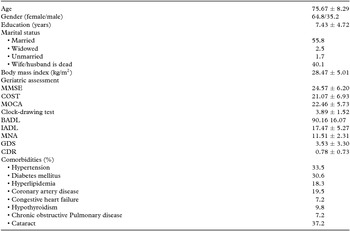
Descriptive characteristics of 529 patients, of whom the mean age was 75.67 ± 8.29 years, are demonstrated in Table 1. Four hundred and three participants had no CI, whereas 24 patients were diagnosed with MCI (4.5%) and 102 (19.2%) patients were diagnosed with dementia (43 AH, 14 FTD, 19 LBD, 15 NBH, 5 PDD, and 6 VAD). Comparing the cognitively robust, MCI and dementia groups, it was determined that the mean age and the prevalence of females increased but the scores of MMSE, COST, MOCA, BADL, IADL, and clock-drawing test decreased as CI increased (p < 0.05). There was no difference between the three groups in terms of GDS score and the prevalence of comorbid disease (p > 0.05).
Descriptive characteristics of the patients

BADL: Basic Activity of Daily Living (0 [worst]–100 [best]); CDR: Clinical Dementia Rating (0 [best]–3 [worst]); Clock-drawing test (0 [worst]–5 [best]); COST: Cognitive State Test (0 [worst]–30 [best]); GDS: Geriatric Depression Score (15 [worst]–0 [best]); IADL: Instrumental activity of daily living (0 [worst]–23 [best]); MMSE: Mini-Mental State Examination (0 [worst]–30 [best]); MNA: Mini-Nutritional Assessment (0 [worst]–14 [best]); MOCA: Montreal Cognitive Assessment Test (0 [worst]–30 [best]).
Patients with positive AW sign had significantly lower scores on MMSE, COST, MOCA, clock-drawing test, and both instrumental and basic activities of daily living compared to AW (−) patients (p < 0.001, for each). Similar significant findings were obtained in the patients with positive and negative HTS (p < 0.001)
HTS was positive in 244 (46.1%) and AW was positive in 369 (69.7%) of the participants. Both HTS and AW were significantly different between cognitively healthy, MCI, and dementia groups (p < 0.001) (Table 2).
Comparison of the patients between the groups with cognitively robust, mild cognitive impairment and dementia according to presence of AW and HTS

AW: Attended With; HTS: Head-Turning Sign; MCI: Mild Cognitive Impairment.
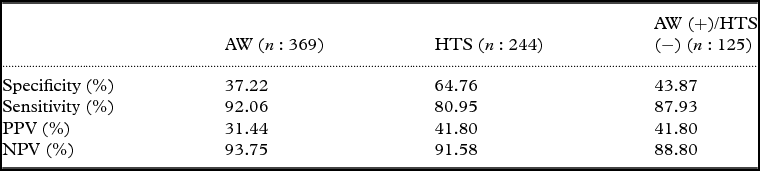
The sensitivity, specificity, positive predictive value, and negative predictive value of AW in detecting CI in elderly were 92%, 37%, 31.4%, and 93.7%, respectively. The sensitivity, specificity, positive predictive value, and negative predictive value of HTS were 80%, 64%, 41.8%, and 91.5%, respectively. These rates correspond to the values in both AW-positive and HTS-positive patients because the patient must have attended with someone to be able to evaluate HTS. Thus, all participants with HTS (+) were also AW (+). The values in the AW-positive patients without HTS are demonstrated in Table 3.
Validity of the AW and HTS for cognitive impairment

AW: Attended With; HTS: Head-Turning Sign; PPV: Positive predictive value; NPV: Negative predictive value.
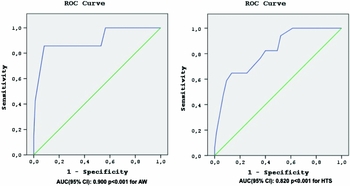
The area under the ROC curve (95% CI) was 0.90 for AW and 0.82 for HTS (Figure 1).
Receiver-operating characteristic (ROC) curve analysis of the AW and HTS to detect cognitive impairment. CI: Confidence Interval.

Discussion
The present study demonstrated that AW and HTS are quite practical, time-saving, and easily applicable sensitive tools to detect CI in older adults.
Dementia, the prevalence of which has increased with prolonged life expectancy, is a significant cause of mortality and morbidity, and is a disease that manipulates the governmental health policies due to high healthcare and treatment cost (Wimo et al., Reference Wimo2017). Furthermore, it is known that identifying patients with dementia in early stage and treating them in time both enhance the functionality and quality of life, and reduces need for long term care. However, diagnosis of CI in elderly may not be easy, particularly in early stages (Ponds et al., Reference Ponds, Commissaris and Jolles1997; Heinik, Reference Heinik2010; Hildreth and Church, Reference Hildreth and Church2015). The MMSE is one of the commonly used screening tools for CI in older adults, but it has several limitations, such as ceiling effects when used in individuals with high educational circumstances, and poor staging for questionable dementia, low rate of success in detecting MCI patients, and probability of false negativity for different types of dementia such as FTD (Kukull et al., Reference Kukull, Larson, Teri, Bowen and Mccormick1994; Tariq, Reference Tariq, Tumosa, Chibnall, Perry and Morley2006; Babacan-Yildiz et al., Reference Babacan-Yildiz2016). In view of mentioned limitations of the MMSE, the need for easily applicable, time-saving and cost effective screening tools has emerged. Therefore, in the present study, the effectiveness of AW and HTS, which are based on mere observation for detecting CI in older adults, has been investigated.
A limited number of studies on AA, which means AW negative in our study, were carried out by Larner. The first of these studies evaluated 726 cases, of which 232 had dementia. The analysis revealed that the sensitivity, specificity, positive predictive value, and negative predictive value of AA were 93%, 45%, 47%, and 93%, respectively (Larner, Reference Larner2014). The results are quite similar to ours, supporting that AA is effective in detecting cognitively robust patients. However, as different from our study, Larner evaluated 16–90 years old patients with or without memory complaints (Larner, Reference Larner2014). In another study, the sensitivity, specificity, positive predictivity, and negative predictivity of AA to identify cognitively robust participants were reported to be 98%, 41%, 56%, and 97%, respectively (Larner, Reference Larner2005). The aforementioned ratios may be quite higher than ours, because the patients with MCI were included in the cognitively normal group in that study. Furthermore, by the fact that Larner evaluated the participants aged between 20 and 90 years with or without memory complaint, the results may not be purely validated for older adults (Larner, Reference Larner2005). Therefore, our results appear to be more rational for elderly people. Also, one of the outcomes of the study is the prevalence of AW being high as 62.8% in non-dementia participants, suggesting that non-cognitive functions such as mobilization, walking, balance and vision may be as important as cognitive ones in geriatric participants’ resorting alone, and as well as might be effective on the low specificity and low positive predictivity value of AW.
The HTS was evaluated in several studies, one of which demonstrated that HTS might be an indicator for CI (Larner, Reference Larner2012). In another one, Fukui et al. (Reference Fukui, Yamazaki and Kinno2011) investigated the presence and frequency of HTS according to the types of dementia during examination. In this study, it was determined that the prevalence of HTS is higher in AD and amnestic MCI than the other types of dementia, but the FTD patients were not included the study and the sensitivity and specificity rates of HTS were not evaluated. Finally, Pereira et al. evaluated the predictivity of HTS for Alzheimer's disease in 78 patients, who were asked to reply five questions, including the last meal they had eaten and the date of the present day, and the answers were rated between 0 and 5. The sensitivity and specificity, for once, of HTS in detecting AD in Pereira's study are similar to our results. In the study, a correlation was also reported between HTS and cerebral spinal fluid concentration of tau protein and p-tau protein (Pereira, Reference Pereira2016). The finding is highly important as it shows how a simple test as HTS could be valuable in detecting CI. In the studies, the specificity and PPV would have been higher if HTS signs had been investigated not for once, but for the repeated signs.
Many tests are currently available for cognitive screening. Among these, the sensitivity and specificity of MMSE, MOCA, The Saint Louis University Mental Status Examination, and COST screening tests are 0.91 and 0.95; 0.81 and 0.78; 0.84 and 0.87; and 0.81 and 0.78, respectively (Gungen et al., Reference Gungen, Ertan, Eker, Yasar and Engin2002; Selekler et al., Reference Selekler, Cangöz and Uluc2010; Babacan-Yildiz et al., Reference Babacan-Yildiz2016; Kaya et al., Reference Kaya, Isik, Usarel, Soysal and Ellidokuz2016). Similar sensitivity of AW and HTS despite lower specificity as compared to the above-mentioned tests suggests that these signs are effective particularly in detecting CI in older adults. Therefore, the elderly patients complaining of memory loss could be better to be directed for further neurocognitive analysis if these signs are positive.
In this study, the prevalence of dementia was 27.6%, which is higher than 20.0% determined in the only prevalence study conducted in Turkey (Gurvit et al., Reference Gurvit2008). This might have resulted from including only the patients attended with memory complaint and our center's being a dementia referral center.
The powerful aspects of the study are that it is the first study that comprises the patients with only “memory loss” complaint and all the participants were over the age of 60 years. Besides, high sample size and not including the patients with hearing loss are the other powerful aspects. The limitations are that this center is a dementia referral center and therefore the patients are accompanied by their families more frequently, efficacy of AW and HTS could not be evaluated in the types of dementia because of low sample size, it was not recorded who the patient's companion is (caregiver, spouse, or relatives), and scoring according to the number of head turnings was not done.
In conclusion, AW and HTS are fast, simple, effective, and sensitive methods in screening CI. Owing to these features, they can be used for the older adults attending the primary care with memory loss. Those with positive AW or HTS can be referred to the relevant memory centers for detailed cognitive assessment.
Conflicts of interest
The study has no funding or conflict interest.
Description of authors' roles
P. Soysal analyzed the data and wrote the paper. C. Usarel and G. Ispirli collected the data. A.T. Isik designed the study and wrote the paper.
Acknowledgments
The authors would like to thank Hulya ELLIDOKUZ for statistical analysis.