


Introduction
Accumulation of mental disorders within families has repeatedly been evidenced (Rasic et al., Reference Rasic, Hajek, Alda and Uher2014). Beyond the varying degree of heredity across diagnostic categories (compare meta-analyses, e.g. Hettema et al., Reference Hettema, Neale and Kendler2001; Sullivan et al., Reference Sullivan, Neale and Kendler2000, Reference Sullivan, Kendler and Neale2003) and shared environmental risk and protective factors (for an overview, see Egle et al., Reference Egle, Hoffmann and Steffens1997), the parent–child relationship has been shown to be crucial in the emergence of mental disorders (Fryers and Brugha, Reference Fryers and Brugha2013; Morgan et al., Reference Morgan, Brugha, Fryers and Stewart-Brown2012; Stewart-Brown et al., Reference Stewart-Brown, Fletcher and Wadsworth2005).
A framework that addresses early interpersonal experiences with regard to later psychopathology has been proposed in the schema theory by Jeffrey E. Young (Reference Young1990, Reference Young1999). The author postulates that early negative experiences and unmet core emotional needs (e.g. need for secure attachment) during childhood and adolescence lead to the manifestation of ‘Early Maladaptive Schemas’ (EMSs), defined as a complex pattern of memories, emotions, cognitions and bodily sensations referring to the self and the relationships to others (see also Young et al., Reference Young, Klosko and Weishaar2003). Numerous research studies indicate that EMSs are closely linked to severe psychopathology (Hawke and Provencher, Reference Hawke and Provencher2012; Jovev and Jackson, Reference Jovev and Jackson2004; Renner et al., Reference Renner, Lobbestael, Peeters, Arntz and Huibers2012; Sundag et al., Reference Sundag, Ascone and Lincoln2018; Unoka et al., Reference Unoka, Tolgyes, Czobor and Simon2010). Other studies find EMSs to mediate between childhood emotional maltreatment and later psychopathology in clinical (Lumley and Harkness, Reference Lumley and Harkness2007) and non-clinical samples (Wright et al., Reference Wright, Crawford and Del Castillo2009). Moreover, EMSs have been found to be associated with perceived adverse parental rearing behaviour (i.e. rejection, control, anxious rearing and lack of emotional warmth) in several studies (Jalali et al., Reference Jalali, Zargar, Salavati and Kakavand2011; Khajouei Nia et al., Reference Khajouei Nia, Sovani and Sarami Forooshani2014; Muris, Reference Muris2006). In this regard it is intuitive to assume that one reason why parents do not satisfy their children's emotional needs is that they are also characterized by EMSs and that these EMSs are making it more difficult for them to raise their offspring in a functional manner. If this is the case, the risk to develop EMSs may be ‘passed on’ from parents to their offspring.
Assuming that EMSs could be passed on from parent to child, the question would remain in which way this happens. Schema theory assumes that EMSs affect the behaviour of a person. Specific behaviours as response to an EMS are subsumed as coping styles. Three general ways of coping styles have been postulated: Surrender, which means giving in to EMSs; Avoidance, which means finding ways to escape or block EMSs; and Overcompensation, which means doing the opposite of what an EMS triggers (cf. van Genderen et al., Reference van Genderen, Rijkeboer, Arntz, Vreeswijk, Broersen and Nadort2012). For example, to cope with the EMS Mistrust/Abuse, somebody would enter an abusive relationship (Surrender), avoid relationships (Avoidance) or act abusively in relationships (Overcompensation). Although adaptive in childhood, these coping styles become maladaptive over time. They are assumed to be automatized and inflexible and repeated throughout adulthood when there is no more adaptive value to use them (Young et al., Reference Young, Klosko and Weishaar2003). EMSs and related coping styles on sides of the parent might negatively affect parent–child interactions and thereby contribute, for example, to the violation of core emotional needs in the offspring. This in turn would negatively influence the child's early representations of the environment and thus facilitate the manifestation of EMSs in the child. Although this seems plausible theoretically, it has not been tested whether parental schema coping styles and adverse parenting are associated and promote EMSs in the child. A better understanding of the underlying mechanisms that facilitate whether the manifestation of EMSs is associated between two generations has implications for preventive health care and family-focused interventions.
To our knowledge, only one study has assessed EMSs in parents and their offspring. Shorey et al. (Reference Shorey, Anderson and Stuart2012) investigated similarities and differences of EMSs among a sample of substance abuse treatment-seeking adults (n = 47) and at least one parent (n = 58) in the context of a substance abuse treatment facility programme. Compared with their parents, the patients scored higher on 17 out of 18 schema subscales with the majority of differences being large when considered in terms of effect size. Moreover, patients rated 13 of the 18 schemas as high/very high significantly more often than their parents. According to the authors, these findings provide preliminary evidence that the majority of EMSs may not be transmitted inter-generationally. The type of analysis employed by Shorey et al. (Reference Shorey, Anderson and Stuart2012) implies a dichotomous transmission of schemas (schema present versus not present). However, a continuum model of transmission would also have been plausible and would have allowed a conclusion about the strength of the association between parent EMSs and child EMSs. Moreover, the translational mechanisms were not investigated in this study. Thus, it seems worthwhile to expand previous findings by investigating the association of the overall extent of EMSs in parent–child dyads including potential mechanisms in a population sample.
Taken together, there is broad evidence for transmission of mental disorders within families and for the relevance of EMSs to psychopathology. However, little is known about whether and how these EMSs are transmitted within families. The aim of the present study was thus to investigate the association of the extent of EMSs in parents and their children in a population sample and the putative factors that account for the association. The following hypotheses were tested: (1) the overall extent of the parents' EMSs is associated with the extent of EMSs in their adult child, (2) the association between parents’ and children's EMSs is accounted for by (2a) the adverse parenting that the child remembers, (2b) the parental schema coping style Overcompensation and (2c) the parental schema coping style Avoidance. (3) The adverse parenting that the child remembers is associated with the level of the (3a) parental schema coping style Overcompensation and (3b) the parental schema coping style Avoidance.
Methods
Participants
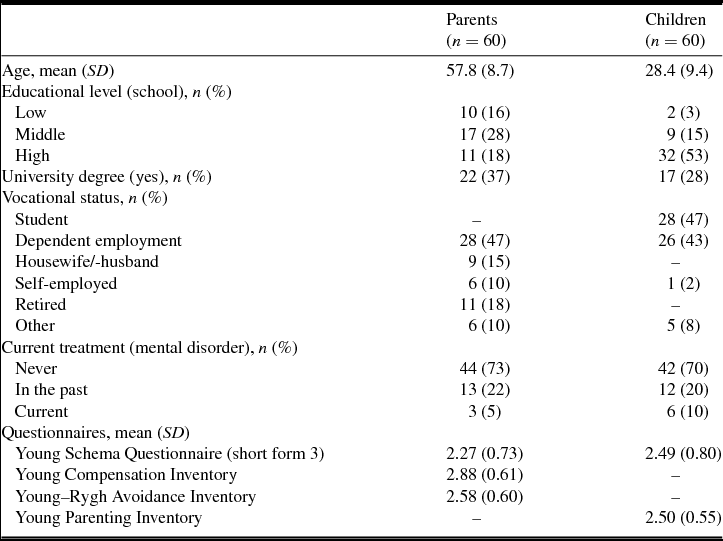
We recruited child–parent (mother or father) dyads. Inclusion criteria for all participants were age 18 years or above and sufficient command of the German language to complete questionnaires. In sum, 182 participants completed the study. We identified 68 paired (child–parent dyad) datasets (total N = 136) and 46 unpaired datasets (child or parent only). Eight paired datasets had to be excluded from further analyses due to minor age of the participant, implausible response pattern, or invalid data (pairs consisting of two parents or two children). The 46 unpaired cases were also excluded from further analyses. Of the 120 valid cases used for the analyses, 72.5% (n = 87) were female and 27.5% (n = 33) were male. The frequencies of pairs (mother–daughter, mother–son, father–daughter, and father–son) are shown in Table 1. For a description of the socio-demographic background of the sample, see Table 2.
Gender distribution among child–parent dyads

Socio-demographic data and questionnaires of the parent and child samples

Participant recruitment
We recruited participant dyads via an online study participation platform of the University of Hamburg (n dyads = 20), online forums (e.g. Facebook), flyers at different locations in Hamburg and Dresden (n dyads = 12), and the online platform Crowd-Flower (n dyads = 28). Student participants taking part via the University platform received 1.25 credit points for participation. Participants recruited via flyers and online forums were offered to participate in a voucher lottery (total voucher value ≈ 100€). Crowd-Flower participants received online credits (value ≈ 1.15 US$ per participant).
Design
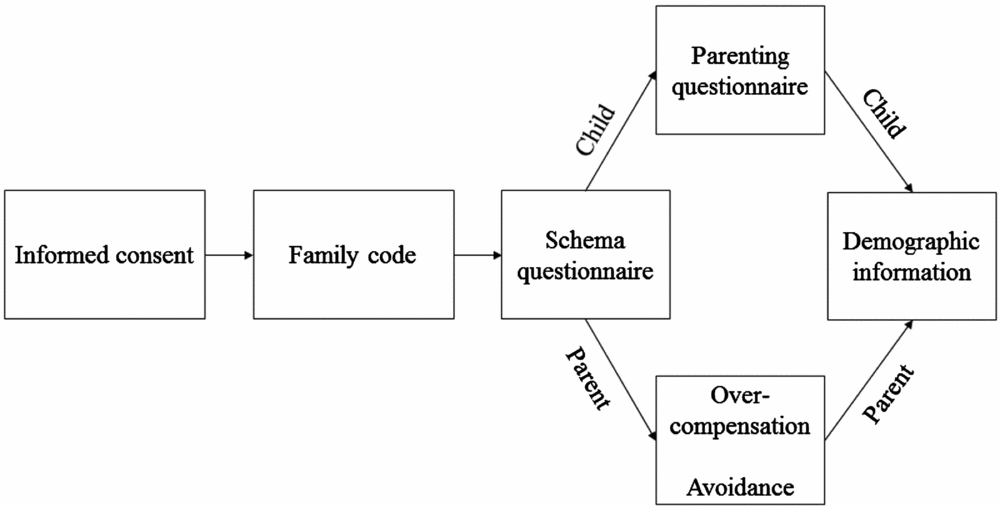
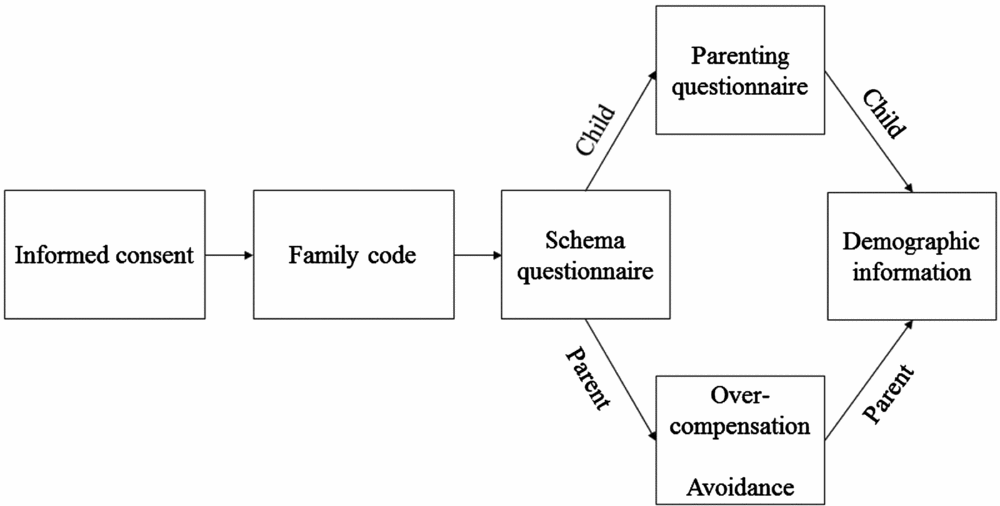
The survey lasted for approximately 30 minutes. After providing informed consent, participants were asked to decide which family member (mother/father or daughter/son) they would ask to participate in the study and to generate a family code. The family code would then be sent self-responsibly to the respective person along with the study link to the respective dyad partner upon completion of the study. Next, all participants (children and parents) filled out the schema-questionnaire. The ‘children’ then continued with a questionnaire that assessed the remembered parenting of their respective dyad-partner parent, whereas the respective parent was required to complete questionnaires addressing the coping styles Avoidance and Overcompensation. Hereafter, socio-demographic information was obtained in both versions. For a graphical summary of the study design see Fig. 1. The study conforms to the Ethical Principles of Psychologists and the Code of Conduct as set out by the APA. Institutional approval was not required.
Study design. Parent = mother or father; Child = adult child of the participating parent. Schema questionnaire (German version of the Young Schema Questionnaire-short form 3); Parenting questionnaire (German version of the Young Parenting Inventory); Overcompensation (German version of the Young Compensation Inventory); Avoidance (German version of the Young-Rygh Avoidance Inventory).
Measures
Early Maladaptive Schemas
We used the German version of the Young Schema Questionnaire, Short Form 3 Revised (YSQ-S3R; Young et al., Reference Young, Brown, Baumann-Frankenberger, Grutschpalk and Berbalk2010) which assesses ‘Early Maladaptive Schemas’ (EMSs; Young et al., Reference Young, Klosko and Weishaar2003). It consists of 90 items phrased as statements (e.g. item ‘People have not been there to meet my emotional needs’), which are rated on a 6-point scale (rating: 1 = completely untrue of me, 6 = describes me perfectly). In total, 18 subscales reflecting different EMSs can be derived. The German version of the YSQ-S3 has been shown to be reliable and to correspond to the theoretically proposed 18-dimensional structure (Kriston et al., Reference Kriston, Schäfer, Jacob, Härter and Hölzel2013). Reliability of the EMS total score in our sample was excellent (Cronbach's α [children] = .97, α [parents] = .97). Confirmatory factor analyses did not provide unequivocal support for the presence of proposed second-order domain structures (Kriston et al., Reference Kriston, Schäfer, Von Wolff, Härter and Hölzel2012). However, findings suggested that the structure of the YSQ-S3 (German version) could be represented by a bifactor model including a first-order generic factor on which all items load and correlated first-order specific schema factors on which only the items load that were meant to measure the respective EMS (Kriston et al., Reference Kriston, Schäfer, Von Wolff, Härter and Hölzel2012). Schema scores of the German version of the YSQ-S3 were positively associated with measures of psychopathology and personality disorder, indicating convergent validity. Furthermore, the YSQ-S3 differentiated between participant subgroups defined by level of health care utilization, supporting discriminant validity (Kriston et al., Reference Kriston, Schäfer, Jacob, Härter and Hölzel2013). In the present study we used the overall mean score of the questionnaire in both samples (parents and children) to reflect the mean extent of EMSs (hereinafter referred to as ‘parent EMSs’ and ‘child EMSs’, respectively). It was formed by summing up the item responses of all 90 items and then dividing the sum score by the number of items.
Parenting behaviour
We used the German version of the Young Parenting Inventory (YPI; Young et al., Reference Young, Berbalk, Grutschpalk, Zarbock and Zaum2007). The questionnaire measures potentially damaging parental behaviours (e.g. emotional abuse) that are theorized to be responsible for schema development in children (Young et al., Reference Young, Klosko and Weishaar2003). It is rated from the perspective of the offspring and consists of 72 items describing parenting behaviour (e.g. the parent ‘Lied to me, deceived me, or betrayed me’), rated on a scale from 1 (= completely untrue) to 6 (= completely true). The instruction originally asks participants to think of their childhood and evaluate both parenting of mother and father. In the present study the instruction was limited to evaluating the parent taking part in the study. The scale can be divided into 17 subscales to identify the potential origins of 17 EMSs. However, preliminary validation of YPI did not support a 17-dimensional factor structure (Grutschpalk, Reference Grutschpalk2009; Sheffield et al., Reference Sheffield, Waller, Emanuelli, Murray and Meyer2005; Soygüt et al., Reference Soygüt, Çakır and Karaosmanoğlu2008; Valentini et al., Reference Valentini, Alchieri and Laros2013). The German version of the YPI reached acceptable levels of reliability for 11 subscales (Grutschpalk, Reference Grutschpalk2009). Construct validity and criterion validity for the revised English version of the YPI, consisting of nine subscales, were partially supported (Sheffield et al., Reference Sheffield, Waller, Emanuelli, Murray and Meyer2005, Reference Sheffield, Waller, Emanuelli and Murray2006). In our study, we used the overall mean score of the questionnaire which implies the overall extent of adverse parenting (hereinafter referred to as ‘the adverse parenting that the child remembered’). Reliability of the total scale was excellent in our sample (α = .94).
Overcompensation
We used the German version of the Young Compensation Inventory (YCI; Young et al., Reference Young, Berbalk, Grutschpalk, Zarbock and Zaum2006). The questionnaire measures Overcompensation of emotional reactions associated with schema activation. Repeated Overcompensation is assumed to result in long-term behavioural patterns that can superimpose underlying EMSs (e.g. perfectionism as a response to the EMS Defectiveness/Shame, see also Young et al., Reference Young, Klosko and Weishaar2003). The scale consists of 48 statements (e.g. ‘I work hard to be among the best or the most successful’), rated on a 6-point scale (1 = completely untrue of me, 6 = describes me perfectly). The items can be assigned to 19 subscales that represent different types of overcompensation for the respective schema. However, reliability for the subscales of the German version of the YCI was insufficient and a 19-dimensional factor structure could not be confirmed (Grutschpalk, Reference Grutschpalk2009). There are different findings regarding the number of factors in previous research (Grutschpalk, Reference Grutschpalk2009; Karaosmanoğlu et al., Reference Karaosmanoğlu, Soygüt and Kabul2013; Luck et al., Reference Luck, Waller, Meyer, Ussher and Lacey2005). Karaosmanoğlu et al. (Reference Karaosmanoğlu, Soygüt and Kabul2013) found that compensation styles were not specific to any given schema. The authors identified seven scales with acceptable levels of reliability, convergent validity and discriminant validity for the Turkish version of the YCI. Moreover, a higher-order factor analysis revealed one global factor (Karaosmanoğlu et al., Reference Karaosmanoğlu, Soygüt and Kabul2013). In the present study, we used the overall mean score of the questionnaire which implies the overall extent of overcompensating coping styles (e.g. control, dominance, striving for power, aggressiveness, hereinafter referred to as Overcompensation). Reliability of the total scale was excellent in our sample (α = .90).
Avoidance
We used the German version of the Young–Rygh Avoidance Inventory (YRAI-1; Young et al., Reference Young, Berbalk, Grutschpalk, Zarbock and Zaum2007). The construct of Avoidance is operationalized as the way people avoid either feeling or dealing with negative emotions that are evoked by their schemas, whereby the emotional distress is dampened by dysfunctional coping strategies (e.g. alcohol consumption, withdrawal; see also Young et al., Reference Young, Klosko and Weishaar2003). The questionnaire consists of 40 items assessing avoidance (e.g. ‘I try not to think about things that upset me’) rated on a 6-point scale (1 = completely untrue of me, 6 = describes me perfectly). Fourteen subscales can be derived, which assess different types of the schema coping style Avoidance. However, preliminary validation did not support a 14-dimensional structure (Grutschpalk, Reference Grutschpalk2009; Luck et al., Reference Luck, Waller, Meyer, Ussher and Lacey2005; Spranger et al., Reference Spranger, Waller and Bryant-Waugh2001). The reliability for 11 subscales of the German version of the YRAI-1 was low (Grutschpalk, Reference Grutschpalk2009). Factor analyses of the YRAI-1 identified 13 factors that partially corresponded to the theorized item allocation (Grutschpalk, Reference Grutschpalk2009). Preliminary validation of the English version of the YRAI suggested a two-factor structure with low levels of internal consistency for both subscales (Luck et al., Reference Luck, Waller, Meyer, Ussher and Lacey2005). For the present study, we used the overall mean score of the questionnaire which implies the overall extent of avoidant coping styles (hereinafter referred to as Avoidance). Cronbach's alpha of the total scale was good in our sample (α = .86).
Statistical analyses
All analyses were conducted with SPSS 22 (IBM Corporation, 2013). To test for the first hypothesis, we used a simple linear regression, entering parent EMSs as independent variable and child EMSs as dependent variable. The other hypotheses were tested using the SPSS macro PROCESS by Hayes (Reference Hayes2014, for statistical details, see Preacher and Hayes, Reference Preacher and Hayes2004). In PROCESS, model template 6 was chosen because it best translates our hypotheses into a statistical model. Model template 6 tests the direct and indirect effects of X on Y while modelling a process in which X affects M 1 which in turn affects M 2, and both M 1 and M 2 affect Y. Two such serial multiple mediator models, each with two mediators, were tested. First, we tested the effects of X (parent EMSs) on Y (child EMSs) with parental Overcompensation as the first mediator (M 1) and the adverse parenting that the child remembered as the second mediator (M 2). Similarly, we tested the effects of X (parent EMSs) on Y (child EMSs) in a second model using parental Avoidance as the first mediator (M 1) and, again, the adverse parenting that the child remembered as the second mediator (M 2). For each model the total indirect effect (a 1b 1 + a 2b 2 + a 1d 21b 2), the three specific indirect effects (a 1b 1, a 2b 2 and a 1d 21b 2, separately) and the direct effect (c′) are reported.
Results
Association between parent and child EMSs
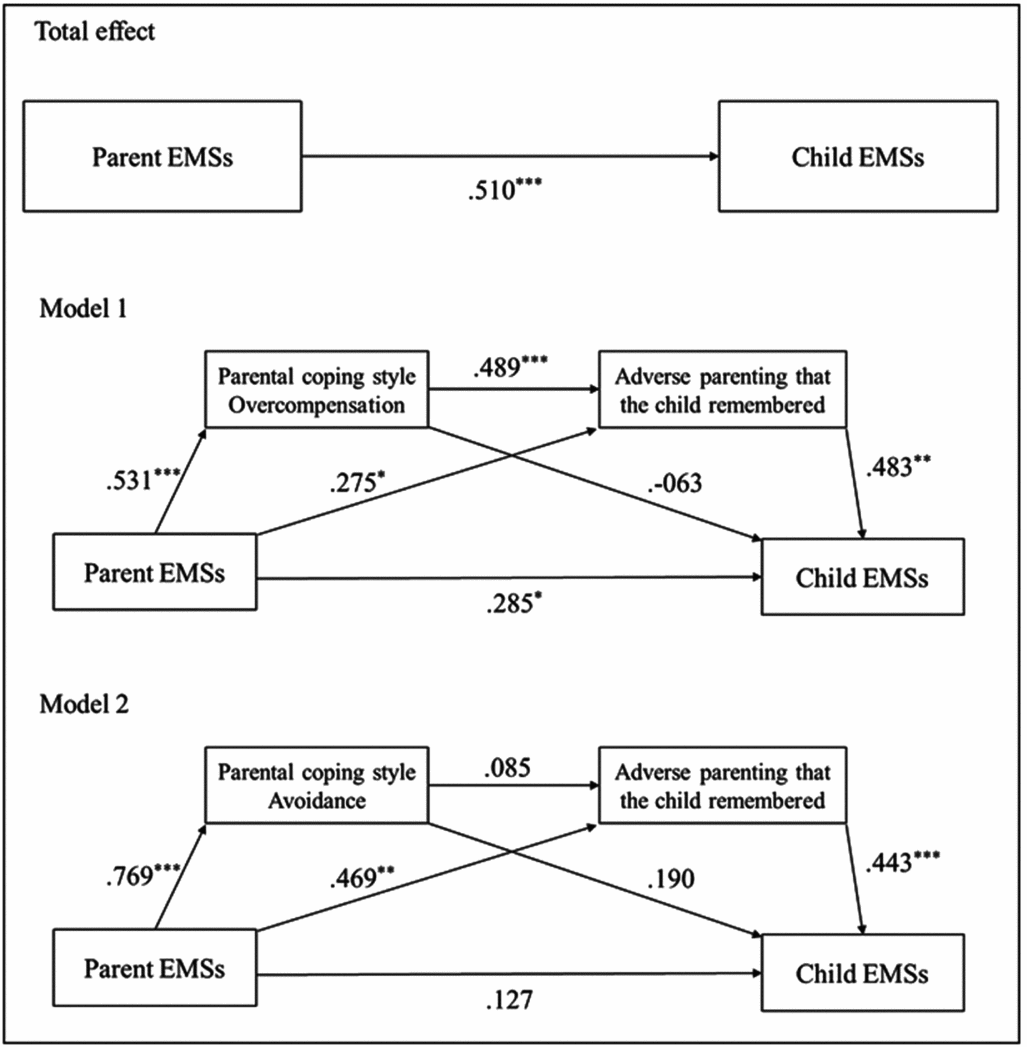
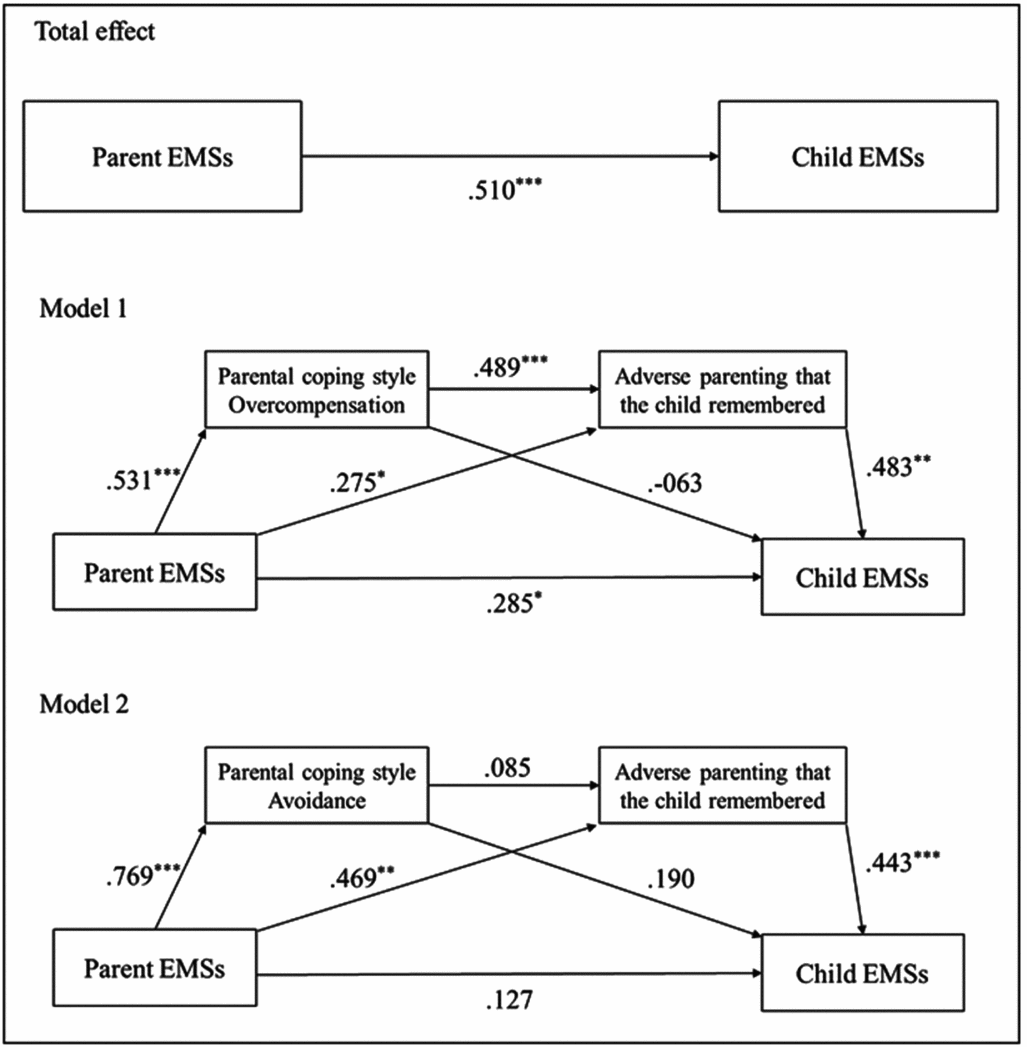
The mean score of the YSQ-S3R for the entire sample was 2.38 (SD = 0.66); the separate means for the parent and child samples are given in Table 2. In support of our hypothesis, parent EMSs significantly predicted child EMSs (c = .510, SE = .113, t = 4.51, p < .001, 95% CI [.284, .736]). For a graphical depiction, see Fig. 2 (Total effect).
Total effect of parent EMSs on child EMSs and mediation analyses of this effect via the parental schema coping styles Overcompensation (Model 1) or Avoidance (Model 2) and the adverse parenting that the child remembered. All coefficients were standardized. EMSs = Early Maladaptive Schemas. ‘Parent EMSs’ (rated by one parent) and ‘Child EMSs’ (rated by the adult child of the participating parent) implied in each case the mean score of the German version of the Young Schema Questionnaire-short form 3. ‘Parental coping style Overcompensation’ (rated by one parent) implied the mean score of the German version of the Young Compensation Inventory, ‘Parental coping style Avoidance’ (rated by one parent) the mean score of the German version of the Young–Rygh Avoidance Inventory and the ‘Adverse parenting that the child remembered’ implied the mean score of the German version of the Young Parenting Inventory (rated by the adult child of the participating parent).
*p < .05; **p < .01; ***p < .001.
Mediation of parent and child EMSs by parental overcompensation and adverse parenting
There was a significant total indirect effect for the mediation model (a 1b 1 + a 2b 2 + a 1d 21b 2 = .225, Boot SE = .103, Boot 95% CI [.061, .475]). The indirect effect for the pathway from parent EMSs to child EMSs through Overcompensation (X → M 1 → Y) was not significant (a 1b 1 = –.034, Boot SE = .077, Boot 95% CI [–.199, .108]). The indirect effect of parent EMSs on child EMSs through the adverse parenting that the child remembered (X → M 2 → Y) was significant (a 2b 2 = .133, Boot SE = .083, Boot 95% CI [.021, .359]). The indirect effect for the pathway through both Overcompensation and adverse parenting sequentially, with parental Overcompensation affecting the adverse parenting that the child remembered (X → M 1 → M 2 → Y) was significant (a 1d 21b 2 = .126, Boot SE = .056, Boot 95% CI [.042, .272]). The direct effect was significant (c′ = .285, SE = .127, t = 2.24, p = .029, 95% CI [.030, .540]) but smaller than the total effect. Detailed path coefficients are reported in Fig. 2 (Model 1).
Mediation of parent and child EMSs by parental avoidance and adverse parenting
There was a significant total indirect effect for the mediation model (a 1b 1 + a 2b 2 + a 1d 21b 2 = .383, Boot SE = .126, Boot 95% CI [.137, .628]). The indirect effect for the pathway from parent EMSs to child EMSs through Avoidance (X → M 1 → Y) was not significant (a 1b 1 = .146, Boot SE = .116, Boot 95% CI [–.069, .386]). The indirect effect of parent EMSs on child EMSs through adverse parenting that the child remembered (X → M 2 → Y) was significant (a 2b 2 = .208, Boot SE = .091, Boot 95% CI [.072, .445]). The indirect effect for the pathway through both Avoidance and adverse parenting sequentially, with Avoidance affecting the adverse parenting that the child remembered (X → M 1 → M 2 → Y) was not significant (a 1d 21b 2 = .029, Boot SE = .062, Boot 95% CI [–.074, .176]). The direct effect was not significant (c′ = .127, SE = .169, t = 0.75, p = .457, 95% CI [–.212, .465]). Detailed path coefficients are reported in Fig. 2 (Model 2).
Additional analyses
Preliminary validation studies suggest that shorter versions of the YCI, YRAI-1 and YPI may have higher construct validity. To ensure that our findings with the original versions are not driven by undetermined items, we additionally analysed whether the results continued to be significant if we used a 35-item version of the YCI (Karaosmanoğlu et al., Reference Karaosmanoğlu, Soygüt and Kabul2013), a 17-item version of the YRAI-1 (Luck et al., Reference Luck, Waller, Meyer, Ussher and Lacey2005) and a 37-item version of the YPI (Sheffield et al., Reference Sheffield, Waller, Emanuelli, Murray and Meyer2005). These shorter versions were highly correlated with the corresponding original versions of the questionnaires, indicating that they measure the same constructs (YCI: r (58) = .977; YRAI-1: r (58) = .909; YPI: r (58) = .951; all p < .001). Cronbach's alpha of the total scores in our sample were good for the shorter versions of the YCI (α = .88) and the YPI (α = .84) and acceptable for the YRAI-1 (α = .77).
The results using the shorter versions of the questionnaires closely resembled the findings found for the complete versions: testing Model 1 revealed that the total indirect effect (Boot 95% CI [.032, .416]) and the two specific indirect effects for the pathway from parent EMSs to child EMSs remained significant (i.e. via adverse parenting (X → M 2 → Y); Boot 95% CI [.006, .323] and via Overcompensation and adverse parenting sequentially (X → M 1 → M 2 → Y); Boot 95% CI [.023, .213]). The specific indirect effect through Overcompensation alone (X → M 1 → Y) continued to be non-significant (Boot 95% CI [–.172, .140]). As for the previous analysis, the direct effect was significant (c′ = .323, SE = .129, t = 2.50, p = .015, 95% CI [.065, .582]) but smaller than the total effect.
Testing Model 2 showed that the total indirect effect (Boot 95% CI [.055, .516]) and one specific indirect effect for the pathway from parent EMSs to child EMSs (i.e. via adverse parenting (X → M 2 → Y)) remained significant (Boot 95% CI [.026, .348]). The other specific indirect effects were – as before – not significant (i.e. via Avoidance (X → M 1 → Y); Boot 95% CI [–.122, .334] and via Avoidance and adverse parenting sequentially (X → M 1 → M 2 → Y); Boot 95% CI [–.040, .176]). The direct effect also continued to be non-significant (c′ = .223, SE = .159, t = 1.40, p = .167, 95% CI [–.096, .542]).
Discussion
In line with our expectations, we found that the extent of parents’ EMSs was associated with the extent of EMSs in their adult children. This association was accounted for by the parental schema coping style Overcompensation and the adverse parenting that the child remembered. The parental coping style Avoidance did not account for the association.
The association of the extent of EMSs in parents and their offspring implies that the extent of EMSs in a parent constitutes a risk factor for the development of EMSs in the child and – due to the known association between EMSs and psychopathology – thereby probably for the formation of psychopathology. This finding corresponds to the repeatedly evidenced accumulation of mental disorders within families (Rasic et al., Reference Rasic, Hajek, Alda and Uher2014). It is also in line with other findings suggesting that vulnerability indicators of mental disorders are passed on between generations, such as the numerous studies indicating attachment styles to be transgenerationally transmitted (for a review, see Verhage et al., Reference Verhage, Schuengel, Madigan, Fearon, Oosterman, Cassibba, Bakermans-Kranenburg and Van IJzendoorn2016).
This is the first study that tested explanatory mechanisms for the assumed association between parent and child EMSs. The clearest finding was that the association between EMSs in parents and their offspring was accounted for by the extent of adverse parenting that the child remembered. This corresponds to the idea of schema theory that EMSs of an (adult) child are reality-based representations of the environment in childhood and reflect the family atmosphere (e.g. a cold and less cordial atmosphere; cf. Young et al., Reference Young, Klosko and Weishaar2003). It also further corroborates findings indicating that EMSs are associated with perceived adverse parental behaviour (Jalali et al., Reference Jalali, Zargar, Salavati and Kakavand2011; Khajouei Nia et al., Reference Khajouei Nia, Sovani and Sarami Forooshani2014; Muris, Reference Muris2006) and findings that suggest that mothers’ parenting is related to their own upbringing (Assel et al., Reference Assel, Landry, Swank, Steelman, Miller-Loncar and Smith2002; Hill et al., Reference Hill, Stein, Keenan and Wakschlag2006). For example, Assel et al. (Reference Assel, Landry, Swank, Steelman, Miller-Loncar and Smith2002) demonstrated that mothers who recalled being raised in a more harsh and neglecting manner were more likely to report higher levels of emotional stress, which were associated with less warmth and flexibility towards their children. Our study expands these findings by indicating that the adverse parenting the child remembers is associated with its parent's dysfunctional schema coping style. The association between the parents’ and their children's EMSs was accounted for by both parental Overcompensation and adverse parenting, with parental Overcompensation being associated with the adverse parenting that the child remembered.
This finding corresponds to some of our clinical observations. For example, a 25-year-old female patient, diagnosed with bulimia nervosa and some symptoms of obsessive-compulsive personality disorder, described herself as permanently tensed and under pressure. She felt that she never did things well enough and tried to compensate for this with spending special effort and care (e.g. working late into the night, excessive exam preparation). She also reported to have suffered from the devaluating and controlling behaviour of her father who she described as having tyrannized the whole family. She tried to meet his high expectations of achievement, success and appearance; hence, she was successful at school and in her studies but without feeling proud or happy. From her mother she knew that her father had grown so ‘tough’ because he had been neglected and beaten by his own parents and that he felt ashamed about his poor origins. Although not assessed psychometrically, it seems likely that her father had EMSs that could have affected his behaviour, for example through the coping style Overcompensation. This is likely to have contributed to the patient's pronounced EMSs (Emotional Deprivation, Failure to Achieve, Mistrust/Abuse, Defectiveness/Shame, Subjugation, Entitlement/Grandiosity, Unrelenting Standards).
Interestingly, the specific indirect effect for the pathway from parent EMSs to child EMSs through Overcompensation alone was not significant. This suggests that parental dysfunctional behaviours may not necessarily lead to EMSs in the child. Rather, the way the child represents its familial experiences appears to be crucial for EMSs to develop. In support of this interpretation, Schafer et al. (Reference Schafer, Morton and Ferraro2014) found a seemingly paradoxical pattern in form of the co-presence of harsh parental behaviour and positive recollections of parental relationships during childhood in a large representative survey. Simultaneously, Schafer et al. (Reference Schafer, Morton and Ferraro2014) found health problems to be most pronounced when maltreated children evaluated the relationship with their parent as negative. On the other hand, it is possible that a higher extent of EMSs in the adult child has influenced its memories of parenting in a negative way (e.g. by the child's schema coping styles). Moreover, personality factors (e.g. neuroticism) and negative mood of the child may have affected both the responses to the schema-questionnaire (see also Stopa and Waters, Reference Stopa and Waters2005) as well as the remembered adverse parenting. Future studies should thus use a prospective design and control for those additional variables to clarify these issues. Regarding the question of why Overcompensation alone was not associated with the child's EMSs, it also seems plausible that some parents rated their overcompensating behaviours as high but did not use these strategies primarily in contact with the child but rather in other interactions (e.g. in the context of their career). Alternatively, it is also possible that the effects of Overcompensation could have been compensated by with the parent's ability to nevertheless provide a healthy family atmosphere.
Whereas parental Overcompensation seems to play a role for the adverse parenting that the child remembered and thereby for its EMSs, this mechanism was not found for parental Avoidance. According to schema theory (Young et al., Reference Young, Klosko and Weishaar2003), overcompensating coping styles consist of excessive, dominant or controlling strategies that are used in order to not feel the negative emotions caused by EMSs. In contrast, a person with an avoidant coping style avoids feelings, thoughts or images that could trigger EMSs by suppression and distracting behaviours (Young et al., Reference Young, Klosko and Weishaar2003). Considering that the means for both Overcompensation and Avoidance ranged from low to moderate in our sample, a possible explanation is that, in contrast to Overcompensation, parental Avoidance needs to be more pronounced to have an effect on the adverse parenting that the child remembered and its EMSs. This would be the case, for example, if a parent excessively uses alcohol/drugs or severely neglects the child. Thus, the idea that parental Avoidance is relevant in the context of the child's EMS formation should not be prematurely discarded. Instead, it seems worthwhile to further investigate this question in samples with more high-scoring participants (i.e. clinical samples).
Limitations
In order to secure an acceptable number of dyads, we chose an online approach to collect the data. The downside to this is that we cannot be certain that all dyads truly consist of parent and child. However, there was no incentive to fraud as the recompense for the participant was not increased upon participation of his or her child/parent. Another limitation is that we investigated a population sample that consisted of participants with and without current or past treatment for mental disorders but did not assess clinical diagnoses or information about psychological treatment to control whether these variables affected results. Moreover, our assessments included only self-ratings. The YPI, YCI and YRAI-1 have only been subject to preliminary validation. There is some content overlap of the items of YSQ-S3R, YPI and YCI and also a certain degree of overlap between the YSQ-S3R and the dimensions of the five-factor model of personality, neuroticism in particular. Replication and further validation of measures used in this study is necessary before firm conclusions can be drawn. Future studies might also consider controlling for neuroticism. Moreover, an additional assessment of clinical interviews and behavioural observations is recommended for future research to further increase the validity. Furthermore, we assessed EMSs in one parent only. This could have biased the sample towards dyads of parents and children who were in contact with each other most frequently or towards those with a more positive relationship. Different findings might have occurred if the other parent or both parents had taken part. Finally, a recency effect might have biased the outcome (e.g. influenced by recent parental behaviour). The association between parental coping and parenting behaviour could also reflect how parents and their children view the parental style at present.
Implications
Our study provides new answers to the questions of whether and how the risk to develop EMSs get passed on from parents to their children by showing an association between the EMS mean scores, which was accounted for by parental Overcompensation and the adverse parenting that the child remembered. A next step could now consist of the assessment of EMSs, parental coping styles and the child's perceptions of parenting during childhood and until adulthood. This would allow conclusions about directions and causality of the evidenced pathways, as well as about stability of EMSs and coping styles over time. Moreover, an assessment controlling for other variables that might influence the transmission process such as relationships to other significant others or temperament factors seems worthwhile. Investigating the role of specific schema modes (e.g. dysfunctional parent modes such as Punitive Parent) could also be an avenue for future research.
According to our findings, a high extent of EMSs in parents may constitute a psychosocial risk factor for the development of EMSs in their children. As EMSs are clearly related to psychopathology (Hawke and Provencher, Reference Hawke and Provencher2012; Jovev and Jackson, Reference Jovev and Jackson2004; Renner et al., Reference Renner, Lobbestael, Peeters, Arntz and Huibers2012; Sundag et al., Reference Sundag, Ascone and Lincoln2018; Unoka et al., Reference Unoka, Tolgyes, Czobor and Simon2010), our results may thus have implications for preventive health care and family-based interventions. For example, it seems worthwhile to consider EMSs and related coping styles in preventive interventions with mentally ill parents to decrease the risk for mental disorders in their offspring.
Conclusion
Our study provides preliminary evidence for the idea that the risk of developing Early Maladaptive Schemas is passed on from one generation to the next and suggests a potential explanatory mechanism via the parental schema coping style Overcompensation and the adverse parenting a child remembers. Our findings thus also support one of the assumptions of schema theory, namely that EMSs are connected to the family environment in terms of adverse parenting. Further research with longitudinal designs is needed to corroborate the interpretation of our findings.
Ethical statements: This study required an online completion of a maximum of three questionnaires and did not target a particularly vulnerable population (parents and their adult children of the general population). There was no manipulation or deception of the participants. All participants were informed about the purpose of the research, expected duration, the procedure as well as their right to decline to participate. Therefore, we did not obtain institutional approval prior to conducting the research. We declare that our study conforms to the Ethical Principles of Psychologists and the Code of Conduct as set out by the APA.
Conflicts of interests: Johanna Sundag, Christine Zens, Leonie Ascone, Susanne Thome and Tania M. Lincoln have no conflicts of interest with respect to this publication.
Financial support: This research received no specific grant from any funding agency, commercial or not-for-profit sectors.




Comments
No Comments have been published for this article.