1. INTRODUCTION
Lightweight aluminum-based products are becoming more and more important in highly competitive industries such as automotive and aeronautical ones. These lightweight products allow cost reduction while increasing technical performance and global sustainability. Because the virgin aluminum extraction is highly energy consuming, very expensive, and polluting, alternative aluminum sources (alloys resulting from recycling) need to be considered. Thus, it was the aim of the European FP7 project entitled SuPLight (SuPLight, 2014) to achieve a recycling rate of 75%, sufficient to replace the virgin aluminum in production. Using new alloy-based materials in production of high-end parts is very challenging, because the quality requirements they have to satisfy are very rigorous. To this end, it is necessary to thoroughly reengineer the life cycle of aluminum-based products to enable the design of high-quality alloys from scrap, with less environmental impact. Knowledge from several disciplines has to be aggregated to prepare the life cycle of a product from cradle to grave and from recycling back to the first life cycle stages. Integration into design tasks of each discipline and viewpoints related to subsequent phases of product life cycle is therefore decisive in such a context and is referred as “concurrent engineering” and “integrated design” (Sohlenius, Reference Sohlenius1992; Tichkiewitch & Brissaud, Reference Tichkiewitch and Brissaud2003). Making the right decisions very early in the design phase can significantly improve the impact on the final product cost (Ullman, Reference Ullman1997; Pahl et al., Reference Pahl, Beitz, Feldhusen and Grote2007). In the same way, sustainability-related decisions taken at this stage are of great importance because they cannot be changed later on (Luttrop & Lagerstedt, Reference Luttrop and Lagerstedt2006).
The World Commission on Environment Development (1987) defined the sustainable development as a “development that meets the needs of the present without compromising the ability of future generations to meet their own needs.” Sustainability refers to three major concerns: environmental, economic, and social (Labuschagne & Brent, Reference Labuschagne and Brent2005), which are known as the three pillars of sustainable development (Pope et al., Reference Pope, Annandale and Morrison-Saunders2004).
Ramani et al. (Reference Ramani, Ramanujan, Bernstein, Zhao, Sutherland, Handwerker, Choi, Kim and Thurston2010) provide a good review of approaches for integrating sustainability in design. According to them, “the decisions have to be made based not only on structure, material, and manufacturing choices, but also on transportation, distribution, and end-of-life logistics and management.” Three main areas of product development affect design choices: manufacturing considerations, supply-chain management, and end of life (EOL) management. Integration of the entire life cycle of a product is necessary.
With regard to previous research, the paper proposes a method for the integration of sustainability considerations into design taking into account the entire life cycle of a product. The method is illustrated by a platform allowing the simulation of a life cycle, integrating multiple disciplines involved in the whole product life cycle (design, manufacturing, and recycling), and a management of environmental information.
In Section 2, a literature review of main integrated design and life cycle engineering methods is presented. Section 3 describes the objectives of the current research and introduces the proposed generic method and shows how the method was applied to specify and implement the platform in the SuPLight project. In Section 4, the case study of a front lower control arm is presented to explain the use of the platform in a real-world context. A discussion of the results is given in Section 5 before concluding with outlines of future research in Section 6.
2. RELATED WORKS
The section introduces some challenges related to collaborative design activities. It also outlines a survey and review of the findings in the area of life cycle engineering (Lofthouse, Reference Lofthouse2006; Vallet et al., Reference Vallet, Millet, Eynard, Glatard-Mahut, Tyl and Bertoluci2013) and integrated design (Bouikni et al., Reference Bouikni, Rivest and Desrochers2008; Noël & Roucoules, Reference Noël and Roucoules2008; Demoly et al., Reference Demoly, Monticolo, Eynard, Rivest and Gomes2010) with their links to product life cycle management (PLM) approaches (Jun et al., Reference Jun, Kiritsis and Xirouchakis2007; Terzi et al., Reference Terzi, Bouras, Dutta, Garetti and Kiritsis2010; Kiritsis, Reference Kiritsis2011; Le Duigou et al., Reference Le Duigou, Bernard, Perry and Delplace2012). These latter are seen as an opportunity for the operationalization of an integrated design method and life cycle engineering approach. The practices for information management related to life cycle engineering (from an environmental point of view) during the product life cycle are presented for the design, manufacturing, and EOL phases (Zhou et al., Reference Zhou, Eynard and Roucoules2009; Dufrene et al., Reference Dufrene, Zwolinski and Brissaud2013; Kozemjakin da Silva et al., Reference Kozemjakin da Silva, Remy and Reyes2015).
Design, as defined in Blessing and Chakrabarti (Reference Blessing and Chakrabarti2009), is a complex and multifaceted phenomenon involving a tight collaboration between multidomain product designers, a multitude of activities and procedures, tools, and knowledge, as well as a variety of contexts that all have to converge in an organization.
Collaboration between multidomain product designers implies that different points of view must be taken into account to achieve the best compromise in product development (Sohlenius, Reference Sohlenius1992). A point of view is the vision and knowledge of an expert involved in a design team (Brissaud & Tichkiewitch, Reference Brissaud and Tichkiewitch2001). An expert may be a specialist of a particular life cycle stage (e.g., manufacturing), a domain (e.g., mechanical engineer), or cross-domain (who brings expertise not linked to a life stage or a domain, but to a specific point of view on the whole life cycle of a product as, for example, the quality engineer or the environmental expert).
The environmental experts often have difficulties sharing environmental information with other design experts (Lindhal, Reference Lindhal2006; Kozemjakin da Silva et al., Reference Kozemjakin da Silva, Remy and Reyes2015). This could be due to the nature of the results (e.g., environmental impacts), which are difficult to link with other design parameters (material parameters, geometric parameters, etc.). It can also be due to the absence of a standard exchange format that encompasses environmental parameters, such as Standard for the Exchange of Product model data, which allows information exchange from various expert tools (Chandrasegaran et al., Reference Chandrasegaran, Ramani, Sriram, Horváth, Bernard and Harik2013). Theret et al. (Reference Theret, Zwolinski and Mathieux2011) argue that there is no appropriate support to exchange data during early design and between ecodesign and computer-aided design (CAD) systems. The last point, which results from the previous one, is the lack of interoperability between the systems used in design and those used by the environmental experts.
Rio et al. (Reference Rio, Reyes and Roucoules2014) proposed a model-driven architecture based interoperability method to improve the exchange of information between ecodesign and other design activities. Some software vendors worked on the integration of sustainability in traditional design tools like CAD systems (SOLIDWORKS from Dassault Systèmes) or material selection tools (CES selector from Granta Design). Russo and Rizzi (Reference Russo and Rizzi2014) suggested another integrated ecodesign method, including shape, material, and production assessment, integrating life cycle analysis (LCA) with CAD and finite element analysis. Their work focuses on a specific design stage and does not consider the environmental impact transfer from one stage to another. Other researchers, like Dufrene et al. (Reference Dufrene, Zwolinski and Brissaud2013) proposed an integrated ecodesign methodology that improves both environmental impacts and technical characteristics. Nevertheless, these methods focus only on the beginning of life (BOL) and do not provide any feedback from middle of life (MOL) or EOL.
One of the major difficulties the environmental experts have to cope with is the lack of information, especially when they try to perform LCA (ISO14040, 2006; Curran, Reference Curran2006). LCA is time and resource consuming and requires a huge amount of heterogeneous data from all over the extended enterprise. Some of them could be extracted from the digital mock-up. The needs of integration between CAD, PLM, and LCA were already underlined in Mathieux et al. (Reference Mathieux, Brissaud, Roucoules and Lescuyer2007). However, this approach considers only the BOL stage, and does not encompass the MOL or EOL stages, although this information is essential in most of the product life cycle engineering. To make a clear and useful analysis of environmental impacts, this information must be specialized and accurate (Pavković et al., Reference Pavković, Štorga, Bojčetić and Marjanović2013).
PLM is a business strategy allowing all life cycle stakeholders to manage and integrate product information at each phase of its life cycle. It enables cross-exchange between the manufacturing information, the MOL information (modes of use, usages environment, maintenance tasks and spare parts, etc.) as well as the EOL information (recycling rate, reverse logistic routes, etc.; Främling et al., Reference Främling, Holmström, Loukkola, Nyman and Kaustell2013). Nevertheless, in the existing PLM systems (such as Enovia from Dassault Systèmes, Teamcenter from Siemens PLM, or Windchill from PTC) implementing the PLM approach, the integration between the different information collected and life cycle processes is still incomplete and there exists a need for stronger interoperability between information systems (Raffaeli et al., Reference Raffaeli, Mengoni and Germani2013).
To summarize, sustainability is an important requirement for industry and information management an important challenge for the current century. Methods and systems allowing the integration of sustainability during product development exist, but they are not mature enough because they target only a part of the product life cycle and, more particularly, only the BOL phase. The results provided by this kind of tool cannot provide a realistic estimation of the current product development impact with regard to sustainability goals. They use generic data about MOL and EOL and do not integrate the environmental impact in their design decisions. A PLM approach is mandatory to provide connexion to specific tools supporting sustainability (e.g., ecodesign, reverse logistics) with classical design tools (computer-aided X). This will allow designers to get more precise data about the material, the geometry, the process, the use, the reverse logistic routes, and so on, to enable better estimation of the environmental impact and to make better design choices.
3. PLATFORM SPECIFICATION FOR PLM APPROACH FOR INTEGRATION OF ENGINEERING DESIGN AND LIFE CYCLE ENGINEERING
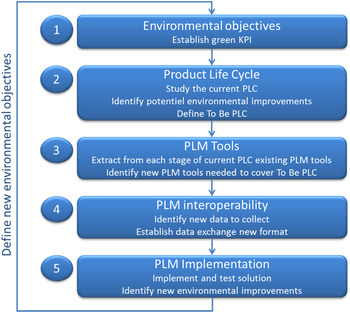
The proposed method to specify a PLM system for integrated design and life cycle engineering is shown in Figure 1. This method is composed of five steps:
-
1. Environmental objectives: Environmental objectives should be defined according to international or local legislation, standards, and so on, which are relevant to the field of activity considered. Success in achievement of initial goals can be measured by key-performance indicators (Fitz-Gibbon, Reference Fitz-Gibbon1990).
-
2. Product life cycle: Knowing the current product life cycle is strategic for the identification of potential improvements and for the future specification of the PLM system. This step allows designers to clarify the activities involved in product development and to detect the ones that govern the environmental impact of a product.
-
3. PLM systems and tools: The purpose of this step is to make an inventory of the existing systems and identify new features/tools needed (Assouroko et al., Reference Assouroko, Ducellier, Eynard and Boutinaud2014). Traditional tools in design, manufacturing, and maintenance must be combined with tools supporting sustainability assessment: design for environment, ecodesign, environmentally conscious manufacturing, and EOL management (reverse logistics) tools.
-
4. PLM interoperability: Changes in the product life cycle, such as integrating new practices or new tools, induce changes at the information management level (data flows between the stakeholder/tools will change). Therefore, information exchange has to be redefined taking into account all the tools in the new life cycle and their coordination (information flow sequence).
-
5. PLM implementation: The last step of the method is to define appropriate architecture and technology implementation to support the integration of the existing systems and new tools in the context of the new life cycle. Tools may be owned by distributed partners, and each of them handles data using their own format for information representation (Belkadi et al., Reference Belkadi, Troussier, Eynard and Bonjour2010). Requirements for the platform have to take into account the need of easy reconfiguration and its use in context of extended enterprise (Ross et al., Reference Ross, Weill and Robertson2006), and an easy integration of existing systems and tools as well as new tools needed to improve current practices.
This method enables designers to connect most of the design tools and to integrate environmental impact evaluation into the design process. Data generated by each tool will be precise and accurate. Then they can be used to assess more precisely the environmental impact. This impact will be also directly linked with the tools to be able to provide accurate decision support to designers. The five steps of the method consist of several tasks that will be described in detail in the following subsections.
Method for environmentally conscious integrated design.

3.1. Step 1: Environmental objectives
As stated before, the final goal of the SuPLight project is to achieve a high rate of reuse of recycled aluminum (namely, 75%), with respect to environmental regulations, quality, customer expectations, and so on. In this project, the relevant indicators are related to productivity (manufacturing time), quality (aluminum alloy properties: material, chemical, mass, etc.), consumption of energy in production, and use of chemicals/emissions.
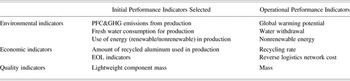
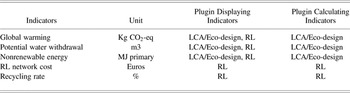
Twenty-two key performance indicators were defined to determine the aluminum industry's progress along the sustainable development path by the International Aluminum Institute (2009). Among them, the below performance indicators were identified by the project partners as relevant to the SuPLight aims (see Table 1). These indicators were then translated into operational indicators measuring the environmental, technical, and economic performances.
Selection of relevant environmental indicators

3.2. Step 2: Product life cycle
In the following, the manufacturing phase of the aluminum parts life cycle is detailed to illustrate this step. The life cycle was reproduced based on two industrial cases in the SuPLight project and the aluminum recycling process described in the report developed by the International Aluminum Institute (2009).
Figure 2 explains the “classic manufacturing phase”: the virgin aluminum is extracted and transformed in billets by “casting,” then sent to “forming,” where they are transformed into a usable industrial form that gives the material the properties of lightness, strength, and durability. The resulting initial “product shape” is then processed into a machined part during the “machining and finishing” process before obtaining the finished assembled part during “assembly.” The tools used in each phase are shown with dotted line. An aluminum recycling loop is already established for aluminum used in lower end products (the scrap is directly sent either to a recycling company or, if it is not pure enough, to a refiner for further purification). On the contrary, there exists no established recycling loop for wrought aluminum used in high-end products. In the latter case, the quality requirements are more stringent. Therefore, the recycling process has to be completed, as to ensure an optimal reuse of aluminum scrap in high-end products without neglecting its impact on the environment. As new materials are used in production, the risks associated to them need to be managed (e.g., risks related to the material properties or geometry). Complex multidisciplinary tests are useful to try to identify potential failures and to reduce risks. Variation sources can be in material properties or manufacturing parameters such as stamping pressure, thermal conduction, temperature, and friction.
Excerpt of product life cycle modeling (manufacturing phase).

3.3. Step 3: PLM systems and tools
An inventory of the existing tools used by the industrial partners allowed identifying the lack of computer-aided X systems integrating the sustainability management issues at the BOL, MOL, and EOL phases. Therefore, integrating ecodesign (Andriankaja et al., Reference Andriankaja, Vallet, Le Duigou and Eynard2015) and reverse logistics (Daaboul et al., Reference Daaboul, Le Duigou, Penciuc and Eynard2014) tools to the current life cycle was highly recommended. In the SuPLight project, both “process improvement and optimization” and new “green processes” were considered as alternatives for the improvement of the current production process. Based on these observations, a group of six components called plugins were identified as mandatory to achieve the established goals.
The plugins are dedicated software providing optimization in specific phases of the product life cycle. A plugin may be an existing tool (or combination of several existing tools) as well as a new tool (developed ad hoc to meet the purpose of the project). It is to be noted that two of the green tools used in the project are the ecodesign (EcoD) and reverse logistics (RL) tools. The plugins are described below.
The MATerial plugin determines the material and mechanical properties of the alloys. These later are further used by the design optimization (DO) and finite element method (FEM) plugins to calculate the behavior of the alloy parts.
The DO plugin performs an analysis in order to find alternative topologies for the part that fulfills the stiffness, weight criteria, eigenvalues, and center of gravity. The output of this plugin includes the CAD files used as an input to the FEM plugin.
The FEM plugin assesses the forging process for the part defined by the DO. The output of this plugin includes the CAD files for the tolerance plugin.
The tolerance plugin uses a metamodel for tolerance analysis and geometric variation simulation to provide rapid results based on a more extensive computation module.
The RL plugin aids at designing the RL network including location/allocation of facilities, partner (supplier) selection, and the design of the transportation network, based on the characteristics of the components involved (Daaboul et al., Reference Daaboul, Le Duigou, Penciuc and Eynard2014).
The EcoD plugin computes environmental impact based on the characteristics of the product and the transportation network used (Andriankaja et al., Reference Andriankaja, Vallet, Le Duigou and Eynard2015). The EcoD plugin performs a simplified life cycle assessment of the design properties and environmental impact based on the input decisions made in other plugins.
3.4. Step 4: PLM interoperability
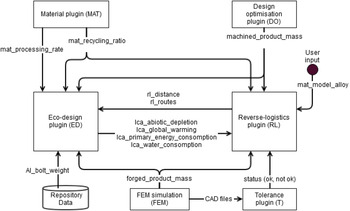
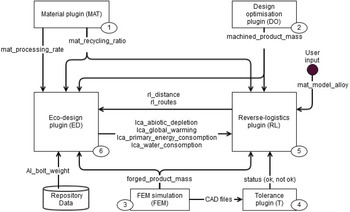
A common agreement on the terms used by each partner as well as a common representation of the information exchanged between heterogeneous tools (the plugins) was defined as a dictionary. To be clear, the dictionary specified a single term for distinct terminologies used by the partners/tools and an associated unique notation for information exchange (e.g., the notation “machined_product_mass” indicates the mass of the product after the “machining” process; see Fig. 3), a unit of measure (e.g., kilogram), and a data type (e.g., double).
Information exchange between the plugins during the product life cycle.

Once the dictionary was established, the second step consisted in the definition of the information exchange between the plugins. In Figure 3, the information flow is indicated by the arrows: the EcoD plugin collects information from several other plugins and sends the results (the environmental indicators) back to the RL plugin. The configuration of plugins used and their sequence may change if one or more plugins are added/deleted from the simulation loop. As compared to Figure 2 outlining the initial product life cycle, it can be noticed that new information was integrated from two new plugins (EcoD and RL) in order to consider the environmental impact.
3.5. Step 5: PLM implementation
According to the previously established requirements, the architecture of the platform needs to be flexible and extendable, and also has to support the integration of distributed systems and tools. According to Hachani et al. (Reference Hachani, Gzara and Verjus2013), service oriented architecture is therefore considered as a good candidate enabling capabilities like agility, business alignment, consolidation of redundant applications, better organization and integration of coexisting systems, and tools.
A common SuPLight format was specified (the SuPLight namespace) to set a standardized format for enabling information exchange and management based on the proposed dictionary. All “Simple Object Access Protocol” messages sent between the communicating modules follow the rules settled by the SuPLight format. The plugins have their own interfaces, and some of them may also be used as independent software, and therefore, they have two functioning modes (independent and integrated mode). In the integrated mode, they run as part of the closed loop and they are provided with a common interface, accessible online within the SuPLight simulation platform (https://collab.suplight.eu/sim/). This interface is automatically generated based on a plugin declaration. The plugin declaration consists in editing overall properties (name, namespace prefix, description, documentation, etc.) as well as the input/output of the plugin. Web services were defined and implemented for each plugin, according to their legacy format. Servlets handle web service calls from the SuPLight platform and translate them into legacy format. The services provided by each plugin were published in a registry implemented as TAS3 Discovery Service (http://www.tas3.eu). The module for information management handles the execution of the plugins in the optimization loop. At this level, the plugin sequence and the mapping between the input and output of each plugin are managed. In the front end, the execution sequence may be set from the graphic user interface, and the execution of the simulation sequence may be visualized step by step (results from each plugin) or at once (final result).
4. CASE STUDY: FRONT LOWER CONTROL ARM
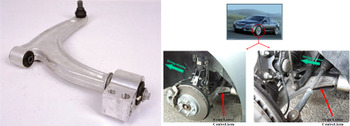
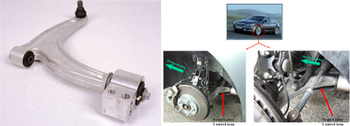
In this section, a case study is introduced in order to illustrate the use of the SuPLight platform for life cycle simulation. The considered part is a front lower control arm, which is a part of the suspension system of a car (see Fig. 4). The chosen control arm is manufactured from AA6082, which is a high-strength wrought aluminum alloy. The baseline process for the manufacturing of the control arm is the following:
-
• manufacturing of AA6082 ingots from virgin aluminum and treated production scrap,
-
• extrusion of ingots to produce the AA6082 rods,
-
• cutting rods into pieces and annealing to soften the billet and make it easier to forge,
-
• rods forging,
-
• aging rods (which increases the strength of the aluminum alloy), and
-
• machining and assembly of the control arm.
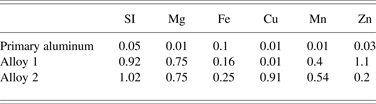
The production (or preconsumer) scrap is treated to remove the fluids and dirt and is then reused in the manufacturing of the AA6082 ingot. Several scenarios were proposed, with the purpose of specifying the optimal aluminum alloy properties to be used for the control arm to achieve the best global performance (in terms of resistance, rate of recycled aluminium, or environmental impacts). The scenarios were then compared to each other against the list of indicators considered relevant with regard to cost, quality, and environmental concerns. Three aluminum alloys were identified as eligible, with respect to the quality needed for high-end products manufacturing. The scenarios presented in this paper concern the Alloy 1 and Alloy 2 (see Table 2 for the alloy composition). To achieve sustainability in manufacturing, an optimized production process was proposed as an alternative to the baseline. This optimized process consists in increasing the use of recycled material, while considering all suitable scrap sources (EOL vehicles, building demolition, and end-of-life packaging).
The front lower control arm.
Alloy composition
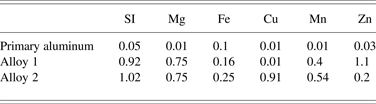
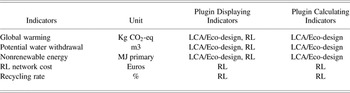
Figure 5 highlights the communication between the plugins in the simulation loop. For simplicity, only the interaction and detailed information exchanged during the last steps of the simulation loop are discussed, namely, the exchanges between the RL and EcoD plugins. These plugins calculate significant indicators in the simulation loop (the environmental impact indicators and the RL indicators). A summary of the indicators is presented in Table 3. The inputs to the RL plugin are the alloy type (input data), the mass (calculated by the DO plugin), and the recycling ratio expected at the end (sent by the MATerial plugin). The RL plugin determines all possible RL networks and sends the RL network characteristics (total distance of the network, and the routes: flow transported, transportation means, etc.) to the EcoD plugin, which then computes the environmental indicators and sends them back to the RL plugin.
Information exchange and management between the plugins in the simulation platform.

Indicators considered for estimation of environmental and economic performance of scenarios
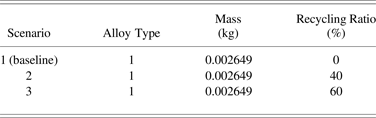
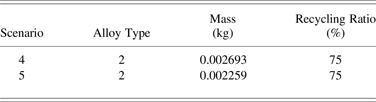
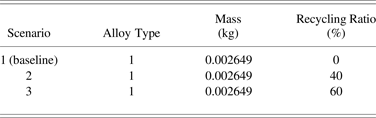
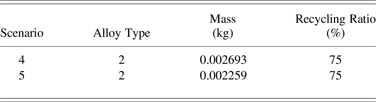
As shown in Table 4 and Table 5, five scenarios were proposed, considering a variation of the recycling rate and a constant mass as well as a mass variation and a constant recycling rate. Scenario 1 is the baseline. The mass is the initial one, with an aluminium alloy that do not contain any recycled aluminium. The functional unit considered for this study is expressed as follows: “2 control arm bodies (left and right sides) equipping a GM Opel Insignia Diesel version over an average life time mileage of 200 000 km” (Andriankaja et al., Reference Andriankaja, Vallet, Le Duigou and Eynard2015). For the baseline, the control arm body is recycled at its EOL, but no RL scenario is specified.
Scenarios for simulation: Variation in recycling rate and material used and constant mass
Scenarios for simulation: Constant recycling rate and mass variation
In Scenarios 2 and 3, the percentage of recycled aluminum is increased. This impacts the material characteristics, the process, the RL routes flow, and cost. The plugin sequence used in the simulation platform is MA → FEM → T → RL → ED → RL.
In Scenarios 4 and 5, the recycling rate is maintained to the targeted value (75%), and the topology optimization plugin allows a mass reduction in Scenario 5. The plugin sequence used in the simulation platform is MA → DO → FEM → T → RL → ED → RL.
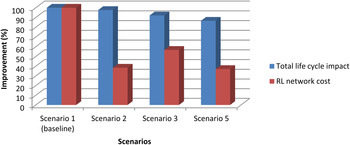
The results obtained when comparing the alternative scenarios (Scenarios 2, 3, and 5) against the baseline (recycling ratio = 0%) are shown in Figure 6. The improvements, with regard to the total life cycle impact and the total cost of the RL network, are defined in percentages. The environmental impact was calculated by the LCA/ecodesign plugin for each main life cycle stage: BOL, MOL, and EOL. Only the optimal RL network was considered for each scenario, although several alternative RL networks are possible in each case. The environmental impact improvement obtained in Scenario 5 is considerable (>10%), which is not the case for Scenarios 2 and 3 where a lower recycling rate is used. It can be noticed that the cost of the RL network may be maintained relatively constant (Scenario 2 and Scenario 5) while reducing the component mass and increasing the recycling ratio.
Histogram showing a comparison between several scenarios for the control arm production.

5. DISCUSSION OF THE OBTAINED RESULTS
The obtained results (see Fig. 6) show that the overall life cycle impact decreases as the recycling rate increases. Nevertheless, the economic performance of the RL network is altered when increasing the recycling rate while keeping the component mass constant. The best performance is obtained when increasing the recycling rate and reducing the component mass (Scenario 5), in other words, when a trade-off is made between the technical, environmental, and economic indicators. In each case, results show that the integrated approach leads to an improved global performance compared to the current product life cycle (Scenario 1). According to Wijngaards et al. (Reference Wijngaards, Boonstra and Brazier2003), the integrated approach also shows that the decisions made across several disciplines conduct to the best compromise when results are shared among numerous and distributed expertise (as illustrated before for the RL and ecodesign). When considering only the results issued from the ecodesign plugin, one may conclude that the best scenario from the environmental point of view is to increase the recycling rate, whereas considering both ecodesign and RL emphasizes that the optimal performances may be reached when balancing the recycling rate augmentation and the mass reduction of part.
Regarding the proposed model for information management, it can be noticed that there is a strong dependency between the component mass, the recycling ratio, and the used alloy. The component mass reduction may be more or less optimized depending on the used alloy. The performance of the RL is directly influenced by this information and the capacity to collect and transport the necessary flows from the partners in the RL network. In addition, the life cycle performance computations carried out by the ecodesign plugin (BOL, MOL, EOL) is achieved by collecting information from all the other plugins in the optimization loop: aluminum bolt weight (repository data), RL routes and distance (RL plugin), the material processing rate (MATerial plugin), and the product mass (machined and forged mass from DO and FEM plugins).
These results underline the huge importance of a proactive and consistent information management between disciplines and expertise involved in the lightweight part development and manufacturing. The use of integrated design and life cycle engineering methods is of a huge benefit. The implementation of an interoperable PLM platform with associated tools is also a key success factor.
6. CONCLUSION AND FUTURE WORK
This paper presented a method and implementation of an interoperable PLM platform as support for integrated design and life cycle engineering. As shown in the research survey, an integrated and collaborative design initiative has to consider the synergy between several fields: life cycle engineering, product design, and related disciplines such as manufacturing, supply-chain management, and EOL management. Previous research work focused on local initiatives for improving sustainability assessment during product design, particularly on BOL but often neglecting the EOL phase, which do not allow designers to integrate all the useful information, nor to maintain sustainability across the whole product life cycle.
To cope with this lack in the previous work, the present research work addressed the sustainability from technical, environmental, and economic points of view and the integration between design and EOL management. The steps of the proposed general approach were illustrated on the case of the European SuPLight project aiming to provide solutions for lightweight high-end products. Several scenarios were described for the simulation of information exchange and management in the PLM platform based on a front lower control arm case study. Compared to the classical approach, the results have shown that the integrated approach brings significant improvements provided that a balance is maintained between the economic, technical, and environmental priorities.
In this study, the possibility of using a novel process was tested by excluding the extrusion phase and forging directly from cast ingots (because of the complexity of the extrusion process and its sensitivity for chemical composition of the alloy). Howeer, the results were not successful. The aluminium alloy has a lower formability especially with a higher recycling rate due to aluminum alloy chemical composition. Other process routes can be explored as solid-state recycling routes (hot extrusion, screw extrusion, or spark plasma sintering) that reduce environmental impacts with a factor of 2 to 4 (Duflou et al., Reference Duflou, Tekkaya, Haase, Welo, Vanmeensel, Kellens, Dewulf and Paraskevas2015). Finally, additive manufacturing is gaining widespread attention for its ability to produce high-quality structural metallic components with significant cost reduction and lead-time improvement (Atzeni & Salmi, Reference Atzeni and Salmi2012). It has endogenous characteristics for sustainable production of aluminum structural parts (Diegel et al., Reference Diegel, Singamneni, Reay and Withell2010) and must be studied in future work.
The second future work is related to the fact that this study was done in a lightweight aluminum context. The proposed method aims to improve recycling rate and decrease weight of structural parts integrating engineering design and life cycle engineering. It can easily be applied to metallic parts (e.g., steel) with the same goals. For other materials (e.g., plastic or composite), the method can be applied even if the plugins will be different (the material plugin, the topology plugin, the process plugin will be different but will exchange the same information). More industrial cases with diversified materials should be investigated to confirm the extensibility of the proposed method.
ACKNOWLEDGEMENTS
We acknowledge the European Commission for financial support through the SuPLight FP7 project (Grant 263302). We also express our gratitude and appreciation to all of the project partners for their contributions during the development of various ideas and concepts presented in this paper.
Diana Penciuc works as a Research Engineer at the Institut de Recherche Technologique SystemX. She was previously a Postdoc Researcher at the Université de Technologie de Compiègne. She received a PhD in information and systems technologies from the Université de Technologie de Compiègne. Her research interests include product life cycle management, PLM interoperability, knowledge management, collaborative systems, extended enterprise, SOA and cloud architectures.
Julien Le Duigou is an Assistant Professor at Université de Technologie de Compiègne and a Researcher in the Roberval Mechanical Laboratory (UMR CNRS 7337). He obtained his MS in mechatronics and a mechanical engineering from Supmeca and a PhD in mechanical engineering from Ecole Centrale. Dr. Duigou is member of the IFIP working group 5.1, dealing with global product development for the whole life cycle. His current research interests include product life cycle management, enterprise modeling, interoperability, and product/process integration. He has published more than 50 papers in refereed international journals, books, and conferences.
Joanna Daaboul is an Assistant Professor at the Université de Technologie de Compiègne and Researcher at the Roberval Mechanical Laboratory (UMR CNRS 7337). She obtained a PhD in mechanical engineering from Ecole Centrale Nantes. Dr. Daaboul's research interests include product life cycle management, enterprise modeling, systems performance evaluation, product/process integration, and mass customization. She has published more than 30 papers in refereed international journals, books, and conferences.
Flore Vallet is a Senior Researcher at the Institut de Recherche Technologique SystemX and an Associate Researcher at the Laboratory of Industrial Engineering at CentraleSupélec. She was previously a Lecturer (Professeur Agrégé) of mechanical design at the Université de Technologie de Compiègne, where she obtained her PhD in ecodesign and mechanical engineering. She is a member of the Design Society. Dr. Vallet's current research interests include ecodesign, eco-innovation, engineering design, human centered design, sustainable urban mobility, and smart urban systems.
Benoît Eynard is a Professor in the Department of Mechanical Systems Engineering and the Director of the Institute for Mechatronics at the Université de Technologie de Compiègne. He was previously an Assistant Professor at the Université de Technologie de Troyes, where he managed the MS program in information technology for mechanical engineering. Prof. Eynard obtained his PhD in computer-integrated manufacturing from the University of Bordeaux. He is Chairman of the academic group of the French Association of Mechanical Engineering on Factories of the Future: Integrated Design and Advanced Manufacturing (AIP-PRIMECA) network. He is also a member of IFIP Working Group 5.1, which deals with global product development for the whole life cycle, and is a member of the Design Society, where he currently leads the special interest group on design methods for cyberphysical systems. Benoît is a recognized researcher in product life cycle management, collaborative design, systems engineering, mechatronic design, digital factory, manufacturing process management, ecodesign, and sustainable manufacturing. He has published over 50 papers in international journals and 150 papers in international conferences. Prof. Eynard has been Guest Editor for 10 journal special issues and academic books.