Introduction
Electroconvulsive therapy is a well-recognized treatment for depression in older adults. It might be used as a first line treatment if the depressive illness is associated with a high risk of suicide or medical complications due to patients’ difficulty with eating and drinking. It is also used when the condition has not improved with pharmacotherapy or if the patient cannot tolerate pharmacotherapy (Unutzer and Park, Reference Unutzer and Park2012). But cognitive side effects including delirium have been reported with ECT particularly with bilateral electrode placement in older adults (Gardner and O’Connor, Reference Gardner and O’Connor2008). Following efforts to reduce cognitive side effects right unilateral ultra-brief pulse width ECT was found to have fewer cognitive side effects than Brief pulse width ECT (Loo et al., Reference Loo, Sainsbury, Sheehan and Lyndon2008; Sackeim et al., Reference Sackeim2008). The optimal width of neuronal depolarization is 0.1–0.2 ms and the ultra-brief pulse width of 0.3 ms avoids unnecessary stimulation during the refractory period (Ranck, Reference Ranck1975). So far the published studies comparing ultra-brief and brief pulse width ECT report mean ages of 40s or 50s in their studies (Loo et al., Reference Loo, Sainsbury, Sheehan and Lyndon2008; Sackeim et al., Reference Sackeim2008; McCormick et al., Reference McCormick, Brumm, Benede and Lewis2009). Various studies have reported higher utilization rate of ECT in patients over 65 years of age and to our knowledge there is no published report on use of RUL-UB ECT in older adults (Plakiotis et al., Reference Plakiotis, George and O’Connor2012).
In our study we compared outcomes of ECT from three psychogeriatric services in Australia – Central Coast Local Health District (CCLHD) in New South Wales, Peter James Centre (PJC), Melbourne and Goulbourn Valley Health (GVH) service in Victoria. The three centers were chosen due to collegial collaboration and the initial understanding that the centers used different electrode placement. In CCLHD RUL-UBP was introduced after the studies by Sackeim et al and Loo et al. reported on the cognitive advantages and comparable efficacy and effectiveness of RUL-UBP ECT to other electrode placements and pulsewidths. Not many centers followed this path due to the view that bilateral brief pulse ECT is more efficient and this view was supported by Fink and Taylor (Reference Fink and Taylor2007). PJC continued to offer Bilateral ECTs for this reason. The preferred method in PJC changed from bitemporal to bifrontal due to supposed cognitive advantages for the latter. These differences in practice lent itself to compare the outcomes between RUL-UBP and other modalities.
Method
We conducted a retrospective case note review of all patients aged over 65 years who had a diagnosis of a major depressive episode and an acute course of ECT after August 2009 (when RUL-UB ECT was introduced in CCLHD). Exclusion criteria were significant neurological disorders, dementia, personality disorders, rapid cycling bipolar disorder, drug and alcohol problems in the last six months and patients who have had ECT in the last three months. The main outcome measure was clinical response in terms of non-remission, partial remission/response and remission. Remission was defined as absence of depressive symptoms or close to it. We also looked at switch rate (switch to other electrode placement or pulse width) and total number of treatments in the acute course. We identified age, sex, diagnosis (bipolar/unipolar), presence of psychotic symptoms and anaesthetics.
CCLHD and GVH used titration method to identify seizure threshold and RUL-UB treatment was offered at six times the threshold, RUL brief pulse was offered at 2–5 times the threshold and Bitemporal and Bifrontal was offered at 1.5–2.5 times the seizure threshold. In PJC, patients only received Bitemporal or Bifrontal ECT and half age method was used to determine treatment dose. In all three centers, doses were increased during treatment course based on clinical response and EEG parameters.
PJC only offered Bitemporal ECT initially and the practice changed to Bifrontal around 2010, CCLHD predominantly offered RUL-UB but there was a small number of patients starting with other modalities as clinicians were allowed to vary from the preferred method. GVH was thought to offer RUL-BP predominantly but as we gathered the data we recognized that the choice of electrode placement was quite varied. Hence we decided to group patients based on the electrode placement with which they started treatment and not by center to evaluate the outcomes and we had four groups: RUL-B, RUL-UB, BT and BF. The data was analyzed using IBM SPSS statistics 22.0. We used χ 2 test for categorical variables and One-Way ANOVA for continuous variables.
Results
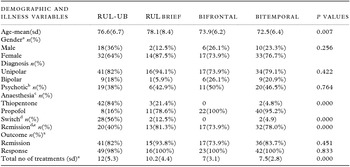
After the inclusion and exclusion criteria were applied CCLHD had a total of 48 patients out of which 43 started ECT with RUL-UB, three with RUL-Brief and two with Bitemporal ECT. PJC had 53 patients, 33 with Bitemporal and 20 with Bifrontal. GVH had 32 patients, seven starting with RUL-UB, 14 with RUL Brief pulse, three with Bifrontal and eight with Bitemporal (see Table 1).
Groups based on electrode placement and center

The four groups did not differ in terms of gender, bipolar depression and presence of psychotic symptoms (see Table 2). The groups differed in age and anaesthetic agent used. With age post-hoc analysis using Tukey HSD revealed that both RUL-UB and RUL brief pulse groups were older compared to the Bitemporal group (mean ages of 76.6, 78.1 respectively versus 72.5). 84% of RUL-UB, 21% of RUL-B and 5% of BT received Thiopentone as the anaesthetic while 16% of RUL-UB, 79% of RUL-B, 100%of BF and 95% of BT received Propofol.
Demographic, illness and outcome variables

aMissing value = 1, bmissing value = 4, cmissing value = 5, dmissing value = 3, eexcludes switchers.
Switch rate
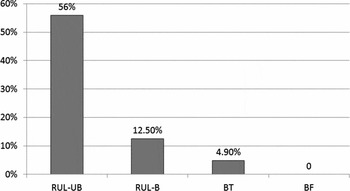
The switch rate was statistically different between groups with χ 2 = 43.92, p = 0.000 (df 3, n = 130) cramer's V = 0.58. RUL-UB had a switch rate of 56% compared with 12.5% in RUL Brief pulse and 4.9% in bilateral (See Figure 1). There were no switchers in Bifrontal group. We performed χ 2 tests between RUL-UB and the other three groups. A χ 2 test for independence (with Yates Continuity Correction) indicated significant association (p < 0.017 after Bonferroni adjustment) between electrode placement and switch rates in all three comparisons. Between RUL-UB and RUL-B χ 2 = 7.58, p = 0.006 (df 1, n = 66), phi = 0.37 but the association was stronger between RUL-UB and BF χ 2 = 18.59, p = 0.000 (df 1, n = 73), phi = 0.54 and between RUL-UB and BT χ 2 = 24.38, p = 0.000 (df 1, n = 91), phi = 0.54.
Switch rates in different electrode placements.

We looked at reasons for switching in the RUL-UB group and 15/28(57.7%) switched due to inadequate response, 7/28(26.9%) switched due to high or increasing seizure threshold, 3/28(11.5%) switched due to deteriorating mental state, 1/28(3.8%) due to patient preference and 2/28 had missing values.
Clinical outcome
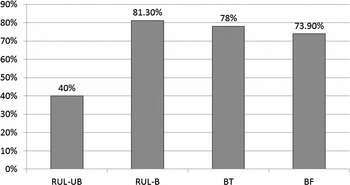
Only 40% of patients starting RUL-UB achieved remission with RUL-UB whereas 81.3% in RUL brief pulse, 73.9% in Bifrontal and 78% in Bitemporal(see Figure 2) reached remission with the same modality and this was statistically significant with χ 2 = 18.81, p = 0.000 (df 3, n = 130), Cramer's V = 0.38. We performed χ 2 tests for independence (with Yates Continuity Correction) between RUL-UB and the other three groups with an alpha value of 0.017 after Bonferroni adjustment. The association between electrode placement and remission rate was statistically significant in all three comparisons. Between RUL-UB and RUL-B χ 2 = 6.68, p = 0.01(df 1, n = 66), phi = 0.35, between RUL-UB and BF χ 2 = 5.96, p = 0.015(df 1, n = 73), phi = 0.32 and RUL-UB and BT χ 2 = 11.81, p = 0.001(df 1, n = 91), phi = 0.38.
Remission rates in different electrode placements.

However, the final outcome was not significantly different between groups when we followed intention to treat analysis (i.e. outcome was measured based on what sort of electrode placement was started regardless of switch). The response rates (including switchers) were 100% in RUL-B, BF and BT and 98% in RUL-UB and remission rates (including switchers) were 82% in RUL-UB, 93.8% in RUL-B, 74% in BF and 84% in BT.
Total number of treatments
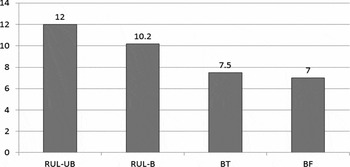
The mean number of treatments (includes treatments after switching) received by patients was statistically different between the groups. RUL-UB received 12 treatments, RUL Brief received10.2 treatments, Bifrontal received the lowest of seven treatments, Bitemporal received 7.5 treatments (see Figure 3). A one-way between-groups analysis of variance was conducted to explore the impact of electrode placement on number of treatments received. There was a statistically significant difference in the number of treatments between the four groups: F = 11.6, p = 0.000 (df 3, n = 132). The F quoted here is from the Welch Robust test of Equality of Means as the assumption of homogeneity of variances was violated. The effect size calculated using eta was 0.23 which is quite large. Post-hoc comparisons using Dunnett T3 test indicated that the mean number of treatments for RUL-UB (M = 12.02, SD = 5.25) was significantly different from both BT (M = 7.47, SD = 2.76) and BF (M = 7, SD = 3.09). There was no statistically significant difference between RUL-UB and RUL-B, RUL-B and BF and RUL-B and BT.
Number of treatments in different electrode placements.

Discussion
In our study we found that 56% of patients starting RUL-UB ECT switched to other pulse width and/or electrode placement. Loo et al. (Reference Loo, Sainsbury, Sheehan and Lyndon2008) in their prospective naturalistic study found a switch rate of 55.4% and McCormick et al. (Reference McCormick, Brumm, Benede and Lewis2009) in their naturalistic study also found a switch rate of 46%. Interestingly the switch rates in RUL brief ECT was 12.5% compared to 36% reported by Loo et al. (Reference Loo, Sainsbury, Sheehan and Lyndon2008) and 5% reported by Galletly et al. (Reference Galletly, Clarke, Paterson, Rigby and Gill2014).
We found that the number of treatments received by patients In the RUL-UB group was 12 which is approximately two more treatments when compared to RUL-Brief group and five more treatments compared to the Bifrontal and the Bitemporal group. McCormick et al. (Reference McCormick, Brumm, Benede and Lewis2009) in their retrospective analysis found that patients receiving Bitemporal ECT had approximately two treatments fewer compared to the RUL-UB patients and Galletly et al. (Reference Galletly, Clarke, Paterson, Rigby and Gill2014) reported that patients receiving RUL- Brief ECT received at least two treatments fewer when compared to the RUL-UB group. Similarly Fink and Taylor (Reference Fink and Taylor2007) have observed that patients receiving Bilateral Brief pulse ECT in CORE study received three treatments fewer when compared with patients receiving RUL-Brief pulse ECT in the CUC sample, suggesting that right unilateral ECT might be less efficient compared to Bilateral ECT.
We looked at the number of treatments patients received before switching in the RUL-UB group and patients had a mean of 5.92(sd 2.99) treatments before switching. However patients who switched due to inadequate response had a mean of 7.13(sd 2.9) treatments before switching while the rest of the switchers switched after a mean of 4.27(sd-2.53) treatments. Loo et al. (Reference Loo, Katalinic, Martin and Schweitzer2012) argues that patients receiving RUL-UB ECT should have six to eight treatments before switching even though Sackeim et al. (Reference Sackeim2008) did not find any difference in the number of treatments received between RUL-UB and Brief pulse bilateral and RUL ECT. In our sample the RUL-UB patients have received adequate number of treatments before switching considering the patients who started Bifrontal and Bitemporal ECT received a mean of 7 and 7.5 ECTs achieving 74% and 78% remission respectively. Hence the difference in switch rates might not be attributed to inadequate number of treatments. Conversely, the increased number of treatments in the RUL-UB group might be due to a proportion of non-responders continuing to receive RUL-UB ECT. In our study a significant difference in number of treatments between RUL-BP and RUL-UBP suggests that RUL-UBP is less effective than RUL-BP. What is also interesting is that only two out of 66 patients receiving Bilateral ECT switched amongst which none of the patients in the bifrontal group switched. This might suggest that Bilateral ECT was reasonably tolerated or a switch to unilateral ECT was not considered despite patients experiencing significant cognitive side effects.
On examining the clinical outcome, only 40% of patients starting RUL-UB achieved remission with it. The rates of remission are similarly low in the studies by Loo et al. (Reference Loo, Sainsbury, Sheehan and Lyndon2008); Galletly et al. (Reference Galletly, Clarke, Paterson, Rigby and Gill2014), 27% compared to 77% in Sackeim et al. (Reference Sackeim2008). Overall there appears to be some dissociation between the RCT findings of Sackeim and the other naturalistic studies; the naturalistic studies reporting higher switch rates, number of treatments and lower remission rates for RUL-UB ECT and demonstrates the inconsistency between the efficacy and the effectiveness of RUL-UB ECT. Despite the above mentioned inconsistency between efficacy and effectiveness of RUL-UB ECT, cognitive advantages for RUL-UB ECT has been consistently demonstrated (Loo et al., Reference Loo, Sainsbury, Sheehan and Lyndon2008; Sackeim et al., Reference Sackeim2008) hence it might have a specific role as a first line treatment option for some patients who have either experienced distressing cognitive impairment previously or who are at risk of developing cognitive impairment with ECT. Similarly Bilateral Brief pulse ECT should be considered as first line treatment in patients with intracranial pathology, vascular aneurysms and who are at high risk of cardiac complications due to increased number of stimulations and anaesthesia. In a meta-analysis of bifrontal ECT, (Dunne and McLoughlin, Reference Dunne and McLoughlin2012) there was no difference in efficacy between bifrontal and bitemporal ECT but the decline in post treatment MMSE scores was less with bifrontal ECT. The same study also showed that bifrontal ECT when compared to right unilateral ECT showed lesser decline in visual memory scores and a greater decline in immediate verbal memory scores. Hence bifrontal ECT might have an advantage in terms of cognition while preserving the efficacy.
There are some limitations with our study. Being a retrospective study, we relied on data documented by the clinicians at the time of treatment as there were no objective measures of effectiveness. There might have been a bias towards documenting a favorable clinical outcome and this bias may or may not have been equal across the groups. In GVH, only 14 out of 32 patients started ECT with RUL-B and the other patients received one of the other three modalities. Similarly 5 out of 48 patients in CCLHD received a modality other than RUL-UB. The reason for this variation is not known. It is possible that these patients were different in some way and might have contributed to the better effectiveness and efficiency of bilateral ECTs. There were some missing data and variables that were not available for analysis that was of interest. Duration of episode and history of previous ECT have been identified by factors that are associated with a better response (Loo et al., Reference Loo, Mahon, Katalinic, Lyndon and Hadzi-Pavlovic2011) and an unequal distribution of these variables might have an effect on the outcomes of interest. There could have been other factors that made PJC more effective and efficient apart from the choice of electrode placement but our knowledge about the centers suggest that the care received by patients is comparable however this would be difficult to measure and report within the scope of our study.
Patients receiving RUL-UB predominantly received Thiopentone as the anaesthetic agent and Propofol was the predominant anaesthetic agent in the other groups. Ingram et al. (Reference Ingram, Schweitzer, Ng, Saling and Savage2007) has reported that patients receiving Thiopentone had a higher response rate of 67% after six ECTs when the response rate was 28% in patients receiving Propofol. They also reported better verbal and visual memory score for patients receiving Thiopentone. Another group conducted a RCT to evaluate the effects of propofol and thiopentone on clinical effectiveness and cognitive side effects (Bauer et al., Reference Bauer2009) and they found no differences in remission and response rates but the BDI scores after six treatments were significantly lower in the propofol group but this difference was not apparent at the end of the treatment, moreover there was no differences between HDRS scores. While the number of treatments received was not statistically significant, the patients receiving thiopentone received at least two more treatments (12.3 versus 10), conversely Kumar et al. (Reference Kumar, Sharma and Mani2012) reported that patients in the thiopentone group received fewer number of treatments compared to the propofol group and this was statistically significant (5.9 versus 9.7). In the same study (Kumar et al., Reference Kumar, Sharma and Mani2012) they also found that the Beck's Depression Inventory scores at the end of ECT was significantly better for propofol compared to thiopentone (3 versus 7). Furthermore Purtuloglu et al. (Reference Purtuloglu2013) demonstrated in their RCT that patients receiving Thiopentone had a significantly lower reduction in HDRS scores after six treatments. Overall the effect of the choice of anesthetic between propofol and thiopentone on clinical efficacy and effectiveness seems varied and a Cochrane systematic review (Lihua et al., Reference Lihua, Su, Ke and Ziemann-Gimmel2014) concluded that the studies were liable to bias and were not designed to detect differences in depression scores. The trend reported by Bauer et al. (Reference Bauer2009) in terms of the difference in the number of treatments might explain at least some of the difference in number of treatments between the RUL-UB and the bilateral groups but the difference in our study was much larger hence the electrode placement and pulse width might have contributed to the difference. The variability in stimulus dosing methods is less likely to have contributed to the outcome as half age method for bilateral ECT is considered a practical and useful substitute for dose titration methods and correlates well with the titration methods (Petrides et al., Reference Petrides2009).
Despite the limitations detailed above we were able to demonstrate that patients starting ECT with RUL-UB had high rates of switching and required substantially more ECTs (much higher than previous reports which had younger subjects). We have not been able to report on cognitive outcomes with RUL-UB ECT in older adults and further research is much needed to confirm the cognitive advantages of RUL-UB ECT in older adults. Similarly, a RCT comparing RUL-UB and Bitemporal ECT in older adults should ascertain the efficacy and speed of response with RUL-UB ECT as the findings will hugely influence decisions on electrode placement and pulse width when proposing ECT in older adults
Conflict of interest
None.
Description of authors’ roles
Dr Jothi Ramalingam - Study design, data collection, data analysis, interpretation of findings and writing the manuscript.
Dr Alby Elias - Study design, data collection, data analysis, interpretation of findings and reviewing manuscript.
Dr Kuruvilla George - Study design, data collection, interpretation of findings and reviewing manuscript.
Dr Sathish Thangapandian - Study design, data collection, data analysis, interpretation of findings and assisted with writing the manuscript.
Dr Ravi Bhat – Data Collection and interpretation of findings
Acknowledgment
We would like to thank Dr J Lynn Francis for her assistance in data analysis