Realists believe that they are an endangered species in the United States. Despite its long-standing status as the dominant paradigm in international relations, realist scholars and policymakers assert that Americans do not like their theory at all. In The Tragedy of Great Power Politics, John Mearsheimer concludes that, “American political culture is deeply liberal and correspondingly hostile to realist ideas.”1
Other realists have echoed this sentiment for the past sixty years. According to these scholars, realism is pessimistic about both the nature of man and the effect that anarchy exerts on world politics. In a realist world, states will compete for power regardless of their regime type, and neither international institutions nor global norms will ameliorate this drive for power.2Ibid. See also Morgenthau and Thompson 1985.
Realists and non-realists alike accept Louis Hartz's supposition that the Lockean worldview has an ideological chokehold over the American body politic.4
What I label the anti-realist assumption serves many useful purposes for the realist paradigm. If the American public dislikes realism, then U.S. foreign policy outputs represent a tough test of the theory. Any government in a liberal democracy wants to stay in office, so it should be reluctant to pursue a foreign policy at odds with the broad mass of its country's population. If successive U.S. governments pursued realist policies despite a hostile public, it would be robust evidence that the anarchic world system imposes a powerful structural constraint upon the foreign policies of states. The assumption also helps realists explain away movements in American foreign policy—such as Wilsonianism and neoconservativism—that appear to contradict the realist paradigm. They are explained as moments when America's creedal passions overwhelmed the principles of realpolitik.5Liberal internationalists, on the other hand, promote the anti-realist assumption to argue that their foreign policy preferences are more in tune with the American populace. See, for example, Kull and Destler 1999.
Despite the prevalence of the anti-realist assumption within international relations theory, there has been no systematic attempt to ascertain whether it is true. In part, this is because IR theorists and public opinion analysts often talk past each other. For decades, international relations theorists have focused on systemic-level explanations, marginalizing analysis of public opinion. At the same time, public opinion researchers, when they talk about American foreign policy, do not test whether the mass public adheres to foreign policy views consistent with one theoretical paradigm or another. Instead, they decompose the mass public into identifiable subgroups, in order to isolate individual-level determinants of foreign policy attitudes.
This article takes a critical look at the anti-realist assumption. I do so by reviewing the existing survey data and empirical literature on American public opinion towards foreign policy priorities and worldviews, military statecraft, and foreign economic policy for the past three decades. The results suggest that Americans are far more receptive to realpolitik than is commonly assumed. For the key components of U.S. foreign policy—war, trade, and grand strategy—realist tenets resonate just as strongly with Americans as liberal internationalism. When asked to weigh the costs and benefits of different foreign policy approaches, realism scores much better among the broad mass of Americans than realists tend to believe. At a minimum, the claim that Americans hold attitudes antithetical to realism is wrong. This might be because American indifference and rational ignorance of foreign policy problems creates a kind of “folk realist” attitude to coping with the rest of the world. Intriguingly, it is possible that realism resonates better with the mass public than it does with the elite public.
If the preliminary findings of this article hold up, there are important implications for both international relations theory and foreign policy analysis. At a minimum, the finding vitiates the premise that American foreign policy represents a “tough test” for realist theory. The underlying cause of American realist actions could emanate from domestic attitudes rather than the structure of the international system. For foreign policy analysis, the implications are equally fascinating. Since the heyday of George Kennan, the standard mantra about American foreign policy has been that a coterie of sober statesmen must manage international relations while holding back the primal impulses of an American public imbued with the “legalistic-moralistic” spirit. It could very well be that the situation is reversed—elite public opinion embraces the liberal internationalist ethos more readily than the broad mass of Americans.
The rest of this article is divided into eight sections. The next section demonstrates the breadth and depth of the anti-realist assumption in scholarly and public discourse. The third section parses out how this assumption could be falsified. The fourth section reviews the survey and experimental data and on American foreign policy worldviews and priorities. This review demonstrates mass support for the core tenets of realist thought. The fifth and sixth sections look at American attitudes towards the use of force and foreign economic policy, respectively. It finds that Americans are comfortable with realist uses of force and a relative gains approach to the global economy. The seventh section considers methodological counterarguments that could undercut the argument presented here. The final section speculates on the sources for the realist fallacy. One possibility is that realists are not reacting to the hostility of most Americans to realism, but to the hostility of American elites.
The Anti-Realist Assumption
Realism has a long and distinguished intellectual lineage, which is another way of saying that there are many varieties of realisms: classical realism, neoclassical realism, post-classical realism, offensive realism, defensive realism, structural neorealism, etc.6
For classical realism, see Morgenthau and Thompson 1985. For neoclassical realism, see Rose 1998 and Zakaria 1998. On post-classical realism, see Brooks 1997. Mearsheimer 2001 provides the exemplar of offensive realism. For a good example of defensive realism, see Snyder 1991. For a critique, see Legro and Moravcsik 1999.
The first wave of American public opinion research led to the Almond-Lippmann consensus, which suggested that mass attitudes towards foreign policy were inconstant, irrational, and ill-considered.9
Because the mass public was so uninformed about foreign affairs, scholars argued that their reaction to current events would be based on emotion rather than reason. This leads to a public with erratic mood swings about foreign policy issues of the day. A recent variation of this concern can be seen in debates about the “CNN effect.”10 In 1993, George Kennan described this effect as the tendency for American foreign policy to be, “controlled by popular emotional impulses, and particularly ones provoked by the commercial television industry.”11Quoted in Mermin 1997, 385.
The second concern was that Americans filter foreign policy decisions through a moralistic system of beliefs. This renders the mass public unable to digest the realist logic of a dispassionate, hard-headed national interest.12
Huntington 1957, ch. 6.
Morgenthau and Thompson 1985, 165.
Kissinger 1994, 30 and 50.
These concerns have not abated as realist thought has adopted a more scientific cast.16
An important exception is Waltz 1967, ch. 4 and 10. He argued that democratic publics were perfectly capable of accepting realist principles.
Another, lesser strand of realist criticism—which will not be discussed here—argues that the power of particularistic interest groups distorts how the pubic thinks about foreign policy. For a recent example, see Mearsheimer and Walt 2006, 2007.
Realism is a hard sell. Americans appear to have an especially intense antipathy towards balance-of-power thinking… .
Americans tend to be hostile to realism because it clashes with their basic values. Realism stands opposed to Americans' views of both themselves and the wider world. In particular, realism is at odds with the deep-seated sense of optimism and moralism that pervades much of American society. Liberalism, on the other hand, fits neatly with those values.19
Mearsheimer 2001, 23.
Scholars argue that the exceptionalist history of the United States allowed a liberal worldview of international relations to develop unfettered by realpolitik concerns. Separated from Europe, the United States emerged as a great power relatively unscathed by foreign invasion, military occupation, or economic deprivation. There was no need for realism when no great power could overcome the stopping power of water.20
Mearsheimer 2001.
On national identity, see Huntington 1957, 150; Monten 2005; Kagan 2006. The first sentence of the March 2006 National Security Strategy reads: “It is the policy of the United States to seek and support democratic movements and institutions in every nation and culture, with the ultimate goal of ending tyranny in our world.” Accessed at http://www.whitehouse.gov/nsc/nss/2006/sectionI.html, July 2, 2007.
From the day of our Founding, we have proclaimed that every man and woman on this earth has rights, and dignity, and matchless value, because they bear the image of the Maker of Heaven and earth. Across the generations we have proclaimed the imperative of self-government, because no one is fit to be a master, and no one deserves to be a slave. Advancing these ideals is the mission that created our Nation.23
George W. Bush, second inaugural address, January 20, 2005, emphasis added. Accessed at http://www.whitehouse.gov/news/releases/2005/01/20050120-1.html, March 2006.
Bush's rhetoric underscores the fact that realists are not the only analysts who make this assumption. Michael Lind argues the ideas of realpolitik fundamentally conflict with the “American School” of foreign policy.24
Lind 2006. See also Lind, “Immigrant Intellectuals and American Grand Strategy,” The Globalist, April 4, 2003, 1.
Mead 2002, 35–55.
Doyle 1983, 343.
It should also be noted that the anti-realist assumption is not limited to the United States. Ironically, America's most recent foreign adversaries have also made this assumption. In the past decade alone, Slobodan Milosevic, Saddam Hussein, and Osama bin Laden all assumed that the American public was reluctant to apply force in a ruthless, realpolitik manner. They all assumed that the mass public was inordinately sensitive to casualties, and that this sensitivity would constrain American leaders. The anti-realist assumption led each of them to underestimate the likelihood of American military action.29
To be sure, this logic behind the anti-realist assumption is not universally accepted as a given. Numerous historians of American foreign policy have argued that multiple traditions have competed for dominance within American foreign policy, some of which are perfectly compatible with realism.30
It should also be noted that the anti-realist assumption does not mean that realists believe their model cannot explain U.S. foreign policy.31On the post-2003 renaissance of realists in the American foreign policy establishment, see Lawrence Kaplan, “Springtime for Realism,” The New Republic, June 21, 2004.
Quote from Harry Kreisler, “Conversations with John Mearsheimer,” 8 April 2002. Accessed at http://globetrotter.berkeley.edu/people2/Mearsheimer/mearsheimer-con4.html, March 2006.
Testing the Assumption
Realists share a consensus about how the structure of the international system works, but that consensus partially breaks down at the level of foreign policy recommendations.33
Schweller 2004, 162.
On balancing behavior, see Waltz 1979, ch. 6, Christensen and Snyder 1990, and Schweller 2004. On power vs. security maximization, compare Waltz 1979 with Mearsheimer 2001. On grand strategy, compare Gholz, Press, and Sapolsky 1997, Layne 1997, and Layne 2006 with Art 1998/99, 2003.
Waltz 1979, 105.
For our purposes, the distribution of power during the period under study renders the buck-passing/balancing debate moot. Proponents of buck-passing would agree that as a great power in a unipolar or bipolar world, the United States cannot pass the buck to any other country.
Walt 2005.
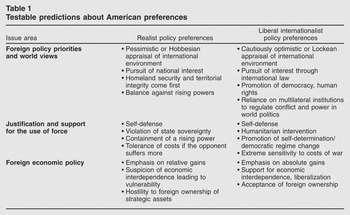
Table 1 lists the set of testable predictions that flow from the anti-realist assumption across three areas. The category of foreign policy priorities and worldviews considers how Americans views international politics, and how they would rank order particular objectives for the American government to achieve. To realists, the international system is a Hobbesian one, in which anarchy makes it impossible to fully trust other countries. The United States' top priority should therefore be the defense of American borders and territorial integrity. Alliances should be based on geopolitics and not regime type. The U.S. government should also be prepared to balance against rising great powers, before they amass sufficient power to become a peer competitor—again, regardless of regime type. Beyond those obligations, however, realists would not support other “internationalist” policy priorities—the protection of human rights, democracy promotion, or the strengthening of multilateral institutions.
Testable predictions about American preferences

The anti-realist assumption predicts that the American mass public should be more likely to trust other countries and prefer cooperation over self-help. They are therefore expected to place a greater reliance on international law and multilateral institutions to regulate world conflict. In terms of substantive preferences, Americans are predicted to advocate for the spread of liberal norms to other countries. The active promotion of democracy, human rights, and economic development to other countries cannot be defined as realist.38
Some realists would fall under the “exemplarist” approach of promoting liberal ideas abroad by perfecting them at home. For more on exemplarism, see Monten 2005, Lieven and Hulsman 2006.
Realists would also be expected to differ with the mass American public on the justification and use of force. For realists, again, the top priority would be preserving the territorial integrity, homeland security and regional hegemony of the United States. Because realists place great value on state sovereignty, they would be expected to support the use of force to deter or repel a violation of that sovereignty. Similarly, realists would support military measures to contain rising powers. When war breaks out, realists can tolerate a heavy loss of men and material—provided the opponent suffers even greater costs.
The anti-realist assumption predicts that Americans would support the use of force for a much wider set of policy objectives, but not at a sustainable level. To ensure the spread of liberal norms in world politics Americans would be expected to support other types of military missions, such as humanitarian interventions, multilateral peacekeeping, and intervention in civil conflicts. It is safe to say that realists would disapprove of all of these activities.39
Despite the support for a broader category of military actions, however, Americans are also simultaneously hypothesized to be squeamish about the costs of prolonged military commitments.40 As Peter Feaver and Christopher Gelpi observe, “There is an implicit comparison between a naïve public and a ‘hard-nosed’ view of what it takes to be a great power (or the only superpower).”41Feaver and Gelpi 2004, 104.
Foreign economic policy is the final significant policy arena where realists and the mass public are expected to diverge. Realists should be warier of trade liberalization and economic interdependence than most Americans. In an anarchic world system, realists argue that states must be concerned about the distribution of gains that come from economic cooperation.42
Even if economic integration leads to a balanced distribution of gains, realists are wary of the interdependence that can emerge from a liberal economic order. For realists, “interdependence” is simply another word for “vulnerability,” and implies a loss of economic autonomy and heightened interstate frictions.43Gowa 1986.
Because the United States is such a large economic power, the realist concern about interdependence should be relatively muted when thinking about trade with smaller countries. Relative gains concerns should be present, however, when thinking about economic exchange with other candidate great powers, such as China, Japan, and the European Union. The fear of rising economic powers should be present regardless of regime type.
The American public is predicted to be more comfortable with an open economic order. Mainstream economists argue that free trade is a win-win proposition, benefiting all countries that participate. Because Americans are predicted to care more about absolute gains than relative gains, there should be majority support for any liberalizing measures, given that the economic benefits outweigh the costs. In a similar vein, the broad mass of Americans are expected to be more comfortable with enhanced levels of economic interdependence than realists—in part because of the longstanding liberal argument that interdependence is a force for peace.44
Hirschman 1977.
Two sources of polling data will be used to test the robustness of the anti-realist assumption. Extensive surveys have been conducted to test American attitudes towards the use of force, the expansion of trade, and the proper orientation of American foreign policy. The most prominent of these polls is the quadrennial Chicago Council on Global Affairs (CCGA) survey of public attitudes about American foreign policy.45
All of the reports can be accessed online at http://www.thechicagocouncil.org/past_pos.php. Until 2006 the CCGA was known as the Chicago Council on Foreign Relations.
It should be stressed that these data are far from perfect. The most obvious problem is that most survey questions are not tailored to isolate whether Americans are receptive to any particular paradigm of international relations theory. Many of the survey questions that have been consistently asked do not directly address realist doctrine. Furthermore, on some foreign policy questions there is extreme sensitivity to the framing of the questions. Nevertheless, public responses to real-world policy problems can serve as useful proxies for general attitudes towards foreign policy preferences.
The second set of data consists of experimental surveys designed to ascertain how Americans think about foreign policy in the abstract. The advantage of these experiments is that they allow the researcher to vary the scenario parameters, determining how sensitive public opinion is to changes in external circumstances. The disadvantage to this survey methodology is that, because these scenarios are hypothetical in nature, there is reason to question whether the respondents have fully thought out their answers. It is possible that respondents who are willing to support a policy in the abstract could change their minds when confronted with a real-world variant of the scenario.46
Klarevas 2002, 424. For example, a majority of Americans claim in surveys that they would be willing to pay more for goods made according to strict labor and environmental standards. Both purchasing patterns and experimental evidence contradict this finding. See Elliott and Freeman 2003.
One final observation: it is logical to expect that the easiest test for the anti-realist assumption should come from polling data taken during the interregnum between the end of the Cold War and the September 11 attacks. During the Cold War and the post-9/11 periods, the United States faced a clear, paramount, external threat. One would expect Americans to be more comfortable with realpolitik when the threat environment is high. During the nineties, American power was unrivaled and the threat environment was low. Polling data strongly suggests that Americans knew this fact.47
In 1986, 26 percent of Americans cited international issues as a problem for the United States; by 1998, only 7 percent made the same assertion. Rielly 1999, 8.
American Public Opinion on Foreign Policy Worldviews and Priorities
To determine the sources of American attitudes towards foreign policy attitudes in a post-9/11 world, Paul Brewer led a series of panel studies to determine how much Americans trusted other countries.48
What they found was that Americans were cynical about the outside world. Over 70 percent of respondents agreed that “the U.S. can't be too careful” in dealing with other countries. And 65 percent of Americans rejected the idea that other countries try to help the U.S.; instead, they said that other countries were “just looking out for themselves.” Brewer et al. concluded that “most Americans see the realm of international relations as resembling the ‘state of nature’ described by Hobbes. Put more simply, they see it as a ‘dog-eat-dog’ world.”49Brewer et al. 2004, 105.
One could argue that such a Hobbesian outlook was simply a post-9/11 anomaly. However, survey evidence shows that American attitudes about the international system were not all that different during the nineties. The Pew Research Center conducted surveys in 1994 and 1999 that asked Americans about trusting other countries. In both surveys, more than 70 percent of respondents believed that other countries took unfair advantage of the United States. The numbers were not significantly different between the two surveys. Brewer concludes that “trust appears to be the exception, rather than the rule,” during both the pre and post-9/11 worlds.50
Brewer 2004, 327.
Ana Maria Arumi and Scott Brittle, “Public Agenda Confidence in U.S. Foreign Policy Index,” Volume 2, Winter 2006. Downloaded from http://www.publicagenda.org, 15 April 2006.
Ibid., 20.
There is also evidence that Americans do not subscribe to key components of the liberal world view. When asked whether it was right, wrong but sometimes necessary, or always wrong for the U.S. to cooperate with “harsh, undemocratic governments” in order to fight terrorism, less than 15 percent said it would always be wrong; 64 percent said it was wrong but sometimes necessary. While a slim majority agreed with the contention that more democracies reduce global conflict and violence, a slim majority disagreed with the contention that less poverty in the world does the same.53
Ibid.
Page and Bouton 2006, 100.
What about foreign policy priorities? In the summer of 2004, the Council on Foreign Relations and Pew Research Center released a poll on American foreign policy attitudes that appeared to confirm the anti-realist assumption. Analyzing the data, Lee Feinstein, James Lindsay, and Max Boot concluded that “Realpolitik does not play well with the American public…. Americans overwhelmingly believe that morality should influence foreign policy decisions.”55
Lee Feinstein, James M. Lindsay, and Max Boot, “On Foreign Policy, Red and Blue Voters Are Worlds Apart,” Council on Foreign Relations, August 2004, 39. The Pew survey (“Foreign Policy Attitudes Now Driven by 9/11 and Iraq”) is available at http://people-press.org/reports/pdf/222.pdf (accessed May 1, 2006)
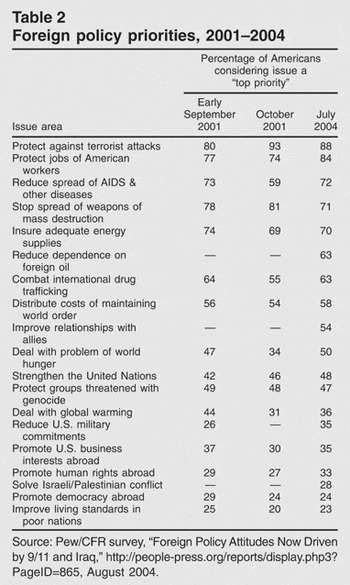
However, when Americans were asked which issues should be thought of as “top priorities,” the responses suggest a public that is much more comfortable with realism than previously thought. Table 2 reveals that policy priorities conventionally categorized in the “legal-moral” tradition—promoting democracy, advocating for human rights, and strengthening the United Nations—are considered low-priority options. The only clearly liberal issue that earned more than 70 percent support was the prevention of AIDS and other epidemics.56
Even this response does not necessarily reflect a liberal worldview. Given American hostility to inward flows of drugs and migration, and given the 2001 anthrax scare, the concern about epidemics could be related to concerns about personal security rather than altruism. On this point, see Drezner 2007a, 184–190.
Foreign policy priorities, 2001–2004

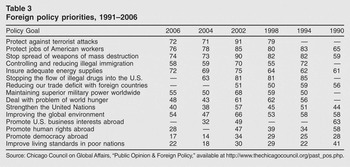
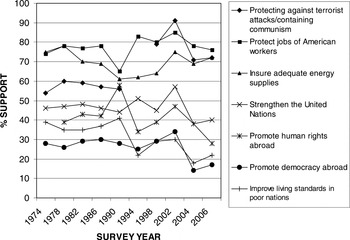
These two results hint at a pattern of American attitudes towards foreign policy priorities. Americans possess aspirations for liberal internationalism, but when asked to rank order priorities, realist principles come to the fore. Table 3 looks at the CCGA data on top foreign policy priorities over the past 30 years, and finds a similar result to the Pew/CFR surveys. Over the past few cycles, realist policy priorities, emphasizing security and autonomy, consistently earn more than 60 percent support from the mass public. Liberal policy priorities, emphasizing multilateralism, democracy and human rights, consistently earn less than 50 percent support. As figure 1 demonstrates, the top-ranking policy priorities for the past three decades—protecting American jobs, securing energy supplies—have a realist cast to them. In contrast, Americans have consistently placed less importance on liberal internationalist policy priorities—democracy promotion, human rights, and strengthening the United Nations. These results are stable across the three different time periods, despite variation in the level of international threat.57
Page and Bouton 2006, 38–43.
Holsti 2004, 95.
Foreign policy priorities, 1991–2006


Foreign policy priorities, 1974–2004
Source: Chicago Council on Global Affairs, “Public Opinion & Foreign Policy,” available at http://www.thechicagocouncil.org/past_pos.php
Sam McFarland and Melissa Matthews come to a similar conclusion about American attitudes towards human rights promotion. They find that Americans give strong support for abstract human rights principles—but when asked to rank order policy priorities, human rights came in 12th out of 15 possibilities. They conclude that, “although most Americans express agreement with the ideals of human rights, a willingness to commit American resources to promote and defend human rights is much weaker.”59
In other words, while Americans aspire for liberal policy ends, realist considerations of national interest trump those aspirations.The CCGA surveys do reveal one trend that would, at first glance, support the anti-realist assumption. Most Americans strongly support multilateral institutions like the United Nations and NATO. More than 70 percent of Americans supported American participation in the International Criminal Court and the Kyoto Protocol to protect global warming.60
Healthy majorities of Americans—including conservatives and Republicans—support giving up America's veto in the UN Security Council if it meant a more effective global body. Similar majorities endorse giving the UN limited powers of taxation to raise a standing multilateral force. In questions about going to war or deploying American forces as peacekeepers, public support is highly contingent on whether there is multilateral support.A second cut at the data, however, suggests a realist motivation behind the support for multilateral institutions. The major reason Americans support international organizations is because they can facilitate burden-sharing. In the 2002 CCGA survey, for example, by 71 percent to 17 percent, Americans preferred the U.S. to “do its share to solve international problems together with other countries” over “be[ing] the preeminent world leader to solve international problems.”61
Bouton 2002, 26, emphasis added. The other nine percent of respondents preferred the isolationist policy option.
Page and Bouton 2006, 150–1.
Krasner 1991.
A closer examination of public attitudes towards the ICC and the Kyoto Protocol also shows that support for multilateralism in principle is soft. Although a majority of Americans endorse the ICC in the abstract, for example, they also oppose allowing U.S. soldiers to be tried in The Hague. This is in sharp contrast to France, Germany, and the U.K, where majorities supported having their soldiers tried by the ICC. Similarly, on global warming, a strong majority of Americans want poorer countries to bear as much of the burden in dealing with global warming as richer nations.64
Kohut and Stokes 2006, 179–180.
Ibid., 79.
A 2006 Bertlesmann Foundation poll crystallizes how Americans think about international cooperation.66
“Poll of 9 Major Nations Finds All, including U.S., Reject World System Dominated by Single Power in Favor of Multipolarity,” accessed at http://www.worldpublicopinion.org/pipa/articles/views_on_countriesregions_bt/208.php?nid=&id=&pnt=208&lb=btvoc (November 2006).
For more on this, see Drezner 2007b.
American Public Opinion on the Use of Force
The debate about mass public attitudes towards the use of force revolves around two kinds of survey questions. The first set asks Americans whether they would support a future use of force. These questions vary with the proscribed mission and the anticipated adversary. The second set of questions polls Americans on their support of imminent or ongoing military interventions—either wars or other kinds of troop deployments, such as peacekeeping missions. If the anti-realist assumption holds, we should expect to see public enthusiasm for military interventions into genocides, civil wars, and humanitarian relief operations. Support for these activities is expected to decline, however, as casualties begin to mount.
The responses to hypothetical scenarios strongly refute the anti-realist assumption. Richard Herrmann, Philip Tetlock, and Penny Visser found in their surveys a strong predisposition towards balancing behavior among the mass public:
Rather than be deterred by the potential costs of confronting a strong opponent, participants were more willing to intervene against a powerful aggressor than a weak aggressor… despite the reminder that such an endeavor would require a major military effort. Evidently, they paid more attention to the long-range threat posed by a powerful enemy if not checked than to the immediate costs of fighting.68
Herrmann, Tetlock, and Visser 1999, 558.
Herrmann et al. achieved similar results when questions regarding nuclear proliferation and the prior behavior of possible adversaries were posed. Americans were more likely to prefer tougher responses to states that had acquired nuclear weapons and states with “revisionist motives” in the international system.69
Ibid., 558–561.
Other experiments have yielded similar results. Peter Feaver and Christopher Gelpi asked military elites, civilian elites, and mass publics about their attitudes towards the use of force. They found that across the board, respondents ranked the realist goals as more important than the interventionist or humanitarian goals.70
Feaver and Gelpi 2004, 62. It should be noted that consistent with the liberal internationalist argument, Feaver and Gelpi also found that both mass and elite civilians were more supportive of humanitarian interventions than their military counterparts.
Ibid., ch. 4.
Analyses of polling during real world applications of force also contradict the anti-realist assumption. The first, overriding metric that Americans use to gauge their support for war is whether the operation appears to be successful. Most scholars have found a “halo effect” that comes from successful uses of force.73
As Richard Eichenberg summarizes this work, “quite simply, successful military operations enjoy high support, even when the objective is unpopular and casualties are suffered.”74Eichenberg 2005, 147.
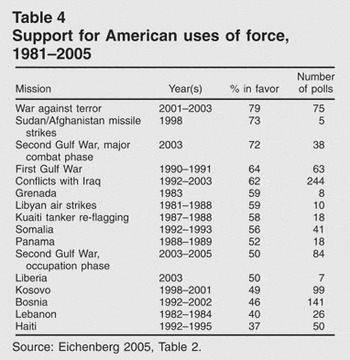
Beyond the importance of perceived success, Americans appear to have realist instincts in placing a value of the uses of force. Table 4 demonstrates the mean level of support for American uses of force between 1981 and 1995, as collected by Richard Eichenberg.75
Eichenberg 2005.
Burbach 1994, 44.
Support for American uses of force, 1981–2005

The empirical literature on public responses to war and other uses of force also undercut the anti-realist assumption. Testing public reaction to thirty-eight uses of force during the Cold War era, John Oneal, Brad Lian, and James Joyner found that Americans were more likely to support the use of force to repel armed aggression than to intervene in civil conflicts. They concluded that “the public evaluates the use of force pragmatically and in a way consistent with fundamental international principles regarding sovereignty and self-determination.”77
Eichenberg found similar results: Americans provided significantly more support for uses of force that involved restraining foreign aggressors than other kinds of military intervention.78Eichenberg 2005.
One possible counterexample to these findings is the apparent contrast between public and realist attitudes about the invasion of Iraq in 2003. Most realists opposed the invasion of Iraq, while by March 2003 the American public largely supported the invasion—ostensibly in reaction to the Bush administration's public relations campaign.79
On realist opposition, see Mearsheimer and Walt 2003; on the malleability of the public, see Kaufmann 2004 and Western 2005.
Everts and Isernia 2005, 274–5.
For Mearsheimer's quote, see “America Amnesia interview with John Mearsheimer,” http://int.usamnesia.com/Mearsheimer-2.htm. Jackson and Kaufman 2007, 98.
See the transcript of Sam Tannenhaus's May 2003 interview with then Deputy Secretary of Defense Paul Wolfowitz. Accessed at http://www.defenselink.mil/transcripts/transcript.aspx?transcriptid=2594, July 2, 2007.
Another prediction that flows from the anti-realist assumption is that Americans should not be able to stomach casualties during combat. However, multiple reviews of casualty data with public support for military deployments contradict this expectation. Eric Larson concludes that the public's aversion to losses of U.S. life in military interventions has less to do with intolerance for casualties than with the debatable merits of the operations themselves. Multivariate analyses shows that casualties in and of themselves do not cause an erosion of public support; Americans compare these costs to the possible benefits from victory.83
Furthermore, process tracing of high-profile military reversals suggest that such events trigger rally-round-the-flag effects. For example, after the October 1993 “Black Hawk down” incident in Mogadishu, public support for the Somalia mission to temporarily increased.84Kull and Destler 1999, 106–108.
For a counterargument, see Reiter and Stam 2002, ch. 7.
With regard to public opinion polling on different types of armed interventions, the results again support a realpolitik mass public. McFarland and Matthews found consistent results when polling Americans about the use of force to prevent genocide or ethnic cleansing. Seven years after the Rwandan genocide, they found only 26 percent of respondents supporting the use of U.S. troops to halt the genocide, while 41 percent preferred to “not become involved.” When asked whether the U.S. military should be used more or less often to stop either mass killings or ethnic cleansing, there was plurality support (38 percent to 15 percent) for curtailing activity. In June 1999, support for sending U.S. ground troops into Kosovo as part of a NATO operation to serve in a combat situation registered only 40 percent support.86
McFarland and Matthews 2005b, 308.
Ibid., 310.
Turning back to the question of multilateralism, surveys conducted by the German Marshall Fund of the United States, the Program on International Policy Attitudes (PIPA), and CCGA show that multilateral backing also has a dramatic effect on American support for activities like armed interventions.88
Bouton 2002, 28; German Marshall Fund of the United States, Transatlantic Trend series, 2003–2004; Kull and Destler 1999.
Further examination, however, suggests a realist logic is at work. The increases in public support for defending vital allies came when the question specifically said that the United States would be “contributing forces together with other countries.”89
Ceteris paribus, even academic realists evinced strong support for the use of force when such action receives multilateral backing.90Maliniak et al. 2005.
The question is whether the mass public desires multilateral outcomes if all else is not equal. Compared to other countries, Americans still favor reserving the right to use preemptive military force to a much greater extent than Europeans. Kohut and Stokes conclude that “the American public looks primarily to its own military for its self-defense.”91
Kohut and Stokes 2006, 201.
Jentleson and Britton 1998.
Eichenberg 2005.
American Public Opinion on Foreign Economic Policy
Since the beginning of modern polling, there has been public suspicion about the merits of free trade. This suspicion remains even during boom times. In 1953—a time when the U.S. was running a massive trade surplus—a plurality of Americans supported greater import restrictions over greater import expansion.94
The precise figure was 37 percent to 24 percent. Cited in Destler 1986, 5.
Bauer, Pool, and Dexter 1963.
Scheve and Slaughter 2001, 21.
Ibid., ch. 2.
Audley and Anker 2004, 2005; Bouton 2002; Pew/CFR, “Foreign Policy Attitudes Now Driven by 9/11 and Iraq,”; Foreign Policy Association, “Americas and the World Around Them: A Nationwide Poll,” September 2004.
“On Balance, Feelings about Trade Lukewarm,” accessed at http://americans-world.org/digest/global_issues/intertrade/onbalance.cfm, May 2006.
The debates over offshore outsourcing offer an even more pungent example of a mercantilist public at work.100
Drezner 2005.
http://www.themarlincompany.com/poll/outsourcing.htm, accessed August 10, 2004.
Employment Law Alliance, “Offshoring: Made in the U.S.A.,” June 7, 2004. Accessed at http://www.employmentlawalliance.com/pdf/ELA_Offshore_Outsource_Poll_D1_5_25_04.pdf, August 6, 2004; the Associated Press poll can be accessed at http://www.ipsos-na.com/news/pdf/media/mr040607-1tbzzz.pdf. Watson Wyatt, “Offshoring Labor,” August 5, 2004. Accessed at http://biz.yahoo.com/prnews/040805/phth035_1.html, August 10, 2004.
Pew Research Center, “Bush Approval Falls to 33%, Congress Earns Rare Praise,” March 15, 2006. Accessed at http://people-press.org/reports/display.php3?ReportID=271, March 2006.
Tucker 2006.
What is the source of the mass hostility to trade expansion? A non-realist explanation is that people are responding out of self-interest rather than the national interest. Scheve and Slaughter argue that respondents with lower education and income status are more likely to project mercantilist opinions about trade.105
However, this is only a partial explanation. For example, neither class nor educational status can explain why, between 1999 and 2004, public support for free trade declined across the board.106Kull 2004.
Watson Wyatt, “Offshoring Labor,” August 5, 2004.
While individual economic factors undoubtedly play a role in determining opinions about trade, there is strong evidence that realpolitik considerations of national interest also play an important role. Ronald Inglehart, Neil Nevitte, and Miguel Basanez conclude that “free trade galvanizes concern for a much wider set of issues, such as cultural integrity and national identity.”108
Inglehart, Nevitte, and Basanez 1996, 166.
A recent example of realism driving American policy attitudes towards foreign economic policy comes in the wake of the March 2006 Dubai Ports World controversy. A Pew survey found that 58 percent of Americans supported Congress acting to block Dubai Ports World from operating port terminals in six American cities. The framing of questions surrounding foreign direct investment revealed a key driver of mass public opposition on this issue is a loss of economic autonomy. On the one hand Americans approved of “companies in other countries investing in the U.S.” by 53 percent to 36 percent. On the other hand, Americans disapproved of “investors from other countries owning companies in the U.S.” by 53 percetn to 33 percent.110
Pew Research Center, “Bush Approval Falls to 33%,” emphasis added.
Experimental survey results confirm the strong bias in favor of relative gains concern among the mass public of Americans. Informal surveys by Robert Reich found a high degree of relative gains concern vis-à-vis Japan in 1990—the peak of Japan's perceived threat to U.S. economic hegemony.111
Robert Reich, “Do we want the U.S. to be Rich or Japan Poor?” Wall Street Journal, June 18, 1990.
Herrmann, Tetlock, and Diascro 2001, 202.
Ibid., emphasis added.
Rousseau 2002, 411.
How Robust Are These Results?
The experimental and survey data suggests that Americans do not reject realist principles in their thinking about foreign policy. Indeed, Americans share a lot of intuitions with realists. That said, there may still be methodological reasons to argue that the anti-realist assumption should still be privileged. Different components of the mass public can hold different images of foreign affairs. This paper has treated the mass public as an undifferentiated whole, but most public opinion research finds that factors such as education, income status, political ideology, party affiliation, and prior military service affect individual attitudes towards foreign policy.115
There is likely to be a slice of the American public that is hostile to realpolitik, just as there is a slice that is hostile to liberal internationalism. Feaver and Gelpi, for example, find that 20 percent of Americans are casualty-phobic—but there exist an equal or greater number of defeat-phobic Americans.116 If these different components of the mass American public hold transitive preferences over foreign affairs, it could lead to the type of cycling and instability consistent with the Almond-Lippmann hypothesis.Another issue is the sensitivity of survey responses to framing effects.117
Druckman 2001.
Hiscox 2006.
Kull and Destler 1999, ch. 5. The robustness of this finding is open to question, however. See Kohut and Stokes 2006, 188–9.
While these methodological problems should be kept in mind, none of them pose serious challenges to the arguments presented here. The existence of different components of the American public fails to undercut the evidence presented here. What is striking about the aggregate data is that American foreign policy attitudes have been consistent over a long period of time, despite the end of the Cold War and the September 11 terrorist attacks. This is consistent with arguments made within the literature that mass public opinion is more structured and stable than Almond or Lippmann posited a half-century ago.120
Hurwitz and Peffley 1987; Page and Shapiro 1992; Nincic 1992; Holsti 1992; Jenkins-Smith and Herron 2005.
Chittick, Billingsley, and Travis 1995.
As for framing effects, it is undeniable that public opinion responses vary considerably in response to how questions are framed. Recall, however, that the anti-realist assumption implies that realists cannot hawk their policy wares to American because they are ideationally hard-wired to dislike realpolitik. The fact that questions can be framed in a way that elicits a realist response directly refutes this claim. It is perfectly possible to articulate a set of foreign policy principles in a realist frame and have them accepted by the American people.122
Indeed, when balanced against the bulk of the survey evidence, the worst conclusion one could draw from these caveats is that Americans are just as comfortable with realism as they are with any other paradigm of international relations. In the court of American public opinion, realists are not handicapped in any way whatsoever.One possible explanation for the mass public's receptivity to realism is that their rational ignorance of world politics engenders a kind of “folk realism.”123
I am grateful to Benjamin Fordham and Jonathan Caverley for their suggestions on this point.
The one criticism that is difficult to contest is the dearth of survey questions and results that directly address whether Americans think like realists or liberal internationalists. Most of the longstanding questions in the CCGA, Pew, and other surveys are designed to examine whether Americans are isolationists or internationalists. Herrmann and Tetlock's experimental surveys are more explicitly designed to test the anti-realist assumption—but it is not the primary focus of their research. Clearly, further survey and experimental work is needed to conclusively determine whether the mass American public holds intuitions that resonate strongly with a particular international relations paradigm.
Why Does the Anti-Realist Assumption Persist?
This paper concludes that the anti-realist assumption is not empirically valid. Americans do hold some liberal aspirations for their conduct across the globe, and believe that morality should play a role in foreign affairs—in the abstract. However, surveys about foreign policy world views and priorities, the use of force, and foreign economic policies all reveal a strong realist bent among the mass American public. The overwhelming majority of Americans possess a Hobbesian world view of international relations. Americans consistently place realist foreign policy objectives—the securing of energy supplies, homeland security—as top foreign policy priorities. Objectives associated with liberal internationalism—strengthening the United Nations, promoting democracy and human rights—rank near the bottom of the list. On the uses of force, experimental surveys reveal that Americans think like intuitive neorealists; they prefer balancing against aggressive and rising powers while remaining leery about liberal-style interventions. On foreign economic policy, Americans think of trade through a relative gains prism, particularly if the trading partner is viewed as a rising economic power. Surveys and polling do suggest that Americans like multilateral institutions, but they appear to like them for realist reasons—they are viewed as mechanisms for burden-sharing. Liberal internationalist attitudes did not resonate more during the nineties, the period when the anti-realist assumption should have had the greatest support. If anything, during that decade Americans appeared to adopt attitudes consistent with offshore balancing.
The implications of these results for the analysis of American foreign policy are significant. Realists have repeatedly asserted that U.S. foreign policy leaders act in a realist manner but disguise these actions through liberal rhetoric. The anti-realist assumption allows these scholars to assert that the only source of realpolitik behavior comes from the systemic level. If the American public holds realist views on certain foreign policy dimensions, then a unit-level causal mechanism exists that would also explain these policy outcomes.
These findings also lead to an important question. If American attitudes towards foreign policy have been consistent for decades, and those attitudes are receptive to a realist world view, then why does the anti-realist assumption persist within the academy and the policymaking worlds? One possible explanation is that, even at the elite level, misperceptions about public opinion are remarkably difficult to change. Public opinion scholars refer to this phenomenon as “pluralistic ignorance”—shared but incorrect beliefs about what other people think. Americans believe that a majority hold views similar to the actual outputs of U.S. foreign policy.124
Todorov and Mandisodza 2004.
Another possible explanation is that realist scholars believe the anti-realist assumption because they encounter hostility to realism on a daily basis. Hostility to realism resides in the elite public more than the mass public. Most survey research in foreign policy—including the Foreign Policy Leadership Project—separate out elite opinions from the mass public. The elite public is usually defined as people who are both knowledgeable about foreign affairs and have some access to foreign policy decision-makers. This includes high-ranking members of the executive branch, members of Congress and their staffs, lobbyists and interest group representatives, journalists, academics, and leaders of labor, business, and religion.125
Powlick and Katz 1998, 34.
Kennan 1984.
However, many of the studies cited here also find that across a broad array of questions, the elite public is more liberal internationalist than the mass public.128
During the mid-nineties, the mass public was significantly more pessimistic about world affairs than policymakers.129Pew Research Center, “America's Place in the World II,” October 1997. Accessed at http://people-press.org/reports/pdf/102.pdf, April 2006.
Holsti 2004, 259.
Alvarez and Brehm 2002, ch. 9.
Schildkraut 2002.
Foreign economic policy is where the most prominent gap between elite and mass public opinion exists. In their experimental surveys, Herrmann, Tetlock, and Diascro found that elite participants were far less sensitive to relative gains than most Americans: “even in the condition of a ten-to-one relative loss, more than two-thirds of elite Americans still pursue absolute gains and choose free trade.”133
Herrmann, Tetlock, and Diascro 2001, 200.
The gap between elites and the rest of America on trade policies have ramifications beyond foreign economic policy. Some commentators have hypothesized that in the current era of economic globalization, elite members of the American public would adopt a more cosmopolitan view of world politics, consistent with liberal internationalism.135
Friedman 1999.
Herrmann and Keller 2004.
The relatively liberal attitude of American elites comes into particular focus when one considers precisely which elites strongly influence American foreign policy. Lawrence Jacobs and Benjamin Page conclude that the preferences of four elite groups had the strongest effect on the attitudes of policymakers: media, business, think tanks and other foreign policy organizations, and educators.138
Jacobs and Page 2005, 113.
On journalists, see Tai and Chanfe 2002. On academics, see Maliniak et al. 2005, 2007. On businessmen, see PriceWaterhouseCoopers, “9th Annual Global CEO Survey,” January 2006.
Jacobs and Page 2004.
The existence of a liberal internationalist foreign policy establishment would help to explain an enduring puzzle in this area of research—why elites continually believe that the public is more isolationist than it actually is.141
It is entirely possible that either the elites or the polling questions are confusing wariness about American isolationism with liberal concerns about a realist mass public. Ironically, the fear that gripped Kennan and Morgenthau in the early fifties may be completely at odds with present-day reality: America now has a realist mass public governed by a liberal internationalist elite.This leads to a final speculative hypothesis. The liberal internationalist trend is strong among the elites that realist scholars interact with the most—other international relations professors.142
Survey research and analyses of journal articles reveal that most IR scholars believe realism to be on the wane as a tool for explaining international relations in terms of scholarship, teaching, and real-world relevance.143Ibid. See also Walker and Morton 2005.