Introduction
This report on the taxonomy, zonal and graphic correlation of Frasnian (lower Upper Devonian) conodonts from New York State contributes to a long collaborative effort to refine the sequence initially compiled by John Huddle (in Klapper et al., Reference Klapper, Sandberg, Collinson, Huddle, Orr, Rickard, Schumacher, Seddon and Uyeno1971, fig. 3). Huddle’s monograph on Genesee Group conodonts added considerable detail, particularly in the lower part of the sequence (Huddle, Reference Huddle1981). These early studies used conventional biostratigraphy to correlate with the European conodont zonation (Ziegler, Reference Ziegler1971) based mainly on species of the genus Palmatolepis and Mesotaxis that eventually became the Standard Frasnian Zonation (Ziegler and Sandberg, Reference Ziegler and Sandberg1990). With the faunas then at hand, correlation between the New York sequence and the European zonation proved difficult, especially in the absence or apparent absence of key Palmatolepis species, particularly in the lower Frasnian (Huddle in Klapper et al., Reference Klapper, Sandberg, Collinson, Huddle, Orr, Rickard, Schumacher, Seddon and Uyeno1971; Huddle, Reference Huddle1981). Fortunately the European conodont zones were aligned with the long established European ammonoid (goniatite) cephalopod zones (Ziegler, Reference Ziegler1971, chart 4). Following the discovery by House (Reference House1962) that all the major Upper Devonian European ammonoid zones could be recognized in New York, conodont sampling there focused on horizons with zone-defining ammonoids, thus providing the potential for a check on the alignment and international correlation of both groups. As a consequence we follow the stratigraphic terminology, locality and bed-numbering system developed by House and Kirchgasser (Reference House and Kirchgasser1993 and Reference House and Kirchgasser2008) for their monograph on the New York ammonoid sequence (Figs. 1–6). As noted below, the conodont sequence presented here, incorporates species from several genera and is aligned by graphic correlation with an alternate zonation, the thirteen-fold zonation first developed in the Montagne Noire, southern France (Klapper, Reference Klapper1989; Table 1 herein), but recognized now throughout the Devonian tropics. For this reason, we term it the “Frasnian conodont” zonation rather than the “Montagne Noire” or “MN” zonation as used previously.
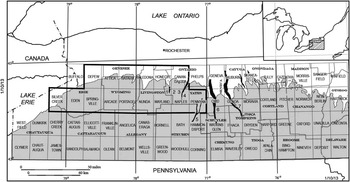
Map of upstate New York showing outcrop area of late Devonian rocks (Tully Limestone Formation and younger [shaded]) and area of 15’ Quadrangles (bold outline) and counties of sampled localities (Appendix 1). Finger Lakes illustrated in black (west to east): (1) Conesus; (2, 3) Hemlock, Honeoye (not shown); (4) Canandaigua; (5) Keuka; (6) Seneca; (7) Cayuga.

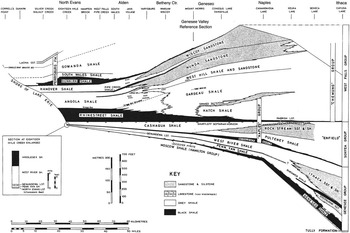
Late Devonian facies in western New York, modified from House and Kirchgasser (Reference House and Kirchgasser2008). Note position of Genesee Valley Reference section. Recent work by Cszonka et al. (Reference Cszonka, Bush and Beard2013) on ranges of benthic taxa in the Chemung (sandstone) facies (Nunda-Wiscoy sandstones) indicates that the Frasnian/Famennian boundary may be miscorrelated in the Genesee Valley region. Our conodont samples from the interval in question are from sections to the west where we are confident of the positions of the Pipe Creek Shale, Hanover Shale and Dunkirk Shale, the base of the latter being at or near the base of the conodont-defined Frasnian/Famennian boundary.

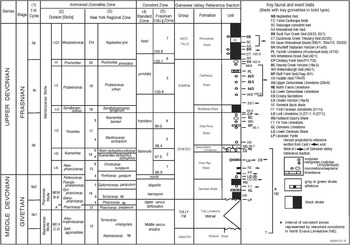
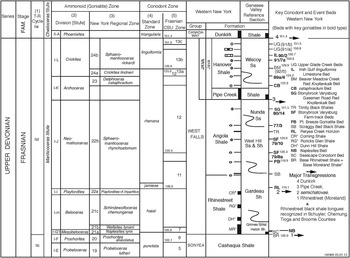
Correlation of major units, Transgression-Regression (T-R) cycles and key faunal and event beds of the Geneseo Shale to lower Rhinestreet Shale in western New York. (1) T-R cycles after Johnson et al. (Reference Johnson, Klapper and Sandberg1985). (2) Ammonoid (Goniatite) Divisions (Stufen) after Becker and House (Reference Becker and House2000), House and Kirchgasser (Reference House and Kirchgasser1993, Reference House and Kirchgasser2008), Aboussalam and Becker (Reference Aboussalam and Becker2011). (3) New York Regional Zones after House and Kirchgasser (Reference House and Kirchgasser1993, Reference House and Kirchgasser2008). (4) Standard conodont zones of Ziegler and Sandberg (Reference Ziegler and Sandberg1990) with alignment to numbered Frasnian conodont zones following Klapper and Becker (Reference Klapper and Becker1999). (5) Numbered Frasnian Conodont Zones and Composite Standard Unit (CSU) values for base of each zone by graphic correlation; CSU values also given for selected faunal and event beds.

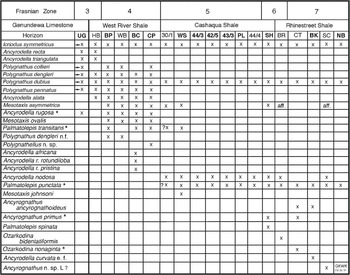
Ranges of key conodonts from sampled horizons in the Upper Genundewa Limestone, West River Shale, Cashaqua Shale and lower Rhinestreet Shale with correlations to Frasnian Conodont Zones. Abbreviations of key horizons and locality/bed-numbers refer to Figure 3 and Appendix 1; horizons with key goniatites in bold type. Asterisk indicates zone-defining conodont species. (Note: The horizon taken as the Williamsburgh Bed [WB] at Chidsey Point, Keuka Lake [PY-7/2] by House and Kirchgasser [Reference House and Kirchgasser2008] correlates by graphic correlation to a position above the Beards Creek Horizon [BC] at Beards Creek [18a/5] and is here designated the Chidsey Point Bed [CP] and is our topmost faunal horizon of the West River Shale.) The Shurtleff Septarian Horizon (SH) at North McMillan Creek (Appendix 1, SH) lacks Ancyrognathus ancyrognathoideus but the species is present at this level in the type locality, Shurtleff’s Gully (House and Kirchgasser, Reference House and Kirchgasser2008, p. 40, loc.41). Ancyrodella recta occurs in the North Evans Limestone just below the Upper Genundewa Limestone (UG).

Correlation of major units, Transgression-Regression (T-R cycles) and key faunal and event beds of the Rhinestreet Shale to top of Hanover Shale in western New York. (1) T-R cycles after Johnson et al., Reference Johnson, Klapper and Sandberg1985. (2) Ammonoid (Goniatite) Divisions (Stufen) after Becker and House (Reference Becker and House2000), House and Kirchgasser (Reference House and Kirchgasser1993, Reference House and Kirchgasser2008). (3) New York Regional Zones after House and Kirchgasser (Reference House and Kirchgasser1993, Reference House and Kirchgasser2008). (4) Standard conodont zones after Ziegler and Sandberg (Reference Ziegler and Sandberg1990) with alignment to numbered conodont zones following Klapper and Becker (Reference Klapper and Becker1999). (5) Numbered Frasnian Conodont Zones and Composite Standard Unit (CSU) values for base of each zone by graphic correlation; CSU values also given for selected faunal and event beds. Note: Position of Frasnian/Famennian boundary may be miscorrelated in the Genesee Valley Reference Section (Cszonka et al., Reference Cszonka, Bush and Beard2013).

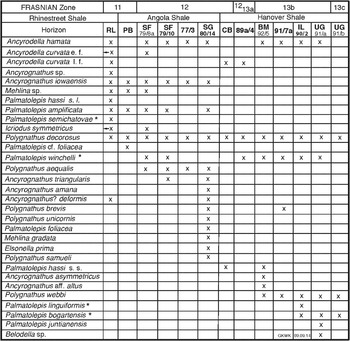
Ranges of key conodonts from sampled horizons in the Upper Rhinestreet Shale, Angola Shale and Hanover Shale with correlations to Frasnian conodont zones. Abbreviations of key horizons and locality/bed-numbers refer to Figure 5 and Appendix 1; horizons with key goniatites in bold type. Asterisk indicates zone-defining conodont species.

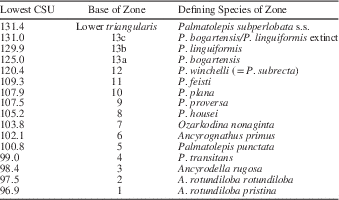
Scale in composite standard units of the 13-fold Frasnian conodont zonation.
CSU, composite standard unit.
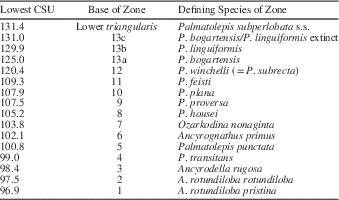
The CSU values represent the lowest bases of the zone-defining species of each Frasnian zone. The base of the Famennian Stage coincides with the base of the Lower triangularis Zone, defined by the lowest occurrence of Palmatolepis subperlobata s.s. and the flood occurrence of P. ultima, as recommended by Klapper et al. (Reference Klapper, Uyeno, Armstrong and Telford2004, p. 375–377) and Klapper (Reference Klapper2007b, p. 67–68). P. triangularis does not enter at the base of the zone, but somewhat higher. Subzones 13b and 13c are equivalent to the lower and upper linguiformis zones, respectively, of Sandberg et al. (Reference Sandberg, Morrow and Ziegler2002). P. linguiformis is restricted to Subzone 13b and P. bogartensis is the main Palmatolepis species of Subzone 13c (Girard et al., Reference Girard, Klapper and Feist2006).
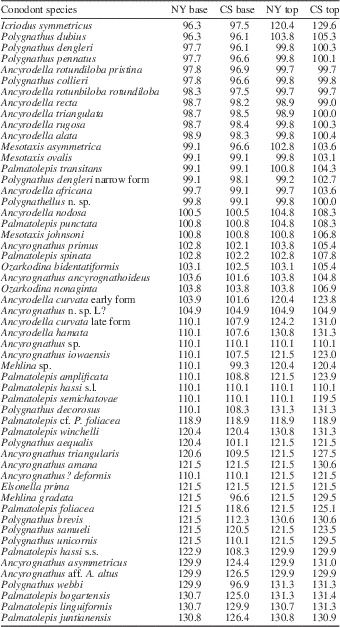
The preliminary survey analyzed 20 sections from the Genesee and overlying Sonyea groups (Klapper et al., Reference Klapper, Kirchgasser and Baesemann1995). The ranges of 28 conodont species and the stratigraphic positions of 23 key beds (mostly the bases of traceable black shales) were compiled by graphic correlation (see below), into a New York Regional Composite. The New York composite was in turn correlated with a global Frasnian Composite Standard with data from 27 sections and scaled to the thirteen-fold “Montagne Noire” zonation (Kirchgasser and Klapper, Reference Kirchgasser and Klapper1992; Klapper and Kirchgasser, Reference Klapper and Kirchgasser1992; Klapper et al., Reference Klapper, Kirchgasser and Baesemann1995). In this final report we expand our analysis, adding 17 sections from the West Falls Group (or Java Group for the Pipe Creek and Hanover shales) such that the New York Regional Composite currently incorporates the ranges of 55 conodont species whose New York ranges are compared with their global ranges in a Frasnian Composite Standard developed through graphic correlation (Table 2). The Frasnian Composite is currently based on data from 42 sections (including the two New York composites; the other 40 are individual sections), in North America, Europe, European Russia and Australia. The results, summarized in correlation charts (Figs. 3, 5), also show alignments with the Standard Frasnian Conodont Zones (Ziegler and Sandberg, Reference Ziegler and Sandberg1990) and the global and regional Ammonoid (Goniatite) Zones.
Ranges of conodont species in the New York Frasnian sequence.

Columns 1 and 3 give the lowest bases and highest tops in CSU values of 55 species in New York. Columns 2 and 4 indicate the current CSU value of the lowest bases and highest tops of the same species in the Frasnian Composite Standard.
Stratigraphy
The Frasnian (Upper Devonian) rocks in New York State are part of the Catskill Delta, a succession of siliciclastic sediments deposited in the northern Appalachian Foreland Basin during tectophases of the Acadian Orogeny (Woodrow and Sevon, Reference Woodrow and Sevon1985; Ettenson, Reference Ettensohn1985; Ver Straeten et al., Reference Ver Straeten, Brett and Sageman2011). The conodonts reported here from western New York (Fig. 1, Appendix 1) are mostly from calcareous horizons and sedimentary lag accumulations in the shales (mudrocks) of the distal margin of the basin. Above the Hamilton Group and Tully Formation (Givetian, Middle Devonian), is a series of cycles (sequences) of black and gray shale of varying scales of thickness, a record of sea-level change, basin subsidence and episodic influx of clastic sediments from the east and southeast (Fig. 2). The succession is subdivided by the major (thickest) cycles into three stratigraphic groups: (1) Genesee Group (black Geneseo Shale and gray Penn Yan Shale (with the Givetian /Frasnian boundary near its base), Genundewa Limestone and gray West River Shale; (2) Sonyea Group (black Middlesex Shale and gray-green Cashaqua Shale); (3) West Falls Group (black Rhinestreet Shale and gray Angola Shale, black Pipe Creek Shale and gray Hanover Shale. Alternatively, the Pipe Creek and Hanover shales comprise the Java Group (Figs. 3, 5).
The major cycles are thought to track eustatic changes in sea level corresponding to the global-scale transgressive-regressive T-R cycles of Johnson et al. (Reference Johnson, Klapper and Sandberg1985). The black shales (Geneseo, Middlesex, Rhinestreet and Dunkirk, the base of which is slightly above the base of the Famennian Stage) record the transgressive (deepening) events with bottom anoxia and the succeeding gray shales, the regressive (shallowing) events with bottom dysoxia. The depositional cycles also record changes in basin configuration, notably the westward migration of the basin axis (thickest sections of Geneseo, Middlesex, Rhinestreet and Dunkirk black shales) and the westward shift of clastic wedges of siltstone and sandstone (Sherburne, Ithaca, Rock Stream, Grimes, West Hill, Nunda, Wiscoy) (Fig. 2). As a result of these shifts in facies (depositional environments), the pelagic conodont and ammonoid faunas are unevenly distributed through the succession, with productive horizons, key faunal and event beds sensu Brett et al. (Reference Brett, Algeo and Mclaughlin2003; Figs. 3, 5 and Appendix 1, see below) typically separated by monotonous shale intervals with poor faunas or devoid of fossils.
Conodont facies: key faunal and event beds
Black shales
In many parts of the succession, but particularly in the Genesee Group, conodonts are concentrated with pyrite and fish-bone debris in detrital lag deposits along discontinuities at the bases of black shales (Baird et al., Reference Baird, Brett and Kirchgasser1989). At the very base of the Genesee Group, the Leicester Pyrite (LP), is the classic example of a highly condensed, time-rich, black shale-roofed lag of insoluble debris that accumulated in the deep-water, basinal environment under bottom conditions of near-anoxia, black-mud deposition, pyritization, complete to nearly complete carbonate dissolution and extremely slow sedimentation (that is, sediment starvation associated with high sea-levels). These unusual deposits are the residuals of original carbonate beds, the result of a complex mechanism of internal-wave (pycnocline) shoaling and erosion against the basin-margin slope prior to deepening and burial by black muds (Baird et al., Reference Baird, Kirchgasser, Over and Brett2006, p. 359 and references therein). The Leicester Pyrite is a placer-like residuum of pyrite, fish debris and conodonts along the Taghanic disconformity, which tracked the westward onlap (transgression) of the black Geneseo Shale on the eroded upper Hamilton Group shales through an interval spanning possibly five conodont zones (Upper Givetian hermanni Zone to Frasnian Zone 2).
Similar pyrite-bone-conodont lags occur at discontinuities higher in the succession, sometimes at or near the tops of black shales. However these top-black shale disconformities are overlain by shales and siltstones marking the onset of the regressive (swallowing) phase of the cycle and attendant conditions for submarine erosion. An important one of these top-black shale lags marks the Middle-Upper Devonian (Givetian/Frasnian) boundary in New York with the entry of the first Frasnian conodonts (FF) in the lower Penn Yan Shale of Ancyrodella rotundiloba pristina [=A. rotundiloba early form] defining Frasnian Conodont Zone 1 (Kirchgasser, Reference Kirchgasser1994; Baird et al., Reference Baird, Over, Kirchgasser and Brett2006, p. 363; Fig. 3 herein). Recent work by G. Baird (SUNY, Fredonia) has shown that the FF event-bed in the Hemlock-Honeoye area (2–3 of Fig. 1) is a distinctive pyrite-lag that records an interval of submarine erosion that at its maximum cut out the underlying Lodi Limestone (LO) at the base of the Penn Yan Shale and the Hubbard Quarry (HQ) black shale and Fir Tree Limestone (FT) of the upper Geneseo Shale. This new work indicates that the black shale labeled Penn Yan Shale A by Kirchgasser (Reference Kirchgasser1994, fig. 3) may in fact be the Hubbard Quarry Member at the top of the Geneseo Shale and the underlying limestone labeled Lodi may be the Fir Tree Limestone. Thus in the Honeoye Valley to Canandaigua Lake region the FF event-bed discontinuity (Givetian-Frasnian boundary) varies in stratigraphic position from at (or near) the top to the base of the Hubbard Quarry Shale (=Black Shale A) at the Geneseo-Penn Yan contact (Fig. 3).
Conodont lags also occur in thin carbonate units on the top surface of black shales, often with fish debris, dacryoconarids (styliolines and annulated forms), and small articulate brachiopods. Like their counterparts at the bases of black shale these deposits are also believed to represent highstand (high sea-level) intervals of sediment starvation and submarine transport and erosion. At Seneca Lake, Lodi Limestone Bed A (LO A of Fig. 3) at the top of the black Geneseo Shale (Hubbard Quarry Member), at the contact with the regressive, gray, Penn Yan Shale (or Sherburne Siltstone) at Mill Creek (Lodi Glen), is an example of this facies (Kirchgasser, Reference Kirchgasser1994, Loc. 17, p. 133). Here the top-Geneseo-basal Lodi level (LO A) yields norrisi Zone conodonts of the uppermost Givetian as does the main Lodi Bed (LO B) above (Kirchgasser, Reference Kirchgasser1994). The conodont record shows that the top and bottom surfaces of the Geneseo Shale are regionally diachronous as are many horizons along lesser discontinuities within the Geneseo and in the overlying Penn Yan Shale, Genundewa Limestone and lower West River Shale, specifically the Huddle Bed (HB) (Baird et al., Reference Baird, Over, Kirchgasser and Brett2006, p. 373, fig. 10).
Carbonates
Most of the conodont faunas reported herein were recovered from calcareous beds with ammonoid cephalopods from the upper part of the regressive, gray-shale phase of the depositional cycles (sequences). The carbonates appear to have accumulated under dysoxic conditions early in the shift to the transgressive phase of the cycle before the return of bottom conditions of anoxia, carbonate dissolution and black shale (mudrock) deposition. The facies include gray-colored nodular and concretionary beds, baritic (white or pink) septarian-concretions, thin styliolinid (dacryoconarid) limestones and thin calcareous siltstones. In detail there are considerable similarities with the discontinuity lags described above, including pyrite mineralization and reworking of biogenic and lithic debris. The Williamsburgh Bed (WB), Beards Creek Horizon (BC), and Chidsey Point Bed (CP) in the upper West River Shale and the Shurtleff Septarian Horizon (SH) in the upper Cashaqua Shale are examples from the major cycles (Genesee and Sonyea groups). The Bluff Point Bed (BP) of the middle West River Shale and the Point Breeze Goniatite Bed (PB) in the lower Angola Shale are representative of the smaller-scale (meter-scale) cycles or microcycles (House and Kirchgasser, Reference House and Kirchgasser2008). Fossil plants (or fossil logs) often occur in the concretions and are associated with abundant epiplanktonic mollusks, particularly small gastropods, bivalves and ammonoids, sometimes baritized or pyritized, dacryoconarids (styliolines and annulated forms) and lingulid brachiopods.
The Genundewa Limestone (Formation), is a distinctive and widespread mass accumulation of styliolines in the mid-Genesee Group between the Penn Yan Shale and West River Shale. The Genundewa contains a diverse molluscan fauna, including key ammonoids. The Lower Genundewa (LG) is a nodular band with Frasnian Zone 2 conodonts and the Upper Genundewa (UG) a more evenly bedded division with Frasnian Zone 3 conodonts. The North Evans Limestone (NE) (=“Conodont-bed” of Hinde, Reference Hinde1879) occupies a position between the two divisions along a significant disconformity (see below).
Within the lighter-colored shales of the Sonyea Group and West Falls or Java Group (in contrast with the deep-water, dark-colored facies of the Genesee Group) is a particularly distinctive facies of red and green nodular limestones (Knollenkalk) often with ammonoids and well-preserved conodonts. The Parrish Limestone (PL) of the Cashaqua Shale (Sonyea Group) is the typical example in New York, and Bed SG of the upper Angola Shale and Bed BM of the upper Hanover Shale are later representatives (Figs. 2, 3, 5). These Knollenkalk beds resemble the European Cephalopodenkalk or griotte facies and seem to represent relatively shallow-water, well-oxygenated environments associated with submarine rises or shallowing above wedges of siltstone or sandstone (House and Kirchgasser, Reference House and Kirchgasser2008, p. 67).
Of all the carbonate facies yielding Frasnian conodonts in New York the highest concentrations are from the famous Conodont bed of Hinde Reference Hinde1879 or North Evans Limestone (NE). The North Evans Limestone is a pelmatozoan-rich carbonate unit with reworked fish debris, glauconite grains, concretions and a rich and distinctive mixture of conodonts representing possibly as many as seven conodont zones (Givetian ansatus Zone to Frasnian Zone 2). From its type locality at Eighteenmile Creek, at North Evans, Erie County, the North Evans facies and fauna has been traced along a sub-Upper Genundewa Limestone discontinuity eastward to Genesee County and Livingston County (Genesee Valley) where it lies between the Lower and Upper Genundewa divisions, some 100km distant. Once thought to be a lateral facies equivalent of the Leicester Pyrite along the Taghanic discontinuity at the base of the black Geneseo Shale and Genesee Group, the North Evans lag beneath the Upper Genundewa in fact lies along a significant mid-Genesee discontinuity. The taphonomic and biostratigraphic age of the North Evans lag material is Frasnian Conodont Zone 2 (Baird et al., Reference Baird, Kirchgasser, Over and Brett2006, p. 372–375). Westward from the Genesee Valley to its type area in Erie County the sub-Upper Genundewa or North Evans discontinuity oversteps the lower units (and event beds and discontinuities) of the Genesee Group (Lower Genundewa Limestone, Penn Yan Shale, Geneseo Shale). With the convergence of the North Evans and Taghanic discontinuities around Eighteenmile Creek, where the North Evans lies between Hamilton Group shale and the Upper Genundewa Limestone, the hiatus of the Taghanic Unconformity reaches its maximum, an interval of possibly seven conodont-zones duration as noted above.
It was the occurrence of species and subspecies of the conodont genus Ancyrodella (A. rotundilba pristina [=A. rotundiloba early form]), A. rotundiloba rotundiloba [=late form] and A. recta in the North Evans Limestone in Erie County that led to the earlier placement of the base of the Upper Devonian (Frasnian) at the base of the overlying Genundewa Limestone (Upper Genundewa) (Huddle in Klapper et al., Reference Klapper, Sandberg, Collinson, Huddle, Orr, Rickard, Schumacher, Seddon and Uyeno1971). As indicated above, the highest stratigraphic position (FF) of the boundary-defining fauna (entry of A. rotundiloba pristina) and base of Frasnian Conodont Zone 1, is in the lower Penn Yan Shale.
Frasnian conodont zonation and graphic correlation
The thirteen-fold Frasnian conodont zonation initially developed in the Montagne Noire, southern France (Klapper, Reference Klapper1989) has been widely replicated in many areas of the Devonian tropics, e.g., Timan-Pechora region, Russia, Canning Basin, Western Australia, Alberta Rockies and subsurface of western Canada, Iowa and New York (Johnson and Klapper, Reference Johnson and Klapper1992; Kirchgasser, Reference Kirchgasser1994; Kralick, 1994; Klapper et al., Reference Klapper, Kuz’min and Ovnatanova1996; McLean and Klapper, Reference McLean and Klapper1998; Klapper, Reference Klapper2007a, Reference Klapper2009). It differs in principle from the Frasnian Standard Zonation of Ziegler and Sandberg (Reference Ziegler and Sandberg1990), which is based exclusively on the ranges of species of the genus Palmatolepis. In contrast, the thirteen-fold Frasnian zonation uses all short-ranging species regardless of generic affiliation and numbers for the zones instead of species names. The original Frasnian Zone 13, which spans a significant part of the latest Frasnian, has been subdivided into three subzones (Girard et al., Reference Girard, Klapper and Feist2006, p. 189–190; Klapper, Reference Klapper2007a, Reference Klapper2009, p. 406). Table 1 indicates the criteria for subdivision. Subzones 13b and 13c coincide with the lower and upper parts respectively of the linguiformis Zone as proposed by Sandberg et al. (Reference Sandberg, Morrow and Ziegler2002).
For the purpose of testing the validity of species ranges in the Frasnian conodont zonation, we have long been involved in an effort to calibrate the zonation in terms of graphic correlation, the powerful numerical correlation technique first developed by Shaw (Reference Shaw1964). A brief history of this research program is given in the introduction to a paper correlating the conodont sequence in the Montagne Noire with two contrasting biofacies sequences in western Canada (Klapper, Reference Klapper1997, p. 113-114), with the bases of the zonally defining species given in terms of their ranges in a Frasnian Composite Standard (Table 1).
Starting in the early 1990s, we constructed two regional composites for the Frasnian of New York State (Fig. 1; Klapper et al., Reference Klapper, Kirchgasser and Baesemann1995, p. 181) using the technique of supplemented graphic correlation advocated by Edwards (Reference Edwards1989). That is we used key beds to position the line of correlation (abbreviated hereafter as LOC), for example, the regionally traceable bases of the Middlesex and Rhinestreet black shales (Fig. 2). These are both at the base of T-R cycle boundaries: IIc and IId (Johnson et al., Reference Johnson, Klapper and Sandberg1985; Fig. 3 herein). In the lower composite, New York 1, extending from the Geneseo Shale base to the Rhinestreet Shale base, there are 21 measured sections with Beards Creek, Leicester, Livingston County, as the standard reference section (hereafter as SRS, as in Shaw, Reference Shaw1964; locality data are given in Appendix 1). In 17 of the graphs, two key beds were used to position the LOC and in three graphs, three key beds were used. The Middlesex Shale base and Rhinestreet Shale base were used for 19 of the points positioning the LOC. Other regionally traceable key beds were used for 21 positioning points, with one ammonoid (goniatite) and two conodont bases accounting for the three remaining points. In the Eighteenmile Creek graph, the two ends of the LOC were positioned on the Middlesex and Rhinestreet bases, but four traceable black shale beds remarkably lie exactly on the LOC between the two anchors. Such results lend support to the hypothesis of geologic synchrony of the key beds justifying their use in constructing the New York regional composites, the proposed test of our original paper (Klapper et al., Reference Klapper, Kirchgasser and Baesemann1995, p. 181).
The New York 2 regional composite extends from the base of the Rhinestreet black shale to the base of the Dunkirk black shale. There are eleven measured sections with Cazenovia Creek, Griffins Mills, Erie County, serving as the SRS. Eight of the graphs used two key beds for positioning the LOC, whereas the other two graphs used three key beds. All of the positioning points were key beds with the exception of one conodont base. The graph for Stony Brook, Varysburg, Wyoming County, has two key beds lying exactly on the line anchored by two other key beds.
The two New York regional composites were then graphed against the Frasnian Composite Standard consisting of a total of 42 sections. The resulting ranges of 55 conodont species are given in Table 2 and compared with their maximum bases and tops in the Composite Standard. What this means in terms of the Frasnian conodont zonation can be seen by comparing the Composite Standard Unit (hereafter as CSU) values in Table 2 with the lower boundaries of each of the zones given in Table 1 and partly shown in Figures 3 and 5.
The Upper Genundewa Limestone (Fig. 4) has the lowest occurrences of two species of Ancyrodella, A. rugosa and A. triangulata (for authorship of species and abbreviated synonymy lists, see Appendix 2). This association indicates Frasnian Zone 3, in agreement with the study of Kralick (1994, fig. 2) and in terms of the coincident CSU value of 98.7 for the two species at a position midway in Zone 3 in the Frasnian Composite Standard. Ancyrodella recta and A. triangulata have tops in the Huddle Bed (HB) at Fall Brook, Geneseo, Livingston County, a position low in the West River Shale but with a CSU value of 98.9 it corresponds to a position very high in Zone 3.
The lower West River Shale above the Huddle Bed (HB) has not been dated by conodonts. However, in about the middle of the formation, Palmatolepis transitans (Fig. 8), the defining species for the lower boundary of Frasnian Zone 4, enters in the Bluff Point Bed (BP), in the section at South Middlesex, Yates County, 3 meters below the distinctive, widely traceable Bluff Point Siltstone. This entry of P. transitans in New York is at exactly the same CSU value as the lowest occurrence of this species in the Frasnian Composite Standard at Timanites Hill, Canning Basin, Western Australia (Appendix 1; 98.96; rounded off to 99.0 in Table 2, in which all values are rounded to the first decimal place). Note that this entry, which coincides with the lowest occurrence of Mesotaxis ovalis in the Bluff Point Bed, was not used to position the LOC in constructing the New York 1 composite. The close spacing of CSU values for the lower Frasnian zones (Table 1, Zones 1 to 3; all less than 1 CSU) is because the original SRS for the Composite Standard is a highly condensed Montagne Noire section; it is the SRS that determines the scale of the x-axis in graphic correlation and consequently the numerical value of the CSUs.
Higher in Frasnian Zone 4, the rare Polygnathellus n. sp. occurs in the Chidsey Point Bed (CP) at 99.8 CSU, a level that projects to less than 0.1 CSU above the Beards Creek Horizon (BC) at the Beards Creek SRS and 0.1 CSU higher than the top of the slightly more abundant occurrence of the same species at Timanites Hill.
The lowest unquestioned New York occurrence of Palmatolepis punctata, the defining species for the lower boundary of Frasnian Zone 5, is in the basal 5 cm of the Cashaqua Shale at Eighteenmile Creek, North Evans, Erie County, illustrated by Over et al. (Reference Over, Hopkins, Brill and Spaziani2003, pl. 1, figs. 1, 2). They report a questionable occurrence of P. punctata in the underlying Middlesex Shale (op. cit., p. 218–219, fig. 2). Our lowest unquestioned occurrence of P. punctata is in the Whetstone Brook Bed (WS) of the lower Cashaqua Shale, 30 cm above the topmost siltstones of the Rock Stream Siltstone that cap the first falls in Whetstone Brook, Honeoye, Ontario County. This graphs at 100.8 CSU and is presently the lowest base for P. punctata in the Composite Standard, less than 0.1 CSU lower than the second lowest occurrence in one of the Montagne Noire sections.
Ancyrognathus primus, the defining species for the lower boundary of Frasnian Zone 6, has its lowest occurrence near the top of the Cashaqua Shale in the Shurtleff Septarian Horizon (SH) at North McMillan Creek, Conesus Lake, Livingston County. This horizon graphs at 102.8 CSU and thus represents a midway point in Zone 6. The lowest occurrence of Ozarkodina nonaginta, the defining species for the lower boundary of Frasnian Zone 7, is in the Cazenovia Creek Tributary Bed (CT), Spring Brook, Erie County, about 6 m above the base of the Rhinestreet Shale. At CSU 103.8 this occurrence of O. nonaginta in New York is less than 0.1 CSU higher than the lowest base of the species in the Composite Standard SRS in the Montagne Noire.
Between the lower Rhinestreet Shale and the upper part of the formation, zonally diagnostic conodont faunas have not yet been found. A large fauna with Palmatolepis amplificata as the dominant species of that genus, but accompanied by the key marker species P. semichatovae, occurs in the upper Rhinestreet in the Relyea Creek Horizon (RL) at Relyea Creek, South Warsaw, Wyoming County. This horizon graphs at 110.1 only fractionally higher (less than 0.1 CSU) than the lowest occurrence of P. semichatovae in the Composite Standard, which is in core 178 in the Voronezh region of the Russian Platform (illustrated in Aristov, Reference Aristov1988). The base of Frasnian Zone 11 is defined by the lowest occurrence of Palmatolepis feisti (=P. sp. B of Klapper and Foster, Reference Klapper and Foster1986 and Klapper and Becker, Reference Klapper and Becker1999, see synonymy in Klapper, Reference Klapper2007a, p. 521), which is at 109.3. Palmatolepis semichatovae typically enters very low in Zone 11 in sixteen sections in the Composite Standard and its top is also low in Zone 11, except for one anomalous occurrence high in Zone 11 in the Timan-Pechora region of Russia in core 2023 (Klapper et al., Reference Klapper, Kuz’min and Ovnatanova1996, fig. 5).
The sample from the Point Breeze Goniatite Bed (PB; Fig. 6) at Big Sister Creek, Angola, Erie County, in the lower Angola Shale is indeterminate by zonal methods but graphs at 118.9 and thus is in the higher part of Frasnian Zone 11. The entry of Palmatolepis winchelli in Bed 79/8a (SF) in the Angola Shale at Stony Brook, Varysburg, Wyoming County, identifies the base of Frasnian Zone 12 and graphs at 120.4, tied with the lowest occurrence in the Composite Standard at La Serre Trench D, Montagne Noire, southern France (Klapper et al., Reference Klapper, Kirchgasser and Baesemann1995, fig. 1). Note that P. winchelli was not used to position the LOC in the Stony Brook graph, because two key beds were used to position the LOC near its ends with two other keys beds lying exactly on the line in between.
A large and diverse fauna occurs high in the Angola Shale in Bed 80/14 (SG) at Stony Brook (Gassman Road), Varysburg, Wyoming County, and graphs at 121.5 relatively low in Frasnian Zone 12. A significant occurrence in this fauna is Polygnathus samueli, which occurs in ten sections in the Composite Standard, all but one of which have bases and tops in the lower part of Zone 12. Both the Zone 11 fauna at Relyea Creek and the higher fauna at Stony Brook strongly resemble Sweetland Creek, Iowa faunas (Johnson and Klapper, Reference Johnson and Klapper1992) in style of preservation.
The low diversity faunas in the lower part of the Hanover Shale (CB and 89a/4, Figs. 5, 6) are indeterminate by zonal methods, but the cataphractum bed (CB) with Palmatolepis hassi s.s. graphs at 122.9 indicating that this horizon is within Frasnian Zone 12. Bed 89a/4 at Walnut Creek, Silver Creek, Chautauqua County, could fall within Zone 12 or Frasnian Subzone 13a.
The fauna of the Beaver Meadow Creek Bed (BM), Bed 92/5 (Fig. 6) in the upper Hanover Shale at Beaver Meadow Creek, Java, Wyoming County, contains Ancyrognathus aff. A. altus and A. asymmetricus and graphs at 129.9, which coincides with the base of Frasnian Subzone 13b. The lower boundary of Subzone 13b (Girard et al., Reference Girard, Klapper and Feist2006) is defined on the lowest occurrence of Palmatolepis linguiformis, which in the Composite Standard is at Horse Spring in the Canning Basin, Western Australia (Klapper, Reference Klapper2007a). In the New York succession, P. linguiformis first occurs together with P. bogartensis in the Irish Gulf linguiformis Limestone Bed (IL), Bed 90/2 (Fig. 6) high in the Hanover Shale, 4.7 m below the base of the Dunkirk Shale at Irish Gulf, North Boston, Erie County. This horizon graphs at 130.7 CSU within Subzone 13b.
The highest fauna we collected, that of Bed 91/b in the Hanover Shale, 1.1 m below the base of the Dunkirk at upper Glade Creek (UG), Strykersville, Wyoming County, graphs at 131.3 CSU. The only species of Palmatolepis in this sample is P. bogartensis, indicating a position within Frasnian Subzone 13c according to the CSU value in the Composite Standard. Subzone 13c is defined on several criteria: the extinction of P. linguiformis, the domination of P. bogartensis in an impoverished fauna with few other species of Palmatolepis, and the rare appearance of P. ultima.
Over (Reference Over1997, table 2, 3 and figs. 7, 8) reported on a suite of samples across the Frasnian-Famennian boundary at several sections in western New York. At Irish Gulf (op. cit., table 3, fig. 8) Over’s sample IG-03b at 2.95 m below the base of the Dunkirk has Palmatolepis bogartensis and P. winchelli, but also the reported occurrence of P. triangularis. The illustrated specimen of the latter from this sample (Over, Reference Over1997, fig. 10.1), however, is identified herein as Palmatolepis ultima Ziegler, Reference Ziegler1958. This is based on a taxonomic distinction published later than Over’s paper (Klapper et al., Reference Klapper, Uyeno, Armstrong and Telford2004, p. 382-383; Klapper, Reference Klapper2007b, p. 72, 74). Palmatolepis ultima has its lowest occurrences in Frasnian Subzone 13c so that its presence in IG-03b together with P. bogartensis and P. winchelli suggests this highest Frasnian subzone, which is in agreement with the placement of the Frasnian-Famennian boundary at Irish Gulf by Over (Reference Over1997, fig. 8).
Identification of the lower boundary of the Lower triangularis Zone, and consequently the lower boundary of the Famennian, is based on the flood occurrence of P. ultima and the lowest occurrence of P. subperlobata s.s., as suggested by Klapper et al. (Reference Klapper, Uyeno, Armstrong and Telford2004, p. 375-377) and accepted by Becker et al. (Reference Becker, Gradstein and Hammer2012, p. 570).
Systematic paleontology
Abbreviations for the repository of figured specimens are USNM=U. S. National Museum, Washington; SUI=The University of Iowa; GSWA=Geological Survey of Western Australia, Perth.
Genus Ancyrodella Ulrich and Bassler, Reference Ulrich and Bassler1926
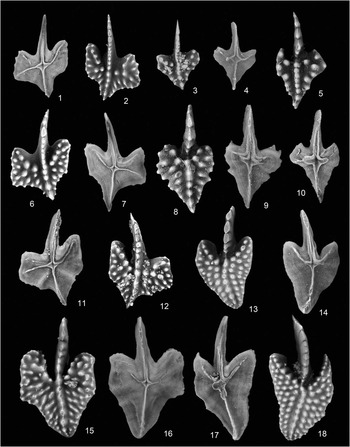
Ancyrodella rotundiloba rotundiloba (Bryant, Reference Bryant1921)
In Figures 7–12, abbreviations and locality/bed numbers refer to sampled beds (Figures 4–6; Appendix 1). Zone numbers refer to the Frasnian conodont zonation first developed in the Montagne Noire (Klapper, Reference Klapper1989) but since replicated at many sections in Devonian tropical areas (Klapper, Reference Klapper2007a).Magnifications all ×40; (1, 4, 7, 9, 10, 11, 14, 16, 17) are lower views, the rest are upper views of Pa elements. (1, 2, 6, 7, 11, 12) Ancyrodella alata Glenister and Klapper, (1, 2) USNM 608200, CP PY-7/2, Chidsey Point, Keuka Lake, Zone 4; (6, 7) USNM 608201, BP Nap-8/1, South Middlesex, Zone 4; (11, 12) USNM 608202, HB 19a/2, Fall Brook, Zone 3; (3, 4) A. africana García-López, USNM 608203, BC, 18a/5, Beards Creek, Zone 4; (5, 10) A. rotundiloba pristina Khalymbadzha and Chernysheva, USNM 608204, BC 18a/5, Beards Creek, Zone 4; (8, 9) A. rotundiloba rotundiloba (Bryant), USNM 608205, BC, 18a/5, Beards Creek, Zone 4; (13, 14, 17, 18) A. rugosa Branson and Mehl; (13, 14) USNM 608206, BP Nap-8/1, South Middlesex, Zone 4; (17, 18) USNM 608207, CP PY-7/2, Chidsey Point, Keuka Lake, Zone 4; (15, 16) A. recta Kralick, USNM 608208, HB, 19a/2, Fall Brook, Zone 3.

Polygnathus rotundilobus Bryant, Reference Bryant1921, p. 26, pl. 12, figs. 1–6, text-fig. 7 [fig. 1=lectotype, selected by Ziegler, Reference Ziegler1958, p. 44].
Ancyrodella rotundiloba rotundiloba; Khalymbadzha and Chernysheva, Reference Khalymbadzha and Chernysheva1970, p. 91, pl. 1, figs. 9–12; Huddle, Reference Huddle1981, p. B19, pl. 1, figs. 1–3, 6–8, 11–13 [figs. 1, 2= reillustration of lectotype, not figs. 4, 5, 14, 15=A. triangulata Kralick, 1994, nor figs. 16, 17=A. sp. ?], pl. 3, figs. 20, 21; Bultynck and Jacobs, Reference Bultynck and Jacobs1981, p. 17, pl. 10, figs. 1–9; Bultynck, Reference Bultynck1982, p. 38, pl. 1, fig. 26 [only], pl. 2, figs. 1, 2 [not fig. 3=A. recta Kralick, 1994].
Ancyrodella rotundiloba; late form of Klapper, Reference Klapper1985, p. 24, pl. 2, figs. 1–4, pl. 3, figs. 1–4, 12, pl. 4, figs. 9–12, pl. 8, figs. 9, 10, pl. 11, figs. 3, 4, text-fig. 3E–3J, M, N; Klapper, Reference Klapper2000, p. 158, pl. 1, figs. 6, 7, 9-14 [figs. 13, 14= reillustration of lectotype, figs. 10, 11=reillustration of Klapper, Reference Klapper1985, pl. 4, figs. 11, 12]; Uyeno and Wendte, Reference Uyeno and Wendte2005, p. 163, pl. 1, figs. 4, 5.
Ancyrodella rotundiloba; Sandberg et al., Reference Sandberg, Ziegler and Bultynck1989, p. 212, pl. 2, figs. 5, 6 [not figs. 9, 10=A. recta Kralick, 1994], pl. 3, fig. 7 [= reillustration of lectotype; not figs. 1, 2, 5, 6, 8, 9=A. recta, nor figs. 3, 4=A. sp. ?]; Kralick, 1994, p. 1387, figs.3.15–3.24 [figs. 3.21, 3.22= reillustration of lectotype], figs. 4.7, 4.8, figs. 5.3, 5.4, 5.7–5.11; Gouwy et al., Reference Gouwy, Haydukiewicz and Bultynck2007, p. 389, figs. 15E–15G.
Ancyrodella soluta Sandberg et al., Reference Sandberg, Ziegler and Bultynck1989, p. 211, pl. 2, figs. 1–4 [only; figs. 1, 2=holotype]; Liao and Valenzuela-Ríos, Reference Liao and Valenzuela-Ríos2008, p. 7, figs. 6 K, L.
Ancyrodella rotundiloba; late morphotypes of Kirchgasser, Reference Kirchgasser1994, p. 125, pl. 2, figs. L, M, Q, R.
[not] Ancyrodella rotundiloba; Gouwy and Bultynck, Reference Gouwy and Bultynck2000, p. 40, pl. 1, figs. 1, 2 [= A. recta].
Ancyrodella rotundiloba (Bryant, 1931 [sic]). Miller, Reference Miller2007, p. 447, figs. 3A–3G, 3K, 3L, 5B, 5C.
Ancyrodella pristina Khalymbadzha and Chernysheva. Miller, Reference Miller2007, p. 446, figs. 2A–2M, 3H, 3J.
Diagnosis
Pa element: Platform outline more or less heart-shaped. Denticle or several denticles just posterior of free blade substantially lower than those following to the posterior, or there is a conspicuous gap in denticulation between the blade and carina. Platform covered with numerous coarse nodes. Pit of moderate size. Secondary keels lacking or only weakly developed at right angles to keel.
Remarks
Based on Montagne Noire material, Klapper (Reference Klapper1985) recognized two morphotypes of Ancyrodella rotundiloba, an early and a late form. The early form coincides with the types of A. pristina Khalymbadzha and Chernysheva (Reference Khalymbadzha and Chernysheva1970) and the late form with the types of A. rotundiloba. The morphological differences are not substantial and there are transitional forms between the two indicating that the two taxa should be treated at the most as subspecies.
In an interpreted ontogenetic series from a single sample in the Kozhym River section in the Sub-Polar Urals identified by Miller (Reference Miller2007, fig. 2) as Ancyrodella pristina, the smaller specimens (Miller, Reference Miller2007, figs. 2N–2R) coincide with A. pristina, whereas the larger specimens (figs. 2A–2M) coincide with A. rotundiloba, especially considering the relative pit size. If this is indeed an ontogenetic series of a single taxon and not a mixture of two taxa, it suggests that the differences between A. pristina and A. rotundiloba are only at the morphotype level. Nevertheless, a key difference is the conspicuous gap in denticulation between the blade and carina commonly occurring in A. rotundiloba¸ although as already noted there is a continuous transition between the two taxa. Thus, the two are treated here as subspecies, a possibility suggested by Gouwy et al. (Reference Gouwy, Haydukiewicz and Bultynck2007, p. 389) and formally used by Aboussalam and Becker (Reference Aboussalam and Becker2007).
The holotype of Ancyrodella soluta Sandberg et al. (Reference Sandberg, Ziegler and Bultynck1989, pl. 2, figs. 1, 2) coincides with A. rotundiloba rotundiloba as interpreted herein, whereas their other identified and illustrated specimens of A. soluta coincide with A. rotundiloba pristina (see respective synonymy lists). Earlier but somewhat different interpretations of the lack of validity of A. soluta have been given by Kralick (1994, p. 1387), Klapper (Reference Klapper2000, p. 154), Gouwy et al. (Reference Gouwy, Haydukiewicz and Bultynck2007, p. 389), and Miller (Reference Miller2007, p. 450).
Ancyrodella rotundiloba pristina Khalymbadzha and Chernysheva, Reference Khalymbadzha and Chernysheva1970
Ancyrodella pristina Khalymbadzha and Chernysheva, Reference Khalymbadzha and Chernysheva1970, p. 89, pl. 1, figs. 3–8 [figs. 5–7=holotype]; Sandberg et al., Reference Sandberg, Ziegler and Bultynck1989, p. 210, pl. 1, figs. 3, 4, 9, 10, 13, 14; Gouwy et al., Reference Gouwy, Haydukiewicz and Bultynck2007, p. 389; Miller, Reference Miller2007, p. 446, figs. 2N–2T; Liao and Valenzuela-Ríos, Reference Liao and Valenzuela-Ríos2008, p. 2–3, 7, fig. 6 J [I=?].
Ancyrodella prima Khalymbadzha and Chernysheva, Reference Khalymbadzha and Chernysheva1970, p. 88, pl. 1, figs. 1, 2.
Ancyrodella rotundiloba; Kirchgasser, Reference Kirchgasser1970, p. 343, pl. 65, figs. 5, 6, 8, 9.
Ancyrodella binodosa Uyeno, Reference Uyeno1967. Bultynck and Jacobs, Reference Bultynck and Jacobs1981, p. 16, pl. 8, figs. 1–14, pl. 9, figs. 1, 2, 6 [figs. 3–5, 7, 8=transitional between A. binodosa and A. rotundiloba pristina]; Bultynck, Reference Bultynck1982, p. 38, pl. 1, figs. 18–24 [not figs. 25, 28–30=A. binodosa].
Ancyrodella rotundiloba rotundiloba; Bultynck, Reference Bultynck1982, p. 38, pl. 1, fig. 27 [only];
Ancyrodella rotundiloba; early form of Klapper, Reference Klapper1985, p. 24, pl. 1, figs. 1–20, pl. 2, figs. 5–12, pl. 3, figs. 5–9 [misprinted in original as the late form, but corrected in distributed reprints]; Klapper, Reference Klapper2000, p. 158, pl. 1, figs. 1, 5 [=reillustration of Klapper, Reference Klapper1985, pl. 3, figs. 5, 6]; Uyeno and Wendte, Reference Uyeno and Wendte2005, p. 163, pl. 1, figs. 1, 2.
Ancyrodella soluta Sandberg et al., Reference Sandberg, Ziegler and Bultynck1989, p. 211, pl. 1, figs. 5, 6, 11, 12 [only]; Liao and Valenzuela-Ríos, Reference Liao and Valenzuela-Ríos2008, p. 7, figs. 6 M-P.
Ancyrodella rotundiloba; early morphotype of Kirchgasser, Reference Kirchgasser1994, p. 125, pl. 2, figs. A–K, N–P.
Ancyrodella rotundiloba pristina Khalymbadzha and Chernysheva. Aboussalam and Becker, Reference Aboussalam and Becker2007, p. 364, figs. 9K, 9L, 9O–9R.
Diagnosis
Pa element: Platform outline more or less triangular. Conspicuous gap in denticulation between the blade and carina generally lacking. Platform covered with numerous coarse nodes in large specimens. Pit of relatively large size. Secondary keels absent or extremely short and at right angles to keel.
Remarks
Sandberg et al. (Reference Sandberg, Ziegler and Bultynck1989) indicated that A. prima also proposed by Khalymbadzha and Chernysheva (Reference Khalymbadzha and Chernysheva1970) was questionably a junior synonym. Aboussalam and Becker (Reference Aboussalam and Becker2007, p. 364) formally treated A. prima as the junior synonym, so their action as first revisers must stand regardless of page precedence.
Ancyrodella nodosa Ulrich and Bassler, Reference Ulrich and Bassler1926
Ancyrodella nodosa Ulrich and Bassler, Reference Ulrich and Bassler1926, p. 48, pl. 1, figs. 10–13 [fig. 10= lectotype, selected by Ziegler, Reference Ziegler1958, p. 44]; Ziegler, Reference Ziegler1958, p. 44, pl. 11, fig. 1; Glenister and Klapper, Reference Glenister and Klapper1966, p. 798, pl. 86, figs. 9, 10 [only]; Huddle, Reference Huddle1968, p. 6, pl. 13, figs. 7–10 [only; reillustrations of Ulrich and Bassler, Reference Ulrich and Bassler1926, pl. 1, figs. 10, 11, 13, 12, respectively]; Seddon, Reference Seddon1970b, p. 94, pl. 7, fig. 18; Szulczewski, Reference Szulczewski1971, p. 14, pl. 2, fig. 4, pl. 5, figs. 2–4 [only]; Druce, Reference Druce1976, p. 61, pl. 7, figs. 1–3, pl. 8, figs. 2, 3 [only]; Klapper and Lane, Reference Klapper and Lane1985, p. 925, figs. 14.6, 14.7, 14.10, 14.11; Baliński, Reference Baliński1979, p. 74, pl. 19, fig. 6; Dzik, Reference Dzik2002, p. 590, fig. 25 F, H [only; D, G=Ancyrodella sp. indet. juveniles; E=Ancyrodella curvata (Branson and Mehl, Reference Branson and Mehl1934) early form of Klapper, Reference Klapper1989; I=Pb, J=M elements of Ancyrodella sp. indet.].
Polygnathus spinulosa Youngquist, Reference Youngquist1947, p. 110, pl. 24, fig. 9 [= juvenile specimen].
Polygnathus rotundiloba Bryant. Youngquist, Reference Youngquist1947, p. 110, pl. 26, fig. 6 [=juvenile specimen].
Ancyrodella sp. Miller and Younguist, Reference Miller and Youngquist1947, p. 503, pl. 74, fig. 13; Müller, Reference Müller1956c, p. 1340, pl. 145, figs. 12, 14 [only].
Ancyrodella gigas Youngquist. Seddon, Reference Seddon1970b, p. 94, pl. 7, fig. 7 [only]; Bultynck and Jacobs, Reference Bultynck and Jacobs1981, p. 24, pl. 9, figs. 9–11; Klapper, Reference Klapper1985, p. 29, pl. 10, figs. 3–6, 9, 10, 13–16; Gouwy and Bultynck, Reference Gouwy and Bultynck2000, p. 40, pl. 1, figs. 9, 10 [only]; Gouwy et al., Reference Gouwy, Haydukiewicz and Bultynck2007, p. 389, fig. 15 N [only; fig. 15 M=A. gigas].
Ancyrodella gigas Youngquist form 1 of Klapper, Reference Klapper1989, p. 457; Over et al., Reference Over, Hopkins, Brill and Spaziani2003, pl. 1, fig. 5; Pisarzowska et al., Reference Pisarzowska, Sobstel and Racki2006, p. 625, fig. 13D, 13E.
Diagnosis
Pa element: Platform outline more or less triangular. Upper surface covered with coarse nodes. Secondary carinae well developed, reaching tips of anterior lobes. Nodes of secondary carinae not substantially higher than those of posterior platform. Each secondary carina meets or comes close to a slightly curved row of nodes that parallels the posterior carina and is separated from it by an adcarinal trough. Secondary keels well developed, reaching tips of anterior lobes. Pit relatively small.
Remarks
The secondary carinae join or come close to a row of nodes on either side of the posterior carina in the Pa element of A. nodosa This is well shown by the lectotype and, for example, the Canadian specimens illustrated by Klapper and Lane (Reference Klapper and Lane1985, figs. 14.6, 14.7, 14.10, 14.11). For the distinction with the morphologically closely related Ancyrodella hamata, see under the latter.
An ontogenetic series of specimens from the Montagne Noire (Klapper, Reference Klapper1985, pl. 10, figs. 3–6, 9, 10, 13–16) seems best placed in Ancyrodella nodosa although they were originally identified as A. gigas Youngquist (Reference Youngquist1947) and later termed A. gigas form 1 (Klapper, Reference Klapper1989, p. 457). They show the characteristic development of the rows of nodes parallel to the posterior carina. Such node rows are not present in the holotype of A. gigas (reillustrated in Klapper and Lane, Reference Klapper and Lane1985, fig. 14.15). The types of A. devonica García-López (Reference Garcĺa-López1986, p. 448, pl. 3, figs. 1–10) compare closely with the small specimens of the Montagne Noire growth series, as indicated in the synonymy of García-López (Reference Garcĺa-López1987, p. 60), and thus may also be synonymous with A. nodosa.
Ancyrodella hamata Ulrich and Bassler, Reference Ulrich and Bassler1926
Ancyrodella hamata Ulrich and Bassler, Reference Ulrich and Bassler1926, p. 48, pl. 7, fig. 7 [= holotype, reillustrated in Huddle, Reference Huddle1968, pl. 13, fig. 1]; Müller and Müller, Reference Müller and Müller1957, p. 1091, pl. 136, fig. 4.
Ancyrodella symmetrica Ulrich and Bassler, Reference Ulrich and Bassler1926, p. 49, pl. 8, fig. 1 [reillustrated in Huddle, Reference Huddle1968, pl. 13, figs. 2, 3].
Ancyrodella buckeyensis Stauffer, Reference Stauffer1938, p. 418, pl. 52, figs. 17, 18, 23, 24 [figs. 23, 24= lectotype, selected by Müller and Müller, Reference Müller and Müller1957, p. 1091]; Youngquist, Reference Youngquist1945, p. 356, pl. 54, fig. 11; Müller and Müller, Reference Müller and Müller1957, p. 1091, pl. 136, figs. 2, 5 [fig. 5= reillustration of Müller, Reference Müller1956c, pl. 145, fig. 13]; Ziegler, Reference Ziegler1958, p. 40, pl. 11, fig. 7; Druce, Reference Druce1976, p. 53, pl. 2, figs. 2, 5 [only]; Over, Reference Over1997, p. 172, figs. 11.1–11.9 [fig. 11.7=reillustration of lectotype; synonymy]; Over and Rhodes, Reference Over and Rhodes2000, p. 109, fig. 6.1; Klapper et al., Reference Klapper, Uyeno, Armstrong and Telford2004, p. 383, fig. 5.5 [synonymy]; Klapper, Reference Klapper2007a, tables 1–3; Over, Reference Over2007, p. 1201, figs. 11.1–11.3; Navas-Parejo et al., 2009, p. 115, figs. 3.1, 3.2.
Ancyrodella plena Stauffer, Reference Stauffer1938, p. 418, pl. 52, figs. 21, 22.
Ancyrodella robusta Stauffer, Reference Stauffer1938, p. 418, pl. 52, figs. 28, 29.
Ancyrodella lobata Branson and Mehl. Miller and Youngquist, Reference Miller and Youngquist1947, p. 502, pl. 74, figs. 10–12; Dzik, Reference Dzik2002, p. 590, fig. 27A, 27B [only].
Ancyrodella magister Miller and Youngquist, Reference Miller and Youngquist1947, p. 503, pl. 74, fig. 14.
Ancyrodella subrotunda Miller and Youngquist, Reference Miller and Youngquist1947, p. 503, pl. 74, fig. 17; Müller and Müller, Reference Müller and Müller1957, p. 1092, pl. 136, fig. 6.
Ancyrodella nodosa; Youngquist and Miller, Reference Youngquist and Miller1948, p. 441, pl. 68, figs. 13, 14; Bischoff, Reference Bischoff1956, p. 119, pl. 8, figs. 12, 15; Glenister and Klapper, Reference Glenister and Klapper1966, p. 798, pl. 86, figs. 5–8, 11, 12 [only]; Seddon, Reference Seddon1970a, p. 753, pl. 16, fig. 5; Szulczewski, Reference Szulczewski1971, p. 14, pl. 2, fig. 5 [only]; Druce, Reference Druce1976, p. 61, pl. 8, fig. 1 [only]; Orchard, Reference Orchard1978, p. 928, pl. 114, fig. 3; Mouravieff, Reference Mouravieff1982, p. 113, pl. 2, fig. 8, pl. 3, figs. 8, ?9; Fuchs, Reference Fuchs1987, pl. 3, figs. 5, 10 [only]; Uyeno, Reference Uyeno1992, p. 72, pl. 16, figs. 1–6.
Ancyrodella sp. Müller, Reference Müller1956c, p. 1340, pl. 145, fig. 13 [only].
Ancyrodella gigas Youngquist. Müller and Müller, Reference Müller and Müller1957, p. 1091, pl. 141, fig. 8 [not pl. 142, fig. 1=? juvenile of A. gigas].
Diagnosis
Pa element: Platform outline more or less triangular. Upper surface covered with coarse to fine nodes. Secondary carinae well developed, reaching tips of anterior lobes. Nodes of secondary carinae substantially higher than those of posterior platform. Secondary carinae meet carina or just short of it at the adcarinal troughs, and are not continued by a row of nodes on each side of posterior carina. Secondary keels well developed, reaching tips of anterior lobes. Pit relatively small.
Remarks
Over (Reference Over1997, p. 174, figs. 11.1–11.9) illustrated an ontogenetic series for the species called Ancyrodella buckeyensis in much of the Frasnian conodont literature. This evidence demonstrates that the lectotype of A. buckeyensis is a juvenile specimen, the mature form of which is represented by A. hamata and its many junior synonyms indicated in the above listing.
Ancyrodella hamata (=A. buckeyensis) lacks the posterior rows of nodes parallel to the carina that are present in the Pa element of A. nodosa. This was noted by Over (Reference Over1997, p. 174), Over and Rhodes (Reference Over and Rhodes2000, p. 109), and Klapper et al. (Reference Klapper, Uyeno, Armstrong and Telford2004, p. 383) as the distinction between A. buckeyensis and A. nodosa. Furthermore, the secondary carinae are higher than the posterior nodes in A. hamata, whereas they are more or less at the same height in A. nodosa. The platform outlines of the two species overlap, so this feature cannot be used consistently as a distinction.
Huddle (Reference Huddle1968) synonymyzed Ancyrodella hamata under A. nodosa and Klapper and Lane (Reference Klapper and Lane1985, p. 925) synonymyzed A. buckeyensis under A. nodosa. However, the two species can be distinguished as described above. The Pa element of Ancyrodella gigas Youngquist (Reference Youngquist1947) has a longer and narrower platform than in A. hamata.
Genus Polygnathellus Bassler, Reference Bassler1925
Type species
Polygnathellus typicalis Bassler, Reference Bassler1925 (by subsequent designation, Hass, Reference Hass1959).
Remarks
The genus Polygnathellus is rare in Frasnian faunas, apparently limited to Zone 4, and consequently poorly understood. Ulrich and Bassler (Reference Ulrich and Bassler1926, p. 53, pl. 1, figs. 1–3) described the type species of Polygnathellus, illustrating three syntypes of P. typicalis. A lectotype for the type species was first designated by Hass (Reference Hass1959, p. 380) who selected the specimen in Ulrich and Bassler (Reference Ulrich and Bassler1926, pl. 1, fig. 1). Unaware of Hass’ selection, Rhodes (in Rhodes et al., 1966, p. 4) selected the specimen of Ulrich and Bassler (Reference Ulrich and Bassler1926, pl. 1, fig. 3) as lectotype, and Huddle (Reference Huddle1968, p. 37 and explanation of pl. 4, fig. 10) chose the same specimen as did Hass. As first reviser, Hass’ designation of the lectotype must stand. This is a matter of some consequence, as the specimen in Ulrich and Bassler (pl. 1, fig. 3; reillustrated in Huddle, Reference Huddle1968, pl. 4, fig. 3) differs from what has generally been regarded as Polygnathellus. Instead it is arguably an element of the form genus Bryantodus Bassler (Reference Bassler1925), which in turn has been reconstructed as the Pb element of Ancyrodella by Klapper and Philip (Reference Klapper and Philip1972, p. 99). The effect of Rhodes’ action (in Rhodes et al., 1966, p. 4) would have made Polygnathellus a junior synonym of Bryantodus, but his action was invalid as he was not the first to select a lectotype.
Most of the specimens identified herein as Polygnathellus n. sp. are interpreted as Pa elements. Admittedly there is a similarity to a Pb element such as Nothognathella Branson and Mehl (Reference Branson and Mehl1934), which is well established as the Pb element of many species of Palmatolepis, as well as the Pb element of Mesotaxis. Nevertheless, typical Pb elements accompany the Pa elements in one of our Australian collections. This evidence refutes the opinion of Klapper (in Clark et al., 1981, p. W178) in which Polygnathellus was treated as a senior synonym of Nothognathella and mistakenly regarded as a Pb element.
Polygnathellus n. sp.
Figures 10.15–10.18; 11.1–11.4
Diagnosis
Pa element: Carinal denticles posterior of cusp extremely low. Inner platform wide with downward flange-like projection at central part of inner margin.
Remarks
The Pa element of Polygnathellus n. sp. is moderately arched anteriorly and more sharply posterior of the cusp. The cusp is commonly distinct and higher than the carinal denticles and the inner platform is wide. The downward flange at the inner margin centrally is either in the shape of a downward convex curve or it is a double convex curve demarcated by an intermediate sinus. The carina is sinuous and there is a distinct and moderately wide adcarinal trough anteriorly. A strong keel is present anterior and posterior of the evidently small pit that is covered by basal plate material in our Australian material, but is visible and small in the New York specimens.
There are three specimens of an accompanying Pb element in one of the Australian collections of the new species (Timanites Hill, 370B). The unit is moderately arched, slightly less than in the Pa element, with some downward arching posteriorly. The carinal denticles are very high anteriorly and extremely low posteriorly as in the Pa element, a unifying characteristic. There is a narrow inner platform in the Pb element.
The carinal denticles posterior of the cusp are strikingly lower in the Pa element of the new species in contrast with those of normal height in Polygnathellus typicalis Bassler (reillustrations in Huddle, Reference Huddle1968, pl. 4, figs. 6, 10). Another critical difference is the lack of a downward flange at the inner margin of the platform in the established species.
There are two Pa elements in the New York collections (Chidsey Point, sample 4046). At Timanites Hill in Western Australia, there is one Pa element in sample 370A, five Pa and 3 Pb elements in 370B. There is an obvious difference in the posterior termination of the platform in the Pa element in comparison of the specimens in Figures 11.1 and 11.2 versus that of Figures 10.17, 10.18 (two views of the same specimen). However, there is far too little material to determine the range of intraspecific variation and whether we are dealing with one or two new species, let alone to establish a formally named species. Thus, these specimens are retained in open nomenclature provisionally as one species.
Genus Palmatolepis Ulrich and Bassler, Reference Ulrich and Bassler1926
Palmatolepis amplificata Klapper, Kuz’min, and Ovnatanova, Reference Klapper, Kuz’min and Ovnatanova1996
Palmatolepis (Manticolepis) flabelliformis (Stauffer, Reference Stauffer1938). Müller and Müller, Reference Müller and Müller1957, p. 1101, pl. 139, figs. 3, 5, 6 [not fig. 4=P. rhenana Bischoff, Reference Bischoff1956].
Palmatolepis gigas Miller and Youngquist. Seddon, Reference Seddon1970b, p. 102, pl. 11, fig. 10; Szulczewski, Reference Szulczewski1971, p. 31-32, pl. 11, figs. 2, 5 [only]; Austin et al., Reference Austin, Orchard and Stewart1985, p. 150, pl. 4.6, figs. 8, 9 [only; re-illustration of Matthews and Riddolls, see below]; Ovnatanova and Kuz’min, Reference Ovnatanova and Kuz’min1991, p. 49, pl. 3, fig. 18.
Palmatolepis punctata (Hinde, Reference Hinde1879) transitional to P. gigas Miller and Youngquist, Seddon, Reference Seddon1970b, p. 102, pl. 11, fig. 11.
Palmatolepis subrecta Miller and Youngquist. Hass, Reference Hass1959, pl. 50, fig. 22; Seddon, Reference Seddon1970b, p. 102, pl. 11, fig. 4; Matthews and Riddolls, in Selwood et al., 1984, p. 34, pl. 6, figs. 13, 15 [only].
Palmatolepis aff. P. rhenana Bischoff, Reference Bischoff1956. Klapper and Lane, Reference Klapper and Lane1989, p. 474, pl. 1, figs. 11, 13 [not pl. 1, figs. 10, 12=P. brevis Ziegler and Sandberg, Reference Ziegler and Sandberg1990].
Palmatolepis kireevae Ovnatanova, Reference Ovnatanova1976. Klapper and Lane, Reference Klapper and Lane1989, p. 474, pl. 1, fig. 7.
Palmatolepis amplificata Klapper et al., Reference Klapper, Kuz’min and Ovnatanova1996, p. 140, figs. 7.1, 7.2, 7.4 [fig. 7.2= holotype; synonymy]; Ovnatanova et al., Reference Ovnatanova, Kuz’min and Menner1999, p. 356, pl. 2, figs. 7, 10; Ovnatanova and Kononova, Reference Ovnatanova and Kononova2008, p. 1087, pl. 9, figs. 1–9 [figs. 1–3=figs. 7.2, 7.1, 7.4 of Klapper et al., Reference Klapper, Kuz’min and Ovnatanova1996].
Palmatolepis manzuri Bardashev, Reference Bardashev2009, p. 302, pl. 7, fig. 7.
Diagnosis
Pa element: Outline of platform roughly triangular. Outer lobe wide, midline of lobe directed laterally, well demarcated by anterior and posterior sinuses. Outer posterior margin convex to weakly convex between first sinus and posterior tip, a second sinus weakly developed in front of tip. Blade much higher than anterior carina, together outwardly curved to almost straight. Posterior carina almost straight to angled inwardly, may reach posterior tip or short of that lying in a shallow groove. Parapet on anterior inner platform consisting of a cluster of nodes, or straight to curved row of nodes. Secondary carina developed in mature specimens.
Remarks
In a comprehensive synonymy list, Ziegler and Sandberg (Reference Ziegler and Sandberg1990, p. 54) continued the then long-standing practice of including within the concept of Palmatolepis gigas almost any Frasnian named species of Palmatolepis based on a Pa element with a widely expanded outer lateral lobe. This concept began after W. Ziegler’s study of the holotype in the University of Iowa collections in October 1961, as a result of which he regarded P. rhenana Bischoff (Reference Bischoff1956) as a junior synonym of P. gigas, despite the distinctly different platform outlines. His study of the P. gigas holotype was too late to affect the nomenclature in Ziegler (Reference Ziegler1962), the proofs of which he had already returned; the change was noted in Ziegler (Reference Ziegler1971, p. 267). Ziegler and Sandberg (Reference Ziegler and Sandberg1990), however, treated the two as separate species due to their different outlines and different lateral profiles of the blade, among other features. But in their synonymy list they considered many specimens and different species such as P. unicornis Miller and Youngquist (Reference Miller and Youngquist1947) as falling within the concept of P. gigas. The holotype, which is the sole specimen in the Sweetland Creek collection identified by Miller and Youngquist (Reference Miller and Youngquist1947) as P. gigas, has not been matched by any subsequently illustrated specimen, especially in terms of the unique platform outline. This uniqueness of the platform outline of the holotype was discussed by Klapper and Foster (Reference Klapper and Foster1993, p. 31–32) in their shape analysis of potentially related species of Palmatolepis. They concluded that “the overall morphology of the P. gigas holotype suggests that it can be interpreted as a large, aberrant Pa element of P. winchelli.” Klapper (Reference Klapper2007a, p. 529, 531) formally considered P. gigas as a junior synonym of P. winchelli (Stauffer, Reference Stauffer1938).
Palmatolepis amplificata Klapper et al. (Reference Klapper, Kuz’min and Ovnatanova1996) here includes the Iowa Amana beds specimens identified as P. flabelliformis Stauffer (Reference Stauffer1938) by Müller and Müller (Reference Müller and Müller1957), though that expands the concept somewhat. However, the New York material of P. amplificata (Fig. 12.8–12.15) provides a link between the Timan types and the Iowa specimens. And the Amana specimen of Müller and Müller (Reference Müller and Müller1957, pl. 139, fig. 3) with the extremely wide lobe provides a further link to the central Texas specimen illustrated by Seddon (Reference Seddon1970b, pl. 11, fig. 10) and the Devon specimen of Matthews and Riddolls (Reference Matthews and Riddolls1984, pl. 6, figs. 13, 15). Additional specimens illustrated by Seddon (Reference Seddon1970b, pl. 11, figs. 4, 11) agree well with the Timan and New York examples of the species; the specimen identified as P. subrecta Miller and Youngquist (Seddon, Reference Seddon1970b, pl. 11, fig. 4) has the following characteristics of the species: strong anterior inner parapet, the posterior carina lying in a narrow trough near the posterior end, and the distal part of the secondary carina curved slightly to the posterior.
The holotype of Pamatolepis manzuri Bardashev (Reference Bardashev2009, pl. 7, fig. 7) is closely comparable if not identical to the center of the range of variation of P. amplificata, yet a comparison of the two species was not discussed originally. Other specimens assigned to P. manzuri (e.g., Bardashev, Reference Bardashev2009, pl. 7, figs. 1, 4, 13, 16) are likely also synonymous with P. amplificata.
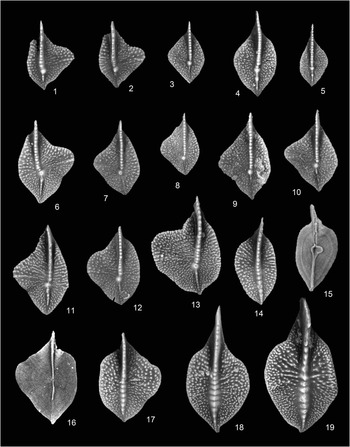
Magnifications all ×40; all are upper views of Pa elements, except 15 and 16 are lower views. (1, 2) Palmatolepis spinata Ovnatanova and Kuz’min, USNM 608209, 608210, SH 41a/5, North McMillan Creek, Zone 6; (3–5) P. transitans Müller, USNM 608211-608213, WS 42/1, Whetstone Brook, Zone 5; BC 18a/5, Beards Creek, Zone 4; BP Nap-8/1, South Middlesex, Zone 4; (6–13) P. punctata (Hinde), USNM 608214-608221; (6, 11) SH 41a/5, North McMillan Creek, Zone 6; (7) 44/3, Randall Gully, Zone 5; (8, 9) WS 42/1, Whetstone Brook, Zone 5; (10) PL 47/2, Conklin Gully, Zone 5; (12, 13) BK 65/1, Buck Run Creek, Zone 7; (14, 15) Mesotaxis ovalis (Ziegler and Klapper), USNM 608222, BP Nap-8/1, South Middlesex, Zone 4; (16, 17) M. asymmetrica (Bischoff and Ziegler) transitional with Palmatolepis transitans Müller, USNM 608223, BC 18a/5, Beards Creek, Zone 4; (18, 19) M. asymmetrica, USNM 608224, 608225, BP Nap-8/1, South Middlesex, Zone 4; CP PY-7/2, Chidsey Point, Zone 4.

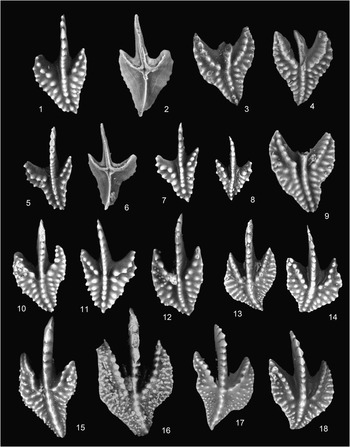
Magnifications all ×40; all are upper views of Pa elements, except 2 and 6 are lower views. (1–12) Ancyrodella nodosa Ulrich and Bassler; (1, 2, 7, 8, 11, 12) USNM 608226-608230, PL 47/2, Conklin Gully, Zone 5; (3, 4) paralectotype and lectotype , USNM 145871, 11303, new photographs (see also Huddle [Reference Huddle1968, p. 6, pl. 13, figs. 10, 7]), Rhinestreet Shale=BR 30b/1, Acme Shale Co. pit, Weyer of this report, Zone 6; (5, 6) USNM 608231, 44/3, Randall Gully, Zone 5; (9, 10) USNM 608232-608233, SH 41a/5, North McMillan Creek, Zone 6; (13–18) A. hamata Ulrich and Bassler; (13, 16) SUI 5524c, 5525, new photographs, originally illustrated by Miller and Youngquist, Reference Miller and Youngquist1947, pl. 74, figs. 12, 14 and identified by them as A. lobata and the holotype of A. magister (see synonymy), Sweetland Creek, Iowa (Appendix 1); (14, 18) USNM 608234-608235, BM 92/5, Beaver Meadow Creek, Zone 13b; (15, 17) USNM 608236-608237, RL 60/3, Relyea Creek, Zone 11.

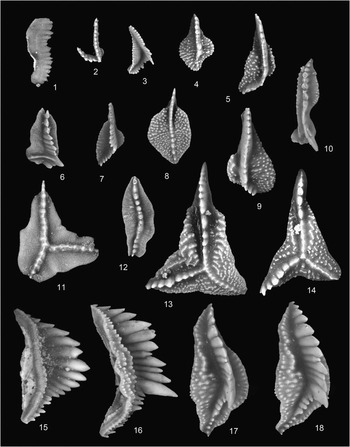
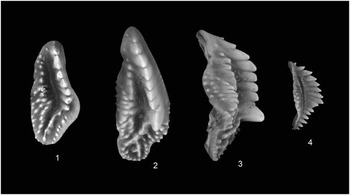
Magnifications all ×40; (1, 15, 16) lateral views, (3, 6, 18) oblique-upper views, the rest are upper views. All are Pa elements, except (3–5, 7, 9, 15, which are Pb elements. (1) Ozarkodina bidentatiformis (Pham), USNM 608238, BR 30a/12, Pike Creek, Zone 6; (2) O. nonaginta Klapper, Kuz’min, and Ovnatanova, USNM 608239, CT 32/23, Cazenovia Creek Tributary, Zone 7; (3) Palmatolepis spinata Ovnatanova and Kuz’min, USNM 608240, SH 41a/5, North McMillan Creek, Zone 6; (4) P. punctata (Hinde), USNM 608241, PL 47/2, Conklin Gully, Zone 5; (5, 9) Mesotaxis asymmetrica (Bischoff and Ziegler), USNM 608242-608243, BP Nap-8/1, South Middlesex, Zone 4, CP PY-7/2, Chidsey Point, Zone 4; (6) Ancyrognathus primus Ji, USNM 608244, SH 41a/5, North McMillan Creek, Zone 6; (7) P. punctata?, USNM 608245, SH 41a/5, North McMillan Creek, Zone 6; (8) M. johnsoni Klapper, Kuz’min, and Ovnatanova, USNM 608246, WS 42/1, Whetstone Brook, Zone 5; (10) Ancyrognathus? deformis (Anderson), USNM 608247, SG 80/14 , Stony Brook, Varysburg (Gassman Road), Zone 12; (11) A. primus Ji, USNM 608248, CT 32/23, Cazenovia Creek Tributary, Zone 7; (12) A. ancyrognathoideus (Ziegler), USNM 608249, BK 65/1, Buck Run Creek, Zone 7; (13) A. triangularis Youngquist, USNM 608250, SF 79/10, Stony Brook, Varysburg, Zone 12; (14) A. iowaensis Youngquist, USNM 608251, RL 60/3, Relyea Creek, Zone 11; (15–18) Polygnathellus n. sp. (15) GSWA F52034, Timanites Hill, Canning Basin, sample 370B, Zone 4; (16–18) GSWA F52035, Timanites Hill, sample 370A, Zone 4.

Magnifications all ×20; (1, 2) upper views; (3, 4) lateral views. All are Pa elements, except (4), which is a Pb element. Polygnathellus n. sp. (1) USNM 608252, CP PY-7/2, Chidsey Point, Zone 4; (2, 3) GSWA F52036, Timanites Hill, Canning Basin, sample 370B, Zone 4; (4) GSWA F52037, same sample as preceding.

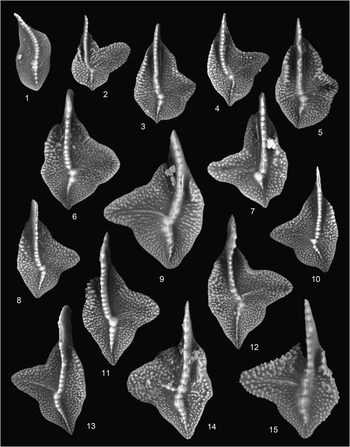
Magnifications all ×40; all are upper views of Pa elements. (1) Palmatolepis linguiformis Müller, USNM 608253, IL 90/2, Irish Gulf, Zone 13b; (2) P. semichatovae Ovnatanova, USNM 608254, RL 60/3, Relyea Creek, Zone 11; (3, 5) P. foliacea Youngquist, USNM 608255-608256, SG 80/14, Stony Brook, Varysburg (Gassman Road), Zone 12; (4) P. hassi Müller and Müller s.s., USNM 608257, CB 92/2, Beaver Meadow Creek, Zone 12; (6) P. hassi Müller and Müller s.l., USNM 608258, RL 60/3, Relyea Creek, Zone 11; (7) P. winchelli (Stauffer), USNM 608259, BM 92/5, Beaver Meadow Creek, Zone13b; (8–15) P. amplificata Klapper, Kuz’min, and Ovnatanova, USNM 608260-608267; (8, 14) SF 79/8a, Stony Brook, Varysburg, Zone 12; (9, 15) SG 80/14, Stony Brook, Varysburg (Gassman Road), Zone 12; (10) SF 79/10, Stony Brook, Varysburg, Zone 12; (11–13) RL 60/3, Relyea Creek, Zone 11.

Acknowledgments
We thank J. Repetski (U.S. Geological Survey, Reston) for loan of conodont slides of the samples collected by J. Huddle in 1974. G. Baird (SUNY Fredonia), C. Brett (Cincinnati University) and D.J. Over (SUNY Geneseo) are thanked for collaborations over many years on the stratigraphy of the Upper Givetian and Frasnian in western New York. C.A. Sandberg (emeritus at the U. S. Geological Survey, Denver) provided much encouragement for the completion of this study and specifically discussed the taxonomic problem surrounding Polygnathellus and its relation to the Pb elements of Palmatolepis and Mesotaxis. We thank Neo McAdams (University of Iowa) for her indispensable help with the Visionary Digital BK Lab System (http://www.visionarydigital.com/IntegratedSystems2.html). This was especially so in her running the software that composites the multiple images taken at different focal planes. We also thank Tiffany Adrain, curator of the conodont and other fossil collections at Iowa, for her expert assistance. Sofie Gouwy (Royal Belgium Institute of Natural Sciences, Brussels) generously provided advice for the running of GraphCor on Windows XP and 7, for which it was not designed. The GraphCor program was designed by Kenneth Hood in the late 1980s and revised until 1995 (version 3.0). We thank Curt Klug who processed and picked the samples G.K. collected with W.K. in 1989 and 1991. Partial funding from NSF grants EAR87-06567 (to G.K.) and EAR89-03475 (to G.K.; supplemented by an NSF ROA to W.T.K., 1990-91) and grants to W.T.K. from SUNY Potsdam. We are indebted for comments by D.J. Over and an anonymous reviewer.
Appendix 1. Localities
New York localities and sampled beds listed in approximate stratigraphic order. Sample numbers in the Genesee Group with SD notation (Silurian-Devonian) refer to United States Geological Survey (U. S. G. S.) samples in deWitt and Colton (Reference De Witt and Colton1978) and Huddle (Reference Huddle1981). U. S. G. S. SD samples in the Sonyea and West Falls groups were collected in 1974 by John Huddle (JH) of the U. S. G. S. and U. S. National Museum and William Kirchgasser (WK). Among other collectors were James Kralick (JK) and Gilbert Klapper (GK); the names of less frequently cited collectors are written out; these follow the sample numbers at end of each locality description. Locality, bed and sample numbers from New York follow Kirchgasser (Reference Kirchgasser1965, Reference Kirchgasser1967), Klapper et al. (Reference Klapper, Kirchgasser and Baesemann1995) and House and Kirchgasser (Reference House and Kirchgasser1993, Reference House and Kirchgasser2008); asterisk (*) indicates horizon is identified in illustrated section. Latitude and Longitude values from Google Earth. Iowa and Australian localities listed separately after those of New York.
Most of the samples were collected before the metric system became the preferred scale for measurement of distance and bed and section thickness in New York stratigraphy. Later collecting used the metric system directly. The English-scale measurements have been converted to the metric scale with the necessary rounding and are not given in the locality descriptions.
NEW YORK
UG: Genundewa Point, Canandaigua Lake, Yates County, NY, Middlesex 7.5’ Quad., NE ¼ NAPLES 15’ Quad. Genundewa Limestone (Genesee Group), Upper Genundewa (UG), Bed 23b/6. Type locality of Genundewa Limestone along east side of Canandaigua Lake (opposite Seneca Point on west side of lake), north of Genundewa Point [42°44’15.60”N, 77°19’31.11”W], 900, East Lake Road, 1.6 km north of Vine Valley. Genundewa Limestone at this locality is a 2.43 m interval of styliolinid lenses alternating with gray shales that overlie a 10 cm-thick black shale (House and Kirchgasser, Reference House and Kirchgasser2008, p. 29); sample bed 6715 SD is the bed immediately above the 10 cm black shale in the section of deWitt and Colton (Reference De Witt and Colton1978, pl. 4*). Conodont Sample 6718-SD of Huddle (Reference Huddle1981) [=Bed 23b/5 of House and Kirchgasser (Reference House and Kirchgasser2008)] is a baritic, styliolinid ledge with the goniatite Tornoceras common, which lies between 1.14 and 1.45 m above the 10 cm black shale. Conodont Sample 3958-SD of Huddle (Reference Huddle1981) [=Bed 23b/6 of House and Kirchgasser (Reference House and Kirchgasser2008)], is from a prominent ledge of styliolinid limestone with poor barite-replaced goniatites, 1.96 to 2.13 m above the base of the Genundewa; the top of the bed dips below lake level about 43 m north of the point. The top of Bed 23b/6 underlies a 30 cm interval of thin styliolinid limestones that is taken as the top bed of the Genundewa Limestone. Locality Nap-4 of deWitt and Colton (Reference De Witt and Colton1978, 6718-SD and 3958-SD, pl. 4*). Goniatite Division: Timanites (Frasnian I-C); NY Regional Zone: Manticoceras contractum (17a). Frasnian Conodont Zone 3.
Sample: Bed 23b/5: 6718-SD: W. H. Hass, 2 of 9.18.57 (Huddle, Reference Huddle1981, p. B51, table 1, sheet 5). Sample: Bed 23b/6: 3958-SD: W. H. Hass, 2 of 9.12.56 (Huddle, Reference Huddle1981, p. B51, table 1, sheet 5).
HB: Fall Brook, Geneseo, Livingston County, NY, Geneseo 7.5′ Quad., SE ¼ CALEDONIA 15′ Quad. Lower West River Shale (Genesee Group), Huddle Bed (HB), Bed 19a/2 of House and Kirchgasser (Reference House and Kirchgasser2008 p. 30, 31; fig. 9*). Five cm-thick styliolinid bed, 2.3 m above the top of the Genundewa Limestone (caprock of high falls) in Fall Brook Creek, upstream (east) of NY Rte. 63 overpass at 42°46'28.23"N 77°49'38.63"W, about 2.4 km south of Geneseo. Horizon about 28 m above base of Geneseo Shale (Genesee Group). Sample 8122-SD of deWitt and Colton (Reference De Witt and Colton1978, plate 2*); Huddle (Reference Huddle1981, p. B-52). Lower West River Shale (LWR) of Kirchgasser et al. (Reference Kirchgasser, Over and Woodrow1994, p. 354, figs. 3*, 10*). Huddle Bed of Baird et al. (Reference Baird, Kirchgasser, Over and Brett2006, p. 380-381, fig. 10*), named in honor of John Huddle. Bed H of Zambito et al. (Reference Zambito, Baird, Brett and Bartholomew2007, p. 96, fig. 4*), in microcycle 2 of the 23 West River Shale microcycles, and Zambito et al. (Reference Zambito, Baird, Brett and Bartholomew2009, p. 64, fig. 6*). Goniatite Division: Timanites (Frasnian I-C); NY Regional Zone: Manticoceras contractum (17a). Frasnian Conodont Zone 3.
Samples: Bed 19a/2: 8122-SD: W. H. Hass 2 of 9.21.57=4062: WK 2 of 8.30.90.
BP: South Middlesex, Middlesex, Yates County, NY, Middlesex 7.5′ Quad., NE ¼ NAPLES 15′ Quad. Middle West River Shale, Bluff Point Bed (BP), informal name herein, Bed Nap-8/1 of House and Kirchgasser (Reference House and Kirchgasser2008, p. 32). Loose, 8 cm-thick fossil-log styliolinid concretion, with pyrite, barite, plant debris and rich fauna of conodonts, gastropods, lingulids and goniatites. Probably from line of concretions 3 m below the 5 cm-thick, convolute-bedded Bluff Point Siltstone that crops out about 6 m above where exposures begin in the creek that crosses NY Rte. 245 at 42°41’39.50”N 77°16’45.52”W, 1.3 km south of village of Middlesex. Horizon lies between two 8 cm-thick black shales that define the first sedimentary microcycle (microcycle 13) below the microcycle with the Bluff Point Siltstone (microcycle 14). Bed Nap-8/1 is about 21 m below base Middlesex Shale in microcycle 13 of the 23 West River Shale microcycles. Locality Nap-8 of deWitt and Colton (Reference De Witt and Colton1978). Goniatite Division Timanites (Frasnian I-C); NY Regional Zone: Koenenites beckeri (17b). Frasnian Conodont Zone 4.
Samples: Bed Nap-8/1: 3884: WK 5 of 7.31.77, 5 of 5.28.79=4058: WK 1 of 8.27.90.
WB: Snyder’s Gully, Woodville, Ontario County, NY, Middlesex 7.5′ Quad., NE ¼ NAPLES 15′ Quad. Upper West River Shale, Williamsburgh Bed (WB), Bed 46c/1 of House and Kirchgasser (Reference House and Kirchgasser2008, p. 30, 31, fig. 9*). Fossil-log styliolinid concretionary bed (22 cm-thick), with goniatites and abundant lingulid brachiopods, in dark gray shales of the upper West River Shale. The base of the bed is 4.97 m below base Middlesex Shale, in Snyder’s or Snyder Gully, southwest end of Canandaigua Lake, which is crossed by NY Rte. 21 at 42°39’54.81”N 77°21’53.52”W, 0.5 km south of Woodville. Top of bed is .90 m below a 10 cm-thick black shale. Probable equivalent of Williamsburgh Bed of Over et al. (Reference Over, Hopkins, Brill and Spaziani2003) and Bed 18a/4b of House and Kirchgasser (Reference House and Kirchgasser2008, p. 31, FL: fig. 9*) at Beards Creek (see following locality). Microcycle 18 of the 23 West River Shale microcycles. Goniatite Division Timanites (Frasnian I-C); NY Regional Zone: Koenenites beckeri (17b). Frasnian Conodont Zone 4.
Sample: Bed 46c/1: 4056: WK 2 of 8.26.90.
BC: Beards Creek, Leicester, Livingston County, NY, Leicester 7.5′ Quad., SW ¼ CALEDONIA 15′ Quad. Upper West River Shale, Beards Creek Horizon (BC), Bed 18a/5 of House and Kirchgasser (Reference House and Kirchgasser2008, p. 30, 31, fig. 9*). Prominent septarian concretion bed, 2.4 m below base Middlesex Shale in upper Beards Creek, above Dunkley Road bridge that crosses the creek at 42°46’27.91”N 77°54’51.85”W, about 1.6 km northwest of Leicester. Microcycle 19-20 of 23 West River Shale microcycles. Goniatite Division: Timanites (Frasnian I-C); NY Regional Zone: Koenenites beckeri (17b). Frasnian Conodont Zone 4.
Samples: Bed 18a/5: M. R. House and WK, horizon 10 of 7.30.65=3948: WK 4 of 4.21.75.
CP: Chidsey Point, Keuka Lake, Branchport, Yates County, NY, Pulteney 7.5′ Quad., SW ¼ PENN YAN 15′ Quad. Upper West River Shale, Chidsey Point Bed (CP), informal unit named herein, Bed Py-7/2 of House and Kirchgasser (Reference House and Kirchgasser2008, p. 32-33). Pyritic and baritic fossil-log, styliolinid, concretion bed with goniatites, 3.4 m below base Middlesex Shale in creek crossing NY Rte. 54A at 42°34’27.66”N 77°09’04.25”W, above Chidsey Point, West Branch Keuka Lake, 2.7 km south of Branchport. Graphic correlation indicates horizon is not a correlative of Williamsburgh Bed (WB) at Beards Creek, Bed 18a/4b of House and Kirchgasser (Reference House and Kirchgasser2008, p. 30, 31, fig. 9*), but instead graphs to a position above the Beards Creek Horizon (BC) (Fig. 3). [The productive Sample 6754-SD of Huddle (Reference Huddle1981, table 1, sheet 6) and of deWitt and Colton (Reference De Witt and Colton1978, pl. 6*) is the 5 cm-thick, pyritic, styliolinid band, 6.7 m below base Middlesex Shale]. Goniatite Division Timanites (Frasnian I-C); NY Regional Zone: Koenenites beckeri (17b). Frasnian Conodont Zone 4.
Sample: Bed Py-7/2: 4046: WK 1 of 6.1.90.
30/1: Eighteenmile Creek, North Evans, Erie County, NY, Eden 7.5′Quad., NW ¼ EDEN 15′ Quad. Base Cashaqua Shale (Sonyea Group), Bed 30/1 of House and Kirchgasser (Reference House and Kirchgasser2008, p. 35, fig. 10*). Concretion-bed at base Cashaqua Shale, immediately above top Middlesex Shale, in south bank of creek about 183 m upstream (east side) of the railroad bridge at 42°41”15.21”N 78°56’50.93”W, below North Evans. Horizon is 13 m below base Rhinestreet Shale (West Falls Group). Goniatite Division: Probeloceras (Frasnian I-E); NY Regional Zone: Probeloceras lutheri (19). Frasnian Conodont Zone 5.
Samples: Bed 30/1: WK 9.24.64=12057-SD: JH and WK 5 of 8.9.74.
WS: Whetstone Brook, Honeoye, Ontario County, NY, Honeoye 7.5′Quad., SE ¼ HONEOYE 15′ Quad. Base Cashaqua Shale, Whetstone Brook Bed (WS), informal name herein, Bed 42/1 of House and Kirchgasser (Reference House and Kirchgasser2008, Fig. 10*). Silty, calcareous, concretion-bed, 8-15 cm-thick, with abundant styliolinids and annulated dacryoconarids (“tentaculites”) near base Cashaqua Shale, 0.30 m above topmost siltstones of the Rock Stream Siltstone, which cap the first falls in Whetstone Brook, upstream of U. S. Rte. 20A crossing at 42°47’20.06”N 77°33’23.27”W, 3.2 km west of Honeoye. Bed is about 40 m below base Rhinestreet Shale (West Falls Group). Goniatite Division: Probeloceras (Frasnian I-E); NY Regional Zone: Probeloceras lutheri (19). Frasnian Conodont Zone 5.
Samples: Bed 42/1: WK 8.20.63=4000: WK 3 of 5.25.87.
44/3: Randall Gully, Bristol Center, Ontario County, NY, Bristol Center 7.5′ Quad., SW ¼ CANANDAIGUA 15′ Quad. Cashaqua Shale, Bed 44/3 of House and Kirchgasser, Reference House and Kirchgasser2008 (p. 41, fig. 10*). Concretion-bed (38 mm-thick) in floor of creek, with baritized goniatites, about 6.4 m above base Cashaqua Shale (top Rock Stream Siltstone (elevation ~1120 ft), in Randall Gully, below Dugway Road; 2.4 m above a pair of thin siltstones at the top of a 4-m interval of silty shale. Bed 44/3 is about 28 m below base Rhinestreet Shale (West Falls Group). NY Rte. 64 crosses Randall Gully at 42°46’33.61”N 77°24’13.69”W, 4 km south of Bristol Center. Goniatite Division: Probeloceras (Frasnian I-E); NY Regional Zone: Probeloceras lutheri (19). Frasnian Conodont Zone 5.
Sample: Bed 44/3: WK 8.15,19.63.
42/5: Whetstone Brook, Honeoye, Ontario County, NY, Honeoye 7.5′Quad., SE ¼ HONEOYE 15′ Quad. Cashaqua Shale, Bed 42/5 of House and Kirchgasser (Reference House and Kirchgasser2008, p. 40, fig. 10*). Concretion bed with baritized goniatites in floor of Whetstone Brook, upstream of U S Rte. 20A crossing at 42°47’20.06”N 77°33’23.27”W, 3.2 km west of Honeoye. Bed 42/5 is about 6.7 m above first marker black shale in section and 30 m below base Rhinestreet Shale (West Falls Group). Goniatite Division: Probeloceras (Frasnian I-E); NY Regional Zone: Probeloceras lutheri (19). Frasnian Conodont Zone 5.
Sample: Bed 42/5: WK 8.20, 21.63.
43/3: Briggs Gully, Honeoye Lake, Ontario County, NY, Springwater and Bristol Springs 7.5′Quads., NE 1/4 WAYLAND and NW ¼ NAPLES 15′ Quads. Cashaqua Shale, Bed 43/3 of House and Kirchgasser (Reference House and Kirchgasser2008, p. 40, fig. 10*). Horizon of small concretions with baritized goniatites in third stream north of Briggs Gully, crossed by East Lake Road (southeast side of Honeoye Lake) at 42°43’21.50”N 77°30’06.41”W. Horizon is 7.9 m above first marker black shale in section, 2.4 m above a thin, prominent siltstone, and 20 m below base Rhinestreet Shale (West Falls Group). Goniatite Division: Probeloceras (Frasnian I-E); NY Regional Zone: Probeloceras lutheri (19). Frasnian Conodont Zone 5.
Sample: Bed 43/3: WK 8.19.63.
PL: Conklin Gully, Naples, Ontario County and Yates County, NY, Middlesex 7.5′ Quad., NE ¼ NAPLES 15′ Quad.: Parrish Limestone (PL), type locality, Bed 47/2 of House and Kirchgasser (Reference House and Kirchgasser2008, p. 42, fig. 10*). Distinctive, red-green, nodular limestone (10.2 cm-thick) (Knollenkalk) with goniatites, 2.1 m above first falls and Rock Stream Siltstone-Cashaqua Shale contact, in Conklin (formerly Parrish) Gully southeast of intersection of Rumpus (Parish) Hill Road and NY Rte. 245 overpass at 42°38’07.44”N 77°22’02.58”W, 6.7 km northeast of Naples. Goniatite Division: Probeloceras (Frasnian I-E); NY Regional Zone: Probeloceras lutheri (19). Frasnian Conodont Zone 5.
Samples: Bed 47/2: WK 1962-1963=4066: WK and JK 1 of 5.30.90.
44/4: Randall Gully, Bristol Center, Ontario County, NY, Bristol Center 7.5′ Quad., SW ¼ CANANDAIGUA 15′ Quad. Cashaqua Shale, Bed 44/4 of House and Kirchgasser (Reference House and Kirchgasser2008, p. 41, fig. 10*). Argillaceous limestone lens (5-10 cm-thick) with goniatites, 2.3 m above a thin but prominent siltstone cropping out about 2 m above where a side stream enters Randall Gully from the north at about 1170 ft. elevation, in section below Dugway Road. NY Rte. 64 crosses Randall Gully at 42°46’33.61”N 77°24’13.69”W, 4 km south of Bristol Center. Bed 44/4 is about 14.6 m below base Rhinestreet Shale (West Falls Group). Goniatite Division: Probeloceras (Frasnian I-E); NY Regional Zone: Probeloceras lutheri (19). Frasnian Conodont Zone 5.
Sample: Bed 44/4: WK 8.15,19.63.
SH: North McMillan Creek, Conesus Lake, Livingston County, NY, Conesus 7.5′ Quad., NE ¼ WAYLAND 15′ Quad. Upper Cashaqua Shale, Shurtleff Septarian Horizon (SH), Bed 41a/5 of House and Kirchgasser (Reference House and Kirchgasser2008, p. 40). Septarian concretion horizon with baritized (pink and white) goniatites and other mollusk groups, in north bank of North McMillan Creek that is crossed by East Lake Road (southeast end of Conesus Lake) at 42°43’23.32”N 77°42’08.39”W. Horizon is 1.37 m below base Rhinestreet Shale (West Falls Group) (~880 ft elev.). Goniatite Division: Prochorites (Frasnian I-F); N. Y. Regional Zone Prochorites alveolatus (20). Frasnian Conodont Zone 6.
Samples: Bed 41a/5: WK 8.27.63=4043: WK 2 of 5.25.87; JH and WK 1 of 8.7.74.
BR: Acme Shale Co. pit, Weyer (formerly Shaleton), Erie County. Eden 7.5′Quad., NW ¼ EDEN15′ Quad. Rhinestreet Shale (West Falls Group). Base Rhinestreet Shale (BR), Bed 30b/1. Interval (0.0-0.15 m-thick) of black shale at top of abandoned shale pit at Weyer. East wall at about 42°43’29.53”N 78°54’58.77”W. Locality of Ulrich and Bassler (Reference Ulrich and Bassler1926, p. 3) cited in Huddle (Reference Huddle1968, p. 1-2). Goniatite Division: Prochorites (Frasnian I- F); NY Regional Zone Prochorites alveolatus (20). Frasnian Conodont Zone 6.
Sample: Bed 30b/1: 4247: WK 9.3.64
BR: Pike Creek, Jerusalem Corners, Erie County, NY, Angola 7.5′ Quad., NE ¼ SILVER CREEK 15′ Quad. Base Rhinestreet Shale (BR), Bed 30a/12. Fissile black shale, 46 cm above base Rhinestreet Shale, above a low falls in Pike Creek, upstream (north) of Lake Shore Road, 2.1 km northeast of Jerusalem Corners. Pike Creek is crossed by NY Rte. 5 at 42°41’29.72”N 79°00’05.81”W. Continuation of Cashaqua Shale Locality 30a of House and Kirchgasser (Reference House and Kirchgasser2008, p. 38). Goniatite Division: Prochorites (Frasnian I-F); NY Regional Zone Prochorites alveolatus (20). Frasnian Conodont Zone 6.
Sample: Bed 30a/12: 4246: WK 9.3.64.
BR: Cayuga Creek, Cowlesville, Wyoming County, NY, Cowlesville 7.5′ Quad., SW ¼ ATTICA 15′ Quad. Base Rhinestreet Shale (BR), Bed 33/22. Fissile black shale, 0.0 to 15 cm above base Rhinestreet Shale at Cowlesville, upstream of Urf Road bridge crossing of Cayuga Creek at 42°50’27.67”N 78°28’12.33”W. Continuation of Cashaqua Shale Locality 33 of House and Kirchgasser (Reference House and Kirchgasser2008, p. 38, Fig. 10*), without bed number; Bed 33/22 of Kirchgasser (Reference Kirchgasser1967, p. 133) . Goniatite Division: Prochorites (Frasnian I-F); NY Regional Zone Prochorites alveolatus (20). Frasnian Conodont Zone 6.
Sample: Bed 33/22: WK 9.10,15.64.
CT: Cazenovia Creek, Tributary, Spring Brook, Erie County, NY, Orchard Park 7.5′ Quad., SW ¼ DEPEW 15′ Quad. Rhinestreet Shale, Cazenovia Creek Tributary Bed, informal unit named herein, Bed 32/23. Septarian concretions and surrounding black shale immediately above the falls below the road culvert, at about 42°48’20.56”N 78°40’41.56”W, in ravine of northwesterly flowing tributary to Cazenovia Creek, below (downstream) of the North Davis-Conley Road intersection, 1.3 km south of Spring Brook. Bed 32/23 is 6.25 m above base Rhinestreet Shale. Continuation of Locality 32 of House and Kirchgasser (Reference House and Kirchgasser2008, p. 28, fig. 10). Goniatite Division: Mesobeloceras (Frasnian I-G1); NY Regional Zone Naplesites iynx (21a). Frasnian Conodont Zone 7.
Sample: Bed 32/23: WK 9.13.63.
BK: Buck Run, Mount Morris, Livingston County, NY, Mt. Morris 7.5′ Quad., NW ¼ NUNDA 15’ Quad. Rhinestreet Shale, Buck Run Creek Bed, informal unit named herein, Bed 65/1 of House and Kirchgasser (Reference House and Kirchgasser2008). Dark, styliolinid concretion horizon with goniatites and plant fragments, 13 m above base Rhinestreet Shale (~755 ft. elev.) in upper part of Buck Run, downstream of Swanson Road bridge crossing creek at 42°41’25.51”N 77°53’09.12”W, 16 km southeast of Mount Morris. Bed 65/1 [Fossil Log (FL)] of House and Kirchgasser (Reference House and Kirchgasser2008, p.49, figs. 11*, 23) =Bed 39/25 in continuation of Cashaqua Shale Locality 39 of House and Kirchgasser (Reference House and Kirchgasser2008, p. 39-40, fig. 10). Goniatite Division: Mesobeloceras (Frasnian I-G1); NY Regional Zone Naplesites iynx (21a). Frasnian Conodont Zone 7.
Samples: Bed 65/1 (=39/25): MR House and WK 7.31.66, 8.26.66; JH and WK 3 of 8.7.74= 9415-SD=4064: WK 1 of 8.31.90.
SC: Seascape, Lake Erie shore, Erie County, NY, Angola 7.5′ Quad., NE ¼ SILVER CREEK 15′ Quad. Rhinestreet Shale, Seascape Conodont Bed (SC), informal unit named herein. Conodont-fish-bone lag at top of 5 cm-thick black shale and base of 5 cm-thick cross-bedded siltstone, 1 m above a K-bentonite ash bed [Rhinestreet Ash Bed (RA), informal unit named herein (possible Belpre Ash Bed): see discussion in Baird et al. (Reference Baird, Kirchgasser, Over and Brett2006) and Over et al. (Reference Over, Baird and Kirchgasser2013)]. Seascape Conodont Bed is about 9 m above base of Rhinestreet Shale, in the bluff below the Seascape Estate of the Sisters of St. Mary, Lake Erie shore at 42°41’51.00”N 79°01’21.75”W, 1.6 km northwest of Jerusalem Corners. Locality 30c/1 following House and Kirchgasser (Reference House and Kirchgasser2008). Locality of Baird et al. (Reference Baird, Kirchgasser, Over and Brett2006, p. 139-140, 157-158, fig. 7*, Stop 3) and Over et al. (Reference Over, Baird and Kirchgasser2013, fig. 7AB* and p. 190, 213-215). Horizon at base of prominent intra-Rhinestreet gray-green shale unit, informal field designation herein: “False Cashaqua” (FC), a reference to its similarity to the gray-green shales of pre-Rhinestreet Cashaqua Shale (Sonyea Group). Goniatite Division: Mesobeloceras (Frasnian I-G1); NY Regional Zone Naplesites iynx (21a). Frasnian Conodont Zone 7.
Sample: 4094: WK and G. Baird 2 of 8.21.92=4119: WK and P. Levin 2 of 8.25.93.
NB: Sturgeon Point, Lake Erie shore, Erie County, NY, Angola 7.5′ Quad., NE ¼ SILVER CREEK 15′ Quad. Rhinestreet Shale, Naplesites Bed (NB). Concretions from the black shale horizon with the goniatite Naplesites cropping out along Lake Erie shore, east of Sturgeon Point Marina and car park at 42°41’27.09”N 79°02’49.03”W; continuous shale cliff section near outflow pipes of Derby waterworks. The Naplesites Bed , at or near the base of the black shale band that caps the False Cashaqua (FC) interval of gray-green shale (~2.5 m-thick), is about 11.5 m above base Rhinestreet Shale. Locality 30d/1 following House and Kirchgasser (Reference House and Kirchgasser2008). Locality of Baird et al. (Reference Baird, Kirchgasser, Over and Brett2006, p. 139-140, 157-158, fig. 7* (Stop 4) and Over et al. (Reference Over, Baird and Kirchgasser2013, fig. 7AB*, p. 190, 195-196, 215-217). Goniatite Division: Mesobeloceras (Frasnian I-G1); NY Regional Zone Naplesites iynx (21a). Frasnian Conodont Zone 7.
Sample: 4285: WK 10.7.06.
RL: Bed 60/3: Relyea Creek, South Warsaw, Wyoming County, NY, Warsaw 7.5′ Quad., NW ¼ PORTAGE 15’ Quad.,Rhinestreet Shale, Relyea Creek Horizon (RL). Bed 60/3 of House and Kirchgasser (Reference House and Kirchgasser2008, p. 48, fig. 13*), 5.5 m below the Rhinestreet Shale - Angola Shale contact. Concretion bed with goniatites, above a 23 cm-thick black shale and about 0.84 m above a thin siltstone capping a small falls upstream of the farm-track crossing Relyea Creek (or Gibson’s Glen), where section commences about 460 m west of NY Rte. 19 at about 1100 ft. elevation. NY Rte. 19 crosses Relyea Creek at 42°42’45.73”N 78°07’48.74”W. Goniatite Division: Neomanticoceras (Frasnian I-J); NY Regional Zone Sphaeromanticoceras rhynchostomum (22b). Frasnian Conodont Zone 11.
Sample: Bed 60/3: 12050-SD: JH and WK 2 of 8.8.74=4080: WK and JK 1 of 8.12.91 and WK and GK on 10.12.91.
RL: Bed 61/1: Stony Creek, Warsaw, Wyoming County, NY, Warsaw 7.5′ Quad., NW ¼ PORTAGE 15’ Quad. Rhinestreet Shale, Relyea Creek Horizon (RL), Bed 61/1 of House and Kirchgasser (Reference House and Kirchgasser2008, p. 48-49, fig. 13*). Concretion bed with goniatites, in a 0.6 m interval of gray shale between 10 and 15 mm-thick black shales, that is 7.5 m below the 1 m-thick black shale that marks Rhinestreet Shale-Angola Shale contact, in the waterfall section in Stony Creek, below the railroad crossing, 2 km southwest of Warsaw. The 1 m-thick marker black shale at the base of the Angola Shale is about 11 m below the base of the siltstone on which the railroad bridge is built and 7.3 m below the base of the 0.3 m-thick siltstone that caps the main falls at 42°43’57.87”N 78°09’10.18”W. Goniatite Division: Neomanticoceras (Frasnian I-J); NY Regional Zone Sphaeromanticoceras rhynchostomum (22b). Frasnian Conodont Zone 11.
Sample: Bed 61/1: 12049-SD: JH and WK 1 of 8.8.74
PB: Bed 73/6: Big Sister Creek, Angola, Erie County, NY, Angola 7.5′ Quad., NE ¼ SILVER CREEK 15′ Quad. Angola Shale (West Falls Group), Point Breeze Goniatite Bed (PB), Bed 73/6 of House and Kirchgasser (Reference House and Kirchgasser2008, p. 54 fig. 15*), in 6th microcycle, 12 m above base Angola Shale. Concretion bed with goniatites beneath a thin black shale and 0.6 m below prominent 0.15 m-thick siltstone in the bluff section on the east bank of Big Sister Creek, 183 m upstream from the railroad bridge crossing of the creek at 42°38’31.11”N 79°01’23.47”W. Goniatite Division: Neomanticoceras (Frasnian I-J); NY Regional Zone Sphaeromanticoceras rhynchostomum (22b). Frasnian Conodont Zone 11.
Sample: Bed 73/6: 12039-SD: JH and WK 2 of 8.2.74.
PB: Bed 74/6b: Hampton Brook, Hamburg, Erie County, NY, EDEN 15’ Quad. Angola Shale, Point Breeze Goniatite Bed (PB), Bed 74/6b of House and Kirchgasser (Reference House and Kirchgasser2008, p. 54, fig. 15*), in 6th microcycle 13 m above base Angola Shale. Concretion bed with goniatites in Hampton Brook, downstream of the East Eden or Hamburg Road bridge crossing at 42°41’28.49”N 78°50’01.19”W, 2.5 km south of Hamburg. The first falls downstream of the bridge are over a siltstone above a 0.60 m-thick black shale which caps the 9th microcycle. Goniatite Division: Neomanticoceras (Frasnian I-J); NY Regional Zone Sphaeromanticoceras rhynchostomum (22b). Frasnian Conodont Zone 11.
Sample: Bed 74/6b: 12043-SD: JH and WK 1 of 8.5.74.
PB: Bed 75/6: Cazenovia Creek, Griffins Mills, Erie County, NY, COLDEN 15’ Quad. Angola Shale. Point Breeze Goniatite Bed (PB). Bed 75/6 of House and Kirchgasser (Reference House and Kirchgasser2008, p. 55, fig. 15*), in 6th microcycle, 13 m above base Angola Shale. Concretion bed with goniatites in Cazenovia Creek at Griffins Mills is beneath a 30 cm-thick black shale at base of microcycle 7 downstream from a 30 cm-thick black shale at base of microcycle 8 within which is the prominent siltstone that forms a low falls below Jewetville/Mill Road bridge at 42°32’27.62”N 78°40’12.36”W. Goniatite Division: Neomanticoceras (Frasnian I-J); NY Regional Zone Sphaeromanticoceras rhynchostomum (22b). Frasnian Conodont Zone 11.
Sample: Bed 75/6: 12044-SD: JH and WK 2 of 8.5.74.
SF: Bed 79/8a: Stony Brook, Varysburg, Wyoming County, NY, ATTICA 15’ Quad. Angola Shale. Stony Brook Farm-track Beds (SF), informal units named herein. Bed 79/8a of Locality 79 of House and Kirchgasser (Reference House and Kirchgasser2008, p. 55, fig. 15*: bed shown but not labeled), is in microcycle 8, 14.5 m above base Angola Shale. Nodular limestone with goniatites in Stony Brook, east of Varysburg. Bed 79/8a is above the 0.46 m-thick black shale at base of microcycle 8 and is capped by the thin black shale at base of microcycle 9. The pair of black shales (20 and 25.4 cm-thick) capping microcycle 9 at about 1180 ft. elevation are the first prominent black shales downstream of farm-track crossing creek at about 42°46’02.33”N 78°16’40.23”W, north of US Rte. 20A. Goniatite Division Neomanticoceras (Frasnian I-J); NY Regional Zone: Sphaeromanticoceras rhynchostomum (22b). Frasnian Conodont Zone 12.
Sample: Bed 79/8a: 12051-SD: JH and WK 3 of 8.8.74.
SF: Bed 79/10: Stony Brook, Varysburg, Wyoming County, NY, ATTICA 15’ Quad. Angola Shale, Stony Brook Farm-track Beds (SF), informal units named herein. Bed 79/10 of House and Kirchgasser (Reference House and Kirchgasser2008, p. 55, fig. 15*), 23.5 m above base Angola Shale. Nodular limestone with goniatites, in Stony Brook east of Varysburg, is below a 25 cm-thick black shale at base of the second microcycle upstream of farm-track crossing of the creek at 42°46’02.33”N 78°16’40.23”W, north of US Rte. 20A. Goniatite Division: Neomanticoceras (Frasnian I-J); NY Regional Zone: Sphaeromanticoceras rhynchostomum (22b). Frasnian Conodont Zone 12.
Sample: Bed 79/10: 12052-SD: JH and WK 4 of 8.8.74.
Bed 77/3: Glade Creek, Strykersville, Wyoming County, NY, ARCADE 15’ Quad. Angola Shale. Concretion bed 77/3 with goniatites, 0.48 m above base of 30 cm-thick black shale marking base of “Trinity” black shales (TR) of upper Angola Shale (House and Kirchgasser, Reference House and Kirchgasser2008, p.55, fig. 15*) in Glade Creek, 1.1 km north of Strykersville. Section upstream of Dutch Hollow road crossing of creek at 42°42’27.14”N 78°27’04.69”W (and upstream of NY Rte. 78) and below a falls over a 0.8 m-thick sandstone at about 1,075 ft. elevation (taken as base Nunda Sandstone); horizon is downstream of bridge foundations. Goniatite Division: Neomanticoceras (Frasnian I-J); NY Regional Zone: Sphaeromanticoceras rhynchostomum (22b). Frasnian Conodont Zone 12.
Sample: Bed 77/3: 12047-SD: JH and WK 3 of 8.6.74.
SG: Bed 80/14: Stony Brook (Gassman Road), Varysburg, Wyoming County, NY, ATTICA 15’ Quad. Angola Shale. SG is the Gassman Road Red Knollenkalk Bed, informal unit named herein. Nodular red and green limestone (10 cm-thick) with goniatites, about 1.8 m above old bridge foundation where Gassman Road crossed Stony Brook at 42°46’02.33”N 78°16’40.23”W, 3 km east of Varysburg. Bed 80/14, at about 1375 ft elevation on north bank of creek, is high in Angola Shale, above measured section in House and Kirchgasser (Reference House and Kirchgasser2008, p.55, fig. 15) and is estimated to be about 73 m above base Angola Shale. It may be the middle or upper of three nodule bands in the Nunda Sandstone interval illustrated in Pepper et al. (Reference Pepper, De Witt and Colton1956, fig. 2). Goniatite Division: Neomanticoceras (Frasnian I-J); NY Regional Zone: Sphaeromanticoceras rhynchostomum (22b). Frasnian Conodont Zone 12.
Sample: Bed 80/14: 12053-SD: JH and WK 5 of 8.8.74=4079b JK and WK 1 of 8.13.91=4079c: WK and GK 5 of 10.12.91.
CB: Bed 92/2: Beaver Meadow Creek, Java, Wyoming County, NY, ARCADE 15’ Quad. Hanover Shale (West Falls or Java Group), cataphractum Bed, informal unit named herein, Bed 92/2 of House and Kirchgasser (Reference House and Kirchgasser2008, p. 59, fig. 16*), 7.7 m above the base of the 7.6 m-thick black Pipe Creek Shale. Horizon of small, irregularly shaped limestone nodules with the goniatite Delphiceras cataphractum in floor of creek near base Hanover Shale where road track crosses (fords) Beaver Meadow Creek at Java. CB is about 140 m upstream of the NY Rte. 78 bridge that crosses creek at 42°40’19.64”N 78°26’08.86”W, and Angel Falls over the Nunda Sandstone. Goniatite Division: Archoceras (Frasnian I-K); NY Regional Zone: Delphiceras cataphractum (23). Frasnian Conodont Zone 12.
Sample: Bed 92/2: 12046-SD: JH and WK 1 of 8.6.74=4097: WK and J. Over 2 of 8.22.92.
Bed 89a/4: Walnut Creek, Silver Creek, Chautauqua County, NY, SILVER CREEK 15’ Quad. Hanover Shale. Concretion horizon with goniatites in lower Hanover Shale on east bank of Walnut Creek, upstream of NY Rte. 20 bridge crossing at 42°32’17.84”N 79°10’08.88”W, south of Silver Creek. Bed 89a/4 of House and Kirchgasser (Reference House and Kirchgasser2008, p. 58, fig. 16*) is at stream level about 37 m upstream of the bridge, underlies a 10 cm-thick black shale, and is 3 m above base black Pipe Creek Shale (0.61m thick), the top of which is exposed under the bridge. Goniatite Division: Crickites (Frasnian I-L); NY Regional Zone: Crickites lindneri (24a). Frasnian Conodont Zone 12 – Subzone 13a.
Sample: Bed 89a/4: 12042-SD: JH and WK 3 of 8.4.74.
BM: Bed 92/5: Beaver Meadow Creek, Java, Wyoming County, NY, ARCADE 15’ Quad. Hanover Shale, Red Knollenkalk Bed, informal unit named herein. Bed 92/5 is about 8.4 m below base Dunkirk Shale (Canadaway Group; Over (Reference Over1997, fig. 7); House and Kirchgasser (Reference House and Kirchgasser2008, p. 59, fig. 16: bed not shown). Nodular, red and green limestone bed (4 cm-thick) in the upper Hanover Shale of Beaver Meadow Creek, above a 50 cm-thick siltstone capping a low falls about 37 m downstream of the first high falls in the creek. NY Rte. 78 crosses Beaver Meadow Creek at 42°40’19.64”N 78°26’08.86”W in the village of Java. Goniatite Division: Crickites (Frasnian I-L); NY Regional Zone: Sphaeromanticoceras rickardi (24b). Frasnian Conodont Subzone 13b.
Sample: 4098: WK and J. Over 3 of 8/22/92.
91/7a: Glade Creek, upper part, Strykersville, Wyoming County, NY, ARCADE 15’ Quad. Hanover Shale. Nodular, red and green limestone (6.4 cm-thick) in upper Hanover Shale in upper Glade Creek northwest of Strykersville. Bed 91/7a is first carbonate unit above Bed 91/7 of House and Kirchgasser (Reference House and Kirchgasser2008, p. 59, fig. 16*), and is about 7.6 m below base Dunkirk Shale. Bed 91/7, the lower of two beds labeled 7x, is a bed of siltstone that yielded a single goniatite (Sphaeromanticoceras rickardi), 7.9 m below base Dunkirk Shale. The base of Dunkirk Shale crops out at creek level just above where a farm-track crosses upper Glade Creek at about 42°42’53.82”N 78°25’12.70”W, below Bartz (Sheldon) Road, 3 km north of Strykersville. Goniatite Division: Crickites (Frasnian I-L); NY Regional Zone: Sphaeromanticoceras rickardi (24b). Frasnian Conodont Subzone 13b.
Sample: Bed 91/7a: 12048-SD: JH and WK 6 of 8.6.74=12056-SD: JH and WK 3 of 8.9.74; GK and WK 2 of 7.20.89.
IL: Bed 90/2: Irish Gulf, North Boston, Erie County, NY, EDEN and SPRINGVILLE 15’ Quads. Hanover Shale, IL linguiformis Limestone Bed, informal unit named herein. Thin limestone (2.0-2.5 cm-thick) with crinoids and small gastropods, the conodont Palmatolepis linguiformis and the highest Frasnian goniatites in New York (House and Kirchgasser, Reference House and Kirchgasser2008), capping a low falls in upper part of Irish Gulf, 2.6 km southeast of North Boston, 4.7 m below base Dunkirk Shale, Canadaway Group (Over, Reference Over1997, fig. 8*, marked by concretion symbol; House and Kirchgasser, Reference House and Kirchgasser2008, p. 58-59, fig. 16*), indicated by concretion band below the Frasnian-Famennian boundary. NY Rte. 219 crosses lower Irish Gulf at 42°40’10.57”N 78°45’13.33”W. Goniatite Division: Crickites (Frasnian I-L); NY Regional Zone: Sphaeromanticoceras rickardi (24b). Frasnian Conodont Subzone 13b.
Sample: Bed 90/2: 4101: WK and J. Over 3 of 8.23.92.
UG: Bed 91/a: Glade Creek, Strykersville, Wyoming County, NY, ARCADE 15’ Quad. Hanover Shale, Upper Glade Creek Beds, informal units named herein. Prominent calcareous siltstone (7-15 cm-thick) in upper Hanover Shale, at top of a low falls below where a farm-track crosses upper Glade Creek at 42°42’53.82”N 78°25’12.70”W, below Bartz (Sheldon) Road, 3 km north of Strykersville. Bed 91/a (House and Kirchgasser, Reference House and Kirchgasser2008, fig. 16* - horizon marked “lip of falls”), is 3.4 m below base Dunkirk Shale. Goniatite Division: Crickites (Frasnian I-L); NY Regional Zone: Sphaeromanticoceras rickardi (24b). Frasnian Conodont Subzone 13b.
Sample: Bed 91/a: 12055-SD: JH and WK 2 of 8.9.74; GK and WK 4 of 7.20.89.
UG: Bed 91/b: Glade Creek, Strykersville, Wyoming County, NY, ARCADE 15’ Quad. Hanover Shale, Upper Glade Creek Beds, informal units named herein. Nodular limestone (15 cm-thick) in upper Hanover Shale, immediately below where a farm track crosses upper Glade Creek at 42°42’53.82”N 78°25’12.70”W, below Bartz (Sheldon) Road, 3 km north of Strykersville. Bed 91/b (House and Kirchgasser, Reference House and Kirchgasser2008, fig. 16* - horizon above black Rider Bed marked 7x) is 1.1 m below base Dunkirk Shale. Goniatite Division: Crickites (Frasnian I-L); NY Regional Zone: Sphaeromanticoceras rickardi (24b). Frasnian Conodont Subzone 13c.
Sample: Bed 91/b: 12054-SD: JH and WK 1 of 8.9.74; GK and WK 5 of 7.20.89.
WESTERN AUSTRALIA
Timanites Hill, Canning Basin, Western Australia. Gogo Formation. Thin platy limestones with goniatite cephalopod Timanites cropping out at top of low anticlinal knoll, informal Timantites Hill, Bugle Gap. WAPET D section of Glenister and Klapper (Reference Glenister and Klapper1966, p. 836, fig. 1, table 9), AMG Zone 52, 188200E 7932400N. Locality 370, Becker and House (Reference Becker and House1997, fig. 2, locality map). Goniatite Division: Timanites (I-C); Australian Regional Zone: Timanites angustus. Frasnian Conodont Zone 4.
Sample: Beds 370A and 370B: GK and R. S. Nicoll, 8.13.88.
IOWA
Sweetland Creek, Muscatine County, Iowa. Illinois City Quad., type section [N ½ SW ¼ sec. 27, T77N, R 1W). East bank of Sweetland Creek at 41°26’26.63”N 90°57’17.19W; position of section shown in Over (Reference Over2006, p. 75)]. Section north of Iowa Rte. 22 bridge, about 6.5 km east of junction with US Rte. 61, in Muscatine. The sample of Miller and Youngquist (Reference Miller and Youngquist1947) from which two of their types are reillustrated on Figs. 9.13, 9.16 herein, is probably from within the interval of 1.85-2.30 m above base of type section. This is based on the restricted occurrences of their species, especially Ancyrognathus calvini (Miller and Youngquist, Reference Miller and Youngquist1947; see Johnson and Klapper, Reference Johnson and Klapper1992, fig. 2, and Klapper, Reference Klapper1990, p. 1006, 1010). Frasnian Conodont Subzone 13a.
Appendix 2
For those species illustrated in Figures 7–11 and/or listed in Table 2, but not formally described in the Systematic Paleontology section, an abbreviated synonymy is given here.
Ancyrodella africana Garcĺa-López, Reference Garcĺa-López1981, p. 264, pl. 1, figs. 1–14 [figs. 1–3=holotype]; Klapper, Reference Klapper1985, p. 28, pl. 8, figs. 11–22, pl. 9, figs. 1–16, text–figs. 3 S, T, AA, BB; Over et al., Reference Over, Hopkins, Brill and Spaziani2003, pl. 1, fig. 4. Figures 7.3, 7.4 herein.
Ancyrodella alata Glenister and Klapper, Reference Glenister and Klapper1966, p. 799, pl. 85, figs. 1–8 [figs. 7, 8= holotype; not pl. 86, figs. 1, 2=A. recta Kralick, 1994, figs. 3, 4=A. pramosica Perri and Spalletta, Reference Perri and Spalletta1981]; Klapper, Reference Klapper1985, p. 27, pl. 6, figs. 1, 2 [only; not figs. 3–12=A. recta], pl. 7, figs. 1–11, pl. 8, fig. 8, text–figs. 3 Q, R [only, not figs. 3 K, L, O, P= A. recta. Ancyrodella alata s.s.=essentially the late form of Klapper, Reference Klapper1985]; Over et al., Reference Over, Hopkins, Brill and Spaziani2003, pl. 1, figs. 16, 17. Figures 7.1, 7.2, 7.6, 7.7, 7.11, 7.12 herein.
Ancyrodella curvata (Branson and Mehl, Reference Branson and Mehl1934) early form of Klapper, Reference Klapper1989, p. 457, pl. 3, figs. 18, 19; Gouwy and Bultynck, Reference Gouwy and Bultynck2000, p. 40, pl. 2, figs. 5, 6; Gouwy et al., Reference Gouwy, Haydukiewicz and Bultynck2007, p. 389, figs. 15 P–S.
Ancyrodella curvata (Branson and Mehl, Reference Branson and Mehl1934) late form of Klapper, Reference Klapper1989, p. 457, pl. 3, fig. 20; Bultynck et al., Reference Bultynck, Helsen and Hayduckiewich1998, p. 55, pl. 5, figs, 8–10, pl. 6, figs. 1–3 [These authors distinguish a late form=pl. 6, figs. 1, 2, the rest of the illustrated specimens as a latest form]; Gouwy and Bultynck, Reference Gouwy and Bultynck2000, p. 40, pl. 2, figs. 1–4 [fig. 4=latest form]; Gouwy et al., Reference Gouwy, Haydukiewicz and Bultynck2007, p. 389, fig. 15 T.
Ancyrodella recta Kralick, 1994, p. 1387, figs. 3.5, 3.6, 3.11, 3.12, 4.11, 4.12, 6.1, 6.2, 6.5, 6.6, 6.9, 6.10 [figs. 6.1, 6.2=holotype]; Klapper, Reference Klapper2000, p. 154, pl. 1, figs. 2–4, 8 [figs. 2, 3=reillustration of holotype]; Miller, Reference Miller2007, p. 447, figs. 4 A–4Y, 5A, 5D–5Y. Figures 7.15, 7.16 herein.
Ancyrodella rugosa Branson and Mehl, Reference Branson and Mehl1934, p. 239, pl. 19, figs. 15, 17 [=holotype]; Klapper, Reference Klapper1985, p. 30, pl. 11, figs. 1, 2, 5–14, text–figs. 3 U, V; Kralick, 1994, p. 1393, figs. 3.7, 3.8, 3.13, 3.14, 4.9, 4.10; Over et al., Reference Over, Hopkins, Brill and Spaziani2003, pl. 1, figs. 18, 19. Figures 7.13, 7.14, 7.17, 7.18 herein.
Ancyrodella triangulata Kralick, 1994, p. 1390, figs. 3.3, 3.4, 3.9, 3.10, 4.1–4.4, 6.3, 6.4, 6.7, 6.8, 6.11, 6.12 [figs. 3.3, 3.4, 6.11, 6.12=holotype].
Ancyrognathus aff. A. altus Müller and Müller, Reference Müller and Müller1957, p. 1095, pl. 141, fig. 5; Klapper, Reference Klapper1990, p. 1001, figs. 2.7–2.9.
Ancyrognathus amana Müller and Müller, Reference Müller and Müller1957, p. 1095, pl. 138, fig. 5 [=holotype]; Klapper, Reference Klapper1990, p. 1001, figs. 2.1–2.6; Bultynck et al., Reference Bultynck, Helsen and Hayduckiewich1998, p. 55, pl. 7, figs. 9–11.
Ancyrognathus ancyrognathoideus (Ziegler, Reference Ziegler1958), p. 69, pl. 9, figs. 8, 16, 17, 20 [figs. 8, 17,=holotype; not figs. 11, 19=A. primus Ji, Reference Ji1986, not fig. 18=?]; Klapper, Reference Klapper1990, p. 1003, figs. 2.10, 2.11, 3.8, 3.9. Figure 10.12 herein.
Ancyrognathus asymmetricus (Ulrich and Bassler, Reference Ulrich and Bassler1926), p. 50, pl. 7, fig. 18 [=holotype]; Huddle, Reference Huddle1968, p. 7, pl. 13, figs. 11, 12 [reillustration of holotype]; Klapper, Reference Klapper1990, p. 1003, figs. 4.1–4.16, 5.9–5.16, 6.4, 6.7, 6.10, 7.10–7.13; Savage, Reference Savage2013, p. 9, figs. 7.17–7.21.
Ancyrognathus iowaensis Youngquist, Reference Youngquist1947, p. 97, pl. 25, fig. 22 [=holotype]; Müller and Müller, Reference Müller and Müller1957, p. 1096, pl. 137, fig. 5; Klapper, Reference Klapper1990, p. 1014, figs. 3.11–3.16 [fig. 3.13=reillustration of holotype]. Figure 10.14 herein.
Ancyrognathus n. sp. L? [questionably related to A. n. sp. L of Klapper, Reference Klapper1989, p. 458, pl. 4, fig. 14; Klapper, Reference Klapper1990, p. 1021, figs. 2.15–2.20].
Ancyrognathus primus Ji, Reference Ji1986, p. 28, 113, pl. 6, figs. 9–14 [figs. 13, 14=holotype], text–fig. 4; Klapper, Reference Klapper1990, p. 1015, figs. 2.12–2.14. Figures 10.6, 10.11 herein.
Ancyrognathus triangularis Youngquist, Reference Youngquist1945, p. 356, pl. 54, fig. 7 [lectotype selected by Müller and Müller, Reference Müller and Müller1957, p. 1097; see comment by Klapper, Reference Klapper1990, p. 1019]; Klapper, Reference Klapper1990, p. 1017, figs. 7.1–7.6, 7.9, 11.3–11.21 [fig. 11.8=reillustration of lectotype]. Figure 10.13 herein.
Ancyrognathus? deformis (Anderson, Reference Anderson1966), p. 411, pl. 50, figs. 1, 2, 4, 5 [figs. 1, 5=holotype]; Metzger, Reference Metzger1989, p. 516, figs. 14.17, 14.18, 14.23, 14.24; Day, Reference Day1990, p. 623, figs. 11.9, 11.10,11.15, 11.17; Klapper, Reference Klapper1990, p. 1010, 1014. Figure 10.10 herein.
Elsonella prima Youngquist, Reference Youngquist1945, p. 358, pl. 56, fig. 5 [=lectotype selected by Müller, Reference Müller1956a, p. 825]; Klapper, Reference Klapper1966, p. 24, pl. 5, fig. 9 [reillustration of lectotype].
Icriodus symmetricus Branson and Mehl, Reference Branson and Mehl1934, p. 226, pl. 13, figs. 1–3 [fig. 3=lectotype selected by Klapper, Reference Klapper1975, p. 151]; Klapper, Reference Klapper1975, p. 151, Icriodus – pl. 3, figs. 7, 8 [fig. 8=reillustration of lectotype in three views];Uyeno, Reference Uyeno1992, p. 71, pl.16, figs. 7–16; Over, Reference Over2007, p. 1202, figs. 10.18–10.20.
Mehlina gradata Youngquist, Reference Youngquist1945, p. 363, pl. 56, fig. 3 [lectotype selected by Müller and Müller, Reference Müller and Müller1957, p. 1083]; Müller and Müller, Reference Müller and Müller1957, p. 1083, pl. 135, figs. 10, 11 [these authors assigned M. gradata to the genus Ctenognathus, a junior homonym, see Clark et al., 1981, p. W165]; Uyeno, Reference Uyeno1982, p. 77, pl. 37, figs. 28–43 [full multielement reconstruction]; Klapper and Lane, Reference Klapper and Lane1985, p. 921, fig. 12.1.
Mesotaxis asymmetrica (Bischoff and Ziegler, Reference Bischoff and Ziegler1957), p. 88, pl. 16, figs. 18, 20–22 [fig. 20=holotype], pl. 21, fig. 3 [proposed as Polygnathus dubia asymmetrica]; Klapper and Philip, Reference Klapper and Philip1972, p. 100, pl. 1, figs. 20–27, pl. 2, figs. 14–17 [multielement reconstruction, identified as Mesotaxis asymmetrica asymmetrica]; Ziegler and Klapper, Reference Ziegler and Klapper1982, p. 469, pl. 1, figs. 7, 8 [fig. 8=reillustration of holotype; identified as Polygnathus asymmetricus asymmetricus]; Ziegler and Sandberg, Reference Ziegler and Sandberg1990, p. 44, pl. 1, figs. 5–7 [figs. 5, 6=reillustration of holotype]; Dzik, Reference Dzik2002, p. 592, figs. 30 L–T [full multielement reconstruction]; Over et al., Reference Over, Hopkins, Brill and Spaziani2003, pl. 1, figs. 14, 15. Figures 8.18, 8.19 [Figures 8.16, 8.17=M. asymmetrica transitional with Palmatolepis transitans Müller, Reference Müller1956b]=Pa elements, Figures 10.5, 10.9=Pb elements herein.
Mesotaxis johnsoni Klapper et al., Reference Klapper, Kuz’min and Ovnatanova1996, p. 140, figs. 6.13–6.16 [figs. 6.14, 6.15=holotype]; Ovnatanova and Kononova, Reference Ovnatanova and Kononova2001, p. 76, pl. 11, figs. 6, 7. Figure10.8 herein.
Mesotaxis ovalis (Ziegler and Klapper, Reference Ziegler and Klapper1964), p. 423 [Ziegler, Reference Ziegler1958, p. 57, pl. 1, figs. 1, 2=holotype; proposed as Polygnathus asymmetrica ovalis in the 1964 paper]; Klapper, Reference Klapper1989, p. 458, pl. 3, figs. 15, 16; Ziegler and Sandberg, Reference Ziegler and Sandberg1990, p. 43 [identified as Klapperina ovalis]; Over et al., Reference Over, Hopkins, Brill and Spaziani2003, pl. 1, figs. 6–9; Bardashev and Bardasheva, Reference Bardashev and Bardasheva2012, p. 53, pl. 5, figs.17, 18, 21, 22, 25, 26 [identified as Zieglerina ovalis of which genus it was chosen as the type species; Z. monikae Bardashev and Bardasheva is based only on minor differences in the platform outline]. Figure 8.14, 8.15 herein.
Ozarkodina bidentatiformis (Pham, Reference Pham1979), p. 89, pl. 6, figs. 8, 9 [fig. 8=holotype; proposed as Spathognathodus bidentatiformis]; Klapper, Reference Klapper1989, p. 458, pl. 3, figs. 1, 2; Klapper et al., Reference Klapper, Kuz’min and Ovnatanova1996, p. 137, fig. 6.6. Figure 10.1 herein.
Ozarkodina nonaginta Klapper, et al., Reference Klapper, Kuz’min and Ovnatanova1996, p. 137, figs. 6.3–6.5 [fig. 6.4=holotype]; Pisarzowska et al., Reference Pisarzowska, Sobstel and Racki2006, p. 625, fig. 13 J; Figure 10.2 herein.
Palmatolepis bogartensis (Stauffer, Reference Stauffer1938), p. 436, pl. 48, fig. 30 [=holotype; proposed as Nothognathella bogartensis]; Klapper and Foster, Reference Klapper and Foster1993, p. 17, figs. 13.4–13.16, 19.1–19.5 [fig. 19.2= reillustration of holotype of N. bogartensis], 20.1–20.11 [full multielement reconstruction]; Klapper, Reference Klapper2007a, p. 517, figs. 1.1, 1.2; Klapper, Reference Klapper2007b, p. 70, pl. 1, figs. 1–13; Narkiewicz and Bultynck, Reference Narkiewicz and Bultynck2011, pl. 10, figs. 1–6, 8–11.
Palmatolepis boogaardi Klapper and Foster, Reference Klapper and Foster1993, p. 18, figs. 13.3, 14.1–14.10, 17.1, 17.2, 19.13–19.15 [fig. 14.5=holotype]; Klapper et al., Reference Klapper, Kuz’min and Ovnatanova1996, p. 143, figs. 8.9, 8.11, 8.12.
Palmatolepis foliacea Youngquist, Reference Youngquist1945, p. 364, pl. 56, figs. 11, 12 [fig. 12=lectotype selected by Müller and Müller, Reference Müller and Müller1957, p. 1102]; Müller and Müller, Reference Müller and Müller1957, p. 1102, pl. 140, figs. 6, 7, 9 [not fig. 8=P. cf. P. foliacea];Ziegler and Sandberg, Reference Ziegler and Sandberg1990, p. 49, pl. 5, figs. 1, 3, 4, 6 [only; fig. 6=reillustration of lectotype]; Klapper and Foster, Reference Klapper and Foster1993, p. 8, figs. 6.1–6.9, 7.17–7.20; Ovnatanova et al., Reference Ovnatanova, Kuz’min and Menner1999, p. 356, pl. 2, figs. 19, 20. Figures 12.3, 12.5 herein.
Palmatolepis hassi Müller and Müller s.s., Reference Müller and Müller1957, p. 1102, pl. 139, fig. 2, pl. 140, figs. 2–4 [fig. 4=holotype]; Ziegler and Sandberg, Reference Ziegler and Sandberg1990, p. 55, pl. 2, fig. 2 [only; fig. 2=reillustration of holotype]; Klapper and Foster, Reference Klapper and Foster1993, p. 22, figs. 15.1–15.9, 18.12, 19.16–19.18 [fig. 15.4=reillustration of holotype]; Over, Reference Over1997, p. 169, figs. 6.4, 6.5; Bultynck et al., Reference Bultynck, Helsen and Hayduckiewich1998, p. 58, pl. 2, fig. 6, pl. 3, figs. 2–7; Klapper, Reference Klapper2007a, p. 521, figs. 3.1–3.6. Figure 12.4 herein.
Palmatolepis hassi Müller and Müller s.l., Bultynck et al., Reference Bultynck, Helsen and Hayduckiewich1998, p. 58, pl. 2, figs. 1–5. Figure 12.6 herein.
Palmatolepis juntianensis Han, Reference Han1987, p. 186, pl. 1, figs. 15, 16 [fig. 15=holotype]; Ziegler and Sandberg, Reference Ziegler and Sandberg1990, p. 52, pl. 14, figs. 6, 7; Klapper et al., Reference Klapper, Uyeno, Armstrong and Telford2004, p. 378, figs. 6.1–6.3; Klapper, Reference Klapper2007a, p. 535, figs. 5.1, 5.2.
Palmatolepis linguiformis Müller, Reference Müller1956b, p. 24, pl. 7, figs. 1–7 [fig. 4=holotype]; Ziegler and Sandberg, Reference Ziegler and Sandberg1990, p. 59, pl. 14, figs. 8–10; Sandberg et al., Reference Sandberg, Hasenmueller and Rexroad1994, p. 252, pl. 2, figs. 1–4; Klapper et al., Reference Klapper, Uyeno, Armstrong and Telford2004, p. 386, fig. 6.11; Klapper, Reference Klapper2007a, p. 535, fig. 2.6. Figure 12.1 herein.
Palmatolepis punctata (Hinde, Reference Hinde1879), p. 367, pl. 17, fig. 14 [=holotype]; Klapper and Foster, Reference Klapper and Foster1993, p. 15, figs. 5.4–5.9, 8.11, 8.12, 10.18–10.21; Over et al., Reference Over, Hopkins, Brill and Spaziani2003, pl. 1, figs. 1, 2; Pisarzowska et al., Reference Pisarzowska, Sobstel and Racki2006, p. 626, fig. 14 K; Klapper, Reference Klapper2007a, p. 527, figs, 8.8–8.12. Figures 8.6–8.13=Pa elements, Figures 10.4, 10.7?=Pb elements herein.
Palmatolepis semichatovae Ovnatanova, Reference Ovnatanova1976, p. 110, pl. 9, figs. 3, 4 [fig. 3=holotype; proposed as Palmatolepis gigas semichatovae]; Klapper and Lane, Reference Klapper and Lane1985, p. 928, figs. 15.8–15.10; Aristov, Reference Aristov1988, p. 75, pl. 7, figs. 20, 21 [as P. gigas semichatovae]; Ziegler and Sandberg, Reference Ziegler and Sandberg1990, p. 58, pl. 11, figs. 1, 2, pl. 13, figs. 3–11; Klapper, Reference Klapper2007a, p. 535, fig. 2.9. Figure 12.2 herein.
Palmatolepis spinata Ovnatanova and Kuz’min, Reference Ovnatanova and Kuz’min1991, p. 47, pl. 3, figs. 4–7 [fig. 6=holotype]; Klapper et al., Reference Klapper, Kuz’min and Ovnatanova1996, p. 148, fig. 9.13; Klapper, Reference Klapper2007a, p. 535, figs. 8.5, 8.6. Figures 8.1, 8.2=Pa elements, Figure 10.3=Pb element herein.
Palmatolepis transitans Müller, Reference Müller1956b, p. 18–19, pl. 1, fig. 1 [only;=holotype]; Ziegler and Sandberg, Reference Ziegler and Sandberg1990, p. 45, pl. 1, fig. 9; Klapper et al., Reference Klapper, Kuz’min and Ovnatanova1996, p. 149, fig. 9.14; Kuz’min, Reference Kuz’min1998, p. 76, pl. 7, fig. 1, pl. 8, figs. 6, 7; Over et al., Reference Over, Hopkins, Brill and Spaziani2003, pl. 1, figs. 11–13; Klapper et al., Reference Klapper, Uyeno, Armstrong and Telford2004, p. 387, fig. 6.7; Klapper, Reference Klapper2007a, p. 535, fig. 8.7; Ovnatanova and Kononova, Reference Ovnatanova and Kononova2008, p. 1107; pl. 1, figs. 1–5, 8 [fig. 8=reillustration of holotype; figs. 6, 7=?]. Figures 8.3–8.5 herein. Palmatolepis keyserlingi Kuz’min, Reference Kuz’min1998, p. 74, pl. 8, figs. 2–5 is a probable junior synonym.
Palmatolepis winchelli (Stauffer, Reference Stauffer1938), p. 423, pl. 48, fig. 33 [=holotype; proposed as Bryantodus winchelli]; Klapper and Foster, Reference Klapper and Foster1993, p. 24, figs. 13.1, 13.2, 18.1–18.8, 18.10, 18.11 [fig. 18.5=lectotype of Palmatolepis subrecta Miller and Youngquist, Reference Miller and Youngquist1947], 19.6–19.12 [fig. 19.12=reillustration of holotype of Bryantodus winchelli], 20.12–20.24 [full multielement reconstruction]; Klapper, Reference Klapper2007a, p. 529, figs. 1.9–1.11; Klapper, Reference Klapper2007b, p. 72, pl. 1, figs. 14–16. Figure 12.7 herein.
Polygnathus aequalis Klapper and Lane, Reference Klapper and Lane1985, p. 930, figs. 16.7–16.14 [fig. 16.13=holotype]; Ziegler et al., Reference Ziegler, Ovnatanova and Kononova2000, p. 634, pl. 7, figs. 13, 14.
Polygnathus brevis Miller and Youngquist, Reference Miller and Youngquist1947, p. 514, pl. 74, fig. 9 [= holotype]; Klapper, Reference Klapper1973, p. 341, Polygnathus – pl. 1, fig. 2 [= reillustration of holotype]; Klapper and Lane, Reference Klapper and Lane1985, p. 944, figs. 17.1, 17.6; Savage, Reference Savage1992, p. 286, figs. 5.26–5.28 [only]; Klapper, Reference Klapper2007a, p. 536, fig. 7.11; Ovnatanova and Kononova, Reference Ovnatanova and Kononova2008, p. 1117, pl. 23, figs. 8–11.
Polygnathus collieri Huddle, Reference Huddle1981, p. B27, pl. 9, figs. 20–25, pl. 10, fig. 22, pl. 11, figs. 1–4, pl. 12, figs. 1–3 [= holotype], pl. 13, fig. 11; BULTYNCK, Reference Bultynck1986, p. 276, pl. 1, fig. 6; Aboussalam and Becker, Reference Aboussalam and Becker2007, p. 368, figs. 6 J, K.
Polygnathus decorosus Stauffer, Reference Stauffer1938, p. 438, pl. 53, figs. 5, 6, 10, 15, 16 [only; fig. 6=lectotype selected by Huddle, Reference Huddle1970, p. 1034]; Klapper et al., Reference Klapper, Philip and Jackson1970, p. 652–654, pl. 3, figs. 1–6 [figs. 4-6= reillustration of lectotype]; Huddle, Reference Huddle1970, p. 1033; Klapper and Lane, Reference Klapper and Lane1985, p. 935, fig. 18.7; Uyeno, Reference Uyeno1992, p. 77, pl. 14. figs. 9–17; Over, Reference Over1997, p. 174, fig. 10.11; Dzik, Reference Dzik2002, p. 590, figs. 21 A–M [as Avignathus decorosus, multielement reconstruction]; Over, Reference Over2007, p. 1202, figs. 12.8, 12.13, 12.14.
Polygnathus dubius Hinde, Reference Hinde1879, p. 362, pl. 16, fig. 17 [only; lectotype selected by Roundy, Reference Roundy1926, p. 13]; Huddle, Reference Huddle1970, p. 1037, pl. 138, figs. 1–17, 22, 23 [figs. 5, 6=netotype of P. dubius proposed by Huddle, Reference Huddle1970, p. 1033, at the same time it was designated as the lectotype of P. foliatus Bryant, Reference Bryant1921, reillustrated from Bryant’s pl. 10, fig. 16; figs. 22, 23=lectotype of P. dubius, now lost]; Klapper, Reference Klapper1973, p. 353, Polygnathus – pl. 1, figs. P, O1, N, A1–3, 1 [fig. 1=reillustration of Bryant, Reference Bryant1921, pl. 10, fig. 16]; Uyeno, Reference Uyeno1992, p. 78, pl. 13, figs. 24–30; Over, Reference Over2007, p. 1202, figs. 12.9–12.12.
Polygnathus dengleri Bischoff and Ziegler, Reference Bischoff and Ziegler1957, p. 87, pl. 15, figs. 14, 15, 17–24 [fig. 18=holotype], pl. 16, figs. 1–3 [not fig. 4=P. dengleri narrow form, see below]; Klapper, Reference Klapper1980, p. 102, pl. 4, figs. 24–28 [not fig. 30=P. dengleri narrow form]; Huddle, Reference Huddle1981, p. B29, pl. 6, figs. 15–23; Uyeno, Reference Uyeno1992, p. 77, pl. 13, figs. 16–18; Kirchgasser, Reference Kirchgasser1994, p. 127, pl. 3, fig. H; Aboussalam and Becker, Reference Aboussalam and Becker2007, p. 356, figs. 6C–6F.
Polygnathus dengleri Bischoff and Ziegler narrow form of Klapper, Reference Klapper1989, p. 458, pl. 3, fig. 9.
Polygnathus pennatus Hinde, Reference Hinde1879, p. 366, pl. 17, fig. 8 [=holotype]; Branson and Mehl, Reference Branson and Mehl1933, p. 144, pl. 11, fig. 3 [=reillustration of holotype]; Huddle, Reference Huddle1970, p. 1038, pl. 137, figs. 1–19; Klapper, Reference Klapper1973, p. 373, Polygnathus – pl. 1, fig. 7; Uyeno, Reference Uyeno1992, p. 78, pl. 13, figs. 19–23; Kirchgasser, Reference Kirchgasser1994, p. 127, pl. 3, figs. A, B, F, G; Over, Reference Over2007, p. 1202, figs. 12.15, 12.16.
Polygnathus samueli Klapper and Lane, Reference Klapper and Lane1985, p. 943, figs. 17.13–17.18 [figs. 17.16, 17.17=holotype]; Aristov, Reference Aristov1988, p. 84, pl. 3, fig. 9 [identified as P. brevis; fig. 10=?]; Savage, Reference Savage1992, p. 287, fig. 2.13; Over, Reference Over1997, p. 174, fig. 6.1; Morrow, Reference Morrow2000, p. 56, pl. 5, fig. 3; Klapper, Reference Klapper2007a, p. 536, figs. 7.12, 7.13.
Polygnathus unicornis Müller and Müller, Reference Müller and Müller1957, p.1089, pl. 135, figs. 5–7 [fig. 5=holotype], pl. 141, fig. 10; Klapper and Lane, Reference Klapper and Lane1985, p. 944, figs. 19.1–19.10; Savage, Reference Savage1992, p. 287, figs. 3.7–3.9.
Polygnathus webbi Stauffer, Reference Stauffer1938, p. 439, pl. 53, figs. 25, 26, 28, 29 [figs. 28, 29=lectotype selected by Wittekindt, Reference Wittekindt1966, p. 641]; Klapper, Reference Klapper1971, p. 66, pl. 1, figs. 25–28 [fig. 26=reillustration of lectotype; fig. 27=reillustration of holotype of P. normalis Miller and Youngquist, Reference Miller and Youngquist1947]; Klapper, Reference Klapper1973, p. 393, Polygnathus – pl. 2, fig. 7 [= reillustration of Klapper, Reference Klapper1971, pl. 1, fig. 28, not fig. 25 as stated]; Bultynck, Reference Bultynck1982, pl. 3, figs. 24, 26, 35; Klapper and Lane, Reference Klapper and Lane1985, p. 944, fig. 16.18.