Introduction
This study seeks to explain how employees' negative beliefs about their current career situation might influence their voice behavior. Extant management research acknowledges the importance of this behavior, through which employees proactively bring up ideas to improve the organizational status quo (Crant, Kim, & Wang, Reference Crant, Kim and Wang2011; Venkataramani & Tangirala, Reference Venkataramani and Tangirala2010; Wu et al., Reference Wu, Qu, Zhang, Hao, Tang, Zhao and Si2019). A common distinction refers to prohibitive versus promotive voice behavior. The former focuses on pinpointing organizational failures; the latter provides solutions (Liang, Farh, & Farh, Reference Liang, Farh and Farh2012; Lin & Johnson, Reference Lin and Johnson2015). This study focuses on promotive voice behavior – but uses the term voice behavior hereafter, for parsimony – because this type of voice can directly enable organizational improvements, through novel, specific recommendations about how to overcome or redress organizational shortcomings (Guzman & Espejo, Reference Guzman and Espejo2019; Mo & Shi, Reference Mo and Shi2018; Van Dyne & LePine, Reference Van Dyne and LePine1998). Prior meta-analyses indicate that promotive voice behavior may spur employee job performance, but the opposite tends to be true for its prohibitive counterpart (Chamberlin, Newton, & LePine, Reference Chamberlin, Newton and LePine2017).
When employees speak up about areas of organizational improvement, it can lead to successful organizational change projects (Morrison & Milliken, Reference Morrison and Milliken2000), enhanced team innovation (Ye, Wang, & Guo, Reference Ye, Wang and Guo2019), an organizational climate of procedural fairness (Avery & Quinones, Reference Avery and Quinones2002), and organizational learning (Argyris & Schon, Reference Argyris and Schon1978). Employees who are vocal about possible solutions to problem situations also may experience greater psychological well-being (Avey, Wernsing, & Palanski, Reference Avey, Wernsing and Palanski2012) and achieve greater creativity levels (Song, Wu, & Gu, Reference Song, Wu and Gu2017). Along with these positive outcomes, there are significant challenges associated with speaking up although, such that employees might be reluctant to raise their voice. In particular, voice behaviors are energy-consuming and risky. Other organizational members may not agree that the issues raised need solutions, or they may perceive that the complaints refer to their own failures (Barry & Wilkinson, Reference Barry and Wilkinson2016; Bergeron & Thompson, Reference Bergeron and Thompson2020). Moreover, others might regard employees' voice behaviors as purposeful, cynical attempts to leave a positive impression on leaders, which could undermine those employees' organizational standing (Liang et al., Reference Liang, Farh and Farh2012; Maynes & Podsakoff, Reference Maynes and Podsakoff2014).
In light of these benefits and challenges linked to voice behavior, an interesting question pertains to whether adverse, resource-depleting career situations steer employees away from or toward this behavior. An unexplored career feature in this regard pertains to the extent to which employees believe they have limited opportunities for professional advancement (Conner, Reference Conner2014; Song, Kim, & Lee, Reference Song, Kim and Lee2019). Such career plateau beliefs might result from employees' sense that their early career expectations have not been met or that the work assignments they receive are repetitive and incapable of supporting their professional growth (Foster, Lonial, & Shastri, Reference Foster, Lonial and Shastri2011). Employees tend to experience significant frustration if they believe their career has stalled, leading to absenteeism, withdrawal (Conner, Reference Conner2014), and reduced organizational commitment, work satisfaction, or job performance (Chao, Reference Chao1990; De Clercq, Haq, Azeem, & Hassan, Reference De Clercq, Haq, Azeem and Hassan2020; Nachbagauer & Riedl, Reference Nachbagauer and Riedl2002). Yet, no extant research explicitly examines whether beliefs about a halted career dampen or fuel employees' propensity to propose improvements to the organization's current functioning. This oversight is striking; it prevents organizations from predicting if hardships due to a stagnated career might (1) escalate into work-related complacency (i.e., diminished voice efforts) or (2) translate into behaviors to deal with the hardships (i.e., enhanced voice efforts). This study aims to determine which one of these two scenarios prevails, as well as to investigate key contingencies that underpin the relationship between career plateau beliefs and voice behavior.
Taken together, the study contributes to extant research by pinpointing career plateau beliefs as unexplored determinants of employees' voice behavior, establishing whether this connection is negative or positive, and elucidating in which conditions this source of career adversity is more or less likely to produce the predicted effects. Prior research indicates that a stalled career may compromise productive work attitudes or behaviors (e.g., Conner, Reference Conner2014; De Clercq et al., Reference De Clercq, Haq, Azeem and Hassan2020; Nachbagauer & Riedl, Reference Nachbagauer and Riedl2002), and this detrimental effect reasonably could manifest as diminished voice behaviors. But, this study offers an alternative perspective, in which career plateau beliefs stimulate voice behaviors, because employees seek a strategy to address and overcome their negative career situation (Ng & Feldman, Reference Ng and Feldman2012).
Moreover, it considers the moderating roles that four specific contextual contingencies – work overload, work–family conflict, organizational politics, and organizational underperformance – might play in the career plateau beliefs–voice behavior link. In so doing, it complements previous studies that indicate how productive work activities can be influenced directly by these factors, that is, by the extent to which employees suffer excessive time pressures (Zhang, Zhang, & Song, Reference Zhang, Zhang and Song2015), are frustrated by the negative interference of work with family (Cloninger, Selvarajan, Singh, & Huang, Reference Cloninger, Selvarajan, Singh and Huang2015), suffer from overly politicized organizational climates (Li, Wu, Liu, Kwan, & Liu, Reference Li, Wu, Liu, Kwan and Liu2014), or are dissatisfied with how their organization and its work units perform (Yuan & Woodman, Reference Yuan and Woodman2010). This study focuses on their indirect roles and develops parallel arguments about how they might invigorate the (negative or positive) relationship between career plateau beliefs and voice behavior.
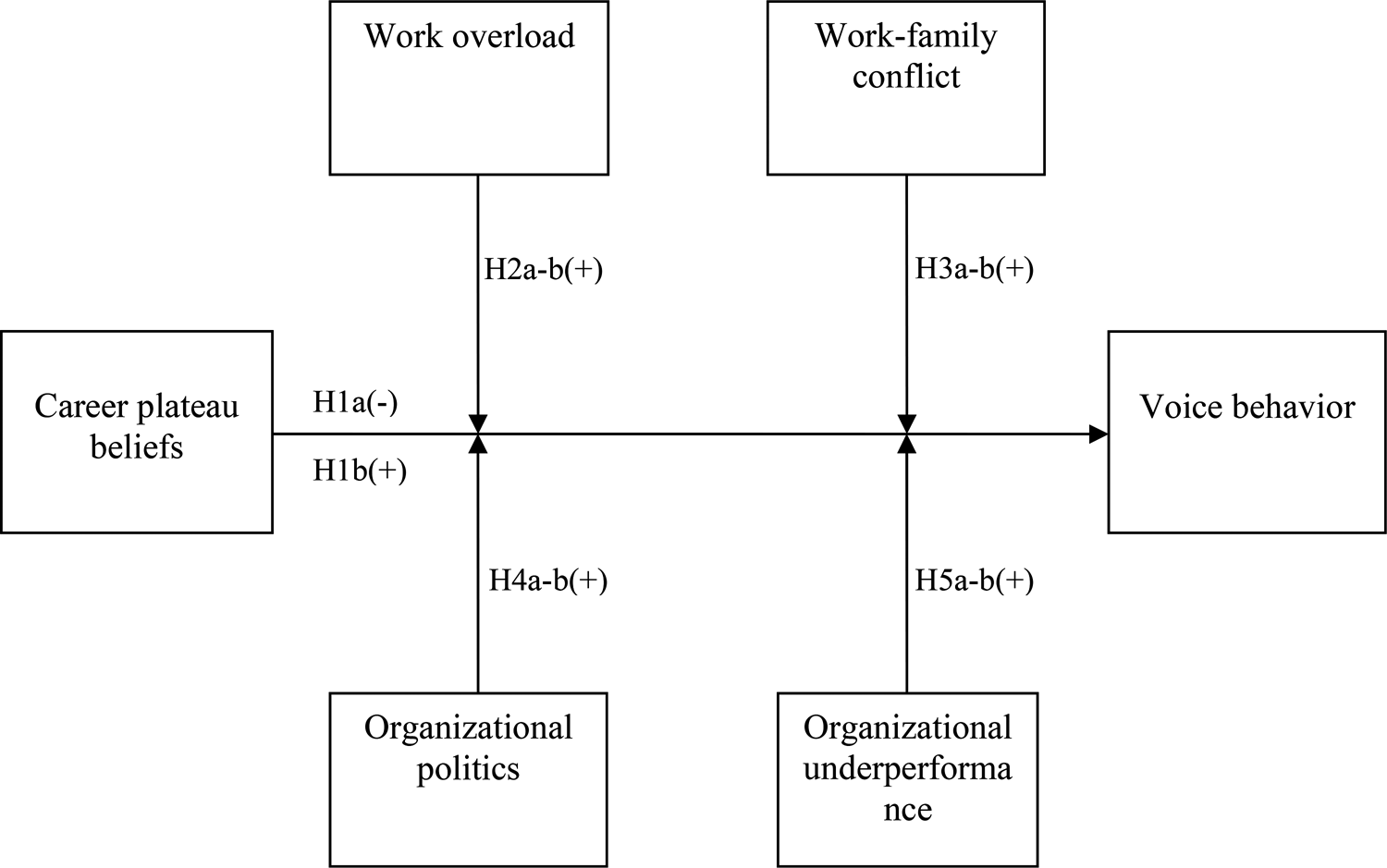
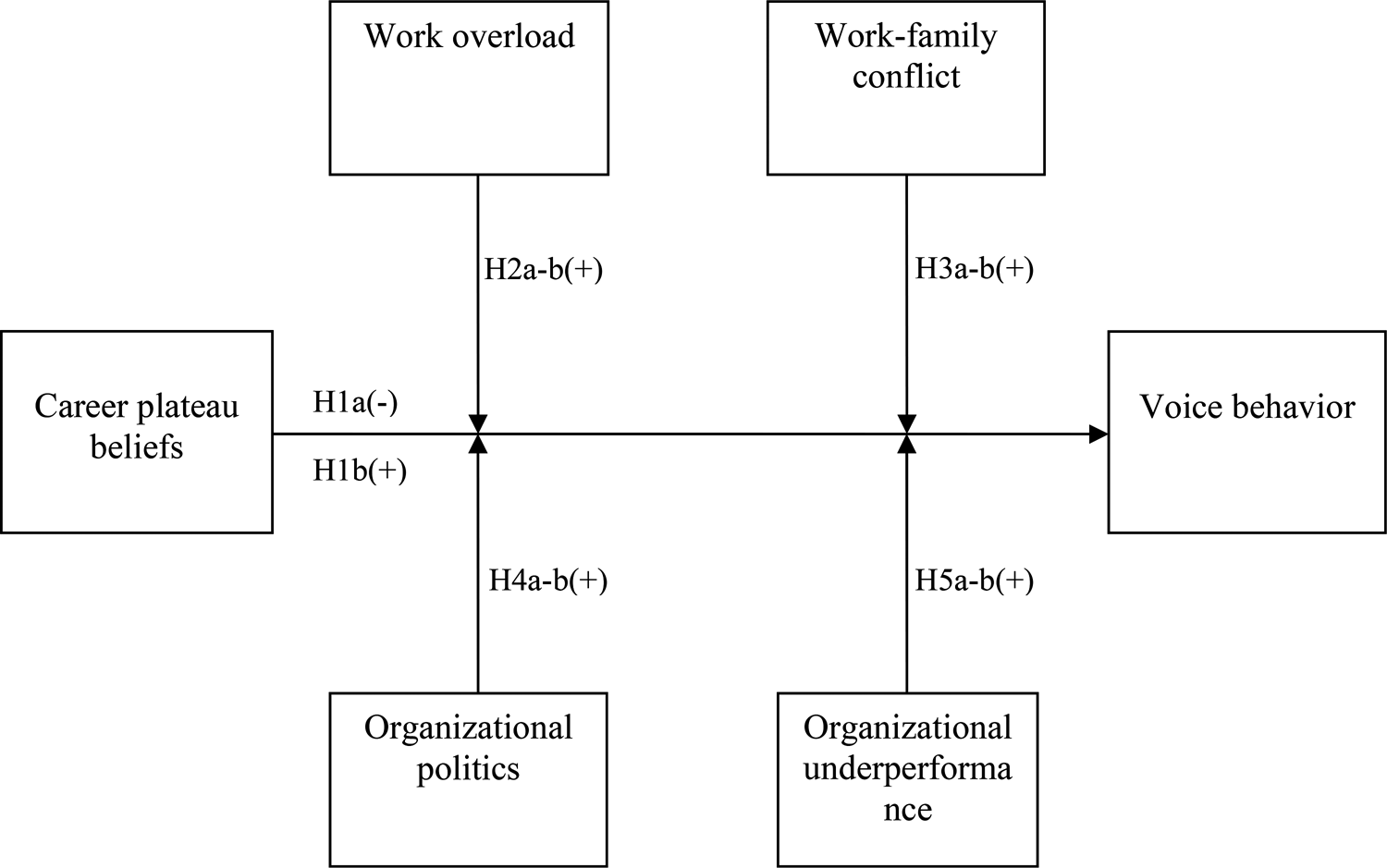
The proposed theoretical framework and its constitutive hypotheses are shown in Figure 1. The baseline relationship reflects parallel predictions about a negative or positive connection between employees' career plateau beliefs and voice behavior. It is postulated that this connection gets reinforced by the selected sources of adversity, which constitute two groups: work-related (overload and conflict with family) and organization-related (politics and underperformance).
Conceptual model.
Note: The (+) sign attached to the moderating effect hypotheses reflects the prediction that both the negative and positive relationships between career plateau beliefs and voice behavior could be invigorated by these moderators.
Theoretical background
Conservation of resources theory
The study's theoretical arguments are anchored in conservation of resources (COR) theory (Hobfoll, Reference Hobfoll1989; Hobfoll, Halbesleben, Neveu, & Westman, Reference Hobfoll, Halbesleben, Neveu and Westman2018). According to this theory, employees' behaviors are largely informed by their desire to protect their existing resource bases and acquire additional resources. It offers two contrasting perspectives with regard to whether employees are likely to engage in voice behavior in response to career plateau beliefs. On the one hand, the resource-conservation perspective suggests that employees avoid voice behaviors when they suffer from a stalled career (Hobfoll, Reference Hobfoll1989; Ng & Feldman, Reference Ng and Feldman2012), because they already are upset about and drained by their career-related disappointments. To avoid additional resource losses, they may refuse to ‘waste’ their time on risky, energy-consuming voice activities that could prompt skepticism (Bergeron & Thompson, Reference Bergeron and Thompson2020). On the other hand, the resource-acquisition perspective implies that employees with pessimistic beliefs about their career situation may have strong desires to voice their opinions, as a means to resolve the negative situation (Hobfoll, Reference Hobfoll1989; Ng & Feldman, Reference Ng and Feldman2012). If their career has come to a halt, employees may feel compelled to voice their concerns and find solutions, which would generate resource gains (De Clercq, Azeem, & Haq, Reference De Clercq, Azeem and Haq2021).
The different tenets of COR theory also reflect the notion that employees' behavioral responses to resource-draining career situations are contingent on the presence of other resource-draining factors that determine the severity of the experienced resource threats (Hobfoll, Reference Hobfoll1989; Hobfoll & Shirom, Reference Hobfoll, Shirom and Golembiewski2000). These contingency effects may manifest in different ways. According to the resource-conservation perspective, resource-depleting contingencies likely invigorate the escalation of career plateau beliefs into diminished voice behaviors, because a downward spiral initiates if various resource-draining conditions combine. In that case, voice behaviors might seem particularly risky (Hobfoll, Reference Hobfoll2001). But, the resource-acquisition perspective instead predicts invigorating effects of the same contingencies. In this case, the effects translate the negative beliefs into enhanced voice efforts, because these employees develop intensified beliefs that their efforts to find solutions will be useful (Hobfoll & Shirom, Reference Hobfoll, Shirom and Golembiewski2000).
Contingency factors
To test both predictions, this study integrates four resource-depleting contingencies: work overload (Avery, Tonidandel, Volpone, & Raghuram, Reference Avery, Tonidandel, Volpone and Raghuram2010), work–family conflict (Grant-Vallone & Donaldson, Reference Grant-Vallone and Donaldson2001), organizational politics (Jam, Donia, Raja, & Ling, Reference Jam, Donia, Raja and Ling2017), and organizational underperformance (Yuan & Woodman, Reference Yuan and Woodman2010). They threaten to deplete employee resources in different ways, such that the four factors represent two distinct, complementary contingency categories, related to the pressures employees experience due to the nature of their work (work overload and work–family conflict) or else their dissatisfaction with the quality of the employer's decision making (organizational politics and organizational underperformance). In turn, this study proposes that the strength of the relationship between career plateau beliefs and voice behavior, whether this relationship is negative or positive, depends on the extent to which employees' resource bases already are drained because they (1) cannot keep up with the pace of work, (2) find that work obligations negatively interfere with their family lives, (3) perceive that organizational decision making is self-centered and based on favoritism, and (4) are pessimistic about their organization's performance. Together, these four contingency factors offer a comprehensive, consistent perspective on how employees' exposure to resource-draining conditions might influence the chances that they speak up to suggest organizational improvements, in response to their career plateau beliefs (Hobfoll & Shirom, Reference Hobfoll, Shirom and Golembiewski2000).
Another reason to select these four specific factors is the study's conceptual focus on their simultaneous interplay with career plateau beliefs, instead of how each factor might cause employees to feel pessimistic about their careers. Extant research indicates that employees tend to be less happy about their career situation if they suffer from unrealistic work deadlines (Kraimer, Greco, Seibert, & Sargent, Reference Kraimer, Greco, Seibert and Sargent2019), experience incompatible work–family demands (Martins, Eddleston, & Veiga, Reference Martins, Eddleston and Veiga2002), perceive that their organization indulges in self-serving decision making (Yavas, Karatepe, & Babakus, Reference Yavas, Karatepe and Babakus2013), or work for an organization performing below standards (Yuan & Woodman, Reference Yuan and Woodman2010). This study takes these considerations a step further, to address more explicitly how each of the four focal factors may shape employees' behavioral responses to their own beliefs that their career has come to a halt (Guzman & Espejo, Reference Guzman and Espejo2019). It thus helps define the circumstances in which frustrations about a stalled career might translate into diminished or enhanced efforts to express opinions about organizational improvements.
Hypotheses
Career plateau beliefs and voice behavior
The resource-conservation tenet of COR theory predicts a negative relationship between career plateau beliefs and voice behavior (Ng & Feldman, Reference Ng and Feldman2012). The belief that their career has come to a halt may diminish voice efforts, because employees feel so drained that they lack the energy to dedicate themselves to any discretionary activities (Quinn, Spreitzer, & Lam, Reference Quinn, Spreitzer and Lam2012). Due to this energy-depleting effect, employees might be less capable of pinpointing solutions to organizational problems (Morrison, Reference Morrison2011). Moreover, employees disappointed by their career situation tend to feel less enthusiastic about their organizational membership (Jawahar & Liu, Reference Jawahar and Liu2016; Nachbagauer & Riedl, Reference Nachbagauer and Riedl2002), which may diminish their motivation to allocate personal energy to constructive voice activities. They may interpret inadequate organizational support for their career as evidence that their employer is not concerned about their professional well-being (Conner, Reference Conner2014; Wickramasinghe & Jayaweera, Reference Wickramasinghe and Jayaweera2010), which may lead them to try to preserve their valuable energy rather than ‘waste’ it on an undeserving employer (Hobfoll & Shirom, Reference Hobfoll, Shirom and Golembiewski2000). Disappointment with a halted career thus may reduce employees' interest in contributing to the success of their organization with dedicated voice behaviors (Ng & Feldman, Reference Ng and Feldman2012).
Hypothesis 1a: There is a negative relationship between employees' career plateau beliefs and their engagement in voice behavior.
The resource-acquisition logic of COR theory suggests a relationship in the opposite direction. Employees might be motivated to allocate personal energy to work behaviors with the potential to generate resource gains, as a way to limit the harmful consequences of negative career conditions (Hobfoll, Reference Hobfoll2001; Hobfoll et al., Reference Hobfoll, Halbesleben, Neveu and Westman2018). If they feel disappointed about the lack of opportunities for career progress – a situation that undermines the quality of their current and future job functioning (Chao, Reference Chao1990; De Clercq et al., Reference De Clercq, Haq, Azeem and Hassan2020) – they may develop a strong desire to undo this negative situation by suggesting valuable solutions (Smith-Ruig, Reference Smith-Ruig2009). Their career worries then might spur employees to voice their opinions about ways to resolve their precarious career situation, with the ultimate goal of improving their professional situation and giving a boost to their stalled career (Morrison, Reference Morrison2011; Seibert, Kraimer, & Crant, Reference Seibert, Kraimer and Crant2001). Employees who are unhappy with how their career has advanced likely feel negative about their current and future job prospects and thus may experience more need to speak up about areas for organizational improvement (Guan et al., Reference Guan, Wen, Chen, Liu, Si, Liu and Dong2014; Hobfoll & Shirom, Reference Hobfoll, Shirom and Golembiewski2000).
Hypothesis 1b: There is a positive relationship between employees' career plateau beliefs and their engagement in voice behavior.
Moderating role of work overload
The resource-conservation logic suggests that employees' frustrations with excessive workloads increases the probability that they experience inadequate career support as upsetting, such that it diminishes their interest in devoting substantial time and effort to constructive voice efforts (Hobfoll & Shirom, Reference Hobfoll, Shirom and Golembiewski2000; Ng & Feldman, Reference Ng and Feldman2012). When employees experience unrealistic deadlines at work, they may feel especially threatened by a resource-draining career situation that offers little hope for the future (Avery et al., Reference Avery, Tonidandel, Volpone and Raghuram2010; Lee, Reference Lee2003), so their desire to undertake effortful, constructive voice activities is undermined further (Quinn et al., Reference Quinn, Spreitzer and Lam2012). Without sufficient time to complete their work tasks, they may become particularly cautious about the risk of deteriorating their already negative career situation (Montani & Dagenais-Desmarais, Reference Montani and Dagenais-Desmarais2018), such as by adopting risky voice activities that may be ill-received by others. Because reasonable workloads instead should reassure employees that they can handle their regular job duties (De Clercq & Belausteguigoitia, Reference De Clercq and Belausteguigoitia2019), it may be less likely that worries about a halted career situation steer them away from energy-consuming voice activities in this case.
Hypothesis 2a: The negative relationship between employees' career plateau beliefs and their engagement in voice behavior is moderated by their perceptions of work overload, such that the relationship is stronger at higher levels of perceived work overload.
According to the resource-acquisition tenet, the motivation to leverage a negative career situation, such as beliefs about a stalled career, into resource-generating voice behaviors is contingent on the extent to which employees must simultaneously cope with other resource-depleting work conditions (Hobfoll, Reference Hobfoll2001). When employees experience significant time pressures and cannot cope with their workloads, they may fear that their already negative career situation is about to get worse, due to their inability to meet organization-set performance targets (Montani & Dagenais-Desmarais, Reference Montani and Dagenais-Desmarais2018). In this scenario, employees who believe that their career has come to a halt may be particularly motivated to recommend improvements, because the associated solutions would mitigate their fears (Kraimer et al., Reference Kraimer, Greco, Seibert and Sargent2019). In line with this logic, career plateau beliefs should stimulate resource-enhancing voice behavior more powerfully if employees continuously feel behind in their work (Hobfoll & Shirom, Reference Hobfoll, Shirom and Golembiewski2000). In contrast, when employees do not feel overburdened by work demands, they are more likely to believe they can meet their performance targets (Conner, Reference Conner2014) and have little need to turn the troubling career situation around, such that their motivation to propose organizational improvements is lower too (Smith-Ruig, Reference Smith-Ruig2009). That is, in the absence of experience of excessive workloads, employees should have less desire to address their frustration with a stalled career by undertaking dedicated voice efforts.
Hypothesis 2b: The positive relationship between employees' career plateau beliefs and their engagement in voice behavior is moderated by their perceptions of work overload, such that the relationship is stronger at higher levels of perceived work overload.
Moderating role of work–family conflict
The resource-conservation logic suggests that career plateau beliefs should be stronger determinants of diminished voice efforts when employees also have to deal with the negative interference of work with family, because the associated stresses exacerbate the energy depletion they experience due to their stalled career (Hobfoll & Shirom, Reference Hobfoll, Shirom and Golembiewski2000). When employees feel drained by conflicting work and family demands, they may be particularly keen to respond to career-related hardships with passivity, to avoid further energy depletion (Wayne, Lemmon, Hoobler, Cheung, & Wilson, Reference Wayne, Lemmon, Hoobler, Cheung and Wilson2017). That is, the spillover of work stress into the family domain may cause employees to experience their halted career as particularly draining and as evidence of their personal inadequacies (Conner, Reference Conner2014), to which they respond in self-protective ways by becoming even more reluctant to undertake energy-consuming voice behaviors (Ng & Feldman, Reference Ng and Feldman2012). The invigorating effect of work–family conflict, with regard to the harmful role of career plateau beliefs in diminishing their voice efforts, is consistent with the COR logic that two resource-draining work conditions reinforce each other in generating complacent, self-protective responses (Hobfoll, Reference Hobfoll2001).
Hypothesis 3a: The negative relationship between employees' career plateau beliefs and their engagement in voice behavior is moderated by their perceptions of work–family conflict, such that the relationship is stronger at higher levels of perceived work–family conflict.
The resource-acquisition perspective instead conveys the idea that employees' voice behavior in response to career plateau beliefs increases in the presence of strong work–family conflict. Employees who perceive that their work obligations negatively interfere with their family lives likely fear that this interference imposes further limits on their already negative career situation, due to their seeming inability to find a healthy balance (Beham & Drobnic, Reference Beham and Drobnic2010). The sense that work and family are in conflict provides employees who already suffer from a stalled career with an additional reason to pursue resource gains, by improving their work situation, and thus avoid the chance that their career progress gets further limited by negative spillovers across work and home (Karatepe, Kilic, & Isiksel, Reference Karatepe, Kilic and Isiksel2008; Martins et al., Reference Martins, Eddleston and Veiga2002). To the extent that employees struggle with work obligations that undermine their family lives (Liao, Lau, Hui, & Kaylee, Reference Liao, Lau, Hui and Kaylee2019), they should be especially concerned about their stalled career and feel more motivated to find resource-gain solutions to achieve a better balance between work and family (Hobfoll & Shirom, Reference Hobfoll, Shirom and Golembiewski2000). But, if employees do not suffer work–family conflict, their career plateau beliefs should have less motivational value for stimulating their voice behaviors. If they can handle their concurrent work and family demands, it might seem less valuable to leverage frustrations about a stagnating career into constructive suggestions for redressing the situation (Zivnuska, Kacmar, Ferguson, & Carlson, Reference Zivnuska, Kacmar, Ferguson and Carlson2016). Accordingly,
Hypothesis 3b: The positive relationship between employees' career plateau beliefs and their engagement in voice behavior is moderated by their perceptions of work–family conflict, such that the relationship is stronger at higher levels of perceived work–family conflict.
Moderating role of organizational politics
According to the resource-conservation perspective, employees' career plateau beliefs may escalate into diminished voice efforts more forcefully to the extent that they are exposed to resource-draining, political games in their organization (Ng & Feldman, Reference Ng and Feldman2012). Favoritism and egoism as drivers of organizational decision making drain employees' resources, because they are unsure about their ability to meet organization-set performance targets (Abbas, Raja, Darr, & Bouckenooghe, Reference Abbas, Raja, Darr and Bouckenooghe2014; Chang, Rosen, & Levy, Reference Chang, Rosen and Levy2009). In this scenario, employees may feel particularly compelled to respond to a negative career situation with diminished voice behaviors, considering the significant uncertainty they experience about their work tasks (Li, Liang, & Farh, Reference Li, Liang and Farh2020) and their related sense that their employer does not care for their professional success (Li et al., Reference Li, Wu, Liu, Kwan and Liu2014). Rather than devote their valuable personal energy to voice behaviors designed to benefit the organization, they likely try to conserve them (Bergeron & Thompson, Reference Bergeron and Thompson2020; Hobfoll, Reference Hobfoll2001). Self-preserving tendencies, including not voicing suggestions, in response to career plateau beliefs thus may be greater to the extent that politicized decision-making processes undermine their professional functioning.
Hypothesis 4a: The negative relationship between employees' career plateau beliefs and their engagement in voice behavior is moderated by their perceptions of organizational politics, such that the relationship is stronger at higher levels of perceived organizational politics.
The resource-acquisition argument points in the opposite direction: career plateau beliefs spur voice behavior more when organizational decision making appears driven by self-serving motives and favoritism (Kacmar & Baron, Reference Kacmar, Baron and Ferris1999; Kiewitz, Restubog, Zagenczyk, & Hochwarter, Reference Kiewitz, Restubog, Zagenczyk and Hochwarter2009). If organizational colleagues appear self-centered, such that they only think about themselves, it threatens the focal employees' job performance (Abbas et al., Reference Abbas, Raja, Darr and Bouckenooghe2014; Chang et al., Reference Chang, Rosen and Levy2009), with possibly negative consequences for their career (Grimland, Vigoda-Gadot, & Baruch, Reference Grimland, Vigoda-Gadot and Baruch2012). Employees who already suffer from a stalled career accordingly may be particularly keen to make proactive recommendations for organizational improvements, because the promise of associated resource gains would counter the difficulty of restarting their career progress in the presence of overly politicized decision making (Hochwarter, Ellen, & Ferris, Reference Hochwarter, Ellen and Ferris2014; Smith-Ruig, Reference Smith-Ruig2009). That is, the perceived usefulness of voice behaviors, in the presence of a stalled career, may increase in resource-draining climates in which organizational colleagues seem to work behind the scenes and protect their own interests at all costs (Abbas et al., Reference Abbas, Raja, Darr and Bouckenooghe2014). In contrast, if organizational decision making is not based on egoism and favoritism, employees may be less concerned that their already negative career situation will get even worse due to dysfunctional political games (Grimland et al., Reference Grimland, Vigoda-Gadot and Baruch2012), which diminishes the relative value of leveraging their career plateau beliefs as dedicated voice efforts.
Hypothesis 4b: The positive relationship between employees' career plateau beliefs and their engagement in voice behavior is moderated by their perceptions of organizational politics, such that the relationship is stronger at higher levels of perceived organizational politics.
Moderating role of organizational underperformance
Finally, from the resource-depletion perspective, the negative relationship between employees' beliefs about a stagnated career and the likelihood that they engage in voice behavior might be stronger to the extent that they are pessimistic about their organization's performance (Ng & Feldman, Reference Ng and Feldman2012). A reluctance to make suggestions for organizational improvements, as a means to conserve their personal energy in the presence of a stagnated career, may increase in strength if they also feel disappointed about their organization's competitive standing (Yuan & Woodman, Reference Yuan and Woodman2010). When they hold negative views about their employer, concerns about their future in the organization may be reinforced by its apparent difficulty in meeting performance targets (Cyert & March, Reference Cyert and March1983). In this scenario, they may be keen to use their career plateau beliefs as excuses to halt their voice efforts, which seem pointless anyway (Barry & Wilkinson, Reference Barry and Wilkinson2016). If their career already seems in jeopardy, with little chance that it can be salvaged due to their employer's precarious performance, employees may become complacent (Quinn et al., Reference Quinn, Spreitzer and Lam2012). Conversely, if employees feel energized by the stellar performance of their employer, worrying about a halted career situation might not be enough to discourage constructive work activities, even if those activities are effortful (Hobfoll & Shirom, Reference Hobfoll, Shirom and Golembiewski2000).
Hypothesis 5a: The negative relationship between employees' career plateau beliefs and their engagement in voice behavior is moderated by their perceptions of organizational underperformance, such that the relationship is stronger at higher levels of perceived organizational underperformance.
The contrasting resource-acquisition argument suggests that the value of career plateau beliefs for spurring voice behavior may be higher among employees who are pessimistic about their organization's performance (Yuan & Woodman, Reference Yuan and Woodman2010). Perceived organizational underperformance is resource-draining and worrisome; it implies that fewer organizational resources will be available and that their employer can offer only limited career opportunities (Birkinshaw & Mol, Reference Birkinshaw and Mol2006; Cyert & March, Reference Cyert and March1963). According to the resource-acquisition logic, employees who worry about their organization's performance may have a particularly strong desire to voice recommendations for altering the negative status quo, in the hope of increasing organizational resources that then can enhance their career prospects (Domínguez, Reference Domínguez2013). For example, if the organization appears to be lagging competitors, they might try to find ways to improve its competitive standing and protect against further escalation of their negative career situation (Liang et al., Reference Liang, Farh and Farh2012; Morrison, Reference Morrison2011). In contrast, if employees believe the organization is performing well, they should be more confident that their employer can give their career a boost (Yuan & Woodman, Reference Yuan and Woodman2010), so the perceived need to suggest organizational improvements in reaction to their stalled career may diminish (Hobfoll & Shirom, Reference Hobfoll, Shirom and Golembiewski2000).
Hypothesis 5b: The positive relationship between employees' career plateau beliefs and their engagement in voice behavior is moderated by their perceptions of organizational underperformance, such that the relationship is stronger at higher levels of perceived organizational underperformance.
Research method
Data collection
The empirical tests of the research hypotheses rely on survey data collected among Canadian-based employees who work in the information technology (IT) sector. The focus on a particular industry sector helps account for unobserved industry differences and the likelihood that industry characteristics exert unintended impacts on the conceptual framework. For example, in different industries, organizations offer more or less interesting career opportunities (Kraimer, Seibert, Wayne, Liden, & Bravo, Reference Kraimer, Seibert, Wayne, Liden and Bravo2011), and external competitive forces may stimulate employees' proactive efforts to improve the organizational status quo to greater or lesser degrees (Morrison, Reference Morrison2011). Qualtrics, a survey firm with extensive expertise in academic data collection projects (e.g., Nesheim & Smith, Reference Nesheim and Smith2015; Zhang & Inness, Reference Zhang and Inness2019), was tasked to collect the data. Its solicitation methods span various websites, membership referrals, and targeted email lists to find research participants who are also industry professionals; they receive modest compensation for their responses (i.e., gift card). To ensure a relevant sample, Qualtrics was asked to gather data from at least 300 Canadian-based, full-time, IT-sector employees.
The survey opened with a statement that detailed the overall goal of the research – namely, to understand the challenges and opportunities that employees may encounter in their work environments – and ensured participants of the strict confidentiality of their responses. Several measures were undertaken to protect participants' rights and diminish the chances of social desirability bias (Spector, Reference Spector2006). In particular, recruits were informed that their participation was completely voluntary, that their answers would only be accessible to the researchers, that the interest was in aggregate data patterns, and that no personal data would ever be released. In addition, the survey explicitly indicated that there were no correct or incorrect answers, so they should answer as honestly as possible (Spector, Reference Spector2006). Finally, it expressly asked participants to confirm that they were agreeing to provide their truthful and honest opinions. The final sample included 355 employees, 32% of whom were women; they had worked for their organization for an average of 8 years.
Measures
The six focal constructs were measured with previously validated scales, using 7-point Likert scales, ranging from 1 (‘strongly disagree’) to 7 (‘strongly agree’).
Voice behavior
Employees' propensity to voice their opinions about how the organizational status quo can be improved was measured with a five-item scale of promotive voice (Liang et al., Reference Liang, Farh and Farh2012). Two example items are ‘I proactively raise suggestions to improve the organization's working procedures’ and ‘I proactively suggest new projects which are beneficial to the organization’ (Cronbach's alpha = .94). Even though it might be useful to corroborate self-rated voice behaviors with other-rated scores, the people who engage in voice behaviors tend be the most knowledgeable about the actual efforts that they undertake; other raters, such as supervisors or colleagues, instead may have only a partial view on how much time employees actually devote to suggesting improvements (Dutton, Ashford, O'Neill, & Lawrence, Reference Dutton, Ashford, O'Neill and Lawrence2001; Morrison, Reference Morrison2011). Previous research similarly indicates that employees are valuable sources of ratings of their own creative behaviors (e.g., Sijbom, Anseel, Crommelinck, De Beuckelaer, & De Stobbeleir, Reference Sijbom, Anseel, Crommelinck, De Beuckelaer and De Stobbeleir2018; Zhou, Shin, & Canella, Reference Zhou, Shin and Canella2008) or championing activities (e.g., De Clercq, Castañer, & Belausteguigoitia, Reference De Clercq, Castañer and Belausteguigoitia2011; Kissi, Dainty, & Tuuli, Reference Kissi, Dainty and Tuuli2013). Notably, Conway and Lance (Reference Conway and Lance2010) indicate that the risk of common method bias is substantially reduced when self-rated measures are appropriate.
Career plateau beliefs
The extent to which employees are frustrated about their past career progress was assessed with a 7-item scale of career plateau beliefs (Foster et al., Reference Foster, Lonial and Shastri2011). For example, respondents indicated if ‘In this organization, the opportunities for my career development have been limited’ and ‘When I joined the organization, I thought that I would move up the corporate ladder faster, but I have not been allowed to’ (Cronbach's alpha = .91).
Work overload
To assess the extent to which employees suffer from excessive work pressures, a 4-item scale of work overload was applied, as informed by prior research (Pooja, De Clercq, & Belausteguigoitia, Reference Pooja, De Clercq and Belausteguigoitia2016). Two example statements are ‘I often have problems with the pace of work’ and ‘I often work under time pressure’ (Cronbach's alpha = .86).
Work–family conflict
The measure of the extent to which employees suffer from a negative interference of work with their family life relies on a 3-item scale of work–family conflict (De Clercq & Belausteguigoitia, Reference De Clercq and Belausteguigoitia2017). For example, participants indicated whether ‘Anxiety about my job frequently spills over into my personal life’ or ‘My job prevents me from spending the time with my family or friends that I would like’ (Cronbach's alpha = .88).
Organizational politics
To assess employees' perceptions that their organization's climate is marked by dysfunctional political games, four items were drawn from prior research on organizational politics (Hochwarter, Kacmar, Perrewé, & Johnson, Reference Hochwarter, Kacmar, Perrewé and Johnson2003), including ‘There is a lot of self-serving behavior going on in the organization’ and ‘People do what's best for them, not what's best for the organization’ (Cronbach's alpha = .92).
Organizational underperformance
A 3-item scale of dissatisfaction with the organizational status quo (Yuan & Woodman, Reference Yuan and Woodman2010) reflects the extent to which employees are unhappy with their organization's performance. For example, they rated whether ‘The performance of my organization needs to be improved’ and ‘The performance of my work unit needs to be improved’ (Cronbach's alpha = .92).
Control variables
The statistical models include two demographic characteristics: gender (1 = female) and organizational tenure (in years). Male employees may exhibit higher voice rates than their female counterparts (Detert & Burris, Reference Detert and Burris2007), and employees who have worked for their organization for a longer time may feel more confident about their ability to voice their opinions (Tangirala & Ramanujam, Reference Tangirala and Ramanujam2008). The study also controls for employees' perceptions of organizational support for change, measured with a 4-item scale (Scott & Bruce, Reference Scott and Bruce1994). Two sample items are ‘My organization is responsive to change’ and ‘My organization is open to having its people come up with new suggestions’ (Cronbach's alpha = .92). Such organizational support may provide employees with resources that enable them to be successful in their voice efforts (Zhou & George, Reference Zhou and George2001).
Construct validity
The validity of the six focal constructs is assessed by performing a confirmatory factor analysis on a six-factor measurement model (Anderson & Gerbing, Reference Anderson and Gerbing1988). The model reveals excellent fit: χ2(284) = 750.90, incremental fit index (IFI) = .94, Tucker–Lewis index (TLI) = .92, confirmatory fit index (CFI) = .94, and root mean squared error of approximation (RMSEA) = .07. All items load very strongly on their corresponding constructs (p < .001) (Gerbing & Anderson, Reference Gerbing and Anderson1988), and the average variances extracted (AVE) are all higher than the cut-off value of .50 (Bagozzi & Yi, Reference Bagozzi and Yi1988), in support of the presence of convergent validity. Moreover, the presence of discriminant validity is confirmed by noting that the AVE values are all higher than the squared correlations of the associated construct pairs (Fornell & Larcker, Reference Fornell and Larcker1981). The fit of the models that estimate the 15 unconstrained construct pairs (in which correlations between two constructs vary freely) also is significantly better than the fit of the associated constrained models (in which correlations between the constructs are fixed to 1) (Δχ2(1) > 3.84, p < .05; Anderson & Gerbing, Reference Anderson and Gerbing1988).
Common method bias
To assess whether common method bias is an issue, two diagnostic tests are undertaken. First, Harman's one-factor test (Podsakoff & Organ, Reference Podsakoff and Organ1986) reveals that the study's focal six constructs – voice behavior, career plateau beliefs, work overload, work–family conflict, organizational politics, and organizational underperformance – account for only 39% of the total data variance, which diminishes concerns about a reliance on common respondents. Second, the six-factor model has a significantly better fit than a one-factor model in which all items load on the same factor (χ2(15) = 4,002.52, p < .001), which corroborates the idea that common source bias is not a substantial concern (Sharma, Reference Sharma1996). From a conceptual perspective, the likelihood of common method bias is drastically lower in theoretical frameworks that include multiple moderating effects, because it is more difficult for participants to anticipate what the research hypotheses are and adjust their responses accordingly (Simons & Peterson, Reference Simons and Peterson2000).
Results
Main analyses
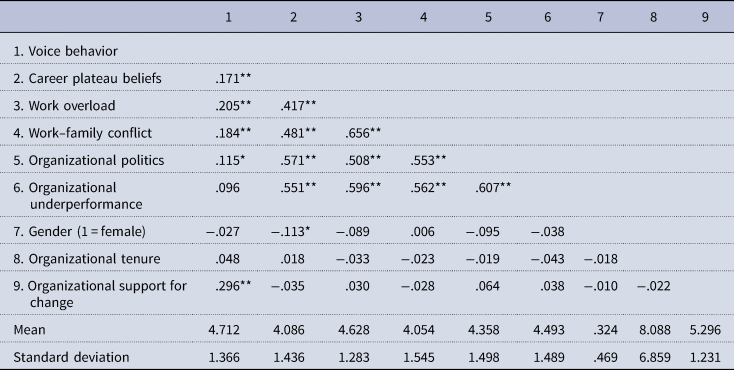
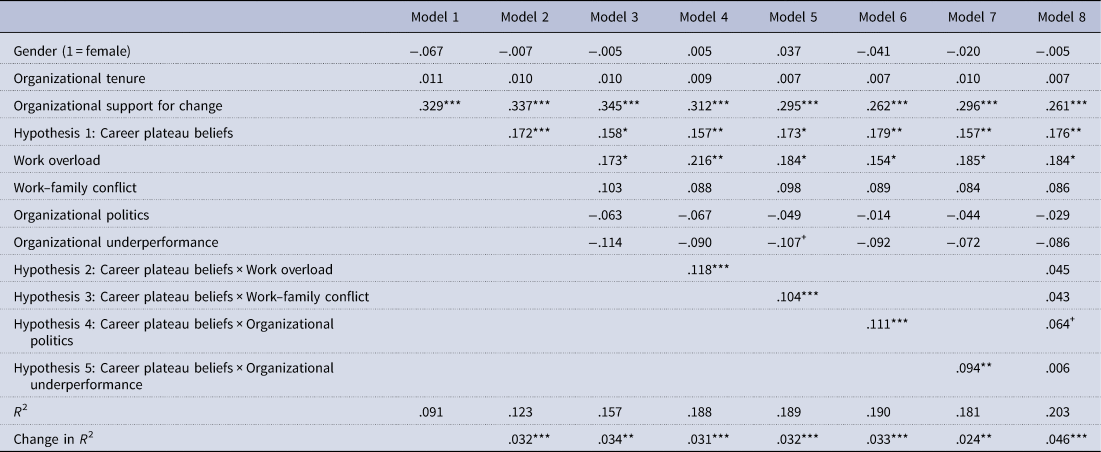
Table 1 reports the zero-order correlations between the focal constructs and their descriptive statistics; Table 2 shows the results obtained from the hierarchical moderated regression analyses. Model 1 includes the control variables, model 2 adds career plateau beliefs, model 3 adds the direct roles of the four moderators, and models 4–7 add the career plateau beliefs × work overload, career plateau beliefs × work–family conflict, career plateau beliefs × organizational politics, and career plateau beliefs × organizational underperformance interaction terms, respectively. According to prior research, different moderating effects should be assessed in separate regression equations, because their concurrent estimation in a single equation can hide true interaction effects (e.g., Covin, Green, & Slevin, Reference Covin, Green and Slevin2006; De Clercq, Thongpapanl, & Dimov, Reference De Clercq, Thongpapanl and Dimov2013).Footnote 1 Following the approach suggested by Aiken and West (Reference Aiken and West1991), the constructs are mean-centered before calculating any corresponding product terms.
Correlations and descriptive statistics
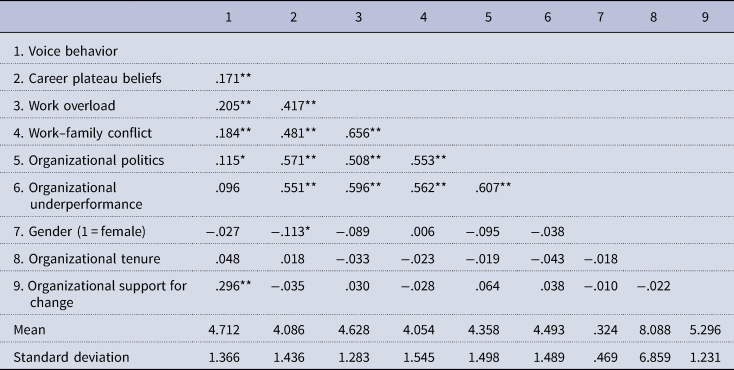
Note: N = 238.
*p < .05; **p < .01.
Regression results (dependent variable: voice behavior)
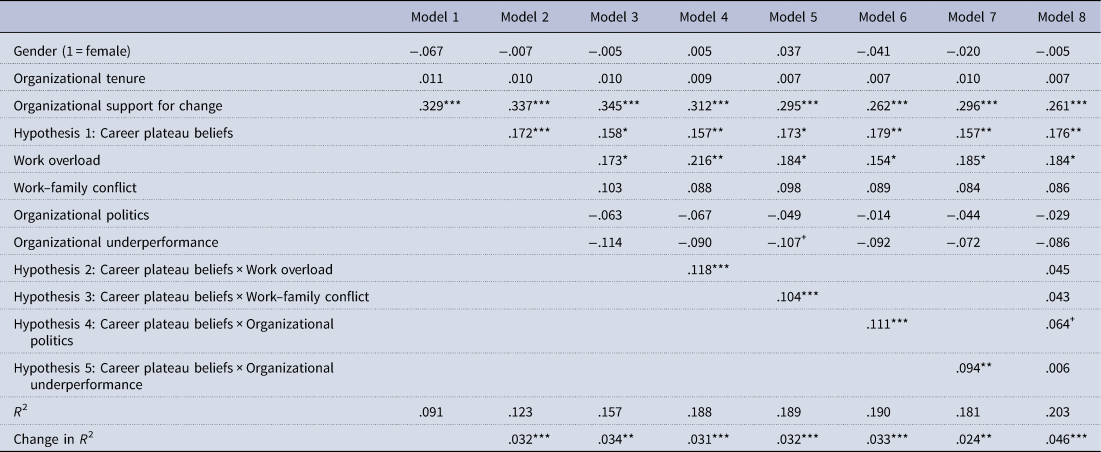
Notes: N = 238; unstandardized coefficients (standard errors are reported in parentheses).
+p < .10; *p < .05; **p < .01; ***p < .001 (two-tailed tests).
The control model (model 1) indicates that perceptions of organizational support for change enhance employees' voice efforts (β = .329, p < .001), but there are no significant effects of gender (β = −.067, ns) or organizational tenure (β = .011, ns). Furthermore, the results provide strong support for the resource-acquisition baseline relationship (Hypothesis 1b), instead of its resource-preservation counterpart (Hypothesis 1a). In particular, model 2 reveals a positive relationship between career plateau beliefs and voice behavior (β = .172, p < .001), indicating that frustrations due to a stalled career spur employees to speak up about areas of organizational improvement. Beyond the theoretical scope of this research, there is a direct positive relationship between work overload and voice behavior (β = .173, p < .05) but no significant direct relationships for the other three sources of adversity (model 3). Two of these three constructs correlate positively and significantly with voice behavior (r = .184, p < .01 for work–family conflict; r = .115, p < .05 for organizational politics; Table 1). The multiple regression results in model 3 indicate that these direct effects get overpowered by career plateau beliefs (as well as work overload). That is, the findings highlight an instrumental role of career-related frustrations in stimulating employees to voice their ideas for organizational improvements.
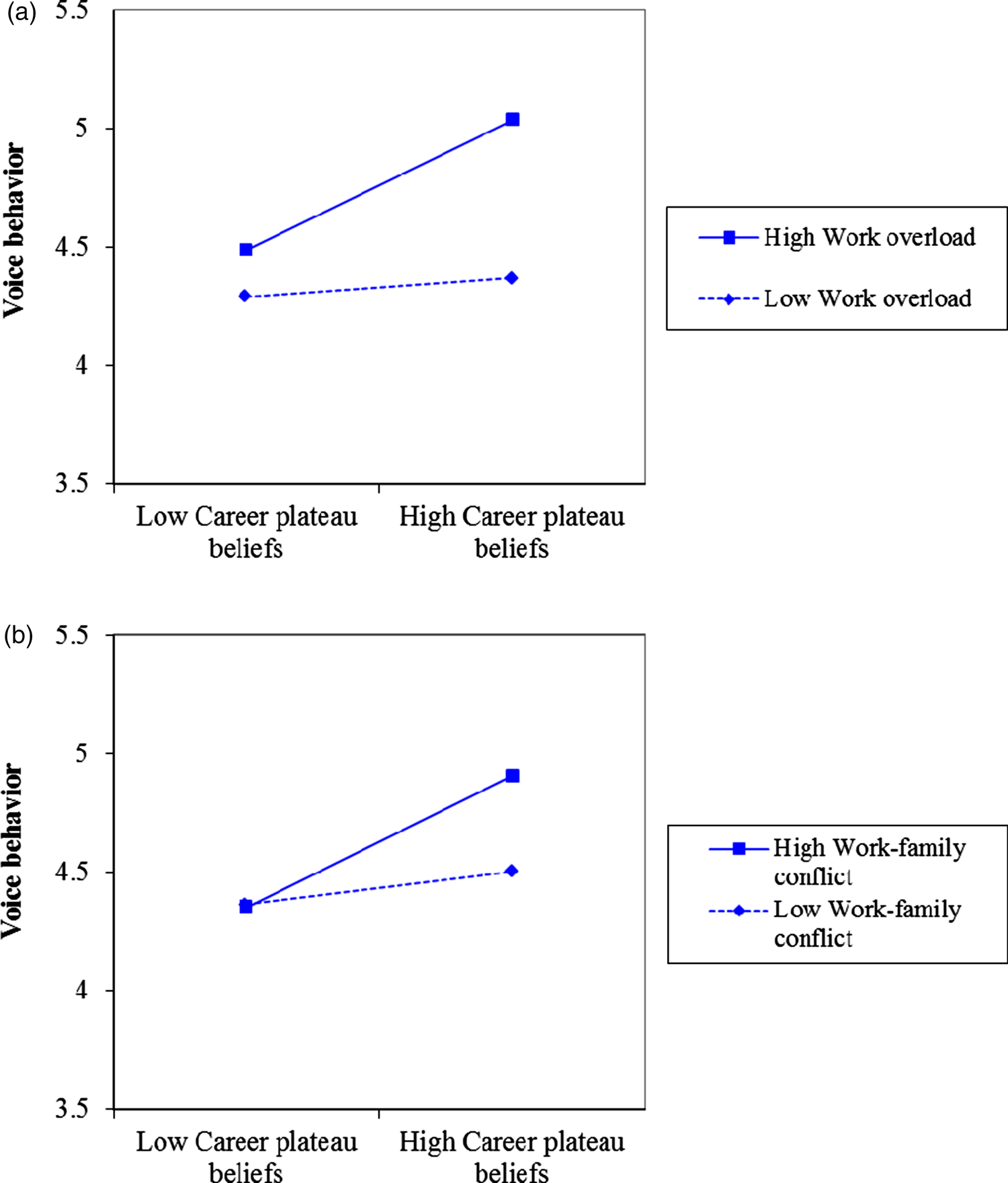
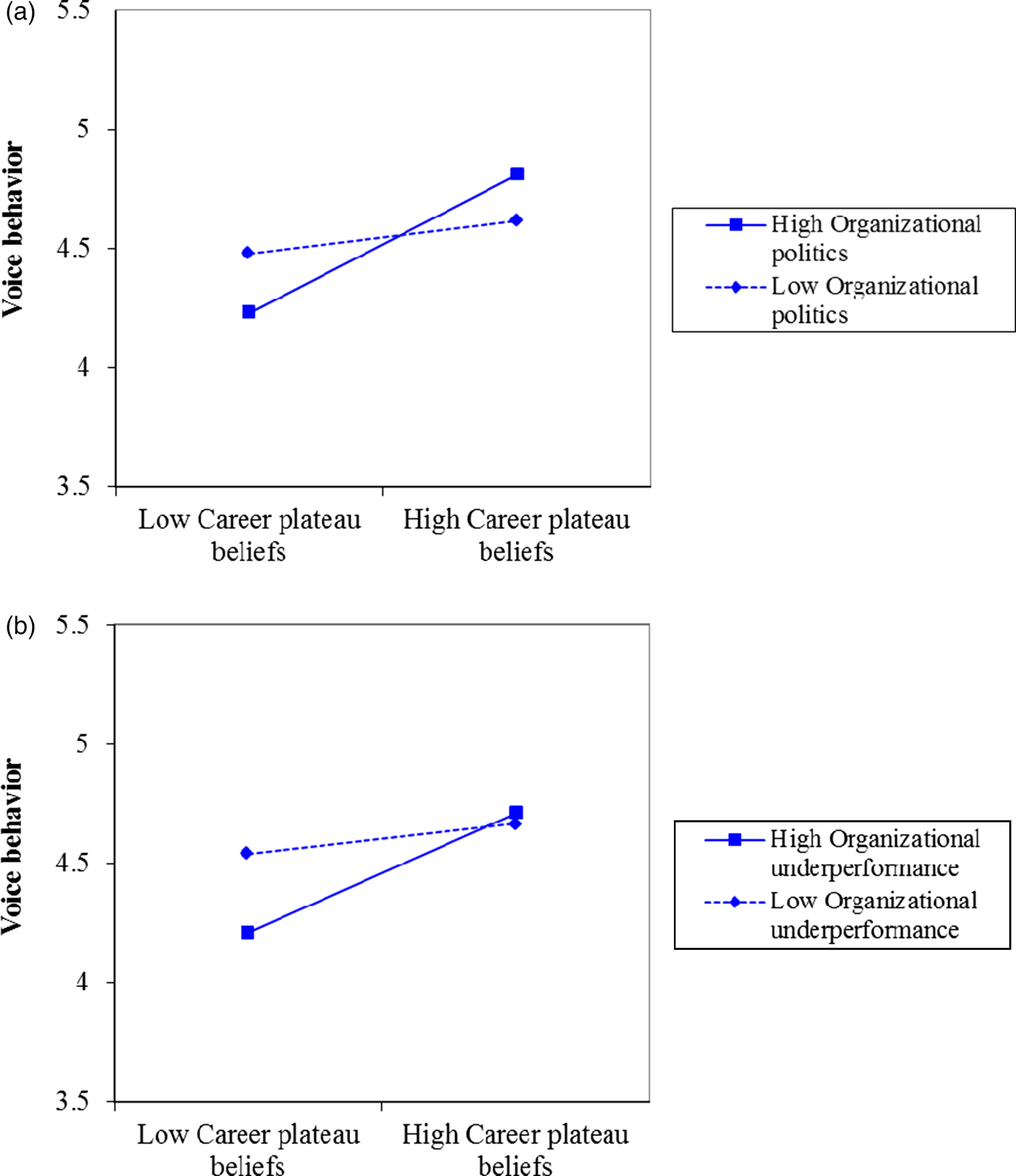
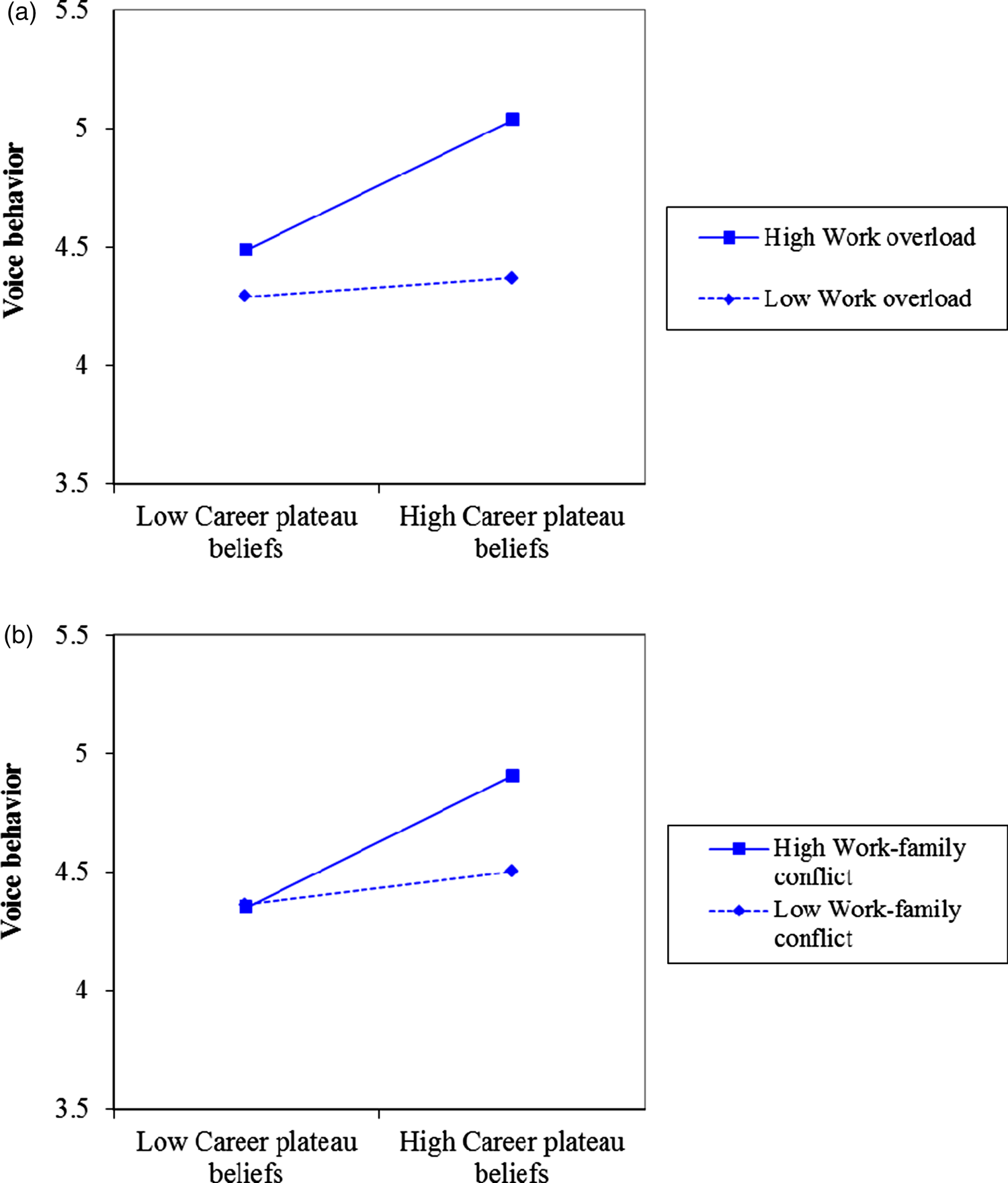
Models 4 and 5 offer support for the hypothesized catalytic effects of the two sources of adversity related to work pressures on the positive relationship between career plateau beliefs and voice behavior (work overload β = .118, p < .001; work–family conflict β = .104, p < .001), consistent with the resource-acquisition logic. The likelihood that career plateau beliefs prompt voice efforts increases if employees feel stressed by excessive workloads (Hypothesis 2b) and when their work demands negatively interfere with their family lives (Hypothesis 3b). Figure 2, panels A and B, reveal these interaction effects by depicting the relationship between career plateau beliefs and voice behavior at high and low levels of the two moderators (Aiken & West, Reference Aiken and West1991). In the simple slope analysis, this relationship is positive and significant at high levels of work overload (β = .275, p < .001) and work–family conflict (β = .277, p < .001) but non-significant at low levels (β = .039, β = .069, respectively, both ns), consistent with Hypotheses 2b and 3b.
(A) Moderating effect of work overload on the relationship between career plateau beliefs and voice behavior. (B) Moderating effect of work–family conflict on the relationship between career plateau beliefs and voice behavior.
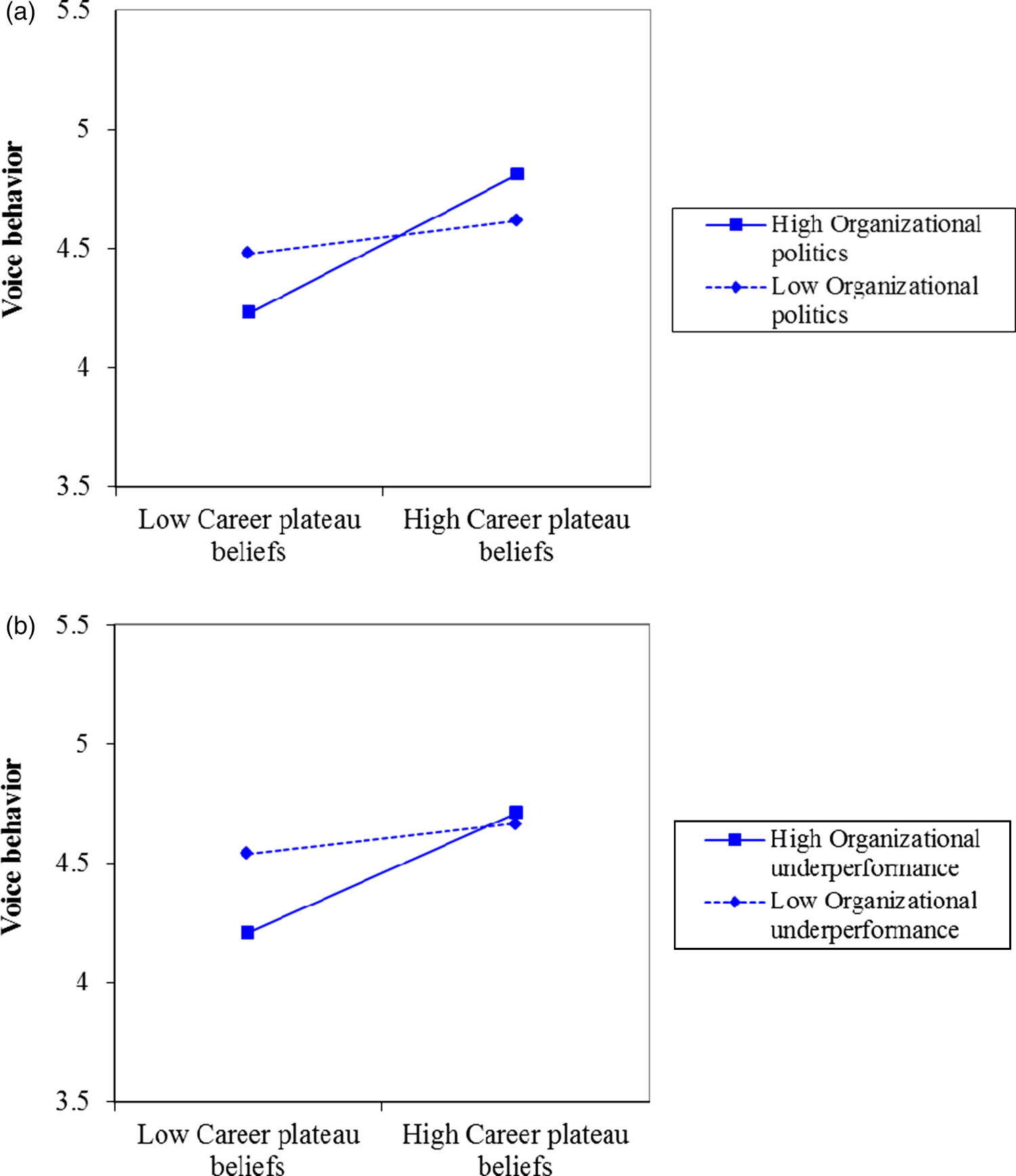
Models 6 and 7 similarly reveal support for the invigorating effects of the two sources of adversity related to the organization's decision making, by showing positive interaction terms for organizational politics (β = .111, p < .001) and organizational underperformance (β = .94, p < .01). The likelihood that employees' increasing frustration about a stalled career stimulates their propensity to raise their voice is higher when they are exposed to dysfunctional political games and an employer that is underperforming. As Figure 3, panels A and B, and the associated simple slope analyses indicate, the relationship between career plateau beliefs and voice behavior is positive and significant when organizational politics (β = .290, p < .001) and organizational underperformance (β = .251, p < .001) are high, but this relationship loses its significance when these two sources of organizational adversity are low (β = .068; β = .063, respectively, both ns), in line with Hypotheses 4b and 5b.
(A) Moderating effect of organizational politics on the relationship between career plateau beliefs and voice behavior. (B) Moderating effect of organizational underperformance on the relationship between career plateau beliefs and voice behavior.
Post hoc analyses
This study's theoretical focus is on the concurrent roles of career plateau beliefs and four sources of workplace adversity for predicting voice behavior, but with two post hoc analyses, it also considers the alternative possibility that employees' negative career perceptions may stem from the sources of adversity. First, a path model is estimated in which career plateau beliefs mediate the relationships of work overload, work–family conflict, organizational politics, and organizational underperformance with voice behavior. The fit of this path model is very poor (CFI = .23, IFI = .25, TLI = −.31, RMSEA = .28). Second, in four additional path models, one of the four interaction terms and the correlation of career plateau beliefs with work overload, work–family conflict, organizational politics, or organizational underperformance are included, to account for potential interdependencies. The signs and significance levels of the four interaction terms are in line with those generated by the focal regression analyses (see Table 2). These post hoc findings affirm that the four sources of workplace adversity critically influence the extent to which beliefs about a stalled career spur employees' efforts to voice their opinions about organizational improvements, beyond any direct causal connections between these beliefs and the four sources of workplace adversity. These findings corroborate the value and robustness of this study's conceptual framework (Lattin, Carroll, & Green, Reference Lattin, Carroll and Green2003).
Although estimating multiple product terms simultaneously in a single equation can hide actual moderating effects, calculating such model can affirm the robustness of the main results, assuming the signs of the interaction terms match those in the models that include each individual interaction (Arnold, Reference Arnold1982; Covin et al., Reference Covin, Green and Slevin2006). In the comprehensive model 8 (Table 2), only one of the four product terms is significant, and weakly so (career plateau beliefs × organizational politics β = .064, p < .10), but the signs of all four interaction terms are positive, consistent with models 4–7. The significance of the interaction terms in models 4–7, but not in model 8, affirms the unique meaning of each interaction (mean-centered) when taking the three other interactions into account (De Clercq, Dimov, & Thongpapanl, Reference De Clercq, Dimov and Thongpapanl2010). Models 4–7, each of which estimates one interaction term, reflect the relationship between career plateau beliefs and voice behavior at non-average values of a particular moderator; model 8 instead shows the influence of each moderator in a multidimensional space restricted to the average values of the other moderators. Thus, for example, the moderating role of work overload in model 8 refers to the case in which work–family conflict, organizational politics, and organizational underperformance (mean-centered in their respective interactions terms) operate at their average values. In model 4 although, the moderating effect of work overload spans the entire range of values for work–family conflict, organizational politics, and organizational underperformance. The non-significance of most interaction terms in model 8 indicates that the associated moderating effects are sensitive to the impact of the other moderators (Aiken & West, Reference Aiken and West1991).Footnote 2
This study's theoretical focus also excludes the potential roles of employees' access to enabling organizational resources (Bergeron & Thompson, Reference Bergeron and Thompson2020; Morrison, Reference Morrison2011). According to COR theory, leveraging beliefs about a halted career in enhanced voice efforts, in the presence of other resource-depleting conditions, likely is easier to achieve to the extent that employees can draw from supportive organizational resources that enable such leveraging efforts (Hobfoll & Shirom, Reference Hobfoll, Shirom and Golembiewski2000). Four additional models accordingly are run to estimate three-way interaction effects with the organizational support for change control variable. The results generate positive and significant effects of the product terms (with career plateau beliefs and organizational support for change) that include work overload (β = .065, p < .01), work–family conflict (β = .052, p < .01), and organizational underperformance (β = .049, p < .05) but no significant effect for the three-way interaction involving organizational politics (β = .031, ns). The three significant effects affirm the positive influence of employees' resource access on their perceived ability to deal with the hardships that stem from the combination of career plateau beliefs and other resource-draining situations, through their dedicated voice efforts. Continued studies might consider the roles of other contextual or personal resources, beyond organizational support for change.
Finally, the cross-sectional research design cannot rule out reverse causality, but the empirical findings reflect the resource-acquisition logic of COR theory, according to which resource-draining career situations stimulate employees to allocate personal energy to resource-enhancing activities that can help them overcome the resource drainage (Hobfoll, Reference Hobfoll1989; Hobfoll et al., Reference Hobfoll, Halbesleben, Neveu and Westman2018). To alleviate concerns about reverse causality to some extent, another post hoc analysis is performed, with employee age as the instrumental variable; from a conceptual view, it might relate to career plateau beliefs but not voice behavior. In a two-stage least squares estimation with this instrumental variable, career plateau beliefs are regressed on employee age, then the residual is used as a predictor in the focal regression equations. The results are consistent with those reported in Table 2, which diminishes the chances of reverse causality (Antonakis, Bendahan, Jacquart, & Lalive, Reference Antonakis, Bendahan, Jacquart and Lalive2010).Footnote 3 Yet, the occurrence of such causality cannot be eliminated or fully addressed based on this study's research design. For example, the positive relationship between career plateau beliefs and voice behavior might be explained by the fact that employees' career prospects become hampered to the extent that their opinions are not well received by their superiors.
Discussion
This study adds to existing research by elaborating how employees' career plateau beliefs, or their convictions that their career has stalled, inform their propensity to offer constructive ideas about how their organization can be enhanced. The paucity of research on this topic is surprising, in light of the widespread recognition that employees' perceptions of limited career opportunities can be a significant source of frustration, with notable effects on their work attitudes or behaviors (Conner, Reference Conner2014; Smith-Ruig, Reference Smith-Ruig2009). Consistent with the resource-conservation and resource-acquisition tenets of COR theory, this study has juxtaposed two sets of parallel hypotheses that predict that resource-draining beliefs about a career plateau either (1) steer employees away from voice efforts, in an attempt to preserve their energy, as reinforced by their exposure to other resource-draining contingencies, or else (2) stimulate such efforts, a process that is invigorated by the same contingencies, reflecting the desire to reverse their negative career situation by generating resource gains. The empirical findings support the latter, resource-acquisition motive.
As a central theoretical insight, this study accordingly reveals that beliefs about a halted career may enhance instead of undermine voice efforts. This finding stands in stark contrast to extant research that emphasizes the negative attitudinal and behavioral outcomes of employees' beliefs about limited opportunities for career development (e.g., Conner, Reference Conner2014; De Clercq et al., Reference De Clercq, Haq, Azeem and Hassan2020). Employees' career-related disappointments may motivate them to be more vocal, in the hope that the associated resource gains and organizational solutions might refuel their career (Hobfoll et al., Reference Hobfoll, Halbesleben, Neveu and Westman2018; Smith-Ruig, Reference Smith-Ruig2009). Employees' sense that their employing organization does not support their professional development and growth is an important source of frustration, because it seems to signal organizational disrespect for their diligent work efforts and places the viability of their future organizational membership in question (Jawahar & Stone, Reference Jawahar and Stone2017; Nachbagauer & Riedl, Reference Nachbagauer and Riedl2002). Employees who believe their career has stagnated might be motivated to undo these harmful outcomes and obtain resource gains in the form of enhanced career prospects, by devoting their efforts to pinpointing solutions to organizational shortcomings (Liang et al., Reference Liang, Farh and Farh2012). Consistent with the resource-acquisition tenet of COR theory, they seek to turn their precarious career situation around by expressing frustrations about the limited career support they have received and suggesting positive ways forward, in the hope that these activities will resuscitate their career (Hobfoll & Shirom, Reference Hobfoll, Shirom and Golembiewski2000; Smith-Ruig, Reference Smith-Ruig2009).
Another valuable theoretical implication, also in line with the resource-acquisition perspective, is that the extent to which employees leverage their career plateau beliefs into enhanced efforts to recommend organizational improvements grows stronger in conditions where the perceived value of these leveraging efforts is higher – that is, when the associated resource gains can protect them against other sources of resource loss too (Hobfoll, Reference Hobfoll2001). This study has focused on two categories of sources: stringent work pressures and suboptimal organizational decision making. In particular, the empirical findings reveal that voice behavior is a more likely response to employees' beliefs that their career has reached a plateau to the extent that they suffer from heavy workloads (Avery et al., Reference Avery, Tonidandel, Volpone and Raghuram2010), sense that their work obligations interfere with the quality of their private lives (De Clercq & Belausteguigoitia, Reference De Clercq and Belausteguigoitia2017), feel threatened by an organizational climate predicated on self-serving politics (Abbas et al., Reference Abbas, Raja, Darr and Bouckenooghe2014), and perceive that their organization is not able to meet its own performance targets (Yuan & Woodman, Reference Yuan and Woodman2010). Each factor serves as a catalyst of employees' decision to express their concerns about a stalled career with proactive voice efforts.
An important element in this regard is the study's focus on the incremental or relative contribution of career plateau beliefs for spurring voice behavior. The empirical findings provide critical insights into the boundary conditions in which frustrations about limited career opportunities might direct employees' energy toward proactive recommendations for organizational enhancement. This issue is evident in the slope patterns across different levels of experienced workplace adversity in Figures 2 and 3. The simple slope analyses reveal that increasing levels of career plateau beliefs do not significantly stimulate voice efforts, as long as employees can handle their workloads, do not worry about work pressures undermining their family lives, do not observe self-serving tendencies in organizational decision making, or are satisfied with their organization's performance. The desire to redress a stalled career by formulating areas for organizational improvement arises instead when employees are exposed to negative circumstances that trigger them to work to turn their career around. As one of the aforementioned post hoc analyses reveals, these triggering effects are further reinforced to the extent that employees can rely on an organizational climate that embraces change (Zhou & George, Reference Zhou and George2001).
This study thereby offers a deeper understanding of when employees' frustrations with their limited career progress might increase their motivation to deal with the situation using dedicated voice efforts. It extends previous studies that focus on how unfavorable work conditions steer employees away from voice behaviors, such as perceptions of organizational politics (Bergeron & Thompson, Reference Bergeron and Thompson2020; Li et al., Reference Li, Liang and Farh2020), psychological contract breaches (Guo, Reference Guo2017), or the experience of role stress (Parks, Ma, & Gallagher, Reference Parks, Ma and Gallagher2010). Furthermore, the study moves beyond a conventional approach to the focal contingencies that describes how work overload, work–family conflict, organizational politics, and organizational underperformance directly inform employees' propensity to dedicate themselves to productive work activities (Cloninger et al., Reference Cloninger, Selvarajan, Singh and Huang2015; Li et al., Reference Li, Wu, Liu, Kwan and Liu2014; Yuan & Woodman, Reference Yuan and Woodman2010; Zhang et al., Reference Zhang, Zhang and Song2015). This study instead pinpoints their catalytic roles in motivating employees to do something positive with regard to their negative career situation, that is, to make others aware of it and voice ideas for how organizational shortcomings might be resolved.
Limitations and future research directions
This study has some limitations that also suggest avenues for continued research. First, the post hoc analysis results suggest that reverse causality might not be a significant concern, yet the assessment of the independent and dependent variables at the same point in time clearly cannot provide firm evidence on this issue. It accordingly would be useful to adopt longitudinal or experimental designs that explicitly address causality. In a related vein, the conceptual arguments underpinning the resource-acquisition perspective indicate that the connection between employees' career plateau beliefs and voice efforts is informed by the reduced quality of their current and future work functioning and their associated desire to reverse or improve this situation. Continued research could measure these intermediate mechanisms directly, by proposing and testing mediation models.
Second, the study examines four contingency factors that provide a comprehensive view of how various sources of workplace adversity – including both work-related burdens (work overload and work–family conflict) and ineffective organizational decision making (organizational politics and organizational underperformance) – may influence the (positive) connection between career plateau beliefs and voice behavior. Further studies might consider other sources of adversity too, such as perceptions of organizational injustice (Liu & Berry, Reference Liu and Berry2013), distrust in management (Gallagher, Meurs, & Harris, Reference Gallagher, Meurs and Harris2016), conflicting demands across different work roles (Jawahar, Kisamore, Stone, & Rahn, Reference Jawahar, Kisamore, Stone and Rahn2012), or unhealthy internal rivalry for organizational resources (De Clercq et al., Reference De Clercq, Thongpapanl and Dimov2013). Such studies could apply configurational approaches that test the relative potency of (different sets of) work- versus organization-related factors in translating career plateau beliefs into enhanced voice behaviors (Vorhies & Morgan, Reference Vorhies and Morgan2003). In addition, a post hoc analysis indicates that the invigorating roles of the four focal contingent factors are stronger when employees can rely on valuable resources, such as organizational support for change (Scott & Bruce, Reference Scott and Bruce1994), but continued research could consider the roles of individual differences too. That is, the likelihood to engage in voice behavior in the presence of specific contextual conditions may depend on personal resources such as resilience (Conley, Clark, Vande Griek, & Mancini, Reference Conley, Clark, Vande Griek and Mancini2016) or creative self-efficacy (Tierney & Farmer, Reference Tierney and Farmer2002), and personality traits such as extraversion (Son & Ok, Reference Son and Ok2019) or proactivity (Fuller & Marler, Reference Fuller and Marler2009).
Third, the study's empirical setting includes employees in just one industry sector, IT. Its conceptual arguments are industry-neutral, so even if the strength of the theoretical relationships may vary across industry settings, their nature should not. However, it would be interesting to test the proposed conceptual framework across different industries and test for influences of relevant industry characteristics. For example, in industries that feature an oversupply of skilled employees, it is difficult for employees to move from one organization to another, so the hardships of a stalled career may appear particularly problematic (Amankwaa & Anku-Tsede, Reference Amankwaa and Anku-Tsede2015), and employees may feel compelled to find and recommend internal solutions for precarious career situations. In industries marked by a lack of environmental munificence (Castrogiovanni, Reference Castrogiovanni1991), employees instead might realize that their employer simply does not have sufficient organizational resources to support everyone's career enhancement, so their associated motivation to respond with voice efforts may be subdued.
Fourth, another extension of this study could compare the hypothesized relationships across countries to investigate the role of relevant cultural factors. For example, in countries characterized by higher levels of collectivism, employees may be more reluctant to stand up for themselves and be vocal about a stalled career, because such expressions may be perceived as undermining group harmony or organizational cohesion (Hofstede, Hofstede, & Minkov, Reference Hofstede, Hofstede and Minkov2010).
Practical implications
This study has important implications for managerial practice. Employees' frustrations about limited career support and advancement stimulate, instead of compromise, their motivation to speak up about areas for organizational improvement, and this positive effect is particularly prominent when a negative career situation combines with other sources of workplace adversity. But, for organizations, a general challenge is that some employees might be hesitant to mention their limited career progress, worried that they might gain a reputation for complaining or that they would be blamed for their own lack of advancement (Nachbagauer & Riedl, Reference Nachbagauer and Riedl2002; Smith-Ruig, Reference Smith-Ruig2009). Organizations accordingly should create an internal climate in which employees feel comfortable expressing career concerns, whether informally with colleagues or through more formal channels that feature, for example, an ombudsman or ombudswoman (Harrison, Hopeck, Desrayaud, & Imboden, Reference Harrison, Hopeck, Desrayaud and Imboden2013). In supportive, collegial environments, employees tend to feel more at ease sharing their career-related worries with peers who confront similar challenges, which may help them generate collective organizational solutions.
In addition, the positive interaction effects between career plateau beliefs and additional adverse workplace conditions offer some valuable practical suggestions. Organizations can benefit from motivating employees to find positive energy in their career-related disappointments and turn it into constructive suggestions for organizational improvement when those employees also (1) have to deal with very tight deadlines, (2) are concerned about how work pressures spill over into the family sphere, (3) are victims of others' self-centered decision making, or (4) work for an employer that struggles to meet its own performance goals. This finding is not to suggest, of course, that firms should seek to impose such negative workplace characteristics, but to the extent they are unavoidable – perhaps due to the nature and complexity of the work undertaken or external competitive pressures – focused training initiatives that explain why employees' careers might have stalled and how they can apply these insights into effective organizational solutions may be particularly valuable. Organizations marked by significant work pressures or suboptimal decision-making processes then can avoid the detrimental situation in which perceived career hurdles remain unaddressed, by encouraging employees to speak up about their concerns and share potentially pertinent solutions.
Conclusion
This study tackles questions of how and when career plateau beliefs inform the likelihood that employees speak up about ways to improve the organizational status quo. Frustrations that stem from a lack of attractive career opportunities can be converted into positive energy that motivates employees to share constructive ideas that add to organizational effectiveness, instead of turning them away from such constructive activities. This process is particularly salient to the extent that employees suffer from additional adversity, due to work pressures or dysfunctional organizational decision making, which make it particularly difficult to bounce back from a stalled career when they do not undertake proactive voice efforts. The findings thus might serve as stepping stones for further investigations into how organizations can motivate employees to take a negative career situation by its horns and allocate energy to productive work activities that have the potential to undo this situation, instead of exhibiting complacency in their work efforts.
Acknowledgement
The author acknowledges financial support for this research by the Social Sciences and Humanities Research Council (SSHRC) of Canada (File: 435-2016-0127).