In the 2005 SSLA special issue on implicit and explicit second language (L2) learning, Williams published an article titled “Learning without Awareness” (Williams, Reference Williams, VanPatten, Williams, Rott and Overstreet2005). The bold statement in this title, and the experimental work that was reported in the article, challenged the prevailing view that awareness plays a central role in L2 learning. For example, in their diary study of Richard Schmidt’s (R’s) experiences of learning Portuguese in Brazil, Schmidt and Frota (Reference Schmidt, Frota and Day1986) write, “R subjectively felt as he was going through the learning process that conscious awareness of what was present in the input was causal” (p. 281). Schmidt’s point was that there was no evidence of learning any aspect of the L2 unless he noticed the relevant forms and meanings in the course of daily interactions outside the classroom. Subsequent theoretical development in the works of Schmidt (Schmidt, Reference Schmidt and Ellis1994, Reference Schmidt and Schmidt1995, Reference Schmidt and Robinson2001) and empirical work by, among others, Ronald Leow (Leow, Reference Leow1997, Reference Leow2000; Rosa & Leow, Reference Rosa and Leow2004) reinforced the idea that conscious awareness, in the form of noticing, is essential to learning. The notion that there could be “learning without awareness” challenged this view.
In the experiments reported in Williams (Reference Williams, VanPatten, Williams, Rott and Overstreet2005), participants first learned four novel determiners: gi, ro, ul, and ne. They were told that these were like the English article the, but they also encoded the distance between the speaker and the object being referred to—gi and ro for near objects, and ul and ne for far objects. The participants then were exposed to English sentences containing these novel determiners, such as I was terrified when I turned around and saw gi lion right behind me, and I couldn’t read the title of ne book that was on the top shelf. What they were not told was that two of the articles (i.e., ro and ne) only occurred with nonliving things, whereas the other two (i.e., gi and ul) only appeared with living things. In a subsequent two-alternative forced-choice test, participants were presented with novel sentences (e.g., While lying in the field the woman was stung by gi / ro bees) and had to choose between the determiners, both of which meant either near or far, consistent with the context. Participants were significantly above chance at selecting the determiner that was appropriate to the animacy of the noun, and, crucially, this was true of the participants who in a subsequent interview reported no awareness of the correlation between articles and noun animacy. Because the crucial test items used article-noun combinations that had been withheld in training, it was claimed that participants had implicitly learned the underlying semantic generalization—that is, without the intention to learn it and without awareness of it as they made their decisions in the test phase. This result has subsequently been replicated in Chinese (Chen et al., Reference Chen, Guo, Tang, Zhu, Yang and Dienes2011).
Returning to the title “Learning without Awareness,” it should be clear that this was not intended to mean without awareness of the relevant forms (as if learning might have occurred during sleep). Indeed, the task encouraged participants to pay attention—that is, notice—the novel article in each sentence by requiring them to immediately indicate whether it meant near or far, to repeat the whole sentence, and to form a mental image of the situation described. Subsequent experiments by Leung and Williams (Reference Leung and Williams2012, Reference Leung and Williams2014) presented the participants with noun phrases (e.g., gi dog) only and required them to make button press responses to indicate first whether the noun referred to a living or nonliving thing and then whether the article meant near or far. Hence, attention was directed to the relevant elements of the input to ensure that they were noticed. Therefore, all that participants who were classified as unaware were not aware of was the generalization connecting articles to noun animacy, which falls under what Schmidt (Reference Schmidt and Robinson2001) called awareness at the level of understanding. Following a wealth of evidence from experimental psychology (see Williams, Reference Williams2013, for a review), it was assumed that drawing attention to the relevant forms and meanings would enhance encoding in memory without necessarily revealing the generalization that linked them together.
But why should we be so concerned with learning without awareness, even when it is restricted to the level of understanding? In fact, perhaps we should not, because awareness of the semantic generalization as such is not, in itself, as important as the way in which the generalization was acquired. From the time of Krashen onward, the notion that there is some kind of natural and unconscious learning process that simply picks up linguistic patterns in the input has been very alluring. The point of experiments such as Williams (Reference Williams, VanPatten, Williams, Rott and Overstreet2005) was to test this claim in a rigorously controlled setting in which item and generalization learning could be distinguished and in which the training task encouraged incidental learning rather than intentional inductive processes involving conscious deliberation and hypothesis testing. As part of a larger research agenda, the point of such research, as in much of SLA research, is to increase understanding of the task conditions that enhance this form of learning, of which aspects of language are more or less amenable to it, of the influence of prior linguistic knowledge on the learning process, and of individual differences more generally. But in all of this, awareness of the knowledge that results from incidental induction is not the primary issue. Nevertheless, the question of the assessment of awareness is methodologically important because the claim that learning is a result of spontaneous induction can be made most forcefully if it is the case that there is no awareness of the regularity in question, either at the point of encoding training material or at the point of testing. The issue then becomes whether learning was implicit in the sense used in cognitive psychology, meaning learning without the intention to learn and without awareness of what was learned. We will return to the issue of the assessment of awareness in relation to the present experiments in the General Discussion section.
One area in which evidence is beginning to accumulate concerning the incidental induction process is with regard to different types of regularity. Always working within systems in which an articlelike element agrees with a following noun along some dimension, a number of studies have demonstrated incidental induction of correlations with noun animacy (Chen et al., Reference Chen, Guo, Tang, Zhu, Yang and Dienes2011; Leung & Williams, Reference Leung and Williams2012, Reference Leung and Williams2014; Williams, Reference Williams, VanPatten, Williams, Rott and Overstreet2005) and, in one case, thematic roles (Leung & Williams, Reference Leung and Williams2011). But it certainly does not appear to be the case that all possible correlations are learnable. Leung and Williams (Reference Leung and Williams2012) failed to find effects for relative size (e.g., gi would refer to the intrinsically larger of two objects in a display); Chen et al. (Reference Chen, Guo, Tang, Zhu, Yang and Dienes2011) failed to find learning of a correlation with size relative to a dog. Leung and Williams (Reference Leung and Williams2014) also failed to find learning of a correlation based on the typeface of the noun. These failures are perhaps not surprising because of the linguistic unnaturalness of the systems (but note that, in all but the Chen et al. experiment, the participants were required to actively compute, and hence notice, the relevant features as part of the task). It has also been suggested that prior linguistic knowledge plays a role in semantic implicit learning. Williams (Reference Vinter and Perruchet2004, Reference Williams, VanPatten, Williams, Rott and Overstreet2005) found evidence of correlations between learning an animacy-based system and knowledge of languages that encode grammatical gender. Leung and Williams (Reference Leung and Williams2014) show learning of a correlation involving a long-flat distinction in Cantonese Chinese speakers, for whom the novel articles mapped onto their native classifiers. No such effect was found for English native speakers with no knowledge of Cantonese or Chinese. Whatever the ultimate explanation of these findings, it is clearly the case that the incidental induction mechanism is constrained by prior knowledge, be it specifically linguistic or generally conceptual, and it is not a simple associative learning process that simply picks up all and any correlations in the environment. Given the findings that prior knowledge of gender or classifier systems plays a role, the question arises whether similar effects could be obtained for an aspect of language that falls outside the realm of grammar and is not so potentially affected by prior dispositions. This motivated the current investigation of learning the collocational behavior, specifically the semantic preferences, of novel verbs.
Semantic preference is the tendency of a word to co-occur with words sharing similar semantic features. For example, the verb drink is typically followed by nouns denoting liquids, and the verb chase is typically followed by animate nouns. Semantic preference can be understood as a particular type of collocation, in which collocation refers to higher-than-chance co-occurrence of two or more words. Collocates sound natural together, and substituting one of them with a near-synonym results in a loss of naturalness for native speakers; for example, in English it is better to say fast car and fast food, rather than quick car or quick food. Conversely, it is more natural to say quick glance and quick meal than fast glance or fast meal. Intuitions about collocability form an important aspect of attaining a nativelike command of a language. In fact, it has been suggested that the same process that guides formation of collocations (as one example of formulaic language) may be central to language acquisition in general (Ellis, Reference Ellis2002). Although it may be debated whether semantic preferences and indeed collocations in general belong to the domain of grammar or lexicon, the answer depends on what we understand as grammar. In this article we use grammar to mean morphosyntax. Therefore, for example, the phrase big rain is grammatically correct but sounds odd because it violates the collocational behavior of rain, which collocates with heavy rather than big.
It has been traditionally proposed that collocations reflect syntagmatic relations between words—and are therefore related to their surface structure—rather than paradigmatic relations regarding their meaning. “Meaning by collocation is an abstraction at the syntagmatic level and is not directly concerned with the conceptual or idea approach to the meaning of words. One of the meanings of ‘night’ is its collocability with ‘dark’” (Firth, Reference Firth and Firth1957, p. 196). However, syntagmatic regularities may not be the optimal or the sole way of accounting for the existence and acquisition of semantic preferences. After all, new collocates can be freely generated as long as they follow implicit assumptions regarding applicable semantic sets. For example, knowing that pack collocates with dog, hounds, and wolves and swarm with bees, mosquitoes, and bats naturally suggests other animals that would be appropriate in either set. It makes sense then to assume that the existence of such semantically preferred sets of collocates involves abstraction at a level higher than form. The question is, can such semantic generalizations be learned implicitly?
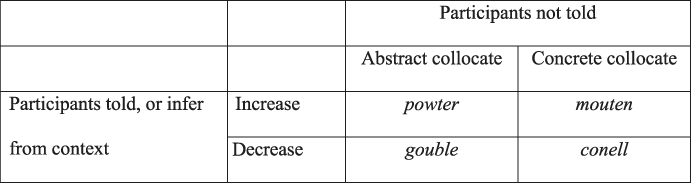
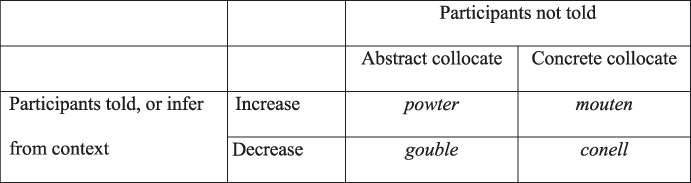
The present experiments used four novel verbs: powter, mouten, gouble, and conell. The participants were exposed to these verbs in verb phrases containing a direct object noun. Their task required them to think about whether the verb conveyed an increase or decrease meaning, either as inferred from the context (Experiment 1) or as learned from instruction given before the experiment (Experiment 2). What they were not told was that powter and gouble took abstract collocates, whereas mouten and conell took concrete collocates (see Figure 1). For example, correct verb phrases would be powter the significance, gouble the power, mouten the calcium, and conell the chocolate. Using two techniques, we tested whether participants would learn the semantic preferences of these novel verbs implicitly. Experiment 1 embedded the verb phrases in sentence contexts and required participants to make an explicit concreteness decision on the nouns and to indicate whether the verb meant increase or decrease at the end of the sentence. The prediction was that, after exposure to many correctly formed trials, concreteness decision times and/or increase-decrease response times would be faster for new verb-noun combinations that respect the rule than for combinations that do not (e.g., powter with a concrete collocate such as compost). These are referred to as the new grammatical (NG) and new ungrammatical (NU) conditions, respectively. If learning is implicit, then this effect would be obtained even for participants who evinced no awareness of the relevance of concreteness to the collocational behavior of the verbs, as assessed by a posttest.
The novel verbs used in the experiments.
In Experiment 2, participants saw only the verb phrases, but this time they had to decide whether the noun conveyed positive or negative connotations (a decision that is subjective and irrelevant to the hidden regularity). This was followed by the increase-decrease decision, as before. Any effect here would arguably provide stronger evidence for implicit learning and would speak to the automaticity of the semantic activation underlying the effect.
EXPERIMENT 1
Participants
A total of 41 students at the University of Cambridge participated in the experiment. Seventeen were native speakers of English. All of the nonnative participants had achieved a band score of at least 7.5 (out of 9) on the International English Language Testing System (IELTS).
Materials and Procedure
A total of 80 sentences were created (20 for each novel verb) in which the verb conveyed either an increase or decrease meaning with respect to the object. For procedural reasons, the word order was scrambled so that the verb phrase occurred at the beginning of the sentence, resulting in a verb-object-subject (VOS) word order. The VOS word order was used so that the only context prior to the critical decision on the noun was the novel verb. If we had adopted an English SVO word order, then processing of the noun would have been affected by other contextual constraints that would have varied among items. Example sentences from Experiment 1 are shown in (1)–(4).
(1) POWTER the prestige of wealthy families, artists can.
(2) GOUBLE the role of nuclear weapons, Obama stresses the need to.
(3) MOUTEN the nutrients you need, make sure you.
(4) CONELL the histamine stores, the sweating helps to.
The experiment comprised two blocks of trials. In the first block there were 44 training trials in which each novel verb occurred equally often. The collocates occurred with both increase and decrease verbs (e.g., POWTER the prestige and GOUBLE the prestige occurred but in different sentence contexts). Block 2 began with 12 trials repeated from Block 1 followed by 32 critical trials in which the novel verbs occurred in new sentences and with new collocates not encountered in Block 1. Half of these items respected the semantic preference rule (NG condition), and half violated it, for example, by pairing a concrete noun with powter (NU condition). The 32 critical trials were randomly intermixed with the remaining 32 grammatical trials from Block 1. Note that NG and NU are merely labels and refer to the predetermined selectional preferences of the novel verbs (and not, strictly speaking, to their grammaticality). The new collocates in the critical test items were chosen so as to be roughly synonymous with an object noun that occurred in Block 1 (e.g., POWTER the importance occurred in training, and POWTER the significance occurred in test). Each object noun appeared only once in the critical trials. Assignment of items to conditions was rotated around two presentation lists so as to control for item effects. The order of trials in Blocks 1 and 2 followed the same random order for all participants, although the actual items on the critical trials varied between Lists 1 and 2 of Block 2 due to the item rotation.
Approximately halfway through running the experiment it was decided to increase the number of training items in Block 1. Sixteen new sentences were created, containing new collocates, which occurred only once (see the Appendix).
Participants were told that each sentence would begin with a novel verb written in capitals and were asked to indicate whether it conveyed an increase or decrease meaning based on the sentence context. Two sentences were used as a demonstration of the procedure, and the experimenter verbally pointed out the second required response—the increase-decrease decision on the noun following the verb. The sentences were presented word by word in the center of the screen. First the verb (e.g., powter) was presented in capital letters for 600 ms, followed by the article the for 600 ms. This was followed by a noun (e.g., prestige) in red lowercase letters. The participants were instructed to indicate as quickly as possible whether this noun referred to an abstract or a concrete object by pressing the left or right buttons on a response box. If they made an error, the word remained on the screen until they pressed the correct button. On a correct response, the display changed to a recall prompt, “___ the ___,” and they had to recall the verb phrase aloud (i.e., say “powter the prestige”). They then pressed a response button, and the remainder of the sentence appeared at a rate of 600 ms per word (e.g., of wealthy families artists can). At the end of the sentence, the prompt +/− appeared on the screen, and the participants had to indicate as quickly as possible whether they thought the verb conveyed, broadly, an increase or decrease meaning by pressing the right or left buttons on the response box. There was no feedback on this decision nor were the participants told that the verbs would have consistent meanings. This aimed at stimulating deep processing of the meanings of the words in the sentences, as if the participants had read them in a natural situation.
To assess awareness, at the end of the experiment the participants were presented with a surprise posttest comprising eight new sentences from which the verb had been removed. They were asked to indicate which of the four novel verbs they thought should be used in that context and to think aloud as they made their decision. They were also asked probing questions by the experimenter about any observations they had about the experiment and patterns in the words used. Any participant who referred to the abstract-concrete distinction, or something similar, or who made any potentially relevant remark was classified as aware, regardless of his or her actual performance on the posttest. The experiment was run using SuperLab software (Version 4.5) and a Cedrus response box. The whole procedure took approximately 40 min. There was a small break between Block 1 and Block 2, which lasted as long as it took the experimenter to load a new SuperLab file and to inform the participant that the task continued in the same manner.
Results and Discussion
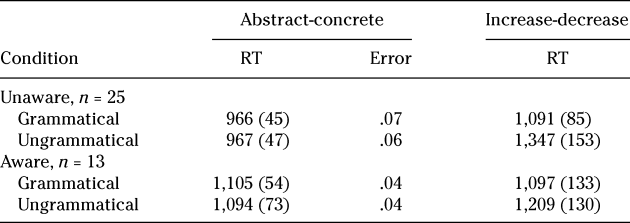
Out of 41 participants, 12 revealed at least fragmentary explicit knowledge in the postexperiment debriefing and were classified as aware. The remaining 29 participants were classified as unaware. For each participant, response times that were greater or less than 2.5 standard deviations above the mean response time over the 32 critical trials were winsorized (i.e., replaced with the next highest or lowest value). Additionally, in cases in which an error was made on the first (abstract-concrete) decision, the response on the second decision was removed from the analysis. This was because participants were likely to have been distracted on the subsequent increase-decrease decision by just having had to correct themselves. Two participants were excluded because of low accuracy on the abstract-concrete decision (50% and 53%), which suggested that they were having problems with the task and led to an inordinate loss of data on the second decision. Two other participants were excluded due to excessively long mean response times on the second increase-decrease decision (greater than 2 SDs from the mean).Footnote 1 The mean reaction times and error rates in each condition for the remaining 25 unaware and 12 aware participants are shown in Table 1. Note that response errors were excluded from the reaction time analysis of the abstract-concrete decision but not that of the increase-decrease decision (because there was no error from the participant’s point of view in this task).Footnote 2
Mean reaction times (RTs; in ms, with SEs in parentheses) and error rates (for the abstract-concrete decision only) in Experiment 1
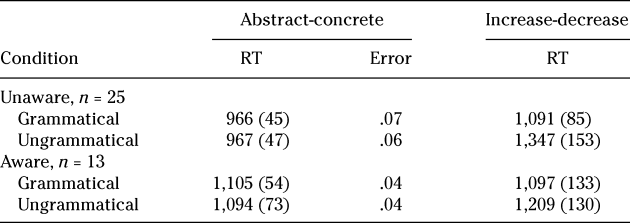
Separate ANOVAs were conducted on the correct reaction time and error data on the responses from critical trials in Block 2 for the unaware and aware groups in which grammaticality (grammatical or ungrammatical) was a within-subjects factor and item rotation (first or second list) was a between-subjects factor. For the unaware group for the abstract-concrete decision there was no effect of grammaticality on either reaction times, F(1, 23) = 0.003, p = .959, η2 = .000, or errors, F(1, 23) = 0.166, p = .687, η2 = .007. However, there was a significant effect of grammaticality in the unaware group on increase-decrease reaction times, F(1, 23) = 5.707, p = .025, η2 = .199.
For the 12 aware participants there was no significant effect of grammaticality on reaction times for the abstract-concrete decision, F(1, 10) = 0.043, p = .840, η2 = .004, and the error rates in the grammatical and ungrammatical conditions were identical. Similarly, there was no effect of grammaticality on reaction times for the increase-decrease decision, F(1, 10) = 1.733, p = .217, η2 = .148. Although the mean reaction times for the increase-decrease decision showed a 112 ms difference in the expected direction, there was higher variability among aware participants than among the unaware group.
A post hoc analysis was carried out to check for potential differences in performance between the native and nonnative English-speaking participants in the unaware group. An ANOVA revealed no interaction between grammaticality and native-nonnative speaker status for any dependent variable, all Fs < 1.0. The impact of increasing the amount of training was also assessed (recall that partway through the experiment 16 new items were added to Block 1). Among the unaware group, 12 participants received the shorter training version and 13 the longer version. For the increase-decrease decision there was no significant interaction between training version and grammaticality, F < 1.0, although the grammaticality effect was numerically larger for the longer than for the shorter training version, 307 ms and 197 ms, respectively. For the abstract-concrete decision, there was no interaction between training version and grammaticality, F < 1.0, and the grammaticality effects for the longer and shorter versions were 16 ms and 22 ms, respectively. Only three of the 12 aware participants received the longer training version, so no such analysis was performed.
This experiment provides evidence of an implicitly acquired sensitivity to a semantic preference rule. The fact that learning effects were apparent on the decisions involving purely the indication of whether a particular verb meant to increase or decrease is particularly compelling because the decision was being made with reference to the meaning of the verb, not the collocate, and knowledge of the semantic preference rule does not directly inform this decision. This effect actually provides stronger evidence of the use of implicit knowledge than if it had occurred on the concreteness decision (a point on which we elaborate in the General Discussion section).
Having said this, it is not clear how the effect of grammaticality on the increase-decrease decision arose. One possibility is that the mismatch between the verb and noun in the NU condition somehow disturbed the process of deriving the increase-decrease meaning from the verb and its context. It may also have caused confusion about the identity of the verb (because the collocate would have suggested other verb possibilities than the one that occurred). However, there is an alternative explanation that cannot be ruled out at this stage. The effect may not reflect learning of a semantic regularity at all but, rather, may indicate associations between novel verbs and patterns of button presses (e.g., powter was associated with successive responses on the right-hand button). Experiment 2 was designed to rule out this possibility as well as to create conditions under which awareness of the hidden regularity was much less likely to occur and under which any effect of knowledge on behavior was more likely to reflect automatic, as opposed to controlled, behavior.
Even if we suppose that the effect obtained in Experiment 1 was semantic in origin, the question remains as to the nature of the generalization that was formed. Although the noun collocates in the critical test items were different from those that occurred in training, they were in fact roughly synonymous with a noun that had occurred in the training phase. This means that it is hard to defend the claim that what was learned was a correlation between verbs and the abstract-concrete distinction as such. Rather, the effect could have reflected the similarity between individual nouns in the training and the test. To address this issue, the noun collocates in Experiment 2 were changed so as to represent a more heterogeneous set of abstract and concrete nouns, and no noun in the test phase was a synonym of a noun in the training phase. Learning over these items would be more likely to reflect abstraction of a broad concreteness distinction.
EXPERIMENT 2
This experiment employed a reaction time methodology similar to that of Experiment 1. Two main changes were made. First, a simplified procedure was employed in which only verb phrases were presented. Participants were informed about the increase-decrease meanings of the verbs prior to the experiments so as to reduce the number of errors on this decision. The second change was that, instead of making a concreteness decision on the collocates, participants now had to indicate whether the collocate had positive, negative, or neutral connotation. For example, chocolate and holidays would be expected to receive positive judgments, whereas horror would be expected to receive a negative judgment. Participants were informed that the choices were subjective and that there was no correct answer. Crucially, the semantic preference rule was exactly the same as in Experiment 1; powter and gouble went with abstract nouns and conell and mouten with concrete nouns. Given that no systematic alignment between connotative meaning judgments and concreteness is expected, this means that there will be no systematic relationship between the button pressed on the first decision and the second increase-decrease decision. Thus, learning is unlikely to be based on associations between nonsense verbs and patterns of button presses. This also means that any influence of noun concreteness on the second decision must reflect automatic activation of this aspect of meaning rather than explicit retrieval as part of the task (as was the case in Experiment 1).
Participants
Forty-six students of the University of Cambridge participated in the experiment. Three participants were excluded due to problems with the task. Of the remaining group of 43 participants, 22 were native speakers of English. All of the nonnative participants had achieved an IELTS band score of at least 7.5 (out of 9).
Materials and Procedure
The experimental design was identical to Experiment 1, except that the number of items in Block 1 was increased to 80. Forty-four of these occurred in Block 2 mixed with grammatical and ungrammatical critical items, as was the case in Experiment 1. The nouns for the training and test items were changed so as to comprise a more heterogeneous set of abstract and concrete nouns. The broadened category of abstract nouns included ones as different as happiness, wisdom, impact, and understanding. The category of concrete nouns was similarly broadened to include, for example, chocolate, luggage, metal, and paper. Half of the nouns in each group were selected because they had a positive valence and the other half a negative valence, according to the authors’ intuitions. This also applied to the groups of nouns that occurred with each verb in the test items (see the Appendix). Only verb phrases were used.
Participants were first informed about the increase-decrease meanings of the novel verbs. The experimenter helped them practice pronouncing the words and used oral questioning to ensure that they remembered which one meant increase or decrease. The simplified procedure in Experiment 2 comprised the following sequence of events. First the verb was presented in capital letters for 600 ms. This was followed by the word the for 600 ms, followed by the noun in red. The participants made their decision about the connotation of the noun within an allocated time of 3 s. Responses were entered on a millisecond-accurate keyboard on which M indicated “positive,” Z “negative,” and the space bar “neutral.” Once the participants made any response, the noun was replaced by the “inc/dec” prompt, and they indicated whether the verb meant increase or decrease by pressing M or Z, respectively. The prompt would only disappear if they made a correct response. After every two stimuli, participants received prompts that required them to recall out loud one of the phrases they had just seen. The prompt revealed either the first part of the phrase—for example, “MOUTEN the _______”—or the second part—“_______ the prestige”—and participants were asked to pronounce the complete phrase. The memory task was designed to encourage full attention to the materials, and the data were not analyzed. All stimuli were presented in the center of the screen. The experiment was followed by a posttest similar to that in Experiment 1.
Results and Discussion
None of the participants appeared to have any awareness of the correlation between the novel verbs and the concreteness of the noun. The data were treated in the same way as in Experiment 1. Two of the native participants were excluded on the basis of excessively long second decision response times (beyond 2 SDs from the mean).Footnote 3 Because there was no prescribed correct response for the valence decision, occasions on which no response was made before the time limit were classed as errors for the purposes of analysis. To check on how the participants actually did classify the nouns as positive, negative, or neutral, the proportions of responses for the grammatical and ungrammatical conditions were calculated separately. The mean proportions of positive responses in the grammatical and ungrammatical conditions were .420 (SE = .020) and .426 (SE = .018), respectively; the proportions of negative responses were .441 (SE = .016) and .451 (SE = .013), respectively; and the proportions of neutral responses were .139 (SE = .031) and .123 (SE = .026), respectively. For none of the response types was there a significant difference in response proportions between the grammatical and ungrammatical conditions: for positive responses, t(40) = 0.327, p = .746; for negative responses, t(40) = 0.792, p = .433; for neutral responses, t(40) = 1.101, p = .277. Thus, the majority of responses were roughly equally divided between positive and negative, and there were no differences in response patterns to the test items that might confound effects of grammaticality on response times and accuracy.
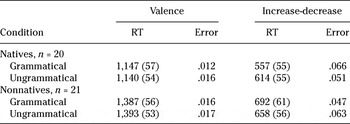
An initial ANOVA showed that there was no overall effect of grammaticality on the valence decision in either reaction times, F(1, 39) = 0.004, p = .950, η2 = .000, or errors, F(1, 39) = 0.065, p = .800, η2 = .002. In contrast to Experiment 1, there was no effect on increase-decrease decision times, F(1, 39) = 0.383, p = .539, η2 = .010, or errors, F(1, 39) = 0.023, p = .881, η2 = .001. However, when native-nonnative speaker was entered as an additional between-subjects factor, a significant interaction between native speaker status and grammaticality was obtained for increase-decrease decision reaction times, F(1, 37) = 8.935, p = .005, η2 = .195, but not for errors, F(1, 37) = 1.910, p = .175, η2 = .049. There was no interaction between native speaker status and grammaticality for the valence decision in either reaction time or errors, F(1, 37) = 0.118, p = .733, η2 = .003, and F(1, 37) = 0.029, p = .865, η2 = .001, respectively. Table 2 shows the mean reaction time and error data for each group.
Mean reaction times (RTs; in ms, with SEs in parentheses) and error rates in Experiment 2

Individual ANOVAs on the native and nonnative groups showed that for the natives there was no effect of grammaticality on valence decision times, F(1, 18) = 0.086, p = .773, η2 = .005, or on errors, F(1, 18) = 0.184, p = .673, η2 = .010. But there was a significant effect of grammaticality on increase-decrease decision times, F(1, 18) = 9.470, p = .007, η2 = .345, although not on errors, F(1, 18) = 0.890, p = .358, η2 = .047. For the nonnative speakers there was no effect of grammaticality on valence decision times, F(1, 19) = 0.041, p = .841, η2 = .002, or on errors, F(1, 19) = 0.006, p = .937, η2 = .000. Likewise, there was no effect of grammaticality on increase-decrease decision times, F(1, 19) = 2.044, p = .169, η2 = .097, or on errors, F(1, 19) = 1.023, p = .325, η2 = .051.
Experiment 2 provides stronger evidence for semantic implicit learning than Experiment 1 because the learned generalization was unrelated to the tasks being performed. Knowledge of the correlation between verbs and noun concreteness was unrelated both to the decision being made on the noun (connotative meaning) and to the increase-decrease decision. It has been argued that implicit knowledge should exert its influence on behavior in an automatic rather than a controlled way (Cleeremans & Jiménez, Reference Cleeremans, Jiménez, French and Cleeremans2002) and that the strongest test of implicit knowledge is to be obtained in situations in which knowledge has an effect on performance even though it is irrelevant to the task at hand (Tzelgov, 1997; Vinter & Perruchet, Reference Tzelgov1999). Experiment 2 seems to satisfy those criteria. Furthermore, in this experiment, none of the participants demonstrated awareness of the semantic regularity in the posttest, which in itself suggests that the relevant knowledge was well below the level of awareness.
Experiment 2 also shows that the effects obtained in Experiment 1 were not due to learning associations between the novel verbs and patterns of keystrokes. This was because the nouns in the abstract and concrete categories elicited a range of “positive” (M), “negative” (Z), and “neutral” (space bar) responses, and there was no difference in the distribution of these responses between the grammatical and ungrammatical conditions. Thus, the effects must have had a semantic origin. Furthermore, the learning effect in native speakers was obtained over sets of nouns that were more heterogeneous than in Experiment 1, and the critical test nouns were not synonyms of any nouns in training. Therefore, the learning effect must have been supported by a broad generalization, which we assume is essentially based on the abstract-versus-concrete distinction.
The fact that, in this experiment (Experiment 2), learning was not obtained for nonnative speakers is perhaps not surprising. There is a wealth of evidence that the mapping from L2 words to meaning is less automatic than from first language words. For example, automatic semantic priming from L2 words can only be obtained at very high levels of proficiency (Basnight-Brown & Altarriba, Reference Basnight-Brown and Altarriba2007). Thus, in a situation in which a decision is made about one aspect of meaning, it is not surprising that the nonnative speakers in Experiment 2 did not activate other aspects of meaning with sufficient strength to produce a learning effect.
GENERAL DISCUSSION
We argue that the present experiments demonstrate that semantic implicit learning of linguistic regularities can be obtained outside of the realm of grammar and can extend into learning about verb meaning. But do the effects really reflect the spontaneous induction of the hidden regularity, or are they the result of a more active, explicit form of learning involving conscious hypothesis testing? Leow and Hama (Reference Leow and Hama2013) raise a number of methodological issues, which they argue question the internal validity of Leung and Williams’s (Reference Leung and Williams2011, Reference Leung and Williams2012) studies. Because the present experiments used a similar method, the question is whether they are subject to the same criticisms.
One criticism is the provision of feedback during the task, which Leow and Hama (Reference Leow and Hama2013) argue may have increased the likelihood of noticing and encouraged explicit learning (which would then have had to go unreported in the unaware group). Although it seems unlikely that the provision of feedback would have altered participants’ conception of the task over and above the explicit requirements, it is true that, as Leow and Hama suggest, there is no way of knowing without carrying out experiments in which the presence of feedback is manipulated. Important, though, is the fact that the present Experiment 2 goes a step further because it presents a situation in which there is no feedback on the valence decision, and the task requirements do not draw attention to the abstract-concrete dimension in any way. Notably, none of the participants appeared to be aware of the hidden regularity, in contrast to the 33.3% who were aware in Experiment 1. Therefore, it does seem to be the case that the task requirement to make an explicit decision on the relevant semantic dimension, and possibly also the provision of feedback, does increase the probability of awareness of the underlying regularity. Even so, it is still not clear whether this is because the task encourages an explicit learning strategy or because more reliable encoding of the relevant semantic information enhances the incidental induction process, which in some cases leads to awareness.Footnote 4
The possibility that conscious knowledge could result from both implicit and explicit learning processes highlights a problem with using verbal report as a means of isolating participants who have learned through incidental induction. The emphasis here, as elsewhere, on implicit learning (as learning without awareness of either the process or product of learning) is actually going a step beyond what is required to study incidental induction as a language learning mechanism. This is because incidental induction could result in conscious knowledge through spontaneous insight, a possibility that is woefully neglected in relation to language learning and has only been investigated with any rigor in the problem-solving literature (Bowden, Jung-Beeman, Fleck, & Kounios, Reference Bowden, Jung-Beeman, Fleck and Kounios2005). From this perspective, excluding all participants who show any conscious knowledge of the hidden regularity in a postexperiment interview, whether this emerged during the training or test phases, is actually a conservative means of isolating the incidental induction mechanism.
Nevertheless, Hama and Leow (Reference Hama and Leow2010) and Leow and Hama (Reference Leow and Hama2013) raise objections to the use of postexperiment verbal report as a means of assessing awareness, primarily on the basis that participants may find it difficult to articulate the relevant knowledge and that they may have forgotten their conscious impressions by the time they are asked about them. Rather, they favor concurrent think-alouds. But note that the problem of articulating impressions is shared by think-alouds and, in any case, is an objection that has been raised primarily in relation to artificial grammar research in which the underlying regularities are highly complex (Shanks & St. John, Reference Shanks and St. John1994). We assume that regularities based on clear conceptual distinctions such as living versus nonliving and, in the present case, abstract versus concrete would be easily reportable. With regard to forgetting over a delay, note that the posttest task that we use as a vehicle for eliciting verbal report occurred immediately after the main task had ended. It seems unlikely that a participant who had formulated an understanding of all, or part, of the system and had strategically used this knowledge to influence his or her decisions would forget that he or she had done so in such a short space of time.
Of course, the issue of awareness at the level of understanding is only relevant if conscious knowledge actually influences the behavior that leads to the inference of a learning effect. In the present experiments it is not obvious that this would have been the case because the learning effects were evident on the increase-decrease decision (rather than on the noun itself, as in Leung & Williams, Reference Leung and Williams2012, Reference Leung and Williams2014). Knowing that there is a correlation between certain verbs and certain kinds of nouns would not inform this decision in any way. Indeed, the 13 aware participants in Experiment 1 failed to show a significant difference between response times on the grammatical and ungrammatical trials, although the reaction time difference for the increase-decrease decision was in the expected direction. The variability over participants indicates that the levels of reportable knowledge that lead to the classification of being aware do not guarantee that a learning effect will be evident in reaction times, precisely because this knowledge is not directly relevant to the task at hand. Additionally, if a number of participants classified as unaware actually did have conscious knowledge that they failed to report or forgot, one wonders how many such cases there would need to be to produce a significant effect for the unaware group as a whole, given that the effect was not even significant over 13 aware participants. Although misclassification or underreporting is always a possibility, we doubt that there were a sufficient number of such cases to account for the statistically significant overall learning effect in the unaware group.
Turning to theoretical issues, although we would argue that the present studies demonstrate an implicitly learned sensitivity to semantic preferences of verbs, this is not to say that all aspects of word meaning have the potential to be learned in this way. Paradis (Reference Paradis2004) has proposed that learning referential meaning requires the declarative system and hence presumably depends on awareness of the connection between form and meaning. But other aspects of meaning, such as semantic preferences, could be acquired implicitly. Although it is not clear whether the kind of learning demonstrated here actually depends on the operation of the procedural system, as hypothesized by Paradis, the present results do show that this aspect of verb meaning is amenable to implicit learning.
It should also be stressed that the present experiments demonstrate learning semantic preferences in a situation in which some aspect of the meaning of the verbs (i.e., their increase or decrease meaning) is already explicitly known (as in Experiment 2) or is being intentionally inferred from context (Experiment 1). Thus, we regard these learning effects as essentially reflecting the process of tuning an already established meaning of which the participants are aware. Although this tuning process undoubtedly forms an important part of word learning through usage, it has to be distinguished from the process of actually forming new form-meaning connections from scratch.
Although the present lab-based experiments may seem rather contrived and artificial, with scrambled word order sentences and response pressure, we would argue that the procedures do tap into processes that occur in natural L2 learning. On encountering unfamiliar words in context, it is natural to first consider the gist of the meaning (e.g., whether a verb denotes increasing or decreasing) and to subsequently learn more about collocational properties (e.g., whether it occurs with abstract or concrete nouns). In a similar vein to learning about mouten, powter, gouble, and conell, a foreign language learner would learn the distinction between the English add, increase, diminish, and deplete. A beginner would most likely focus on the core meaning. A more advanced learner may show greater sensitivity to the words’ collocational behavior, and we have demonstrated that this can be acquired implicitly through usage.
Finally, the fact that there was no semantic implicit learning effect in Experiment 2 for nonnative speakers provides a cautionary note in relation to the role this process may play in L2 acquisition. The implication is that semantic regularities will be most effectively learned when attention is drawn to the relevant aspects of meaning by the task. Otherwise semantic implicit learning effects may be limited unless semantic access from known words in the context is highly automatic. This does not mean, though, that learners have to be aware of the actual underlying regularities. Even if in some cases it may be necessary to be aware of both form and meaning, it is not necessary to be aware of the semantic generalizations that they license. This was the conclusion from the Williams (Reference Williams, VanPatten, Williams, Rott and Overstreet2005) study and is reinforced by the findings from the present experiments.
APPENDIX
EXPERIMENT 1
Training
Items in italics were added to make the longer training version.
POWTER the prestige of wealthy families, artists can.
POWTER the role of philanthropy in raising funds, experts will.
POWTER the significance of suffering, a belief in God would.
POWTER the greatness of their country, scientists can.
POWTER the authority of the Department of Justice, the legislation will.
POWTER the eminence of the artist, this award will.
POWTER the esteem of scientific research, the Academy will.
POWTER the criticism of the campaign, this will.
POWTER the prestige of Paraguay, Lopez sought to.
POWTER the role of former professional cricketers, the cricket association will.
POWTER the esteem of peers, teenagers think smoking will.
POWTER the freedom for all, the new laws aim to.
POWTER the confidence in their kids, the parents need to learn to.
POWTER the excitement we put some of the rollercoaster track underground, in order to.
POWTER the nobility of the wine, careful racking is carried out to.
GOUBLE the prestige of America, Palin argued that Obama will.
GOUBLE the role of nuclear weapons, Obama stresses the need to.
GOUBLE the significance of the radio, TV tends to.
GOUBLE the greatness of this noble president, nothing can.
GOUBLE the authority of the holy book, biblical ambiguity does not.
GOUBLE the eminence of the tribe further, the Shamans should not.
GOUBLE the esteem of popular figures, such stories only tend to.
GOUBLE the criticism, such reassurances did little to.
GOUBLE the significance of this factor, I decry any tendency to.
GOUBLE the greatness of America, it is repugnant to watch this Congress.
GOUBLE the authority of the speaker, referring to notes will.
GOUBLE the advantage of wealthy candidates for office, limiting the activities of lobbyists will.
GOUBLE the safety of our youth citizens, we do not recommend anything that could.
GOUBLE the anxiety of change by preparing for retirement, you can.
GOUBLE the integrity of the court, avoid any inappropriate comments which might.
MOUTEN the nutrients you need, make sure you.
MOUTEN the calcium powder after you test the pH of the milk.
MOUTEN the minerals the body needs, it is possible to.
MOUTEN the glycogen to improve yields, you can.
MOUTEN the histamine blockers, then you have to.
MOUTEN the oxygen to the gas supply, the flame will turn blue as you.
MOUTEN the serotonin that you need, a warm bowl of oatmeal will.
MOUTEN the ozone into your breathing environment, allow the therapist to.
MOUTEN the nutrients rather than empty calories, a stewed apple will.
MOUTEN the calcium and lose weight, you can both.
MOUTEN the minerals to a purified water, how do I?
MOUTEN the iron to a vegan diet, how to?
MOUTEN the fluoride to the paste to protect the teeth, we do.
MOUTEN the humus necessary for your vegetables’ growth, you need to.
MOUTEN the iodine crystals and fill up with water.
CONELL the nutrients in food, microwaves can.
CONELL the calcium in your bones faster than you replace it as you age, you.
CONELL the minerals that occur naturally in the soil, modern agriculture tends to.
CONELL the glycogen, use prior intense exercise to.
CONELL the histamine stores, the sweating helps to.
CONELL the oxygen available for fish to breathe, algae can.
CONELL the serotonin in the brain, ecstasy will.
CONELL the ozone in the upper atmosphere, deodorant sprays will.
CONELL the oxygen from the atmosphere as they rot, plants will.
CONELL the serotonin over time, stimulants will.
CONELL the ozone by the year 2050, the rise in rocket launches will.
CONELL the sodium of the food supply, the goal is to.
CONELL the sulphur compounds in the body, drugs like para cresol can.
CONELL the carbon content in the soil, these harmful substances can.
CONELL the chlorine in your pool this procedure will.
Test List 1
List 2 was formed by changing POWTER to MOUTEN, and so on.
Grammatical
POWTER the splendour of your home, these fixtures will.
POWTER the trust in your relationships at work, team working can.
POWTER the prosperity of family farms, the Welsh assembly will.
POWTER the value of your gift by nearly 30%, Gift Aid will.
GOUBLE the power of the central state, Federalism is intended to.
GOUBLE the importance of Darwin’s discoveries, do not.
GOUBLE the influence of gangs on our streets, law-abiding citizens need to.
GOUBLE the impact of problems related to alcohol, government policy should.
MOUTEN the nitrogen fertilizer around the plants, you should.
MOUTEN the methane as a gas, we can.
MOUTEN the enzymes separately as required, brewers can.
MOUTEN the vitamins before cooking, it’s best not to.
CONELL the calories pretty fast, circuit training can.
CONELL the carbohydrates that worms need, ants tend to.
CONELL the potassium supply, physical stress can.
CONELL the sugar reserves in your liver, you must.
Ungrammatical
MOUTEN the position of your website on Google, purchased links will.
MOUTEN the prominence of current affairs programming, the BBC will.
MOUTEN the status of nurses, Nightingale worked to.
MOUTEN the force of calls for global action, the lobbyists will seek to.
CONELL the strength of the labour unions, the Conservatives sought to.
CONELL the appeal of fundamentalism, encouraging tolerant Islam will.
CONELL the fame of the actor, defects in voice or gesture.
CONELL the recognition of the human rights of Chinese women, there has been a worrying trend to.
POWTER the hydrogen as needed and available, we can.
POWTER the aerosol delivery system to the exhaust, here’s how to.
POWTER the magnesium in the form of granules, it is convenient to.
POWTER the glucose and stir rapidly, while the solution is still hot.
GOUBLE the insulin in your system, it takes time for your liver to.
GOUBLE the dopamine stores, prolonged use of methadone can.
GOUBLE the fertilizers we use, activated carbon will.
GOUBLE the proteins that you need, your body will.
EXPERIMENT 2
Training Items
POWTER/GOUBLE clarity
POWTER/GOUBLE luck
POWTER/GOUBLE comfort
POWTER/GOUBLE disappointment
POWTER/GOUBLE assurance
POWTER/GOUBLE harmony
POWTER/GOUBLE innovation
POWTER/GOUBLE damage
POWTER/GOUBLE compassion
POWTER/GOUBLE popularity
POWTER/GOUBLE advantage
POWTER/GOUBLE pain
POWTER/GOUBLE decay
POWTER/GOUBLE conflict
POWTER/GOUBLE awkwardness
POWTER/GOUBLE desolation
POWTER/GOUBLE sadness
POWTER/GOUBLE memory
POWTER/GOUBLE exploitation
POWTER/GOUBLE criminality
MOUTEN/CONELL vanilla
MOUTEN/CONELL tea
MOUTEN/CONELL cocaine
MOUTEN/CONELL junk
MOUTEN/CONELL mould
MOUTEN/CONELL silk
MOUTEN/CONELL aspirin
MOUTEN/CONELL bacteria
MOUTEN/CONELL balm
MOUTEN/CONELL asbestos
MOUTEN/CONELL pudding
MOUTEN/CONELL caramel
MOUTEN/CONELL debris
MOUTEN/CONELL soap
MOUTEN/CONELL gunpowder
MOUTEN/CONELL weed
MOUTEN/CONELL ammunition
MOUTEN/CONELL dandruff
MOUTEN/CONELL food
MOUTEN/CONELL money
Test list 1
List 2 was formed by changing POWTER to MOUTEN, and so on.
Grammatical
POWTER kindness
POWTER honesty
POWTER harm
POWTER laziness
GOUBLE attraction
GOUBLE trust
GOUBLE chaos
GOUBLE exploitation
MOUTEN jewellery
MOUTEN honey
MOUTEN poison
MOUTEN dust
CONELL ice cream
CONELL perfume
CONELL mud
CONELL slime
Ungrammatical
MOUTEN laughter
MOUTEN wisdom
MOUTEN anger
MOUTEN irritation
CONELL amusement
CONELL delight
CONELL hatred
CONELL racism
POWTER fruit
POWTER chocolate
POWTER vinegar
POWTER grease
GOUBLE dirt
GOUBLE rubbish
GOUBLE medicine
GOUBLE gold