

Introduction
Health anxiety refers to excessive anxiety related to one's present or future health and can be a feature of a number of different disorders, such as hypochondriasis/illness anxiety/somatic symptoms disorder, obsessive compulsive disorder, and panic disorder (Rachman, Reference Rachman2012). While physical illness is typically the focus of concern, it is possible that mental illness can be the focus of dread and fear. In this case, patients fear losing control of their mind, acting in violent and unpredictable ways, or being locked away in psychiatric facilities (Rachman, Reference Rachman2012).
While mental illness anxiety is recognized as a form of health anxiety (Rachman, Reference Rachman2012), extant literature has focused on individuals who fear physical rather than mental illness. Cognitive behavioral therapy (CBT) has been demonstrated to be efficacious for health anxiety (see Rachman, Reference Rachman2012 for a review) but there is a paucity of research on adapting CBT for mental illness anxiety. The current case study aims to advance the understanding of the clinical picture of mental illness anxiety, and facilitate the understanding of how CBT techniques for health anxiety can be effectively adapted and implemented for such a case.
Method
Overview and design
Tamara, a 24 year old woman who resided with her parents in a small town in Canada, self-referred for services at a University Psychology Training Clinic. Tamara participated in an intake assessment, feedback session, and eight treatment sessions. A telephone follow-up session was conducted 2 months after treatment. With her consent, a single case study design was used to describe Tamara's treatment.
Assessment
Presenting problem
Tamara presented with elevated anxiety characterized by fears that she was “going crazy” or may “end up in a mental institution”. She further described experiencing intrusive thoughts and images of hurting people close to her, which would often trigger cued panic attacks. Tamara's interpretation of her intrusive thoughts was that she must be becoming a “serial killer” or developing a serious mental illness. Similarly, when having a panic attack, Tamara would think “this also proves I’m losing my mind”. In response to her anxiety, Tamara reported avoiding places or activities that she suspected would trigger her anxiety (e.g. television depicting serial killers, articles about mental illness). Tamara identified her fears of mental illness as the most distressing and impairing of her symptoms.
History of problem
Tamara reported first experiencing mental illness anxiety 5 years prior while under significant school stress. Subsequently, Tamara experienced panic attacks due to escalating mental illness anxiety. In the past few months, Tamara's symptoms worsened to the point of daily intrusive thoughts and weekly panic attacks. Tamara had no previous mental health treatment. Tamara reported that her father and brother had “anxiety issues”; however, she had limited information regarding the nature of their concerns. From Tamara's report, her parents had negative views of mental health issues, and it was a taboo topic within the family. Tamara shared that her mother had tried to dissuade her from seeking help and warned that she may “get locked away in an institution”.
Assessment measures
As part of the assessment process, Tamara completed the Short Health Anxiety Inventory (SHAI; Salkovskis, Rimes, Warwick and Clark, Reference Salkovskis, Rimes, Warwick and Clark2002), and Anxiety Sensitivity Index–3 (ASI-3; Taylor et al., Reference Taylor, Zvolensky, Cox, Deacon, Heimberg and Ledley2007). In order to adapt the SHAI for mental illness anxiety, Tamara was instructed to consider both physical and mental illness anxiety when completing the questionnaire. Tamara's scores on the SHAI and ASI-3 placed her in the moderate range of health anxiety and the severe range for anxiety sensitivity.
Case conceptualization
Tamara's presentation was conceptualized as mental illness anxiety. See the extended report for information regarding differential diagnosis. Cognitive theory posits that illness anxiety does not stem from events, but rather the interpretation of these events. Misinterpretations can arise because past experiences lead to the formation of specific beliefs and assumptions about illness. These beliefs and assumptions about illness can be activated by trigger stimuli (e.g. new illness information, physical changes), increasing anxiety and hypervigilance for further symptoms. Increased anxiety can lead to either reassurance seeking or avoidance behaviours in an attempt to reduce anxiety.
Tamara's early learning experiences were likely impacted by her parents’ negative views of mental illness and treatment-seeking. These learning experiences appeared to contribute to the development of catastrophic beliefs and assumptions about mental illness. When Tamara encountered triggers (e.g. information about mental illness, depictions of mental illness, bodily changes), her misinterpretations were activated, and she experienced heightened anxiety. Furthermore, she became hypervigilant for additional signs of mental illness (e.g. panic attacks were used as additional evidence that she was mentally ill), and engaged in either reassurance-seeking or avoidance behaviours that prevented disconfirmation of her beliefs.
Treatment
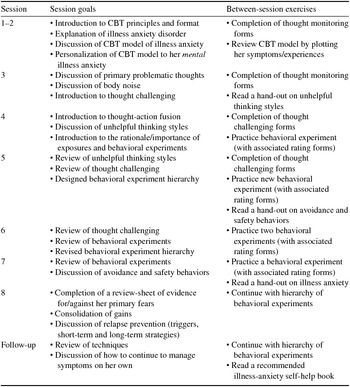
See Table 1 for an overview of treatment and the extended report for a full description.
Overview of treatment

Psychoeducation
During the psychoeducation phase, Tamara was instructed that often people with health anxiety fear becoming physically ill, or interpret certain bodily symptoms as signs of physical illness, but sometimes people focus on mental illness. The CBT model for health anxiety originally developed by Salkovskis and Warwick (Reference Salkovskis and Warwick1986) was introduced. Psychoeducation included information regarding the role of safety behaviours and reassurance-seeking in maintaining anxiety, as well as the importance of refraining from such behaviours. Psychological Treatment of Health Anxiety and Hypochondriasis: a biopsychosocial approach (Abramowitz and Braddock, Reference Abramowitz and Braddock2008) was used to guide treatment.
Cognitive restructuring
From her thought records, Tamara identified her primary anxiety-laden cognitions: “What if I’m mentally ill, and hurt someone?” and “I’m losing my mind and losing control”. To illustrate an example of thought challenging, Tamara was asked what “losing control” might tangibly look like in her life (e.g. getting fired for erratic behavior, boyfriend leaving her because she became violent), and then was asked if she had evidence of this type of “losing control”. She was also asked to query the likelihood of her interpretation, and generate alternative balanced thoughts (e.g. “I have more evidence of maintaining control in my life than I do losing control”). The concept of thought-action fusion was particularly helpful for Tamara, as she frequently used the phrases “thoughts aren't reality” and “thinking it doesn't make it more likely” as her alternative thoughts.
Behavioural experiments
Behavioural experiments (although at times similar to exposure exercises) are often incorporated into CBT for health anxiety in order for clients to gather evidence for or against their thoughts and interpretations. Tamara's first behavioural experiment was designed to test the notion that having intrusive thoughts about lashing out at a loved one meant she was mentally ill, and likely to carry out this type of action. For homework, Tamara spent 5 minutes per day vividly imagining verbally lashing out at her mother. In this way, she gathered evidence about whether or not thinking about a violent act caused it to occur. At her next session, she reported that she was far less inclined to believe that she would act in this violent way as a result of experiencing an intrusive thought. Her experiment afforded the opportunity to practise challenging her thoughts by incorporating this new-found “data”, and developing more realistic/helpful thoughts (e.g. “I’ve had this thought before, and nothing bad has happened”).
Exposures
Engaging in exposure and response prevention allows clients to experience anxiety associated with their feared stimuli without the feared outcomes materializing. As a result, clients become accustomed to the feared stimuli, and learn that the feared stimuli are not as threatening as they had originally believed (Abramowitz and Braddock, Reference Abramowitz and Braddock2008). For Tamara, this meant becoming accustomed to her unwanted and intrusive thoughts and the concept of mental illness. In session, a fear hierarchy of Tamara's distressing thoughts and images about mental illness was constructed. Tamara's hierarchy included imaginal exposures (e.g. imagining developing schizophrenia until she habituated to the thought) and behavioral exposures (e.g. reading an article about serial killers, visiting an inpatient hospital ward).
Results
Over the course of treatment, Tamara's initial SHAI score declined from 30 (moderate health anxiety) to 19 (mild) at midpoint, and further declined to 10 (mild) at treatment end. In terms of anxiety sensitivity, Tamara's initial ASI-3 score declined from 48 (severe) to 22 (moderate) at midpoint, and further declined to 9 (mild to no anxiety sensitivity). At 2-month follow-up, Tamara maintained low scores on measures of health anxiety (SHAI = 10) and anxiety sensitivity (ASI-3 = 9), demonstrating strong maintenance of treatment gains. Using Reliable and Clinically Significant Change methodology (Evans, Margison and Barkham, Reference Evans, Margison and Barkham1998) the decreases in Tamara's SHAI and ASI-3 scores were demonstrated to represent reliable and clinically significant change (see extended report). Tamara reported still experiencing some anxiety posttreatment; however she related that it no longer escalated to the point of panic attacks or disrupted sleep, and she felt better able to manage her symptoms.
Discussion
Given the lack of literature specifically focused on mental illness anxiety, we sought to illustrate the clinical picture and treatment of such a case. By the therapist's account, the CBT model and recommended treatment for health anxiety was relatively simple to adapt for mental illness anxiety. By the client's account of treatment applicability, and the improvement documented in her outcome measures, CBT appears to be effectively adapted as well. Moreover, the outcome measures often used to monitor treatment outcomes in physical health anxiety (i.e. SHAI, ASI-3) appeared to be suitable options for mental illness anxiety.
A potential limitation of the present case is the generalizability and applicability to other clients with mental illness anxiety, as it is unknown whether Tamara's presentation is typical. The case study design would have been strengthened by the use of repeated baseline measures showing the stability of her symptoms prior to treatment onset. To the authors’ knowledge, no other case or treatment studies of mental illness anxiety are available. As such, research focusing on the basics of mental illness anxiety (i.e. prevalence, risk factors, common fears) would be a valuable contribution and intuitive starting point.
Acknowledgments
Financial support: None
Conflict of interest: The authors have no conflicts of interest with respect to this publication.
Ethical standards: The authors assert that all procedures contributing to this work comply with the ethical standards of the relevant national and institutional committees on human experimentation and with the Helsinki Declaration of 1975, as revised in 2008.




Comments
No Comments have been published for this article.