Introduction
Sinonasal inverted papilloma is a rare but the most prevalent sinonasal tumour, accounting for 0.5–4 per cent of nasal sinus neoplasms.Reference Wang and Noel1 Sinonasal inverted papilloma arises from the Schneiderian epithelium of the nasal cavity and paranasal sinus. There are three histologically unique papilloma types: exophytic, oncocytic and, the most common, inverted papilloma.Reference Lisan, Laccourreye and Bonfils2,Reference Barnes3
Sinonasal inverted papilloma has three key features distinguishing it from other sinonasal tumours: high potential for recurrence, local bone destruction and risk of malignant transformation. Sinonasal inverted papilloma tends to occur more commonly in males, with a ratio of 3:1. The mean age of sinonasal inverted papilloma patients is 55 years.Reference Lisan, Laccourreye and Bonfils2,Reference Govindaraj and Wang4
The aetiology of sinonasal inverted papilloma remains unclear. Smoking, viral infections, diabetes, allergies and chronic inflammation are possible causes. Human papillomavirus (HPV) is considered a significant cofactor in the pathogenesis, especially HPV types 6, 11, 16 and 18. Recent reports suggest that occupational exposure is a risk factor for sinonasal inverted papilloma.Reference Hong, Kim, Lee, Cho and Roh5–Reference d'Errico, Zajacova, Cacciatore, Baratti, Zanelli and Alfonzo9
This study aimed to analyse clinical outcomes, recurrence rate and malignant transformation rate of sinonasal inverted papilloma.
Materials and methods
We conducted a retrospective analysis of patients diagnosed with sinonasal inverted papilloma in our hospital from December 2010 to May 2022. A total of 139 patients were reviewed. Clinical characteristics included sex, age, symptoms, previous sinus surgery history, tumour location, alcoholism and smoking history. Twelve patients presented with sinonasal inverted papilloma recurrence.
Computed tomography (CT) or magnetic resonance imaging (MRI) was conducted on all patients to identify the characteristics, location and tumour extension before surgery. All patients who underwent endoscopic surgery were classified according to four staging systems: Krouse, Cannady, Hans and Dragonetti.Reference Krouse10–Reference Dragonetti, Gera, Sciuto, Scotti, Bigoni and Barbaro14
The patients visited the hospital a week after surgery for a post-operative check-up and then two weeks later. Subsequently, they attended follow-up appointments at three months, six months and finally once a year. An endoscopic examination was performed at each visit to evaluate recurrence.
Results
The demographics of the 139 patients are summarised in Table 1 (100 males (71.9 per cent); 39 females (28.1 per cent)). The mean age was 67.3 years (standard deviation (SD) = 5.7) (age range: 17–79 years). Seventy-six patients (54.7 per cent) had a smoking history and 53 (38.1 per cent) had an alcohol drinking history. The tumour was located in the right nasal cavity in 74 cases (53.2 per cent), the left nasal cavity in 59 cases (42.4 per cent) and both nasal cavities in 6 patients (4.3 per cent).
Clinical demographics of 139 sinonasal inverted papilloma cases

SD = standard deviation; SNIP = sinonasal inverted papilloma
The most common chief complaint was nasal obstruction (n = 81, 58.3 per cent). Twenty-five cases (17.9 per cent) were incidentally detected on endoscopy or imaging. The third most common complaint was rhinorrhoea (n = 18, 12.9 per cent), followed by post-nasal drip (n = 3, 2.2 per cent), headache (n = 3, 2.2 per cent) and foul odour (n = 3, 2.2 per cent), nasal bleeding (n = 2, 1.4 per cent) and nasal discomfort (n = 2, 1.4 per cent), and dysgeusia (n = 1, 0.7 per cent) and snoring (n = 1, 0.7 per cent).
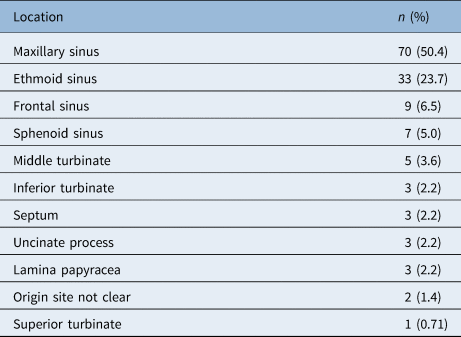
The maxillary sinus (n = 70, 50.4 per cent) was the most prevalent site of sinonasal inverted papilloma, followed by the ethmoid sinus (n = 33, 23.7 per cent), frontal sinus (n = 9, 6.5 per cent) and sphenoid sinus (n = 7, 5.0 per cent). The origin sites of sinonasal inverted papilloma in this study are summarised in Table 2.
Origin site of sinonasal inverted papilloma

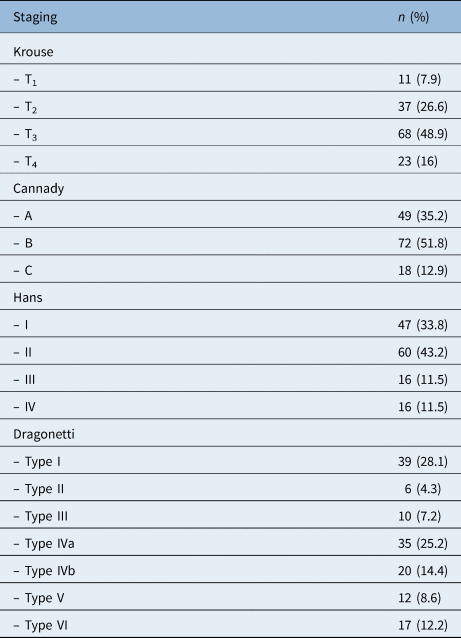
We classified cases according to the Krouse, Cannady, Hans and Dragonetti staging systems (Table 3). According to the Krouse system, 11 patients had stage T1 tumours (7.9 per cent), 37 were T2 (26.6 per cent), 68 were T3 (48.9 per cent) and 23 were T4 (16 per cent). Regarding the Cannady system, 49 were staged as group A (35.2 per cent), 72 were group B (51.8 per cent) and 18 were group C (12.9 per cent). For the Hans system, 47 were staged as group I (33.8 per cent), 60 were group II (43.2 per cent), 16 were group III (11.5 per cent) and 16 were group IV (11.5 per cent). According to the Dragonetti system, 39 were staged as type I (28.0 per cent), 6 were type II (4.3 per cent), 10 were type III (7.2 per cent), 35 were type IVa (25.2 per cent), 20 were type IVb (14.4 per cent), 12 were type V (8.6 per cent) and 17 were type VI (12.2 per cent).
Classification according to four sinonasal inverted papilloma staging systems

Of the patients, 125 (90 per cent) received a pathological diagnosis of sinonasal inverted papilloma without dysplasia. Four patients (2.9 per cent) were diagnosed with sinonasal inverted papilloma with low-grade dysplasia (mild to focal dysplasia), two (1.42 per cent) were diagnosed with sinonasal inverted papilloma with high-grade dysplasia, while nine (6.5 per cent) were diagnosed with squamous cell carcinoma.
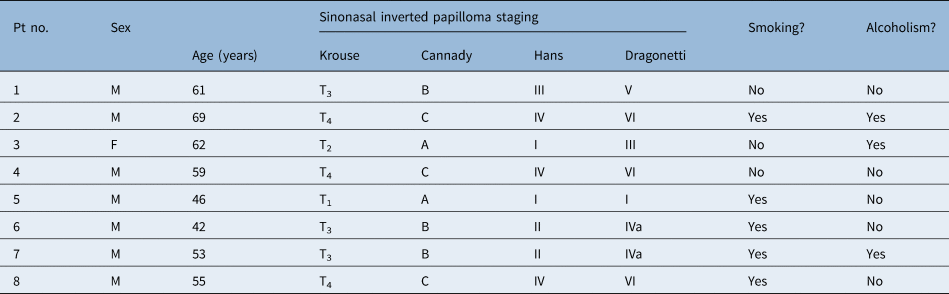
Recurrence occurred in eight patients (5.75 per cent). Data for these patients are summarised in Table 4. Seven of the patients were male (87.5 per cent), with a mean age at recurrence of 55.8 years (SD = 8.82). Five of the patients had a smoking history (62.5 per cent), and three had an alcohol history (37.5 per cent). The mean time to recurrence was 81.4 ± 88.4 months, ranging from 3 to 288 months. According to the Krouse system, three of the patients were at stage T4 (37.5 per cent), three were at stage T3 (37.5 per cent) and one each at stage T2 and T1 (12.5 per cent). In the Cannady system, three patients each (37.5 per cent) were in group B and group C, and two patients (25 per cent) were in group A. In the Hans system, the most prevalent stage was IV, with three patients (37.5 per cent). Two patients each (25 per cent) were in stage I and II. Only one patient (12.5 per cent) was in stage III. In the Dragonetti system, the most common stage was stage VI, with three patients (37.5 per cent), followed by stage IVa with two patients (25 per cent). Stages I, III and V included one patient each (12.5 per cent).
Data of eight patients with recurrence

Pt no. = patient number; M = male; F = female
After surgery, the mean follow-up period was 19.5 ± 34.9 months, ranging from 0.2 to 127 months.
Discussion
Sinonasal inverted papilloma is three times more prevalent in males than in females (mean age: 55 years).Reference Lisan, Laccourreye and Bonfils2,Reference Barnes3 In this study, sinonasal inverted papilloma occurred more often in males than in females, with a ratio of 2.6:1 (mean age: 67.3 ± 5.7 years at diagnosis). The youngest patient was a 17-year-old female; the oldest was a 79-year-old female.
Patients with sinonasal inverted papilloma had symptoms such as rhinorrhoea, nasal obstruction, nasal bleeding, hyposmia or anosmia, headache, and facial pain.Reference Doddawad, Premalatha, Sreeshyla and Nitin15 Nasal obstruction (58.3 per cent) was the most common symptom in this study. Of the cases, 17.9 per cent were incidentally detected. Rhinorrhoea (12.9 per cent) was the third most common symptom.
• Sinonasal inverted papilloma has a high tendency for recurrence, local bone destruction and risk of malignant transformation
• A total of 139 sinonasal inverted papilloma patients were reviewed; sex, age, symptoms, previous sinus surgery history, tumour location, alcoholism and smoking history were assessed
• The recurrence rate was 5.75 per cent and the malignant transformation rate was 6.5 per cent
• All study patients underwent endoscopic surgery and showed no significant difference in recurrence rate compared to the rates reported in current literature
Computed tomography and MRI are preferred for determining tumour site and extension. The key features of sinonasal inverted papilloma on CT are an isodense lobulated mass with or without calcification, prevalent bone erosion, and focal hyperostosis.Reference Momeni, Roberts and Chew16–Reference Chawla, Shenoy, Chokkappan and Chung18 On MRI, sinonasal inverted papilloma presents as an isodense to hypodense mass on T1-weighted images and as hyperdense on T2-weighted images. Convoluted cerebriform morphology is a frequent MRI presentation.Reference Savy, Lloyd, Lund and Howard17–Reference Ojiri, Ujita, Tada and Fukuda19 We conducted CT or MRI on all our patients to evaluate tumour location, origin site and extension. After imaging, we determined sinonasal inverted papilloma staging and type of surgery.
The most common origin site was the maxillary sinus, accounting for 50.4 per cent. This finding is consistent with current literature, in which the maxillary sinus is the most prevalent site of inverted papilloma.Reference Lian and Juan20 The second most common origin site was the ethmoid sinus, accounting for 23.7 per cent, followed by the frontal sinus and the sphenoid sinus.
The literature describes several sinonasal inverted papilloma classifications, with the Krouse system being the most widely used. We classified our patients according to the Krouse, Cannady, Hans and Dragonetti staging systems.Reference Krouse10–Reference Dragonetti, Gera, Sciuto, Scotti, Bigoni and Barbaro14 Stage T3 was most common (48.9 per cent) in the Krouse system, group B (51.8 per cent) was most common in the Cannady system, group II (43.2 per cent) was most common in the Hans system, and type I (28.1 per cent) was most common in the Dragonetti system.
The recurrence rate was 5.75 per cent, which is consistent with the rate reported in the literature, of 5–30 per cent (up to 78 per cent in another article).Reference Barnes3,Reference Gu and Zhang21–Reference Lund, Stammberger, Nicolai, Castelnuovo, Beal and Beham23 In the Krouse staging system, 12.5 per cent of recurrences occurred in both stage T1 and stage T2 and 37.5 per cent in both stage T3 and stage T4. According to the Cannady system, groups B and C had the same rate of 37.5 per cent. In the Hans system, stage IV was the most common at recurrence (37.5 per cent), and in the Dragonetti system stage VI was the most common (37.5 per cent).
The malignant transformation rate was 6.5 per cent. This finding is consistent with the current literature, in which the malignant transformation rate ranges from 7 per cent to 11 per cent.Reference Lund, Stammberger, Nicolai, Castelnuovo, Beal and Beham23–Reference Nowosielska-Grygiel, Pietkiewicz, Owczarek, Olszewski and Miłoński25
Up to the mid-1990s, the ‘gold standard’ was external approach surgery. Since endoscopic surgery was first described, the endoscopic approach has become the new gold standard. According to current literature, there is little difference in efficacy between the external approach and endoscopic surgery.Reference Lisan, Laccourreye and Bonfils2,Reference Mirza, Bradley, Acharya, Stacey and Jones24–Reference Jiang, Dong, Li, Huang and Zhang30 All patients in this study underwent endoscopic surgery.
Recurrence rates are significant, and recurrences have been reported several years after surgery.Reference Lund, Stammberger, Nicolai, Castelnuovo, Beal and Beham23 Therefore, periodic follow up of at least three years is essential.Reference Lund, Stammberger, Nicolai, Castelnuovo, Beal and Beham23
Conclusion
In this study, the recurrence rate was 5.75 per cent and the malignant transformation rate was 6.5 per cent. All patients in this study underwent endoscopic surgery, and showed no significant difference in recurrence rate compared with the rates reported in current literature. Meticulous resection and regular long-term follow-up sessions are important to reduce the incidence of sinonasal inverted papilloma recurrence after surgery.
Competing interests
None declared.