Implications
Population structure of gut methanogens in herbivores tends to be unique in composition and representation, and is controlled by mechanisms that still remain to be elucidated. Despite this high level of diversity, data analysis indicates that gut methanogens tend to cluster in discrete phylogenetic groups, and that a certain level of overlap can exist between populations under different conditions. This review summarizes the population structure of methanogens in a diverse range of herbivores, and discusses the commonality and uniqueness in these animals. It also provides a tool to compare gut methanogens between different hosts, breeds, diets or geographical locations.
Introduction
Enteric fermentation is performed by mutualistic communities of microorganisms that populate the gastrointestinal tract (GIT) of their hosts. These complex anaerobic microbial communities consist of many species from divergent groups such as protozoa, fungi, bacteria and archaea, which are connected through intricate synthrophic networks (Wolin, Reference Wolin1979). Through the combined activity of these microorganisms, macromolecules such as polysaccharides, proteins and lipids are metabolized into smaller organic molecules such as volatile fatty acids, which are absorbed by the host to provide energy. However, other products of microbial anaerobic respiration, including carbon dioxide and methane, are not assimilated and are released into the environment. Methane emissions from livestock are problematic for two reasons. First, enteric production of methane has a negative impact on animal productivity, resulting in lost energy ranging from 2% to 12% of the animal's gross energy intake (Johnson and Johnson, Reference Johnson and Johnson1995). Second, once released into the environment, methane acts as a potent greenhouse gas with 25 times the global warming potential of carbon dioxide. As a result of the continuous growth of the human population, and of changes in the dietary preferences of rapidly growing countries toward westernized diets, there is an expected increase in the number of domesticated ruminants worldwide. Decreasing methane emissions by livestock has therefore become a priority and an integral part of climate control policies (Thorpe, Reference Thorpe2008).
Methane is produced by methanogens, a diverse group of obligate anaerobic archaea that share methane synthesis as the end product of their anaerobic respiration (Liu and Whitman, Reference Liu and Whitman2008). Archaea form a large and diverse domain, both phylogenetically and ecologically, and have been identified in a wide variety of environments. Methanogens belong to the phylum Euryarchaeota, and are divided between six orders (Methanobacteriales, Methanococcales, Methanocellales, Methanomicrobiales, Methanosarcinales and Methanopyrales) that include 13 families and 35 genera (Euzéby, Reference Euzéby2012). As a group, methanogens are not restricted to the GIT of animals as an ecological niche, as they also inhabit diverse anaerobic environments such as marine and freshwater sediments, a wide variety of soil types, as well as landfills. Rumen methanogens most commonly use hydrogen and carbon dioxide as substrates for methanogenesis, but some species can also metabolize small organic molecules such as formate, methanol or acetate. They depend on other microorganisms in their community to provide them with substrates in order to sustain their energy needs through anaerobic respiration and methane production. Although methanogens can acquire substrates from their surrounding environment, some form intimate contacts with the ciliated protozoa or anaerobic fungi for increased efficiency. It is also possible that specific cell–cell interactions take place between gut bacteria and methanogens to facilitate synthrophic relationships, but it remains to be further investigated.
A number of laboratories have devoted their efforts to investigate the population structure of gut methanogens in a variety of hosts, in response to different diets or in various geographical locations. As with other environmental microbiology fields, gut methanogen research has greatly benefited from the development and enhancement of culture-independent methods for the identification of microorganisms. Owing to its widespread use and availability of large sequence databases, the 16S rRNA gene has been the most widely used phylogenetic marker in the investigation of gut methanogen populations (Balch et al., Reference Balch, Fox, Magrum, Woese and Wolfe1979; Raskin et al., Reference Raskin, Stromley, Rittmann and Stahl1994).
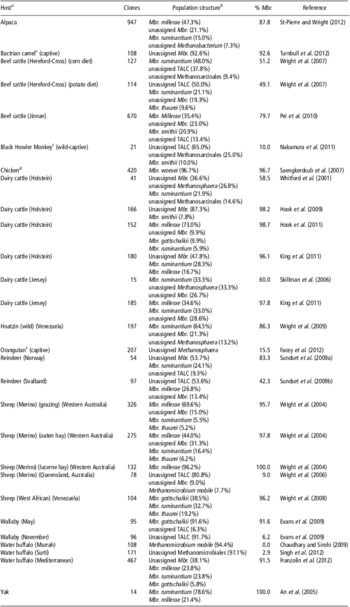
In this review, we have summarized methanogen representation in different host species or conditions using available results only from 16S rRNA gene clone library studies. Methanogens were assigned to specific groups based on their level of sequence identity with their closest related 16S rRNA gene sequences from validly described archaeal species (Table 1). In accordance with the current methanogen literature, 98.0% or greater sequence identity was used as species-level identity (Wright et al., Reference Wright, Northwood and Obispo2009). Clones with 95% to 97.9% sequence identity were deemed to have genus-level identity, that is, that they corresponded to 16S rRNA gene sequences from unassigned species of the same genus as their closest valid relative. Clones with less than 95% sequence identity were categorized as unassigned species of the same order as their closest relative. These categories not only proved useful to summarize the population structure from each study, they also provided a tool to compare gut methanogen composition between different hosts, breeds, diets or geographical locations.
Representation of gastrointestinal methanogens in a variety of host species based on 16S rRNA gene clone library analysis

Mbr. = Methanobrevibacter; TALC = Thermoplasmatales-Affiliated Lineage C.
aUnless otherwise noted, rumen or forestomach contents were analyzed.
bPercentages shown only if greater than 5.0%
cFecal sample.
dCecal sample.
Dairy cattle
Holstein cows are the most popular breed in the dairy industry, which explains why they have the highest number of published reports on rumen methanogen population structure using 16S rRNA gene clone libraries. In an early study, Whitford et al. (Reference Whitford, Teather and Forster2001) found that the rumen methanogen population structure from mid-lactating cows was very diverse, consisting of unassigned Methanobrevibacter species (36.6%), unassigned Methanosphaera species (26.8%), Methanobrevibacter ruminantium (21.9%) and unassigned species of Methanosarcinales (14.6%). The animals from the Whitford et al. (Reference Whitford, Teather and Forster2001) study were maintained on a total mixed ration (TMR) consisting of 35% forage, 30% corn silage and 35% concentrate. In contrast, Hook et al. (Reference Hook, Northwood, Wright and McBride2009) found in lactating Holsteins fed a different TMR (60 : 40 forage to concentrate) that unassigned species of Methanobrevibacter were by far the most prevalent methanogens (87.3%), with Methanobrevibacter smithii (7.8%) being the second most abundant group. Recently, rumen methanogens were investigated in lactating Holsteins from a mixed dairy herd (i.e. Holsteins and Jerseys) maintained under a TMR consisting of 33% forage, 33% corn silage and 33% concentrate (King et al., Reference King, Smith, St-Pierre and Wright2011), and although Methanobrevibacter was found to be the most prominent genus the population structure consisted of unassigned Methanobrevibacter species (47.8%), M. ruminantium (28.3%) and Methanobrevibacter millerae (16.7%). In another study, Hook et al. (Reference Hook, Steele, Northwood, Wright and McBride2011) studied the effects of changing the diet of non-lactating Holsteins from hay to a hay and mixed grain regimen. The change in diet did not dramatically affect the overall population structure in the animals, as M. millerae remained the most prevalent methanogen during the various treatments (54.1% to 79.4%), but there were fluctuations in representation between the minor groups consisting of unassigned Methanobrevibacter species, Methanobrevibacter gottschalkii and M. ruminantium. Together, these studies highlight the degree of variation in rumen methanogen populations, which can be observed between animals of the same breed. They also bring to our attention that factors other than diet, such as the physiological state (lactating v. non-lactating) of an animal, can possibly influence the composition of its microbiota.
Jersey cows are the second most commonly used breed in the U.S. dairy industry. Two reports on Jersey rumen methanogen populations by 16S rRNA gene clone libraries are currently available. In a study conducted by Skillman et al. (Reference Skillman, Evans, Strompl and Joblin2006), 15 rumen 16S rRNA gene clones from the rumen of a Jersey cow grazing on ryegrass/clover pasture were analyzed. Methanobrevibacter ruminantium and unassigned Methanosphaera species were found in equal abundance (33.3%), followed by unassigned Methanobrevibacter species (26.7%). The nature and representation of methanogens from the Skillman et al. (Reference Skillman, Evans, Strompl and Joblin2006) study show significant overlap with that of the Holsteins analyzed by Whitford et al. (Reference Whitford, Teather and Forster2001) presented above. In a recent report by King et al. (Reference King, Smith, St-Pierre and Wright2011), the frequency of M. ruminantium (33.3%) and unassigned Methanobrevibacter species (28.6%) in Jersey cows from a mixed herd were also found to be similar to the study by Skillman et al. (Reference Skillman, Evans, Strompl and Joblin2006), but in contrast M. millerae was identified as a prominent methanogen (34.6%) and unassigned species of Methanosphaera were observed at a much lower frequency.
Non-dairy cattle
Wright et al. (Reference Wright, Auckland and Lynn2007) investigated possible differences in rumen methanogen populations between Canadian-raised Hereford-Cross beef cattle that were fed different sources of starch. In animals fed a corn-based diet, Methanobrevibacter-related methanogens were found at 51.2% (of which M. ruminantium represented 48.0%), whereas Thermoplasmatales-affiliated archaea were identified at a frequency of 37.8%, and unassigned species belonging to the order Methanosarcinales were observed at 9.4%. However, in animals fed a potato by-product diet, Thermoplasmatales-affiliated methanogens were slightly more prevalent (50.0%) than Methanobrevibacter-related archaea (49.1%), with no detection of Methanosarcinales-related sequences. An additional difference between these two diets was the higher observed diversity of the Methanobrevibacter-related population in potato-fed cattle, as it included M. ruminantium (21.1%), unassigned Methanobrevibacter species (19.3%) and Methanobrevibacter thaurei (9.6%). Pei et al. (Reference Pei, Mao, Cheng and Zhu2010) reported that in Jinnan beef cattle raised in China under a corn and cottonseed meal-based diet, 79.7% of methanogens were Methanobrevibacter-related, which included a diverse array of M. millerae (35.4%), unassigned Methanobrevibacter species (23.0%) and M. smithii (20.9%). Thermoplasmatales-affiliated methanogens were found at a lower frequency (13.4%) than in the report by Wright et al. (Reference Wright, Auckland and Lynn2007).
Water buffalo (Bubalus bubalis)
Our current knowledge of rumen methanogens in water buffalo represents an excellent example of the complex interplay that breed, diet and geographical locations can have on the microbiota of herbivores. For example, two studies conducted in India reported that the most abundant methanogens in the rumen of Murrah (Chaudhary and Sirohi, Reference Chaudhary and Sirohi2009) and Surti (Singh et al., Reference Singh, Tripathi, Pandya, Parnerkar, Rank, Kothari and Joshi2012) breeds of water buffalo fed a concentrate : forage diet were 94.4% to 97.1% related to Methanomicrobium mobile, respectively. In contrast, a study conducted in Brazil on water buffaloes of the Mediterranean breed found that Methanobrevibacter-related phylotypes were the most abundant rumen methanogens at 91.5%, regardless of diet (grazing, corn silage and concentrate, or sugar cane and concentrate; Franzolin et al., Reference Franzolin, St-Pierre, Northwood and Wright2012). Thus, by mechanisms that still remain to be elucidated, rumen methanogen populations in the water buffalo consist of phylogenetically very distinct methanogens (Methanomicrobiales v. Methanobacteriales).
Sheep
Similarly to the current status of methanogen investigations in water buffaloes, the published studies on sheep rumen methanogens also highlight the possible effects of breed, diet and geographical locations on the microbiota of this host species. Under the three diets that were investigated by Wright et al. (Reference Wright, Williams, Winder, Christophersen, Rodgers and Smith2004), Methanobrevibacter-related archaea were found to be the dominant methanogens (95.7% to 100.0%) in the rumen of Merino sheep from Queensland, Australia. Overall, Wright et al. (Reference Wright, Williams, Winder, Christophersen, Rodgers and Smith2004) found M. millerae to be the most prevalent, but its representation varied noticeably between diets (44.0% to 96.2%). In the rumen of ‘West African’ hair sheep raised in Venezuela under a diet of alfalfa pellets and hay, Methanobrevibacter-related archaea were also dominant (96.2%), but they included M. gottschalkii (38.5%), M. ruminantium (32.7%) and M. thaurei (19.2%) as the most represented phylotypes (Wright et al., Reference Wright, Ma and Obispo2008). In contrast, Thermoplasmatales-affiliated archaea were by far the most prevalent (80.8%) rumen methanogens in Merino sheep from Rockhampton, Australia, that were fed a poor-quality Rhodes grass (Chloris gayana) diet. From that same study, Methanobrevibacter-related methanogens were identified at a relatively low frequency (9.0%) that was comparable to M. mobile-related archaea (7.7%; Wright et al., Reference Wright, Toovey and Pimm2006).
Yak (Bos grunniens)
Yaks are ruminants exclusively confined to the Qinghai-Tibetan plateau in China, at an elevation of 3000 m above sea level. Owing to the shortage of grain in this area, their diet typically consists of grazing on grasses. In an early study, An et al. (Reference An, Dong and Dong2005) identified 14 archaeal sequences from yak rumen samples, which were divided between M. ruminantium (78.6%) and M. millerae (21.4%) phylotypes. Current investigations on yak rumen methanogen populations are underway (R. Long, unpublished data), which will provide further insight on the microbiota of a ruminant that thrives in a harsh environment.
Reindeer (Rangifer tarandus platyrhynchus)
Methanogens have also been investigated in wild ruminants in order to improve our understanding of the ecological importance of rumen methanogens in natural environments. Reindeer represents an interesting model for this purpose because it is adapted to survive in a harsh environment where diet consists of vegetation of poor nutritional quality, the abundance of which is controlled by seasonal weather changes. Rumen methanogen studies have so far been published on Norwegian (Sundset et al., Reference Sundset, Edwards, Cheng, Senosiain, Fraile, Northwood, Præsteng, Glad, Mathiesen and Wright2009a) and Svalbard reindeer (Sundset et al., Reference Sundset, Edwards, Cheng, Senosiain, Fraile, Northwood, Præsteng, Glad, Mathiesen and Wright2009b). In the rumen of Norwegian reindeer grazing on late summer pastures consisting of woody plants, graminoids, mosses and lichens, Methanobrevibacter-related methanogens were found to be the most prominent (83.3%; Sundset et al., Reference Sundset, Edwards, Cheng, Senosiain, Fraile, Northwood, Præsteng, Glad, Mathiesen and Wright2009a). In this category, unassigned species of Methanobrevibacter were the most highly represented group (53.7%), followed by M. ruminantium (24.1%). Other than Methanobrevibacter-related methanogens, Thermoplasmatales-affiliated archaea were found at a frequency of 9.3%. In contrast, Thermoplasmatales-affiliated archaea were the most prevalent (53.6%) rumen methanogens in reindeer from the high-arctic desert island Svalbard that were sampled in late fall (Sundset et al., Reference Sundset, Edwards, Cheng, Senosiain, Fraile, Northwood, Præsteng, Glad, Mathiesen and Wright2009b). Methanobrevibacter-related methanogens were less abundant in Svalbard reindeer than in Norwegian reindeer (42.3%), and they were predominantly represented by M. millerae (26.8%) and unassigned Methanobrevibacter species (13.4%).
Camelids
Compared with ruminants, camelids have higher productivity on vegetation of poor quality and lower production of enteric methane, which has sparked interest in the characterization of their foregut microbiota. As foregut fermenters, camelids are physiologically similar to ruminants, but they are evolutionarily distant from them and thus express a variety of distinctive features, such as a digestive tract with a three-chambered stomach instead of the four-chambered stomach found in ruminants. Camelids originated in North America ∼40 to 45 millions of years ago (mya), where they diversified and remained confined until 3.5 to 6 mya, when representatives arrived in Asia and in South America (Prothero and Schoch, Reference Prothero and Schoch2002). The natural geographical distribution of modern camelid species reflects this ancestral separation: the Dromedary resides in the northern Africa and the south-west Asia region; the Bactrian camel is found in central Asia; and the llama and alpaca are located in South America. Gut methanogen populations have been investigated in species from different camelid evolutionary lineages. In the forestomach of alpacas fed a mixture of timothy, clover and rye supplemented with fresh fruits, Methanobrevibacter-related phylotypes were found to be the most prevalent archaea, with clones closely related to M. millerae being the most abundant (St-Pierre and Wright, Reference St-Pierre and Wright2012). While a foregut study in Dromedary camels is currently underway, hindgut methanogen populations in Bactrian camels have recently been described by Turnbull et al. (Reference Turnbull, Smith, St-Pierre and Wright2012) using fecal samples from animals maintained in captivity. According to this investigation, Methanobrevibacter-related archaea were also the most highly represented group, but in contrast to the alpaca forestomach populations 92.6% of Bactrian fecal 16S rRNA gene sequences were found to correspond to unassigned species of Methanobrevibacter.
Marsupials
Because of their geographical isolation, macropod marsupials have evolved separately from other major herbivore groups such as ruminants and camelids. For reasons analogous to camelids, interest in the composition of their microbiota has stemmed from their low to undetectable levels of methane emissions and their higher productivity on vegetation of poor quality in comparison to ruminants. Evans et al. (Reference Evans, Hinds, Sly, McSweeney, Morrison and Wright2009) compared the methanogen populations in the foregut of the wallaby (Macropus eugenii) in response to a change in natural diet, that is, between individuals sampled during the Australian autumn (May) and individuals sampled during the Australian spring (November). In May-sampled wallabies, Methanobrevibacter-related methanogens were the most abundant (91.6%), and consisted exclusively of M. gottschalkii. Methanogens from the Thermoplasmatales-affiliated group were the next most abundant group, but at a far lower representation (6.3%). In contrast, an opposite population structure was observed in wallabies from the same colony that were sampled in November, where Thermoplasmatales-affiliated methanogens were represented at 91.7% compared with Methanobrevibacter-related methanogens that were found at only 6.2%.
Non-human primates
In the Sumatran orangutan (Pongo abelii), Methanosphaera stadtmanae was recently found to be the dominant hindgut methanogen, which is the first reported instance of the prevalence of this archaea in a gastrointestinal environment (Facey et al., Reference Facey, Northwood and Wright2012). Because M. stadtmanae is unable to use hydrogen and carbon dioxide for methane synthesis and have a limited substrate range (Fricke et al., Reference Fricke, Seedorf, Henne, Kruer, Liesegang, Hedderich, Gottschalk and Thauer2006), M. stadtmanae-related methanogens are typically only found at a low prevalence in the gut of herbivores. It has been hypothesized that perhaps the degradation of large amounts of fruit pectin in frugivore hosts such as the orangutan may result in increased levels of methanol and acetate, which would favor the growth of M. stadtmanae methanogens (Facey et al., Reference Facey, Northwood and Wright2012).
As its diet consists largely of foliage, the black howler monkey (Alouatta pigra) relies on colonic microbial fermentation of plant structural polysaccharides to fulfill its energy requirements (Eisenberg et al., Reference Eisenberg, Muckenhirn and Rundran1972). As part of a recent study of hindgut methanogens in this host, Nakamura et al. (Reference Nakamura, Amato, Garber, Estrada, Mackie and Gaskins2011) found using a small clone library that Thermoplasmatales-affiliated methanogens were the most prevalent (65.0%), followed by unassigned members belonging to the order Methanosarcinales (25.0%) and M. smithii (10.0%).
Birds
Methanobrevibacter-related phylotypes have been found to be the most prevalent methanogens in the foregut of the hoatzin and in the hindgut of the chicken. The hoatzin (Opisthocomus hoazin), a follivorous bird from South America, is the only bird species to have evolved a foregut fermentation system, the crop, that is analogous to the rumen. Methanobrevibacter ruminantium was the highest represented methanogen (64.5%) in the crop of the hoatzin, followed by a substantial representation of unassigned Methanobrevibacter species (21.3%) and unassigned Methanosphaera species (13.2%; Wright et al., Reference Wright, Northwood and Obispo2009). In chickens, Methanobrevibacter woesei was found to be the most prevalent methanogen in the ceaca (96.7%; Saengkerdsub et al., Reference Saengkerdsub, Anderson, Wilkinson, Kim, Nisbet and Ricke2007). This was the first report of M. woesei as the most prevalent methanogen in a GIT.
Reptiles
Although 80% of mammalian species are herbivorous (Stevens and Hume, Reference Stevens and Hume1995), it is estimated that only 2% of squamate reptiles (snakes and lizards) are herbivores (Espinoza et al., Reference Espinoza, Wiens and Tracy2004). The existence of active methanogens in the gut of herbivorous lizards has been detected by methane production from fecal material of captive iguanas (Hackstein and Van Alen, Reference Hackstein and Van Alen1996). Recently, Hong et al. (Reference Hong, Wheeler, Cann and Mackie2011) reported an investigation of hindgut microbiota in three herbivorous reptiles from the Galapagos Islands: marine iguana (Amblyrhynchus cristatus), land iguana (Conolophus sp.) and giant tortoise (Geochelone nigra). Whereas marine iguanas feed primarily on soft macrophytic algae growing in intertidal and subtidal zones (Shepherd and Hawkes, Reference Shepherd and Hawkes2005), land iguanas and giant tortoises feed on similar species of terrestrial vegetation (Christian et al., Reference Christian, Tracy and Porter1984). Intriguingly, Hong et al. (Reference Hong, Wheeler, Cann and Mackie2011) were unable to recover archaeal sequences from marine iguanas, perhaps because of very low methanogen densities. However, archaeal sequences were successfully amplified from the feces of the other hosts sampled. In land iguanas, Methanobrevibacter-related methanogens were found to be the most prevalent, representing 81.6% of sequences recovered, with remaining sequences corresponding to methanogens from either Methanosarcina or Methanocorpusculum genera.
In contrast, Methanocorpusculum-related methanogens were the most abundant archaeal group in giant tortoises (87.5%), and no sequences from Methanobrevibacter- or Methanosarcina-related archaea were recovered from this host. In this study, assignment of archaeal sequences could only be resolved at the genus level, because pyrosequencing analysis of short-length 16S rRNA amplicons was used. However, it clearly demonstrates that the gut methanogen populations of herbivorous reptiles are complex, and that their composition is heavily influenced by factors such as species and diet as observed in mammals. Interestingly, Methanocorpusculum-related species have only been found in the feces of both cattle (Yamamoto et al., Reference Yamamoto, Otawa and Nakai2010) and Bactrian camels (Turnbull et al., Reference Turnbull, Smith, St-Pierre and Wright2012), as well as in hindgut fermenters such as the horse (A.-D. G. Wright, unpublished data). Methanocorpusculum, Methanofollis and Methanoculleus species may represent a unique population of hindgut methanogens. These methanogens have also been identified in manure anaerobic digesters (B. St-Pierre and A.-D. G. Wright, unpublished data).
Concluding remarks
Population structure of gut methanogens in herbivores tends to be unique in composition and representation, and it is controlled by mechanisms that still remain to be elucidated (Kim et al., Reference Kim, Morrison and Yu2011). Despite a high level of diversity at the species level, gut methanogens tend to cluster predominantly within certain phylogenetic groups (Methanobacteriales, Thermoplasmatales-Affiliated Lineage C (TALC)) and a certain level of overlap can exist between populations under different conditions.
Overall, 16S rRNA gene sequences belonging to the genus Methanobrevibacter are the most frequency identified phylotypes in gut samples from herbivores. Although there is variation in the level of representation depending on host species, diet, and, or geographical location, the prevalence of Methanobrevibacter-related archaea in a diverse range of host herbivores worldwide is quite remarkable. For instance, in certain hosts ranging from birds (chicken, hoatzin) and marsupials (wallaby) to camelids (alpaca, Bactrian camel) and ruminants (dairy cattle, water buffalo, reindeer, sheep and yak), Methanobrevibacter-related sequences represent more than ∼80% of 16S rRNA gene sequences identified. In other studies (beef and dairy cattle, reindeer), they were still prevalent while detected at a lower frequency (40% to 60%). As currently known Methanobrevibacter species are hydrogenotrophic, that is, that they can produce methane using hydrogen and carbon dioxide as substrates, it is assumed that Methanobrevibacter-related methanogens, identified only by their 16S rRNA gene sequence, are also capable of the same metabolic activity.
Fourteen Methanobrevibacter species have been described to date. However, Methanobrevibacter-related 16S rRNA sequences from the gut of herbivores are more frequently found to be closely related to four species in particular, either M. ruminantium, M. millerae, M. gottschalkii or M. smithii. Although they are typically observed at a lower frequency, 16S rRNA gene sequences more closely related to either Methanobrevibacter olleyae, M. thaurei or Methanobrevibacter wolinii are also identified consistently in different gut samples. To our knowledge, M. woesei-related 16S rRNA gene sequences have only been identified in chickens.
In addition to Methanobrevibacter-related sequences, methanogens from other archaeal phylogenetic groups are also consistently identified in gut samples from herbivores. To our knowledge, members of the second most prominent group of gut methanogens have yet to be cultivated and characterized. Although together they form a well-defined cluster phylogenetically, 16S rRNA gene sequences from these methanogens typically show limited sequence identity to species belonging to the Thermoplasmatales, within a range of ∼80% to 85%, and thus likely represent members of a new methanogen order (Wright et al., Reference Wright, Williams, Winder, Christophersen, Rodgers and Smith2004 and Reference Wright, Toovey and Pimm2006). In the literature, this group has variably been referred to as ‘rumen cluster C’, ‘uncultured novel order’ or ‘Thermoplasmatales-Affiliated Lineage C (TALC)’. Not only are they consistently identified in the gut of herbivores, but these methanogens can represent a very highly prevalent type of archaea in the gut environment (Wright et al., Reference Wright, Toovey and Pimm2006 and Reference Wright, Auckland and Lynn2007; Evans et al., Reference Evans, Hinds, Sly, McSweeney, Morrison and Wright2009; Sundset et al., Reference Sundset, Edwards, Cheng, Senosiain, Fraile, Northwood, Præsteng, Glad, Mathiesen and Wright2009b). These results have generated a great deal of interest in Thermoplasmatales-affiliated methanogens, and efforts are underway to successfully cultivate isolates from this group and determine their genome sequence.
Not surprisingly, most studies to date have focused on livestock ruminant species. However, it has become evident that analysis in other host species, such as wild ruminants, camelids and marsupials, can also benefit future research in elucidating the effects of host, breed, diet and geographical location on methanogen population structure. For this reason, investigations on other wild species, such as musk ox (R. Forster, unpublished data), are currently underway. Together, these insights will contribute in developing comprehensive strategies for reducing methane emissions from the livestock industry. In biological research, progress is often dependent on the development or improvement of experimental tools. Most of the population structure data in gut methanogen research to date have been generated from Sanger sequencing of clone libraries, as well as denaturing gradient gel electrophoresis bands, which are limited in scope and resolution. However, the use of next-generation sequencing will dramatically improve investigations of population structure studies by not only providing a more comprehensive sequence data set, but also by facilitating the analysis of an increased number of samples or conditions from the same study.
Acknowledgments
The authors wish to thank the organisers of 8th International Symposium on the Nutrition of Herbivores for the invitation to write this review paper.