

Introduction
The loss of biodiversity caused by human activities is a pressing environmental issue (Chapin et al. Reference Chapin, Zavaleta, Eviner, Naylor, Vitousek and Reynolds2000; Dirzo et al. Reference Dirzo, Young, Galetti, Ceballos, Isaac and Collen2014). Anthropogenic activity has caused an unprecedented acceleration in the extinction rate of species, which has increased to levels up to 100 times higher than natural levels observed during the last century alone (Ceballos et al. Reference Ceballos, Ehrlich, Barnosky, García, Pringle and Palmer2015). At least 1,300–1,500 bird species have gone extinct since the Late Pleistocene (Cooke et al. Reference Cooke, Sayol, Andermann, Blackburn, Steinbauer and Antonelli2023). Consequently, there have been direct impacts on ecosystem services, and further extinctions have occurred due to alterations in the interactions between different organisms (Brook et al. Reference Brook, Sodhi and Bradshaw2008; Keyes et al. Reference Keyes, McLaughlin, Barner and Dee2021; Şekercioǧlu et al. Reference Şekercioǧlu, Daily and Ehrlich2004). To mitigate the probability of future anthropogenic extinctions, it is crucial to understand the causes and drivers of extinction phenomena (Chapin et al. Reference Chapin, Zavaleta, Eviner, Naylor, Vitousek and Reynolds2000; Szabo et al. Reference Szabo, Khwaja, Garnett and Butchart2012).
One viable approach to achieving this objective is to fit models to empirical data to estimate extinction drivers and guide conservation management by scrutinising the incidence of extinctions (Brook et al. Reference Brook, Sodhi and Bradshaw2008). Historical records of extinctions provide valuable insights into how human activities contribute to species extinctions and how species can persist despite on-going anthropogenic threats (Dirzo et al. Reference Dirzo, Young, Galetti, Ceballos, Isaac and Collen2014; Turvey et al. Reference Turvey, Crees and Di Fonzo2015). However, sufficiently robust monitoring has not always been conducted for conservation, leading to an insufficient understanding of the demographic parameters and population dynamics (Betts et al. Reference Betts, Young, Hilton-Taylor, Hoffmann, Rodríguez and Stuart2020; Conde et al. Reference Conde, Staerk, Colchero, da Silva, Schöley and Baden2019). Many extinction processes are overlooked and demographic parameters, and specific threats to them, are rarely quantitatively assessed (Conde et al. Reference Conde, Staerk, Colchero, da Silva, Schöley and Baden2019; Cooke et al. Reference Cooke, Sayol, Andermann, Blackburn, Steinbauer and Antonelli2023; Stork Reference Stork2010). Consequently, the quantitative evaluation of drivers frequently poses difficulties (Ducatez and Shine Reference Ducatez and Shine2017).
The recently established integrated population model and population viability analysis (IPM-PVA) framework (Schaub and Kéry Reference Schaub and Kéry2021; Schaub et al. Reference Schaub, Gimenez, Sierro and Arlettaz2007) exhibits substantial potential for undertaking comprehensive assessments of extinction drivers despite information scarcity. The IPM-PVA framework simultaneously estimates population size, demographic parameters, and the projection of population dynamics under a range of scenarios, accounting for the uncertainty associated with all demographic parameters (Brooks et al. Reference Brooks, King and Morgan2004; Schaub and Abadi Reference Schaub and Abadi2011; Schaub and Kéry Reference Schaub and Kéry2021). A noteworthy advantage of IPM-PVA is its ability to estimate parameters even in the absence of explicit data (Plard et al. Reference Plard, Fay, Kéry, Cohas and Schaub2019; Schaub and Kéry Reference Schaub and Kéry2021). This ability supports a more thorough exploration of historical demographic parameters and population dynamics, even when records of past extinctions are limited.
This study conducted a detailed examination of the extinction process of Crested Ibis Nipponia nippon in Japan, offering a case study that employs the IPM-PVA framework to explore the underlying processes and drivers of extinction. Prior to the nineteenth century, Crested Ibis inhabited a wide area across East Asia, ranging from Taiwan to eastern Russia (Birdlife International Reference Collar, Andreev, Chan, Crosby, Subramanya and Tobias2001). Crested Ibis was a common bird; however, its population declined in the nineteenth century and was considered extinct in Japan by 1925 (Nakamura Reference Nakamura1925; Yamashina and Nakanishi Reference Yamashina and Nakanishi1983). After being denoted as extinct, a population resident to Sado Island was discovered (Nagata and Yamagishi Reference Nagata, Yamagishi and Soorae2013). In 1934, the species was designated as a natural monument, leading to a prohibition on hunting (Yamashina and Nakanishi Reference Yamashina and Nakanishi1983). The Crested Ibis Protection and Reproduction Program was initiated in 1959, signifying the beginning of focused conservation efforts. These efforts included supplementary feeding, restrictions on pesticide use at feeding sites, restricted access to nesting forests, and the prohibition of hunting of Crested Ibis (Niigata Prefectural Board of Education 1974; Niigata Prefecture 2000; Yamashina and Nakanishi Reference Yamashina and Nakanishi1983). Since 1965, captive breeding attempts have been initiated with captured wild juveniles (Nagata and Yamagishi Reference Nagata, Yamagishi and Soorae2013; Niigata Prefectural Board of Education 1974). Despite these measures, the population continued to decline, finally becoming ‘Extinct in the Wild’ when the last five individuals on Sado Island were captured in 1981 (Nagata and Yamagishi Reference Nagata, Yamagishi and Soorae2013). Despite attempts at captive breeding, the Japanese population went extinct in 2003 (Nagata and Yamagishi Reference Nagata, Yamagishi and Soorae2013). This programme attracted national attention as Japan’s first modern endangered species conservation activity (Okahisa Reference Okahisa2022), making it one of the country’s most well-known birds. However, the details of population dynamics of the extinct population are unknown because individual ringing and detailed nest monitoring were not conducted. Previous reports have suggested that various factors might contribute to extinction, although the evidence is not definitive. These potential drivers include unsustainable hunting, human disturbance, harsh winters, use of pesticides, introduction of invasive mammalian predators, and capture for captive breeding (Niigata Prefecture 2000; Uchida Reference Uchida1915; Yamashina and Nakanishi Reference Yamashina and Nakanishi1983; Yanai Reference Yanai2006). The impact of each potential driver on demographic parameters and population dynamics during the extinction process remains uncertain.
This study utilised the IPM-PVA framework to analyse the population size, demographic parameters, and extinction drivers of the Crested Ibis in Japan. Historical data, including population counts, carcass recoveries, reproduction and captures for captive breeding, were used to reconstruct population trends, survival rates, and fecundity of the last wild population on Sado Island. A stepwise approach was applied, starting with a base IPM excluding covariates, followed by models incorporating covariates associated with individual extinction drivers. The PVA evaluated the impacts of these drivers and conservation measures on extinction risk. Despite limitations in data availability, this study provides valuable insights into the ibis’s extinction processes and underscores the practical utility of the IPM-PVA framework for species with limited historical data.
Methods
Data collection
Sado Island (854.8 km2, 37°50’–38°20’N, 138°10’–138°33’E) is located in the Sea of Japan. This is the last habitat of the Crested Ibis. On Sado Island, fragmentary reports of populations, carcass recoveries, and hunting were obtained from around 1934 (Niigata Prefectural Board of Education 1974; Niigata Prefecture 2000; Sato Reference Sato1978). Although these activities were disrupted by World War II, continuous monitoring was conducted from 1950 until the extinction of the population in the wild in 1981, including population counts, protective housing of injured individuals, recovery of carcasses, and monitoring of reproduction (Niigata Prefectural Board of Education 1974; Niigata Prefecture 2000; Sato Reference Sato1978). Given the anticipated differences in data accuracy between the pre-war and wartime periods, this study focused exclusively on data collected from 1950 onward.
Since 1950, repeated observations of Crested Ibises in and around roosting sites were conducted to count population size (Kaji Reference Kaji2015; Niigata Prefectural Board of Education 1974; Niigata Prefecture 2000; Sato Reference Sato1978). These surveys were primarily carried out during the non-breeding season (October–March), when the species exhibits flocking behaviour, forming visible groups that enhance the reliability of population counts (Niigata Prefectural Board of Education 1974; Niigata Prefecture 2000; Sato Reference Sato1978). At the start of these surveys, the population had been confined to a highly restricted range and consisted of only three flocks, which eventually consolidated into a single flock. Given the restricted distribution and small population size, the accuracy of the survey results is considered relatively high. However, the specific methodologies used to conduct these surveys were not detailed in the cited references. For this study, the total population counts reported in these historical surveys were used.
When local residents discovered Crested Ibis carcasses, they reported them to the authorities, who then collected the remains (Niigata Prefectural Board of Education 1974; Niigata Prefecture 2000). Information on mortality and capture incidents was gathered from past reviews (Kaji Reference Kaji2015; Yamashina and Nakanishi Reference Yamashina and Nakanishi1983), official reports from the Niigata Prefecture (Niigata Prefectural Board of Education 1974; Niigata Prefecture 2000), and records maintained by local conservation groups (Niibomura Toki Aigokai Reference Yunshan and Akinobu1959; Ryotsu Toki wo Aigosurukai 1985). The accumulated data highlighted the recovery of nine dead or injured ibises from 1950 to 1981. Of these, three deaths were hunting-related: two birds were shot, and one was caught in a steel trap intended for Japanese raccoon dogs Nyctereutes viverrinus. The cause of death for the remaining six ibises was unknown. Additionally, nine ibises were captured for captive breeding programmes (four juveniles from 1965 to 1968, five adults in 1981).
To minimise disturbance to the ibis from human observation, direct nest monitoring was largely avoided. In cases where researchers or locals accidentally discovered nests, monitoring occasionally took place. In the 1970s, post-breeding nest searches were conducted in nesting areas. However, these opportunistic efforts left the annual number of nests unknown, rendering the data unsuitable for analysis. Since 1953, collection of breeding data focused on counting fledglings after the breeding season (Niigata Prefectural Board of Education 1974; Niigata Prefecture 2000). Nesting forests were concentrated in a single region, and the small population size likely enhanced monitoring accuracy. However, as with the population surveys, the methodologies for collecting these data were not detailed in the references. For this study, the numbers of fledglings reported in these historical surveys were used.
The potential extinction drivers considered in this paper included human disturbance at nest-sites, harsh winters, pesticide use, the introduction of mammalian predators, hunting, and capture for captive breeding. These factors have been suggested in previous reports as possible contributors to the extinction of the Crested Ibis (Niigata Prefecture 2000; Sato Reference Sato1978; Suda Reference Suda1994; Uchida Reference Uchida1915; Yamashina and Nakanishi Reference Yamashina and Nakanishi1983; Yanai Reference Yanai2006). Human disturbance was replaced by a dummy categorical variable with 0 for years in which restrictions were imposed on entry to nesting forests by the Crested Ibis Protection and Reproduction Program, and 1 for years in which no restrictions were imposed. The number of snow cover days at Niigata Observatory was obtained from the database of the Japan Meteorological Agency (https://www.data.jma.go.jp/obd/stats/etrn/index.php). As an indicator of pesticide usage, data on pesticide shipments in Niigata Prefecture were extracted from the Webkis-Plus database (National Institute for Environmental Studies http://w-chemdb.nies.go.jp/) and the Pesticide Handbook (Japan Plant Protection Association 2021). From 1959, 21 non-native Japanese marten Martes melampus individuals were introduced to Sado Island (Niigata Prefecture 2001; Sato Reference Sato1998). By 2004, the marten population had risen to an estimated 2,000 (Miguchi et al. Reference Miguchi, Nakajima and Nakamura2004). The population of Japanese martens at time t can be described by the exponential growth equation: Nmarten,t = 21*1.1065564 t. The number of hunted birds was obtained as an indicator of hunting intensity, based on the hunting statistics compiled by the Ministry of the Environment (2001). All continuous potential driver indicators were standardised (see Supplementary material Appendix S1). Some correlation coefficients between the covariates were high (Appendix S2); however, these covariates were used in separate IPMs, each including only its variables. In addition to these potential drivers, the density dependence of demographic parameters was also tested with the standardised total population size following Abadi et al. (Reference Abadi, Gimenez, Jakober, Stauber, Arlettaz and Schaub2012) and Margalida et al. (Reference Margalida, Jiménez, Martínez, Sesé, García-Ferré and Llamas2020).
Integrated population models
The IPMs integrated four separate data sources, i.e. total population size, number of dead or rescued injured individuals, reproductive data, and capture for captive breeding to have estimated annual survival rate, fecundity, and population size (see Appendix S3 for detail). In this analysis, ‘N’ denoted the abundance of individuals as derived from the model, whereas ‘C’ referred to the observed value; ‘t’ was used to denote year, and ‘i’ was used to denote individual. A base IPM was first constructed with only the intercept and a random year effect. Potential extinction drivers were then added individually. To present the equations concisely, all covariates were included in the following model equations.
Survival rate (φi,t) was modelled with intercept (α1) and coefficients (α2.3.4.5.6.7.8) of factors, such as individual age (Agei: 0 for juvenile, 1 for yearling and adult), density dependence (Nstand,t), number of days of snow cover (Snowt), marten population size (Martent), pesticide usage (Pesticidet), human disturbance at nest-site (Disturbt), and hunting intensity (Huntingt) in addition to the yearly random effect εθ,t:
 $$ Logit\left({\varphi}_{i,t}\right)={\displaystyle \begin{array}{l}{\varepsilon}_{\theta, t}+{\alpha}_1+{\alpha}_2{Age}_i+{\alpha}_3{N}_{\mathit{stand,}t}+{\alpha}_4{Snow}_t\\ {}+\hskip2px {\alpha}_5{Marten}_t+{\alpha}_6{Pesticide}_t + {\alpha}_7{Disturb}_t\\ {}+\hskip2px {\alpha}_8{Hunting}_t\end{array}} $$
Moment matching in a binomial generalised linear mixed model (GLMM) estimated fecundity by aligning observed fledgling counts with theoretical parameters and setting a biologically feasible upper limit. This prevents unrealistic values under dispersion and improves flexibility and accuracy compared with Poisson models (Kéry and Royle Reference Kéry, Royle, Kéry and Royle2016). The fecundity (fec) described in this study was the number of fledglings per pair during the current breeding season. It was modelled as the expected number of chicks per pair, expressed as a limit omega (ωt), with the maximum number of fledglings per pair for the Crested Ibis set at four (Okahisa and Nagata Reference Okahisa and Nagata2022). The number of chicks was assumed to be determined by intercept (β1), the coefficient of possible drivers (β2.3.4.5.6.7), and the yearly random effect εf,t:
 $$ {\displaystyle \begin{array}{c}{\omega}_t=\frac{1}{4}{e}^{\varepsilon_{f,t}+{\beta}_1+{\beta}_2{N}_{stand,\ t}+{\beta}_3{Snow}_t+{\beta}_4{Marten}_t+{\beta}_5{Pesticide}_t+{\beta}_6{Disturb}_t+{\beta}_7{Hunting}_t}\\ {}\hskip-40.6em fec=4{\omega}_t\end{array}} $$
Crested Ibises were categorised into three age groups, juveniles, yearlings, and adults, the latter of which included individuals over two years of age when they achieved sexual maturity (Okahisa and Nagata Reference Okahisa and Nagata2022). The numbers for each age class were described as the numbers of juveniles (Nj,t), yearlings (Ny,t), adults (Nad,t), and total (Ntot,t). Population dynamics resulting from mortality were modelled based on binomial distributions. The number of juveniles captured for captive breeding (Cc,t) was subtracted from the population outside the binomial model, and the resulting number of yearlings was denoted as Nj1,t. The population increase due to breeding was modelled using moment matching in a binomial distribution. The maximum number of fledglings per year was calculated by multiplying the upper limit of four chicks per pair by the number of adult individuals (Nad,t) and the breeding participation rate (bp). The breeding participation rate reflected the proportion of breeding individuals of the less abundant sex among the surviving adults. The total number of fledglings was modelled using moment matching. The model equations were as follows:
 $$ {N}_{j,t}\sim Binomial\left({\omega}_t,4 bp{N}_{ad,t}\right) $$
 $$ {N}_{j1,t}={N}_{j,t-1}-{C}_{c,t-1} $$
 $$ {N}_{y,t}\sim Binomial\left({\varphi}_{j,t},{N}_{j1,t}\right) $$
 $$ {N}_{ad1,t}\sim Binomial\left({\varphi}_{a,t},{N}_{y,t-1}\right) $$
 $$ {N}_{ad2,t}\sim Binomial\left({\varphi}_{a,t},{N}_{ad,t-1}\right) $$
 $$ {N}_{ad,t}={N}_{ad1,t}+{N}_{ad2,t} $$
 $$ {N}_{tot,t}={N}_{j,t}+{N}_{y,t}+{N}_{ad,t} $$
The number obtained from the population counts (Ctot,t) was described according to normal distributions averaged over the true population size (Ntot,t). Tau of the count process (τc) reflected the precision of this distribution. The number of carcass recoveries or injured individuals found (Cdead,t) was modelled using Poisson distributions because there was no information on the age of the recovered bodies. The probability of a bird being recovered as a carcass or found injured was equivalent to the product of mortality rate (1–φj,t for juvenile, 1–φa,t for yearling and adult) and detection rate (q1). The total number of fledglings (Cf,t) was modelled according to moment matching. The model equations were as follows:
 $$ {C}_{tot,t}\sim Normal\left({N}_{tot,t},{\tau}_c\right) $$
 $$ {C}_{dead,t}\sim Poisson\left\{\left(1\hbox{--} {\theta}_{j,t}\right)q1\;{N}_j+\left(1\hbox{--} {\theta}_{ad,t}\right)q1\left({N}_y+{N}_{ad}\right)\right\} $$
 $$ {C}_{f,t}\sim Binomial({\omega}_t,4{bpN}_{ad,t}) $$
The prior distributions were determined exploratively. Informative prior distributions were set for the breeding participation rate, initial population size in 1934. Noninformative or weak-informative prior distributions were applied to other parameters (see Appendix S4 for details).
The goodness-of-fit (GOF) of the IPM was assessed by evaluating submodels separately to detect discrepancies in the overall model (Besbeas and Morgan Reference Besbeas and Morgan2014; Margalida et al. Reference Margalida, Jiménez, Martínez, Sesé, García-Ferré and Llamas2020; Regehr et al. Reference Regehr, Hostetter, Wilson, Rode, Martin and Converse2018). The Freeman–Tukey statistic and Bayesian P values were used, accounting for the presence of zeros in the data set (Besbeas and Morgan Reference Besbeas and Morgan2014; Plard et al. Reference Plard, Turek and Schaub2021; Schaub and Kéry Reference Schaub and Kéry2021).
In the PVA, population changes from 1934 to 1980 were estimated under the following scenarios: (1) using actual data; (2) without captive breeding captures; (3) without human disturbance at nest-sites; (4) a combined scenario of no captures and no disturbance; (5) excluding the effects of the Crested Ibis Protection and Reproduction Program. Human disturbance was included due to its confirmed significant impact on population dynamics, as shown by the IPM. For each scenario, relevant terms were excluded from the model equations (see Appendix S5 for details). Extinction probability was calculated by defining extinction as fewer than six individuals remaining by 1980.
The runjags package (Denwood Reference Denwood2016) of R 4.1.3 (R Core Team 2022) and JAGS 4.3.0 (Plummer Reference Plummer2003, Reference Plummer2017) were used to run the Markov chain Monte Carlo (MCMC) method. Four chains were run with different initial values and an adaptation phase of 10,000 iterations to fine-tune the samplers, with the first 50,000 iterations as a burn-in and thinned each chain by 30 to obtain 50,000 posterior samples. Convergence was evaluated by ensuring that the Gelman–Rubin statistic was less than 1.1 for all parameters (Gelman et al. Reference Gelman, Carlin, Stern, Dunson, Vehtari and Rubin2013) and that each MCMC reached a steady state, as determined by visual examination of the time-series plot (Kéry Reference Kéry2010). The mean values and confidence intervals (CIs) of the samples were used for parameter estimation in the IPM, while median values were applied in the PVA.
Results
The base IPM successfully estimated the parameters of Crested Ibis, with no significant lack of fit (Appendix S4: population count, P = 0.756; number of carcass recoveries, P = 0.251; reproduction, P = 0.291). No tested variables had significant effects on survival rates (Table 1). However, the prohibition of human access to nesting forests during the breeding season significantly affected fecundity (Table 1).
Estimated intercepts and coefficients from the integrated population models (IPMs) for the Extinct Crested Ibis in Japan. Estimates are shown for IPMs that include only the specified covariates. The intercept and age-related coefficients are derived from the base IPM, which excludes potential extinction drivers

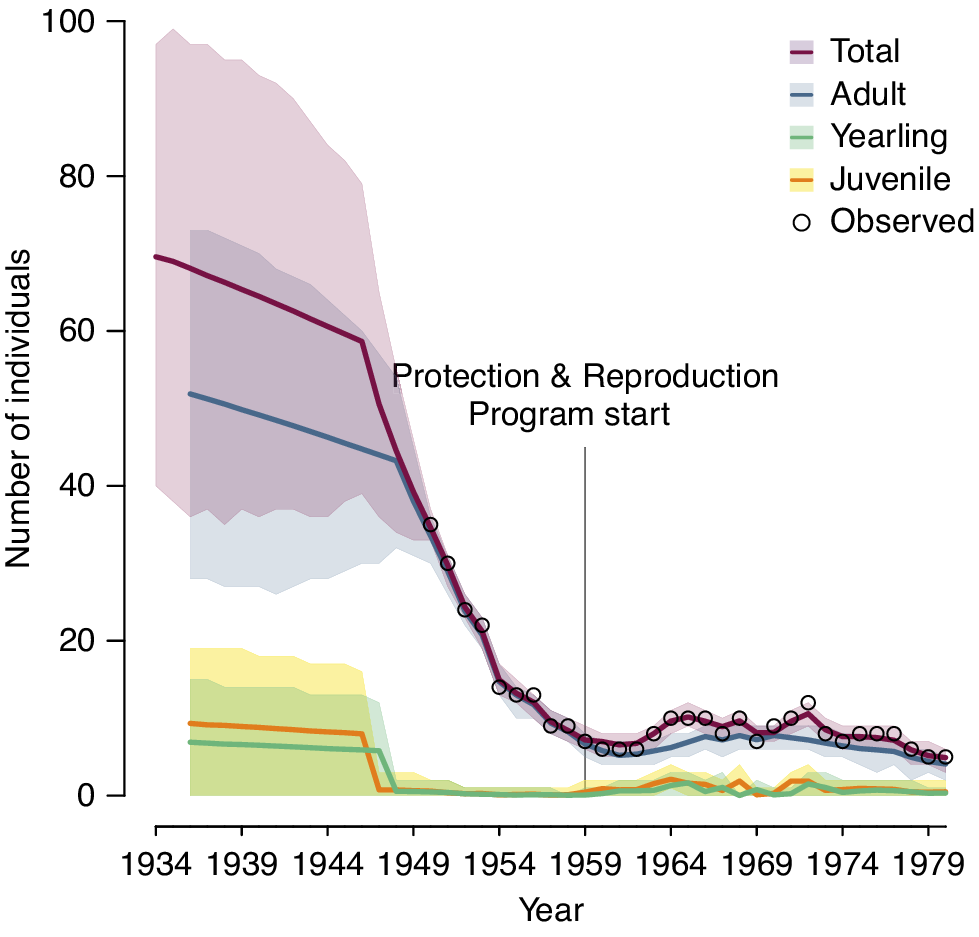
In the IPM with human disturbance covariates, the population size in 1934 was configured at 69.58 individuals (posterior mean 95% CI: 40–97) based on the prior distribution informed by historical knowledge (Figure 1). By 1959, the population had declined to 7.19 individuals (posterior mean 95% CI: 6–9). Although there were fluctuations in the numbers thereafter, the population continued to decline, reaching a low of 4.91 individuals (posterior mean 95% CI: 3–6) in 1980. The estimated total population sizes followed the results of count surveys conducted between 1950 and 1980.
Population size from an integrated population model (IPM) of the Extinct Crested Ibis in Japan. Posterior means and 95% Bayesian credible intervals for the age-specific numbers of individuals are shown.

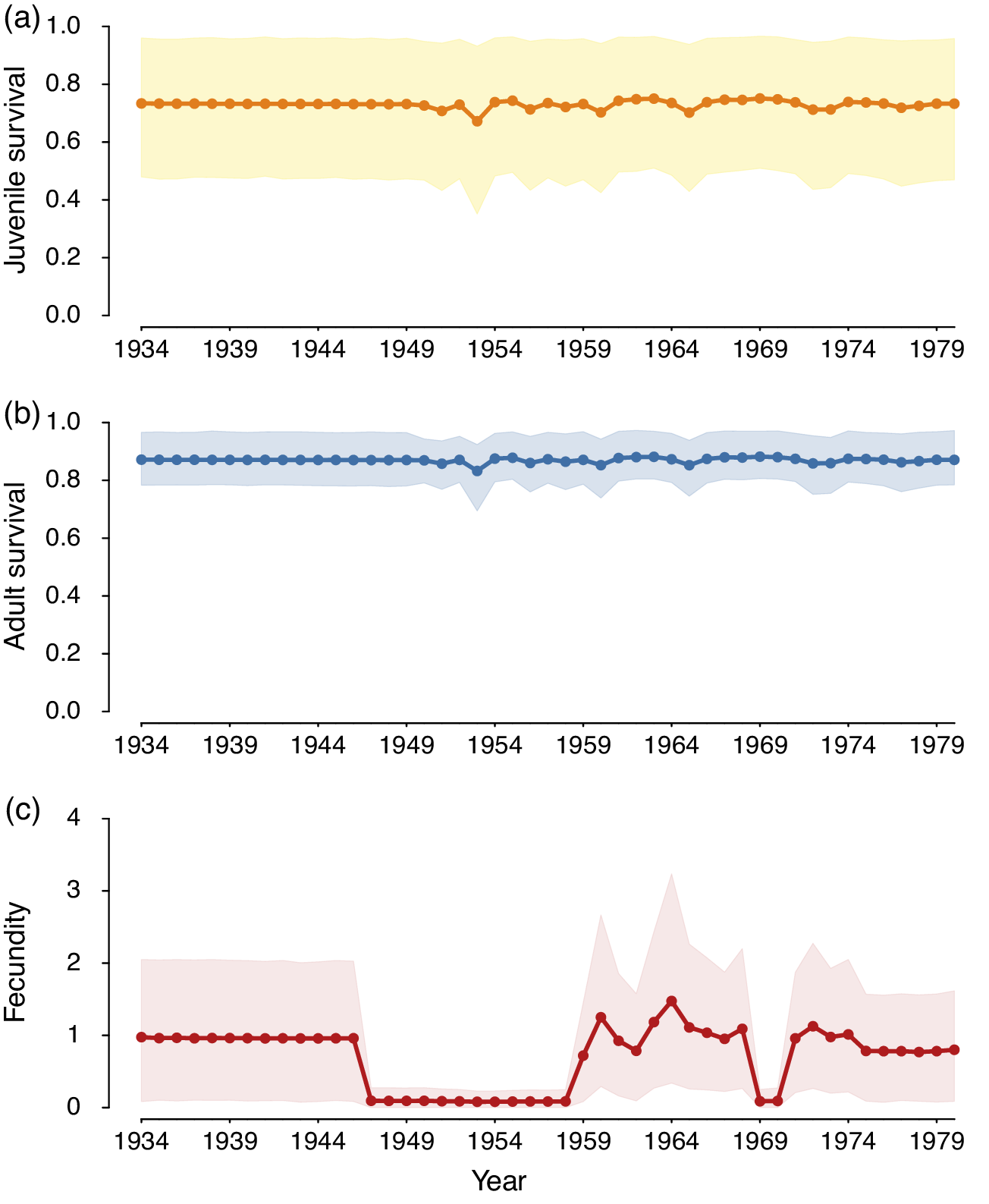
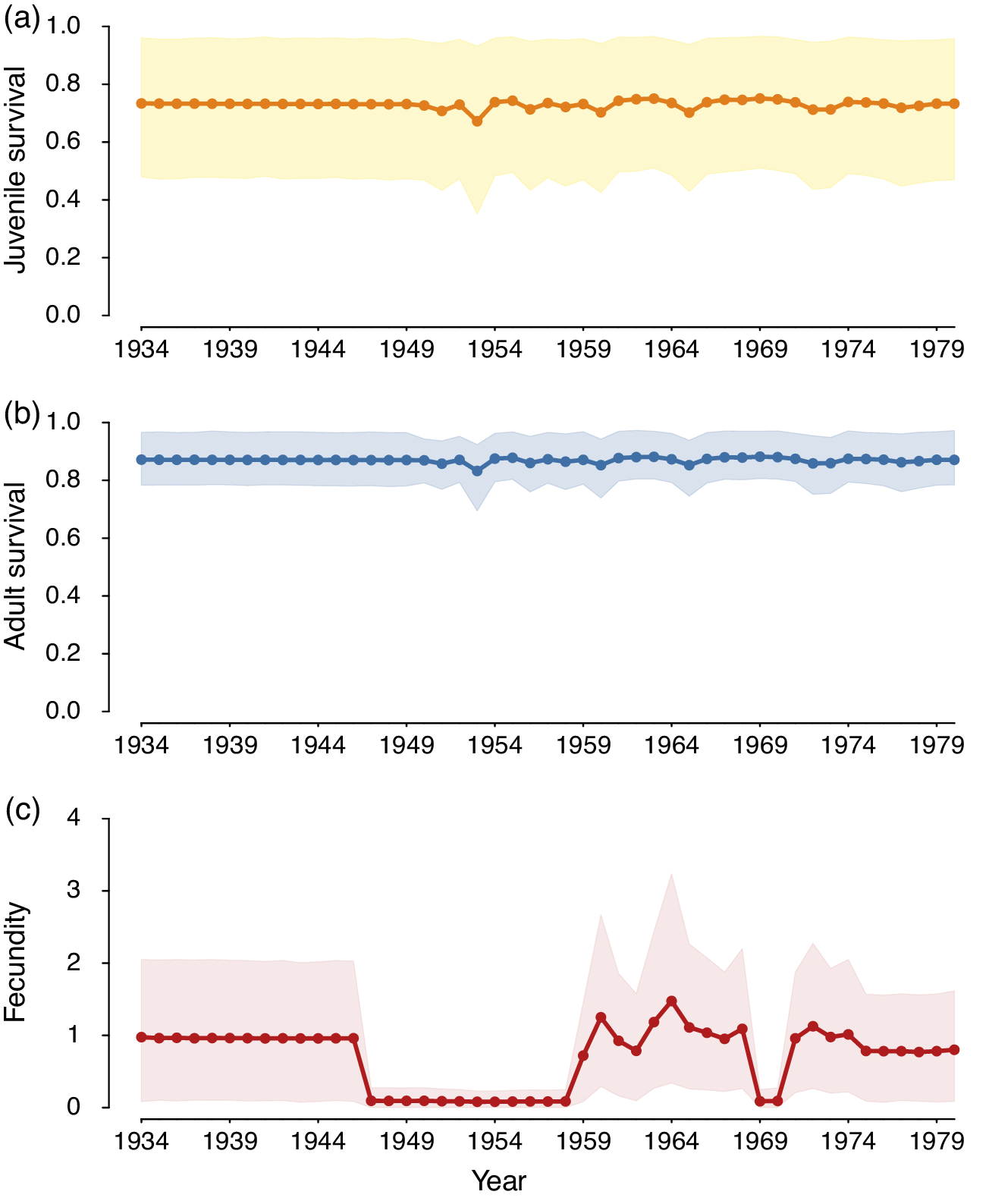
The estimated mean survival rate of the juveniles was 0.730 (posterior mean 95% CI: 0.506–0.927; Figure 2a). The estimated mean survival rate of the adult ibis was 0.870 (posterior mean 95% CI: 0.827–0.909), with year-to-year fluctuations observed; however, no distinct trend was evident (Figure 2b). The detection rate (q1) for carcasses and injured individuals was 0.291 (posterior mean 95% CI: 0.117–0.479). The rate bp was 0.203 (posterior mean 95% CI: 0.104–0.326). The average number of fledglings per pair during the breeding season of the Crested Ibis was 0.703 (posterior mean 95% CI: 0.301–1.152; Figure 2c). Fecundity was estimated to be 0.088 (posterior mean 95% CI: 0.0000008–0.253) in years when human access to the nest-site was not prohibited (Figure 2c).
Demographic estimates from an integrated population model (IPM) of the Extinct Crested Ibis in Japan. Posterior means and 95% Bayesian credible intervals of (a) juvenile annual survival (φj), (b) adult annual survival (φa), and (c) fecundity (fec) are shown.
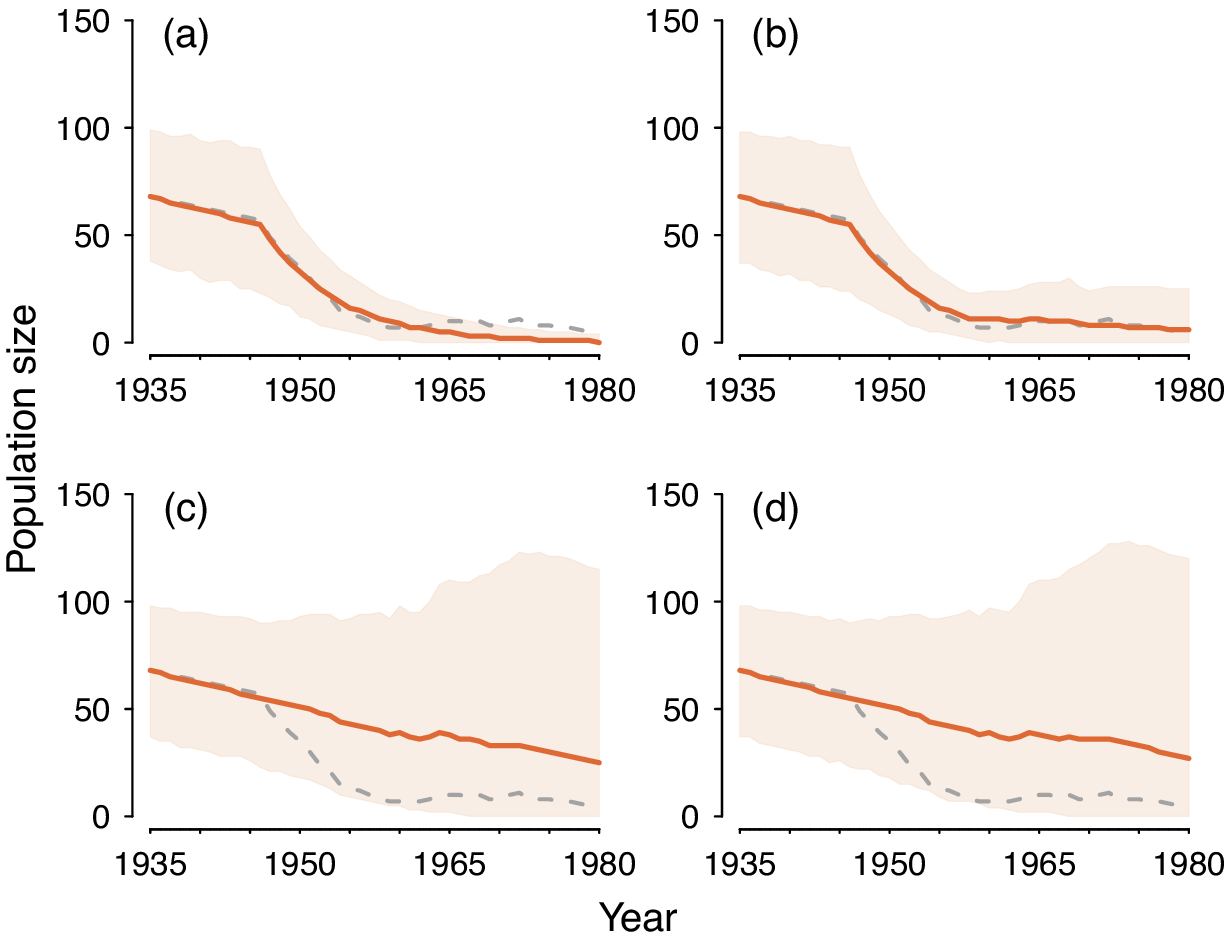
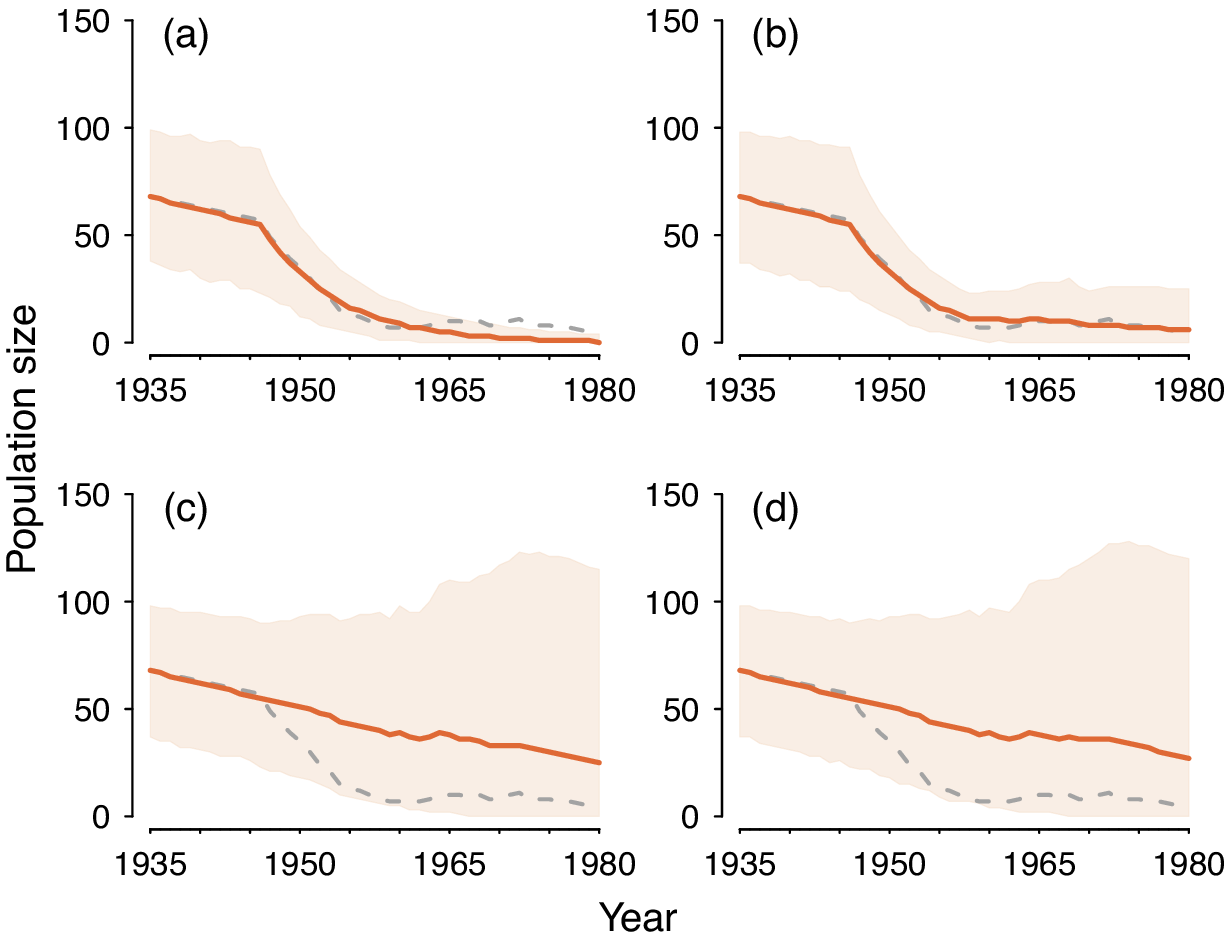
The PVA projected a consistent population decline across all scenarios (Figure 3). Without the conservation programme, the population was projected to decline sharply after 1947, with the median population size falling below six individuals by 1964 (95% CI: 0–20; Figure 3a). When excluding capture for captive breeding, the decline continued, with a projected median population size of six individuals by 1980 (95% CI: 0–25; Figure 3b). Prohibiting human access to nesting forests slowed the decline, resulting in a projected median population size of up to 24 individuals by 1980 (95% CI: 0–116; Figure 3c). Under the scenario of excluding both capture and human disturbance, the decline persisted, but the projected median population size was 27 individuals by 1980 (95% CI: 0–121; Figure 3d). The overlapping 95% CIs with 0 indicate uncertainty regarding the population’s persistence in all scenarios.
Population size estimates of the Crested Ibis in Japan from an integrated population model (IPM) and population viability analysis (PVA) in the scenarios (a) no conservation programme, (b) no capture for captive breeding, (c) no human access to the nest-site, (d) remove capture for captive breeding and human access to the nest-site are shown. Grey lines indicate the posterior means of the total number of individuals. Red lines and polygons indicate posterior medians and 95% Bayesian credible intervals for total numbers of individuals.
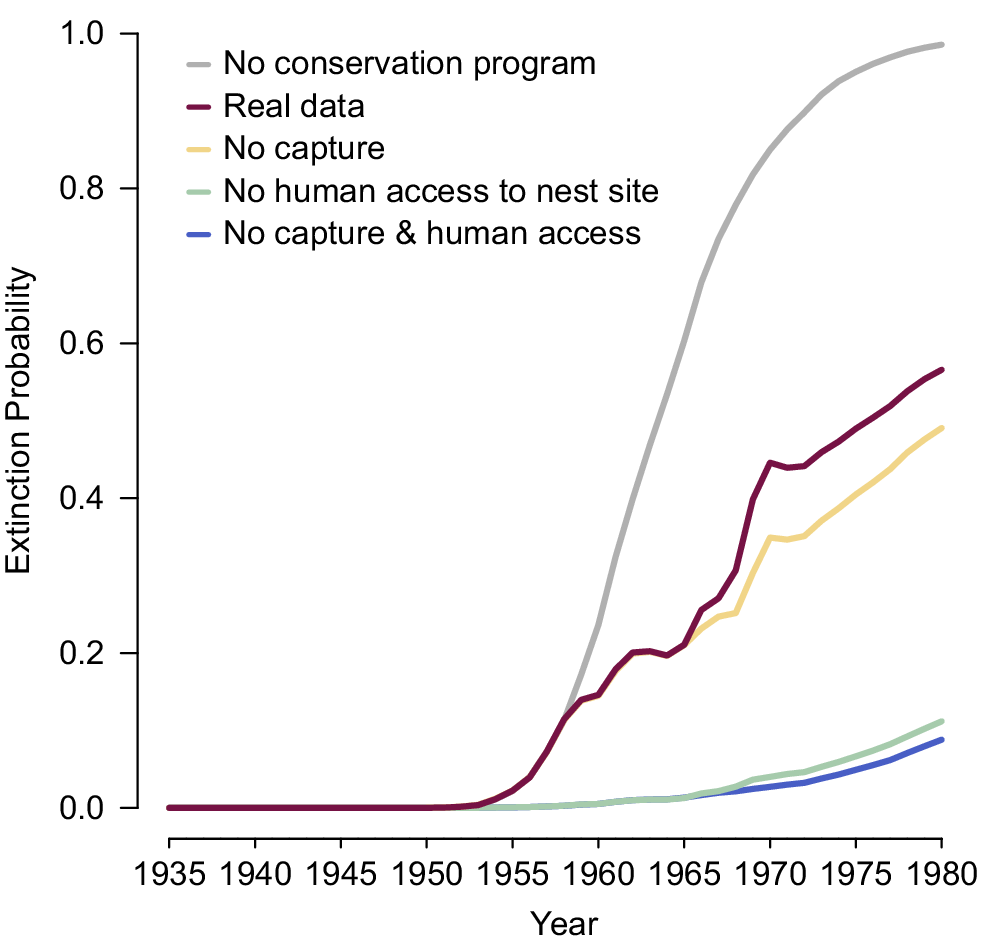
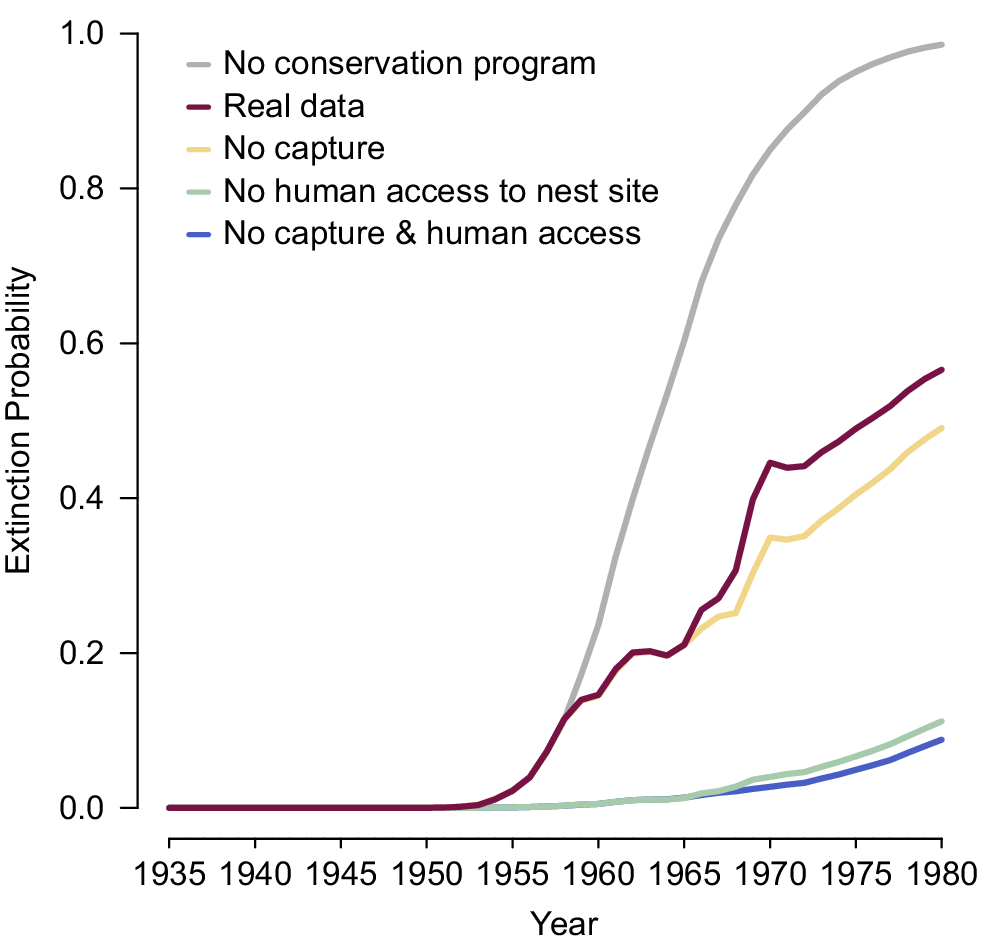
The PVA also projected the extinction probability for Crested Ibis for each scenario (Figure 4). With all factors maintained as in the present conditions, the extinction probability in 1980 was 56.6%. If the Crested Ibis Protection and Reproduction Program had not been initiated, the extinction probability would have reached 98.6%. If no individuals were captured for captive breeding, the extinction probability decreased to 49.1%. Prohibiting access to nesting forests decreased the extinction probability to 11.2%. Excluding capture for captive breeding and human disturbance at nest-sites, the extinction probability decreased to 8.8%.
Probability of extinction from an integrated population model (IPM) of the Extinct Crested Ibis in Japan under different conservation measures. The extinction probability indicates that the probability of the population size was five or fewer in 1980.
Discussion
This study utilised the IPM-PVA framework to examine the factors contributing to the extinction of the Crested Ibis in Japan, providing valuable insights despite certain data limitations. The model, however, faced several constraints. Due to the lack of detailed descriptions of survey methodologies and survey efforts, uncertainties remain regarding the observation process. For instance, the absence of nest observations needed to estimate breeding participation and pair numbers may have introduced inaccuracies in fecundity estimates. Furthermore, the indicators for extinction drivers were not based on high-resolution data, which limited the precision of the impact assessments. Despite these limitations, this study substantially improves our understanding of the processes that led to the extinction of the Crested Ibis. Nevertheless, the findings should be interpreted with caution due to these inherent uncertainties.
The average fecundity of the Crested Ibis was estimated at 0.702, dropping to 0.088 in years when human access to nest-sites was not prohibited. This value is lower than the values for the reintroduced population on Sado Island (0.796; calculated from Okahisa and Nagata Reference Okahisa and Nagata2022) and the Chinese population (1.67; Wang et al. Reference Wang, Ye, Li, Huo, Li and Yu2017). Furthermore, removing human disturbances reduced the extinction probability of the Crested Ibis from 56.6% to 11.2%, suggesting that excessive human activity was a direct driver of extinction. This suggests that the extinction of the Crested Ibis was directly influenced by excessive human disturbance. The rise of single-lens reflex camera use since 1946 led to the intrusion of television crews, amateur photographers, researchers, and other members of the public into the nesting forests of the ibis, resulting in the frequent abandonment of ibis nests (Haruyama Reference Haruyama1975; Suda Reference Suda1994). Adult ibises abandon their nests because of human disturbance, resulting in chicks starving to death (Sato Reference Sato1978; Suda Reference Suda1994). Nestlings tended to fall to their deaths when photographers climbed to the nest to take photographs (Sato Reference Sato1978; Suda Reference Suda1994). This disturbance was triggered by the status of the ibis as a notably rare species in the country. It can be argued that excessive public interest was the driver of the extinction of the Crested Ibis.
In the analysis, no significant density dependence was observed. However, Allee effects (Crates et al. Reference Crates, Rayner, Stojanovic, Webb and Heinsohn2017) and deleterious gene accumulation due to the small population size cannot be ruled out. The estimated breeding participation rate was 0.203, suggesting mate-finding issues. In 1981, the sex ratio among the last five individuals was 0.2 (Niigata Prefecture 2000), likely worsening the low breeding rate. In China, harmful genetic effects have been reported, such as albinism, beak misalignment, paralysis, stunted growth, and reduced nestling survival (Huang et al. Reference Huang, Zhu and Wang2017; Yang et al. Reference Yang, Liu, Zhang, Qing and Lu2015). Genetic regions affecting embryonic development (Fu et al. Reference Fu, Guang, Wan and Fang2019) and egg-laying traits (Sun et al. Reference Sun, Zhou, Stone, Wan and Fang2019) have also been identified. In Japan, two captive females did not lay eggs, and one died from egg binding (Niigata Prefecture 2000). These findings suggest genetic factors contributed to low fecundity and warrant further investigation.
The estimated average survival rate of Crested Ibis was 0.730 for juveniles and 0.870 for adults, which is consistent with the apparent survival rate of the currently self-sustaining reintroduced population on Sado Island (0.757 for juveniles, 0.899 for adults; Okahisa and Nagata Reference Okahisa and Nagata2022) and the Chinese population (0.877 for juveniles, 0.599 for yearlings, 0.678 for adults; Wang et al. Reference Wang, Ye, Li, Huo, Li and Yu2017; 0.853 for juveniles, 0.384 for yearlings, 0.812 for adults; Li et al. Reference Li, Ye, Wang, Li, Dong and Huo2018). In China, juvenile survival rates may be underestimated due to breeding dispersal (Yu et al. Reference Yu, Li and Huo2015; Li et al. Reference Li, Ye, Wang, Li, Dong and Huo2018). In contrast, on Sado Island, the reintroduced population shows similar survival rates likely because dispersal is limited by the island’s geography (Okahisa and Nagata Reference Okahisa and Nagata2022). These relatively high survival rates suggest that survival was not a critical driver of the Crested Ibis extinction.
The decline of the Crested Ibis in Japan after the Meiji Restoration (1868) is largely attributed to unsustainable hunting (Yamashina and Nakanishi Reference Yamashina and Nakanishi1983). Its pink feathers, prized for decoration, fuelled hunting for export to Europe (Miyamura Reference Miyamura1987; Uchida Reference Uchida1915). The meat was also sought for its purported medicinal value (Haruyama Reference Haruyama1975; Niigata Prefectural Board of Education 1974). Hunting pressure led to designation as a natural monument in 1934. In 1954, 4,376 ha of habitat were conserved (Niigata Prefecture 2000). Despite protections, illegal hunting and bycatch persisted, with four ibises reported shot or trapped between 1940 and 1965. However, despite increased hunting intensity, the analysis did not reveal a clear relationship with the mortality rate. The results do not provide sufficient evidence to conclude that hunting was the primary driver of extinction during the study period.
The influence of pesticides introduced after World War II was considered a cause of the decline of the ibis. Sato (Reference Sato1978) analysed Crested Ibis excrement from 1949, observing a decline in insects after 1955 and an improvement following pesticide regulations in 1965. Organic mercury, DDT, BHC, and other chemicals were discovered in the body of a juvenile ibis on Sado Island in 1965 (Niigata Prefectural Board of Education 1974), indicating pesticide contamination in the habitat. However, Yanai (Reference Yanai2006) raised doubts about pesticide-induced mortality. The IPM in this study did not reveal a consistent negative relationship between pesticide use and survival of the Crested Ibis, suggesting that pesticides were not a direct cause of extinction. It is also possible that restrictions on pesticide use at feeding sites implemented through the conservation programme effectively mitigated pesticide impact.
Since 1965, nine Crested Ibises were captured for captive breeding. As demonstrated in this study, this capture increased the extinction probability of the wild population (Figure 4) and directly caused the extinction of the wild population in 1981 (Nagata and Yamagishi Reference Nagata, Yamagishi and Soorae2013). Furthermore, breeding efforts in captivity were unsuccessful, and the Japanese population of Crested Ibis went extinct in 2003 (Nagata and Yamagishi Reference Nagata, Yamagishi and Soorae2013). As a result, the capture had only negative impacts on the wild population. Nonetheless, these attempts at captive breeding laid the groundwork for conservation efforts in China and enabled reintroduction programmes in Japan using individuals sourced from China (Li Reference Li1991; Okahisa Reference Okahisa2022). The findings of this study underscore the importance of the current international guidelines, which emphasise the need for early and well-planned actions to minimise the impact of founder introduction on wild populations during captive breeding programmes (IUCN/SSC 2013, 2014).
In conclusion, this study emphasises the complexity of the drivers behind the extinction of the Crested Ibis, highlighting the cumulative impacts of multiple threats. Among these, human disturbance was suggested as a critical driver, significantly accelerating the species’ decline. While measures such as restrictions on access to nesting forests under the Crested Ibis Protection and Reproduction Program played an essential role in reducing extinction risk, they were insufficient to reverse the on-going decline. The lack of a comprehensive conservation strategy combining ex situ and in situ measures further worsened the situation, ultimately contributing to the species’ extinction. To prevent similar extinctions, conservation policies should adopt a multifaceted approach that addresses interconnected threats comprehensively, is sustained over long time frames, and considers larger geographical scales, especially for migratory or wide-ranging species (Brook et al. Reference Brook, Sodhi and Bradshaw2008; Oppel et al. Reference Oppel, Dobrev, Arkumarev, Saravia-Mullin, Bashmili and Bino2024).
Supplementary material
The supplementary material for this article can be found at http://doi.org/10.1017/S0959270925100282.
Acknowledgements
This study is dedicated to the residents of Sado Island who have devoted their lives to the conservation of the Crested Ibis and have meticulously documented their efforts. This research was self-funded and conducted by the author. I thank the reviewers and editors for their valuable critiques, which improved the manuscript.