Introduction
In the decades between the wars, modern feminism surged into mainstream popular culture all over the world. In a radical departure from a bygone era, women were suddenly seen to be working, driving, playing sports, smoking and drinking. Amy Johnson and Amelia Earhart flew airplanes across Asia and the Atlantic, while a new, casual and lean look in fashion said women were capable of doing anything men could do. From London and Paris to Singapore and Shanghai, the Modern Girl glided onto the scene in trousers and casual shifts inspired by Art Deco couture, and donned new, androgynous styles consonant with existing cultural traditions. The press was fascinated by her. Whereas the jazz-age flapper became the controversial symbol of radical feminine chic, the more ubiquitous image of the Modern Girl— with her cropped hair, short skirts and active lifestyle—appeared in advertisements and was a constant subject of debate, admonishment and admiration. Not only was the trope of the ‘Modern Girl’ circulated in global print-culture, but she was also a spectacle-in-motion to behold on screen, thanks to the new medium of American cinema. Greta Garbo and Anna May Wong, the sirens of the silent era, became icons to be emulated by a generation of women all over the world.
Occupying the imaginations of people throughout the globe, the Modern Girl provided a threshold to ‘modernity’, which had to be crossed locally.Footnote 2 She did not come from any one centre, but emerged in cities everywhere, as a worldwide phenomenon consolidated through the newly international media of newspapers and cinema. Viewed within the context of colonial and world history, the Modern Girl completely collapses traditional dichotomies between the modern, imperial metropole and a ‘backward’, colonial periphery. Britain, in fact, had much more to lose in the challenge to traditional Victorian values than some of the younger, cosmopolitan port-cities that lined her empire. Adrian Bingham has described the emergence of the Modern Girl as one of the most prominent and characteristic figures of post-war culture in Britain, an era in which gender identities were being redefined and new images presented to the public.Footnote 3 Seeking to generate controversy and remain relevant to young readers, English newspapers latched disproportionately upon modernity and ‘modern women’. The political achievement of the vote in 1929 happened within the context of changing social mores in mainstream popular culture, which valorised the young as ‘harbingers of the future’.Footnote 4 Although her well-publicized move into traditionally ‘male’ arenas generated controversy, the Modern Young Woman provided an opportunity for editors, journalists and the British public to reassert a new vision of modernity that broke from traditional Victorian values, emblematic of that discontinuity so integral to the English imagination in the years after the Great War.Footnote 5
Scholars have focused on the significance of modern women in the articulation of national identity in the interwar period, not only in Western societies but also in Asian ones. As a visible sign of modernity and change—a nexus of Western influence in fashion and custom, mobility, independence, and new educational and professional opportunities—the Modern Girl was central to the attempts by Asian intelligentsia to reconcile and reinvent cultural traditions to suit modern times and challenge traditional structures of authority. She was a controversial figure: while her role as a consumer attune to the fashion world generated charges of superficiality, her independence was heralded as a necessary marker of civilisational progress. In Japan, the Modern Girl or moga, with her bobbed hair and short skirts, was a ‘powerful symbol of Taishi modernity’, generating anxieties among intellectuals and the public at large about the direction of Japanese society.Footnote 6 In India, images of Bombay cinema actresses of the 1920s in varied modes of Western and Asian dress, symbolizing their cosmopolitan modernity, were harnessed in the 1930s by powerful elites seeking to promote via cinema the modest, sari-clad Hindu woman as the model for an emerging nationalism.Footnote 7 In both China and India, the symbol of the Modern Girl was, for better or worse, ‘part of a modernizing discourse that made possible the imagining of a new nation’.Footnote 8 Hindu reformers and Chinese republicans attempted to set agendas for educational and social reform for women, grasping desperately for a foothold on a phenomenon that was spreading like wildfire in the press and cinema. In advertisements from America to India to Africa, the Modern Girl often looked similar—short hair, provocative fashions and a stylised elongated body—but she could also be Indian, Asian or African, and ‘indexed the racial formation of the nation or colony in which she resided’.Footnote 9 Anne Mcclintock has described the role of soap and cosmetic companies in solidifying racial hierarchies and furthering the white imperial project; however, as Tani Barlow and others have shown, such companies also used targeted marketing strategies, appealing to cultural traditions and using language sensitive to the intricacies of race politics to sell products that would lighten, darken or enrich the natural skin colour of Asian, African and Western women.Footnote 10 The Modern Girl was thus implicated in the production of ‘national racial formation’.Footnote 11
As a modern, urban citizen of the world, the Modern Girl captured the essence of cosmopolitanism while exemplifying its many guises. Just as scholars such as Frederick Cooper have made us more attune to the plurality of experiences of ‘modernity’, cosmopolitanism has also been experienced in particular ways, based on a variety of local cultural contexts and social dynamics. The Modern Girl was thus a regional shape-shifter, tapping into local challenges and aspirations of belonging to a very global modernity, marked by the trans-national processes that were rapidly transforming the world: consumerism, technology, urbanisation, and intellectual and cultural exchange through rapid circulation of popular media. Nowhere were the confluences of these processes with local cultural dynamics felt more acutely than in the cosmopolitan port-cities of empire. As the new citadels of imperial trade and communication, these cities were tied loosely to a network of local, diasporic, national and imperial affiliations that made them impossible to define through any one homogenizing concept of race or nation. Characterized by their inherent cosmopolitanism, these cities were possibly the most welcoming environments for the emergence of the Modern Girl.
Cosmopolitan Penang: A Tangled Web of Solidarities
Networks of trade and immigration dating from at least the sixteenth century to an age of high imperial commerce linked cities from Cape Town to Columbo, Calcutta to Rangoon, Singapore to Shanghai.Footnote 12 By the 1920s and 1930s, a golden age for travel, the intrepid traveller journeying through them may have experienced an acute sense of déjà vu; wandering through tightly knit neighbourhoods, he (or sheFootnote 13) would have smelled incense from Hindu and Chinese temples, seen mosques, churches, synagogues, dance halls, cinemas, coffeehouses, new luxury cars and tramways puncturing its streets and heard jazz bands playing from the courtyards of grand Edwardian hotels. The urban fabric of these cosmopolitan port-cities, it seemed, was eerily similar. Populated by a continuous mingling of Europeans, immigrants and merchants, they were centres of economic trade and cultural exchange, producing new platforms for debate through literary or religious activity and acting as ‘nodal points of change’.Footnote 14
Penang was no exception. With a scattering of gold coins shot from a cannon—as the legend goes—the British established a port on the island in 1786, and Penang rapidly became a centre of immigration and mercantile interests. Even after being eclipsed by its sister city, Singapore, Penang was still a favoured destination for immigrants seeking to make their fortune, political exiles and religious reformers, and European travellers who referred to the island—with its beaches and lush natural surroundings—as the ‘Pearl of the Orient’. Throughout the colonial era, the polyglot migrant world of Penang included not only the indigenous Malays and Baba (Chinese) Malays, but also the Chinese, Indians, Arabs, Europeans, Eurasians, Acehnese, Armenians, Siamese and Burmese. Sir George Leith, Lieutenant-Governor of Penang, said of the settlement at the beginning of the nineteenth-century: ‘There is not, probably, any part of the world where, in so small a space, so many different people are assembled together, or so great a variety of languages spoken’.Footnote 15
Penang's status as a polyglot urban sphere continued throughout the nineteenth and early twentieth centuries, with the island positioned, along with Singapore, at the intellectual crossroads of emerging and competing communal identities in British Malaya.Footnote 16 Islamic religious reformers from the Dutch East Indies as well as the Middle East converged in Penang to forge a new vision for Malay-Muslim society in Southeast Asia and beyond to the wider Arab world.Footnote 17 Penang's role as a centre for publishing was paramount in the Malay world, second only to that of Singapore's, with whom she maintained close links. Teacher-training schools meant to foster vernacular education for a rural Malay populace were breeding grounds for an emerging Malay literati, who would in the 1930s flock to Penang and Singapore as renegade journalists to foster a burgeoning Malay political consciousness through the vernacular press. As an established port of arrival for immigrants and a link to the towns and plantations of the interior in which they worked, Penang was a nodal point in maintaining diasporic links to distant homelands. Alongside the flowering of Malay journalism and literature, diasporic communities produced their own Hindi-, Tamil-, and Chinese-language publications, strengthening ethno-linguistic ties. Descendents of unions between Indian or Chinese merchants and traders and native women—the Jawi Peranakan (Indian Malay-Muslims) and the Straits-Chinese—took on a paramount role in forging a journalistic tradition in Malaya. Whereas the Jawi Peranakan set Malay-language journalism (and thus, the seeds of Malay nationalism) in motion with the publication of Jawi Peranakan, the first Malay newspaper of the region, the Straits-Chinese launched a number of English-language periodicals in both Singapore and Penang.Footnote 18 Long-domiciled in Malaya and educated in English missionary schools, the Straits-Chinese rose to prominence in both port-cities, often acting as intermediaries between Europeans, Chinese traders and Malays. Most spoke a blend of the Hokkien dialect and Malay (originally ‘Baba Malay’, and later, Penang Hokkien) and cultivated a hybrid identity, drawing on both British and Confucian values. They frequently defined themselves against recently arrived Chinese immigrants (‘orang cina’) and were referred to by outsiders as the ‘King's Chinese’ or ‘Queen's Chinese’.Footnote 19 The evolution, and competition, of Straits-Chinese, Jawi Peranakan, Chinese, Indian and Malay ethno-nationalisms has often been explored in separate histories of each community.Footnote 20 What has commanded less attention is the way these communities communicated and debated with each other, exploring their differences as well as their shared common aspirations.
The emergence of discreet cultural identities in Malaya occurred in parallel with another emerging discourse which was more inclusive, cross-cultural and cosmopolitan. ‘Cosmopolitanism’ has gained much academic currency of late in disciplines ranging from law to the social sciences and humanities. Social and political theorists have used the concept to promote internationalism and global civil society based on a Kantean ideal of a ‘world federation’ of states. Post-colonial and cultural theorists have used it to destabilize rigid cultural identities in order to cope with the challenges of living in a globalised, multicultural world punctured by the movements of exiles, migrants and travellers.Footnote 21 My use of cosmopolitanism is twofold, based on particular cultural experiences of both the global and the local, almost in the form of a ‘double consciousness’.Footnote 22 On the one hand, I see cosmopolitanism as a consciousness of belonging to a larger, global world above and beyond that of a particular community or nation-state, one made possible through the experience of modernity, which rendered the world at once larger (in complexity), smaller (in connectedness) and more universally comprehensible through the spread of modern education, print-culture, cinema and technology.Footnote 23 At the same time, cosmopolitanism is also a consciousness of living in a particular multicultural society, in which individuals draw upon and reshape their own group traditions through cross-cultural dialogue in a dynamic public sphere. This kind of ‘double consciousness’ recognises the vitality, elasticity and diversity of culture as part of a universal, humanist tradition.
Although the theoretical literature has been vast, only recently have historians and ethnographers begun to ask deeper questions on why cosmopolitanism has arisen at certain times and places, for certain people. As a multicultural urban sphere, with a particular community (the Straits-Chinese) having an economic and political incentive to fuel an ideology of openness and multiculturalism over a narrow and homogenous nationalism, and at a time when passports did not exist, when ideas, images, technology, and people were moving freer and faster throughout the world than ever before, the port of Penang in the 1930s provides an ideal case study for examining cosmopolitanism in practice. This particular historic experience of cosmopolitanism as a ‘double consciousness’ of global community and local, dynamic multiculturalism may help illuminate and colour some of the current theoretical debates on cosmopolitanism and its value.
While Tim Harper has linked the promotion of English by imperialists and internationalists with ‘globalism’ and world peace, so too did English become the de facto vehicle for local ‘cosmopolitanism’ in Penang.Footnote 24 The history of English education lay in the intentions of a colonial state needing a cadre of indigenous administrative assistance, and those of missionaries seeking to inculcate notions of progress and moral education. Eurasian, Indian, Chinese and, increasingly, Malay parents soon grasped the benefits of an English education for their children, and by the 1930s English was rapidly becoming the ‘lingua franca’ of the colony among the urban middle class and elite.Footnote 25 In a cosmopolitan public sphere such as late colonial Penang, which witnessed high degrees of trade and social interaction, the English-language press acted as a crucial mediator between communities as well as with the outside world. The Straits Echo, an English-language newspaper originally founded by Penang's Straits-Chinese community, provides a kaleidoscopic glimpse of the way such a population understood themselves and each other. Flourishing from 1902 under a series of left-leaning editors until the 1940s, the paper acted as a vehicle for Penang's multi-ethnic communities ‘irrespective of class or creed’ to have their grievances addressed, including those against the colonial administration. Compared to Singapore, the press in Penang—particularly the English-language press—was given much more leeway throughout the 1920s and 1930s to voice reasoned criticisms of colonial policies; indeed, after the war the British Military Administration encouraged the Straits Echo to begin publishing again, and even furnished them with a loan to do so (Singapore's Straits Times, on the other hand, received no such support).Footnote 26 Various reasons explain the freedom of Penang's press compared to Singapore, including its more liberal atmosphere as a secondary, though long-established, seat of colonial power in the Straits Settlements, as well as the amicable relationship of members of the colonial administration in Penang and the paper's editors—George Bilainkin in the 1920s and M. Saravanamuttu in the 1930s—who were often used as mediators in communal disputes.Footnote 27 Apart from Penangites, the paper was also immensely popular with people—particularly the Straits-Chinese—in the interior towns of Ipoh and Taiping, which also had large Indian and Chinese communities; readers from both these areas contributed to a discourse of cosmopolitanism emanating from Penang.Footnote 28 The 1930s saw the paper at its most successful peak, the frontrunner of North Malayan newspapers under the editorship of an Oxford-educated Ceylonese journalist, the ‘legendary'Manicasothy Saravanamuttu.Footnote 29
The paper's content both reflected a cosmopolitan society and perpetuated it. Radio schedules listed programs from Berlin, Calcutta, Holland, Melbourne, Moscow, Paris, Rome and Tokyo, broadcasting news as well as variety programs—including ‘Asiatic music’ and ‘The Pronunciation of English’. Local cinemas advertised films starring Chaplin and Garbo as well as Cantonese and Tamil talkies. Advertisements—from Kloster beer to Cadbury chocolate and Japanese pearls—suggest a readership plugged into global consumer networks. American ‘Modern Girls’ flashed Pepsodent smiles, while Japanese mogas advertised pearls from Tokyo and Eurasian women showcased exquisite dresses. The Readers’ Page, an initiative begun by Saravanamuttu in 1937, provided a shared space for public debate between Penang's multi-ethnic, educated elite.Footnote 30 One finds educated readers of different ethnic origins debating—in flawless English—the merits of languages, cultural traditions, modernity and foreign affairs. In debates on language, readers acknowledged the necessity of English as a vehicle for progress and cross-cultural communication, while fostering an appreciation of one's mother tongue, be it Chinese, Malay, Tamil or Hindi. In debates on political associations, readers called for cultural clubs that strengthened solidarities among cultural communities, while extolling the virtues of sports teams, music clubs, and international associations that encouraged cross-cultural membership and cooperation (in 1937, for example, the Straits Echo reported that Penang's Ladies’ Hockey Team had a ‘notable season on account of improved standards of play and a number of new players which include Chinese, Sikhs, Malays as well as Europeans and Eurasians’).Footnote 31
Women played a central role as contributors to the paper, debating on love, language and politics on an equal footing with men. A particularly fiery debate between Evelyn Chong, a popular female writer, and a male writer, AC Chen, occurred over the criss-crossing of Chinese and British loyalties generated by the issue of China's war with Japan and its call for help from the overseas Chinese community. Chong passionately objected to his use of the paper as a venue to incite Chinese patriotism, and to Chen's statement, ‘Obviously she is unaware that it took Dr. Sun Yat Sen forty years to remove the Manchu yoke from our people’, she scathingly retorted, ‘Let me put it this way: Obviously Mr. Chen is unaware that it took the British almost twice that time to make Malaya such a place that it can offer us such peaceful homes, and good government, and can even let us talk politics in armchairs without the fear of anybody putting pieces of lead into us’.Footnote 32 Other concerns of the Readers’ Page centred on the China Relief Fund—to which Chinese pledged donations as well as Indians, Ceylonese, Malays and even, it was rumoured, a Japanese firm.Footnote 33 The visit of Congress Leader Pandit Kunzru was said to have commanded the attention of Indians as well as Chinese and non-Indian community groups, and incited reactions of both diasporic nationalism and insistence on sustaining social harmony between Indians and ‘sister communities’.Footnote 34 Issues such as these emphasized the tensions between ‘diasporic’ allegiances to China and India, imperial allegiances to Britain, ‘national’ or communal allegiances to Malaya and Malay or local allegiances to cosmopolitan Penang, a testament to the ‘tangled web of solidarities’ in which Penang's various communities were embroiled. Readers thus wrestled with the tension of cultivating one's own cultural heritage or ‘roots’, while advocating a modern, cosmopolitan view. Here, print-capitalism did not invent nationalism, or even ‘universalism’.Footnote 35 Rather, to use Kwame Anthony Appiah's term, what was invented was a sense of ‘rooted cosmopolitanism’Footnote 36—an acknowledgement, and celebration, of living in a particular multicultural urban sphere plugged into dynamic global networks of people, goods and ideas.
Central to these debates was the role of the Modern Girl. Feminism quickly took root in Penang, with women playing an increasingly active role in the public sphere—as teachers, charity organisers and gradually into traditionally male-dominated professions such as law. European women educators taught and tested out modern ideas of equal citizenship and multiracial cooperation via the missionary school and organizations such as the YWCA and Girl Guides.Footnote 37 Cinema and print culture were perhaps more powerful in putting forth a model of the independent woman, causing a dramatic change in the way young women dressed and acted. While advertisements targeted Penang's young women as consumers, the stars of the silver screen were icons which they sought to emulate—and it is unlikely that breathless independence of the glamorous Garbo went unheeded by the young men with whom they frequented the picture-houses, men who were later to extol the virtues of Penang's Modern Miss. In a changing environment that opened up new possibilities for women—borrowed and adapted from models of liberation elsewhere in the world—at stake was the loss of particular cultural conceptions of femininity rooted in cultural traditions. The tensions between Western-style female emancipation and the ‘authenticity’ of inherited cultural traditions were thus explored in debates surrounding the Modern Girl.
‘My Kind of Town’: Penang and the Modern Girl
Penang's diverse cultural communities adopted and played with the idea of the Modern Girl in their own encounters with modernity. By debating with each other in a shared public sphere, a multicultural, reading public wrestled with the tensions between modernity and cultural authenticity together—the Modern Girl was emblematic of a cross-cultural dialogue in which they learned from each other in order to grow. Indeed, unlike the debates cited above in Britain, China or Japan, the debate centred not only on the challenge she posed to the gender roles of one cultural tradition, but also on many. As such, the Modern Girl, in the context of this progressive English paper, did not generate nearly as many anxieties as she did in the mainstream media of interwar Britain and Japan,Footnote 38 where what seemed to be at stake was ‘civilisational’ integrity. As opposed to the heavy debates occurring in these countries over the liberalization of women, there is a playfulness and possibility running through the Straits Echo readers’ pages. Noticeably absent were grave Victorian arguments about social morality and prostitution, despite the fact that Penang had long been a centre for regional trafficking of Asian women into the trade. The English-educated, Straits-Chinese men and women who were the most ardent contributors to the Straits Echo, sought to put forth a reinvigorated image of the Modern Girl, particularly the Modern Chinese Girl. In a colony where few occupations apart from domestic servitude and prostitution had been available up until the 1930s,Footnote 39 presenting a new image of Asian women as intelligent, educated and moral—particularly in a newspaper read by Europeans—was of utmost importance in the articulation of a modern, urban, middle-class identity by the Straits-Chinese and their Asian counterparts. The Straits Echo played an important role in both hosting a venue for debate and advocating new strides by women, reporting favourably on women attaining overseas degrees and going to China to take part in the war. In 1939, the paper proudly reported on the first Chinese girl from Malaya to go to China as a qualified mechanic. A lecture given at Penang's Rotary Club in 1937 on the ‘Changing Women of the Orient’ urged, ‘Women can be more than objects of pleasure to men. We can be their pleasing and helpful intellectual Companions’.Footnote 40
Indeed, the cosmopolitan, cooperative spirit of the paper and its contributing readers continuously advocated the values of ‘platonic friendship’ between men and women. The ability to engage the other sex on an intellectual plane, rather than a sexual one, was seen as a mark of progress. The unique feature of Penang's interactive, journalistic tradition encouraged and even celebrated this intellectual banter between men and women, and created a welcome space for the emergence of the Modern Girl, a trope that was to be discursively turned over and imbued with new meaning by Penang's multicultural men and women. Writing against criticisms from her male colleagues of liberal trends in female fashion and activities, Ms Maureen Cheah, Penang's ‘it’ girl and one of the Page's most popular writers, wrote a passionate defence of the Modern Girl:
We are criticized because we wear sunglasses! . . . [and] because of our continual change of styles of dresses. We are flayed because we like the cinemas, the parks, like to gamble and be sporting and fair to boys. . . If a modern boy considers it modern to do such things, why shouldn't a modern girl be allowed to do the same?Footnote 41
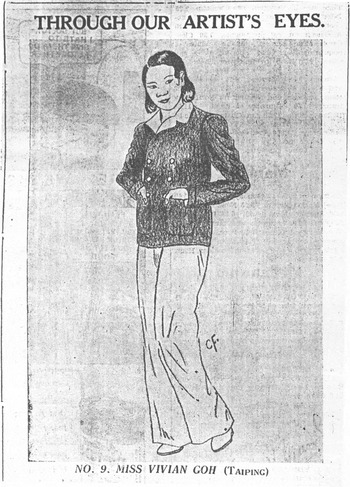
Following Maureen's letter, men and women wrote in to show support for her progressive views. One ‘Merry Widow’ with ‘years of experience to her credit’ pointedly argued, ‘Members of my sex have been rebuked on account of adopting the “trouser craze” fashion, but it is only fair to add that the opposite sex (the effeminate) first found pleasure in ladies' dresses.’Footnote 42 In the sexual politics of fashion, women were not to be criminalized for a blurring of boundaries that men had been practising for years. But whereas cross-dressing men delighted in subverting their masculinity in favour of effeminacy, women's appropriation of trousers signified their movement into a traditionally male-dominated public sphere (see Figure 1).
A local artist was commissioned by the paper to draw sketches of the paper's most frequent contributors. Vivian Goh of Taiping is shown here in trousers.

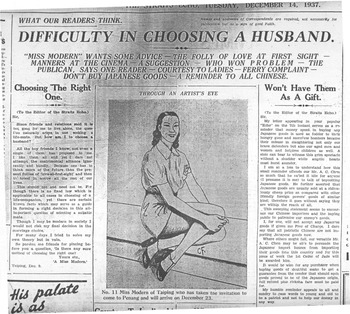
Another letter testified to the entry of women into traditionally male territory when it affirmed the question of ‘Should a Lady Propose?’: ‘Surely the Modern Miss with her up-to-date ideas will not find it hard to propose to a man of her own selection instead of always remaining on the chosen side with the customary “YES” or “NO” answer’.Footnote 43 Many other letters from ‘modern misses’ waxed philosophical about the merits of love and the difficulties of choosing a husband (see Figure 2). Women, it seems, were increasingly aware of their own freedom of choice in both their public activities and private life.
“Miss Modern of Taiping” laments on the dilemmas of choosing a husband.

The role of men in debating and, for the most part, supporting the liberalization of women is particularly apparent. Maureen Cheah's letters on the Modern Girl generated fiery but playful responses from popular male writers, cited later as one of the classic popular debates of the Readers’ Page. G.S. Teo's laments about the Modern Girl pointed to the particular—and to his mind, devastating—influence of American popular culture on the Modern Girl: ‘She idolises Robert Taylor, Clark Gable and those matinee-idols of the screen. . . She adopts American slang, and every time she opens her mouth to say “Oh yeah—you're telling me?” I would close my eyes and pray I were deaf. . . It is an enigma how so beautiful a creation as the modern miss, who is supposed to be gifted with refined mannerisms, should rival Donald Duck in speaking’.Footnote 44 Another writer calling himself B.O.Y. came quickly to the defence of modern women in another issue: ‘Three cheers! . . . Our sisters are only doing what is expected of them in this modern world—in parallel to what we boys are doing ourselves—and it is not fair on our part to condemn them or their actions. . .. Why not play fair and leave the girls alone?’.Footnote 45
A typical male position seemed to be to admire her charm and intelligence, but in so far as she could engage men as a beautiful and ‘delightful’ companion. A ‘Passionate Pair’ of European travellers found the Modern Chinese Girl ‘extraordinarily attractive and charming,’ comparing her style to the ‘“chic” peculiar ladies from France’ and her carriage to the ‘highly-trained mannequins of London, Paris, and New York’.Footnote 46 A similar view was taken by a self-professed bachelor who argued, ‘Among her most delightful qualities is the great interest with which she follows conversations. . . The girl of today has been rather harshly judged simply because she prefers not to be kept back but insists on keeping abreast with the conditions of the ever-changing world and to lead a life wherein she plays a part, however small. . . Knowing her limits, she never exceeds them’.Footnote 47 While men applauded the new strides by women, they did so within certain parameters of behaviour. The modern woman had to strike a delicate balance in exuding charm, beauty and intelligence, without crossing certain boundaries. Nonetheless, these boundaries were clearly becoming much wider, with women playing an equal—if not greater—role in defining them as men.
The growing liberality of women was thus a major issue of public debate and often seen as a mark of progress, a standard by which communities such as the Straits-Chinese measured themselves, particularly against their ‘Western sisters’. Liberal, English-educated Penang Straits-Chinese used the Modern Girl to examine their own progressiveness or conservatism in comparison to Western and other Chinese communities elsewhere, generating controversy over the nature of cultural identity and tradition. A Western writer argued, ‘I regret that in spite of the fact that now-a-days Penang girls are “modern” they are backward compared with their Western sisters, and too bashful to mix up with boys freely’.Footnote 48 This charge was met with a clever retort from Maureen Cheah, who asserted that perhaps it was the Penang girls who were too modern for the boys, ‘a modernity which our western brothers may not have the chance to keep step with’.Footnote 49 The banter between these two writers suggests that inter-racial courtship on relatively equal terms did exist, entailing a large degree of choice between a young generation of Asian women. Ambivalence towards the advances of Western men was clearly a mark of the Penang girl's modernity. Another reader welcomed the existence of platonic friendships between men and women, an opportunity for cultural progress that had been duly seized: ‘Penang Chinese do not discard their traditions aimlessly, they only discard those that are a hindrance to their progress and adopt those that are conducive to their development. Although they seek to advance, they never forget that they are Chinese, and are proud of the heritage that is theirs’.Footnote 50 The reconciliation of tradition and modernity thus centred on the Modern Girl—openness and liberality were advocated simultaneously with a reassertion of cultural identity.
Gender equality was seen as a marker of progress between Penang's diverse communities, a standard by which they judged themselves in contrast to others. As with the emergence of nationalism or ethno-communalism in Malay historiography, changing gender roles have thus far only been traced in separate histories of each community. As such, scholars have ignored the way in which new, communal conceptions of femininity and masculinity emerged in interaction with each other. Generally, the Straits-Chinese and Eurasians were seen as more liberal, providing a model which some Indian, Sinhalese and other communities sought to emulate to modernise themselves. One Indian reader argued that Indian parents, in comparison with Chinese, were too old-fashioned and appealed that they ‘be a little more broad-minded. Should an Indian find his son talking to a girl he will at once come to the conclusion that his son is in love with her. I seldom find Chinese parents so narrow-minded’.Footnote 51 The sentiment was echoed a year later by a reader who said that while most of the girls taking strolls along Penang's esplanade, gardens and cinema halls were Chinese and Eurasians, Indian girls seemed to stay at home. He pleaded, ‘I sincerely hope all Indian parents will . . . see that their daughters do not remain ancient but on the contrary become—Modern’.Footnote 52 Modernity thus entailed entry of women into the public sphere, and so long as Indian girls stayed at home, they lagged behind other communities in the march to progress.Footnote 53
Other readers attempted to engage with female liberality on cultural terms, finding resonance in old traditions. One applauded Sinhalese girls, whose ‘freedom is not hampered in the least traditionally or by any religious point of view. The majority of the Singhalese [sic] are Buddhists and Lord Buddha was the first teacher to advocate equality of the sexes’.Footnote 54 A discussion over the role of women also occurred between two distinguished male Islamic scholars, both advocating the benefits of Islamic practice for the advancement of women. A visiting Thai-Muslim scholar argued that Purdah, the Muslim practice of female seclusion, created a ‘cool and calm atmosphere for study and learning by women. A peep into the Muslim history, will tell you of the intellectual attainments (and otherwise) of Muslim women in the past. Her responsibilities widely differ from those of man. She therefore should acquire such an education which answers her responsibilities’.Footnote 55 One of the Straits Echo's regular contributors, the erudite Muslim scholar, H.G. Sarwar, took issue with the visitor's religious interpretation, arguing for a more liberal view: ‘There is not one word in the whole Qu'ran saying that a woman must hide herself from males . . . Muslim women who observe strict “Purdah” [sic] do it out of excess of modesty. There is nothing in Islam to prevent them from social intercourse with their fellow brethren as long as they are God-fearing and modest and as long as they do not abuse their liberty’.Footnote 56
Women's education was rapidly becoming an issue for Islamic reformers in Malaya. In the late colonial era, a cadre of educated, politically powerful Malay-Muslim women were being schooled at the Melaka teacher-training school and religious schools at home and across the Straits.Footnote 57 Nonetheless, there has been a perception that far fewer Malay-Muslim women obtained a modern education than Chinese and Indian women, whose communities responded more positively to such opportunities.Footnote 58 This stems, in part, from the resentment of the Malays towards the encroachment of Chinese and Indian immigrants, who seemed to strive ahead economically, politically and culturally, documented in various social histories of Malaya. These histories explain the emergence of a distinct Malay political consciousness as a defensive strategy against the threat of Indian and Chinese economic and cultural power.Footnote 59 Penang Malays thought of themselves as more educated and enlightened than other Malays in the Peninsula, possibly due to the settlement's long history of English education, which by the 1930s had begun to attract well-born Malays.Footnote 60 The Straits Echo provided a unique venue where such Malays could engage with Indians and Chinese on matters of cultural importance, participating in an inclusive, cosmopolitan discourse with them rather than one of defence and antagonism towards them.Footnote 61 The one issue which provoked as much fervour as the Modern Girl was language, and it was a long, passionate letter on the merits of the English language by a Malay writer, Mas Akbar, which captured the most cosmopolitan standpoint of all the debates. Mas Akbar advocated a necessary bilingualism, encompassing love of one's mother tongue at the same time as English. To be ‘modern’ did not have to mean ‘loving one's vernacular tongue less’; one could nurture one's vernacular tongue at the same time as English. Both were valuable for different purposes—one to progress and communicate with others in the cosmopolitan public sphere, the other for nurturing one's cultural heritage and forging solidarities within a particular community.Footnote 62 After a long treatise alluding to world-historical figures, Mas Akbar said, “I venture to suggest that my Malay brethren here who are aspiring for advancement in many ways than one, should think of the benefits of change and act on it’.Footnote 63 In the standard story of Malay nationalism, voices such as this are not often heard, precisely because they do not fit into a homogeneous understanding of Malay identity that has been promulgated since independence. In the words of the anthropologist Joel Kahn, it is these stories that are paramount in ‘recovering a suppressed narrative of cosmopolitan Malay-ness’.Footnote 64
It is fitting, then, that the most eloquent example of the tensions of modernity and authenticity with regards to the growing liberality of women came from a Malay-Muslim woman, Mas Amina Rahil. She began by arguing that learned Muslim women have by no means been unknown in the history of Islam, but described how, despite her own high intellectual achievement, she had been barred from becoming a teacher by her father. She continued:
I am, however, glad to be the first in the field to give these Muslim parents the impetus to allow their daughters to acquire an English education. Besides, the time is now ripe for these parents to rid themselves of those old and antiquated notions and become conscious of the awakening around us.Footnote 65
The ‘awakening’ to which she referred was an opportunity to be seized. Her letter attempted to resolve the demands of modernity and cultural tradition, striking an appeal for Muslim women to take pride in their traditions while applauding the kind of liberality she saw being undertaken by other races:
With seeing eyes and hearing ears one finds Muslim girls fast taking to the style, ways, manners and ideas of our progressive sisters and Western lassies. . .. But make it a point to appear in your classrooms in our Muslim garbs at least on all Fridays, which is our Sabbath day. I believe this will at least give one the inkling that you are a Muslim above all other reforms. It is essential to maintain and cultivate your Muslim principles side by side with Western knowledge, for we have examples of young Muslim gentlemen who have returned from Universities abroad, devoid of all Muslim principles, with everything Western in them, as if Muslim religion has been a damnation on their progress.Footnote 66
Similar to Mas Akbar's standpoint on language, Amina Rahil promoted the necessity of loving one's own cultural heritage while acknowledging the ‘progressive’ steps taken by other communities and Western women. She ended her letter by citing examples of two Muslim women who went abroad to study medicine, and another who was undergoing a course of training at the Melaka girls’ school. She argues, ‘these are valuable assets to our poor community. Be benefited by these examples and let me hope that my Muslim sisters will not be found wanting in the progressive strides made by our sisters of other communities’.Footnote 67 The following Straits Echo editorial championed Mas Amina's letter:
The sound advice which she imparts is worthy of study and ultimate application by Malay girls. . .. It is a retrograde policy to stand in the way of the gentler sex who seek progress. Their legitimate aspirations to share man's burden in life should be encouraged rather than scorched. The pages of history are gloriously adorned with the great deeds and achievements of women. In their pursuit of progress these women had to fight hard to shake off the shackles of convention, but they did not falter, and on departing, left behind them ‘footprints on the sands of time.’ The women of today must carry on where they left off.Footnote 68
Despite a general trend of support for women's growing liberality, some writers continued to defend time-honoured cultural traditions against the march of progress. An Indian writer argued, ‘As a result of social contact with the other nationalities, we are apt to follow blindly certain of their ways which turn out ultimately to be false imitation. It is wise on the part of our enlightened Indian parents to preserve their national characteristics, the principal one being to protect their boys and girls from having too many modern ideas’.Footnote 69 Letters such as these reflected a tension between the drive towards modernity and progress and a desire for cultural authenticity.Footnote 70
As seen above, from the wearing of sunglasses to the cinema to the donning of Muslim garb on Sabbath days, fashion played a major role in debates surrounding the Modern Girl. Fashion was the most outward expression of cultural identity, and readers negotiated between the adornment of modern, European styles of dress and traditional costume, ensuring that one did not trade in the dignity of one's own cultural heritage to ‘falsely’ imitate others. A moderate position not only seemed to allow modern dress for purposes of sport and profession, but also encourage the donning of traditional modes of dress. A speech on the subject of the ‘Modern Girl’ held at the K.L. Fortnightly club was thus printed:
The modern girl dresses simply but comfortably . . . There is so much discussion nowadays as to whether or not national costume should be given up. But why should it? After all none of us I think will wear somebody's clothes and at the same time possess the dignity, the grace and the charm which each costume offers in its own way. The European dress is certainly very convenient and has been adopted by many girls who have not since childhood been accustomed to wearing it, especially those who have to spend their time in shops or offices and also for sport. . . but for other occasions nothing looks so charming as each in our own costume. Anyone in her own costume makes a very much more picturesque figure.Footnote 71
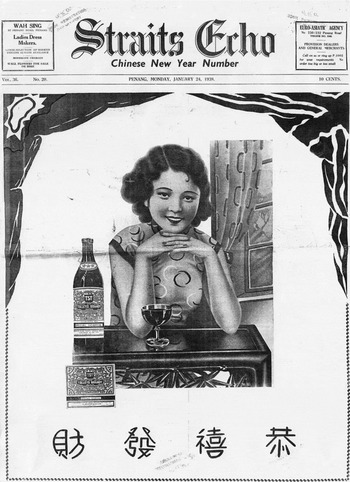
The demands of an older generation to hang on to cultural authenticity in dress were not incompatible with a young generation of Asian women who sought to please their parents and remain à la mode. Oriental exoticism generated an interest in Chinese silks and African, Egyptian and Russian motifs through the high culture of Art Deco, creating a wider cultural context for the internationalization of the Modern Girl. The Modern Young Chinese woman looked to trends in Shanghai as much as she did to Western fashions, donning the qipao or cheong sam, an invention of the 1920s which merged the traditional robes of the Manchu men with an Edwardian high collar, and later in the 1930s, a sartorial cut which stressed the female figure.Footnote 72 Modernity was thus as much Asian as European, drawing on tradition while subverting it. Cartoons of the Modern Chinese Girl in the Straits Echo show her wearing the cheong sam, next to a bottle of brandy (see Figure 3) or relaxing in Western-style shoes. As well as the cheong sam, cartoons of the most popular contributors to the Readers’ Page also depicted women in trousers and short skirts. Out in the public sphere, young women were seen to borrow elements of other cultural traditions in their mode of dress. A report on an Indian fair spotted Malay girls buying glass bangles, while ‘European girls from a party of tourists do not hesitate to stretch out their hands for the Indian to slip the bangles on their wrists’.Footnote 73 The reporting of these episodes of ‘cultural-borrowing’ from trend-setting cities abroad, as well as a diversity of cultural traditions at home, testified to the fluid boundaries of contemporary fashion.
The Modern Chinese Girl figured prominently on the cover of the 1937 Chinese New Year edition of the paper, pictured next to a bottle of brandy.

The Straits Echo's editorial stance steered a middle ground between retaining the rich diversity of Penang's cultural traditions and applauding the progressive steps taken by the modern woman. It advocated versatility in dress, in keeping with the dynamic, heterogeneous nature of the cosmopolitan public sphere. In its 'Random Notes' section, journalists commented on the issue of beauty contests in Malaya. Since the first Miss America pageant in 1920 in Atlantic City, beauty contests kept pace with the ‘Modern Girl’ to become another global phenomenon in the 1920s and 1930s, circulated through Hollywood films and the newsreel.Footnote 74 Neighbouring Siam was becoming a regional leader in capitalizing on the trend, which some Penangites sought to emulate to attract tourism and promote the beauty of Penang's women. In contrast to Siam, where beauty contests were drawn into a state-sponsored project of nation-building,Footnote 75 the Straits Echo saw the beauty contest as a vehicle to showcase Penang's cosmopolitanism. A Straits Echo journalist argued that the question of ‘Who Is the Malayan Beauty Queen?’ was impossible to answer, because each of Malaya's heterogeneous communities had their own standard of beauty. A full dress competition, with each community judged by their own standard of dress, would meet with a better response than a swimsuit contest along American lines, for ‘It would be really interesting to know who would be Miss Malaya (European), Miss Malaya (Malay), Miss Malaya (Indian), Miss Malaya (Eurasian), Miss Malaya (Chinese), Miss Malaya (Nonya in ‘sarong’ and ‘kebaya’) and Miss Malaya (other nationalities)’.Footnote 76
Of all these women, the writer went on, the ‘Nonya’, or Straits-born Chinese girl, was the most interesting. Nonya women, who descended from Chinese who had assimilated Malay culture over the last 400 years, were a shining example of cultural hybridity. Through years of intermarriage, these Straits-born Chinese adopted Malay, Muslim, and Indian elements of culture and dress while cultivating their own distinctive peranakan Footnote 77 cuisine—combining Malay, Chinese, Indian and Thai traditions. As mentioned above, they spoke both Baba Malay (roughly, a patois of Hokkien and Malay) as well as English and cultivated a ‘symbiotic relationship’ with the British colonial administration.Footnote 78 But their role in establishing and contributing to papers such as the Straits Chinese Magazine in Singapore and Straits Echo in Penang in the early 1900s made them the vanguard for critiquing the administration using its own language and ideals (i.e. ‘fair play’, justice and pax Britannica).Footnote 79 The writer thus applauded the ‘cosmopolitanism’ of Nonya women, as expressed by an adaptive style of dress and demeanour which drew on a variety of cultural traditions, both old and new:
She is the most versatile, if not the most progressive. Her versatility lies in the fact that she is able to adapt herself more readily in matters of dress, language and living than girls of other nationalities. She wears the comfortable Chinese coat and trousers à la Canton, but the next moment she is ready to slip into the ‘sarong’ and ‘kebaya’. She can be as much at home with the tight-fitting Shanghai ‘cheong sum’ as she is with the European skirt. She presents a mixture of styles and fashions of different places and periods. She still wears age-old Malaya anklets, while at the same times her hair is made up in the latest bob. She can appear as easily as a ‘nyai’ of the Dutch Indies, a girl from Shanghai or a belle from Canton./ She speaks more languages and dialects than others. As regards food, she is neither conservative nor fastidious; she relishes anything, be it Chinese, Malay, Indian, European, Siamese or Burmese.Footnote 80
The ‘Nonya’ woman symbolized a particular brand of cosmopolitanism rooted in local histories of immigration and adaptation to a changing environment. Her mode of dress reflected a willingness to engage with different cultural traditions as well as modernity in certain contexts. Her enjoyment of a variety of foods similarly reflected a visceral appreciation of inherited culinary traditions, and as such, of the shared rituals of multiple communities. The Straits Echo thus championed her as an exemplar of the model cosmopolitan woman—one who was modern, adaptive and representative of various distinct and hybrid cultural traditions to which she pledged solidarity.
Women in Malaya in the 1930s faced the challenge of preserving each of their unique, cultural traditions while looking to each other and the rest of the world for new, modern ways of being. Through education, organization and public debate, Europeans, Indians, Chinese and Malays connected over the humanist ideal of women's liberation, which gave women the freedom to do everything men could do. But as reflected in the Straits Echo, Malaya's disparate communities engaged with modern conceptions of femininity—as with English—in different ways: by finding resonances with older traditions, by advocating reform and departure from cultural norms, and by fusing, recovering and reinventing a multiplicity of customs. By incorporating modernity into existing cultural traditions, readers of the Straits Echo sought to reconcile universal, shared aspirations for women with a rich diversity of feminine practices, practicing a cosmopolitanism that savoured its roots.
Globalism and the End of an Era
The emergence of a discourse, or conversation, about cosmopolitanism and the Modern Girl was symptomatic not only of a society's reconciliation with its own cultural diversity, but also that of the wider world as a whole. The end of the 1930s was an age of tremendous idealism, difficult to imagine with the benefit of hindsight and the memory of the turmoil that was to ensue in the following years. In reports and letters, the Straits Echo and its readers advocated a new kind of ‘globalism’—of thinking and acting on a global basis, in the common interest of all nations and races. It was in this period that clubs such as Rotary, which fostered a spirit of mutual understanding and international cooperation, gained prestige. Saravanamuttu referred to its express purpose in creating an ‘international mind’, meaning ‘a mind which, looking out beyond its own racial and territorial boundaries, discerns the essential oneness of all humanity.’Footnote 81 Readers of the Straits Echo founded a ‘Straits Echo League’ to foster ‘harmonious relations among the various races of Malaya, to bring them to a common platform of thoughts and strive for the progressions of this country’.Footnote 82 Women were also members of the League, which among its idealistic founding aims provided ‘an opportunity for lonely souls to meet and cultivate amiable companions’.Footnote 83 The Anglo-Chinese school, which provided English education not only to Chinese, but also to Penang's multicultural youth, incited donations from Chinese, Indian-Muslim, Indian-Chettiar as well as Malay communities, prompting the large page spread and headline ‘Donors Represent a Miniature League of Nations’.Footnote 84 The symbolic impact of the League of Nations was a macrocosm of Penang's local brand of cosmopolitanism, in which its diverse communities cooperated in the interests of a better world for themselves and their children.
The failure of the League came to them as a blow. Even closer to home, the real impact of the Japanese occupation during the Second World War and the social and economic hardships that ensued succeeded in almost tearing Malaya's diverse communities apart, forcing new solidarities along racial lines: Malay radicals aligned themselves with the Japanese to gain political capital and were viewed by Chinese victims of Japanese brutality as collaborators, the Indian National Army played on diasporic patriotism to instil martial support for a Free India. As the first point of occupation—surrendered to the Japanese and deserted by Europeans in a blink of an eye—Penang witnessed ‘the moral collapse of British rule in Southeast Asia’,Footnote 85 an event which stained imperial ideas of a commonwealth of nations that fostered the ‘globalism’ of some of Penang's more Anglophile communities. Young women who had years earlier playfully debated on love and the merits of choosing a husband were hurriedly married off as Japanese soldiers arrived on the island in droves. Witnessing the war-torn victims of the occupation in the hospitals in which they worked, they grew up very quickly. The Readers’ Page had ended with the war and was never revived when the Straits Echo re-launched as a shell of its former self due to immediate post-war paper shortages and the departure of Saravanamuttu in 1947.
After the war, Malaya's ethnic communities found themselves having to accommodate to a new ideal: the modern nation-state. The Malay elite—who largely administered the country during the Japanese occupation and emerged with new confidence and popular support—proposed the Federation of Malaya, giving limited rights to non-Malays. The British, whose policies had traditionally been pro-Malay, endorsed the scheme, and via a series of negotiations the Indians and Chinese generally accepted the political position of the Malays to shape the cultural identity of the nation in exchange for economic freedoms. Through compulsory language education and other national symbols, ‘Malay’ became the new face of a nation that had traditionally been defined by its inherent cultural diversity. In 1948, a group of secessionists in Penang—supported by the Straits Echo—voiced their opposition to the federation, fearing loss of British citizenship and the possibility of free-port status while at the mercy of Malay political power from Kuala Lumpur. The group consisted of Eurasians, Indians and (mostly Indian) Muslims but was predominantly driven by the Straits-Chinese, whose political identity of allegiance to the British Empire had left them, in the words of Clive Christie, ‘stranded by the tide’ of post-war decolonisation.Footnote 86 A footnote in Mohammed Sopiee's study of the period says that at the root of such demands was Penang's view of her own importance, evidenced by the pride she took in her motto ‘Penang leads.’Footnote 87 This was based, as Christie makes clear, in ‘loyalist nostalgia for the stability and racial harmony of pre-war Penang’, evidenced in the words of their petition to the colonial office which celebrated the settlement's ‘great past . . . to build a more glorious future for Penang’.Footnote 88 On an ideological level, perhaps what the secessionists felt was at stake was their particular history of urban cosmopolitanism, which continued to value the tangled roots of a shared multicultural public sphere over a nation defined by one sole ethnic group. In early post-war discussions about the shape of the nation in the Straits Echo, it was hoped that the interests of cosmopolitanism and nation could be reconciled. As Saravanamuttu observed in 1946, ‘A satisfactory basis for a modern nationality is neither race nor religion, nor even a community of interest. Two things go to make up a nation, which is a soul, a spiritual principle. One of these things is a heritage of common suffering and common rejoicing in the past, and the other, which lies in the present, is actual agreement, and to make the most of the inheritance shared jointly’.Footnote 89
Conclusion: Cosmopolitanism and New Possibilities
In his study on the languages of globalism, Tim Harper observes, ‘The modern nation state was achieved at a tremendous cost to other discourses’.Footnote 90 Cosmopolitanism was one of those discourses. Through the ‘distorting lens of the nation-state’,Footnote 91 historians have written out cosmopolitanism from history, dwelling largely on the imagined solidarities created within the territory of Malaya that justified the position of its post-colonial political leadership. By focusing on the Malay language, ‘bangsa’ (race) and ‘sons of the soil’ to define the essence of the Malay nation, what has been lost is a particular mode of being that valued the shared aspirations of the culturally diverse people of Malaya as well as their differences. For modern Malaysia and other nation-states caught up in the challenges of ‘globalisation’ and continually scoured by the politics of race, the recovery of cosmopolitan moments in the ‘national’ narrative—which speak to the inclusiveness, fluidity and interchange among its culturally diverse citizens and with the rest of the world—is of utmost importance.
Recently, a policy of ‘official’ multiculturalism has recognized Malaysia as a plural society in political and public discourse, although the tendency has been to rigidly categorize cultural identities into the three dominant ‘uniform ethnicities’ of ‘Malay’, ‘Chinese’ and ‘Indian’.Footnote 92 The power of the state to shape and categorize cultural identity continues to pose challenges to the organic, dynamic nature of a cross-cultural public sphere, in which men and women seek to represent themselves, either individuals or as groups, in ways that are much more creative, fluid and hybrid than dominant cultural stereotypes that constitute the ‘national narrative’.Footnote 93 There is a lineage between the idealistic readers of late colonial Penang's English-language newspaper and those scholars, activists, artists and writers in Malaysia today who are attempting to break out of myopic cultural molds, forging connections and redefining the boundaries of cultural difference through dialogue and cultural exchange. Cosmopolitan civic culture has continued in Penang, through the work of scholars such as Francis Loh Kok Wah and Khoo Boo Teik at the University Sains Malaya who strive to put cultural diversity and social justice at the heart of national policy, through their work in multi-ethnic human rights organisations such as Aliran, through trans-national, activist organizations such as the Third World Network and through the efforts of the Penang Heritage Trust and other conservation societies who have continued to celebrate Penang's cosmopolitan past. The Penang State Museum, too, is one of the far too few state-sanctioned museums in the world predicated on celebrating the historical contribution of immigrants from all over the world (Chinese, Indians, Muslims, Acehnese, Jews, Armenians, Eurasians) in forging a vibrant civic culture alongside those traditionally considered the inheritors of the nation.
The role of the historian is to help strengthen the lineage of cosmopolitan civic culture, giving as much weight to hitherto neglected histories of openness, cultural exchange and globalism as histories of nationalism and separate communities. In the post-colonial moment, those histories were empowering—now, they have solidified into a national narrative that do not accommodate the varied forms of cultural experience within and across the boundaries of ‘nation’. A younger generation of Malaysians are beginning to speak out—as Malaysian political scientist and activist Farish A. Noor writes, ‘the contribution of “Other” ethnic and racial groups, the role of women in the country's historical development and the pre-Islamic part of the country have been conveniently sidelined and relegated to the footnotes of history. . .. A close reading of Malaysian official historiography will show that the Malaysian historical subject remains male, Malay/Bumiputera, middle-class and Muslim’.Footnote 94 An alternate view, as proposed in this essay, would be to see a new historical subject in Penang's Modern Girl, in all her manifold cultural shapes and forms, as representative of a dynamic, open and cosmopolitan version of Malaysian history—one that has long historical roots, reaching back through centuries of trading ships and cultural exchange, of keeping pace and revelling in the wonders of a truly global modernity. It is within that rich tapestry—the entanglement of many old cultural roots and new, creative visions for the future—that the legacy of an ‘inheritance shared jointly’ can be fully brought to bear.