INTRODUCTION
Yedoma sediments are a particular kind of Quaternary deposit in permafrost terrain that are widespread in central and northeastern Siberia and the High Arctic, but only a few of them have been found and described in northwestern Siberia. Yedoma exposure in the Seyakha River mouth east of the Yamal Peninsula is the first to have been studied in detail. Yedoma is ice-saturated sediment (containing 50–90 vol. % of ice) which is, as a rule, rich in organic material (>1–2% of Corg); yedoma consists of clayey and silty loams, loamy sands, or fine sands dated to the Late Pleistocene. Yedoma sediments contain thick (1–3.5-m wide and 15–20-m thick or more) syngenetic ice wedges that are often multitiered (Vasil’chuk and Vasil’chuk Reference Vasil’chuk and Vasil’chuk2020).
The discovery of Seyakha yedoma strata with syngenetic ice wedges and their dating (Vasil’chuk and Trofimov Reference Vasil’chuk and Trofimov1984) resulted in a significant refinement of the Eurasian ice sheet boundary on the Yamal Peninsula during the Late Glacial Maximum (LGM). According to earlier studies, the Barents-Kara Sea Ice Sheet covered a large part of northern Siberia, including the Yamal Peninsula (Forsstrom and Greve Reference Forsstrom and Greve2004). Later, in publications of Svendsen et al. (Reference Svendsen, Alexanderson, Astakhov, Demidov, Dowdeswell, Funder, Gataullin, Henriksen, Hjort, Houmark-Nielsen, Hubberten, Ingolfsson, Jakobsson, Kjaer, Larsen, Lokrantz, Lunkka, Lysa, Mangerud, Matiouchkov, Murray, Moller, Niessen, Nikolskaya, Polyak, Saarnisto, Siegert, Siegert, Spielhagen and Stein2004, Reference Svendsen, Krüger, Mangerud, Astakhov, Paus, Nazarov and Murray2014) and Hughes et al. (Reference Hughes, Gyllencreutz, Lohne, Mangerud and Svendsen2016), it was proposed that the ice sheet did not reach the northern rim of the mainland of most part of Western Siberia and European sector of Northern Russia during the LGM (20–25 ka BP) and its boundary was located in the Kara Sea, to the west of the Yamal Peninsula. The position of the last Eurasian ice sheet was determined on the basis of a chronological series of more than 5000 age determination of Late Quaternary sediments in more than 2500 locations. These dates indicate the terrace formation, vegetation growth, and other events that could not occur in ice sheet conditions. Accumulation of yedoma strata in northwestern of Siberia is important evidence of non-glacial but severe geocryological conditions during the LGM.
Connecting the stable isotope records on ice wedges to a timescale based on 14C dating of ice wedge was a basis for reconstruction of mean January air temperatures. Detailed isotope diagrams with a mean temporal resolution of less than 100 years were obtained for some ice wedges of Seyakha yedoma (Vasil’chuk et al. Reference Vasil’chuk, Budantseva and Vasil’chuk2019) that allowed us to estimate winter climate conditions for the eastern Yamal Peninsula during the LGM.
MATERIAL AND METHODS
Study Area
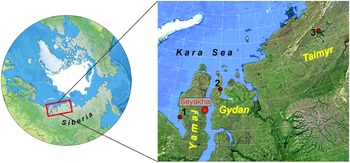
Yedoma exposures in northwestern Siberia, on the eastern coast of the Yamal Peninsula at the Seyakha River mouth (70.157364°N, 72.569100°E, Figure 1) were studied in detail.
Location of Seyakha yedoma and nearest yedoma exposures at the western part of northern Siberia: Marresale (1), Ery-Maretayakha (2), and Sabler Cape (3).

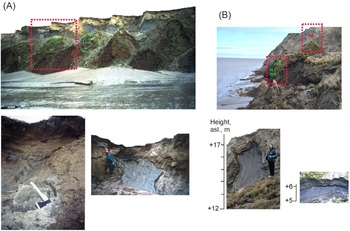
The cryostratigrapy of the central part (Figure 2A) of the exposure can be divided into three units. The lowest 11-m unit is characterized by 3-m-wide ice wedges consisting of pure ice. The enclosing sediments accumulated under alternating subaqueous-subaerial conditions, which is indicated by lamination of sediments and admixture of organic material such as rootlets, stems, and leaves (subaerial layers) or sandy loam (subaqueous layers). In the middle unit (8–9 m thick) narrower (up to 1–1.5 m wide) ice wedges with vertical layers of mineral inclusions are found. These wedges pierce the ice wedges of the lower stage. Surrounding sediments are clearly laminated but are almost lacking in organics. These sediments are capped by 2–3 m of laminated yellow sand (subaqueous conditions) from where a third generation of ice wedges pierces the underlying unit. It is assumed that this unit accumulated during a period of high Ob’ Bay level, which is also proved by the presence of well-preserved in situ sub-saline foraminifera: Elphidium subclavatum Gudina, Pninaella pulchela Parker, Protelphidium parvum Gudina, etc. (Vasil’chuk et al. Reference Vasil’chuk, Vasil’chuk, Jungner, Korneeva and Budantseva1998).
Seyakha yedoma exposure: central part (A) and edge part (B).

The edge of the yedoma was studied in 2016 (see Figure 2B). In the upper 5-m part of the outcrop (from +11.5 to +16.5 m asl) grayish yellow fine sand with an admixture of organic material was revealed. Ice wedges up to 1.0–1.5 m wide at the top were exposed. At a height of +5 to +6 m, the paragenesis of the ice wedge and a lens of segregated ice was found. In a baidzherakh (in permafrost areas, a remnant of frozen sediments surrounded by ground subsided along thawed ice wedges) located at heights of 0 to +7 m, stratified peat containing remains of plants, subshrubs, and hypnum mosses were identified.
Field Studies and Sampling
Field studies of Seyakha yedoma were carried out by the authors four times over the period 1978 to 2016. During the field studies of 1996 and 2016, four ice wedges were selected for sampling. Ice samples for 14C dating and stable isotope analysis were cut from ice wedges using an ice axe. Since the samples were taken at temperatures above zero, a layer of ice at least 5 cm thick was removed before sampling to avoid the possible admixture of modern water. The surface of each ice sample was scraped off with clean blades to remove surface dirt and washed with meltwater from the same sample of ice. To separate the organic material, ice samples were thawed at a temperature of about 5°C and stood for at least 24 hr, and then sediment was collected in plastic vials. Samples for isotope analysis were taken from the same ice wedges both along the axial parts and horizontal profiles. Each sample of ice was packed in a double plastic zip-bag, where ice melted at a temperature slightly above 0°C. The water poured into plastic vials and sealed with parafilm to avoid evaporation. The enclosing sediments with organic material were also sampled for conventional radiocarbon (14C) dating.
Laboratory Treatment and Radiocarbon Dating
Accelerator Mass Spectrometry (AMS) 14C Dating of Ice Wedges
The first radiocarbon measurements (after field studies of 1996) were made in using a Tandetron AMS at the Center for Isotope Research at the University of Groningen (van der Plicht et al. Reference van der Plicht, Aerts, Wijma and Zonder1995). Sediment with organic matter from ice wedges was chemically treated to extract the alkaline fraction (dissolved organic carbon—DOC) and fraction >400 µm (particulate organic carbon—POC) for each sample. These two fractions were then prepared separately for analysis: they were combusted in an automatic element analyzer Carlo Erba 1500, connected to a Micromass Optima IRMS and a gas chromatographic column to separate the isotopes close to 14C, such as 13C, and 15N. AMS radiocarbon dating of organic matter from the ice wedge (total organic carbon—TOC) sampled in 2016 was carried out at the Laboratory of Radiocarbon Dating and Electron Microscopy of the Institute of Geography of the Russian Academy of Sciences (obtaining counting material) and the Center for Isotope Research of the University of Georgia in the USA (direct measurements on an accelerator mass spectrometer).
Conventional Dating of Sediments
Organic matter from the enclosing sediments was dated using a conventional method at the Institute for the History of Material Culture, St. Petersburg (lab code LE), Institute of Geology RAS (lab code GIN), and Helsinki University (lab code Hel); one sample of moss from a bulk sample was dated at Helsinki University and Uppsala University AMS (lab code Hela). All obtained radiocarbon dates were calibrated using OxCal 4.4 based on the IntCal20 data set and given as yrs cal BP (Bronk Ramsey Reference Bronk Ramsey2009; Reimer et al. Reference Reimer, Austin, Bard, Bayliss, Blackwell, Bronk Ramsey and Butzin2020).
Stable Isotope Analysis
Stable isotope (oxygen and hydrogen) analysis in ice-wedge ice was carried out in the Stable isotope laboratory of the Geography Faculty at Lomonosov Moscow State University using a Finnigan Delta-V Plus mass spectrometer. Analytical precision was ±0.4‰ for δ18O and ±1‰ for δ2H. Oxygen isotope measurements of some ice wedges sampled before 2016 were carried out using a G-50 device at the isotope hydrology laboratory at the Institute of Water Problems of Russian Academy of Science (Dr. A. Esikov), at the isotope geology laboratory at the Institute of Geology, Tallinn, Estonia (Prof. R. Vaikmäe), at the Isotope Laboratory of Helsinki University (E. Sonninen and Prof. H. Jungner), and in the Hannover Isotope Laboratory (Prof. M. Geyh). All values are presented in δ-notation in per mille (‰) relative to the Vienna Standard Mean Ocean Water (VSMOW).
January Paleotemperature Reconstructions
Reconstructions of mean January temperatures (Tmean Jan., oC) were carried out by comparing the isotope composition of modern ice veinlets (δ18Oiv) and mean January temperatures (t °J) for the period of ice veinlet growth, i.e., for the last 60–100 years (Vasil’chuk Reference Vasil’chuk1991). As a result of this comparison, the equation is obtained:
 $${\rm T_{\rm mean\,Jan.}} = 1.5\,{\rm \delta ^{18}}{\rm O_{iv}}\left( { \pm 3^\circ C} \right)$$
The range of ±3°C indicates the average range of variations of the reconstructed temperatures.
RESULTS
Radiocarbon Dating
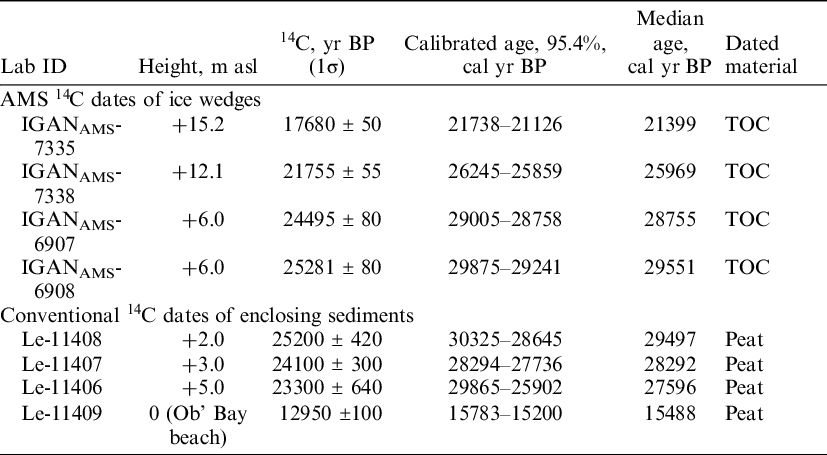
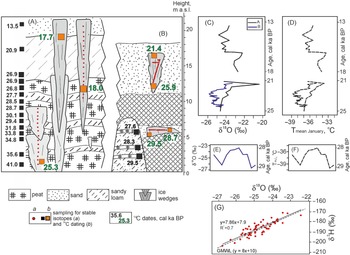
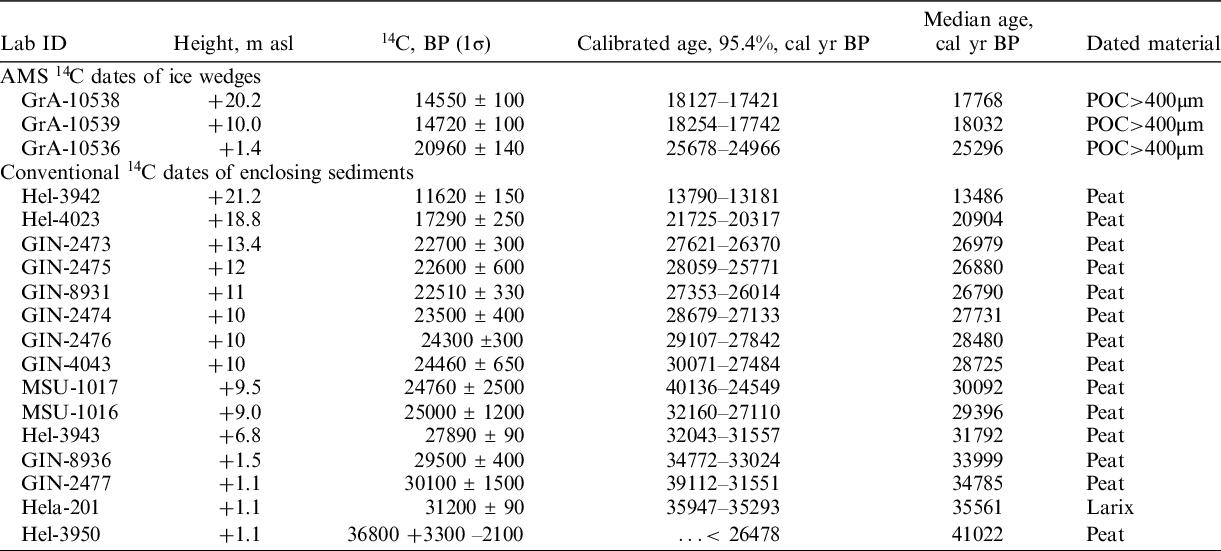
Four new AMS 14C dates were obtained for ice wedges from the middle and lower parts of Seyakha yedoma (the edge part of the section). Ice wedges from the middle part were dated from 21 to 25 cal ka BP. Ice wedges from the lower fragment were dated from 28 to 29 cal ka BP. These are the oldest dates for ice wedges of Seyakha yedoma. Three new radiocarbon ages ranging from 27.5 to 29.4 cal ka BP were obtained for the enclosing sediments at absolute heights of +2 to +5 m (Table 1, Figure 3A). Previous 14C AMS dates (Vasil’chuk et al. Reference Vasil’chuk, Vasil’chuk, Jungner, Korneeva and Budantseva1998, Reference Vasil’chuk, van der Plicht, Jungner, Sonninen and Vasil’chuk2000a, Reference Vasil’chuk, van der Plicht, Jungner and Vasil’chuk2000b) from 17.7 to 25.3 cal ka BP were obtained for three fragments of ice wedges (the central part of the section), and the enclosing sediments were dated from 13.5 cal ka BP at an absolute height of +21 m to 41 cal ka BP from sample at an absolute height of +1 m (Table 2, see Figure 3A).
14C dates of organic remains in ice wedges from middle and lower parts of Seyakha yedoma and enclosing sediments (edge part of yedoma exposure).

*Calibrated using OxCal 4.4 equipped with IntCal20 (Reimer et al. Reference Reimer, Austin, Bard, Bayliss, Blackwell, Bronk Ramsey and Butzin2020).
Cryostratigraphy and 14C dates of ice wedges and enclosing sediments for the central (А) and edge (B) parts of Seyakha yedoma, δ18О diagrams for dated ice wedges (C) and reconstructed mean January air temperatures (D) for the period of 29–13.5 cal ka BP. Co-isotope line for ice wedges is also shown (E).

14C dates of organic remains in ice wedges and enclosing sediments (central part of Seyakha yedoma exposure).

*Calibrated using OxCal 4.4 equipped with IntCal 20 (Reimer et al. Reference Reimer, Austin, Bard, Bayliss, Blackwell, Bronk Ramsey and Butzin2020).
Stable Isotope Composition of Ice Wedges
The new high-resolution oxygen isotope record (with a temporal resolution of 80-100 yrs) covers the entire period between 25 and 21 cal ka BP. The δ18О values in the upper ice wedge vary from –25.75 to –23.15‰ (see Figure 3C). Two isotope trends were established: in the interval from +12 to +14.2 m, the δ18О values vary in a range of about 1.5‰ (–24.18 to –25.75‰); in the interval from +14.2 to +15.8 m, a clear tendency toward the upward increase of δ18О by 2.6‰ was noted (–25.75 to –23.15‰). For the lower section of ice wedge exposed at a height of +6 m δ18О values vary from –23.41 to –26.63‰, that corresponds to the isotope range for the upper ice wedge (from –23.4 to –25.75‰). The previously-obtained oxygen isotope values for the ice wedges in the central part of the Seyakha yedoma (Vasil’chuk Reference Vasil’chuk1992; Vasil’chuk et al. Reference Vasil’chuk, van der Plicht, Jungner and Vasil’chuk2000b) vary between –20.4 to –25‰, which is rather close to the isotope data for ice wedges from the edge part of the yedoma (–23.4 to –25.75‰).
The slope of the δ18О-δ2H ratio line for the ice wedge ice is 7.8, which is close to that of precipitation (global meteoric water line—GMWL). This indicates that the ice wedges were formed mainly through precipitation (melted winter snow) which was not subject to significant isotopic transformations. Thus, the δ18О values are valid for paleotemperature calculations.
INTERPRETATION AND DISCUSSION
The Age of Ice Wedges of the Seyakha Yedoma
According to the obtained AMS 14C dates, ice wedge growth occurred between 29 and 18 cal ka BP. The age of 17.7 cal ka BP from the upper ice wedge (see Figure 3A) seems too old as it is supposed that this ice wedges could have been contaminated with older organic dust, which blew into frost cracks from the neighboring exposures. The additional evidence for this was a high concentration of re-deposited pollen and spores of pre-Pleistocene age in the upper part of the section. The termination of yedoma accumulation and ice wedge growth may have been established by the 14C date of 13.5 cal ka BP at a depth of 0.8 m.
Comparison of Dates for Ice Wedges and Enclosing Sediments
Radiocarbon dates for the ice wedges and enclosing sediments in the edge part of Seyakha yedoma show a non-inversion series from 29 to 21 cal ka BP. Dates from baidzherakh sediments—from 29.5 to 27.6 cal ka BP—are comparable with AMS 14C dates of organic matter from ice wedges at the same depth. It should be noted that baidzherakh sediments occur in permafrost state and had not thawed and been reworked, but this block of frozen sediments has set down (by a maximum of 1.5 m) due to the thawing of ice wedges. Therefore, the dated organic horizons from this baidzherakh were initially located at heights of +3.5 to +6.5 m, i.e., at the same height as the lower ice wedge fragment. From this, it can be assumed that the lower ice wedge was formed synchronously with the enclosing sediments about 29-27 cal ka BP.
A comparison of the obtained dates for ice wedges (from 25.3 to 18 cal ka BP) and enclosing sediments at the same depth (from 41 to 26.8 cal ka BP) in the central part of the yedoma exposure demonstrates a discrepancy (see Figure 3A), indicating that the sediments must have been contaminated by older organic material.
It has been established that reworked organic matter noticeably complicates the dating of syngenetic permafrost sediments like yedoma strata (Vasil’chuk and Vasil’chuk Reference Vasil’chuk and Vasil’chuk2017). All yedoma sediments in alluvial conditions were once at a beach level and most of the material for yedoma accumulation was re-worked from older sediments. The proportion of reworked material can be very high in accumulative coastal areas, even distant from abraded shores. Ancient organic detritus was washed out by thermal abrasion and deposited in the scalloped form of an almost pure organic matter. For example, peat from the beach under Seyakha yedoma exposure was dated to 15.5 cal ka BP (see Table 1), but visually it was similar to the in situ peat layers exposed in the outcrop. This peat could be identified as autochthonous although it is generally allochthonous. The admixture of such allochthonous material may cause an overestimation of the real age of the sediments by thousands and even dozens of thousands of years.
Paleotemperature Calculations and Chronological Scale for Isotope Data
A comparison of 14C dated oxygen isotope curves (obtained for different parts of the yedoma section) show a good correlation for the period from 25 to 21 cal ka BP: the δ18О values generally vary within the range from –23 to –25‰ (see Figure 3C).
Paleotemperature reconstructions based on Equation (1) show that from 25 to 21 cal ka BP Tmean January varied from –36 to –39°C (see Figure 3D) that is, it was 10–14oC lower than modern mean January air temperature at the Seyakha site. In the ice wedge formed from 18 to 13.5 cal ka BP, there is a general trend of an upward decrease of δ18О values from –22 to –24.5‰ (Vasil’chuk et al. Reference Vasil’chuk, van der Plicht, Jungner and Vasil’chuk2000b). Accordingly, Tmean Jan. during 18–13.5 cal ka BP varied from –33 to –37°C, decreasing during the terminal stage of ice wedge growth.
Synchronism of Yedoma Strata Formation and Mean January Air Temperature in the Western Sector of Siberian Arctic 30–19 cal ka BP
The 14C dates and stable isotope compositions of ice wedges of the Seyakha yedoma were compared with yedoma exposures at three nearest sites in western part of Siberia: Marresale site (western coast of the Yamal Peninsula, 69.720ºN, 66.800ºE), Ery-Maretayakha (north of the Gydan Peninsula, 71.833ºN, 75.216ºE) (Forman et al. Reference Forman, Ingólfsson, Gataullin, Manley and Lokrantz2002; Oblogov et al. Reference Oblogov, Streletskaya, Vasiliev, Gusev and Arslanov2012; Streletskaya et al. Reference Streletskaya, Vasiliev, Oblogov and Matyukhin2013), and Sabler Cape on the Taimyr Peninsula (74.550ºN, 100.533ºE) (Derevyagin et al. Reference Derevyagin, Chizhov, Brezgunov, Siegert and Hubberten1999). Radiocarbon ages for these yedoma sections range from 36 to 10 cal ka BP. According to Forman et al. (Reference Forman, Ingólfsson, Manley and Lokrantz1999, Reference Forman, Ingólfsson, Gataullin, Manley and Lokrantz2002), active ice wedge growth and eolian and fluvial deposition occurred during the Late Weichselian, ca. 40–11 ka BP on the western Yamal Peninsula. In the ice wedges formed between 19.7 and 14.2 cal ka BP the δ18О values vary from −24.8 to −23.4‰ (Streletskaya et al. Reference Streletskaya, Vasiliev, Oblogov and Matyukhin2013). For the Ery-Maretayakha yedoma, the ice wedge which has been dated to about 26 cal ka BP is characterized by δ18О values from −22.6 to −24.6‰ (Oblogov et al. Reference Oblogov, Streletskaya, Vasiliev, Gusev and Arslanov2012). The range of stable isotope data is close to that of the Seyakha ice wedges indicating similar winter climate conditions during yedoma strata formation between 26 and 14 cal ka BP.
Yedoma strata on Sabler Cape reveal a notable similarity in stratigraphy and synchronicity with the Seyakha yedoma. At this location, a series of 14C dates of enclosing sediments, almost without inversions, was obtained by Sulerzhitsky (Reference Sulerzhitsky1982). One series of eight dates from 28.5 to 13.5–14 cal ka BP was obtained for the depth range 1–17 m; later, 13 dates from 35.1 to 11.8 cal ka BP were obtained for the depth range 3–25 m (Andreev et al. Reference Andreev, Tarasov, Siegert, Ebel, Klimanov, Melles, Bobrov, Dereviagin, Lubinski and Hubberten2003). Thus, yedoma strata at Sabler Cape accumulated synchronously with Seyakha yedoma, from 35–29 to 13–12 cal ka BP.
Three tiers of ice wedges were described in the Sabler Cape yedoma exposure. The oxygen isotope composition (δ18O) of ice wedges dated between 34.5 and 30.9 cal ka BP vary from –31.5 to –28.3‰; in ice wedges dated between 22 and 14 cal ka BP, δ18O values vary between –29.5 and –24.3‰. These values are lower than in the ice wedges of Seyakha yedoma, which is explained by the more severe winter climate conditions of the Taimyr Peninsula during the Late Pleistocene. However, the general trend of increasing of δ18O values in ice wedges at the final stage of their growth was observed at both sites. The mean δ18O values in the modern ice veinlets at the Sabler Cape site is –20.6‰ (Derevyagin et al. Reference Derevyagin, Chizhov, Brezgunov, Siegert and Hubberten1999), so the difference in the isotopic composition of Late Pleistocene and modern ice wedges is 6–9‰. The same difference in mean isotope values between Late Pleistocene and modern ice wedges was obtained for the Seyakha site.
Stratigraphic and geomorphic observations and associated chronologic controls do not support the existence of an ice sheet or even the proximity of a glacier margin in the western section of north Siberia between 30–29 and 20–19 cal ka BP. During this period winter climatic conditions were much more severe than modern ones: the mean January air temperature was on average 10°C lower than modern one and varied from −35 to −36°C on the Yamal and Gydan Peninsulas to −44 to −40°C on the Taimyr Peninsula, which favored the active growth of syngenetic ice wedges. These conclusions are in good agreement with the data for the Polar Ural region where due to cold and dry winter climate conditions prevailed during the MIS 2 even in the mountains only small local glaciers could exist (Svendsen et al. Reference Svendsen, Krüger, Mangerud, Astakhov, Paus, Nazarov and Murray2014).
CONCLUSIONS
Yedoma strata with thick ice wedges (over 20 m high) were formed in northwestern Siberia during the Late Pleistocene cryochron (dated to 50–11.7 cal ka BP). Direct dating of ice wedges of the Seyakha yedoma on the Yamal Peninsula allows us to conclude that ice wedges were formed between 29 and 18 cal ka BP, and the termination of yedoma strata accumulation had occurred by 13.5 cal ka BP. The δ18O values in ice wedges formed 25–21 cal ka BP vary from –23 to –25‰ and the reconstructed mean January air temperatures during this period were on average –36°C, that is at least 10°C lower than modern ones. Active accumulation of yedoma sediments with ice wedges on the Yamal, Gydan, and Taimyr Peninsulas proves that vast areas of the western sector of the Siberian Arctic were not covered by the Eurasian ice sheet during the LGM (between 25 and 20 cal ka BP).
ACKNOWLEDGMENTS
We thank the Associate Editor, Dr. Ya. Kuzmin and two anonymous reviewers for their helpful and constructive comments and suggestions during reviewing process. The research was financially supported by the Russian Scientific Foundation (grant № 19-17-00126). The authors state that they have no conflicts of interest.