Introduction
The Antarctic flora and fauna are well adapted to the continent's harsh conditions (Convey Reference Convey1996, Rogers et al. Reference Rogers, Johnston, Murphy and Clarke2012). However, today they face increasing threats from both direct human impacts and climate change (Convey Reference Convey2010, Chown et al. Reference Chown, Lee, Hughes, Barnes, Barrett and Bergstrom2012, Convey & Peck Reference Convey and Peck2019). Limited to typically small and often extremely isolated areas of ice-free land (oases), the Antarctic terrestrial biota is typified by high levels of regional endemism, surviving through the multiple and extensive glacial cycles of the Miocene, Pliocene and Pleistocene (Convey & Stevens Reference Convey and Stevens2007, Convey et al. Reference Convey, Gibson, Hillenbrand, Hodgson, Pugh, Smellie and Stevens2008, Reference Convey, Biersma, Casanova-Katny, Maturana, Oliva and Ruiz-Fernández2020, Fraser et al. Reference Fraser, Nikula, Ruzzante and Waters2012). Even today, many of the isolated ice-free oases across Antarctica have yet to receive even basic surveys of their terrestrial biodiversity (Convey Reference Convey2010, Convey et al. Reference Convey, Chown, Clarke, Barnes, Cummings and Ducklow2014).
Thala Hills is a coastal oasis located in Enderby Land, East Antarctica. Although there is a history of research in the area, this has focused on geological, geocryological and pedological studies (Dolgikh et al. Reference Dolgikh, Mergelov, Abramov, Lupachev, Goryachkin and Bockheim2015), and very little is known of its terrestrial biology and diversity. Most published studies are in the Russian-language literature, describing work that was carried out between the 1960s and the 1990s, and they are not widely accessible. The area of study within the oasis was also restricted in this period, mostly in the immediate vicinity of the Russian ‘Molodyozhnaya’ ('Youth') station in the western part of the oasis.
Since 2008, members of the Belarus Antarctic Expedition (BAE) have conducted multidisciplinary studies in the eastern part of the Thala Hills oasis during each summer season in the vicinity of the Belarus station ‘Vechernyaya Mount’ ('Evening Mount'). One of the primary goals of these studies has been to assess terrestrial (including freshwater) biodiversity, along with aspects of marine coastal diversity, in this poorly studied region, and to provide a baseline against which to assess any future evidence of human impacts and the consequences of global and regional environmental change.
In this study, we present the most thorough overview of the biodiversity of the Thala Hills oasis yet achieved. The information presented focuses on the Eukarya and is based on both the available literature and our recent surveys and collections. These data allow for an initial assessment of native terrestrial biodiversity of the Thala Hills oasis, and they are discussed in the wider context of Antarctic terrestrial biogeography.
Materials and methods
Study area
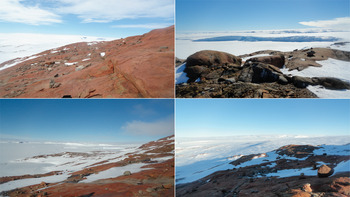
The Thala Hills oasis was first mapped in 1960 using aerial photography taken in 1956–1958 under the auspices of the Antarctic Names Committee of Australia. A more detailed map was completed in 1962 by Russian (Soviet Union) surveyors when Molodyozhnaya station was constructed. This low-lying coastal oasis is typical of such habitats in East Antarctica (Fig. 1). It is surrounded by glacial formations of different types. Although coastal, the nearshore area is normally covered with sea ice. The relief is rocky and undulating, reaching a maximum altitude of ~260 m above sea level (a.s.l.). Numerous riegels and depressions characterize the ground surface, indicating the influence of very strong geomorphological and periglacial processes. The main rock types are granitoids, primarily charnockites (including enderbites) (Simonov Reference Simonov1971).
Characteristic landscapes of the eastern part of the Thala Hills oasis (photographs by Dzmitry A. Lukashanets).

The climate is harsh even in comparison with other East Antarctic oases (MacNamara Reference MacNamara1969, Simonov Reference Simonov1971, Dolgikh et al. Reference Dolgikh, Mergelov, Abramov, Lupachev, Goryachkin and Bockheim2015). Blizzards are experienced on ~190 days each year (cf. 88 days at Schirmacher Oasis and 70 days at Bunger Hills). The average wind speed is ~10.2 m s-1. Katabatic winds occur frequently, along with frequent cyclone intrusion. Maximum solar irradiance is high, with total irradiance of ~100.6 kcal cm-2, ground-absorbed irradiance of 70.5 kcal cm-2 (four times greater than that of ice cover) and the irradiance balance being 30.5 kcal cm-2. The average annual air temperature is -11.1°C, with the warmest monthly mean being -1.0°C in January and the coldest being -18.8°C in August. The instantaneous temperature of the ground surface ranges from -38°C in winter to +36°C in summer, with an annual average of -9.3°C. Annual precipitation is 484 mm water equivalent.
Water bodies are present in the inter-ridge depressions and several larger lakes are present in the western part of the oasis, including Lakes Glubokoe, Lagernoe and Ovalnoe. These have surface areas of 280, 53 and 40 × 103 m2 and average depths of 11.6, 3.3 and 1.0 m, respectively (Simonov Reference Simonov1971).
Data collection
To collate all available information relating to Thala Hills biodiversity, the available literature was carefully examined. We referred to 21 sources that contain information on biodiversity records from the western and eastern parts of the Thala Hills oasis specifically, as well several atlases with information on species distribution (mainly for marine fauna) and multiple works addressing overall East Antarctic diversity.
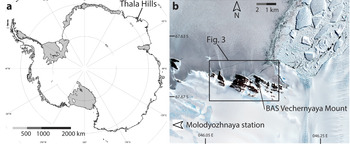
The new studies reported here were conducted in the eastern part of the Thala Hills oasis (Enderby Land, East Antarctica) near the Belarusian station ‘Vechernyaya Mountain', ~12 km from Molodyozhnaya station (Fig. 2). Studies took place during the II, III, V, VI, VIII, IX and XI BAE, in the summer periods between 2008–2009 and 2018–2019.
Study area. a. The location of the Thala Hills oasis on the coast of East Antarctica. b. Satellite image of the eastern part of the Thala Hills oasis (Vechernyaya Mount). BAS = Belarus Antarctic Station.

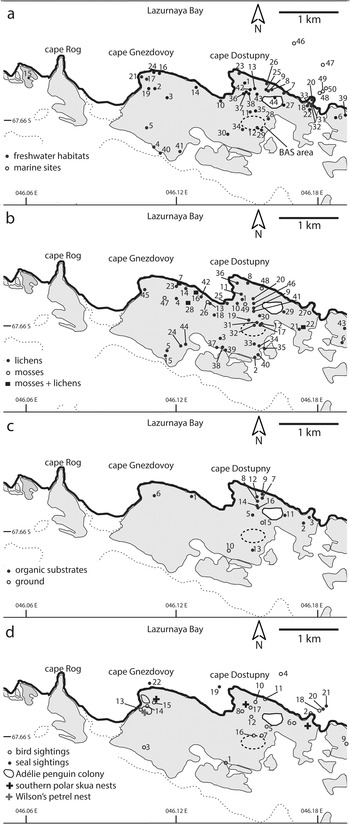
Marine biota were surveyed at Lazurnaya Bay in the Cosmonaut Sea. Marine macrobenthos were collected using several approaches, including benthic traps and grabs, direct collection by divers and using remotely operated underwater vehicles. The latter were also used to obtain video and photographic records. Fish were collected using standard line-and-hook collection methods following bioethical and ecological standards. Marine mammals and birds were observed using binoculars from the maximum possible distance. On land, lichens and mosses were collected by hand from rocks and the soil surface. Terrestrial invertebrates were extracted from some of these samples. Samples of freshwater zooplankton were collected by means of standard hydrobiological procedures (Andrews Reference Andrews1972, Schwoerbel Reference Schwoerbel1972) using plankton nets (mesh size 45 or 20 μm). Both qualitative and quantitative plankton samples were taken, the latter filtering 50, 150, 200 or 400 l of water and expressing abundances as number of individuals per 100 l. Plankton samples were fixed using 4% formalin solution. The locations of all sample sites are illustrated in Fig. 3, and summary information about the sampled locations and habitats (freshwater bodies, sites of vegetation, etc.) is given in Supplemental Tables S1–S4.
Sampling and observing sites in the area of the Belarus Antarctic Station (BAS) ‘Vechernyaya Mount’ in the eastern part of the Thala Hills oasis. a. Aquatic habitats: freshwater and marine (for details, see Supplemental Table S1). b. Vegetation sampling sites (for details, see Supplemental Table S2). c. Terrestrial substrates sampled for micrometazoans (for details, see Supplemental Table S3). d. Birds and mammals (for details, see Supplemental Table S4).

All sampling and observations strictly followed the guidance of Annex II to the Protocol on Environmental Protection to the Antarctic Treaty (Conservation of Antarctic Fauna and Flora 2009) and the guidelines of the Scientific Committee on Antarctic Research (SCAR 2018), ensuring the minimum possible impact on the environment.
Sample processing
Initial sample processing took place at the Belarus Antarctic station, with subsequent studies on return of preserved material to Belarus. Processing techniques were appropriate to each of the groups examined. Microscopic metazoans (e.g. zooplankton, terrestrial invertebrates, etc.) were examined using Petri dishes or counting chambers under dissection and light microscopy. Appropriate reagents were used to dissolve the soft parts of rotifer individuals in order to make the details of sclerotized jaws visible, with morphometric analyses performed as described by Iakovenko et al. (Reference Iakovenko, Kašparová, Plewka and Janko2013). Micrographs of rotifers, parasitic nematodes and acanthocephalans were obtained using AxioCAM and NIKON E200 cameras with AxioVision and NIS Elements BR analysis 5.10.00, respectively. To isolate fish parasites, we followed procedures described by Buchmann (Reference Buchmann2007). For different taxonomic groups, we relied on appropriate taxonomic literature as follows. Lichens: Øvstedal & Smith (Reference Øvstedal and Smith2001), Speilmann & Pereira (Reference Speilmann and Pereira2012); rotifers: Donner (Reference Donner1965), Kutikova (Reference Kutikova1970, Reference Kutikova2005), Dartnall & Hollowday (Reference Dartnall and Hollowday1985), Nogrady et al. (Reference Nogrady, Poirrot and Segers1995), De Smet & Pourriot (Reference De Smet and Pourriot1997), Iakovenko et al. (Reference Iakovenko, Smykla, Convey, Kašparová, Kozeretska and Trokhymets2015); tardigrades: Ramazzotti & Maucci (Reference Ramazzotti and Maucci1983), Pilato & Binda (Reference Pilato and Binda2010), Bingemer & Hohberg (Reference Bingemer and Hohberg2017); mites: Strandtmann (Reference Strandtmann1967); springtails: Wise (Reference Wise1971), Greenslade (Reference Greenslade2018a); marine macrobenthos: Brueggeman (Reference Brueggeman1998), Hibbert & Moore (Reference Hibbert and Moore2009), Rauschert & Arntz (Reference Rauschert and Arntz2015), Sirenko et al. (Reference Sirenko, Gagaev and Smirnov2017); fish: Fischer (Reference Fischer1985), Gon (Reference Gon, Gon and Heemstra1990), McMillan et al. (Reference McMillan, Marriott, Hanchet, Fenaughty, Mackay, Sui and Wei2014).
Data analysis and presentation
Following identification to the lowest taxonomic level practicable, for each taxon we assessed whether it had previously been recorded 1) in Antarctica generally (including Maritime Antarctic and sub-Antarctic regions, 2) in Continental Antarctica (from Dronning Maud Land to the Ross Sea) or 3) in the Thala Hills region specifically. The relatively limited spatially explicit data available in the literature from the latter region, in particular from the marine environment, meant that assessment of 3) was sometimes problematic (commonly the lack of precise location information meant that we considered taxa previously recorded from the ‘Cosmonaut Sea’ to be potentially present in the Thala Hills area). We extracted known distributional information primarily from the Biogeographic Atlas of the Southern Ocean (De Broyer et al. Reference De Broyer, Koubbi, Griffiths, Raymond and Van de Putte2014) and the published literature, as well as open-access databases (Australian Antarctic Data Center (AADC n.d.), AlgaeBase, BirdLife International, Global Biodiversity Information Facility (GBIF) and The World Register of Marine Species (WoRMS)).
Results
Our search of the available literature and open-access data sources identified that the previously recorded eukaryotic terrestrial and marine biodiversity of the Thala Hills area included 90 species. In the new surveys reported in the current study, a total of 95 species were found. However, only 51 of these species (54%) were previously recorded from this area. A full list of all species that have now been reported from the Thala Hills oasis is given in Table I.
Checklist of the biota recorded from the Thala Hills oasis, with notes on wider distribution and biogeography.

Dark grey boxes indicate previous records; light grey boxes indicate no previous record.
Ant = Antarctica (including the Maritime Antarctic and sub-Antarctic islands); BP = bipolar distribution; Cosm = cosmopolitan; EA = East (Continental) Antarctica; End = endemic to Antarctica (including Continental Antarctica, the Maritime Antarctic and the sub-Antarctic islands); FW = freshwater; Mar = marine; SH = Southern Hemisphere; Ter = terrestrial; TH = Thala Hills (within the Cosmonaut Sea coastal area).
Voucher specimens are stored in the collections of the Scientific and Practical Center of the National Academy of Sciences of Belarus for Bioresources (SPC for Bioresources), Minsk, Belarus. Lichen specimens are also stored in the lichen herbarium (MSK-L) at the V.F. Kuprevich Institute of Experimental Botany of the National Academy of Sciences of Belarus (IEB), Minsk, Belarus. All data on specimens collected during the 2018/2019 season are available at http://boldsystems.org/index.php/MAS_Management_DataConsole?codes=GDBAE (the project in Barcode of Life Data System ‘GDBAE', Genetic Diversity of East Antarctica). Supplemental Table S5 contains general information on voucher specimens. Photographs and video records confirming other records of species (without voucher specimens) are also available at the SPC for Bioresources.
Below, we provide brief overviews of the main groups of Eukarya recorded from the oasis.
Terrestrial diversity
Lichens
The only published synthesis of lichen diversity from Thala Hills is that of Andreev (Reference Andreev2013), which includes some recently obtained data (2010–2011) and a collation of earlier fragmentary reports (Golubkova et al. Reference Golubkova, Savich and Simonov1969, Andreev Reference Andreev1990). These reports document material from the vicinity of Molodyozhnaya station in the western part of the oasis and a small number of other locations (Cape Kosisty and the McMahon Islands). A total of 38 species were reported, representing mostly crustose growth forms and saxicolous species. No closed lichen communities were present, and lichens were present only in very small clusters or as individual thalli, mostly in cryptic locations. Candelariella flava, Rinodina olivaceobrunnea, Amandinea punctata, Xanthoria mawsonii and Flavoplaca citrina were the dominant lichens in moss-algae-lichen associations growing on gravel substrata in sheltered locations around rocks and hollows and in rock crevices. The species Buellia frigida, Umbilicaria decussata, Umbilicaria aprina and Pseudephebe minuscula were present in moist sites such as lotic waterbeds and near the edges of melting snow patches and glacier edges. Small patches of P. minuscula and Lecidea spp. were also infrequently present on more exposed rock surfaces on the hills of the western part of the oasis.
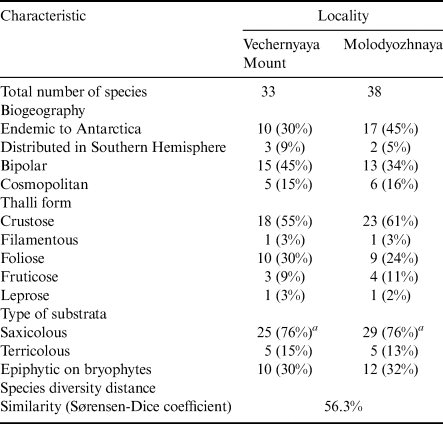
Collections in the Vechernyaya Mountain locality in the eastern part of the oasis initiated in 2009 now allow for a more complete description of the lichen diversity of Thala Hills. The lichen flora of this part of the oasis consists of 32 species, and one species of lichenicolous fungus was also recorded (Table I). Twenty of the 33 species are present in both the western and eastern parts of the oasis, and the remaining 13 species were newly recorded only from the eastern part. In the eastern part of the oasis, lichens were recorded at altitudes of 15–256 m a.s.l., and again no continuous cover was present. Most species (25; 75.8%) were saxicolous. Ten species were epiphytic on mosses and five were terricolous (some species can grow on more than one substratum). The most frequent growth forms were crustose (18 species) and foliose (10 species). These features are closely similar to those of the lichen community of the western part of the oasis (Andreev Reference Andreev2013).
The most abundant species were Buellia frigida, Physcia caesia, Xanthoria elegans, Umbilicaria aprina, Umbilicaria decussata and Usnea sphacelata. Moderately common species included Candelariella flava, Lecanora polytropa, Polyozosia expectans and Pseudephebe minusculа. Species only occurring rarely in the oasis included Acarospora gwynnii, Lecidea cancriformis, Pleopsidium chlorophanum, Pseudophebe pubescens, Rhizocarpon adarense, R. flavum, Xanthoria candelaria, amongst others. There was low similarity (as indicated by the Sørensen-Dice coefficient) between lichen species diversity in the vicinity of Vechernyaya Mountain and in the western part of Thala Hills (Table II).
Comparison of lichen assemblages between Vechernyaya Mount, eastern Thala Hills, obtained in recent surveys, and Molodyozhnaya, western Thala Hills (extracted from Andreev Reference Andreev2013).

a The sum is more than 100% because some species occurred on more than one substratum.
Mosses. The bryophyte flora included nine species of moss, with no other groups of embryophytes represented. According to brief summaries (Savicz-Lyubitskaya & Smirnova 1972, Kurbatova et al. Reference Kurbatova, Andreev and Dolgikh2014), in the western part of the oasis only Bryum pseudotriquetrum and Ceratodon purpureus are common, with other species (B. archangelicum, Hennediella heimii, Orthogrimmia sessitana, Schistidium antarctici and Coscinodon lawianus) being rare.
In the eastern part of the oasis, B. pseudotriquetrum and C. purpureus are again the most common species, often growing together. Relatively large carpets of B. pseudotriquetrum are present (up to 60 m2), especially in areas with ornithogenic influence from the local Adélie penguin colony. Two other newly recorded species had more limited occurrence as isolated clumps: B. argenteum and Funaria hygrometrica (Table I), the latter being limited to moist places.
Terrestrial and freshwater micro-invertebrates
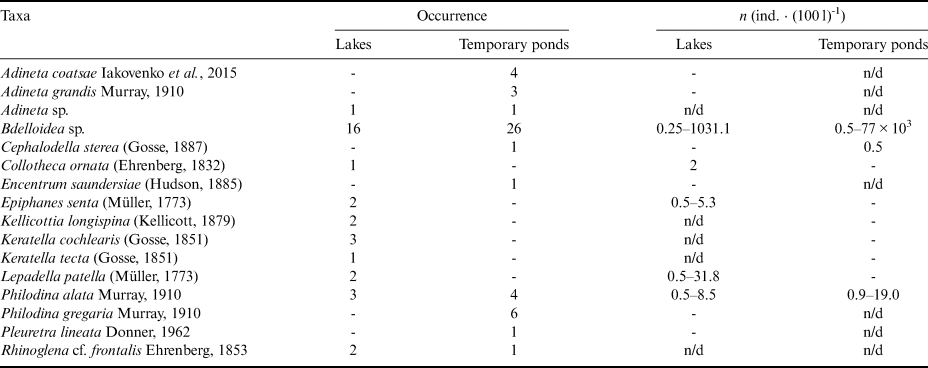
Four species of planktonic rotifer have previously been recorded in the western part of the Thala Hills oasis (Opaliński Reference Opaliński1972, Kutikova Reference Kutikova1991, Sharov et al. Reference Sharov, Berezina and Tolstikov2015). Sampling of 50 water bodies in the eastern part of the oasis in the current study revealed five bdelloid (Bdelloidea) and nine monogonont (Monogononta) species (Table I). Other than Lepadella patella and Keratella cochlearis, all freshwater rotifer species identified from the samples examined in this study are new records for the oasis. Most of the species were characterized by low occurrence frequency, with only bdelloids (mostly unidentified) present in most water bodies (Table III). Six further bdelloid species, new for the oasis, were extracted from terrestrial samples (moss associations, algal mats).
Rotifers obtained from freshwater lakes (n = 18) and temporary ponds (n = 27) in the Thala Hills oasis.

n/d = not determined.
Three tardigrade species were identified in the current study from moss and algal samples - Milnesium tardigradum, Acutuncus antarcticus and Echiniscus kerguelensis - confirming their presence in the oasis. Eleven other freshwater and terrestrial species have been reported in previous studies in the western (Utsugi & Ohyama Reference Utsugi and Ohyama1991) and eastern parts of the oasis (Dastych Reference Dastych1984) (Table I).
Terrestrial micro-arthropods
The described micro-arthropod diversity of the Thala Hills oasis is very low, and samples examined in the current study did not include specimens of the one springtail (Collembola) recorded, previously known as Friesea grisea (Wise Reference Wise1971). The taxonomy of Antarctic members of this genus has recently been extensively revised (Greenslade Reference Greenslade2018a, Carapelli et al. Reference Carapelli, Cucini, Fanciulli, Frati, Convey and Nardi2020a, Reference Carapelli, Greenslade, Nardi, Leo, Convey, Frati and Fanciulli2020b), and material from Thala Hills has been re-described as the new and oasis-endemic species F. eureka (Greenslade Reference Greenslade2018b). The prostigmatid mite Stereotydeus meyeri was sometimes commonly associated with moss vegetation and lichens (Strandtmann Reference Strandtmann1967).
Marine diversity
Marine invertebrates
Very limited published information is available documenting marine benthos diversity in the Thala Hills region, with few species recorded (Gruzov & Pushkin Reference Gruzov and Pushkin1973). Our recent observations of benthos close to the shoreline of Lazurnaya Bay in the eastern part of Thala Hills revealed eight echinoderm species (the starfish Cuenotaster involutus and Odontaster validus, the sea urchin Sterechinus neumayeri and five species of brittle stars), two mollusc species, three polychaete worms and a number of other species (anthozoans and sponges) (Table I). Most have previously been recorded in the Cosmonaut Sea, while the polychaetes appear to be the first formal records from the area.
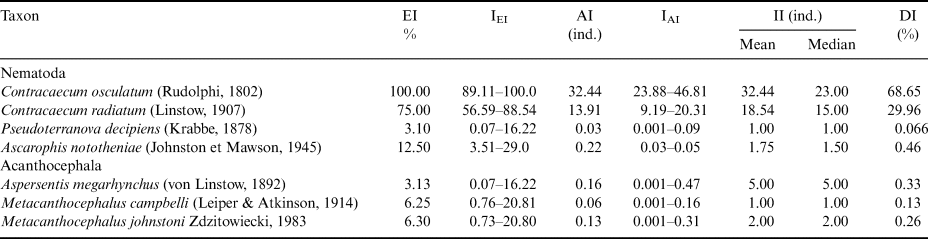
All three parasitic acanthocephalan species and three of the four parasitic nematodes have been recorded for the first time in the recent sampling studies. All species were found in fish individuals (Trematomus spp.), with the parasite contamination levels being extremely high (Table IV). The most frequently encountered in rank order were Contracaecum osculatum larvae followed by C. radiatum larvae, Ascarophis nototheniae adults, the three acanthocephalan species and Pseudoterranova decipiens larvae.
Parasites associated with Trematomus spp. sampled in the Cosmonaut Sea (n fish = 32; n parasites = 1512).

AI = abundance index (average number of parasite individuals per fish examined); DI = dominance index (relative abundance of each species); EI = proportion of contaminated fishes; IAI = confidence interval of AI; IEI = confidence interval of EI; II = intensity of invasion (number of parasite individuals per individual contaminated fish).
Fish, birds and mammals
Fish species previously recorded close to the Thala Hills coastline include Trematomus bernacchii, T. newnesi, T. nicolai, T. borchgrevinki and Gymnodraco acuticeps, with new records of T. hansoni and T. pennellii obtained in our recent surveys (Table I). Similarly, the only mammal (Leptonychotes weddellii) and most marine birds have previously been noted in the area, with the exception of Aptenodytes forsteri, for which we provide the first formal record. Pygoscelis adeliae, Stercorarius maccormicki and Oceanites oceanicus breed within the oasis.
Discussion
Thala Hills biodiversity
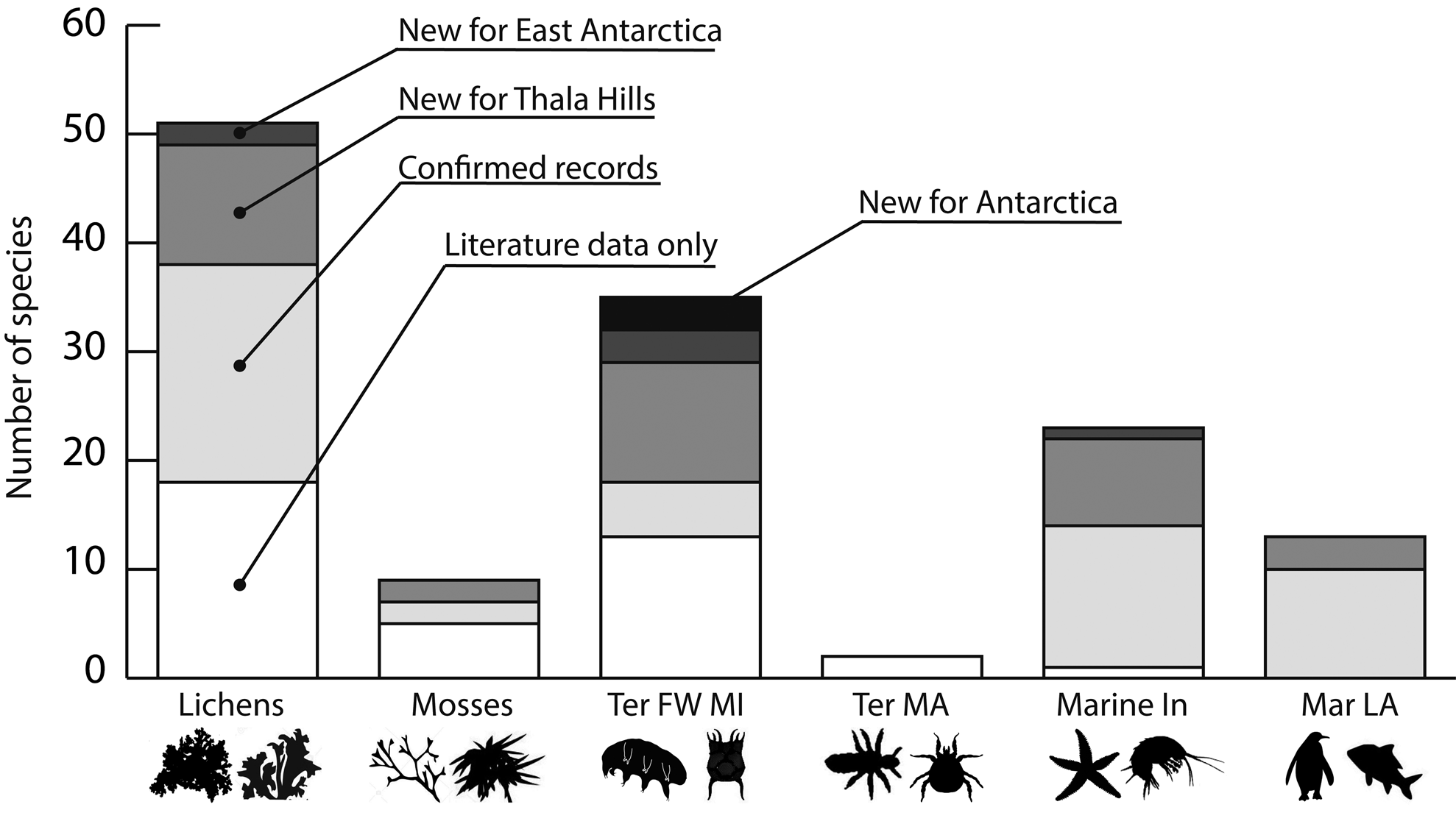
Lichens are well known for their high levels of environmental stress tolerance (Singh et al. Reference Singh, Olech, Cannone and Convey2015) and they form the main component of continental Antarctic vegetation (Castello & Nimis Reference Castello, Nimis, Battaglia, Valencia and Walton1997, Øvstedal & Smith Reference Øvstedal and Smith2001, Nayaka & Upreti Reference Nayaka and Upreti2005, Peat et al. Reference Peat, Clarke and Convey2007). The lichen diversity of Thala Hills is similar to that of Bunger Hills and Schirmacher Oasis, the Prince Charles Mountains and other continental Antarctic locations (Andreev Reference Andreev2013). Some of the species present (Acarospora gwynnii, Buellia frigida, Candelariella flava, Rinodina olivaceobrunnea, Pseudephebe minusculа) are widespread throughout the Antarctic continent (Øvstedal & Smith Reference Øvstedal and Smith2001). The data obtained in the current study have increased the known lichen species diversity of the Thala Hills oasis by almost 25%, from 38 to 51 species (Fig. 4). Most of the new species records are of species known from elsewhere in Continental Antarctica, although two have not previously been recorded in from this region (Filson Reference Filson1975, Smith Reference Smith1988, Kanda & Inoue Reference Kanda and Inoue1994, Castello & Nimis Reference Castello and Nimis1995, Pandey & Upreti Reference Pandey and Upreti2000, Nayaka & Upreti Reference Nayaka and Upreti2005, Singh et al. Reference Singh, Nayaka and Upreti2007, Reference Singh, Olech, Cannone and Convey2015, Rai et al. Reference Rai, Khare, Nayaka, Upreti and Gupta2011, Smykla et al. Reference Smykla, Krzewicka, Wilk, Emslie and Sliwa2011, Singh & Nayaka Reference Singh and Nayaka2017). The two new records are of Porpidia crustulata, a cosmopolitan species known from the sub-Antarctic and Maritime Antarctic (AADC n.d., Singh et al. Reference Singh, Olech, Cannone and Convey2015) and Leptogium puberulum, which was previously known only from the Maritime Antarctic (AADC n.d.). Eleven species known from elsewhere in the Antarctic Conservation Biogeographic Region of East Antarctica are recorded specifically from Thala Hills for the first time: Arthonia molendoi, Pleopsidium chlorophanum, Buellia soredians, Lecanora polytropa, Lecidea lapicida, Lecidella stigmatea, Pseudephebe pubescens, Rhizocarpon adarense, R. flavum, Umbilicaria africana and Polycauliona candelaria.
All species records (lichens, embryophytes, metazoans) available from the Thala Hills oasis (literature data plus current study). Marine In = marine invertebrates; Marine LA = marine large animals (fish, seals, birds); Ter FW MI = terrestrial and freshwater micro-invertebrates; Ter MA = terrestrial micro-arthropods.

The low similarity between lichen species diversity in the eastern and western parts of Thala Hills (Table II) is perhaps surprising as the ecological structure of these assemblages (in terms of growth form and growth substrate) as well as the wider biogeography of the component species are closely similar. However, at small scales, considerable patchiness is characteristic of many elements of Antarctic terrestrial diversity, even though at larger scale many factors that can strongly influence diversity are more predictable, such as overall climate, pedology and underlying geology and other environmental factors (Usher & Booth Reference Usher and Booth1984, Green et al. Reference Green, Sancho, Türk, Seppelt and Hohh2011, Convey et al. Reference Convey, Chown, Clarke, Barnes, Cummings and Ducklow2014, Reference Convey, Coulson, Worland and Sjöblom2018).
Of the nine moss species recorded, two are new for Thala Hills. The presence of a solitary clump of Bryum argenteum in our recent surveys (coll. O. Borodin) has already been reported (Kurbatova et al. Reference Kurbatova, Andreev and Dolgikh2014). This species is known from other locations in Continental Antarctica (Ochyra & Singh Reference Ochyra and Singh2008, Ochyra et al. Reference Ochyra, Smith and Bendarek-Ochyra2008b). However, the record of Funaria hygrometrica is striking, as the species is otherwise known in Antarctica only from sub-Antarctic South Georgia (Ochyra et al. Reference Ochyra, Smith and Bendarek-Ochyra2008b) and a single record (presumed introduced) from one site in Wilkes Land in Continental Antarctica (Ochyra et al. Reference Ochyra, Bernadek-Ochyra and Smith2008a). The species has previously been recorded from actively geothermally heated ground on Deception Island (South Shetland Islands) as a colonist soon after eruptions in 1967/1968 (Collins Reference Collins1969). However, it only persisted at that location as long as the geothermal activity continued, then rapidly died out (Smith Reference Smith1984, Reference Smith2005), which suggests that the species does not have appropriate physiological abilities to support its survival in a Continental Antarctic location such as Thala Hills. The material identified here (and also reported from Wilkes Land) as F. hygrometrica may, therefore, require further taxonomic assessment.
Rotifer diversity has previously received very little attention in Thala Hills. Of the freshwater species listed in Table III, only Lepadella patella and Keratella cochlearis have previously been recorded from the oasis specifically, although most of the other species are recorded from other regions of Continental Antarctica (Chatey et al. Reference Chatey, Parker, Simmons, Yongue and Brunt1981, Everitt Reference Everitt1981, Suren Reference Suren1990, Kutikova Reference Kutikova1991, Dartnall Reference Dartnall1995a, Reference Dartnall2000, Webster-Brown et al. Reference Webster-Brown, Gall, Gibson, Wood and Hawes2010, Hansson et al. Reference Hansson, Hylander, Dartnall, Lidström and Svensson2012). Exceptions include Rhinoglena frontalis, which is known from sub-Antarctic Heard Island, the Kerguelen archipelago and Macquarie Island (Dartnall Reference Dartnall1993, Reference Dartnall1995b, De Smet Reference De Smet2001, Dartnall et al. Reference Dartnall, Hollwedel and de Paggi2005), Pleuretra lineata known from the Maritime Antarctic (Iakovenko et al. Reference Iakovenko, Smykla, Convey, Kašparová, Kozeretska and Trokhymets2015) and Encentrum saundersiae and Keratella tecta, which are new Antarctic records. There are no previous records of rotifers from terrestrial habitats at Thala Hills. Four of the species identified here are known from other parts of Continental Antarctica: Adineta editae, A. vaga vaga, A. steineri and Philodina gregaria (Sohlenius et al. Reference Sohlenius, Boström and Hirschfelder1995, Sohlenius & Boström Reference Sohlenius and Boström2005, Webster-Brown et al. Reference Webster-Brown, Gall, Gibson, Wood and Hawes2010, Iakovenko et al. Reference Iakovenko, Smykla, Convey, Kašparová, Kozeretska and Trokhymets2015). Macrotrachela kallosoma is a new record from Continental Antarctica, although it has been recorded from the Falkland Islands in the South Atlantic (Kutikova Reference Kutikova1991). The subspecies A. vaga minor has not previously been recorded from Antarctica or the sub-Antarctic.
In the marine environment, all fish species identified excluding Trematomus hansonii and Trematomus pennellii have been recorded previously from the Thala Hills shoreline or the wider Cosmonaut Sea (Jakubowski Reference Jakubowski1970, Reference Jakubowski1975, Rakusa-Suszczewski Reference Rakusa-Suszczewski1972a, Jakubowski & Rembiszewski Reference Jakubowski and Rembiszewski1974, Dewitt et al. Reference Dewitt, Heemstra, Gon, Gon and Heemstra1990).
Acanthocephalans have not been studied in the region of the Cosmonaut Sea. While all three parasitic acanthocephalan species are new records for the oasis, they have been noted previously from Antarctic waters, and members of the genus Metacanthocephalus have been noted widely around Continental Antarctica (Rocka Reference Rocka2006).
All marine nematode species recorded here are widely distributed around Antarctica and also sub-Antarctic South Georgia (Rocka Reference Rocka2006). However, only Contracaecum radiatum has explicitly been recorded from the Cosmonaut Sea (WoRMS 2021b). All of our records of Echinodermata, Mollusca and several other taxa confirm previous reports from the Cosmonaut Sea, while Odontaster validus and Sterechinus neumayeri have explicitly been reported from the coastal zone near Thala Hills (Gruzov & Pushkin Reference Gruzov and Pushkin1973). New species records for the region are reported for Polychaeta. Overall, the macrobenthos communities present along the coast of Thala Hills show no distinct differences from the well-described communities of Prydz Bay (Commonwealth Sea, East Antarctica) (Saucede et al. Reference Saucede, Pierrat, David, Broyer, Koubbi, Griffiths, Raymond, Udekem d'Acoz, Van de Putte and A.P.2014, Sirenko et al. Reference Sirenko, Gagaev and Smirnov2017). Although no studies of the birds and mammals present around Thala Hills are available, all species present are well known from the wider region of East Antarctica (Del Hoyo et al. Reference Del Hoyo, Elliot and Sargatal1992, Ropert-Coudert et al. Reference Ropert-Coudert, Hindell, Phillips, Charrassin, Trudelle, Raymond, De Broyer, Koubbi, Griffiths, Raymond, Udekem d'Acoz and Van de Putte2014).
Biogeographical patterns
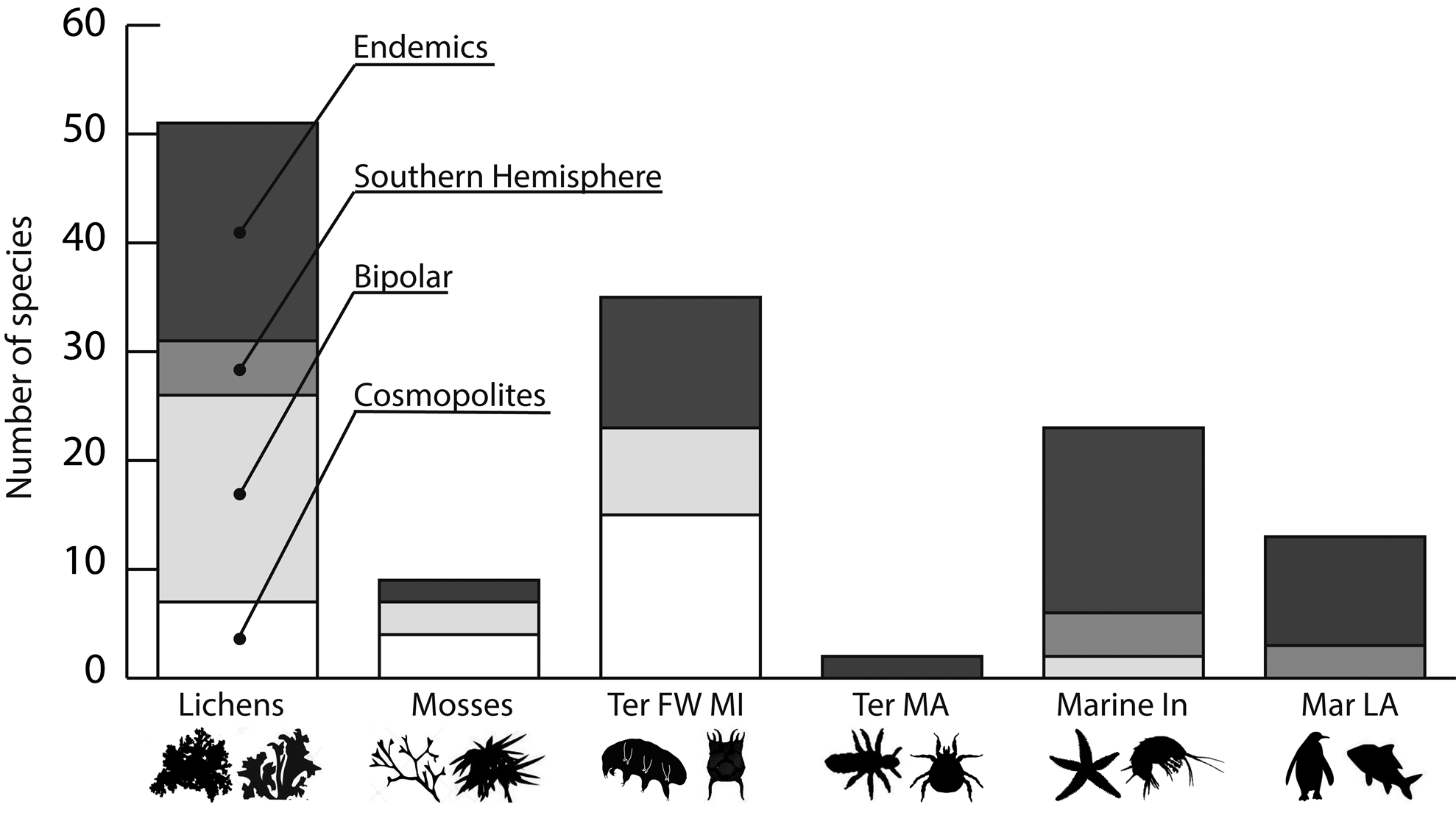
The Thala Hills terrestrial biota includes a high proportion of endemic species (Fig. 5), a feature that is being increasingly strongly recognized across Antarctica (Pugh & Convey Reference Pugh and Convey2008, Convey et al. Reference Convey, Biersma, Casanova-Katny, Maturana, Oliva and Ruiz-Fernández2020). Most of the lichens present in Thala Hills are widely represented in polar vegetation and are either Antarctic endemics or have bipolar distributions. However, several species are cosmopolitan (e.g. Amandinea punctata, Flavoplaca citrina, Physcia caesia, Lecanora polytropa, Lecidea lapicida, Porpidia crustulata, Rhizocarpon geographicum) (Singh et al. Reference Singh, Olech, Cannone and Convey2015), with a small number having Southern Hemisphere distributions, including Acarospora gwynnii, Umbilicaria africana, Usnea antarctica, Stereocaulon antarcticum (Singh et al. Reference Singh, Olech, Cannone and Convey2015), Rhizocarpon adarense (Øvstedal & Smith Reference Øvstedal and Smith2001, McCarthy & Elix Reference McCarthy and Elis2014). Moss diversity, while being lower overall, had a slightly greater proportion of Antarctic endemic and bipolar species, along with the cosmopolitan Ceratodon purpureus, Bryum argenteum and B. archangelicum (Ochyra et al. Reference Ochyra, Smith and Bendarek-Ochyra2008b).
Biogeographic analysis of all species (lichens, embryophytes, metazoans) known from the Thala Hills oasis. Marine In = marine invertebrates; Marine LA = marine large animals (fish, seals, birds); Ter FW MI = terrestrial and freshwater micro-invertebrates; Ter MA = terrestrial micro-arthropods.

The relatively high number of cosmopolitan species apparently characterizing the terrestrial and freshwater rotifer faunas of Thala Hills may be a reflection of the lack of modern taxonomic analyses, including the application of molecular approaches, applied to material from this region. Where such studies have been applied (e.g. Iakovenko et al. Reference Iakovenko, Smykla, Convey, Kašparová, Kozeretska and Trokhymets2015), the general conclusion is that Antarctic representatives are clearly distinct from other relatives globally, as is the case in other groups of terrestrial fauna (reviewed by Convey et al. Reference Convey, Biersma, Casanova-Katny, Maturana, Oliva and Ruiz-Fernández2020). There is a similar lack of up-to-date taxonomic reconsideration of tardigrades across much of Antarctica. Few tardigrades were directly recorded in the current study, with the majority of species records only being available in older literature. Of those records, five species are currently considered to be cosmopolitan and seven to be Antarctic endemics. The species Echiniscus kerguelensis and Hebesuncus conjungens currently have bipolar distributions. Endemic species recorded include Acutuncus antarcticus, considered to be one of the most widely distributed tardigrades in Antarctica (Tsujimoto et al. Reference Tsujimoto, McInnes, Convey and Imura2014). However, the latest research indicates that even this apparently well-known species most likely represents a species group with geographically distinct intra-Antarctic distributions, further highlighting the need for up-to-date taxonomic re-analyses (Short Reference Short2021). Diphascon langhovdense is also an Antarctic endemic, along with five other species originally described from this study area but not apparently subjected to subsequent study.
In the marine communities assessed here, most recorded species are typical of and only known from Antarctic and sub-Antarctic waters (Danis et al. Reference Danis, Griffths, Jangoux, Broyer, Koubbi, Griffiths, Raymond, Udekem d'Acoz, Van de Putte and A.P.2014, Saucede et al. Reference Saucede, Pierrat, David, Broyer, Koubbi, Griffiths, Raymond, Udekem d'Acoz, Van de Putte and A.P.2014, Sirenko et al. Reference Sirenko, Gagaev and Smirnov2017, Stöhr et al. Reference Stöhr, O'Hara and Thuy2020). However, the benthic Odontaster validus and Serpula narconensis have been reported from the southern Pacific and south-west Atlantic Oceans (Blom & Moriarty Reference Blom and Moriarty2021, Mah Reference Mah2021, Orrell Reference Orrell2021, Read & Fauchald Reference Read and Fauchald2021) and Perkinsiana magalhaensis from South America (Häussermann & Försterra Reference Häussermann and Försterra2009, Bigatti Reference Bigatti2015). All recorded fish species are widely distributed in the Southern Ocean (Andriyashev Reference Andriashev, Pawloswski and Andriashev1964, Dewitt et al. Reference Dewitt, Heemstra, Gon, Gon and Heemstra1990, Gon Reference Gon, Gon and Heemstra1990, Duhamel et al. Reference Duhamel, Hulley, Causse, Koubbi, Vacchi, Belchier, Broyer, Koubbi, Griffiths, Raymond, Udekem d'Acoz, Van de Putte and A.P.2014). The fish parasites, acanthocephalans and nematode worms show both restricted and globally widespread distributions (Rocka Reference Rocka2006, Bezerra et al. Reference Bezerra, Eisendle, Hodda, Holovachov and Leduc2021a, Reference Bezerra, Eisendle, Hodda, Holovachov and Leduc2021b, WoRMS 2021a, 2021b).
Acknowledgements
We are grateful to Igor S. Smirnov, Boris I. Sirenko, Sergey Yu. Gagaev and Alexey V. Neelov from the Zoological Institute, Russian Academy of Sciences, for their help in identifying marine benthos and fish. We thank all members of the Belarus Antarctic Expeditions for their assistance in sampling and return of material to Belarus, as well as the officers and crew of the Russian scientific vessels for logistic support in the transfer of samples. We acknowledge Alex Borisenko and Maria Kuzmina from Center of Biodiversity Genomics (Guelph, Canada) for their promotion in creating the reference library in Barcode of Life Data System. In addition, we thank two anonymous reviews for their helpful comments.
Author contributions
DL combined all literature data as well as field data, including those collected by himself (2018–19), and prepared the text, figures and supplemental materials. PC made significant contributions in preparing the text and interpreting the data. OB, VM and YH have been the main implementers of the surveys on site throughout the BAEs (2008–2018). AG, the chief of the expedition, facilitated the logistic and transport support for sampling during all seasons. Several authors identified species in specific taxonomic groups: VV and NM - rotifers (with DL in case of bdelloids); AY - lichens; and TS - fish parasites.
Financial support
This study was conducted in the framework of the Belarus National Antarctic Program's projects ‘Monitoring of the Polar Regions of the Earth and Ensuring the Activities of Arctic and Antarctic Expeditions’ (2007–2015) and ‘Monitoring of Polar Regions of the Earth, Creation of the Belarusian Antarctic Station and Support of the activities of Polar Expeditions’ (2016–2020). This paper also contributes to the SCAR ‘State of the Antarctic Ecosystem’ programme. Peter Convey is supported by NERC core funding to the British Antarctic Survey's ‘Biodiversity, Evolution and Adaptation’ Team.
Supplemental material
Five supplemental tables will be found at https://doi.org/10.1017/S0954102021000328.