

Position changes, ambiguity, and updating
How do voters incorporate policy position changes into their perceptions of what candidates actually believe? We blend insights from growing literatures on the cognitive implications of partisanship (Achen and Bartels Reference Achen and Bartels2016; Arceneaux and Vander Wielen Reference Arceneaux and Vander Wielen2017; Heit and Nicholson Reference Heit and Nicholson2016; Sniderman and Stiglitz Reference Sniderman and Stiglitz2012; Theodoridis Reference Theodoridis2017b) and motivated reasoning (Bartels Reference Bartels2002; Bolsen, Druckman and Cook Reference Bolsen, Druckman and Cook2014; Campbell et al. Reference Campbell, Converse, Miller and Stokes1960; Druckman Reference Druckman2012; Druckman and Bolsen Reference Druckman and Bolsen2011; Jerit and Barabas Reference Jerit and Barabas2012; Leeper and Slothuus Reference Leeper and Slothuus2014; Lerman and Acland Reference Lerman and Acland2018; Mullinix Reference Mullinix2016; Taber and Lodge Reference Taber and Lodge2006) with the seminal work of Tomz and Van Houweling (Reference Tomz and Van Houweling2009, Reference Tomz and Van Houweling2012) on voter processing of candidate position changes and ambiguity. Focusing on candidate position changes as a source of ambiguity (Glazer Reference Glazer1990; Hersh and Schaffner Reference Hersh and Schaffner2013; Page Reference Page1976; Rogowski and Tucker Reference Rogowski and Tucker2018; Shepsle Reference Shepsle1972), we present new survey experimental data that sheds light on the ways in which voters update their beliefs when faced with new information regarding candidate positions. This study is informed by these findings and the increasingly vast literature characterizing party identity in the United States as a deep attachment with substantial implications for political cognition (Arceneaux and Vander Wielen Reference Arceneaux and Vander Wielen2017; Goggin and Theodoridis Reference Goggin and Theodoridis2017; Greene Reference Greene1999; Henderson and Theodoridis Reference Henderson and Theodoridis2017; Huddy, Mason and Aarøe Reference Huddy, Mason and Aarøe2015; Iyengar, Sood and Lelkes Reference Iyengar, Sood and Lelkes2012; Iyengar and Westwood Reference Iyengar and Westwood2015; Klar Reference Klar2014; Mason Reference Mason2018; Nicholson Reference Nicholson2012; Theodoridis Reference Theodoridis2017b, Reference Theodoridis2013).
Using a novel experimental design, we find that the consequences of candidate position changes are the product of a complex partisan motivated reasoning process. The experiment, fielded as part of the University of California, Merced and University of Massachusetts, Boston modules of the 2016 Cooperative Congressional Election Study, presents respondents in a broadly representative national sample with hypothetical candidates for Governor. Each candidate has taken two different positions on the appropriate level of the minimum wage in their state, a highly salient and readily quantifiable policy domain. After being exposed to this information, respondents are asked what they think is the candidate’s “true” preference.
We show that respondents do not simply take current or past candidate positions at face value, engaging instead in a type of motivated reasoning that we term Preference-Mediated Partisan Motivation. Respondent reactions to the position endorsed by the candidate are determined by an interaction between their partisan allegiance and their own preference on that issue. Partisans process messages from a candidate of their own party as follows: they are far more receptive when the candidate moves closer to their own preferred position than when the candidate shifts away from them. The opposite pattern emerges if the candidate belongs to the other party: they tend to be more receptive if the candidate moves away from them. This reflects a sophisticated form of motivated reasoning in which voters process candidate rhetoric in a way that serves to preserve consistency between their issue preference and party attachment.
Broadly speaking, we are informed by the conceptual structure set forth by Heider (Reference Heider1946) in his foundational treatment of cognitive dissonance. We also draw insights from seminal work by Taber and Lodge (Reference Taber and Lodge2006) on motivated responses by voters facing confirming or disconfirming information regarding their own prior beliefs. These works, do not, however, provide clear-cut, single predictions regarding voter responses to the ambiguity generated by changes in stated positions by candidates. More specifically, we expand upon previous work on voter reactions to candidate position changes (Doherty, Dowling and Miller Reference Doherty, Dowling and Miller2016; Mullinix Reference Mullinix2016; Tomz and Van Houweling Reference Tomz and Van Houweling2012), confirming that each of these studies illuminates a relevant factor in the processing of new information about candidate positions. At the same time, we show how the accounts that these studies propose do not paint a complete picture. Tomz and Van Houweling (Reference Tomz and Van Houweling2012), for instance, reported that, when a candidate shifts policy stances, respondents do not fully adjust their perceptions. This study suggests that behind this overall voter skepticism lies an important degree of heterogeneity explained by the voter’s partisanship and their own preference on that issue. Similarly, while Doherty, Dowling and Miller (Reference Doherty, Dowling and Miller2016) showed that voters look more kindly upon a candidate who moves closer to the voter’s own preferred policy position, our finding suggests that this pattern applies only to the candidate’s co-partisans. For out-partisans, in contrast, the reverse applies: these voters find the candidate to be more credible if she moves farther from their position. Finally, Mullinix (Reference Mullinix2016) considers how a voter’s issue positions can be a source of motivated reasoning. Our paper complements this perspective by showing that a voter’s issue preference induces a diametrically different pattern of motivated reasoning depending on whether the candidate belongs to the voter’s preferred party or not.
The evidence we report has important implications for party competition, adding another mechanism with the potential to distort ideological representation (Bawn et al. Reference Bawn, Cohen, Karol, Masket, Noel and Zaller2012; Halberstam and Montagnes Reference Halberstam and Montagnes2015; Montagnes and Rogowski Reference Montagnes and Rogowski2015) or enable gradual party position shifts (Karol Reference Karol2009). Preference-mediated partisan motivation implies that candidates have room to maneuver and endorse issue positions at odds with their core supporters, who will discount that stance, not believing that their candidate has moved away from them. The other side of the coin is, however, that moving away from core supporters is not very effective in attracting out-party voters, because these out-party voters are somewhat dubious when the candidate of the other party moves toward their position. Both patterns, taken together, offer insights into the dilemma that candidates face when deciding which policy position to take in primary and general election contests. On the one hand, changing positions between the primary and the general election may not be as costly as previously thought (Tomz and Van Houweling Reference Tomz and Van Houweling2014), because core supporters will discount the candidate’s movement toward moderate voters. At the same time, supporters of the opposite party may not be swayed by this move, since they tend to disregard movements toward their position.
Our findings also highlight the potential of candidate ambiguity as a tool to cultivate a diverse voting coalition. Recent scholarship has shown that adopting a diverse set of policy positions can broaden a political party’s electoral appeal (Somer-Topcu Reference Somer-Topcu2015).Footnote 1 Our study identifies a mechanism that explains this phenomenon: a candidate that endorses different policies on the same issue may maintain the support of a heterogeneous constituency because each group in the voting coalition focuses on the candidate’s rhetoric that agrees with its views and discounts the rhetoric that does not. This mechanism for how ambiguity can be electorally profitable complements previous work on the ways in which vagueness or imprecision in policy messages, rather than a multiplicity of heterogeneous messages, can be an electoral asset (Shepsle Reference Shepsle1972; Tomz and Van Houweling Reference Tomz and Van Houweling2009).
More broadly, preference-mediated partisan motivation sits at the intersection of varied takes on the place of party identity vis-à-vis democratic competence. On the one hand, this phenomenon implies a Sniderman and Stiglitz (Reference Sniderman and Stiglitz2012) brand of party identity, one that straddles a spatial, rationalist depiction and a more affective, behaviorist model. After all, our findings suggest that large numbers of voters do possess meaningful issue positions, for which their motivated cognition accounts. On the other hand, this is a mechanism very much in keeping with characterizations of party identity as more of a blinding force (Achen and Bartels Reference Achen and Bartels2016; Lenz Reference Lenz2013), as voters tend to incorporate new information in ways that increase consistency between their party identity and specific issue positions.
Theoretical scenarios
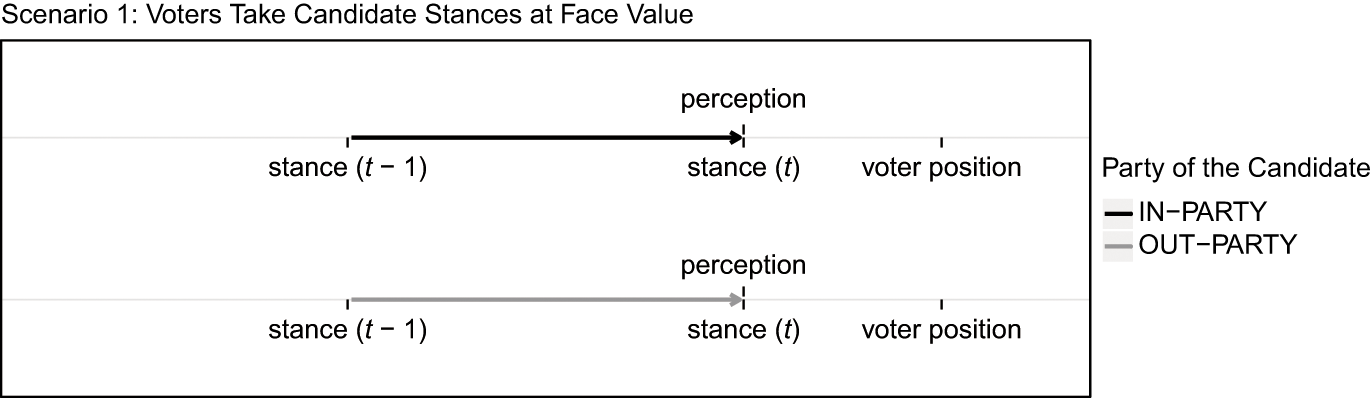
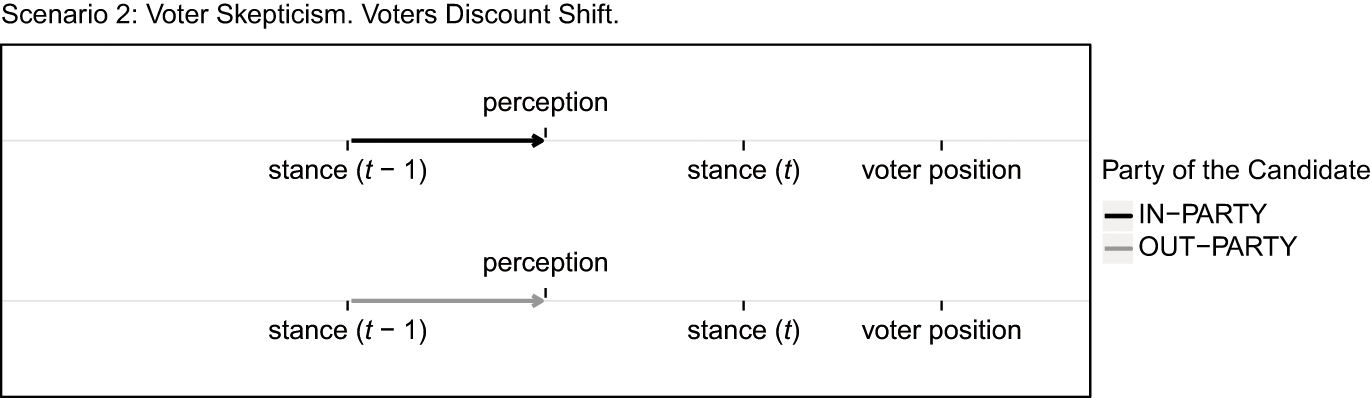
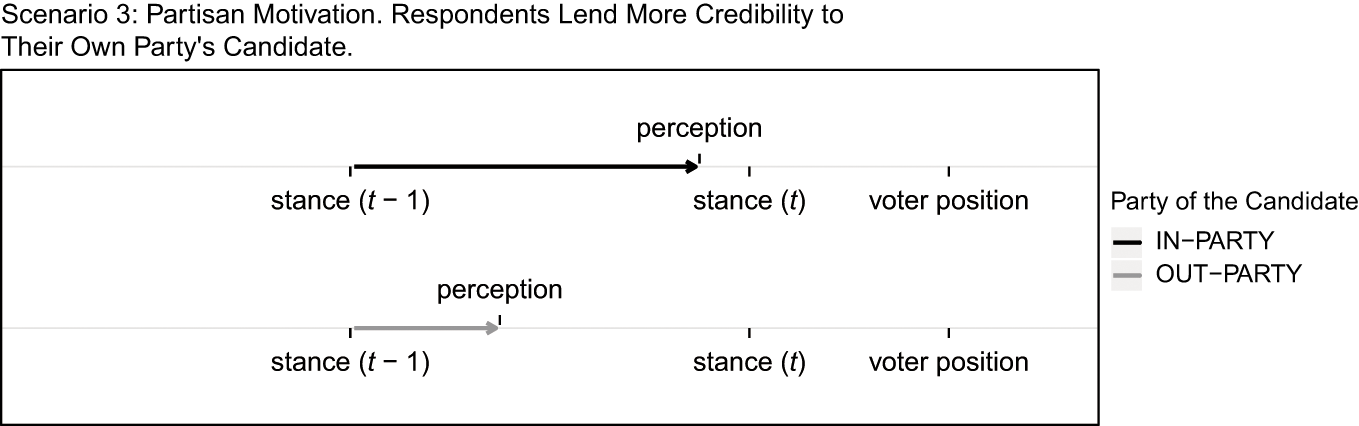
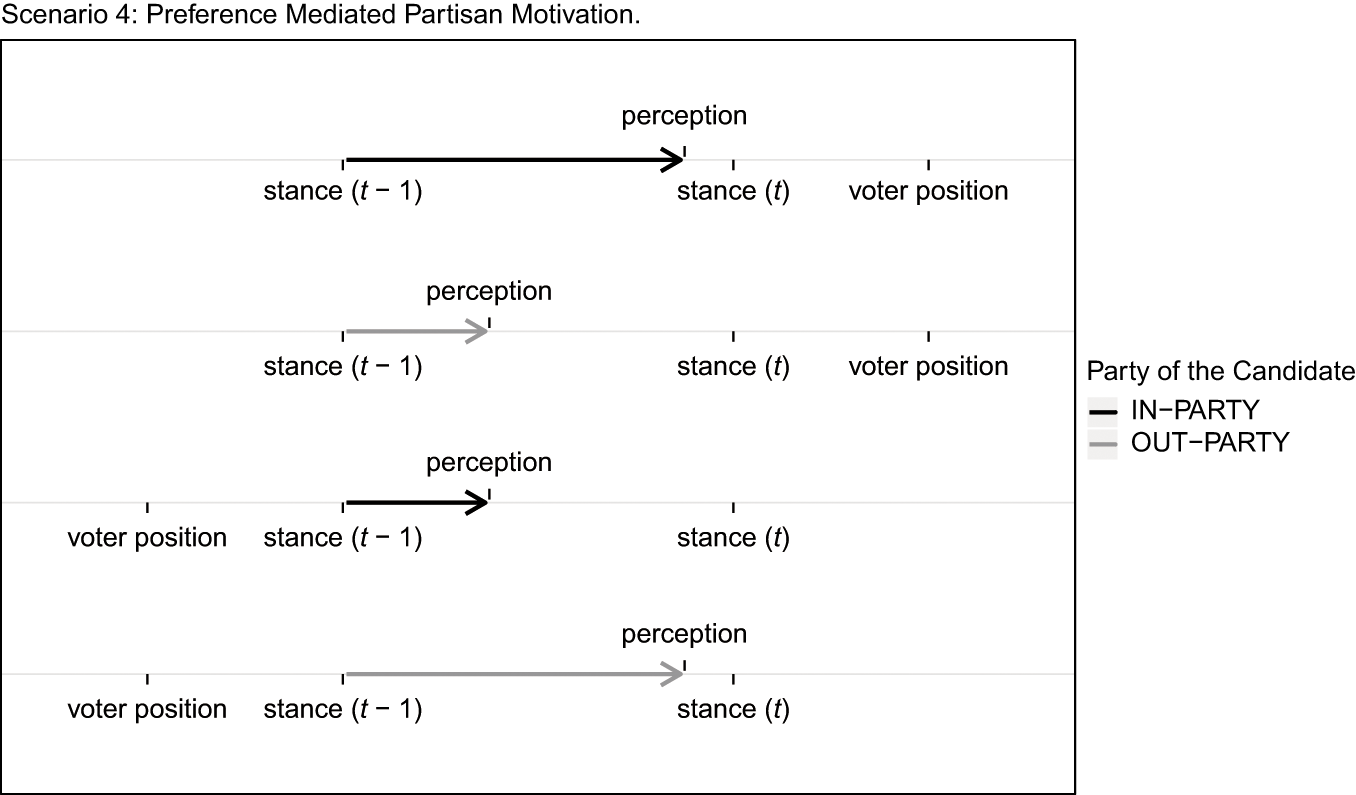
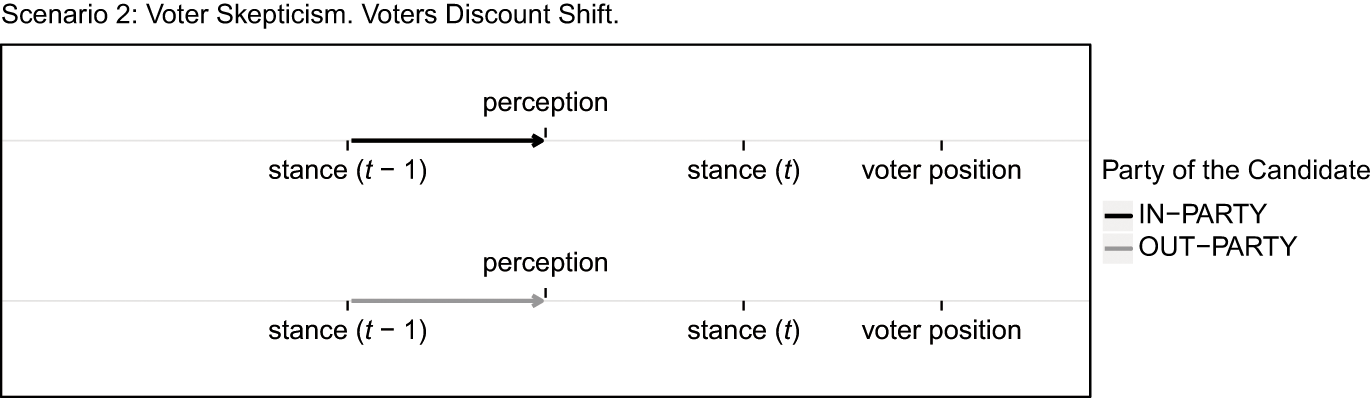
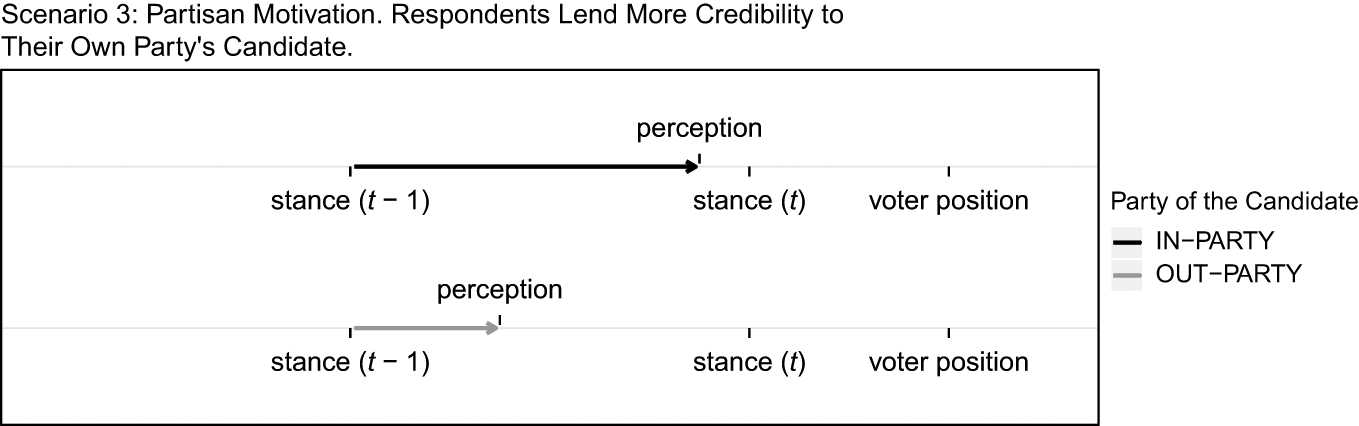
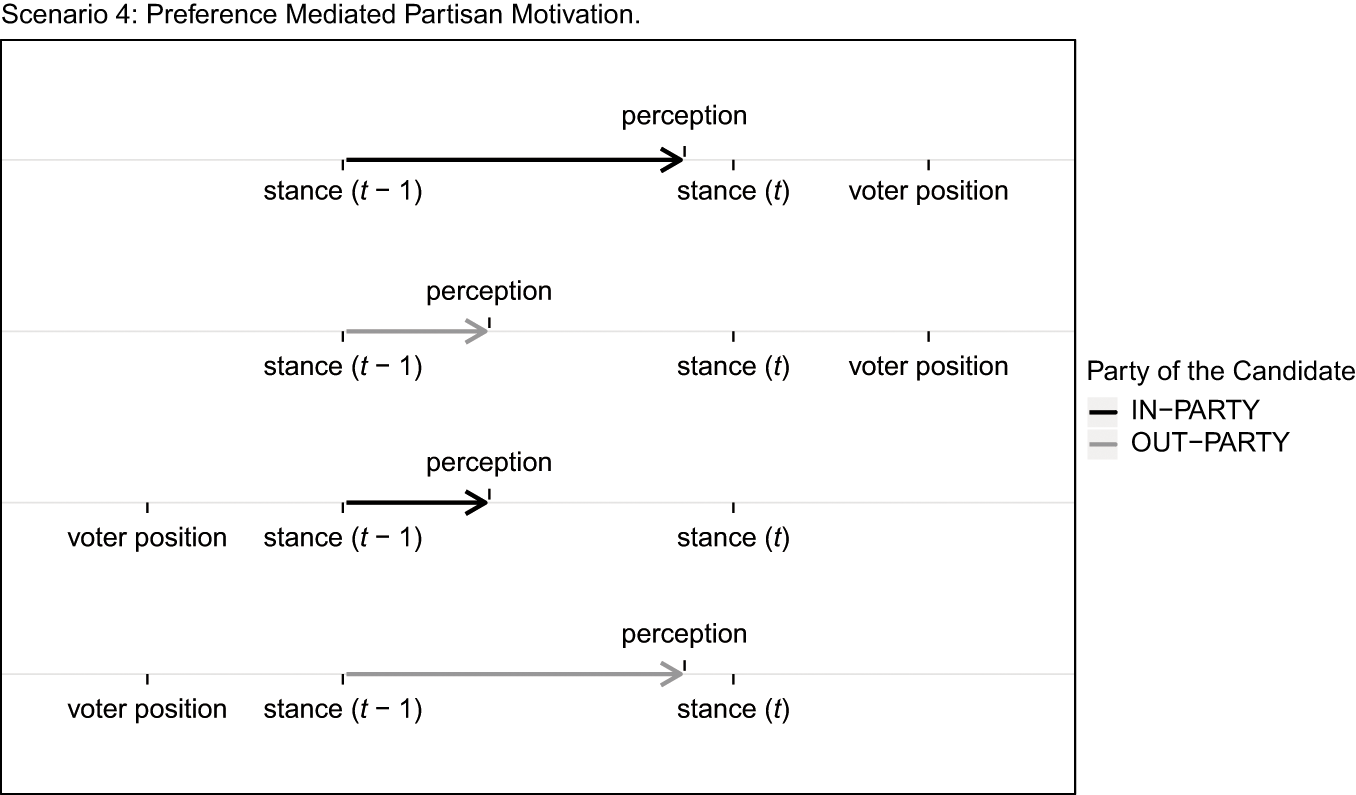
When a candidate changes his/her stated position on an issue, there are different ways in which voters might process this shift. We distinguish four easy-to-imagine scenarios: (1) Full Credibility, (2) Skepticism, (3) Naive Partisan Motivation, and (4) Preference-Mediated Partisan Motivation. In the first hypothetical scenario (full credibility), the voter takes each candidate at face value, no matter whether the candidate belongs to their own party or not. Hence, the voter’s guess about where the candidate stands coincides with the candidate’s most recent stated position. This is the setup described in introductory formal models of spatial competition (Enelow and Hinich Reference Enelow and Hinich1984). In the skepticism scenario, voters discount the candidate’s new position. In other words, they do not fully believe that the new stated position reflects a true change in the candidate’s preference. As a result, they place the candidate somewhere in between the past and the current stance. The discounting applies equally to the in-party and the out-party. The skepticism scenario corresponds to the empirical pattern reported by Tomz and Van Houweling (Reference Tomz and Van Houweling2012). The third scenario, naive partisan motivation, describes the context in which voters lend more credibility to the candidate of their own party. In this type of motivated reasoning, the voter considers that his/her party candidate is more truthful when announcing a change in issue position than the other party candidate. Consequently, the voter’s guess about where a candidate stands is closer to the most recent stated position if the candidate is affiliated with the voter’s preferred party. To account for both the policy preferences and party identity of the voter, we propose a fourth scenario, preference-mediated partisan motivation. This suggests a more complex brand of motivated reasoning. In this scenario, the voter is motivated to accept candidate shifts that reinforce the consistency between his/her issue preference and partisan affiliation. For that reason, the voter is very receptive when a candidate of their own party moves toward their own preferred position but discounts candidate movements away from it. The pattern reverses itself regarding the out-party candidate: the voter is more receptive when the out-partisan moves away from the voter’s position.
Figures 1–4 illustrate each of these hypothetical scenarios. In each of them, a candidate who once endorsed a certain issue position, stance (t - 1), now espouses a different position, stance (t). Both stances are the same across all scenarios. The voter’s preferred policy is denoted as voter position. Perception indicates the voter’s guess about where the candidate stands. Lines with arrows denote the difference between the initial candidate stance and the voter’s perception of the candidate’s position. The greater this difference, the closer the voter’s guess to the candidate’s current stance. The black line refers to the party with which the voter is affiliated (in-party). The grey line, in turn, refers to the candidate of the other party (out-party).
Scenario 1: Full Credibility.

Scenario 2:Skepticism.
Scenario 3: Naive Partisan Motivation.
Scenario 4: Preference-Mediated Partisan Motivation.
It is worth noting that all these scenarios can be explained in terms of Heider’s (Reference Heider1946) Balance Theory. For example, preference-mediated partisan motivation represents one, but by no means the only, possible response of voters faced with the cognitive dissonance generated by the party and new position of the candidate in question. Alternatively, voters might update or discount the centrality of their own position on the issue, minimize or change their own partisanship, or question the authenticity of the candidate’s partisanship. These reactions might empirically look like full credibility. Respondents might also not wish to think their party’s candidate is being disingenuous, which could resemble naive partisan motivation.
Experimental design
To examine how voters react when a candidate shifts his/her stated position on an issue, we employ a novel survey experimental paradigm. This study was fielded by YouGov as part of the University of California, Merced, and University of Massachusetts, Boston, modules of the 2016 Cooperative Congressional Election Study (Ansolabehere Reference Ansolabehere2017; Theodoridis Reference Theodoridis2017a). Respondents (N = 3052) in a broadly representative national online sample were asked to evaluate the credibility of randomly generated candidate position changes along a range of policies regarding the federal minimum wage.Footnote 2 We selected this issue domain because it is readily quantifiable and was highly salient during the 2016 campaign. We began by measuring the respondent’s own preference on this issue (figure available in the online Appendix). We then solicited the respondent’s beliefs regarding the preferences of the average American, the average Democrat, and the average Republican (figure available in the online Appendix). The issue scale reflects the range of alternative policies in discussion during the 2016 election season, from the status quo federal minimum wage level of $7.25 per hour to the $15 per hour demanded by the ‘flight for $15’ social movement.Footnote 3
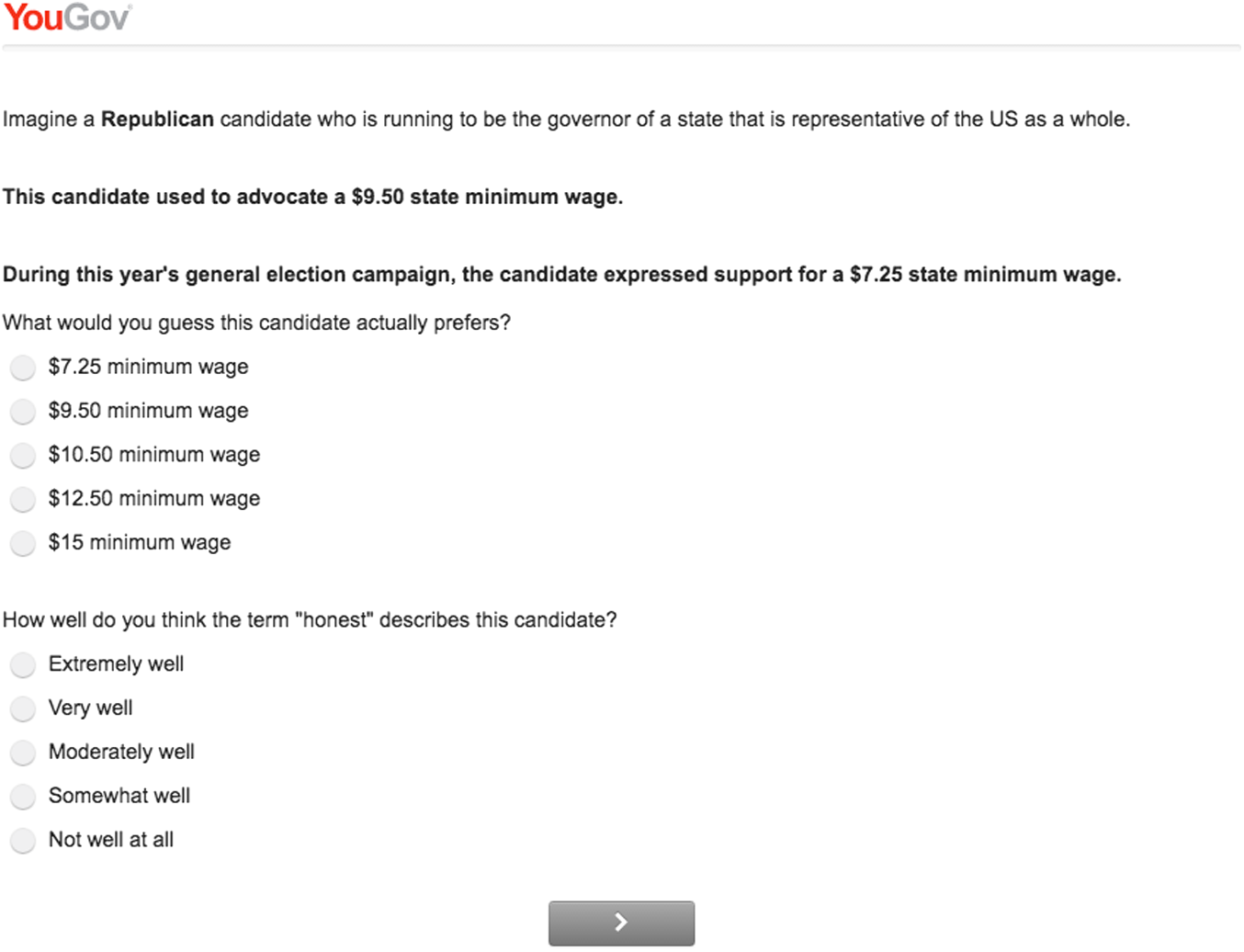
Respondents were presented with both a Republican candidate and a Democratic one, with the order randomly assigned (Figure 5). Each candidate, the respondent was told, adopted a position on the minimum wage in the past and another one in the present. The initial stated position was randomly selected and the revised position was selected from the same set of positions without replacement (to ensure a change in position). Respondents were then asked to guess which minimum wage position the candidate actually prefers.
Sample Experimental Stimulus.

This design extends a survey experiment fielded by Tomz and Van Houweling (Reference Tomz and Van Houweling2012). Both their study and ours analyze voter expectations about a candidate who has changed positions on an issue and evaluate the consequences of such flip-flopping for evaluations of the candidate’s traits. The primary difference is that, in our study, candidate profiles include party labels. Herein lies a central contribution of our paper, by providing respondents with information about the candidate’s party affiliation, we can analyze whether the respondent’s partisanship induces motivated reasoning.
Results: adjudicating between the scenarios
In order to capture how a position shift affects respondents’ perceptions of where the candidate stands, we compute the difference between the respondent’s guess and the candidate’s initial issue stance, measured in absolute distance. This outcome reflects how the candidate’s shift pulls respondents’ opinions away from the initial candidate position. It is operationalized as follows: for a candidate who initially advocated a $7.25 minimum wage, the difference equals one if the respondent places the candidate in the immediately following option on the issue scale $9.50, the difference equals two if she places the candidate two options away ($10.50), and so forth. Since we calculate the difference in absolute value, the same logic applies if, for instance, the candidate’s initial stance is a $15 minimum wage: the outcome takes the value of one if the second candidate position is $12.50.Footnote 4 Note that, while the manuscript focuses on this outcome of interest, the same substantive conclusion emerges with an alternative outcome measure, namely the distance between the respondent’s perception and the second candidate position.Footnote 5
We can use the following benchmark to gauge the magnitude of the candidate shift’s impact on voter perceptions. From the design of the experiment, the average distance between the first and the second candidate positions is found as two issue positions.Footnote 6 Hence, if respondents take the candidate shift at face value, the distance between perceptions and the initial candidate stance – our outcome of interest – should also be two on average. Any value below two will thus indicate that voters do not take candidate stances at face value.
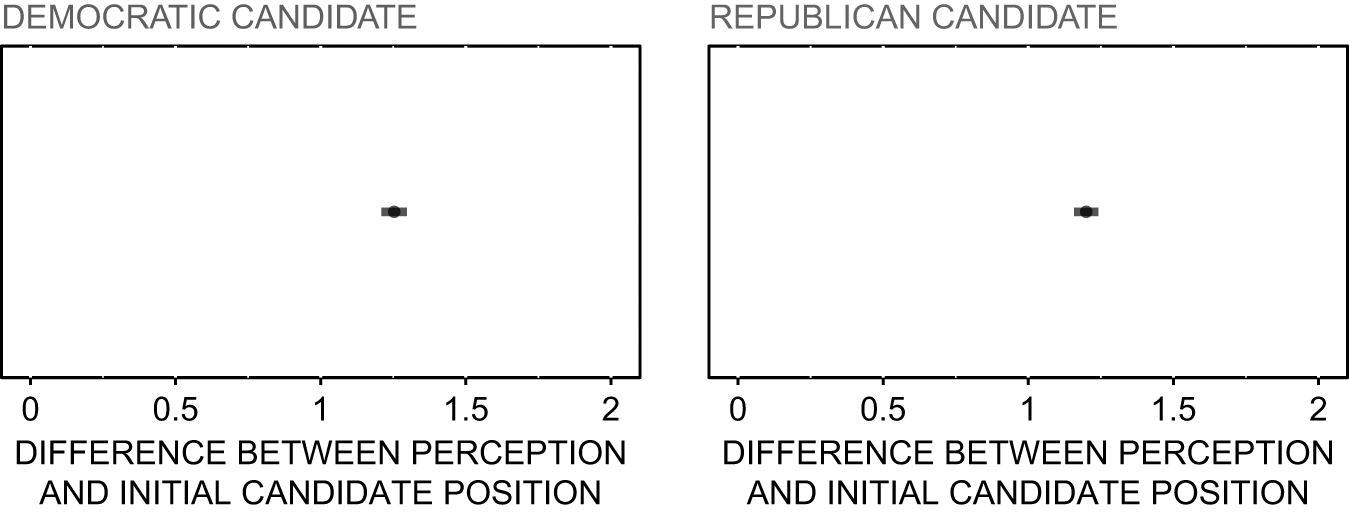
Figure 6 presents the average difference for the Republican and Democratic candidates. The effect is very similar for both candidates, 1.20 for the Republican and 1.25 for the Democratic one and the divergence between them is not statistically significant. Since these differences are less than 2, we can infer that respondents do not fully adjust their opinion in line with the candidate’s change in position. In other words, they are skeptical and do not take the candidate’s policy shift at face value. Hence, this evidence suggests that voters do not behave according to the full credibility scenario (Figure 1). The pattern is actually more consistent with the skepticism hypothesis (Figure 1).
Absolute difference between the initial candidate position and respondents’ perception of where the candidate stands. Averages and 95% confidence intervals.

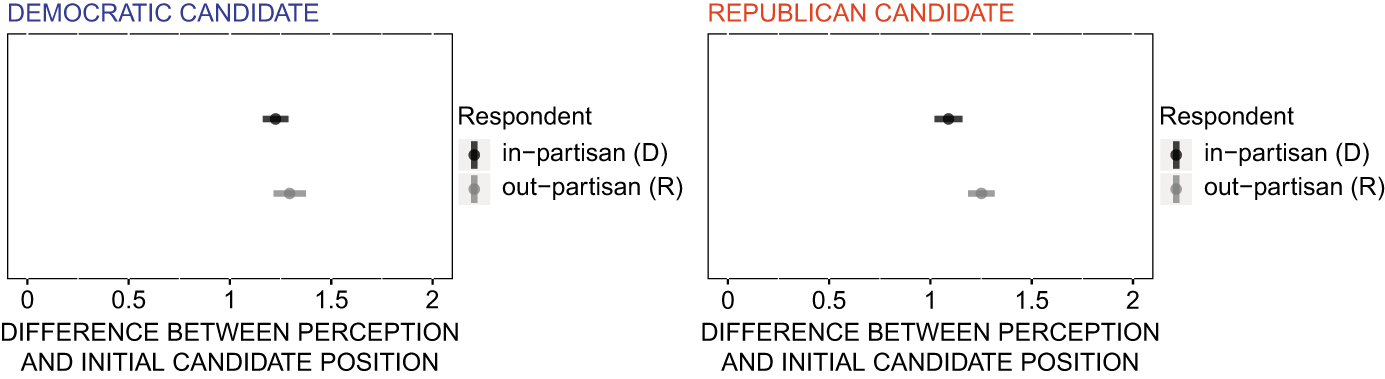
The similar pattern of skepticism toward both candidates could still obscure some significant heterogeneity depending on the respondent’s partisanship. In this regard, Figure 7 evaluates the empirical support for the partisan motivation scenario.Footnote 7 This figure does so by comparing the average difference between the candidate’s initial stance and the voter’s perception across partisan groups. The evidence in the plot suggests that partisan voters are not more responsive to the policy shifts adopted by the candidate of their own party. As can be seen, the difference is not higher among respondents that identify with the party of the candidate. Specifically, the size of the effect for the Democratic candidate is statistically indistinguishable between Democratic and Republican respondents. For the Republican candidate, the effect is higher among respondents that identify as Democrats. This implies that respondents do not engage in a type of motivated reasoning that only considers the partisanship of the candidate (the naive party motivation scenario).
Absolute difference between the initial candidate position and respondents’ perception of where the candidate stands. Averages and 95% confidence intervals. By partisan group.

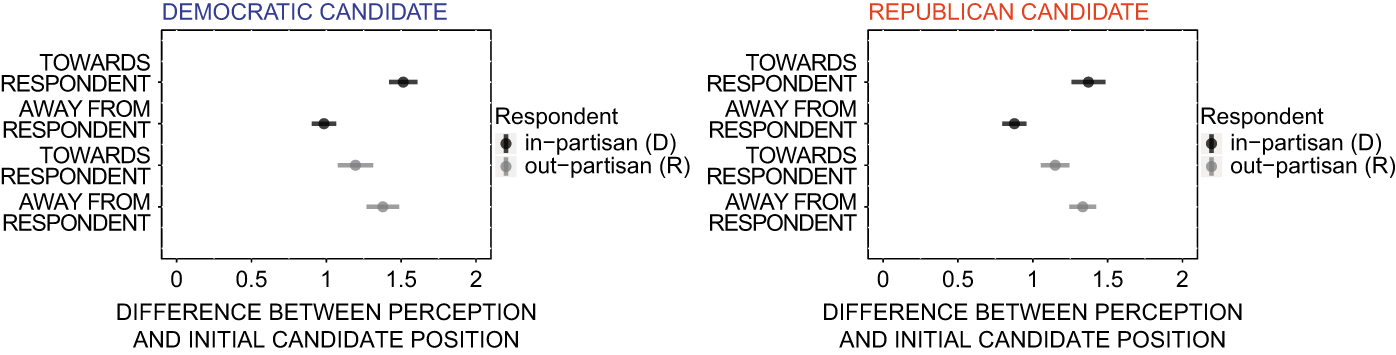
We now test whether respondents’ reactions are motivated by both their partisanship and their own individual preference on the issue (preference-mediated partisan motivation scenario). Figure 8 reports the influence of the candidate’s change in position across partisan groups and depending on the direction of the candidate position shift, i.e. whether the candidate moves closer to the respondent’s preferred policy or not.
Absolute difference between the initial candidate position and respondents’ perception of where the candidate stands. Averages and 95% confidence intervals. By partisan group and by the DIRECTION of the candidate position shift.

The evidence shows that partisan voters bring their own issue preference to bear when reacting to their own candidate’s rhetoric: the effect of the policy shift is substantially larger when the current candidate stance is closer to the respondent’s preference. In other words, partisan voters are receptive if their candidate moves closer to them but substantially discount the shift if the candidate moves away. The partisan voter’s preferred policy also shapes the processing of policy shifts from the candidate of the other party, but in the reverse fashion. In this case, the respondent gives more weight to the out-party candidate’s shift if she moves away from the respondent’s position. For the Democratic candidate, the effect of the shift among Republican respondents is larger if the candidate moves away from their position. Similarly, for the Republican candidate, the shift has a larger impact among Democratic voters when the candidate shifts farther from their issue position. Taken together, the empirical pattern reported in Figure 8 fits very well with the theoretical scenario illustrated in Figure 4, which describes our preference-mediated partisan motivation hypothesis.Footnote 8
One natural worry is that the empirical pattern observed in Figure 8 could be produced by respondents using the party’s stereotypical position on the issue to guess where the candidate is located. Indeed, the two scenarios in which we observe the highest impact of candidate stances, i.e., moving closer to the position of in-partisans and moving farther from the position of out-partisans, correlate positively with moving toward the party stereotype. Even under this mechanism, the pattern we observe would have similar and important implications for both partisan cognition and electoral politics.
However, to more deeply understand the phenomenon, we call upon a feature of our design to conduct three robustness checks that disentangle preference-mediated partisan motivation from the role of party stereotypes. Our survey questionnaire included items measuring each individual’s perception of the party stereotypes. In all three tests, which are detailed in the online Appendix, we confirm that preference-mediated partisan motivation arises empirically even when we take into account the role of stereotypes. In the first test, we split the sample according to whether the candidate has moved closer to the party’s stereotype or not, and we replicate the analysis reported in Figure 8 for each subsample, hence controlling for the role of party stereotypes (see online Appendix). The second robustness test calculates how much the candidate’s perceived position deviates from the party’s stereotype and estimates the impact of the experimental treatment on this difference. Hence, this robustness check effectively gauges how the treatment affects the part of the individual’s guess that is unexplained by the party’s stereotype (see online Appendix). The last robustness test estimates a regression model that controls for the respondent’s perception of what the partisan stereotype is (see online Appendix).
This regression model also helps rule out the possibility that the empirical pattern is driven by false-consensus bias. Indeed, one might worry that the evidence of preference-mediated partisan motivation is also consistent with voters simply assuming that co-partisans agree with them. The fear would be that false-consensus bias is what explains partisan respondents being more receptive when their candidate moves toward their own-policy position (Krueger and Clement Reference Krueger and Clement1994; Ross, Greene and House Reference Ross, Greene and House1977). While this sort of process would also not alter the practical implications of our result, it is important to understand the mechanism at play. Using a multiple regression model, we are able to control for the respondent’s priors about where Republicans and Democrats tend to stand on the issue of the minimum wage, whether the position shift is away from or toward the respondent, and we are able to incorporate interaction terms to isolate joint effects. These robustness checks are all consistent with the empirical analysis presented here.
Discussion
Our findings represent a significant advancement in our understanding of motivated reasoning and the updating processes pursued by voters when faced with conflicting or ambiguous information. As such, there are important theoretical and practical implications. For starters, contrary to what Lenz (Reference Lenz2013) argued, we find that respondents’ issue preferences appear to be genuinely held, and a source of motivated reasoning on their own. This suggests scholars should take these preferences seriously and consider potential interactions when evaluating motivated reasoning.
For candidates, our findings suggest that moving away from the position of your partisan supporters may not be very costly electorally, because these core supporters will discount the shift as not very meaningful. At the same time, moving closer to capture a new voter constituency may not be very effective to the extent that those voters identify with the other party, as they will discount shifts toward their own position. In certain contexts, this suggests the efficacy of ambiguity as a campaign strategy. In others, it may render such a strategy futile.
Broadly speaking, our results intersect a number of takes on the place of party identity in democratic competence. Preference-mediated partisan motivation implies a Sniderman and Stiglitz (Reference Sniderman and Stiglitz2012) brand of party identity that straddles a spatial, rationalist depiction and a more affect based, behaviorist model. Large numbers of voters, it seems, do possess meaningful issue preferences and their motivated cognition accounts for them. At the same time, the mechanism we uncover is very much in line with characterizations of party identity as a blinding force among the electorate, as voters systematically incorporate new information in ways that boost consistency between their party identity and specific issue positions.
Supplementary Material
To view supplementary material for this article, please visit https://doi.org/10.1017/XPS.2019.16