1. INTRODUCTION
The cultivation of arable crops inevitably entails the problem of replenishment of soil nutrients needed for plant growth. Apart from essential trace elements like zinc, manganese, iron and boron, greater quantities of macro-nutrients are required for growth stimulation such as nitrogen, phosphorous, potassium, calcium, sulphur and magnesium. As harvesting results in the extraction of nutrients from the soil, natural supplies have to be supplemented in order to sustain soil fertility.Footnote 1 Having abandoned the primitive system of ‘swidden or slash-and-burn agriculture’ and lacking the regular natural deposits of new nutrients, generated by flooding and irrigation (for example, farming in the Nile delta), agriculture in medieval and early modern Europe largely relied on fallow, farmyard manure and nutrient-enriching fodder crops or legumes to sustain soil fertility. Since a lack of fertiliser can be considered as ‘the chronic shortcoming of agriculture’Footnote 2 in pre-modern societies, the most advanced agricultural regions of north-western Europe gradually narrowed down the nitrogen-enriching, but basically unproductive, fallow in the course of the early modern period in favour of more fodder crops and legumes in the rotation scheme. The Norfolk four-course rotation of wheat-turnips-barley-clover has been argued to be the major factor behind the English Agricultural (R)evolution of the eighteenth century.Footnote 3
Whereas the advances in physical productivity realised by eighteenth-century English agriculture are usually associated with large farmers, operating in the three-tiered social structure of agrarian capitalism (landlord – tenant farmer – agricultural labourer), other regions, characterised by peasant smallholder farming, could also display important gains in arable productivity. This is the case, for instance, in eighteenth-century inland Flanders, the heartland of the intensive Flemish husbandry. Apart from labour-intensive cultivation practices, the gradual decline of fallow and a parallel increase of fodder crops together with the generalisation of stable feeding, the increasing use of urban waste as fertiliser has been recognised as another explanatory factor in this steady process of growth acceleration in Flemish agriculture. This not only resulted in higher levels of nutrient recycling in agriculture, but also contributed to the solution of a second major environmental problem: urban waste removal.Footnote 4
It is almost self-evident that the use of urban trash for sustaining soil fertility was not a strategy restricted to Flanders, nor to the eighteenth century. Everywhere where people lived together in (urban) agglomerations, considerable quantities of human and animal faeces, as well as organic by-products of industrial production, were produced.Footnote 5 The content of cesspools, kitchen refuse, ashes from soap- and bleach-works, etc. were all useful as ‘manure’ – defined as ‘any substance which increases the fertility of the soil’.Footnote 6 In ancient Rome, the largest Mediterranean city at the time, waste management was an important policy issue and involved major costs, but a clear link with agricultural usage remained absent, although numerous agronomic textbooks elaborated on qualities of different kinds of manure.Footnote 7 With respect to late medieval England and Flanders, rural historians such as Bruce M. S. Campbell and Erik Thoen argued that fertilising with urban night-soil was already practised, but only on (very) large farms within the range of one boat or cart journey from the city.Footnote 8 In addition, medieval town residents themselves probably applied it on their own plots of land within or just outside the city gates.Footnote 9 On the other side of the Eurasian continent, the success of Chinese and Japanese agriculture in the eighteenth century relied heavily on the return of nutrients from cities back to the countryside, since their agricultural systems lacked a sufficient supply of animal manure. Therefore, alternative supplies were sought with avidity and found in the form of urban night-soil and beancake fertiliser (that is, a by-product of pressing oil out of ([soy]beans).Footnote 10
Also in the Flemish countryside, where arable farming went hand in hand with livestock breeding, the use of urban waste as fertiliser was widely observed by eighteenth- and early nineteenth-century agronomists.Footnote 11 Particularly inland Flanders, a region characterised by very intensive agriculture and dense urbanisation, seemed to be an area par excellence for this kind of environmental symbiosis between town and countryside. In the course of the seventeenth and eighteenth centuries, city governments clearly regulated the waste trade more intensely and even created municipalised services in charge of removing dirt (in systems of either waste farming or direct waste management by city officials).Footnote 12 A circuit of intermediary transporters and rural distributors of urban waste came into being along which the allocation of the waste products to the countryside was organised.Footnote 13
However, this widely accepted, yet never empirically evidenced, model suffers from a strategic explanatory contradiction. The Flemish Husbandry model was a mixed-farming system that was structured along lines of reciprocal exchange of labour and services between a majority of smallholders (cultivating fewer than 2 hectares) and a minority of larger farmers (working middle-large farms of 5 hectares to more substantial farms of over 15 hectares): smallholding families could make use of the horses of larger farmers for ploughing their fields or transporting stuff (or having the larger cultivators doing these tasks for them) in exchange for labour on the larger farms. Production on the smallholdings was characterised by ‘massive labour input’-based intensification and the combination of activities (proto-industry), but surprisingly largely without capital intensification.Footnote 14 The purchase of urban waste – the allocation of which involved certain amounts of transaction costs and value creationFootnote 15 – is exactly an example of capital investment. This finding raises the following questions: were the Flemish peasants with smaller farms, the majority smaller than two hectares, indeed able to invest in the acquisition of increasing amounts of urban manure? And were the amounts of urban manure bought indeed sufficient to cause a significant increase in land productivity (higher yields per hectare)? Or did these off-farm manures end up on the minority of larger farms in the system, which existed in a symbiotic – but highly unequal – relationship with the majority of micro-farms in the area? Previous research could not shed light on the importance of urban manures for different layers of rural society, nor assess its impact in relation to other on-farm strategies of soil improvement (for example, application of livestock manure, cultivation of fodder crops, composting crop residues, household waste, etc.). Many investigations were restricted to a qualitative analysis based on close reading of the writings of contemporary travellers and agronomists.Footnote 16 Attempts to quantify the importance of urban manure confined themselves to aggregation on a macro-perspective.Footnote 17 Based on the increasing value of urban waste leases in the city accounts of Antwerp between 1750 and 1800, the conclusion was that the rural demand for urban manures was on the rise.Footnote 18 If attempts were made to study manure use on particular farms, only large farms, for which (published) bookkeeping documents are preserved, came to the fore.Footnote 19 In this article, I will adopt a micro-perspective on the level of the individual farm and account for differences in farm size as well as in farming practices. In the following pages, our research area will be introduced and justified as typical of the Flemish Husbandry region. The evaluation of applying urban fertilisers according to farm size categories and the shifting fertilisation strategies will stress the unambiguous importance of the latter, together with the impact of crop choices, which were in turn related to the broader economic situation and surplus extraction methods of landowners. By doing so, this article argues for a necessary ‘social’ approach to agricultural production and productivity changes. For too long, attention has been focused on aggregate analyses of yields, which insufficiently take into account both regional divergences and differences between small and larger farmers, and as such often prove unable to explain the observed productivity increases.Footnote 20
2. SAMPLE VILLAGES IN THE DISTRICT OF TIELT AND IN THE LAND OF WIJNENDALE
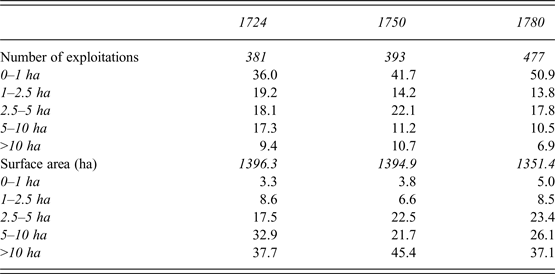
The above-mentioned questions will be investigated for a specific test region within inland Flanders. Our test case encompasses some villages in the Land of Wijnendale (Gits, Lichtervelde and Torhout) within the Franc of Bruges and in the adjacent district of Tielt (Meulebeke, Pittem and Ingelmunster) to the north of the city of Courtrai for which detailed sources of eighteenth-century manuring practice were preserved. The sample villages reveal clear resemblances to other peasant regions in Flanders with regard to occupational structure and farm size. The localities were situated in an area of very intensive agriculture, which was further stimulated in the course of the eighteenth century by a steady population increase and fragmentation of holdings. Registers of the seigniory of Lichtervelde in which the size of farms was recorded for taxation purposes inform us that the average farm size decreased from 3.7 hectares in 1724 to 3.5 hectares in the mid-eighteenth century to 2.8 hectares in 1780, while the number of households grew from 381 in 1724 and 393 in 1750 to 477 in 1780. By 1780, 83 per cent of the cultivators worked on a total acreage of less than 5 hectares (Table 1).Footnote 21 Many smallholders turned to the home production of linen cloth (proto-industry) for an additional income and even the larger farmers in the area had their permanent labour force engage in spinning and weaving during agriculturally less busy times of the year.Footnote 22 In accordance with proto-industry, the cultivation of flax was widespread in this area: more than 80 per cent of the holdings in the castellany of Courtrai grew flax in the eighteenth century.Footnote 23 The cultivation of crops (with a predominance of cereals) occupied the bulk of the land: in the surroundings of Tielt, a census of 1765 pointed to a proportion of sown land of 71 per cent of the total surface area and the 1812 agricultural inquiry pointed to similar proportions for the arrondissements of Bruges and Courtrai (that is, 72 and 76 per cent, respectively).Footnote 24
Farm structures in the seigniory of eighteenth-century Lichtervelde, at surface area (ha) (percentages) a
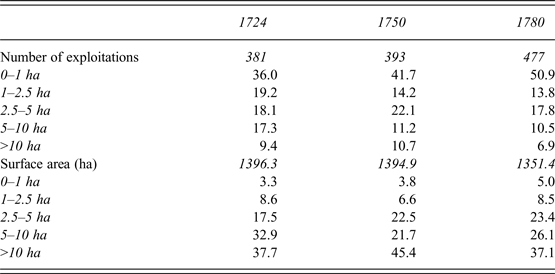
a Changes in the surface are related to changes in jurisdictional boundaries.
Source: State Archives Bruges (SAB), INV 129/16, Archief van Lichtervelde (oud), no. 292–5.
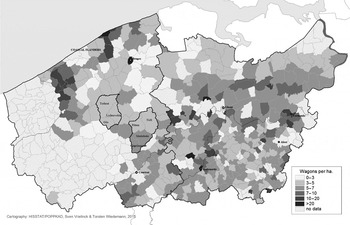
With regard to the availability of farmyard manure, our villages were characterised by relatively few animals (and hence a limited amount of farmyard manure, at least in a Flemish context). Based on a livestock census of 1725 (recording numbers of cows, horses and sheep), we could reconstruct the (maximum) availability of farmyard manure, using the standard figures that eighteenth-century appraisers used to estimate manure production by these animals (Figure 1).Footnote 25
Maximum farmyard manure recuperation per ha.

Within inland Flanders, small local differences in the availability of animal manure existed, mainly due to the presence or absence of river meadows. Villages with river meadows in general sustained higher amounts of animals.Footnote 26 The availability of farmyard manure per hectare of farmland was much higher in the coastal parts of Flanders, especially in those regions specialising in cattle breeding (for example, north of the city of Bruges).Footnote 27
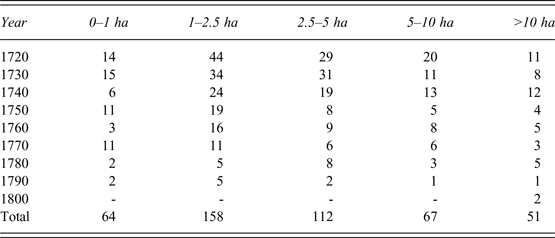
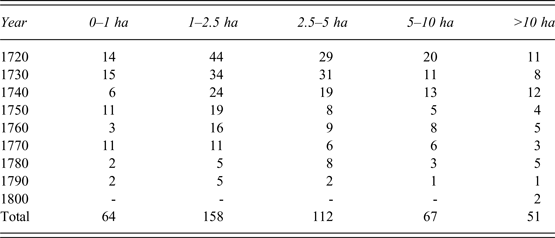
Studying eighteenth-century manuring practices on a micro-level – and more precisely the relevance of applying urban and industrial waste – requires sources that specify these kinds of capital inputs to farmland. Therefore, our analyses will henceforth be based upon a series of unique, detailed eighteenth-century appraisals of goods and chattels (prijzijen), which are preserved for our sample villages that enable us to investigate the distribution of urban manure on smallholdings and large farms. For the district of Tielt (365 prijzijen preserved for the period 1719–1770) and the Land of Wijnendale (87 preserved for the period 1766–1805), these sources not only enable the researcher to estimate the use of specific types of manure, but also list the cultivated arable land of the household (Table 2).Footnote 28
Number of appraisals per farm size group per decade
Source: State Archives Courtrai (SAC), Aanwinsten, nos. 50–9 and SAB, Bruse Vrije Sanders, nos. 138-40 (together further referenced as ‘Database’).
However, the same issues with respect to representativeness of the sources can be raised as the ones attested by research on agriculture and rural life based on probate inventories: the poorest levels (that is, the cottagers cultivating less than one hectare) are underrepresented, whereas the higher strata are relatively overrepresented.Footnote 29 The cottage families represent merely 14 per cent of the households in our dataset of appraisals, while this category accounts for an ever-increasing proportion of families in the total village community, as Table 1 reveals: we should keep this issue in mind when interpreting our results. Prijzijen are the drafts that appraisers used to compose probate inventories in which they – in contrast to the definitive version of probates – listed all the belongings of the household and registered the size of each plot of cultivated land, the crops on it, the number of times the fields were ploughed and harrowed, the applied fertilisers, and finally a total estimation of the production costs of each field. The level of detail in the appraisals is exceptional: for most regions, probate inventories would never detail the specific type of fertiliser on each plot of land. The appraisers’ extreme accuracy in noting and valuing the fertiliser use on farms already points, by its very quality, to the advanced ‘manure economy’ of early modern Flanders, in which manure had become an important article of trade.Footnote 30
3. URBAN AND INDUSTRIAL WASTES: POPULAR SOIL IMPROVERS?
Peasants and farmers recycled as many on-farm nutrients as they could from their own farmsteads. In addition to the application of solid farmyard manure, a whole range of organic material (such as leaves from trees or stable sweepings and crop residues) was gathered at the compost heap and used as fertiliser. These types of manure contained nitrogen and phosphorous and added to the soil organic matter content, hence contributing to a better soil structure and texture.Footnote 31 Next to the solid substances, liquid manure from farm animals – rich in nitrogen and potash – was collected in specific underground cisterns. This kind of fertiliser has the benefit of being readily available for uptake by the root system of plants, because of the liquid form.Footnote 32 In addition to these on-farm manures, cultivators in our sample villages bought extra off-farm urban and industrial fertilisers. These fertilisers often contained characteristics that on-farm manures did not possess.Footnote 33 As such, they were not just substitutes for farmyard manure, but also suppliers of other sorts of nutrients. Urban night soil (that is, the content of urban privies) was a slurry-like fertiliser – rich in nitrogen, phosphorous and potassium – that was often applied in addition to liquid manure from farm animals, but was believed to be superior in quality.Footnote 34 Ashes were either imported from the Dutch Republic – labelled as ‘Hollandse turfas’ or Dutch peat ash (that is, ashes from burning lumps of peat) – or they originated from urban industries like bleach works and soap works.Footnote 35 Burned material no longer contains nitrogen but is rich in phosphorous and potassium and can adjust the soil pH towards less acidic conditions.Footnote 36 Both from the viewpoint of the latter characteristic and the improvement of nitrogen uptake from organic manures, liming was an efficient strategy as well, but it only took off from the late 1740s onwards in our sample villages.Footnote 37 The most frequently used form was unslaked lime (or CaO), the result of heating limestone at high temperatures in specific limekilns. In our regions, lime formed a welcome substitute for the exhausted marl.Footnote 38 Apart from these popular fertilisers, oil cakes, urban solid waste, and pigeon dung were of minor importance in our sample villages.
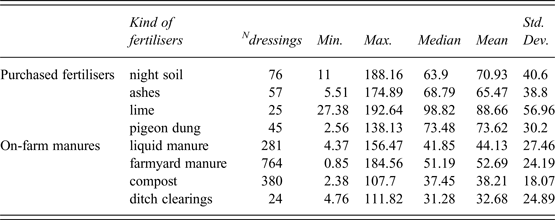
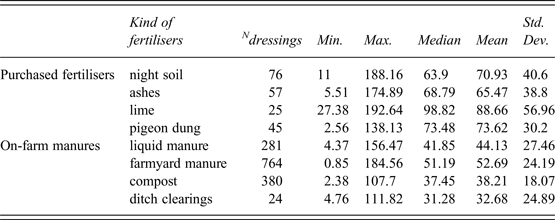
In contrast to on-farm recycled nutrients, off-farm fertilisers involved certain transaction costs, as they had to be allocated from cities to rural distribution centres and on to the cultivators’ arable fields.Footnote 39 When we consider the estimated manuring value per hectare of fertilised land, it turns out that in general the cost of fertilising with purchased manures surpassed the estimated value of manuring with on-farm nutrients (Table 3).Footnote 40
Manuring value per hectare of fertilised land (in Paris pounds), 1720–1800
Source: Database.
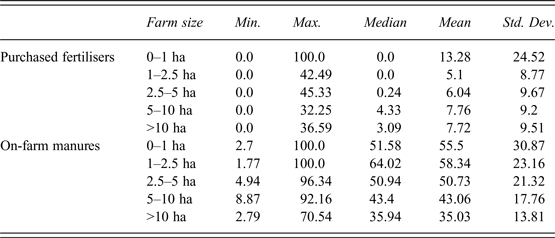
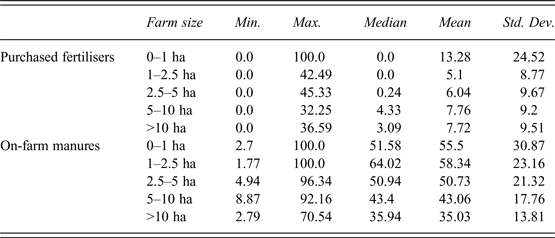
The difference in value between off- and on-farm manures (that is, the cost of purchasing) might explain why the overall contribution of purchased fertilisers in relation to on-farm manures was rather low. When calculating the proportion of land manured with off- and on-farm manures respectively to the total cultivated area, the mean application rate of purchased manures fluctuated around 6 per cent of the total cultivated area. However, the observed data – especially for the smallest farm size category – are characterised by a noticeable dispersion (Table 4).
Proportion offields manured for the total cultivated area of different farm size groups, 1720–1800 (percentages)
Source: Database.
4. THE EIGHTEENTH-CENTURY INCREASE IN THE USE OF OFF-FARM MANURE
The analysis of manuring practices reveals on the one hand clear divergences between and within different groups of farmers, but on the other hand also a broadly similar increase in the appetite for off-farm fertilisers in the course of the eighteenth century. In the 1720s, only a minority of smallholders with less than 2.5 hectares (that is, 14 out of 53 or 26.4 per cent) bought manures, whereas 15 out of 30, or 50 per cent, of cultivators with an acreage above 5 hectares applied off-farm manures in the same period. By the 1750s, 53.6 per cent of peasants cultivating less than 2.5 hectares (or 15 out of 28) fertilised parts of their arable land with off-farm manures and in the 1770s, this percentage even increased to 70 (or 14 out of 20), whereas 77.8 per cent of the cultivators with more than 5 hectares (or 7 out of 9) bought manures in both the 1750s and 1770s. It seems that for all farm size categories – ranging from small cottagers (0–1 hectares), small (1–2.5 hectares) and middle-small farm households (2.5–5 hectares) to middle-large (5–10 hectares) and large farmers (more than 10 hectares) – buying off-farm fertilisers became more widespread in the course of the eighteenth century in our sample villages. If only those cultivators applying off-farm manures were taken into account, the smallholders with less than 1 hectare manured a significantly greater part of their acreage with fertilisers they bought (a mean application up to 34 per cent),Footnote 41 whereas the application rates of urban manures at the other smallholding households (that is, 13.6 per cent and 11.8 per cent for the 1–2.5 and 2.5–5 hectares categories respectively) was very comparable to those of families cultivating more than 5 hectares (that is, 12.6 per cent for the 5–10 hectares category and 11.7 per cent for farmers with more than 10 hectares).
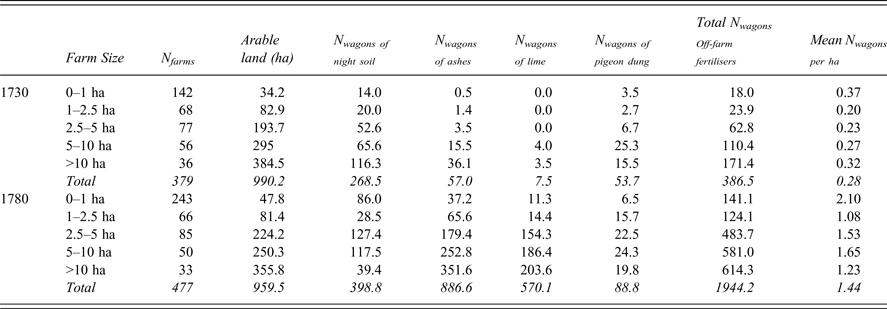
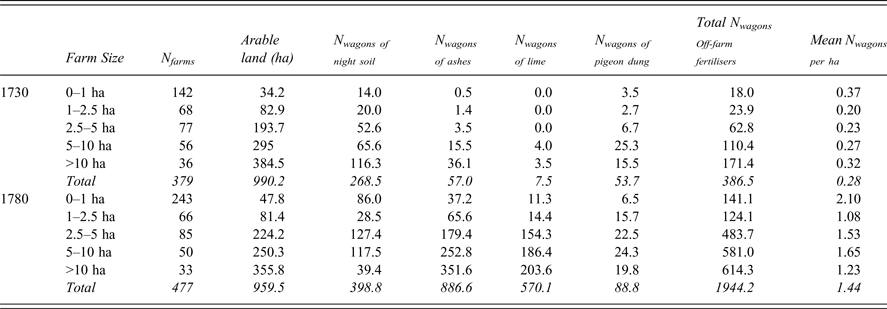
However, at the aggregated level of the village, some differences between farm size categories and types of off-farm fertilisers can be noticed. On the basis of farm sizes recorded in the abovementioned taxation registers of the seigniory of Lichtervelde, combined with the average shares of cultivated land fertilised with each kind of off-farm fertiliser on small and large farms and the mean intensity (wagonloads per hectare) with which these fertilisers were applied (as both deduced from the appraisals), I estimated the numbers of wagons of off-farm fertilisers needed for the years 1730 and 1780, presented in Table 5.Footnote 42
Estimated numbers of required wagons of off-farm fertilisers in 1730 and 1780 in the seigniory of Lichtervelde
Sources: Database and SAB, Archief van Lichtervelde (oud), nos. 293, 295.
The numbers of required wagons sharply increased from 387 in 1730 to 1,944 in 1780, which must have profoundly challenged the transport infrastructure.Footnote 43 The increasing impact of cottagers, small and middle-small farming families adopting off-farm fertilisers indeed results in the increasing numbers of estimated wagons of off-farm fertilisers to be allocated to these farmsteads (with especially great impact of night soil and ashes). A greater share of the supplied urban fertilisers was taken up by the smallholding layers of the village community (28 per cent of the required wagonloads in the period before 1750 versus 39 per cent thereafter). The middle-large farmers slightly enhanced their inputs of urban night soil, while the large farmers downsized its application. At a time when rural population growth outpaced urban growth, leading to a decrease in the proportion of the Flemish population living in cities from a fourth in the sixteenth and seventeenth centuries to a fifth at the end of the eighteenth century,Footnote 44 access to urban night soil should be framed within a story of redistribution in the countryside itself, rather than in large-scale increases in the urban supply. Aggregate supplies of ashes and lime, on the other hand, boomed.Footnote 45 The farm categories with more than 5 hectares under the plough primarily purchased ashes and lime, resulting in steep increases in the number of wagons needed. The larger farmers most probably took into account that dressing one hectare with night soil required more labour input (that is, 3 days per ha) than applying lime or ashes (that is, 1.3 days per ha). As they relied on day labourers to carry out these activities, the amount of labour required was of interest to them, in addition to the purely agronomic characteristics of the fertilisers. As they grew proportionally less flax than smallholders, these larger cultivators were in less need of extra amounts of night soil (which was mostly applied to flax) than the peasant families, while clover cultivation in combination with cereal growing on the large farms would have profited from the increasing ash and lime dressings. As these middle-large and large farmers had more than 60 per cent of the village's arable land under the plough (see Table 1), their fertilising strategies and production choices would have considerably impacted on the aggregate evolution of agricultural produce at the village level and on aggregate yield tendencies (as reflected in the value of tithe leases). Yet, as greater shares of off-farm fertiliser supplies were destined for peasant smallholdings, their share of the arable (31.4 per cent in 1730 and 36.8 per cent in 1780), which was already yielding more because of higher labour inputs and higher levels of manuring, would have contributed more than previously to general yield estimates.
Apparently, farm size was not so much a factor in determining whether rural households bought off-farm fertilisers or not, and if these households decided to buy them, the application rates were very comparable across all categories (except for the small cottagers dressing relatively more of their land). Which farming strategies of our rural households under study turned out to be decisive for the choice to dress part of the arable acreage with off-farm fertilisers?
5. LOOKING FOR FERTILISATION STRATEGIES
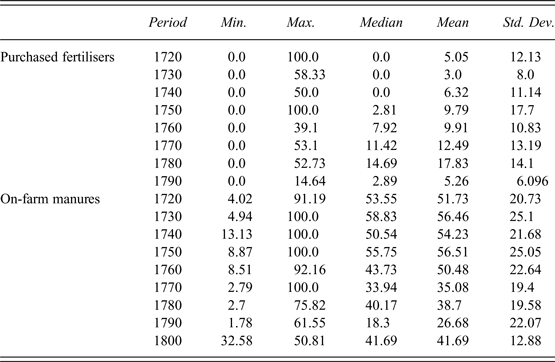
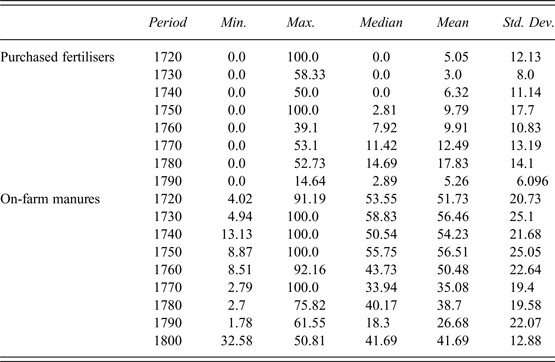
Common sense would suggest that the cultivator turned to off-farm manures whenever he ran short of supplies of manure on his own farm. If this were the case, the smallholding economy of inland Flanders would fit into a story of compensation comparable to the Chinese and Japanese situation. A major difference with peasant agriculture in Asian countries was the typical feature of mixed farming in European agriculture, both in areas of large-scale farming and smallholding husbandry.Footnote 46 For peasant and cottage families, keeping some livestock –chickens, pigs and cows in particular – was often a vital component of their survival strategy. First of all, these animals enhanced the level of self-sufficiency as they provided rural dwellers with dairy and meat.Footnote 47 More important for our story, the manure of farm animals was a readily available means for the replenishment of soil nutrients. Thanks to the cattle on their farmsteads, these households did not have to rely entirely on off-farm fertilisers to guarantee the maintenance of soil fertility. Our farming households adapted the way of fertilising with their on-farm manure, deciding to apply it on fewer hectares (Table 6) but at higher levels of intensity and thus more carts or wheelbarrows per unit area.
Proportion of fields manured for the total cultivated area (per cent) in the course of the eighteenth century
Source: Database.
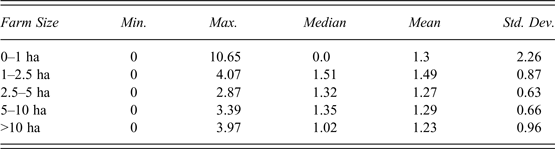
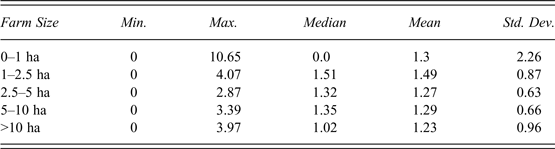
The little information we have (especially scarce for the later eighteenth century) on numbers of wagonloads of farmyard manure heading to the fields indeed points to a rise in manuring intensity: the mean number of 23 to 25 wagons of farmyard manure per hectare in the 1720s and 1730s increased to 28 wagons in the 1740s and 30 wagonloads in the 1750s to 34 wagons in the 1780s. The amounts of livestock units (that is, a commonly calculated parameter value that levels the differences with regard to both feed requirements between different farm animals and age among the same animal species)Footnote 48 per hectare of cultivated acreage on our sample farms (and thus on-farm manure supply) also remained more or less constant across the eighteenth century and turned out to be comparable between and within the social groups of the households (Table 7).Footnote 49 In other words, when the share of the total cultivated area manured with on-farm solid fertilisers (that is, the on-farm fertilisation degree) decreased, the intensity of manuring per surface area unit increased.
Number of livestock units per hectare of cultivated land on different farm size groups, 1720–1800
Source: Database.
This changing fertilisation strategy with farmyard manure was accompanied by a greater share of clover in the rotation scheme (Table 8). From the viewpoint of fertilisation and agricultural progress, clover was an important crop, as the symbiotic relation with specific soil micro-biota results in the fixation of atmospheric nitrogen.Footnote 50 With other fodder crops, clover also bolstered the transition towards generalised stall-feeding systems, which in their turn provided rural households with more farmyard manure.Footnote 51 Clover cultivation was already widespread in our sample region: 81.7 per cent of all cultivators grew clover.Footnote 52 The parameters studied above strengthen our viewpoint that the total pool of on-farm nutrient supply remained fairly constant, if not indeed increased due to a greater share of clover in the rotation scheme. The additional purchases of urban and industrial fertilisers did not have to compensate for a decreasing stock of on-farm nutrients, except for those cottage households (around a third of them) who were not able to keep livestock nor to cultivate clover.
Mean proportion of cereals, potatoes, flax and clover for the total cultivated area (percentages)

Source: Database.
6. TO BUY OR NOT TO BUY? ON-FARM FERTILISATION AND CROP CHOICE
The section above points to at least a stable level of on-farm nutrient recycling (and most likely even a rising one) for the bulk of our sample households, at the same time as both the on-farm fertilisation degree was lowered and the use of urban manures tended to rise during the eighteenth century. To begin to explore the decision to buy off-farm fertiliser, a logistic regression was carried out in which the decision of each household to provide themselves with extra manure from outside their own farmsteads formed the dependent variable upon which the above-mentioned choice to fertilise a smaller share of the cropland more intensively with on-farm manures could have had an effect. Indeed, taking into consideration the proportion of cultivated land that rural households fertilised with their on-farm manures, together with time (as a categorical variable referring to the decades from the 1720s to the 1800s), a statistically significant regression model was obtained.Footnote 53
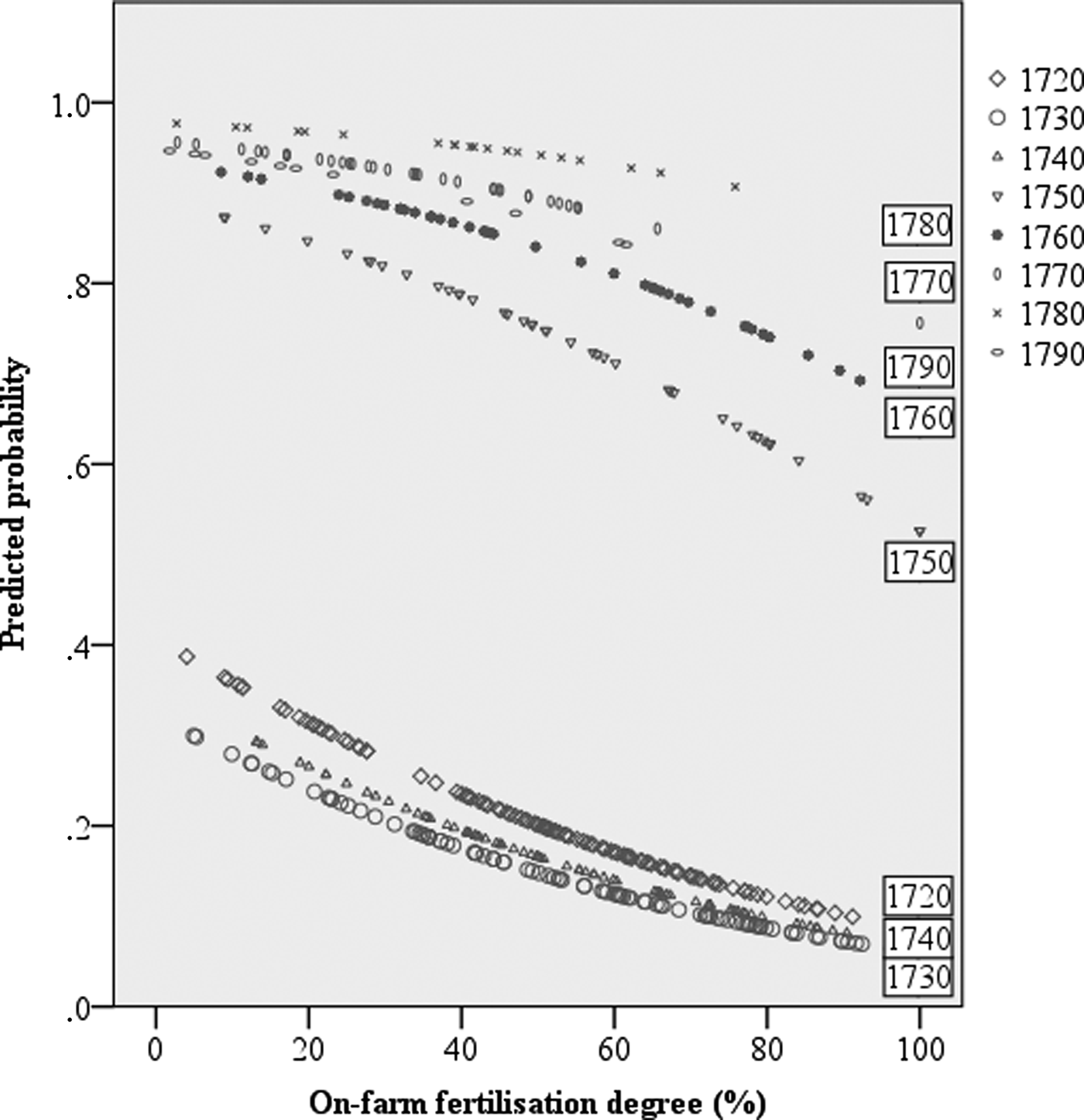
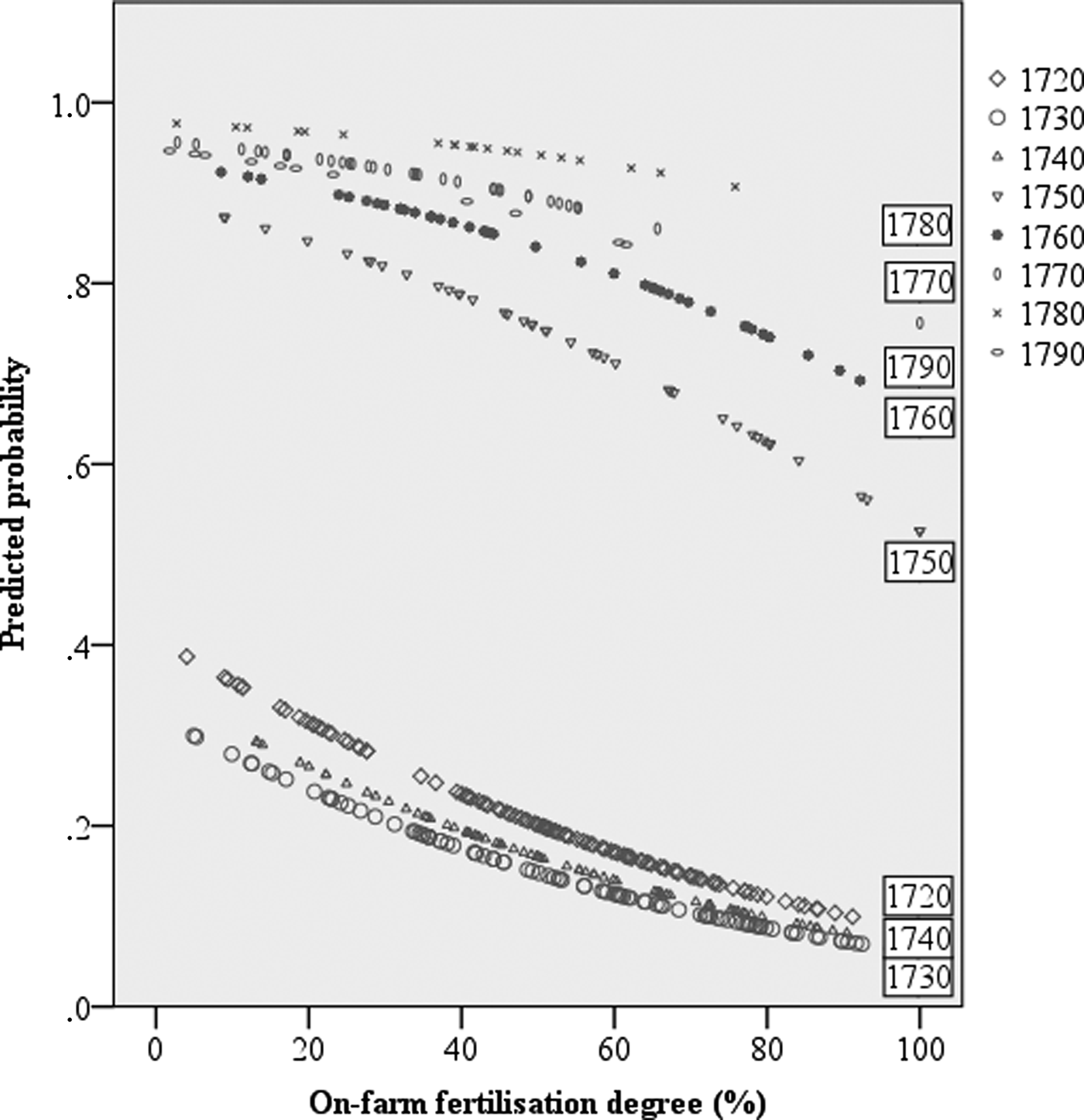
From the regression equation (note 53), the probability π(x), that cultivators bought extra urban manures at a given degree of cropland fertilised with on-farm manure within a specific time span, can be predicted and these predicted probabilities were plotted on Figure 2. Within a given time period, the chance that a cultivator provided himself with off-farm fertilisers was negatively influenced by the degree of fertilisation that he employed with on-farm nutrients. In other words, the fewer hectares that were fertilised with manure produced on the cultivator's farm, the more likely it was that this cultivator bought extra fertilisers. Time had a major influence as well. If a cultivator fertilised around 60 per cent of his arable acreage with on-farm manure (that is, close to the median on-farm fertilisation degree of the 1–2.5 and 2.5–5 hectares farm size categories), the predicted probability that he applied extra off-farm fertilisers in the 1730s was only 12.5 per cent, rising impressively to 71.2 per cent in the 1750s.Footnote 54 Especially from the 1750s onwards, the use of off-farm manures (and so its demand) was apparently on the rise. When the same analysis was undertaken including the total cultivated acreage as a continuous variable the effect did not stand the test of significance.Footnote 55 This means that the degree of fertilisation with on-farm manure had a greater impact on buying extra urban manure than did farm size.
Predicted probability of buying extra off-farm fertilisers according to the fertilisation degree with on-farm manure throughout the eighteenth century in the district of Tielt and the Land of Wijnendale.
Processing flax to linen at home, on the farm, as a proto-industrial by-employment, as well as the cultivation of commercial crops like flax (as raw material for the domestic industry), was widespread in our sample region.Footnote 56 This finding was also reflected in the prijzijen. The appraisals of 67 per cent of all households with an acreage of more than 1 hectare (that is, 260 out of 388) registered flax, and even among small cottagers 20 out of 64 (31.3 per cent) grew flax.Footnote 57 There was a slight increase in the second half of the eighteenth century, meaning that more and more households tried to enlarge their area under flax (Table 8).Footnote 58 Due to the high yields of flax,Footnote 59 an increase of 1 to 2 per cent of the total acreage had a great impact on the total flax harvest and hence on domestic processing activities. Peasants with smaller holdings cultivated proportionally more of this soil-depleting, hence nutrient-demanding, crop than the ones with larger holdings (Table 8).Footnote 60 Peasants with an arable acreage between 1 and 5 hectares devoted some 9 per cent to flax cultivation, whereas the larger cultivators sowed flax on 5 to 6 per cent of their fields.
With regard to soil fertility management, clover was an important crop as well, as discussed above. Smallholders and larger farmers alike dedicated on average 10 to 11 per cent of their cropland to clover cultivation, whereas more than half of the clover-growing micro-smallholding cottagers devoted double this share to the fodder crop (Table 8). As clover is believed to have figured as an important contributor to the production of on-farm livestock manure in particular and to soil fertility in general, cultivating clover would counteract the necessity to buy additional fertilisers from outside the farmstead. However, contemporary travellers and agronomists argued that clover cultivation went hand in hand with ash and lime fertilisation.Footnote 61
Because of these contrasting observations with regard to clover and the fact that flax was a crop requiring heavy manuring, I introduced two variables to the logistic regression model that express the share of clover and flax respectively to the total cultivated area of each household. The introduction of these variables was highly significant, resulting in a new and stronger regression equation.Footnote 62 Thus, besides the on-farm fertilisation degree and the time variable, the fact that clover and/or flax were planted in the fields did matter for the choice to buy or not to buy off-farm fertiliser. If we repeat the aforementioned exercise and consider a cultivator who fertilised around 60 per cent of his acreage with on-farm manure in the 1750s, his choice to provide himself with extra off-farm manures depended for a considerable extent on the share of flax and/or clover in his rotation. For the sake of the example, let us assume a share of clover of 10 per cent and 9 per cent in the case of flax. According to the presence of clover and/or flax, provision with off-farm fertilisers varied as follows:
-
a) If the cultivator had no clover nor flax on his fields, then the predicted probability that he bought extra fertilisers was 59.1 per cent;
-
b) If clover, but no flax was registered, then the chance was 68.2 per cent that he chose to buy additional manures;
-
c) If flax, but no clover was on the fields, then it was 75.4 per cent likely that he bought off-farm fertilisers;
-
d) If both crops were on his cropland, then the model predicts a chance of 81.9 per cent that he bought fertilisers in addition to his on-farm manure supply.Footnote 63
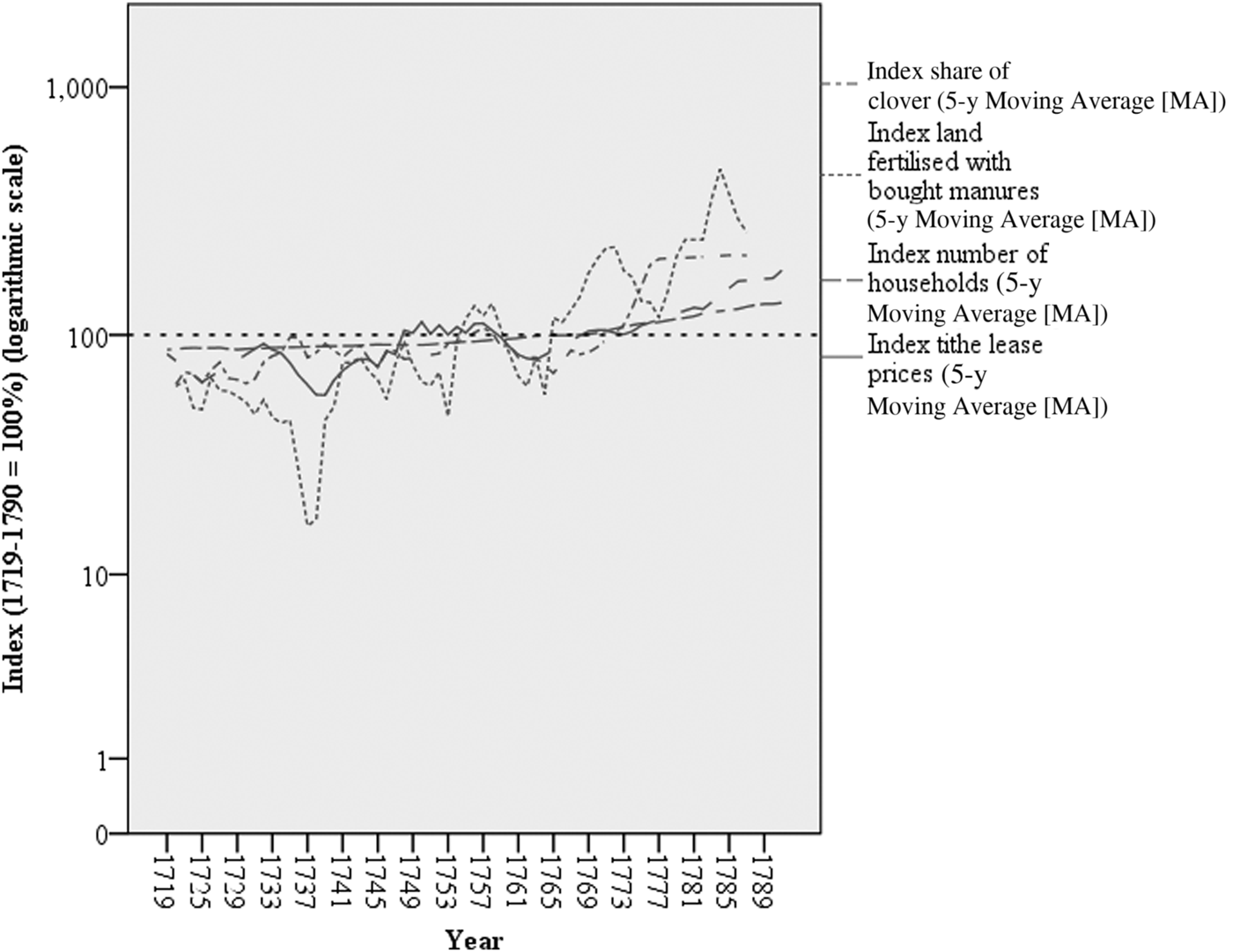
The regression model shows that these particular crop choices had a considerable positive influence on the decision of the smallholder or large farmer to buy additional fertilisers,Footnote 64 in combination with a growing clover cultivation and a reorganisation of the fertilising strategy with on-farm manures, based on manuring fewer units of cropland with increasing volumes of manure. The new fertilising pattern enabled cultivators to grow more flax and potatoes, and fewer cereals (Table 8), while their cereal output increased as the index of tithe leases of the seigniory of Lichtervelde shows, that is, higher cereal yields (Figure 3).Footnote 65 Applying more off-farm fertilisers not only required capital input, but also physical labour. As such, the new and more intensive ways of fertilisation fit into the observation that Flemish Husbandry was becoming increasingly labour-intensive (Figure 3, the index of the number of households as a proxy for the agricultural labour force) so that physical productivity increased at the expense of labour productivity.Footnote 66
Indices of tithe lease prices (Lichtervelde), number of households (Lichtervelde), land fertilised with off-farm manures and clover cultivation, 1719–1790.

7. TO BUY OR NOT TO BUY? THE ECONOMIC SITUATION
In the logistic regression above, on-farm decisions concerning fertilisation and crop choice were highlighted as factors influencing the cultivator to acquire additional off-farm fertilisers. However, peasants and farmers operated in a broader economy and it is likely that economic imperatives and conjunctures were a determinant factor in steering them towards manure purchases. After a period of rapid demographic and economic recovery following the devastation of the Eighty Years’ War, agriculture in the Low Countries faced a reversal from the mid-seventeenth century until the 1730s–1740s, when an upturn began, which lasted until the end of the century.Footnote 67 It is as well to remember that these economic fluctuations impacted differently upon those smallholders who had to rely on the food market as consumers when their own stored produce was running out.
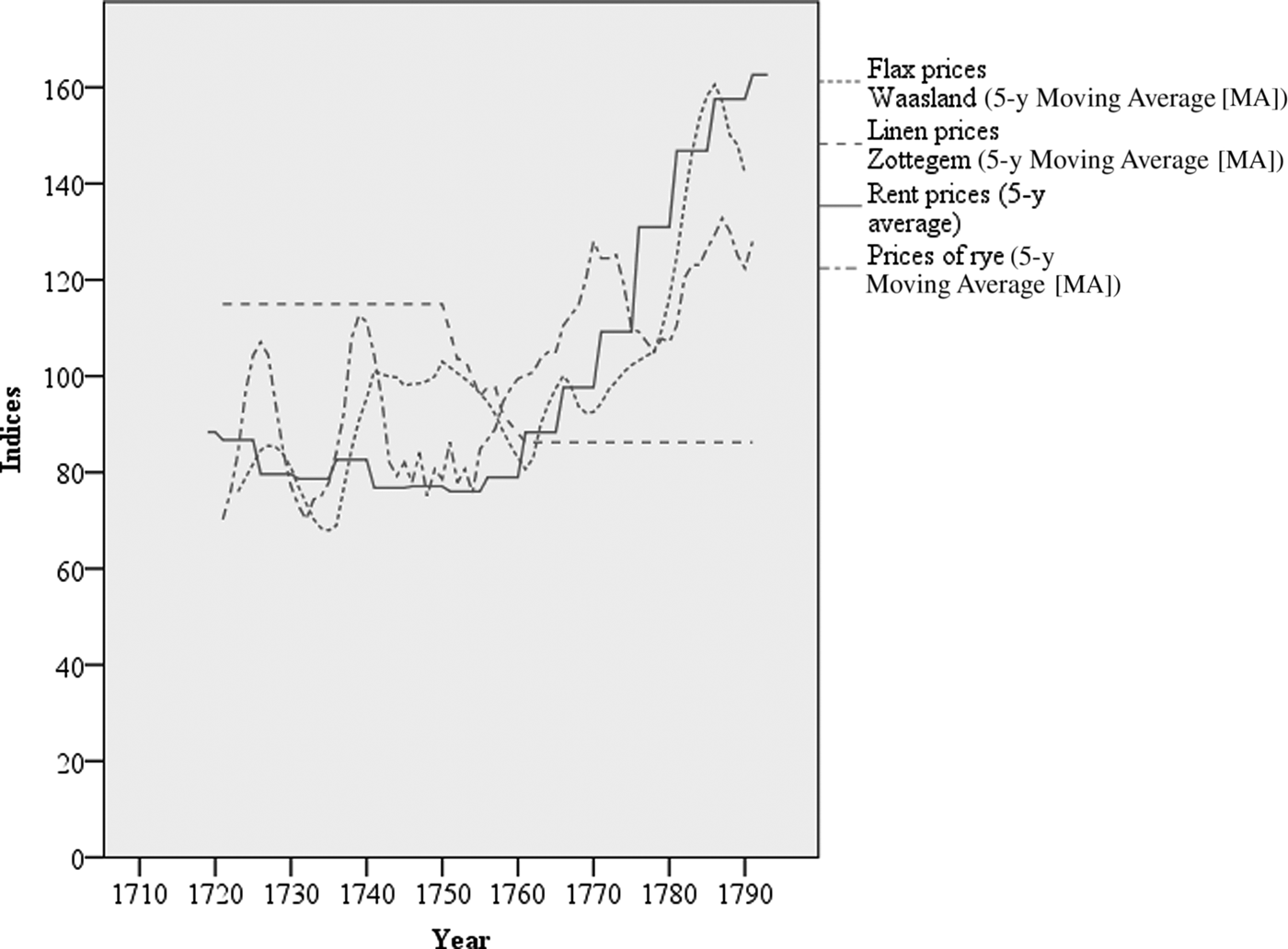
In order to assess the impact of the economic situation on peasants’ and farmers’ decision-making about fertilisation with purchased inputs, I will consider four factors likely to have had an influence: changes in the price of rye, flax and linen, and agricultural rents (Figure 4). I introduced these price data into the logistic regression model instead of the time factor, which simply represented the sequence of decades from the 1720s to the 1800s.
Price indices of flax, linen, rye and rents in eighteenth-century Flanders (mean value of 1719–1792 = 100 per cent).

The evaluation of the price impact of the basic foodstuff – rye – is somewhat difficult to interpret. Change in the price of rye was characterised by some high peak values in the 1720s, late 1730s and early 1740s (see Figure 4), pointing to a number of crisis years of grain cultivation (triggered by climatic factors and aggravated by the almost endemic acts of warfare in the later seventeenth and early eighteenth centuries).Footnote 68 The effect of rye combined with the flax and linen prices emerged negative: the high price of rye in these decades did not correspond with increases in the use of off-farm fertilisers.Footnote 69 It was only after 1750 that recurrent food crises became less frequent and the price of rye (as for other basic foodstuffs) steadily rose in the second half of the century, following the growing population.Footnote 70 Because of the distorted picture of the rye prices, I omitted this variable from the regression.
As the cultivation of flax turned out to stimulate the purchase of extra off-farm manure, we would expect that changes in price of the household's manufactured linen affected fertilising strategies and rotation schemes. The eighteenth-century Austrian Netherlands were characterised by a rise in the output of flax and linen together with a considerable export volume for linen, but were at the same time challenged by declining prices for these goods.Footnote 71 Because no price series for linen are known for my sample area thus far, I made use of a series from a peasant region nearby that resembles our research area in terms of occupational structure, social property relations and distance to urban linen markets. This confirmed the general impression of declining linen prices: the stable price of 12 groten Vlaams per el of linen, which held from the end of the seventeenth century to the middle of the eighteenth century, suddenly began to tumble in the 1750s, previously stabilising around 9 groten Vlaams per el in 1759 and remaining thus to the end of the century (see Figure 4).Footnote 72 The prices of crude flax on the market of Saint-Nicolas in the Land of Waas – the main flax-growing and flax-exporting region of the Austrian NetherlandsFootnote 73 – fluctuated more in comparison with the linen price data. From the beginning of the 1770s and at an accelerated pace in the 1780s, the price of the raw material sharply increased (see Figure 4).
In addition to the price of proto-industrial fabrics, the rental price of leasehold land might also have influenced the decision to acquire additional fertilisers. In the course of the eighteenth century, landowners profited from the hunger for land in the countryside by splitting up their leasehold and claiming higher rental prices per unit area of land. In our research area, rents of both entire farmsteads and individual plots of land were sharply on the rise in the second half of the eighteenth century (see Figure 4).Footnote 74
To evaluate the impact of the drop in the linen price and changing prices for crude flax and rents on the decision-making of cultivators to buy extra urban manure, I introduced these price data as independent variables in the logistic regression. With the inclusion of linen prices, with the sudden drop in the 1750s to a lower level, the impact of flax prices and rents lost statistical significance. The resulting model points to an effect where the lower linen price in the second half of the century stimulated cultivators to buy extra fertilisers.Footnote 75 After all, the majority of the households in this region were involved in the manufacture of linen yarn and/or finished linen cloth,Footnote 76 so that a drop in the price of linen encouraged cultivators to produce more flax in order to turn more of it into linen so that their proto-industrial income could be maintained. The price of linen was a determinant factor in the combined effect of linen prices, flax prices and rents. However, in reality such a combined effect would not have played an important role because the rise in rental prices and prices of flax occurred after the linen price had already stabilised at a lower level (see Figure 4). When leaving the linen price out of the regression analysis, the combined impact of the price of flax and rents yielded a statistically significant result.Footnote 77 The crude flax prices had the opposite effect of the linen price: the higher the prices of the raw material, the more likely it was that cultivators tried to boost their own flax production for which they needed to buy extra off-farm fertiliser inputs. Smallholding families tried to secure their access to flax so that they were not, or at least were less, dependent upon purchasing this raw material, whereas the rise in flax prices meant first and foremost a commercial opportunity for the larger farmers. Of course, this result should not be approached as a rule of thumb but interpreted in the light of the specific economic situation concerning the linen industry of the eighteenth century: in order to try to maintain (or even increase) their proto-industrial revenues, cultivators – especially the smaller peasant families – grew more flax, for which they bought off-farm fertilisers.
The surplus extraction by lessees in the form of higher rents generated similar effects: setting higher rental prices stimulated manure purchases or even compelled cultivators to purchase off-farm inputs in an effort to stimulate arable production and especially to boost flax cultivation so that requirements of lessees could still be met and revenues derived from turning flax into linen could be maintained.Footnote 78 The compelling effects of increasing rents on off-farm fertiliser inputs must have been particularly felt in the late eighteenth century, when real rental prices (expressed in terms of rye) surpassed previous levels from the late sixteenth to the middle of the eighteenth centuries.Footnote 79
As smallholding households aimed at avoiding risky undertakings that might harm their survival strategy in the event of a poor outcome,Footnote 80 it is rather surprising that these cultivators also increasingly invested in the acquisition of off-farm fertilisers without knowing future returns. However, the way in which the inland Flemish agro-system was structured (along lines of reciprocal exchange of labour and services between smallholders and large farmers) entailed a reduction of this risk: smallholders were able to transform around 26 per cent of the fertiliser purchase price into labour input on the large farms by having the large farmers carry the fertilisers from the distribution centres to their fields (that is, they paid for this service with labour).Footnote 81 The combination of these fertiliser purchases and higher levels of manuring intensity enabled smallholders to enlarge their acreage under flax in order to maintain their proto-industrial household model and, at the same time, get more grain output from fewer hectares of cereals. As such, smallholders (especially the ones with fewer than 2 hectares) reduced the necessity to buy flax (as raw material) as well as cereals to survive the period when their own grain supplies had run out prior to the next harvest.Footnote 82
To summarise, the sudden drop in the linen price in the 1750s provided the momentum for the turn to the increasing use of off-farm fertiliser inputs, while increasing prices of crude flax and higher levels of surplus extraction by landowners in the second half of the century stimulated or necessitated further increases in fertiliser purchases.
8. CONCLUDING REMARKS
Could pre-modern smallholding economies sustain a green ‘fertiliser’ revolution? With more than 80 per cent of holdings smaller than five hectares, eighteenth-century inland Flanders certainly was a smallholding economy, although based on a symbiosis with a minority of larger farms. Throughout the eighteenth century, this smallholding economy did increase its fertilisation rates significantly, thanks to the application of increasing amounts of off-farm, ‘urban’ fertilisers. Independent of their farm size, cottagers, peasants and farmers in the 1770s or 1780s were buying up to five times as much urban manure than their predecessors half a century before. Even a substantial part of the growing number of small cottage families had access to an on-farm pool of nutrients by keeping livestock on their own or entering into an animal lease arrangement, and yet increasingly adopted off-farm nutrient inputs. This is in contrast to their Chinese and Japanese colleagues, who increased use of off-farm inputs because they did not have access to on-farm animal inputs. Nevertheless, like their Asian counterparts, a third of these Flanders cottagers were cut off from animal nutrient supplies and so compelled to purchase off-farm inputs to enable their crops to grow.
The decision to buy or not to buy off-farm fertilisers did not depend so much on farm size, but was mainly influenced by a number of on-farm decisions, which were taken in line with the evolution of the broader economic situation. Cattle-owning cultivators restructured the on-farm fertilisation pattern and extended their clover cultivation, both of which did help the performance of cereal cultivation (yield increases), so that the share of these crops could be lowered in favour of cash crops like flax. Flax was a crop requiring large amounts of various nutrients, and peasants and farmers alike had to have recourse to off-farm fertiliser inputs in order to boost the share of flax in their rotation schemes. With regard to clover, it is safe to argue that the cultivation of this nitrogen-enriching crop stimulated, rather than obstructed, cultivators from obtaining extra manure from outside their farms.
The use of urban fertilisers tended to rise significantly in the course of the eighteenth century, especially from the 1750s onwards, an indication of the growing rural demand. This growing rural demand tied in with the price evolution of particularly linen, crude flax and rents. The lower prices for linen from the 1750s onwards – and the concurrent stimulation to increase their flax acreage in order to secure as far as possible their income from proto-industry – boosted the probability that cultivators bought additional urban and industrial fertilisers. The increasing prices for crude flax in the later eighteenth century further stimulated the cultivation of flax on one's own farm (for reasons of eliminating dependence on buying crude flax in the case of smallholders and out of commercial considerations on the part of larger farmers) and hence the purchase of off-farm fertilisers. The strategy of landowners to split up their leasehold and try to siphon away more profits by setting higher lease prices per unit area of land in the later eighteenth century further encouraged (or obliged) cultivators to buy off-farm soil-improving inputs in an effort to increase output and make ends meet.
In this article, the increased use of fertilisers was explained by developing a micro-level approach, starting from the fertiliser strategies of individual farm households, from small cottagers to middle-sized and larger holdings. Such an approach can be a welcome complement to more aggregate, macro-level analyses of agricultural output and productivity. From such a micro-level perspective, we can explain rising cereal outputs in the eighteenth century – as have been observed for Flanders based on tithe receipts – by higher levels of manuring intensity with on-farm recuperated nutrients in combination with higher inputs of off-farm fertilisers like lime and ashes on cereal fields by larger farmers (who still were responsible for the majority of cereal output), but also by higher inputs of urban night soil benefiting (primarily) flax cultivation, which allowed smallholders and cottagers to continue their proto-industrial household model, and hence kept the reproduction cost of labour low. Low labour costs in turn favoured labour inputs on the larger holdings, which once again stimulated cereal outputs. As a result, a green revolution of changing fertilising patterns characterised by more intensive use of on-farm pools of nutrients and higher levels of off-farm fertiliser inputs were instigated from below – by both smallholders and large farmers themselves – as a response to the rhythms of the economic situation and the surplus extraction by landowners in a period of population growth and fragmentation of holdings.
ACKNOWLEDGEMENTS
The author wishes to thank Tim Soens, Laurent Herment, Marion Gray and the participants of the session ‘Waste into Manure: The Recycling of Urban Waste in Agriculture (Sixteenth–Twentieth Centuries)’ at the 2014 ESSHC conference in Vienna, as well as the three anonymous reviewers for their valuable remarks and suggestions.