Introduction
Humanitarian workers today are using the ambiguous loss model and its guidelines for understanding and aiding families of the missing, wherever they may be. With cultural and religious differences in play, and where truth remains elusive about the fate of the disappeared, family- and community-based interventions are found to be most effective.Footnote 1 Simon Robins, a former worker and researcher for the International Committee of the Red Cross (ICRC), writes: “Therapeutic approaches have begun both to use the ambiguous loss model and to acknowledge that, where professional services are limited, community-based methodologies can be relevant.”Footnote 2 Such approaches are often more applicable than medical models because in many cases, the cause of symptoms emanates from the social context. In addition, many people across cultures are unaccustomed to individual therapy and prefer relational interventions at the family and community levels. As a result, this more systemic approach can be more effective (and less resisted) with families of the missing. Surprisingly, we are finding that family and community or peer-group approaches are increasingly a preference for families of the missing across cultures, individualistic and collective, though in patriarchal communities, peer groups may have to be split by gender.Footnote 3
When objective truth remains unavailable about a loved one's fate, interventions require a post-structuralist way of thinking.Footnote 4 In the absence of proof about the whereabouts of the missing person, families (and the professionals who work with them) must shift away from the secure knowledge of absolute thinking – i.e., “My husband is either dead or alive, absent or present.” Instead, we encourage families to use a more paradoxical way of thinking – i.e., “My husband is both absent and present. He is probably dead, but maybe not.” Psychologically, in their hearts and minds, the missing person is physically gone but still here. The intervention goal then becomes one of finding the resilience to live with the mystery rather than finding a solution.Footnote 5
Overall, the ambiguous loss framework focuses more on perceptions than objective truth, more on resilience than pathology, and more on family functioning and community support than on individual symptomatology. The cause of distress and trauma is the ambiguity surrounding the family's loss and is thus externalized to the social context of war or terrorism. It is not attributed to personal or family deficits. From this view, family members are less likely to blame themselves for feeling anxious and confused; knowing it is not their fault, they are less resistant to intervention and the necessary changes that must occur for the family to function once again.Footnote 6
Definition of ambiguous loss
Ambiguous loss is an unclear loss with no official verification of life or death and thus, no closure. It occurs when a person is missing with no clarity about his or her absence or presence.Footnote 7 Ambiguous loss is the most stressful type of loss because there is no proof of finality.Footnote 8
There are two types of ambiguous loss. The first type is physical ambiguous loss, the topic of this paper. Here, a person is physically absent, but kept psychologically present because their status as dead or alive remains unclear. Without proof of death, remaining family members are understandably confused and predictably disagree on the fate of their missing loved one. Some continue to hope for return; others perceive the lost person as clearly dead. Examples include men, women and children who are kidnapped or disappeared due to war, terrorism or natural disasters such as tsunamis, floods or earthquakes. Without some physical proof – DNA evidence or a body to bury – the family's loss becomes a story with no ending.
The second type of ambiguous loss is psychological; a person is physically present but absent psychologically due to some cognitive or emotional impairment. Examples of psychological ambiguous loss are dementia from disease or brain injury, addictions, chronic mental illness and frozen grief – a preoccupation with a lost person which is so strong that one is no longer available (cognitively and emotionally) to remaining family and friends.Footnote 9
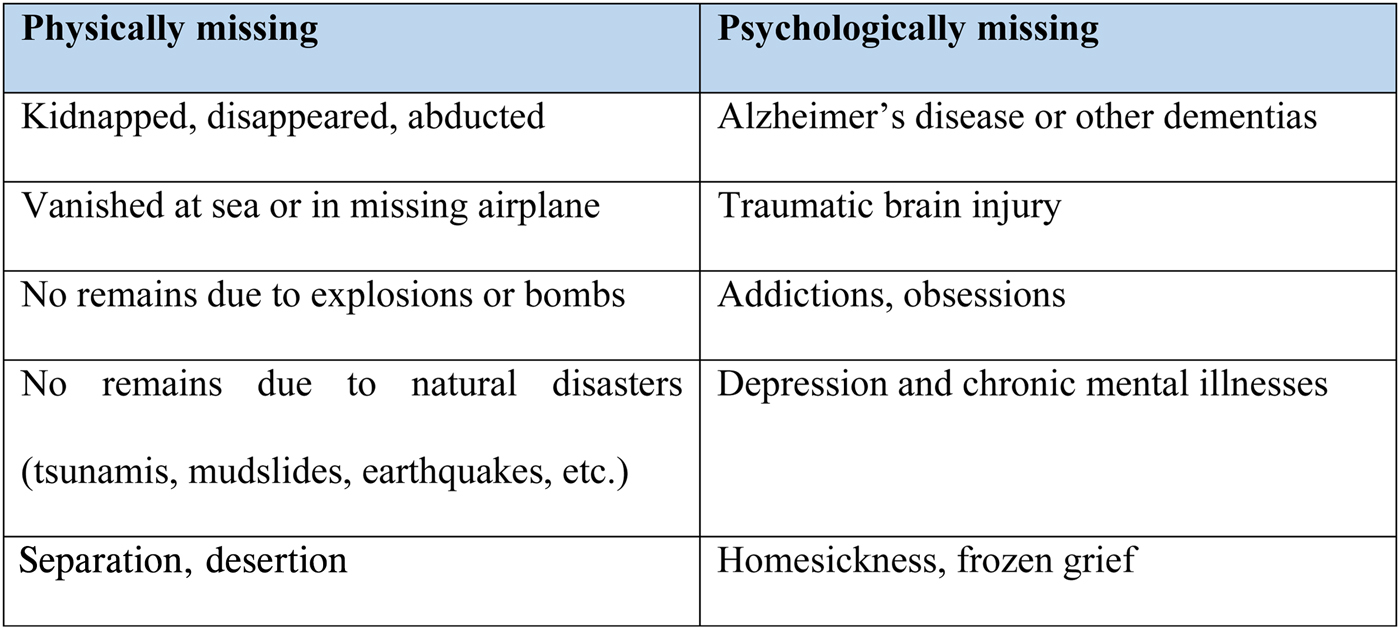
Examples of the two types of ambiguous loss are shown in Figure 1.Footnote 10 Note that both types of ambiguous loss – the physical and the psychological – can occur for one person or one family at the same time. For example, after the September 11 attacks on New York's World Trade Center in 2001, several families we worked with had fathers and mothers physically missing in the smoking rubble, while at the same time, an elder at home who was missing psychologically due to Alzheimer's disease.Footnote 11 Simultaneously, experiencing both physical and psychological ambiguous losses creates a double ambiguous loss and causes even more distress. Assessments of a more psychosocial nature more easily reveal such a pile-up of stress.
Examples of the two types of ambiguous loss.

Difference between ambiguous loss and death
With death, there is legal and social clarity: a death certificate, rituals for mourning with others, and the opportunity to honour the lost person and dispose of their remains in one's own way. With ambiguous loss, there is no proof of death and thus there are no markers of certainty about the fate of the lost person.
Adding to the trauma, the family's grief is often disenfranchisedFootnote 12 – that is, in the eyes of the law, religious institutions and the larger community, the family's loss is often not considered “real” as it would be with a verifiable death. They are left to cope alone. Without proof of death, the family are forced to imagine their own ending to their loss. This is immensely challenging and is not required when there is evidence of death.
When a loved one is lost physically without verification of death or a body to bury, such loss becomes a “complicated loss” and thus leads to symptoms akin to those of complicated grief.Footnote 13 Through no fault of family members, ambiguous loss understandably causes open-ended and long-term grief. It may resemble “malingering”, but it is important to note that because there is no possibility of resolution or closure, the cause of chronic sorrow and lingering grief lies in the type of loss experienced and not in the pathology of the individuals and families that are grieving.Footnote 14
Difference between ambiguous loss and ambivalence
To clarify, the words “ambiguous” and “ambivalent” are not synonymous. As used in ambiguous loss theory, the word “ambiguous” means “unclear”, while “ambivalent” means “conflicted”. For families of the missing, this means that the ambiguity surrounding their loss is the cause of their ambivalence. It is not a psychiatric problem. “Sociological ambivalence”, a term coined by sociologists Merton and Barber in 1963,Footnote 15 is relevant for normalizing the confusion and conflicted emotions experienced by families of the missing.
Effects of ambiguous loss
For professionals trained in the medical model and researchers trained in positivism, the ambiguous loss approach requires a new way of thinking about increasing tolerance for unanswered questions.Footnote 16 Acknowledging differing perceptions among family and community members and the differentials in empowerment, we see the effects of ambiguous loss through a psychosocial lens.
Psychologically, cognition is blocked by the ambiguity and lack of information. Decisions are put on hold, and coping and grieving processes are frozen.Footnote 17 The ambiguous loss then complicates grief.Footnote 18 The ambiguity prevents the search for meaning that is so essential for resolution of loss. In addition, it blocks the processes of coping and adaptation which are essential for human resilience.Footnote 19
Sociologically, ambiguous loss ruptures a family's structure and function. With a person missing, family members become confused about who is in or out, and who does what to make the family function in daily life. Who does the parenting after mother has vanished in the waters of a tsunami? Who earns the income now that father has been kidnapped? Am I still married? Am I a widow or widower now that my spouse has been missing for so long? Daily tasks remain undone, and roles are confused. Mates and children are neglected, and traditional family rituals and celebrations are cancelled even though they could be comforting. Because ambiguous loss immobilizes the necessary processes for individual and family coping, adaptation and change, families become brittle, with no resilience to withstand the long-term stress of ambiguous loss.
It is important to note that in most cases, the psychological and sociological effects merge. For example, when there is no body to bury, there appears to be a universal traumatizing effect. This has both psychological and sociological roots. First, when people are not able to see, with their own eyes, the physical transformation in a loved one's dead body, they are less likely to accept the loss as permanent. Second, without seeing the body or its remains, family members feel guilty about grieving, so the effect is immobilizing. Third, without being able to use their own volition to honour and dispose of the remains in their own cultural way, they feel helpless and betrayed.Footnote 20 Finally, without a body to bury, the community does not recognize their loss. There are therefore no social support structures to comfort families of the missing, nor can the usual cultural and religious rituals be performed. This is just one example of the merger of disciplines that may be necessary when working with ambiguous loss.
The multiple levels of effects from ambiguous loss
Ambiguous loss is a stressor that affects individuals, families and their communities. As we assess the effects of ambiguous loss, we evaluate each of these levels.
The individual level
Individually, grief is frozen and thus is complicated; cognition remains confused, so coping and decision-making processes are blocked.Footnote 21 The ongoing ambiguity and lack of information may lead to chronic hyper-vigilance, sorrow, anxiety or depressive symptoms.Footnote 22 Individuals may manifest symptoms that need professional treatment – e.g. major depression, suicidal ideation, addiction or abuse – but such pathologies are largely caused by the immobilizing ambiguity from which the individual is suffering.Footnote 23 While full-blown depression needs medical care, the typical sadness from ambiguous loss is best eased by human connection, e.g. peer groups and social activities.
The family level
For the family as a system, ambiguous loss ruptures relationships and thus impedes the family's systemic processes as well as its dynamics for everyday family life. The ambiguity confuses family membership and boundaries, and boundary ambiguity may result;Footnote 24 if it does, the family as a system becomes fragile. The ambiguity surrounding the family's loss typically becomes a trigger for family conflict, and without intervention, permanent family rifts may be created. If this occurs, the ambiguous loss has led to the disintegration of the family.Footnote 25
In addition, the family often cancels holiday rituals, gatherings and celebrations, thinking that this is the proper thing to do. This causes families to become even more isolated and without the human connections that are essential to their resilience.
The community level
Depending on culture and religion, the community determines the power structure in a community as well as its values and beliefs. Death in the family is a universal stressor recognized by communities, but with ambiguous loss this recognition may not be granted. Communities may not acknowledge it as a real loss; friends and neighbours may have no script to offer comfort, nor will they understand the continuing grief. Not knowing what to say or how to act, they may withdraw, isolating the affected families of the missing even more and thus increasing their pain.
Intervention
Assumptions for ambiguous loss interventions
The goal of interventions for ambiguous loss, for both individuals and families, is to build resilience through increasing their tolerance for ambiguity. With this unique type of loss, which often has no solution, we do not recommend traditional grief or trauma therapies for loss from death. Instead, to build resilience for long-term unresolved loss, we use methods of narrative therapy for re-storying and externalizing blameFootnote 26 – that is, people tell their story willingly to peers who, as they say, have walked in their shoes. Also, with methods of psycho-education, we teach ways of thinking that de-emphasize binary thinking (dead or alive) and instead encourage “both-and” thinking.Footnote 27
To prepare for ambiguous loss intervention, there are three assumptions that are essential to know and understand. They are (1) the assumption of a psychological family, (2) the need for “both-and” thinking, and (3) the need for family/community meetings as therapeutic.Footnote 28
Psychological family
The first core assumption upon which the theory of ambiguous loss is built is that a psychological family can exist in the human mind. Perceptions of the psychological family differ between families and often within families. This is important to know when shaping interventions because support is often drawn from one's psychological family. Gender, age, culture, spiritual beliefs and values are among the many factors that influence who (or what deity) may be part of one's psychological family.Footnote 29
We assume therefore that families can be both physical and psychological entities, and that both are sources of resilience. The family is comprised of people we lean on physically or symbolically in times of adversity or celebration. For example, a bride and groom might light a candle at their wedding to symbolize the presence of an absent family member. A child keeps her lost mother in mind even though she is being mothered now by her grandmother. A wife keeps her missing husband present psychologically to symbolically guide her as she is now the head of the family, a role she has never had to play before.Footnote 30 She imagines what he would have done, and then does it herself. In other cases, people take their strength from God to withstand the ongoing suffering. What strengthens people's resilience is often surprising and unlike what we, as professionals, may expect from our own cultural backgrounds. I recently learned that in the Fukushima area of Japan, where a tsunami killed 1,614 people,Footnote 31 many families believe that their ancestors are now caring for their missing loved ones.Footnote 32 That their psychological family calms and brings comfort to these individuals is critical to their strength and resilience to move forward with their lives. Through this form of psychological support, communities of like-minded people can gain stability despite massive ambiguous losses.Footnote 33
“Both-and” thinking
The second general prerequisite for interventions for ambiguous loss is “both-and” thinking. This means holding two opposing ideas in our minds at the same time: “Our missing son is both likely dead and maybe not dead”, or “Our father is both gone and still here.” Family members, individually and collectively, can learn to think in this way more easily if we who work with them can also do this. Professionals see this as the thesis and antithesis of dialectical thinking – or what the poet John Keats called “negative capability”. Keats believed people were “capable of being in uncertainties, mysteries, doubts, without any irritable reaching after fact or reason”.Footnote 34 For professionals, negative capability is the ability to recognize that we can't find a perfect solution for families of the missing. We must make our peace with this, without feeling guilty or professionally inept.Footnote 35 Not every question has an answer; not every problem has to be solved. This is our challenge, too.
Although more research is needed, it appears that both-and thinking can reduce some of the distress for individuals and families who must live with ambiguous loss; holding two opposing ideas is more calming than hanging on to absolutes. Rather, encouraging people to embrace conflicting thoughts – “He's probably dead, but maybe not” – acknowledges the reality of ambiguity that remains for families of the missing.Footnote 36
Family/community meetingsFootnote 37
The first general requisite for interventions is to use a family and community approach. To implement an intervention for ambiguous loss, family meetings are recommended. Once basic needs are met, such meetings can be organized. They can involve one family with its multiple members, or multiple families within one community. They can include a psychological family such as friends, or they can be organized by gender or age. The meetings should occur in a safe and familiar place within the community, such as a school, community centre or religious centre. They should be organized to include some natural community leaders as para-professionals who first assist and later lead meetings on their own. While adjustments may need to be made for diversity in cultural, religious beliefs and power differentials between the genders and age groups, the following are recommendations to aid in organizing and implementing family meetings:
• Label the problem as ambiguous loss: “What you are experiencing is called ambiguous loss. It is the most stressful type of loss because there is no resolution or closure. What you are experiencing is not your fault.”
• Expect disagreement and perhaps conflict. Help families listen to each other's perceptions. Normalize differing perceptions. To prevent family rifts, repeat this phrase as often as necessary: “It's OK if you don't all see it the same way now.”
• Discourage the tendency to cancel rituals and celebrations by helping the families to talk about and reconstruct them.
• Do not use the word “closure” with families of the missing; help them create ways to move forward without a clear ending to their story of loss. Help them reconstruct family roles, rules and rituals so that they can function despite the ambiguity.
• Check to see if there are family secrets. Have children been told why an aunt is now their mommy, or why their father is so silent? Can the family grieve openly together, if this is done in their culture?
The first meetings will tend to move slowly, but eventually family members will begin sharing their perceptions of what happened. Some will tell stories; others will listen. Both are valuable. Some think their loved one is alive somewhere or that they saw them on a busy street. In the absence of facts such as DNA evidence, we do not pathologize such reports. When families argue over whether the lost person is alive or dead, we continually repeat: “It's all right if you don't all see it the same way now.”
Ideally, family meetings should continue as long as there is interest. In New York after 9/11, family meetings were requested by the families of the missing (surprisingly, in preference to other offers of free therapy), first monthly, with intense meetings at the one-year anniversary; then bimonthly; and near the end of the second year, a picnic outing. By then, the families had become mutual support systems and needed our help no longer. At the picnic, which they organized, the families ceremoniously thanked us and said they did not need us anymore. Community para-professionals were now carrying on the meetings without us, and often, the gatherings were now recreational and no longer focused on ambiguous loss.
For professionals to no longer be needed because families have gained enough support and strength from their own communities to carry on and move forward with new plans for themselves and their children – that was our goal. This was a community of labour union workers who serviced the World Trade Center and worked in the top-floor restaurant, who babysat for each other so that the newly single parents could go to school to learn or improve their English and then study for degrees or training, which would lead to employment. They were actively moving forward by preparing themselves for their new role of family breadwinner. Their ingenuity in helping each other taught us, as professionals, that resilience indeed comes in surprising ways.Footnote 38 The capacity of these families to move forward in the fog of ambiguous loss allowed us to observe first-hand what is called the “ordinary magic of resilience”.Footnote 39
Six guidelines for interventions with families of the missingFootnote 40
The following section describes six guidelines for interventions with families of the missing and those experiencing ambiguous loss. First, some essential clarifications: the six guidelines are indeed guidelines. They are not prescribed strategies, nor a linear model, nor rigid steps for what to do. The fluidity of what were intentionally labelled “guidelines”Footnote 41 is meant to allow for the vast diversity of families, as well as the need for neutrality in humanitarian interventions.
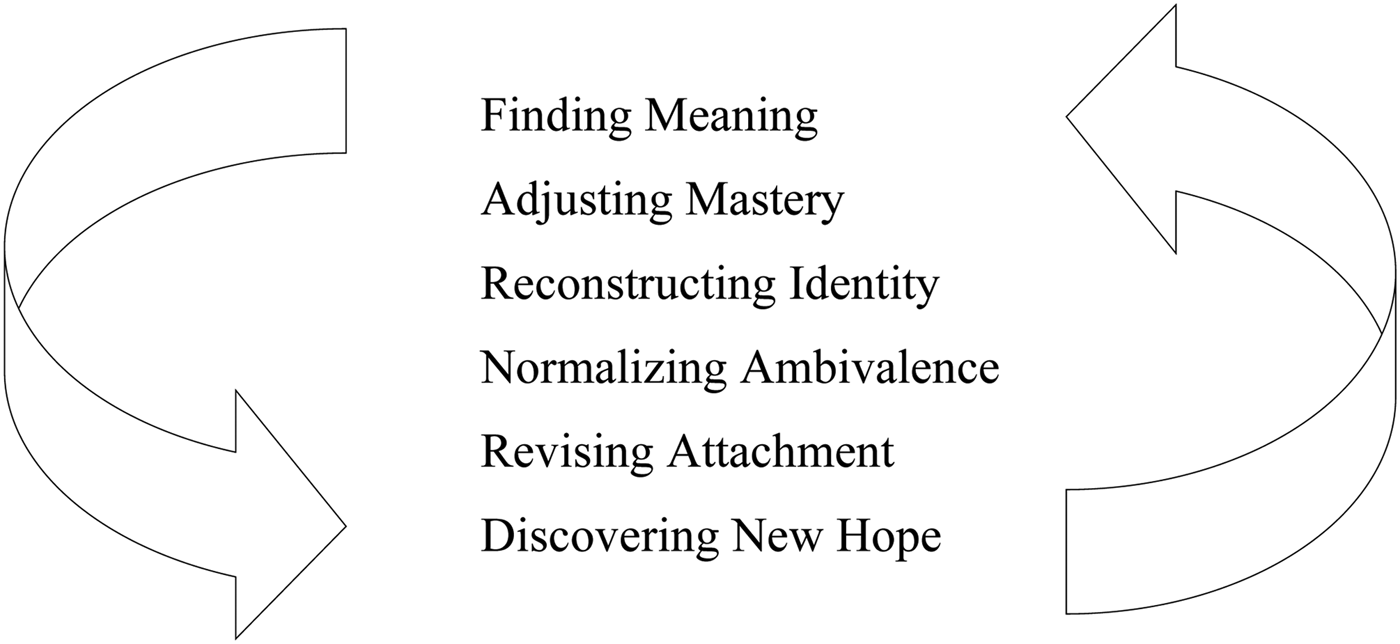
Second, the order in which guidelines are used is meant to fit the time and place of a particular intervention and the population involved. In Figure 2, we link “Finding Meaning” in a circle to “Discovering New Hope”, echoing Viktor Frankl's finding that there is no meaning without hope, nor hope without meaning;Footnote 42 the two curved arrows symbolize that the process of building resilience to live with the ambiguity of loss is neither linear or cyclical, but simply circular. Within this framework, however, the guidelines can be used in any order for an intervention process that is fluid and flexible, depending on the culture and power structure of the people involved.
Six guidelines for increasing resilience to live without closure. Source: P. Boss, Loss, Trauma and Resilience, above note 1.

Finally, while each guideline is summarized below, I strongly urge professionals to read the full discussions of each guideline, which appear in separate chapters in the present author's book Loss, Trauma, and Resilience Footnote 43 or its German,Footnote 44 JapaneseFootnote 45 or GeorgianFootnote 46 translations.
Finding Meaning
To find meaning in the experience of ambiguous loss is to be able understand it. To do this, we must first give the problem a name. We tell family members, individually as well as in groups: “What you are experiencing is ambiguous loss. It is one of the most difficult types of loss because there is no closure. It is not your fault.” Giving the problem a name (ambiguous loss) allows survivors to better understand the situation and thus ease their feelings of helplessness and of blame (toward themselves or others). Naming the stressor allows the coping process to begin. Talking with others who are experiencing the same type of loss helps people understand the dialectic of both-and thinking. That is, they slowly learn to embrace the paradox of ambiguous loss: “My child is both probably dead, and maybe not”; “He is both gone, and still here in my thoughts and dreams.” To find some measure of meaning in the meaninglessness and absurdity and irrationality of ambiguous loss, we give up on absolute thinking and accept the paradox – there may still be some meaning in meaninglessness. It may be found in spiritual resources and in the practice of family rituals and gatherings. Family- and community-based therapies serve as antidotes to isolation, secret-keeping and self-blame, which hinder the discovery of meaning. By naming and externalizing the cause, we normalize its effect so that families understand that it is not their fault. With this new meaning, they are better able to begin the necessary process of change and adaptation.Footnote 47
Adjusting Mastery
Mastery is defined as the ability to have control over one's life. The extreme poles of mastery are perfectionism (believing one can control everything) and passivity (believing that one has no control). Neither extreme is recommended in everyday life, and certainly not with ambiguous loss. The overall assumption, however, is that having a mastery orientation, a sense that you can solve problems, is a consistent moderator of stress and trauma. While the original title for this guideline was “Tempering Mastery”, Robins,Footnote 48 in his research on families of the missing in Nepal, found that sometimes a family member's sense of mastery needs to be increased, not tempered. For example, he found that in Nepal's patriarchal cultures, if a husband disappears, his wife no longer has any role or agency and thus is often neglected or abused by his family. Neither wife nor widow, with no power to master her own life, she needs more empowerment, not less.Footnote 49 To do this, an ICRC delegate organized the disenfranchised women into a group that met regularly in the community. Together, the women were empowered to live well despite a missing husband. While these women may still live with their missing husband's family, they now have a psychological family of peers to increase their sense of mastery and thus make their lives better.
Robins’ finding adds a correction to this particular guideline. It is now retitled as “Adjusting Mastery” (up or down). If families of the missing are already highly competent and mastery-oriented, accustomed to solving problems, we may need to temper down their need for mastery. If people are not accustomed to being in charge of their lives, or for some reason are not culturally allowed to be, we increase their empowerment. If survivors feel helpless and hopeless, we encourage them to begin mastering their internal selves through – depending on their culture and beliefs – meditation, prayer, mindfulness, physical activity, music, art and dance, among others. Mastering a musical instrument or a drawing or simply being in prayer are ways by which many have lessened their sense of helplessness and thus gained mastery and resilience.
In additional to cultural factors, we note that due to discrimination, poverty, stigma, imprisonment, illness, disability or age (too young or too old), there are many human beings who have no mastery or control over their lives. Again, this requires careful assessment and intervention to increase their mastery, not temper it.
Reconstructing Identity
This guideline concerns the need to reconstruct one's identity in order to fill the roles vacated by the missing person. We encourage family members to reflect on who they are now that a spouse or child or sibling has disappeared: “Who am I now that my loved one is gone? Am I a wife or widow if my husband has been gone for years? Am I still a mother if my only child was kidnapped? What new roles must I now take on to make up for this person's absence?” We also encourage reflection about family membership: “Who do you see as your family now? Who is in and who is out? That is, have marital and family boundaries changed? If family members are non-supportive, have others become like family to you?” Together and individually, depending on culture and circumstance, we encourage people to reflect on these questions. Being able to shift who one is and what one does in the family now – and over the family life cycle – is essential for resilience. Human identity and performance are, after all, quite malleable over time, even apart from ambiguous loss.Footnote 50
Normalizing Ambivalence
Ambivalence means having mixed emotions or feelings about a person, e.g. love/hate, anger/sorrow. In families of the missing, such conflicting emotions often cause immobilizing guilt and anxiety, so it is necessary to talk with someone, perhaps a professional, to acknowledge and manage the negative side of the ambivalence. To prevent pathologizing this reaction to ambiguous loss, we need to know the difference between psychiatric and social ambivalence.Footnote 51 With ambiguous loss, the ambivalence is caused by an external social rupture; it is not a psychiatric problem. The pathology emerges from the ambiguity in the family's social environment and is a typical response to ambiguity. The resulting ambivalence is thus normalized. We also normalize what is the most guilt-producing response: wishing it were over, wishing the missing person's body would be found, wishing them dead because it would bring closure to the pain. Once recognizing that the ambivalence is sociological and not psychiatric, the guilt and tension are more easily managed. Note, however, that although we normalize anger and guilt, we do not normalize harmful actions such as abusing oneself or others.
Social ambivalence may be an unfamiliar concept because it was not mentioned by early grief theorists and is thus rarely taught nowadays. While BowlbyFootnote 52 wrote about the intense pain of losing a loved one and the stress of ambivalence after loss that helps motivate letting go to lower this anxiety, he did not refer to losses that remain socially ambiguous; nor did Freud.Footnote 53
Revising Attachment
Family members of a missing person report confused attachment, as they no longer know how to relate to the lost person. Are they connected or not? Without reciprocity, spouses, parents and siblings of the missing say they no longer have the relationship they had emotionally, socially and cognitively. The attachment, as it was, is now gone. To understand the relationship with a missing person, one has to embrace the both-and paradox: “My loved one is both gone and still here.”
Revising attachment does not mean seeking closure. Rather, it means maintaining an ongoing internal relationship with the lost person while also investing emotional energy in finding new relationships and connections.Footnote 54 This means both letting go and remembering the lost person – grieve what was lost, but celebrate what you still have of that person. No family member is fully present all the time; nor are they fully gone, even after disappearance or death. Rather than severing your attachment to the missing person, let go of the idea of closure, and instead, remember and honour them while moving forward with life in a new way and with new attachments.
Discovering New Hope
Due to the ongoing nature of ambiguous loss, it is essential that families of the missing discover some new hope – a new hope that does not focus on the missing person. Again, both-and thinking may help: “I both hope for my loved one's return and am moving forward with new hopes and dreams.” Often, families of the missing hope to help prevent the kidnapping and disappearance of others by working to change laws or government policy; or they find new hope in raising their children well because that is what the missing person would have wanted, and because the next generation might make life better. Surviving families may move to a new place where life is safer. Some discover that working for justice embodies hope. Others find that renewing and deepening their spiritual resources enables them to imagine and then implement new hopes. Understanding that hope does not end suffering, but enables forward movement despite the pain of ambiguity, becomes a valuable family resource. Something good can come of the suffering when some new hope is found.
These six guidelines, reviewed briefly here, embody the therapeutic core needed to restore meaning and hope in families of the missing. They are a map for building resilience.Footnote 55 With the ambiguous loss theory as a guiding map, we challenge the idea that unresolved grief and ambivalence are always pathological. As families of the missing meet together to discuss these guidelines, and hear from others who are also experiencing ambiguous loss, they realize they are not alone. They see that suffering can be eased by shifting perceptions and building resilience. We strongly recommend the ambiguous loss model as a map to guide interventions, wherever they take place.
Relevance for humanitarian workers: The need for professional self-reflection
Those who work with ambiguous loss must recognize that we cannot bring the families that we work with farther than we ourselves can go in tolerating ambiguity. It is not just the surviving families who must grapple with the six issues presented above; those of us who work with them must do so as well. Elsewhere I have written specifically about how to care for oneself and regularly reflect on how to prevent burnout and fatigue.Footnote 56 As humanitarians, we all need to be aware of how we feel about doing this difficult and often dangerous work with the families of missing. Who am I as I do this work? What is my own level of tolerance for ambiguity? Do I feel like a professional failure if I cannot find a solution for the people I am aiding? How do I feel when I cannot find answers for the affected families and communities?
We must regularly reflect on our own losses if we are to understand the losses of others. We, too, must be mindful of the six guidelines – finding meaning in our losses, adjusting mastery over our lives personally and professionally, reconstructing our identities, normalizing the inevitable ambivalence, revising our attachments, and discovering new hopes and dreams as we move through life. If we are to be effective in aiding the families suffering with ambiguous loss, we must first recognize and reflect on our own. We all have some ambiguous losses, though rarely as extreme as those discussed here. It is from acknowledging our own needs and vulnerabilities that we become more resilient and effective in our humanitarian work. While we have been trained professionally to find answers, cure pain, solve problems and fix the broken, working with the families of the disappeared is indeed a unique challenge.