Introduction
Cultivated barley (Hordeum vulgare ssp. vulgare) was domesticated from its wild progenitor (H. vulgare ssp. spontaneum) ~12,000 years ago within the Fertile Crescent (Zohary and Hopf, Reference Zohary and Hopf2000), a region which spans Israel, Jordan and parts of Turkey. Barley is now one the world's most important grain crops, and is cultivated in temperate environments throughout the world. One of the major genetic adaptations to the novel agricultural environments encountered during the post-domestication spread of cultivation was the modulation of flowering time, which is largely controlled in response to day length (photoperiod) and low temperature (vernalization). Four major genes controlling barley flowering time have been identified (Laurie et al., Reference Laurie, Pratchett, Bezant and Snape1995). Wild-type alleles at the vernalization response loci (VRN-H1 and VRN-H2) delay flowering in the absence of vernalization, thereby maintaining vegetative growth in wild barley and autumn-sown domesticates during the winter months, and preventing damage to sensitive floral organs (Cockram et al., Reference Cockram, Jones, Leigh, O'Sullivan, Powell, Laurie and Greenland2007a). Selection for vernalization-non-sensitive alleles at these loci resulted in spring-sown domesticates which lack a vernalization response, allowing avoidance of the comparatively cold winters encountered in northern Europe. Of the two major photoperiod response loci, PPD-H1 modulates flowering in response to long-day (LD) photoperiods, while PPD-H2 controls flowering in response to short-days (SDs). Mutations at PPD-H1 resulted in photoperiod-non-sensitive alleles that remove the promotion of flowering in response to LDs (Turner et al., Reference Turner, Beales, Faure, Dunford and Laurie2005), extending the growing period and allowing domesticates to take advantage of the long cool and wet summers of north Europe. Deletions within the PPD-H2 candidate gene HvFT3 are associated with a delay in flowering under SDs (Faure et al., Reference Faure, Higgins, Turner and Laurie2007), which helps to maintain the vegetative stage in autumn-sown types until the onset of spring, even after the vernalization requirement has been met. Here, we use recently developed genetic markers diagnostic for allelic state at these major flowering time loci to explore diversity in wild and domesticated barley.
Methods
Genomic DNA was extracted as described by Jones et al. (Reference Jones, Leigh, Mackay, Bower, Smith, Charles, Jones, Jones, Brown and Powell2008). The PCR-based marker assaying for allelic variation at VRN-H1 is described by Cockram et al. (Reference Cockram, Norris and O'Sullivan2009). VRN-H2 genotyping was performed using the assay described by Karsai et al. (Reference Karsai, Szűcs, Mészáros, Filichkina, Hayes, Skinner, Láng and Bedö2005). The HvFT3 candidate gene at the PPD-H2 locus was genotyped as described by Faure et al. (Reference Faure, Higgins, Turner and Laurie2007). PPD-H1 genotypic data was sourced from Jones et al. (Reference Jones, Leigh, Mackay, Bower, Smith, Charles, Jones, Jones, Brown and Powell2008). Sequencing was performed as described by Cockram et al. (Reference Cockram, White, Leigh, Lea, Mackay, Laurie, Powell and O'Sullivan2008) and contig formation was conducted using the VectorNTI package (Eppendorf). Geodata were plotted using ArcGIS v.10 (ESRI). For clarity, we use the vernalization locus nomenclature described by Dubcovsky et al. (Reference Dubcovsky, Lijavetzky, Appendino and Tranquilli1998).
Results
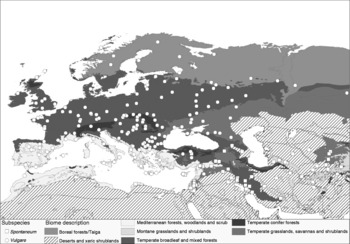
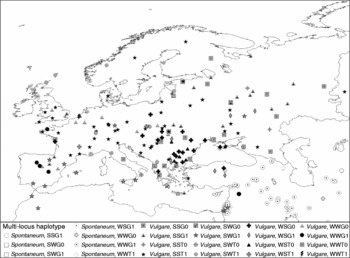
We sourced a collection of 315 barley germplasm accessions with associated collection site geodata (longitude and latitude) from national genebanks (Fig. 1). Of these, 120 represent wild barley accessions, sampled from throughout their natural range. The remaining 195 accessions are landraces (cultivated, locally adapted barleys that pre-date systematic plant breeding), from across north-western Europe. Overlaying biome data illustrates that the western spread of barley domestication into the Mediterranean basin was into environments broadly similar to those encountered in the centre of domestication (Fig. 1). However, the spread into north and north-western Europe resulted in cultivation in regions with very different seasonal conditions and biomes. Genotypic analysis of VRN-H1 intron 1 InDel variation finds that, while 98% of wild barley accessions are predicted to possess winter alleles, three accessions (all of which are located within Israel) carry spring alleles (Fig. 2). Of these, the amplicons obtained from two accessions suggest they possess that same allele, found at low frequency within landrace accessions from the western Mediterranean. Sequencing the VRN-H1 amplicon obtained in the third accession finds that it possesses an intron 1 deletion not previously identified in cultivated barley (Cockram et al., Reference Cockram, Chiapparino, Taylor, Stamati, Donini, Laurie and O'Sullivan2007b,c) (Supplementary Fig. S1, available online only at http://journals.cambridge.org). PCR assays for the presence/absence of the three candidate genes at VRN-H2 (ZCCT-Ha, ZCCT-Hb and ZCCT-Hc) shows that the deletion of all three genes associated with spring vrn-H2 alleles in landrace and modern European cultivars (Cockram et al., Reference Cockram, Chiapparino, Taylor, Stamati, Donini, Laurie and O'Sullivan2007b) is not found in wild barley. However, additional deletions are observed: individual deletions of ZCCCT-Ha (ten accessions), ZCCT-Hb (one accession) and ZCCT-Hc (one accession), as well as a single example of a double deletion (ZCCT-Ha and ZCCT-Hb). Analysis of the PPD-H2 candidate gene HvFT3 shows that the mutated allele that delays flowering under SDs occurs at low frequency across the mid-to-western range of H. vulgare ssp. spontaneum. Overlaying genotypic data for allelic status at PPD-H1 (sourced form Jones et al., Reference Jones, Leigh, Mackay, Bower, Smith, Charles, Jones, Jones, Brown and Powell2008) shows the presence of the mutant photoperiod non-responsive allele in wild barley from the east of its natural range. Simultaneous analysis of allelic status at all four flowering time loci finds an increase in haplotype number from 7 in wild barley, to 16 in landraces.
Biome descriptions, overlaid with the geographic locations of germplasm collection sites for the landrace and wild barley accessions utilized in this study.

Predicted allelic combinations at the major barley flowering time loci in landraces and wild barley. Allelic status predicted by VRN-H1 and VRN-H2 genotypes is indicated by S (spring) and W (winter). Allelic status at the diagnostic PPD-H1 single-nucleotide polymorphism described by Turner et al. (Reference Turner, Beales, Faure, Dunford and Laurie2005): G, LD-photoperiod responsive (wild-type); T, LD-photoperiod non-responsive. PPD-H2: 1, HvFT3 present (SD-photoperiod responsive, wild-type); 0, HvFT3 absent (SD-photoperiod non-responsive).

Conclusions
The modulation of flowering time during the post-domestication spread of barley cultivation allowed flexibility in the timing of sowing and harvesting, helping to maximise the yield. Our findings support the assumption that this flexibility was conferred both by the selection for mutations at major flowering time genes and the utilization of multiple allelic combinations at these loci. We find that the mutated photoperiod-non-responsive ppd-H1 and photoperiod-responsive ppd-H2 alleles originated pre-domestication. In contrast, the spring Vrn-H1 and vrn-H2 alleles found in modern European varieties (Cockram et al., Reference Cockram, Chiapparino, Taylor, Stamati, Donini, Laurie and O'Sullivan2007b) are absent in wild barley. However, we identify rare instances of novel VRN-H1 and VRN-H2 deletions, predictive of spring alleles. Deletions within VRN-H1 intron 1 result in the loss of vernalization requirement, and it is thought that the size and location of these deletions may have a quantitative effect on flowering time (Szűcs et al., Reference Szűcs, Skinner, karsai, Cuesta-Marcos, Haggard, Corey, Chenn and Hayes2007). The identification of a novel deletion in ssp. spontaneum demonstrates that unexplored allelic variation exists within wild germplasm. The presence of identical 6 bp repeat motifs flanking this deletion suggests that it was formed by illegitimate recombination (IR) following double strand break (DSB) repair (Puchta, Reference Puchta2005), as previously observed in other VRN1 deletions in barley and wheat (Cockram et al., Reference Cockram, Mackay and O'Sullivan2007c). As DSBs that occur anywhere within the intron have the potential to result in large deletions after IR, the creation of novel spring Vrn-H1 alleles is predicted to be more frequent than the mutation of single DNA bases at a precise location within a gene. The predicted increased frequency of allele conversion supports our hypothesis that the spring Vrn-H1 alleles observed in modern European cultivars arose post-domestication.
As was the case with VRN-H1, our data suggest the triple ZCCT deletion associated with spring vrn-H2 alleles in all European germplasm surveyed to date (Cockram et al., Reference Cockram, Chiapparino, Taylor, Stamati, Donini, Laurie and O'Sullivan2007b) occurred post-domestication. The prediction of single and double ZCCT deletions in wild barley indicates this genomic region may be prone to structural rearrangements. Genetic analysis of populations constructed from accessions differing for ZCCT copy number could help determine the relative function/phenotypic strength of each copy. Studies in human and animal genetics are increasingly finding copy number variation (CNV) to be an important component of functional genetic variation. Our findings suggest that mining germplasm for CNV could help resolve the contributions of duplicated genes in such cases. We hope to build on the preliminary analysis of barley germplasm presented here, with the aim of investigating the routes of cultivation into Europe, and the basis of genetic adaptation to local agricultural environments.