INTRODUCTION, BACKGROUND, AND AIMS
The primary aim of this article is to describe the design, implementation, and preliminary results, at 18 months, of “La Caixa” Foundation Program (LCP) entitled: “Comprehensive Care for Patients with Advanced Illnesses, and their Families.”
Background
Patients with life-limiting, advanced, chronic, progressive diseases (and their families), have the challenge of adjusting to impairment and loss. This presents multi-dimensional needs and demands, which require a comprehensive approach for their resolution.
A rapid implementation of palliative care (PC) services has been developed in Spain within the context of the Spanish National Strategy for Palliative Care (Estrategia Nacional de Cuidados Paliativos, Ministerio de Sanidad, 2007). A comprehensive and systematic care of the needs of patients and their families has been proposed as the ideal model of care and intervention. A qualitative analysis of the Spanish model has identified care of the spiritual, psycho-social, and bereavement domains as the main areas in need of improvement.
“Fundació La Caixa” (FLC) (http://obrasocial.lacaixa.es/) is a section of “La Caixa,” the biggest Spanish savings bank the profits of which, by its constitution, are dedicated to social needs of the population. The FLC has been constituted to improve and develop cultural and social programs in response to identified needs, and complements public, or government-sponsored, coverage. The WHO Collaborating Center for Palliative Care Public Health Programs (WHOCC) (http://iconcologia.net) is based in the “Qualy” End-of-Life Observatory at the Catalan Institute of Oncology (ICO) in Barcelona. The mission of this Center is to promote the implementation of PC as one of the elements of Public Health Programs in Spain and, by extension, Europe and Latin America.
Both organizations (WHO and ICO) agreed in late 2007 to design and implement a program to comprehensively improve the psycho-social aspects of care (emotional, social, family, spiritual, bereavement) in Spain based on a qualitative analysis of needs, and within the context of the National Strategy for Palliative Care.
METHOD
This current report describes the process of design and implementation of “La Caixa” Foundation Program, together with the preliminary results at 18 months. The Program “Comprehensive Care for Patients with Advanced Illnesses and their Families,” consists of the selection and implementation of 30 Psycho-social Support Teams (PSTs) providing support for preexisting PC services.
The material reviewed includes: the process of identifying needs; defining the aims, mission, and vision of the program; proposing/defining the model of care, intervention, and organization; and identifying the selection criteria. Also addressed were: the composition of the selection committee and the core nuclear team; initial activities that were performed in implementing the teams and the training processes involved; the follow-up requirements including quantitative and qualitative evaluations performed; evaluations of quality, preliminary, clinical results at 9 months; and updated organizational outputs at 18 months.
The clinical outcomes were collected in September 2009 in a retrospective sample of 453 clinical notes of patients attended to by 23 teams. The same documentation and monitoring of the four core parameters selected (general well-being, anxiety, depression, insomnia) were applied using numerical verbal scales (NVS).
The perception of general well-being, the severity of anxiety, depression, and insomnia were assessed on admission and, subsequently, in every follow-up visit. These variables were selected for evaluation based on our previous experience in clinical oncology. The data are sufficiently detailed but provide an easily acquired picture of symptom burden and represent the different dimensions of needs (Porta-Sales et al., Reference Porta–Sales, Codorniu and Gómez–Batiste2005) as defined by the European Association for Palliative Care (Caraceni et al., Reference Caraceni, Cherny and Fainsinger2002) and its Spanish equivalent (Centeno et al., Reference Centeno, Noguera and Lopez2004). The selection of these symptoms was based on their high prevalence, the feasibility of modifying them with treatment, and their impact on the patients (Barreto et al., Reference Barreto, Bayés and Comas1996). Improvement in psychological symptoms is one of the cornerstones of the perception of well-being. The measurements of intensity using NVS constructed jointly by the patient and healthcare professional are the most common method in our context. Also, we proposed this methodology to encourage participation and increase the feasibility of conducting the study within the context of a multi-centered program involving many teams (Gómez-Batiste et al., Reference Gómez–Batiste, Porta–Sales and Espinosa–Rojas2010). The four dimensions of the spiritual pain scale are those used at the San Diego Hospice/Institute of Palliative Medicine (http://sdhospice.org/). The scale assessed Relationships, Peace, Hope, and Sense-of-Life on categorical scales of 0 to 4 (where 0 = least favorable; 4 = most favorable). These data were collected from the clinical notes of the patients. No data from relatives and bereavement interventions had been collected systematically, and are not included in this report. The organizational outputs (activity) were retrieved from the commonly adapted activity information system, and collected periodically (usually weekly).
A total number of 29 PST teams were evaluated by an external quality assessment agency (AENOR: Asociación Española de Normalización y Certificación), according to criteria established by the steering committee. The criteria were identified in a consensus meeting in which a formal structured survey was conducted to evaluate data on structure, activity, and outcomes. The AENOR agency contacted 72 healthcare professionals (service directors and other members of the PC services), from among the 61 teams supported by the PST. The structured survey addressed parameters related to satisfaction with the PC service.
The process of training in PC was evaluated by attendees at the meeting, using a semi-structured survey.
Statistical Analysis
All study variables were analyzed at the baseline visit and again at the follow-up visits using the appropriate descriptive statistics depending upon the nature of the variable. Continuous variables included number of observations, mean, standard deviation (SD), standard error of the mean (SEM), minimum, median, and maximum. Categorical variables included number of observations and column percentages (N, %).
A preliminary clinical outcomes questionnaire addressing well-being, depression, anxiety, and insomnia was completed at the baseline visit and again at follow-up. Additionally, the patients completed a survey that was scored on the Likert scale (10 = completely satisfied, 0 = very unsatisfied). The effect size (mean change/SD of baseline value) was calculated with confidence interval at 95% (Kazis et al., Reference Kazis, Anderson and Meenan1989). A minimal effect size of 0.50 is usually described as moderate, and a size of 0.8 is described as large. Significance was set at p < 0.05. All analyses were performed with the SPSS program.
AIMS OF THE “LA CAIXA” PROGRAM
The principal aims of the project/program are the improvement of psycho-social care of terminally ill patients (and their families) with a special focus on spiritual aspects. The support of the healthcare professionals in existing PC services is also addressed.
The program acts as catalyst in creating the experience and evidence necessary to promote further implementations and to achieve good coverage for this area of medicine in Spain. It helps spread knowledge of models of organization of psycho-social and spiritual care within the context of the Spanish National Strategy for Palliative Care.
PROCESS OF DESIGN AND IMPLEMENTATION
Qualitative Assessment of Needs: SWOT Analysis (Strong and Weak Points, Opportunities, and Threats)
The psycho-social and spiritual orientation of the program was based on the results of two qualitative evaluations, performed to assess the outcomes of the Catalonia WHO Demonstration Project (WHO DP) at 15 years (Brugulat et al., Reference Brugulat, de la Puente and Masachs2008; Gómez-Batiste et al., Reference Gómez–Batiste, Fernández and Lacasta2008a) and the methodology for evaluation of palliative care public health programs (Gómez-Batiste et al., Reference Gómez–Batiste, Ferris and Paz2008c). In this process the health teams involved in the emotional, social, and spiritual aspects of care, as well as care during the bereavement process, were identified as the main areas for improvement of the PC network in our country.
DEFINED MODEL OF CARE AND ORGANIZATION
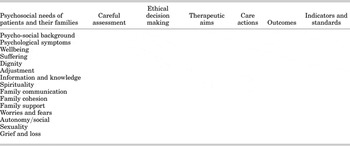
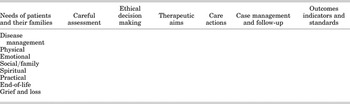
The model of care and intervention was proposed while defining the psycho-social dimensions of the clinical square of care (Table 1). A systematic approach was proposed for every psycho-social dimension.
The psycho-social dimensions of needs, and the model of care and intervention

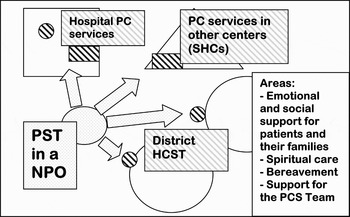
The model of organization of services (Fig. 1) was proposed based on the concept of “support teams” (Gómez-Batiste et al., Reference Gómez-Batiste, Paz and Porta–Sales2009) i.e., specialist psycho-social PST acting in support of preexisting PC services in a District. PST interventions were to focus on the issues of emotional support of patients and their families, spiritual care, bereavement process assistance, and support for the PC team.
The PST areas of intervention and model of organization in a District. PST: La Caixa Psycho-social support team. NPO: Nonprofit organization as healthcare provider. PC: Palliative Care. HCST: Home care support team. SHC: Socio-health or rehabilitation/long term care centers.

The name proposed for these specialist services was Equipos de Apoyo Psicosocial (EAPS), translated into English as Psycho-social Support Team (PST).
SELECTION PROCESS: CRITERIA, DIMENSIONS, AND OUTCOMES
A selection process was initiated with a public call for projects, with nonprofit nongovernmental organizations (NGOs) or foundations as healthcare providers taking part. There were four dimensions and four evaluation criteria for every selected dimension: the quality of the project, the experience and status of the project's director, the formal agreement with PC services, and the characteristics and experience of the provider's organization in the field of PC or of psycho-social care. A total of 86 projects were presented for selection, and the top 30 were selected by the steering committee based on the score awarded.
CONSTITUTION OF A CORE LEADERSHIP TEAM
A leadership team was constituted with five full-time administration professionals from the FLC and the WHOCC. This team had also the support of an expert group of healthcare professionals in the field of PC.
Structure of the PST
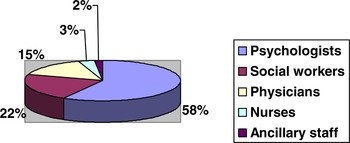
The PST, in general, is composed of three full-time administrative professionals with an appointed director (part- or full-time). There were 120 of these professionals appointed. The PST professional profile distribution is depicted in Figure 2.
(Color online) Provenance of healthcare professionals involved in the La Caxia psycho-social support team (PST) program (N=120).

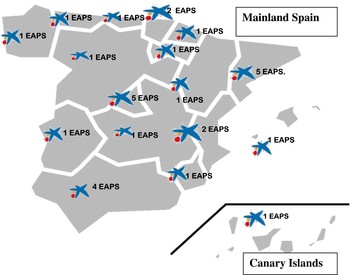
At least one PST is based in each of the 17 Autonomous Regions of Spain (Fig. 3). Autonomous Regions, as with the individual states in the United States, represent a political system in which the Autonomous Regions have their own elected legislatures whose responsibilities, in collaboration with the National Government of Spain, include fiscal planning, social welfare, infrastructure, healthcare facilities (NHS), research and development, and education. Two PST were devoted specifically to supporting pediatric PC services, and five were asked to focus on advanced geriatric patients. There were 30 PSTs initially providing support to a total number of 61 PC services (mean: 3.58 PC services/PST), and these were expanded to 154 within 1 year (5.1 PC services/PST), either as home care support teams (HCST) or hospital support teams (HST), but always within the same geographical area.
(Color online) Geographical distribution of the La Caixa psycho-social support team (PST) (N = 30). EAPS = Equipos de Apoyo Psicosocial = psycho-social support team = PST.

Training Initiation and Activity
On the organizational level, the PSTs were asked to draw up an individual strategic plan. Building up leadership and internal consensus were the main aims in the initial months.
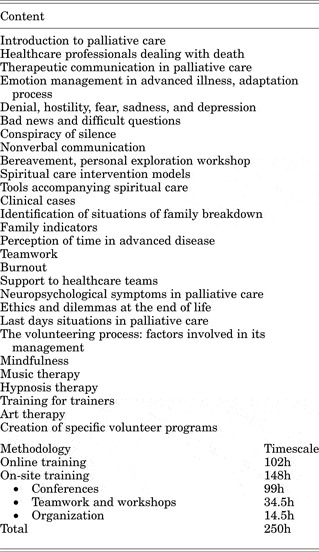
A comprehensive training focusing on psycho-social PC was implemented within 1 year. This consisted of 12 on-site sessions of 2 days each, which included all topics and methodologies. A member of the core team undertook responsibility to visit and monitor each PST and to individualize the improvements, if and when required. Additionally, an online process and a tutorial were implemented. The contents and the complete methodological planning distribution are depicted in Table 2.
Content and methodology of training

COMMON DOCUMENTATION, TOOLS, INDICATORS, AND CLINICAL GUIDELINES
A common documentation was developed based on the clinical picture of care (Tables 1 and 3). A computer-based virtual campus (http://campus.atencionsocial.org/) was created where all the teams could share experiences, documentation, and policies relating to clinical and organizational aspects. A web site for online tutoring was implemented, as well. An expert group is currently designing and validating a common tool specifically for the psycho-social and spiritual dimensions of care (Center for Improving the Care of the Dying, 2010).
The multi-dimensional model of needs, care, and intervention (adapted from Ferris, 2002)

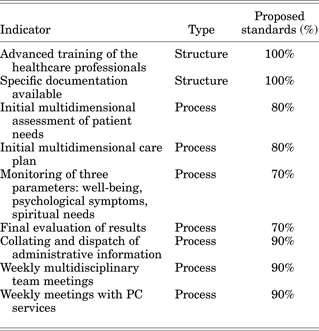
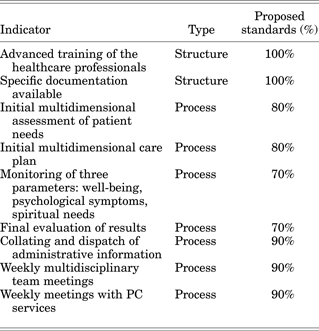
A core battery of nine indicators (Gómez-Batiste et al., Reference Gómez–Batiste, de la Mata and Fernández2002; Ferris et al., Reference Ferris, Gómez–Batiste and Furst2007; Gómez-Batiste et al., Reference Gómez–Batiste, Ferris and Paz2008b) has been designed, and with the plan of being monitored systematically in the year 2010. The basic indicators proposed are listed in Table 4, and include structure and process indicators. The performance of these core indicators in every team will be checked formally by an external assessment (AENOR).
Proposed basic indicators and standards of structure and process
PRELIMINARY RESULTS: ORGANIZATIONAL OUTPUTS AND CLINICAL OUTCOMES INCLUDING SATISFACTION OF KEY HEALTHCARE PROFESSIONALS
The activity of the PSTs began, essentially, during January of 2009, depending upon local circumstances and capacity. As of the writing of this article, the clinical activity outcomes of the PSTs represent a mean of 292 new patients and 472 relatives/year.
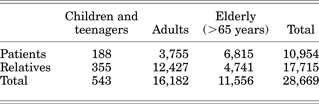
After 18 months, the quantitative results, by the end of June 2010 (Table 5) include 10,954 patients and 17,715 relatives. Of the patients, 58% were male and 83% had advanced cancer. The mean age was 73 years (range: 1–93 years). The primary diagnoses are summarized in Figures 4 and 5. A total number of 79,336 (2,664 per PST) care interventions have been performed, 75% in hospitals (i.e., SHCs). PSTs have been associated with a total of 154 PC services; 115 in hospitals (or SHCs) and 39 in HCSTs acting in the community (a mean number of 5.1 PC services/PST). Support interventions were provided to 1,349 professionals of the PC service.
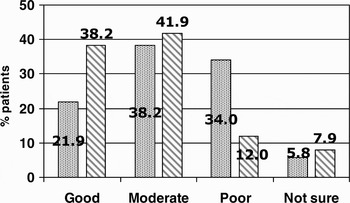
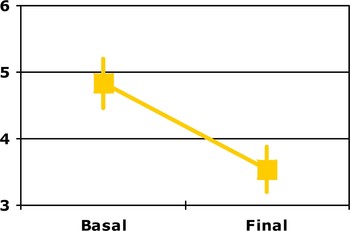
Emotional well-being at the first and last assessment.

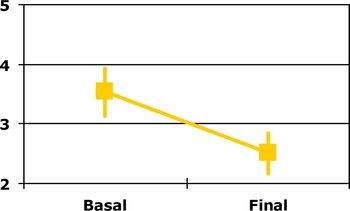
(Color online) Anxiety score (NVS: numerical verbal scale). Reduction: 1.5; 95% CI (1.03 to 1.79). Effect size: 0.60 (0.38 to 0.82). Missing: 51 (23%).

Numbers of patients and carers receiving attention, segregated by group and age distributiona
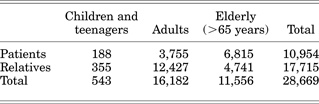
a Data collected between 1 January 2009 and 1 June 2010.
Preliminary Clinical Outcomes
We conducted a retrospective analysis of the clinical notes of 453 patients attended to by 23 PSTs. The mean duration of intervention was of 2.5 weeks, with a mean number of 3.5 direct interventions per patient; 85% of patients died of their illness in the course of the intervention. We found a significant improvement in the perception of well-being (Figure 4), and a significant reduction in anxiety and insomnia, together with a non-significant reduction in depression (Figs. 5, 6, and 7).
(Color online) Insomnia score (NVS: numerical verbal scale). Reduction: 1.18; 95% CI (0.78 to 1.57). Effect size: 0.46 (0.25 to 0.68). Missing: 52 (24%).

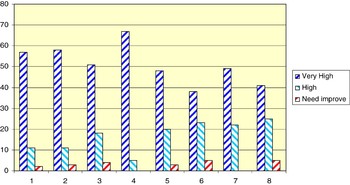
(Color online) Survey of the PC service leaders’ satisfaction and perception of support from PSTs (N = 74). Dimensions: 1. General satisfaction with PST support. 2. Satisfaction with the La Caixa Program. 3. Perceived competence of the PST (care and goals achievement). 4. Perceived professional commitment. 5. Analysis of the care activity indicators. 6. Training activities. 7. Knowledge of the program and its relationship with the La Caixa Social Program Foundation (La Caixa “Obra Social Fundació”). 8. Special difficulties during the start-up period.

OTHER OUTCOMES
External Assessment by a Quality Control Agency
A formal external assessment/survey was programmed by a quality assessment organization (AENOR). A structured interview relating to the PST program was undertaken by 74 healthcare professionals from the 61 PC services.
There were eight different dimensions evaluated, including satisfaction with the PC services. The results are summarized in Figure 7.
Costs
The total cost of the program for the year 2009 was €5,691,195 of which €4,170,000 (73.3%) was devoted to the operating costs of PSTs. The individual budget of each PST during 2009 was ~€139,200 and was €150,800 in 2010. As such, the estimated cost per patient per process is of the order of €515.
EVALUATION AND EXTENDING THE TRAINING PROCESS
Three different factors are under consideration: (1) Compulsory active participation in the present activities; (2) Generation of a specific protocol of care for every PST; and (3) Individual knowledge measured by a semi-structured survey.
A postgraduate course entitled “Comprehensive Care for Patients with Advanced Illness, and their Families” has been extended to five universities. The total number of healthcare professionals trained within the context of PST is 120, plus 150 other professionals performing other auxiliary activities. As such, a total of 270 individuals attending to the PC needs of patients (and their families) have been trained in the first year of the program.
International Uptake
The FLC promotes its program wherever La Caixa Savings Bank negotiates agreements with other financial institutions. As such, there are projects underway in Hong Kong, Mexico, Portugal, and Turkey. The aim of this international spread is not only to improve the care of patients in this area of medicine, but also assess the validity of the proposed model in contexts other than Spain.
Aims for 2010–2011
There are short-term aims proposed for the year 2010 (and currently ongoing), based on the quantitative and qualitative analysis of the program to date.
The biggest concern in 2010 is consolidating the teams and implementing new activities related to the less-developed areas identified. These include bereavement counseling, support to the PC professionals, and volunteering. To achieve these goals implies developing new joint clinical guidelines and policies, new specific training activities, and new agreements to evaluate clinical and organizational outcomes.
Other relevant goals are systematic evaluation of patient clinical outcomes with validated scales, assessment of quality in order to implement improvement programs, and increased training in the methodology of complex care provision. A further goal is to increase training in research, initially with multi-centered observational surveys followed by more complex studies on effectiveness and efficiency.
DISCUSSION
Psycho-social and spiritual needs of patients with advanced, progressive, life-limiting illnesses attended to by PC services in Spain have been described as the major areas for improvement of our PC system (Gómez-Batiste et al., Reference Gómez–Batiste, Nabal Vicuña and Trelis Navarro2008d). Over the past decade, there has been an enormous increase in awareness, experience, and evidence in these dimensions of care (Breitbart et al., Reference Breitbart, Rosenfeld and Pessin2000, Reference Breitbart, Gibson and Poppito2004; Ferris et al., Reference Ferris, Balfour and Bowen2002; McClain et al., Reference McClain, Rosenfeld and Breitbart2003; Pessin et al., Reference Pessin, Potash and Breitbart2003; Carlsson & Bultz, Reference Carlsson and Bultz2004; Chochinov & Cann, Reference Chochinov and Cann2005; Breitbart, Reference Breitbart2006; Hudson et al., Reference Hudson, Kristjanson and Ashby2006; Hanson et al, Reference Hanson, Dobbs and Usher2008; Vivat, Reference Vivat2008; Puchalski et al., Reference Puchalski, Ferrell and Virani2009; Balboni et al., Reference Balboni, Paulk and Balboni2010).
The relief of avoidable pain and the alleviation of unavoidable suffering are considered the main focus of PC (George, Reference George2009; Kellehar, Reference Kellehar2009). Empathy and communication are the main factors in coping with emotional needs and demands, whereas information and communication skills are crucial for good PC (Gysels et al., Reference Gysels, Richardson and Higginson2004). The maintenance and promotion of dignity has also been proposed as one of the basic aspects of care (Chochinov et al., Reference Chochinov, Hassard and McClement2008), and has shown positive results (Breitbart, Reference Breitbart2001; Chochinov et al., Reference Chochinov, Hassard and McClement2008).
Spiritual and existential needs can be considered the most relevant dimensions, as are the core elements such as the meaning of life, hope, and peace. These enable a patient to die peacefully, and with acceptance of the process of dying. There are well-described models of PC organizations globally (Gómez-Batiste, 2008d), as well as the provision for psycho-social aspects of care and prevention of burnout in healthcare professionals in our country (Bayés, Reference Bayés2001; Arranz et al., Reference Arranz, Barbero and Barreto2003; Benito et al., Reference Benito, Barbero and Payás2008; Benito & Barbero, Reference Benito and Barbero2008; Gómez-Batiste et al., Reference Gómez–Batiste, Porta–Sales and Walsh2008e; Lacasta Reverte et al., Reference Lacasta Reverte, Rocafort Gil and Blanco Toro2008; Payás et al., Reference Payás, Barbero and Bayés2008).
Following a careful assessment, care of the family with an overall systemic view together with bereavement support are cornerstones of good practice (Altshuler, Reference Altshuler, Firth, Luff and Oliviere2005; O'Connor et al., Reference O'Connor, Abbott and Payne2009; Payne & Hudson, Reference Payne and Hudson2009; Agnew et al., Reference Agnew, Mankltelow and Taylor2010; Thomas et al., Reference Thomas, Hudson and Oldham2010), and interventions have also shown good outcomes (Harding & Higginson, Reference Harding and Higginson2003). Based on the qualitative assessment of these areas, “La Caixa” program was designed, and has been implemented, with a systematic selection of projects, a common process of training and follow-up, a common documentation, accurate monitoring by the core team, and an organizational model based on specific support teams.
The preliminary results show effectiveness in the improvement of some measurable parameters, as in other experiences cited earlier. To obtain measurable clinical results in interventions of short duration with patients in PC services is a major challenge. Further evaluation with validated tools and prospective quasi-experimental methodology is needed to confirm these initial results. The data on the degree of satisfaction of the PC teams involved are encouraging; identifying the levels of commitment by the PST professionals was the most appreciated value. Monitoring satisfaction with the service is a core indicator of the program.
Care for the patients (and relatives) has been the focus of the PST professionals in the first year since implementation and, currently, bereavement support is being added.
The data identify a limited number of short-duration interventions with patients. This is because of the limited amount of interventions in PC services in Spain, and the implementation of the PST being very recent. These data will, probably, increase gradually because PSTs will be progressively consolidated and PC services will develop strategies for early, flexible, and shared interventions.
The costs appear to be reasonable, but more research needs to be conducted to assess the economic impact on the use of other types of resources.
Based on a systematic qualitative analysis and on a systematic design and implementation, the PST could represent a major innovation in improving the quality of PC in Spain. Also, it provides a good model of provision of psycho-social care for terminally ill or chronic advanced disease patients, and their families. There is a formal commitment to accountability, outcome evaluation in the course of generating experience, and evidence in this area.
Additionally, in this report, we present our experiences as a model of good practice in the corporate social responsibility and innovation of a savings bank. Through a formal project inserted within the Spanish National Strategy for Palliative Care, it has become possible for there to be close cooperation between the La Caixa Savings Bank, the Ministry of Health, and a WHOCC.
CONCLUSIONS
After a qualitative evaluation showing psycho-social, spiritual, and bereavement aspects of care to be the main issues in improving the model of PC provision in Spain, we designed and conducted a wide comprehensive program implementing 30 PSTs, with the aim of improving the care of patients and families, and giving support to healthcare professionals in the area of PC. Based on our findings, albeit provisional, we suggest that the PST can be a model of organization that is effective and efficient in improving the psycho-social and spiritual aspects of care of patients with advanced diseases, and their families. The program also provides support to healthcare professionals working within existing PC services. Further ongoing evaluations will add consistency to these initial findings.
Future Trends
Psycho-social and spiritual dimensions of care are key needs and demands of patients with advanced progressive illnesses, and their families. Evidence is being generated regarding models of intervention and organization, and the PST program can contribute to generating experience and evidence. The most important long-term challenge is to fully implement this program within the existing PC networks and to explore new models of organization so as to achieve better coverage for all patients and families in need.
In the course of 2011, we will design and conduct surveys on outcomes, satisfaction, and costs, using validated instruments.
Limitations
We have described the process of selecting, developing, implementing, and evaluating the PST program. The clinical outcomes are based on a retrospective analysis of the clinical notes of a limited number of patients, with tools that are not yet fully validated in Spanish, but that are commonly used by psycho-social and PC teams. In this preliminary analysis, we are have not included outcomes of interventions with respect to the patient's relatives, the bereavement interventions, and the activities related to supporting the healthcare professionals in PC services. These aspects will be the focus of future reports.
ACKNOWLEDGMENTS
We thank Mrs. Sara Ela, for logistical support and English translation.