1. Introduction
Geodesic acoustic modes (GAMs) (Winsor, Johnson & Dawson Reference Winsor, Johnson and Dawson1968) are oscillating axisymmetric perturbations that are unique to configurations with closed magnetic field lines with a geodesic curvature, like tokamaks. They are the oscillating counterparts of the zero-frequency zonal flow (Hasegawa, Maclennan & Kodama Reference Hasegawa, Maclennan and Kodama1979) and are examples of zonal structures. Zonal structures are of great interest to magnetic fusion reactors due to their potential capabilities of generating nonlinear equilibrium (Chen & Zonca Reference Chen and Zonca2007) by regulating microscopic turbulence and its associated heat and particle transport.
Geodesic acoustic modes have been largely studied in the literature, both analytically (see Garbet et al. Reference Garbet, Falchetto, Ottaviani, Sabot, Sirinelli and Smolyakov2006; Smolyakov et al. Reference Smolyakov, Garbet, Falchetto and Ottaviani2008; Zonca & Chen Reference Zonca and Chen2008; Qiu, Chen & Zonca Reference Qiu, Chen and Zonca2009; Chakrabarti et al. Reference Chakrabarti, Guzdar, Kleva, Singh, Kaw, Naulin and Rasmussen2010; Zhang & Zhou Reference Zhang and Zhou2010; Hassam & Kleva Reference Hassam and Kleva2011; Zarzoso et al. Reference Zarzoso, Garbet, Sarazin, Dumont and Grandgirard2012; Gao Reference Gao2013; Girardo et al. Reference Girardo, Zarzoso, Dumont, Garbet, Sarazin and Sharapov2014; Ren Reference Ren2015; Ming, Zhou & Wamg Reference Ming, Zhou and Wamg2018; Conway, Smolyakov & Ido Reference Conway, Smolyakov and Ido2022) and numerically (see Biancalani et al. Reference Biancalani, Bottino, Lauber and Zarzoso2014; Novikau et al. Reference Novikau, Biancalani, Bottino, Conway, Gurcan, Manz, Morel, Poli and Di Siena2017; Grandgirard et al. Reference Grandgirard, Garbet, Ehrlacher, Biancalani, Bottino, Novikau, Asahi, Caschera, Dif-Pradalier and Donnel2019). A key aspect in the linear gyro-kinetic theory of GAMs is the determination of mode frequency and damping rate. The GAM frequency is of the order of the ion sound frequency, and its major damping mechanism is collisionless damping. Analytical expressions of GAM frequency and growth rate can be found, for example, in Sugama & Watanabe (Reference Sugama and Watanabe2006) and Qiu et al. (Reference Qiu, Chen and Zonca2009). These expressions were obtained assuming Maxwellian distributions of ions and electrons with no temperature anisotropy.
Tokamak plasmas are generally modelled in analytical theory, assuming isotropic Maxwellian distributions of ions and electrons. However, in reality, there can be several sources of anisotropy in tokamak plasmas. Anisotropy in tokamaks can be introduced by auxiliary heating such as neutral beam injection, which can generate a strong parallel temperature anisotropy, whereas strong perpendicular temperature anisotropy can be observed when using ion cyclotron resonance heating. Parallel and perpendicular here are defined with respect to the equilibrium magnetic field. Generally, ion temperature anisotropy, both gyro-tropic and non-gyro-tropic, can be generated due to the action of the traceless rate of shear, which anisotropically heats the in-plane components of the pressure tensor by tapping kinetic energy from shear flow when the local gradient of the ion fluid velocity, say $\omega \sim \|\boldsymbol {\nabla }\boldsymbol {u}_i\|$ , is not negligible with respect to the local ion cyclotron frequency $\varOmega _i$
 and the collision rate (Del Sarto, Pegoraro & Califano Reference Del Sarto, Pegoraro and Califano2016). This condition is likely to occur in developed turbulence, since it can be verified on vorticity sheets delimiting vortex structures (Del Sarto & Pegoraro Reference Del Sarto and Pegoraro2018a). In particular, as long as the ratio $\omega /\varOmega _i$
 remains small enough, the generated anisotropy is mostly gyro-tropic and thus compatible with a gyro-kinetic description (Del Sarto & Pegoraro Reference Del Sarto and Pegoraro2018b) and it can be thus related to the first-order finite-Larmor radius corrections to double-adiabatic closures (Kaufman Reference Kaufman1960; Thompson Reference Thompson1961; Macmahon Reference Macmahon1965; Cerri et al. Reference Cerri, Henri, Califano, Del Sarto, Faganello and Pegoraro2013). Sasaki et al. (Reference Sasaki, Horling, Fall, Brzozowski, Brunsell, Hokin, Tennfors, Sallander, Drake and Inoue1997) measured reasonably high ion temperature anisotropy in EXTRAP-T2, and large pressure anisotropies have also been reported in Hole et al. (Reference Hole, von Nessi, Fitzgerald, McClements and Svensson2001) and Hole et al. (Reference Hole, von Nessi, Fitzgerald, McClements and Svensson2011). Ren & Cao (Reference Ren and Cao2014) studied the impact of ion temperature anisotropy on GAM frequency and growth rate in the limit of a vanishing electron to ion temperature ratio, with ions described by a bi-Maxwellian distribution. Those authors found that ion temperature anisotropy modifies the linear dynamics of GAMs. However, the GAM dynamics is known to strongly depend on the electron to ion temperature ratio (see Sugama & Watanabe Reference Sugama and Watanabe2006; Zonca & Chen Reference Zonca and Chen2008; Qiu et al. Reference Qiu, Chen and Zonca2009; Biancalani et al. Reference Biancalani, Bottino, Lauber and Zarzoso2014). Hence, a finite electron to ion temperature ratio must be retained in a complete linear theory of GAMs.
In this work, we investigate the linear dynamics of GAMs with a bi-Maxwellian distribution of ions and assuming adiabatic electrons, as in Zonca & Chen (Reference Zonca and Chen2008) and Sugama & Watanabe (Reference Sugama and Watanabe2006). We generalize the work of Ren & Cao (Reference Ren and Cao2014) to a general value of electron to ion temperature ratio and by keeping account of a gyro-tropic ion temperature anisotropy, using an approach based on the standard limit of small finite orbit radius and small finite orbit width, kept up to the leading order (consistently with Zonca, Chen & Santoro (Reference Zonca, Chen and Santoro1996) and Zonca & Chen (Reference Zonca and Chen2008)). We show that in the appropriate limits, we recover the GAM dispersion derived in Ren & Cao (Reference Ren and Cao2014), Zonca & Chen (Reference Zonca and Chen2008) and Girardo et al. (Reference Girardo, Zarzoso, Dumont, Garbet, Sarazin and Sharapov2014) from the general GAM dispersion relation which we here obtain. From our study, we find that the ion temperature anisotropy yields a sensible modification to both the real and imaginary parts of the frequency, as both tend to be increasing functions of $\chi ={T_{\perp,i}}/{T_{\|,i}}$ , and this result is strongly affected by the electron to ion temperature ratio, $\tau ={T_e}/{T_i}$
 . The equivalent ion temperature $T_i$
 is defined such that it corresponds to the same total pressure as that of the anisotropic distribution ($T_i={T_{\|,i}}/{3}+{2T_{\perp,i}}/{3}$
 ).
This first section is an introduction, which describes the motivations for this work. In § 2, we derive a general linear GAM dispersion relation for an arbitrary distribution function. In § 3, we solve the dispersion relation with a bi-Maxwellian distribution of ions and study the impact of ion temperature anisotropy and electron to ion temperature ratio on GAM frequency and growth rate. We apply our theory to an experimentally relevant case in § 4 and conclusions are reported in § 5.
2. The model for a general distribution function
In this section, we use the gyro-kinetic formalism to study the physics of GAMs in the electrostatic limit. The fundamental equations of this model are the gyro-kinetic Vlasov equation (2.1) and Poisson equations (2.2):


where $f_s$ is the distribution function of a given species, $\boldsymbol {R}$
 the particle position vector, $E=({m_s}/{2})(v_{\|}^2+v_\perp ^2)$
 the particle energy, $e$
 the electron charge, $n_{0,s}$
 the equilibrium density of a species $s$
 , $m$
 the particle mass, $c$
 the speed of light, $B$
 the magnitude of magnetic field, $Z_s$
 the species charge number, $J_{0,i}$
 the ion gyro-average operator and ${\rm d}W_s$
 a volume element in velocity space.
We make the following assumptions:
(i) We consider adiabatic electrons.
(ii) We neglect magnetic fluctuations.
(iii) We use flat density and temperature profiles.
2.1. Linear analysis
We linearize the Vlasov and quasi-neutrality equations by splitting each quantity into an equilibrium and a perturbed component, such that


where $\dot {\boldsymbol {R}}_0$ is the unperturbed particle velocity, i.e. $\dot {\boldsymbol {R}}_0= \boldsymbol {v}_{\|}+\boldsymbol {v}_{\boldsymbol {\nabla } B}+\boldsymbol {v}_{curv B}$
 , and $E_0=({m(v_{\|}^2+v_{\perp }^2)})/{2}$
 .
2.2. Linear Vlasov equation
Substituting (2.3)–(2.6) in (2.1), and neglecting second- and higher-order terms, the linear Vlasov equation reads

This linear Vlasov equation can be further simplified by splitting the perturbed distribution function into an adiabatic and a non-adiabatic component:

Substituting (2.8) in (2.7), we obtain the equation for the non-adiabatic part of the perturbed distribution function:

Using the expression of the equilibrium velocity and perturbations of the form $x \longrightarrow \exp {({\rm i}k_r-{\rm i}\omega t)}+{\rm c.c.}$ in (2.9), we obtain the expression

where $\omega _t={v_{\|}}/{qR_0}$ is the transit frequency, $q$
 is the safety factor, $\omega _{d,s}=\bar {\omega }_{d,s}\sin {\theta }$
 is the drift frequency, with $\bar {\omega }_{d,s}=({cm_sk_r}/{Z_seB_0R_0})(v_{\|}^2+{v_{\perp }^2}/{2})$
 , $E_1=Z_seJ_{0,s}\varPhi _1$
 and $k_r$
 is the radial wavenumber. Since GAMs are predominantly zonal, we can further divide the non-adiabatic part of the perturbed distribution function into a zonal and a non-zonal part:

Similarly, we write the scalar potential as

where the overbar represents the zonal components. Using these definitions, and making a flux surface average of the gyro-kinetic equation to eliminate the zonal component of the non-adiabatic part of the perturbed distribution function, the linear Vlasov equation reduces to

The corresponding vorticity equation is obtained by multiplying this relation by the gyro-average operator and integrating over the velocity space:

Considering all the changes of variable we have made, the perturbed distribution function has the form

2.3. Linear quasi-neutrality equation
Using a similar approach, we substitute (2.3) and (2.6) into (2.2) and we thus obtain the following equation:

where $\left \langle \cdots \right \rangle _W$ represents the integral over velocity space. The non-adiabatic part of the perturbed electron distribution function has been neglected in accordance with our assumptions.
2.4. Ordering of the gyro-kinetic equation
The gyro-kinetic equation (2.13) describes a wide range of phenomena at different time scales. In order to study GAMs, we need to apply an appropriate ordering that will filter out time scales which are irrelevant to GAM dynamics. The GAM frequency is of the order of ion sound frequency. The ordering is done by comparing this frequency with the characteristic frequencies in our system, i.e. $\omega _{t,s}$ , $\omega _{d,s}$
 :


To leading order, the ion and electron gyro-kinetic equations are, respectively,


2.5. General form of dispersion relation
We consider the following form for the non-zonal perturbed ion distribution function and scalar potential:


Substituting these relations into (2.19) and separating the sine and cosine components, we obtain


Following the same procedure with the quasi-neutrality equation:


Taking the flux surface average of the quasi-neutrality equation (2.19) and the vorticity equation (2.14), we have, respectively,


Substituting (2.28) into (2.27) and evaluating the flux surface average, we obtain

Substituting (2.23), we obtain the general dispersion relation of GAMs to leading order:

3. Bi-Maxwellian case
3.1. Derivation of dispersion relation
To evaluate the integrals over the velocity space given in the general linear GAM dispersion relation equation (2.30), we have to choose an equilibrium distribution function for ions. In this work, we consider it to be a bi-Maxwellian, while a regular Maxwellian is used for electrons. The ion distribution function is normalized such that its integral over velocity space equals one ($n_{0,i}=1$ ). We take $J_{0,i}=1$
 (drift kinetic limit):

By defining an equivalent temperature, $T_i={T_{\|,i}}/{3}+{2T_{\perp,i}}/{3}$ , the bi-Maxwellian can be written in the form

where $b=({2\chi +1})/{3}$ , with $\chi ={T_{\perp,i}}/{T_{\|,i}}$
 , $v_t=\sqrt {{2T_i}/{m}}$
 and $E=({m}/{2})(v_{\|}^2+v_\perp ^2)$
 . We have

Equation (2.26) then reduces to

where $\tau ={T_e}/{T_i}$ . Substituting this result in the general dispersion relation, we have

These three velocity integrals once evaluated read


where $Z(y)$ is the plasma dispersion function and

Then (3.5) becomes

with


3.2. Comparison with fluid limit and with previous results
In the limit $\chi =1$ , we recover the GAM dispersion relations in Zonca & Chen (Reference Zonca and Chen2008), Zonca et al. (Reference Zonca, Chen and Santoro1996) and Girardo et al. (Reference Girardo, Zarzoso, Dumont, Garbet, Sarazin and Sharapov2014). In the fluid limit, we can show that the dispersion relation equation (3.10) reduces to

If we consider the isotropic limit of this fluid dispersion relation, we obtain $\omega ^2_{GAM}=({7}/{4}+\tau )({v^2_t}/{R^2_0})$ , which is the same GAM dispersion relation obtained using magnetohydrodynamics with a double adiabatic closure (Smolyakov et al. Reference Smolyakov, Garbet, Falchetto and Ottaviani2008). The GAMs are special types of sound waves and, as sound waves, their frequency strongly depends on the equilibrium pressure. Considering the magnetohydrodynamic description of GAMs with a double adiabatic closure, $\chi$
 in our work is equivalent to the ratio ${p_{\perp,0}}/{p_{\|,0}}$
 , with $p_{\perp,0}$
 the equilibrium perpendicular pressure and $p_{\|,0}$
 the equilibrium parallel pressure. So increasing $\chi$
 for a fixed $p_{\|,0}$
 is equivalent to changing the equilibrium perpendicular pressure, which directly modifies the GAM frequency due to its dependence on the equilibrium pressure. This explains the global growing dependence of both the growth rate and frequency on $\chi$
 , which is evident in the figures presented below. The GAM frequency can be written in terms of the equilibrium parallel and perpendicular pressures as follows (neglecting $\tau$
 ):

where $\rho _0$ is the equilibrium mass density. The dispersion relation equation (3.10) can be written in the following form by substituting (3.11), (3.12) and (3.13) in (3.10):

3.3. Asymptotic behaviour: case $\tau$ $\rightarrow$ $0$


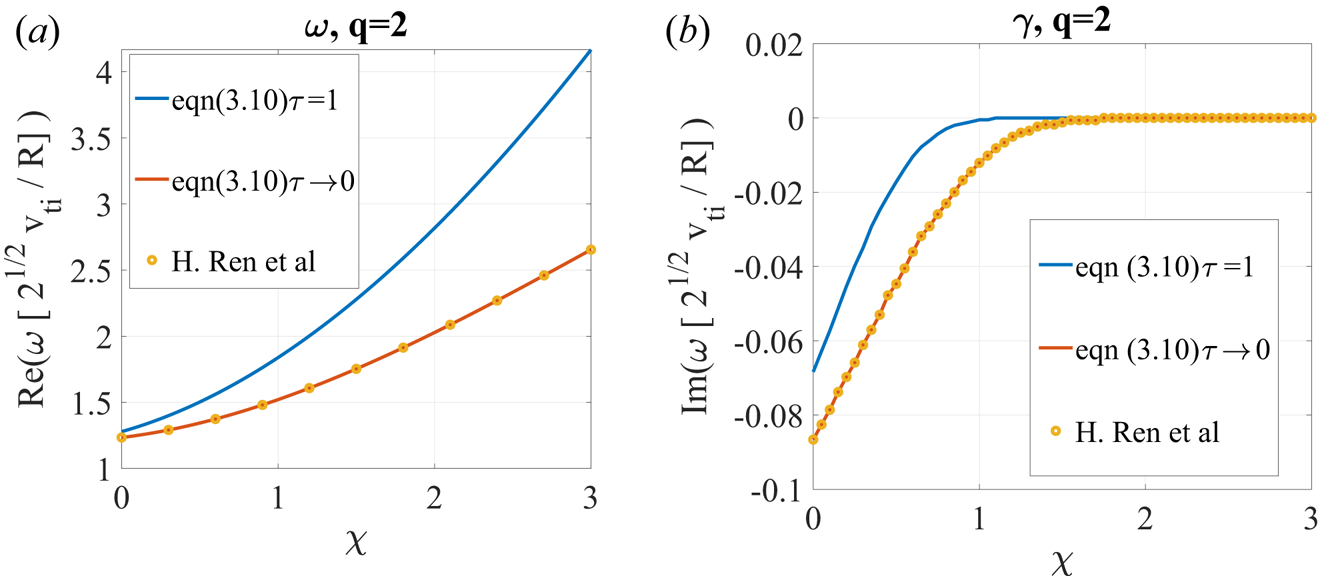
In this limit, the first term in the square brackets is large compared with the second term. Neglecting this second term, we recover the dispersion relation in Ren & Cao (Reference Ren and Cao2014):

Figure 1 shows the frequency and growth rate obtained from the complete dispersion relation (3.10) (blue curve) and the same quantities obtained in the $\tau \rightarrow 0$ limit (red curve).
(a) Frequency. (b) Growth rate.

3.4. Asymptotic behaviour: case $\tau \rightarrow \infty$

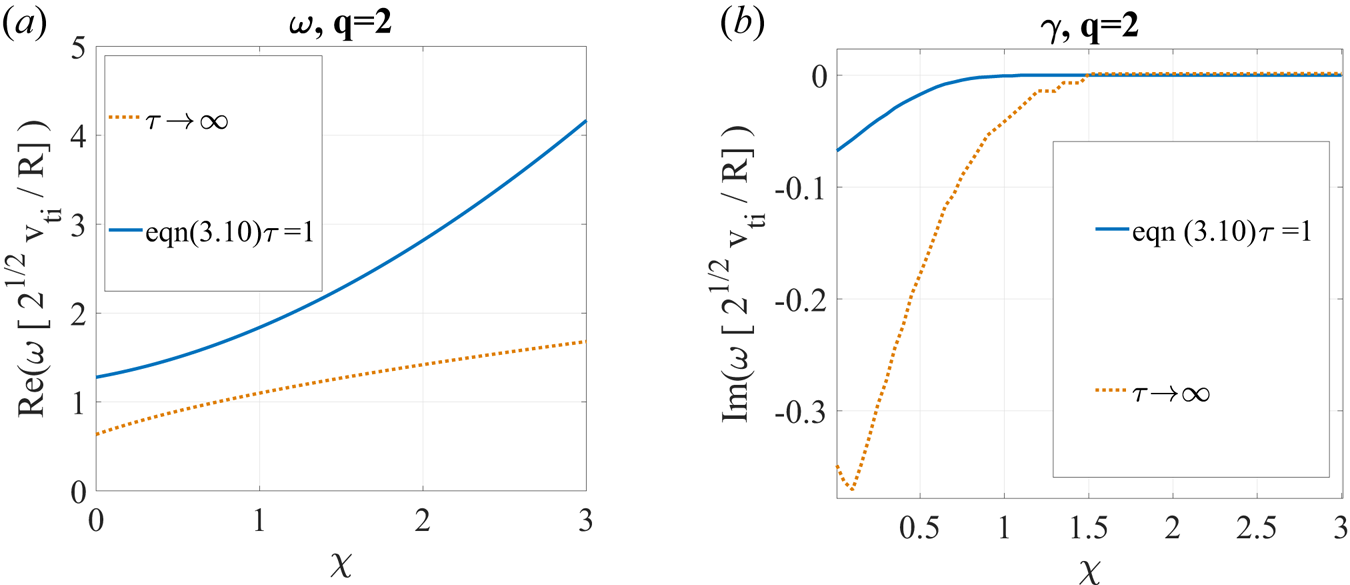
In this limit, the terms in the second square brackets in (3.16) are larger in comparison with those in the first. So the dispersion relation reduces to

Figure 2 shows the frequency and growth rate obtained from the complete dispersion relation (3.10) (blue curve) and those obtained in the $\tau \rightarrow \infty$ limit (red dashed curve).
(a) Frequency. (b) Growth rate.

In the following sections, we solve the complete dispersion relation, (3.10), with values of $\tau$ that are more realistic for tokamak plasmas.
3.5. Effect of ion temperature anisotropy on GAM frequency and growth rate
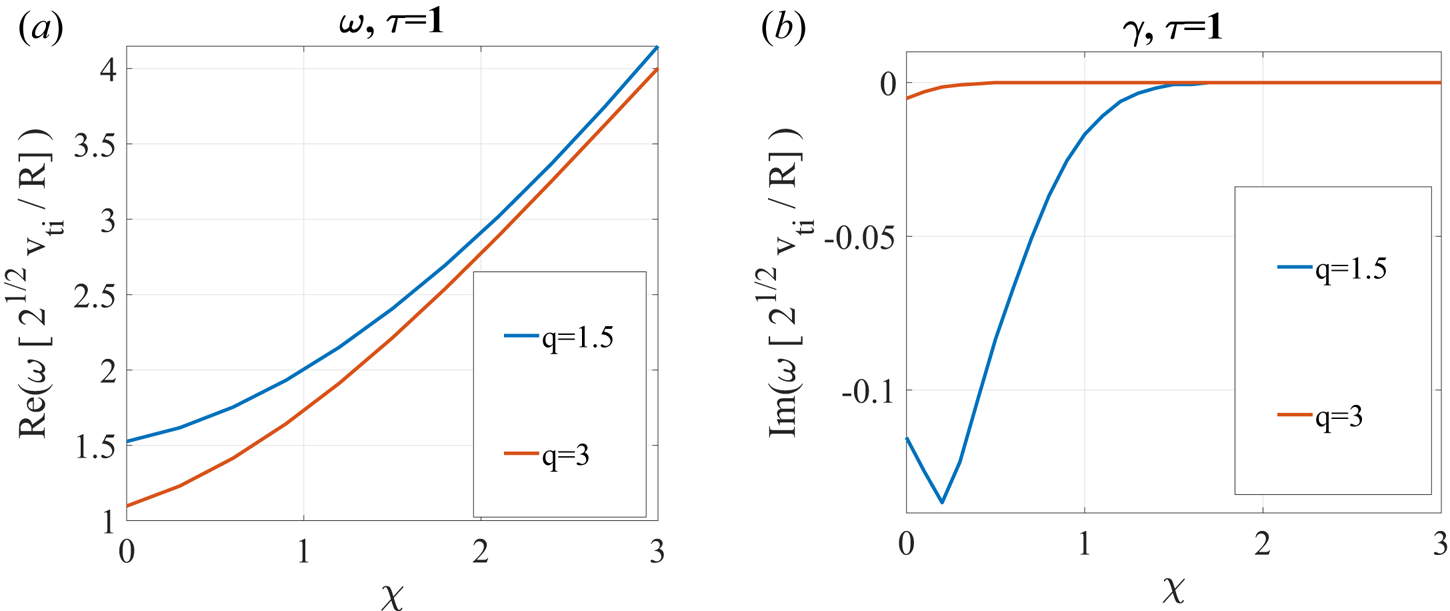
The GAM frequency and growth rate increase with $\chi$ (figure 3). However, the growth rate saturates for values of the parameters for which the instability becomes marginally stable. This saturation occurs at lower values of $\chi$
 for higher values of $q$
 . It should be noted that the growth rate at higher values of $q$
 is overestimated, since damping effects due to finite orbit width are not considered in our model. These effects tend to be more important when $q$
 increases (Biancalani et al. Reference Biancalani, Bottino, Lauber and Zarzoso2014). Similar results were obtained in Ren & Cao (Reference Ren and Cao2014). The regime of validity of our model is the plasma core. This is the region of excitation of energetic-particle-induced GAMs (EGAMs). Incidentally, the zonal flow residual level (Cho & Hahm Reference Cho and Hahm2021) can be enhanced by the anisotropic energetic particle distribution dominated by barely passing/barely trapped particles or by deeply trapped particles (Lu et al. Reference Lu, Wang, Lauber, Fable, Bottino, Hornsby, Hayward-Schneider, Zonca and Angioni2019).
(a) Frequency. (b) Growth rate.

3.6. Effects of electron to ion temperature ratio
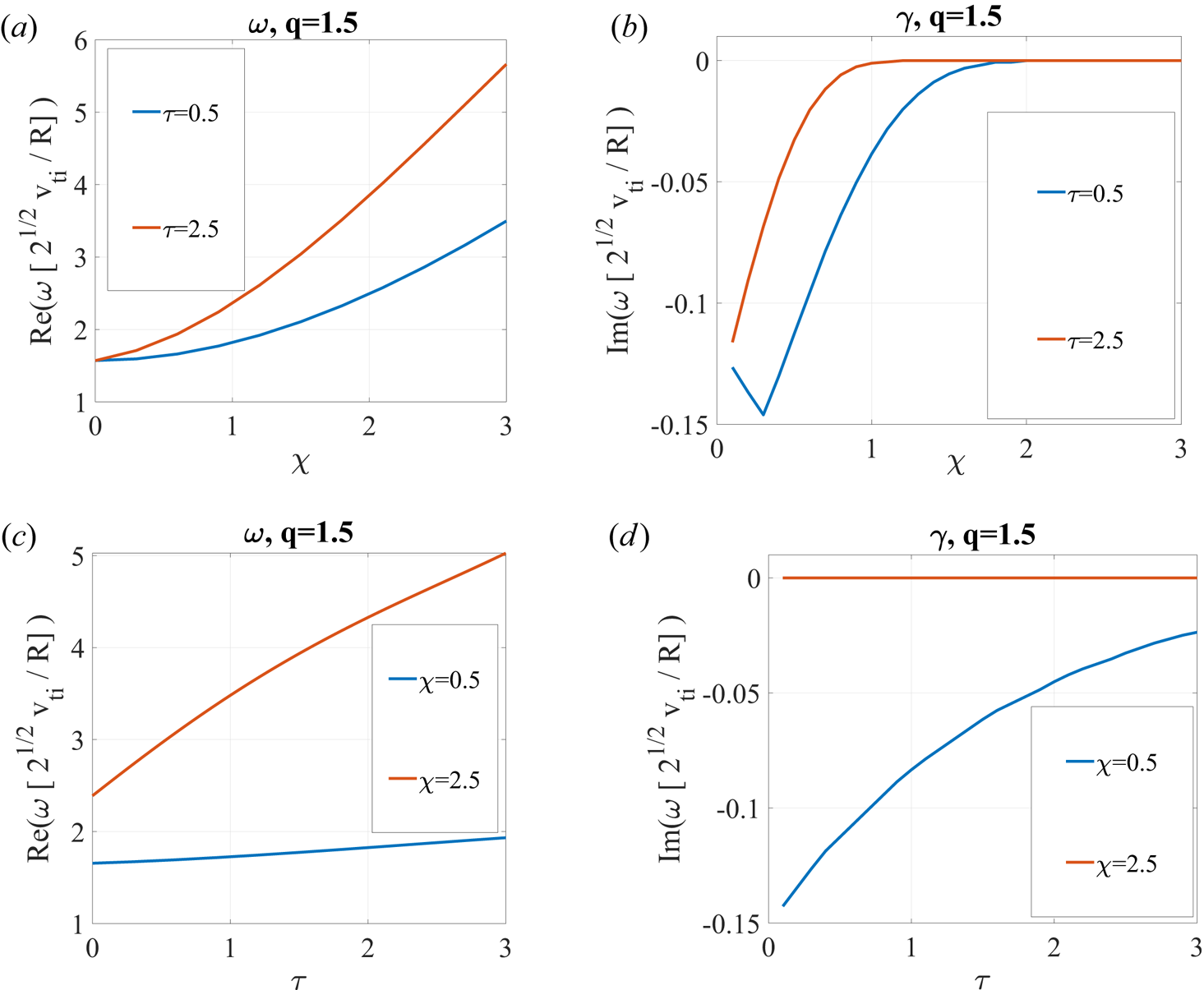
In this section, we study the effect of a finite $\tau$ (this parameter was neglected in Ren & Cao Reference Ren and Cao2014). Figure 4(a,b) shows the effects of $\chi$
 on GAM frequency and growth rate for two different values of $\tau$
 . We observe, as expected, that these quantities are increasing functions of $\chi$
 . However, there is a significant increase in frequency and growth rate with $\tau$
 . Figure 4(c,d) shows the variation of GAM frequency and growth rate with $\tau$
 for two values of $\chi$
 . We recover the isotropic $\tau$
 dependence of GAMs (i.e. increasing frequency with increasing $\tau$
 ). This effect is more pronounced for higher values of $\chi$
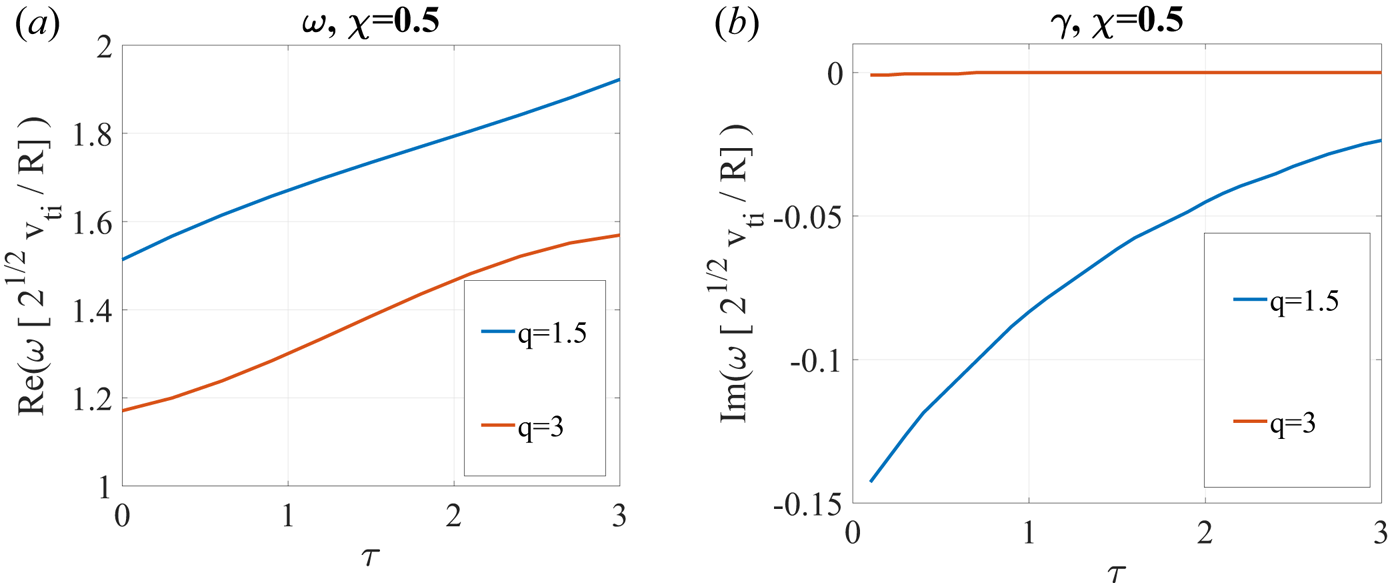
 in the anisotropic case. Figure 5 shows the effect of $\tau$
 on GAM frequency and growth rate for two different values of the safety factor $q$
 and for a fixed $\chi$
 . We observe stronger damping for smaller values of $q$
 . This confirms the fact that even in the anisotropic case, GAMs are more stable in the core than at the edge of the tokamak plasma, where the safety factor $q$
 has large values. We can conclude from figures 4 and 5 that GAM frequency and growth rate significantly increase with $\tau$
 and neglecting this parameter can lead to an underestimation of the frequency and to an overestimation of the damping rate.
Effects of $\tau$ : (a,c) frequency; (b,d) growth rate.

Effects of $\tau$ : (a) frequency; (b) growth rate.

4. Application to an experimentally relevant case
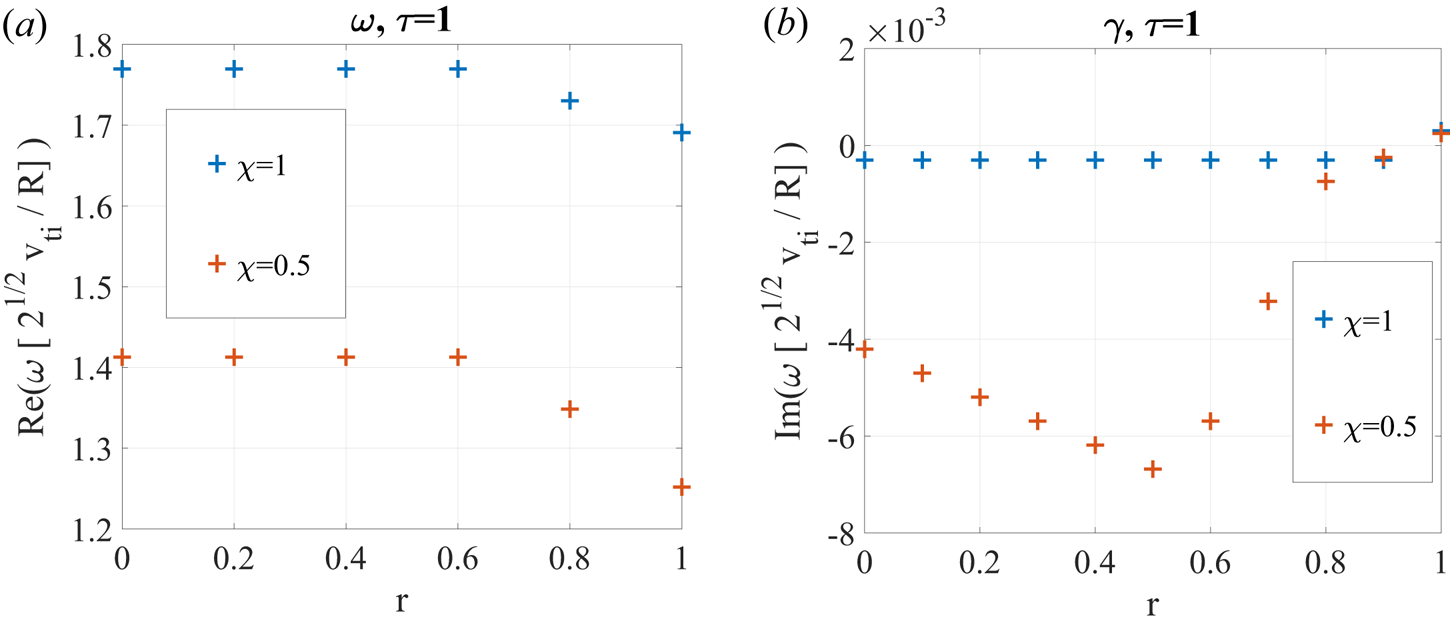
In this section, we apply the theory we have developed to a case of likely experimental relevance. For simplicity, we consider the case where the electron to ion temperature ratio is one ($\tau =1$ ), which is compatible with experimental conditions. Sasaki et al. (Reference Sasaki, Horling, Fall, Brzozowski, Brunsell, Hokin, Tennfors, Sallander, Drake and Inoue1997) studied the ion temperature anisotropy in the reverse field pinch device EXTRAP-T2. In that work, $\chi \sim 0.5$
 was measured. We here assume such values of $\chi$
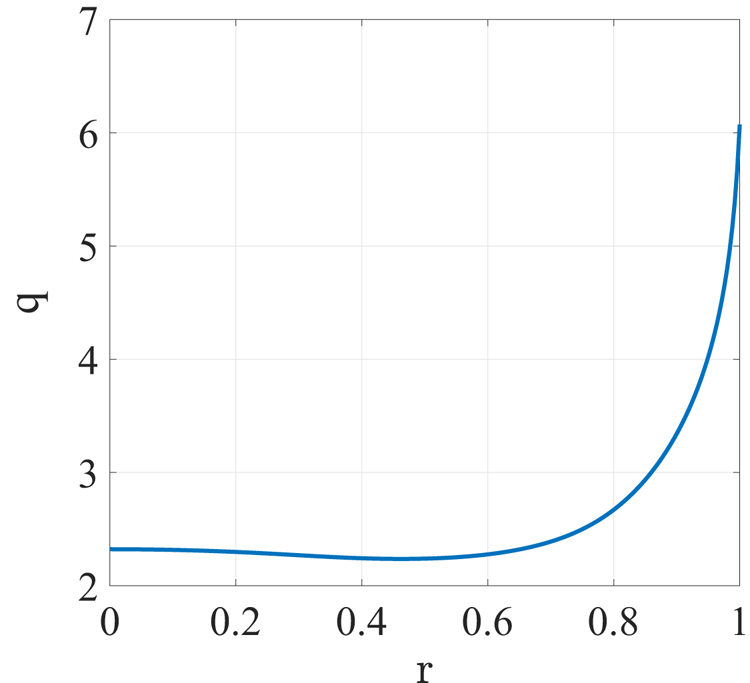
 are comparable with those that can be measured in tokamaks. To plot the GAM frequency spectrum for values of this parameter, we use the safety factor profile from the experimental benchmark test case selected for NonLinear Energetic-particle Dynamics EuroFusion project for Asdex Upgrade (NLED-AUG) (Vlad et al. Reference Vlad, Wang, Vannini, Briguglio, Carlevaro, Falessi, Fogaccia, Fusco, Zonca and Biancalani2021).
Figure 6 shows that the frequency spectrum of GAMs is very sensitive to the safety factor in the presence of ion anisotropy (Figure 7 shows the NLED-AUG safety factor profile used for these plots). This is particularly true closer to the plasma core where the GAM damping rate is almost an order of magnitude higher than in the isotropic case (damping due to finite orbit width which is important at higher values of $q$ is not considered in this work). Even though GAMs are heavily damped in the core in the presence of anisotropy, as shown in figure 6, the core dynamic of GAMs is, however, important, since it can significantly modify the interaction of GAMs and energetic particles in the core, which leads to the so-called EGAMs (Fu Reference Fu2008; Vannini et al. Reference Vannini, Biancalani, Bottino, Hayward-Schneider, Lauber, Mishchenko, Poli and Vlad2021; Rettino et al. Reference Rettino, Hayward-Schneider, Biancalani, Bottino, Lauber, Chavdarovski, Vannini and Jenko2022).
(a) Frequency versus radial position ($r$ ) and (b) growth rate versus radial position ($r$
 ) for the set of parameters of potential experimental relevance discussed in § 4.

Safety factor profile.

5. Conclusion
Zonal structures are axisymmetric perturbations that are nonlinearly generated by turbulence in fusion plasmas. There are two main types of zonal flows, namely the zero-frequency zonal flow and its finite-frequency counterpart, the GAM. The GAMs are unique to configurations with closed magnetic field lines with a geodesic curvature, like tokamaks. The GAM frequency is of the order of the ion sound frequency, and its major damping mechanism in fusion plasma is collisionless damping (ion Landau damping). The GAMs are of interest to future magnetic fusion devices due to their potential role in regulating microscopic turbulence and its associated heat and particle transport.
In this work we revisited the linear gyro-kinetic theory of GAMs with adiabatic electrons described by a Maxwellian distribution function by including the effects of kinetic ions displaying a gyro-tropic temperature anisotropy modelled with a bi-Maxwellian distribution. We thus extended the linear GAM theory with an anisotropic ion temperature to include a general value of the electron to ion temperature ratio and we derived a general linear dispersion relation for an arbitrary ion distribution function. In the appropriate limit of a negligible electron to ion temperature ratio, we thus recovered the GAM dispersion relation in Ren & Cao (Reference Ren and Cao2014). Solving the dispersion relation for the GAM frequency and damping rate for the more general case of interest here, we found that the ion temperature anisotropy yields non-negligible changes to both the GAM frequency and damping rate, as both tend to be increasing functions of $\chi ={T_{\perp,i}}/{T_{\|,i}}$ . The ion Landau damping is confirmed to be stronger for smaller values of the safety factor. These features become more pronounced when a finite electron to ion temperature ratio is considered. The values of the frequency and growth rate for a given $\chi$
 increase significantly as $\tau ={T_e}/{T_i}$
 increases. Hence, the effect of $\tau$
 on GAM dynamics is not negligible and must be included in a complete model.
We applied our theory to a scenario of potential experimental relevance by using the safety factor profile from the NLED-AUG experimental benchmark test case and assuming the ion temperature anisotropy in tokamaks is close to that measured in the reversed field pinch device EXTRAP-T2. Plotting the frequency spectrum and the damping rate as a function of position (while restricting for simplicity to the case of equal total electron and ion temperature), we find that in this scenario the core dynamics of GAMs is significantly modified in the presence of ion temperature anisotropy. Such a modification of the core dynamics of GAMs can impact the the interaction of GAMs and energetic particles in the plasma core.
In future works, we shall extend this linear theory of GAMs with inclusion of ion anisotropy effects in order to study the interaction of GAMs and energetic particles in the plasma core (EGAMs), since we have seen that the linear core dynamics of GAMs in relevant experimental scenarios is significantly modified by the ion temperature anisotropy.
Acknowledgements
The authors are grateful to E. Gravier and M. Lesur (IJL, Nancy, France), to G. Dif-Pradalier and X. Garbet (IRFM, CEA, France), to W. Bin and S. Schmuck (ISTP, CNR, Italy), to F. Zonca (CNPS, Frascati, Italy) and to X. Wang and Z. Lu (IPP, Garching, Germany) for useful discussions and remarks.
Editor P. Ricci thanks the referees for their advice in evaluating this article.
Funding
This work was partially supported by the Lorraine Université d'Excellence Doctorate funding (project R01PKJUX-PHD21) belonging to the initiative I-SITE LUE and by the R&D Program through Korea Institute of Fusion Energy (KFE) funded by the Ministry of Science, ICT and Future Planning of the Republic of Korea (no. KFE-EN2241-8). Part of this work was carried out within the framework of the EUROfusion Consortium, funded by the European Union via the Euratom Research and Training Programme (Grant Agreement no. $101052200$ EUROfusion). Views and opinions expressed here are, however, those of the authors only and do not necessarily reflect those of the European Union or the European Commission. Neither the European Union nor the European Commission can be held responsible for them. Numerical calculations for this work were partially performed on the cluster Explor of the Maison de la simulation Lorraine (we are grateful for the partial time allocation under project no. 2019M4XXX0978) and on the MARCONI FUSION HPC system at CINECA.
Declaration of interests
The authors report no conflict of interest.