1. Introduction
For the survivors of mass extinctions, their fate can be highly variable but also to some extent predictable. Groups with intrinsically high rates of extinction before the crisis often radiate at high rates afterwards whilst evolutionary laggards often recover much more slowly. This is exemplified by the evolutionary process of ammonoids, a group characterized by exceptionally high evolutionary rates throughout its history. Having suffered a severe extinction at the Permian–Triassic (P–Tr) transition they radiated at typically high rates in the immediate aftermath (Stanley, Reference Stanley2007). Similarly, the bivalves, the evolutionary carthorses of the marine invertebrates, underwent little radiation in the aftermath of the P–Tr extinction with the exception of the spectacular recovery of the claraiids, a family of ‘flat clams’ belonging to the Pterinopectinidae, that exhibit similarly high evolutionary rates before the extinction (Yin, Reference Yin1985).
One of the most interesting facets of the immediate post-extinction interval is the presence of prolific abundances of opportunists, typically called disaster taxa (Harries, Kauffman & Hansen, Reference Harries, Kauffman, Hansen and Hart1996; Kauffman & Harries, Reference Kauffman, Harries and Hart1996). These are defined as species that are adapted to the highly stressed conditions of an extinction crisis and its immediate aftermath but are rare or absent at other times (Harries, Kauffman & Hansen, Reference Harries, Kauffman, Hansen and Hart1996; Kauffman & Harries, Reference Kauffman, Harries and Hart1996; Rodland & Bottjer, Reference Rodland and Bottjer2001). They thus differ from ‘normal’ opportunists, which have long species ranges, and often appear in high-stress settings including (but not restricted to) the aftermath of mass extinctions. Opportunists are, by definition, ecological generalists that exhibit high fecundity – a facet of their lifestyle that is manifest by the rapid attainment of sexual maturity and a small, simple morphology. Disaster taxa also typically exhibit these features but their more restricted temporal distribution suggests that they are suited to the specific and unusual conditions of the post-extinction interval. Disaster taxa are evolutionary dead ends. However, they differ from a third category found at this time – progenitor taxa, which appear and radiate rapidly in the post-extinction interval (Kauffman & Harries, Reference Kauffman, Harries and Hart1996).
Several benthic biota have been considered as potential disaster forms in the aftermath of the P–Tr extinction, e.g. stromatolites (Schubert & Bottjer, Reference Schubert and Bottjer1992), lingulide brachiopods (Rodland & Bottjer, Reference Rodland and Bottjer2001) and calcareous tubeworms (He et al. Reference He, Wang, Woods, Li, Yang and Liao2012). Amongst the foraminifers the small, tube-like Earlandia is regarded as a typical disaster genus found in huge numbers immediately following both the Frasnian–Famennian (F–F) mass extinction and the Permian–Triassic boundary (PTB) extinctions (Hallam & Wignall, Reference Hallam and Wignall1997). Earlandia is known in the aftermath of both P–Tr extinction pulses (Song et al. Reference Song, Wignall, Tong and Yin2013 b) along with Postcladella kalhori. For example, both these taxa are especially abundant in the microbialite facies that developed following the latest Permian extinction in Turkey (Altiner et al. Reference Altiner, Baud, Guex and Stampfli1980; Altiner & Zaninetti, Reference Altiner and Zaninetti1981; Groves, Altiner & Rettori, Reference Groves, Altiner and Rettori2005), Italy (Groves et al. Reference Groves, Rettori, Payne, Boyce and Altiner2007) and South China (Song et al. Reference Song, Tong, Chen, Yang and Wang2009). Earlandia also occurs in wackestones in the immediate aftermath of the earliest Triassic extinction at the Meishan section of South China (Wignall & Twitchett, Reference Wignall, Twitchett, Koeberl and MacLeod2002).
However, the ecological significance of disaster taxa is unclear. Traditionally, opportunists should record high-stress environmental conditions and so, ostensibly, the presence of post-extinction disaster forms could record the persistence of high-stress conditions that caused the preceding mass extinction. Alternatively they may record the expansion of hardy opportunists, capable of surviving the extinction episode, into vacated environments once the environments had returned to normal. In this second alternative, disaster taxa fit a distinct ecological category (rather than a temporally defined subset of opportunist) – their success is owing to their extinction resistance but not to any specific adaptation to the environments in which they find themselves in the post-extinction world.
The significance of disaster taxa is at the heart of a long-running debate on the delayed recovery of benthic ecosystems in Early Triassic time in the aftermath of the P–Tr mass extinction. Hallam (Reference Hallam1991) was the first to note that the severity of the P–Tr mass extinction and delayed recovery may be, in part, owing to the prolongation of the harmful conditions that triggered the extinction – specifically the extent and duration of global marine anoxia. In contrast, Schubert & Bottjer (Reference Schubert and Bottjer1992, Reference Schubert and Bottjer1995), noting the spread of stromatolites in Early Triassic seas, argued that they were filling an ecospace in which biotic factors (such as gastropod grazing) were much reduced (and had yet to recover) but with normal, physical environmental factors. Similarly, Rodland & Bottjer's (Reference Rodland and Bottjer2001) work on lingulide brachiopods in the Lower Triassic of the western USA concluded that their proliferation took place in well-oxygenated shelf seas. In contrast, Pruss & Bottjer (Reference Pruss and Bottjer2004) and Fraiser & Bottjer (Reference Fraiser and Bottjer2009) studied impoverished Early Triassic trace fossil assemblages in the same strata and suggested repetition of stressful conditions. In support of this conclusion, contemporaneous trace fossils from nearer shore strata in western Canada are of much higher diversity suggesting that there was indeed environmental stress prevailing in certain offshore marine settings in Early Triassic time (Zonneveld et al. Reference Zonneveld, MacNaughton, Utting, Beatty, Pemberton and Henderson2010).
In this study, we document the types, stratigraphic ranges and ecological behaviours of disaster and opportunistic foraminifers during the biotic recovery from the P–Tr mass extinction and address the issue of whether they were survivors living in a pleasant but emptied nirvana or they were living in a harsh post-apocalyptic hell.
2. Geological setting and studied sections
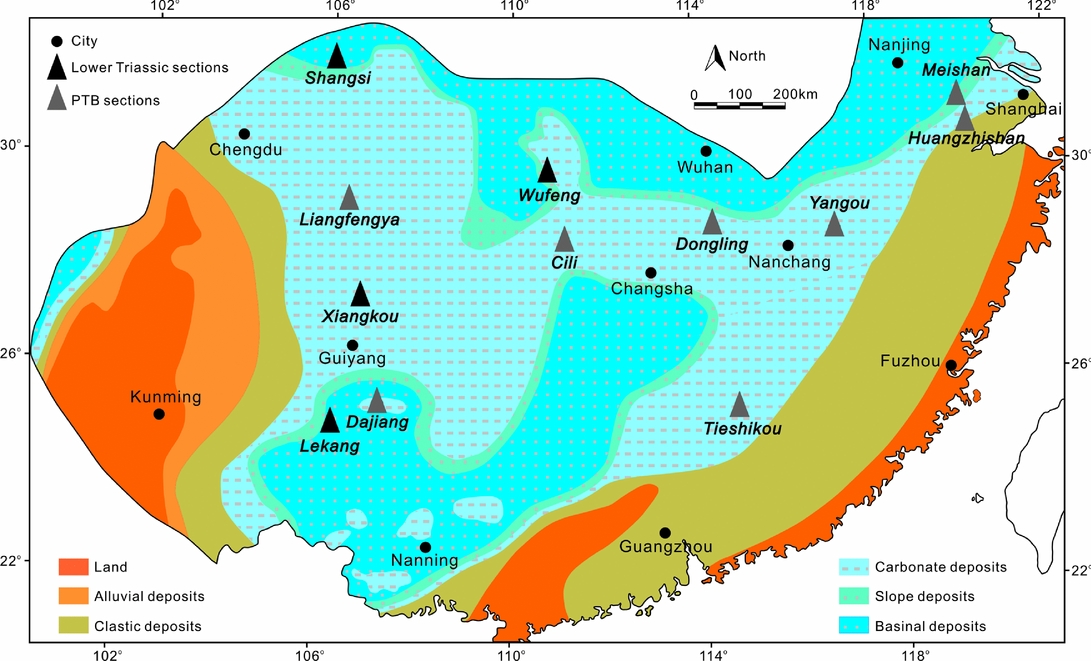
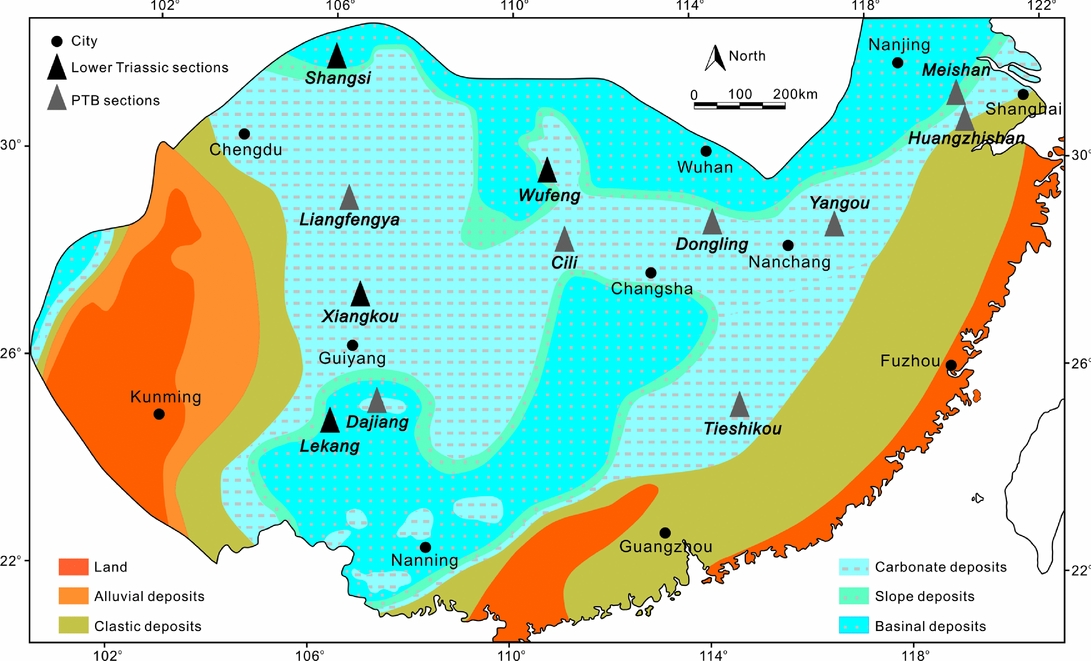
We report on our analysis of the foraminifer content of the Lower Triassic successions of South China and supplement our observations with literature records from elsewhere. During the P–Tr transition, the South China block was located in the eastern Tethys near the equator, consisting of islands, widespread shallow-water platforms and deep basins (Fig. 1). Numerous sections containing PTB strata and Lower Triassic strata are known from South China including the Global Stratotype Section and Point (GSSP) of the PTB – Meishan (Yin et al. Reference Yin, Zhang, Tong, Yang and Wu2001). Of these, the Meishan, Huangzhishan, Yangou, Tieshikou, Dongling, Cili, Wufeng, Shangsi, Liangfengya, Xiangkou, Dajiang and Lekang sections (Fig. 1) contain abundant disaster and opportunistic foraminifers and are selected herein to study their stratigraphic ranges and palaeoenvironmental implications.
Early Triassic palaeogeographic map of South China modified from (Feng, Bao & Liu, Reference Feng, Bao and Liu1997; Lehrmann, Wei & Enos, Reference Lehrmann, Wei and Enos1998). Black triangles show Lower Triassic sections containing disaster and opportunistic foraminifers whereas grey triangles show PTB sections containing disaster foraminifers.
2.a. Meishan section
The Meishan section, the GSSP of the PTB, is situated 200 km west of Shanghai City, eastern China (Fig. 1). The base of the Triassic is marked by the first occurrence of the conodont Hindeodus parvus at the base of Bed 27c (Yin et al. Reference Yin, Zhang, Tong, Yang and Wu2001). The PTB succession immediately overlying the Changxing limestone, consists of two thin beds, a white clay (Bed 25) and black shales (Bed 26), and a wackestone (Bed 27), followed by a succession of thinly interbedded black shales, grey-green marls and pale grey micrites interpreted to have accumulated in a generally dysoxic setting (Wignall & Hallam, Reference Wignall and Hallam1993).
2.b. Huangzhishan section
The Huangzhishan section, located 40 km southeast of the classic Meishan section, Zhejiang Province, eastern China (Fig. 1), records a similar P–Tr boundary succession. The PTB strata (the Huangzhishan Formation), overlying the Changxing limestones, mainly consists of marly limestones and marls. The first appearance datum (FAD) of Hindeodus parvus at Huangzhishan is in the middle part of the Huangzhishan Formation, about 3.8 m above the top of the Changxing limestones (Chen, Henderson & Shen, Reference Chen, Henderson and Shen2008; Chen et al. Reference Chen, Tong, Zhang, Yang, Liao, Song and Chen2009). The lowest Triassic strata include black shales and are thinly bedded and contain a low-diversity fauna with abundant Claraia and Ophiceras and small Planolites burrows suggesting oxygen-restricted conditions once again (Chen et al. Reference Chen, Tong, Zhang, Yang, Liao, Song and Chen2009).
2.c. Yangou section
The Yangou section, located in the northeast of the Yangou Coalmine, Leping County, Jiangxi Province (Fig. 1), records a carbonate-dominated P–Tr boundary succession. The top part of the Permian strata comprises a 12 m thick packstone–grainstone, yielding diverse fossil groups, e.g. calcareous algae, fusulinids, small foraminifers and conodonts (Song et al. Reference Song, Tong, Xiong, Sun, Tian and Song2012 a; Sun et al. Reference Sun, Tong, Xiong, Tian and Yin2012 b; Tian et al. Reference Tian, Tong, Sun, Xiong, Wang, Song, Song and Huang2014 b). The PTB succession is in the lower part of the Daye Formation, mainly consisting of thin-bedded limestone containing small foraminifers, ostracods, small gastropods and conodonts (Zhu et al. Reference Zhu, Wang, Lu, Mu, Zhang, Qin, Luo, Yang and Deng1994; Sun et al. Reference Sun, Tong, Xiong, Tian and Yin2012 b). The base of the Triassic is marked by the FAD of Hindeodus parvus at the base of Bed 21–4, about 21 cm above the base of the Daye Formation (Sun et al. Reference Sun, Tong, Xiong, Tian and Yin2012 b).
2.d. Tieshikou section
The Tieshikou section is located in the north of Zhaigao village, Xinfeng County, Jiangxi Province (Fig. 1). The PTB succession immediately overlying the Changxing limestones mainly comprises black shales and limestone lenses with abundant conodonts and brachiopods (Yang & Sun, Reference Yang and Sun1990). The lowest Triassic strata include black shales with limestone lenses and are thinly bedded and contain a low-diversity fauna with abundant Claraia (Yang & Sun, Reference Yang and Sun1990) suggesting oxygen-restricted conditions.
2.e. Dongling section
The Dongling section is situated to the northeast of Diaoyan village, Xiushui County, Jiangxi Province (Fig. 1). The upper Changxing Formation is composed of massive packstones and a 50 m thick algae-sponge bindstone (reef) that contains diverse sponges, corals, calcareous algae, fusulinids, small foraminifers, ostracods and conodonts. The PTB succession is in the lower part of the Daye Formation, mainly consisting of marly limestones with conodonts, ostracods, gastropods and small foraminifers (Zhu, Reference Zhu1999). The FAD of Hindeodus parvus in the Dongling section is at 25 cm above the top of the Changxing limestones (Zhu, Reference Zhu1999). The basal Triassic is a thinly interbedded succession of black shales, grey-green marls and pale grey micrites.
2.f. Cili section
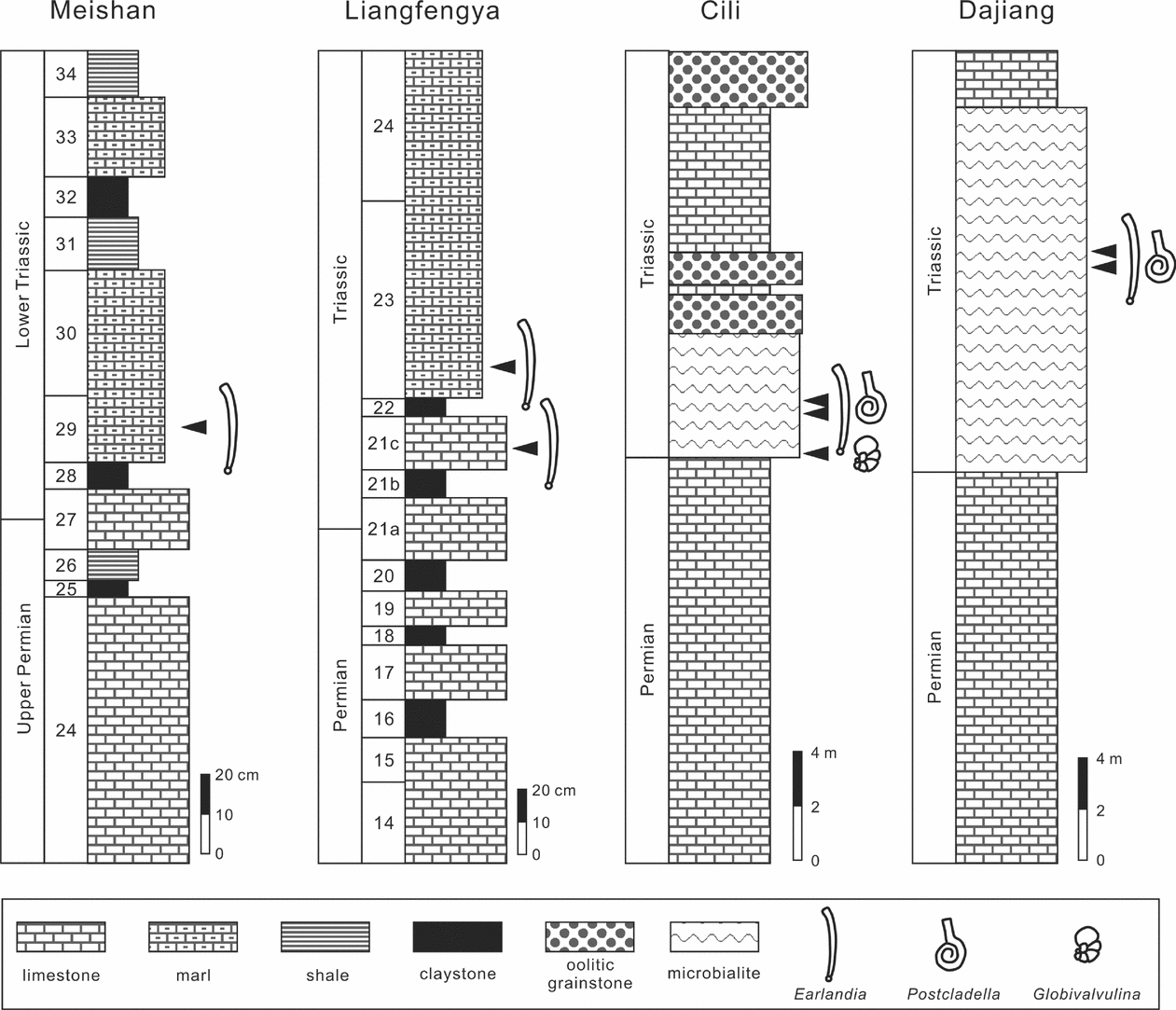
The Cili section, also called the Kangjiaping section, is situated near Kangjiaping village of Cili County, Hunan Province (Fig. 1). It consists of a well-developed Upper Permian coral-sponge reef sequence and the overlying PTB succession of calcimicrobialite and oolite facies. The top of the coral-sponge reef succession is composed of skeletal limestones yielding abundant fossils, e.g. calcareous algae, fusulinids, small foraminifers, ostracods and echinoderms (Wang et al. Reference Wang, Tong, Song and Yang2009). The fusulinid Palaeofusulina sinensis and many other species of this genus are found in the top of the uppermost Permian packstones (Yang et al. Reference Yang, Song, Tong, Chu and Tian2013). The PTB stratigraphic succession comprises calcimicrobialites, oolitic grainstones, vermicular (bioturbated) limestones and thin-bedded wackstones (Fig. 2), yielding ostracods, gastropods, small foraminifers, microconchids and conodonts (Wang et al. Reference Wang, Tong, Song and Yang2009; Yang et al. Reference Yang, Chen, Wang, Tong, Song and Chen2011). Compared with the other sections noted above, the Lower Triassic facies at Cili clearly record improved oxygenation. The FAD of Hindeodus parvus is in the upper part of the microbialite, about 4.5 m above the Changxing limestones and calcimicrobialites boundary (Wang et al. Reference Wang, Tong, Song and Yang2009).
The stratigraphical distributions of disaster foraminifers in four PTB sections: Meishan, Liangfengya, Cili and Dajiang.

2.g. Liangfengya section
The Liangfengya section, also called the Beifengjing section, is located to the west of Chongqing City, southwestern China (Fig. 1). The top part of the Permian is composed of a 60 m thick bioclastic limestone, yielding abundant fossils such as foraminifers (Tong & Kuang, Reference Tong and Kuang1990; Song, Tong & Chen, Reference Song, Wignall, Chen, Tong, Bond, Lai, Zhao, Jiang, Yan, Niu, Chen, Yang and Wang2011), brachiopods (Shen & He, Reference Shen and He1991), calcareous algae, echinoids and ostracods (Yang et al. Reference Yang, Yin, Wu, Yang, Ding and Xu1987; Wignall & Hallam, Reference Wignall and Hallam1996). The PTB is at the base of the Feixianguan Formation, which mainly comprises thin-bedded limestones, marls and claystones that are frequently pyritic (Fig. 2). Bivalves, brachiopods and small foraminifers are generally common. Tiny burrows are present but these have not disrupted the centimetre-scale bedding in the unit and the overall depositional setting is considered to be dysoxic (Wignall & Hallam, Reference Wignall and Hallam1996; Wignall & Twitchett, Reference Wignall and Twitchett1999).
2.h. Dajiang section
The Dajiang section is situated in the middle part of an isolated carbonate platform called the Great Bank of Guizhou in the Nanpanjiang basin of SW China (Lehrmann, Wei & Enos, Reference Lehrmann, Wei and Enos1998). A series of PTB sections are well exposed from the southeast to northwest (from platform facies to basin facies), i.e. Dawen, Heping, Dajiang, Rongbo, Langbai, Mingtang, Guandao, Bianzhonglu and Bianyang sections. The Dajiang section records a typical facies transition at the PTB: fossiliferous packstones of the Wuchiaping Formation are succeeded by lowest Triassic microbialites of the Daye Formation, which contain a diverse ostracod fauna that indicates well-oxygenated conditions (Forel et al. Reference Forel, Crasquin, Kershaw, Feng and Collin2009).
2.i. Wufeng section
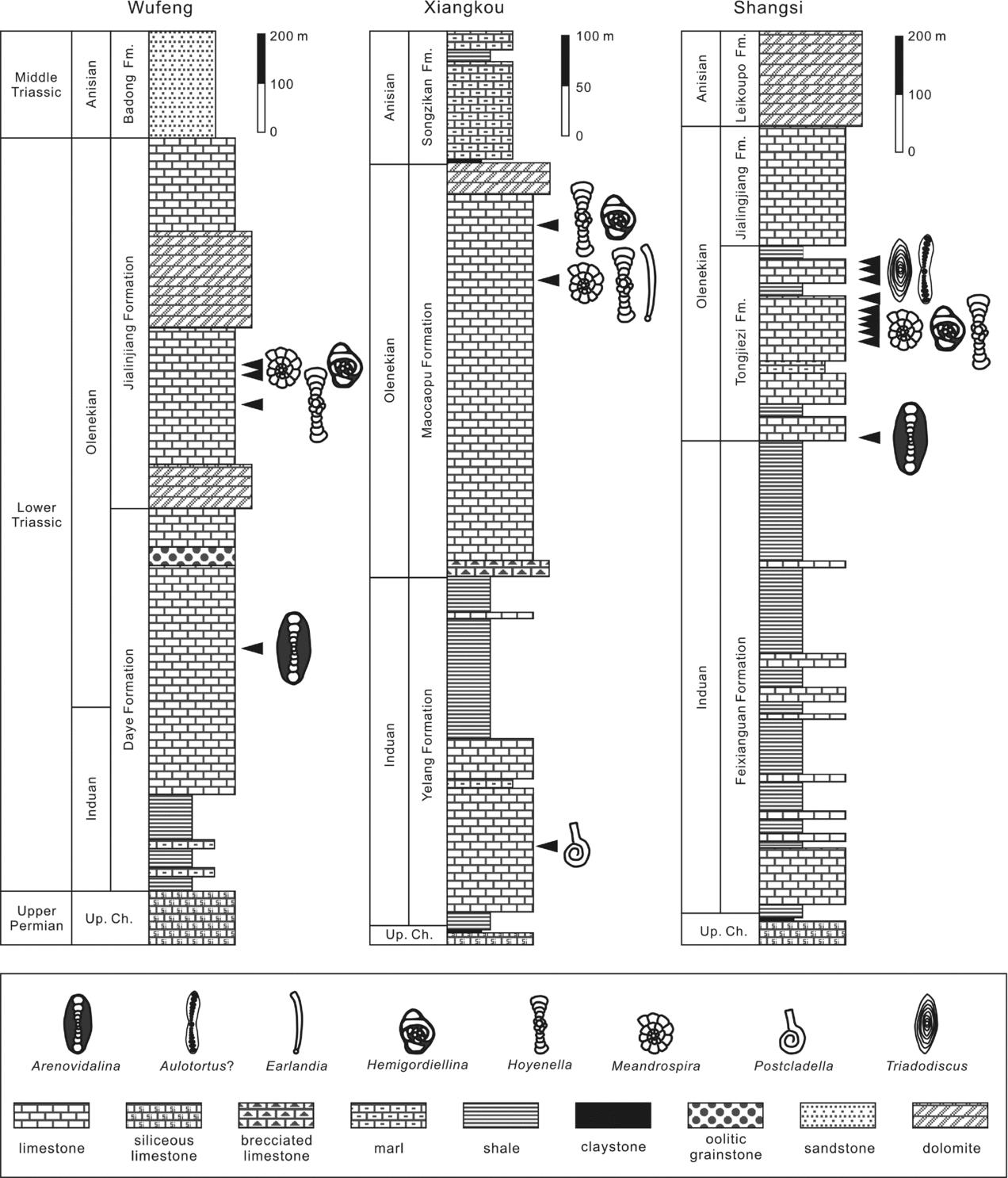
The Wufeng section is situated in the Wufeng County of western Hubei Province (Fig. 1). During the P–Tr transition, Wufeng was located on the northern margin of the Yangtze Platform. The uppermost Permian Dalong Formation consists of siliceous limestone and black shales. The Lower Triassic sequence is composed of the Daye and Jialingjiang formations. Of these, the Daye Formation consists of thinly laminated shales in its lower part and medium- to thick-bedded limestones in its upper part. The Jialingjiang Formation comprises interbeds of dolomite units and limestone units (Fig. 3).
The stratigraphical distributions of disaster and opportunistic foraminifers in three Lower Triassic sections: Wufeng, Xiangkou and Shangsi.

2.j. Shangsi section
As one of the candidates for the GSSP of the PTB, the Shangsi section contains one of the most detailed records of events during the P–Tr mass extinction in a deep basinal setting (Li et al. Reference Li, Zhan, Dai, Jin, Zhu, Zhang, Huang, Xu, Yan and Li1989; Wignall et al. Reference Wignall, Hallam, Lai and Yang1995; Lai et al. Reference Lai, Yang, Hallam, Wignall and Yin1996). In Early Triassic time, Sichuan occupied the northwestern margin of the Yangtze Platform (Fig. 1). The Shangsi section is located 30 km west of Guangyuan City, northern Sichuan Province (Fig. 1). Over 1200 m of strata, spanning the entire Upper Permian and Lower Triassic, are continuously exposed. The uppermost Permian Dalong Formation mainly consists of interbeds of limestones, cherts and dark shales with pervasive bioturbation suggesting well-oxygenated conditions (Wignall et al. Reference Wignall, Hallam, Lai and Yang1995). The Lower Triassic sequence is composed, in ascending order, of the Feixianguan, Tongjiezi and Jialingjiang formations (Fig. 3). Of these, the Feixianguan Formation is characterized by a 3.5 m thick siliceous marly limestone at its base followed by a 95 m thick unit of limestone and 685 m thick black shales. The siliceous marl is thinly laminated, pyritic and interpreted as representing a dysoxic–anoxic facies (Wignall et al. Reference Wignall, Hallam, Lai and Yang1995). Higher levels in the Feixianguan Formation are dominated by chocolate-coloured marls and thin micrite interbeds together with storm-generated flat-pebble conglomerates (Wignall & Twitchett, Reference Wignall and Twitchett1999).
2.k. Xiangkou section
The Xiangkou section is situated in Xiangkou Town, Zunyi City, northern Guizhou Province (Fig. 1). In Early Triassic time, Xiangkou occupied the southwestern margin of the Yangtze Platform. Over 1200 m of strata, spanning the uppermost Permian to the Middle Triassic, are continuously exposed. The uppermost Permian Changxing Formation consists of dark grey cherty limestone. The Lower Triassic sequence is composed, in ascending order, of the Yelang and Maocaopu formations (Fig. 3). Of these, the Yelang Formation is characterized by a 15 m thick marl at its base followed by a 175 m thick unit of limestone and 160 m thick shales. The marl is thinly laminated and contains a low-diversity fauna with abundant Claraia and Lingula suggesting oxygen-restricted conditions. Higher levels in the formation are dominated by thin micrite interbeds together with storm-generated flat-pebble conglomerates and chocolate-coloured marls. The Maochaopu Formation is characterized by pale grey, medium- to thick-bedded micrite in its lower and middle parts and thick dolomite in its top part.
2.l. Lekang section
The Lekang section is situated in Lekang village of Wangmo County, Guizhou Province (Fig. 1). In Early Triassic time, the Lekang section was located on the northern margin of the Nanpanjiang Basin. The uppermost Permian Linghao Formation consists of interbeds of limestones, cherts and dark shales with pervasive bioturbation, suggesting well-oxygenated conditions. The Lower Triassic sequence is composed of the Luolou Formation, which, in its lowest part, is dominated by unbioturbated laminated black shales and overlying thinly bedded micrite interbeds.
3. Disaster and opportunistic foraminifers
A total of nine disaster and opportunistic foraminiferal species were identified from the 12 Lower Triassic sections in South China, i.e. Postcladella kalhori, Earlandia sp., Globivalvulina lukachiensis, Hemigordiellina regularis, Hoyenella spp., Arenovidalina chialingchiangensis, Aulotortus? bakonyensis, Triadodiscus eomesozoicus and Meandrospira pusilla. These are typical disaster and opportunistic forms that are prolifically common in some beds after the P–Tr crisis (Figs 2, 3).
3.a. Postcladella kalhori
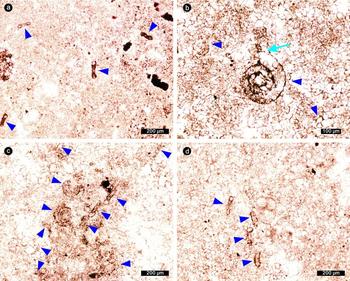
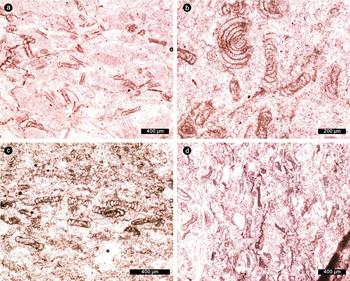
Postcladella kalhori (Brönnimann, Zaninetti & Bozorgnia, Reference Brönnimann, Zaninetti and Bozorgnia1972) is one of the most common foraminiferal taxa in the lowermost Triassic. It has usually been identified as ‘Rectocornuspira kalhori’ (e.g. Groves, Altiner & Rettori, Reference Groves, Altiner and Rettori2005; Groves et al. Reference Groves, Rettori, Payne, Boyce and Altiner2007; Song et al. Reference Song, Tong, Chen, Yang and Wang2009). This taxon has an initial planispiral coiling part and an uncoiled last whorl (Fig. 4). Krainer & Vachard (Reference Krainer and Vachard2011) designated this taxon as Postcladella kalhori. P. kalhori, as one of most common disaster foraminifer in Lower Triassic strata, has been found in the base of the microbialite of the Taskent section of Turkey (Altiner et al. Reference Altiner, Baud, Guex and Stampfli1980; Altiner & Zaninetti, Reference Altiner and Zaninetti1981; Groves, Altiner & Rettori, Reference Groves, Altiner and Rettori2005), in the lower Werfen Formation of northern Italy (Groves et al. Reference Groves, Rettori, Payne, Boyce and Altiner2007) and southern Austria (Krainer & Vachard, Reference Krainer and Vachard2011), and the base of the Lower Triassic of the Lukač section of western Slovenia (Nestell et al. Reference Nestell, Kolar-Jurkovsek, Jurkovsek and Aljinovic2011). In South China, P. kalhori was found in the lowermost Triassic microbialite of the Dajiang section (Song et al. Reference Song, Tong, Chen, Yang and Wang2009; Yang et al. Reference Yang, Chen, Wang, Tong, Song and Chen2011) and in the Langpai section (Ezaki et al. Reference Ezaki, Liu, Nagano and Adachi2008) in Guizhou Province, the Cili section in Hunan Province (Fig. 2) and the Dongwan section in Sichuan Province (Ezaki, Liu & Adachi, Reference Ezaki, Liu and Adachi2003). P. kalhori was also found in other shallow-water facies in the lowermost Triassic, e.g. the lowermost Daye Formation at the Dongling section of Jiangxi Province and the lower Yelang Formation at the Xiangkou section of Guizhou Province (Figs 3, 4). Therefore, P. kalhori is a typical and widespread disaster form that bloomed instantaneously in the Palaeotethys after the P–Tr extinction. It is found in a range of environments spanning oxygenated, shallow-water facies (e.g. Dajiang and Cili sections) and deeper, dysoxic facies (e.g. Werfen Formation).
Disaster foraminifer Postcladella kalhori Brönnimann, Zaninetti & Bozorgnia, Reference Brönnimann, Zaninetti and Bozorgnia1972 from the Permian–Triassic boundary strata of South China. (a) Lowest Daye Formation of the Dongling section, Jiangxi Province; (b) lower Yelang Formation of the Xiangkou section, Guizhou Province; (c, d) lowermost Daye Formation of the Cili section, Hunan Province. Triangular arrows indicate blurry specimens whereas long arrow indicates broken specimen.

3.b. Earlandia sp.
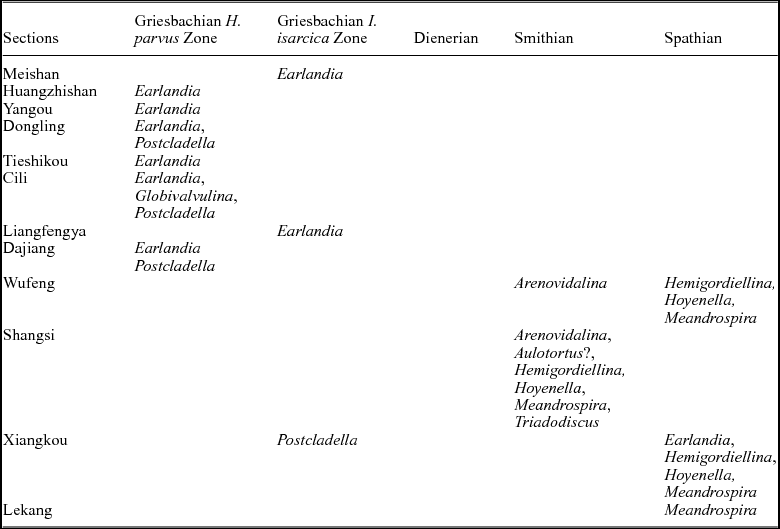
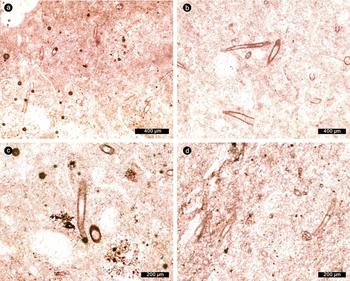
Earlandia sp. is a tube-like foraminifer with a globular proloculus followed by a long, straight, undivided tubular chamber. It is a common disaster taxon that bloomed immediately in the aftermath of the latest Permian extinction and earliest Triassic extinction (Table 1), as first identified by Hallam & Wignall (Reference Hallam and Wignall1997). Earlandia has been found in the P–Tr boundary interval of the Demirtas and Taskent sections of Turkey (Altiner et al. Reference Altiner, Baud, Guex and Stampfli1980; Altiner, Groves & Özkan-Altiner, Reference Altiner, Groves and Özkan-Altiner2005; Groves & Altiner, Reference Groves and Altiner2005; Groves, Altiner & Rettori, Reference Groves, Altiner and Rettori2005), the Bulla and Tesero sections of northern Italy (Groves et al. Reference Groves, Rettori, Payne, Boyce and Altiner2007), and the Andreasstrasse and Suchagraben sections in southern Austria (Krainer & Vachard, Reference Krainer and Vachard2011). In South China, Earlandia sp. bloomed during the conodont Hindeodus parvus Zone in shallow-water sections, e.g. the microbialite of the Cili and Dajiang sections and other shallow-water facies such as the Yangou, Dongling and Tieshikou sections, and in the Isarcicella isarcica Zone in platform margin and slope facies such as the Liangfengya and Meishan sections (Table 1). In this study, we also found that Earlandia sp. was very abundant in one bed of the Maochaopu Formation of the Xiangkou section in Guizhou Province, South China (Fig. 5d). This is the first report of this opportunistic form from Spathian strata.
The distribution of Early Triassic disaster and opportunistic foraminifers in South China

Disaster and opportunistic foraminifer Earlandia sp. from the Permian–Triassic boundary strata and Lower Triassic of South China. (a) Lowermost Tieshikou Formation of the Tieshikou section, Jiangxi Province; (b) lowermost Feixianguan Formation of the Liangfengya section, Chongqing; (c) lowermost Daye Formation of the Dongling section, Jiangxi Province; (d) upper Maocaopu Formation of the Xiangkou section, Guizhou Province.

3.c. Globivalvulina lukachiensis
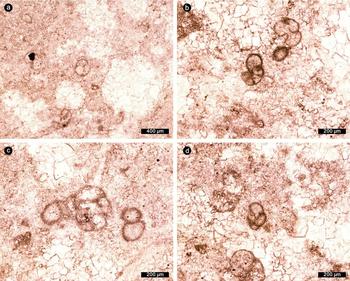
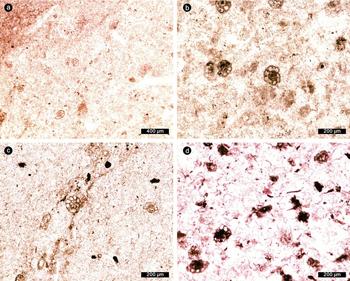
Globivalvulina lukachiensis, a new species for the Globivalvulina genus, was established by Nestell et al. (Reference Nestell, Kolar-Jurkovsek, Jurkovsek and Aljinovic2011). Globivalvulina lukachiensis, a rather small, planispirally coiled form with a biserial chamber arrangement, is a common foraminiferal species in Upper Permian strata, and has been found in South China (see ‘Globivalvulina bulloides’ in Song et al. Reference Song, Tong, Zhang, Wang and Chen2007, Reference Song, Tong, Chen, Yang and Wang2009), western Slovenia (where it occurs in Upper Permian facies but not after the mass extinction; Nestell et al. Reference Nestell, Kolar-Jurkovsek, Jurkovsek and Aljinovic2011) and the northwestern Caucasus (see ‘Globivalvulina araxensis’ in Pronina-Nestell & Nestell, Reference Pronina-Nestell and Nestell2001). It survived the latest Permian extinction and is found in the microbialite of the Dajiang section (Song et al. Reference Song, Tong, Chen, Yang and Wang2009) and in the Hindeodus parvus Zone of the Meishan section (Song et al. Reference Song, Tong, Zhang, Wang and Chen2007; Song, Tong & Chen, Reference Song, Tong, Chen, Yang and Wang2009), and in the lowermost Induan of Turkey as a failed survivor (see ‘Globivalvulina aff. cyprica’ in Altiner, Groves & Özkan-Altiner, Reference Altiner, Groves and Özkan-Altiner2005). However, its abundance is very low at these two sections and does not show any characteristics of a disaster taxon. In this study, we found Globivalvulina lukachiensis with a high abundance at the base of the microbialite from the Cili section (Fig. 6), indicating a typical disaster taxon's characteristics.
Disaster foraminifer Globivalvulina lukachiensis Nestell et al. Reference Nestell, Kolar-Jurkovsek, Jurkovsek and Aljinovic2011 from the Permian–Triassic boundary strata of South China. (a–d) lowermost Daye Formation of the Cili section, Hunan Province.

3.d. Hemigordiellina regularis
Hemigordiellina, with its small glomospiroid porcelaneous test with a proloculus followed by an undivided tubular second chamber that is streptospirally coiled in a somewhat irregular manner, is a controversial taxon (p. 85 in Gaillot & Vachard, Reference Gaillot and Vachard2007). Regarding its glomospiroid test, lots of species with calcareous tests have been attributed to Glomospira, e.g. Glomospira sp. and Glomospira regularis from the Meishan section (Song et al. Reference Song, Tong, Zhang, Wang and Chen2007), Glomospira spp. from the Nanpanjiang Basin (Song et al. Reference Song, Tong, Chen, Yang and Wang2009, Reference Song, Wignall, Chen, Tong, Bond, Lai, Zhao, Jiang, Yan, Niu, Chen, Yang and Wang2011) and Glomospira sp. from Japan (Kobayashi, Reference Kobayashi2004, Reference Kobayashi2012). But Glomospira is an agglutinated foraminifer (Loeblich & Tappan, Reference Loeblich and Tappan1988) and so this name is inappropriate. In this study, glomospiroid porcelaneous species are attributed to Hemigordiellina Marie in Deleau & Marie, Reference Deleau and Marie1959.
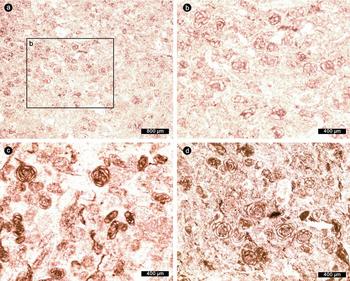
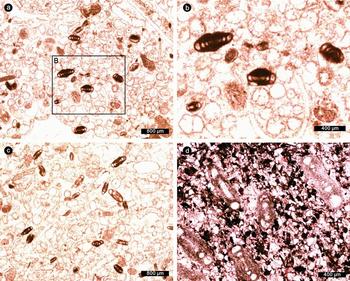
Hemigordiellina regularis is one of the most common foraminiferal taxa in the Lower Triassic strata (Song et al. Reference Song, Wignall, Chen, Tong, Bond, Lai, Zhao, Jiang, Yan, Niu, Chen, Yang and Wang2011). Hemigordiellina regularis has a long geological range, from Early Permian to latest Triassic time (Gaillot & Vachard, Reference Gaillot and Vachard2007). It has an extensive distribution in the Upper Permian with a low abundance, e.g. South China (Song et al. Reference Song, Tong, Chen, Yang and Wang2009), Tibet (Song, unpub. data), the Middle East (Gaillot & Vachard, Reference Gaillot and Vachard2007) and Japan (Kobayashi, Reference Kobayashi2012). However, a large number of Hemigordiellina regularis specimens appear suddenly in some Lower Triassic beds from South China, e.g. upper Maochaopu Formation of the Xiangkou section and lower Jialingjiang Formation of the Wufeng section (Fig. 7), showing that Hemigordiellina regularis is an opportunistic form that appeared in late Early Triassic time.
Opportunistic foraminifer Hemigordiellina regularis (Lipina, 1949) from the Lower Triassic of South China. (a, b) upper Maocaopu Formation of the Xiangkou section, Guizhou Province; (c, d) lower Jialingjiang Formation of the Wufeng section, Hubei Province.

3.e. Hoyenella spp.
Hoyenella with its small porcelaneous test is homeomorphic with the agglutinating Glomospirella. A lots of species with glomospirellid-like calcareous tests have been attributed to Glomospirella, e.g. Glomospirella irregularis, Glomospirella spirillinoides, Glomospirella ammodiscoidea, Glomospirella shengi, Glomospirella vulgaris and Glomospirella facilis from the Jialingjiang Limestone of Sichuan Province (Ho, Reference Ho1959), Glomospirella lampangensis from the Lampang Group of Northern Thailand (Kobayashi et al. Reference Kobayashi, Martini, Rettori, Zaninetti, Ratanasthien, Saegusa and Nakaya2006) and Glomospirella spp. from Pakistan (Zaninetti & Brönnimann, Reference Zaninetti and Brönnimann1975). In this study, glomospirelloid porcelaneous species are attributed to Hoyenella Rettori, Reference Rettori1994. Hoyenella is one of most common foraminiferal taxa in the Lower Triassic strata of South China (Song et al. Reference Song, Wignall, Chen, Tong, Bond, Lai, Zhao, Jiang, Yan, Niu, Chen, Yang and Wang2011). In this study, we found that a large number of Hoyenella spp. specimens occurred suddenly in some Lower Triassic beds in South China, mostly in dysoxic settings, e.g. Wufeng, Xiangkou and Shangsi sections (Figs 3, 8; Table 1).
Opportunistic foraminifer Hoyenella spp. from the Lower Triassic of South China. (a, b) Upper Tongjiezi Formation of the Shangsi section, Sichuan Province; (c) upper Maocaopu Formation of the Xiangkou section, Guizhou Province; (d) lower Jialingjiang Formation of the Wufeng section, Hubei Province.

3.f. Arenovidalina chialingchiangensis
Arenovidalina chialingchiangensis was firstly found in the Lower Triassic Jialingjiang Limestone of South China (Ho, Reference Ho1959). Subsequently, this species was reported world wide, e.g. the Albarracín Formation (Anisian) of Spain (Horwitz & Pidgeon, Reference Horwitz and Pidgeon1993), the Olenekian and Anisian strata of the Karst Dinarides (Velić, Reference Velić2007), and the Lower Triassic Tütünlüktepe Formation of NW Turkey (Okuyucu et al. Reference Okuyucu, Ivanova, Bedi and Ergen2014). In this study, a large number of Arenovidalina chialingchiangensis specimens appeared suddenly in some Lower Triassic beds from South China, i.e. upper Daye Formation of the Wufeng section and the basal Tongjiezi Formation of the Shangsi section (Fig. 9), showing that Arenovidalina chialingchiangensis is an opportunistic form that appeared in Olenekian time (Fig. 3).
Opportunistic foraminifer Arenovidalina chialingchiangensis Ho, Reference Ho1959 from the Lower Triassic of South China. (a–c) Upper Daye Formation of the Wufeng section, Hubei Province; (d) lowermost Tongjiezi Formation of the Shangsi section, Sichuan Province.

3.g. Aulotortus? bakonyensis
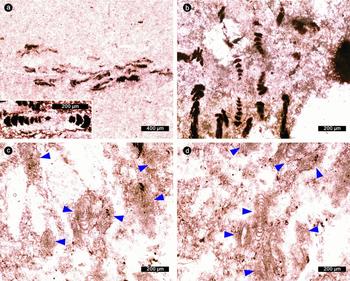
Aulotortus? bakonyensis was first reported in the Jurassic strata of the Dogger of Hungary (Blau, Reference Blau1989). Here, we found abundant Aulotortus? bakonyensis in two thin beds of the upper Tongjiezi Formation of the Shangsi section (Fig. 3). These two thin beds contain hundreds of specimens of Aulotortus? bakonyensis, showing that Aulotortus? bakonyensis is an opportunistic taxon that occurred occasionally in upper Lower Triassic strata. The thickness of each thin bed is only several millimetres (Fig. 10a, b), suggesting that this opportunistic taxon bloomed each time for only a very short period.
Opportunistic foraminifer Aulotortus? bakonyensis Blau, Reference Blau1989 and Triadodiscus eomesozoicus (Oberhauser, Reference Oberhauser1957) from the Lower Triassic of South China. (a, b) Aulotortus? bakonyensis Blau, Reference Blau1989, upper Tongjiezi Formation of the Shangsi section, Sichuan Province; (c, d) Triadodiscus eomesozoicus (Oberhauser, Reference Oberhauser1957) from the upper Tongjiezi Formation of the Shangsi section, Sichuan Province. Triangular arrows indicate blurry specimens.

3.h. Triadodiscus eomesozoicus
Triadodiscus eomesozoicus, an involutinid-like form, was originally established by Oberhauser (Reference Oberhauser1957) from the Carnian of the eastern Alps. It is a common foraminiferal species in the Triassic oceans, and has been found in Egypt (Kuss, Reference Kuss1988), Tunisia (Kamoun et al. Reference Kamoun, Peybernès, Ciszak and Calzada2001), southern Spain (Pérez-López, Márquez & Pérez-Valera, Reference Pérez-López, Márquez and Pérez-Valera2005), Japan (Kobayashi, Martini & Zaninetti, Reference Kobayashi, Martini and Zaninetti2005), northern Thailand (Kobayashi et al. Reference Kobayashi, Martini, Rettori, Zaninetti, Ratanasthien, Saegusa and Nakaya2006) and Timor (Haig & McCartain, Reference Haig and McCartain2012). Although most specimens of Triadodiscus eomesozoicus have been found in the Middle and Upper Triassic, it firstly appeared in the upper part of the Lower Triassic (Márquez, Reference Márquez2005). In this study, one Triadodiscus eomesozoicus bed was found in the Lower Triassic Tongjiezi Formation at the Shangsi section (Fig. 3). In this bed, Triadodiscus eomesozoicus is abundant but poorly preserved (Fig. 10c, d).
3.i. Meandrospira pusilla
Meandrospira pusilla is one of the most common foraminiferal species in the Lower and Middle Triassic. It has been found in Greece (Rettori, Angiolini & Muttoni, Reference Rettori, Angiolini and Muttoni1994), Italy (Zaninetti, Rettori & Martini, Reference Zaninetti, Rettori and Martini1994), Austria (Krainer & Vachard, Reference Krainer and Vachard2011), the Eastern Carpathians (Popescu & Popescu, Reference Popescu and Popescu2005), Tunisia (Kilani-Mazraoui, Razgallah-Gargouri & Mannai-Tayech, Reference Kilani-Mazraoui, Razgallah-Gargouri and Mannai-Tayech1990), Romania (Bucur, Strutinski & Paica, Reference Bucur, Strutinski and Paica1997), the Northern United Arab Emirates (Maurer, Rettori & Martini, Reference Maurer, Rettori and Martini2008), the Western Caucasus and Eastern Precaucasus (Vuks, Reference Vuks2007), Iran (Baud, Bronnimann & Zaninetti, Reference Baud, Bronnimann and Zaninetti1974), Japan (Kobayashi, Martini & Zaninetti, Reference Kobayashi, Martini and Zaninetti2005) and South China (Ho, Reference Ho1959; He, Reference He1988, Reference He1993; Song et al. Reference Song, Wignall, Chen, Tong, Bond, Lai, Zhao, Jiang, Yan, Niu, Chen, Yang and Wang2011). In this study, we found that a large number of Meandrospira pusilla specimens appeared instantaneously in some Lower Triassic beds in South China, e.g. lower Jialingjiang Formation of the Wufeng section, upper Tongjiezi Formation of the Shangsi section, Lekang Formation of the Lekang section, and upper Maochaopu Formation of the Xiangkou section (Fig. 11), showing that Meandrospira pusilla is an opportunistic form that appeared in late Early Triassic time.
Opportunistic foraminifer Meandrospira pusilla (Ho, Reference Ho1959) from the Lower Triassic of South China. (a) Lower Jialingjiang Formation of the Wufeng section, Hubei Province; (b) upper Tongjiezi Formation of the Shangsi section, Sichuan Province; (c) Lekang Formation of the Lekang section, Guizhou Province; (d) upper Maocaopu Formation of the Xiangkou section, Guizhou Province.

4. Temporal distribution of disasters and opportunists
4.a. Temporal distribution of disasters
In this study, we found that disaster foraminifers occurred in the immediate aftermath of the P–Tr extinction (Fig. 12). The group Postcladella kalhori–Earlandia sp., usually dominated by abundant Postcladella kalhori, Earlandia sp., Globivalvulina lukachiensis and rare Nodosaria expolita, occurred in the microbialites at the Dajiang and Cili sections that followed the latest Permian mass extinction. This foraminiferal group has also been reported in the basal Triassic microbialites at the Dongwan section of South China (Ezaki, Liu & Adachi, Reference Ezaki, Liu and Adachi2003), the Taskent and Taurides sections of Turkey (Altiner et al. Reference Altiner, Baud, Guex and Stampfli1980; Altiner & Zaninetti, Reference Altiner and Zaninetti1981; Ünal et al. Reference Ünal, Altiner, Yilmaz and Ozkan-Altiner2003; Groves, Altiner & Rettori, Reference Groves, Altiner and Rettori2005), and the Bulla section of Italy (Groves et al. Reference Groves, Rettori, Payne, Boyce and Altiner2007). These foraminifers co-occurred with other disaster taxa such as cyanobacteria (Ezaki, Liu & Adachi, Reference Ezaki, Liu and Adachi2003; Wang et al. Reference Wang, Tong, Wang and Zhou2005), worm tubes (polychaete Spirorbis) and microgastropods (Yang et al. Reference Yang, Chen, Wang, Tong, Song and Chen2011). Another disaster group dominated by Earlandia sp. has been identified above the lowermost Triassic extinction horizon, e.g. Bed 29 at the Meishan section and beds 21c and 23 at the Liangfengya section. Several peaks in the abundance of Earlandia sp. have been recorded coinciding with an abrupt extinction of foraminifers during the earliest Triassic crisis (Song, Tong & Chen, Reference Song, Tong and Chen2009; Song et al. Reference Song, Wignall, Tong and Yin2013 b).
Stratigraphic ranges of disaster and opportunistic foraminifers in South China during end-Permian and Early Triassic time.

4.b. Temporal distribution of opportunists
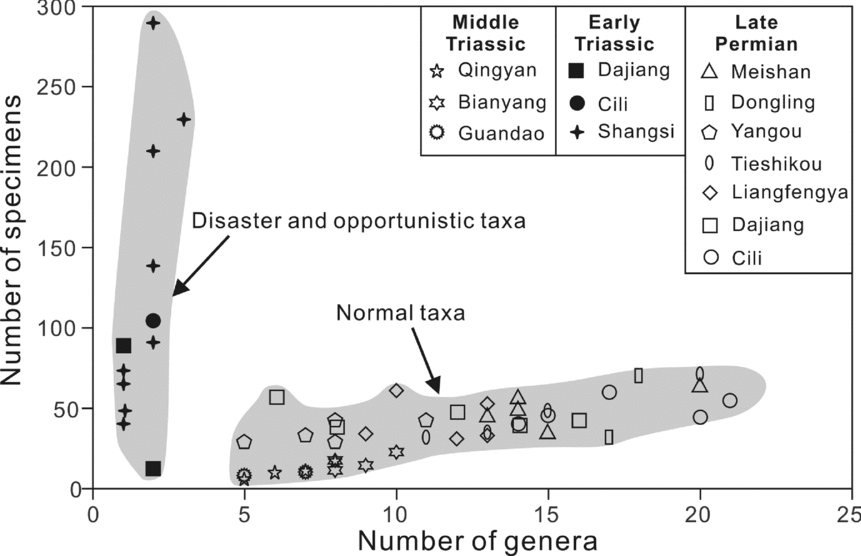
In the Dienerian strata of South China, we did not find any opportunistic or disaster foraminifers. The opportunistic fauna dominates within the Smithian and Spathian and is characterized by the extremely prosperous Hemigordiellina and Hoyenella (Fig. 12). The number of Hemigordiellina regularis and Hoyenella spp. specimens exceeds 200 in a 2.2×2.2 cm2 thin-section in some levels at the Shangsi section (Fig. 13). The lower boundary of the opportunistic fauna interval is defined by the horizon where Arenovidalina chialingchiangensis first bloomed. The upper boundary of the opportunistic fauna interval is defined by the horizon where the relative abundance of the opportunistic group decreases to less than 50%.
Number of specimens versus number of genera in a 2.2×2.2 cm2 thin-section for disaster and opportunistic foraminifers from the Lower Triassic and normal taxa from the Upper Permian and Middle Triassic.

Smithian opportunists are divided into three groups based on the stratigraphic ranges. The first group dominated by Arenovidalina chialingchiangensis occurred in the lower Tongjiezi Formation (Fig. 3). The second group dominated by Hemigordiellina regularis, Hoyenella spp. and Meandrospira pusilla occurred in the middle Tongjiezi Formation (Fig. 3). The third group dominated by Aulotortus? bakonyensis and Triadodiscus eomesozoicus occurred in the upper Tongjiezi Formation (Fig. 3). Opportunistic fauna in the Spathian consist of Earlandia sp., Hemigordiellina regularis, Hoyenella spp. and Meandrospira pusilla (Fig. 12).
5. Survival strategy response to stressed environments
Opportunistic taxa usually take advantage of high-stress, strongly fluctuating environments as a result of dramatic changes in oceanic ecosystems. As such they are capable of prolific population expansion and rapid biogeographical dispersal into stressed environments (Harries, Kauffman & Hansen, Reference Harries, Kauffman, Hansen and Hart1996; Kauffman & Harries, Reference Kauffman, Harries and Hart1996). The bloom of opportunistic foraminifers coincided with the Early Triassic stressed environments that have been frequently reported in recent years, e.g. widespread and long-term anoxia (Wignall & Twitchett, Reference Wignall, Twitchett, Koeberl and MacLeod2002; Song et al. Reference Song, Wignall, Tong, Bond, Song, Lai, Zhang, Wang and Chen2012 b), high sea-surface temperature (Joachimski et al. Reference Joachimski, Lai, Shen, Jiang, Luo, Chen, Chen and Sun2012; Sun et al. Reference Sun, Joachimski, Wignall, Yan, Chen, Jiang, Wang and Lai2012 a), intensified water-column stratification (Song et al. Reference Song, Tong, Xiong, Sun, Tian and Song2012 a; Song et al. Reference Song, Tong, Algeo, Horacek, Qiu, Song, Tian and Chen2013 a) and expansion of the oceanic oxygen minimum zone (Algeo et al. Reference Algeo, Chen, Fraiser and Twitchett2011; Song et al. Reference Song, Wignall, Chu, Tong, Sun, Song, He and Tian2014; Tian et al. Reference Tian, Tong, Algeo, Song, Song, Chu, Shi and Bottjer2014 a).
In this study, we found that disaster foraminifers develop relatively large populations in the early survival interval. They are replaced by opportunistic foraminifers and other survivors early in the following repopulation period. Both disaster and opportunistic foraminifers had a very short time span, and occurred repeatedly in Early Triassic time. These fossil beds (yielding disaster and opportunistic foraminifers) usually have a low diversity but a high abundance (Fig. 13). The ‘normal’ species (including the Late Permian and Triassic foraminifers that have been reported in Song et al. Reference Song, Tong, Zhang, Wang and Chen2007, Reference Song, Tong, Chen, Yang and Wang2009, Reference Song, Wignall, Chen, Tong, Bond, Lai, Zhao, Jiang, Yan, Niu, Chen, Yang and Wang2011, Reference Song, Yang, Tong, Chen, Tian, Song and Chu2015; Song, Tong & Chen, Reference Song, Tong and Chen2009, Reference Song, Tong and Chen2011; and some unpub. data for the Dongling, Tieshikou, Cili, and Bianyang sections) beds usually have a moderate diversity with a moderate abundance (see Fig. 13). These disaster and opportunistic taxa are very small compared to pre-extinction forms (Payne et al. Reference Payne, Summers, Rego, Altiner, Wei, Yu and Lehrmann2011; Song, Tong & Chen, Reference Song, Tong and Chen2011; Rego et al. Reference Rego, Wang, Altiner and Payne2012). All of these traits characterize an r-selection strategy, i.e. high fecundity, small body size, short generation time and wide offspring dispersion. When the environmental conditions tended to get better in middle to late Spathian time, larger, more diverse K-selection foraminifers began to dominate the benthic ecosystem.
6. Conclusion
Three disaster foraminiferal species were identified in the immediate aftermath of the P–Tr mass extinction, i.e. Postcladella kalhori, Earlandia sp. and Globivalvulina lukachiensis. Amongst them, Postcladella kalhori and Earlandia sp. have also been found as disaster species in many other regions around the world. As such, the bloom (rather than the occurrence) of these disaster forms could be used as evidence of post-extinction strata in the case of a lack of conodonts and ammonoids.
Disaster fauna were replaced by opportunistic fauna in Smithian and Spathian time. The opportunistic fauna is composed of Earlandia sp., Hemigordiellina regularis, Hoyenella spp., Arenovidalina chialingchiangensis, Aulotortus? bakonyensis, Triadodiscus eomesozoicus and Meandrospira pusilla. These opportunistic fauna are the main components of the recovery fauna (see Song et al. 2011) and the relative abundance decreases to less than 50% of foraminifers in the middle–upper Spathian, in accord with the improvement of marine environments.
Disaster and opportunistic foraminifers have often been found in the aftermath of many extinction events in the Phanerozoic. This phenomenon shows r-selection is a commonly used strategy for survivors to cope with the catastrophe events. After the crisis, many opportunists live in limited areas whilst others are likely to choose a K-selection strategy and become the dominant groups during the recovery interval.
Acknowledgements
This study was supported by the 973 Program (2011CB808800), the National Natural Science Foundation of China (41302271, 41272372), State Key Laboratory of Palaeobiology and Stratigraphy, Nanjing Institute of Geology and Palaeontology (133111), the 111 Project (B08030), BGEG (GBL11202, GBL11302), and the Fundamental Research Funds for the Central Universities (CUG130407).