Although most patients with surgically corrected congenital cardiac disease now have a substantially prolonged life expectancy1, 2 and a satisfactory quality of life,3, 4 their outward appearance, especially the scar and physical impairments in terms of reduced cardiopulmonary performance, are reminders that their heart had been surgically corrected. Continuous adaptations are needed and recent studies have addressed the question of psychological consequences of congenital cardiac malformations. Utens et al.5 compared 278 patients between 18 and 35 years with a control group. They found that patients showed less hostility, lower neuroticism, and higher self-esteem than healthy controls. The authors assumed that the results might be explained by denial, and this was supported by an earlier study.6 Van Rijen et al.7 confirmed these results in a study with 362 adults with congenital heart disease, with patients again displaying more favourable results on hostility, self-esteem, and neuroticism than their controls.
Later, van Rijen et al.8 used self-report and parallel parent report interviewing. They assessed anxiety/depression, withdrawal, somatic complaints, thought and attention problems, along with intrusive as well as delinquent and aggressive behaviour. In their study on predictors of long-term psychopathology7 they used broad groupings of symptom scales as key outcomes. Pronounced gender differences were reported for psychopathology, with women being affected to a greater extent than men.
In an earlier pilot study,9 the focus of attention had been on anxiety/depression as assessed with the Brief Symptom Inventory.10, 11 Although patients reported to being well adapted to everyday life, the degree of depression increased with the severity of the malformation. This study, however, suffers from its small sample size of 22 patients, rendering it impossible to make further differentiations by diagnostic groups, severity of disease, or gender.
The most visible sign of the surgical intervention is the scar, thus body image should be subject to particular attention, but only a few results have been published on this issue.12 In an early study based on qualitative interviews with women13 respondents reported dissatisfaction with their size and shape. In the study made by van Rijen et al.7 restrictions by the scar were found to be moderate, but produced statistically significant effects on psychological symptoms.
From epidemiological studies, it is known that women and men differ in the number of psychological and physical symptoms, as well as in the way these are perceived and presented.14 In the literature on psychological consequences of congenital cardiac malformations, they had been counted together if the sample sizes do not permit differentiation.9, 15 In the study by van Rijen et al.,16 the numbers were sufficiently large, and women with congenital heart disease were reported to having higher scores on neuroticism and lower self-esteem. They also reported more somatic complaints than their male counterparts. The differences were explained on the basis of possible disease-specific uncertainties, and discomfort due to the postoperative scar.7
Taken together, the knowledge on the psychological consequences of congenital cardiac disease in adulthood is still limited, as confirmed in a recent state of the art-review.17 In order to improve the knowledge about this topic, we conducted a study with a population of patients with different types of congenital heart disease. We sought to establish whether impairments of limitations in activity and cardiac performance had psychological consequences. Due to the limited knowledge in this area we found it appropriate to assess a broad range of psychological symptoms, such as somatization, obsession-compulsion, interpersonal sensitivity, depression, anxiety, hostility, phobic anxiety, paranoid ideation, and psychoticism.
In particular, we wanted to answer the following questions:
- Do impairments due to congenital heart disease have effects on psychological symptoms as mentioned above? Impairments will have to be considered both in terms of subjectively reported impairments and as physiological measures of cardiopulmonary performance capacity. All psychological measures of symptoms were expected to increase with the degree of impairment.
- Does the perception of body image by the patient have effects on the above-mentioned psychological symptoms? All psychological measures of symptoms were expected to increase with an unfavourable body image.
- Do women and men differ with respect to psychological symptoms? Based on findings from earlier studies, we expected higher scores in women.
The analyses are performed separately for women and men, as they are known to differ in the reporting of symptoms and impairments of health.14, 18, 19
Methods
Population studied
The population consisted of males and females who underwent surgery for correction of congenital cardiac malformations at the University Hospital of Göttingen, Germany. Prior to and after surgery, they were receiving continuous care at the Department of Paediatric Cardiology, thus complete medical records were available. We excluded individuals with syndromes, such as Down Syndrome, Marfan Syndrome, Noonan Syndrome, and Williams-Beuren Syndrome, along with those in which the diagnosis was unclear, and patients whose disease proved not to be congenital.
At the date of interview or at examination, the patients were between 14 and 45 years of age. The protocol was approved by the local ethics committee, and written informed consent had been obtained from all subjects. Interview data were collected by means of face-to-face interviews and standardized self-report questionnaires. The cardiological part comprised the assessment of the complete clinical history, a physical examination and spiro-ergometry.
Measurement of outcomes
Psychological symptoms were assessed on the basis of the Brief Symptom Inventory,20 a 53-item self-report instrument for assessing psychological symptoms in clinical and non-clinical respondents. It is the short form of Derogatis’ Symptom Checklist-90-Revised.10 Each item is rated on a five-point scale ranging from “1 – not at all” at one pole to “5 – extremely” at the other. Subscale scores are computed by summing up the respective items, and higher scores are indicative of higher magnitudes of symptoms.
According to the manual, the Brief Symptom Inventory had been standardized for age groups from 13 years on. It was designed to depict a broad range of psychological variables, including somatization, obsession-compulsion, interpersonal sensitivity, depression, anxiety, hostility, phobic anxiety, paranoid ideation, and psychoticism.
As specific information was to be obtained, we did not compute global measures like the General Symptom Index. Instead of restricting the analyses to a few measures, such as anxiety or depression, we found it appropriate to use the whole range of subscales.
Internal consistencies of the subscales were reported to vary between 0.71 for psychoticism and 0.85 for depression; test-retest-reliabilities were reported to vary between 0.73 for phobic anxiety and 0.93 for obsession-compulsion.
Measurement of predictors
Subjectively perceived limitations in activity were measured by a classification21 proposed by the New York Heart association. It is widely used in the field of cardiology, and refers to subjectively felt restrictions of physical activity in everyday life as classified into one of four categories:
- Class 1: patients with no limitations; no symptoms are present when performing ordinary activities.
- Class 2: patients with some limitations of activities; they are comfortable at rest or at mild exertion.
- Class 3: patients with marked limitations of activities; they are comfortable only at rest.
- Class 4: patients who should be at complete rest, confined to bed or chair; any physical activity is associated with discomfort and symptoms are also occurring at rest.
In the following analyses, classes 3 and 4 are counted together, as only a few patients fell in the fourth class.
The functional capacity of the heart was measured by the peak uptake of oxygen as a reference value for cardiac performance.22,23
It was measured by cardiopulmonary exercise testing performed on an upright bicycle ergometer, starting with a workload of 0.5 watts per kilogram body weight, which was increased by 0.5 watts per kilogram every 2 minutes. Uptake was measured using a breath by breath analysis. All patients were exercised to maximum exercise capability. The peak uptake was determined as the highest value reached during the test. For the purposes of our study, the degree of cardiopulmonary capacity of each patient was compared with the normal range for the respective age and for gender as proposed by Pothoff et al.24 It is given as the proportion of the predicted value of the peak uptake.
The 6-lead electrocardiogram and heart rate were recorded continuously during the test.
Body image was assessed by the Body Image Questionnaire.25 It was designed to assess cognitive and affective evaluations of the own body, particularly with respect to fitness, vitality, attractiveness and satisfaction with ones appearance. It is divided into two subscales: “Rejection of the body” depicts a negative attitude towards the physical appearance, lack of well-being, and an attitude that the body fails to meet demands that are considered as normal.
“Vitality” depicts positive aspects of body image, particularly feelings of vitality, strength and enjoying physical activity.
The questionnaire contains 20 items scored from 1 to 5. Subscale scores are computed by summing up the item scores. The subscales are only moderately correlated (–0.29), and could be reproduced by means of factor analyses. The internal consistency for rejection of the body as well as for vitality was 0.84, but up to now no test-retest-reliabilities have yet been published.
Age and socio-economic position had to be included as additional variables since both were expected to have effects on health and on the way health impairments are reported.26
Socio-economic position was determined according to the International Standard Classification of Occupations “ISCO-88” that was transformed into a variable at metric level as proposed by Ganzeboom.27
Statistical analyses
Ordinary least squares regression will be used since all independent and dependent variables except the classification of the New York Heart Association are at interval level. Standardized regression coefficients will be reported. The classification of the New York Heart Association is categorical, thus regression effects are presented in comparison with the first category.
The gender differences were analysed by means of multivariate analyses of variance. Each outcome variable, for example, each subscale of the Brief Symptom Inventory, is considered for gender differences by controlling for age. For some analyses, the Kruskall-Wallis test was applied in order to compare variables with skewed distributions with an appropriate nonparametric procedure. Significance tests were accepted if the error level is equal or lower than 0.05. All computations were performed with STATA version 8 SE.28
Results
Characteristics of the population
The total number of patients who underwent surgery of congenital heart disease at the Göttingen University Clinic was 820. We excluded 58 individuals with syndromes, and also patients over 45 years, because only a few were in the basic population. The potential study population was 698. Of these, 91 could not be tracked, 33 were found to have died, 92 did not respond after three letters, and 121 explicitly refused to participate. In 53% of the patients, the operation was performed before the age of 6, in 76% it took place before the age of 10, and 90% underwent surgery before the age of 16. The mean age at the time of the surgery was 7.0 years, with a standard deviation of 7.2. The mean period having elapsed between surgery and date of interview was 19 years, with standard deviation of 8.6 years.
As medical records were available for all the patients, we were able to compare participants and all non-participants as listed above with respect to a number of variables of interest. They did not differ with respect to the type of heart defect, gender, and age at the date when the collection of data was finished. The response rate of patients in the upper third of the age distribution with transposition and functionally single ventricle was threefold higher than of patients with left-to-right shunt as the least severe type of cardiac defect. The number of cases falling into these subgroups is small.
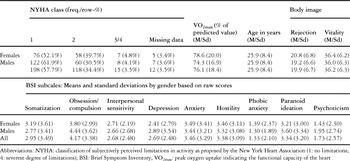
The final sample size was 361, and 343 after removing cases with missing data on at least one variable. Tables 1 and 2 provide the basic descriptive information.
Table 1. Socio-demographic characteristics of our population.

Table 2. Clinical and psychological characteristics of our population.

Classifying patients according to the type of heart defect, 85 (24.8%) were born with tetralogy of Fallot, 41 (12.0%) had transposition of the great arteries, 21 (6.1%) had a functionally single ventricle, 93 (27.1%) had left-to-right shunt through atrial and ventricular septal defects or persistently patent arterial ducts, 92 (26.8%) had a stenosis of various types, such as coarctation of aorta or arterial valvar stenosis, and 11 (3.2%) had miscellaneous types of congenital cardiac malformations.
Statistical analyses
Effects of impairments on outcome variables.
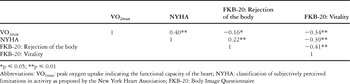
Relationships between predictor variables were computed in order to examine whether highly correlated variables may cause multicollinearity problems. From Table 3, it can be seen that all correlations are statistically significant, but the magnitude of the correlations indicate that the results of the regression analyses will not be impaired.
Table 3. Intercorrelations of the predictive variables (Spearman rank order correlations).

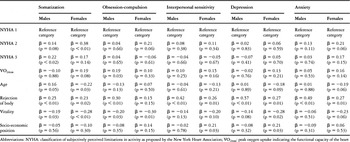
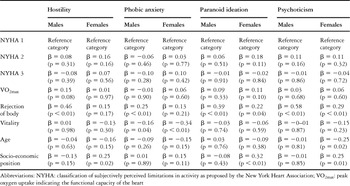
The results of the regression analyses are displayed in Tables 4 and 5.
Table 4. Effects of body image, classification in the system of the NYHA, peak uptake of oxygen, and age (standardized regression coefficients and p-levels) on psychological symptoms in males and females.

Table 5. Effects of body image, classification in the system of the NYHA, peak uptake of oxygen, and age (standardized regression coefficients and p-levels) on psychological symptoms in males and females.

If the grading system of the New York Heart Association was used for classifying patients, significant results were produced only for somatization, but the effects are small or moderate.
Peak uptake of oxygen as an objective measure of cardiopulmonary performance had a moderate effect only on obsession-compulsion, and only in women.
Socio-economic position entered the analyses as a control variable, since in the present study social inequalities in health were not subject to examination. It turned out that this variable has significant regression effects only in women. They are moderate throughout, for interpersonal sensitivity the standardized effect is 0.21, 0.21 for depression, 0.24 for hostility, 0.32 for paranoid ideation, and 0.25 for psychoticism.
Effects of body image on outcome variables.
Body image has strong effects over the whole range of outcomes. For “rejection of the body” they are particularly pronounced in males, and they emerged for somatization, obsession-compulsion, interpersonal sensitivity, depression, anxiety, hostility, phobic anxiety, paranoid ideation, and psychoticism. The effects range from 0.25 to 0.58.
In females the effects are less pronounced, and insignificant for obsession-compulsion, hostility, phobic anxiety.
For “vitality” some significant results were found. In contrast to “rejection of the body” they emerged primarily in females, specifically for somatization, obsession-compulsion, depression, phobic anxiety. In males this refers to somatization, obsession-compulsion and phobic anxiety, but the effect sizes are smaller.
Gender differences in outcome variables.
At the side of the predictors, significant gender differences were found for “rejection of the body” with females having a slightly higher score (see Table 2; Kruskall-Wallis test on mean rank differences: p equal to 0.01, df equal to 1, χ2 equal to 6.19), but not for “vitality”. For peak oxygen uptake the difference was again statistically significant (p equal to 0.04, df equal to 1, χ2 equal to 4.36), but not if patients were classified according to the system proposed by the New York Heart Association.
Gender-specific regression effects have already been presented above, and it remains to be examined whether psychological symptoms differ between females and males. For every symptom scale, we performed an analysis of variance, and age was introduced in order to take the wide age range into account. For none of the psychological measures of symptoms did a statistically significant result emerge.
Discussion
With our first question, we asked whether impairments in terms of everyday functioning and cardiopulmonary performance capacity as a physiological measure had effects on psychological symptoms. Subjectively reported impairments had effects on only one psychological symptom measure, on somatization. For the physiological measure also only one significant effect was found, and this was more pronounced in males than in females.
Psychological symptoms were expected to vary with the degree of impairment. This assumption was based on an earlier study, where patients scored higher on depression and anxiety than controls.9 Another study failed to find differences in psychological outcomes between different diagnostic groups with cardiac disease,5 and in a later follow-up of the same cohort7 only smaller effects of one diagnostic category, transposition, were reported. It should be kept in mind that the grading system of the New York Heart Association is reflecting subjective perceptions of impairment. These should not affect the measurement of peak oxygen uptake, but again there were no effects on psychological outcomes, suggesting that the impairments considered here indeed do not have effects.
This is also supported by the results of the two dimensions of perception of body image, which was the topic of our second research question. “Rejection of the body” had the strongest effects on psychological outcomes, and they were most pronounced in males, where moderate to strong coefficients were obtained. A similar finding was reported by van Rijen et al.7 They considered a broad range of predictors and restrictions due to the scar. Effects of scar-related restrictions were rather modest, ranging from 0.11 to 0.25. This may be due to the use of summary measures used to depict psychological symptoms, and considering only restrictions due to the scar may underestimate the complexity of coping with a repaired heart defect that cannot be limited to the physical appearance. The perspective should be broadened by considering in more detail how patients perceive their body under conditions of congenital cardiac disease. The findings on interpersonal sensitivity indicate that an unfavourable body image may lead individuals to perceive themselves as defective, which in turn may be associated with self-doubts and a sense of insecurity. This is also in line with the strong effects on depression and anxiety. Both may indicate impression that not much can be changed, and that the heart has been repaired, and this left visible imprints on the body, associated with reduced physical fitness. The strong relationship with “psychoticism” supports the interpretation, as the subscale was designed to measure self-alienation and isolation.
For “vitality” as the positive dimension of body image, only moderate effects emerged, indicating that with decreasing vitality more symptoms were reported. In this case interpretable effects on somatization, obsessive-compulsive thoughts, depression and anxiety were found only in female respondents.
Our third question devolved on gender differences with respect to our outcome variables. Contrary to expectations as derived from earlier studies14, 16 no such differences emerged. For peak uptake of oxygen, and “rejection of the body”, gender differences were small, although statistically significant. From our findings, it can be concluded that there is considerable similarity in psychological symptoms between females and males, but their scores may be explained differently. In males, the perception of the body as deficient and injured may lead to increased symptomatology up to a degree above standard level, and thus to an equalization with the level of females. In women the effects of impaired “vitality” were smaller, and may not have led to a significant increase of psychological symptoms. This is, however, an interpretation, as comparative datasets from general population samples are unavailable.
In our study, we performed a series of regression analyses and the related significance tests. Multiple testing increases the likelihood of chance findings, although the interpretations of our results are mainly based on the magnitude of regression effects. Interpretations, nevertheless, should be made very carefully. This is particularly essential if statistically significant effects appear without clear patterns. Keeping this in mind, the effects of rejection of the body on psychological symptoms can be considered as substantial because they are systematic and the magnitudes of regression effects are high (up to 0.58).
Finally, we should mention some limitations of our study. The first one arises out of the cross-sectional approach, which does not permit depiction of the long-term development of the psychological symptoms considered. Time is only partially accounted for by the inclusion of age, but effects that are specific for different age cohorts remain undetected. As mentioned in the introduction, the survival rates of patients with congenital cardiac diseases have improved over the years, because surgical techniques and the quality of care have made considerable progress. When surgical therapies started, patients with more severe defects were more likely to die prematurely, and as a consequence older patients are less affected and may express less psychological symptoms. There is, however, not much empirical support for this assumption, as the effects of age are small, suggesting that age may not affect the results.
A second limitation of our study may arise out of the lower participation of individuals with more severe degrees of congenital heart disease, as represented in the third and fourth classes of the New York Heart Association. This is also a limiting condition in other studies,2, 3 but it may nevertheless lead to an underestimation of psychological symptoms.
A final point needs to be made concerning the classification of our population. In contrast to studies where patients were categorized according to the type of cardiac malformation,2, 7, 16 or studies where only one or two lesions were considered,15 we classified the patients according to the severity of impairment of everyday functioning. This may affect the comparability with other studies, but we did not want to take specific types of cardiac malformations into account. Instead, the related impairments were given priority. Indeed the diagnostic group does not necessarily predict the degree of limitations of activity or impairment of cardiac performance. Due to the low frequencies in some diagnostic groups, the regression analyses may lead to unstable estimates.
We have shown that perceived, as well as physical, limitations have only minor effects on psychological symptoms in patients with surgically corrected congenital cardiac malformations. Most of these symptoms, however, are accounted for by the attitude patients have towards their body, and how they evaluate their vitality.
Acknowledgements
This study was conducted with financial support from the Deutsche Forschungsgemeinschaft (German Research Association) under grant numbers WE 2670/1-1 and GE 1167/2-1 to Armin Wessel and Siegfried Geyer.