Introduction
Wallago attu Bloch and Schneider, 1801, a freshwater, demersal fish, commonly known as ‘padhan’ in Indian fish markets, has been examined extensively in India and abroad for monogenoidean infection (species of three genera – Thaparocleidus, Bychowskyella and Mizelleus – are confirmed so far). Of these, the genus Thaparocleidus is an iconic ecological model, having five oioxenous and co-existing species on the host, collected throughout the year from the River Gomti, district Lucknow. Customarily, monogenoideans form species complexes due to their large populations. Such complexes may arise through host–parasite co-evolution. Since parasites have opportunities for sympatric speciation, they exploit different microhabitats within the same host. Earlier studies conducted in India, on the genus Thaparocleidus, were either on taxonomical aspects or on phylogeny (Mollaret et al., Reference Mollaret, Lim and Justine2000; Justine et al., Reference Justine, Jovelin, Neifar, Mollaret, Lim, Hendrix and Euzet2002; Šimková et al., Reference Šimková, Matejusova and Cunningham2006a, Reference Šimková, Serbielle, Pariselle, Vanhove and Morand2013; Pandey & Agrawal, Reference Pandey and Agrawal2008; Wu et al., Reference Wu, Zhu, Xie, Wang and Li2008; Rajvanshi & Agrawal, Reference Rajvanshi and Agrawal2013, Reference Rajvanshi and Agrawal2014a, Reference Rajvanshi and Agrawalb; Rajvanshi et al., Reference Rajvanshi, Agrawal and Upadhyay2014; Tripathi et al., Reference Tripathi, Rajvanshi and Agrawal2014). Rajvanshi et al. (Reference Rajvanshi, Agrawal and Upadhyay2014), while establishing the phylogenetic relationship among various species of the genus Thaparocleidus, using a molecular marker, validated these five species. Monogenoideans are particularly suitable parasites for revealing novel insights into host ecology and evolution (Xavie et al., Reference Xavie, Faria, Paladini, Oosterhout, Johnson and Cable2015). They are also economically important for cultured and feral fish because they cause diseases and foster secondary infections, more specifically in overcrowded culture systems (Cusack & Cone, Reference Cusack and Cone1985; Scholz, Reference Scholz1999; Jones, Reference Jones and Rohde2005; Ogawa, Reference Ogawa and Rohde2005), due to shorter generation period, direct life cycle and host specificity that intensify infection rate (Turgut & Akm, Reference Turgut and Akm2003). Thus, in the present study, component community, seasonal rhythmicity, intensity of infection, microhabitat preference, host specificity index, species co-existence, niche size, niche overlap, intra/interspecific aggregation and phylogeny have been examined within same microhabitat.
Materials and methods
Collection of fish and examination of gills
Three fish were collected monthly for Thaparocleidus sp., from the River Gomti, Lucknow, near the Mohan Meakin brewery (26°52′28″N, 80°55′18″E), at regular intervals from January 2011 to December 2012, with the help of fishermen using a floating gill net, trammel net and angling. Gills were excised from the fish into Petri dishes and subsequently examined for parasites under a phase-contrast microscope (Olympus BX 51, Tokyo, Japan). Collection and preservation of parasites was done using standard techniques (Agrawal et al., Reference Agrawal, Tripathi and Devak2006). From 72 specimens of W. attu, 10,920 specimens of Thaparocleidus were collected. Of these, 3186 parasites were T. sudhakari (GenBank accession no. JX984666), 2865 T. indicus (JX960419), 2676 T. gomtius (KC962229), 2064 T. yogendraii (JX984665) and 129 T. wallagonius (JN020351). Calculation of component community was based on the 2-year dataset. A line-chart graph of infection intensity was plotted for each species. Microhabitat preference was quantified by counting the number of each species on gill arches. The following calculations were also included to analyse the dataset.
Host specificity and species aggregation
The host specificity index (S i) of each species has been calculated according to Rohde's first sub-section of his third law (Rohde, Reference Rohde1980a):
 $$S_{i} = \displaystyle{1 \over {{\raise0.7ex\hbox{${P_{ij}} $} \!\mathord{\left/ {\vphantom {{P_{ij}} {nj}}}\right.\kern-\nulldelimiterspace} \!\lower0.7ex\hbox{${nj}$}}}} = \displaystyle{1 \over {n_i}} $$
where
 $$P_{ij} = \displaystyle{{n_i} \over {n_j}} $$
ni and nj are number of individual of i and j species.
Species co-existence (A 12) was calculated according to Ives (Reference Ives1991), Jeanike & James (Reference Jeanike and James1991) and Stevenster (Reference Stevenster1996). Intraspecific aggregation dominates over interspecific aggregation if the value of A 12 is greater than one.
 $$A_{12} = \displaystyle{{\left( {J_1 + 1} \right)\left( {J_2 + 1} \right)} \over {\left( {C_{12} + 1} \right)^2}} $$
Here J 1 and J 2 are intraspecific aggregation for the species one and two.
Intraspecific aggregation (J 1) was calculated according to Ives (Reference Ives1988, Reference Ives1991) followed by Morand et al. (Reference Morand, Poulin, Rohde and Hayward1999), where J 1 is the proportional increase in the number of conspecific competitors experienced by random individual relatives to a random distribution (Šimková et al., Reference Šimková, Desdevises, Gelnar and Morand2000):
 $$J_{1} = \displaystyle{{\mathop \sum \nolimits_{i = 1}^p \displaystyle{{n_{1i} \left( {n_{1i} - \left. 1 \right)} \right.} \over {m_1}} - m_1} \over {m_1}} = \; \displaystyle{{\displaystyle{{V_1} \over {m_1}} - 1} \over {m_1}} $$
Here n 1i is a number of species 1 on gill arch i, m 1 is a mean number of species 1 per gill arch and V 1 is variance in number of species 1 on one host. P is the number of gill arches. If the value of J 1 = 0, individuals are randomly distributed. If J 1 = 0.5, there is an increase of 50% in the average number of conspecifics that occur on the same patch above a random distribution (Šimková et al., Reference Šimková, Desdevises, Gelnar and Morand2000).
Interspecific aggregation (C 12) was calculated according to Ives (Reference Ives1988, Reference Ives1991). Interspecific aggregation is a proportional increase in the number of hetero-specific competitors in relation to random association:
 $$C_{12} = \displaystyle{{\mathop \sum \nolimits_{i = 1}^P \displaystyle{{n_{1i} n_{2i}} \over {m_1 P}} - m_2} \over {m_2}} = \displaystyle{{Cov_{12}} \over {m_1 m_2}} $$
where n 1i and n 2i are the numbers of species 1 and 2 on gill arch i; m 1 and m 2 are the mean numbers of species 1 and 2 per gill arch, P is the number of gill arches, Cov 12 is the covariance between a pair of species. Two species are positively correlated if C 12 > 0 while negatively if the value is C 12 < 0.
Niche size and overlap
Levin's niche breadth (B) was calculated according to Colwell & Futuyma (Reference Colwell and Futuyma1971), where Pj is the proportion of individuals of a species found on one gill arch:
 $$B = \displaystyle{1 \over {\Sigma \left( {P_j^2} \right)}}$$
Niche overlap was calculated using Renkonen's index (Geets et al., Reference Geets, Coene and Ollevier1997), where Pia is the proportion of individuals of species i on gill 1 and Pja is the proportion of individuals of species j on gill 1:
 $$1 - \displaystyle{{\Sigma \vert Pia - Pja \vert} \over 2}$$
Phylogeny
Sequences retrieved from GenBank (National Center for Biotechnology Information) were analysed by MEGA software, version 6.06 (Tamura et al., Reference Tamura, Stecher, Peterson, Filipski and Kumar2013) for reconstruction of the phylogenetic tree (without outgroup). Minimum-evolution (ME), neighbor-joining (NJ) and unweighted pair group method with arithmetic mean (UPGMA) were utilized to test genetic diversity significantly affecting morphological variations and niche overlapping among species.
Results
Component parasite community and seasonality
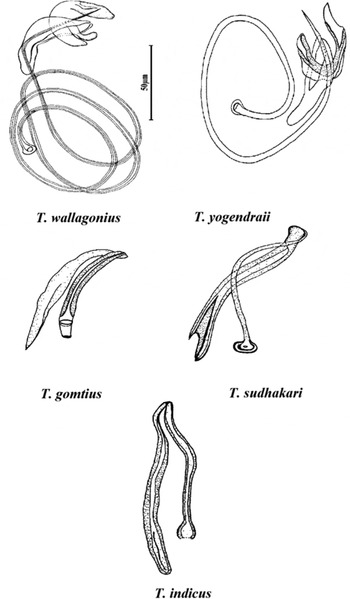
All five Thaparocleidus sp. co-exist splendidly on the same host, affecting each other to a lesser extent. During this study, a total of 10,920 worms were observed with an infection intensity of 151.66 parasites/fish examined, none from fries/fingerlings of W. attu. Thaparocleidus sudhakari was the most abundant, with 29.17% intensity, followed by T. indicus (26.23%), T. gomtius (24.50%), T. yogendraii (18.90%) and T. wallagonius (1.18%). Thaparocleidus wallagonius (48.61 ± 32.57 prevalence which is 100 for rest four species) represents the apex of the community, followed by T. yogendraii, T. gomtius, T. indicus and T. sudhakari (having the maximum number within the community). All five Thaparocleidus sp. are oioxenous, sympatric (Lerssutthichawal & Lim, Reference Lerssutthichawal and Lim2005; Rajvanshi et al., Reference Rajvanshi, Agrawal and Upadhyay2014) and structurally distinct (fig. 1).
Morphological variations in male reproductive parts of the five Thaparocleidus sp.

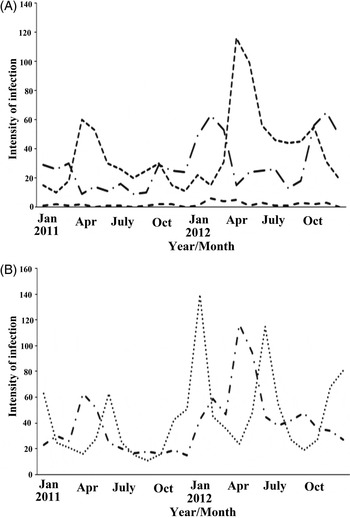
Each species had a characteristic pattern (more or less similar in both years) of seasonal rhythmicity (winter/summer/monsoon peak) that never disturbs each other even in high infection phases. Thaparocleidus wallagonius (being the type species) was found throughout the year, at very low intensity (fig. 2A); T. yogendraii prevailed during winter (February) and autumn (November) (fig. 2A), T. gomtius also showed two peaks, spring (April) and autumn (October). Thaparocleidus sudhakari showed two peaks, winter (mid-December and January) and summer (June), and T. indicus showed three peaks, winter (February), spring (April) and autumn (mid-September and October), the second peak being prominent. The first peak showed the time of initial recruitment, followed by a second peak due to increase in intensity of infection (fig. 2B). Thaparocleidus gomtius and T. indicus showed similar peak values in the spring (April). The peak values of T. sudhakari were higher than those of the other species throughout year (fig. 2A and B).
The intensity of infection of (A) Thaparocleidus wallagonius ( ), T. yogendraii (
 ) and T. gomtius (
 ) (B) T. indicus (
 ) and T. sudhakari (……) in the freshwater shark Wallago attu in the River Gomati from January 2011 to December 2012.

Microhabitat preference
All four pairs of gill arches were infected with the five congeners of Thaparocleidus. Thaparocleidus wallagonius expressed more-or-less similar preference for all the four pairs of gill arches. However, T. yogendraii, T. indicus, T. gomtius and T. sudhakari showed a preference for the first and fourth gill arches. Thaparocleidus sudhakari prevailed over the rest of the species (with respect to prevalence and intensity of infection). The supremacy of T. sudhakari on gill arches was followed by T. gomtius, T. indicus, T. yogendraii and T. wallagonius. Thaparocleidus sp. demonstrated a proportionate relationship between infection intensity and host size.
Host specificity and species aggregation
The host specificity (HS) index was 1 for all congeners of Thaparocleidus under study. This index approaches 1 for parasites restricted to a single host species (Rohde, Reference Rohde1980a). Thus, all these five Thaparocleidus sp. were strictly host specific for W. attu, regardless of the fact that this is a generalist genus. The HS index of each Thaparocleidus sp. remained same throughout the year in both sexes and different climatic conditions.
These five Thaparocleidus sp. co-exist. The value of species co-existence (A 12) was >1 for all species, proving intraspecific aggregation over interspecific aggregation (table 1). Species co-existence ranged between 6.087 and 16.399. The highest A 12 value was assigned for the pair T. gomtius–T. indicus (16.339), similar to those for the pairs T. sudhakari–T. indicus (16.334) and T. sudhakari–T. gomtius (16.143).
Correlation values for species of Thaparocleidus relative to co-existence (A 12) /interspecific aggregation C 12 (×10−2)/niche overlap.

Each Thaparocleidus sp. had an intraspecific aggregation value >0, confirming intraspecific aggregation of Thaparocleidus sp. within the same habitat. The values of intraspecific aggregation for T. gomtius, T. indicus and T. sudhakari were more or less similar, followed by those for T. yogendraii and T. wallagonius. Thaparocleidus wallagonius had the lowest value for intraspecific aggregation (table 2). The infection intensity and intraspecific aggregation expressed a positive correlation for all species, with significant values for T. yogendraii and T. gomtius (table 3). Intraspecific aggregation and niche size revealed negative interactions for all species, except T. wallagonius (table 3).
Mean values (± SD) of abundance, intensity, intra-specific aggregation (J 1) and niche size in five species of Thaparocleidus.

Intensity of infection (± SE) levels in five species of Thaparocleidus, calculated as log(x + 1), versus intraspecific aggregation as log(x + 2)/intraspecific aggregation as log(x + 2) versus niche size as log(x + 1), corrected for total intensity of infection as log(x + 1).

The interspecific aggregation (C 12) for ten pairs of Thaparocleidus sp. was >0, exhibiting positive values (table 1). The highest value of interspecific aggregation was assigned for T. yogendraii–T. gomtius and least for the pair T. wallagonius–T. indicus. The high value of C 12, indicating enhanced co-existence by reduction of interspecific competition due morphological variation, seems plausible reason that allows species to co-exist (Šimková et al., Reference Šimková, Desdevises, Gelnar and Morand2000, Reference Šimková, Ondrackova, Gelnar and Morand2002).
Niche size and niche overlap
The niche size ranged between 3.44 and 3.78 for all species (table 2). Each species had its own separate niche albeit of different population dynamics along with slight niche overlap, spanning between 0.764 and 0.893 (table 1). Maximum niche overlap was between T. gomtius and T. yogendraii (0.893) and least was between T. wallagonius and T. yogendraii (0.764). Nevertheless, parasites having different reproductive parts occupy the same niche. Surprisingly, species having more-or-less similar sclerotized parts may also have niche overlap if there is less interspecific competition.
Phylogeny
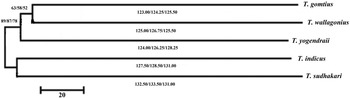
All three methods of phylogeny (without an out-group) performed for the queried species of the genus Thaparocleidus depicted similar results (fig. 3). The aligned dataset consisted of 363 parsimony-informative sites and three conserved sites. All species are descended from common ancestor via intra-host speciation (within a host). In spite of sharing an ancestral node, they are genetically different. Highest negative free energy, topology and pattern of the loops within secondary structures of RNA also support genetic discrimination of the species under study (Rajvanshi et al., Reference Rajvanshi, Agrawal and Upadhyay2014).
Phylogenetic tree for five Thaparocleidus sp. by minimum evolution (ME)/neighbor joining (NJ)/unweighted pair group method with arithmetic mean (UPGMA) methods.

Discussion
All the five species of the genus Thaparocleidus are specialized to a specific niche and exhibit overlapping to some extent, due to co-existence. Rohde (Reference Rohde1980b) has also supported overlapping for monogenoidean multispecies communities. Nevertheless, parasite abundance does not affect survival rate or species diversity (Rohde, Reference Rohde1980b, Reference Rohde1981). Random distribution and host size (which provides a greater microhabitat to flourish, with less intra/interspecific competition) may dwindle the expected number of congeneric species (Pianka, Reference Pianka1983).
These monogenoideans demonstrate biological rhythmicity (fig. 2A and B), a peculiar and indispensable feature for maintenance of population size and interspecific competition among allied and non-allied parasite species within the same microhabitat (Maclung, Reference Maclung2006; Ray & Agrawal, Reference Ray and Agrawal2014). High intensities of parasites support expansion of the microhabitat and intra/interspecific competition (Rohde, Reference Rohde1991). Relative performance (throughout the year) of each species is mainly under density-dependent regulation and environmental stochasticity (Wilson & Yoshimura, Reference Wilson and Yoshimura1994; Šimková et al., Reference Šimková, Gelnar and Sasal2001a). Tripathi et al. (Reference Tripathi, Agrawal, Pant and Agrawal2010) have reported similar observations for T. gomtius, T. wallagonius and M. indicus on W. attu.
Monogenoidean parasites also display microhabitat preference (Cerfontaine, 1896, 1898). All Thaparocleidus sp. appear well adapted to suitable and specific microhabitats, indistinguishably infecting right and left gill arches. The preference for gill arch (numbers 1–4 of each side) is influenced by aquatic pressure within the habitat (Wootten, Reference Wootten1974; Kadlec et al., Reference Kadlec, Simkova and Gelnar2003). Thaparocleidus gomtius, T. indicus, T. sudhakari and T. yogendraii had less affinity for the second and third gill arches (despite the gill area decreasing from first to fourth arch) (Gutierrez & Martorelli, Reference Gutierrez and Martorelli1999) as they receive strong water pressure in comparison to the first and fourth arches. However, T. wallagonius showed similar preference for all arches throughout the year. This may be due to lower infection compared to that of the other species. Mature parasites prefer secondary gill lamellae, especially terminal edges, as axial filaments are physiologically dead (Hughes, Reference Hughes1966; Turget et al., Reference Turgut, Shinn and Wootten2006), and immature parasites ignore the extremities, to minimize the chance of being washed away. However, the middle part of the gill arch, washed by strong water currents, provides a greater surface area and aeration (Wootten, Reference Wootten1974; Turget et al., 2006). The microhabitat preference among parasites reduces intra/interspecific competition. Generally, parasites expand their microhabitat during intense infection, and cause it to contract during the reproductive phase to ensure mating and promote communication (Ramasamy et al., Reference Ramasamy, Ramalingam, Hanna and Halton1985; Rodhe, 1991), ascertaining survival of their progeny.
Monogenoideans are known to be highly host specific (Rohde, Reference Rohde1994; Rajvanshi et al., Reference Rajvanshi, Tripathi and Agrawal2015) and may evolved from generalist parasites (Kawecki, Reference Kawecki1998). These parasites can be used as biological tag (Rajvanshi et al., Reference Rajvanshi, Tripathi and Agrawal2015; Agrawal et al., Reference Agrawal, Rajvanshi and Verma2016). They co-speciate more closely along with their hosts than generalist parasites (Humphery-Smith, Reference Humphery-Smith1989; Sasal et al., Reference Sasal, Desdevises and Morand1998), show stark variations (Sasal et al., Reference Sasal, Desdevises and Morand1998; Bush et al., Reference Bush, Fernandez, Esch and Seed2001; Kaci-Chaouch et al., Reference Kaci-Chaouch, Verneau and Desdevises2008) and develop structural specificity due to selection pressure within the microhabitat (Kaci-Chaouch et al., Reference Kaci-Chaouch, Verneau and Desdevises2008). Host-specific parasites exhibit less variation in sclerotized parts than generalists (Šimková et al., Reference Šimková, Desdevises, Gelnar and Morand2001b; Jarkovsky et al., Reference Jarkovsky, Morand, Simkova and Gelnar2004). Ecological availability of the host throughout the year, or not getting the chance to switch hosts, could be possible grounds for host specificity (Šimková et al., Reference Šimková, Verneau, Gelnar and Morand2006b).
Lower interspecific competition among congeners could be a cause of co-existence and species diversity. Species having different sets of characteristics (copulatory organ and haptoral armature) co-exist in the same microhabitat due to spatial segregation (Rohde & Hobbs, Reference Rohde, Hobbs, Cremin, Dobson and Moorhouse1986; Šimková et al., Reference Šimková, Ondrackova, Gelnar and Morand2002). Monogenoideans show a different niche size in species-rich habitats (Rohde, Reference Rohde1981). Space is the critical factor for niche segregation regardless of food resources, which are unlimited while the host survives (Rohde, Reference Rohde1991). Reproductive barriers to prevent species hybridization play a crucial role in niche segregation, rather than interspecific competition (Rohde, Reference Rohde1991; Šimková et al., Reference Šimková, Ondrackova, Gelnar and Morand2002). However, the co-existence of species increases as the morphological variability and niche centre increases (Šimková et al., Reference Šimková, Ondrackova, Gelnar and Morand2002). Apart from behavioural differentiation, morphologically more-or-less similar Thaparocleidus sp. are reproductively as well as genetically isolated and share an ancestral genome, pointing towards evolution from the same gene pool. The host–parasite phylogenetic congruity prediction is not possible here due to intra-host speciation (Bochkov & Mironov, Reference Bochkov and Mironov2008). The parasite–host association evolved contemporaneously but congeners of the parasite evolved sympatrically. Microhabitat specialization may be a cause of genetic divergence among these congeneric species (Eichler, Reference Eichler1966; Bochkov & Mironov, Reference Bochkov and Mironov2008). Gene duplication is the explanation for sympatric speciation/intra-host speciation (Huyse et al., Reference Huyse, Poulin and Theron2005). Faster diversification of the parasite is responsible for multispecies complex formations within the same microhabitat, due to higher evolutionary rates in comparison to that of host species (Rohde, Reference Rohde1980b).
Thus, Thaparocleidus demonstrates itself to be an iconic ecological model, paving the way for further investigations in other oioxenous species. The morphological and molecular data suggest that all five congeners live together harmoniously, employing seasonal variation in intensity of infection, reproductive isolation and genetic isolation as increasingly effective barriers to competition.
Financial support
University grant Commission for financial assistance (SR 28943 and NA F-4-10/2010 BSR) and facilities developed from UGC-SAP (DRS-II and I) and DST-PURSE programmes of the Department of Zoology were utilized for the present work.
Conflict of interest
None.