INTRODUCTION
In the last 30–40 years marine ecosystems are experiencing ever more frequent mortality events, with coral bleaching being the most monitored phenomenon. Recent research and monitoring have shown that different diseases involving also other taxa have increased their frequency both in tropical and temperate areas. Current research supports a connection between climate warming and increased incidence of disease (Harvell et al., Reference Harvell, Kim, Quirolo, Weir and Smith2001, Reference Harvell, Mitchell, Ward, Altizer, Dobson, Ostfeld and Samuel2002).
After scleractinian corals one of the most affected groups are gorgonian octocorals, with the first case reported for the Caribbean area involving Gorgonia flabellum (Guzman & Cortes, Reference Guzman and Cortes1984). In 1992 a similar mass mortality involved G. ventalina (Garzon-Ferreira & Zea, Reference Garzon-Ferreira and Zea1992), and in both cases the occurrence of a pathogenic agent was hypothesized. In 1995 a new mortality involved both species and the fungus Aspergillus sydowii was identified as the causative agent (Nagelkerken et al., Reference Nagelkerken, Buchan, Smith, Bonair, Bush, Garzon-Ferreira, Botero, Gayle, Harvell, Heberer, Kim, Petrovic, Pors and Yoshioka1996, Reference Nagelkerken, Buchan, Smith, Bonair, Bush, Garzon-Ferreira, Botero, Gayle, Heberer, Petrovic, Pors and Yoshioka1997). During the El Niño event of 1998 Briareum asbestinum was severely affected (Harvell et al., Reference Harvell, Kim, Burkholder, Colwell, Epstein, Grimes, Hofmann, Lipp, Osterhaus, Overstreet, Porter, Smith and Vasta1999) by a disease tentatively attributed to the cyanobacterium Scytonema sp. (Harvell et al., Reference Harvell, Kim, Quirolo, Weir and Smith2001). In the Bahamas, a local episode involving particularly the genus Plexaura (Lasker, Reference Lasker2005) was related to a thermal event. In the Caribbean, local mortalities of sea fans have been reported also due to fish (Kinzie, Reference Kinzie1973), ovulid grazing (Harvell & Suchanek, Reference Harvell and Suchanek1987), epibiosis (Whale, Reference Whale1985) and tumours (Morse et al., Reference Morse, Morse and Duncan1977, Reference Morse, Morse, Duncan and Trench1981).
Mortalities of sea fans are described also from the Mediterranean Sea since 1983 (Harmelin, Reference Harmelin1984) with acute episodes in 1999 (Cerrano et al., Reference Cerrano, Bavestrello, Calcinai, Cattaneo-Vietti and Sarà2000; Perez et al., Reference Perez, Garrabou, Sartoretto, Harmelin, Francour and Vacelet2000) and 2003 (Scinto et al., Reference Scinto, Benvenuto, Cerrano and Mori2007; Fava et al., submitted) mainly due to thermal stress consequent to climate warming.
Here we report the first case of local gorgonian mortality due to an amphipod massive attack. During May 2005 at the Marine Park of Bunaken (North Sulawesi, Indonesia) numerous gorgonian colonies were severely colonized by caprellids that lasted for about one month. To evaluate a possible relation between evident signs of tissue sloughing and the caprellids, gut contents were examined.
MATERIALS AND METHODS
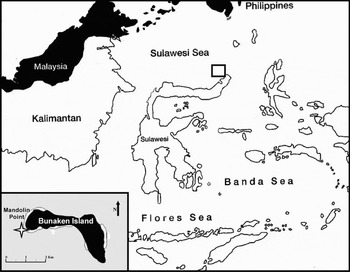
The phenomenon here described was studied on the reef of Mandolin Point (Bunaken Marine Park, Manado, Indonesia) (Figure 1) from the beginning of May to June 2005.
Map of the sampling area. The cross in the inset shows the area where the caprellid massive attack was documented.

All the gorgonian colonies found along a vertical transect two metres wide, from 5 to 30 m depth, were counted and two 10 cm long apical branches were sampled from each hosting caprellid colony. Samples were fixed in buffered 4% formalin. In the laboratory half of the samples were transferred to alcohol 70° to preserve both gorgonian sclerites and caprellid exoskeleton. A digital photograph for each sample was taken before collection, positioning a dimensional scale in each image.
The density of caprellids living on the colonies (individuals/cm) was measured from photographs. The analyses of the stomach contents were made following the method of Saunders (Reference Saunders1965) on twenty specimens for each gorgonian species. We measured total body length (from the tip of the rostrum to the end of the cephalon, TL) of the amphipods and when present we measured the sclerites found in the stomach contents, using a stereomicroscope equipped with an ocular micrometer. Scanning electron microscopy (SEM) was utilized to study caprellid mouthparts, to evaluate the adult feeding mechanisms, based on the relation diet–morphology of antennae and mandibles proposed by Caine (Reference Caine1977). Samples were critical-point dried and mounted on stubs, and coated with gold and observed by a Fey Philips XL 20 SEM (Netherlands).
RESULTS
The morphological analyses showed that exclusively the caprellid species Metaprotella sandalensis Mayer, 1898 was involved. This species is one of the most common caprellid in moderately exposed coral reefs of the Indo-Pacific Ocean. In respect to other caprellids, it is considered a highly variable species with regard to the number and the arrangement of acute projections on head and pereonites 2–3 as well as to the shape of the male propodal palm (Müller, Reference Müller1990).
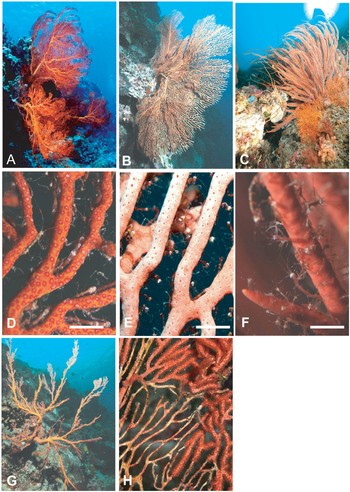
In total we recorded 24 colonies in the considered areas and the massive presence of M. sandalensis was found on 19 of them. Three species of gorgonians were infested by caprellids: the scleraxonians Melithaea sp. (11 colonies) (Figure 2A & D) and Annella reticulata (5 colonies) (Figure 2B & E), and the calcaxonian Ellisella cf. ceratophyta (3 colonies) (Figure 2C & F). Among the affected colonies, little damage was recorded only for Ellisella cf. ceratophyta, which evidenced a small portion of naked skeleton. The strongest effects of this invasion were recorded on the colonies of Melithaea sp., which were completely damaged within a week, with loss of coenechyme rapidly followed by skeleton fragmentation. Only the main axis with few lateral branches remained in situ (Figure 2D & G). Annella reticulata was heavily damaged only on the 50% of the affected colonies. Affected colonies evidenced strong loss of coenechyme but only the apical portions of the axial skeleton were damaged (Figure 2E & H), slightly reducing colony dimensions. Every time the infestation was recorded, caprellids were present with an average density of 8.5 ± 0.5 (±SD) individuals/cm in each colony. All the caprellids hosting gorgonians showed contracted polyps.
Sequences and details of colonies infested by caprellids. (A) Melithaea sp.; (B) Annella reticulata; (C) Ellisella cf. ceratophyta at the beginning of the infestation; (D, E, F) detail of Metaprotella sandalensis specimens feeding on seafans. Scale bars = 5 mm; (G) a colony of Melithaea sp. one month after the infestation; (H) detail of A. reticulata branches evidencing the naked axis.

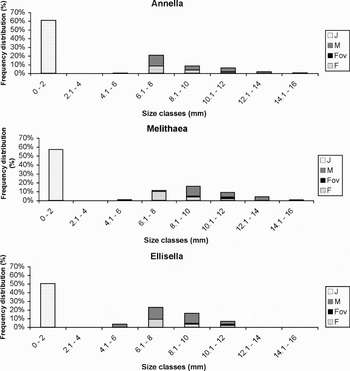
To verify the trophic relationship between caprellids and gorgonians we analysed the gut content on different size-classes. Analyses of the stomach contents showed that in the amphipods with a length smaller than 6 mm, sclerites were always absent. The size of sclerites found in the amphipods gut was correlated with caprellids length, in Annella reticulata (r-Pearson: 0.840), in Melithaea (r-Pearson: 0.879), and in Ellisella cf. ceratophyta (r-Pearson: 0.927). The percentage of M. sandalensis with sclerites in the stomach contents was 40% on Melithaea colonies, and 25% on Ellisella cf. ceratophyta and Annella reticulata colonies. The most abundant category was the one of juveniles (size-classes 0.1–2 mm) and the male category reached maximum dimensions (Figure 3).
Frequency percentages of different size-classes of Metaprotella sandalensis on the three seafans species. J, juveniles; M, males; Fov, ovigerous females; F, females.

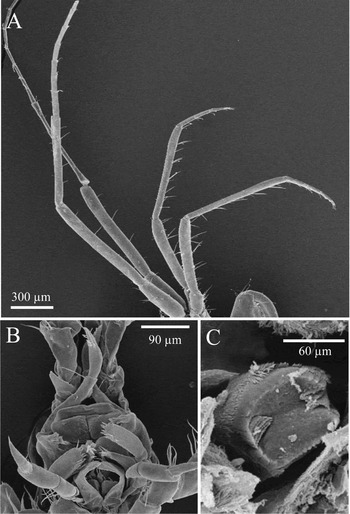
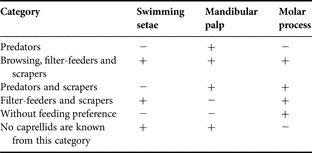
The ultrastructural study of M. sandalensis put in evidence the absence of the swimming setae on the antennae (Figure 4A), the presence of a columnar molar process with oval fully triturating surface (Figure 4B), and the mandibular palp (Figure 4C). These features suggest that, in accordance with Caine (Reference Caine1977), M. sandalensis is a predator/scraper (Table 1).
Metaprotella sandalensis. (A) Antennae without swimming setae; (B) mandibular palp; (C) molar process.

Feeding categories of the Caprellidae, based on mandibular morphology and swimming setae (from Caine, Reference Caine1977).

+, presence; −, absence.
DISCUSSION
Caprellid amphipods are small peracarid crustaceans, which occur from the littoral to about 5000 m depth (Laubitz & Mills, Reference Laubitz and Mills1972), important as secondary and tertiary producers in marine ecosystems (Guerra-García, Reference Guerra-García2004). Most attention is devoted to this group owing to their ecological importance, their high degree of niche specificity, their sensitivity to a variety of pollutants and toxicants and their relatively low dispersal capabilities (Thomas, Reference Thomas1993). Among caprellids five types of adult feeding mechanisms are known (Caine, Reference Caine1974, Reference Caine1977): browsing on filamentous algae, filter-feeding, scavenging, scraping on encrusting material and predation. Caine (Reference Caine1977) created six distinct categories based on mandible morphology and the presence or the absence of the swimming setae on the antennae. On the basis of the arrangement of dorsal projections and the absence of a marked suture between head and 1st pereonite our samples have been assigned to the species Metaprotella sandalensis (Larsen, Reference Larsen1997). This species can be found on many different habitats and substrates: algae, sea grass, sponges, hydroids, gorgonians, soft corals, dead hard corals, bryozoans, ascidians, coral rubble, coarse and fine sediments and mangroves (Guerra-García, Reference Guerra-García2003).
Habitat diversification and feeding preference of caprellids are directly related to the different morphologies of their head appendices (Caine, Reference Caine1977). Caprella gorgonia is a caprellid amphipod known only from gorgonian octocorals in California. It has molar process, mandibular palp and strong swimming setae on the antennae. This species feed on gorgonian tissue and polyp mucus secretions (Laubitz & Lewbel, Reference Laubitz and Lewbel1974). The Mediterranean species Pseudoprotella phasma, very common on hydroid colonies, shows a molar process, mandibular palp and the absence of the swimming setae on the antennae. This caprellid showed a predatory and clepto-commensal trophic strategy (Bavestrello et al., Reference Bavestrello, Cerrano, Cattaneo-Vietti and Sarà1996). Our results evidence the importance of cnidarians as a trophic source for this group of amphipods and suggest that these predator/prey interactions are very fragile and that disequilibrium towards predators can occur, dramatically affecting prey survivorship and gorgonian population stability (Berryman, Reference Berryman1992). Gorgonian distribution is related mainly to physical variables, such as water movement and clarity, temperature, and nutrients (Goh et al., Reference Goh, Loo and Chou1997; Fabricius & McCorry, Reference Fabricius and McCorry2006) while biological interactions such as competition for space, for food, and predation, likely have little effect (Yoshioka & Buchanan Yoshioka, Reference Yoshioka and Buchanan Yoshioka1989). Marine modular organisms present most of their ecological aspects typical of plants. In particular, colonial marine invertebrates and their predators possess important parallels to terrestrial plant–herbivore interactions. In both systems predators consume their prey slowly without killing them, and giving to the prey enough time to recover from injury. Typical examples are nudibranchs feeding on sponges (Wulff, Reference Wulff2006) or ovulids on gorgonians (Gerhart, Reference Gerhart1986). All known gorgonian predators are generally considered as ‘partial predators’. Cases of gregariousness of specialized predators are known (Gerhart, Reference Gerhart1986) and generally, also in these cases, the prey is not completely exploited. Cases of total consuming are reported for sponge-eating sea stars in Antarctica (Cerrano et al., Reference Cerrano, Bavestrello, Calcinai, Cattaneo-Vietti and Sarà2000).
Here we document the first case of gorgonian mortality caused by a massive attack of caprellids. The effect of this invasion was more evident on colonies with axial structures formed mainly by sclerites (scleraxonians) even if they can be joined together more or less firmly by horny material.
Among these, Melithaea sp. colonies, which are characterized by a segmented axial skeleton with swollen nodes and rigid internodes, lost the thinnest branches and only few lateral ones and the main axes remained unaltered after the massive attack (Figure 1G).
Annella reticulata has a horny axis with partially fused sclerites embedded in it. In this case skeleton was less damaged than in Maelithea. This compact organic skeleton was more resistant to fragmentation and remained in situ for a long time, allowing recovery.
Ellisella cf. ceratophyta is a calcaxonian and has a non-scleritic calcareous axis. Thanks to this strong axis, lesions on the skeleton were less damaging with respect to the other species and regeneration was fast.
The caprellid feeding strategy here reported extends the list of negative agents able to rapidly affect gorgonian health. Predator/scraper caprellids can feed on gorgonian coenenchyme, but in comparison to other gorgonian predators, such as gastropods and polychaetes, they can completely destroy their resource, in case of sudden increase of population density and in relation to the skeletal characteristics of the octocoral colonies.
Lack of baseline data in most marine communities limit our understanding of episodic events (Boero, Reference Boero1996). Mortalities affect not only the involved species but can have cascading trophic effects through the ecosystems altering its structure (Lessios, Reference Lessios1988). In the case of gorgonians, their disappearance may affect the ecosystem not only functionally but also structurally, reducing habitat heterogeneity.
ACKNOWLEDGEMENTS
The authors are indebted to Professor S. Ruffo (Museum of Natural History of Verona) and Dr Guerra-García (Universidad de Sevilla, Spain) for helpful suggestions during caprellid classification. This work was performed under the auspices of the Italian–Indonesian Joint Project No. 16 Annex III code STA.